Infinite Edge Partition Models for Overlapping Community Detection and Link Prediction
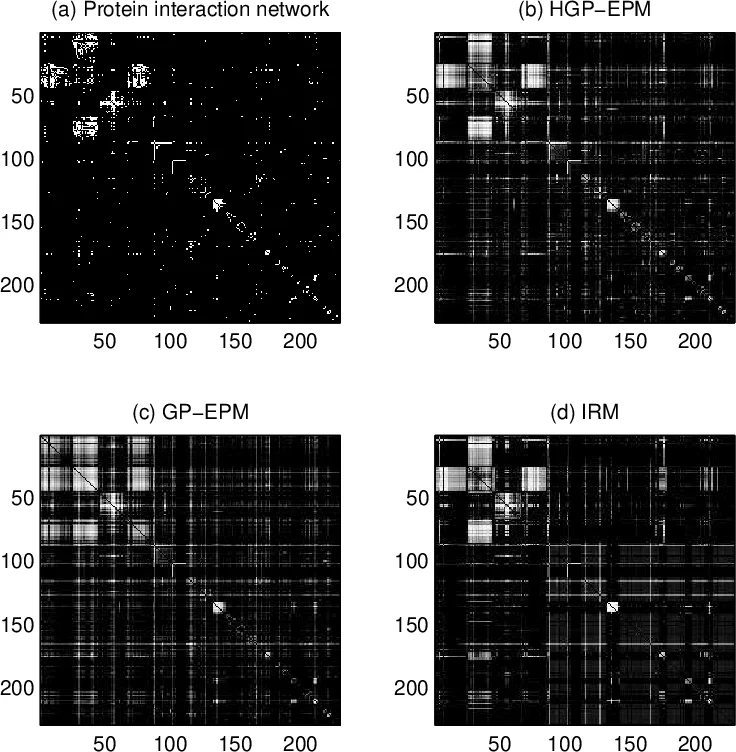
A hierarchical gamma process infinite edge partition model is proposed to factorize the binary adjacency matrix of an unweighted undirected relational network under a Bernoulli-Poisson link. The model describes both homophily and stochastic equivalence, and is scalable to big sparse networks by focusing its computation on pairs of linked nodes. It can not only discover overlapping communities and inter-community interactions, but also predict missing edges. A simplified version omitting inter-community interactions is also provided and we reveal its interesting connections to existing models. The number of communities is automatically inferred in a nonparametric Bayesian manner, and efficient inference via Gibbs sampling is derived using novel data augmentation techniques. Experimental results on four real networks demonstrate the models’ scalability and state-of-the-art performance.
💡 Research Summary
The paper introduces a novel Bayesian non‑parametric framework for overlapping community detection and link prediction in unweighted, undirected graphs, called the Infinite Edge Partition Model (EPM). The core idea is to treat each observed binary edge as a latent count variable m and to connect this count to the binary observation through a Bernoulli‑Poisson (BerPo) link: an edge is present (b=1) if and only if the latent count is at least one. This transformation allows the authors to leverage the rich toolbox of count‑data models while preserving the sparsity of the original adjacency matrix.
The latent count m is factorized by a Poisson factor model. For nodes i and j, \
Comments & Academic Discussion
Loading comments...
Leave a Comment