The Role of Race, Ethnicity, and Gender in the Congressional Cosponsorship Network
Previous research indicates that race, ethnicity, and gender influence legislative behavior in important ways. The bulk of this research, however, focuses on the way these characteristics shape an individual legislator's behavior, making it less clea…
Authors: Alison Craig, Skyler J. Cranmer, Bruce A. Desmarais
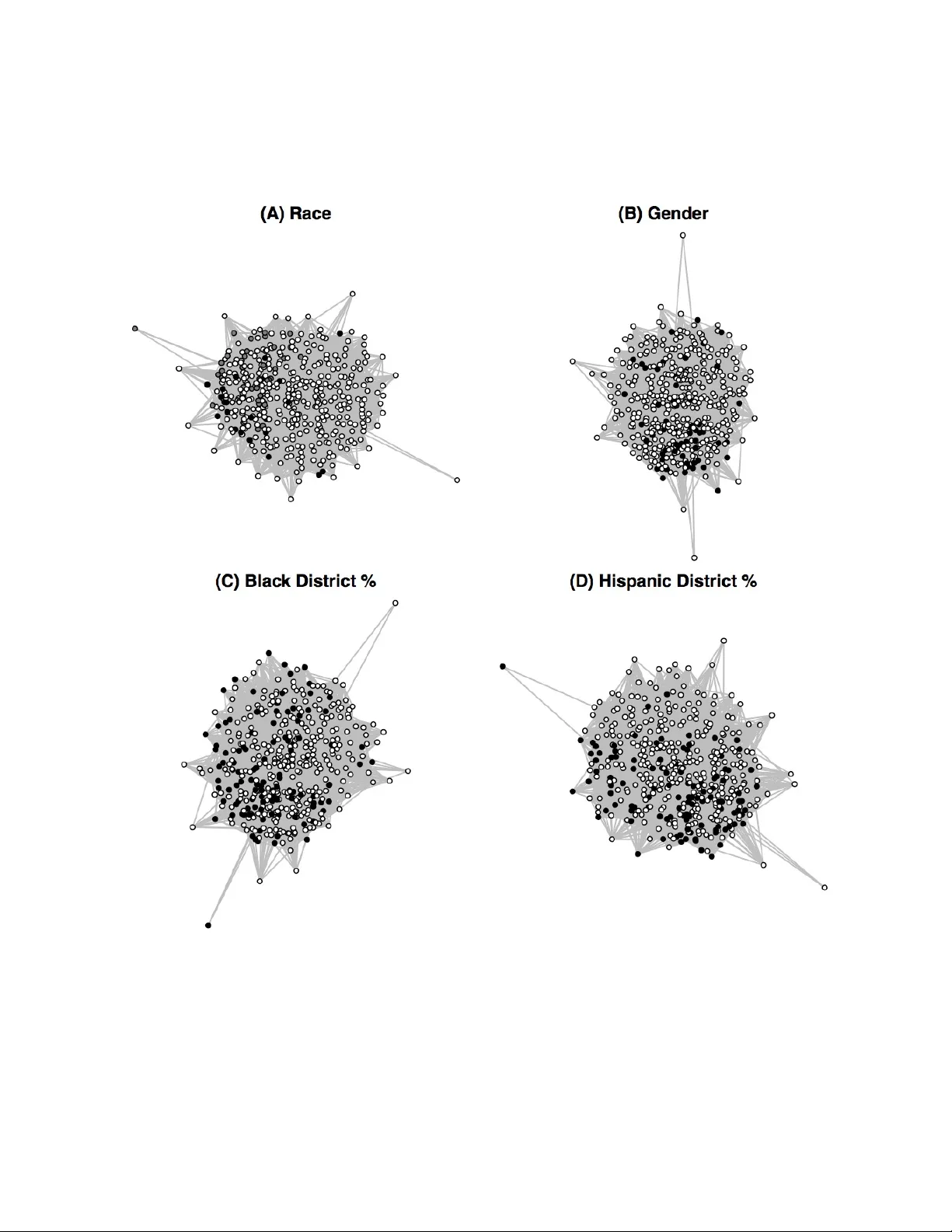
The Role of Race, Ethnicit y , and Gender in the Congressional Cosp onsorship Net w ork Alison Craig ∗ 1 , Skyler J. Cranmer † 1 , Bruce A. Desmarais ‡ 2 , Christopher J. Clark § 3 , and Vincen t G. Moscardelli ¶ 4 1 Departmen t of P olitical Science, Ohio State Universit y 2 Departmen t of P olitical Science, Pennsylv ania State Univ ersity 3 Departmen t of P olitical Science, Universit y of North Carolina at Chap el Hill 4 Departmen t of P olitical Science, Universit y of Connecticut August 20, 2018 Abstract Previous research indicates that race, ethnicity , and gender influence legislative b eha v- ior in imp ortan t w ays. The bulk of this research, ho w ev er, fo cuses on the wa y these c haracteristics shap e an individual legislator’s b ehavior, making it less clear how they accoun t for relationships betw een legislators. W e study the cosp onsorship pro cess in order to understand the race and gender based dynamics underlying the relational comp onen t of represen tation. Using a t emp oral exp onen tial random graph mo del, w e examine the U.S. House cosp onsorship net work from 1981 through 2004. W e find that Blac k and Latino members of Congress are at a comparative disadv an tage as a result of race-based assortative mixing in the cosp onsorship pro cess, y et this disadv an tage is mitigated by the electoral pressures that all members face. Members representing dis- tricts with significan t racial and ethnic minority populations are more likely to support their minority colleagues. W e also find that women members do not app ear to face a similar disadv an tage as a result of their minority status. W e argue that these race and gender dynamics in the cosp onsorship net w ork are the result of b oth the inheren t ten- dency to w ards intra-group homophily in so cial netw orks and the electoral connection, whic h is manifested here as mem b ers supp orting minority colleagues to broaden their o wn electoral base of supp ort among minorit y constituencies. ∗ craig.373@buc k eyemail.osu.edu † cranmer.12@osu.edu ‡ b desmarais@psu.edu § c hriclar@email.unc.edu ¶ vin.moscardelli@uconn.edu 1 The 114th Congress w as heralded as the most diverse Congress in history , yet it remains disprop ortionately white and male when compared to the p opulation of the United States. Of the 535 members of Congress who to ok office in 2015, 104 w ere women and 96 w ere racial or ethnic minorities. 1 The disprop ortionately white and male mem b ership of the United States Congress has imp ortant implications for how women and minorities are represen ted, as has b een describ ed by a multitude of scholars (e.g. Baker and Co ok 2005; Canon 1999; Hero and T olb ert 1995; Mansbridge 1999; ? ). How ev er, in addition to b eing a problem for descriptiv e represen tation, this underrepresen tation of minorities in Congress has p oten tial implications for ho w effectiv e they can b e as legislators. F or a legislator to be effective, collaboration and coalition-building are key . Mem b ers of Congress must rely on others to adv ance their agendas, from gathering cosp onsors to ensuring a bill has enough votes to pass. Building a broad coalition usually means reac hing across the aisle in the searc h for collab orators (F enno 1989). How ev er, Congress is a close-knit and so cial h uman institution. As such, w e exp ect to observe tendencies tow ard in tra-group homophily , in whic h mem b ers of a group displa y a preference for asso ciating with other mem b ers of the same group. This tendency , often describ ed as “birds of a feather flo ck together,” is prev alent across so cial net w orks in a v ariet y of con texts, from friendship groups to sc ho ols and businesses (Goo dreau, Kitts and Morris 2008; Mollica, Gray and T revino 2003; Ruef, Aldrich and Carter 2003) and most commonly manifests as asso ciation with others of the same race or ethnicit y (McPherson, Smith-Lovin and Co ok 2001). Intra-group homophily has the p oten tial to p ose a particular problem in the legislativ e arena as it ma y negativ ely affect the ability of minority mem b ers to build supp ort for their legislation. If members of Congress draw supp ort predominan tly from colleagues of the same race, ethnicit y , or gender, then minority mem b ers are disadv an taged first b y their 1 While this is a mark ed increase from the 56 who w ere w omen and 68 who w ere racial or ethnic minorities t w ent y y ears ago, w omen and minorities remain significan tly underrepresen ted in the United States Congress. Blac ks comprise 13% of the US p opulation, but only 8.5% of Congress. Latinos comprise 17% of the p opulation, but only 7% of Congress. The disparit y is largest for women, who make up 51% of the p opulation, but only 20% of the representativ es in Congress. 2 small group size and then by the tendency for the white, male ma jorit y to preferentially supp ort other mem b ers of the ma jorit y . This has serious implications for ho w w ell minority p opulations are represen ted ev en in the presence of descriptive represen tation. In this pap er, w e examine the degree to whic h mem b ers of demographic minorities are at a comparative disadv an tage in the legislative pro cess as a result of their minorit y status. W e find a strong tendency for intra-group homophily among mem b ers, y et the resulting disadv an tage is mitigated by the electoral pressures that all members face. Reelection- minded legislators cannot safely ignore sizable p opulations in their constituencies if they wish to maintain their electoral securit y . Using the House cosp onsorship netw ork, w e show that mem b ers displa y a strong bias tow ards their o wn race or ethnicit y in their cosponsorship decisions. A t the same time, mem b ers who represen t racially diverse districts are more lik ely to supp ort colleagues of the same race as their constituents. W e also show that women do not face the same disadv antages as Blac k and Latino members, which w e argue is the result of b oth the need to app eal to w omen constituen ts and an ov erall tendency against gender- based segregation. As a result of these dynamics, Blac k and Latino members ma y struggle to build supp ort for their legislation outside of their o wn in-group unless they app eal to colleagues who represent sizable minority p opulations. Congress is the most professionalized legislature in the United States (Squire 1992). The mem b ers who ha ve b een elected to Congress are, for the most part, professional p oliticians who ha v e dev oted substan tial p ortions of their liv es to successfully seeking election and rising through a series of demo cratically elected offices (Berkman 1994). If these mem b ers are prone to fa voring the legislation of their own in-group absen t electoral pressures that comp el them otherwise, then this suggests that de facto segregation not only imbrues relationships within the citizen p opulation, but also betw een elected officials at all lev els of go vernmen t. Y et as the p opulation of the coun try b ecomes increasingly div erse, our researc h suggests that minorities will see increased supp ort for their interests, pro vided that electoral districts are 3 represen tative. This is not to sa y that the election of minority mem b ers is not important, rather that b oth descriptiv e represen tation of minorit y p opulations and increased diversit y in electoral districts are necessary for lev eling the playing field b et w een minorit y legislators and their ma jorit y coun terparts. Represen tation of Minorit y In terests The degree to whic h minority mem b ers are disadv an taged is shap ed b y b oth in ternal and external dynamics of legislativ e b o dies. In ternally , there is a wealth of evidence suggesting that minority legislators ha v e a differen t exp erience than their white, male counterparts. Blac k mem b ers are more lik ely to report exp eriencing discrimination (Button and Hedge 1996), w omen of color report b eing marginalized in Congress (Ha wkesw orth 2003), and studies of w omen elected officials find that they tend to exp erience discrimination in the legislature (Thomas 1994), esp ecially when it comes to seeking leadership p ositions (Do dson and Carroll 1991). Latinos and w omen hav e low er bill passage rates than their non-Latino and male counter parts (Bratton 2006; Kathlene 1995) and p eers rate blac k legislators as less effectiv e than non-black legislators (Haynie 2002). A t the same time, it is w ell established that mem b ers of Congress are motiv ated by a desire for reelection (Mayhew 1974) and to win elections they must cultiv ate supp ort among their constituen ts. One w a y in whic h mem b ers ma y build supp ort is through position taking, whether expressed through a mem b er’s voting record or simply b y making a statemen t of supp ort for a given p olicy . Studies of represen tation hav e found that legislators generally try to remain in step with their constituents, from the seminal w ork of Miller and Stokes (1963) to more recent w ork which finds that legislators are more lik ely to v ote in line with their district if they are aw are of constituent opinion (Butler and Nic kerson 2011), and members who are ideologically aligned with their districts are more likely to make public statements 4 of their p ositions (Grimmer 2013). Mem b ers are also resp onsive to constituency opinion in their cosponsorship decisions (High ton and Rocca 2005) and cosp onsorship is explicitly describ ed b y mem b ers and their staff as a v alued form of p osition taking (Koger 2003). In this study , we examine how this electoral connection b etw een mem b ers and their constituen ts in teracts with the tendency to w ards bias in the legislature to affect minorit y mem b ers in Congress. The degree to which members supp ort colleagues of a differen t race, ethnicit y , or gender is the result of b oth a natural tendency tow ards intra-group homophily and the electoral pressures that they face. F or mem b ers who represen t districts comprised predominan tly of their o wn race or ethnic group, they ha ve little incen tive supp ort colleagues of a different race or ethnicity . P atterns of assortative mixing dominate; white and minor- it y mem b ers alik e display a bias in fav or of supporting colleagues of their own race o ver mem b ers of a different group. This form of race-based de facto segregation characterizes our neigh b orho o ds (Massey and Den ton 1993), sc ho ols (Mollica, Gra y and T revino 2003), corp orations (Ruef, Aldrich and Carter 2003), and so cial groups (Louch 2000). Th us, there is little reason to b elieve mem b ers of Congress are not prone to the same tendencies. Within the context of an institution as p o werful and dominated by white males as the United States Congress, this tendency tow ards de facto segregation can put minority members at a par- ticular disadv an tage when they m ust secure supp ort from their colleagues to adv ance their o wn legislative agenda. Mem b ers represen ting racially div erse districts, how ever, cannot afford to neglect the in terests of those constituen ts if they w ant to b e reelected. F or a mem b er representing a district with a sizable Black or Latino p opulation, supp orting legislation sponsored b y Blac k or Latino mem b ers is an easy , lo w-cost w a y for a mem b er to take a p osition and sho w supp ort for that comm unit y . Minority members are more lik ely to introduce legislation addressing minorit y issues (Bak er and Co ok 2005; Rouse, Sw ers and Parrott 2013), Black v oters tend to view Blac k representativ es more p ositively than their white coun terparts ( ?? ), and Latino 5 v oters who are represen ted by co-ethnics rep ort higher trust in gov ernmen t (Ramirez, Sanc hez and Sanchez-Y oungmann 2012) and are more lik ely to correctly recall the race and party of their representativ e ( ? ). Supp orting a Black or Latino colleague by signing onto the bills they introduce can b e used by a mem b er of a differen t race or ethnicity to send a signal to those constituen ts that (s)he is supp ortiv e of their interests and build electoral supp ort among minorities. 2 While w e expect to see clear patterns of assortative mixing and district resp onsiveness b y race, the gender dynamics are somewhat more complicated. Although w omen rep ort dis- crimination in the legislature, studies on their effectiveness as legislators are less bleak than those for Blac ks and Latinos. W omen are more successful in delivering federal sp ending to their district (Anzia and Berry 2011), and at passing legislation when in the minority part y (V olden, Wiseman and Wittmer 2013). Gender-based segregation is not as prev alen t as race-based segregation. Whereas someone ma y go their en tire c hildho o d without dev el- oping a meaningful relationship with someone outside of their race, males often dev elop relationships with female guardians and siblings, female sc ho olteachers and p eers, and with females in their neigh b orho o d or place of worship. Therefore there is a certain familiarit y that dev elops betw een men and w omen that may not dev elop betw een those of differen t races and ethnicities. F urthermore, male members of Congress uniformly represent districts that are comprised of appro ximately 50% women. If an y tendency to wards assortativ e mixing is mitigated b y electoral resp onsiveness, as w e argue that it is, all mem b ers m ust concern themselv es with their female constituen ts to some degree. A male mem b er who wishes to ap- p ear “friendly” to women, or supp ortive of women’s issues has a strong incen tive to supp ort his female counterparts. 2 W e do not claim that constituen ts are closely following the bills that their members of Congress c ho ose to cosp onsor. Rather, cosponsoring minority-sponsored legislation is a delib erate signal on the part of a mem b er that (s)he can then make a p oint to emphasize when (s)he is reaching out to his or her minority constituen ts. 6 Therefore, w e exp ect to observe three distinct patterns in the cosp onsorship net work. First, Mem b ers of Congress will b e less likely to cosp onsor legislation introduced b y mem b ers of another race or ethnicity than their own. Second, Men will supp ort legislation in tro duced b y w omen at rates equal to bills sp onsored by their o wn gender. Third, as the prop ortion of a minority p opulation in their district increases, the pressures of represen tation will push mem b ers to cosp onsor more bills in tro duced by colleagues of that race or ethnicity . The result is that racial and ethnic minority mem b ers remain at a disadv antage as a result of bias in cosp onsorship patterns, but as constituencies b ecome more div erse, that bias is mitigated. Cosp onsorship as a Sho w of Supp ort The few studies on ho w minority constituency size translates into supp ort for minority mem b ers of Congress ha ve fo cused predominantly on Black populations and supp ort for civil righ ts legislation. Demo crats with significan t African American constituencies w ere more likely to v ote for final passage of the V oting Righ ts Act (Black 1978) and the 1990 Civil Righ ts Act (Hutchings 1998). Ho wev er, supp ort for Black issues among members represen ting minority constituencies is inconsisten t. On the one hand, researc h suggests that part y matters more than race when it comes to v oting on legislation, meaning that white Demo crats represen t the p olicy interests of African Americans (Swain 1993; ? ). Other researc h on minority representation has found that increased minority p opulation translates in to decreased supp ort for conserv ativ e legislation (Combs, Hibbing and W elch 1984), and incum b en t Demo crats b ecame more supp ortive of Blac k issues when their district’s Black p opulation increased through redistricting (Ov erby and Cosgrov e 1996). On the other hand, researc h suggests that white Demo crats in the South b ecome responsive to blac k interests when it comes to roll call v oting b ehavior once the group comprises forty p ercen t of the p opulation in a district (Lublin 1997), and even then their resp onsiveness is less certain when 7 lo oking at lo w er profile issues (Hutc hings, McClerking and Charles 2004). The relationship b et w een Latino p opulation size and legislativ e resp onsiveness is complex as well. (Hero and T olb ert 1995) show that Latino p opulation has an indirect effect on whether the p olicy in terests of the group are represented; the scholars show that in districts where Latinos comprise at least fiv e p ercen t of the p opulation that Demo crats are more lik ely to get elected, and in turn Demo crats are more likely than Republicans to vote in a wa y that advocates for Latino in terests. Later researc h shows that dep ending on the size of the Latino p opulation, mem b ers of Congress b ecome more or less resp onsive to Latino in terests. In districts where Latinos are b et w een forty and fift y p ercen t of the p opulation, mem b ers of Congress b ecome less resp onsiv e to their in terests, and y et once the group comprises fifty p ercent or more of a district’s p opulation, then members of Congress are resp onsiveness to Latino interests (through their roll-call voting b ehavior) (Griffin and Newman 2007). V oting for a bill is only one of the w a ys a mem b er can support a colleague and opp or- tunities for support on the flo or are limited to those bills that ha ve survived an extensive winno wing process (Krutz 2005). Cosponsorship, on the other hand, is b oth an imp ortan t signaling device within the legislature and the only w ay to officially asso ciate with a piece of legislation outside of casting a roll-call v ote in fa vor of it. Since most legislation dies in committee, and cosp onsors can sign on at any p oint in the legislative pro cess, cosp onsorship is used to officially asso ciate with legislation that will never mak e it to the flo or. Members cosp onsor legislation b oth to send a signal within Congress that they supp ort a bill (Kessler and Krehbiel 1996) and to sho w their supp ort to constituen ts and other outside interests that can supp ort their reelection (Koger 2003). Although some hav e suggested that cosponsorship is merely “cheap talk,” mem b ers are clearly selectiv e about the legislation they cosp onsor, signing on to an av erage of 3.9% of in tro duced bills from 1980 to 2004 (F owler 2006 a ). In recent y ears scholars hav e developed sev eral approaches to using observ able legislative 8 b eha vior to proxy net works of support and collab oration b etw een legislators. 3 The most common approac h to measuring collab oration b et w een legislators has b een through the use of cosp onsorship data (Kirkland and Gross 2014). The cosp onsorship stage of the legisla- tiv e pro cess also has considerable implications for legislative success (Browne 1985; Crisp, Kan thak and Leijonh ufvud 2004; T am Cho and F owler 2010; Kirkland 2011). Members con- sider the list of cosp onsors already on a bill when deciding whether to sign on (Kessler and Kreh biel 1996), the num b er of cosp onsors is a strong p ositive predictor of legislativ e success at the committee stage (Wilson and Y oung 1997), and the connectedness of a legislator is p ositiv ely asso ciated with the success of amendmen ts they introduce (F owler 2006 a ). If mi- norit y members are unable to build widespread supp ort for their legislation outside of their o wn in-group at this earliest stage of the legislativ e pro cess, they may b e discouraged from activ ely sp onsoring legislation. Sev eral studies ha v e examined cosp onsorship patterns within minority groups in Congress. Ro cca and Sanc hez (2008) find that Blac k and Latino members of Congress tend to cosp on- sor few er bills than other mem b ers. Numerous studies reveal that compared to men, w omen are more lik ely to cosp onsor women’s in terest legislation (Balla and Nemac hec k 2000; W ol- brec ht 2000; Sw ers 2002, 2005). Y et we kno w significan tly less ab out how race, ethnicity , and gender influence the legislator to legislator comp onen t of cosp onsorship. Researc h sug- gests that because of Congressional Blac k Caucus blac ks may b e inclined to supp ort one another’s legislation (Canon 1999), but this evidence is based on a quote and ev en then it is not clear that cosp onsorship w as b eing describ ed. 4 With this study , we study the effect of race, ethnicit y , and gender b oth within and across minority groups and incorp orate district 3 These include netw orks of co-voting (Ringe and Victor 2013), committee co-mem b ership (P orter, Mucha, Newman and W arm brand 2005), caucus co-mem b ership (Ringe and Victor 2013), press ev ent collab ora- tion (Desmarais, Moscardelli, Schaffner and Ko wal 2015), similarity in campaign con tributions (Desmarais, La Ra ja and Kow al 2015). 4 The quote is from p.152 and as follows: ”W e ha ve gotten go o d support from the CBC on our bills. The CBC is adept at understanding the p olitical pro cess and go o d at working together.” 9 demographics to pro vide a complete picture of race and gender based patterns of supp ort in Congress. Researc h Design T o analyze the degree to whic h minorit y mem b ers are supp orted b y their colleagues, w e apply inferen tial metho ds of longitudinal netw ork analysis to the US House cosp onsorship netw ork (HCN) for the 97th - 108th Congresses. 5 The cosp onsorship pro cess is fundamen tally a r elational pro cess b ecause the act of cosp onsoring another mem b er’s legislation - whether it implies a show of supp ort for that legislator or for their legislation - represents a collaboration b et w een the legislators. It is commonly observed that the tally of cosponsors for an y bill results from an explicitly in teractive pro cess b et w een sp onsor and cosp onsors. Bill sp onsors solicit supp ort from their colleagues, who in-turn resp ond if they are willing to sign on to the legislation (F enno 1989; Koger 2003). Therefore, we follo w F owler (2006 a ) in arguing that the set of complex relations b etw een legislators is b est represen ted as a netw ork where each legislator is a no de and each relationship is an edge. W e use the House cosp onsorship data from F o wler (2006 a , b ) and a temp oral exp onen tial random graph mo del (TERGM) to estimate the probabilit y of cosp onsorship from one mem- b er to another. 6 The theoretical approach to the data that motiv ates the TER GM is that a netw ork is not reducible to indep enden t edges or subsets thereof, which mak es it uniquely appropriate to handle a relational pro cess such as cosp onsorship. Instead of ha ving 2 N 2 observ ations in the sample, our sample contains tw elv e net work-v alued m ultiv ariate obser- v ations with eac h netw ork capturing the cosp onsorship relations in a t wo-y ear Congress. F urthermore, the TER GM allows us to mo del b oth exogenous and endogenous netw ork ef- 5 The corresp onding years are 1981-2004. 6 W e briefly review the TER GM here. F or a more in depth discussion of the mo del, please see the supplemen tal app endix. 10 fects rather than assuming that Represen tative i ’s decision to cosp onsor Represen tative j ’s bill is indep enden t of other cosp onsorship decisions (Desmarais and Cranmer 2012 b ). W e can account for not only the attributes that mak e a member more or less likely to cosponsor legislation as traditional studies hav e done, but also the commonalities (or lac k thereof ) b et w een cosp onsor and bill sp onsor, and the other relationships b et w een members. Whereas the exp onential random graph mo del (ER GM) tak es a single net w ork as the measure of interest, the TER GM is an extension for longitudinal netw orks observ ed in t dis- crete time p erio ds (Leifeld, Cranmer and Desmarais 2015). Each netw ork N is an adjacency matrix that records the n um b er of times Representativ e i cosp onsored a bill introduced b y Represen tative j in Congress t . Ho wev er, the basic TERGM assumes ties b etw een no des to b e binary and therefore, we recode the adjacency matrix so that observ ation ( i, j ) is a binary indicator of whether Representativ e i cosp onsored more than one bill introduced by Represen tative j in Congress t . Because we are interested in supp ort for minorit y mem b ers, w e threshold the netw ork at > 1. This eliminates the weak est connections b et w een mem b ers so that a tie from Represen tativ e i to Represen tative j is a more meaningful indicator of supp ort than cosp onsoring a single bill w ould b e. 7 The degree to which members support their colleagues through cosp onsorship is then mo deled as a function of b oth endogenous and exogenous dep endencies, h ( N ). Our sp ecifi- cation allows us to estimate the effect of race and gender-related co v ariates on the probabilit y of tie-formation from one member to another, while also accounting for netw ork effects suc h as recipro city , p opularit y , and triadic closure. The probabilit y of observing the net work at some discrete p erio d of observ ation ( N t ) is: P ( N t | N t − K , ..., N t − 1 , θ ) = exp ( θ T h ( N t , N t − 1 , ..., N t − K )) c ( θ , N t − K , ..., N t − 1 ) 7 Differen t thresholding sp ecifications were tested and are discussed in the supplemen tal app endix. 11 The mo del is estimated using maxim um pseudolik eliho o d (MPLE) with b o otstrapp ed confidence interv als, as dev elop ed b y Desmarais and Cranmer (2012 b ) and implemented in the xergm pack age (Leifeld, Cranmer and Desmarais 2015). This approac h deals with the computational intractabilit y of the normalizing constant, c ( θ , N t − K , ..., N t − 1 ) b y using a hill-clim bing algorithm to find the maximum lik eliho o d of the pro duct o ver the conditional probabilit y of eac h elemen t giv en the rest of the net w ork. Because MPLE underestimates the v ariance of its estimates, a b o otstrapp ed sample of MPLEs is used to calculate consisten t confidence in terv als for the parameter estimates. The result is a set of mo del co efficients and corresp onding confidence interv als that giv e us the likelihoo d of tie formation b et ween no des in the netw ork, which in this case is an indicator of supp ort from one member to another. Determinan ts of Cosp onsorship The decision to cosp onsor legislation can b est b e understo o d as the result of three broad considerations: the cosp onsoring member’s own goals and ideals, the relationship b etw een the cosp onsor and bill sp onsor, and the actions of colleagues in Congress. Muc h of the previous empirical researc h on Congressional cosp onsorship has mo deled the aggregate tendency of legislators to cosponsor, irresp ectiv e of the sp onsor and c haracteristics thereof (Campb ell 1982; Wilson and Y oung 1997; Koger 2003). In netw ork terms, this is referred to as a no de’s tendency to send ties, or out-degree cov ariates. This work has produced consisten t evidence that senior and electorally secure members cosp onsor few er bills, and that lib erals and ideological extremists cosp onsor more legislation (Ro cca and Sanc hez 2008; Koger 2003; Campb ell 1982; Kessler and Krehbiel 1996). The relational comp onent of cosp onsorship has b een less studied, although there is evidence that members with a history of supp orting eac h other are less lik ely to renege on their cosp onsorship pledges (Bernhard and Sulkin 2013) and members of state legislatures are more likely to cosp onsor bills from colleagues who are 12 closer in ideological distance and represent neigh b oring districts, as well as those of the same race, ethnicit y or gender (Bratton and Rouse 2011) The net work approach allows us to account for all three considerations through the co- v ariates included in our mo del, whic h can b e classified into three corresp onding categories: out-degree co v ariates, dyadic co v ariates, and endogenous net w ork effects. Within this frame- w ork we are able to test our cen tral h yp otheses that the House cosp onsorship net work is c haracterized by race and gender based assortative mixing and that members are resp onsiv e to the racial comp osition of their district, while also demonstrating the necessit y of a net work approac h to account for the interdependencies among mem b ers. Visual represen tations of the cosp onsorship supp ort netw ork from the 108th Congress, displa yed in Figure 1, rev eal the tendency for members to cluster together b y race, gender, and district demographics. Graph A colors the no des by race, with white mem b ers in white, Blac k members in black, and Latino members in grey . 8 Most of the 38 Black and 24 Latino mem b ers of the 108th Congress are clearly clustered together on the left side of the graph, suggesting a strong tendency for these members to supp ort eac h other. Graph B plots the same net w ork, this time highlighting the 60 w omen members in blac k. Again, we observe a tendency for the women members to cluster together, although not as tightly as the racial and ethnic minorities do. Graphs C and D sho w the netw ork with the black nodes indicating mem b ers who represen t districts in the upp er quartile of Black and Hispanic constituencies (resp ectiv ely). F or Blac k constituencies, this means a Blac k p opulation greater than 14.8% of the district and for Hispanic constituencies, this means a Hispanic p opulation greater than 15.6% of the district. The members represen ting these districts with sizable minorit y p opulations also displa y a tendency to cluster together, although again, it is not as dense as the cluster formed by racial and ethnic minority mem b ers. 8 Asian, P acific Islander, and Native American members are included with the white members as they do not comprise a large enough p opulation in the House to estimate an effect ov er the time p erio d studied here. 13 [Insert Figure 1 here] In addition to displaying race and gender based clustering in the cosp onsorship net work, the net w ork graphs in Figure 1 clearly show the underrepresentation of minorities and women in the House of Representativ es. If minorit y mem b ers are unable to attract cosp onsors from the ma jority party , is that the result of discriminatory practices or simple n umbers? Baseline assortativ e mixing refers to the degree of assortativ e mixing which can b e explained by the opp ortunit y structure. F or example, if 10% of the Congress w ere ethnic minorities, w e w ould not exp ect an un biased mem b er of Congress to cosp onsor half minorit y and half ma jority group legislation. W e would exp ect the cosp onsorships of the unbiased mem b er to b e assortativ e 90% of the time and disassortative 10% of the time. Pr efer ential assortative mixing on the other hand is assortative mixing b eyond that whic h can b e explained by the opp ortunit y structure. F or example, if a member of Congress under the same circumstances as describ ed ab o ve, cosp onsored assortatively 98% of the time, that would indicate a strong preference to work within one’s ethnic group b ey ond the fact that Congress is mostly white. T o examine whether the House cosp onsorship net work shows baseline or preferential assortativ e mixing, Figure 2 sho w the proportion of ties from each race to all other races, compared to the unbiased baseline. In the cosponsorship netw ork for the 108th Congress, there w ere 377 no des co ded as white 9 , 38 are Black, and 24 are Latino. Therefore, for an un biased mem b er of Congress of any race, w e should exp ect 85.88% of their ties to b e to white mem b ers, while 8.67% are to Blac k mem b ers, and 5.55% are to Latino mem b ers. Instead, we see that 90.71% of ties from white mem b ers are to other white members, 5.96% are to Blac k mem b ers, and 3.32% are to Latino members. Blac k and Latino mem b ers displa y a similar tendency tow ards preferential assortative mixing. F or Black mem b ers, 22.81% of their ties are to other Blac k mem b ers, 72.18% are to white mem b ers, and 5.02% are to Latino mem b ers. F or Latino members, 11.43% of their ties are to other Latino members, 78.0% are 9 Whic h also includes four Asian/Pacific Islander and 3 Nativ e American members 14 to white members, and 10.57% are to Blac k members. All three groups display a preference for supp orting members of their o wn race, ab ov e what can b e explained by the opp ortunity structure. [Insert Figure 2 here] When considering the effect of gender, we observe a different pattern. Here, our baseline exp ectation is that an unbiased mem b er of Congress will giv e 86.33% of their supp ort to male mem b ers and 13.67% of their supp ort to female members. As shown in figure 3, male mem b ers are close to this baseline, with 84.13% of their ties going to their male colleagues and 15.87% of their ties going to female colleagues. Ho wev er, female mem b ers displa y a tendency for preferential assortative mixing, giving 79.77% of their supp ort to male colleagues and 20.23% of their supp ort to female colleagues. These patterns of assortativ e mixing by race and gender are supp orted b y our empirical analysis, which w e consider next. [Insert Figure 3 here] Net w ork Effects The first subset of cov ariates w e need to consider is that comprised b y the structural net- w ork factors. The literature on in tra-cham b er dynamics provides great guidance in this phase of our mo del sp ecification. Three phenomena that factor prominen tly in the litera- ture on Congressional pro cesses are informational influence and cue-taking (Kingdon 1973; Matthews and Stimson 1975; Krehbiel, Shepsle and W eingast 1987; Sulliv an, Shaw, McAvo y and Barnum 1993; Bianco 1997), mutual exchange (Mo oney 1991; Caldeira, Clark and P at- terson 1993; Gilligan and Krehbiel 1994; Alv arez and Saving 1997) and coalition-building (Hammond and F raser 1983; F erejohn and Krehbiel 1987; Baron and F erejohn 1989; Wise- man 2004). Three endogenous net w ork effects that parallel these tendencies are p opularit y , 15 recipro cit y , and transitivit y , resp ectiv ely . Popularity in a so cial net work is measured with in-degree statistics, whic h accoun t for the n umber of directed ties to a giv en no de. Here, this corresp onds to the n umber of unique cosp onsors that a member has across all of the legislation that (s)he has introduced, whic h w e op erationalize using the geometrically weigh ted in-degree statistic. This accounts for the n umber of ties that a node attracts, while placing a geometrically decreasing w eight on no des with higher degrees to a void model degeneracy issues . Within our vector of endogenous and exogenous net w ork statistics, h ( N ), the geometrically w eigh ted in-degree statistic adds a term equal to: h ( d ) α ( N ) = n − 1 X k =0 e − αk d k ( N ) = n X i =1 e − αN i + where d k ( N ) is the num b er of no des with in-degree k and α con trols the rate of geometric decrease in the w eigh ts (Snijders, Pattison, Robins and Handco ck 2006). As an endogenous net work statistic, what the p opularity measures captures is the prop ensity for tie-formation to no des simply b ecause they are p opular with the other no des in the net work. In the congressional context, this can b e conceptualized as Representativ e i cosp onsoring Represen tative j ’s legislation b ecause (s)he sees that Represen tativ es k , l , m , and n ha ve already done so. Because w e hav e thresholded the cosponsorship net work to only include ties when a member has cosp onsored more than one bill in tro duced by his or her colleague, w e are able to distinguish betw een p opular legislation and p opular mem b ers. W e consider Represen tative i a supp orter of Representativ e j if (s)he cosp onsored tw o or more of the bills sp onsored b y Representativ e j . The mem b ers who are able to attract a broad base of supp orters can therefore b e seen as cue-giv ers within the legislature. In the 108th Congress, the mem b er with the highest in-degree was Representativ e Phil English (R-P A) who attracted 333 supp orters, compared to the median member, who attracted 38. While this may b e partly 16 attributed to him sp onsoring 61 bills, which is considerably higher than av erage, our mo del allo ws us to account for the p ossibility that his supp ort built cumulativ ely , indep enden t of other effects such as num b er of bills sp onsored, ideology , race, or gender. W e also include a geometrically w eighted out-degree statistic, which accounts for the n umber of ties that a no de sends. This captures so ciality in the net work, or the tendency of some members to cosp onsor legislation more freely , suc h as Representativ e Martin F rost (D-TX) who supp orted 221 of his colleagues in the 108th Congress and 205 in the 107th. Some mem b ers are simply more selectiv e than others in their cosp onsorship decisions, and the so cialit y measure allo ws us to account for that. The direct tendency for exchange in the net work is op erationalized as a measure of r e cipr o city . W e add a statistic to the h ( N ) term that is equal to the num b er of pairs of actors i and j where i → j and j → i . This allo ws us to capture the degree to which mem b ers view supp orting each other as a matter of mutual exchan ge. A member who do es not cosp onsor the legislation of his or her colleagues may ha v e trouble building supp ort for his or her own bills, particularly if cosp onsorship is seen as a fav or to a colleague. Again, as an endogenous net work statistic, this allows us to consider patterns of recipro city indep endent of other factors that might lead t wo members to supp ort each other, suc h as ideological distance or serving on the same committee. A p ositiv e co efficien t on this indicates a tendency tow ard recipro cit y in the net w ork. Figure 4 giv es examples of small recipro cal and asymmetric net works. [Insert Figure 4 here] T r ansitivity in a netw ork pro vides a measure of clustering by accoun ting for the tendency of t wo no des to share more than one partner. In its simplest form of the transitive triad, w e observe either ( i → j, i → k , k → j ) or ( i → j, k → j, k → i ). W e measure clustering using the geometrically weigh ted edgewise shared partner statistic (GWESP), which similarly 17 to the geometrically w eigh ted degree statistics, accounts for the tendency tow ards shared partners b et w een no des, while weigh ting the distribution to account for the higher lik eliho o d that t wo no des will ha ve one shared partner than one hundred shared partners (Hun ter 2007; Wimmer and Lewis 2010). The GWESP term adds a statistic equal to v ( N ; φ T ) = e φT n − 2 X i =1 (1 − (1 − e − φT ) i ) E P i ( N ) where E P i ( N ) is the num b er of edges b etw een tw o no des in the net work that share exactly i common partners (Hunter, Handco c k, Butts, Go o dreau and Morris 2008). Figure 5 illus- trates the concept of edgewise shared partners b y demonstrating a cluster in whic h no des i and j ha ve t w o edgewise shared partners, k 1, and k 2. [Insert Figure 5 here] The equiv alen t relationships in Congress are an illustration of clustering that may be considered the result of either cue-taking or coalition building. In a netw ork prone to tran- sitivit y , if Represen tative i supports b oth Represen tatives j and k , then Representativ es j and k should b e more lik ely to supp ort eac h other. Represen tative j ma y decide to supp ort Represen tative k b ecause (s)he sees that Represen tative i has done so and trusts his or her judgmen t, or Represen tativ e i may forge a coalition with Represen tativ es j and k . Untan- gling the mechanics of this relationship is b ey ond the scop e of this pap er, ho wev er we exp ect transitivit y to figure prominently in the House cosponsorship net w ork as a result of b oth cue-taking and coalition dynamics in Congress. Legislator Effects Man y past studies hav e examined the influence of legislator characteristics on the tendency of legislators to cosp onsor (out-degree). In an analysis of the n um b er of cosp onsorships by 18 legislator in the 95th House, Campb ell (1982) found that ma jority part y members cosp onsor more than minorit y part y mem b ers, senior legislators cosp onsor less, and lib eral and ideo- logically extreme legislators cosp onsor more often. Koger (2003) studies cosp onsorship in the House ov er a p erio d of ten Congresses and found that minorit y part y members cosp on- sor more than ma jority party mem b ers, electorally vulnerable freshman cosponsor more, lib eral members cosponsor more, and senior members cosp onsor less. Ro cca and Sanchez (2008) examine cosp onsorship in the 101st-108th Congresses and found that racial and eth- nic minorities cosp onsor less, w omen cosp onsor more, senior members cosponsor less, and ideologically extreme legislators cosp onsor more. These findings are accounted for in our mo del as con trols and to examine whether the dynamics of the cosp onsorship pro cess shift when accoun ting for the relational aspect of cosp onsorship and setting a higher threshold for supp ort. Ele ctor al mar gin is co ded as the cosp onsor’s share of the tw o-part y v ote, which is dra wn from the Statistics of the Gener al Ele ction compiled every t wo years by the Clerk of the House of Represen tatives. W e exp ect that mem b ers who ha v e receiv ed a higher share of the t wo-part y vote will cosp onsor few er bills and therefore supp ort fewer of their colleagues. As electorally secure mem b ers, they hav e less of a need to engage in the sort of p osition taking for constituen ts and interest groups that cosp onsorship can represent. Similarly , we exp ect that a cosp onsor’s Seniority , which is co ded as the num b er of Congresses they hav e serv ed, will also hav e a negative effect on tie formation as most senior mem b ers already ha v e w ell-established reputations and p ositions. This has b een one of the most consistent findings in the cosp onsorship literature and we exp ect it to hold in our analysis. Ideology and part y ha ve also b een sho wn to play in to the decision to cosp onsor legis- lation and we include three con trols here. Ide olo gy is the cosp onsor’s 1st dimension D W- NOMINA TE score, drawn from McCart y , Poole and Rosen thal (1997). 10 Ide olo gic al ex- 10 W e test 2nd dimension DW-NOMINA TE as well but exclude it from the final mo del as it has no effect 19 tr emity is the absolute v alue of the difference b et w een the cosp onsor’s 1st dimension D W- NOMINA TE score and the cham b er median. Majority p arty is a binary indicator for whether the cosp onsor is a mem b er of the ma jority part y in that Congress. W e exp ect the ideology findings to b e consistent with the existing literature that shows lib eral and ideologically ex- treme legislators cosp onsor more often than conserv ativ e and mo derate legislators. Lib eral mem b ers cosponsoring more is consisten t with an ideology that fa vors expanded go vern- men t interv ention, while ideologically extreme legislators are lik ely to view cosp onsorship as a w ay to express their views on legislation that will not surviv e the winno wing pro cess in the House. F or the same reason, we exp ect ma jority party mem b ers to cosp onsor less than minorit y party members, whose fav ored p olicies are less lik ely to receive a flo or vote. Finally , w e include con trols for the racial comp osition of the cosp onsor’s district. Black district p er c ent is the p ercen t of the district p opulation iden tifying as Blac k and Hisp anic district p er c ent is the p ercent of the district p opulation iden tifying as Hispanic. These data are dra wn from the F ederal Election Pro ject (Lublin and V oss 2001) and the Congressional District Demographic and P olitical Data, 1972-1994 (Lublin 1997). W e do not ha v e exp ec- tations on the direct effect of these v ariables and include them as a comp onent part of the in teraction terms discussed next. Relational Effects The primary co v ariates of interest in this study are those that apply to directed dy ads of legislators. Relational effects are captured with dyadic co v ariates, which are cov ariates that relate to a pair (or dyad) of no des. In the context of the House, whether t wo members are from the same state delegation is a dy adic cov ariate. This v ariable would take the form of an NxN matrix where the ijth elemen t is equal to one of Representativ es i and j are from on our results. 20 the same state. Another example of a dyadic co v ariate is ideological distance. Giv en the ideological p ositions of the N mem b ers, a distance measure can b e computed b etw een the p ositions of Represen tativ es i and j . T o test our h yp othesis that the House cosp onsorship net work is c haracterized b y race and gender based assortative mixing, w e include as dyadic edge cov ariates (1) a series of indicators for whether the tie from cosponsor to bill sp onsor is one of nine p ossible p erm utations of race combinations, and (2) a series of indicators for whether the tie from cosp onsor to bill sp onsor is one of four p ossible p ermutations of gender com binations. F or example, the White → Black co v ariate equals one if the tie is from a white cosponsor to a Blac k bill sp onsor and zero otherwise. This measure therefore captures the prop ensit y of white mem b ers to supp ort their Blac k colleagues. Similarly , Men → Women equals one if the tie is from a male cosp onsor to a female bill sp onsor and zero otherwise. Ev ery race and gender p erm utation is included in the mo del sav e the tw o largest of White → White and Men → Men whic h are the excluded reference categories. Therefore, the results can b e interpreted as the difference b et w een the given mixing rate and the white → white rate for race and the men → men rate for gender. If the confidence interv als for tw o mixing co efficien ts do not o verlap, the rates are statistically distinct. If the confidence in terv als do not contain zero, then the rate is differen t from the intra-white rate or in tra-male rate. W e exp ect to see positive co efficients on the same race dy ads of Black → Black and L atino → L atino and negativ e co efficients on the remaining six race mixing co efficien ts, in keeping with our h yp othesis of race-based assortativ e mixing. F or the gender mixing co efficients, we exp ect to see little to no distinction b et w een the rates at which men cosp onsor women and other men and threfore Male → F emale should b e statistically indistinguishable from our baseline excluded category of Male → Male . Our third hypothesis deals with the relationship b etw een the racial composition of a 21 cosp onsor’s district and the race of a bill sp onsor. W e include four in teraction terms to cap- ture this relationship: Black District*White Sp onsor , Black District*Black Sp onsor , L atino District*White Sp onsor , and L atino District*L atino Sp onsor . These interaction terms are created b y m ultiplying the appropriate district racial composition v ariable for a cosp onsor b y the race of the bill sp onsor. The result is a v ariable that captures whether tie formation to a bill sp onsor of a particular race is more likely as the p ercentage of that race in the district increases. W e exp ect Black District*Black Sp onsor and L atino District*L atino Sp onsor to b e p ositiv e, with a corresp onding decrease in the lik eliho o d of cosp onsoring bills introduced b y white members. W e also include sev eral v ariables that could confound results if omitted from the analy- sis. T o adjust for preference-based homophily we include as dy adic co v ariates the absolute difference b et ween the 1st dimension DW-NOMINA TE score for b oth legislators, with the exp ectation that legislators will be more lik ely to support those who are ideologically similar. W e also adjust for whether a pair of legislators are from the same party , or serv e on the same committee, whic h we also exp ect to b e p ositively asso ciated with tie-formation. Our netw ork approac h also allows us to adjust for sp onsor characteristics that are likely to influence the supp ort they receive from other members in the House. First and foremost is the Bil ls Sp onsor e d b y the mem b er. These data are dra wn from the Congressional Bills Pro ject (Adler and Wilk erson 1991-2002) and are included in the mo del as an in-degree co v ariate as a count of the n um b er of bills a member in tro duced in that Congress. Ob viously mem b ers who in tro duce more legislation will pro vide more opp ortunities for their colleagues to support them than members who introduce only a few bills. Because of our in terest in race effects, we also adjust for the num b er of race bills in tro duced, R ac e Bil ls Sp onsor e d , using the bill topic co ding done by the Policy Agendas Pro ject (Baumgartner and Jones 2013). T o accoun t for the p ossibility that the num b er of race bills a mem b er sp onsors may ha ve different effects in attracting supp orters, dep ending on their race, we include tw o more 22 in teraction terms, L atino*R ac e Bil ls and Black*R ac e Bil ls whic h in teract the race of the cosp onsoring no de with the n um b er of bills in tro duced b y the sp onsoring no de. Finally , we include a series of netw ork-level controls: Congr ess and its asso ciated p oly- nomials, Congr ess 2 and Congr ess 3 adjust for the v ariation in patterns of supp ort from one Congress to the next. Party Homophily in teracts whether t wo members are from the same part y with the Congress in which they serv e. Results W e argue that racial and ethnic minorit y mem b ers of Congress are at an inherent disadv an- tage as a result of assortative mixing patterns, but that this disadv an tage is mitigated b y the electoral pressures that mem b ers representing div erse districts face, while women do not face a similar disadv antage. The results of our TER GM estimation supp ort our hypotheses and are presen ted in T able 1. The co efficien t estimates represent the c hange in the conditional log o dds of tie formation in the netw ork as a result of a unit c hange in the resp ective co- v ariate or netw ork statistic. The co efficients are presented with the 95% confidence interv als calculated using 1,000 b o otstrap iterations. W e also presen t a plot of our key co efficients of in terest in Figure 6 for ease of interpretation. [Insert T able 1 here] [Insert Figure 6 here] Our first h yp othesis is that mem b ers are less likely to cosp onsor legislation in tro duced by mem b ers of another race or ethnicity than their own. This h yp othesis is strongly supp orted for Blac k mem b ers and somewhat supported for Latino mem b ers. W e see that all but one of the heterophilous race combinations are negativ e and statistically distinct from zero, 23 indicating that these pairings are less lik ely to o ccur than our baseline category of White → White . The sole exception is the relationship from Black to white members, whic h is indistinct from the relationship from white to white members. Most relev an t to our theory of minority members as being at a disadv an tage are the coefficients of White → Black and White → L atino . Here we find that white members are less lik ely to cosp onsor bills in tro duced b y minority members than their o wn race. There is also a clear pattern of assortative mixing among Black members, who supp ort their Black colleagues at rates greater than either White or Latino mem b ers do, while L atino → L atino is indistinct from either white in-group supp ort or supp ort for Latino members from other races. Therefore w e conclude that white members are less lik ely to supp ort minority mem b ers than their own race, Black members receive less supp ort from their white and Latino colleagues than their o wn race, while there is no distinction b et w een rates of supp ort for Latino mem b ers across all three races. Racial and ethnic minorities represent suc h a small prop ortion of the legislature that they must rely on supp ort from their white colleagues to adv ance their agenda. Our analysis here shows that minorit y members of Congress, particularly Black mem b ers, are at an even greater disadv antage than n um b ers alone w ould indicate. The same racial assortativ e mixing patterns that w e observe in other so cial net works from online communities to corp orations are prev alen t in the United States Congress and the result is de facto segregation in whic h mem b ers prefer to supp ort colleagues of their o wn race to the detrimen t of minorit y mem b ers. Our second hypothesis regards gender effects in the cosp onsorship netw ork. W e exp ect that men will supp ort legislation introduced b y w omen at rates equal to bill sponsored b y their own gender. Instead w e find the somewhat surprising result that men are even more supp ortiv e of their women colleagues than they are of their o wn gender. The effect is sligh t in magnitude, but Men → Women is statistically distinct from Men → Men . On the other hand, assortativ e mixing is prev alen t among w omen, who supp ort eac h other at rates muc h 24 higher than any of the other gender mixing co efficients. W e p osit tw o explanations for why men are ev en more supp ortive of their w omen col- leagues in Congress than we exp ected. The first is that de facto segregation based on gender is far less prev alent than segregation based on race and ethnicity . Whereas someone ma y sp end their formativ e y ears without developing a meaningful relationship with someone out- side of their o wn race, men frequen tly dev elop relationships with w omen in their families, sc ho ols, and neighborho o ds. Consequen tly , while it is feasible for someone to dev elop feelings of disattac hment based on race and ethnicit y , they are m uch less lik ely to do so based on gender as a result of the so cialization that o ccurs betw een men and women. As a result, while w e observ e women display a preference for their o wn gender that w e argue is due to their status as minorities in the legislature, men do not displa y a similar preference for supp orting their male colleagues. The second explanation is that male supp ort for female colleagues is the result of electoral pressures similar to the electoral-racial dynamics that w e observ e. Whereas some mem b ers represen t districts with larger minority p opulations than others, and as a result we are able to disentangle the effect of district comp osition b y race, the prop ortion of women in Congressional districts is nearly constant across all 435 House districts. Therefore, all men represent districts in which w omen comprise half of the p opu- lation and they cannot afford to ignore this constituency . Ho wev er, as a result of the lack of v ariation in district gender comp osition, we are unable to conclusively demonstrate that male supp ort for their female colleagues is the result of electoral pressures. Finally , w e consider our third hypothesis, that as the prop ortion of a minorit y p opulation in the district increases, mem b ers will be more likely to supp ort colleagues of that race or ethnicit y . Here w e look at the four district composition-sp onsor race interaction terms. F rom T able 1 we see that increasing the p ercentage of a minorit y p opulation in a Represen tative’s district has a significant effect on the probabilit y that they supp ort a colleague of that race and ethnicit y . Both Black District*Black Sp onsor and L atino District*L atino Sp onsor are 25 p ositiv e and statistically significan t. They are also statistically distinct from the effect of district comp osition on support for white members in b oth cases. As the proportion of Blac k mem b ers in a district increases, the member represen ting that district is significantly more lik ely to supp ort a Blac k colleague than they are a white colleague. The same pattern holds for mem b ers represen ting districts with sizable Latino p opulations, who are significan tly more lik ely to supp ort Latino colleagues than white members. While the co efficient estimates sho w us the general tendency of mem b ers to supp ort colleagues of a different race, gender or ethnicit y , they tell us little ab out the substantiv e magnitude of these effects. T o b etter understand the effects of race, gender, and district comp osition in the cosponsorship net work, w e calculate the predicted probabilities of tie formation by sampling dyadic pairs and calculating the probabilit y of tie formation b et ween those t wo no des (Desmarais and Cranmer 2012 a ). Using this sampling pro cedure w e are able to estimate the probabilit y of tie formation betw een no des of different race, ethnicit y , or gender at each of the tw elv e time p erio ds in our net work. Figure 7 shows that the giv en the rest of the net work and the other terms included in our model, the median probabilit y for ties from white cosp onsors to white bill sp onsors is consisten tly higher than the probabilit y of ties from white cosp onsors to Blac k or Latino bill sp onsors, with the exception of the 97th and 102nd Congresses. Aggregated o ver the whole time p erio d, the median predicted probability of a tie from a white cosp onsor to a white sp onsor is 0.11, compared to a 0.05 probability of a tie from a white cosp onsor to a Blac k sponsor, and a 0.07 probability of a tie from a white cosponsor to a Latino sp onsor. Again, w e observ e a clear tendency for white members to fa vor their white colleagues in their cosp onsorship decisions. [Insert Figure 7 here] 26 The tendency for assortative mixing is even stronger among Blac k and Latino mem b ers, who display a clear preference for supp orting colleagues of their same race or ethnicit y . F or a Black cosp onsor, the median probabilit y of supp orting a Blac k colleague is 0.60, compared to a 0.10 probabilit y of supp orting a white colleague, and a 0.24 probabilit y of supp orting a Latino colleague. Latino bill cosp onsors are similarly supp ortiv e of their same-race com- patriots. W e observ e the median probability of tie formation from a Latino cosp onsor to a Latino bill sp onsor to be 0.36, compared to 0.10 for white sponsors, and 0.16 for Black sp onsors. Ho wev er this preference for supp orting same-race colleagues among Blac k and Latino mem b ers is not enough to ov ercome the disadv an tage they face in building supp ort for their legislation as a result of their small p opulation in the U.S. House. W e observ e a different pattern when we consider the probability of tie formation by gen- der. W omen displa y a strong tendency for assortative mixing, with a 0.27 median probabilit y of tie formation from one woman member of Congress to another. Men, on the other hand, are slightly more lik ely to supp ort their female coun terparts than other men. The median probabilit y of tie formation from a male cosp onsor to a male bill sp onsor is 0.10, compared to a 0.12 probability of a male mem b er supp orting a w oman. Figure 8 sho ws the probabilit y of tie formation by gender across all t w elve Congresses. W e see a consistent pattern of men supp orting w omen at a slightly higher rate. As exp ected, gender-based segregation is not as prev alen t as race-based segregation in the U.S. House of Representativ es. [Insert Figure 8 here] Finally , we consider the probability of support for Blac k and Latino mem b ers as the p opulation of Blac k and Latino constituents increases in a mem b er’s district. Here we fo cus on the 108th Congress in particular and calculate the predicted probabilities of tie formation from a cosp onsor to a Black bill sp onsor as the p ercen tage of Blac k constituen ts increases as w ell as the predicted probabilities of tie formation from a cosp onsor to a Latino 27 bill sp onsor as the p ercen tage of Latino constituents increases. Figures 9 and 10 sho w the predicted probabilities of ties to Blac k and Latino represen tativ es (resp ectively) at each decile of Blac k and Latino district p opulation. The probabilit y of tie formation to a Black bill sp onsor remains relatively constant until the 90th p ercentile, which in the 108th Congress represen ts districts with a Blac k p opulation of 32.66%. Here, the median probabilit y of a mem b er supp orting a Black bill sp onsor is 0.41, compared to 0.04 in districts with a Blac k p opulation of 1.4% or less. When lo oking at the effect of Hispanic district percentage, w e see a more consistent p ositive trend but also one that is smaller in magnitude. The probability of tie formation to a Latino bill sp onsor from a mem b er representing a district that is less than 1.3% Hispanic is 0.04, increasing to 0.11 for members representing districts that are o ver 34.54% Hispanic. As exp ected, members represen ting districts with sizable minorit y p opulations are m uc h more likely to supp ort colleagues of that race or ethnicit y . [Insert Figure 9 here] [Insert Figure 10 here] Conclusion The underrepresen tation of minorities in the United States Congress affects not only the degree to which minorities are descriptiv ely represented b y their elected leaders, but also the effectiv eness of minorit y leaders in the legislativ e process. As w e ha ve shown, members of Congress displa y a strong tendency for assortative mixing in their cosp onsorship decisions, preferring to supp ort colleagues of the same race ov er and ab o v e what w ould b e exp ected from an un biased member in a disprop ortionately white and male legislature. Blac k and Latino mem b ers are disadv an taged first by their small n umbers in the House of Representativ es and second b y the tendency for the white ma jority to fav or other white members. 28 Unlik e racial and ethnic minorities, while women mem b ers are still at a disadv an tage as a result of the disprop ortionately male membership of Congress, men do not displa y the same pattern of assortative mixing to wards w omen as white mem b ers do tow ards Blacks and Latinos. In fact, male members display a sligh t preference for supporting their female colleagues ov er their fello w men. Assortative mixing b y gender is b oth less prev alent than assortativ e mixing by race and is likely to result in less bias in constituency representation as mem b ers uniformly represent districts that are close to 50% w omen. When considered in tandem with the evidence of increased supp ort for minorit y mem b ers as the size of a mem b er’s minority constituency increases, we conclude that electoral pressures can mitigate at least some of the disadv antages that minorit y members face. This research has implications for studies of redistricting. Arguably the most imp ortan t factor that determines the presence of racial and ethnic minorities in office is the presence ma jority-minorit y districts comprised of the racial and ethnic groups in question ( ? Lublin 1997). Several studies ha ve considered ho w the race or ethnicity of a legislator affects the wa y constituen ts relate to that individual ( ??? ), and our study contributes to this ric h literature, alb eit in a different manner. Our findings suggest that aside from the quality of substan tive represen tation blacks and Latinos receiv e from elected officials, another consequence of racial gerrymandering is that it alters the wa y legislators relate to one another. Thus, not only do es racial gerrymandering influence the constituent-legislator relationship, but it also alters the legislator to legislator relationship. Minorit y mem b ers of Congress are disadv antaged on several fronts, from rep orts of out- righ t discrimination to obtaining leadership p ositions and passing legislation. With this pap er, w e add the ability of Blac k and Latino mem b ers to obtain support through the cosp onsorship pro cess to the list of w ays that minorities struggle in Congress. All mem- b ers must rely on their colleagues to adv ance their legislative agendas, and this trend of race-based assortative mixing has particularly troubling implications for the effectiveness of 29 minorit y legislators. A t the same time, w e demonstrate a clear pattern of mem b ers resp onding to the racial comp osition of their district, which suggests that mem b ers are able to use cosp onsorship of minorit y in terest bills for their electoral benefits and that mem b ers who represent diverse districts are particularly sensitiv e to their minorit y constituencies. As the minorit y p opu- lation of the country con tinues to increase, we exp ect that whatev er disadv an tage minorit y mem b ers face will con tinue to b e lessened as their colleagues represent increasingly diverse districts and use supp ort for minority mem b ers and minorit y issues to shore up supp ort for their o wn reelection. 30 References Adler, Scott E. and John Wilkerson. 1991-2002. “Congressional Bills Pro ject: (1991-2002), NSF 00880066 and 00880061.”. Alv arez, R. Mic hael and Jason L. Sa ving. 1997. “Congressional Committees and the P olitical Econom y of F ederal Outlays.” Public Choic e 92(1/2):55–73. Anzia, Sarah F. and Christopher R. Berry . 2011. “The Jac kie (and Jill) Robinson Effect: Wh y Do Congressw omen Outp erform Congressmen?” Americ an Journal of Politic al Scienc e 55(3):478–493. Bak er, Andy and Corey Co ok. 2005. “Representing Blac k Interests and Promoting Blac k Cul- ture: The Imp ortance of African American Descriptive Representation in the US House.” Du Bois R eview 2(2):227–246. Balla, Steven J. and Christine L. Nemac hec k. 2000. “Position T aking, Legislativ e Signaling, and Nonexpert Extremism: Cosp onsorship of Managed Care Legislation in the 105th House of Representativ es.” Congr ess & The Pr esidency 27(2):163–188. Baron, David P . and John A. F erejohn. 1989. “Bargaining in Legislatures.” The A meric an Politic al Scienc e R eview 83(4):1181–1206. Baumgartner, F rank R. and Bryan D. Jones. 2013. “Policy Agendas Pro ject, NSF 9320922 and 0111611.”. Berkman, Mic hael B. 1994. “State Legislators in Congress: Strategic Politicians, Professional Legislatures, and the P art y Nexus.” Americ an Journal of Politic al Scienc e 38(4):1025– 1055. Bernhard, William and T racy Sulkin. 2013. “Commitmen t and Consequences: Reneging on Cosp onsorship Pledges in the US House.” L e gislative Studies Quarterly 38(4):461–487. 31 Bianco, William T. 1997. “Reliable Source or Ususal Susp ects? Cue-taking, Information T ransmission, and Legislative Committees.” The Journal of Politics 59(3):913–924. Blac k, Merle. 1978. “Racial Comp osition of Congressional Districts and Supp ort for F ederal V oting Righ ts in the American South.” So cial Scienc e Quarterly 59(3):435–350. Bratton, Kathleen A. 2006. “The Beha vior and Success of Latino Legislators: Evidence from the States.” So cial Scienc e Quarterly 87(5):1136–1157. Bratton, Kathleen A. and Stella M. Rouse. 2011. “Netw orks in the Legislative Arena: Ho w Group Dynamics Affect Cosp onsorship.” L e gislative Studies Quarterly 36(3):423–460. Bro wne, William P . 1985. “Multiple Sp onsorship and Bill Success in U. S. State Legislatures.” L e gislative Studies Quarterly 10(4):483–488. Butler, Daniel M. and David W. Nic k erson. 2011. “Can Learning Constituency Opinion Affect Ho w Legislators V ote? Results from a Field Exp eriment.” Quarterly Journal of Politic al Scienc e 6:55–83. Button, James and Da vid Hedge. 1996. “Legislativ e Life in the 1990s: A Comparison of Blac k and White State Legislators.” L e gislative Studies Quarterly 21(2):pp. 199–218. Caldeira, Gregory A., John A. Clark and Sam uel C. P atterson. 1993. “Political Resp ect in the Legislature.” L e gislative Studies Quarterly 18(1):3–28. Campb ell, James E. 1982. “Cosp onsoring legislation in the US Congress.” L e gislative Studies Quarterly pp. 415–422. Canon, David T. 1999. R ac e, R e districting, and R epr esentation: The Unintende d Conse- quenc es of Black Majority Districts . Chicago: Univ ersity of Chicago Press. 32 Com bs, Mic hael W., John R. Hibbing and Susan W elc h. 1984. “Black Constituen ts and Congressional Roll Call V otes.” Western Politic al Quarterly 37(3):424–434. Crisp, Brian F., Kristin Kan thak and Jenn y Leijonh ufvud. 2004. “The Reputations Legis- lators Build: With Whom Should Represen tatives Collab orate?” The Americ an Politic al Scienc e R eview 98(4):703–716. Desmarais, Bruce A, Raymond J La Ra ja and Michael S Ko wal. 2015. “The F ates of Challengers in US House Elections: The Role of Extended Part y Netw orks in Supp ort- ing Candidates and Shaping Electoral Outcomes.” Americ an Journal of Politic al Scienc e 59(1):194–211. Desmarais, Bruce A, Vincent G Moscardelli, Brian F Sc haffner and Michael S Ko wal. 2015. “Measuring legislativ e collab oration: The Senate press even ts netw ork.” So cial Networks 40:43–54. Desmarais, Bruce and Skyler J. Cranmer. 2012 a . “Micro-Lev el Interpretation of Exp onential Random Graph Mo dels with Application to Estuary Net w orks.” Policy Studies Journal 40(3):402–434. Desmarais, Bruce and Skyler J. Cranmer. 2012 b . “Statistical Mechanics of Net works: Esti- mation and Uncertaint y .” Physic a A 391:1865–1876. Do dson, Debra and Sue Carroll. 1991. R eshaping the A genda: Women in State L e gislatur es . Rutgers: Center for the American W oman in Politics. F enno, Ric hard F. 1989. The Making of a Senator: Dan Quayle . Congressional Quarterly Press. F erejohn, John and Keith Krehbiel. 1987. “The Budget Pro cess and the Size of the Budget.” A meric an Journal of Politic al Scienc e 31(2):296–320. 33 F o wler, James .H. 2006 a . “Connecting the Congress: A study of cosp onsorship net w orks.” Politic al Analysis 14(4):456–487. F o wler, J.H. 2006 b . “Legislative cosp onsorship net w orks in the US House and Senate.” So cial Networks 28(4):454–465. Gilligan, Thomas W. and Keith Krehbiel. 1994. “The Gains from Exc hange Hyp othesis of Legislativ e Organization.” L e gislative Studies Quarterly 19(2):181–214. Go o dreau, S.M., J. Kitts and M. Morris. 2008. “Birds of a feather, or friend of a friend? Using exp onen tial random graph mo dels to in v estigate adolescen t so cial netw orks.” Demo gr aphy 45(4):103–125. Griffin, John D. and Brian Newman. 2007. “The Unequal Representation of Latinos and Whites.” Journal of Politics 69(4):1032–1046. Grimmer, Justin. 2013. “Appropriators not Position T akers: The Distorting Effects of Elec- toral Incentiv es on Congressional Represen tation.” Americ an Journal of Politic al Scienc e 57(3):624–642. Hammond, Thomas H. and Jane M. F raser. 1983. “Baselines for Ev aluating Explanations of Coalition Beha vior in Congress.” The Journal of Politics 45(3):635–656. Ha wkesw orth, Mary . 2003. “Congressional Enactments of Race-Gender: T o ward a Theory of Raced-Gendered Institutions.” The Americ an Politic al Scienc e R eview 97(4):529–550. Ha ynie, Kerry L. 2002. “The Color of Their Skin o r the Co n ten t of Their Beha vior? Race and P erceptions of African American Legislators.” L e gislative Studies Quarterly 27(2):295–314. Hero, Ro dney E. and Caroline J. T olb ert. 1995. “Latinos and Substan tiv e Representation in the U.S. House of Representativ es: Direct, Indirect, or Nonexisten t?” A meric an Journal of Politic al Scienc e 39(3):pp. 640–652. 34 High ton, Benjamin and Mic hael S. Ro cca. 2005. “Bey ond the Roll-Call Arena: The Deter- minan ts of Position T aking in Congress.” Politic al R ese ar ch Quarterly 58(2):303–316. Hun ter, Da vid R. 2007. “Curved Exponential F amily Mo dels for So cial Net works.” So cial Networks 29(2):216–230. Hun ter, David R., Mark S. Handcock, Carter T. Butts, Steven M. Go o dreau and Martina Morris. 2008. “ergm: A Pac k age to Fit, Sim ulate and Diagnose Exp onen tial-F amily Models for Net works.” Journal of Statistic al Softwar e 24(3). Hutc hings, Vincent L. 1998. “Issue Salience and Supp ort for Civil Rights Legislation among Southern Demo crats.” L e gislative Studies Quarterly 23(4):521–544. Hutc hings, Vincen t L., Harwoo d K. McClerking and Guy-Uriel Charles. 2004. “Congressional Represen tation of Blac k Interests: Recognizing the Importance of Stability .” Journal of Politics 66(2):450–468. Kathlene, Lyn. 1995. “Alternative Views of Crime: Legislativ e P olicymaking in Gendered T erms.” The Journal of Politics 57(3):pp. 696–723. Kessler, Daniel and Keith Krehbiel. 1996. “Dynamics of Cosp onsorship.” Americ an Politic al Scienc e R eview 90(3):555–566. Kingdon, John W. 1973. Congr essmen ’s V oting De cisions . Ann Arb or, MI: Univ ersity of Mic higan Press. Kirkland, Justin H. 2011. “The relational determinants of legislative outcomes: Strong and w eak ties b et ween legislators.” The Journal of Politics 73(03):887–898. Kirkland, Justin H and Justin H Gross. 2014. “Measurement and theory in legislativ e net works: The ev olving top ology of Congressional collab oration.” So cial Networks 36:97– 109. 35 Koger, Gregory . 2003. “Position T aking and Cosp onsorship in the U.S. House.” L e gislative Studies Quarterly 28(2):225–246. Kreh biel, Keith, Kenneth A. Shepsle and Barry R. W eingast. 1987. “Wh y Are Congressional Committees P ow erful.” The A meric an Politic al Scienc e R eview 81(3):929–945. Krutz, Glen S. 2005. “Issues and Institutions: “Winnowing” in the U.S. Congress.” Americ an Journal of Politic al Scienc e 49(2):313–326. Leifeld, Philip, Skyler J. Cranmer and Bruce A. Desmarais. 2015. “T emp oral Exp onen tial Random Graph Models with xergm: Estimation and Bo otstrap Confidence Interv als.” Journal of Statistic al Softwar e . Louc h, H. 2000. “P ersonal netw ork integration: transitivit y and homophily in strong-tie relations.” So cial networks 22(1):45–64. Lublin, David. 1997. The Par adox of R epr esentation: R acial Gerrymandering and Minority Inter ests in Congr ess . Princeton: Princeton Univ ersity Press. Lublin, David and D. Stephen V oss. 2001. “F ederal Elections Pro ject.” American Univ ersity , W ashington, DC and the Universit y of Ken tuc ky , Lexington, KY. Mansbridge, Jane. 1999. “Should Blac ks Represen t Blacks and W omen Represen t W omen? A Con tingent ”Y es”.” The Journal of Politics 61(3):628–657. Massey , Douglas S. and Nancy A. Den ton. 1993. Americ an Ap artheid: Se gr e gation and the Making of the Under class . Cam bridge: Harv ard Universit y Press. Matthews, Donald R. and James A. Stimson. 1975. Y e as and Nays: Normal De cision-Making in the U.S. House of R epr esentatives . New Y ork: John Wiley and Sons. Ma yhew, David R. 1974. Congr ess: The ele ctor al c onne ction . Y ale Univ ersity Press. 36 McCart y , Nolan M., Keith T. P o ole and Ho ward Rosen thal. 1997. Inc ome R e distribution and the R e alignment of A meric an Politics . W ashington, DC: AEI Press. McPherson, J. Miller, Lynn Smith-Lo vin and James M. Co ok. 2001. “Birds of a F eather: Homophily in So cial Net works.” Annual R eview of So ciolo gy 27:415–444. Miller, W arren E. and Donald E. Stokes. 1963. “Constituency Influence in Congress.” A mer- ic an Politic al Scienc e R eview 57(1):45–56. Mollica, Kelly A., Barbara Gra y and Linda K. T revino. 2003. “Racial Homophily and Its P ersistence in Newcomers’ So cial Netw orks.” Or ganization Scienc e 14(2):123–136. Mo oney , Christopher Z. 1991. “P eddling Information in the State Legislature: Closeness Coun ts.” The Western Politic al Quarterly 44(2):433–444. Ov erby , Marvin and Kenneth M. Cosgrov e. 1996. “Unintended Consequences? Racial Redis- tricting and the Representation of Minorit y Interests.” Journal of Politics 58(2):540–550. P orter, Mason A, Peter J Mucha, Mark EJ Newman and Casey M W armbrand. 2005. “A net work analysis of committees in the US House of Represen tatives.” Pr o c e e dings of the National A c ademy of Scienc es of the Unite d States of A meric a 102(20):7057–7062. Ramirez, Ricardo, Gabriel R. Sanchez and Shannon Sanc hez-Y oungmann. 2012. “Identifying a Relationship Bet ween Latino Representation in Congress and T rust in Gov ernmen t.” Latino Decisions. Ringe, N and JN Victor. 2013. “Bridging the Information Gap: Legislativ e Mem b er Orga- nizations as So cial Net works in the United States and the Europ ean Union.”. Ro cca, M.S. and G.R. Sanc hez. 2008. “The Effect of Race and Ethnicity on Bill Sp onsorship and Cosp onsorship in Congress.” A meric an Politics R ese ar ch 36(1):130–152. 37 Rouse, Stella M., Michele Swers and Mic hael Da vid Parrott. 2013. “Gender, Race, and Coalition Building: Agenda Setting as a Mec hanism for Collab oration Among Minority Groups in Congress.” Presen ted at the 2013 Annual Meeting of the American P olitical Science Asso ciation. Ruef, Martin, Ho ward E. Aldrich and Nancy M. Carter. 2003. “The Structure of F ounding T eams: Homophily , Strong Ties, and Isolation among U.S. Entrepreneurs.” A meric an So ciolo gic al R eview 68(2):195–222. Snijders, T om A. B., Philippa E. Pattison, Garry L. Robins and Mark S. Handco ck. 2006. “New Sp ecifications for Exponential Random Graph Mo dels.” So ciolo gic al Metho dolo gy 36:99–153. Squire, Pev erill. 1992. “Legislative Professionalization and Membership Div ersit y in State Legislatures.” L e gislative Studies Quarterly 17(1):pp. 69–79. Sulliv an, John L., L. Earl Sha w, Gregory E. McAv oy and Da vid G. Barnum. 1993. “The Dimensions of Cue-T aking in the House of Represen tativ es: V ariation by Issue Area.” The Journal of Politics 55(4):975–997. Sw ain, Carol M. 1993. Black F ac es, Black Inter ests: The R epr esentation of Afric an A meri- c ans in Congr ess . Cam bridge: Harv ard Universit y Press. Sw ers, Mic hele L. 2002. The differ enc e women make: The p olicy imp act of women in Congr ess . Universit y of Chicago Press. Sw ers, Michele L. 2005. “Connecting Descriptiv e and Substantiv e Representation: An Anal- ysis of Sex Differences in Cosp onsorship Activity .” L e gislative Studies Quarterly 30(3):pp. 407–433. 38 T am Cho, W endy K and James H F owler. 2010. “Legislative success in a small world: So cial net work analysis and the dynamics of congressional legislation.” The Journal of Politics 72(01):124–135. Thomas, Sue. 1994. How Women L e gislate . New Y ork: Oxford Universit y Press. V olden, Craig, Alan E. Wiseman and Dana E. Wittmer. 2013. “When Are W omen More Effectiv e Lawmak ers Than Men?” Americ an Journal of Politic al Scienc e 57(2):326–341. Wilson, Rick K. and Cheryl D. Y oung. 1997. “Cosp onsorship in the U. S. Congress.” L e g- islative Studies Quarterly 22(1):25–43. Wimmer, Andreas and Kevin Lewis. 2010. “Bey ond and Below Racial Homphily: ER G Mo dels of a F riendship Netw ork Do cumen ted on F aceb o ok.” Americ an Journal of So ciolo gy 116(2):583–642. Wiseman, Alan E. 2004. “T ests of V ote-Buyer Theories of Coalition F ormation in Legisla- tures.” Politic al R ese ar ch Quarterly 57(3):441–450. W olbrec ht, Christina. 2000. The Politics of Women ’s Rights: Parties, Positions, and Change . Princeton: Princeton Universit y Press. 39 Figure 1: Cosp onsorship by Attribute in the 108th Congress 40 Black Sponsor Latino Sponsor White Sponsor 0 25 50 75 100 Base Black Latino White Base Black Latino White Base Black Latino White Cosponsor Race P ercent of Ties Figure 2: Percen t of Ties by Cosp onsor Race Compared to Unbiased Baseline 41 Female Sponsor Male Sponsor 0 25 50 75 100 Base Female Male Base Female Male Cosponsor Gender P ercent of Ties Figure 3: Percen t of Ties by Cosp onsor Gender Compared to Unbiased Baseline 42 Figure 4: Netw ork Recipro cit y 43 Figure 5: Netw ork T ransitivit y 44 ERGM Coefficients Bars denote CIs. Electoral Margin Black District Pct Latino to White White to Black Black to Black Latino to Black White to Latino Black to Latino Men to W omen W omen to Women Black District*White Sponsor Black District*Black Sponsor Latino District*Latino Sponsor Latino District Pct Black to White Latino to Latino W omen to Men Latino District*White Sponsor −1.0 −0.5 0.0 0.5 1.0 1.5 2.0 ● ● ● ● ● ● ● ● ● ● ● ● ● ● ● ● ● ● Figure 6: Co efficients and 95% confidence in terv als for key indep endent v ariables 45 ● ● ● ● ● ● ● ● ● ● ● ● ● ● ● ● ● ● ● ● ● ● ● ● ● ● ● ● ● ● ● ● ● ● ● ● ● ● ● ● ● ● ● ● ● ● ● ● ● ● ● ● ● ● ● ● ● ● ● ● ● ● ● ● ● ● ● ● ● ● ● ● ● ● ● ● ● ● ● ● ● ● ● ● ● ● ● ● ● ● ● ● ● ● ● ● ● ● ● ● ● W L B W L B W L B W L B W L B W L B 0.0 0.2 0.4 0.6 0.8 Race of sponsor Tie probability Figure 7: Probabilit y of tie formation from white cosp onsors to white, Blac k, and Latino bill sp onsors for the 97th through 108th Congresses 46 ● ● ● ● ● ● ● ● ● ● ● ● ● ● ● ● ● ● ● ● ● ● ● ● ● ● ● ● ● ● ● ● ● ● ● ● ● ● ● ● ● ● ● ● ● ● ● ● ● ● M M M M M M M M M M M M 0.0 0.2 0.4 0.6 0.8 Gender of sponsor Tie probability Figure 8: Probabilit y of tie formation from male cosp onsors to male and female bill sp onsors for the 97th through 108th Congresses 47 ● ● ● ● ● ● ● ● ● ● ● ● ● ● ● ● ● ● ● ● 1 2 3 4 5 6 7 8 9 10 0.0 0.2 0.4 0.6 0.8 Black district population percentile Tie probability Figure 9: Probability of tie formation from an y race cosp onsor to Black bill sp onsors by district p ercen t blac k p opulation (in deciles) for the 108th Congress 48 ● ● ● ● ● ● ● ● ● ● ● ● ● ● ● ● ● ● ● ● ● ● ● ● ● ● ● ● ● ● ● ● ● ● ● ● 1 2 3 4 5 6 7 8 9 10 0.0 0.2 0.4 0.6 Hispanic district population percentile Tie probability Figure 10: Probability of tie formation from an y race cosp onsor to Latino bill sponsors b y district p ercen t hispanic p opulation (in deciles) for the 108th Congress 49 Estimate 2.5% 97.5% Edges -3.4146 -4.4151 -2.5182 Recipro cit y 0.7378 0.6735 0.7981 So cialit y -33.277 -44.8033 -24.6346 P opularity -16.268 -18.5485 -13.8439 T ransitivit y 0.6054 0.5294 0.6861 Electoral Margin -0.0007 -0.0013 -0.0003 Seniorit y -0.0310 -0.0372 -0.0243 Ideology -0.4615 -0.5557 -0.3537 Ma jority P art y 0.0483 -0.0700 0.1618 Ideological Extremit y 1.1596 0.9127 1.4197 P ercent Black Population 0.4324 0.2653 0.5925 P ercent Hispanic Population 0.0409 -0.2390 0.4340 Bills Sp onsored 0.0296 0.0257 0.0344 Race Bills Sp onsored 0.0734 -0.0474 0.1553 Latino * Race Bills 0.0415 -0.0385 0.1270 Blac k * Race Bills 0.0587 -0.0463 0.1653 Same Committee 0.3907 0.3596 0.4315 Ideological Distance -2.0388 -2.2251 -1.9029 Same P arty 0.0008 -0.0902 0.1071 Blac k → White -0.0169 -0.1342 0.1108 Latino → White -0.2737 -0.3979 -0.1467 White → Black -0.3262 -0.6222 -0.0792 Blac k → Black 0.4516 0.1527 0.8091 Latino → Black -0.3117 -0.6998 -0.0216 White → Latino -0.4946 -0.7496 -0.2408 Blac k → Latino -0.4984 -0.7246 -0.2223 Latino → Latino 0.0282 -0.3196 0.2751 W omen → Men 0.0096 -0.0323 0.0553 Men → W omen 0.1555 0.0947 0.2376 W omen → W omen 0.5960 0.4987 0.7088 Blac k District * White Sp onsor -0.3997 -0.5489 -0.2334 Blac k District * Black Sp onsor 0.4598 0.3114 0.6918 Latino District * White Sp onsor 0.2518 -0.1987 0.5383 Latino District * Latino Sp onsor 1.4290 0.9790 1.8145 Congress 0.6581 0.1628 1.2266 Congress 2 -0.1082 -0.2243 -0.0338 Congress 3 0.0051 0.0013 0.0114 P arty Homophily -0.0229 -0.0396 0.0019 T able 1: TERGM estimates, 97th-108th congresses. Co efficien t estimates and 95% b o otstrap confidence in terv als (1,000 b o otstrap iterations) are given. 50
Original Paper
Loading high-quality paper...
Comments & Academic Discussion
Loading comments...
Leave a Comment