Fundamental invariants of orbit closures
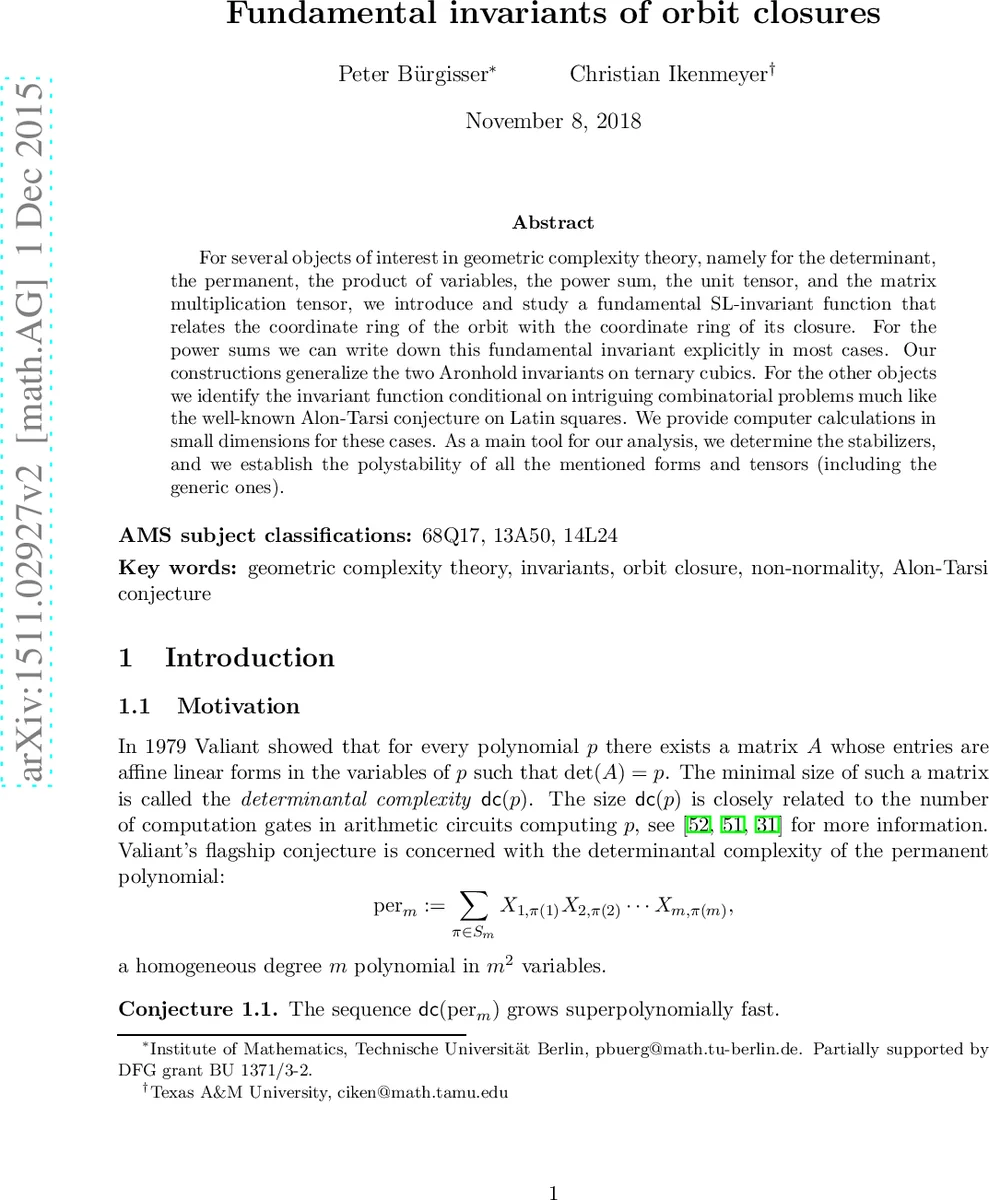
For several objects of interest in geometric complexity theory, namely for the determinant, the permanent, the product of variables, the power sum, the unit tensor, and the matrix multiplication tensor, we introduce and study a fundamental SL-invariant function that relates the coordinate ring of the orbit with the coordinate ring of its closure. For the power sums we can write down this fundamental invariant explicitly in most cases. Our constructions generalize the two Aronhold invariants on ternary cubics. For the other objects we identify the invariant function conditional on intriguing combinatorial problems much like the well-known Alon-Tarsi conjecture on Latin squares. We provide computer calculations in small dimensions for these cases. As a main tool for our analysis, we determine the stabilizers, and we establish the polystability of all the mentioned forms and tensors (including the generic ones).
💡 Research Summary
This paper introduces and studies a fundamental SL‑invariant, called the “fundamental invariant,” which links the coordinate ring of a GL‑orbit of a polynomial or tensor to that of its Zariski closure. The authors focus on several objects that are central to geometric complexity theory (GCT): the determinant, the permanent, the monomial product X₁⋯Xₘ, power‑sum polynomials X₁ᴰ+⋯+Xₘᴰ, the unit tensor ⟨n,n,n⟩, and the matrix‑multiplication tensor ⟨n,n,n⟩. For each of these they determine the stabilizer subgroup, compute the stabilizer period a(w), and establish polystability (i.e., closed SL‑orbits).
A key construction is the degree monoid E(w) = { d ∈ ℕ | O(G·w)^{SL}_d ≠ 0 }, where G is the appropriate GL‑group. They prove that E(w) generates the lattice b(w)ℤ with b(w) = m·D·a(w) (for forms of degree D in m variables) and define the minimal positive element e(w) of E(w). The fundamental invariant Φ_w is the unique (up to scaling) SL‑invariant of degree e(w) satisfying Φ_w(w)=1. Its zero set on the orbit closure coincides with the boundary G·w \ G·w, and the coordinate ring of the closure is the localization of the orbit ring at Φ_w. However, when b(w) < e(w) the boundary ideal is strictly larger than the principal ideal generated by Φ_w, implying that the orbit closure is non‑normal. This non‑normality is identified as a major obstacle in the Mulmuley–Sohoni program for separating determinant and permanent orbit closures.
For power‑sum polynomials the authors give explicit formulas for the fundamental invariant. When D is even, the generic invariant P_{D,m} does not vanish; when D is odd the minimal degree is 2m and they construct an invariant generalizing the classical Aronhold invariant of ternary cubics. For the monomial product X₁⋯Xₘ they show that the non‑vanishing of P_{m,m} is equivalent to the Alon–Tarsi conjecture on the sign imbalance of Latin squares. Thus, the existence of a fundamental invariant for this case is tied to a deep combinatorial problem. Analogous conjectures are formulated for odd m.
The determinant detₙ and permanent perₙ are treated similarly. The stabilizer of detₙ consists of transposition and the linear maps X ↦ A X B with A,B∈SLₙ; its period is 1 when n≡0,1 (mod 4) and 2 otherwise. For perₙ the period is 2 except when n≡0 (mod 4). The authors compute the corresponding degree monoids and fundamental invariants, again observing non‑normality of the orbit closures.
In the tensor setting (elements of ⊗³ℂᵐ) they develop a parallel theory. The degree monoid of a generic tensor w has minimal element n³, where n = √m. They construct an irreducible SLₘ³‑invariant Fₙ of degree n³ and define the fundamental invariant of w as the restriction of Fₙ. For the unit tensor ⟨n,n,n⟩ and the matrix‑multiplication tensor ⟨n,n,n⟩ they translate the condition Fₙ≠0 into combinatorial statements involving “Latin cubes,” a three‑dimensional analogue of Latin squares. Computational verification is provided for n=2 and n=4.
Throughout the paper the authors employ the Hilbert–Mumford criterion refined by Luna and Kempf to prove polystability, and they use explicit stabilizer calculations to determine periods. They also discuss the generic stabilizer periods, showing that for most (D,m) pairs the reduced period a′(D,m) equals 1, with a few low‑dimensional exceptions.
The main contributions are: (1) the systematic definition of a fundamental SL‑invariant linking orbits and their closures; (2) explicit constructions for several key GCT objects; (3) identification of non‑normality as a structural barrier; (4) reduction of invariant non‑vanishing to well‑known combinatorial conjectures (Alon–Tarsi, Latin cubes). The work opens a new avenue for attacking determinant vs. permanent lower bounds and related complexity questions by translating them into invariant‑theoretic and combinatorial problems.
Comments & Academic Discussion
Loading comments...
Leave a Comment