iDART-Intruder Detection and Alert in Real Time
In this work, we design and develop a smart intruder detection and alert system which aims to elevate the security as well as the likelihood of true positive identification of trespassers and intruders as compared to other commonly deployed electronic security systems. Using multiple sensors, this system can gauge the extent of danger exhibited by a person or animal in or around the home premises, and can forward various critical information regarding the event to home owners as well as other specified entities, such as relevant security authorities.
💡 Research Summary
The paper presents iDART (Intruder Detection and Alert in Real Time), a low‑cost, modular home‑security prototype designed to overcome the shortcomings of conventional CCTV systems. Traditional closed‑circuit television offers continuous recording but lacks real‑time notification and forces users to sift through hours of irrelevant footage. iDART addresses these issues by employing an event‑driven architecture that records video only when a potential intrusion is detected and immediately forwards the clip to the homeowner and designated authorities via email.
The system integrates three processing layers. The first layer consists of a microcontroller (Arduino‑compatible) coupled with a laser‑LDR pair positioned at entry points such as doors and windows. When the laser beam is interrupted, the microcontroller triggers a Zigbee radio module to send an “intruder alert” packet to a central PC. The second layer is a Raspberry Pi single‑board computer equipped with an ultrasonic distance sensor and a camera module. Upon detecting a person’s presence within a few centimeters, the Pi records a short 5‑10 second video segment, stores it locally, and prepares it for transmission. The third layer is a PC running LabVIEW, which receives the Zigbee alert, invokes an email‑sending routine, and dispatches the video clip to the user’s email address and to pre‑configured security agencies.
Key features include: (1) low‑power optical intrusion detection via the laser‑LDR pair; (2) separation of low‑bandwidth alert signaling (Zigbee) from high‑bandwidth video transmission (Wi‑Fi); (3) event‑based recording that dramatically reduces storage requirements and network traffic; (4) a PIN‑based external deactivation keypad that allows authorized occupants to silence the system; and (5) modular hardware design, enabling individual components to be upgraded without redesigning the entire system.
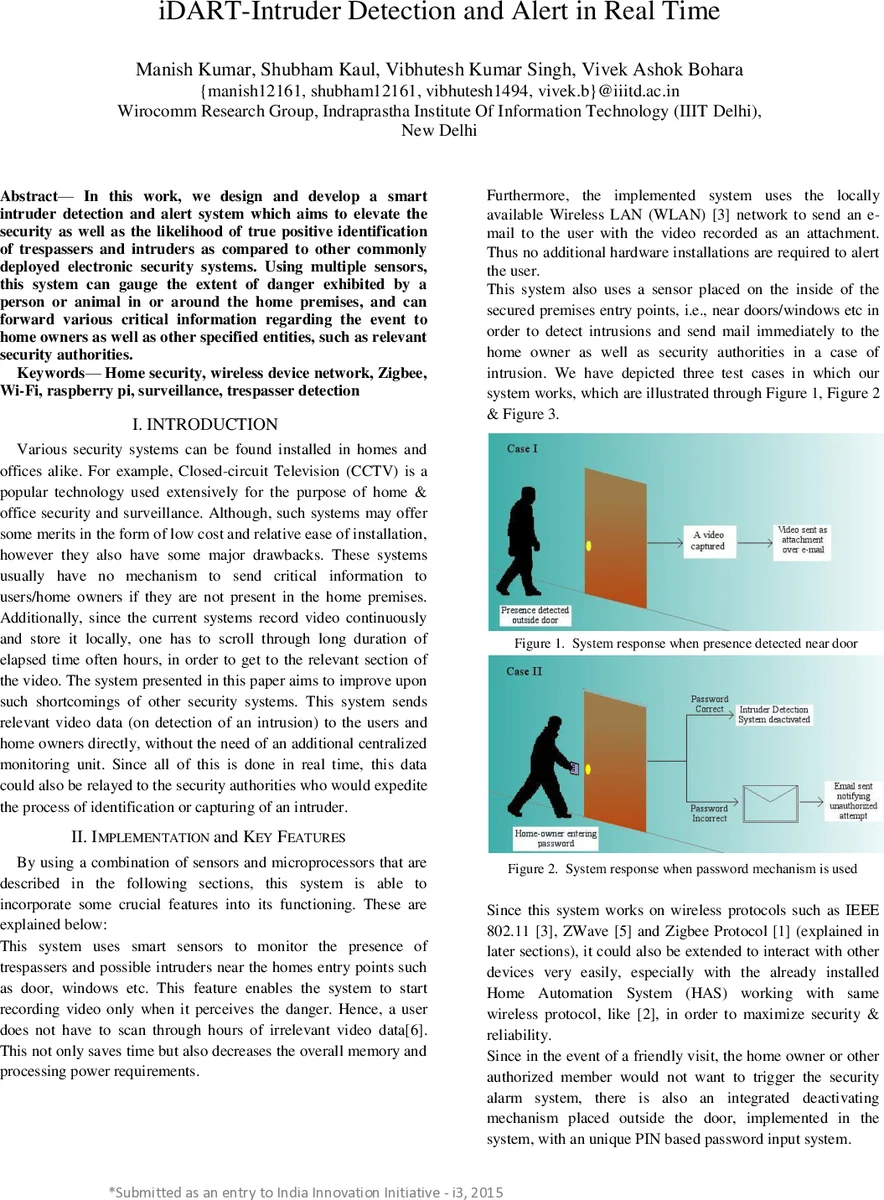
The authors illustrate three test scenarios: detection of presence near a door, activation of the PIN deactivation mechanism, and a full break‑in event. Diagrams (Figures 1‑3) depict system responses for each case. Hardware schematics (Figures 4‑5) show the placement of the microcontroller, Zigbee module, Raspberry Pi, ultrasonic sensor, and camera both inside and outside the monitored premises.
In the discussion of future work, the authors propose several enhancements: replacing the simple button‑based PIN entry with a traditional numeric keypad or voice‑command interface; deploying multiple Raspberry Pi units at all possible entry points (windows, vents, etc.) to achieve comprehensive coverage; integrating the system with broader Zigbee‑enabled IoT ecosystems for coordinated home‑automation actions; adding SMS or push‑notification capabilities for users without reliable email access; and securing Zigbee communications with AES‑128 encryption to mitigate potential man‑in‑the‑middle attacks. They also acknowledge limitations such as susceptibility of the laser‑LDR sensor to ambient light variations, potential false positives from ultrasonic noise, the relatively high power draw of continuous video processing on the Raspberry Pi, and the lack of quantitative performance metrics (detection accuracy, latency, power consumption) in the current evaluation.
Overall, iDART demonstrates a feasible, cost‑effective approach to real‑time intruder detection and alerting by combining inexpensive sensors, open‑source software, and widely available wireless protocols. While the prototype requires further refinement—particularly in robustness, security hardening, and scalability—it provides a solid foundation for future smart‑home security solutions that can be readily extended through additional sensors, communication channels, and integration with existing IoT platforms.
Comments & Academic Discussion
Loading comments...
Leave a Comment