Model Checking One-clock Priced Timed Automata
We consider the model of priced (a.k.a. weighted) timed automata, an extension of timed automata with cost information on both locations and transitions, and we study various model-checking problems for that model based on extensions of classical tem…
Authors: Patricia Bouyer, Kim G. Larsen, Nicolas Markey
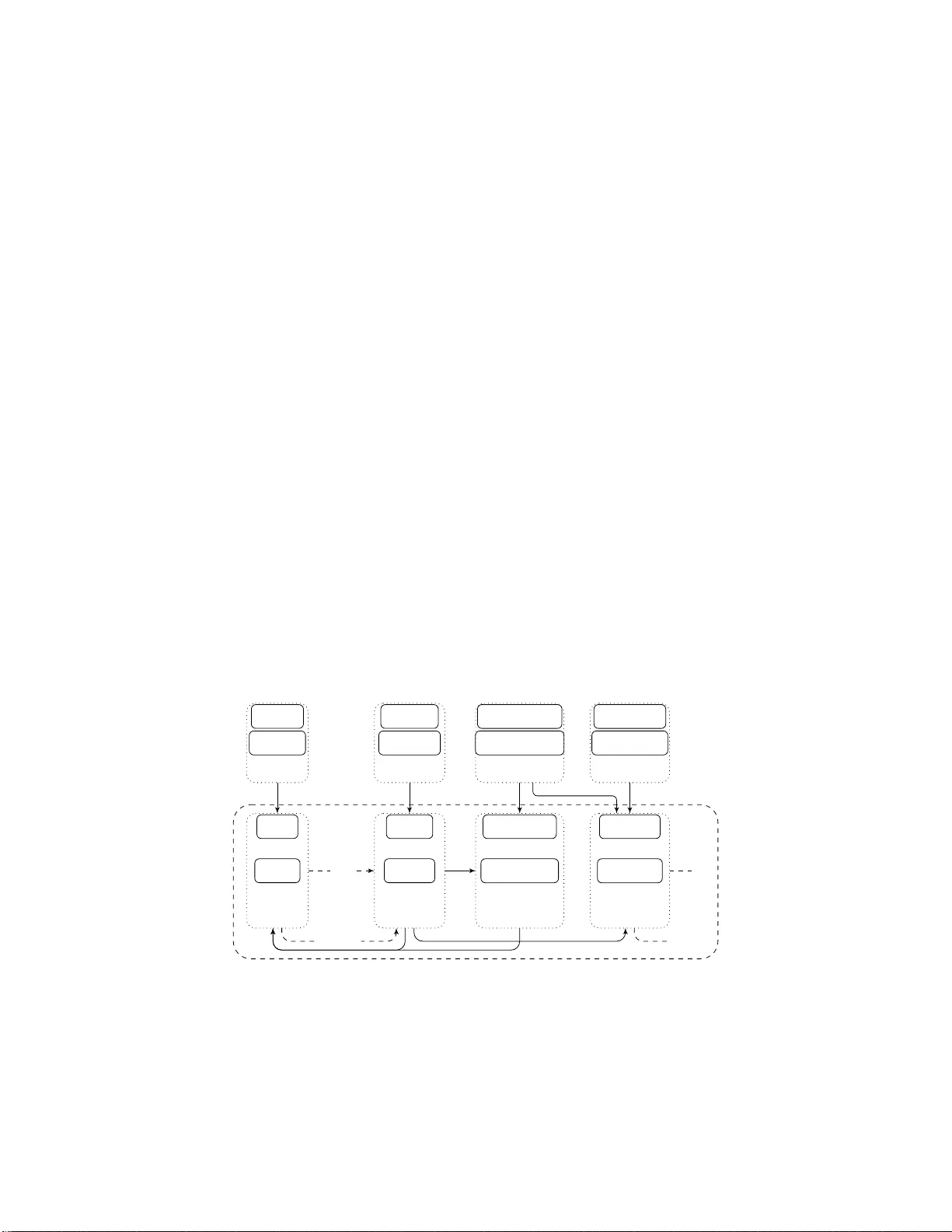
Logical Methods in Computer Science V ol. 4 (2:9) 2008, pp. 1–28 www .lmcs-online.org Submitted Sep . 20, 2007 Published Jun. 20, 2008 MODEL CHECKI N G ONE-CLOC K PRICED TIMED A UTOMA T A ∗ P A TRICIA BOUYER a , K IM G. LARSEN b , A ND NICOLAS MARKEY c a LSV, CNR S & ENS de Cachan, F rance and Oxford Universit y Computing Laboratory , UK e-mail addr ess : b ouyer@lsv.ens-cac h an.fr b Aalb org Universi ty , Denmark e-mail addr ess : kgl@cs.aau.dk c LSV, CNR S & ENS de Cachan, F rance e-mail addr ess : markey@lsv.ens-cac h an .fr Abstra ct. W e consider the mo del of priced (a.k.a. wei ghted) timed automata, an exten- sion of timed automata with cost information on b oth locations and transitions, and we study v arious mo del-chec king problems for that mo del based on extensions of classical tem- p oral logics with cost constrain ts on mo dalities. W e pro v e that, under the assumption that the mo del has only one clock, model-checking this class of models against th e logic WCTL, CTL with cost-constrained modalities, is PSP ACE -complete (while it has b een shown u n- decidable as soon as the model has three clo cks). W e also prove that mod el-checking WMTL, L TL with cost-constrained mo dalities, is decidable only if th ere is a single clo ck in the mo del and a single stop watc h cost v ariable ( i .e. , whose slopes lie in { 0 , 1 } ). An interesting dir ection of real-ti me mo del-c hec king that has r ecen tly receiv ed sub- stan tial atten tion is the extension and r e-targeti ng of timed automata tec hnology to wards optimal sc heduling and con troller sy nthesis [AAM06, RLS04, BBL08 ]. In particular, scheduling pr ob lems can often b e reformulate d in terms of reac habilit y questions with resp ect to b ehavio ural mo dels wh ere tasks and resour ces relev an t for the sc heduling pr oblem in question are mo d elled as interac ting timed automata [BLR05a]. Al- though there exists a wide b ody of literature and established resu lts on (optimal) sc hedu ling in the fi elds of real-t ime systems and op eratio ns researc h, the applicatio n of mod el-c hecki ng has pro v ed to provide a nov el and comp etitiv e tec h n ology . In particular, m o del-c hec king has the adv anta ge of offering a generic approac h, going w ell b ey ond most classical sc heduling solutions, whic h ha ve go o d prop erties only for scenarios satisfying sp ecific assumptions that ma y or, quite often, ma y not apply in actual pr actical circumstances. Of course, mo del- c h ec kin g comes with its o wn restrictions and stum bling b lo c ks, the m ost n otorious b eing 1998 ACM Subje ct Classific ation: F.1.1,F.3.1. Key wor ds and phr ases: priced timed aut omata, model-chec king. ∗ This article is a long ve rsion of [BLM07]. It has b een extended with recent related results from [BM07]. a P artly supported by pro ject DOTS (ANR-06-SETI-003), and by a Marie -Curie fello wship. b P artly supported by an invited p rofessorship from ENS Cachan. c P artly supported by pro ject DOTS (ANR-06-SETI-003). LOGICAL METHODS l IN COMPUTER SCIENCE DOI:10.216 8/LMCS-4 (2:9) 2008 c P . Bouyer, K.G. Larsen, and N. Markey CC Cr eative Comm ons 2 P . BOUYER, K.G. LARSEN, AND N. MARKEY the state-space explosion. A lot of research has thus b een devo ted to “guide” and “prune” the reac habilit y searc h [BFH + 01a]. As part of the effort on applying timed automata tec hnology to sc h eduling, the n otion of p riced (or w eigh ted) timed au tomata [BFH + 01b, ALP01] h as b een promoted as a useful extension of the classical mo d el of timed automata allo w in g contin uous consu mption of resources (e.g. energy , money , p ollution, etc.) to b e mo d elled and analyzed. In this w a y one ma y distinguish different feasible schedules according to their consumption of resources ( i.e. , accum ulated cost) with ob vious p r eference for the optimal sc hedule with minimal resource requ iremen ts. Within the mo del of priced timed automata, the cost v ariables serv e pur ely as evalu- ation functions or observers , i.e. , the b ehavio ur of the underlying timed automata may in no w a y d ep end on these cost v ariables. As an imp ortan t consequence of this restriction —and in con trast to the related mo dels of constan t s lop e and linear h ybrid automata— a num b er of optimization pr oblems ha v e b een sh o wn decidable for priced timed automata including minim u m-cost reac habilit y [BFH + 01b, ALP01 , BBBR07], optimal (minimum and maxim um cost) r eac habilit y in multi- priced settings [LR05] and cost-optimal infi nite sc hed- ules [BBL04, BBL08] in terms of min imal (or maximal) cost p er time ratio in the limit. Moreo ver UPP AAL Cora [BLR05b] provides an efficien t to ol for computing cost-optimal or near-optimal solutions to reac habilit y questions, implement ing a sym b olic A ∗ algorithm based on a new data structure (so-called pr iced zones) allo wing for efficien t symbolic state- represent ation with additional cost-information. Cost-extended ve rsions of temp oral logics suc h as CTL (branching-time ) and L TL (linear-time) app e ar as a natural “generali zations” of the ab o v e optimization problems. Just as TCTL and MTL pr o vide extensions of CTL and L TL with time-constrained mo d al- ities, W CTL and WMTL are extensions with c ost -constrained mo dalities in terpreted with resp ect to pr iced timed automata. Unfortun ately , th e addition of cost now turn s out to come with a price: whereas th e mo d el-c hecking p r oblems for timed automata with resp ect to TC TL and MTL are decidable, it has b een sho wn in [BBR04 ] that mo del-c hec king pr iced timed automata with r esp ect to W C TL is un decidable. Also, in [BBR05] it has r ecently b een sho w n that the p roblem of determining cost-optimal winning str ategies for p riced timed games is not computable. In [BBM06] it has b een sho wn that these negativ e results hold ev en for priced timed (game) automata with no more than thr ee clo c ks. Recen tly , the r estriction of timed sys tems to a single clo ck has raised some atte n tion, as it leads to muc h nicer decidabilit y and complexit y r esults. Ind eed, the emptiness problem in single-cloc k timed automata b ecomes NLOGSP A CE -Complete [LMS04] instead of PSP A CE - Complete in the general framewo rk [AD94]. Also, the emptiness pr ob lem is decidable for single-cloc k alternating timed automata and is undecidable for general alternating timed automata [L W05, OW0 5, L W08, OW0 7]. Ev en more recen tly , cost-optimal timed games ha v e b een p ro v ed decidable for one-clock priced timed games [BLMR06 ], and construction of almost-optimal str ategies can b e d one. In this pap er we fo cus on mo del-c hec kin g problems for pr iced timed automata with a single clo c k. On the one hand , w e sh ow that th e mo del-c hec king problem with r esp ect to WCTL is PSP A CE -Complete under the “single clo c k” assumption. This is rather sur- prising as mo del-c hec king TCT L (the only cost v ariable is the time elapsed) un der the same assumption is already PSP A CE -Complete [LMS04]. On the other h and, w e p ro v e that the mo del-c hec king problem with r esp ect to WMTL, the linear-time coun terp art of W CTL, is decidable if we add the extra requiremen ts that there is only one cost v ariable whic h MODEL CHECKING ONE-CLOCK PRICED TIMED AUTOMA T A ∗ 3 is stop watc h ( i.e. , with slop es in { 0 , 1 } ). W e also pro v e that those tw o conditions are necessary to get decidabilit y , b y pr o ving that an y slight extension of that mo del leads to undecidabilit y . The pap er is organized as follo ws: In Section 1, we p r esen t the mo del of priced timed automata. Section 2 is dev oted to the definition of WCTL, and to the pro of that it is decidable when the mo d el has only one clo c k. W e prop ose an E XPTIME algorithm, which w e then slightly mo dify so that it ru ns in PSP A CE . S ection 3 then hand les the linear-time case: w e first defin e WMTL, pr o ve that it is decidable under the single-clo c k and sin gle- stop w atc h-cost assum ptions, and that it is u ndecidable if we lift any of these r estrictions. 1. Preliminaries 1.1. Priced Timed Automat a. In th e sequel, R + denotes the set of nonnegativ e reals. Let X b e a set of clo ck v ariables. The set of clo c k constraints (or guards) ov er X is defin ed b y th e grammar “ g ::= x ∼ c | g ∧ g ” wh ere x ∈ X , c ∈ N and ∼ ∈ { <, ≤ , = , ≥ , > } . The set of all clock constrain ts is denoted B ( X ). Th at a v aluatio n v : X → R + satisfies a clo c k constrain t g is defined in a n atural wa y ( v satisfies x ∼ c whenever v ( x ) ∼ c ), and we then write v | = g . W e denote b y v 0 the v aluation that assigns zero to all clo c k v ariables, by v + t (with t ∈ R + ) the v aluation that assigns v ( x ) + t to all x ∈ X , and for R ⊆ X w e write [ R ← 0] v to den ote the v aluation th at assigns zero to all v ariables in R and agrees with v for all v ariables in X r R . Definition 1.1. A pric e d time d automaton ( PT A for short) is a tuple A = ( Q, q 0 , X , T , η , ( cost i ) 1 ≤ i ≤ p ) where Q is a fi nite s et of lo c ations , q 0 ∈ Q is th e ini tial lo cation, X is a set of clo cks , T ⊆ Q × B ( X ) × 2 X × Q is the set of tr ansitions , η : Q → B ( X ) defines the invariants of eac h lo cation, and eac h cost i : Q ∪ T → N is a c ost (or pric e) function . F or S ⊆ N , a cost cost i is said to b e S -slop e d if cost i ( Q ) ⊆ S . If S = { 0 , 1 } , it is said stopwat ch . If | S | = n , we sa y that th e cost cost i is n -slop ed. The seman tics of a PT A A is giv en as a lab eled timed transition s y s tem T A = ( S, s 0 , → ) where S ⊆ Q × R X + is the set of states, s 0 = ( q 0 , v 0 ) is the initial state, and the transition relation → ⊆ S × ( T ∪ R + ) × S is comp o sed of dela y and discrete mov es d efined as follo ws: (1) (discr ete move) ( q , v ) e − → ( q ′ , v ′ ) if e = ( q , g , R, q ′ ) ∈ E is s.t. v | = g , v ′ = [ R ← 0] v , v ′ | = η ( q ′ ). Th e i -th cost of this discrete mo v e is cost i ( q , v ) e − → ( q ′ , v ′ ) = cost i ( e ). (2) (delay move) ( q , v ) t − → ( q , v + t ) if ∀ 0 ≤ t ′ ≤ t , v + t ′ | = η ( q ). T he i -th cost of th is dela y mov e is cost i ( q , v ) t − → ( q , v + t ) = t · cost i ( q ). A d iscr ete mo ve or a dela y mo ve will b e called a simple move . A mixe d move ( q , v ) t,e − → ( q ′ , v ′ ) corresp onds to the concatenation of a dela y mov e and a d iscrete mo ve . F or tec hnical reasons, w e only consider n on-blo c king PT A s, b ec ause we will fu rther interpret logical formulas o ve r infinite p aths. T he i -th cost of this mixed mov e is the sum of the i -th costs of the t w o mo v es. A finite (resp. infinite) run of a PT A is a finite (resp. infi nite) sequence of mixed mo ves in the underlying transition system. A run of A will thus b e distinguished from a p ath in T A , whic h is comp osed of simp le mo ves and where stuttering of dela y mo v es is allo w ed. Note ho w ever that a path in T A is naturally asso ciated with a r un in A . The i -th cost of a run 4 P . BOUYER, K.G. LARSEN, AND N. MARKEY in A (resp. path in T A ) is the sum of th e i -th costs of the mixed (resp. simple) mo v es comp osing the run (resp. path), and is denoted cost i ( ). T he length | | of a fi nite ru n = s 0 t 1 ,e 1 − − − → s 1 t 2 ,e 2 − − − → · · · t n ,e n − − − → s n is n . A p osition along is a nonn egativ e intege r π ≤ | | . Giv en a p osition π , [ π ] denotes the corresp onding state s π , w h ereas ≤ π denotes the finite prefix of ending at p osition π , and ≥ π is the su ffix starting in π . Remark 1.2. In the mo del of priced timed automata, the cost v ariables only play the role of observers (they are history variables in the sense of [OG76 , AL88]): th e v alues of these v ariables don’t constrain the b eha viour of the system (the b eha viours of a priced timed automaton are those of the und erlying timed automaton), but can b e used as ev aluation functions. F or ins tance, problems such as “optimal reac habilit y” [BFH + 01b, ALP 01 ], “op- timal infinite sc hedules” [BBL04] or “optimal reac habilit y timed games” [ABM0 4, BCFL04, BBR05, BBM06] ha v e recen tly b een inv estigated. The problem we consider in this pap er is closely related to these kinds of pr oblems: we will use temp oral logics as a language for ev aluating the p erformances of a system. 1.2. Example. Th e PT A of Figure 1 mo dels a never-ending pro c ess of repairing p roblems, whic h are b ound to o ccur rep eatedly w ith a certain fr equ ency . T h e repair of a problem has a certain cost, captured in the mo del by the cost v ariable c . As so on as a pr oblem o ccurs (mo deled b y the Problem lo cation) the v alue of c gro ws with rate 3, u n til actual repair is taking place in one of the lo cations Chea p (rate 2) or Expen siv e (rate 4). At most 20 time units after the o ccurrence of a p roblem it w ill h a v e b een rep aired one wa y or another. ˙ c =0 x ≤ 9 ˙ c =3 x ≤ 10 ˙ c =2 x< 20 ˙ c =4 x ≤ 15 x ≥ 2 x ≥ 4 x =20 , x :=0 , c +=5 x =15 , x :=0 Problem Cheap Expensive OK Figure 1: Repair pr oblem as a P T A 2 4 6 8 10 x 10 20 30 40 50 c W ait in Problem Goto Cheap W ait in Problem Goto Expe nsive Figure 2: Minimum cost of r epair and asso ci- ated strategy in lo cation Problem In this setting w e are in terested in prop erties concerning the cost of repairs. F or instance, w e w ould lik e to express that when ev er a p roblem o ccurs, it may b e repaired ( i.e. reac h the lo cation OK ) within a total cost of 47. In fact Figure 2 gives the minimum cost of repair —as we ll as an optimal strategy— for any state of the form ( Problem , x ) with x ∈ [0 , 10]. Corresp on d ingly , the minimum cost of reac h ing OK from states of the form ( Cheap , x ) (resp . ( Expensiv e , x )) is giv en b y the expression 45 − 2 x (resp. 60 − 4 x ). Symmetrically , w e w ou ld lik e to express prop erties on th e w orst cost to r epair, or to link the uptime with the (b est, w orst) cost of repairing. As will b e illustrated later, extending temp oral logics with cost informations p ro vides a nice setting for expressin g suc h prop erties. MODEL CHECKING ONE-CLOCK PRICED TIMED AUTOMA T A ∗ 5 2. Model Checking Br anching-Time Logics W e first fo cus on the case of branc hing-time logics. F r om this p oint on, A P denotes a fixed, fi nite, non-empt y set of atomic p rop ositions. W e first defin e the cost-extended version of CTL. 2.1. The Logic W CTL. The logic W CTL 1 [BBR04] extends CT L with cost constrain ts. Its synta x is giv en by the follo w ing grammar: W C TL ∋ ϕ ::= a | ¬ ϕ | ϕ ∨ ϕ | E ϕ U cost ∼ c ϕ | A ϕ U cost ∼ c ϕ where a ∈ AP , cost is a cost fun ction, c ranges o v er N , and ∼ ∈ { <, ≤ , = , ≥ , > } . W e in terpr et formulas of W CTL o v er labeled PT A , i .e. P T A ha ving a lab eling function ℓ whic h asso ciates with ev ery lo cation q a subset of AP . W e iden tify eac h cost app earing in the W CTL f orm ulas with the cost ha ving the same name in the mo d el (whic h is assumed to exist). Definition 2.1. Let A b e a lab eled PT A . The satisfac tion relation of W CTL is d efined ov er configurations ( q , v ) of A as follo w s: ( q , v ) | = a ⇔ a ∈ ℓ ( q ) ( q , v ) | = ¬ ϕ ⇔ ( q , v ) 6| = ϕ ( q , v ) | = ϕ ∨ ψ ⇔ ( q , v ) | = ϕ or ( q , v ) | = ψ ( q , v ) | = E ϕ U cost ∼ c ψ ⇔ there is an infi nite run in A from ( q , v ) s.t. | = ϕ U cost ∼ c ψ ( q , v ) | = A ϕ U cost ∼ c ψ ⇔ any infi n ite run in A f rom ( q , v ) satisfies | = ϕ U cost ∼ c ψ | = ϕ U cost ∼ c ψ ⇔ there exists a p ositio n π > 0 along s.t. [ π ] | = ψ , for ev ery p ositio n 0 < π ′ < π , [ π ′ ] | = ϕ, and cost ( ≤ π ) ∼ c If A is not clear f rom the con text, we ma y write A , ( q , v ) | = ϕ instead of simply ( q , v ) | = ϕ . As usual, w e will use sh orthands suc h as “ true def ⇔ a ∨ ¬ a ”, “( ϕ ⇒ ψ ) def ⇔ ¬ ϕ ∨ ψ ”, “ E F cost ∼ c ϕ def ⇔ E true U cost ∼ c ϕ ”, and “ A G cost ∼ c ϕ def ⇔ ¬ E F cost ∼ c ¬ ϕ ”. Moreo ve r, if th e cost function cost is unique or clear from the con text, w e ma y w rite ϕ U ∼ c ψ instead of ϕ U cost ∼ c ψ . Finally , we omit to mentio n the su bscript “ ∼ c ” wh en it is equiv alent to “ ≥ 0” (th us imp osing n o r eal constrain t). Example 2.2. W e go bac k to our example of Section 1.2. T hat it is alwa ys p ossible to repair a problem with cost at most 47 can b e expressed in W CTL with the follo w in g form ula: A G Problem ⇒ E F c ≤ 47 OK . W e can also express that th e worst cost to repair is 56, in the sens e th at state Rep air can alw ays b e reac hed w ithin this cost: A G Problem ⇒ A F c ≤ 56 OK . 1 WC TL stands for “W eigh ted CTL”, follo wing [BBR04] terminology . It would hav e b een more natural to call it “Priced CTL” (PCTL) in our setting, bu t this w ould hav e b een confusing with “Probabilistic CTL” [HJ94]. 6 P . BOUYER, K.G. LARSEN, AND N. MARKEY No w, consider in g time as a sp ecia l case of a cost (with constan t slop e 1), w e can express prop erties r elating the time elapsed in the OK state and the cost to repair: A G ¬ E ( OK U t ≥ 8 ( Problem ∧ ¬ E F c< 30 OK )) . This expresses that if the system sp end s at least 8 (consecutiv e) time units in the OK state, then the next Problem can b e repaired with cost at most 30. The main r esu lt of this section is the follo wing theorem: Theorem 2.3. Mo del-che cking WCTL on one-clo ck P T A is PS P A CE - Complete. The P SP A CE lo w er b oun d can b e pro v ed by a d irect adaptation of the PSP A C E - Hardness pro of for the mo del-c hec king of TCTL, the restriction of W CTL to time con- strain ts, o v er on e-clo c k timed automata [LMS04]. The PSP A CE up p er b ound is more in v olv ed, and w ill b e done in t w o steps: (1) first w e will exhibit a set of regions whic h will b e correct for mo del-c hec king W CT L form ulas, see Section 2.2; (2) then w e will use this r esult to p r op ose a PS P A CE algorithm for mo del-c hec kin g W C TL, s ee Section 2.3. Finally , it is worth r eminding here that the mo d el-c hecking of W CTL o v er priced timed automata with th r ee clo c ks is und ecidable [BBM06]. 2.2. Sufficien t Gran ularit y for WCTL. The pro of of T heorem 2.3 partly relies on the follo wing prop ositio n, which exhibits, for ev ery WCTL formula Φ , a set of r e gions within whic h th e tr u th of Φ is uniform. Note that these are not the classical regions as defi ned in [AD94, A CD93], b ecause their granularit y needs to b e refined in order to b e correct. Computing a sufficien t gran ularit y was already a k ey step for c h ec kin g dur ation prop erties in simple timed automata [BES93]. Prop osition 2.4. L et Φ b e a WCTL formula and let A b e a one-clo ck PT A . Then ther e exist a finite set of c onstan ts { a 0 , ..., a n } satisfying the fol low ing c onditions: • 0 = a 0 < a 1 < . . . < a n < a n +1 = + ∞ ; • for every lo c ation q of A , for every 0 ≤ i ≤ n , the truth of Φ is unif orm over { ( q , x ) | a i < x < a i +1 } ; • { a 0 , ..., a n } c ontains al l the c onstants app e aring in clo ck c onstr aints of A ; • the c onstants ar e inte g r al multiples of 1 /C ~ (Φ) wher e ~ (Φ) is the constrained temp oral heigh t of Φ , i.e., the maximal numb er of neste d c onstr aine d mo dalities 2 in Φ , and C is the lcm of al l p ositive c osts lab eling a lo c ation of A ; • a n e quals the lar gest c onstant M app e aring in the g uar ds of A ; In p articular, we have n ≤ M · C ~ (Φ) + 1 . As a corollary , we reco ver th e partial decidabilit y r esult of [BBR04], stating th at the mo del-c hec king of one-clo c k PT A with a stopwatch c ost 3 against W CTL formulas is decidable using classical one-dimens ional r egions of timed automata ( i.e. , w ith gran ularit y 1). 2 With ”constrained mod alit y” w e mean a modality decorated with a constraining interv al d ifferent from (0 , + ∞ ). 3 I.e. , cost with rates in { 0 , 1 } . MODEL CHECKING ONE-CLOCK PRICED TIMED AUTOMA T A ∗ 7 Pr o of. Th e pro of of this prop osit ion is b y str u ctural ind uction on Φ. The cases of atomic prop ositions and b oolean com binations are straight forw ard; unconstrained mo d alities r e- quire n o refin emen t of the granularit y (the basic CTL algorithm is correct and do es n ot need to refi ne the gran ularit y); we will th us fo cus on constrained m o dalities. 2.2.1. We first assume that A has no discr ete c osts. ( i.e . cost ( T ) = { 0 } ) , the extension to the general case will b e p resen ted at the end of the pro of. ◮ W e first fo cus on the case when Φ = E ϕ U cost ∼ c ψ (w e s im p ly w rite Φ = E ϕ U ∼ c ψ , and assume that cost is the only cost of A , as its other costs pla y n o role in the p r oblem). Assume that the resu lt has b een p ro v ed for the W CTL sub form ulas ϕ and ψ , and that w e hav e merged all constan ts f or ϕ and ψ : w e th us h a ve constant s 0 = a 0 < a 1 < . . . < a n < a n +1 = + ∞ suc h that for ev ery lo cation q of A , for ev ery 0 ≤ i ≤ n , the truth of ϕ and that of ψ are b oth u niform ov er { ( q , x ) | a i < x < a i +1 } . By induction h yp othesis, the gran ularit y of these constants is 1 /C max( ~ ( ϕ ) , ~ ( ψ )) = 1 /C ~ (Φ) − 1 . W e will exhibit extra constan ts such that th e ab o ve prop ositio n then also h olds for th e form ula Φ. F or the sak e of simp licit y , we w ill call r e gi ons all elemen tary interv als ( a i , a i +1 ) and singletons { a i } . In ord er to compute the set of states s atisfying E ϕ U ∼ c ψ , for every state ( q , x ) we compute all costs of paths from ( q , x ) to some region ( q ′ , r ), along whic h ϕ alw a ys holds after a d iscrete action has b een done, and su c h that a ψ -state can immediately b e reac h ed via a discr ete action from ( q ′ , r ). W e then chec k whether w e can ac h iev e a cost satisfying “ ∼ c ” for the m entioned ψ -state. W e thus first explain ho w w e compu te th e set of p ossible costs b et w een a state ( q , x ) and a region ( q ′ , r ) in A . Indeed, for c hec k in g the existence of a run satisfying ϕ U ∼ c ψ , we will fi r st remo v e discrete tran s itions leading to states not satisfying ϕ , and then compute all p ossible costs of run s from ( q , x ) to some ( q ′ , r ), where ( q ′ , r ) is a ψ -state just reac hed by a discrete action, in the restricted graph . F or eac h ind ex i , w e restrict the automaton A to transitions whose guard s con tain the in terv al ( a i , a i +1 ), and that do not reset th e clo ck. W e denote by A i this restricted automaton. Let q and q ′ b e t w o lo cations of A i . As stated by the follo wing lemma, th e set of costs of paths b et w een ( q , a i ) and ( q ′ , a i +1 ) is an in terv al that can b e easily computed: Lemma 2.5. We assume a i +1 6 = + ∞ . L et S i ( q , q ′ ) b e the set of lo c ations that ar e r e achable fr om ( q , a i ) and c o-r e achable fr om ( q ′ , a i +1 ) in T A i , and assume it is non-empty ( i.e. , ther e is a p ath joining those two states). L et c i,q ,q ′ min and c i,q ,q ′ max b e the minimum and maximum c osts among the c osts of lo c ations in S i ( q , q ′ ) . Then the set of al l p ossible c osts of p aths in T A i going fr om ( q , a i ) to ( q ′ , a i +1 ) is an interval h ( a i +1 − a i ) · c i,q ,q ′ min , ( a i +1 − a i ) · c i,q ,q ′ max i . The interval is left-close d iff ther e exist two lo c ations r and s (with p ossibly r = s ) in S i ( q , q ′ ) with c ost c i,q ,q ′ min such that 4 ( q , a i ) ∗ A i ( r , a i ) , ( r , a i ) ∗ A i ( s, a i +1 ) , and ( s, a i +1 ) ∗ A i ( q ′ , a i +1 ) . The i nterval i s right-close d iff ther e exists two lo c ations r and s in S i ( q , q ′ ) with c ost c i,q ,q ′ max such that ( q , a i ) ∗ A i ( r , a i ) , ( r , a i ) ∗ A i ( s, a i +1 ) , and ( s, a i +1 ) ∗ A i ( q ′ , a i +1 ) . The cond itions on left/righ t-closures c h aracterize the fact that it is p ossible to instan ta- neously reac h/lea v e a lo cation w ith minimal/maximal cost, or if a small p ositiv e delay h as to elapse (du e to a strict guard). 4 The notation α ∗ A i α ′ means t hat th ere is a path in T A i from α to α ′ . 8 P . BOUYER, K.G. LARSEN, AND N. MARKEY Pr o of. Obviously the costs of all paths in T A i from ( q , a i ) to ( q ′ , a i +1 ) b elong to the in terv al ( a i +1 − a i ) · [ c i,q ,q ′ min , c i,q ,q ′ max ]. W e w ill n o w prov e that the set of costs is an in terv al contai ning ( a i +1 − a i ) · ( c i,q ,q ′ min , c i,q ,q ′ max ). q ,a i q ′ ,a i +1 maximal cost minimal cost Figure 3: The set of costs b et we en tw o s tates is an inte rv al. Let τ min (resp. τ max ) b e a sequence of transitions in A i leading fr om ( q , a i ) to ( q ′ , a i +1 ) and going through a lo cation with minimal (resp . maximal) cost (see Figure 3). Easily enough, the p ossible costs of the p aths follo wing τ min (resp. τ max ) form an in terv al wh ose left (resp. r igh t) b ound is c i,q ,q ′ min · ( a i +1 − a i ) (resp. c i,q ,q ′ max · ( a i +1 − a i )). No w, if c and c ′ are the resp ect iv e costs of q and q ′ , then 1 2 · ( c + c ′ ) · ( a i +1 − a i ) is in b oth in terv als. Indeed, the path follo win g τ min (resp. τ max ) whic h dela ys 1 2 · ( a i +1 − a i ) time units in q , then d irectly go es to q ′ and w aits there for the remaining 1 2 · ( a i +1 − a i ) time units ac hiev es the ab ov e-men tioned cost. This implies that th e set of all p ossible costs is an int erv al. The b ound c i,q ,q ′ min · ( a i +1 − a i ) is r eac hed iff th er e is a path from ( q, a i ) to ( q ′ , a i +1 ) whic h dela ys only in lo cations with cost c i,q ,q ′ min . This is precisely the condition expressed in th e lemma. Th e same holds for the upp er b ound c i,q ,q ′ max · ( a i +1 − a i ). Similar results clearly hold f or other kin ds of r egions: • b et w een a s tate ( q , a i ) and a region ( q ′ , ( a i , a i +1 )) with a i +1 6 = + ∞ , the set of p ossible costs is an interv al h 0 , c i,q ,q ′ max · ( a i +1 − a i )), where 0 can b e r eac hed iff it is p ossible to go from ( q , a i ) to some state ( q ′′ , a i ) co-reac hable fr om ( q ′ , x ) for some x ∈ ( a i , a i +1 ), and cost ( q ′′ ) = 0. • b et w een a state ( q , x ), with x ∈ ( a i , a i +1 ), and ( q ′ , a i +1 ), the s et of costs is ( a i +1 − x ) · h c i,q ,q ′ min , c i,q ,q ′ max i , with s im ilar conditions as ab o v e for the b oun ds of the interv al. • b et w een a s tate ( q , x ), with x ∈ ( a i , a i +1 ), and region ( q ′ , ( a i , a i +1 )) (assuming a i +1 6 = + ∞ ), the set of p ossible costs is [0 , c i,q ,q ′ max · ( a i +1 − x )); • b et w een a state ( q , a n ) and a regio n ( q ′ , ( a n , + ∞ )), the set of p ossible costs is either [0 , 0], if n o p ositiv e cost rate is r eac hable and co-reac h able, or h 0 , + ∞ ) otherwise. If the latter case, 0 can b e achiev ed iff it is p ossible to reac h a state ( q ′′ , a n ) with cost ( q ′′ ) = 0; • b et w een a s tate ( q , x ) with x ∈ ( a n , + ∞ ) and a region ( q ′ , ( a n , + ∞ )), the set of costs is either [0 , 0] or [0 , + ∞ ), with the same conditions as previously . W e use these computations and bu ild a graph G lab eled by inte rv als which will store all p ossible costs b et w een symb olic states ( i.e. , pairs ( q , r ), where q is a lo ca tion and r a region) in T A . V ertice s of G are pairs ( q , { a i } ) and ( q , ( a i , a i +1 )), and tuples ( q , x, { a i } ) and ( q , x, ( a i , a i +1 )), where q is a lo cation of A . Th eir roles are as follo ws: v ertices of th e MODEL CHECKING ONE-CLOCK PRICED TIMED AUTOMA T A ∗ 9 form ( q , x, r ) are us ed to initiate a computation, th ey rep resen t a state ( q , x ) with x ∈ r . States ( q , { a i } ) are “regular” steps in the computation, while states ( q , ( a i , a i +1 )) are u sed either for fi nishing a computation, or jus t b efore r esetting the clo ck (there will b e no edge from ( q , ( a i , a i +1 )) to any ( q ′ , { a i +1 } )). Edges of G are d efined as follo w s: • ( q , { a i } ) → ( q ′ , { a i +1 } ) if there is a path from ( q , a i ) to ( q ′ , a i +1 ). This edge is then lab eled with an inte rv al h ( a i +1 − a i ) · c i,q ,q ′ min , ( a i +1 − a i ) · c i,q ,q ′ max i , the natur e of the interv al (left-clo sed and /or righ t-closed) d ep endin g on the criteria exp osed in Lemma 2.5. • ( q , { a i } ) → ( q ′ , { a i } ) if th ere is an instantaneo us p ath fr om ( q , a i ) to ( q ′ , a i ) in A , the edge is then lab eled w ith the in terv al [0 , 0] (b ecause we assum ed there are n o discrete costs on transitions of A ). • ( q , { a i } ) → ( q ′ , { a 0 } ) if there is a transition in A en ab led w hen the v alue of the clo c k is a i and resetting th e clo c k. It is lab el ed with [0 , 0]. • ( q , ( a i , a i +1 )) → ( q ′ , { a 0 } ) if there is a tr an s ition in A enabled when the v alue of the clo ck is in ( a i , a i +1 ) and resetting the clo c k. It is lab ele d w ith [0 , 0]. • ( q , { a i } ) → ( q ′ , ( a i , a i +1 )) if th er e is a path from ( q, a i ) to some ( q ′ , α ) with a i < α < a i +1 . This edge is lab eled with the interv al h 0 , ( a i +1 − a i ) · c i,q ,q ′ max ). • ( q , x, { a i } ) → ( q , { a i } ) lab eled with [0 , 0]. • ( q , x, ( a i , a i +1 )) → ( q ′ , { a i +1 } ) if there is a path f rom some ( q , α ) w ith a i < α < a i +1 to ( q ′ , a i +1 ). Th is edge is lab eled w ith ( a i +1 − x ) · h c i,q ,q ′ min , c i,q ,q ′ max i . • ( q , x, ( a i , a i +1 )) → ( q ′ , ( a i , a i +1 )) lab eled w ith [0 , ( a i +1 − x ) · c i,q ,q ′ max ). Figure 4 represents one part of this graph. Note that eac h path π of this graph is naturally associated with an inte rv al ι ( π ) (p ossibly dep endin g on v ariable x if we start from a no d e ( q , x, ( a i , a i +1 ))) by sum ming up all interv als lab el ing transitions of π . q ,x, { 0 } q ,x, { a i } q ,x, ( a i ; a i +1 ) q ,x, { a i +1 } q ′ ,x, { 0 } q ′ ,x, { a i } q ′ ,x, ( a i ; a i +1 ) q ′ ,x, { a i +1 } ... ... ... ... q , { 0 } q , { a i } q , ( a i ; a i +1 ) q , { a i +1 } q ′ , { 0 } q ′ , { a i } q ′ , ( a i ; a i +1 ) q ′ , { a i +1 } ... ... ... ... Figure 4: (Sc hematic) r epresen tation of th e graph G (in terv als lab eling transitions ha v e b een omitted to improv e r eadabilit y) The correctness of graph G w.r.t. costs is stated by the follo wing lemma, wh ic h is a direct consequence of the p revious inv estigations. Lemma 2.6. L et q and q ′ b e two lo c ations of A . L et r and r ′ b e two r e gions, and let α ∈ r . L et d ∈ R + . Th er e exists a p ath π in G fr om a state ( q , x, r ) to ( q ′ , r ′ ) with ι ( π )( α ) ∋ d 10 P . BOUYER, K.G. LARSEN, AND N. MARKEY if, and only if, ther e is a p ath in T A with total c ost d , and g oing fr om ( q , α ) to some ( q ′ , β ) with β ∈ r ′ . Corollary 2.7. Fix two r e gions r and r ′ . Then the set of p ossible c osts of p aths in G fr om ( q , x, r ) to ( q ′ , r ′ ) is of the form [ m ∈ N h α m − β m · x, α ′ m − β ′ m · x i (p ossibly with β m and/or β ′ m = 0 , and/or α ′ m = + ∞ ). M or e over, • al l c onstants α m and α ′ m ar e either inte g r al multiples of 1 /C max( ~ ( ϕ ) , ~ ( ψ ) ) or + ∞ , and c onstants β m and β ′ m ar e e i ther c osts of the automaton or 0 ; • if r = ( a n , + ∞ ) , then β m = β ′ m = 0 for al l m . Pr o of. App lying Lemma 2.6 , the union of the costs of all p aths in G from ( q , x, r ) to ( q ′ , r ′ ) represent s the set of all p ossible costs of paths in T A from ( q , α ) with α ∈ r to some ( q ′ , β ) with β ∈ r ′ . This set can b e w ritten as the counta ble union, f or eac h m ∈ N , of the costs of paths of length m in G , thus a coun table union of (a fi nite u nion of ) inte rv als. No w, any path in G con tains at most one transition issued from a state ( q , x, r ). Thus, co efficien ts β m are either 0, or the cost of some lo cation of A . Co efficien ts α m are then in tegral com b in ations of terms of the form c · ( a i +1 − a i ) where c is th e cost of s ome location. As all a i ’s are integral m ultiples of 1 /C max( ~ ( ϕ ) , ~ ( ψ )) , w e get w hat w e exp ected. Th e sp ecial form for th e unboun ded region is ob vious from th e construction of G . Lemma 2.8. F or every lo c ation q , and for Φ = E ϕ U ∼ c ψ ∈ WCTL, the set of c lo ck v alues x such that ( q , x ) satisfies Φ is a finite union of intervals. Mor e over, • the b ounds of those intervals ar e inte gr al multiples of 1 /C ~ (Φ) ; • the lar gest finite b ound of those intervals is at most the maximal c onstant app e aring in the guar ds of the automaton. Pr o of. Th e set of clo ck v alues x suc h that ( q , x ) satisfies E ϕ U ∼ c ψ can b e wr itten as [ r region { x ∈ r | ( q , x ) | = E ϕ U ∼ c ψ } . There is a finite num b er of regions. F or the unboun ded region, the set of p ossible costs does not dep end on the initial v alue of x , and thus either the whole region s atisfies the form ula, or no p o in t in that region do es. Fix a b ounded region r , and x ∈ r . T hen, ( q , x ) | = E ϕ U ψ if, and only if there exists a path in T A from ( q , x ) to some ( q ′ , r ′ ) su c h that ( i ) a ψ -stat e is immediately reac h able from ( q ′ , r ′ ) b y a d iscrete mo v e, and ( ii ) along that path, all states tra versed just after a discrete mov e satisfy ϕ . F or eac h pair ( q , r ) leading to a ψ -state, w e can applying Corollary 2.7 on the graph just obtained after having remov ed d iscrete transitions not leading to a ϕ -state. The set of p ossib le costs of paths satisfying ϕ U ψ is then a (count able) u n ion of the form S m ∈ N h α m − β m · x, α ′ m − β ′ m · x i with the constraint s on constan ts describ ed in the previous corollary . W e assume that r = ( a i , a i +1 ) and th at the constraint ∼ c is either ≤ c , or < c , or = c (the other cases w ould b e h an d led in a similar w a y). If α m − β m · a i > c , then the inte rv al h α m − β m · x, α ′ m − β ′ m · x i pla y s n o role for th e satisfaction of formula E ϕ U ∼ c ψ in th e region r , we can thus remov e this in terv al from th e un ion. Now, β m is an int eger whic h is either n ull or divides C . Thus as α m is an in tegral m ultiple of 1 /C max( ~ ( ϕ ) , ~ ( ψ )) = 1 /C ~ (Φ) − 1 , left-most b ou n ds of in teresting in terv als MODEL CHECKING ONE-CLOCK PRICED TIMED AUTOMA T A ∗ 11 can b e α m − β m · x for finitely many α m ’s an d β m ’s (w ith the fu rther option closed or op en). Fix some α and β , and also fix some β ′ . F or tw o in terv als h α − β · x, α ′ 1 − β ′ · x i and h α − β · x, α ′ 2 − β ′ · x i in the ab o v e union, it is sufficien t to keep only the one with the largest α ′ (b ecause the other is included in this interv al). Thus, in the ab o ve countable union of inte rv als, w e can select a fin ite union of int erv als whic h will b e sufficient for c hec kin g prop erty E ϕ U ∼ c ψ in region r . W e th us assume that the set of costs of paths which ma y witness f orm ula ϕ U ∼ c ψ is a finite un ion S k m =1 h α m − β m · x, α ′ m − β ′ m · x i with α m and α ′ m in N /C ~ (Φ) − 1 and β m and β ′ m in ( C / N ∗ ∩ N ) ∪ { 0 } . No w, the b ounds a ′ i of the in terv als of p ositions where Φ holds sh ould corresp ond to v alues of x w here one of th e b ound s α m − β m · x or α ′ m − β ′ m · x exac tly equ als c . It easily f ollo ws that th ose b ou n ds a ′ i are inte gral multiples of 1 /C ~ (Φ) , as requ ired. This p ro v es that w e get only finitely man y new in terv als, and that the largest constant is the same as for ϕ and ψ (b ecause of the initial remark on the unb ounded region), th us it is the largest constan t app ea ring in the automaton. This concludes the ind uction step for f orm ula E ϕ U ∼ c ψ w hen the automaton has no discrete cost. W e will now handle the cases of the formulas E G ≥ c false and E G = c false b efore giving sev eral equiv alences to hand le all the other cases. ◮ W e no w consider the form ulas Φ = E G = c false and Φ = E G ≥ c false : handling those mo d alities is su fficien t f or our pr o of, as we explain later. T o handle those t w o formulas, we will extend the graph G d efined previously for th e initial automaton (with non-refin ed classical regions). W e add to the graph G new “fin al” states which are triples ( q , y , r ) (we o verline it to d istinguish it fr om the initial states). Suc h a state has the same incoming transitions as the state ( q , r ), except that we will enforce the fin al v alue of the clo ck b e y , and not any v alue in r . F or instance, a tr ansition ( q , { a i } ) → ( q ′ , y , ( a i , a i +1 )) will b e lab ele d by the in terv al h 0 , ( y − a i ) · c i,q ,q ′ max ] (remember the construction of the graph on p age 9). F rom eac h of these n ew fin al states, we add an outgoing transition lab ele d by a finite union of interv als corresp ond ing to all the costs of a single mixed mo v e leading to a s tate from whic h infi nite runs are p ossible. These in terv als are either of th e form h 0 , γ · ( b − y ) i , or of th e form h γ · ( a − y ) , γ · ( b − y ) i where γ is the cost rate of the corresp onding state, and a , b are constant s of the au tomaton. No w, w e omit the details, bu t they are v ery s imilar to th ose for the original graph G . In this extended graph, the set of p ossible costs of paths in T A from ( q , x ) to ( q ′ , y ) cor- resp ond s to the set of costs of paths in the new graph fr om ( q , x, r ) to ( q ′ , y , r ′ ) and is a coun table un ion [ m ∈ N h α m − β m · x + γ m · y , α ′ m − β ′ m · x + γ ′ m · y i where α m and α ′ m are intege rs (or + ∞ ), and β m , β ′ m , γ m and γ ′ m are costs of the automaton or 0 (resu lt similar to Corollary 2.7). W e can ev en b e more precise: β m is either 0 or the cost rate of q , whereas β ′ m is the cost rate of q . Similarly , γ m is either 0 or th e cost rate of q ′ , and γ ′ m is the cost rate of q ′ . A state ( q , x ) will satisfy the formula Φ = E G = c false w henev er there is a run in A suc h that it can b e decomp osed int o = 1 · 2 · 3 suc h that the cost of 1 is strictly less than c , the cost of 1 · 2 is strictly larger than c an d 2 corresp onds to a single mixed mo ve. That is, w henev er there exists a p ath from ( q , x, r ) to ( q ′ , y , r ′ ) of cost less than c s.t., w hen adding u p the outgoing cost of a single mixed mo v e, we get a cost larger than c . As in 12 P . BOUYER, K.G. LARSEN, AND N. MARKEY Lemma 2.8, we can r estrict the ab o v e u nion to a fin ite union, and we th us only need to solv e finitely many linear systems of inequations. Then, we can analyze all p ossible cases for the b ounds where the truth of Φ c hanges, and as previously , we see that the granularit y needs only to b e r efi ned by 1 /C , hence th e gran ularit y whic h is required is 1 /C (sin ce w e started from the classical region automaton, with non-refin ed constan ts). A state ( q , x ) satisfies E G ≥ c false whenev er there is an infin ite ru n from ( q , x ) for which the cost of all its prefixes is str ictly less than c (though the limit of these costs can b e c itself ). In suc h a run, there is a prefix of cost strictly less than c and fr om that p oin t on, the cost of eac h mixed mo v e is very close to 0 (and indeed as close as we wa n t to 0). W e thus pro ceed as follo ws: we fix a lo c ation q and a region r . F or ev ery x and y , we compute the set of p ossible costs b et w een ( q , x ) an d ( q , y ) for x, y ∈ r . T his is a coun table u n ion [ m ∈ N h α m − β m · x + γ m · y , α ′ m i after ha ving simplified the previous union in whic h β ′ m and γ ′ m w ere b oth equal to the cost of lo cation q . F or eac h of the term s of the union, we distinguish b etw een s ev eral cases: • if β m = γ m = α m = 0, then there is a cycle which can b e iterated from ( q , r ), and the global cost w ill b e as small as we w an t. If the left-most b ound of the in terv al is closed, then we can ensur e a zero-cost, otherwise we cannot ensu r e a zero-cost. • if β m = γ m = 0 b ut α m > 0, then there is n o corresp on d ing cycle that can b e iterated without the cost to diverge. • if β m = 0 bu t γ m > 0 is the cost of q , then the only c hance to b e able to iterate a cycle without pa ying to o m uc h is to c ho ose y b e the left-most p o in t a of th e r egion r . Then, either α m + γ m · a = 0, in which case w e can iterate a cycle, or α m + γ m · a > 0, in which case w e cannot iterate a cycle. • if β m = 0 bu t γ m > 0 is the cost of q , a s imilar reasoning can b e d one, b ut with the righ t-most b ound b of r . • if β m = γ m > 0 is the cost of lo cation q , then it is not difficu lt to chec k that α m is then not smaller than β m · ( b − a ) (this can b e c heck ed on the graph G ). Hence, a corresp onding cycle can only b e iterated if a = b , and thus if r is a punctual region. The analysis of all these cases show th at w e only need to lo ok at terms of the un ion suc h that α m − β m · b + γ m · a = 0, and either a = b , or the α m · β m · γ m = 0. Moreo ver, for eac h suc h constrain t, it is only necessary to lo ok at one of the witnessing inte rv als. W e see that this set of states is a set of regions (we do n ot need to refine the region: a wh ole r egion either satisfies the prop ert y , or do es not satisfy the p rop erty). That w a y , w e can compu te th e set of s tates S 0 from w hic h there exists an infi nite ru n with a cost as small as p ossib le (thou gh p ossibly not zero). It remains to describ e the set of states from which there is a finite p ath of cost strictly less than c and reac hin g a state of S 0 . This can easily b e done u sing the extended graph G w e ha v e presente d ab ov e. ◮ W e no w explain ho w we reduce all t he other cases to t he previous ones. W e consider the case of form ula A ϕ U ∼ c ψ , still assumin g that the automa ton has no discrete costs. W e pro v e this result by reducing to th e previous case. W e consider the r egion automaton of A w.r.t. constants ( a i ) 0 ≤ i ≤ n +1 men tioned earlier (correct for subformulas ϕ and ψ ), w e assume it is still a timed automaton (truth of formula s in the original automaton and in th is region automaton is then equiv alen t). MODEL CHECKING ONE-CLOCK PRICED TIMED AUTOMA T A ∗ 13 W e moreo ve r assume th at we ha v e t w o copies of eac h state, lab eled with tw o extra atomic prop osit ion has paid and can hav e no t paid w hic h c h aracterize when the last mo ve had a p ositiv e cost, and w h en it could ha v e no cost (for instance an instantaneo us tr an s ition or a transition fr om a lo cation where th e cost rate is null). W e denote th e new automaton b y A ext , and give no w a list of equiv alences, not difficult to chec k, and us efu l for pro ving the ind uction step for formulas of the form A ϕ U ∼ c ψ . • ( q , x ) , A | = A ϕ U ≥ c ψ iff ( q , x ) , A | = A ϕ U ψ ∧ A G c ψ iff ( q , x ) , A | = A ϕ U ψ ∧ A G ≤ c ( A ϕ U ψ ) ∧ A F >c true ; • ( q , x ) , A | = E G >c false iff ( q , x ) , A | = E G ≥ c false ∨ E F ≤ c E G ( can hav e not paid ); • ( q , x ) , A | = A ϕ U ≤ c ψ iff ( q , x ) , A | = A ϕ U ψ ∧ A F ≤ c ψ ; • ( q , x ) , A | = E G ≤ c ψ iff ( q , x ) , A ext | = E G ψ ∨ E ψ U >c true ; • ( q , x ) , A | = A ϕ U c + 1 and there is a tr ansition in T with discrete cost k from q to q ′ . W e note A unf this unf oldin g. Then, ( q , x ) , A | = E ϕ U ∼ c ψ iff ( q (0) , x ) , A unf | = _ i ≤ p +1 E ϕ U ∼ c − i ( ψ ∧ cop y i ) where cop y i is an atomic prop osit ion lab eling all lo cations of A i . The correctness of this construction is ob vious. No w, app lying the induction h yp othesis on automata with no discrete cost on transitions, the granularit y of r egions required f or mo del-c hec king eac h form ula is 1 /C max( ~ ( ϕ ) , ~ ( ψ ))+1 , th e granularit y for the original form ula in A is thus also 1 /C max( ~ ( ϕ ) , ~ ( ψ ))+1 = 1 /C ~ (Φ) , which prov es the induction step also for automata with discrete costs on transitions. Finally , this extension to automata with discrete costs can b e adapted to mo dalit ies of the form A U . W e omit the tedious details. Remark 2.9. In the ab ov e pro of, w e h a v e exhibited exp onen tially many constan ts a i ’s at whic h truth of the formula can change. W e will show here that the exp onentia l num b er of constan ts is unav oidable in general. Ind eed, consider the one-clo ck PT A A disp la yed on Figure 5. Usin g a WCTL form ula, we will r equire that th e cost is exact ly 4 b etw een a 14 P . BOUYER, K.G. LARSEN, AND N. MARKEY ˙ p =1 ˙ p =4 ˙ p =2 ˙ p =2 ˙ p =1 ˙ p =1 ˙ p =1 x< 1 x ≥ 1 x =2 x :=0 x =2 x :=0 x< 2 x< 2 x =0 a b c Figure 5: The one-clo c k PT A A and b . That wa y , if clo c k x equals x 0 .x 1 x 2 x 3 . . . x n . . . (this is th e binary repr esen tatio n of a r eal in the in terv al (0 , 2)) w hen leavi ng a , then it will b e equ al to x 1 .x 2 x 3 . . . x n . . . in b . W e consider the W CTL form ula ϕ ( X ) = E ( a ∨ b ) U =0 ( ¬ a ∧ E ( ¬ b U =4 ( b ∧ X ))) , where X is a formula w e will sp ecify . Th en formula ϕ ( E F =0 c ) states that w e can go from a to b with cost 4, and that x = 0 wh en arriving in b (since w e can fir e the transition leading to c ). F r om the remark ab o v e, this can only b e true if x = 0 or x = 1 in a . No w, consider form ula ϕ ( E F =0 c ∨ ϕ ( E F =0 c )). If it holds in state a , then state c can b e reac hed after exactly one or t wo r ou n ds in the automaton, i.e. , if the v alue of x is in { 0 , 1 / 2 , 1 , 3 / 2 } . Clearly enough , n esting ϕ n times characte rizes v alues of the clo c ks of the f orm p/ 2 n − 1 where p is an int eger strictly less than 2 n . 2.3. Algorithms and Complexity. In this section, we pro vid e t w o algorithms for mo d el- c h ec kin g W C T L on one-clo c k PT A . T he fir st algorithm run s in E XPTIME , whereas the second one ru n s in PSP ACE , thus matc hin g th e PSP A CE lo w er b ound. Ho wev er, it is easier to first exp lain the first algorithm, and then reuse part of it in the second algorithm. Finally , w e will p ursu e the example of Subs ection 1.2 f or illustrating our PSP ACE algorithm. 2.3.1. An EX PTIME Al gorithm. The correctness of the algorithm we prop ose for mo d el- c h ec kin g one-clock PT A against WCTL p rop erties relies on the prop er ties w e h av e pr o ved in the pr evious section: if A is an automaton with maximal constan t M , writing C for the l.c.m. of all costs lab eli ng a lo ca tion, and if Φ is a W CT L form ula of constrained size n (the maximal n um b er of nested constrained mo dalities), then th e satisfactio n of Φ is uniform on the r egions ( m/C n ; ( m + 1) /C n ) with m < M · C n , and also on ( M ; + ∞ ). T he idea is th us to test the satisfaction of Φ f or eac h state of th e form ( q , k / 2 C n ) for 0 ≤ k ≤ ( M · 2 C n ) + 1 ( i.e. at the b o unds and in the midd le of eac h region). T o chec k the truth of Φ = E ϕ U cost ∼ c ψ in state ( q , x ) with x = k / 2 C n , w e will non- deterministically guess a witness. Using graph G that we ha v e defined in S ection 2.2, w e b egin with pro ving a “small witness p r op erty” : Lemma 2.10. L et s b e the smal lest p ositive c ost in A , and C b e the lcm of al l p ositive c osts of A . L et q b e a lo c ation of A , and x ∈ R + . L et Φ = E ϕ U ∼ c ψ b e a WCTL formula of size n . Then ( q , x ) | = Φ iff ther e exists a run in A , fr om ( q , x ) and satisfying ϕ U ∼ c ψ , and whose pr oje ction in G visits at most N = ⌊ c · C n /s ⌋ + 2 times e ach state of G . Pr o of. Let τ b e a run in A , starting fr om ( q , x ) (with x = k / 2 C n for some k ) and sat- isfying ϕ U ∼ c ψ . T o that r un corresp ond s a p ath in the r egion graph, starting in ( q , x ). Consider a cycle in th at path : either it h as a global cost in terv al [0 , 0], in w h ic h case it can b e remov ed and still yields a witnessin g run; or it has a global cost in terv al of the form h a, b i with b > 0. I n that case, letting s b e the s m allest p ositiv e cost of the automaton, w e know MODEL CHECKING ONE-CLOCK PRICED TIMED AUTOMA T A ∗ 15 that b ≥ s/C n . No w, if some state of G is visited (strictly) more than N = ⌊ c · C n /s ⌋ + 2 times along , we b uild a p ath ′ from by r emoving extraneous cycles, in suc h a wa y that eac h state of G is visited at most N times along (and that starts and end s in the same states). Since w e assum ed that do es not con tain cycles with cost int erv al [0; 0], we kno w that the upp er b ound of the accum ulated cost along ′ is ab o v e c . Also, the lo w er b ound of the accum ulated costs along ′ is less than that of . Since “con tains” a r u n witnessing ϕ U ∼ c ψ , the cost in terv al of conta ins a v alue satisfying ∼ c , thus so do es the cost in terv al of ′ . In other w ords, ′ still con tains a p ath witnessing ϕ U ∼ c ψ . This path can easily b e lifted to a ru n in A s atisfying the formula ϕ U ∼ c ψ . Since a transition in G ma y corresp ond to a linear sequence of transitions in A , we kno w that if ( q , x ) | = E ϕ U ∼ c ψ , then there exists a w itness ha ving at m ost exp onenti ally man y transitions in A . W e now describ e our algorithm: assum ing w e hav e computed, for eac h state q of A , the in terv als of v alues of x w h ere ϕ (resp. ψ ) holds, we non-deterministically guess the successiv e states of a p ath in A , c hec king that ϕ holds after eac h action trans ition and th at the p ath reac h es a ψ -state after an action transition and with cost satisfying ∼ c . Th is v erificatio n can b e achiev ed in PSP ACE (and can b e made deterministic as PSP A CE = NPS P ACE ). Since we apply this algorithm for eac h state ( q , k / 2 C n ) with 0 ≤ k ≤ ( M · 2 C n ) + 1, our global algorithm r uns in d eterministic exp o nen tial time. It is immediate to design a similar algorithm for f ormulas E G ≥ c f a lse and E G = c f a lse . The other existen tial mo dalities are handled b y reducing to those case, as explained in Section 2.2. 2.3.2. A PS P ACE Algo rithm. The PSP A CE a lgorithm will reuse some parts of the pr evious algorithm, but it w ill imp ro v e on space p erformance by computing and storing only the minimal inf ormation r equired: instead of computing th e tr u th v alue of eac h subf orm ula in eac h state ( q , k / 2 C n ), it will only compu te the information it r eally needs. Our metho d is th u s similar in spir it to the space-efficie n t, on-the-fly algorithm for TCTL presen ted in [HKV96]. W e will then need, while guessing a witness for E ϕ U cost ∼ c ψ , to c h ec k that all in ter- mediary states reac hed after an action tran s ition satisfy form ula ϕ . As ϕ migh t b e itself a WCTL formula w ith several nested mo daliti es, w e will fork a new computation of our algorithm on form ula ϕ f rom eac h intermediary state. Th e maximal n um b er of threads runn in g simultaneao usly is at most the depth of th e parsing tree of form ula Φ. When a thread is preempted w e only need to store a p ol ynomial amount of inform ation in order to b e able to resume it. Ind eed, it is sufficient to store for eac h preempted thread a triple ( α, K , I ) wh ere α is a no de of the region graph, K records th e n um b er of steps of the path w e are guessing (we kno w that w hen E ϕ U ∼ c ψ holds, an exp o nen tial witness exists), and I is an in terv al corresp onding to the accumulat ed cost along the path b eing guessed. The algorithm th us run s as follo w s: w e start by lab eling the ro ot of the tree b y α = ( q , x, r ), K = 0 and I = [0; 0]. Then we guess a sequen ce of transitions in the r egion graph, starting from ( q , x, r ); when a new state ( q ′ , r ′ ) is add ed, we incremen t the v alue of K and up d ate the v alue of the interv al, as d escrib ed in th e previous section. If w e just fir ed an action tr ansition, then either we fork an execution for c hec king that ϕ holds, or w e c hec k that the constraint cost ∼ c can b e satisfied b y the new interv al and w e v erify that the new state satisfies ψ (by again forking a new execution). 16 P . BOUYER, K.G. LARSEN, AND N. MARKEY The n um b er of n ested guesses can b e b oun ded b y the depth of the parsing tree of Φ , b ecause when a new thread starts, it starts from a no de in th e parsing tree that is a c h ild of the pr evious no d e. Thus, the memory n eeded in this algorithm is the parsing tree of form ula Φ with eac h no de lab eled by a tuple whic h can b e stored in p olynomial space. Th is globally leads to a P SP ACE algorithm. Example 2.11. W e illustrate our P SP ACE algorithm on our initial example, with for- m ula Φ = ¬ E ( OK U t ≤ 8 ( Problem ∧ ¬ E F c< 30 OK )). W e write g = 1 /C 2 for the resu lting gran ularit y as d efined in Pr op. 2.4, and consider a starting state, e.g. ( OK , x = mg ). ¬ ( OK , x, r ) step : 0 cost : [0 , 0] E U t ≤ 8 ( OK , x, r ) step : 0 cost : [0 , 0] OK ( OK , x, r ) step : 0 cost : [0 , 0] ∧ Problem ¬ E U c< 30 ⊤ OK ¬ ( OK , x, r ) step : 0 cost : [0 , 0] E U t ≤ 8 ( OK , { x + g } ) step : 1 cost : [ g , g ] OK ( OK , { x + g } ) step : 0 cost : [0 , 0] ∧ Problem ¬ E U c< 30 ⊤ OK ¬ ( OK , x, r ) step : 0 cost : [0 , 0] E U t ≤ 8 ( Problem , { x + kg } ) step : k cost : [ kg, k g ] OK ∧ ( Problem , { x + kg } ) step : 0 cost : [0 , 0] Problem ¬ E U c< 30 ⊤ OK ... Figure 6: Execution of our PSP A CE algorithm on the initial example. Figure 6 sh o w s three steps of our algo rithm. The fir st step rep r esen ts the first iteration, where subf orm ula OK is satisfied at the b eginnin g of the ru n. A t step 2, the execution go es to ( OK , x + g ): w e chec k that the left-hand-side formula still holds in ( OK , x + g ) (as depicted), but also in intermediary states. Th e third figur e corresp ond s to k steps later, when the algorithm decides to go to the righ t-hand-part of E U t ≤ 8 . In that case, of course, it is chec k ed that k g ≤ 8, and then go es on v erifying the second until sub f orm ula. 3. Mod el-checking l inear-time logics W e now turn to the case of linear-time temp oral logics. W e b egin with the defin ition of our logic WMTL. 3.1. The L ogic WMTL . The logic WMTL is a we igh ted extension of L TL, but can also b e view ed as an extension of MTL [Ko y90], hence its name WMTL, holding for “W eigh ted MTL”. The syntax of WMTL is d efined inductivel y as follo w s : WMTL ∋ ϕ ::= a | ¬ ϕ | ϕ ∨ ϕ | ϕ U cost ∼ c ϕ MODEL CHECKING ONE-CLOCK PRICED TIMED AUTOMA T A ∗ 17 where a ∈ A P , cost is a cost function, c ranges o v er N , ∼ ∈ { <, ≤ , = , ≥ , > } . If there is a single cost fu nction or if the cost function cost is clear from the cont ext, we simply wr ite ϕ U ∼ c ψ for ϕ U cost ∼ c ψ . W e interpret WMTL f orm ulas ov er (finite) ru ns of lab el ed PT A , iden tifying eac h cost of the formula with the corresp onding cost in the automaton. Definition 3.1. Let A b e a lab eled P T A , and let = ( q 0 , v 0 ) τ 1 ,e 1 − − − → ( q 1 , v 1 ) · · · e p ,τ p − − − → ( q p , v p ) b e a finite run in A . T he satisfaction relation for WMTL is then defined inductive ly as follo ws: | = a ⇔ a ∈ ℓ ( q 0 ) | = ¬ ϕ ⇔ 6| = ϕ | = ϕ 1 ∨ ϕ 2 ⇔ | = ϕ 1 or | = ϕ 2 | = ϕ 1 U cost ∼ c ϕ 2 ⇔ ∃ 0 < π ≤ | | s.t. ≥ π | = ϕ 2 , ∀ 0 < π ′ < π , ≥ π ′ | = ϕ 1 , and cost ( ≤ π ) ∼ c. Example 3.2. Bac k on our example of Figure 1, we can express that there is no path from OK b ac k to itself in time less than 10 and cost less than 20. Th is is ac hiev ed by sho wing that no p ath satisfies the follo w ing form ula: OK U ( Problem ∧ ( ¬ OK ) U x ≤ 10 OK ∧ ( ¬ O K ) U c ≤ 20 OK ) . As w e will see, mo del-c hec king WMTL will in fact b e undecidable when the automaton in v olves more th an one cost. Remark 3.3. Classically , there are t wo p ossib le seman tics for timed temp oral lo gics [Ras99]: the con tin uous semantic s, w here the sy s tem is observed con tinuously , and the p oint -based seman tics, w here th e system is observed only w hen the state of the system changes. W e ha v e c hosen th e latter, b ec ause the mo del chec king problem for MTL un der the contin uous seman tics is already undecidable [AH90 ], wh ereas the mod el-c hecking under the p oin t-based seman tics is d ecidable o v er finite runs [OW05]. W e stud y existen tial m o del-c hec king of WMTL ov er priced timed automata, stated as: giv en a one-clo c k PT A A and a WMTL formula ϕ , d ecide whether there exists a finite run in A starting in an initial state and such that | = ϕ . Since WMTL is closed under negation, our results obviously extend to the du al problem of universal mo d el-c hecking. W e pro v e that the m o del-c hec king problem against WMTL pr op erties is decidable for: (1) one-clock PT A w ith one stopw atc h cost v ariable. An y extension to that mo del leads to und ecidabilit y . Indeed, w e prov e that the mo d el- c h ec kin g problem against WMTL prop erties is u ndecidable for: (2) one-clock PT A w ith one cost v ariable, (3) t w o-clo c k PT A w ith one stopw atc h cost v ariable, (4) one-clock PT A w ith tw o stopw atc h cost v ariables. W e pr esen t our results as follo ws. In Section 3.2, we explain the p ositiv e result (1) us in g an abstraction pr op osed in [O W05 ] for proving the decidabilit y of MTL mo del c hec king o v er timed automata. Th en , in Section 3.3, we p resen t all our u ndecidabilit y results, starting with the pro o f for result (2), and th en sligh tly mo difyin g the construction f or pro ving results (3) and (4). 18 P . BOUYER, K.G. LARSEN, AND N. MARKEY 3.2. Decidability of WMTL for One-C lo c k PT A With O ne Stopw atch Cost. Theorem 3.4. Mo del che cking one-clo ck PT A with one stopwatch c ost against WMTL pr op- erties is de cidable, and non-primitive r e cursive. Pr o of. Time can b e viewed as a sp ecial { 1 } -slo p ed cost. Hence, the non-p r imitiv e recursive lo wer b oun d follo ws from that of MTL mo d el chec king ov er finite timed w ords, see [OW 05, O W07]. The decidabilit y then relies on the same en co d ing as [OW05]. W e present the construc- tion, but do not giv e all d etails, esp ecia lly wh en th ere is nothin g new compared with the ab o v e-mentio ned pap er. Let ϕ b e a WMTL formula, and A b e a single-clo c k P T A w ith a stop w atc h cost. Clas- sically , from form ula ϕ , w e construct an “equiv alen t” one-v ariable alternating timed au - tomaton 5 B ϕ . Figure 7 displa ys an example of suc h an automaton, corresp ondin g to for- m ula G [ a ⇒ ( F ≤ 3 b ∨ F ≥ 2 c )] (see [OW 05] for more details on alternating timed automata). ℓ 1 ¬ a ℓ 2 x :=0 a ℓ 3 x :=0 a b x ≤ 3 c x ≥ 2 Figure 7: A timed alternating automaton for formula G [ a ⇒ ( F ≤ 3 b ∨ F ≥ 2 c )] Ho wev er, n ote that in that case, th e u n ique v ariable of the alternating automaton is not a clo c k bu t a cost v ariable, whose rate will dep end on the lo cation of A w hic h is b eing visited. Ho wev er, as for MTL, w e hav e the p r op erty that A | = ϕ iff there is an accepting join t run of A and B ϕ . In the follo w ing, we write q for a generic lo cation of A and ℓ for a generic lo cation of B ϕ . S imilarly , Q denotes the set of lo cations of A and L the set of lo cations of B ϕ . An A / B ϕ -joint c onfigur ation is a fin ite subs et of Q × R ≥ 0 ∪ L × R ≥ 0 with exactly one elemen t of Q × R ≥ 0 (the cu rrent state in automaton A ). T he join t b ehavio ur of A and B ϕ is made of time evo lutions and discrete s teps in a natural w a y . Note th at, fr om a giv en joint configuration γ , the time ev olution is giv en b y the current location q γ of A : if the cost rate in q γ is 1, then all v ariables b eh a ve lik e clo c ks, i.e. , grow with rate 1, and if the cost r ate in q γ is 0, then all v ariables in B ϕ are stopp ed, and only the clock of A gro w s w ith rate 1. W e encod e configurations w ith words ov er the alph ab et Γ = 2 ( Q × Reg ∪ L × Reg ) , where Reg = { 0 , 1 , . . . , M } ∪ {⊤} ( M is an intege r ab o v e the maximal constan t app earing in b ot h A and B ϕ ). A state ( ℓ, c ) of B ϕ will for instance b e enco ded by ( ℓ, int ( c )) 6 if c ≤ M , and it will b e enco ded by ( ℓ, ⊤ ) if c > M . No w giv en a j oin t confi guration γ = { ( q , x ) } ∪ { ( ℓ i , c i ) | i ∈ I } , partition γ in to a sequence of subsets γ 0 , γ 1 , . . . , γ p , γ ⊤ , such that γ ⊤ = { ( α, β ) ∈ γ | β > M } , and if i, j 6 = ⊤ , for all ( α, β ) ∈ γ i and ( α ′ , β ′ ) ∈ γ j , fr ac ( β ) ≤ fr ac ( β ′ ) 7 iff i ≤ j (so that ( α, β ) and ( α ′ , β ′ ) are in the same block γ i iff β and β ′ are b oth sm aller than or equ al to M and h a v e the same 5 W e use the e ager semantics [BMOW07] for alternating automata, where configuration of the automaton alw a y s hav e the same sets of successors. 6 int represents the integ ral part. 7 fr ac represents t h e fractional part. MODEL CHECKING ONE-CLOCK PRICED TIMED AUTOMA T A ∗ 19 fractional part). W e assume in addition that the fractional part of element s in γ 0 is 0 (ev en if it means that γ 0 = ∅ ), and th at all γ i for 1 ≤ i ≤ p are non-empty . If γ is a j oin t configuration, we define its enco d ing H ( γ ) as the word (o ver Γ ) reg ( γ 0 ) reg ( γ 1 ) . . . re g ( γ p ) reg ( γ ⊤ ) where reg ( γ i ) = { ( α, reg ( β )) | ( α, β ) ∈ γ i } with re g ( β ) = int ( β ) if β ≤ M , and reg ( β ) = ⊤ otherwise. Example 3.5. Consider the configuration γ = { ( q , 1 . 6) } ∪ { ( ℓ 1 , 5 . 2) , ( ℓ 2 , 2 . 2) , ( ℓ 2 , 2 . 6) , ( ℓ 3 , 1 . 5) , ( ℓ 3 , 4 . 5) } . Assuming that the maximal constant (on b oth A and B ϕ ) is 4, the enco d ing is th en H ( γ ) = { ( ℓ 2 , 2) } · { ( ℓ 3 , 1) } · { ( q , 1) , ( ℓ 2 , 2) } · { ( ℓ 1 , ⊤ ) , ( ℓ 3 , ⊤ ) } W e define a discrete transition system o ve r enco dings of A / B ϕ -join t confi gurations: there is a transition W ⇒ W ′ if there exists γ ∈ H − 1 ( W ) an d γ ′ ∈ H − 1 ( W ′ ) such that γ → γ ′ (that can b e either a time ev olution or a discrete s tep). Lemma 3.6. The e quivalenc e r elation ≡ define d as γ 1 ≡ γ 2 def ⇔ H ( γ 1 ) = H ( γ 2 ) is a time- abstr act bisimulation over joint c onfigur ations. Pr o of. W e assu m e γ 1 → γ ′ 1 and γ 1 ≡ γ 2 . W e wr ite H ( γ 1 ) = H ( γ 2 ) = w 0 w 1 . . . w p w ⊤ where w i 6 = ∅ if 1 ≤ i ≤ p . W e distinguish b et wee n the different p ossible cases for the transition γ 1 → γ ′ 1 . • assume γ 1 → γ ′ 1 is a time evolutio n, and the cost rate in the corresp on d ing lo cation of A is 0. If γ 1 = { ( q 1 , x 1 ) } ∪ { ( ℓ i, 1 , c i, 1 ) | i ∈ I 1 } , then γ ′ 1 = { ( q 1 , x 1 + t 1 ) } ∪ { ( ℓ i, 1 , c i, 1 ) | i ∈ I 1 } for some t 1 ∈ R ≥ 0 . W e assume in addition that γ 2 = { ( q 2 , x 2 ) } ∪ { ( ℓ i, 2 , c i, 2 ) | i ∈ I 2 } . W e s et γ i 1 the p art of configuration γ 1 whic h corresp onds to letter w i , and we write α i 1 for the fractional part of the clo ck v alues corresp o nding to γ i 1 . W e ha v e 0 = α 0 1 < α 1 1 < . . . < α p 1 < 1. W e define similarly ( α i 2 ) 0 ≤ i ≤ p for confi guration γ 2 . W e th en distinguish b et w een sev eral cases: − either x 1 + t 1 > M , in which case it is sufficient to c ho ose t 2 ∈ R ≥ 0 suc h that x 2 + t 2 > M . − or x 1 + t 1 ≤ M and fr ac ( x 1 + t 1 ) = α i 1 for some 0 ≤ i ≤ p . In that case, choose t 2 = x 1 + t 1 − α i 1 + α i 2 − x 2 . As γ 1 ≡ γ 2 , it is not difficult to chec k that t 2 ∈ R ≥ 0 . Moreo ver, fr ac ( x 2 + t 2 ) = α i 2 and int ( x 2 + t 2 ) = int ( x 1 + t 1 ). − or x 1 + t 1 ≤ M and α i 1 < fr ac ( x 1 + t 1 ) < α i +1 1 for some 0 ≤ i ≤ p (sett ing α p +1 1 = 1). As previously , in th at case also, w e can c ho ose t 2 ∈ R ≥ 0 suc h that α i 2 < fr ac ( x 2 + t 2 ) < α i +1 2 and int ( x 2 + t 2 ) = int ( x 1 + t 1 ). In all cases, definin g γ ′ 2 = { ( q 2 , x 2 + t 2 ) } ∪ { ( ℓ i, 2 , c i, 2 ) | i ∈ I 2 } , we get that γ 2 → γ ′ 2 and γ ′ 1 ≡ γ ′ 2 , wh ic h prov es the inductiv e case. • there are t w o other cases (time evolutio n with rate of all v ariables b eing 1, and discrete step), bu t they are sim ilar to the case of MTL, and we b etter refer to [OW07]. Hence, from the previous lemma, we get: Corollary 3.7. W ⇒ ∗ W ′ iff ther e exist γ ∈ H − 1 ( W ) and γ ′ ∈ H − 1 ( W ′ ) such that γ → ∗ γ ′ . The set Γ = 2 ( Q × Reg ∪ L × Reg ) is n aturally ordered by inclusion ⊆ . W e extend the classical subw ord r elation for wo rds ov er Γ as follo ws: Give n t w o words a 0 a 1 . . . a n and a ′ 0 a ′ 1 . . . a ′ n ′ 20 P . BOUYER, K.G. LARSEN, AND N. MARKEY in Γ ∗ , we sa y that a 0 a 1 . . . a n ⊑ a ′ 0 a ′ 1 . . . a ′ n ′ whenev er there exists an increasing injection ι : { 0 , 1 , . . . , n } → { 0 , 1 , . . . , n ′ } su c h th at for every i ∈ { 0 , 1 , . . . , n } , a i ⊆ a ′ ι ( i ) . F oll o w - ing [AN00, Theorem 3.1], th e preorder ⊑ is a well-quasi-o rder. Lemma 3.8. Assume that W 1 ⊑ W 2 , and that W 2 ⇒ ∗ W ′ 2 . Then, ther e e xists W ′ 1 ⊑ W ′ 2 such that W 1 ⇒ ∗ W ′ 1 . The algorithm then pro ceeds as follo ws: w e start from th e enco ding of the initial configuration, s a y W 0 , an d then generate the tree u nfolding of the imp licit graph (Γ ∗ , ⇒ ), stopping a b r anc h w hen the curr en t n o de is lab ell ed by W s uc h that there already exists a no de of the tree lab elled b y W ′ with W ′ ⊑ W (note that by Lemma 3.8, if there is an accepting path f r om W , then so is th ere from W ′ , hence it is correct to p rune the tree after no de W ). Note that this tree is finitely branching. Hence, if th e compu tation do es not terminate, then it means th at there is an in finite branch (by K¨ onig lemma). Th is is not p ossible as ⊑ is a w ell-quasi-order. Hence, the computation ev en tu ally terminates, and we can d ecide wh ether there is a joint accepting computation in A and B ϕ , w h ic h imp lies that w e can decide whether A satisfies ϕ or not. Remark 3.9. I n th e case of MTL, the previous enco ding can b e used to prov e the decidabil- it y of mo del c hec kin g for timed automata w ith an y num b er of clo c ks. In our case, it cannot: Lemma 3.6 d o es not hold for tw o-clo c k PT A , ev en with a s ingle stop w atch cost. Consider for instance tw o clo cks x an d z , and a cost v ariable cost . Assume we are in location q of the automaton with cost rate 0 and that there is an outgo ing transition lab elled by the con- strain t x = 1. Assume moreov er that the v alue of z is 0, whereas the v alue of x is 0 . 2. W e consider t wo cases: either the v alue of cost is 0 . 5, or the v alue of cost is 0 . 9. In b oth cases, the encodin g 8 of the joint configuration is { ( q , z , 0) } · { ( q , x , 0) } · { ( cost , 0) } . Ho wev er, in th e first case, the en co ding when fi r ing the transition will b e { ( q , x, 1) } · { ( cost , 0) } · { ( q , z , 0) } , whereas in the s econd case, it w ill b e { ( q , x, 1) } · { ( q, z , 0) } · { ( cost , 0) } . Hence the relation ≡ is not a time-abstract bisim ulation. Remark 3.10. Let A b e a PT A with a stop w atc h cost. F rom the construction using enco d- ings by words we ha v e pr esen ted ab o v e, we see that tru th of WMTL formulas is in v arian t b y classical regions (by classical regions, we mean one-dimensional regions with granular- it y 1): indeed, in the ab o ve construction, it suffices to c hange the in itial configur ation with the enco din g of the r egion we w an t to start f rom, and applying the p revious results, w e immediately get that the truth of the form ula will th en not dep end on the p recise initial v alue of the clo c k. As a consequence, the mo d el chec king of W CTL ∗ 9 is decidable (and non-primitiv e recursiv e) for PT A with a single stop w atc h cost: it suffices to lab el regions (in the classical sense) with the WMTL subformulas they satisfy . Let us mention right no w that the u ndecidabilit y results b elo w directly extend to W CTL ∗ , so that again, any extension of the mo del leads to un decidabilit y . 3.3. Undecidabilit y Results. In this part, w e prov e that the ab ov e result is tigh t, in the sense that addin g an extra stop w atc h cost ot r emo vin g th e “stop w atc h” condition yields undecidabilit y . 8 W e extend the enco ding we hav e presented ab ov e to sev eral clo cks, as originall y done in [O W05]. 9 WC TL ∗ is th e extension of CTL ∗ [CES86] with cost constrain ts. W e omit its definition. MODEL CHECKING ONE-CLOCK PRICED TIMED AUTOMA T A ∗ 21 3.3.1. One- Clo ck PT A With One Cost V ariable. Theorem 3.11. Mo del che cking one-clo ck PT A with one (gener al) c ost against W M TL pr op erties is unde cidable. W e p ush some ideas us ed in [BBM06, BLM07] fu rther to pro v e this new un decidabilit y result. W e reduce the halting problem for a t wo-co unt er machine M to that p roblem. The unique clock of the automato n will store b oth v alues of the counters. If the first (resp . second) counter has v alue c 1 (resp. c 2 ), then th e v alue of the clo c k will b e 2 − c 1 3 − c 2 . Our mac h ine M has t w o kinds of instr u ctions. T h e fir st kind increments one of the counte r, sa y c , and jump s to the n ext instruction: p i : c := c + 1 ; got o p j . (3.1) The second kind decrements one of th e counte r, sa y c , and go es to the n ext instru ction, except if the v alue of the counter w as zero: p i : if ( c == 0 ) th en goto p j else c := c − 1 ; got o p k . (3.2) Our r eduction consists in building a one-clo ck PT A A M and a WMTL form ula ϕ suc h that the t w o-co un ter machine M h alts iff A M has a run satisfying ϕ . Eac h instruction of M is enco ded as a mo d ule, all the mo dules are then plugged together. Mo dule for instru ction (3.1). Consider instru ction (3.1), which incremen ts the first coun ter. T o sim ulate this ins truction, we need to b e able to divide the v alue of the clock b y 2. T h e corresp ondin g mo dule, n amed Mod i , is d epicted on Figure 8. 10 1 A 1 B 2 C 1 D x ≤ 1 x =1 x :=0 +2 to Mo d j mo dule Mo d i x ≤ 1 x ≤ 1 Figure 8: Mod ule f or incremen ting c 1 The follo wing lemma is then easy to p r o v e: Lemma 3.12. Assume that ther e is a run entering mo dule Mod i with x = x 0 ≤ 1 , exiting with x = x 1 , and such that no time e lapses in A and D and the c ost b etwe en A and D e quals 3 . Then x 1 = x 0 / 2 . A similar result can b e obtained f or a m o dule incremen ting c 2 : it simp ly su ffices to replace the cost rate in C b y 3 ins tead of 2. Mo dule for instruction (3.2). T he sim ulation of this instruction is m uc h more in v olv ed than the pr evious in struction. Ind eed, we first ha v e to c h ec k w hether the v alue of x when en tering the mo du le is of the form 3 − c 2 ( i.e. , wh ether c 1 = 0). T his is ac hiev ed, r oughly , by m ultiplying the v alue of x b y 3 unti l it reac hes (or excee ds) 1. Dep endin g on the result, this mo dule will then branc h to m o dule Mod j or d ecremen t counter c 1 and go to m o dule Mod k . The difficult p oint is that clo ck x m ust b e r e-set to its original v alue b et wee n the first and the second p art. W e consider the mo dule Mo d i depicted on Figure 9. 10 As there is a uniq ue cost v ariable, w e write its r ate within the location, and add a discrete incremen tation ( e.g. +2) on edges, when the edge has a positive cost. 22 P . BOUYER, K.G. LARSEN, AND N. MARKEY 1 A 0 3 B 0 1 C 0 1 A 3 B 1 C 1 C ′ 1 D 3 E 1 3 E 2 1 F 1 1 F 2 3 G 1 3 G 2 1 H 1 1 H 2 1 A 2 2 B 2 1 C 2 1 D 2 x< 1 x =1 x :=0 x< 1 x =1 x :=0 x =1 x :=0 x> 1 x :=0 x :=0 x :=0 x =1 x :=0 +1 to Mod k to Mod j x ≤ 1 x =1 mo dule Mod i Figure 9: Mod ule testing/decrement ing c 1 Lemma 3.13. A ssume ther e exists a run entering mo dule Mod i with x = x 0 ≤ 1 , exiting to mo dule Mod j with x = x 1 , and such that • no time elapses in A 0 , C 0 , D , A , C ′ , F 1 and H 1 ; • any visit to C 0 or C ′ is eventual ly fol lowe d (strictly) by a v i sit to C ′ or F 1 ; • the c ost exactly e quals 3 along e ach p art of b etwe en A or A 0 and the next visit in D , b etwe en C 0 or C ′ and the next v isit in C ′ or F 1 , and b etwe en the last visit to D and H 1 . Then x 1 = x 0 and ther e exists n ∈ N s.t. x 0 = 3 − n . Pr o of. Let b e suc h a run. First, if x 0 = 1 and go es directly to mo dule Mod j , then the result immediately follo ws . Otherwise, visits D at least once. W e prov e ind u ctiv ely that, at the k -th visit in D , the v alue of x equals 3 k x 0 (remem b er that no time can elapse in D ). The fi rst part of b et w een A 0 and D is as f ollo ws 11 (the lab els on the arro ws represent the cost of the corre- sp ond ing tran s ition): ( A 0 , x 0 ) 0 − → ( B 0 , x 0 ) 3(1 − x 0 ) − − − − − → ( B 0 , 1) 0 − → ( C 0 , 0) 0 − → ( C , 0) α − → ( C , α ) 0 − → ( D , α ) . The total cost, 3(1 − x 0 ) + α , m ust equ al 3. Thus α = 3 x 0 . A similar argument shows that one turn in the lo op (fr om D b ac k to itself ) also multiplie s clock x b y 3, hence the result. Since ev entually fires the transition fr om D to E 1 , it m ust b e the case that x 0 = 3 − n for some n ∈ N . W e n o w prov e that x 1 = x 0 . The pr o of follo ws a similar line: we pro ve that at the k -th visit to C 0 or C ′ , the v alue of x is (3 k − 3) x 0 . This clearly holds when k = 1 ( i.e . , w h en we visit C 0 ). Assumin g that ev en tually visits C ′ , w e consider the part of b et wee n C 0 and the fir st v isit to C ′ : ( C 0 , 0) 0 − → ( C , 0) 3 x 0 − − → ( C , 3 x 0 ) 0 − → ( D , 3 x 0 ) 0 − → ( A, 3 x 0 ) 0 − → ( B , 3 x 0 ) ( B , 3 x 0 ) 3(1 − 3 x 0 ) − − − − − − → ( B , 1) 0 − → ( C , 0) β − → ( C, β ) 0 − → ( C ′ , β ) . The cost of this part is 3 − 6 x 0 + β , and must equal 3. Th us β = 6 x 0 as required. A similar computation (considering eac h part of b et w een t wo consecutiv e visits to C ′ ) prov es th e inductiv e case. 11 By contradictio n, it can b e prov ed that C ′ cannot b e visited along th at part of , since the cost b etw een C 0 and C ′ must b e exactly 3. MODEL CHECKING ONE-CLOCK PRICED TIMED AUTOMA T A ∗ 23 No w, consider the part fr om the last visit of C ′ to H 1 : ( C ′ , (3 n − 3) x 0 ) 0 − → ( C , (3 n − 3) x 0 ) 3 x 0 − − → ( C, 3 n x 0 ) 0 − → ( D , 3 n x 0 ) 0 − → ( E 1 , 0) ( E 1 , 0) 3 γ − → ( E 1 , γ ) 0 − → ( F 1 , γ ) 0 − → ( G 1 , 0) 3 δ − → ( G 1 , δ ) 0 − → ( H 1 , δ ) . Remem b er that 3 n x 0 = 1, whic h explains wh y the computation go es to E 1 instead of E 2 ). The cost b et w een C ′ and F 1 is 3 x 0 + 3 γ , and equals 3. Thus γ = 1 − x 0 . Similarly , the cost b et w een D and H 1 is 3 γ + 3 δ and m ust equal 3, w hic h pro v es th at δ , whic h is precisely x 1 , equals x 0 . W e ha v e a sim ilar result for a ru n going to mo d ule Mod k : Lemma 3.14. A ssume ther e exists a run entering mo dule Mod i with x = x 0 ≤ 1 , exiting to mo dule Mod k with x = x 1 , and such that • no time elapses in A 0 , C 0 , D , A , C ′ , F 2 H 2 , A 2 and D 2 ; • any visit to C 0 or C ′ is eventual ly fol lowe d (strictly) by a v i sit to C ′ or F 2 ; • the c ost exactly e quals 3 along e ach p art of b etwe en A or A 0 and the next visit in D , b etwe en C 0 or C ′ and the next v isit in C ′ or F 2 , b etwe e n the last visit to D and H 2 , and b etwe en H 2 and D 2 . Then x 1 = 2 x 0 and for ev ery n ∈ N , x 0 6 = 3 − n . Pr o of. Th e arguments of the pr evious pr o of still apply: the v alue of x at th e k -th visit to D is 3 k x 0 . If x 0 had b ee n of the form 3 − n , then would not ha v e b een able to fi r e the transition to E 2 . Also, the v alue of x when visits H 2 is pr ecisely x 0 . The part fr om H 2 to D is then as follo ws: ( H 2 , x 0 ) 0 − → ( A 2 , x 0 ) 0 − → ( B 2 , x 0 ) 2(1 − x 0 ) − − − − − → ( B 2 , 1) 0 − → ( C 2 , 0) κ − → ( C 2 , κ ) 1 − → ( D 2 , κ ) . The cost of this part is 2(1 − x 0 ) + κ + 1, so that x 1 = κ = 2 x 0 . Again, these r esults can easily b e adapted to the case of an in s truction testing and decremen ting c 2 : it suffices to • set the costs of states B 0 , B , E 1 , E 2 , G 1 and G 2 to 2, • set the cost of B 2 to 3, • set the discrete cost of C 2 → D 2 to 0 • set the discrete costs of C → D , G 1 → H 1 and G 2 → H 2 to +1. Global r eduction. W e no w explain th e global red u ction: the automaton A M is obtained by plugging the mo dules ab o v e follo wing the instructions of M . Th ere is one sp ec ial mo d ule for instru ction Halt , whic h is m ade of a single H alt s tate. W e also add a sp ec ial initial state that lets 1 t.u. elapse (so that x = 1) b e fore en tering the first mo dule. The WMTL form ula is b uilt as f ollo ws: w e first define an intermediary subformula stating that no time can ela pse in some giv en state. It writes zero ( P ) = G ( P ⇒ ( P U =0 ¬ P )). If the lo cal cost in state P is n ot zero (whic h is the case in all the states of A M ), this formula forbids time ela psing in P . W e then let ϕ 1 b e the form u la requiring that time cannot elapse in a state lab elle d with A , D , A 0 , C 0 , C ′ , F 1 , F 2 H 1 , H 2 , A 2 and D 2 . It remains to express the other conditions of Lemmas 3.12, 3.13 and 3.14. W e write ϕ 2 for the corresp ond ing 24 P . BOUYER, K.G. LARSEN, AND N. MARKEY form ula.. F or in stance, the conditions of Lemmas 3.13 and 3.14 wo uld b e expressed as follo ws 12 : G A 0 ∧ Mod decr ⇒ ( A ∨ A 0 ) ⇒ ( ¬ D U =3 D ) ∧ ( C 0 ∨ C ′ ) ⇒ ( ¬ ( C ′ ∨ F 1 ) U =3 ( C ′ ∨ F 1 )) ∧ ( D ∧ ¬ D U H 1 ) ⇒ ( ¬ H 1 U =3 H 1 ) U H 1 W ( A ∨ A 0 ) ⇒ ( ¬ D U =3 D ) ∧ ( C 0 ∨ C ′ ) ⇒ ( ¬ ( C ′ ∨ F 2 ) U =3 ( C ′ ∨ F 2 )) ∧ ( D ∧ ¬ D U H 2 ) ⇒ ( ¬ H 2 U =3 H 2 ) ∧ H 2 ⇒ ( ¬ D 2 U =3 D 2 ) U H 2 The follo wing p rop osition is n o w straightforw ard: Prop osition 3.15. The machine M halts iff ther e exists a run in A M satisfying ϕ 1 ∧ ϕ 2 ∧ FHalt . Remark 3.16. • F or the sak e of s im p licit y , our reduction uses d iscrete costs, so that our WMTL form ulas only in v olve constrain ts “= 0” and “= 3” (and the same formula ϕ 2 can b e used for b oth coun ters). But our u ndecidabilit y resu lt easily extends to automata without discrete costs. • Our reduction u ses a { 1 , 2 , 3 } -slop ed cost v ariable, but it could b e ac h iev ed with an y { p, q , r } -slop ed cost v ariable (with 0 < p < q < r , and p , q and r are p airwise coprime) b y enco ding the v alues of the counters b y the clo ck v alue ( p/q ) c 1 · ( p/r ) c 2 . • Our WMTL formula can easily b e tu r ned in to a WMITL form ula (whose synta x is that of MIT L [AFH96], i.e. , with n o p unctual constraints). It suffices to rep lace f orm ulas of the form ( ¬ p ) U = n p with ( ¬ p ) U ≤ n p ∧ ( ¬ p ) U ≥ n p . 3.3.2. Two-Clo ck PT A with O ne Stopwatch-Cost V ariable. While this case do es not fit in our “one-clo c k” setting, it is an in teresting intermediate step b et w een the p r evious and the next resu lts. Theorem 3.17. Mo del che cki ng two-clo ck PT A with one stopw atch c ost against WMTL pr op erties is unde cidable. Pr o of. Th e pro of uses th e same enco ding, except that states with cost 2 or 3 are replaced b y sequences of states with costs 0 and 1 having the same effect. W e ha v e t w o different kinds of s tates with cost 2 (or 3): • those in wh ic h w e sta y until x = 1: A 2 B C x ≤ 1 x =1 x :=0 These states are replaced by th e follo wing submo d ule: A 1 B 0 B 1 B C x ≤ 1 z :=0 x =1 x :=0 z =1 z :=0 x =1 x :=0 12 The atomic prop osition Mod decr is used to indicate that w e are in a mod ule d ecrementing one of the counters. It implicitly lab els all the states of su ch modu les. MODEL CHECKING ONE-CLOCK PRICED TIMED AUTOMA T A ∗ 25 A simple compu tation sho ws that b oth sequences h a v e the same effect on clo c k x and induce th e same cost. Of course, the case of cost 3 is handled b y adding one more p air of states w ith costs 0 and 1. • those in wh ic h w e en ter with x = 0 (and exit with x ≤ 1): A 2 B C x :=0 x ≤ 1 Those are r eplace with a sligh tly different sequen ce of states: A 1 B 0 B 1 B C x :=0 x ≤ 1 z :=0 x =1 x :=0 z =1 Again, one is easily con vinced th at b o th sequences are “equiv alen t”, and that this trans- formation adapts to states w ith cost 3. 3.3.3. One- Clo ck PT A with Two Stopwa tch-Cost V ariables. In the abov e constructions, eac h clock can b e replaced with an observer v ariable, i.e. , with a “clo c k cost” that is not inv olv ed in the guards of the automaton an ym ore. W e briefly exp lain this transformation on an example, and leav e the d etails to the k een reader. A B C x :=0 x =1 x< 1 1 A 1 x 0 1 1 1 1 x < 1 1 B 1 x =1 1 C Figure 10: Replacing a clo ck with an extra “clo c k cost” Figure 10 displays the transform ation to b e applied to the automaton. It then suffices to enforce th at no time elapses in states x 0 , x < 1 and x =1 , and that the follo win g formula holds: ^ ∼ n ∈{ < 1 , =1 } G h x 0 ∧ ¬ x 0 U x ∼ n ⇒ ¬ x 0 U ( c x ∼ n ) x ∼ n i This precisely en co des the role of clock x in the original automat on with a clo c k cost, which is in particular a stopw atc h co st. Note that this transformation is not correct in general, but it is here b ecause our redu ction nev er inv olve s tw o consecutiv e transitions w ith the same guard. Thus, w e get immediately the follo wing result: Theorem 3.18. Mo del che c king one-c lo ck PT A with two stopwatch-c ost variables against WMTL pr op erties is unde cidable. 4. Conclusion In this pap er, we ha v e stud ied v arious mo d el-c hecking problems for one-clo c k priced timed automata. W e ha v e prov ed that th e mo d el-c hec king of one-clock p riced timed au- tomata against W CTL pr op erties is PSP A CE -complete. T h is is rather sur prising as mo del- c h ec kin g T CTL o v er one-clock timed automata has th e same complexit y , though it allo ws m uc h less features. F or proving this result, w e ha v e exhibited a sufficien t granularit y su c h that tr uth of formulas o v er regions defined with th is granularit y is un iform. Based on this 26 P . BOUYER, K.G. LARSEN, AND N. MARKEY result, we dev eloped a space-efficien t algorithm whic h computes satisfaction of sub formula s on-the-fly . T his result has to b e con trasted with the undecidabilit y result of [BBM06] which establishes that mo del-c hec king priced timed automata with three clo cks and m ore against W C TL prop erties is undecidable. W e ha ve also depicted the precise decidabilit y b order for WMTL mo d el-c hecking, a cost-constrained extension of L TL. W e hav e prov ed that the restriction to sin gle-cloc k single-stop watc h cost v ariable leads to d ecidabilit y , and that any single extension leads to undecidabilit y . There are sev eral natural researc h directions: the decidabilit y of W CTL mod el-c hec king for tw o-clo c k s priced timed automata is not kno wn, w e just kn ow that these mo dels ha ve an infinite b isim ulation [BBR04]; another in teresting extension is m u lti-constrained mo dalities, e.g. E ϕ U cost 1 ≤ 5 , cost 2 > 3 ϕ ? Referen ces [AAM06] Y asmina Abd edda ¨ ım, Eugene A sarin, and Oded Maler. Sc heduling with timed automata. The- or etic al Computer Scienc e , 354(2):272 –300, 2006. [ABM04] Ra jeev Alur, Mikhail Bernadsky , and P . Madhusudan. Optimal reac habilit y in wei ghted timed games. In Pr o c. 31st International Col l o quium on Automat a, L anguages and Pr o gr amm ing (ICALP’04) , volume 3142 of L e ctur e Notes in Computer Scienc e , pages 122–1 33. Sp ringer, 200 4. [AC D93] Ra jeev Alur, Costas Courcoub etis, and D a vid Dill. Mo del-chec king in dense real-time. Inf orma- tion and Computation , 104(1):2–3 4, 1993. [AD94] Ra jeev Alur and Da vid Dill. A theory of timed automata. The or etic al Computer Scienc e , 126(2):183 –235, 1994. [AFH96] Ra jeev Alur, T om´ as F eder, and Thomas A. H enzinger. The b en efits of relaxing punctuality . Journal of the ACM , 43(1): 116–146 , 1996. [AH90] Ra jeev Alur and Thomas A . Henzinger. Real-time logics: Complexit y and expressiveness. In Pr o c. 5th Annual Symp osium on L o gic in Computer Scienc e (LICS’ 90) , pages 390–401 . IEEE Computer Society Press, 1990. [AL88] Martin Abadi and Leslie Lamp ort. The existence of refinement mapp ings. In Pr o c. of the 3r d Ann ual IEEE Symp. on L o gic In Computer Scienc e (LICS’88) , pages 165–175. IEEE Computer Society Press, 1988. [ALP01] Ra jeev Alur, Salv atore La T orre, and George J. Pappas. O ptimal paths in weigh ted timed automata. In Pr o c. 4th International Workshop Hybrid Systems: Computation and Contr ol (HSCC’01) , vo lume 2034 of L e ctur e Notes in Computer Scienc e , pages 49– 62. Springer, 200 1. [AN00] Parosh Aziz Ab dulla and A letta Nyl´ en. Better is b etter than well: O n efficient verification of infin ite-state systems. I n Pr o c. 15th A nnual Symp osium on L o gic in Computer Scienc e (LICS’00) , pages 132–140. IEEE Computer S ociety press, 2000. [BBBR07] Patricia Bouyer , Thomas Brihay e, V´ eronique Bruy` ere, and Jean-F ran¸ cois Raskin. O n t he op- timal reachabilit y problem on wei ghted timed automata. F ormal Metho ds in System Design , 31(2):135– 175, Octob er 2007. [BBL04] Patricia Bouyer, Ed Brinksma, and Kim G. Larsen. Staying aliv e as cheaply as p os sible. In Pr o c. 7th International Workshop on Hybrid Systems: Computation and Contr ol (HSCC’04) , v olume 2993 of L e ctur e Notes in Com puter Scienc e , pages 203–218. Springer, 200 4. [BBL08] Patricia Bouyer, Ed Brinksma, and Kim G. Larsen. Optimal infinite sc h eduling for multi-priced timed automata. F ormal M etho ds i n System Design , 32(1):2 –23, F ebruary 2008. [BBM06] P atricia Bouyer, Thomas Brihay e, and N icolas Mark ey . Improv ed und ecidability results on w eigh ted timed automata. Information Pr o c essing L etters , 98(5):188 –194, 2006. [BBR04] Thomas Brihay e, V´ eronique Bruy` ere, and Jean-F ran¸ cois Raskin. Mo del-chec king for weigh t ed timed automata. In Pr o c. Joint Conf . F ormal M o del ling and Analysis of Tim e d Systems and F ormal T e chniques in R e al-Time and F ault T oler ant System (FORMA TS+FTR TFT’04) , v olume 3253 of L e ctur e Notes in Com puter Scienc e , pages 277–292. Springer, 200 4. MODEL CHECKING ONE-CLOCK PRICED TIMED AUTOMA T A ∗ 27 [BBR05] Thomas Brihay e, V´ eronique Bruy` ere, and Jean-F ran¸ cois Raskin. On optimal timed strategies. In Pr o c. 3r d International Confer enc e on F ormal Mo deling and Analysis of Time d Systems (F ORMA TS’05) , vo lume 3821 of L e ctur e Notes in C om puter Scienc e , pages 49–64. Springer, 2005. [BCFL04] Patricia Bouyer, F ranc k Cassez, Emmanuel Fleury , and Kim G. Larsen. Optimal strategies in priced timed game automata. In Pr o c. 24th Conf. F ound. Softw. T e ch. & The or. Comp. Scienc e (FST&TCS’04) , volume 3328 of L e ctur e Notes in Computer Scienc e , pages 148–160. Springer, 2004. [BES93] Ahmed Boua jjani, Rachid Echahed, and Jos eph Sifakis. On mo del chec k ing for real-time p rop- erties with du rations. In Pr o c. 8th A nnual Symp osium on L o gic i n Computer Scienc e (LICS’93) . IEEE Compu t er Society Press, 1993. [BFH + 01a] Gerd Behrmann, Ansgar F ehnker, Thomas Hu ne, Kim G. Larsen, Paul Pettersson, and Judi Romijn. Efficient guiding tow ards cost-optimalit y in UPP AAL. In Pr o c. 7th I nternational Con- fer enc e on T o ols and Algorithms for the C onstruct ion and Analysis of Systems (T A CAS’01) , vol ume 2031 of L e ctur e Notes in Computer Scienc e , pages 174–1 88, 2001. [BFH + 01b] Gerd Behrmann, A nsgar F ehnker, Thomas Hun e, Kim G. Larsen, P aul P ettersson, Jud i Romijn, and F rits V aandrager. Minimum-cost reac habilit y for priced timed aut omata. I n Pr o c. 4th In- ternational Workshop on Hybrid Systems: Computation and C ontr ol (HSCC’01) , volume 2034 of L e ctur e Notes i n Com puter Scienc e , pages 147–161 . Springer, 2001. [BLM07] P atricia Bouyer, Kim G. Larsen, and Nicolas Markey . Mo del-chec king one-clo ck priced timed automata. In Pr o c e e dings of the 10th International Confer enc e on F oundations of Softwar e Sci- enc e and Computation Structur es (F oSSaCS’07) , vol ume 4423 of L e ctur e Notes in Computer Scienc e , pages 108–1 22. Springer, Marc h 2007. [BLMR06] Pa tricia Bouyer, K im G. Larsen, Nicolas Markey , and Jacob I. Rasmussen. Almost opt imal strategies in one-clo ck priced timed automata. I n Pr o c. 26th Conf. F ound. Softw. T e ch. & The or. Comp. Scienc e (FST&TCS’06) , volume 4337 of L e ctur e Notes i n Computer Scienc e , pages 346 – 357. Springer, 2006. [BLR05a] Gerd Behrmann, Kim G. Larsen, and Jacob I. Rasmussen. Op timal scheduling using priced timed automata. ACM SIGMETRICS Performanc e Evaluation R eview , 32(4):34–40, 2005. [BLR05b] Gerd Behrmann, Kim G. Larsen, and Jaco b I. Rasm ussen. Priced timed automata: Algorithms and applications. In R evise d L e ctur es 3r d International Symp osium on F ormal Metho ds for Com- p onents and Obje cts (FMCO’04) , volume 3657 of L e ctur e Notes in Computer Scienc e , pages 162–182 . Springer, 2005. [BM07] P atricia Bouy er and Nicolas Mark ey . Costs are expensive! I n Pr o c e e dings of the 5th Internat ional Confer enc e on Formal Mo del ling and Analysis of Time d Syst ems (FORMA TS’07) , vo lume 4763 of L e ctur e Notes i n Com puter Scienc e , pages 53–68. Sp ringer, Oct ob er 2007. [BMO W07] Patricia Bouyer, Nicolas Mark ey , Jo ¨ el Ouakn ine, and James W orrell. The cost of punctuality . In Pr o c. 21st Annual Symp osium on L o gic in Computer Scienc e (LICS’07) , p ages 109–11 8. IEEE Computer Society Press, 2007. [CES86] Edm und M. Clarke, E. Allen Emerson, and A. Prasad Sistla. Au tomatic verificatio n of finite- state concurrent systems u sing temp or al logic specifications. A C M T r ansactions on Pr o gr amming L anguages and Systems , 8(2):244–263, April 1986 . [HJ94] Hans Hansson and Bengt Jonsson. A logic for reasoning ab out time and reliabilit y . F ormal Asp e cts of Computing , 6(5):512–5 35, 1994. [HKV96] Thomas A. Henzinger, Orna Kupferman, and Moshe Y. V ardi. A space-efficient on-th e-fly algo- rithm for real-time mod el c hec king. In Pr o c. 7th Intl. C onf. Concurr ency The ory (CONCUR’96) , vol ume 1119 of L e ctur e Notes in Computer Scienc e , pages 514–5 29. Springer, 1996. [Ko y90] Ron Koymans. Sp ecifying real-time prop erties with Metric Temporal Logic. R e al-Time Systems , 2(4):255–2 99, 1990. [LMS04] F ran¸ cois Laroussinie, Nicolas Markey , and Philipp e S chnoeb elen. Mo del chec k ing timed au- tomata with one or tw o clocks. In Pr o c. 15th I nternational Confer enc e on Concurr ency The ory (CONCUR’04) , v olume 3170 of LNCS , pages 387–40 1. Sp rin ger, 2004. [LR05] Kim G. Larsen and Jacob I . Rassmussen. Optimal conditional reachabili ty for multi-priced timed automata. In Pr o c. 8th Internationl Confer enc e on F oundations of Softwar e Scienc e and 28 P . BOUYER, K.G. LARSEN, AND N. MARKEY Computation Structur es (F oSSaCS’05) , volume 3441 of L e ctur e Notes in Com puter Sci enc e , pages 234–2 49. Springer, 200 5. [L W05] Sla womir Lasota and Igor W alukiewicz. A lternating timed automata. I n Pr o c. 8th International Confer enc e on F oundations of Softwar e Scienc e and C om putation Structur es (F oSSaCS’05) , vol- ume 3441 of LNCS , pages 250–265. Springer, 2005 . [L W08] Sla womir Lasota and Igor W alukiewicz. Alternating timed automata. A CM T r ansactions on Computational L o gic , 9(2), March 2008. [OG76] Susan Owic ki and David Gries. An axiomatic pro of technique for parallel programs. A cta Infor- matic a , 6(4):319–340 , Au gust 1976. [OW0 5] Jo ¨ el Ou aknine and James W orrell. On the decidability of Metric Temporal Logic. In Pr o c. 19th Ann ual Symp osium on L o gic in Computer Scienc e (LICS’ 05) , pages 188–197 . IEEE Computer Society Press, 2005. [OW0 7] Jo ¨ el Ouakn ine and James W orrell. On the decidability and complexity of Metric Temporal Logic o ver finite w ords. L o gic al Metho ds in Computer Scienc e , 3(1:8), 2007. [Ras99] Jean-F ran¸ cois Raskin. L o gics, Automat a and Cl assic al The ories for De cidi ng R e al-Time . PhD thesis, Univers ity of Namur, Namur, Belgium, 1999. [RLS04] Jacob I. Rasmussen, Kim G. Larsen, and K. Subramani. R esource-optimal scheduling using priced timed automata. In Pr o c. 10th International Confer enc e on T o ols and Algorithms for the Construction and Analysis of Systems (T ACAS’04) , volume 2988 of L e ctur e Notes in Computer Scienc e , pages 220–2 35. Springer, 2004 . This wor k is licensed unde r the Creative Commons Attr ibution-NoDer ivs Lice nse. T o view a copy of this license, visit h ttp:/ /cre ativecommons.org/licenses/by-nd/2.0/ or send a letter to Creative Commons , 559 Nathan Abbott Wa y , S tanford, California 94305, USA.
Original Paper
Loading high-quality paper...
Comments & Academic Discussion
Loading comments...
Leave a Comment