Development of a Bayesian method for the analysis of inertial confinement fusion experiments on the NIF
The complex nature of inertial confinement fusion (ICF) experiments results in a very large number of experimental parameters that are only known with limited reliability. These parameters, combined with the myriad physical models that govern target …
Authors: Jim A Gaffney, Dan Clark, Vijay Sonnad
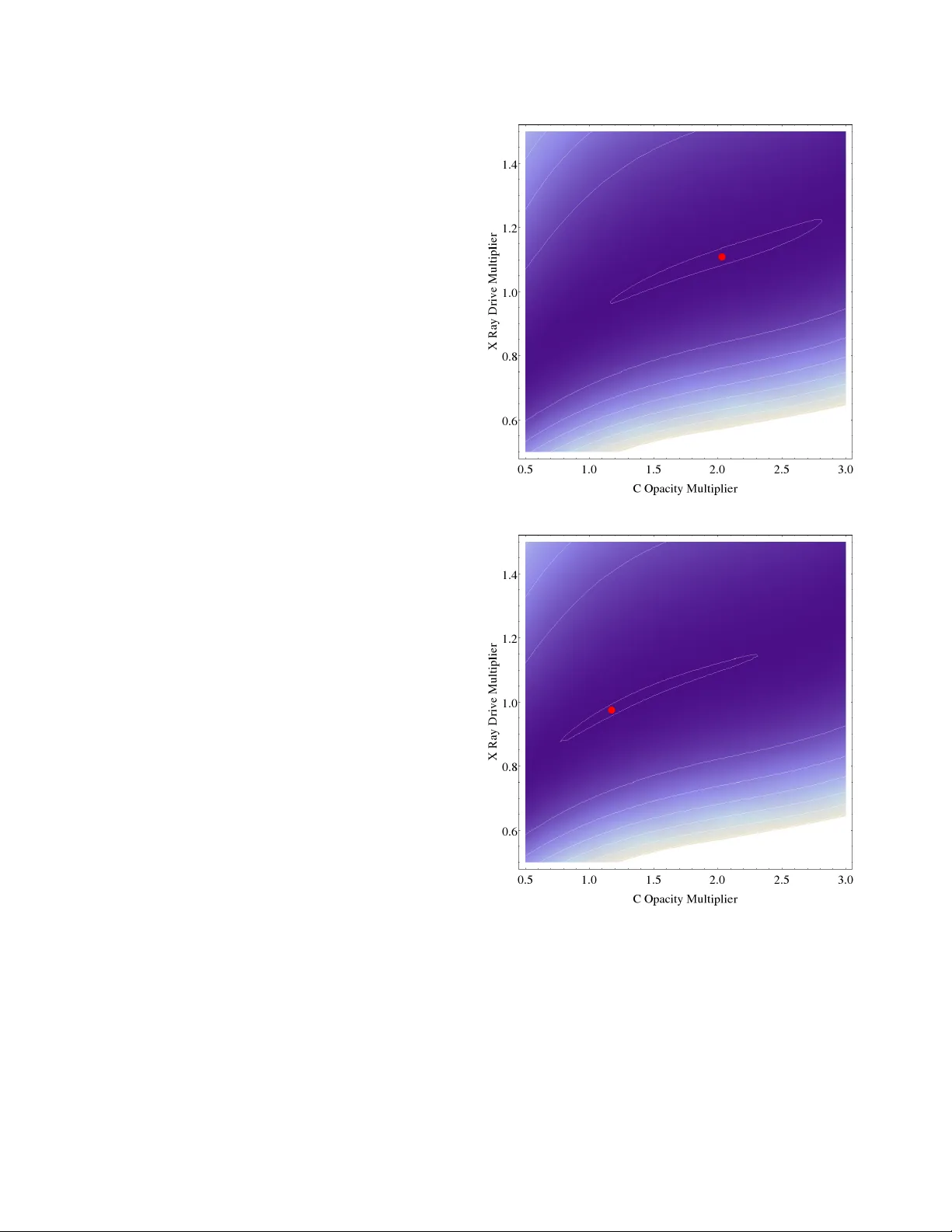
Dev elopmen t of a Ba y esian metho d for the analysis of inertial confinemen t fusion exp erimen ts on the NIF J.A. Gaffney a, ∗ , D. Clark a , V. Sonnad a , S.B. Libb y a a L awr enc e Livermor e National L ab or atory, 7000 East Ave, Livermor e, CA 94550 Abstract The complex nature of inertial confinement fusion (ICF) exp erimen ts results in a very large num b er of experimental parameters that are only known with limited reliability . These parameters, combined with the myriad ph ysical mo dels that gov ern target evolution, make the reliable extraction of physics from exp erimental campaigns very difficult. W e dev elop an inference metho d that allows all important exp erimental parameters, and previous kno wledge, to b e tak en in to account when inv estigating underlying microphysics models. The result is framed as a mo dified χ 2 analysis which is easy to implemen t in existing analyses, and quite p ortable. W e present a first application to a recent conv ergent ablator exp eriment p erformed at the NIF, and inv estigate the effect of v ariations in all physical dimensions of the target (v ery difficult to do using other metho ds). W e sho w that for well c haracterised targets in which dimensions v ary at the 0.5% level there is little effect, but 3% v ariations c hange the results of inferences dramatically . Our Ba yesian metho d allo ws particular inference results to b e asso ciated with prior errors in microphysics mo dels; in our example, tuning the carb on opacity to matc h exp erimental data (i.e., ignoring prior knowledge) is equiv alent to an assumed prior error of 400% in the tabop opacity tables. This large error is unreasonable, underlining the importance of including prior kno wledge in the analysis of these exp erimen ts. Keywor ds: inertial confinemen t fusion, radiation hydrodynamic simulation, Ba y esian inference, plasma opacity, uncertain ty analysis, conv ergent ablator, national ignition facility 1. In tro duction 1 The design of exp erimen tal sc hemes to reach thermonu- 2 clear ignition and burn in laser driven targets in v olves 3 complex mo dels that incorp orate man y physical effects 4 [1]. The radiation-h ydro dynamic sim ulations used to pre- 5 dict the evolution of fusion capsules [2] therefore con tain 6 a h uge num ber of ph ysical parameters whic h play an im- 7 p ortan t role. The resulting laser targets are corresp ond- 8 ingly complex, with a large num b er of design parameters. 9 In a t ypical inertial confinemen t fusion (ICF) experiment 10 p erformed at large laser facilities suc h as the national ig- 11 nition facility (NIF) [3], there are many tens of v ariables 12 that play an imp ortan t role in determining target ev olu- 13 tion [4]. This p oses a difficult problem for data analysis 14 since these parameters should not be neglected but are too 15 n umerous to treat directly using the standard methods of, 16 for example, particle ph ysics where Monte Carlo sampling 17 of noise sources is often used [5]. In this pap er w e develop 18 a metho d that allo ws all imp ortan t v ariables to b e in- 19 I This work performed under the auspices of the U.S. Depart- ment of Energy b y Lawrence Livermore National Lab oratory under Contract DE-AC52-07NA27344. LLNL-JRNL-614352 ∗ Corresponding author Email addr ess: gaffney3@llnl.gov (J.A. Gaffney) cluded, along with prior w ork on microph ysics models, in 20 a consisten t and efficient analysis. The approach has been 21 designed to couple with existing radiation-h ydro dynamics 22 sim ulation co des without modification; in fact sim ulations 23 are treated as a ‘black b o x’ making the method applicable 24 to a large class of difficult data analysis problems. This 25 approac h also allows us to av oid the complex fitting func- 26 tions used in other approac hes [6, 7], which are unlikely 27 to capture the complex behavior of ICF experiments close 28 to ignition (and are unsuitable for suc h large problems in 29 an y case). 30 The data analysis approac h that w e describ e is particu- 31 larly imp ortan t when considering the results of the recent 32 national ignition campaign (NIC). Throughout the cam- 33 paign, p ost-shot simulations failed to match the observed 34 data; the implication is that simulations, or their under- 35 lying microphysics mo dels, are inaccurate. Determining 36 whic h of the mo dels should be in vestigated, and pro duc- 37 ing a consisten t picture of the implied error, is a difficult 38 task and forms a ma jor motiv ation for this work. 39 In fact, modifications to v arious physical parameters, 40 ev en unrealistically large mo difications, often cannot pro- 41 duce a matc h to NIC data. In this situation the neglect 42 of imp ortant v ariables and prior knowledge has a dra- 43 matic effect on the results of inference (even if they are 44 Pr eprint submitte d to Elsevier Octob er 31, 2018 purely sources of noise). Our method allows these effects 45 to b e included with almost no computational ov erhead. 46 W e demonstrate this by presenting an analysis of a single 47 NIC conv ergent ablator (conA) shot [8, 9], N110625. W e 48 find that v ariations in the dimensions of the target can 49 ha ve a dramatic effect on the inferred drive and carb on 50 opacit y , although this is mitigated by thorough metrology 51 of the target. Our metho d also allows prior kno wledge to 52 b e included and in the case of ICF w e find that this is an 53 extremely imp ortant factor. W e use it to inv estigate the 54 implied error in microphysics models associated with ne- 55 glecting this prior w ork. The inclusion of this prior kno wl- 56 edge is an imp ortant strength of the Bay esian metho d, as 57 it provides con text for observed data and therefore allows 58 meaningful information to b e inferred even from a sin- 59 gle exp erimental result. The total information from a set 60 of exp erimen ts can be viewed as a series of such single- 61 shot inferences, allowing the analysis p erformed here to 62 b e generalised to full exp erimental campaigns very easily . 63 The approac h is to treat the output of the simula- 64 tion co de as probabilistic, and to apply standard meth- 65 o ds of Ba yesian analysis [10]. The probabilistic nature 66 of simulations is due to v ariations in the myriad imp or- 67 tan t v ariables (or ‘n uisance parameters’). W e deriv e a 68 semi-analytic expression in which the dep endence on in- 69 teresting ph ysics is retained but all other v ariables are 70 represen ted b y an analytic information loss. The result 71 is framed as a mo dified χ 2 analysis which is easy to im- 72 plemen t, p ortable, and allo ws all av ailable data to b e in- 73 cluded in a single analysis. 74 W e b egin b y elaborating on the challenges we hav e 75 already introduced. W e then dev elop our inference ap- 76 proac h in section 3, and discuss metho ds for its applica- 77 tion in section 4. Finally , the imp ortance of including 78 all imp ortan t v ariables and prior knowledge is demon- 79 strated with an example application to a single NIC shot, 80 N110625. 81 2. Challenges for data analysis from ICF exp eri- 82 men ts 83 In curren t analyses, particular data (chosen largely 84 through exp erience) are preferentially matched by v ary- 85 ing inputs that are considered to b e unreliable, such as 86 X ray drive [11, 12]. This approach has been v ery useful 87 in testing the consistency b et ween sim ulations and ex- 88 p erimen t, how ever it is potentially sensitive to noise and 89 giv es little information ab out the ph ysical origin of incon- 90 sistencies. Increasing the n umber of inferred parameters 91 is essential to gaining more information ab out underlying 92 ph ysics mo dels. 93 Radiation-h ydro dynamic simulations represen t a non- 94 linear map from the space of physical mo dels that we 95 wish to inv estigate to the data that are collected in an 96 exp erimen t. The nature of the simulations often means 97 that they are not amenable to adjoint differentiation [13], 98 are discon tinuous, and may b e noisy; these complex fea- 99 tures can mak e standard metho ds of searching the space 100 of physical parameters quite unreliable. This limits the 101 n umber of parameters that can b e reliably inferred. The 102 n uisance parameters included by our metho d result in a 103 smo othing of the co de output, allowing the use of ad- 104 v anced methods and an increase in the num ber of physical 105 parameters that can b e in v estigated. 106 W e hav e already describ ed the difficulties asso ciated 107 with the large n umbers of target parameters inv olv ed 108 in ICF experiments. Although many of these are con- 109 strained b y manufacturing precision and target metrol- 110 ogy , it has already been seen that their large num b er can 111 ha ve an imp ortant impact on the output of sim ulation 112 co des [4]. There will b e a corresp onding effect on infer- 113 ence results, and w e aim to inv estigate this. 114 The physical parameters we aim to infer often refer to 115 microscopic physics (for example opacities or equations 116 of state) that are understo o d using other, separate, com- 117 puter simulations. These simulations are highly complex 118 and hav e b een inv estigated b oth theoretically and exp eri- 119 men tally for many decades; the exp ected systematic error 120 bars on their outputs are therefore quite small. This error 121 bar plays an important role in data analysis by ensuring 122 that the results are ph ysically reasonable, and this moti- 123 v ates our Bay esian approac h. 124 3. Probabilistic output from a deterministic sim- 125 ulation co de – the imp ortance of n uisance pa- 126 rameters 127 The fundamen tal problem is to develop a metho d of 128 exploring the h uge space of parameters that can affect 129 the outcome of a sim ulation. As discussed, in the case 130 of ICF data there is no p oin t in this space for whic h all 131 data are correctly simulated. In general there may b e a 132 set of p oin ts that give comparable agreement. The b est 133 fit is found by defining a figure of merit that takes into 134 accoun t the difference b etw een observ ed and simulated 135 v alues of all data p oints, as well as the difference b etw een 136 sim ulation parameters and the exp ected ph ysical realit y . 137 In this section we outline a figure of merit that is based 138 on the Bay esian posterior probability of a p oin t in phase 139 space (the maximum a p osteriori , or MAP , solution [10]), 140 and use an analytic prior-predictive approach to reduce 141 the phase space to manageable size. 142 W e b egin by splitting the set of all parameters in to t w o; 143 • ‘Interesting Parameters’ θ - Ph ysically significan t pa- 144 rameters that w e aim to infer from experiment data. 145 F or example material equation of state, opacities, 146 conductivities, ..., 147 • ‘Nuisance P arameters’ η – Other parameters that 148 ha ve an effect on simulations but are not of direct 149 ph ysical significance. These are usually known with 150 2 go od precision, for example target dimensions, laser 151 p o w ers, ..., 152 In our mo del, inference is p erformed on the in teresting parameters only . Bay es’ theorem allows us to write do wn the probabilit y distribution of the in teresting parameters once the exp erimen t has b een p erformed (the p osterior ), in terms of the probabilit y distribution before the exp eri- men t (the prior ) and the probabilit y of the experimental data (the likeliho o d ). Bay es’ theorem is P ( θ | d exp ) = P ( d exp | θ ) P ( θ ) P ( d exp ) = R R dη dd m P ( d exp , d m , θ , η ) P ( d exp ) , where d exp is the v ector of experimental data and w e ha ve introduced the co de output d m and the nuisance parameters as marginalised v ariables. This allows us to in tro duce the kno wn measuremen t error and prior distri- butions of the n uisance parameters later. Such an ap- proac h is equiv alent to assuming that exp erimental data are the simulation results plus a randomly distributed error, as is done in other approaches [7, 15]. W riting P ( d exp , d m , θ , η ) = P ( d exp | d m , θ , η ) P ( d m | θ , η ) P ( θ, η ) and in tro ducing the deterministic nature of the sim ulation co de, P ( d m | θ , η ) = δ ( d m − d m ( θ , η )) , the integration o ver d m can b e p erformed trivially . The result is P ( θ | d exp ) = P ( θ ) P ( d exp ) Z dη P ( d exp | d m ( θ , η )) P ( η ) ≡ P ( θ ) P ( d exp ) P ( d exp | θ ) , (1) The lik elihoo d P ( d exp | d m ( θ , η )) implicitly con tains the 153 exp erimen tal error distribution and the co de output as a 154 function of all parameters d m ( θ , η ). The tw o comp onents 155 of the prior distribution P ( θ , η ) ≡ P ( θ ) P ( η ) describ e the 156 exp ected distributions of n uisance and interesting param- 157 eters b efore the exp eriment has b een p erformed; these 158 are determined b y the exp erimen tal design, target man- 159 ufacturing tolerances, previous exp erimental results and 160 exp ert opinion. 161 Equation (1) describ es the relationship betw een the 162 probabilit y distributions of the in teresting parameters b e- 163 fore and after an exp eriment. The details of the relation- 164 ship are approximated by the simulation code, and con- 165 tained in the likelihoo d function. Data analysis, then, is 166 based on the ev aluation of the in tegral in the definition 167 of the lik eliho o d. In its general form this inv olv es the 168 in tegration of simulation output ov er the en tire nuisance 169 parameter space; it is common to ev aluate this using a 170 Mon te-Carlo sampling of the integrand (see, for example, 171 [16]). F or our application, where even a conserv ativ e set 172 of n uisance parameters results in a ∼ 20 dimensional in te- 173 gral, this is prohibitiv ely expensive. Even if the radiation- 174 h ydro dynamics can b e mo delled by some fast surrogate 175 mo del (as a Gaussian Process or through other tec hniques 176 [6, 7, 17]), which itself is very difficult given the size of 177 the space w e must consider, the integral is still to o ex- 178 p ensiv e. W e instead ev aluate the integral by assuming a 179 linear resp onse to n uisance parameters, 180 d m ( θ , η ) = d m ( θ , η = η 0 ) + A ( η 0 − η ) . (2) In the ab ov e η 0 is the nominal v alue of the nuisance pa- 181 rameters, t ypically zero. The linear response matrix A 182 can b e populated using a small num ber of simulations; 183 once this has b een done, the matrix A is entirely portable 184 and may be used in all subsequent analyses of this type 185 without further calculation. 186 The case of linear resp onse, equation (2), is v ery useful 187 as it allows an analytic treatmen t of the n uisance parame- 188 ters. Assuming that the exp erimen tal measurement errors 189 and nuisance parameter v ariations are describ ed by un- 190 correlated normal distributions with correlation matrices 191 Λ exp and Λ η , 192 P ( d exp | θ ) = Z dη e − ( d exp − d m ( θ,η )) T Λ − 1 exp ( d exp − d m ( θ,η )) p (2 π ) n exp | Λ exp | × × e − ( η − η 0 ) T Λ − 1 η ( η − η 0 ) p (2 π ) n η | Λ η | , the result is 193 P ( d exp | θ ) = e − ( d exp − d m ( θ )) T [ Λ − 1 exp − β T β ] ( d exp − d m ( θ )) p (2 π ) n exp | Λ exp || Λ η || α T α | . (3) In the ab o ve, d m ( θ ) ≡ d m ( θ , η 0 ) is the simulation result for nominal nuisance parameters and the matrices α and β satisfy the equations α T α = A T Λ − 1 exp A + Λ − 1 η β T α = Λ − 1 exp A . These expressions are the multiv ariate generalisation of 194 the usual quadrature error propagation formula; it should 195 b e noted that even if n uisance parameters and exp erimen- 196 tal errors are independent to b egin with (i.e., if Λ exp and 197 Λ η are diagonal), the resp onse of the simulations means 198 that the lik eliho o d can become strongly correlated. These 199 p oten tially strong correlations arise due to the determin- 200 istic nature of the simulation code and play a v ery imp or- 201 tan t role in the inference pro cedure describ ed in the next 202 section. 203 4. Inference of in teresting parameters from exp er- 204 imen tal data 205 The results of the previous section allow the efficien t 206 calculation of the lik eliho o d as a function of interesting 207 3 parameters, without neglecting other important v ariables 208 or prior kno wledge. As discussed in section 2, this can b e 209 exp ected to give a significan t impro v ement in data anal- 210 ysis results. The marginalisation of n uisance parameters 211 represen ts an a v eraging that smooths the response of sim- 212 ulations, making them more well-behav ed. This allows us 213 to use standard n umerical techniques. 214 The b est fit to data, taking into accoun t nuisance pa- 215 rameters and prior knowledge, is given by the parameters 216 that maximise the p osterior probability P ( θ | d exp ) (see 217 equation (1)). It is conv enien t to minimise the informa- 218 tion, I ( θ | d exp ) = − Log P ( θ | d exp ), which using equations 219 (1) and (3) is 220 I ( θ | d exp ) = X i ( d exp,i − d m ( θ ) i ) 2 σ 2 exp,i − ( d exp − d m ( θ )) T β T β ( d exp − d m ( θ )) + 1 2 ln | Λ η || α T α | − ln P ( θ ) . (4) The ab o v e equation has the form of a modified χ 2 func- 221 tion, and is derived b y assuming that Λ exp is diagonal. 222 Note that the dep endence of the first term on θ through 223 the simulation d m ( θ ) means that even in the absence of 224 n uisance parameters and prior kno wledge the lik eliho o d is 225 non-normal. Equation (4) can b e interpreted as an infor- 226 mation processing rule [18]; the first 3 terms on the righ t 227 hand side are the information gained from the exp eriment, 228 and the final term is the information ab out the interesting 229 parameters before the experiment w as performed. In that 230 sense it is clear that the p ositive definite matrix β T β rep- 231 resen ts a loss of information due to n uisance parameters. 232 As mentioned, once β T β has b een computed the ev alua- 233 tion of the mo dified χ 2 only requires a single sim ulation. 234 In an actual inference problem w e are interested in the 235 v alues of θ that giv e the b est fit to the experime n tal data. 236 This requires the numerical minimisation of equation (4). 237 The well b eha ved nature of the marginalised lik eliho od al- 238 lo ws us to use standard methods; t wo common approaches 239 are 240 • Marko v Chain Monte Carlo (MCMC) – This ap- 241 proac h gives an appro ximation to the entire poste- 242 rior information [19]. This is extremely useful to 243 the ev aluation of error bars on inferred parameters. 244 The trade-off is that these metho ds require extensive 245 ‘burn in’ p erio ds and are difficult to run in parallel. 246 In our applications where a single simulation repre- 247 sen ts a significan t computational ov erhead, this is a 248 ma jor disadv an tage; 249 • Genetic Algorithm (GA) – This metho d uses ideas 250 tak en from genetics to efficiently find the minimum 251 of a function. It is very easy to run in parallel and 252 so is w ell suited to our application. The final result 253 is the p osition of the minimum only and so some 254 appro ximation is required to calculate error bars [10], 255 In the following section we presen t an example applica- 256 tion of the metho d. F or simplicity the parameter space is 257 small allowing the lik eliho od and p osterior to b e explored 258 directly . The adv anced techniques discuss ed abov e are 259 therefore not needed. In a forthcoming paper we con- 260 sider more complex cases for which we dev elop a genetic 261 algorithm that is optimised for the sparse datasets en- 262 coun tered in ICF research. 263 5. Application to NIF con vergen t ablator exp eri- 264 men tal data 265 In order to demonstrate the application to an actual 266 inference problem, w e now consider exp erimental data 267 tak en on a NIC con vergen t ablator (conA) exp eriment 268 [8, 9]. In this design, an ICF capsule is implo ded and 269 bac klit b y emission from a nearb y high Z plasma. This al- 270 lo ws time- and space- resolv ed measuremen t of the plasma 271 densit y during the implosion. This is analysed to give 272 time resolved measuremen t of fuel shell p osition, velocity , 273 and line density . Simple mo dels sho w that these quanti- 274 ties are sensitiv e to the details of the X ra y drive from 275 the hohlraum, and to radiation transp ort in the capsule 276 ablator [1]. 277 In these experiments the measured implosion v elo cities 278 are consistently low er than simulated predictions, p ossi- 279 bly suggesting a reduced X ra y driv e. Absorption of the 280 driv e X ra ys by carb on in the ablator plastic also plays an 281 imp ortan t role, and simulations show that an increased 282 carb on opacity can impro ve agreement [14]. These pa- 283 rameters can b e used to tune simulations to agree with 284 exp erimen t, ho w ever suc h an approach runs the risk of de- 285 stro ying the predictive capabilities of co des when run far 286 from existing exp erimental data (a common o ccurrence in 287 all areas of HEDP , and a p ossible problem when design- 288 ing improv ed ICF targets). W e aim to analyse the signif- 289 icance of these exp erimen tal results with resp ect to the 290 driv e and carb on opacit y b y inferring the v alues of mo di- 291 fiers to those quantities in the presence of many nuisance 292 parameters and of prior knowledge. The prior distribu- 293 tions that we place on these m ultipliers are interpreted 294 as the uncertainties in the off-line calculations of opacity 295 and driv e. 296 The inference is based on the HYDRA radiation- 297 h ydro dynamics co de [20]. The parameters of in terest are 298 the v alues of tw o dimensionless multipliers; one is applied 299 to the X ray driv e sp ectrum (at all times and photon 300 energies) and the other is applied to the carb on opac- 301 it y (all temp eratures, densities and photon energies). W e 302 tak e into account 29 nuisance parameters, allo wing all 303 capsule dimensions, material densities and material com- 304 p ositions [4] to v ary . These parameters are allo w ed to 305 v ary according to tw o distributions with standard devia- 306 tions of 0 . 5% and 3% resp ectiv ely . These represent w ell 307 constrained target parameters (many NIC capsule dimen- 308 sions are known to b etter than 0 . 5%), and ones with 309 4 more uncertaint y (demonstrating the p oten tial effect of 310 n uisance parameters on inferred physics). F or this rel- 311 ativ ely small inference it is feasible to generate a set of 312 sim ulations that span the 2D parameter space. F or each 313 p oin t, defined b y the multipliers (∆ driv e , ∆ C opac ), we run 314 HYDRA and extract the implosion velocity , ablator mass 315 fraction, and time at whic h the implosion reac hes a r adius 316 of 310 µ m. These quan tities are compared to experimental 317 v alues taken from radiograph y [21]. 318 In figure 1 w e plot the information in the lik eliho o d as 319 a function of ∆ driv e and ∆ C opac , calculated using equa- 320 tion (3) with different v alues of the mo dification matrix 321 β T β . These plots represent our modified χ 2 when the 322 prior distribution P ( θ ) is neglected. In (a) nuisance pa- 323 rameters are neglected ( β T β = 0), and in (b) the mo di- 324 fication is calculated as described for all 29 nuisance pa- 325 rameters v arying at the 3% lev el. In the case with 0 . 5% 326 v ariations, nuisance parameters ha ve a small effect and 327 the likelihoo d is very similar to figure 1(a). The p ositions 328 of the minima are marked with red p oints, making the ef- 329 fect of n uisance parameters clear. This shift in minim um 330 is v ery imp ortan t in the subsequent analysis. 331 T o further quantify the differences we p erform a set 332 of inferences based on the calculated likelihoo ds. The 333 sp ecific c hoice of prior distribution is often a difficult is- 334 sue since it can b e a sub jective choice that has a direct 335 influence on inference results. F or this reason we per- 336 form a range of inferences with prior distributions for 337 (∆ driv e , ∆ C opac ) of v arying width. This allows us to tak e 338 in to account the dep endence of the inference results on 339 the prior, and place limits on the actual prior for v arious 340 results. 341 W e b egin with a reasonable estimate of the uncertain- 342 ties in opacity and drive models of 10% and 20% resp ec- 343 tiv ely . This defines our nominal prior as a normal distri- 344 bution cen tered on (1 , 1), with cov ariance matrix 345 Λ p = 0 . 1 2 0 0 0 . 2 2 . (5) A set of inference results are found b y scaling this cov ari- 346 ance, thereb y c hanging the assumed prior error in micro- 347 ph ysics mo dels (and the relativ e importance of prior and 348 exp erimen tal information). F or a very large scaling of (5), 349 the prior is flat and our analysis repro duces the maxim um 350 lik eliho o d (ML) result; for a small scaling factor the prior 351 tends to a δ -function and the minim um of equation (4) is 352 at (∆ driv e , ∆ C opac ) = (1 , 1) (their prior v alues). 353 In figure 2 w e plot the tra jectories of the b est fit as 354 the prior cov ariance is scaled from small to large. The 355 tra jectory for calculations that neglect n uisance parame- 356 ters, and that include them at the 0 . 5% level, ov erlay eac h 357 other and are shown in purple; note the slight shift in the 358 ML result at the righ t hand end. The 3% case is plotted 359 in green. The shap es of the tra jectories are determined 360 b y all the factors we hav e discussed so far, not least the 361 (a) No nuisanc e p ar ameters (b) Line ar model for nuisanc e p ar ameters with 3% variations Figure 1: Information in the lik elihoo d for multipliers placed on the carbon opacity and X ray drive for a NIC conA exp erimen t. P anel (a) sho ws the result when no n ui- sance parameters are included, and (b) sho ws the effect of including target metrology as n uisance parameters. 5 Figure 2: T ra jectories of the b est fit to exp erimen tal data from a NIC conA exp erimen t, as the prior width is v aried (see equation (5)). The blue line shows the result when n uisance parameters are ignored, or included at the 0 . 5% lev el. The t wo red points at the right hand end represent the maxima of the likelihoo d for these t wo cases. The green line shows the case when nuisance parameters are included at the 3% level. As the prior is scaled from a δ -function, through our b est estimated defined b y (5), to flat, the inferred results tracks from the prior results (1 , 1) to the minimum of the likelihoo d functions plotted in figure 1. The figure also shows contours that define a c hange in multiplier of 5% from eac h end p oin t. shap e of the lik elihoo d (i.e., the effect of n uisance param- 362 eters). The left hand end of the tra jectories corresp onds 363 to small prior error and reproduces the prior result. The 364 righ t hand end of each line is the flat prior result; as w e 365 ha ve already seen in figure 1 the inclusion of nuisance pa- 366 rameters at the 3% lev el has a very significant effect on 367 the inferred v alues of our interesting parameters. 368 The wide difference b et ween the start and end points of 369 all tra jectories in figure 2 clearly shows that the prior dis- 370 tribution has an extremely imp ortan t role to play in our 371 analysis. F or our nominal prior, defined by the co v ariance 372 (5), w e find that the prior is in fact more imp ortant than 373 the details of the n uisance parameters regardless of their 374 distribution widths, giving inference results that are al- 375 most the same; (∆ driv e , ∆ C opac ) = (1 . 03 , 0 . 94). The ML 376 analysis, that neglects the prior, will then result in a sig- 377 nifican tly differen t result. This is true even for extremely 378 broad priors; for our MAP analysis (which includes b oth 379 prior and nuisance parameters) to repro duce the 0 . 5% n ui- 380 sance parameter ML result to within 5% (shown by the 381 dashed contours in figure 2), the prior cov ariance must 382 b e scaled so that the prior errors in opacity and driv e are 383 more than 400% and 800% resp ectiv ely . The simulations 384 on whic h the opacity and driv e are based can b e expected 385 to b e m uch more accurate that this, giving further sup- 386 p ort to the importance of the prior. 387 6. Discussion and Conclusions 388 W e hav e dev elop ed a Ba yesian mo del for in vestigation 389 of underlying ph ysics using complex HED exp erimen ts. 390 The mo del allows for the inclusion of complications aris- 391 ing in exp erimen ts by using an approximate description 392 of so-called n uisance parameters, and of previous inv esti- 393 gations through a Bay esian prior. The result is a mo di- 394 fied χ 2 function that can be easily incorporated in to any 395 analysis using standard metho ds. This approac h allows 396 complex simulations to b e treated as black b o x transfor- 397 mations from physical mo dels to exp erimental data and 398 so is suitable for application in a wide range of physi- 399 cal applications. The linear resp onse mo del describ ed is 400 the basis of the usual ‘Normal Linear’ model [10]. Ho w- 401 ev er, unlike that mo del, the use of complex simulations 402 to describ e in teresting parameters and the resultan t cor- 403 relations b etw een nuisance parameters results in a non- 404 normal p osterior. 405 In the case of ICF experiments, the linear resp onse 406 appro ximation ma y not b e sufficient. The difficult task 407 of achieving thermonuclear ignition requires that target 408 designs are highly optimised; a c hange in n uisance pa- 409 rameters in either direction is lik ely to pro duce a reduc- 410 tion in target p erformance. Such nonlinear behavior can 411 b e imp ortan t, and is not captured by the curren t ap- 412 proac h. T est calculations for a reduced problem, includ- 413 ing quadratic resp onse to nuisance parameters, suggests 414 that these eff ects are significant in the analysis of ICF 415 data. A ma jor piece of further work is to develop an effi- 416 cien t wa y of including nonlinearit y . 417 In the final sections of this paper we hav e applied our 418 analysis to a single NIC experiment. W e attempt to de- 419 scrib e deficiencies in radiation transp ort physics through 420 m ultipliers on t wo physical quan tities, and infer the p oste- 421 rior v alues of these multipliers. This pro cess is a common 422 one in the analysis of NIF data, and is usually view ed as 423 the tuning of sim ulations to allo w more reliable target de- 424 sign. In this work w e in terpret the results of this pro cess 425 as a measure of the uncertain t y in the underlying physi- 426 cal mo dels, whic h are often applied in regimes where they 427 are un tested. Only b y impro v ement of these models, mo- 428 tiv ated b y the kind of data analysis described here, can a 429 truly predictiv e simulation b e developed. 430 The particular example giv en here is sufficient to 431 demonstrate the imp ortance of an in tegrated approac h 432 to data analysis, and provides comp elling evidence that 433 a straigh tforw ard fit to experimental data, ignoring prior 434 kno wledge, can giv e misleading results. F or the very well 435 c haracterised targets used at the NIF, certain dimensions 436 are kno wn to b etter than the 0 . 5% accuracy we allow in 437 this w ork, ho wev er other n uisance parameters (for exam- 438 ple material densities) could v ary ov er a larger range. W e 439 ha ve demonstrated that these nuisance parameters may 440 ha ve an imp ortan t effect; our metho d allo ws a complete 441 description of the problem. Alongside the nuisance pa- 442 6 rameters that we hav e included in this demonstration, 443 there are also many other simulation inputs which can b e 444 treated as n uisance parameters in the same wa y . 445 W e demonstrated a nov el metho d of analysing the im- 446 p ortance of prior knowledge by referencing the p ossi- 447 ble conclusions from data to limits on prior distribu- 448 tion widths. The multipliers used here do not, how ev er, 449 pro vide an insight in to sp ecific problems in underlying 450 ph ysics; it is also true that these multipliers only describ e 451 the av erage mo dification to theory that is required. Any 452 inferred physical mo difier will lose its meaning when the 453 sim ulations used in the inference hav e other unknown in- 454 accuracies, and this is certainly the case in our first ap- 455 plication. W e b egin addressing these problems in a forth- 456 coming pap er. 457 The work presented here represen ts the first steps to 458 pro viding a clearer view of problems with ph ysics mo d- 459 els from exp erimental data, in cases where the exp eri- 460 men ts are very complex. Although we concentrate on 461 ICF exp erimen ts here, n uisance parameters can b e ex- 462 p ected to b e imp ortant in all HED experiments, in partic- 463 ular those where target plasmas are less well constrained. 464 The p ortabilit y of our method makes its application to 465 other exp eriments very easy . The computational frame- 466 w ork described also provides the opportunit y for Ba yesian 467 exp erimen tal design [22], allowing future exp erimen ts to 468 pro vide a significan t measurement of difficult asp ects of 469 underlying physics [23]. The integrated approac h that 470 w e propose ma y also facilitate disco very of new rules and 471 phenomenology that go vern the evolution of these com- 472 plex systems. 473 References 474 [1] A TZENI, S. and MEYER-TER VEHN, J., The 475 Physics of Inertial F usion , v olume 125 of Internation 476 Series of Mono gr aphs on Physics , Oxford Science, 477 2004. 478 [2] CASTOR, J., R adiation Hydr o dynamics , Cambridge 479 Univ ersity Press, 2004. 480 [3] MOSES, E., IEEE T ransactions on Plasma Science 481 38 (2010) 684. 482 [4] HAAN, S., LINDL, J., CALLAHAN, D., et al., 483 Ph ysics of Plasmas 18 (2011) 051001. 484 [5] L YONS, L., The Annals of Applied Statistics 2 485 (2008) 887. 486 [6] MCCLARREN, R. G., R YU, D., DRAKE, R. P ., 487 et al., Reliabilit y Engineering & System Safety 96 488 (2011) 1194 . 489 [7] KENNEDY, M. C. and O’HA GAN, A., Journal of 490 the Roy al Statistical So ciet y: Series B (Statistical 491 Metho dology) 63 (2001) 425. 492 [8] HICKS, D. G., SPEARS, B. K., BRA UN, D. G., 493 et al., Physics of Plasmas 17 (2010) 102703. 494 [9] HICKS, D. G., MEEZAN, N. B., DEW ALD, E. L., 495 et al., Physics of Plasmas 19 (2012) 122702. 496 [10] SIVIA, D., Data Analysis: A Bayesian T utorial , 497 Clarendon Press, 1996. 498 [11] ROBEY, H. F., BOEHL Y, T. R., CELLIERS, P . M., 499 et al., Physics of Plasmas 19 (2012) 042706. 500 [12] GU, J., ZOU, S., LI, Y., DAI, Z., and YE, W., 501 Ph ysics of Plasmas 19 (2012) 122710. 502 [13] HANSON, K. and CUNNINGHAM, G., Pro ceedings 503 of the SPIE 3338 (1998) 371. 504 [14] CLARK, D., Capsule modeling of ConAbl N101220, 505 Presen ted at NIC W orkshop, April 18 2011. 506 [15] HIGDON, D., NAKHLEH, C., GA TTIKER, J., and 507 WILLIAMS, B., Computer Methods in Applied Me- 508 c hanics and Engineering 197 (2008) 2431 . 509 [16] ROE, B. P ., Nuclear Instruments and Metho ds 510 in Physics Research Section A: Accelerators, Spec- 511 trometers, Detectors and Asso ciated Equipmen t 570 512 (2007) 159 . 513 [17] SACKS, J., WELCH, W., MITCHELL, T., and 514 WYNN, H., Statistical Science 4 (1989) 409. 515 [18] ZELLNER, A., The American Statistician 42 (1988) 516 278. 517 [19] GREEN, P ., Biometrik a 82 (1995) 711. 518 [20] MARINAK, M. M., KERBEL, G. D., GENTILE, 519 N. A., et al., Physics of Plasmas 8 (2001) 2275. 520 [21] HICKS, D. Private c ommunic ation 521 [22] CHALONER, K. and VERDINELLI, I., Statistical 522 Science 10 (1995) 273. 523 [23] FISCHER, R., DREIER, H., DINKLA GE, A., 524 KURZAN, B., and P ASCH, E., In tegrated bay esian 525 exp erimen tal design, in KNUTH, K., ABBAS, A., 526 MORRIS, R., and CASTLE, J., editors, Bayesian 527 Infer er enc e and Maximum Entr opy Metho ds in Sci- 528 enc e and Engine ering , 2005. 529 7
Original Paper
Loading high-quality paper...
Comments & Academic Discussion
Loading comments...
Leave a Comment