Broad-band Jet Emission in Young and Powerful Radio Sources: the Case of the CSS Quasar 3C 186
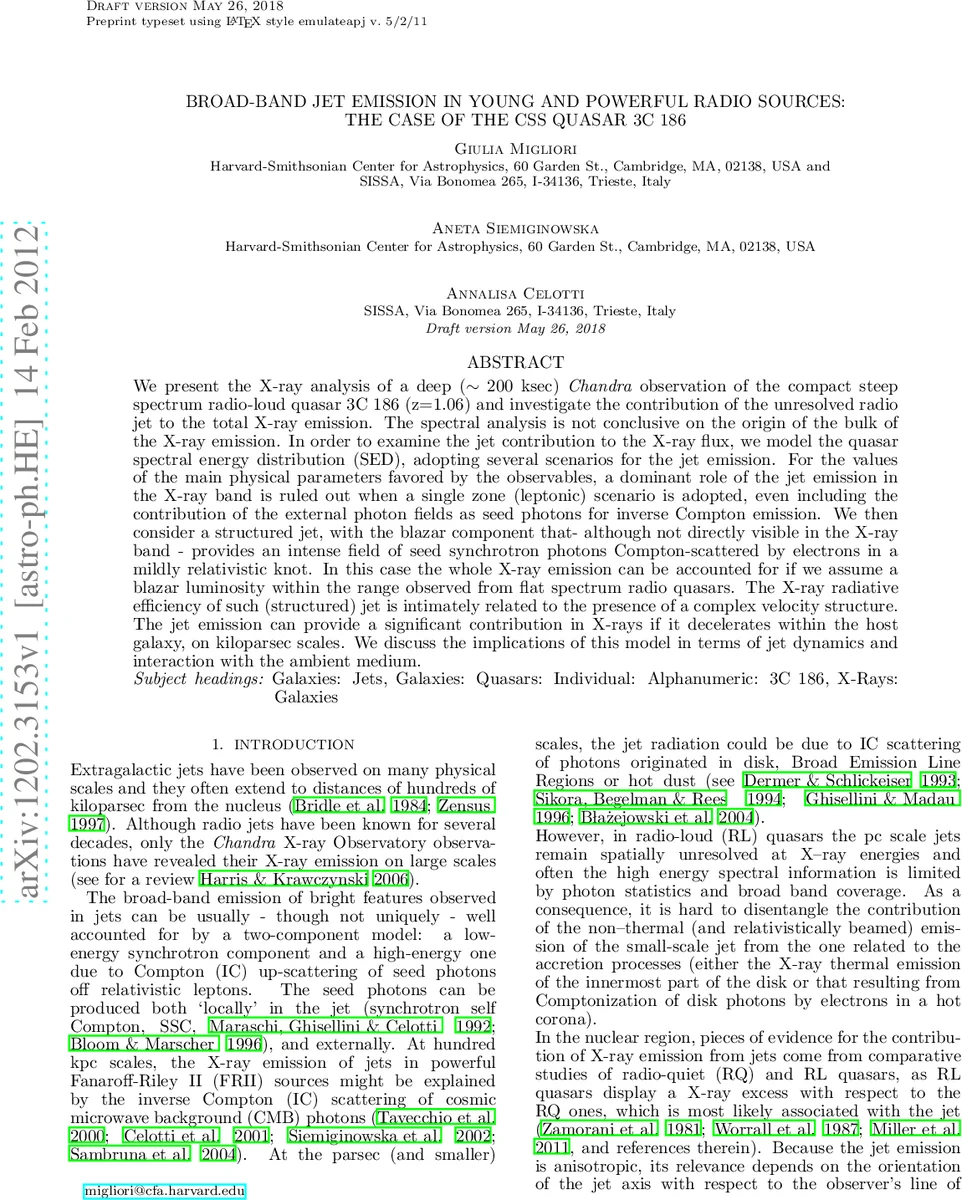
We present the X-ray analysis of a deep ~200 ksec Chandra observation of the compact steep spectrum radio-loud quasar 3C 186 (z=1.06) and investigate the contribution of the unresolved radio jet to the total X-ray emission. The spectral analysis is not conclusive on the origin of the bulk of the X-ray emission. In order to examine the jet contribution to the X-ray flux, we model the quasar spectral energy distribution (SED), adopting several scenarios for the jet emission. For the values of the main physical parameters favored by the observables, a dominant role of the jet emission in the X-ray band is ruled out when a single zone (leptonic) scenario is adopted, even including the contribution of the external photon fields as seed photons for inverse Compton emission. We then consider a structured jet, with the blazar component that- although not directly visible in the X-ray band - provides an intense field of seed synchrotron photons Compton-scattered by electrons in a mildly relativistic knot. In this case the whole X-ray emission can be accounted for if we assume a blazar luminosity within the range observed from flat spectrum radio quasars. The X-ray radiative efficiency of such (structured) jet is intimately related to the presence of a complex velocity structure. The jet emission can provide a significant contribution in X-rays if it decelerates within the host galaxy, on kiloparsec scales. We discuss the implications of this model in terms of jet dynamics and interaction with the ambient medium.
💡 Research Summary
**
The authors present a comprehensive X‑ray study of the compact steep‑spectrum (CSS) radio‑loud quasar 3C 186 (z = 1.06) using a deep ∼200 ks Chandra observation, complemented by the earlier 200 ks dataset. 3C 186 is a luminous quasar (L_bol ≈ 10^47 erg s⁻¹) with a small (∼1.6 kpc) radio structure consisting of two lobes and a knotty jet, embedded in a rich X‑ray cluster at high redshift. The nuclear X‑ray spectrum, extracted from a 1.5″ radius region, is well described by a simple power‑law (Γ ≈ 2.0) with no statistically significant Fe Kα line, leaving the origin of the bulk X‑ray emission ambiguous.
To disentangle thermal (accretion‑related) from non‑thermal (jet‑related) contributions, the authors construct a broadband spectral energy distribution (SED) that includes radio core and lobe data, the optical–UV big blue bump (L_UV ≈ 5.7 × 10^46 erg s⁻¹), infrared torus emission, and the Chandra X‑ray points. They then test two leptonic jet scenarios.
1. Single‑zone (homogeneous) leptonic model
In this conventional picture a single emitting region produces synchrotron radiation, synchrotron‑self‑Compton (SSC) emission, and external‑Compton (EC) scattering of photons from the accretion disk, broad‑line region (BLR), and dusty torus. By adopting parameters that reproduce the observed radio–optical fluxes (magnetic field B ≈ 0.1 G, electron minimum Lorentz factor γ_min ≈ 10, bulk Lorentz factor Γ ≈ 5–10), the model predicts an X‑ray output that is only ~30 % of the measured 2–10 keV luminosity (L_X ≈ 1.2 × 10^45 erg s⁻¹). Moreover, the spectral shape is too soft at low energies. Consequently, a single homogeneous zone cannot account for the X‑ray dominance, implying that the jet does not dominate the X‑ray band under this assumption.
2. Structured‑jet (two‑zone) model
Motivated by recent evidence for velocity stratification in AGN jets, the authors introduce a fast “blazar” component (Γ_bl ≈ 10–15) that emits intense synchrotron photons, and a slower downstream knot (Γ_knot ≈ 2) that sees these photons as an external radiation field. The fast zone’s synchrotron luminosity is set to values typical of flat‑spectrum radio quasars (L_syn ≈ 10^46 erg s⁻¹). The knot’s electron distribution (γ_min ≈ 100, B ≈ 0.05 G) up‑scatters the blazar photons via EC, producing X‑ray emission that matches both the flux level and the observed photon index. This configuration requires that the jet decelerates on kiloparsec scales, a plausible outcome of interaction with the dense interstellar medium of the host galaxy or the surrounding cluster gas.
The structured‑jet scenario naturally yields a high X‑ray radiative efficiency because the seed photon density from the blazar zone far exceeds that of the external fields (disk, BLR, torus). The model also explains why the X‑ray spectrum appears similar to that of radio‑quiet quasars (α_ox ≈ 1.5) despite the source’s high radio loudness: the X‑rays are dominated by EC off internally produced photons rather than by a pure coronal component.
Implications
The analysis demonstrates that for young, compact radio sources like 3C 186, jet dynamics cannot be captured by a single homogeneous region. A velocity‑structured jet, with a fast spine feeding seed photons to a slower sheath or knot, can dominate the X‑ray output. This has several broader consequences:
- Jet–environment feedback: Deceleration on kpc scales implies substantial momentum transfer to the ambient medium, potentially influencing the cooling of the surrounding X‑ray cluster core and regulating black‑hole growth.
- Evolutionary considerations: CSS/GPS sources may already develop complex velocity structures early in their life cycles, affecting how they evolve into large‑scale FR II radio galaxies.
- Observational prospects: High‑resolution VLBI imaging could resolve the predicted spine–sheath morphology; deeper γ‑ray observations (e.g., with the Fermi‑LAT) might detect the high‑energy counterpart of the blazar component, providing a direct test of the model.
In summary, the paper provides a thorough X‑ray spectral analysis of 3C 186, shows that a single‑zone leptonic jet model fails to explain the observed X‑ray luminosity, and proposes a structured jet with a fast blazar core and a slower knot as a viable solution. This work highlights the importance of jet velocity stratification in young radio quasars and sets the stage for future multi‑wavelength campaigns aimed at probing jet dynamics and their feedback on the host galaxy and cluster environment.
Comments & Academic Discussion
Loading comments...
Leave a Comment