Determining Key Model Parameters of Rapidly Intensifying Hurricane Guillermo(1997) using the Ensemble Kalman Filter
In this work we determine key model parameters for rapidly intensifying Hurricane Guillermo (1997) using the Ensemble Kalman Filter (EnKF). The approach is to utilize the EnKF as a tool to only estimate the parameter values of the model for a particu…
Authors: Humberto C. Godinez, Jon M. Reisner, Alex
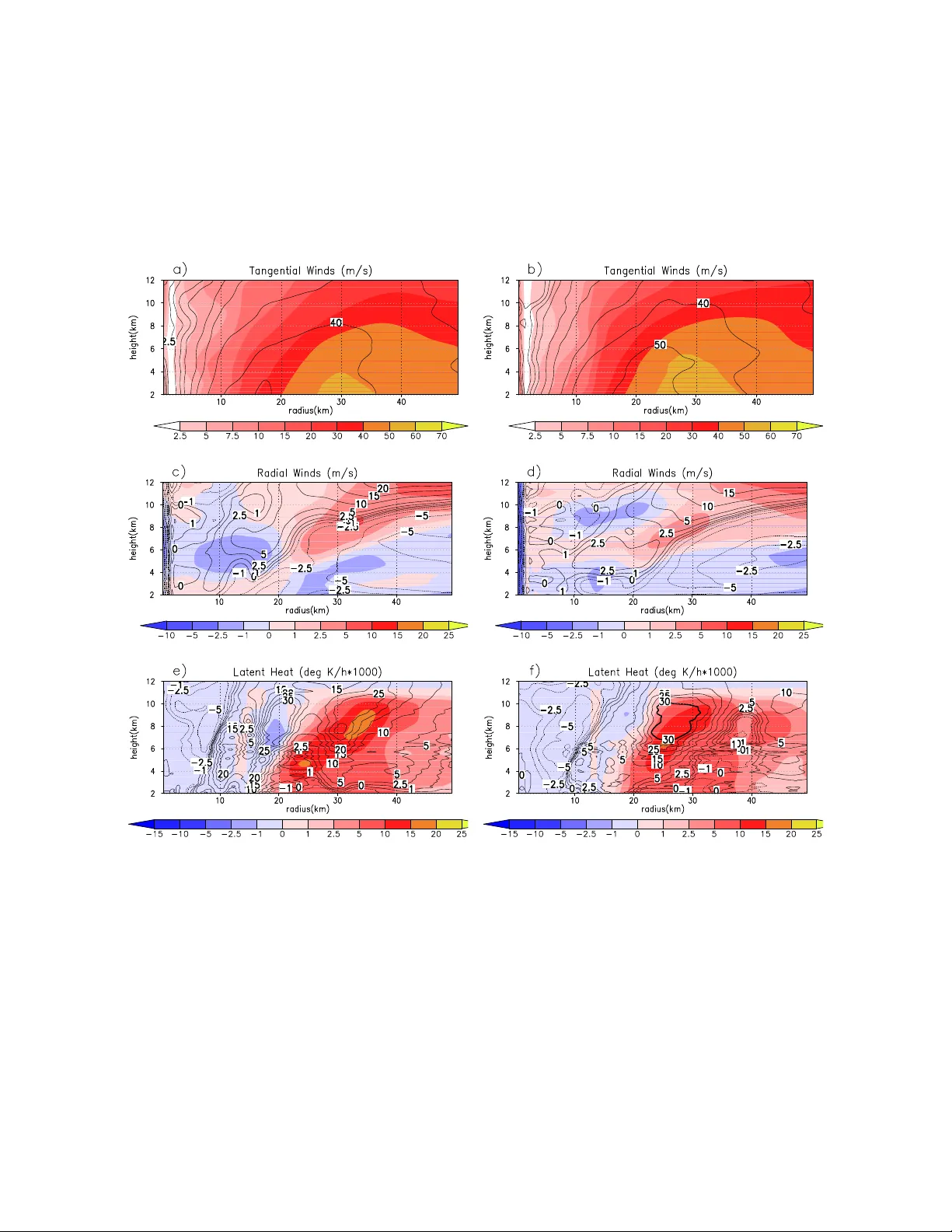
Generated using v ersion 3.1.2 of the official AMS L A T E X template Determining Key Mo del P arameters of Rapidly In tensifying 1 Hurricane Guillermo(1997) using the Ensem ble Kalman Filter 2 Humber to C. Godinez ∗ and Jon M. Reisner L os A lamos National L ab or atory, L os Alamos, New Mexic o 3 Alexandre O. Fierro Earth and Envir onmental Scienc es division/Sp ac e and R emote Sensing Gr oup, L os A lamos National L ab or atory, L os Alamos, New Mexic o NO AA/Co op er ative Institute for Mesosc ale Mete or olo gic al Studies, Norman, Oklahoma 4 Stephen R. Guimond Center for Oc e an-Atmospheric Pr e diction Studies, Florida State University, T al lahasse e, Florida 5 Jim Ka o L os A lamos National L ab or atory, L os Alamos, New Mexic o 6 ∗ Corr esp onding author addr ess: Hum b erto C. Godinez, Los Alamos National Laboratory , MS B284, Los Alamos, NM 87545. E-mail: hgo dinez@lanl.go v 1 ABSTRA CT 7 In this w ork w e determine k ey model parameters for rapidly intensifying Hurricane Guillermo 8 (1997) using the Ensem ble Kalman Filter (EnKF). The approac h is to utilize the EnKF as 9 a tool to only estimate the parameter v alues of the mo del for a particular data set. The 10 assimilation is p erformed using dual-Doppler radar observ ations obtained during the p eriod 11 of rapid in tensification of Hurricane Guille rmo. A unique aspect of Guillermo w as that during 12 the p eriod of radar observ ations strong con vectiv e bursts, attributable to wind shear, formed 13 primarily within the eastern semicircle of the ey ew all. T o repro duce this observ ed structure 14 within a hurricane mo del, background wind shear of some magnitude must be sp ecified; as 15 w ell as turbulence and surface parameters appropriately sp ecified so that the impact of the 16 shear on the simulated hurricane vortex can b e realized. T o iden tify the complex nonlinear 17 in teractions induced b y c hanges in these parameters, an ensemble of mo del sim ulations ha v e 18 b een conducted in whic h individual mem b ers w ere formulated b y sampling the parameters 19 within a certain range via a Latin h yp ercube approac h. The ensemble and the data, derived 20 laten t heat and horizon tal winds from the dual-Doppler radar observ ations, are utilized in the 21 EnKF to obtain v arying estimates of the mo del parameters. The parameters are estimated 22 at each time instance, and a final parameter v alue is obtained b y computing the a v erage 23 o v er time. Individual sim ulations were conducted using the estimates, with the simulation 24 using latent heat parameter estimates pro ducing the lo west ov erall model forecast error. 25 1. In tro duction 26 Hurricanes are among the most destructiv e and costliest natural forces on Earth and 27 hence it is important to impro v e the abilit y of n umerical mo dels to forecast changes in 28 their track, in tensity , and structure. But, accurate prediction dep ends on minimizing errors 29 asso ciated with initial, en vironmen tal, and b oundary conditions, numerical formulations, 30 and physical parameterizations. Though significant progress has b een made o v er the past 31 1 decade with regard to using data assimilation to primarily impro ve the initial state of a 32 h urricane (Zhang et al. (2009); T orn and Hakim (2009); Zou et al. (2010)), uncertainties still 33 remain in other aspects of hurricane prediction. 34 One source of uncertaint y within hurricane mo dels come from parameters, whic h domi- 35 nate the long-term b eha vior of the mo del. T o explore whether these long-term uncertain ties 36 can b e reduced, model parameters asso ciated with b oth environmen tal and physical forc- 37 ings are estimated for sheared h urricane Guillermo (1997, see Fig. 1) through the use of the 38 ensem ble Kalman filter (EnKF). Sp ecifically , four parameters describing momen tum sinks 39 and moisture sources in the planetary b oundary-la yer, the unresolved transport of these 40 quan tities a w a y from the b oundary-la yer, and a parameter asso ciated with describing the 41 wind shear impacting Guillermo will b e estimated. One of the key p oin ts of this pap er is 42 to illustrate that parameter uncertaint y con tributes significan tly to the ov erall long-term 43 uncertain t y in a hurricane sim ulation. 44 V arious authors (Anderson (2001); Annan et al. (2005); Hac ker and Sn yder (2005); Akso y 45 et al. (2006b); Akso y et al. (2006a); T ong and Xue (2008); Hu et al. (2010); Nielsen-Gammon 46 et al. (2010)) ha ve do cumented the abilit y of the EnKF pro cedure to simultaneously ev aluate 47 mo del state and parameters. In these pap ers, the parameters are included as part of the 48 mo del state in the assimilation. This com bination of evolving elements (mo del v ariables) and 49 non-ev olving elemen ts (mo del parameters) within the analysis introduces some difficulties for 50 parameter estimation, suc h as parameter collapse and assimilation divergence. T o mitigate 51 these difficulties, the parameters are inflated to a presp ecified v ariance, so as to av oid the 52 collapse and k eep a reasonable spread in the parameters. These tec hniques ha v e pro v en to b e 53 effectiv e for parameter estimation, but they require adjustments and tuning of the inflation to 54 obtain go od estimates. The approach in our current pap er differs from previous w ork in the 55 sense that the parameters and model state are not com bined in the assimilation pro cedure in 56 order to estimate the parameters. In this w ork w e use the EnKF as a tool to only estimate 57 k ey mo del parameters for a giv en time-distrib uted observ ational data set. F urthermore, since 58 2 the parameters are assumed to b e non-evolving, they are estimated indep endently from eac h 59 observ ational data set in time. Once the parameters are estimated at each time instance 60 where observ ations are av ailable, a final estimate is obtained b y computing the time a v erage 61 v alue. A k ey asp ect is to explore if estimating parameters through EnKF data assimilation 62 can improv e model sim ulation, esp ecially for such a highly non-linear problem as a hurricane. 63 T o test the applicability and viability of this approac h, a t win-exp erimen t is p erformed for a 64 h urricane mo del, where results indicate that the correct parameter v alues are reco v ered when 65 considering sufficient observ ational data. It must b e noted that the parameter estimates 66 presen ted in the current w ork dep ends on t w o imp ortan t factors: the n umerical mo del b eing 67 utilized, and the data set b eing assimilated. Nevertheless, this technique is applicable for 68 estimating mo del parameters for an y model and data set, as long as the parameters ha v e a 69 strong connection to the type of observ ational data b eing used to estimate them. 70 One of the b est dual-Doppler radar data sets (Reasor et al. (2009); Sitk o wski and Barnes 71 (2009)) obtained within a hurricane will b e used to estimate the parameters through assim- 72 ilation. Some unique asp ects of Guillermo’s dual-Doppler radar data were that data from 73 10 flight legs o v er a six hour time p eriod were individually pro cessed to address temp oral 74 v ariabilit y and b oth derived fields of horizon tal winds and laten t heating (Guimond et al. 75 (2011)) were constructed from the fligh t legs. T aken together this observ ational data will b e 76 used to quantify temp oral v ariabilit y in the four parameter estimates along with ho w these 77 estimates c hange dep ending on which observ ational field is utilized. Note that assessing 78 the temporal v ariability of the four parameters is imp ortan t with regard to addressing the 79 effectiv eness of parameter estimation within this highly nonlinear system. 80 An imp ortan t test of the viability of the particular approach and data used to estimate 81 the parameters, is their abilit y to improv e the solution of a h urricane mo del. T o inv estigate 82 this issue, three sim ulations were run using temp orally av eraged v alues of the parameters 83 obtained from either deriv ed observ ational field, (horizon tal winds or laten t heat) or b oth 84 fields. Hence, the final p oint of this pap er will b e to illustrate whether or not the parameter 85 3 estimates improv ed o verall mo del predictabilit y with regard to the t yp e of observ ations b eing 86 assimilated. 87 The pap er is organized as follows; Section 2 first describ es the predictiv e comp onen t of the 88 parameter estimation mo del including the analytic equation set of the hurricane mo del, the 89 four mo del parameters present within this predictive mo del, the discretization, and a brief 90 o v erview of the EnKF data assimilation metho d. In Section 3 we describ es v arious asp ects 91 of the parameter estimation mo del setup including the ensemble setup and the pro cessing 92 of the derived observ ational data fields. Section 4 is broken up into three sub-sections with 93 eac h section showing results relating to the three ma jor p oin ts of this pap er. A summary 94 and final remarks are presented in Section 5. 95 2. P arameter estimation mo del 96 The parameter estimation mo del is comprised of a predictive mo del and an parameter 97 estimation mo del. The chosen predictive mo del is the Na vier-Stok es equation set coupled 98 to a bulk cloud mo del with the four parameters utilized within this mo del, whereas the 99 parameter estimation model employs the EnKF data assimilation. In addition to describing 100 their represen tative analytical represen tations, discussions regarding their resp ectiv e discrete 101 form ulations will also b e presen ted in this section. 102 2.a. Pr e dictive mo del 103 2.a.1) Na vier-Stokes equa tion set 104 Since the analytical equation set represen ting the momentum, energy , and mass of the 105 gas phase is iden tical to that utilized in Reisner and Jeffery (2009), RJ hereafter, in terested 106 readers can examine this man uscript for details regarding its form ulation. Lik ewise the 107 primary difference b et ween the equation set found in that pap er and the current equation 108 4 set are additional terms asso ciated with buoy ancy in the v ertical equation of motion related 109 to v arious hydrometers, i.e., g ( ρ 0 + ρ c + ρ r + ρ i + ρ s + ρ g ) where g is gra vit y , ρ 0 is a density 110 p erturbation, ρ c is the cloud w ater density , ρ r is the rain w ater density , ρ i is the ice w ater 111 densit y , ρ s is the density of sno w, and ρ g is the graup el density , with the next section briefly 112 describing the bulk microph ysical mo del used to predict the evolution of the hydrometers. 113 2.a.2) Bulk microphysical model 114 The mass conserv ation equation for a giv en particle t yp e, ρ part = ρ c , ρ r , ρ i , ρ s , ρ g , within 115 the bulk microph ysical mo del can b e written as follo ws 116 ∂ ( ρ part ) ∂ t + ∂ [( u i 0 − w f al l part δ i 0 3 ) ρ part ] ∂ x i 0 = f density part + ∂ F i 0 ρ part ∂ x i 0 , (1) where u i 0 are fluid velocities in eac h spatial direction and the last term represents the tur- 117 bulen t diffusion of a particle t ype using a diffusion co efficien t diagnosed from a turbulence 118 kinetic energy (TKE) equation, see Eq. 3 in Reisner and Jeffery (2009). 119 The conserv ation equation for either cloud droplet n um ber ( N c ) or ice particle n um ber 120 ( N i ), N part = N c , N i , can b e written as follows 121 ∂ ( N part ) ∂ t + ∂ [( u i 0 − w f al l part δ i 0 3 ) N part ] ∂ x i 0 = f number part + ∂ F i 0 N part ∂ x i 0 , (2) where w f all part , f density part , and f number part represen t the fall speed, density , and n umber 122 sources or sinks from the bulk microphysical mo del for a given particle t yp e, a hybrid of the 123 activ ation and condensation mo del found in Reisner and Jeffery (2009) together with all of 124 the other relev an t bulk parameterizations found in Thompson et al. (2008). Note, b ecause 125 of significant differences in the particle distributions b etw een win ter storms and h urricanes, 126 the slop e-intercept form ulas were mo dified following McF arquhar and Black (2004). 127 5 2.a.3) P arameters of interest 128 The initialization of the environmen tal or bac kground horizontal homogeneous p oten tial 129 temp erature, w ater v ap or, and total gas density fields for all Guillermo simulations w as 130 ac hiev ed b y examining vertical profiles from ECMWF analyses obtained near the time p erio d 131 of the dual-Doppler radar data (1830 UTC 2 August to 0030 UTC 3 August 1997) and using a 132 represen tativ e comp osite. Though some uncertaint y exists within the thermo dynamic fields 133 with regard to the actual en vironmen t v ersus the p erturb ed en vironmen t obtained from the 134 ECMWF soundings, the impact of this uncertain ty was deemed to b e smaller than that 135 asso ciated with the momen tum fields, i.e., the sim ulated v ortex is sensitiv e to small c hanges 136 in wind shear. So to quantify this sensitivity , the horizontal velocity fields, u 1 0 and u 2 0 , w ere 137 initialized as follo ws 138 u 1 0 ( x 3 0 ) = φ shear [ ecmw f u ( x 3 0 ) + 1 . 5] , (3) u 2 0 ( x 3 0 ) = φ shear [ ecmw f v ( x 3 0 ) − 1 . 5] , (4) where φ shear is a tuning coefficient that determines the shear impacting hurricane Guillermo 139 within a range of 0 and 1, x 3 0 is the heigh t, and ecmw f u and ecmw f v represen t mean 140 soundings calculated from the ECMWF analyses. 141 Giv en the delicate balance in nature that is needed for a sheared hurricane to in tensify , it 142 is not en tirely ob vious whether n umerical mo dels, that are necessarily limited in resolution, 143 can accurately represen t b oundary pro cesses that are resp onsible for supplying w ater v ap or 144 to ey ew all con vection. The accurate represen tation of b oundary-la yer pro cesses implies the 145 mo del has been somewhat tuned to represent the impacts of w av es, sea spra y , and air bubbles 146 within the water; likewise the accurate treatmen t of energy release in eyew all con vection 147 implies that the up w ard mo vemen t of, for example, moisture is b eing reasonably sim ulated 148 b y the h urricane mo del. 149 T o examine this uncertain ty the diffusion co efficien t for surface momen tum calculations 150 6 w as sp ecified as follows 151 κ = κ surf acef r iction tanh V h 80 , (5) where κ surf acef r iction is a tuning co efficien t that ranges from 0.1 to 10 m 2 s − 1 and V h is the 152 near surface horizontal wind speed. A no-slip b oundary condition w as utilized in the horizon- 153 tal momentum equations ( u 1 0 = u 2 0 =0) with the magnitude of κ surf acef r iction the determining 154 factor with regard to the impact of this b oundary condition on the intensit y and structure of 155 Guillermo. Note, unlik e for the horizon tal momen tum equations, all scalar equations use a 156 diffusion co efficien t estimated from the T K E equation within calculations of surface fluxes. 157 Another uncertain boundary-lay er pro cess that has a significant impact on in tensification 158 rate is surface moisture a v ailabilit y and the unresolved v ertical transp ort of this w ater v ap or 159 with the first term, q s v , b eing form ulated as follo ws 160 q s v = q v s 0 . 75 + q v surf ace tanh V h 30 , (6) where q v s is the saturated v ap or pressure o v er water and q v surf ace is a tuning co efficien t that 161 ranges in v alue from 0.0 to 0.2. This term enters in to surface diffusional flux calculations of 162 w ater v ap or, F 3 0 q v , in discrete form as follo ws 163 F 3 0 q v = κ q 1 v − q s v 0 . 5∆ x 3 0 , (7) where q 1 v is the sp ecific humidit y of the first grid cell in the vertical direction. T o address 164 the uncertain t y asso ciated with the turbulen t transp ort of w ater v ap or (and all other fields) 165 from the surface to the free atmosphere the turbulent length scale was mo dified as follo ws 166 L m s = φ turb L s , (8) where the tuning coefficient, φ turb , ranged from 0.1 to 10, and the eddy diffusivity no w being 167 κ = 0 . 09 L m s √ T K E . 168 7 2.a.4) Discrete model 169 The discrete mo del for the Na vier-Stokes equation set and the bulk microph ysical mo del 170 closely follows what w as describ ed in section 2c of RJ. This discrete equation set form ulated 171 on an A-grid can utilize a v ariet y of time-stepping pro cedures with the curren t sim ulations 172 using a semi-implicit pro cedure (Reisner et al. (2005)). The adv ection scheme used to adv ect 173 gas and v arious cloud quantities w as the quadratic upstream interpolation for con v ective 174 kinematics advection scheme including estimated streaming terms (QUICKEST, Leonard 175 and Drummond (1995)) with these quan tities ha ving the p ossibilit y of b eing limited b y a 176 flux-corrected transp ort pro cedure (Zalesak (1979)). 177 The domain spans 1200 km in either horizontal direction and 21 km in the vertical 178 direction. The stretched horizon tal mesh emplo ying 300 grid p oin ts has the highest resolution 179 of 1 km at the cen ter of the mesh and low est resolution of 7 km at the mo del edges. Because 180 of the addition of a mean wind in tended to k eep the v ortex centered in the middle of the 181 domain, the coarsest resolution resolving the highest wind field of Guillermo is appro ximately 182 2 km. The stretched v ertical mesh is resolv ed b y 86 grid p oin ts with highest resolution of 183 50 m at the surface and low est of 500 m at the model top. 184 2.b. Par ameter estimation Mo del 185 In this section the ensemble Kalman filter (EnKF) metho d is briefly describ ed. In the 186 curren t work, the EnKF is mainly utilized to estimate the model parameters. 187 2.b.1) P arameter estima tion with EnKF 188 The ensem ble Kalman Filter is a Mon te Carlo approach of the Kalman filter whic h 189 estimates the co v ariances b et ween observed v ariables and the model state v ariables through 190 an ensem ble of predictiv e mo del forecasts. The EnKF was first in troduced by Ev ensen 191 (1994) and is discussed in detail in Evensen and v an Leeu wen (1996) and in Houtek amer and 192 8 Mitc hell (1998). F or the curren t study , only the parameters will b e estimated, not the state 193 v ector of the mo del. The EnKF pro cedure is directly applied to the parameters, i.e., the 194 state v ector con tains only the parameter v alues. Nevertheless, the model co v ariance matrix 195 is still required for the inno v ation with observ ations. The follo wing EnKF description will 196 b e concern with mo del parameters. 197 Let p ∈ R ` b e a v ector holding the differen t mo del parameters, and x f ∈ R n b e the model 198 state forecast. Let p i , x f i for i = 1 . . . N b e an ensem ble of mo del parameters and state 199 forecasts, and y o ∈ R m a v ector of m observ ations, then the estimated parameter v alues p a i 200 giv en by the EnKF equations are 201 p a i = p i + ˜ K y o i − Hx f i , i = 1 , . . . , N (9) ˜ K = C T H T HP f H T + R − 1 , (10) where the matrix ˜ K ∈ R ` × m is a modified Kalman gain matrix (see App endix A), P f ∈ R n × n 202 is the mo del forecast cov ariance matrix, C ∈ R n × ` is the cross-correlation matrix b et ween 203 the mo del forecast and parameters, R ∈ R m × m is the observ ations co v ariance matrix, and 204 H ∈ R m × n is an observ ation op erator matrix that maps state v ariables on to observ ations. 205 In the EnKF, the vector y o i is a p erturb ed observ ation vector defined as 206 y o i = y o + ε i , (11) where ε i ∈ R m is a random v ector sampled from a normal distribution with zero mean and a 207 sp ecified standard deviation σ . Usually σ is tak en as the v ariance or error in the observ ations. 208 One of the main adv antages of the EnKF is that the mo del forecast co v ariance matrix is 209 appro ximated using the ensemble of mo del forecasts, 210 P f ≈ 1 N − 1 N X i =1 x f i − ¯ x f x f i − ¯ x f T , (12) where ¯ x f ∈ R n is the mo del forecast ensemble a v erage. The use of an ensem ble of mo del 211 forecast to approximate P f enables the evolution of this matrix for large non-linear mo dels 212 9 at a reasonable computational cost. Additionally , the cross-correlation matrix C is defined 213 as 214 C = 1 N − 1 N X i =1 x f i − ¯ x f ( p i − ¯ p ) T , (13) where ¯ p ∈ R ` is the parameter ensem ble a v erage. 215 F or our particular implemen tation, the system of equations (9)-(10) is rewritten as 216 HP f H T + R z i = y o i − Hx f i (14) p a i = p i + C T H T z i , (15) for i = 1 , . . . , N , where z i ∈ R m is the solution of the linear system (14) for ensemble i . 217 F or our implementation, the observ ation co v ariance matrix R is taken as a diagonal matrix, 218 with σ in its main diagonal. 219 2.b.2) Considera tions f or p ar ameter estima tion with EnKF 220 Sev eral studies ha v e utilized the EnKF data assimilation to simultaneously estimate 221 the model state and parameter. Among them are the studies b y Aksoy et al. (2006a), 222 Akso y et al. (2006b), T ong and Xue (2008), Hu et al. (2010), and Nielsen-Gammon et al. 223 (2010). T ypically , the parameters are included as part of the model state in the assimilation. 224 This evolving of dynamical and non-evolving elemen ts within the analysis introduces some 225 difficulties for parameter estimation, suc h as parameter collapse and assimilation div ergence. 226 T o mitigate these difficulties, the parameters are inflated to a prespecified v ariance, so as to 227 a v oid the collapse and keep a reasonable spread in the parameters. These tec hniques hav e 228 pro v en to b e effectiv e to estimate parameter, but they require adjustments and tuning of 229 the inflation to obtain go o d estimates. 230 The particular approac h taken in this w ork is to use the EnKF as a to ol to only estimate 231 the mo del parameters using the av ailable data. This approac h is significantly different from 232 the studies men tioned ab ov e in the sense that only the parameters are estimated with the 233 EnKF, that is, the model state is not b eing estimated. The motiv ation b ehind this approach 234 10 is that mo del parameters are assumed to b e constant, they do not ev olv e through the mo del, 235 although they affect the dynamics of the solution. F or this reason, determining parameters 236 can b e viewed as a stationary or static optimization. Our ob jective is to estimate a constant 237 parameter v alue for the given data set, ov er the given time window. T o ac hiev e this, the 238 assimilation of the data is p erformed on eac h time instance, where observ ations are a v ailable, 239 indep enden tly . The reasoning b ehind this technique is to treat the parameters as constan ts 240 and non-ev olving elemen ts in the model, hence for eac h time p erio d we compute an estimated 241 parameter v alue. 242 The pro cedure used to estimate the parameters is the following: Let t 1 , . . . , t k b e the 243 time instances where observ ations are a v ailable. F or eac h time instance t j , j = 1 , . . . , k , the 244 EnKF data assimilation (equations (14)-(15)) pro vides parameter estimates for the ensemble, 245 p a i ( t j ), i = 1 . . . N . A final parameter estimate is then computed b y first taking the ensem ble 246 a v erage and then the time av erage of the parameters, that is 247 p a = 1 k k X j =1 " 1 N N X i =1 p a i ( t j ) # (16) One adv antage is that this approac h a v oids the problem of parameter collapse and filter 248 div ergence, since the data assimilation is used to estimate the parameters at each time 249 instance indep endently . Additionally , since the state is not b eing up dated in the assimilation, 250 and only the parameter are being estimated, localization is not required for the EnKF. 251 The n um b er of av ailable data p oin ts for Hurricane Guillermo is ab out 200 , 000 at any 252 giv en time. This ric h data set can b e used to in vestigate a n um b er of asp ects of hurricane 253 in tensification. In order to exploit this data set for assimilation, we used an efficient matrix- 254 free EnKF algorithm dev elop ed b y Go dinez and Moulton (in press, DOI: 10.1007/s10596- 255 011-9268-9). The algorithm w orks by efficiently solving the linear system (14) using a solver 256 based on the Sherman-Morrison formulas. In their paper, Go dinez and Moulton (in press, 257 DOI: 10.1007/s10596-011-9268-9) show that this algorithm is more efficient than traditional 258 implemen tations of the EnKF, by sev eral orders of magnitude, and enables the assimilation of 259 v ast amounts of data. Additionally , the algorithm pro vides an analysis that is qualitatively 260 11 and quan titativ ely the same as more traditional implementations. The reader is referred 261 to the w ork of Go dinez and Moulton (in press, DOI: 10.1007/s10596-011-9268-9) for more 262 details. 263 3. P arameter estimation mo del setup 264 This section describ es the three necessary steps to conduct the parameter estimates: the 265 pro cessing of derived observ ational data fields; the setting up of the ensemble; and the setup 266 of the EnKF system. 267 3.a. Derive d Doppler data fields 268 The primary driver of a hurricane is the release of latent heat in clouds, whic h arises 269 mainly from condensation. Latent heat cannot b e observed directly and instruments, such 270 as Doppler radars, only measure the reflectivit y and radial v elo cit y of precipitation particles 271 a v eraged o v er the pulse volume. As a result, retriev als of dynamically relev ant quantities 272 (e.g. the Cartesian wind comp onen ts and laten t heat) are required. Guillermo’s 3-D wind 273 field was retriev ed using a v ariational approac h on a system of equations that includes the 274 radar pro jection equations, the anelastic mass contin uity equation, and a Laplacian filter 275 (Gao et al. (1999); Reasor et al. (2009)). This wind field and estimates of the precipitation 276 w ater conten t (derived from the reflectivit y measurements) are used to retriev e the latent 277 heat of condensation/ev ap oration follo wing Guimond et al. (2011). There are t w o main 278 steps in the laten t heat retriev al algorithm: (1) determine the saturation state at eac h grid 279 p oin t in the radar analysis using the precipitation contin uity equation; and (2) compute the 280 magnitude of heat released using the first law of thermo dynamics and the vertical v elocity 281 estimates describ ed in Reasor et al. (2009). There are several p oten tial sources of error in 282 the latent heat retriev als and a detailed treatment of these errors can b e found in Guimond 283 et al. (2011). Here, w e summarize the most relev an t information. 284 12 The uncertain ty in the latent heat retriev als reduces to uncertain ties in t w o main fields: 285 reflectivit y and vertical velocity . Guimond et al. (2011) w ere able to reduce and/or do cumen t 286 the uncertaint y in these fields to a level where the latent heat retriev als hav e a reasonably 287 acceptable accuracy . F or example, Guimond et al. (2011) fo cus on the inner p ortion of the 288 ey ew all and often use tw o aircraft to construct the radar analyses (Reasor et al. (2009)), 289 whic h reduce the effects of attenuation. In an attempt to correct the known calibration 290 bias in the NOAA P-3 T ail radar reflectivity , 7 dB w as added to the fields (John Gamac he 291 and P aul Reasor, p ersonal communication). More imp ortan tly , how ev er, the reflectivity is 292 only used to determine the condition of saturation in the latent heat retriev al. Thus, the 293 algorithm is not dep enden t on the precise v alue of the reflectivity rendering the retriev als 294 somewhat insensitive to errors (Guimond et al. (2011)). 295 The uncertainties in the magnitude of the retrieved heating are dominated by errors in 296 the vertica l velocity . Using a combination of error propagation and Monte Carlo uncertaint y 297 tec hniques, biases are found to b e small, and randomly distributed errors in the heating 298 magnitudes are 16% for up drafts greater than 5 m s − 1 and 156% for up drafts of 1 m s − 1 299 (Guimond et al. (2011)). Ev en though errors in the v ertical v elocity can lead to large 300 uncertain ties in the latent heating field for small up drafts/do wndrafts, in an integrated sense, 301 the errors are not as drastic. Figure 2 (from Guimond et al. (2011)) sho ws example horizon tal 302 views (a veraged ov er all heigh ts) of the latent heating rate of condensation/ev aporation for 303 four of the ten aircraft sampling p erio ds of Guillermo. 304 F or the assimilation, only latent heat data where there is a non-zero reflectivit y v alue 305 are incorp orated into the data set. The errors for the retriev ed wind fields are set to 5 . 0 to 306 6 . 0%, and the errors in the retriev ed latent heating, as a p ercen tage, are sp ecified following 307 Guimond et al. (2011) 308 δ y o lh = δ w w × 100 (17) where δ w = 1 . 56 m s − 1 represen ts the o v erall uncertaint y in the vertical wind v elo cit y field 309 w Reasor et al. (2009). It is worth to notice that these errors are sometimes o verestimated 310 13 or underestimated. Th us in an integral sense, the errors are not so drastic, the bias is only 311 of +0 . 16 m s − 1 . 312 3.b. Guil lermo ensemble setup 313 Since the primary goal is to examine the impact of v arious mo del parameters con taining 314 high uncertain t y on the intensit y and structure of Guillermo, but not the track, all sim u- 315 lations comprising the ensem ble ha ve b een undertak en in whic h a mean wind of 1.5 m s − 1 316 w as added or subtracted to the resp ectiv e en vironmen tal wind comp onen ts to preven t the 317 mo v ement of Guillermo from a region containing high spatial resolution found in the domain 318 cen ter. Sp ecifically this high resolution patc h in Cartesian space, ∆ x 1 0 c and ∆ x 2 0 c , is defined 319 as follows 320 ∆ x 1 0 c = 6000sin 2 ( φ g x ∗ ) + 1000 , (18) ∆ x 2 0 c = 6000sin 2 ( φ g y ∗ ) + 1000 , (19) where φ g = π N g p i 0 determines ho w quic kly the grid spacing changes from 7 k m near the mo del 321 edges to 1 km near the cen ter with N g p i 0 the n um b er of grid p oin ts in either direction and 322 x ∗ , y ∗ represen t grid v alues for a normalized grid with a domain employing 0 . 5 N g p i 0 grid 323 p oin ts aw ay from a cen ter lo cation in whic h x ∗ = y ∗ = 0. Lik e the horizontal direction, the 324 v ertical direction also emplo ys stretc hing with highest resolution near the o cean b oundary , 325 appro ximately 50 m, and coarsest near the mo del top, 500 m, with 86 v ertical grid p oin ts 326 b eing utilized to resolve a domain extending upw ards to 21 km. Note, b ecause of the 327 relativ ely high vertical spatial resolution, time step size was limited to 1 s to a v oid any 328 instabilities asso ciated with exceeding the advectiv e Couran t num b er limit. 329 The ensemble is generated b y p erturbing only the four parameters discussed in Section 330 2.a.3, whic h are φ shear , κ surf acef r iction , q v surf ace , and φ turb . The parameter v alues are gener- 331 ated by the Latin hypercub e sampling tec hnique with a uniform distribution, where eac h 332 parameter is sampled ov er a sp ecified in terv al. All ensembles hav e the same initial, where 333 14 the background fields are initialized as describ ed in Section 2.a.3, where the background 334 winds that are independent of the wind field asso ciated with Guillermo are initialized using 335 ECMWF data. Whereas to initialize the wind field asso ciated with Guillermo a comp osite 336 of the radar winds and a b ogus vortex is emplo y ed within a n udging pro cedure o ver a one 337 hour time p eriod. Afterwards, the h urricane mo del is sim ulated in free mo de for five hours 338 to b ecome balanced with the parameters, and dev elop a h urricane vortex. It is imp ortant to 339 men tion that at this stage the b eha vior of the ensem ble sim ulations are mainly dominated 340 not b y the initial conditions, but b y the parameter v alues. Hence utilizing deriv ed fields 341 from the same h urricane for a v ortex initialization do es not bias the results of the parameter 342 estimation exp erimen ts, as long as the subsequent spin-up is sufficiently long to allo w the 343 parameters dominate the long-term b eha vior of the simulation. 344 3.c. EnKF and Observation Sele ction 345 The EnKF data assimilation is used to estimate only the parameters of interest. The time 346 distribution of the parameters is obtained by assimilate each time p erio d independently , as 347 stated in Section 2.b.2. A final parameter v alue is obtained by a veraging in time the results 348 of the assimilation. The particular algorithm used for the parameter EnKF is a matrix-free 349 algorithm presented in Go dinez and Moulton (in press, DOI: 10.1007/s10596-011-9268-9). 350 The initial set of parameter v alues are generated using a Latin Hyp ercub e sampling 351 strategy with a uniform distribution. The interv al for eac h parameter, sho wn in T able 1 is 352 c hosen according to the v alues mentioned in Section 2.a, whic h are based on prior sensitivity 353 sim ulations and from a physical intuition of their in teraction with the mo del. Figure 3 sho ws 354 the initial distribution for each parameter of in terest. 355 Although the optimal ensem ble size for estimating reliable mo del uncertaint y is still under 356 activ e researc h, an ensemble of 120 members w as deemed appropriate to capture essential 357 mo del statistics for parameter estimation. Up on completion of the 120 mem b er ensemble and 358 due to the small mo vemen t of sim ulated hurricanes within the ensemble, information from 359 15 eac h ensemble mem b er w as indep enden tly in terp olated to the center lo cation of the grid suc h 360 to b e coinciden t with the observ ations. Note, only a p ortion of the computational domain 361 w as utilized within the EnKF corresp onding to the p ortion of the domain that contains the 362 deriv ed fields of winds and latent heat. Finally , after this interpolation step, all in terp olated 363 mo del and derived data fields were read in to the EnKF to conduct the parameter estimation 364 for a giv en time p eriod. 365 The data selection pro cedure follow ed in this pap er is similar to the rank parameter- 366 observ ation correlation pro cedure presented b y T ong and Xue (2008). The parameter cross- 367 correlation matrix, C in equation (13), provides information of the correlation b et w een the 368 mo del state v ariables and the parameters. By applying the observ ation op erator H to the 369 mo del state, w e ha v e 370 ˜ C = 1 N − 1 N X i =1 Hx f i − H ¯ x f ( p i − ¯ p ) T , (20) whic h is a cross-correlation matrix b et w een parameters and mo del state v ariables in obser- 371 v ation space. The correlations are then sorted and the observ ational data p oints that are 372 lo cated in regions of largest correlations are selected for assimilation. It is imp ortan t to note 373 that the regions of high correlation can b e identified from differen t mo del v ariables fields, 374 suc h as laten t heat, horizontal winds, or reflectivit y . This enables the use one of these fields 375 as a pro xy for observ ation lo calization in order to b etter capture the physical pro cesses of 376 in terest. 377 4. Results 378 This section will highligh t the three main p oints of this pap er: 1) the highly nonlinear 379 in teractions b et w een the v arious parameters leading to large v ariations in the simulated 380 in tensit y and structure of Guillermo among the 120 ensem ble members; 2) the large amoun ts 381 of derived data, horizontal winds or latent heat, required to reasonably estimate the four 382 mo del parameters; and 3) the newly estimated parameters lead to an o v erall reduction in 383 16 the mo del forecast error. 384 4.a. Ensemble spr e ad and structur e 385 Since the EnKF metho d dep ends on proper mo del statistics to optimally determine the 386 parameter v alues (Anderson (2001)) this section will illustrate this necessary v ariability 387 across the v arious mem b ers of the ensem ble. Likewise, for reasonable parameter estimation 388 it is imp ortan t that the ensemble pro duces statistics that are within the range of the ob- 389 serv ations and this is another asp ect of the ensemble that will b e presented. F or example, 390 Fig. 4 shows the simulated pressure traces for the 120 ensemble mem b ers (blue lines), the 391 ensem ble a v erage (black line), and the 3-hourly observ ations from the NHC advisories (red 392 dots) with a large spread in h urricane in tensity b eing denoted within the ensemble. F urther, 393 ev en though this result may b e somewhat fortuitous, the ensemble-a veraged pressure trace 394 is in remark ably go o d agreement with observ ations with a difference less than 5 hPa. T o 395 highligh t differences b et w een the ensem ble a verage and a giv en member, in addition to dis- 396 pla ying ensemble av erage statistics, results from a select ensem ble member, i.e., member 44, 397 that also reasonably reproduced the observed pressure trace will b e shown. 398 Because hurricane Guillermo was em b edded in an en vironmen t characterized with v ertical 399 wind sp eed shear, its observ ed ey ew all horizon tal structure was asymmetric with a dominan t 400 w a ven umber 1 mo de, e.g., Reasor et al. (2009) and Sitk o wski and Barnes (2009). T o illustrate 401 the mo dels abilit y to repro duce this asymmetry Fig. 5 sho ws b oth the ensem ble-a veraged 402 la y er-av eraged v ertical v elo cities and the corresp onding lay er-a v eraged fields from member 44 403 at t wo different lay ers. As evident in this figure, the v ortex in b oth the a verage sense and 404 for member 44 is asymmetric with a dominan t wa ven um b er 1 mo de b eing readily apparen t. 405 Lik ewise, the impact of av eraging across all members is clearly eviden t in Fig. 5 with a 406 significan t smo othing and reduction in v ertical motions b eing noted with regard to the 407 v ertical motion fields pro duced by ensem ble member 44. F urthermore, using a similar F ourier 408 sp ectral decomposition pro cedure as Reasor et al. (2009) Fig. 6 rev eals significant amoun ts 409 17 of the v ertical motion fields b eing in w a v enum b er 0 and 1 comp onents with the magnitude 410 of the w a v enum b er 1 vertical motion field from ensemble member 44 reasonably agreeing 411 with the observ ations (see Fig. 15a of Reasor et al. (2009)). 412 T o provide another view of the simulated storm structure, b oth the ensem ble av eraged 413 and ensem ble 44 azim uthal structures w ere compared to observ ations and are presen ted for 414 t w o flight legs in Figs. 7-8. Common disagreement with observ ations can b e seen in b oth 415 figures: First the simulated radius of maximum wind (RMW) and hence ey ew all size is 416 ab out 5 − 10 km smaller than in the observ ations. While the simulated ensem ble a v eraged 417 azim uthal tangen tial comp onen t of the wind lies within ∼ 10 m s − 1 of the observ ations, 418 more notable differences are seen in the radial comp onen t of the wind with magnitudes 419 rarely exceeding 10 m s − 1 in the observ ations and the simulation consistently pro ducing 420 magnitudes exceeding 15 m s − 1 . Similar ov erestimation is pro duced in the latent heat fields, 421 with v alues exceeding 25 or even 30 (1000 K h − 1 ) in the sim ulation with the observ ations 422 sho wing v alues marginally reaching 20 (1000 K h − 1 ). 423 Despite these noteworth y differences, the HIGRAD mo del is able to repro duce the 424 slop e/tilt of radial, tangential and latent heat fields with a reasonable degree of realism. 425 Moreo v er, the heights ab o ve sea level of the con tours encompassing the largest sim ulated 426 v alues of those three fields are in ov erall go o d agreemen t with observ ations. Note, that the 427 larger v alues of latent heat are required to comp ensate for the impact of spurious ev ap oration 428 (Reisner and Jeffery (2009)) common to most cloud mo dels with the consequences of this 429 ev ap oration b eing discussed later in this manuscript. Additional plots were made for the 430 remaining 8 fligh t legs (not sho wn) and display ed similar attributes. 431 4.b. Twin-Exp eriments for Par ameter Estimation 432 T o asses the reliability of parameter estimation within the current con text, and the 433 amoun t of observ ational data needed for the estimation, a series of t win-experiments w ere 434 p erformed. A syn thetic observ ational data set is pro duced from a reference model run with 435 18 the sp ecific parameter v alues give in T able 2, and initialized according to Section 3.b. These 436 reference parameters were selected near the ensemble av erage with white noise added to 437 them. 438 In their pap er T ong and Xue (2008) found that to sim ultaneously estimate the mo del 439 state and five parameters with the ensem ble square ro ot filter, using their rank parameter- 440 observ ation pro cedure, they needed only 30 observ ational data p oints. Given that our pa- 441 rameter estimation setting is significantly different from their approac h, it is not entirely 442 ob vious whether only small amoun ts of data are required to conduct the parameter estima- 443 tion or, in the other limiting situation, more data than is currently a v ailable is needed for 444 undertaking the estimates. T o address this issue, nine parameter estimation exp erimen ts, 445 named TE1 to TE9, were p erformed for different amoun ts of data, giv en in T able 3. The 446 data b eing used for parameter estimation is the laten t heat field from the reference run, 447 where the data is selected according to the pro cedure describ ed in Section 3.c. The first 448 observ ation set w as taken at t = 6 hours of simulation time, afterwards nine more observ a- 449 tion sets were taken at 30 min ute interv als, which makes a total of 10 observ ational data set 450 o v er a fiv e hour window. F or each exp erimen t, the parameters are estimated according to 451 Section 2.b.2, that is, parameter estimates for the ensemble are computed with the EnKF at 452 eac h observ ational time, and then a final parameter estimate is then computed b y av eraging 453 o v er ensem ble and then time, as in equation (16). Figure 9 shows the parameter estimates 454 for eac h exp eriment, where the v ertical lines indicate the time v ariance of the parameter 455 estimate. The figure clearly shows the impact of the additional data on the parameter esti- 456 mates with a noticeable reduction in the error for all for parameters. F urthermore, it is only 457 when approximately 200,000 observ ations are used that all four parameters conv erge to the 458 correct v alues. This is highly relev an t since it indicates that a significant amount of data 459 is required, in this con text, to correctly estimate the v alues of the parameters. A similar 460 result w as obtained when the horizontal wind field or reflectivit y were used to estimate the 461 parameters. 462 19 4.c. Par ameter Estimation Exp eriments with Hurric ane Guil lermo Observations 463 Giv en the large ensemble spread in v arious mo del fields, suc h as intensit y , and the abilit y 464 of the mo del to repro duce observed data suggests that estimation of the four mo del pa- 465 rameters is not only p ossible with the EnKF, but should pro duce parameter estimates that 466 hop efully reduce mo del forecast errors. 467 The num b er of observ ations used for parameter estimation, using the EnKF in all sub- 468 sequen t exp eriment, were those identified with the highest ensem ble sensitivity lo cated at 469 200,000 mo del grid-p oin ts (see selection of observ ations in Section 3.c). The assimilation 470 is p erformed ov er laten t heat (DA1), horizon tal winds (D A2), or b oth fields (D A3) started 471 six hours into the ensemble (corresp onding to 1900 UTC). With the inclusion of DA3, an 472 assessmen t regarding ho w the EnKF procedure w eigh ts tw o differen t observ ational data sets 473 and mo del results can b e made and analyzed. Hence, this section will not only highlight 474 ho w the v arious parameter estimates c hange when using different observ ational fields, but 475 also how these estimates change in time. 476 Figure 10 shows the time distribution of the ensem ble a v erage parameter estimates with 477 EnKF using the 10 data time p erio ds for D A1, DA2, and D A3. The largest temp oral 478 oscillations in the parameter estimates are asso ciated with DA2 and suggest that the wind 479 fields pro duced b y the ensem ble tend to oscillate more in time than the latent heat fields. 480 Lik ewise, the surface moisture and the wind shear parameter estimates do not app ear to 481 c hange significantly in time, whereas the turbulen t length scale and surface friction estimates 482 either increase or decrease with time. Note, the temp oral c hanges in these t w o parameters 483 could b e due to numerical errors and/or the impact of initial condition errors. F or example, 484 Fig. 7 sho ws that with time the areas of maxim um laten t heating and/or winds from the 485 ensem ble are expanding out w ard and hence this outw ard expansion, probably the result of 486 n umerical diffusion, could explain the temporal c hanges in these tw o parameter estimates. 487 Up on a v eraging the parameter estimates ov er the ensemble and in time, differences b e- 488 t w een the v arious parameter v alues are small; ho w ever, as will be sho wn in the next section 489 20 these small differences in the parameters do lead to rather significant differences in b oth the 490 structure and intensit y of the simulated hurricanes. T able 4 show the time av erage parameter 491 v alues from the assimilation exp eriments, as w ell as the parameter v alues used for ensemble 492 mem b er 44 prior to assimilation. Fig. 11 also reveals the v arious parameter estimates are 493 differen t than the parameter v alues used in ensemble mem b er 44, suggesting the imp ortance 494 of using a technique such as the EnKF to obtain the estimates, instead of simply using 495 estimates obtained from a sim ulation that matc hes an observ able suc h as minim um sea lev el 496 pressure. This ability of the EnKF to reasonably fit the parameter v alues to the c hosen 497 observ ational data set is as well illustrated b y the time a v eraged estimates from D A3 that, 498 as exp ected, lie somewhere b et ween the parameter estimates from DA1 and D A2, except for 499 the turbulent length scale parameter. 500 4.d. Par ameter err or assessment 501 T o illustrate the ability of the parameter estimates to reduce mo del forecast error, three 502 sim ulations (SDA1, SDA2, and SD A3) were run using the time av erage parameter estimates 503 from DA1, DA2, and D A3 sho wn in table 4. The setup for each simulation is the same 504 as describ ed in Subsection 3.b. Both qualitativ ely (see Figs. 12-13) and quan titativ ely (see 505 Fig. 14) the parameter estimates pro duce mo del fields that are in b etter agreemen t with 506 observ ed fields, esp ecially the estimates asso ciated with DA1 or those deriv ed from using 507 the laten t heat fields. Though it is not surprising that SDA1 b est matc hes the observed 508 laten t heat fields, what was surprising was the errors asso ciated with the wind fields w ere 509 lo w er in SDA1 than those asso ciated with SD A2. This suggests the p ossible utility of using 510 laten t heat instead of more traditional observ ational fields suc h as horizontal winds or radar 511 reflectivit y within data assimilation pro cedures to estimate mo del parameters and/or p or- 512 tions of the mo del state vector. When a combination of b oth observ ational fields are utilized 513 for parameter estimation, error estimates from SDA3 rev eal that the resp onse is weigh ted 514 to w ards pro ducing results closer to SD A2, suggesting the dominance of the horizontal wind 515 21 observ ational data in the parameter estimates. This b eha vior can also b e appreciated in the 516 parameter estimates themselv es, as seen in Figs. 10 and 11. 517 Though Fig. 14 demonstrates that SDA1 pro duces low er errors than SDA2 and SD A3, 518 Fig. 15 illustrates that the intensit y of SDA1 is significan tly weak er than SDA3 and sligh tly 519 w eak er than SD A2. This finding ma y suggest that in order for SD A1 to accurately repro duce 520 the intensit y of Guillermo additional observ ational data is needed b elow the range of the 521 radar (approximately 1 km in heigh t) or that other errors, suc h as numerical errors, are 522 con tributing to the in tensit y differences, i.e., n umerical diffusion and spurious ev ap oration 523 asso ciated with large n umerical errors found near cloud b oundaries. Note, like ensem ble 524 mem b er 44, SDA2 pro duces nearly twice the observed amoun t of laten t heat (see Fig. 13) 525 suggesting the sim ulation is indeed having to comp ensate for large amoun ts of spurious 526 ev ap orativ e co oling. 527 F or example, the bottom pane ls of Figs. 12-13 sho w areas of ev ap orativ e cooling occurring 528 immediately to the left of regions of strong p ositiv e laten t heat release that do not ha v e an 529 analog in the observed fields. Hence, similar to what is shown in Fig. 3b of Margolin et al. 530 (1995), this spurious co oling app ears to b e the result of not b eing able to resolve the sub- 531 grid mo v emen t of cloud b oundaries, i.e., the so-called advection-condensation problem. In 532 fact, when a simulation using the ev ap orativ e limiter describ ed in Reisner and Jeffery (2009) 533 along with the parameter v alues from DA1 is run the resulting minimum sea level pressure 534 from this simulation is actually slightly lo wer than the observed pressure (not shown). But, 535 though SD A1 app ears to suffer from relatively large n umerical errors that are also common to 536 all h urricane mo dels, the end result of the parameter estimation procedure is still a reduction 537 in ov erall mo del forecast error. 538 22 5. Summary and conclusions 539 This pap er presented the estimation of key mo del parameters found within a h urricane 540 mo del, through the use of EnKF data assimilation. The particular approach taken was to 541 use the EnKF to only estimate the parameters at eac h time instance where observ ations 542 w ere av ailable. The adv an tage of this approach is that it av oids the combination of dynamic 543 and non-dynamic elements in the assimilation pro cedure, whic h in tro duces difficulties when 544 estimating parameters. An efficient matrix-free EnKF data assimilation algorithm Go dinez 545 and Moulton (in press, DOI: 10.1007/s10596-011-9268-9) is used to assimilate the derived 546 data fields; namely horizontal wind or laten t heat, a v ailable for Hurricane Guillermo. Lik e- 547 wise, up on completion of a 120 mem b er ensem ble that reasonably repro duced observ ations, 548 the parameter estimation exp erimen ts show that a large num b er of data p oin ts are indeed 549 required within the current approach to provide a reasonable estimate of the mo del parame- 550 ters. Nevertheless, the parameter estimation procedure presen ted in this work can b e easily 551 b e applied to other mo dels and data sets. 552 A unique aspect of this w ork w as the utilization of derived fields of latent heat to estimate 553 the parameters. The estimates obtained using these derived fields pro duced low er mo del 554 forecast errors than a sim ulation using parameter estimates obtained from horizontal wind 555 fields or radar reflectivit y alone (not shown). Unlik e laten t heat which can be directly 556 link ed to a simple ph ysical pro cess o ccurring within a hurricane mo del, i.e., condensation, 557 utilization of other data fields such as radar reflectivit y require the mo del to faithfully capture 558 ph ysical processes that are not yet well understo o d, i.e. collision-coalescence; and are also 559 not the primary driv er for hurricane in tensification, p oten tially leading to large errors in 560 parameter estimates. This result also s uggests the parameters asso ciated with the primary 561 comp onen t of h urricane in tensification, condensation of water v ap or in to cloud water, should 562 also b e included in the current parameter estimation pro cedure. It is imp ortan t to note that 563 deriving laten t heat fields requires accurate vertical velocity measuremen ts, which in most 564 cases are not a v ailable. The a v ailability of dual-Doppler radar data, for Hurricane Guillermo, 565 23 made the computation of laten t heat p ossible. Suc h a data set might not b e easily acquired 566 for other hurricanes, but one of the con tributions of this work is to demonstrate the v alue of 567 suc h a data set for parameter estimation. 568 Another subtle asp ect suggested by this paper is that in order for a given h urricane 569 mo del to b oth repro duce a realistic laten t heat field and the correct in tensit y , n umerical 570 errors, esp ecially near cloud edges, must b e small. Currently , all hurricane models pro duce 571 large n umerical errors near cloud b oundaries with these errors p ossibly inducing significant 572 amoun ts of spurious ev ap oration. Hence, future w ork is needed to help reduce the impact 573 of cloud-edge errors either via the calibration of a tuning co efficien t emplo y ed within an 574 ev ap orativ e limiter, i.e., see Eq. A24 in Reisner and Jeffery (2009), using the current EnKF 575 pro cedure or replacing Eulerian cloud modeling approaches with a potentially more accurate 576 Lagrangian approach (Andrejczuk et al. (2008)). 577 A cknow le dgments. This w ork w as supp orted b y the Laboratory Directed Research and De- 578 v elopmen t Program of Los Alamos National Lab oratory , whic h is under the auspices of the 579 National Nuclear Securit y Administration of the U.S. Departmen t of Energy under DOE 580 Con tracts W-7405-ENG-36 and LA-UR-10-04291. Computer resources were pro vided b oth 581 b y the Computing Division at Los Alamos and the Oak Ridge National Lab oratory Cray 582 clusters. Approv ed for public release, LA-UR-11-10121. 583 APPENDIX 584 585 App endix A: EnKF equations for parameter estimation 586 Man y studies ha v e used the EnKF data assimilation to simultaneously estimate mo del 587 state and parameters. This can b e achiev ed by using an augmen ted state v ector where the 588 parameters are app ended at the end of the vector. In this app endix w e review the EnKF 589 24 equations for the simultaneous state and parameter estimation and extract the necessary 590 equations for parameter estimation. 591 Let p ∈ R ` b e a v ector holding the mo del parameters, and x f ∈ R n b e the mo del state 592 forecast. Define the augmented state v ector 593 w = x f p ∈ R n + ` (A1) and let w i for i = 1 . . . N b e an ensemble of mo del state forecast and parameters. F or a 594 v ector of m observ ations y o ∈ R m the EnKF analysis equations are giv en b y 595 w a i = w i + ˜ K y o i − Hx f i , i = 1 , . . . , N (A2) ˜ K = P f C C T B H T 0 HP f H T + R − 1 , (A3) where P f ∈ R n × n is the mo del forecast co v ariance matrix, B ∈ R ` × ` is the parameter co- 596 v ariance matrix, C ∈ R n × ` is the cross-correlation matrix b etw een the mo del forecast and 597 parameters, R ∈ R m × m is the observ ations cov ariance matrix, H ∈ R m × n is an observ a- 598 tion op erator matrix that maps state v ariables onto observ ations, and y o i is a p erturb ed 599 observ ation vector. The parameter correlation matrix is giv en by 600 B = 1 N − 1 N X i =1 ( p i − ¯ p ) ( p i − ¯ p ) T , (A4) and the cross-correlation matrix is giv e b y 601 C = 1 N − 1 N X i =1 x f i − ¯ x f ( p i − ¯ p ) T , (A5) where ¯ x f and ¯ p are the ensem ble a v erage of the mo del forecast and parameters, resp ectiv ely . 602 The system of equations (A2)-(A3) can b e written as 603 HP f H T + R z i = y o i − Hx f i (A6) w a i = w i + P f C C T B H T 0 z i , (A7) 25 where the v ector z i ∈ R m is the solution of equation (A6). The augmented matrix in equation 604 (A7) can b e simplified as 605 P f C C T B H T 0 = P f H T C T H T , 606 so we hav e the following analysis update equations for the model forecast and parameters: 607 x a i = x f i + P f H T z i , (A8) p a i = p i + C T H T z i . (A9) The up date equation (A9), together with equations (A5) and (A6), form a system that 608 estimate the model parameters for a giv en data set. This is the system used in our curren t 609 study . 610 26 611 REFERENCES 612 Akso y , A., F. Zhang, and J. Nielsen-Gammon, 2006a: Ensemble-Based Sim ultaneous State 613 and P arameter Estimation in a Two-Dimensional Sea-Breeze Mo del. Mon. We a. R ev. , 614 134 , 2951–2970. 615 Akso y , A., F. Zhang, and J. Nielsen-Gammon, 2006b: Ensemble-based sim ultaneous state 616 and parameter estimation with MM5. Ge ophys. R es. L ett. , 33 , L12 801. 617 Anderson, J., 2001: An ensem ble adjustment Kalman filter for data assimilation. Mon. We a. 618 R ev. , 129 , 2884–2903. 619 Andrejczuk, M., J. Reisner, B. Henson, M. Dub ey , and C. Jeffery , 2008: The potential 620 impacts of p ollution on a non-drizzling stratus deck: Do es aerosol num b er matter more 621 than type? J. Ge ophys. R es , 113 , D19 204,doi:10.1029. 622 Annan, J. D., J. C. Hargrea ves, N. R. Edwards, and R. Marsh, 2005: Parameter estimation 623 in an in termediate complexit y earth system mo del using an ensem ble Kalman filter. Oc e an 624 Mo del ling , 8 , 135 – 154. 625 Ev ensen, G., 1994: Sequen tial data assimilation with a nonlinear quasi-geostrophic mo del 626 using Mon te Carlo methods to forecast error statistics. J. Ge ophys. R es. , 99 (C5) , 10 143– 627 10 162. 628 Ev ensen, G. and P . v an Leeuw en, 1996: Assimilation of Geosat altimeter data for the Agulhas 629 Curren t using the ensem ble Kalman filter with a quasigeostrophic mo del. Mon. We a. R ev. , 630 124 , 85–96. 631 Gao, J., M. Xue, A. Shapiro, and K. Droegemeier, 1999: A v ariational method for the 632 27 analysis of three-dimensional wind fields from tw o doppler radars. Mon. We a. R ev. , 127 , 633 2128–2142. 634 Go dinez, H. and J. Moulton, in press, DOI: 10.1007/s10596-011-9268-9: An efficient matrix- 635 free algorithm for the ensemble Kalman filter. Comput. Ge osci. 636 Guimond, S., M. Bourassa, and P . Reasor, 2011: A Latent Heat Retriev al and Its Effects on 637 the Intensit y and Structure Change of Hurricane Guillermo (1997). Part I: The Algorithm 638 and Observ ations. J. Atmos. Sci. , 68 , 1549–1567. 639 Hac k er, J. P . and C. Snyder, 2005: Ensemble Kalman Filter Assimilation of Fixed Screen- 640 Heigh t Observ ations in a P arameterized PBL. Mon. We a. R ev. , 133 , 3260–3275. 641 Houtek amer, P . and H. Mitc hell, 1998: Data assimilation using an ensemble Kalman filter 642 tec hnique. Mon. We a. R ev. , 126 , 796–811. 643 Hu, X., F. Zhang, and J. Nielsen-Gammon, 2010: Ensem ble-based sim ultaneous state and 644 parameter estimation for treatmen t of mesoscale model error: A real-data study. Ge ophys. 645 R es. L ett. , 37 , L08 802. 646 Leonard, B. and J. Drummond, 1995: Wh y y ou should not use ‘hybrid’, ‘pow er-law’ or 647 related exp onen tial sc hemes for conv ective modeling- there are b etter alternativ es. Int. J. 648 Num. Meth. Fluids , 20 , 421–442. 649 Margolin, L., J. Reisner, and P . Smolarkiewicz, 1995: Application of the v olume of fluid 650 metho d to the advection-condensation problem. Mon. We a. R ev. , 125 , 2265–2273. 651 McF arquhar, G. and R. Black, 2004: Observ ations of particle size and phase in tropical 652 cyclones: Implications for mesoscale modeling of microphysical pro cesses. J. Atmos. Sci. , 653 61 , 777–794. 654 Nielsen-Gammon, J., X. Hu, F. Zhang, and J. Pleim, 2010: Ev aluation of planetary b oundary 655 28 la y er sc heme sensitivities for the purp ose of parameter estimation. Mon. We a. R ev. , 138 , 656 3400–3417. 657 Reasor, P ., M. Eastin, and J. Gamac he, 2009: Rapidly in tensifying Hurricane Guillermo 658 (1997). P art I: Low-w av en um b er structure and evolution. Mon. We a. R ev. , 137 , 603–631. 659 Reisner, J. and C. Jeffery , 2009: A smooth cloud model. Mon. We a. R ev. , 137 , 1825–1843. 660 Reisner, J., A. Mousseau, A. Wyszogro dzki, and D. Knoll, 2005: An implicitly balanced 661 h urricane mo del with physics-based preconditioning. Mon. We a. R ev. , 133 , 1003–1022. 662 Sitk o wski, M. and G. Barnes, 2009: Lo w-level thermo dynamic, kinematic, and reflectivit y 663 fields of Hurricane Guillermo (1997) during rapid intensification. Mon. We a. R ev. , 137 , 664 645–663. 665 Thompson, G., R. Rasmussen, and K. Manning, 2008: Explicit forecasts of win ter precipita- 666 tion using an improv ed bulk microph yiscs sc heme. part ii: Implementation of a new sno w 667 parameterization. Mon. We a. R ev. , 136 , 5095–5115. 668 T ong, M. and M. Xue, 2008: Sim ultaneous Estimation of Microph ysical Parameters and 669 A tmospheric State with Simulated Radar Data and Ensem ble Square Ro ot Kalman Filter. 670 P art I I: P arameter Estimation Exp eriments. Mon. We a. R ev. , 136 , 1649–1668. 671 T orn, R. D. and G. J. Hakim, 2009: Ensemble Data Assimilation Applied to RAINEX 672 Observ ations of Hurricane Katrina (2005). Monthly We ather R eview , 137 , 2817–2829. 673 Zalesak, S., 1979: F ully m ultidimensional flux-corrected transp ort algorithm for fluids. J. 674 Comput. Phys. , 31 , 335–362. 675 Zhang, F., Y. W eng, J. Sipp el, Z. Meng, and C. Bishop, 2009: Cloud-resolving hurricane 676 initialization and prediction through assimilation of Doppler radar observ ations with an 677 ensem ble Kalman filter. Mon. We a. R ev. , 137 , 2105–2125. 678 29 Zou, X., Y. W u, and P . S. Ray , 2010: V erification of a High-Resolution Mo del F orecast Using 679 Airb orne Doppler Radar Analysis during the Rapid In tensification of Hurricane Guillermo. 680 J. Appl. Mete or. Climatol. , 49 , 807–820. 681 30 List of T ables 682 1 Initial parameter in terv als for sampling with Latin Hyp ercube strategy using 683 a uniform distribution. 32 684 2 P arameter v alues used for the reference run, from where syn thetic data is used 685 for the t win-exp erimen ts. 33 686 3 Num b er of observ ations used in the t win-exp erimen ts for parameter estimation. 34 687 4 Time av erage parameter v alues for eac h of the exp erimen ts DA1-D A3, and 688 the parameter v alues for ensem ble member 44 (HG 44). 35 689 31 parameter in terv al surface moisture [0 . 05 , 0 . 2] wind shear [0 . 1 , 1 . 0] turbulen t length scale [0 . 1 , 10 . 0] surface friction [0 . 1 , 10 . 0] T able 1. Initial parameter in terv als for sampling with Latin Hyp ercub e strategy using a uniform distribution. 32 parameter v alue surface moisture 9.325522e-02 wind shear 4.968604e-01 turbulen t length scale 3.753693 surface friction 1.443062 T able 2. P arameter v alues used for the reference run, from where synthetic data is used for the t win-exp erimen ts. 33 exp erimen t No. obs ( m ) TE1 20 TE2 63 TE3 200 TE4 632 TE5 2000 TE6 6325 TE7 20000 TE8 63246 TE9 200000 T able 3. Number of observ ations used in the t win-exp eriments for parameter estimation. 34 parameter/sim ulation or D A HG 44 D A1 D A2 D A3 surface moisture 1.944818e-01 9.431537e-02 1.189942e-01 1.132110e-01 wind shear 8.122108e-01 4.843292e-01 5.744430e-01 5.506012e-01 turbulen t length scale 4.524457 3.753072 4.271998 4.401512 surface friction 2.005939 1.619931 2.120377 1.986076 T able 4. Time a v erage parameter v alues for each of the exp erimen ts D A1-D A3, and the parameter v alues for ensemble member 44 (HG 44). 35 List of Figures 690 1 Best T rac k for Hurricane Guillermo (1997). Hurricane In tensit y is color-co ded 691 based on the Saffir-Simpson scale with legend sho wn on the b ottom left of the 692 figure. Data courtesy of the T ropical Prediction Cen ter (TPC), NO AA. The 693 EnKF analysis p erio d is denoted by the small blac k rectangle. 39 694 2 Horizon tal views (av eraged o v er all heigh ts) of the laten t heating rate (K h − 1 ) 695 of condensation/ev ap oration retriev ed from airb orne Doppler radar observ a- 696 tions in Hurricane Guillermo (1997) at four select times of the dual-Doppler 697 radar data, i.e., pass 5 corresp onds to 2117 UTC from Fig. 6 of Reasor et al. 698 (2009). Note that grid points without laten t heating w ere assigned zero v alues 699 after the vertical av eraging. The vertical profile of the azim uthal mean latent 700 heating rate at the RMW (30 km) is sho wn ab o v e eac h contour plot. The first 701 lev el of data is at 1 km due to o cean surface con tamination. 40 702 3 The parameter spread of the 120 ensemble mem b ers obtained by utilization 703 of the Latin Hypercub e sampling strategy within the limits shown in T able 1 41 704 4 Minim um sea level pressure v ersus simulation time for each ensem ble member 705 (blue line), ensemble av erage (black line), and observ ations (red dots), for 706 ensem ble 1-30 (top left), ensem ble 31-60 (top righ t), ensemble 61-90 (b ottom 707 left), and ensem ble 91-120 (b ottom right). 42 708 5 Ensem ble a v erage vertical motion fields at 2300 UTC (11 hours in to the sim- 709 ulations) av eraged b et w een 1-3 km (a) or 5-7 km (c). Corresp onding lay er- 710 a v eraged vertical motions fields from ensemble mem b er 44 b et ween 1-3 km 711 (b) or 5-7 km (d). 43 712 36 6 Time-a v eraged axisymmetric (black solid line) and azimuthal wa ven umber- 713 14 amplitudes of v ertical velocity in the 13-km lay er within a 200 km radial 714 distance from the storm center from the ensem ble a verage (left figure) or 715 ensem ble 44 (righ t figure). The a v eraging times are b etw een 2230 UTC and 716 2300 UTC. 44 717 7 Comparisons b etw een azim uthally-av eraged profiles for the ensem ble a v erage 718 (con tours) and observ ations (shaded) for tangen tial winds (top), radial winds 719 (cen ter), and laten t heat (bottom). Time p eriods for comparisons are at fligh t 720 leg 5 (2117 UTC) and 9 (2333 UTC). 45 721 8 Comparisons b et ween azim uthally-a veraged profiles for ensem ble mem b er 44 722 (con tours) and observ ations (shaded) for tangen tial winds (top), radial winds 723 (cen ter), and latent heat (b ottom). Time p erio ds for comparisons are the 724 same as in the previous figure. 46 725 9 EnKF parameter estimation as a function of num b er of laten t heat observ a- 726 tions assimilated. The latent heat observ ations were added in lo cations w ere 727 the ensemble is most sensitive to c hanges in the parameters (Section 3.c). 47 728 10 Time distribution of the ensemble a v erage parameter estimates with EnKF 729 from D A1 (blue line, latent heat), DA2 (red line, horizontal winds), and D A3 730 (green line, b oth latent heat and horizontal winds). 48 731 11 Analysis parameters a v eraged o v er time for ensem ble mem ber 44 (HG 44), 732 D A1, D A2, and D A3. The v ertical lines from the dots indicate the time 733 v ariance of the parameter estimates eac h exp erimen t. 49 734 12 Comparisons of the azim uthally-a v eraged profiles b et ween a mo del simula- 735 tion (con tours) using estimated parameters from D A1 and observ ations (color 736 shaded). Plots for tangential winds (top), radial winds (cen ter), and laten t 737 heat (b ottom) for flight leg 5 (2117 UTC) and 9 (2333 UTC). 50 738 37 13 Comparisons of the azim uthally-a veraged profiles betw een a mo del simulati on 739 using estimated parameters from DA2 and observ ations (color shaded). Plots 740 for tangen tial winds (top), radial winds (center), and laten t heat (b ottom) for 741 the same time perio ds as in the previous figure. 51 742 14 Error estimates as a function of time computed using Eq. 20 of Reisner and 743 Jeffery (2009) for ensem ble mem b er 44 (HG 44), SD A1, SD A2, and SD A3. 52 744 15 Minim um sea level pressure for SD A1, SD A2, and SD A3 along with the ob- 745 serv ed pressure from Hurricane Guillermo. 53 746 38 Fig. 1. Best T rack for Hurricane Guillermo (1997). Hurricane In tensity is color-coded based on the Saffir-Simpson scale with legend sho wn on the bottom left of the figure. Data courtesy of the T ropical Prediction Center (TPC), NO AA. The EnKF analysis p erio d is denoted b y the small blac k rectangle. 39 Fig. 2. Horizon tal views (av eraged o v er all heights) of the laten t heating rate (K h − 1 ) of condensation/ev ap oration retriev ed from airb orne Doppler radar observ ations in Hurricane Guillermo (1997) at four select times of the dual-Doppler radar data, i.e., pass 5 corresp onds to 2117 UTC from Fig. 6 of Reasor et al. (2009). Note that grid p oin ts without latent heating were assigned zero v alues after the ve rtical a veraging. The vertical profile of the azim uthal mean latent heating rate at the RMW (30 km) is shown ab ov e eac h con tour plot. The first lev el of data is at 1 km due to o cean surface con tamination. 40 0 20 40 60 80 100 120 0 . 04 0 . 06 0 . 08 0 . 10 0 . 12 0 . 14 0 . 16 0 . 18 0 . 20 surface moisture parameter 0 20 40 60 80 100 120 0 . 1 0 . 2 0 . 3 0 . 4 0 . 5 0 . 6 0 . 7 0 . 8 0 . 9 1 . 0 wind shear parameter 0 20 40 60 80 100 120 0 2 4 6 8 10 turbulent length scale 0 20 40 60 80 100 120 0 2 4 6 8 10 surface friction parameter Fig. 3. The parameter spread of the 120 ensemble members obtained by utilization of the Latin Hyp ercub e sampling strategy within the limits shown in T able 1 . 41 1900 2000 2100 2200 2300 2400 920 940 960 980 1000 Min SLP (hP A) Min SLP ens 1-30(hP A) 1900 2000 2100 2200 2300 2400 920 940 960 980 1000 Min SLP ens 31-60(hP A) 1900 2000 2100 2200 2300 2400 Time (UTC) for 2 August 920 940 960 980 1000 Min SLP (hP A) Min SLP ens 61-90(hP A) 1900 2000 2100 2200 2300 2400 Time (UTC) for 2 August 920 940 960 980 1000 Min SLP ens 91-120(hP A) Fig. 4. Minim um sea lev el pressure v ersus sim ulation time for each ensem ble member (blue line), ensem ble av erage (black line), and observ ations (red dots), for ensem ble 1-30 (top left), ensemble 31-60 (top righ t), ensemble 61-90 (b ottom left), and ensem ble 91-120 (b ottom right). 42 !"#"@+AAB!C" !"#$%&" &*+",-. /0"-1 /0-2 /3"1/045-,"1 /,65(7."8 '9: ;" $*<",-. /0"-1 /0-2 /3"1/045-,"1 /,65(7."8 '9: ;" =):/'>,/"-1 /0-2 /" 8-;" 85 ;" 83 ;" 8> ;" =):/'>,/"'/'>/0"??" '"#$%&" Fig. 5. Ensemble av erage v ertical motion fields at 2300 UTC (11 hours in to the sim ulations) a v eraged b etw een 1-3 km (a) or 5-7 km (c). Corresponding lay er-av eraged vertical motions fields from ensem ble member 44 betw een 1-3 km (b) or 5-7 km (d). 43 Fig. 6. Time-av eraged axisymmetric (black solid line) and azimuthal w a v enum b er-14 ampli- tudes of vertical velocity in the 13-km lay er within a 200 km radial distance from the storm cen ter from the ensem ble a v erage (left figure) or ensemble 44 (righ t figure). The a v eraging times are b et ween 2230 UTC and 2300 UTC. 44 Fig. 7. Comparisons b etw een azim uthally-av eraged profiles for the ensemble av erage (con- tours) and observ ations (shaded) for tangen tial winds (top), radial winds (center), and laten t heat (b ottom). Time p eriods for comparisons are at fligh t leg 5 (2117 UTC) and 9 (2333 UTC). 45 Fig. 8. Comparisons b et ween azimuthally-a veraged profiles for ensemble member 44 (con- tours) and observ ations (shaded) for tangen tial winds (top), radial winds (center), and laten t heat (b ottom). Time p erio ds for comparisons are the same as in the previous figure. 46 10 1 10 2 10 3 10 4 10 5 10 6 log 10 ( m ) 0 . 08 0 . 09 0 . 10 0 . 11 0 . 12 0 . 13 0 . 14 0 . 15 0 . 16 0 . 17 surface moisture parameter 10 1 10 2 10 3 10 4 10 5 10 6 log 10 ( m ) 0 . 2 0 . 3 0 . 4 0 . 5 0 . 6 0 . 7 0 . 8 0 . 9 wind shear parameter 10 1 10 2 10 3 10 4 10 5 10 6 log 10 ( m ) 2 3 4 5 6 7 8 turbulent length scale 10 1 10 2 10 3 10 4 10 5 10 6 log 10 ( m ) 0 1 2 3 4 5 6 7 8 surface friction parameter Fig. 9. EnKF parameter estimation as a function of n umber of latent heat observ ations assimilated. The latent heat observ ations w ere added in lo cations w ere the ensem ble is most sensitiv e to c hanges in the parameters (Section 3.c). 47 1855 1933 2001 2042 2117 2154 2225 2258 2333 2404 Time (UTC) for 2 August 0 . 06 0 . 08 0 . 10 0 . 12 0 . 14 0 . 16 0 . 18 0 . 20 surface moisture parameter 1855 1933 2001 2042 2117 2154 2225 2258 2333 2404 Time (UTC) for 2 August 0 . 1 0 . 2 0 . 3 0 . 4 0 . 5 0 . 6 0 . 7 0 . 8 0 . 9 1 . 0 wind shear parameter 1855 1933 2001 2042 2117 2154 2225 2258 2333 2404 Time (UTC) for 2 August 2 4 6 8 10 turbulent length scale 1855 1933 2001 2042 2117 2154 2225 2258 2333 2404 Time (UTC) for 2 August − 2 0 2 4 6 8 10 surface friction parameter Fig. 10. Time distribution of the ensemble a v erage parameter estimates with EnKF from D A1 (blue line, latent heat), D A2 (red line, horizontal winds), and DA3 (green line, b oth laten t heat and horizontal winds). 48 HG 44 DA1 DA2 DA3 0 . 04 0 . 06 0 . 08 0 . 10 0 . 12 0 . 14 0 . 16 0 . 18 0 . 20 surface moisture parameter HG 44 DA1 DA2 DA3 0 . 1 0 . 2 0 . 3 0 . 4 0 . 5 0 . 6 0 . 7 0 . 8 0 . 9 1 . 0 wind shear parameter HG 44 DA1 DA2 DA3 2 4 6 8 10 turbulent length scale HG 44 DA1 DA2 DA3 2 4 6 8 10 surface friction parameter Fig. 11. Analysis parameters a v eraged ov er time for ensem ble member 44 (HG 44), D A1, D A2, and DA3. The v ertical lines from the dots indicate the time v ariance of the parameter estimates each exp erimen t. 49 Fig. 12. Comparisons of the azimuthally-a veraged profiles b et w een a mo del sim ulation (con tours) using estimated parameters from D A1 and observ ations (color shaded). Plots for tangen tial winds (top), radial winds (cen ter), and laten t heat (b ottom) for flight leg 5 (2117 UTC) and 9 (2333 UTC). 50 Fig. 13. Comparisons of the azimuthally-a veraged profiles b et w een a mo del sim ulation using estimated parameters from D A2 and observ ations (color shaded). Plots for tangential winds (top), radial winds (center), and latent heat (b ottom) for the same time p erio ds as in the previous figure. 51 1900 2000 2100 2200 2300 2400 Time (UTC) for 2 August 0 . 010 0 . 012 0 . 014 0 . 016 0 . 018 0 . 020 0 . 022 0 . 024 L-2 norm (K/s) L-2 norm error for latent heat 1900 2000 2100 2200 2300 2400 Time (UTC) for 2 August 10 11 12 13 14 15 L-2 norm (m/s) L-2 norm error for wind speed HG 44 SDA1 SDA2 SDA3 Fig. 14. Error estimates as a function of time computed using Eq. 20 of Reisner and Jeffery (2009) for ensem ble member 44 (HG 44), SD A1, SD A2, and SD A3. 52 1900 2000 2100 2200 2300 2400 Time (UTC) for 2 August 950 960 970 980 990 Min SLP (hP A) minimum sea level pressure observations SDA1 SDA2 SDA3 Fig. 15. Minim um sea level pressure for SD A1, SD A2, and SDA3 along with the observ ed pressure from Hurricane Guillermo. 53
Original Paper
Loading high-quality paper...
Comments & Academic Discussion
Loading comments...
Leave a Comment