Scalable parallel physical random number generator based on a superluminescent LED
We describe an optoelectronic system for simultaneously generating parallel, independent streams of random bits using spectrally separated noise signals obtained from a single optical source. Using a pair of non-overlapping spectral filters and a fiber-coupled superluminescent light-emitting diode (SLED), we produced two independent 10 Gb/s random bit streams, for a cumulative generation rate of 20 Gb/s. The system relies principally on chip-based optoelectronic components that could be integrated in a compact, economical package.
💡 Research Summary
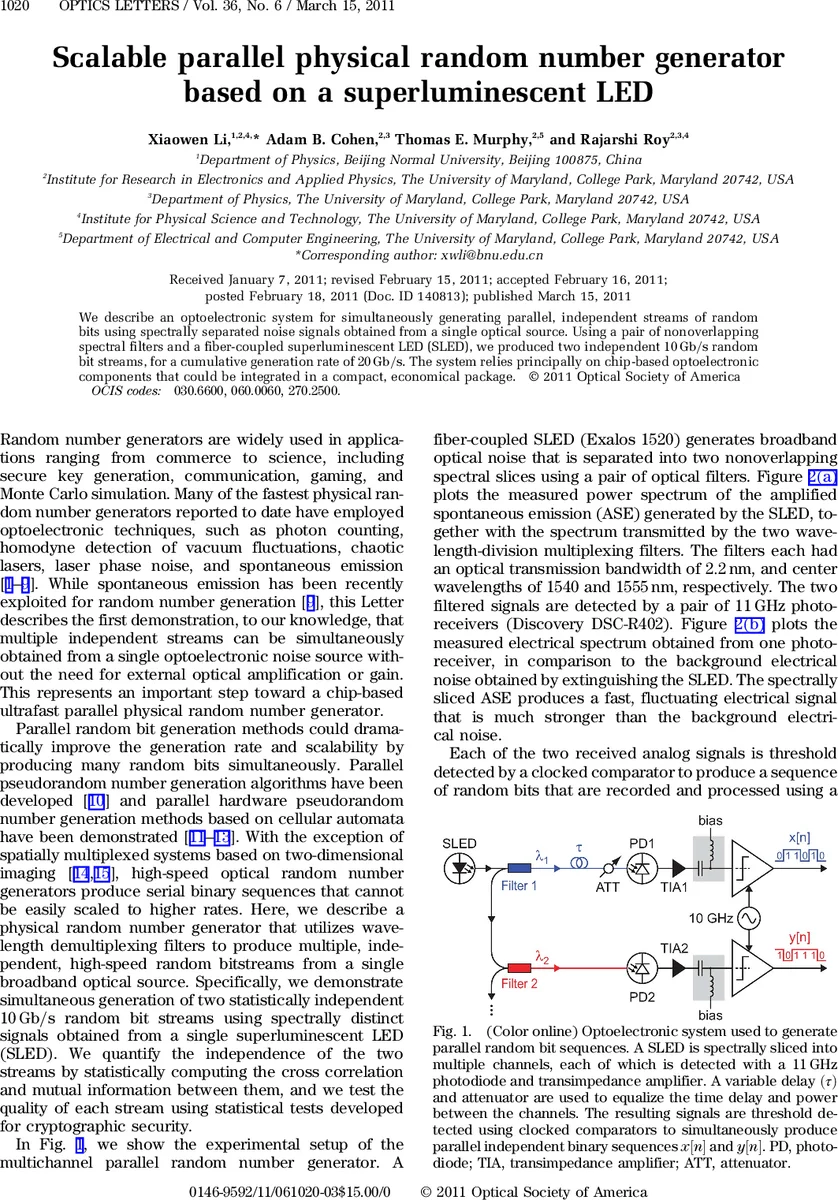
The paper presents a novel optoelectronic architecture for generating multiple high‑speed physical random bit streams from a single broadband light source. Using a fiber‑coupled superluminescent light‑emitting diode (SLED) as the source of amplified spontaneous emission (ASE), the authors split the wide optical spectrum into two non‑overlapping wavelength bands (centered at 1540 nm and 1555 nm, each with a 2.2 nm bandwidth) with standard wavelength‑division multiplexing (WDM) filters. Each band is directed to an independent 11 GHz photodiode‑transimpedance‑amplifier (TIA) pair, producing fast electrical noise that far exceeds the background electronic noise of the receiver. The analog signals are then fed to clocked comparators synchronized to an external 10 GHz clock; the comparator thresholds are finely tuned (≈0.1 mV steps) to balance the proportion of ones and zeros, yielding two parallel 10 Gb/s random bit streams.
To assess independence, the authors compute the cross‑correlation ρ and mutual information I between the two binary sequences as a function of relative delay k. Measured values (|ρ|≈10⁻⁴, I≈10⁻⁸ bits) lie at the theoretical median for two independent unbiased 10⁹‑bit sequences, confirming statistical independence of the channels. However, each individual channel exhibits slight intra‑stream correlations due to the finite temporal response of the photoreceiver electronics. The authors mitigate this by XOR‑ing each stream with a delayed copy of itself (delay of 26 bits). After this post‑processing, the resulting sequences pass all 188 tests of the NIST SP 800‑22 statistical test suite, with composite p‑values well above the 10⁻⁴ threshold and failure counts within the allowed limits.
The paper also demonstrates that interleaving the two processed streams yields a 20 Gb/s composite sequence that likewise passes all NIST tests, further confirming channel independence. The authors argue that adding more wavelength filters could increase the number of parallel channels to at least 20, potentially delivering a cumulative generation rate exceeding 200 Gb/s from a single SLED. All components—SLED, filters, photodiodes, TIAs, comparators—are commercially available and amenable to integration on a chip or board, suggesting a path toward a compact, low‑cost, high‑performance random number generator suitable for cryptographic key generation, high‑performance computing, Monte‑Carlo simulations, and other applications requiring large volumes of high‑quality random bits. Future work will focus on real‑time hardware implementation of the delayed‑XOR operation (e.g., ASIC or FPGA) to achieve fully on‑chip parallel random number generation without offline processing.
Comments & Academic Discussion
Loading comments...
Leave a Comment