Compactifications of Moduli Spaces and Cellular Decompositions
This paper studies compactifications of moduli spaces involving closed Riemann surfaces. The first main result identifies the homeomorphism types of these compactifications. The second main result introduces orbicell decompositions on these spaces us…
Authors: ** 작성자 정보가 논문 본문에 명시되지 않음. (감사의 글에 Sasha Voronov, Eduard Looijenga, Kevin Costello
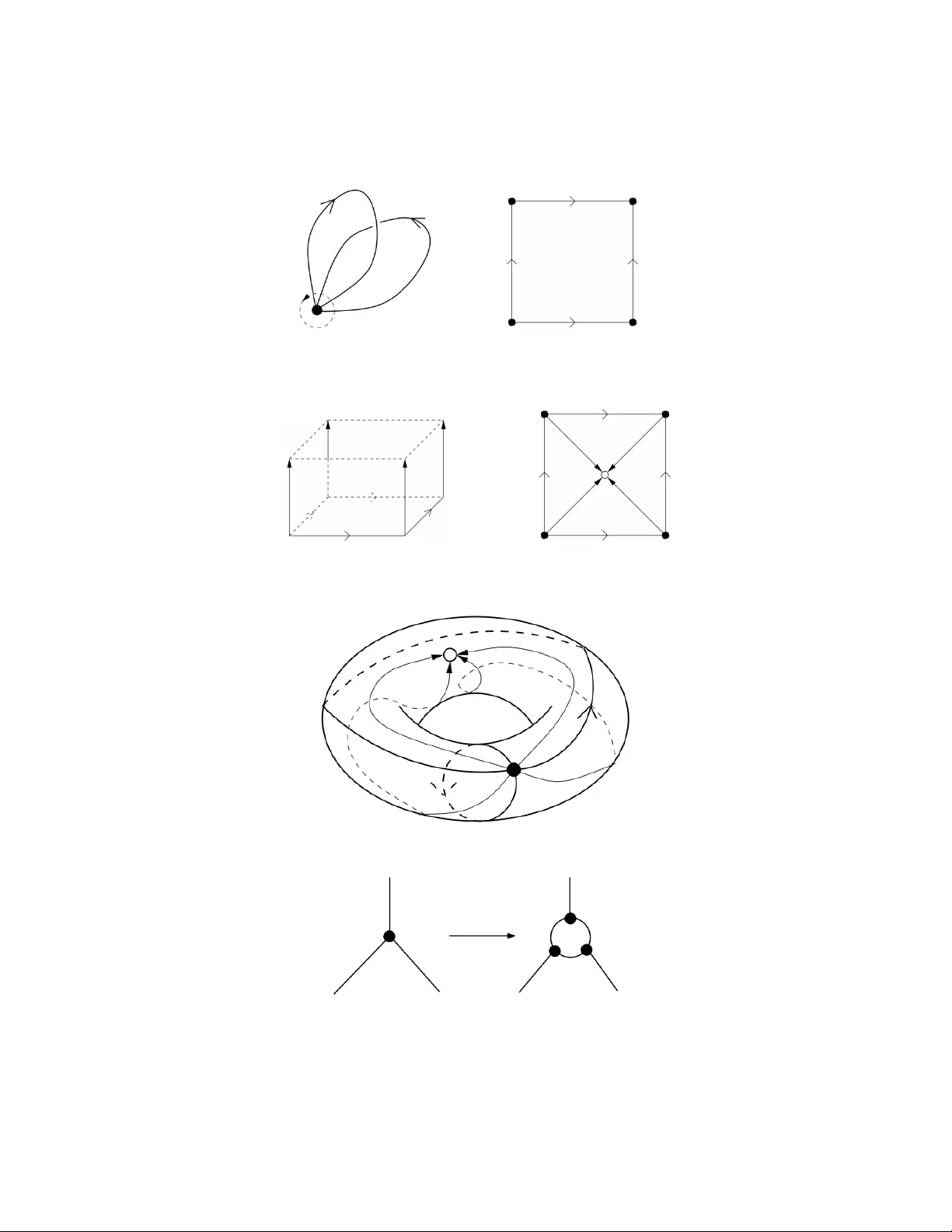
COMP A CTIFICA TIONS OF MODULI SP A CES AND CELLULAR DECOMPOSITIONS JA VIER Z ´ U ˜ NIGA Abstract. This paper studies compactifications of mo duli spaces in volving closed Riemann surfaces. The first main result identifies the homeomorphism types of these compactifications. The second main result in tro duces orbicell decompositions on these spaces using semistable ribb on graphs extending the earlier work of Lo oijenga. Contents 1. In tro duction 1 2. Real Oriented Blowups 2 3. Decorated Mo duli Spaces 6 3.1. Compactifications 6 3.2. T op ology 9 4. Semistable Ribb on Graphs 14 4.1. Ribb on Graphs 14 4.2. Gluing Construction 16 4.3. Semistable Ribb on Graphs 18 4.4. P ermissible Sequences 24 5. Cellular Decomp ositions 26 5.1. Metrics on Ribb on Graphs 26 5.2. Streb el-Jenkins Differentials 29 References 34 1. Introduction By a Riemann surface or simply a curv e we mean a compact connected com- plex manifold of complex dimension one. Denote b y M g ,n the mo duli space of Riemann surfaces with gen us g and n > 0 lab eled p oints. The Deligne-Mumford compactification is denoted by M g ,n . This is a space parameterizing stable Rie- mann surfaces. Here the w ord “stable” refers to the finiteness of the group of conformal automorphism of the surface. Geometrically it means that we only allo w double point (also called node) singularities and that eac h irreducible component of the surface has negative Euler c haracteristic (taking the lab eled points and no des in to account). W e can further p erform a real oriented blo wup along the lo cus of degenerate surfaces to obtain the space M g ,n . In tuitively , this space is similar to Date : Nov ember 21, 2018. 1 2 J. Z ´ U ˜ NIGA the Deligne-Mumford space but it also remem b ers the angle at eac h double p oint at which the surface degenerated. The decorated moduli space is denoted b y M dec g ,n = M g ,n × ∆ n − 1 where ∆ n − 1 is the ( n − 1) dimensional standard simplex. The decorations can b e thought of as h yp erb olic lengths of certain horo cycles or as quadratic residues of Jenkins-Strebel differen tials on a Riemann surface. By c ho osing an appropriate notion of d ecoration on a stable Riemann Surface it is p ossible to construct compactifications M dec g ,n and M dec g ,n . The first main result of this pap er identifies the homeomorphism t yp e of these compactifications. Let P be a finite set of lab els. Corollary 3.12. M dec g ,P ∼ = M g ,P × ∆ P and ther efor e M dec g ,P is Hausdorff and c omp act. Theorem 3.14. Ther e is a map M dec g ,P → M g ,P × ∆ P which is a home omorphism in the interior and has c onic al singularities along the b oundary of M dec g ,P and is thus a homotopy e quivalenc e. It is a known result of Harer, Mumford, Th urston [Har86], P enner [Pen87], Bo wditch, Epstein [BE88], th at the decorated mo duli space is homeomorphic to the mo duli space of metric ribb on graphs denoted by M comb g ,n . This later space comes with a natural orbi-cellular structure given by ribbon graphs. In [Kon92] Kon tsevich in tro duces a wa y to compactify this space in order to pro v e Witten’s conjecture. Later on Lo oijenga formalized and extended these ideas in [Lo o95] in connection with the arc complex. The second part of this pap er describ es a cellular compactification of the ribbon graph space, extending the work of Lo oijenga. The main results are the follo wing. Theorem 5.14. The map Ψ : M comb g ,P → M dec g ,P is a home omorphism. Theorem 5.18. The map Ψ : M comb g ,P → M dec g ,P is a home omorphism. This new compactification co v ers Looijenga’s and Kontsevic h’s compactifications and is finer, meaning that it enco des more information. It also seems more relev ant to quan tum field theory purp oses. In particular, it should b e possible to describe a BV structure on the cellular c hains of our compactification and construct a so- lution to the quantum master equation in a future work. This solution is purely com binatorial and so it a voids the use of string v ertices or geometric chains. I w ould lik e to thank Sasha V oronov for his generosity and guidance, Eduard Lo oijenga for his patience answ ering m y questions, and Kevin Costello for sharing his own ideas about this w ork with me. I am also grateful to Jim Stasheff for reviewing an early draft of this pap er. Finally I would lik e to ackno wledge the enormous contribution made by the referee to the quality and clarity of the present exp osition. 2. Real Oriented Blo wups W e will use a blowup construction in the PL category . Giv en a manifold M and a closed submanifold N the real (or directional) oriented blo wup Bl N ( M ) can b e defined by gluing M − N to the (co dim N -1)-dimensional spherical bundle of rays of the normal bundle of N in M . This is homeomorphic to the result of carving COMP A CTIFICA TIONS OF MODULI SP ACES 3 Figure 1. On the left: A three dimensional manifold with a one dimensional submanifold of the b oundary . On the right: its real orien ted blo wup. Figure 2. Bl {{ (0 , 0 , 0) } , { (1 , 0 , 0) } , { (0 , 0 ,z ) } , { (0 ,y, 0) } , { ( x, 0 , 0) } , { (1 , 0 ,z ) } , { (1 ,y , 0) }} ( R 3 ) an op en tubular neigh b orho od of N out of M . There is a natural pro jection map Bl N ( M ) → M . The construction can be generalized to the PL category of manifolds with b oundary and the submanifold N can b e replaced by a union of submanifolds with some transversalit y condition. Lemma 2.1. Blowing up a submanifold of the b oundary of a manifold do es not change the home omorphism typ e of the original manifold. Pr o of. The normal bundle of a submanifold in the b oundary of M is a closed half space bundle. Therefore the bundle of rays is a half sphere bundle. This pro cess enlarges the b oundary of M without changing its homeomorphism type as in Figure 1. A homeomorphism can b e realized by using a tubular neighborho o d of the submanifold. Giv en a union of PL-submanifolds in tersecting m ulti-transversely , it will b e some- times necessary to blow up suc h union with the aid of a filtration indexed by di- mension. In this case w e will blow up from the low est dimensional to the highest dimensional elements of the filtration. W e will denote b y Bl F ( M ) the sequen tial blo wup of M along the filtration F = { P i } indexed b y dimension. An example can b e seen in Figure 2. In what follo ws the symbol “ ∼ = ” means homeomorphic and “ ' ” means homo- topic. Lemma 2.2. Given two manifolds X , Y and a submanifold Z ⊂ X we have Bl Z × Y ( X × Y ) ∼ = Bl Z ( X ) × Y Pr o of. Let T ( X ) denote the tangent bundle of X and ν X ( Z ) the normal bundle of Z in X . Since T ( Z × Y ) ∼ = T ( Z ) × T ( Y ) the vectors normal to Z × Y in 4 J. Z ´ U ˜ NIGA T ( X × Y ) ∼ = T ( X ) × T ( Y ) do not include any v ector in the second factor. Thus ν X × Y ( Z × Y ) ∼ = ν X ( Z ) × Y and the result follo ws. Let S 2 n − 1 = { − → z ∈ C n | P | z i | 2 = 1 } and T n = ( S 1 ) n . W e also denote by B n the n -dimensional op en unit ball { − → x ∈ R n | | − → x | < 1 } and by B n its closure in R n . Lemma 2.3. L et T n act on S 2 n − 1 by ( θ 1 , ...θ n ) · ( z 1 , ..., z n ) = ( θ 1 z 1 , ..., θ n z n ) . Then S 2 n − 1 / T n ∼ = ∆ n − 1 Pr o of. Notice that Bl { − → 0 } ( C n ) ∼ = C n − B 2 n b y extending to the b oundary the homeomorphism taking − → x to − → x + − → x | − → x | . Th us the b oundary generated is isomor- phic to S 2 n − 1 . Consider the map π : S 2 n − 1 → ∆ n − 1 defined by ( z 1 , ..., z n ) 7→ ( | z 1 | 2 , ..., | z n | 2 ). The preimage of a p oin t in the simplex corresp onds with the orbit of the torus action and hence the map descends to the desired homeomorphism after taking the quotient. In order to clarify the homeomorphism type of certain quotient space we intro- duce the notion of conical singularit y . If X is a top ological space let C X be its cone and v the vertex. When X is a top ological manifold the resulting cone is locally Euclidean in C X − { v } . When C X is not lo cally Euclidean at v we call this vertex a conical singularit y . If X and Y are top ological manifolds and v is a conical singularit y of C X then any p oin t in { v } × Y ⊂ C X × Y is also called a conical singularit y . Lemma 2.4. As in L emma 2.3, the torus T n acts on the b oundary of Bl { − → 0 } ( C n ) . The quotient Bl { − → 0 } ( C n ) / T n is the disjoint union of C n − { − → 0 } and ∆ n − 1 and has c onic al singularities along the se c ond subsp ac e. This sp ac e is c ontr actible and henc e homotopic to C n . Pr o of. W e can view the quotient Bl { − → 0 } ( C n ) / T n as the union of C n −{ − → 0 } with ∆ n − 1 due to Lemma 2.3. Therefore this quotient can b e understo o d as an enlargement of the origin into the simplex. Ho wev er this enlargement is not homeomorphic to C n . T o see this tak e a p oin t p in the interior of the simplex. A neigh b orho o d of this p oin t in the simplex is homeomorphic to B n − 1 . The preimage under π : S 2 n − 1 → ∆ n − 1 of eac h p oint in this neigh b orho o d under the torus action is T n . The normal bundle has rank one (it is the bundle of rays in C n orthogonal to the sphere S 2 n − 1 ). Thus a neigh b orho od of p is homeomorphic to ( B n − 1 × [0 , 1) × T n ) / T n where the semi- op en interv al [0 , 1) corresp onds with the normal bundle and the torus acts only at level zero (which corresp onds to the simplex). A t p this quotient gives the cross pro duct of the torus with the interv al where one end is collapsed to a point. But this is exactly ( C T n ) ◦ , i.e. the interior of the cone o ver the torus. Th us a neigh b orho od of p in Bl { − → 0 } ( C n ) / T n is homeomorphic to B n − 1 × ( C T n ) ◦ and p is a conical singularity . W e will refer to these op en sets as toric neighborho o ds . F or a p oin t on the b oundary of the simplex a similar (but more careful) analysis yields the same toric neighborho o ds. Awa y from the simplex the quotient of the blowup is still homeomorphic to C n . Con tracting radially gives a T n -equiv ariant deformation retraction of Bl { − → 0 } ( C n ) on to its b oundary: S 2 n − 1 . Therefore the quotient deformation retracts onto ∆ n − 1 whic h is contractible. In particular, this space is homotopic to C n . COMP A CTIFICA TIONS OF MODULI SP ACES 5 Figure 3. The blowup of ∆ 3 along the sets ∅ , {{ 3,4 }} , {{ 4 } , { 1,4 } , { 2,4 } , { 3,4 }} , and {{ 1 } , { 2 } , { 3 } , { 4 } , { 1,2 } , { 1,3 } , { 1,4 } , { 2,3 } , { 2,4 } , { 3,4 }} . Corollary 2.5. Denote by D m the interse ction of the m c omplex hyp erplanes in C n given by z i = 0 wher e 1 ≤ i ≤ m . The torus T m acts on the b oundary of Bl D m ( C n ) and in fact the quotient is home omorphic to Bl { − → 0 } C m / T m × C n − m . In p articular, it has c onic al singularities at the p oints of the simplex in the first factor and it is c ontr actible. Pr o of. D m can b e describ ed as { (0 , ..., 0 , z m +1 , ..., z n ) } ∼ = { − → 0 } × C n − m and C n ∼ = C m × C n − m . B y Lemma 2.2 Bl { − → 0 }× C n − m ( C m × C n − m ) ∼ = Bl { − → 0 } C m × C n − m and therefore w e can apply the previous lemma to the first comp onent since T n only acts on the first factor. Consider the n − 1 dimensional standard simplex ∆ n − 1 with vertices lab eled b y the set [ n ] = { 1 , ..., n } . Since ev ery face can b e identified with a subset of [ n ] given a subset P ⊂ 2 [ n ] w e denote by Bl P (∆ n − 1 ) the blowup of the simplex along the filtration indexed by dimension obtained from the faces induced b y P . Notice that blo wing up along sets with n − 1 or n elements do es not change the geometry in a meaningful wa y since the result is linearly isomorphic to the simplex. Therefore the only contributions come from blowing up faces of codimension at least t w o. R emark 2.6 . If P = 2 [ n ] then Bl P (∆ n − 1 ) pro duces the n − 1 dimensional cyclohe- dron. This can be made explicit using for example Prop osition 4.3.1 in [Dev03]. The asso ciahedra can also b e obtained as a blowup of standard simplices. F or in- stance the three dimensional asso ciahedron K 3 corresp onds with the blowup of ∆ 3 along P = {{ 2 } , { 3 } , { 1 , 2 } , { 2 , 3 } , { 3 , 4 }} . 6 J. Z ´ U ˜ NIGA In what follo ws it will be necessary to consider the real oriented blowup in the category of orbifolds. Lo cally , an orbifold lo oks like R n /G where G is a finite group acting linearly . This allo w us to define the real orien ted blowup along a subspace of the quotien t by first blowing up the orbit in R n and then taking the quotien t by the induced action. The compatibilit y conditions of the orbifold define the blowup globally . 3. Decora ted Moduli Sp aces 3.1. Compactifications. The mo duli space M g ,P parametrizes conformal classes of Riemann surfaces of genus g with a fixed finite subset P of labeled points. W e will also denote this mo duli space as M g ,n where n = | P | . The top ological type of a surface is defined as the pair ( g , n ). The symmetric group S P acts b y permuting the lab els. A decoration of a lab eled point is a non-negativ e real n umber asso ciated to that p oin t. W e require that each lab elled p oint has a decoration and that the total sum of decorations is one. This giv es M g ,P × ∆ P where ∆ P is the | P | − 1 dimensional standard simplex spanned by P . Denote this space by M dec g ,P and call these surfaces P -lab eled Riemann surfaces of genus g decorated by real n um b ers . Its dimension is 6 g + 3 n − 7. In [MP98] there is a description of an orbicell decomp osition for M dec g ,P and M dec g ,P / S P in terms of ribbon graphs. The aim of this paper is to construct orbicell decomp ositions for compactified v ersions of these spaces using ribb on graphs and relate their homeomorphism types to those of M g ,n and M g ,n . F or M g ,P it is p ossible to take the Deligne-Mumford compactification M g ,P whic h parametrizes isomorphism classes of P -labeled stable Riemann surfaces. W e can further p erform a real orien ted blo wup along the lo cus of stable curves with singularities to obtain the mo duli space M g ,P as in [KSV96] which is called the mo duli space of P -lab eled stable Riemann surfaces decorated by real tangen t directions . T o b etter understand this space consider the normal bundles to the lo cus of stable curv es with singularities. Lo cally , when we ha v e only one singularit y , the normal bundle is canonically isomorphic to the tensor pro duct of t wo tangent spaces of the surface, one for each side of the singularit y . Poin ts in the b oundary of the real oriented blowup then corresp ond to real rays in the tensor pro duct. This information enco des an angle at eac h double point of the surface and all p ossible angles describ e a circle. The natural pro jection M g ,P → M g ,P has as preimages finite quotients of real tori (a pro duct of circles) on the lo cus of singular curv es. The dimension of the torus is equal to the num b er of singularities and the group action is induced b y conformal automorphisms. W e no w in tro duce a w ay to compactify M dec g ,P motiv ated b y [Lo o95]. A P -lab eled no dal Riemann surface C is semistable when its irreducible components minus lab els and no des hav e non-p ositive Euler characteristic. Denote b y ˆ C = t i ∈ I C i its normalization where the C i ’s are connected and irreducible. The preimages of singularities under the attac hing map are called no des . Let N b e the set of no des and ι : N → N the induced inv olution. Two elements of N are asso ciated if they b elong to the same orbit of ι . Two components of ˆ C are associated if one of them has a node asso ciated to a node in the other comp onent. The only smooth P -labeled semistable surface that is not stable ( χ = 0) is the Riemann sphere with t wo lab eled p oin ts whic h will only arise as no des. W e call this surface a semistable sphere . Its mo duli space is just a point. The only other semistable surface with COMP A CTIFICA TIONS OF MODULI SP ACES 7 zero Euler c haracteristic is the compact torus but since this surface has no lab eled p oin ts we will not consider this case. Now w e further restrict these surfaces as to comply with the following conditions. (1) A comp onent cannot b e asso ciated to itself. (2) Tw o semistable spheres cannot b e asso ciated. (3) The tw o p oints in a semistable sphere are alwa ys no des. (4) A stable component with no labeled p oints m ust be asso ciated with at least one other stable comp onen t. Definition 3.1. A p erimeter function for C is a function λ : P ∪ N → [0 , 1] with the following tw o prop erties. (1) If p and q are the no des of a semistable sphere then λ ( p ) = λ ( q ). (2) Ev ery connected comp onen t of ˆ C has at least one p oint p ∈ P ∪ N with λ ( p ) > 0. Definition 3.2. An order for C is a function ord : π 0 ˆ C → N where N = { 0 , 1 , 2 , ... } with the condition that if ord([ C i ]) = k > 0 then there exist j such that ord([ C j ]) = k − 1. A comp onent of order k will be called a k -comp onen t . W e will also denote by ˆ P k and ˆ N k the subsets of P and N lying on k -comp onen ts. Definition 3.3. W e sa y that the pair ( λ, ord) is compatible if they satisfy the follo wing prop erty: Let p ∈ C i ∩ N and q = ι ( p ) ∈ C j ∩ N then λ ( p ) > 0 if and only if λ ( q ) = 0. Moreov er, in this case we require that ord([ C j ]) < ord([ C i ]). Definition 3.4. A compatible pair ( λ, ord) is unital if for each fixed k X p ∈ ˆ P k ∪ ˆ N k λ ( p ) = 1 A unital pair will b e called a decoration of C . This definition agrees with the definition of a decoration on smo oth Riemann surfaces where there is only one comp onen t of order zero. Lemma 3.5. Given a de c or ation ( λ, ord) of C we have: (1) If p ∈ C i ∩ N with ord([ C i ]) = 0 then λ ( p ) = 0 . (2) Ther e is a c onstant m ∈ N such that ord([ C i ]) ≤ m for al l i and given k such that 0 ≤ k ≤ m ther e exist i with ord([ C i ]) = k . (3) If p, q ∈ C i ∩ N wher e C i is a semistable spher e then λ ( p ) = λ ( q ) > 0 . (4) If C i is a semistable spher e then any c omp onent asso ciate d to it has a lower or der. (5) A c omp onent c annot b e asso ciate d to another c omp onent of the same or der. Pr o of. T o sho w (1) supp ose p ∈ C i ∩ N with λ ( p ) > 0. Then from the definition of order w e get a component C j with ord([ C j ]) < ord([ C i ]) = 0. But this is a con tradiction since ord([ C i ]) ≥ 0. F or (2) first notice that π 0 ( ˆ C ) is finite b ecause the surface is compact. Then there exists a maximal order m and the result fol- lo ws from the definition of order. F or (3) assume that λ ( p ) = 0. Then from the definition of p erimeter function w e get λ ( q ) = 0 whic h is in contradiction with the second condition for a p erimeter function. No w (4) follows from (3) by applying the definition of compatible pair. Finally (5) follo ws solely from the definition of compatible pair. 8 J. Z ´ U ˜ NIGA Figure 4. Semistable surface with unital pair: the num b ers in- side the surface corresp ond to decorations b y real num b ers and the num b ers outside the surface corresp ond to the orders of the irreducible comp onents. Figure 5. Decorations b y tangen t directions at a singularit y be- t ween stable comp onents and semistable spheres. Example 3.6. Figure 4 illustrates a unital pair. An isomorphism in this context is a stable surface isomorphism preserving the lab els p oint wise and the decorations. Definition 3.7. The set of isomorphism classes of P -lab eled semistable Riemann surfaces together with a decoration will also be called the moduli space of dec- orated semistable surfaces and will b e denoted by M dec g ,P . Definition 3.8. In an analogous wa y we in tro duce the mo duli space M dec g ,P b y adding decorations by tangen t directions at eac h node of a surface. Isomorphisms are required to preserve this extra data. R emark 3.9 . The lo cal effect of allo wing semistable comp onents in the moduli space is minimal. F or M dec g ,P it is only adding the combin atorics of the decoration. W e will see later that geometrically it accoun ts for remem b ering how fast a geo desic v anished. F or M dec g ,P , given t wo asso ciated irreducible comp onents, the decorations b y tangent directions enlarge the real dimension of that lo cus by one in the mo duli space. Inserting a strictly semistable sphere in betw een these asso ciated comp onents also adds only one dimension to that lo cus in the mo duli space. This is b ecause the group of automorphisms rotates the sphere so that the real ra ys corresponding to the no des on the semistable sphere are irrelev ant. This is illustrated on Figure 5. COMP A CTIFICA TIONS OF MODULI SP ACES 9 3.2. T op ology. W e wish to define a bijection ϕ : Bl ¯ F ( M g ,P × ∆ P ) → M dec g ,P where Bl ¯ F ( M g ,P × ∆ P ) is certain blowup construction whose top ology w e understand. The top ology of M dec g ,P is then induced via this map. If ([ C ] , λ ) ∈ M g ,P × ∆ P then there is at least one irreducible comp onent of C that has a non-zero decoration. Call these kind of irreducible components non-zero comp onen ts , the rest will b e called zero components . Consider the differen t loci of singular surfaces with the following prop erty: every node in a zero comp onent is associated to a no de on a non-zero comp onents (notice that this rules out self- in tersections on zero comp onents since that component w ould b e asso ciated with itself, whic h is a zero comp onen t b y definition). The union of all these lo ci defines a filtration b y dimension w e call F . The induced filtration by dimension of the closure of the previous lo ci is denoted by ¯ F . Thus ¯ F can b e viewed as the union of strata intersecting multi-transv ersely . R emark 3.10 . The highest dimensional strata of ¯ F corresp ond with the lo cus of surfaces with only one singularity and no irreducible comp onent with all of their decorations equal to zero. Since the dimension of these strata is equal to the dimension of the b oundary it has the same homeomorphism type and th us blowing up along these strata will not pro duce an y new p oints on the b oundary . Theorem 3.11. Ther e is a bije ction ϕ : Bl ¯ F ( M g ,P × ∆ P ) → M dec g ,P that induc es a top olo gy on M dec g ,P . Pr o of. The map ϕ is defined as the identit y on M g ,P × ∆ P . If x b elongs to the lo cus of singular surfaces of Bl ¯ F ( M g ,P × ∆ P ) w e need to define ϕ ( x ) = [( C, λ, ord)]. Since x is in the b oundary it means that it w as a point resulting from blowing up along ( M g ,P − M g ,P ) × ∆ P and thus it determines a class [ C ] ∈ M g ,P . Consider a metric on M g ,P induced b y F enc hel-Nielsen co ordinates. The normal bundle can b e used to induce a small tubular neighborho o d of the b oundary of Bl ¯ F ( M g ,P × ∆ P ) so that each normal ray corresp onds with a geo desic ray isometric to [0 , ρ ). T aking 0 < < ρ this defines a family { [( C , λ )] } of decorated (non-singular) surfaces in M g ,P × ∆ P with lim → 0 [ C ] = [ C ]. No w define a unital pair ( λ, ord) b y induction on the order. Recall that { C i } i ∈ I is the set of connected comp onents of the normalization ˆ C . This comes with an in volution ι : N → N and set P i = C i ∩ P , N i = C i ∩ N . Let { C i } i ∈ I 0 ⊂ I b e the set of all irreducible comp onen ts with P i 6 = ∅ and lim → 0 λ ( p ) > 0 for at least one p ∈ P i . Set λ ( p ) = lim → 0 λ ( p ) for p ∈ P i and λ ( p ) = 0 for p ∈ N i . Also let ord | π 0 ( q C i ) ≡ 0 for i ∈ I 0 . This defines ( λ, ord) at order zero. Notice that P λ ( p ) = 1 where the sum runs o v er all labeled points on comp onen ts of order zero. Lets assume now that ( λ, ord) has b een defined up to order k and it is unital up to that order. W e require a condition on degenerating geo desics. Either a few geodesics hav e been turned into semistable spheres (by b eing collapsed and b ecoming components of higher order) or they ha ve giv en rise to decorations on no des of components of order greater than zero (this will b e made explicit on the inductiv e step). In the first case it is assumed that such semistable spheres are asso ciated to comp onents of order less than or equal to k . If g β is a geo desic b eing collapsed to a no de n we can express this as the limit lim → 0 g β = n . Let l ( g β ) b e 10 J. Z ´ U ˜ NIGA the length of such geo desic. Obviously lim → 0 l ( g β ) = 0. Consider the limits d ( p α ) = lim → 0 λ ( p α ) P λ ( p • ) + P l ( g • ) , d ( n ) = lim → 0 l ( g β ) P λ ( p • ) + P l ( g • ) where the first sum of the denominator runs ov er all lab eled p oints p • ∈ C i with i ∈ I − ( I 0 q I 1 q · · · q I k ) and the second sum runs ov er all geo desics b eing collapsed to a node singularity that ha ve not b een turned into semistable spheres or hav e given rise to decorations on no des. Supp ose d ( n ) > 0 for some no de n . Assume first that n separates tw o comp onents whose orders hav e already been assigned and thus are less than or equal to k . In this case w e cut the surface along the node and glue a semistable sphere in betw een. W e call this sphere C i . Here i = | I | + 1 and we ha ve to include this num b er in the set I . If q 1 , q 2 are the tw o elements of N i define λ ( q 1 ) = λ ( q 2 ) = d ( n ) / 2 , λ ( p 1 ) = λ ( p 2 ) = 0 , ord( C i ) = k + 1 where p 1 = ι ( q 1 ), p 2 = ι ( q 2 ) are given in the obvious wa y . Now supp ose that n separates tw o comp onen ts one of which has already b een assigned an order. Let the other one b e C i . If q ∈ N i and p = λ ( q ) then define λ ( q ) = d ( n ) , λ ( p ) = 0 , ord C i = k + 1 . F or every comp onen t C i with at least one p ∈ P i suc h that d ( p ) > 0 define λ ( p ) = d ( p ) for all p ∈ P i , ord C i = k + 1 . This pro duces a unital pair ( λ, ord) up to order k + 1. Since the type of the surface is finite this pro cess exhausts all comp onents of the normalization of the surface giving them orders and possibly creating along the wa y semistable spheres. This completes the definition of ϕ . The map ϕ is surjective on M g ,P × ∆ P b ecause it is defined as the iden tity there. Giv en a p oint [( C , λ, ord)] where C is a singular surface, it is p ossible to construct a one parameter family { [ C t ] } 0 0. Let g i ( t ) b e the geodesic giving rise to n i in C t . If l denotes the length of a geo desic then l ( g i ( t )) = t k i 2 λ ( n i ) or l ( g i ( t )) = t k i λ ( n i ) dep ending on whether n i b elongs to a semistable sphere or not. • lim t → 0 [ C t ] = [ C ] ∈ ∂ M g ,P Supp ose that p i ∈ P lies on a comp onent of order k i and define by p i ( t ) its corresp onding lab eled p oin t in [ C t ] for 0 < t < 1. Then letting λ ( p i ( t )) = t k i λ ( p i ) defines a path α ( t ) in M dec g ,P . It can b e c hec ked then that lim t → 0 α ( t ) = [( C, λ, ord)] . Moreo ver, the preimage of α under ϕ also defines a path in Bl ¯ F ( M g ,P × ∆ P ) (it is the same path since this map is the identit y on the interior of the mo duli space). This limit also exists and defines a point x = lim t → 0 α ( t ) in Bl ¯ F ( M g ,P × ∆ P ) whic h is a preimage of [( C, λ, ord)] under ϕ . COMP A CTIFICA TIONS OF MODULI SP ACES 11 The map ϕ is injective on M g ,P × ∆ P b ecause it is defined as the identit y there. Let x 1 , x 2 b elong to Bl ¯ F ( M g ,P × ∆ P ) − M g ,P × ∆ P so that x 1 6 = x 2 and let ϕ ( x 1 ) = [( C 1 , λ 1 , ord 1 )], ϕ ( x 2 ) = [( C 2 , λ 2 , ord 2 )]. Now consider the following cases. If x 1 and x 2 w ere generated b y blowing up along the lo cus of singular surfaces with [ C 1 ] 6 = [ C 2 ] then ϕ ( x 1 ) 6 = ϕ ( x 2 ). In case [ C 1 ] = [ C 2 ] it could also happ en that x 1 and x 2 where generated b y blowing up along different strata of ¯ F . This will giv e rise to differen t order functions and hence again ϕ ( x 1 ) 6 = ϕ ( x 2 ). In the last case, if [ C 1 ] = [ C 2 ] and ord 1 = ord 2 it can b e show ed that all the parameters left to consider in the decoration (the p erimeter function) completely parametrizes this part of the blowup and therefore x 1 6 = x 2 implies ϕ ( x 1 ) 6 = ϕ ( x 2 ). Finally , the top ology of M dec g ,P is induced from the top ology of the blowup through this bijection. In M g ,P × ∆ P ⊂ M dec g ,P it is the same topology as usual since the map is defined as the identit y there. Notice that by definition Bl ¯ F ( M g ,P × ∆ P ) and M dec g ,P are homeomorphic. Corollary 3.12. Ther e is an home omorphism M dec g ,P ∼ = M g ,P × ∆ P and ther efor e M dec g ,P is Hausdorff and c omp act. Pr o of. Since Bl ¯ F ( M g ,P × ∆ P ) ∼ = M g ,P × ∆ P , Lemma 2.1 pro vides suc h homeo- morphism. No w w e turn our attention to another mo duli space. Definition 3.13. The space M dec g ,P is obtained from M dec g ,P b y forgetting the dec- orations by tangen t directions. The canonical pro jection M dec g ,P → M dec g ,P induces then a quotient top ology on M dec g ,P . As a result of the previous theorem the space M dec g ,P can b e defined in t w o ana- logue w ays. One can define decorated semi-stable surfaces together with a top ology as b efore or one can blow up M g ,P × ∆ P . The second definition requires an extra step: to forget the decorations by tangent directions pro duced by the blowup. The top ology is then the quotient top ology induced by a similar pro jection as in the previous definition. Theorem 3.14. Ther e is a map M dec g ,P → M g ,P × ∆ P which is a home omorphism in the interior and M dec g ,P has c onic al singularities along the lo cus of singular surfac es. Pr o of. F rom the previous definition M dec g ,P ∼ = ˆ B where the space ˆ B is obtained from Bl ¯ F ( M g ,P × ∆ P ) by forgetting the decorations by tangent directions and th us inherits the quotien t topology . This real oriented blowup provides such map whic h is a homeomorphism on the interior by construction. F or the second part consider tw o cases. If a stratum of ¯ F corresp onds with singular surfaces where all comp onen ts with labeled p oints are of order zero then the new b oundary created and the subsequent quotient corresp onds lo cally with the picture in Corollary 2.5 mo dulo some finite group action. Otherwise there are comp onents of order greater than zero with lab eled p oin ts having all decorations equal to zero. The former case 12 J. Z ´ U ˜ NIGA Figure 6. The top ological t yp e of a surface arising as the in ter- section of strata (notice ho w the orders are added). then generalizes to tak e care of the latter and a neighborho o d of a p oin t in the blo wup after taking the quotien t will hav e a toric neigh b orho od. Corollary 3.15. The sp ac e M dec g ,P is Hausdorff, c omp act and homotopic to M g ,P . The following lemma will help us understand the examples. Lemma 3.16. The pr eimages of p oints in the str ata of ¯ F in Bl ¯ F ( M g ,P × ∆ P ) under the natur al pr oje ction ar e pr o ducts of simplic es mo dulo finite gr oups. Pr o of. By definition of ¯ F a p oint in the filtration lies in the lo cus of multi-in tersecting strata. This gives the top ological type, decoration by tangent directions, and con- formal structure on the irreducible comp onents of the normalization. The extra in- formation in tro duced by the blo wup is the half sphere as in the proof of Lemma 2.1. If a metric is given this induces a metric on the normal bundle. This metric then can b e used to give the half sphere the desired parametrization by a product of blo wn-up simplices, one for every order of the surface, mo dulo a finite group action. Example 3.17. On Figure 6 we can see ho w the top ological type and combinatorics of the order can b e determined by the intersection of the strata b eing blo wn up in the definition of the decorated mo duli space. The actual decorations of the surface in the middle is determined by a p oint in ∆ 1 × ∆ 2 × ∆ 1 corresp onding with the comp onents of order 0, 2, and 1 resp ectively . Figure 7 sho ws surfaces whose asso ciated closure of blo wn-up simplex parameterizing the decorations is given on Figure 3. The extra faces induced b y the blo wup (and captured b y the closure) corresp ond with decorations on comp onents of higher order. R emark 3.18 . By generalizing Figure 3 and Figure 7 one can obtain the cyclohedron from degeneration of surfaces. This is not the case with the asso ciahedron. In the case of K 3 this is b ecause all p ossible three dimensional simplices arising from degeneration of surfaces are illustrated in those figures and K 3 is not among them. This also implies that it will not sho w up as a face in a higher dimensional blo wn-up simplex. T o get the associahedron one needs to consider compactified versions of mo duli of Riemann surfaces with boundary as in [Liu04] or [Cos06]. More recen tly in [DHV11] w e can find a nice treatmen t of this connection b etw een bordered Riemann surfaces and asso ciahedral p olytopes. COMP A CTIFICA TIONS OF MODULI SP ACES 13 Figure 7. Surfaces asso ciated with the blown-up simplices on Figure 3. Figure 8. The complex T . Example 3.19. The space M 0 ,P where | P | = 4 can b e iden tified with the Riemann sphere with three remo ved op en disks corresp onding with the three p ossible w ays in whic h the Riemann sphere with four lab eled points can degenerate. The space M dec 0 ,P is the union of M 0 ,P × ∆ P with three copies of the space S 1 × T where T is a three dimensional simplicial complex obtained from gluing three solids: tw o copies of ∆ 2 × ∆ 1 and the real oriented blo wup of ∆ 3 at tw o opp osite edges corresp onding to the decorations of the lab eled p oin ts in each irreducible comp onen t of the stable surface. The interior of the blown-up copy of ∆ 3 corresp onds with the first surface on Figure 9. The interior of the tw o copies of ∆ 2 × ∆ 1 corresp onds with the second surface on Figure 9. Finally , the in tersection of these complexes are rectangles corresp onding with the third surface on Figure 9. A simple wa y to go from M 0 ,P × ∆ P to the b oundary is to consider the geo desic g ( t ) that is b eing collapsed and its length l . If l ( g ( t )) → 0 and each resulting irreducible comp onent contains a marked p oint with non-v anishing limit, then we land in the blown-up copy of ∆ 3 in T . If the decorations of b oth lab eled p oin ts in a resulting irreducible co mponent tend to zero then we land in one of the copies of ∆ 2 × ∆ 1 . T o decide in which p oin t w e land let d 1 ( t ), d 2 ( t ) b e such decorations and 14 J. Z ´ U ˜ NIGA Figure 9. Surfaces asso ciated to the complex T . n the decoration at the no de. Then the decorations in the limit will b e d 1 = lim d 1 ( t ) d 1 ( t ) + d 2 ( t ) + l ( g ( t )) d 2 = lim d 2 ( t ) d 1 ( t ) + d 2 ( t ) + l ( g ( t )) n = lim l ( g ( t )) d 1 ( t ) + d 2 ( t ) + l ( g ( t )) . This w orks for M dec 0 , 4 as w ell as M dec 0 , 4 . The only difference is that in the first case w e keep track of the angles which giv e the decorations by tangent directions. Since the singular surfaces in M dec 0 , 4 can only ha v e one singularit y the toric neigh b orhoo ds reduce to the cone o v er a circle which is homeomorphic to a disc. 4. Semist able Ribbon Graphs 4.1. Ribb on Graphs. By a graph we mean a com binatorial ob ject consisting of v ertices, edges that split into half-edges and incidence relations. W e av oid iso- lated v ertices. This is the same as a one dimensional CW-complex up to cellular homeomorphism. W e will need to consider a sp ecial graph with only one edge and no vertices homeomorphic to S 1 . W e call this a semistable circle . The following defini- tion of ribb on graph allows then for the p ossibility of having m ultiple connected comp onen ts, some of them possibly b eing semistable circles. Definition 4.1. A ribb on graph Γ is a finite graph together with a cyclic ordering on each set of adjacen t half-edges to every vertex. If H is the set of half-edges and v is a vertex of Γ let H v b e the set of adjacen t half-edges to this v ertex. The v alence of a vertex is then | H v | . A triv alent graph is one for whic h all vertices hav e v alence three. A cyclic ordering at a v ertex v is an ordering of H v up to cyclic p ermutation. Once a cyclic ordering of H v is chosen, a cyclic p ermutation of H v is defined (an elemen t of S H v ): it mo ves a half-edge to the next in the cyclic order. Define by σ 0 the elemen t of S H whic h is the pro duct of all the cyclic permutations at ev ery vertex and let σ 1 b e the in volution in S H that in terchanges the tw o half-edges on each edge of Γ. Notice that if σ 0 do es not act on certain half-edges it is b ecause those half-edges b elong to semistable circles (semistable circles hav e no v ertices). This combinatorial data completely defines the ribb on graph. T o b e more precise, given a finite set H and p ermutations σ 0 , σ 1 ∈ S H suc h that σ 0 is a pro duct of cyclic p erm utations with disjoint support and σ 1 is an in volution without fixed p oin ts, then w e can construct a ribb on graph Γ. A vertex of Γ is COMP A CTIFICA TIONS OF MODULI SP ACES 15 Figure 10. A ribbon graph with b oth v ertices ha ving the counter- clo c kwise orientation. then giv en as an orbit of σ 0 on H , while an edge is then an orbit of σ 1 on H . The set of vertices may b e iden tified with V (Γ) = H /σ 0 and the set of edges with E (Γ) = H/σ 1 . Semistable circles correspond with pairs of half-edges in the orbit of σ 1 that are missed by the action of σ 0 . Let σ ∞ = σ − 1 0 σ 1 . The orbits of σ ∞ will b e called cusps and they form the set C (Γ) = H /σ ∞ . The half-edges in the orbit of a cusp forms a cyclically ordered set of half-edges called a b oundary cycle . The obvious graph asso ciated to the b oundary cycle is called a b oundary subgraph . The reason for suc h terms will b ecome eviden t later. F or a semistable circle we let σ ∞ b e the iden tity . This implies that semistable circles hav e exactly tw o b oundary cycles (each one consisting of only one half-edge). The cusps and the vertices of v alence one or tw o will b e called distinguished p oin ts . Notice also that kno wing σ 1 and σ ∞ completely determines the ribb on graph structure since σ 0 = σ 1 σ − 1 ∞ . A lo op is an edge inciden t to only one v ertex and a tree is a connected graph T satisfying ¯ H ∗ ( T ) = 0. An isomorphism of ribb on graphs is a graph isomorphism preserving the cyclic orders on each vertex. Therefore, tw o graphs Γ, Γ 0 are isomorphic when there is a bijection η : H → H 0 b et w een the set of half-edges of these t wo graphs that comm utes with σ 0 , σ 0 0 and σ 1 , σ 0 1 . In particular this implies that the b oundary cycles are preserved, i.e. η also commutes with σ ∞ , σ 0 ∞ . If we restrict to automorphisms of a graph it is clear that this will generate a group with this definition. The group of automorphisms of the semistable circle is Z / 2 Z . Example 4.2. Consider the ribbon graph in Figure 10. Denote by h i the half- edges of the graph as in the Figure and let the cyclic ordering b e induced by the coun ter-clo c kwise orien tation. Then σ 0 = ( h 1 h 5 h 3 )( h 2 h 6 h 4 ) σ 1 = ( h 1 h 2 )( h 3 h 4 )( h 5 h 6 ) σ ∞ = ( h 1 h 4 h 5 h 2 h 3 h 6 ) Its group of automorphisms is Z / 2 Z × Z / 3 Z where the Z / 2 Z factor is induced b y σ 1 . An in teresting construction associated to a ribb on graph is its dual graph ; it is obtained by passing from ( H Γ ; σ 0 , σ 1 ) to ( H Γ ; σ ∞ , σ 1 ). This new ribbon graph will b e denoted by Γ ∗ . Notice that there is a natural identification b et w een the sets E (Γ) and E (Γ ∗ ). The dual graph of the semistable circle is itself. 16 J. Z ´ U ˜ NIGA F rom now on all figures of ribbon graphs will ha ve the cyclic ordering induced b y the counter-clockwise orientation. R emark 4.3 . The set of half-edges can b e identified with the set of orien ted edges in tw o wa ys. T o eac h oriented edge w e can assign the source or target half-edge. W e use the one assigning the source. The inv olution σ 1 switc hes the orien tation of ev ery edge. T o ev ery ribbon graph Γ w e can associate an oriented surface Surf (Γ) constructed as follows. T o each oriented edge e we can asso ciate a semi-infinite rectangle K e = | e | × R ≥ 0 at the base where | e | is homeomorphic to the closed unit in terv al. Let K e b e its one-p oint compactification. Now identify the base of K e with the base of K σ 1 ( e ) and the righ t-hand edge of K e with the left-hand edge of K σ ∞ ( e ) . There are some special points coming from the compactification (after adding them in to the surface), they can be identified with the orbits of σ ∞ , and that’s why we call them cusps. Each connected component of the graph has genus g i = (2 − χ i − n i ) / 2 where χ i = | V (Γ i ) | − | E (Γ i ) | , Γ i is the i -th connected comp onen t of Γ and n i is the n umber of cusps in that comp onent. The surface comes with a natural orien tation giv en by the tiles since they are naturally orien ted and their orientations match eac h other b ecause of the wa y we glued them. This construction can also b e applied to semistable circles. Even though semi- stable circles hav e no vertices they still ha ve half-edges and thus they also hav e t wo orientations corresp onding to their b oundary cycles. W e glue the semi-infinite rectangles in order to obtain an infinite cylinder with t wo cusps. One may worry that since there is no vertex there is no wa y to know where to start gluing the rectangle. How ever, the choice of a base p oint b ecomes irrelev an t b ecause the mo duli of semistable spheres is trivial. There is also a natural identification b et ween Surf (Γ) and Surf (Γ ∗ ) where Γ ∗ is the dual graph. Definition 4.4. A P -lab eled ribb on graph is a ribb on graph together with an injection x : P → V (Γ) t C (Γ) whose image contains all distinguished p oin ts. The elemen ts of the image will b e called lab eled p oin ts . An isomorphism of P -labeled ribb on graphs is a ribb on graph isomorphism that preserves the lab els. In particular, the automorphism group of the semistable circle is trivial. Definition 4.5. The Euler characteristic of a P -lab eled ribb on graph is defined as the Euler characteristic of the graph minus | P | . The semistable circle is defined to hav e Euler characteristic equal to zero. R emark 4.6 . Clearly , if Γ is a P -lab eled ribb on graph then Surf (Γ) inherits a P - lab eling in the form of a function x : P → Surf (Γ). The top ological t yp e ( g, | P | ) of a P -lab eled ribb on graph refers to the gen us g of the generated surface and the n umber P of lab els. It is also easy to chec k that the Euler characteristic of the ribb on graph is the same as the Euler c haracteristic of the surface asso ciated to it. 4.2. Gluing Construction. Fix a vertex v in a ribb on graph. W e can construct a new ribb on graph by replacing v with | H v | edges and | H v | v ertices as in Figure 12. The new ribbon graph is the blo wup of v . This operation adds one extra b oundary cycle to the ribb on graph. COMP A CTIFICA TIONS OF MODULI SP ACES 17 a b ⇒ b a Ribb on graph Square with no interior b K σ 1 b K b K a K σ 1 a ⇒ b K σ 1 b K b K a K σ 1 a a a Bo x without top and b ottom Square without a p oin t Figure 11. Once-punctured torus, adding the puncture gives Surf (Γ). Figure 12. How to blow up a vertex. 18 J. Z ´ U ˜ NIGA Figure 13. Two b oundary cycles, the one on the left is injective, the one on the righ t is not. A b oundary cycle is called injectiv e if an y t wo half-edges in this orbit are not in the same orbit of σ 0 or σ 1 . This implies that the b oundary subgraph is homeomorphic to a circle. F or example, the extra b oundary cycle generated in the blo wup is alwa ys injective. By disjoint b oundary cycles w e mean b oundary cycles that do not share an y half edges in the same orbit of σ 0 or σ 1 . This means that the asso ciated b oundary subgraphs do not in tersect. Giv en tw o disjoint boundary cycles with at least one of them b eing injectiv e w e can pro duce a finite family of ribb on graphs as follo ws. Since b oth b oundary cycles corresp ond with subgraphs that can b e iden tified with CW-complexes themselves c ho ose parametrizations of each subgraph b y S 1 . The parametrization of the subgraph asso ciated to the injective b oundary cycle m ust b e compatible with the natural counter-clockwise orien tation of S 1 ⊂ C , i.e. it follows the cyclic order of the b oundary cycle. The other subgraph is parametrized with the opp osite orien tation. No w we glue b oth subgraphs via the map identifying tw o points if their preimages under the parametrization coincides. This giv es an obvious new set of half-edges and v ertices and it can b e sho wn that the resulting graph is a ribb on graph (this is the reason why w e introduced disjoin tness and injectivit y of b oundary cycles). No w discard the parametrization left in the gluing. This results then in a ribb on graph called a gluing . There is also a wa y to define this gluing construction in a purely combinatorial wa y but it lac ks the geometrical intuition. T o pro duce a family of ribbon graphs c hange the parametrizations and k eep only one represen tativ e from eac h isomorphism class of ribbon graph thus created. Since there is a b ound on the size of the resulting graphs and these graphs are also finite there will b e only a finite num b er of isomorphism classes. Definition 4.7. Given a v ertex and a b oundary cycle whose asso ciated graph do es not include the giv en vertex w e define a gluing b y applying the gluing construction to the blowup of the vertex and the giv en b oundary cycle. This construction is well defined b ecause the blo wup is injective and the giv en condition implies that the b oundary cycles are disjoin t. The previous definition is a sort of “desingularization” of graphs. 4.3. Semistable Ribb on Graphs. Let us describ e tw o ribb on graphs we can obtain from a prop er subset of edges Z ⊂ E (Γ). One will b e associated to Z and the other to its complement in E (Γ). Denote by Γ Z the subgraph with set of edges Z and H Z its set of half-edges. The ribb on graph structure is induced b y σ 0 and COMP A CTIFICA TIONS OF MODULI SP ACES 19 Figure 14. Different gluings of t wo b oundary cycles from Figure 13. e Γ Γ / Γ { e } Figure 15. The original graph has one v ertex while the second one has tw o and it is disconnected. σ 1 in the follo wing w a y . The new σ Γ Z 1 is just the restriction while σ Γ Z 0 is defined b y declaring σ Γ Z 0 ( h ), with h ∈ H Z , to b e the first term in the sequence ( σ k 0 ( h )) k> 0 that is in H Z . The prop er subset Z ⊂ E (Γ) of edges of a ribb on graph induces a ribb on graph structure on the graph determined b y the complemen t of Z in E (Γ). W e will denote this graph b y Γ / Γ Z . The new graph has set of edges E (Γ) − Z with induced set of half-edges H Γ / Γ Z . Since σ 1 and σ ∞ completely determine the ribb on graph structure it is enough to define them in H Γ / Γ Z . The new inv olution is just the restriction σ Γ / Γ Z 1 = σ 1 | H Γ / Γ Z . Given h ∈ H Γ / Γ Z w e define σ Γ / Γ Z ∞ ( h ) to b e the first term of the sequence ( σ k ∞ ( h )) k> 0 that is in H Γ / Γ Z . R emark 4.8 . If Γ Z is simply connecte d then Γ / Γ Z is top ologically the result of collapsing eac h comp onent of Γ Z to a p oint. In general this is not a top ological quotien t. Figure 15 shows an example of this last case. It turns out that this definition allows us to trac k the creation of no des at the graph lev el. W e now describ e ho w to collapse edges in a P -labeled ribb on graph without c hanging the homeomorphism type of Surf (Γ) relative to P . Definition 4.9. A subset Z ⊂ E (Γ) of a P -lab eled ribb on graph Γ is called neg- ligible if eac h connected comp onent of Γ Z is either a tree with at most one lab eled p oin t or a homotopy circle without lab eled points that contains a boundary sub- graph. Definition 4.10. If Γ is a P -lab eled ribbon graph and Z ⊂ E (Γ) is a negligible subset define the edge collapse of Γ resp ect to Z as Γ / Z = Γ / Γ Z with the induced P -labeling. R emark 4.11 . Collapsing a tree with at most one lab eled p oint does not change the injectivit y of the labels. Collapsing a homotop y circle without labeled p oints that 20 J. Z ´ U ˜ NIGA con tains a b oundary subgraph is called a total collapse and in this case the lab el of the corresponding cusp turns into a lab el of the induced v ertex. The injectivity of this lab eling is still preserved. Lemma 4.12. If Z is ne gligible then Surf (Γ) ∼ = Surf (Γ / Z ) r elative to P . Pr o of. It is possible to exhibit a sequence of homeomorphisms starting at Surf (Γ) and ending at Surf (Γ / Z ). If a connected comp onen t of Γ Z is a tree with at most one lab eled p oin t let e b e an edge in that tree. As e is contracted the result on the asso ciated surface is to contract K e to an interv al (one vertex go es to one v ertex of the interv al and the opp osite edge to this vertex is con tracted to the other v ertex of the in terv al). This can b e done to all edges of the tree without changing the injectivity of the lab els. The same can be done on a homotopy circle without lab eled points that con tains a b oundary subgraph. The difference is that in the last step we hav e a lo op b eing c on tracted to a p oint lab eling the resulting v ertex. This collapse also resp ects the injectivit y of the lab els b ecause the homotopy circle did not ha ve a lab eled p oin t on it. Such pro cess do es not change the homeomorphism t yp e of the surface. W e can also collapse more general graphs allo wing only mild degenerations. If w e collapse more arbitrary subsets of edges the homeomorphism type is not preserved but we can show that the singularities thus obtained are simple. W e start with the follo wing definition. Definition 4.13. A prop er set of edges Z is semistable if no comp onen t of Γ Z is the set of edges of a negligible subset and every univ alent vertex of Γ Z is lab eled. R emark 4.14 . If Z is semistable then every contractible comp onen t of Γ Z con tains at least tw o lab eled p oints (otherwise it would b e negligible). A comp onent that is a homotop y circle without labeled v ertices is necessarily a topological circle because univ alent vertices must b e lab eled. It is also not a boundary subgraph of Γ or else it would b e negligible. Lemma 4.15. Given a ribb on gr aph Γ every pr op er subset Z ⊂ E (Γ) c ontains a unique maximal semistable subset Z sst ⊂ Z . Pr o of. W e giv e an algorithm to find Z sst . Starting from Z remov e all edges con- taining an unlab eled vertex of v alence one. Repeat this process un til w e can not delete further edges. All remaining univ alent vertices are lab eled. Now thro w aw ay all b oundary subgraphs with no labeled vertices. At the end what remains is Z sst and w e hav e Z sst = ∅ if and only if Z is negligible. The uniqueness of Z sst follo ws from construction. Definition 4.16. Let Z b e a semistable subset of Γ. The reduction of Γ Z is the result of deleting unlab eled v ertices of v alence tw o. W e denote the reduction by ˆ Γ Z . The reduction of a homotopy circle with no lab eled vertices corresp onding with a semistable subset is in fact a semistable circle. A semistable subset Z is stable if ev ery component of Γ Z that is a topological circle contains a lab eled vertex. An arbitrary prop er subset Z contains a unique maximal stable subset Z st , which is obtained from Z sst b y getting rid of the com- p onen ts that are top ological circles without lab eled v ertices. COMP A CTIFICA TIONS OF MODULI SP ACES 21 Definition 4.17. If Γ is a P -labeled ribbon graph and Z ⊂ E (Γ) is an arbitrary subset define the edge collapse of Γ resp ect to Z as the disjoint union Γ / Z = Γ / Γ Z t ˆ Γ Z sst with the induced P -labeling. R emark 4.18 . This generalizes Definition 4.10 because when Z is negligible Z sst = ∅ b y Lemma 4.15. Also notice that if Z 1 ∪ Z 2 = ∅ then Γ / ( Z 1 t Z 2 ) = (Γ / Z 1 ) / Z 2 . The next step is to introduce a generalization of ribbon graphs that will giv e a cellular decomp osition of the decorated moduli space of semistable Riemann sur- faces. This is similar to Lo oijenga’s definition in [Lo o95, 9.1] but some changes w ere required. Let Z be semistable. T ake a vertex in Γ / Γ Z . This is represented by an orbit of σ Γ / Γ Z 0 . If any of the elements in that orbit is the image under σ 0 of an element of H Z w e call that vertex exceptional . In that case there is a corresp onding orbit of σ Γ Z ∞ that is not an orbit of σ ∞ and such that the orbit of the exceptional vertex under σ 0 has non-trivial intersection with that particular orbit of σ Γ Z ∞ . In this case w e call the elements of the corresp onding orbit of σ Γ Z ∞ an exceptional b oundary cycle and the associate d subgraph an exceptional b oundary subgraph . Consider an in volution without fixed points ι on a subset N ⊂ V (Γ) t C (Γ). The elemen ts of N will b e called no des , tw o elements of the same orbit are asso ciated and in this case w e ma y also say that the corresp onding connected comp onents of the graph are asso ciated. Cusp-no des and v ertex-no des are defined in an ob vious w ay . This inv olution allows us to identify p oints in Surf (Γ). Denote by Surf (Γ , ι ) the resulting surface. Let Γ = ∪ i ∈ I Γ i where the Γ i ’s are the connected comp onen ts of Γ. Thus π 0 (Γ) = { [Γ i ] } ∼ = I . Set V i = V (Γ i ), C i = C (Γ i ), and N 0 i = N (Γ i ) the no des in the i th comp onen t of Γ. W e will only consider graphs with inv olutions for which the follo wing properties apply: (1) A connected comp onent of the graph cannot b e asso ciated to itself. (2) Tw o semistable circles cannot b e asso ciated. (3) The tw o cusps of a semistable circle are no des. (4) A cusp-no de can only be asso ciated to a vertex-node and vice versa. (5) The surface Surf (Γ , ι ) must b e connected. An order for Γ is a function ord : π 0 (Γ) → N satisfying the following prop erties. (i) If ord([Γ i ]) = k > 0 then there exist j such that ord([Γ j ]) = k − 1. (ii) Let p ∈ N 0 i and q = ι ( p ) ∈ N 0 j , then p ∈ C i if and only if q ∈ V j b y prop erty (4) on the previous list. In this case w e require that ord([Γ j ]) < ord([Γ i ]). The following gives some insight in to this definition and is not hard to pro ve. Lemma 4.19. Given an or der ord : π 0 Γ → N we have: (1) If p ∈ N 0 i and ord([Γ i ]) = 0 then p ∈ V . (2) Ther e is a c onstant m ∈ N such that ord([Γ i ]) ≤ m for al l i and given k such that 0 ≤ k ≤ m ther e exist i with ord([Γ i ]) = k . Definition 4.20. A semistable ribb on graph is a ribb on graph Γ together with an inv olution ι as ab o ve and an order function ord. 22 J. Z ´ U ˜ NIGA Figure 16. Semistable ribbon graph whose associated surface is isomorphic to the one in Figure 4. R emark 4.21 . A ribb on graph can b e viewed as a semistable ribb on graph with N = ∅ . Notice also that Surf (Γ) is the normalization of Surf (Γ , ι ). When N 6 = ∅ w e call the graph singular . Definition 4.22. A P -labeled semistable ribb on graph is a semistable ribb on graph together with an inclusion x : P → V (Γ) t C (Γ) satisfying: (1) The image x ( P ) is disjoint from the set of no des. (2) The union x ( P ) ∪ N contains all distinguished p oints. This inclusion is called a P -lab eling. An isomorphism in this case is an isomor- phism of the underlying ribb on graph resp ecting the in volution and order as well as the lab eling. A top ological surface satisfying all the prop erties of a P -lab eled semistable Rie- mann surface except for its complex structure and the exact v alue of the positive decorations by real n umbers is called a P -lab eled semistable top ological sur- face . This means we remem b er the order function and whether a decoration is zero or non-zero. Lemma 4.23. If Γ is a P -lab ele d semistable ribb on gr aph then Surf (Γ) is a P - lab ele d semistable top olo gic al surfac e. Pr o of. W e need to show that every comp onent of the normalization of Surf (Γ) has non-p ositiv e Euler characteristic, i.e. the Euler characteristic of the comp onents of Surf (Γ) − ( N t x ( P )). W e kno w that Surf (Γ) − C (Γ) admits Γ as a deformation retract. If a comp onent is con tractible then it must ha v e at least tw o lab eled p oints or no des b ecause such graph has at least tw o univ alent vertices and the union x ( P ) ∪ N contains all distinguished p oin ts. This makes the Euler characteristic negativ e on those comp onents. If the comp onent is a topological circle the Euler c haracteristic is at most zero. In any other case the connected comp onen t of the graph will hav e negative Euler c haracteristic. W e are almost ready to define the edge collapse for semistable ribb on graphs. The order function keeps trac k of ho w the graph degenerates and to satisfy its definition we are not allow ed to collapse all the edges asso ciated to all comp onents of a given order. Otherwise there w ould b e a “gap” in the order function (we w ould COMP A CTIFICA TIONS OF MODULI SP ACES 23 b e missing a num b er in the list of orders in con tradiction with Lemma 4.19). This is why w e hav e the following definition. A subset of edges of a given P -labeled semistable ribb on graph is called collapsible if it do es not contain the set of edges of the union of all comp onents of a fixed order for any order k . F or metric ribb on graphs this t yp e of collapse will be a voided naturally because the metrics considered are unital. The definition of negligible subset needs to b e mo dified for P -labeled semistable ribb on graphs. A boundary subgraph is negligible even if it corresp onds to a cusp- no de. In this case a total collapse induces an inv olution without fixed p oints that w ould asso ciated a vertex-node with the newly generated vertex-node. This is in con tradiction of the definition of semistable ribb on graph. T o fix this we simply exclude from the definition of negligible subset all those comp onents that are homotop y circles without labeled points that con tain a b oundary subgraph giving rise to a cusp-no de. Notice this only makes sense when we ha v e the P -labeling and the semistable ribb on graph structure (that includes the inv olution). The main consequence is that now when doing a total collapse of a b oundary subgraph corresp onding to a cusp-node this subgraph will not simply disapp ear. Instead, it will generate a semistable circle. The induced in volution without fixed points will asso ciate the old v ertex-no de and the newly generated vertex-node to b oth cusps of this semistable circle. In this w ay the induced inv olution satisfies the condition of only associating cusp-nodes with vertex-nodes and vi ce v ersa. Another consequence is that a semistable subset of a P -lab eled semistable ribb on graph could p ossibly con tain boundary subgraphs giving rise to cusp-no des. Definition 4.24. If Γ is a P -lab eled semistable ribb on graph and Z ⊂ E (Γ) is a collapsible subset of edges, the edge collapse is a new P -lab eled semistable ribbon graph defined as follows. • As a P -lab eled ribb on graph the edge collapse is Γ / Z . Notice that the c hange on the definition of negligible subset creates semistable circles for eac h total collapse of a homotop y circle without lab eled p oin ts that corre- sp onds to a cusp-no de. • There is a new order function defined inductively . F or this we express Z as a disjoint union Z = t Z i where each comp onent of Γ Z i has order i . Let r be the first index suc h that Z r 6 = ∅ . The new components generated b y Γ / Γ Z r k eep order r . The order of the new comp onents in ˆ Γ Z sst r is r + 1. No w we increase by one the order of all unaffected components except for those of order less than or equal to r . This defines an order function on Γ / Z r . By remark 4.18 we can con tinue this process inductively un til w e generate an order function for Γ / Z . • There are p ossibly new induced nodes together with an inv olution without fixed p oints. In the case of the total collapse of a homotopy circle without lab eled p oin ts that corresp onds to a cusp-no de the old vertex-node and the newly generated vertex-node are asso ciated to b oth cusp-no des of the generated semistable circle. It can be sho w ed following the inductive con- struction in the previous item that the resulting inv olution without fixed p oin t satisfies the definition required by a semistable ribb on graph. The previous definition is really a lemma which we state b elow. 24 J. Z ´ U ˜ NIGA Lemma 4.25. The e dge c ol lapse of a c ol lapsible subset of a P -lab ele d semistable ribb on gr aph pr o duc es a new P -lab ele d semistable ribb on gr aph of the same top olo g- ic al typ e but with p ossibly mor e c omp onents of higher or der and mor e no des. R emark 4.26 . T o obtain semistable ribbon graphs with higher orders we need to collapse sev eral subsets of a ribbon graph consecutiv ely . Therefore, the righ t notion of edge collapse in a category of P -lab eled semistable ribb on graphs is that of consecutiv e collapse of collapsible subsets. 4.4. P ermissible Sequences. Fix a pair of asso ciated no des on a P -lab eled semi- stable ribbon graph. A tangen t direction is a c hoice of gluing b et ween the v ertex- no de and the boundary cycle corresp onding to the cusp-no de as in Definition 4.7. This choice has to be compatible with the cyclic orders on the set of half-edges of the vertex-node and the edges of the graph asso ciated to the exceptional b oundary cycle corresp onding to the cusp-no de. W e are just choosing then an element of the finite set of isomorphism classes of graphs created b y the gluing construction. Definition 4.27. A decoration b y tangen t directions on a semistable ribb on graph is the choice of tangent directions for eac h pair of asso ciated no des. An isomorphism of semistable ribbon graphs decorated b y tangen t directions m ust preserv e the tangen t directions in the sense that the there is an induced graph isomorphism on the corresp onding gluings. The previous definition of semistable ribb on graphs decorated b y tangent di- rections will connect graphs with complex surfaces after introducing metrics on ribb on graphs. The following approac h is b etter suited to induce a top ology in the com binatorial moduli space that w e will later define. Definition 4.28. Given a P -lab eled ribb on graph Γ, a p ermissible sequence is a sequence Z • = ( E (Γ) = Z 0 , Z 1 , ..., Z k ) suc h that Z i ⊂ Z sst i − 1 where the inclusion is strict. W e call k the length of the se- quence. The pair (Γ , Z • ) denotes a lab eled ribbon graph and a p ermissible sequence in it. If in addition all Z i ’s are semistable we call this a semistable sequence . An isomorphism of ribb on graphs with permissible sequences is a ribb on graph isomorphism that preserve the p ermissible sequences. R emark 4.29 . The length of the sequence will correspond with the maximal order of an asso ciated semistable ribb on graph. Notice also that there is a natural bijection b et w een pairs of length zero and P -lab eled ribb on graphs. Definition 4.30. A negligible subset of (Γ , Z • ) is a sequence D • = ( D 0 , D 1 , ..., D k ) suc h that all D i are negligible, D i ⊂ D i − 1 and D i ⊂ Z i . Call N (Γ , Z • ) the set of negligible subsets of (Γ , Z • ). R emark 4.31 . It is easy to c heck that w e hav e a bijection betw een negligible subsets of Γ and negligible subsets of (Γ , Z • ) by using the natural restriction. Moreov er, w e can collapse along negligible subsets in a similar w ay as we did b efore. Giv en a p ermissible sequence Z • and negligible subset D • w e define the edge collapse of (Γ , Z • ) along D • as (Γ / Γ D 0 , ( Z /D ) • ) where ( Z /D ) • is the sequence induced by edge collapse. It can b e shown that the result is also permissible and has the same length. COMP A CTIFICA TIONS OF MODULI SP ACES 25 No w that we know how to collapse along negligible subsets, w e also wan t to b e able to collapse permissible sequences along semistable subsets but we need to b e careful on ho w we define the new sequence. Let (Γ , Z • ) be a P -lab eled ribbon graph together with a permissible sequence. A subset S ⊂ E (Γ) is collapsible with resp ect to (Γ , Z • ) if Z i 6⊂ S for all i . This last definition is similar to the concept of collapsible subset for semistable ribb on graphs and serves the same function. Lemma 4.32. Given a c ol lapsible subset S with r esp e ct to (Γ , Z • ) and semistable in Γ , we c an induc e a new p ermissible se quenc e ( Z /S ) • inductively. Pr o of. Let i b e the integer satisfying S ⊂ Z i and S ⊂ / Z i +1 . Then ( Z/S ) j = Z j for j ≤ i . Set ( Z/S ) i +1 = S ∪ Z i +1 and ( Z/S ) i +2 = Z i +1 . No w, if S ∩ ( Z i +1 − Z i +2 ) 6 = ∅ then ( Z/S ) i +3 = ( S − Z c i +1 ) ∪ Z i +2 and ( Z/S ) i +4 = Z i +2 , otherwise ( Z /S ) i +3 = Z i +2 . W e can contin ue this pro cess until the we reach the last step: either w e exhaust all of S meaning that the last element of the sequence will b e ( Z /S ) l = Z k or ( Z/S ) l = S − Z c k where k is the length of Z • and l the length of the new sequence. The resulting sequence can be shown to be p ermissible and will hav e l > k . The resulting pair is then (Γ , ( Z /S ) • ). Prop osition 4.33. A P -lab ele d ribb on gr aph to gether with a p ermissible se quenc e Z • c an b e use d to c onstruct a P -lab ele d semistable ribb on gr aph. Pr o of. F or i > 0 we can alwa ys collapse Z i − Z sst i since these sets are negligible due to maximality . Therefore w e can assume that all Z i are semistable for i > 0. The disjoin t union Γ / Γ Z 1 t ˆ Γ Z 1 naturally inherits a semistable ribbon graph structure through the inv olution identifying exceptional vertices with their corresp onding exceptional b oundary cycles. The connected comp onents of ˆ Γ Z 1 − Z st 1 are semistable circles. The comp onents in Γ / Γ Z 1 only contain vertex-nodes and thus all those comp onen ts ha ve order zero. All the comp onents of ˆ Γ Z 1 ha ve at least one cusp- no de asso ciated to a vertex-node in a comp onen t of order zero and hence all those comp onen ts hav e order one. The P -labeling naturally induces a P -lab eling on the semistable ribb on graph. W e can inductively apply this pro cess to ˆ Γ Z i and Z i +1 th us obtaining a P -lab eled semistable ribb on graph (Γ / Γ Z 1 t ˆ Γ Z 1 / Γ Z 2 t · · · t ˆ Γ Z k , ι, x ). No w w e describ e the connection b et ween ribb on graphs with semistable se- quences and semistable ribb on graphs with decorations b y tangen t directions. Theorem 4.34. Ther e is a natur al bije ction b etwe en isomorphism classes of P - lab ele d ribb on gr aphs with semistable se quenc es and isomorphism classes of P -lab ele d semistable ribb on gr aphs with de c or ations by tangent dir e ctions. This identific ation pr eserves isomorphism classes of ne gligible and c ol lapsible semistable subsets (with r esp e ct to the given structur es) and c ommutes with the e dge c ol lapse of the c orr e- sp onding sets. Pr o of. Let Γ b e a P -lab eled ribb on graph and Z • a semistable sequence. This generates a P -labeled semistable ribb on graph by Prop osition 4.33. T o obtain the decorations by tangent directions, it is enough to keep track of where the half- edges of a v ertex-no de w ere attac hed on the original graph. This correspondence naturally descends to a corresp ondence on isomorphism classes. No w supp ose we ha ve a P -labeled semistable ribb on graph decorated by tan- gen t directions. The decorations by tangent directions allow us to reconstructs 26 J. Z ´ U ˜ NIGA a P -labeled ribb on graph by using the gluing construction on vertex-nodes and b oundary cycles. Since this is defined only up to isomorphism this corresp ondence is w ell defined on isomorphism classes. On a representativ e, ev ery comp onen t of a semistable graph induces a subgraph of the ribb on graph. T ogether with the order this defines a sequence of subgraphs Z • in the ribbon graph up to isomorphism. It is not hard to c hec k that this sequence will indeed b e semistable. These corresp ondences are in verses of each other on isomorphism classes by construction. Remark 4.31 implies that negligible subsets are preserved and it also implies the commutativit y with the edge collapse. F or collapsible semistable subsets we also use the natural restriction and the gluing construction to track the image of these sets under the bijection. By the definitions, Lemma 4.25 and Lemma 4.32 we can show that collapsible semistable subsets are also preserved by the bijection. R emark 4.35 . In fact it is p ossible to define a category of semistable ribb on graphs and another one of ribb on graphs with p ermissible sequences. After defining the righ t notion of morphism the previous theorem can b e extended to an equiv alence of appropriate categories. 5. Cellular Decompositions 5.1. Metrics on Ribb on Graphs. Definition 5.1. A metric on a ribb on graph Γ is a map l : E (Γ) → R + . If the sum of the lengths of all edges is one we call this a unital metric or conformal structure . A unital metric on a semistable ribb on graph is a sequence { l • } of unital metrics on ev ery union of connected comp onents of a fixed order. W e call suc h structure a conformal semistable metric . Notice that the surface Surf (Γ) − C (Γ) inherits a piece-wise Euclidean metric induced by the lengths of the edges. An isomorphism of metric ribb on graphs is a ribb on graph isomorphism that respects the metric. The space of conformal structures on Γ up to isomorphism will b e denoted b y cf (Γ). W e use the same notation when Γ and the metric are semistable. If the ribb on graphs are P -labeled w e require such isomorphism to fix the lab els p oint wise. A p oint in cf (Γ) can b e denoted by Γ met . The main consequence of having a metric on a ribb on graph is the follo wing. Prop osition 5.2. A metric on a ribb on gr aph induc es a c omplex structur e on the surfac e it determines. Pr o of. This is the reason why Surf (Γ) w as c onstructed out of patches of the complex plane. No w that ev ery edge has a well-defined length, the tiles K e are subsets of the complex plane. It is then p ossible to giv e Surf (Γ) − { Γ ∪ P } a canonical atlas of complex charts. Such complex structure extends to Surf (Γ) making this a compact Riemann surface with P -labeled p oin ts denoted by C (Γ , l ) (see [MP98, Theorem 5.1] and [Lo o95, 6.2]). The previous construction can b e carried out on the irreducible components of a semistable surface. Therefore, given a conformal semistable ribb on graph we can induce a conformal structure on the singular surface it determines. COMP A CTIFICA TIONS OF MODULI SP ACES 27 R emark 5.3 . There is a natural iden tification cf (Γ) = Y k ≥ 0 ◦ ∆ E (Γ k ) /G where Γ k is the subgraph containing all comp onents of order k , ◦ ∆ E (Γ k ) is the op en simplex generated by the set of edges of Γ k and G is a finite group acting by automorphisms of metric ribbon graphs. This is thus a rational cell following the language of [MP98] which w e call an orbicell . No w w e follo w the notation in sections 2 and 3 of [MP98]. W e use their definition of orbifold, differentiable orbifold and orbifold-cell decomp osition which we are calling an orbicell decomp osition of an orbifold. F or an alternate definition one can chec k the App endix in [Cos06]. Definition 5.4. A near conformal structure on a ribbon graph Γ is a conformal structure l : E (Γ) → R ≥ 0 whose zero set is negligible. The space of near conformal structures is denoted by ncf (Γ). Definition 5.5. Given a P -lab eled ribb on graph and a p ermissible sequence Z • a semistable conformal structure with resp ect to such a sequence is a conformal structure on every difference Γ Z k − Z k +1 . R emark 5.6 . F rom the previous definition w e can see that a semistable conformal metric may b e given as a sequence of functions l k : Z k → R ≥ 0 suc h that l k has zero set Z k +1 (so l • determines Z • ) and the total length of each Z k adds up to one. W e can thus define the spaces cf (Γ , Z • ) and ncf (Γ , Z • ). No w w e construct an orbicell decomp osition made out of semistable ribb on graphs. Definition 5.7. The mo duli space of P -labeled semistable ribb on graphs of gen us g decorated b y tangen t directions is defined as M comb g ,P = a [(Γ ,Z • )] cf (Γ , Z • ) where the union is taken o ver isomorphism classes of P -lab eled semistable ribb on graphs with decorations by tangent directions of top ological t yp e ( g , | P | ) and p er- missible sequences. Theorem 5.8. The set M comb g ,P has a natur al structur e of a top olo gic al sp ac e. Pr o of. The topology of the orbicell decomp osition is determined b y how the orbi- cells are glued together. Two orbicells are glued when one can b e obtained from the other b y collapsing edges. Giv en any non-empty prop er subset of edges Z 1 w e can glue a new orbicell along the b oundary (notice that the prop erness is necessary since the sum of edges alwa ys adds up to one). If Z 1 is negligible this is just part of ncf (Γ) which gives a partial compactification. Otherwise take Z 1 − Z sst 1 first, and then glue along cf (Γ , ( E (Γ) , Z 1 − Z sst 1 )). Ho wev er there might be missing pieces of the b oundary . Those pieces corresp ond to possible degenerations of Γ Z sst 1 . This pro cess can b e understo o d as using ncf (Γ) to glue orbicells. If we contin ue this w ay we can inductively glue orbicells corresp onding with semistable ribb on graphs of higher order. 28 J. Z ´ U ˜ NIGA No w we describ e a system of neigh b orho o ds that generate the top ology of M comb g ,P . Recall from [MP98, Section 3] that w e write Γ 1 ≺ Γ 2 when Γ 1 can be obtained from Γ 2 b y edge collapse. W e also say then that Γ 2 is obtained b y edge expansion of Γ 1 . This definition can b e extended to P -labeled semistable ribb on graphs in a natural w ay due to Definition 4.24. This implies that the edge expansion also includes desingularization of graphs. Giv en a Γ met ∈ M comb g ,P let > 0 b e a p ositive num b er smaller than half of the length of the shortest edge of Γ met . The -neigh b orho o d of Γ met in M comb g ,P , denoted b y U (Γ met ), is the set of all P -labeled semistable metric ribb on graphs Γ 0 met satisfying the following conditions. • Γ Γ 0 . • The edges of Γ 0 met that are contracted into Γ met ha ve length less than . • Let e 0 b e an edge of Γ 0 met that is not contracted and corresp onds to an edge e of Γ met of length L . Then, the length L 0 of e 0 is in the range L − < L 0 < L + . • The lengths of the edges in Γ 0 met are chosen so that the metric is still a conformal semistable metric. F or non-singular graphs and p ossibly non-unital metrics this is the same as [MP98, Definition 3.1]. The top ology of M comb g ,P is defined as the smallest top ology that has these -neighborho o ds as open sets. R emark 5.9 . In fact it is p ossible to extend the proof of [MP98, Theorem 3.5] to our case in order to show that M comb g ,P is a differentiable orbifold. By forgetting the decorations by tangen t directions w e obtain the following def- inition. Definition 5.10. The mo duli space of P -lab eled semistable ribbon graphs of gen us g is defined as M comb g ,P = a [Γ] cf (Γ) where [Γ] is an isomorphism class of P -labeled semistable ribbon graph of top olog- ical type ( g , | P | ). In light of Remark 5.6 and Theorem 4.34, these orbicell decompositions can b e defined in terms of P -lab eled ribb on graphs together with conformal semistable metrics. This comes with a map M comb g ,P → M comb g ,P induced by the map forgetting the decorations b y tangent directions on a semistable ribbon graph. The preimage of a point is the space of decorations by tangent directions on a particular class of conformal semistable ribb on graph. This map allow us to induce the quotient top ology on M comb g ,P using the previous theorem. Example 5.11. T o visualize some orbicells and how they fit together consider the space M comb 0 ,P where | P | = 4. Figure 17 sho ws a triv alent graph and how it can degenerate to tw o different semistable ribb on graphs. The num b er ov er a comp onen t of a graph denotes its order. The triv alent graph determines an orbicell of the form ◦ ∆ 5 whose dimension agrees with the dimension of the corresp onding mo duli space. If we collapse the subgraph determined by the big circle and what it is inside it we obtain the graph on the b ottom left. If we collapse only the big circle we obtain the graph on the b ottom right. The singular graph on the b ottom COMP A CTIFICA TIONS OF MODULI SP ACES 29 0 0 1 0 1 0 a b c d Figure 17. Two degenerations of a triv alen t graph in M comb 0 , 4 . left corresp onds with an orbicell of the form ◦ ∆ 1 × ◦ ∆ 2 and the one on the b ottom righ t with an orbicell of the form ◦ ∆ 3 × ◦ ∆ 0 where ◦ ∆ 0 comes from the semistable circle. This last graph has fiv e edges, but only four of them can b e collapsed since the semistable circle can not an y more. Those four edges are lab eled a , b , c and d . Since this last orbicell is three-dimensional w e show in Figure 18 this orbicell together with its degenerations. The straigh t arrows corresp ond with faces on the fron t and the curved arrows with faces on the bac k. 5.2. Streb el-Jenkins Differentials. A meromorphic quadratic differential on a Riemann surface C is a meromorphic section of ( T ∗ C ) 2 , the second symmetric p o w er of the cotangent bundle. The notions of zero and order of a zero of these differen tials do not dep end on the lo cal representation. In the same wa y the notion of p ole and order of a pole are stable b y change of coordinates. Zeros and p oles will b e call critical p oin ts . If the quadratic differen tial has a pole of order tw o this is called a double p ole and a p ole of order one a simple p ole . Given a represen tation in lo cal co ordinates f ( z ) dz 2 around a double p ole q we can express f as f ( z ) = a − 2 z 2 + a − 1 z + a 0 + · · · and call the term a − 2 its quadratic residue . It can b e sho wn that this num b er do es not dep end on the choice of lo cal co ordinates. These differentials define certain curves on the Riemann surface. If q = f ( z ) dz 2 is a meromorphic quadratic differential then the parametric curve r : ( a, b ) → C is called a horizontal tra jectory or leaf of q if f ( r ( t )) d r ( t ) dt 2 > 0 30 J. Z ´ U ˜ NIGA a b c d 0 2 1 1 2 0 0 1 0 0 1 0 0 1 0 0 1 0 Figure 18. Degenerations of the second singular graph in Fig- ure 17 and how the corresp onding orbicells fit together. and vertical tra jectory if f ( r ( t )) d r ( t ) dt 2 < 0 . The quadratic differentials we are particularly interested on are the following. Definition 5.12. A Streb el-Jenkins differential is a meromorphic quadratic differen tial with only simple p oles or double p oles with negative quadratic residues. In the case of Streb el-Jenkins differen tials we ha ve t w o kinds of leav es: closed ones (surrounding a double pole) and critical ones (connecting zeroes and simple p oles). The union of critical leav es, zero es and simple p oles forms the critical graph . The vertical tra jectories connect the double p oles to the critical graph and are orthogonal to the closed lea ves under the metric induced by √ q . The follo wing existence and uniqueness theorem follo ws from the w ork of Jenkins and Strebel (see [Str84] and [Lo o95, Theorem 7.6]). Theorem 5.13. Given a Riemann Surfac e of genus g with lab ele d p oints P and de c or ations λ ∈ ∆ P ther e exists a unique quadr atic differ ential with the fol lowing pr op erties. It is holomorphic on the c omplement of P . The union of close d le aves form semi-infinite cylinders ar ound the p oints with non-zer o de c or ation. The qua- dr atic r esidues c oincide with λ . The lab ele d p oints de c or ate d by zer o lie on the critic al gr aph. COMP A CTIFICA TIONS OF MODULI SP ACES 31 q = dz 2 q = z m dz 2 q = − dz 2 z 2 Figure 19. Different b eha viors of Streb el-Jenkins differentials. The solid lines represent horizon tal tra jectories and the dotted one v ertical tra jectories. If we restrict to connected (not necessarily unital) metric ribb on graphs with v ertices of v alence at least three and then put together orbicells as in Remark 5.3, this gives the space M comb g ,P of P -lab eled ribb on graphs as in [MP98]. The map Ψ : M comb g ,P → M dec g ,P uses the construction of Prop osition 5.2. The decorations come from taking half the p erimeter of the subgraph asso ciated to a b oundary cycle or it is zero if the lab eled p oint lies on the graph. The reason why w e take the half is because each edge is counted twice, one for each orientation. Theorem 5.13 pro vides its inv erse. As these maps are contin uous Ψ is a homeomorphism. No w w e describ e an extension of Ψ. The map Ψ : M comb g ,P → M dec g ,P is w ell defined for non-singular graphs and surfaces. Let [Γ] b e a p oint in cf (Γ , Z • ). The metric clearly defines a semistable Riemann surface with the aid of the in volution ι and the order function. There is also an induced P -lab eling. The decoration at each lab eled p oin t is induced by taking half the length of the corresp onding subgraph asso ciated to a boundary cycle or it is zero when the labeled point lies on the graph. T o induce decorations by tangen t directions we follo w the idea illustrated in Fig- ure 20. On the blo wup of a v ertex-no de c ho ose a parametrization making one of the half-edges coincide with the p ositiv e real line and so that there is an equal distance b et w een each half-edge. The reason for c ho osing this particular parametrization is to m ak e this construction compatible with the complex c hart induced at a vertex of a metric ribb on graph (see [MP98, Theorem 5.1]). The half-edge on the p ositiv e real line induces a tangent v ector z 1 on the induced surface. On the cusp-no de there is a natural parametrization of the b oundary subgraph by S 1 with opposite orien tation up to rotation. This is b ecause the graph has a metric and thus the subgraph asso ciated to the b oundary cycle has a well defined length that can b e rescaled. Since the graph has a decoration by tangent directions the half-edge on the vertex-node corresp onding to the p ositiv e real line induces a p oint on the sub- graph associated to the boundary cycle. T o fix the parametrization of the boundary subgraph let the p ositiv e real line coincide with the previously induced p oin t. This p oin t in turn induces a tangent vector z 2 on the no de of the surface by going along a vertical tra jectory starting at the induced point and taking minus the tangent of suc h tra jectory at the node. No w let the decoration b y tangent directions on the surface b e z 1 ⊗ z 2 . It is not hard to sho w that this definition is indep endent of the c hoices up to surface isomorphism. The second main theorem of this pap er is the following. 32 J. Z ´ U ˜ NIGA Figure 20. T angent directions on a semistable ribb on graph in- ducing tangent directions on the corresp onding Riemann surface. Theorem 5.14. The map Ψ : M comb g ,P → M dec g ,P is a home omorphism. The pro of is a generalization of [Lo o95, Theorem 11.5] quoted b elo w. This generalization requires a careful analysis of the decorations on labeled p oints and decorations by tangent directions which w e no w present. Using again Strebel-Jenkins differentials w e can produce the in verse Ψ − 1 making this map a bijection. This in verse assigns to a class of a P -lab eled decorated semistable Riemann surfaces the isomorphism class of a metric semistable ribb on graph via Theorem 5.13. By forgetting the decorations b y tangen t directions w e get another surjection Ψ : M comb g ,P → M dec g ,P . Finally by forgetting the decorations and order on the semistable Riemann surfaces w e get surjections Φ : M comb g ,P → M g ,P and Φ : M comb g ,P → M g ,P . Using the notation of [Lo o95] we ha ve a pro jection M comb g ,P → Γ \ ˆ A where ˆ A is a cellular decomp osition of the T eic hm ¨ uller analogue for the compactified decorated mo duli space related to the arc complex and Γ is the mapping class group acting on ˆ A . The definition of ˆ A is connected to the definition of the combinatorial mo duli space by taking the dual graph. The preimage of a p oint under this map corresp onds with decorations including semistable spheres. In fact we ha ve the following Theorem 5.15. (L o oijenga) The map Γ \ ˆ A → M g ,P is a c ontinuous surje ction with the pr eimage of a p oint b eing the sp ac e of de c or ations by non-ne gative r e al numb ers after c ol lapsing semistable spher es. By keeping track of the extra decorations on semistable spheres and using the pro jection M comb g ,P → Γ \ ˆ A we can extend Looijenga’s main theorem to the follo wing result. Theorem 5.16. The map Φ : M comb g ,P → M g ,P is a c ontinuous surje ction with the pr eimage of a p oint b eing the sp ac e of al l semistable ribb on gr aphs gener ating the same c onformal class in the Deligne-Mumfor d mo duli sp ac e. The follo wing result easily follows from the previous one by keeping track of the decoration by tangent directions. It never app eared in the literature b ecause the space M comb g ,P is new. Prop osition 5.17. The map Φ : M comb g ,P → M g ,P is a c ontinuous surje ction with pr eimages the sp ac e of al l semistable ribb on gr aphs de c or ate d by tangent dir e ctions gener ating the same c onformal class in the r e al oriente d blowup of the Deligne- Mumfor d mo duli sp ac e. COMP A CTIFICA TIONS OF MODULI SP ACES 33 In order to extend Ψ to the b oundary w e need to extract decorations from a metric on a ribb on graph. Given a metric ribb on graph (Γ , l ) we can construct a function λ : C (Γ) → R + defined as half the total length of the asso ciated b oundary subgraph (counting twice those edges with b oth half-edges in the b oundary cycle). This is called a p erimeter function . F or a metric P -labeled semistable ribb on graph the perimeter function is defined b y λ : x ( P ) t N → R ≥ 0 v anishing only at the p oints that correspond with vertices of the graph and as signing to each cusp half the p erimeter of the corresp onding b oundary subgraph (coun ting twice those edges with b oth half-edges in the b oundary cycle). It is now p ossible to redefine the maps Ψ = (Φ , λ ) and Ψ = (Φ , λ ). Theorem 5.18. The map Ψ : M comb g ,P → M dec g ,P is a home omorphism. Pr o of. The function Ψ has an inv erse constructed from Streb el’s theorem. Suc h in verse assigns to a decorated P -lab eled semistable Riemann surface a P -labeled semistable ribb on graph with the metric induced from the conformal structure on the surface and transferring the order function to the graph comp onent by comp onen t. This makes Ψ a bijection. Since b oth spaces are Hausdorff and compact it is enough to show con tinuit y of Ψ to show that it is a homeomorphism. The con tinuit y of Φ can b e extended to the contin uity of Ψ by k eeping trac k of the decorations by non-negative real num b ers. Pr o of of The or em 5.14. This is a generalization of the previous theorem obtained b y k eeping track of the decorations by tangent directions. R emark 5.19 . The con tinuit y of (Ψ) − 1 can b e prov ed provided one can extend the pro of in [Zvo04] b y a careful analysis of the conv ergence of Streb el-Jenkins differen tials via the normalization describ ed in Section 3.2. One of the difficulties in showing the existence of the homeomorphisms Ψ and Ψ arises from defining the spaces M dec g ,P and M dec g ,P precisely . This allows us to in terpret the space of decorations as combinatorial data that is possible to em b ed in the definition of a stable Riemann surface thus giving the desired homeomorphisms. Corollary 5.20. We also get orbic el l de c omp ositions of M comb g ,P / S P , M comb g ,P / S P home omorphic to M dec g ,P / S P , M dec g ,P / S P r esp e ctively. R emark 5.21 . By Corollaries 3.12 and 3.15 the surjective maps π : M comb g ,P → M g ,P , π : M comb g ,P → M g ,P are homotop y equiv alences and th us a c hain complex computing the homology of the domains will compute the homology of the target spaces. The spaces M dec g ,P / S P are the decorated analogues of the spaces used in [Cos05] to construct a solution to the quantum master equation. Using the last corollary and extending the previous remark it might b e p ossible to describe a solution to the master equation in terms of ribb on graphs. Another interesting question is how to extend the present result for the moduli of bordered Riemann surfaces and whether that also yields a com binatorial solution to the quantum master equation as in [HVZn10]. 34 J. Z ´ U ˜ NIGA References [BE88] B. Bowditc h and D. Epstein, Natur al triangulations associate d to a surfac e , T opology 27 (1988), no. 1, 91–117. [Cos05] K. J. Costello, The Gr omov-Witten potential asso ciate d to a TCFT , Preprint, October 2005, arXiv:math/0509264v2 . [Cos06] , A dual p oint of view on the ribb on gr aph de c omposition of moduli sp ac e , Preprint, January 2006, arXiv:math/0601130v1 . [Dev03] Saty an L. Dev adoss, A sp ace of cyclohe dr a , Discrete Comput. Geom. 29 (2003), no. 1, 61–75. MR MR1946794 (2003j:57027) [DHV11] S. Dev adoss, T. Heath, and C. Vipismakul, Deformations of b order e d riemann surfac es and associahe dr al p olytopes , Notices of the AMS 58 (2011), 530–541. [Har86] J. Harer, The virtual cohomolo gy dimension of the mapping class gr oup of an orientable surfac e , Inv ent. Math. 84 (1986), no. 1, 157–176. [HVZn10] Eric Harrelson, Alexander V oronov, and J. Javier Z ´ u˜ niga, Op en-close d moduli sp ac es and relate d algebr aic structur es , Letters in Mathematical Physics 94 (2010), no. 1. [Kon92] M. Kontsevic h, Intersection the ory on the moduli sp ace of curves and the matrix airy function , Communications in Mathematical Physics 147 (1992). [KSV96] T ak ashi Kimura, Jim Stasheff, and Alexander V oronov, Homology of mo duli of curves and c ommutative homotopy algebr as , The Gelfand Mathematical Seminars, 1993– 1995, Gelfand Math. Sem., Birkh¨ auser Boston, Boston, MA, 1996, pp. 151–170. MR MR1398921 (99f:14029) [Liu04] C.-C. M. Liu, Mo duli of J-Holomorphic Curves with L agr angian Boundary Conditions and Op en Gr omov-Witten Invariants for an S 1 -Equivariant Pair , Preprint, Harv ard Universit y , 2004, arXiv:math/0210257v2 . [Loo95] Eduard Lo oijenga, Cel lular de c omp ositions of c omp actifie d mo duli sp ac es of p ointe d curves , The mo duli space of curves (T exel Island, 1994), Progr. Math., vol. 129, Birkh¨ auser Boston, Boston, MA, 1995, pp. 369–400. MR MR1363063 (96m:14031) [MP98] M. Mulase and M. Penk a v a, R ibb on gr aphs, quadr atic differentials on Riemann sur- fac es, and algebraic curves define d over Q , Asian J. Math. 2 (1998), no. 4, 875–919, Mikio Sato: a great Japanese mathematician of the t wen tieth cen tury . MR MR1734132 (2001g:30028) [Pen87] R. Penner, The de cor ate d teichm ¨ ul ler spac e of puncture d surfac es , Comm. Math. Phys. 113 (1987), no. 2, 299–339. [Str84] Kurt Strebel, Quadratic differentials , Ergebnisse der Mathematik und ihrer Grenzgebi- ete (3) [Results in Mathematics and Related Areas (3)], vol. 5, Springer-V erlag, Berlin, 1984. MR MR743423 (86a:30072) [Zvo04] Dimitri Zvonkine, Streb el differ entials on stable curves and Kontsevich’s pro of of Wit- ten ’s c onjectur e , January 2004, ArXiv:math/0209071v2 . Dep ar tmento de Econom ´ ıa, Universidad del P a c ´ ıfico, A v. Sala verr y 2020, Jes ´ us Mar ´ ıa, Lima 11 - Per ´ u E-mail address : zuniga jj@up.edu.pe
Original Paper
Loading high-quality paper...
Comments & Academic Discussion
Loading comments...
Leave a Comment