Discovery and characterization of WASP-6b, an inflated sub-Jupiter mass planet transiting a solar-type star
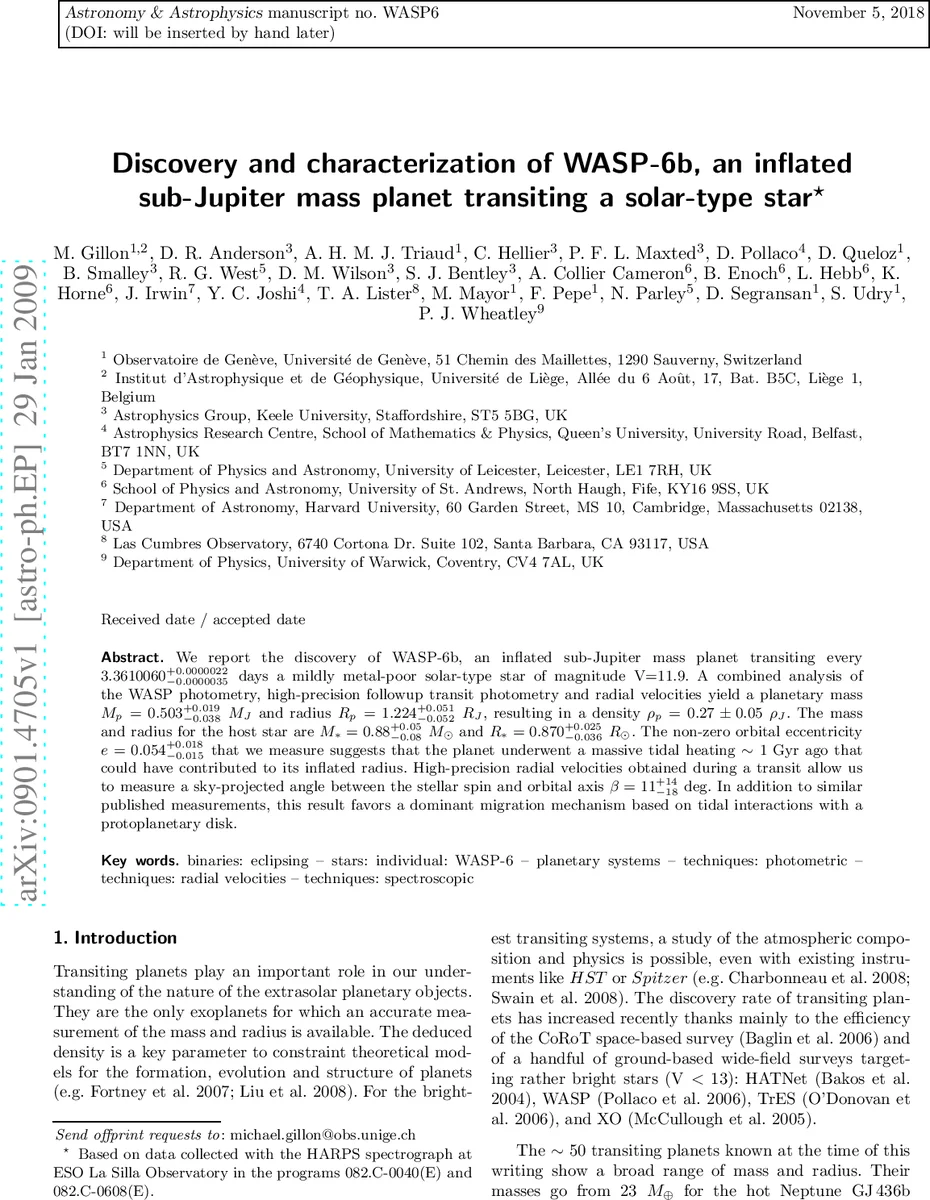
We report the discovery of WASP-6b, an inflated sub-Jupiter mass planet transiting every 3.3610060 +0.0000022-0.0000035 days a mildly metal-poor solar-type star of magnitude V=11.9. A combined analysis of the WASP photometry, high-precision followup transit photometry and radial velocities yield a planetary mass M_p = 0.503 +0.019-0.038 M_jup and radius R_p = 1.224 +0.051-0.052 R_jup, resulting in a density rho_p = 0.27 +-0.05 rho_jup. The mass and radius for the host star are M_s = 0.88 +0.05-0.08 M_sun and R_s = 0.870 +0.025-0.036 R_sun. The non-zero orbital eccentricity e = 0.054 +0.018-0.015 that we measure suggests that the planet underwent a massive tidal heating ~1 Gyr ago that could have contributed to its inflated radius. High-precision radial velocities obtained during a transit allow us to measure a sky-projected angle between the stellar spin and orbital axis Beta = 11 +14-18 deg. In addition to similar published measurements, this result favors a dominant migration mechanism based on tidal interactions with a protoplanetary disk.
💡 Research Summary
The paper reports the discovery and comprehensive characterization of WASP‑6b, a transiting exoplanet identified by the WASP‑South survey. The host star, designated WASP‑6 (V = 11.9), is a mildly metal‑poor G8V dwarf with a mass of 0.88 ± 0.05/−0.08 M☉, a radius of 0.870 ± 0.025/−0.036 R☉, an effective temperature of 5470 ± 130 K, and a projected rotational velocity V sin i of about 1.4 km s⁻¹, indicating an old, slowly rotating star.
Photometric detection was achieved using 963 000 WASP data points collected over the 2006‑2007 seasons, revealing a periodic dimming every 3.361 days. Follow‑up high‑precision transit light curves were obtained with the 2 m Faulkes Telescope South (i′ band) and the 2 m Liverpool Telescope (V+R band). The combined light curves display a depth and duration consistent with a planetary transit, with residual rms values of 1.67 × 10⁻³ (FTS) and ~0.5 % (LT), matching theoretical noise estimates.
Radial‑velocity (RV) measurements were secured with the CORALIE spectrograph (initial confirmation) and, more extensively, with the HARPS spectrograph (44 measurements covering the full orbital phase). The RV semi‑amplitude is ~75 m s⁻¹, confirming a companion in the planetary mass regime. A joint Markov Chain Monte Carlo (MCMC) analysis of the photometry and RV data yields a planetary mass Mₚ = 0.503 +0.019/−0.038 M_Jup, a radius Rₚ = 1.224 +0.051/−0.052 R_Jup, and a bulk density ρₚ = 0.27 ± 0.05 ρ_Jup. The orbit is slightly eccentric, with e = 0.054 +0.018/−0.015, a non‑zero value that is statistically significant.
Spectroscopic analysis of the co‑added HARPS spectra (S/N > 100) provided precise stellar parameters. The effective temperature was derived from Hα line fitting, surface gravity from Na I D and Mg I b lines, and metallicity from Fe I/Fe II line equilibria, giving
Comments & Academic Discussion
Loading comments...
Leave a Comment