Nonlinearizing linear equations to integrable systems including new hierarchies with nonholonomic deformations
We propose a scheme for nonlinearizing linear equations to generate integrable nonlinear systems of both the AKNS and the KN classes, based on the simple idea of dimensional analysis and detecting the building blocks of the Lax pair. Along with the w…
Authors: Anjan Kundu
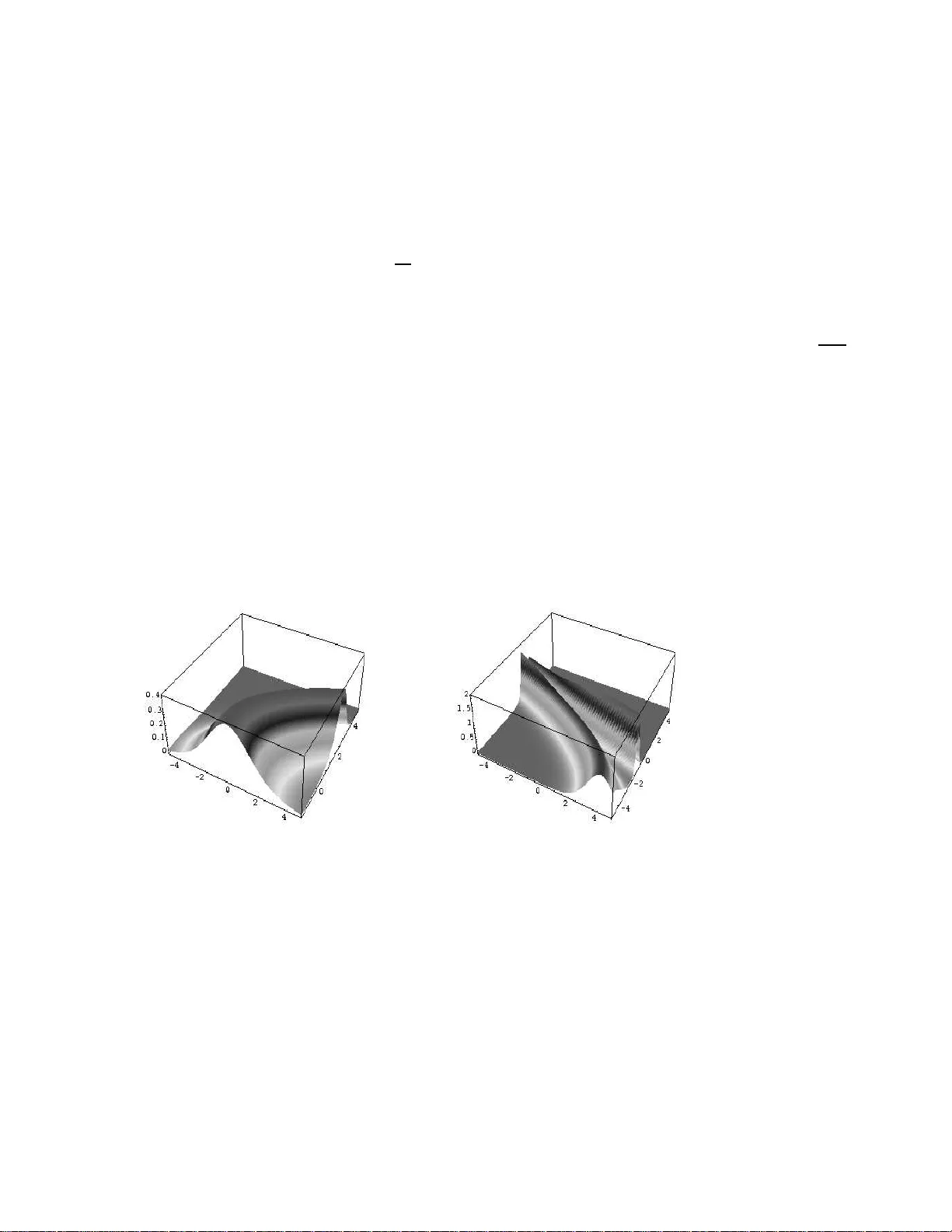
Nonlinearizing linear equations to in tegrable systems including new hierarc hies with nonholono mic defo rmations Anjan Kundu Theory Group & CAM CS, Saha Institute of Nuclear Ph ysic s Calcutta, INDIA anjan.kundu@saha.ac.in Octob er 24, 2018 Runnin g Title: Nonline arizing line ar e quations P A CS : 02.30.lk, 02.30.jr, 05.45.Yv, 11.10.Lm Abstract W e prop ose a scheme for nonlinearizing linear equations to generate in tegrable no nlinear systems of bo th the AKNS and the KN cla sses, ba sed on the simple idea of dimensiona l analysis a nd detecting the building blocks of the Lax pair. Along with the w ell kno wn equations w e discov er a novel in tegra ble hierarch y of higher order no nholonomic deformations for the AKNS family , e.g. for the KdV, the mKdV, the NLS a nd the SG equatio n, showing th us a tw o-fold univ ersality of the recently found deformation for the KdV equa tio n 6kdv ¸ . I. INTR ODUCTION In sp ite of th e significant ac hiev emen ts in the theory of inte grable systems o v er the last fifty y ears, it remains a m ystery: wh at is inte gr able nonline arity , i.e. ho w to iden tify a p riory those nonlinear terms whic h mak e an equation in tegrable. Nev ertheless one notices that, although integrable equations can b e of diverse t yp es, the in tegrabilit y filters out the nonlinearit y to some sp ecific forms, as evident from the w ell known equations like the nonlinear Sc hr¨ odinger (NLS) equ ation, the deriv ativ e NLS (DNLS), the Kortewe g-de V ries (Kd V) equa- tion, the mo dified KdV (mKd V), the sine-Gordon (SG) equation etc.[1]. Moreo v er , al l such integrable nonlinear PDEs exhibit exact soliton solutions, lo calized and stable form of which is b eliev ed to b e due to a fin e balance b etw een their linear disp ersiv e and nonlinear terms. Therefore it ma y not b e un exp ected to exp ect that a linear PDE, the disp ersiv e p art of wh ic h wo uld balance the nonlinear term, should hav e the inform ation of the inte grable nonlinearit y h idden in it. Consequent ly , th er e m ust b e a sc heme f or nonlinearizing linear equations for generating inte grable systems. Ho wev er attac k in g this an ti-in tuitiv e 1 question d irectly seems to h a v e b een av oided in the literature, although the Ablo witz-Kaup-New ell-Segur (AKNS) sc heme [1] and the cele brated Sato construction [2] aimed around this line and a r ecent attempt came close to it [3]. W e pr op ose here a direct but easy sc heme for nonlinearizing the linear equations iq t = q xx , q t = q xxx , θ xt = 0 , (1) etc. together with their conju gates, whic h are in fact the linearized parts of the we ll kno wn equations lik e the NLS , the DNLS, the Kd V, the SG etc. Our aim is to generate first the kno wn in tegrable systems, pro ving thus the effectiv eness of our alternativ e sc heme based on a simple physical idea of dimensional analysis and th en , con tin uing the p ro cess searc h for new integrable nonholonomic deform ations for all kno wn equations. It is evident that the direct nonlinear extension of a linear equation is not uniqu e, s ince it alone can not id entify the integrable nonlinearity and one needs some extra structure for filtering ou t the inte grable cases. Our strategy therefore is t o stic k from the b eginning to a Lax pair, a pr op erty in herent to all in tegrable systems, by defining a pair of naiv e Lax op erators U ( l ) , V ( l ) for the linear system itself and then nonlinearize them to a genuine pair ( U, V ), whic h finally generate the non lin ear in tegrable equation through their flatness condition U t − V x + [ U, V ] = 0 (2) . It is tru e th at seve ral soph isticated form al metho d s lik e the prolongation tec hnique, the P ainlev ´ e tru n - cation [4], the Sato th eory [2], the AKNS metho d [1] etc. are av ailable in the literature for constructing the Lax pair of a nonlinear integ rable equation. Ho w ev er our alternativ e constru ction, based on a fun - damen tal concept of dim en sional analysis, is p erhaps the simplest and the m ost p h ysical one. Exploiti ng only the scaling dimensions and id entifying the constituent b uilding blo cks of the Lax op erators, hid den already in the linear equ ations, we can construct a Lax p air quite easily to any higher order for b oth the AKNS [1] and th e Kaup-Newe ll (KN) [5 ] sp ectral pr oblems. In terestingly , by regulating the scaling dimension of the field w e can generate uniquely b oth the NLS and the DNLS equatio ns, starting from the same linear S c hr¨ odinger (LS) equation. Finally as an imp ortan t application we disco v er new in tegrable hierarc hies of nonholonomic deformations f or the wel l known equations lik e the KdV, the m KdV, the NLS, the SG etc. The nonholonomic deformation in th is field theoretical conte xt is giv en by some differ- en tial constraints on the deform ing fun ction. A r ecen tly disco v ered 6-th order integ rable KdV (6KdV) equation, attracting muc h atten tion [6 , 7, 8 ], happ ens to b e the lo w est order d eformation of this kind for the KdV equation. W e are able to generalize h ere not only the earlier result on the deformed K dV and the 6KdV by unv eiling a no v el hierarc hy of their higher order d eform ations, bu t also to sho w the unive rsalit y of suc h p erturbations, by disco vering inte grable nonholonomic deformations for all memb er s 2 of the AK NS family , including th eir higher order integrable h ierarc hies, a task termed as highly desirable but qu ite imp ossible in a recent study [7]. I n terestingly , such deformed in tegrable sy s tems can b e rep- resen ted also as kno wn nonlinear equations w ith add itional p erturbativ e terms su b jected to d ifferential constrain ts. S u c h p erturbations, contrary to th e usu al b elief, not only preserve the in tegrabilit y of th e original equation but also yield ric her prop erties. Nonlinear integ rable s y s tems lik e the NLS , the m KdV and the S G equations with v arious p ertur- bations app ear in man y physic al situations, e.g . flu xons in Joseph son j u nction, p arametrically drive n damp ed molecular c hain, nonlinear optical fi b er comm unication, ferr omagnet in v ariable magnetic field, nonlinear F arad ay resonance etc. [9 ]. Ho w ev er in almost all these p erturb ed systems the inte grabilit y - the most cherishable p rop erty of a nonlinear system - is usually lost. As a result all their r elated pr e- cious p rop erties like higher conserved quantit ies, exact s oliton s olutions, elasti c scattering of solitons etc., enormously usefu l in ph ysical applications, are also lost. Therefore constructing in tegrable pertu rb ed systems, preserving their complete in tegrabilit y and exact soliton solutions, is a c h allenging physical problem, whic h w e are able to solv e here to certain extend. Our int egrable p erturb ed equations exh ib it the usual exact N-soliton solutions, b u t with an unusual accele rated or decelerated motion. Recall that the standard solitons mo v e with a constan t ve lo cit y and b ehav e lik e particles undergoing elastic collisions with other solito ns, wh ic h hav e b een of significan t imp ortance and application in v arious physica l problems. In the pr esen t con text of in tegrable p erturb ed equations the accelerated solitons b ehav e lik e particles under external forces. They are su b jected to p ertur bations, whic h are themselves solitonic in n ature. In fact the time-dep enden t asymptotic v alue of suc h a p erturbing fun ction acts lik e a force sitting at the space b oun daries and con trolling the motion of the field soliton, dep end in g on the nature of wh ic h the soliton can accelerate or decelerat e. Accelerat ed solitons app ear in man y physical mo d els like in homogeneous plasma [10] , information transfer in the DNA chain [11] , transp ort of solitons and bu bbles [13] etc. Th erefore the present in tegrable mo dels with exact accelerating solitons showing elastic soliton scattering [12] could find applications in practical situations. The arrangement of the pap er is as follo ws. Sec. I I introdu ces our n onlinearization sc heme. Gen- eration of sp ecific nonlinear in tegrable systems is p r esen ted in Sec. I I I. New inte grable nonholonomic deformations of the AKNS s y s tem are detailed in S ec. IV, with the concrete examples giv en in Sec. V. In Sec. VI the p resen t result is listed and compared with the existing ones. Sec. VI I is the concluding section follo w ed by the bibliography . I I. THE NO NLINEARIZA TIO N SC HEME Com bining fi eld q and its conjugate r in a matrix as U (0) = q σ + + r σ − , where σ ± = 1 2 ( σ 1 ± iσ 2 ) and σ a , a = 1 , 2 , 3 are standard 2 × 2-Pa uli m atrices, w e can clearly express our starting linear disp er s iv e 3 equations (1) as iU (0) t = σ 3 U (0) xx , U (0) t = U (0) xxx , etc. Th ese linear equations in turn can b e expr essed by easy observ atio n as a line ar flatness condition U ( l ) t − V ( l ) ix = 0, whic h is defined by ignoring the n onlinear comm utator term b etw een Lax op erators. This naturally iden tifies the pairs of naiv e Lax op erators ( U ( l ) , V ( l ) i ) , i = 2 , 3 , . . . for the consecutiv e higher order linear equations as U ( l ) = iλσ 3 + iU (0) , and V ( l ) 2 = σ 3 U (0) x , V ( l ) 3 = iU (0) xx , (3) etc. with trU (l) = trV (l) i = 0 , i = 2 , 3 , . . . , s in ce tr σ 3 = trU (0) = tr( σ 3 U (0) ) = 0. The significance of parameter λ , whic h enters here only as an additional constan t and can b e ignored without an y loss, will b ecome clear in the pro cess. The Next imp ortan t p oin t is to detect th e scaling d imension of the Lax op erators as w ell as to iden tify their crucial buildin g blo cks (BB), existence of w hic h seem to ha v e b een o v erlooked in most of the wo rk including the AKNS construction. A. Scaling dimension and building blo c ks of the Lax pair W e consider le ngth L a s the fu ndamenta l d imension a nd from the linear ev olutio n equation with N -th order disp ersion: q t = q xx . . . x | {z } N read out the dimension [ · ] of time as [ T ] = L N . The Lax op erators, generating infinitesimal space and time translations, as eviden t from the Lax equations Φ x = U Φ , Φ t = V Φ, naturally sh ould ha v e th e scaling dim en sions (SD) as [ U ] = L − 1 , [ V N ] = [ T ] − 1 = L − N . Assu ming that the linear L ax pair U ( l ) , V ( l ) N share the same scaling d imensions as well as the same building blo c ks as their nonlinear counterpart, we find from the explicit structure (3), the SD of their constituent elemen ts as [ λ ] = [ U (0) ] = L − 1 and at the s ame time iden tify the b uilding blo cks (BB) for b oth the Lax op erators as the set { λ, U (0) } and its x-deriv ativ es: U (0) x , U (0) xx , etc. , which en ter in their construction linearly . Our crucial conjecture is that these linear Lax pair can b e nonlinearized by adding all p ossible nonlinear com binations of the s ame BB, guided by the dimen s ional argument. Note that, the condition [ U (0) ] = L − 1 fixes the SD for the field in this case as [ q ] = [ r ] = L − 1 . Ho w ev er, since a linear equation as such can not put an y restriction on the SD of its fields, this in put is n ot un ique and w e sho w b elo w that a d ifferen t fixation of the SD for the field w ould lead to another construction of the Lax p air. Recalling that a nonlinear v ariable change can generate f r om a given in tegrable s y s tem other gauge equiv alent equations [14], w e concen trate h ere only on fundamental inte grable equations lik e NLS, KdV DNLS etc. belonging to the AKNS or the KN family , while the gauge equ iv alen t systems can b e obtained trough simple transformations. I I I. GENERA TION OF NO NLINEAR INTEGRABLE SYSTEMS The dimension of the field [ q ] and its conjugate [ r ] as well as [ λ ], whic h are not fixed by the starting linear equations (1), s hould b e giv en in our n onlinearization sc heme as inpu t. W e sho w th at for [ q ] = 4 [ r ] = [ λ ] = L − 1 , w e get the AKNS systems, while [ q ] = [ r ] = [ λ ] = L − 1 2 yields the KN hierarc h y . A. AKN S integrable hierarch y W e consider first the case [ q ] = [ r ] = [ λ ] = L − 1 , whic h giv es through the ab o v e construction: [ U (0) ] = [ U ( l ) ] = L − 1 . W e in tend to construct now the sp ace-Lax op erator U ( λ ) ∈ sl (2) , trU( λ ) = 0, naturally with [ U ( λ )] = L − 1 , out of U ( l ) b y usin g the BB: { λ, U (0) } . Therefore the only p ossibilit y left from the dimensional argumen t, w hic h only allo ws summation of the terms h a ving th e same dimension, is to tak e U ( λ ) = U ( l ) = i ( λσ 3 + U (0) ) , reco v ering thus the w ell kno wn AKNS Lax op erator [1 ] uniquely . Ho w ev er for constructing the corresp onding time-Lax op erator V 2 ( λ ) ∈ sl (2) with trV 2 ( λ ) = 0 and S D: L − 2 , in addition to V ( l ) 2 = σ 3 U (0) x , nonlinear terms V ( nl ) 2 with the same SD: L − 2 are to b e constr u cted out of the same BB { λ, U (0) } , through their nonlin ear pro d u cts and p o w ers lik e λ 2 , λU (0) , ( U (0) ) 2 , follo wing the dimensional argumen t. Note that since [ ∂ x ] = L − 1 , the deriv ativ e term U (0) x can app ear only in the linear part, again from the dimensional analysis. Therefore t his set of nonlinear te rms is sufficient to co nstruct the nonlinear part of the time-La x op erator: V ( nl ) 2 = i ( k 2 λ 2 σ 3 + k 1 λU (0) + k 0 σ 3 ( U (0) ) 2 ), upto the in teger co efficients k n , n = 0 , 1 , 2. Note that fixing the d imensionless int egers k n with different terms in V 2 ( λ ) = V ( l ) 2 + V ( nl ) 2 go es b eyond th e scop e of the d imensional argumen t, whic h ho w ev er is ac hiev ed from the flatness condition of U ( λ ) , V 2 ( λ ), yielding seve ral consistency relations at d ifferen t p ow ers of λ . I n terestingly , the num b er of suc h relations obtained is just sufficient to determine the n umerical co efficient s of all the terms w ithout any am biguit y . F or example, it is easy to c hec k that, the condition (2) f or U ( λ ) , V 2 ( λ ) yields three consistency conditions at three differen t p o w ers of λ n , n = 0 , 1 , 2 , of whic h the condition at n = 0 fixes k 0 = − 1, that at n = 1 fixes the in teger k 1 = 2, while n = 2 giv es th e r elation k 2 = k 1 . Th us all the int eger co efficien ts are obtained exactly , d etermin in g the stru cture of the nonlinear part unambig uously as V ( nl ) 2 = 2 iλ 2 σ 3 + 2 iλU (0) − iσ 3 ( U (0) ) 2 , (4) with trV (nl) 2 = 0 , whic h constructs the complete time-Lax op erator uniquely as V 2 ( λ ) = V ( l ) 2 + V ( nl ) 2 . Note that the asymptotic solutions of the Lax e quation giving e ± iλx clarifies the physical meaning of parameter λ as the momentum and ju s tifies the c hoice of its S D: L − 1 . At the fi nal step w e obtain the in tegrable nonlinear equation w e are searc hing for, again fr om the flatness condition, wh ere a nonlinear term 2 σ 3 ( U (0) ) 3 app ears n o w in addition to th e initial linear equation iU (0) t = σ 3 U (0) xx . F or r = ± q ∗ this nonlinear term reduces to ± 2 | q | 2 q , wh ic h together with the starting LS equation yields fi nally th e in tegrable NLS equation, completing our nonlinearization pr o cess. The next higher order linear equation q t = q xxx follo ws a s im ilar pro cedure in the nonlinearization pro cess. The space-Lax op erator b eing the same, one has to build only the time-Lax op erator V 3 ( λ ) by adding to the naiv e op erator V ( l ) 3 = iU (0) xx a nonlinear part V ( nl ) 3 with SD L − 3 , whic h is to b e constructed again fr om the same BB : { λ, U (0) } an d its deriv ativ e U (0) x , follo wing our conjecture. Ob s erv e that the 5 deriv ative term can app ear no w in the nonlinear p art on dimensional ground. By all p ossib le nonlinear com binations as p ow ers and pro d ucts of the BB with total SD = L − 3 and mainta ining trV 3 ( λ ) = 0, w e can, similar to the ab o v e, construct un iqu ely : V ( nl ) 3 = − 4 iλ 3 σ 3 + 2 σ 3 ( − U (0) x + i ( U (0) ) 2 ) λ − 4 iU (0) λ 2 + 2 i ( U (0) ) 3 − [ U (0) , U (0) x ] , (5) yielding finally V 3 ( λ ) = V ( l ) 3 + V ( nl ) 3 . The flatness condition of the pair U ( λ ) , V 3 ( λ ) fixes again the in teg er co efficien ts in differen t term s of (5) and yields the in tegrable equation, by adding only one nonlinear term ( U (0) ) 2 U (0) x to the starting linear disp ersiv e equation U (0) t = U (0) xxx . F or r = κ = const., q = u th e nonlinear term r educes to κ 6 uu x , while for r = q = v to 6 v 2 v x , generating th us the well known inte grable KdV and mKdV equations, from the third order linear equation w e started with. Similarly one can con tin ue b uilding the hierarc h y of in tegrable equations, starting from the arbitrary higher order linear equation q t = q xx...x and non lin earize it follo wing th e pro cedur e as ab o v e and using the same BB and similar dimensional argumen t, as w e ha v e conjectured. S ince the space-Lax op erator U ( λ ) r emains the same, the task is to constr u ct only the time Lax op er ator V N ( λ ) w ith the SD L − N for arbitrary N , out of the same BB: { λ, U (0) } by all p ossible com binations lik e ( λ ) k ( ∂ ∂ x ) l ( U (0) ) m (6) with the dimensional co nstraint k + l + m = N . It is easy to c h ec k that this partitioning of N determines the total n um b er of term s that can app ear in V N ( λ ) as L = 1 + 1 2 N ( N + 1), wh ich inte restingly tallis with our result obtained ab o v e, giving L = 4 for the NLS with N = 2 and L = 7 for the Kd V and mKdV with N = 3. Thus w e can estimate the exact num b er of terms that sh ould app ear in an y h igher ord er Lax op erator, without ev en calculating their explicit form. T h is un ique feature of our nonlinearization sc heme, obtained from the dimensional argument an d th e iden tification of the BB, is absent in all other a v ailable m etho ds. B. Comparison w ith the AKNS sc heme It is true that, though w e h a v e p r esen ted a simple and original sc heme for nonlinearizing linear equations to in tegrable systems, b ased on the dimensional analysis and using the building blo c ks of the Lax pair, we co uld repro duce so far o nly the known in teg rable equations, which a re obtainable also through the AKNS sc heme [1 ]. In -spite of this fact and b efore p resen ting our new result, w e intend to sho w that in comparison with the AKNS prop osal [1 ], the constru ction of time-Lax op erator V N ( λ ), vital in generating in tegrable equations, is significan tly simpler in the p r esen t sc heme. Recall firstly , that in the AKNS metho d one starts with a giv en nonlin ear field equatio n and not from its linearized v ersion, as done here. Secondly , for obtaining t he explicit f orm of V N ( λ ) in th e AKNS metho d, one has to exp an d it in the p o w ers of sp ectral parameter: V N ( λ ) = P N n =1 = λ n V ( n ) , where V ( n ) , n = 1 , 2 , . . . are N num b er of 6 2 × 2 un kno wn matrices with 4 N n umber of unkn own functions, some of them b eing complex. I n our construction on the other h and, the u nknown coefficient s are only N in num b er and moreo v er they are only real in tegers. This is b ecause w e ha v e already identi fied the build in g blo cks of the Lax op erators made up from parameter λ , a kno wn matrix U (0) and its deriv ati v es, and the dimensional argument, whic h is our k ey ingredient, guides us to collect them in the right com bination. Thirdly , in the AKNS sc heme the 4 N unkn o wn functions are to b e determined by solving different partial different ial equations. Ou r N un kno wns b eing only real in tegers are obtained from simple algebraic equalities. This simplicit y of our sc heme b ecomes more evident for higher v alues of N , w here V N con tains L = 1 + 1 2 N ( N + 1) num b er of terms. Note that d etermining a priori the num b er of terms that should b e present in an y V N , as w e ha v e sho wn ab ov e is again easy in our scheme b ut not in the AKNS. F ourthly , while f or the K N sp ectral problem the AKNS t yp e direct expansion b ecomes ev en more complicated, our sc heme co v ers the KN system in an unified w a y . Just a c hange in the scaling dimension of the field switc hes our sc heme from the AKNS to the KN family , as w e demonstrate b elo w. Finally , as an imp ortan t app lication we discov er new in tegrable hierarc hies of nonholonomic deforma- tions for all mem b er s of th e AKNS family (see Sec. V), systematic accoun t of which is absen t in AKNS [1]. C. KN in tegrable hierarc h y Our nonlinearization scheme , as w e sh ow here, is universall y applicable for generating the KN h ier- arc h y , wh ic h is n ot readily a v ailable in the literature due to its app aren t complicacy . W e follo w again the same line of argument, making a slight c hange in the inp ut of the SD of the fi eld as [ q ] = [ r ] = [ λ ] = L − 1 2 . This small deviation h ow ev er dramatically changes the outcome and r esolv es the p uzzle we faced in generating un iquely tw o different nonlinear equations, namely the NLS and the DNLS equations, starting from the same linear LS equation. Note that the SD of the linear Lax op erator has b een c hanged now to [ U ( l ) ] = L − 1 2 , wh ile that for the genuine sp ace Lax op erato r must alw a ys b e [ ˜ U ( λ )] = L − 1 . Therefore th e nonlinearization ind uced b y the d imensional argument should giv e ˜ U ( λ ) = λU ( l ) = iλ 2 σ 3 + iλU (0) , which repro duces correctly the w ell kno wn K N Lax op erator [5]. Note that, in p rinciple, one can also add on dimensional groun d . a term lik e iσ 3 ( U (0) ) 2 to this Lax op erator. Ho wev er, suc h an addition do es not pro du ce any ind ep end ent equation that are not deriv ab le from those obtained without its addition. F or constructing th e corresp ond ing time-Lax op erator ˜ V N ( λ ) through our nonlinearization, one should remem b er that th e situation is a bit d ifferen t here, sin ce though the d imension of ˜ V N ( λ ) must remain as L − N , the SD of its BB: { λ, U (0) } has b een c hanged. Let us consider first th e case with N = 2 and start again from the li near Sc hr¨ odinger equation. W e rep eat the ab o v e p ro cedur e for the NLS case, but w ith the p resen t c hange in the dimension of the 7 BB, w hic h should lead to the constru ction ˜ V 2 ( λ ) = λV ( l ) 2 + V ( nl ) ( λ ) du e to the dimensional constrain t L − 2 , wh ere V ( l ) 2 = σ 3 U (0) x is the n aive linear op erator as in (3). The nonlinear part V ( nl ) ( λ ) shou ld b e constructed therefore b y nonlinear com binations of the BB with dimension L − 2 = [ λ ][( U (0) ) 3 ] = [ λ 2 ][( U (0) ) 2 ] = [ λ 3 ][ U (0) ] = [ λ 4 ] . (7) Note again that though terms like iσ 3 ( U (0) ) 4 , [ U (0) , U (0) x ] matc h in d imensionalit y and hence can also b e added, th ey only yield equations that are deriv able from those, obtained without their add ition. This iden tification together with ˜ V 2 ( λ ) ∈ sl (2) , tr ˜ V 2 ( λ ) = 0 , constru cts the time-Lax op erator ˜ V 2 ( λ ) = ( σ 3 U (0) x + i ( U (0) ) 3 ) λ − iσ 3 ( U (0) ) 2 λ 2 + 2 iU (0) λ 3 + 2 iσ 3 λ 4 , (8) uniquely , with the in teger co efficien ts fixed as ab o v e from th e consistency condition. This condition generates also t he nonlin ear equation with the in tegrable nonlin earit y i (( U (0) ) 3 ) x , whic h for r = ± q ∗ adds a term ± 2( | q | 2 q ) x to our starting LS equation iq t − q xx = 0 , yielding the DNLS equ ation, as required. Similarly the higher order linear equations we considered ab o v e nonlinearize n ow to a differen t set of in tegrable equations b elonging to the KN hierarch y , du e to the c h anged SD of the BB. Without giving the details we just men tion, that the construction, though a bit tedious, is quite similar and straigh tforw ard and giv en again in the form (6), with th e total num b er of terms app earing in ˜ V N ( λ ) as ˜ L = 1 + N 2 , with arbitrary N . Note that this num b er of terms ˜ L , r esulting f rom the new SD constraint: 1 2 ( k + m ) + l = N , is m uc h higher than the n um b er L ap p earing in its AKNS counterpart, sho wing wh y the KN s ystems are more complicated than those of the AKNS. Chec k that N = 2 giv es ˜ L = 5 as w e ha v e ob tained ab o v e for the DNLS case. IV. NEW INTEGRABLE HIE RAR CHIES F OR THE AKNS F AMIL Y WITH NO NHOLO- NOMIC DEF ORMA T IONS Note that th e emphasis in the ab ov e nonlinearization scheme is to construct the time-Lax op erator V N ( λ ) = V ( l ) N + V ( nl ) N ( λ ) , by b uilding up the nonlinear part inv olving p ositiv e p ow ers of λ and confin ing to the elements only from the iden tified build in g blo c k U (0) = q σ + + r σ − , whic h means to construct the nonlinear combinatio ns of the same basic fi elds q , r and their deriv ativ es. No w w e in tend to extend this constru ction furth er b y going b ey ond the conjecture of th e BB and in tro ducing new p erturbativ e functions with SD L > N . Thus k eeping U ( λ ) same as ab o v e, w e add a nonlinear deformation V ( def ) N ( λ ) to the V N ( λ ) by including negativ e p o w ers of λ − n , n = 1 , 2 , . . . in the dimensional argument , whic h we ha v e ignored so far. This simple extension, as we show, w ould d isco v er a completely new class of in tegrable p ertur b ed equations with hierarc h y of h igher order n onholonomic deformations. Thus it creates a n o v el t w o-fold in tegrable hierarc h y [12] b y adding a d eformation hierarc h y to eac h of the kno wn AKNS h ierarc h y . 8 The w ell kno w n equations lik e the NLS, the Kd V, the m KdV and th e SG can b e deformed b y p erturbin g functions with higher and h igher order nonholonomic constrain ts, p reserving the original inte grabilit y . The p resen t r esu lt thus sho ws a t w o-fold unive rsalit y for th e nonh olonomic deformations, found recentl y for the KdV equation [6, 7, 8], since one can co v er n o w the en tire AKNS family , originating from this single mo del, and at the same time can disco v er a n ew in tegrable deformation h ierarc h y for eac h mem b ers of this family . It should b e noted in this con text, that the use of n egativ e p o w ers of th e sp ectral parameter in the time-ev olutio n operator w as considered also in some earlier o ccasions in the long history of inte grable systems. Ho w ev er this was either limited [1, 15], partial [16] or camouflaged [17]. Th e nov elt y of our result lies in the fact, that within this extremely w ell studied field we could d isco v er in a simp le wa y a class of n ew in tegrable systems with a nov el tw o-fo ld int egrable hierarc h y , whic h can b e inte rpr eted as p er tu rb ed equations with integ rable nonholonomic constraints. In th is construction of the time-Lax op erator, we do not confine to the BB, whic h in v olv e only the basic fields, but include a series of new p ertur bing f unctions, eac h influencing the basic field. T his situation can sim ulate an inte resting device for con trolling the basic solit ons through multiple in terv en tion, though remaining with in the scenario of the exact solv abilit y . Suc h an idea was p artially realized in the fi b er optics communicati on through dop ed media [18]. F or p resen ting our new equations we start with V 2 ( λ ) for the AKNS system constructed ab o v e and deform it firs t b y V ( def ) ( λ ) = i 2 λ − 1 G (1) , with a m atrix f unction G (1) with trG (1) = 0 and SD L − 3 . Sin ce our in ten tion is to in tro duce new per tu rbing fu nction g in to the system, w e deriv e f rom the flatness condition its structure as an in tegrable deformation of the second-order AKNS equation: iq t − q xx − 2( qr ) q = g, (9) with th e pertu rbing fu nction, giv en b y the matrix element g = G (1) 12 , sub jected to the nonholonomic differen tial constrain t: G (1) x = i [ U (0) , G (1) ] . (10) Remark ably , we can include further p erturbation in to the system, whic h w ould int eract with the basic field as we ll as with the in itial p erturb ation. This pr o cess can also b e view ed as putting higher order differential constrain t on the original p ertur bation. T o achiev e this higher p erturbation w e extend V ( def ) ( λ ) with another deforming term i 2 λ − 2 G (2) , wher e G (2) is a matrix fun ction of S D L − 4 . Integrabilit y condition (2) no w leads to a further deformation of (9) giv en by the higher order constraint G (1) x = i [ U (0) , G (1) ] + i [ σ 3 , G (2) ] , G (2) x = i [ U (0) , G (2) ] . (11) Generating s uc h h igher order integ rable p ertu rbations can b e con tin ued recursiv ely by adding in V ( def ) ( λ ) more and more terms as i 2 λ − j G ( j ) , j = 1 , 2 , . . . n, with arb itrary n . New matrix fu nctions G ( j ) ha v e the 9 scaling dimension j + 2 anf trG (j) = 0. This would resu lt to a new inte grable hierarch y of nonholonomic deformations for (9), giv en recursive ly as G (1) x = i [ U (0) , G (1) ] + i [ σ 3 , G (2) ] , . . . , G ( n − 1) x = i [ U (0) , G ( n − 1) ] + i [ σ 3 , G ( n ) ] , G ( n ) x = i [ U (0) , G ( n ) ] , (12) whic h clearly reduces to (10) for n = 1 and to (11) for n = 2. Exactly in a similar w a y we can build u p the h ierarc h y of in tegrable p erturbations for eac h mem b er in th e kno wn AKNS hierarch y of higher n on lin ear equations, whic h w ould lead th us to a no v el tw o-fo ld in tegrable hierarch y . In one the same nonlinear equation is p erturb ed b y a function with increasingly higher order different ial constrain ts and in the other all differen t h igher nonlinear equations are deformed b y the same p ertu r bing fun ction. The most imp ortan t fact ab out the hierarchies of all p erturb ed equati ons th us generated is that, they are completely integ rable systems and are exactly solv able by the inv erse scattering metho d (ISM), yielding N - soliton solutions. This follo ws f r om the fact that, for constructing suc h nonh olonomic defor- mations, we h a v e started fr om the Lax pair, k eeping the space-Lax op erator U ( λ ) same as the original one, while deforming the time-Lax op erator V ( λ ). Therefore the scattering prob lem, whic h is cen tral to the IS M remains th e same, while the time ev olution of the sp ectral d ata only gets c hanged for the deformed mo dels. Con s equen tly , in suc h p erturb ed systems along with the exact soliton solution for the basic fi eld w e can find the exact s olution for th e p er tu rbing fun ction, which in triguingly take s also the solitonic f orm. Moreo v er, one can analytically study the soliton dynamics as we ll as the scattering of m ultiple solitons, a task imp ossible to carry out u nder usual p erturbation with a kn own function. It is of significan t p ractical imp ortance th at, though in suc h p erturb ed in tegrable s y s tems, the exact ISM is ap- plicable for extracting the s oliton solution, w e can bypass this in v olv ed and length y pro cedur e and ac hiev e the same result b y taking the we ll-kno wn soliton solutions of the undeformed system and deformin g them b y suitably c ho osing their time-ev olution, giv en b y the deformed soliton v elocit y kunjp a082 ¸ . Remark ably , a p er tu rb ed soliton in the present set up b eha v es lik e a particle d riv en by a force and exhibits an accelerated or decelerated motion, dep end in g on the n ature of the deformation. Note that unlik e kno wn situations [19] the v ariable soliton v elo cit y o ccurs h ere without an y apparent inh omogeneit y and within the framew ork of an isosp ectral flow. V. NE W INTE GRABLE EQ UA T IONS: SIMPLE EXAMPLES Using the ab ov e construction suitable f or equations b elongi ng to the AKNS s p ectral p roblem we can no w analyze in d etail the new class of in tegrable p erturb ations for all memb er s of this family , namely the KdV, the mKdV, the NLS and the SG equations. I n p articular constructing the m atrix Lax pair for eac h 10 of them we can find the explicit form for all those d eformed equations, explore their higher deformations and most imp ortantly , obtain their exact N-soliton solutions. Along with th ese p erturb ed equations we can also stu dy their t w o-fold integ rable hierarc hies, as dev elop ed ab o v e. Ho w ev er we p resen t here only the simplest equations in this hierarc h y , which are the most imp ortan t cases inv olving the p erturbation of the well k n o wn equations and represent the lo w est order nonholonomic deformation, obtained from (12) with n = 1 or 2. A. I n tegrable p e rturbation of the KdV equation Recen t fin d ings of the integrable nonh olonomic deformation of the KdV equation, equiv alen t to a 6th- order KdV equation [6], which app arently cont radicts the accepte d n otion of nonexistence of an y ev en- order equation in the Kd V hierarc hy , arose considerable inte rest [7, 8]. How ever, the exact integrabilit y of this system through AKNS t yp e matrix Lax op erator or its exa ct N-soliton solutions thr ough the ISM could n ot b e established. Consequently , th e in tegrable hierarc hies allo w ed b y th is system as wel l as the dynamics of the solitons, including their nature of scattering could not b e explored. W e on the other hand ha v e dev elop ed the formalism in Sec. IV for constructing AKNS t yp e Lax op erators for all of its memb er s with nonholonomic deformations, whic h should solv e completely the remaining unsolved asp ects of the deformed KdV equation, as we show b elo w. Recall that in the AKNS hierarch y Kd V typ e equations app ear at N = 3 leve l, for wh ic h we ha v e deriv ed exp licitly the time-Lax op erator V 3 ( λ ) , through our nonlinearization s c heme. Now we in tend to deform this Lax op erator by an additional V ( def ) ( λ ) matrix, w hic h would result to a deformed 3rd-order AKNS equation q t − q xxx − 6( qr ) q x = g x , (13) with the multiple nonholonomic constraints as in (1 2) o n the deforming matrices G ( j ) , ha vin g higher scaling dimension: j + 3. F or deriving the p er tu rb ed KdV equation we ha ve to mak e the standard reduction r = 1 , q = u in (13) to yield u t − u xxx − 6 uu x = g x ( t, x ) . (14) F or fixing no w th e lo w est order constraint on the deforming fun ction, w e hav e to add t w o terms with n = 1 , 2 to V ( def ) ( λ ) = i 2 ( λ − 1 G (1) + λ − 2 G (2) ). It is imp ortan t to observ e that adding only one deforming term in this case giv es trivial resu lt, while the double-deformation yields from (11) the explicit stru cture G (1) = ( g + c ) σ 3 + ig x σ + G (2) = − i 1 2 g x σ 3 + ( g + c ) σ − + ieσ + , e x = iug x . (15) and the same compatibilit y condition leads to the n onholonomic constraint on th e p er tu rbing fun ction as g xxx + 4 ug x + 2 u x ( g + c ) = 0 . (16) 11 Therefore the coupled system (14-16) giv es fin ally the int egrable p erturbation of the KdV equation, reco v ering the rece nt result [6]. W e can find n o w th e exact N-soliton solution for this system of equations (16) through the app lication of the ISM. Referring to [12] for details w e pr esen t here only the 1- soliton solutions for b oth the KdV field u ( x, t ) and the p ertur bing f unction g ( x, t ) as u ( x, t ) = v 0 2 sec h 2 ξ , ξ = κ ( x + v t ) + φ, (17) g ( x, t ) = c ( t )(1 − sec h 2 ξ ) , (18) where v = v 0 + v d , with v 0 b eing the usual c onstan t v elocity of the KdV soliton, wh ile v d = − 2˜ c ( t ) v 0 t with ˜ c ( t ) = R dtc ( t ) is its un usual time-dep end en t part, in duced b y the deformation. T he p ertur bing function, itself taking the solitonic f orm as (18), driv es the field s oliton (17) th rough its asymptotic v alue lim | x |→∞ g = c ( t ) . Therefore, in su c h p erturb ed int egrable systems one can cont rol th e motion of the soliton fr om the space-b oun daries by tuning an arbitrary time-dep end en t function c ( t ), a feature seems to b e of immense ph ysical significance for pr actical applications. Fig. 1a sh o ws the d ynamics of this p ertur b ed KdV soliton mo ving with a constant d eceleration, obtained for linear function c ( t ) = c 0 t with c 0 < 0. Th e exact 2-soliton solution for this p erturb ed KdV equation, w hic h can also b e d eriv ed explicitly , sho ws b eautiful elastic scattering of the accelerate d solitons (see Fig. 1b). Figure 1: Dynamics of the exact soliton solution of the inte grable p erturb ation of the KdV equation for the field u ( x, t ). a) 1-soliton with the u sual lo calized f orm bu t with an u nusual d eceleration, refl ected in th e b ending of s oliton tra jectory in the (x,t)-plane, b) 2-solito n w ith the usual elastic scattering and phase shift, but with the dynamics dominated b y an unusual accelerate d motion. B. Integrable p e rturbation of the mKdV e quation In tegrable equation with a nonh olonomic d eformation is driv en by a p erturbing function, whic h in turn is sub jected to a differential constrain t. Therefore, analogous to the deformed K dV, constru cted ab o v e, we can deriv e a new deformed mKdV equation again from (13), but with r eduction q = r = v . In terestingly , in th is case a single d eformation with n = 1 , corresp onding to the constraint (10) is sufficien t 12 to pro du ce the lo w est p erturbation we are interested in, yielding the p erturb ed mKdV v t − v xxx − 6 v 2 v x = w x ( t, x ) , (19) w xx − 2 v ( c 2 ( t ) − w 2 x ) 1 2 = 0 . (20) T o see the effect of deformation more closely we construct explicitly 1- soliton s olution, referring to [20 ] for the details of the the detai ls on th e general N-soli ton. T he accelerating soliton of the p erturb ed mKdV, sho wn in Fig. 2, h as the explicit form v ( x, t ) = v 0 2 sec h ξ , ξ = κ ( x − v t ) + φ, v = v 0 + v d (21) where v 0 = 4 κ 2 is the usu al constan t velocit y of the m KdV soliton, while v d = 2˜ c ( t ) v 0 t is the un usual time- dep end en t part of th e velocit y , induced b y the deform ation. Not e that the p erturb ing function w ( x, t ) itself tak es a self-consisten t solitonic form w x = c ( t ) κ sec h ξ tanh ξ (22) and driv es the field soliton (21) to an ac celerated motion agai n th rough its asym p totic v alue w ( x, t ) | | x |→∞ = c ( t ), sitting as a forcing term at th e space b oun daries. Figure 2: Exact accelerated soliton in th e (x,t)-plane for the in tegrable p ertur b ed mKdV equation. . C. In tegrable p erturbation of the NLS equation F or constructing the in tegrable p erturb ation of the NLS equation the stage is alrea dy set in (9), since with a reduction r = q ∗ and a minim um deformation (10), it w ould yield the NLS case iq t − q xx − 2 | q | 2 q = g , (23) with the p ertur bativ e f unction g ( x, t ) su b jected to a nonholonomic differen tial constrain t g x = − 2 iaq , a x = i ( q g ∗ − q ∗ g ) (24) 13 where G (1) 12 = g , G (1) 21 = g ∗ , G (1) 11 = − G (1) 22 = a are the deforming f u nctions coupled throu gh the b asic fields q , q ∗ . Th e set of constrain ts (24) ma y b e simplified to a single differen tial constrain t ˆ L ( g ) ≡ g xx q − g x q x − 2 q 2 ( q g ∗ − q ∗ g ) = 0 . (25) Eliminating the deforming f u nction g from (23) and (25) we can further derive a n ew 4th-order NLS equation expressed through the basic field as ( q ∂ 2 xx − q x ∂ x )( iq t − q xx − 2 | q | 2 q ) + 2 q 2 ( i ( | q | 2 ) t + ( q q ∗ x − q ∗ q x ) x ) = 0 . (26) As already mentioned, this p erturb ed system can b e solv ed exactly thr ough the IS M. R emark ably ho w- ev er, w e can actually a v oid the inv olv ed pro cedure of the IS M in all such integrable nonholonomic deformations and can obtain the explicit solit on solutions for these deformed equations by ju st suit- ably deforming the k n o wn und eformed solutions. As a r ule the p erturbing affect k eeps the f orm of the soliton in tact, w hile it deforms some p arameters lik e v elocity , frequency etc., making them in general time-dep endent. More precisely , in case of the d eform ed NLS, the original soliton ve lo cit y v 0 and the frequency ω 0 of its en v eloping w a v e are c hanged with an addition of a d eformed v elocity v d ( t ) = ˜ c ( t ) t | λ 1 | 2 and th e deformed w a v e frequency ω d ( t ) = − 2 ˜ c ( t ) ξ t | λ 1 | 2 , wh ere λ 1 = ξ + iη . The fu nction ˜ c ( t ) r esp onsible f or such d eformation is linked to the asymptotic v alue of the p ertur bing function. The accelerating NLS soliton qu alitativ ely lo oks lik e that of the mKdV when the dynamics of | q | is plotted (see Fig.2). W e can generate again a t w o-fold int egrable hierarc hy for the p erturb ed NLS system. The first one is the known hierarc hy of h igher order NLS equations with a p ertur bation constrained b y the same nonholonomic deformation (25), w hile the second one is a new inte grable hierarc hy , w here the same p ertur b ed NLS equation (23) is p erturb ed b y a hierarc h y of higher order deformations of the form (12). F or example, the next to the low est order d eformation (25) wo uld includ e another deform in g function e ( x, t ), in add ition to function g ( x, t ) . Interestingly in this double-deformation the m ain equation w ould remain same as th e p erturb ed NLS equation (23), while the constraint equation for g w ould b e c hanged to ˆ L ( g ) + 2 i ( eq x − q e x ) = 0 , or g xx q − g x q x − 2 q 2 ( q g ∗ − q ∗ g ) + 2 i ( eq x − q e x ) = 0 , (27) coupling to b oth the field q and the fu nction e . The second deformin g function e in tur n is constrained exactly b y the same different ial constraint (25) as ˆ L ( e ) = 0 , or e xx q − e x q x − 2 q 2 ( q e ∗ − q ∗ e ) = 0 . (28) Ev en though these new in tegrable p ertu r b ed NLS equations seem to b e rather academic, it is int riguing that, a mo del like our p erturb ed system (23-25) is implement ed already in d op ed fi b er for efficien t optica l 14 comm unication and therefore th e implement ation of the higher ord er integrable d eformation d isco v ered here for a a similar m ulti-dop ed system seems to b e a promising p ossibility [21]. D. I n tegrable p erturbation of the SG equat ion Notice that in the lin e o f the present approac h, the well kn own S G equation in the light- cone co - ordinates, whic h can b e ob tained through red uction q = r = θ x from the AK NS system, can itself b e considered as a deformation θ xt = − i ˜ g of the linear w a v e equation θ xt = 0, with a constraint (10) on the deforming fun ction ˜ g . This constrain t can b e easily resolv ed as G (1) 12 = ˜ g = i sin 2 θ , yielding the standard SG equation: θ xt = sin 2 θ . The situation ho w ev er b ecomes more inte resting if in the same equation θ xt = − i ˜ g , the deformation ˜ g = ig is coup led to another deformation G (2) , yielding the non h olonomic constrain t (11) in the form g x = − 2 aθ x + 2 e, a x = 2 θ x g , e x = 0 , (29) with the matrix elements G (1) 11 = a, G (1) 12 = − G (1) 21 = ig , G (2) 12 = G (2) 21 = e ( t ) , G (2) 11 = 0, where e ( t ) is an arbitrary function of t . Expressing (29) through the p erturb ing function g we obtain the nonholonomic deformation of the SG equation as θ xt = g , (30) g xx θ x − g x θ xx + 4 gθ 3 x + 2 e ( t ) θ xx = 0 (31) Note that s olving the constraint (29) or equiv alen tly (31) one can get differen t deformations of the S G equation. W e derive one s uc h in teresting solution as g = e ( t )( α sin 2 θ + β cos 2 θ ) , a = e ( t )( α cos 2 θ − β sin 2 θ ) . α x = sin 2 θ , β x = cos 2 θ , (32 ) whic h yields a new in tegrable deformation of the SG as θ xt = e ( t )( α sin 2 θ + β cos 2 θ ) , (33) with α, β as d efined in (32). I t is intrig uing to note that, the n ew SG equation (33) h as an additional cos 2 θ p art along with the trad itional sin 2 θ term and the coefficient eα , wh ic h usually corr esp onds to the particle mass b ecomes a space-time dep en den t function. It is w orth menti oning that, though at e = 0 one can reco ver from (29) the u n deformed stand ard SG equation, as sho wn ab o ve, w e can no longer obtain the standard S G equation fr om its deformation (33 ) at e → 0. This new equation (33 ), wh ic h is related to the system considered in [16], sh ould ho w ev er b e examined carefully for the applicabilit y of the ISM. Nev ertheless, assumin g the existence of its kink solution w e present in Fig. 3 the accelerate d kink for the field θ and th e soliton solution for the p ertur bing fun ction for the integrable p erturb ed SG equation. Con tin uing th e pro cess of higher ord er differentia l constrain ts, b y in tro ducing more and more terms with λ − n , n = 3 , 4 , . . . in V ( def ) ( λ ), we can generate a hierarc h y of integrable higher nonholonomic 15 Figure 3: Exact soliton solutions for the in tegrable p ertur bation of the sine-Gordon equation. a) Acceler- ating k in k solution f or θ ( x, t ). b) P erturbation g ( x, t ) in the solito nic form with nont rivial time-dep en d en t asymptotic c ( t ) = 0 . 5 t . deformations in most of the cases. In some cases, as the explicit calcula tions s h o w, one has to add more than one higher terms to get the fi rst nont rivial result. VI. PRESENT NONLINEARIZA TIO N SCHEME & I NTEGRABLE PER TURBA TIONS IN THE BA CK GR OUND OF E ARLIER RESUL TS W e compared our nonlinearization scheme f or generating in tegrable systems with the AKNS construc- tion in Sec. I I I.B. It is worth men tioning here that the idea of this nonlinearization b ears some analogy as w ell as differences with the we ll known Zakh arav-Shabat (ZS) dressin g metho d [22]. In the dressin g metho d the Lax pair as w ell as th e soliton solution are constructed starting from the asymptotic v acuum solution. In our nonlinearization scheme on the other hand the Lax op erators are build u p starting from the linear field equation, based on ly on the dimensional argum en t and the notion of th e bu ilding blo c k s . In analogy with the Z S dressing metho d it is how ever tempting to construct in our scheme the soliton solution for the nonlinear equation starting from the solution of its linearized equation. Extending our construction further b y nonh olonomic deformation, we ha v e gone b ey ond the standard AKNS metho d and consid er ed p erturbing m atrices of scaling d im en sion L > N in the V N ( λ ) op erator. This amoun ts to extending this op erator as V N ,M ( λ ) = V N ( λ ) + V ( def ) M ( λ ) by considering, together with the p ositiv e p o w ers of λ u pto N , all its n egativ e p o w ers u pto M . W e h a v e sho wn th r ough su c h deformations a b eautiful univ ersalit y of the recen tly found nonholonomic deform ation of the Kd V system [6, 7], by extending this concept to all members of th e AKNS f amily , including the mKdV, the NLS and the SG equations. A t the same time w e ha v e disco v ered a tw o-fol d in tegrable hierarc hy f or them, w ith the explicit finding of some interesting m ultiple deformation. Ou r construction allo ws the application of the exact I S M for obtaining N-soliton solutions for b oth th e field and the p ertu rbing functions, whic h sh o ws 16 an unusual accele rated motion f or the solitons. Ho w ev er a significan t adv an tage of su ch deformations is that, w e can actually a v oid the app lication of the ISM in these cases and construct the exact s oliton of the deformed equations by deforming the we ll kno wn soliton solutions. S uc h p erturb ations only deforms the time ev olution of the sp ectral data, w hic h deforms in turn the soliton ve lo cit y and for the complex fields also the frequency of the en v eloping wa ve . It is true that in the long develo pment of the theory of integrable systems, the use of negativ e p ow ers of λ in the Lax op erator V ( λ ) w as implemente d also in few earlier o ccasio ns. Ho w ev er a consisten t, systematic and full utilizatio n of this pro cedur e includin g the simultaneo us pr esence of higher p ositiv e and n egativ e pow ers of λ , asso ciated to all equations in the AKNS family , and most imp ortantly , the p ossibilit y of introdu cing new p ertu r bing functions as m ultiple deformations, which are our main emphasis here, hav e nev er b een und ertak en. Similarly , the existence of a t wo -fold integrable hierarc h y and exact N-soliton solutions for b oth the field and the p erturbing functions in all integrable p erturb ed systems of the AKNS family , as well as the p ossibility of b oosting the soliton to accelerated motion b y the p ertur bing function thr ough its time-dep en d en t asymp totic at the space b oun daries, as rev ealed here, w ere not explored or clarified in an y earlier o ccasions. As w e u n derstand, the AKNS themselve s hav e considered integrable SG and Maxw ell-Bloc h systems going u pto λ − 1 [1]. A -v e hierarc hy for the mK dV mod el was also considered in [16]. Ho w ev er these w ork either d id not co nsider b oth +v e and -ve p ow er s of λ sim ultaneously , wh ic h w ould result to the inte grable p ertur bations, or they wen t aw ay from th e p erturbative mo dels by considering only the equatio ns for the basic fi eld. T h us these results did not come close to ours , though w e can der ive them as particular cases of our more general in tegrable mo del. Ho w ev er an imp ortant physica lly applicable m o del consider ed earlier [23] can b e repr esen ted by the lo w est order deformation of the NLS e quation (23-25) found through our construction. This in turn indicates th e physical significance of our in teg rable p ertur b ed equations and op ens up the p ossibilit y for app lication of the hierarch y of p erturb ed NLS equatio n, foun d here, to the nonlin ear fib er optics comm unication through media with m ultiple doping, by switching to h igher order deformations [21]. W e sh ould pa y sp ecial atten tion to another class of in teresting source equations prop osed b y Melnik o v [17] and sho w that our integrable p erturb ed mo dels stand as complementa ry to the Melniko v’s mo dels and c an mak e con tact with them a t a highly degenerate limit. In the Melnik o v’s formalism a set of eigen v alues λ n , 1 , 2 , . . . , N app ear explicitl y , whic h are needed to b e d istinct and strictly non v anishin g for an y construction of those m o dels. Ho w ev er as w e show b elo w, our construction could b e related in fact to the complementa ry limit of th e Melnik o v’s systems, when all these eige nv alues b ecome d egenerate and moreo v er go to zero, simultaneously . Miraculously , Melniko v’s system, in general to o complicated, sim- plifies drastically at this h ighly degenerate limit and r educes to our simp le p erturbativ e mo del, allo win g exact accelerat ing solitons and suitable for physica l applications. 17 Let us consider as a d emonstration Melnik o v’s sou r ce equ ation for the NLS system giv en as iu t + u xx + 2 | u | 2 u = X n ( φ 2 n + ψ 2 n ) (34) and its co mplex conju gate, tog ether with a eigen v alue problem at discrete eig en v alues λ n , n = 1 , 2 , . . . , N for a set of complex f u nctions ( φ n , + ψ n ): φ n,x + uψ n = λ n φ n ψ n,x + u ∗ φ n = − λ n ψ n , (35) and their complex conjugates. As su c h this set of 2(1 + 2 N ) n um b er of coup led complex equations is eviden tly m uc h more complicated than our p ertur b ed NLS (23-25) and its applicatio n to ph ysical mo dels seems to b e r ather obscure. If ho w ev er w e denote the rhs of (34) by P n ( φ 2 n + ψ 2 n ) = g an d the com bination P n ( φ n ψ n − φ ∗ n ψ ∗ n ) = b , then after some algebraic manipulation from (35) w e find g x + 2 ub = − 2 X n ( λ n φ 2 n − λ ∗ n ψ ∗ n 2 ) , b x + ug ∗ − u ∗ g = 0 (36) It is clear that the system closes and immensely simplifies only wh en all eigenv alues b ecome the same as well as v anishing: λ n = 0 , n = 1 , 2 , . . . , N , whic h h o w ev er is opp osite to the Melnik o v’s theory , wh ich strictly demands all λ n 6 = 0. W e note immediately that at this v anish in g limit f rom (36) w e get g x = − 2 ub, b x = u ∗ g − ug ∗ , (37) whic h generates our p ertur b ed NLS (23-25) and for th e real field r eduction u ∗ = u, g ∗ = − g repro d u ce further the p erturb ed mKdV equation (20). T herefore we may conclude that at h ighly degenerate limit and in a situation complimen tary to the Mel niko v’s assumption, the w ell known source equations re- duce to th e lo w est deformation cases of our p erturb ed equations. Ho w ev er the p ossibilit y of generating higher ord er d eformation for p erturb ing functions constituting the no v el in tegrable tw o-fol d h ierarch y of in tegrable p ertu rb ed equations, w e ha v e disco v ered, seems to b e absent in the Melnik o v’s f ormalism. VI I. CONCLUDING REMARKS The present s c heme of nonlin earizing linear equ ations to inte grable systems, though b ears similarity with the AKNS app roac h, differs in its motiv ation, simp licit y and generalit y . Our pro cedure do es not start from a giv en integ rable nonlinear equ ation, as customary in the AKNS m etho d, but aims to constru ct it b y nonlinearizing a given lin ear fi eld equation and is applicable without muc h d iffi cu lt y to the AKNS as w ell as to the K N family . Moreo v er due to identificati on of the building blo cks of the Lax op erators and the effectiv e u se of the ph ysical notion of dimensional analysis, our construction of the crucial time-Lax 18 op erator V N ( λ ) b ecomes m uc h simpler. In place of 4( N + 1) un kno wn fu nctions, in general complex, in the AKNS sc heme ob eying coupled partial d ifferen tial equ ations, w e ha v e only N + 1 un kno wn real in tegers to b e d etermined from s im p le algebraic equalities. Th is simplicit y of our sc heme b ecomes more eviden t at higher v alues of N . The extension of th e notion of integ rabilit y from the KdV equation to the whole family of th e AKNS system was a ma jor breakthrough ac hiev ed in early seven ties. W e no w fi nd a similar extension for the nonholonomic deformation of th e KdV equation, discov ered recen tly [6, 7], to all memb ers of the AKNS family , wh ic h sho ws the univ ersalit y of such integrable deform ations b ey ond a single kno wn example [6]. Moreo v er, b y disco v ering an integ rable h ierarc h y of increasingly higher order deformation for eac h of these cases, w e establish that this univ ersalit y , in fact is t w o-fold. O ne is the known AKNS hierarch y with an additional fixed deformation, w hile the other is a new in tegrable hierarc hy for eac h of the NLS, the KdV, the mKdV and the SG equations, deformed b y p erturbing fu nctions with increasingly higher order nonholonomic constrain ts. Interesti ngly , in the second sce nario n onlinear inte grable equations ca n b e generated by p erturbations only , ev en from a linear disp ersionless or trivial equatio n lik e q t = q x , q t = 0. Suc h inte grable p erturbations are ac h iev ed thr ough an extension of our nonlinearization sc heme, where w e go b ey ond our building blo ck conjecture and in tro duce new p erturb ativ e functions at ev ery higher step of deformation of the time-Lax op erator, making the fullest u se of its negativ e p ow er expans ion in the sp ectral parameter. It seems that, in spite of numerous work in this well studied sub ject, these tw o simple steps w ere not consid er ed earlier consisten tly , thereb y m issing a whole class of in tegrable p erturb ed equations, whic h we discov er here. These integ rable p erturb ed equations with n onholonomic constraints are different and m uc h simpler than the traditional source equations of Melniko v. Inte restingly ho w ev er, they are related in a exceedingly subtle w a y , b eing complemen tary to eac h other and link ed at a highly degenerate limit. Nev ertheless suc h a relation can b e sh o wn to exist only at the lo w est order deformation of our equati ons, wh ile the nov el hierarc h y of in tegrable d eformation, that we find for our p erturb ed systems, is totally absen t in Melnik o v’s source equations. The nonholonomic deformation inducing n ew integ rable equations presen ted here are exac tly solv able through the inv erse scattering metho d. How ever an imp ortan t adv an tage of suc h deformed inte grable equations is that, one can completely b ypass the complicated ISM for extracting th eir exact soliton solutions and construct them by merely deforming the well kno wn solutions of th e u np erturb ed equations. One finds that under such p ertu rbations the form of the solitons remain the same, w h ile the soliton v elocity and the wa ve frequency get additional terms, capable of in tro du cing acce leration or deceleration in the solitonic motion. The explicit soliton solutions for the simplest in tegrable p erturb ed NLS , mKdV, KdV and S G equa- tions, pr esen ted here sho w suc h unusual accelerated motion force d b y the p ertur bation. Within this framew ork of in tegrable p erturb ation, one can also arrange these sys tems to receiv e consisten t m ultiple 19 forcing, whic h are exp ected to h av e significan t physical ap p lications, esp ecial ly in fi b er optics comm uni- cation in dop ed media [18, 23, 21]. Exten tions of the nonholonomic d eform ation to the KN family of equations [24] as we ll as to 2 + 1 dimensional models are exciting future problems. Another c h allenging pr oblem, wh ic h we could not solv e here, is to construct the soliton solution of the nonlinear equ ation f rom th e solution of its linearized equation, b y using the present nonlinearization scheme, w h ic h migh t define some new dressing metho d. References [1] M. Ablowitz et al, Stu d. Ap pl. Math. 53 , 294 (197 4) M. Ablo witz and H. Segur, Solitons and In v erse Scattering T ransf orm s (SIAM, P h iladelphia, 1981) S. No vik o v et al , Th eory of Solitons (Consu ltan ts Bureau, NY, 1984) [2] Y. Ohta et al, Prog. Th eor. P h ys. Supl. 94 , 210 (198 8) [3] D. A. Pinotsis, J. Nonlin. Math Phys. 14 , 466 (2007) [4] M. Lakshm anan and S . Ra j asek ar, Nonlinear Dynamics (Springer, Heidelb erg, 2003) [5] D. J. Kaup and A. C. New ell, J. Math. Phys, 19 , 798 (1978) [6] A. Karsu et al, arXiv: 0708 :3247 [n lin.SI] (2007) [7] B. A. Ku p ersh midt, Phys. Lett. A 372 , 2634 (2008 ) [8] Y. Y ad and Y. Zeng, eprint: arXiv:0810.19 86 [nlin.S I] (200 8) [9] Goldobin et. al., Ph ys. Rev. L ett. 92 , 057005 (2004 ) ; H. Su san to and S. v an Gils, Phys. Rev. B69 , 09250 7 (2004); A. Da vid son et. al. Ph ys. Rev. B 32 , 7558 (198 5); I. V. Barashenko v, S R W o odf ord and E V Zemly ana y a Phys. Rev. Lett. 90 , 054103 (2003) ; Z . Y an, J. Phys. A 39 , L401 (2006) ; N. A. Larkin, Math. Method s Appl. Sc. 29 , 751 (200 6) [10] H. H. Chen and C. S. Liu, Ph ys. Rev. Lett. 37 , 693 (197 6); [11] M. Salerno, Phys. Rev. A 44 , 5292 (1991) [12] Anjan Kun du, J. Phys. A 41 , 495201 (2008) [13] J. A. Gonzales et al, Chaos Solitons & F ractals 28 , 804 (2006) [14] A. Kun du, J. Math. Phys. 25 , 3433 (1984) [15] G. L. Lam b Jr., Rev. Mo d. Phys. 43 , 99 (1971) 20 [16] Z. Qiao and W. Strampp, Physic a A 313 , 365 (2002) [17] V. K . Melnik o v, Ph ys. Lett. A 133 , 493 (1988 ) ; V. K. Melniko v, In v erse P roblem 6 , (1990) 233 (1990 ); V. K. Melnik o v , Inv erse Pr ob lem 8 , 133 (1992) J. Leo n, Phys. Lett. A 144 , 444 (1990) ; D. J. Zhang,J. B. Bi and H. H. Hao , J. Ph ys. A 39 , L4627 (2006 ) ; A. B. Khasano v, G. U. Urazb o ev, Diff. Eqns. 43 , 561 (2007) [18] M. Nak aza w a, E. Y amada and H. Kub ota, Phys. Rev. Lett. 66 , 5973 (1991) [19] F. Calogero and A. Degasp er is, Nuo v o Cim. 22 , 270 (1978 ); R. Balakrishnan, A 32 , 1144 (1985) [20] Anjan Kun du, R. Sahadev an and L. Nalinidevi, J. Phys. A 42 , 115213 (2009) [21] Anjan Kun du and Po rsezian (un der in v estigat ion) [22] V. E. Zakharo v and A. B. Shabat, F unct. Anal. & App l. 8 , 226 (1974) [23] A. I . Maimisto v and E. A. Man y akin, So v. Phys. JETP 58 (1983) 685; S. Kak ei and J Satsuma, J. Ph ys. So c. Jpn . 63 (1994) 885 [24] Anjan K undu (under pr ep eration), ⁀ Deformation hierarch y of the deriv ativ e nonlin ear S c hr¨ odinger equation and the Lenells-F ok as equation 21
Original Paper
Loading high-quality paper...
Comments & Academic Discussion
Loading comments...
Leave a Comment