Integral representation of solutions to Fuchsian system and Heuns equation
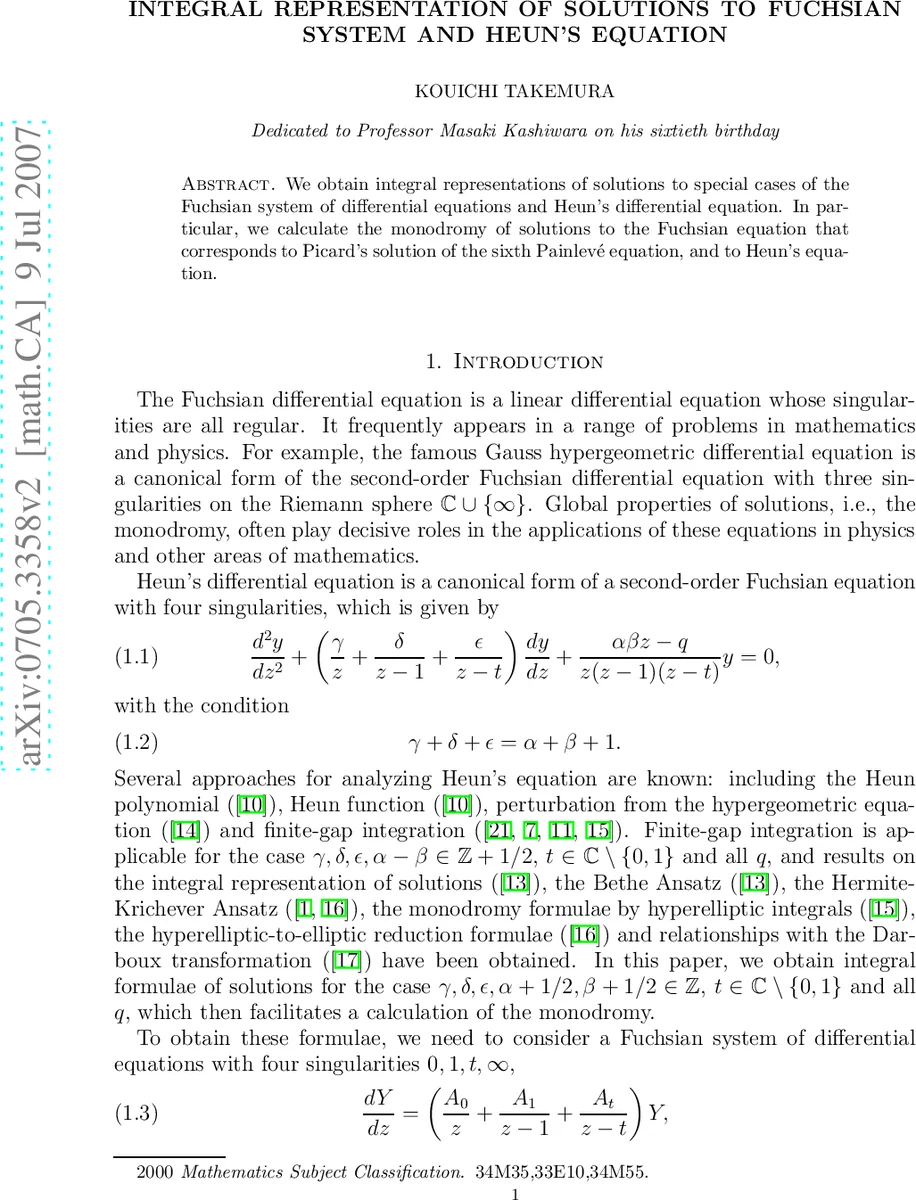
We obtain integral representations of solutions to special cases of the Fuchsian system of differential equations and Heun’s differential equation. In particular, we calculate the monodromy of solutions to the Fuchsian equation that corresponds to Picard’s solution of the sixth Painlev'e equation, and to Heun’s equation.
💡 Research Summary
The paper develops explicit integral representations for solutions of a four‑singularity Fuchsian system and for Heun’s differential equation, focusing on parameter regimes where the exponents are integers or half‑integers. The authors start by formulating a 2 × 2 Fuchsian system with regular singular points at 0, 1, t, ∞, whose coefficient matrices A₀, A₁, A_t have one zero eigenvalue and the other eigenvalue θ_i (i = 0, 1, t). By eliminating the second component they obtain a second‑order scalar equation (2.5) that coincides with the linear problem underlying the sixth Painlevé equation (P_VI). The monodromy‑preserving deformation of this system yields the Hamiltonian formulation of P_VI (equations (2.4)–(2.6)).
A central technical tool is the middle convolution introduced by Dettweiler–Reiter. The authors embed the original 2‑dimensional system into a 6‑dimensional one with block matrices B₀, B₁, B_t (equation (3.1)) and then factor out the invariant subspaces L and K. For the special choice of the convolution parameter ν = κ₁ = (θ_∞ − θ₀ − θ₁ − θ_t)/2, the quotient space C⁶/(K + L) becomes two‑dimensional and the induced matrices ˜B_i define a new Fuchsian system (3.12). The new system has transformed parameters \
Comments & Academic Discussion
Loading comments...
Leave a Comment