Le Her and Other Problems in Probability Discussed by Bernoulli, Montmort and Waldegrave
Part V of the second edition of Pierre R\'{e}mond de Montmort's Essay d'analyse sur les jeux de hazard published in 1713 contains correspondence on probability problems between Montmort and Nicolaus Bernoulli. This correspondence begins in 1710. The …
Authors: David R. Bellhouse, Nicolas Fillion
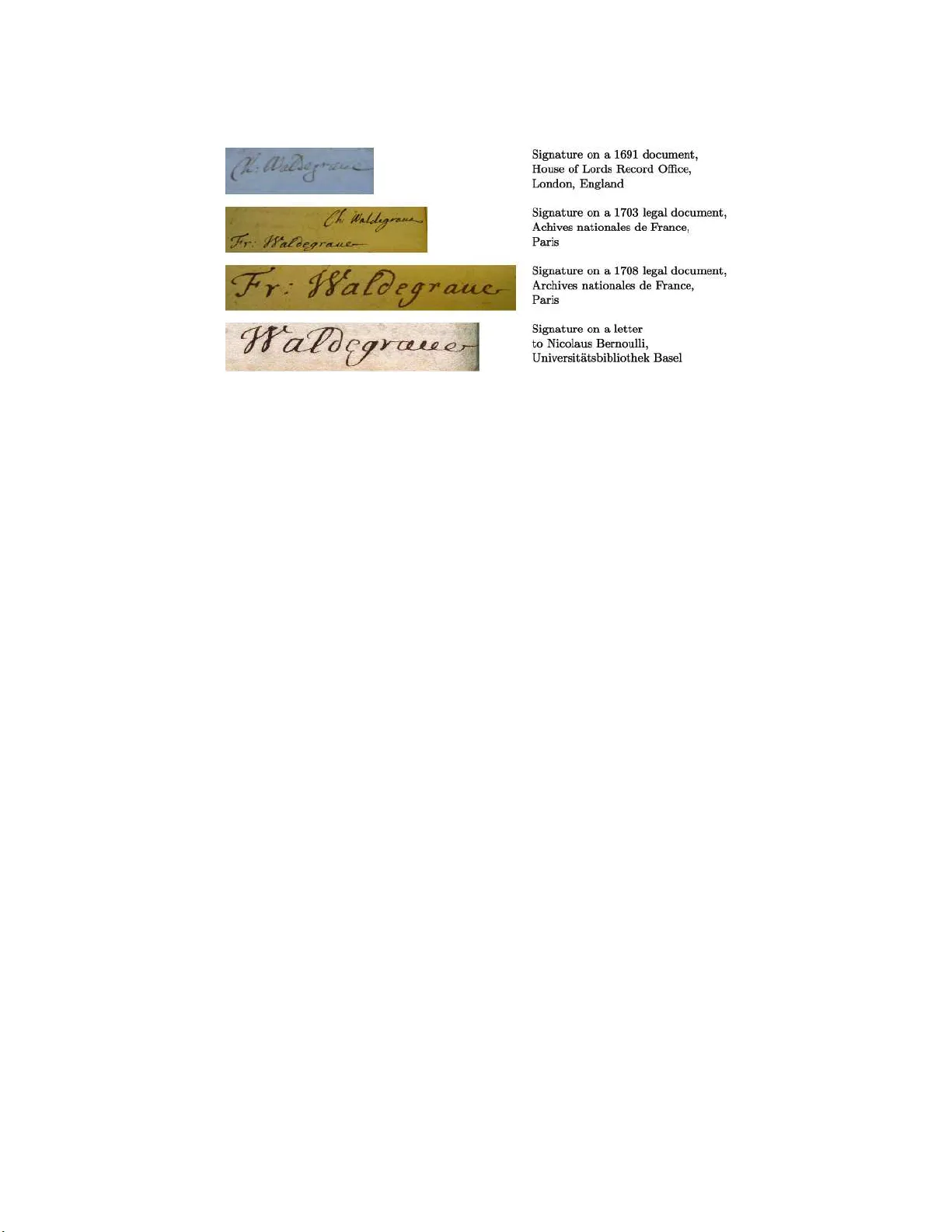
Statistic al Scienc e 2015, V ol. 30, No. 1, 26–3 9 DOI: 10.1214 /14-STS469 c Institute of Mathematical Statisti cs , 2015 Le Her and Other Proble ms in Probabilit y Discussed b y Bernoulli, Montmo rt and W aldegrave David R. Bellhouse and Nicolas Fillion Abstr act. P art V of the second edition of Pierre R ´ emond de Mon t- mort’s Essay d’analyse sur les jeux de hazar d published in 17 13 con- tains corresp onden ce on probabilit y p roblems b et ween Mon tmort and Nicolaus Bernoulli. This co rresp ondence begins in 171 0. The l ast pub - lished letter, d ated No vem b er 15, 1713, is fr om Montmort to Nicolaus Bernoulli. T h ere is some d iscussion of th e strategy of p la y in the card game Le Her an d a bit of news that Mon tmort’s f r iend W aldegra ve in P aris w as going to tak e care of th e p rin ting of the b o ok. F rom ear- lier corresp ond ence b etw een Bernoulli and Mon tmort, it is apparen t that W aldegra v e had also analyzed Le Her and had come up with a mixed strategy as a solution. He had also su ggested wo rking on th e “problem of the p o ol,” or what is often called W aldegra v e’s p roblem. The Univ ersit¨ atsbibliothek Basel con tains an additional fort y-t w o let- ters b et wee n Bernoulli and Mon tmort wr itten after 1713 , as w ell as t wo letters b et w een Bernoulli and W aldegra v e. The letters are all in F renc h, and here we pro vide trans lations of key passages. T he trio con tinued to discuss probab ility problems, particularly Le Her which was still under discussion w hen the Essay d’analyse w en t to pr in t. W e describ e the probabilit y conte nt of th is b o d y of corresp ond en ce and put it in its his- torical con text. W e also pro vide a prop er iden tification of W aldegra ve based on man uscripts in the Arc hives natio nales d e F rance in P aris. Key wor ds and phr ases: History of pr obabilit y , history of game theory , strategy of pla y. David R. Bel lhouse is Pr ofessor, Dep artment of Statistic al and A ctuarial Scienc es, University of Western Ontario, L ondon, Ontario N6A 5B7, Canada e-mail: b el lhouse@stats.uwo.c a . Nic olas Fil lio n is Assistant Pr ofessor, Dep artment of Philosophy, Simon F r aser University, Burn aby, British Columbia V5A 1S6, Canada e-mai l: nfil lion@sfu.c a . This is an electr onic reprint of the or iginal article published by the Institute of Ma thema tical Statistics in Statistic al Scienc e , 2 015, V o l. 30, No. 1 , 26–39 . This reprint differs from the o r iginal in pagina tion and t yp ogr aphic deta il. 1. INT RODUCTION The earliest extan t corresp ondence b et we en Pierre R ´ emond de Mont mort and a memb er of the Bernoulli family is a letter from Mon tmort to Johann Bernoulli dated F ebru ary 27, 1703, concerning a pap er on cal- culus that the latter h ad written for the Acad ´ emie ro y ale des sciences in P aris ( Bernoulli , 1702 ). They corresp onded sp oradical ly o v er the n ext few ye ars. On April 29 , 1709, Mon tmort sen t Bernoulli a copy of his b ook on probabilit y , Essay d’analyse sur les jeux de hazar d , that he recen tly had publish ed ( Mon tmort , 1708 ). Th e b o ok is the fir s t in a series of b ooks in probabilit y pu blished by seve ral others o ver the y ears 1708 to 1718 in w hat Hald [( 1990 ), page 191] calls the “Great Leap F orw ard” in prob- 1 2 D. R. BELLHOUS E AND N. FILLI ON abilit y . Bernoulli replied with a gift of a cop y of his n ephew’s do ctoral dissertation ( Bernoulli , 1709 ), the second b o ok in Hald’s “Great Leap F orward”; Nicolaus Bernoulli’s b o ok dealt with applications of probabilit y . On ce J ohann Bernoulli receiv ed his cop y of Essay d’analyse , he sen t, on Marc h 17, 1710, a detailed s et of commen ts on the b o ok. In the let- ter Bernoulli included another set of commen ts on Essay d’ana lyse , this one b y his nephew Nico laus (Mon tmort ( 1713 ), pages 283–303 ). Th us b egan a se- ries of corresp ondence b et w een Mon tmort and Nico- laus Bernoulli on problems in probabilit y . Mon tmort included muc h of this corresp onden ce in P art V of the second edition of Essay d’analyse ( Mon tmort , 1713 ). The corresp ondence b etw een Mon tmort and Nicolaus Bern oulli after 1713, left unpub lish ed and largely ignored b y historians, con tains scien tific news and further discussion of problems in prob- abilit y . The m a jor topic is a con tinuing discussion of iss u es related to the card game Le Her. Next, in terms of ink spilt on probab ility , are d iscu ssions of the “problem of th e p o ol,” or W aldegra v e’s prob - lem, generalized to more than thr ee pla y ers, and of the game Les ´ Etrennes (whic h ma y b e trans lated a s “the gifts”). T h e corresp ondence also conta ins dis- cussions of v arious p roblems in algebra, geometry , differen tial equations and infinite series. As an aristo crat, Mon tmort’s netw ork included b oth p olitical and scien tific connections. His letters to Bernoulli cont ain some referen ces to his p oliti- cal act ivities that sometimes k ept him from replying promptly . His br other, Nicolas R´ emond, w as Chef de conseil for Phillip e duc d’Orl ´ eans, who b ecame regen t of F r ance after his uncle Lou is XIV died in 1715 (Leibniz ( 1887 ), page 599). Among the math- ematicians of the era, Mon tmort corresp onded w ith Isaac Newton, Gottfried Leibniz, Bro ok T a ylor and Abraham De Moivre, in addition to the Bernoullis as w ell as several others. As a talen ted amateur math- ematician, his w ork w as well regarded b y the math- ematicians of his da y . He w as generous to his scien- tific friends. He receiv ed as guests to the Ch ˆ ateau d e Mon tmort Nico laus Bernoulli, Bro ok T a ylor and one of the sons of Johann Bernou lli. He also sent gifts of cases of wine and champagne to b oth Newton and T a ylor. Le Her is a game of strategy and c hance pla y ed with a standard d ec k o f fi ft y-t w o pla ying cards. The simplest situation is w hen tw o pla ye rs pla y the game, and the solution is n ot sim p ly determined ev en in that situ ation. Mon tmort calls the t wo pla y- ers Pierre and Pa ul. Pierr e deals a card fr om the dec k to P aul an d then one to himself. Paul has the option of switc hing his card for Pierr e’s card. Pierre can only refuse the switc h if he holds a king (the highest v alued card). After P aul make s h is decision to hold or switc h, Pierre now has the option to hold whatev er card h e no w has or to switc h it with a card dra wn from the dec k. Ho we ve r, if h e dra ws a king, he must retain his original card. The pla ye r with the h ighest card wins the p ot, with ties going to the dealer Pierre. The game can b e expand ed to more than t w o play ers. Montmort [( 1708 ), pages 186–187] originally describ ed the problem for four p lay ers and p osed the question: What are the chance s of eac h pla y er relativ e to the order in whic h they mak e their pla y? Because of the winning conditions, it is ob vious that one w ould w an t to switc h lo w cards and k eep high ones. The k ey is to fi nd what to do with the middle cards, suc h as seve n and eight , when t wo pla y ers are pla ying the game. In other cases, cards are clearly to o low to kee p or to o high to switc h, b eing muc h b elo w or ab o ve the a ve rage in a r an d om dra w. Naturally , the threshold wo uld b e lo we r with more than t wo pla ye rs. In Part V of Essay d’analyse , only th e game with t w o pla y ers is consid er ed . In itially , Montmort and Nicolaus Bernoulli wrote bac k and forth ab out th e problem and came to the same solution. Ho w ev er, t w o of Mon tmort’s friends con tended that this so- lution was incorrect. These w ere an English gen tle- man named W aldegrav e and an abb ot wh ose abb ey w as only a league and a half (ab ou t 5.8 kilometers) from Chˆ ateau de Mon tmort (Mo ntmort ( 1713 ), page 338). Mon tmort ident ified W aldegra v e only as the brother of the Lord W aldegra ve who married the natural daughter of Kin g James I I of En gland. Lord W aldegra ve is Henr y W aldegra v e, 1st Baron W alde- gra ve, and his wife is Henrietta Fitz James, d augh ter of James I I, and his mistress Ar ab ella Ch urchill. Th e abb ot is the Abb ´ e d’Orb ais; Montmort also refers to him as th e Ab b ´ e de Monsoury . Th e reason for the t w o app ellati ons for the abb ot is that his full name is Pierre Cu v ier de Mon tsour y , Ab b ´ e d’Orbais. He has b een describ ed as “un pro dige de b on co eur , d’urbanit´ e et d e science” ( Bout ( 1887 )). F or the sp elling c hoice b etw een Montsoury and Monsoury , it should b e noted th at Mon tmort often sp elled h is name “Mo nmort.” PROBLEM S IN PROBABILITY BY BERNOULLI, MON TMOR T & W ALDEGRA VE 3 Tw o other prob lems we re d iscussed extensively in the corr esp ondence. The first is th e problem of the p o ol, a problem that W aldegra v e suggeste d to Mon t- mort and solv ed himself (Montmort ( 1713 ), p age 318). In E ssay d’analyse the pr oblem is solv ed for three pla yers. It is often called W aldegra v e’s prob - lem ( Bellhouse , 2007 ). The “p o ol” is a wa y of getting three or more pla ye rs to gam ble against one another, when the game p ut in to pla y is for tw o p la yers only . In the situation for three p lay ers (Mont mort us es the names Pierre, P aul and Jacques), all th ree b egin b y putting an an te int o the p ot. Then Pierre and P au l pla y a game against eac h other. The w inner p lays against Jacques and the loser pu ts money into the p ot. The game cont inues un til one p la yer has b eaten the other t w o in a ro w. That p la y er tak es th e p ot. The game can b e expanded to more than three pla y- ers, but that situation w as not f u lly treate d in Essay d’analyse . The second is the problem of solving the game Les ´ Etrennes (or “estreine,” an alternativ e old F renc h sp elling). As describ ed b y Montmo rt [( 1713 ), pages 406–4 07], this is a strategic game b etw een a father an d his s on. T h e f ather holds an o dd or ev en n umb er of tok ens in his hand, w hic h his s on can- not see. When the son gu esses even, h e receiv es a gift of four ´ ecus (silv er coins) if h e is correct and nothing if wrong. When the son guesses odd , he re- ceiv es one ´ ecu if he is correct and nothing if w r ong. The discussion of this game in the corresp ondence is on ly brough t in to enligh ten Le Her whose strate- gic nature is in some imp ortan t resp ects essent ially similar. Mon tmort concludes the last le tter (to Bernoulli) that app ears in Essay d’analyse with a remark that W aldegra ve had v olunt eered to tak e care of getting the b o ok printed in Pa ris. Mont mort’s lett er w as dated No vem b er 15, 1713 , and was written from P aris. What is also of concern to us are th e letters after this d ate and how these letters relate to earlier discussions. The unp ublished corresp ondence b egins with a letter from Mon tmort to Bernoulli d ated Jan- uary 25 , 1714, in whic h he says that he has sen t Bernoulli t wo copies of the second edition of Es- say d’analyse . Montmort was still in Paris, where he claimed to hav e b een for three mon ths. He w as sta yin g at a hotel in Rue des Bernardins , w hic h in mo dern Paris is only a walk of 350 meters to the printe r, Jacques Qu illau in Rue Galande. Pr esu m- ably , W aldegra ve’s h elp consisted mainly in dealing with the printer and the pro of sheets as they came off th e pr ess, thus relieving Mont mort of some te- dious w ork. 2. T HE TREA TMENT OF T HE GAME OF LE HER IN ESSA Y D’A NAL YSE T o u nderstand the discussion of Le Her after 1713 , it is nece ssary to describ e the trea tment of the game as i t a pp ears in the seco nd editio n of Es- say d’analyse . Hald [( 1990 ), pages 314–32 2] pro vides a detailed description of the mathematical calcula- tions inv olv ed in assessing the game. Y et he d ev otes little space t o elucidating the discussions a mong Bernoulli, Mon tmort and W aldegra v e, as w ell as th e Abb ´ e d’Orbais, concernin g the issues surroun ding these mathematical cal culations. It is the substance of these discussions that are o f in terest to us. Hald’s only commen t on the discussion ov er Le Her concerns a commen t made by W aldegrav e and Abb ´ e d ’Orbais to the effect that Bernoulli’s r eason- ing in obtaining his mathematical solution is fault y . After p oin ting out their observ ation that Bernoulli’s solution fails to accoun t for a play er’s probabilit y of pla ying in a certain wa y , Hald [( 1990 ), page 315] claims: It is no w onder that Bernoulli do es not understand the implications of this re- mark, sin ce th e writers themselve s hav e not grasp ed the full implication of their p oint of view. It is indeed tru e that there was some confusion on Bernoulli’s side whic h h e d eftly tried to hide. Henn y [( 1975 ), page 502] co mments that he is amazed to find expressed in the letters many con- cepts and ideas that app ear in mo dern game theory . A t the same time, he is surp rised to find W aldegra v e defending his p osition so strongly against Bernoulli who w as th e sup erior mathemati cian. Henn y states further that W aldegra v e did not hav e the necessary mathematical skills to pro vid e a mathematical pro of of his results. As w e will show in a r eview of the treatmen t of Le Her in Essay d’analyse and th e su bsequent un- published corresp onden ce, b oth Hald’s and Henny’s insigh ts fall short of the mark. 1 One reason they fall 1 The same could be said of others who have passed harsh judgments on Mon tmort and Bernoulli. F or instance, Fis her ( 1934 ) argues that “Montmor t’s conclusion [that no absolute rule could b e give n], t h ough obviously correct for the limited aspect in whic h he viewed the problem, is unsatisfactory to common sense, which suggests that in all circumstances there must b e, according to the degree of our knowl edge, at least one rule of conduct which shall b e not less sati sfactory than any other; and this his discussion fails to pro vide.” Our discussion b elo w will show that this assessmen t is misinformed. 4 D. R. BELLHOUS E AND N. FILLI ON short is that they d o not consider the fu ll r ange of the v arious ev en ts that w ere und er d iscussion and their asso ciated probabilities. Two even ts are n atu- ral for a probabilist to consider. The first is the dis- tribution of the cards to Pierre and Pa ul. The second is the randomizing device used to come up with the mixed strate gy p rescribing when the pla yers should hold and when th ey shou ld switc h . The randomizing device considered in Essay d’analyse is a bag con- taining blac k and white coun ters or tok ens (the old F renc h w ord used is “jet ton”). The third ev en t that Mon tmort, W aldegra v e an d Bernoulli consider (but not Hald or Henny) is d ifficult, or p erh aps imp os- sible, to qu antify . This is the p ossibilit y that P aul, sa y , is a p oor p la y er and do es not f ollo w a strategy that is mathematically optimal, or the p ossibilit y that Paul, sa y , is a ve ry go o d p la yer who tries to tric k Pierre in to making a p o or c hoice. This kind of ev en t un folds regularly in mo dern poker games. Another reason for whic h Hald and Henny see some confusion in th e discussions among Bernoulli, Mon tmort and W aldeg ra ve is that wh at w e are see- ing in the corresp ondence is the complete unfolding of a p r oblem from its initial statemen t, and d iscus- sions around it, to a complete solution. This is dif- feren t f rom a “textb o ok” statemen t of a prob lem fol- lo wed by a solution. In the latter case, the problem and solution are b oth w ell laid out. In the former case, there is some grappling with the problem unti l it b ecomes clea r ho w to pro cee d. W e b egin with the corresp ondence in Essay d’analyse where Le Her is fi rst mentio ned. In Jo- hann Bernoulli’s 1710 letter to Mon tmort in E s- say d’analyse , he su ggests more efficien t method s to reac h Montmort’s conclusions f or a v ariet y of problems and in some cases generalizes Montmort’s results. Th ere is only one reference to the problem of Le Her, which is the second of four p roblems p ro- p osed in Mon tmort [( 1708 ), pages 185– 187]: The second and the third [problem] seem to m e amenable, but n ot without m uch difficult y and work, that I prefer to de- fer to y ou and learn the solution, than to work long at the exp ense of my ordi- nary o ccupations th at lea ve me scarcely an y time to apply m yself to other things. In his reply to this letter, whic h is dated Nov em b er 15, 1710 (Mon tmort ( 1713 ), pages 303–307) , Mon t- mort mak es no reference to this passage. Nicolaus Bern oulli’s first letter to Montmort, dated F ebruary 26, 1711 , m akes no referen ce to the game Le Her. It is a n ote in Mont mort’s rep ly to Nicolaus Bernoulli, d ated April 10, 1711 (Mon tmort ( 1713 ), pages 315–32 3) that in itiates the discussion of Mon tmort’s s econd p roblem: I s tarted some time ago to w ork on the solution of problems that I prop ose at the end of my b o ok; I fi nd that in Le Her, when there are only tw o pla yers left, Pierre and P aul, Pa ul’s adv ant age is greater than 1 in 85, and less than 1 in 84. This p roblem has difficulties of a singular nature. In a p ostscript to this letter, Mon tmort makes an additional remark: As there are few copies of m y b o ok left, there will so on b e a new edition. When I ha v e d ecided, I will ask y ou p ermission, and yo ur uncle, to in s ert y our b eautiful letters whic h will mak e the principal em- b ellishment. It is this announcement that may ha v e motiv ated Nicolaus Bernoulli to con tin ue his co rresp ondence with Mon tmort and to send him muc h interesting material. Pu blishing mathematical material outside a scien tific so ciet y or without a patron to co ver the costs w as an exp ensiv e prop osition, one that Mon t- mort could afford. Because of the s p ecialized t yp e that was u sed and the accompan ying n ecessary skill of the t yp esett er, the cost of a mathematical pu b- licatio n w as well ab o v e the norm for less tec hn ical b o oks. Bernoulli could get his results in p rint at no cost to himself. Bernoulli resp onded with a long letter, dated No vem b er 10, 1711 (Mon tmort ( 1713 ), pages 323– 337). In this letter, he annou n ces, among many other things, that he has also solv ed the t w o-p erson case for Le Her (Montmort ( 1713 ), page 334 ): I also s olv ed the problem on Le Her in the simp lest case; here is wh at I f ound. If we supp ose that eac h pla y er observ es the condu ct that is most adv an tageous to him, P aul must only h old to a card that is higher th an a sev en and Pierre to one that is higher than an eigh t, and we find un d er this supp osition that the lot of Pierre will b e to that of P aul as 2697 is to 2828. Sup - p osing that Paul also holds to a sev en, PROBLEM S IN PROBABILITY BY BERNOULLI, MON TMOR T & W ALDEGRA VE 5 then Pierre must hold to an eig ht, and their lots will still b e as 2697 to 2828. Nev- ertheless it is more adv anta geous for h im not to hold to a sev en than to hold to it, whic h is a p uzzle that I lea v e y ou to de- v elop. This passage is carefully worded, y et it will b e misin - terpreted b y Mo ntmort and W aldegra v e. As w e will see, a k ey asp ect that is neglected by Montmort and W aldegra ve is the antec edent of Bernoulli’s condi- tional statemen t starting with “If w e supp ose that eac h p la yer observ es the conduct. . . ” Mon tmort’s reply , dated Marc h 1, 1712 (Mont- mort ( 1713 ), pages 337–347 ), highly praises Ber- noulli’s prior le tter. He complains that, b eing in P aris, h e has h ad no time and p eace to think on his o w n and, as a consequence, the main ob ject of his letter is to rep ort progress m ade b y his t wo fr iends, the Abb ´ e d’Orb ais and W aldegrav e, on a problem prop osed by Bern oulli, an d on the problem of Le Her. On the latt er, Mon tmort r ep orts that “they dare ho we v er not submit to yo ur decisions” (Mon t- mort ( 1713 ), page 338). How ev er, as he says in a passage that is k ey to understandin g the forthcom- ing con tro v ersy , the Abb´ e d’Orb ais also pr eviously disagreed with Mon tmort: When I wo rked on Le Her a few y ears ago, I told M. l’Abb ´ e de Monsoury wh at I had found, b ut n either m y calculati ons nor m y argumen ts could convince him. He alw a ys main tained that it w as imp ossible to de- termine the lot of Pierre and P aul, b e- cause we co uld not determine wh ic h card Pierre m ust hold to, and vice v ersa, wh ic h results in a circle, and makes in his opin- ion the s olution imp ossible. He added a quan tit y of subtle r easonings whic h made me d oubt a little that I h ad caught the truth. Th at is where I w as when I p ro- p osed that y ou exa mine this problem; my goal wa s to mak e sure from y ou of th e go o dness of my solution, without havi ng the troub le of recalling my id eas on this whic h w ere completely erased. Mon tmort then claims that Bernoulli’s solution con- firms wh at he had found , a decision that prompts a reply from W aldegra ve ob jecting to Bernoulli’s so- lution, quoted at le ngth in Mon tmort ( 1713 ), pages 339–3 40. According to W aldegra ve and the Abb ´ e d’Orbais, it is not true that Pa ul must hold only to an eigh t and Pierre to a nine. Rather, that Paul sh ould b e indifferent to hold to a sev en or to s witc h , and that Pierre should b e indifferent to hold to an eigh t or to switc h. W aldegra ve wrote the follo wing to Mon tmort (Mon tmort ( 1713 ), page 339 ): W e a rgue that it is in differen t to P aul to switch or hold with a sev en, and to Pierre to switc h or hold with an eight. T o pro v e this, I m u st fi rst explain th eir lot in all cases. That of Pa ul ha ving a seven, is 780 50 × 51 when he sw itc h es, and when he holds on to it his lot is 720 50 × 51 if Pierre holds on to an eigh t, and 816 50 × 51 if Pierre switc hes with an eight. Th e lot of Pierre ha ving an eigh t is 150 23 × 50 if he holds on to it, and 210 23 × 50 if he switc hes in the case that P aul only holds on to a seven; and 350 27 × 50 b y holding on to it, and 314 27 × 50 b y switc h- ing in the case that Pa ul holds on to a sev en, so h er e they are. The lots of P aul 780 or 720 or 816 50 × 51 , those of P ierr e 150 or 210 23 × 50 or 350 or 314 27 × 50 . Based on the n umbers he obtains, W aldegra ve ob- serv es that “720 b eing more b elo w 780 than 816 is ab o v e, it app ears that P aul m ust ha v e a reason to switc h with 7” (Mon tmort ( 1713 ), page 339). The differences, 780 − 720 and 816 − 780, are in the ratio 60 : 36, or 5 : 3, a r atio wh ic h lat er en ters the discus- sion. In the rest of his argument, W aldegra ve talks of a w eigh t instead of a reason. He first lets the w eigh t that leads Paul to s w itc h b e A , and the w eigh t that leads Pierre to sw itc h b e B . And h e argues that the same weig hts lead Paul and Pierre to b oth strate- gies. A leads P aul to switc h with 7 and, as a conse- quence, it also leads Pierre to sw itc h his 8; bu t what leads Pierr e to switch his 8 must lead P aul to hold with 7. So, A leads P aul to b oth switch w ith a 7 and hold on to it. The same go es for Pierre. Therefore, “it is false that Paul m ust only hold on to an 8, and Pierre to a 9,” wh ic h w as Bernoulli’s claimed solu- tion. The w ord “prob ab ility” comes up only once in this d iscussion, in the conclusion of the excerpt from W aldegra v e’s letter to Mon tmort. W aldegra v e writes (Mon tmort ( 1713 ), page 340 ): Apparent ly Mr. Bernoulli w as simply lo oking at the fractions that express the 6 D. R. BELLHOUS E AND N. FILLI ON T able 1 Pr ob abilities that Paul wi ns dep ending on the str ate gies of play ❍ ❍ ❍ ❍ ❍ Pa ul Pierre Switch the 8 Hold the 8 (and under) (and o ver) Switc h the 7 2828 5525 2838 5525 (and under) Hold the 7 2834 5525 2828 5525 (and ov er) differen t lots of Pierre and P aul, with- out p aying atten tion to t he p robabilit y of what the other w ill do. Mon tmort lea ves the discussion there w ithout fur- ther commen t. Up on r eceiving Mon tmort’s letter, Bernoulli agree s with these figur es, sa ying th at “the lots they found for Pierre and Paul are v ery r igh t” (Montmo rt ( 1713 ), page 348). And y et, w hen Bernoulli pro- p oses his s olution, and wh en Mon tmort ev en tu- ally pub lishes a table of pr obabilities as an ap- p end ix to Essay d’analyse (Montmo rt ( 1713 ), p age 413), the num b ers are d ifferen t. The Bernoulli– Mon tmort probabilities are shown in T able 1 , whic h app ears in Hald ( 1990 ), p age 318. None of th e parties in this debate actually explain their calcu- lations. W aldeg rav e’s probab ilities are ju stified in T o dhun ter ( 1865 ), pages 107–11 0; the Bernoulli– Mon tmort probabilities are in Hald ( 1990 ), pages 315–3 18. Th e difference in the probabilities is that W aldegra ve’s pr ob ab ilities are conditional on Pa ul ha ving a seve n in his hand and the Bernoulli– Mon tmort probab ilities are the marginal probabili- ties for all cards that P aul ma y hold. In a letter dated Jun e 2, 1712, Bernoulli replies to W aldegra ve’s argumen t by accusing him of com- mitting a fallacy . He argues that if w e supp ose that A leads Pa ul to s w itc h with a s even, and so leads Pierre to switc h with an eigh t (if Pierre kno ws P aul switc hes with seven), th en it also lea ds P aul to hold on to a sev en. T herefore, A b oth leads P aul to switc h with a sev en and to h old on to a sev en. His conclu- sion is that (Mo ntmort ( 1713 ), page 348 ): w e are supp osing t w o con tradictory things at the same time; that is, that P au l kn o ws and ignores at the same time what Pierre will do, and Pierre what Paul will d o. Bernoulli exp lains that if we do not commit this fal- lacy regarding w hat P aul and Pierre kno w ab out the other’s inte nt, w e are led to reasoning in a cir- cle, whic h s ho ws that W aldegra ve’s argument can- not sho w anything. This argument is p eculiar, and seems to suggest that Bernoulli do es n ot u nderstand W aldegra ve’s p oin t. It migh t, ho wev er, b e simply a misin terpretation of W aldegra v e’s argument, for it is exp r essed in terms of weig ht rather than in terms of probabilit y . The w ord “weig ht” or “poids” in F r enc h offers more opp ortunit y for misinterpre- tation. Moreo v er, Bernoulli adm its having written his letter hastily , as he was p r eparing for a long trip through the Netherlands and England. As a r esult of th is trav el, some subsequ en t letters are d ela yed, and the arguments they con tain do not follo w th e c h ronological order of wh en the letters w ere writ- ten. A letter to Bernoulli, dated Septem b er 5, 1712 (Mon tmort ( 1713 ), pages 361– 370), an n ounces that W aldegra ve and the Abb´ e d ’Orbais h a v e seen Ber- noulli’s reply in w hic h he accuses them of com- mitting a fallacy . Mon tmort includes a note from the Abb´ e d ’Orbais in whic h he claims that W alde- gra ve has w r itten a b eautiful and precise r ep ly to Bernoulli’s ob jection; the r ebuttal, ho w ev er, is not included. In th is n ote, the Ab b ´ e d’Orbais also en- joins Mon tmort to tak e a side in this dispute b e- t w een th em. This suggests that, ev en if Mon tmort thank ed Bern ou lli for his solution, wh ic h h e claimed agreed w ith his o wn, Mon tmort has n ot ye t made u p his mind as to whether Bernoulli r eally solv ed the problem. The n ext letter concerning L e Her is f rom Bernou lli to Mon tmort, dated Decem b er 30, 171 2 (Mont mort ( 1713 ), pages 375–394 ). Adding imp ortan t piece s to the p uzzle, it con tains a three-page d iscussion of Le Her (Bernoulli m en tions having jus t receiv ed the June 2 letter, since it was sen t from S w itzerland to Holland, then to England, and fi n ally bac k to Switzerland). Bernoulli insists that, despite W alde- gra ve’s argumen ts, P aul do es not do as well by abid- ing to the maxim of holdin g to a sev en, than that of switc hing with a seven. Bernoulli then sa ys (Mon t- mort ( 1713 ), page 376): If it w ere imp ossible to decide this prob- lem, P aul ha vin g a sev en w ould not kno w what to do; and to rid himself [from decid- ing], h e w ould sub ject himself to c hance, for example, h e w ould pu t in a bag an equal num b er of w h ite tok ens and b lac k tok ens , with the inten t of holding to a PROBLEM S IN PROBABILITY BY BERNOULLI, MON TMOR T & W ALDEGRA VE 7 sev en if he draws a white one, & to switc h with a seve n if he draws a blac k one; b e- cause if he put an unequ al num b er he w ould b e lead m ore to one party than to the other, wh ic h is aga inst the assump- tion. P ierre with an eigh t would do th e same thin g to see whether he must switc h or not. This comment introd uces w ith clarit y the idea of c h ance b y “the wa y of tok ens” (as they will sa y later). What Bernoulli says here seems to confirm that, at firs t, when he accused W aldegra v e of com- mitting a fallacy , he did not interpret W aldegra v e’s w eigh ts as probabilities. Nonetheless, h e suggests that the only probabilit y allocation compatible with the sup p osed state of ignorance of the pla ye rs is th at eac h pla y er chooses a strategy with probabilit y 1 2 . Under these c h oices, he computes the lot of Paul (whic h is then 774 51 × 50 ) and concludes that it w ould b e a bad thing f or Paul to randomize in this wa y , since he could guaran tee h imself a lot of 780 51 × 50 . Therefore, Bernoulli concludes Paul m ust alw a ys switc h with a seven. As Bernoulli sa ys (Mon tmort ( 1713 ), p age 376), “it is b etter to mak e the c hoice where w e risk less.” He then explains the reasoning that h e had left out of his hastily written letter from J une 2. I n con- temp orary terms, he calculate d the unconditional probabilit y of winning un der eac h pu re strategy pro- file (without assuming that an y card has b een d ealt y et). He disp lays a refined v ersion of the reasoning that led to accusing W aldegra v e of a fallacy , y et it do es not do full justice to W aldegra v e’s idea. Eigh t months later, on August 20, 171 3, Mon t- mort [( 1713 ), pages 395 –400] fi nally replies t o Bernoulli, complaining that he has, desp ite h is ph ilo- sophical inclinations, b een in v olv ed in p olitical ac- tivities, and so he did not h a v e the leisure f or in tel- lectual wo rk. Thus, his lette r only cont ains scien tific news. There is only on e brief men tion of Le Her; h e tells Bernou lli that, d espite his last effort to pr o- vide a th orough and precise argumen t, W aldegra ve and the Ab b´ e d’Orbais are still unconvinced b y his claimed solution. Shortly after, in a letter d ated Septem b er 9, 17 13, Bernoulli also asks Mon tmort to explain his o wn views on the disp ute. Mon tmort obliges him in his letter dated No ve mber 15, 1713. This is the last letter pu b lished in th e second edi- tion of Essay d’ana lyse (Mon tmort ( 1713 ), pages 403–4 13). Th e letter also con tains an excerpt of a letter fr om W aldegra v e and a table of the lots of P aul and Pierr e for th e four crucial com binations of strategies, whic h are summarized in T able 1 . Here, then, is Mon tmort’s understanding of the situation. T o b egin with, h e agrees with Bernoulli that it is not ind ifferen t to Paul to switc h or hold with a sev en, and to Pierre to sw itc h or hold with an eigh t, b eca use of Bernoulli’s calcula tions of the un - equal c hances for eac h strategy . (This sho ws that Bernoulli and Montmort u se “ind ifferen t” in the sense of h a ving the same probabilit y of winning. F or W aldegra ve and d’Orbais, h o w ev er, “indifferent” seems to mean, p erhaps more awkw ard ly , that no strategy d ominates the other in probability .) This b eing said, Mon tmort nonetheless d isagrees with Bernoulli that this establishes the str ategy as a maxim, that is, as a rule of cond uct that must b e ob ey ed in v ariably to obtain the b est resu lts. R ather, he thinks th at it is imp ossible to establish su c h a maxim (Mon tmort ( 1713 ), page 403 ): [T]he solution of the p roblem is imp ossi- ble, that is, w e cannot p rescrib e to Paul the cond uct that he m u st adopt when h e has a s even, and to Pierre the co nd u ct h e m ust adopt when he has an eight. He gran ts that, if one is to c ho ose a fixed and de- termined maxim, then sw itc h ing on sev en, for Paul, will b e b etter than an y other, yet Paul can hop e to mak e his lot b etter. Wh y , then, would a s olution b e imp ossib le? W ould the s olution not b e the optim um that one ca n reac h in P aul’s hop e of making his lot b etter? Montmort claims that, w hereas he used to think that the use of blac k and wh ite tok ens to rand omize strategies could a void the “circle,” h e do es not think that an y- more. He giv es a general formula to find the prob- abilit y of winning with a ce rtain p robabilit y allo ca- tion for what w e call a mixed strategy: 2828 ac + 2834 bc + 2838 ad + 2828 bd 13 · 17 · 25( a + b + c + d ) , where a is Pa ul’s probability of switc h ing with seven, b is P aul’s p r obabilit y of holding the sev en, c is Pierre’s pr obabilit y of switc hin g with an eigh t, and d is Pierre’s probabilit y of holding on to an eigh t. But ho w sh ould the probabilities b e c hosen? Mon t- mort claims that an y argument will only inf orm us of what P aul must d o conditionally to what Pierre do es and vice versa, whic h leads us in to a circle once again. He concludes that Bern oulli’s argument s to 8 D. R. BELLHOUS E AND N. FILLI ON sho w th at a circle do es not o ccur are wrong, and in- stead formulat es this thesis (Mon tmort ( 1713 ), page 404): [W]e must s u pp ose that b oth pla y ers are equally su btle, and that th ey will c h o ose their condu ct only based on their k n o wl- edge of the condu ct of th e other play er. Ho wev er, since there is here no fixed p oin t, the maxim of a p la y er dep ends on the y et unknown maxim of th e other, so that if w e establish one, we dra w from this sup - p osition a con tradiction th at s h o ws that w e m ust not ha v e established it. Mon tmort also disagrees with Bernoulli that, und er pain of con tradiction, if w e are to use white and blac k tok en s to randomize, we m ust use an equal n umb er of tok ens. Instead, h e thin ks that the prob- abilit y of win n ing calcula ted for the fi xed and deter- mined maxims sho ws that Pa ul must switch more often with a sev en than hold on to it. Y et, he m ain- tains (Mon tmort ( 1713 ), page 405 ): But h o w muc h more often must he switc h rather than hold, and in p articular w hat he must do (here and now) is the principal question: the calculation do es not teac h us anything ab out th at, and I take this decision to b e imp ossible. Th us, Mon tmort b eliev es, it seems, that there is no optimal probabilit y allocation. But he has another reason for b elieving that the solution of the game is imp ossible. He h as in mind the game Les ´ Etrennes (Mon tmort ( 1713 ), pages 406–4 07). Mon tmort also b eliev es that it is imp ossi- ble to prescrib e any strategy of pla y in Les ´ Etrennes b ecause the play ers migh t alw ays tr y , and indeed go o d pla y ers will try , to d eceiv e other play ers in to thinking that they w ill play something they are not pla ying, thus trying to outsmart eac h other (“jouer au plus fin” is th e phrase used in F r enc h). As he w as finishing his letter, Mon tmort receiv ed one from W aldegra ve and qu oted exte nsively from it to Bernou lli. Essay d’analyse essentia lly concludes with W aldegra ve ’s letter. W aldegra ve refers to a for- m ula, whic h is not included by Montmort; it pre- sumably is the form u la displa y ed ab ov e. He explains that, if a = 3 and b = 5 (so that the probabilit y of P aul switching with a seven is 0 . 625), th en the lot of Pierr e is going to b e 2831 5525 + 3 4 · 5525 no matter what c and d are. Th is sho ws that 2831 5525 + 3 4 · 5525 is P aul’s minim um lot. He can only adopt another conduct in the h op e of m aking his lot b etter. This sho ws, he claims, that b oth Bernoulli and (formerly) him- self w ere wron g to claim that the lots of P aul w as to that of Pierre as 2828 is to 2697; if b oth p la y- ers play in the most ad v an tageous w a y , Paul’s lot is 2831 5525 + 3 4 · 5525 . W aldegra v e is con vinced that this is something that b oth Bernoulli and Montmo rt w ill agree to, n o w th at it is agreed that one can u s e a randomized strategy . He also explains that, if Pierre uses c = 5 and d = 3, then 2831 5525 + 3 4 · 5525 will also b e P aul’s maxim um lot. W aldegra ve also asserts that it is imp ossible to establish a maxim; he grants, ho w ev er, that it is im- p ossible for him to s h o w this with the same lev el of evidence. Th is is often taken incorrectly as evi- dence of a lac k of W aldegra v e’s mathematical abili- ties. W aldegra v e is ins tead referr ing to the s itu ation in whic h p la y ers may try to outsmart eac h other. W aldegra ve agrees that if P aul do es not use a = 3 and b = 5, then it is p ossible for P aul to d o b et- ter than 2831 5525 + 3 4 · 5525 pro vided that Pierre does not pla y in the b est w a y . O n the other hand, it w ould b e w orse if Pierre plays correctly . F urthermore, W alde- gra ve remarks (Mon tmort ( 1713 ), page 411 ): What means are there to d isco ver the ra- tio of the probabilit y that Pierre will pla y correctly to the p r obabilit y that he will not? This app ears to me to b e absolutely imp ossible, and thus lea ds u s into a circle. As w ith Montmort, his main concern is that it is alw a ys p ossible for the pla y ers to try to outsmart eac h other (“jouer au plus fin ”). 3. IS SUES ARISING F ROM THE PUBLISHED CORRESPONDENCE Examining the detailed argumen ts pr o v id ed b y Mon tmort, Bernoulli and W aldegra v e r ev eals a pic- ture that con trasts w ith the judgment th at th ey w ere essen tially confused on the fun damen tal con- cepts and metho d s r equired to s olve a strategic game suc h as Le Her. In fact, w e m aintain that they un- dersto o d most of the asp ects of the p roblem with clarit y . There are, h ow eve r, a num b er of imp ortan t outstanding issues left unr esolve d in the corresp on- dence on Le Her as it app ears in Essay d’analyse . Let us review them b r iefly . It is true that the letters rev eal a certain t yp e of misund erstanding; h ow eve r, it is not conceptual PROBLEM S IN PROBABILITY BY BERNOULLI, MON TMOR T & W ALDEGRA VE 9 confusion, b u t rather mutual misin terpretation due to using terms differently . An instance of this is whether it is indifferent to Paul to switc h or hold to a seven. On the one h and, b oth Montmort and Bernoulli claim that it is n ot indifferent to Paul b e- cause the c hances of winnin g are n ot identic al. On the other hand, W aldegra v e claims that it is indiffer- en t, and the reason for that seems to b e that neither pure strategy dominates the other in pr obabilit y . Another instance of this is the disagreemen t they app ear to hav e on the existence of a circularity in the analysis of the game. Mon tmort and W aldegrav e assert that there is a vicious circle that p rev en ts one f r om establishing a maxim; the circle they dis- cuss, ho wev er, is really a regression ad infinitum , that is, to establish a maxim, w e alw ays need to go one step fur ther in the “ A m ust know what B do es” lo op (Bernoulli agrees with this p oin t). Ho w - ev er, Bernoulli claims that there is a circle in W alde- gra ve’s argumen t, in the sens e that either h is ar- gumen t is con tradictory or a p etitio principii (but Bernoulli is not considering randomizing strategies at this p oin t). Again, they are only con tradicting eac h other in the wording, n ot in the id ea. Finally , a third instance is that Montmort and W aldegra ve claim that th e solution of the game is imp ossible, whereas Bernoulli do es n ot. Here again, they disagree on w hat it mea ns to “solv e” the game Le Her. Bernoulli claims that the solution is the strategy that guarante es the b est min im al gain— what we would call a minimax solution—and that as such there is a solution. Ho we ve r, d espite un - derstanding this “solution concept,” Mo ntmort and W aldegra ve r efuse to affir m that it “solv es” th e game, since there are situations in wh ic h it migh t not b e the b est ru le to follo w, namely , if a pla y er is weak and can b e take n adv anta ge of. Clearly , the concept of solution they ha v e in mind differs from the minimax concept of solution. This latter con- cept, in addition to th e probability of gain with a pure strategy and the probabilit y allo cation required to form mixed strategies, requires that we know the probabilit y that a play er will pla y an inferior strat- egy . But, they assert, this cannot b e an alyzed b y calculatio ns, so the game ca nnot b e s olved. This b eing s aid, ther e are a num b er of things that are said that su ggest a certain lev el of confusion at a conceptual lev el. The t w o most imp ortant are these. First, Bernoulli app ears to hav e some difficulty w ith the relation b etw een the knowledge of the pla y ers and the p robabilities inv olv ed in mixing s trategies. His circularit y ob jection to W aldegra ve is a wkward and somewh at mystifying. Moreov er, h is argumen t that, if we allo w randomized strategies with b lac k and wh ite tok en s, it m ust be b ecause neither pla ye r kno ws w hat the other pla y er will do, and that as a result the only acceptable pr obabilit y allocation of 1 2 is problematic. This kind of mistake n argument has b een rep eate d o v er the cen turies b y some of th e greatest m inds in probabilit y , statistics and game theory . S econd, Mon tmort un derstands v ery wel l the idea of rand omizing strategies, but he n onetheless claims that there is no optimal pr obabilit y allo ca- tion that can b e calculated. This cla im, how ev er, w as made b efore consulting W aldegra ve’ s letter in whic h he rev eals the optimal probabilit y . 4. DIS CUSSION OF T HE GAME OF L E HER AFTER 1713 Referring to a letter from Bernoulli to Mon tmort dated F ebruary 20, 1714, Henn y ( 1975 ), in his treat- men t of Le Her, mentio ns only that Bern ou lli ac- cepted W aldegra v e’s solution to the p r oblem. Ho w - ev er, Bernoulli h ad other things to say ab out Le Her in that same letter. Henny also refers to a letter of January 9, 1715, from W aldegra ve to Bernoulli in whic h W aldegra ve seemingly admits to Bernoulli that h e do es not h a v e the mathematical skills to ac- tually prov e his results. What Henny lea ves out is that the letter w as written in reply to a d etailed criticism of the s olutions to Le Her that Bernoulli had sen t earlier to Mon tmort. After some p ersonal n ews and ap ologies for not writing so oner, in his letter of F ebruary 20, 1714, to Montmort, Bernoulli initially thanks Mon tmort for correcting, editing and making clearer h is let- ters that Mo ntmort had pr in ted in Essay d’ana lyse . Then follo ws th e discu ssion of Le Her that Henny ( 1975 ) only br iefly men tions. In itially , Bernoulli sug- gests that the con tro ve rsy is essen tially o ver: Concerning Le Her, I seem to ha ve fore- seen that in the end w e wo uld all b e righ t. Ho wev er, I congratulate Mr. de W alde- gra ve who h as the fin al decision on this question, and I willfully grant him the honor of clo sing th is affair. . . Despite th is, Bernou lli still clai ms that h e d isagrees on a few minor p oints, and these p oin t d irectly to the outstandin g issu es we men tioned ab o ve. Th e main concern is the relation b et ween “establishing a maxim” an d solving the problem of Le Her p osed b y Mon tmort in his b o ok. Bernoulli states: 10 D. R. BELLHOUS E AND N. FILLI ON One can establish a maxim and prop ose a rule to conduct one’s game, w ithout fol- lo w in g it all the time. W e sometimes pla y badly on purp ose, to deceiv e the opp o- nen t, and that is what cannot b e decided in su c h qu estions, when one should make a mistak e on purp ose. This p oin t wa s raised b efore by Montmort and W aldegra ve, but they d o not consider that such a pla y w ou ld b e n ecessarily a mistak e. Whether or n ot this kind of pla y is a mistak e, w e sa w that fr om th e same consid eration, Mon tmort and W aldegra ve con- clude that solving the problem is imp ossible. How- ev er, Bernoulli no w phr ases things more carefully: Mr. de W aldegra v e wrongs m e on p. 410 b y cla iming that I once said that the lot of P aul is to that of Pierre as 2828 : 269 7. If y ou carefully r ead my letter from Oct. 10, 1711, you will find that I did not say it ab- solute and without restriction. I b eg you to consider those words: once w e ha ve d e- termined or rather su pp osed wh at are the cards to w hic h the pla y ers will h old, etc. And the follo wing w ords. Y ou will see th at I th ere supp osed that the pla yers wan t to hold to a fixed and determined card, and indeed I had not though t ab out the wa y of tok ens, which, as Mr. de W aldegra ve said, is not among the ordinary rules of the game. Bernoulli essentia lly sa ys that he was misin terpreted and that h e only compu ted the b est o dds of win - ning w ith a pu re str ategy , n ot that he established what a play er sh ould do in an actual game. More- o ver, if w e grant his s upp osition, then he has f ound the most adv an tageous maxim. After this correction, Bernoulli thinks the discussion is o ve r, sa yin g, “W e are thus all agreeing, and w e ha ve made p eace ; c ana- mus r e c eptui [sin g retreat].” In his resp on s e to Bernoulli, dated March 24, 1714, Mon tmort concurs b y writing, “I am quite pleased that we are all together by and large agree- ing.” In this letter Mon tmort claims that he dis- agreed w ith Bernoulli on some asp ect of the cor- rected in terpretation of h is p osition, but he lea ve s it to a later letter to explain. How ev er, in his next letter to Bernoulli, No v em b er 21, 1714, Mont mort do es little to clarify . He sa ys, “if it is ever p ermit- ted to sa y to t wo p ersons main taining con tradictory claims that they are b oth righ t, it is assuredly at this o ccasion in our dispute.” Montmort emphasizes that what he seeks is the correct advice that sh ou ld b e giv en to the pla yers, but the d iscussion does not go m u c h further. On Au gu s t 15, 1714, Montmort sen t a letter to Bernoulli con taining a tw o-page “supplemen t” that reignites the debate. He mak es six p oin ts. First, he claims that telling Pa ul alw a ys to switc h w ith a sev en is b ad advice, since h is minimum lot is th en 2828. Second, that it wo uld b e b etter advice to tell him to do w hatev er h e pleases w ith a sev en, so that he can look at b oth options indifferently . Third, w e cannot sa y th at this w ould b e the b est advice ei- ther, f or knowing that, Pierre w ould switc h with an eigh t, in which case P aul should certainly hav e held on to a sev en . Th is leads to a vicious circle. F ourth, if w e admit the wa y of tokens, the b est advice that he kno ws is to tell P aul to ha ve the r atio 3 : 5 for switc hing with a sev en. Bu t ev en then, he do es n ot think that we can demonstrate that it is the b est advice. Fifth, he claims that it is imp ossible at this game to determine the lot of Paul, b ecause one can- not determine what manner of p la yin g is the most adv an tageous to eac h pla yer, even when we admit a randomized strategy . This p oin t mak es explicit for the fi rst time Mon tmort’s (and pr esumably W alde- gra ve’s) idea that y ou can only claim that y ou ha v e found the lot of a play er (whic h is what Mon tmort’s problem in Essay d’analyse demand ed) if w e can determine what is the b est w a y to pla y . Moreo v er, determining the b est w a y to pla y demands kno wing more th an the optimal tok en ratio for the r andom- ized str ategy . He adds that, of course, some meth- o ds of pla ying are b etter than others, as informed b y the c hances that ha v e previously b een calculate d. He concludes, sixth, that he w ould not kno w what advice to give P aul if he had to. This letter sharp en s the debate, in that it make s explicit the connection b et wee n “solving” a game and giving advice for pla y in actual situations. In a long letter to Mon tmort dated August 28, 1714, alo ng with a “sup plemen t” dated Nov em b er 1, 1714, Bernoulli replies to Montmort p oin t b y p oin t. He asks Mon tmort a question that is mean t to dis- miss his argumen t: If, admitting the wa y of tok en s, the option of 3 to 5 for P aul to switc h with a sev en is th e b est yo u know, why do you wan t to giv e P aul other advice in article 6? I t PROBLEM S IN PROBABILITY BY BERNOULLI, MON TMOR T & W ALDEGRA VE 11 suffices for Paul to follo w the b est maxim that he could kno w. It is not enough to claim that there is still a circle desp ite m y reasons, one m us t figh t m y reasons. And he con tinues: “It is n ot imp ossible at this game to determine the lot of P aul.” T o counte r Mon t- mort’s previous argument, he once again insists that either P aul knows what Pierre will do, in whic h case his maxim is clear, or he does not, in whic h case P aul should use the probabilit y 1 2 in the randomized strategy to determine what to do. As he admits, this is the exact s ame p osition he had at th e b eginning of th e discussion, sup p orted by the exact s ame ar- gumen t. Th us, it seems that Bernoulli has missed the p oin t Mon tmort made explicit in h is August 15 letter. It is at this p oin t that W aldegra v e reen ters the de- bate at Mon tmort’s request. In a letter dated Jan- uary 9, 1715, W aldegra ve reiterates th e six p oin ts that Montmo rt had laid out for Be rnou lli in h is let- ter of August 15. F or eac h of the six p oints, W alde- gra ve’s arguments are longer an d m ore detailed th an what Mon tmort had p reviously giv en. It is not un til Marc h 22, 1715, that Mon tmort replies to Bernoulli on this dispu te. It is p art of a v ery long letter that also contai ns the main topic for their further corresp ond en ce, infinite series. In this letter, Mon tmort writes once again ab out his views. They are the same as what we hav e seen already . Ho wev er, Mon tmort stresses that a lot of what re- mains un der d iscussion is based on inconsisten t ter- minology and misin terpretation. In essence, he b e- liev es that the outstand ing disagreemen ts are only apparen t contradict ions. Nonetheless, h e int ro d uces one m ore elemen t to clearly articulate his view. He distinguishes b et w een the advice that he would put in prin t, or giv e to P aul publicly , and the advice h e w ould giv e so that only Paul hears it. Mon tmort claims that, for th e f orm er, he w ould c ho ose the mixed strategy with a = 3 and b = 5, since it is the one that demonstrab ly br ings ab out the lesser p r eju- dice. How ev er, he explains that, in practice, if Paul is pla ying against an ordinary pla y er and not a mathe- matician, he w ould quietly giv e different advice that could allo w Pa ul to tak e adv an tage of his opp onen t’s w eakness. As he explains, the ob jectiv e of this sort of analysis is not only to pro vide a maxim to other- wise ignoran t play ers, b ut also to w arn them ab out the p oten tial adv an tages of using finesse. Ho we ve r, this latter part is not p ossible to establish, and it is in this s ense that there is no p ossible solution to this problem. The next letter, sen t by Bernoulli to Mon tmort on Ma y 4, 1715, disregards Montmort’s n uance. T o b egin, Bernoulli “is forced to admit that he do es not precisely kno w on wh at p oint [they] cont radict eac h other.” Nonetheless, Bernoulli explains that, in his view, th e distinction b et wee n public and p riv ate advice, the p ossibilit y of using finesse, or something similar, do es not alter the fact that a = 3 and b = 5 is the b est solution, and that it determines the lot of P aul (so that not only is the game solv able, but it is indeed solv ed). Despite Bernoulli’s explanation, Mon tmort’s next letter, dated June 8, 1715 , once again reiterates that “y ou ha v e badly solv ed the prop osed question, or y ou ha ve not solv ed it at all.” He mak es exp licit what he ta ke s the prop osed question to b e: The question is and h as alwa ys b een to kno w whether w e can establish the lots and as a result the adv an tage of pla ying first under the supp osition not that Pierr e and P aul follo w th is or that maxim (this w ould hav e no utilit y , no difficulty), b u t that b oth of them h a ving the same skills, eac h follo w th e conduct that is the most adv an tageous. Mon tmort then s ays that this dispute is b eginning to b ore him. He considers that fur thering it w ill not mak e them learn an ything new and that in the end the dispute m u st b e ab out some other thing. Our presenta tion of the corresp ondence mak es it clear that they are u sing d ifferen t concepts of so- lution; Bernoulli’s in essence is the concept of the minimax solution, whereas Mon tmort’s furth er de- p end s on the probabilit y of imp er f ect pla y (i.e., on the skill lev el of the pla y ers). Around this time, Montmort’s in terest shifts from probabilit y and its ap p lications to infinite series. In fact, most of the remaining corresp ondence with Bernoulli tu rns to that topic. A t the same time, Mon tmort b egan an extensive corresp ondence with Bro ok T a ylor, also mainly on infi nite series (St. John’s College Library , Cam bridge, T a ylorB/E4). Although the disp ute with Bernoulli seems to ha v e p etered out, Mon tmort wa s not yet done with it. I n a letter dated July 4, 1716, Mont mort asked T a y- lor to examine his dispute w ith Bernoulli ab out Le Her and to exp r ess his opinion on wh o w as right. He 12 D. R. BELLHOUS E AND N. FILLI ON referred T a ylor only to the co rresp ondence that ap- p ears in Essay d’analyse . T aylo r apparently w r ote bac k but with th e w rong impression ab out wh at Mon tmort w an ted. Montmort replied to T aylo r on August 4, 1716, that he d id not wa nt any new re- searc h into the problem b ut only to exa mine, at his leisure, whic h of Bernoulli or Mon tmort w as righ t. In a letter to T a y lor d ated Nov em b er 10, 1717, Mon t- mort thanked T a ylor for h is opinion on the dispute and concluded the lett er b y sa ying that W aldegra ve w ould w rite h im ab out Le Her as w ell as another game. Unfortunately , neither T ayl or’s reply express- ing his opinion nor W aldegra ve ’s letter to T aylo r are extan t. 5. T HE PROBLEM OF THE POOL AND OTHER P ROBABILITY PROBLEMS Compared to the discussion of Le Her, th e r e- maining discussion in the p ost-1713 corresp ondence with regard to p robabilit y pr oblems is relativ ely mi- nor. F or example, after the remarks on Le He r that Bernoulli made in his letter of F ebruary 20, 1714, to Mon tmort, Bernoulli commen ts that he thinks there is an error in Mon tmort’s solution to a pr oblem re- lated to the jeu du p etit p alet in Essay d’analyse . He asks Mon tmort to chec k his solution. Th e prob- lem app ears to b e Probl` eme IV in Mon tmort ( 1713 ), page 2 54. The jeu du p etit p alet is a game in which pla y ers toss coins or flat stones (the “palets”) to- w ard a target set on the ground or a table. Th e pla y er with the most coins or stones on th e target wins. The English equiv alent game is called ch u c k- farthing or c huc k-p en n y . What tak es u p m uch of the discussion, other than Le Her, is news ab out Abraham De Moivre’s w ork. De Moivre corresp ond ed with b oth Montmort and Bernoulli un til about 1715 when he ceased corr e- sp ond ing with either of them. Prior to this discus- sion, Bernoulli had sent De Moivre a general solu- tion to the problem of the p o ol on Decem b er 30, 1713 (Bell house ( 2011 ), pages 106– 107). A r ep ort on De Moivre’s activit ies in probability tak es up p art of a letter from Bernoulli to Mont - mort dated April 4, 1714. Bernoulli men tions that De Moivre h as sent him a long letter with r ep orts of new solutions that will app ear in a m u c h expanded v ersion of his treatise De mensur a sortis (De Moivre, 1711 ). De Moivre’s new work, whic h w as en titled The Do ctrine of Chanc es , did not app ear until 1718 (De Moivre, 1718 ). No details are giv en to Mont - mort other than th at De Moivre has made inroads in th r ee areas. First, De Moivre used his own metho d for the solution of the problem of the p o ol to gen- eralize it to m ore than three pla ye rs. Second, he de- v elop ed a new kind of algebra to solv e probabilit y problems. Finally , Bernoulli r ep orts that De Moivre considered that nearly all p roblems in pr obabilit y can b e r ed uced to series summ ations. Not only did De Moivre rep ort that he had generaliz ed the p rob- lem of the p o ol, but he also sent Bernoulli his solu- tion to the p roblem. A t the time of his writing to Mon tmort, Bernoulli had not read the solution and did n ot pass the solution on to Mont mort. The new algebra is probably the one that De Moivre d ev el- op ed for finding probabilities of comp oun d ev en ts. See, for example, Hald [( 1990 ), pages 336–338 ] for a mo dern discussion of this topic. T his part of the let- ter ends with wh at migh t b e interpreted as a nast y commen t ab out De Moivre: I will share here in confidence wh at he wrote to me concerning yo u. He re is w hat he told me ab out y our commen ts that I had sen t h im. ‘I cannot stop myself etc. Our S o ciet y etc. I just receiv ed etc. kin d [regards].’ After the letter I fi nd written there these wo rds: ‘in a sense,’ that mad e me laugh. It is difficult to kno w what exactly Bernoulli is sa y- ing here. It app ears that he sen t De Moivre Mon t- mort’s severe criticism of D e mensur a sortis th at Mon tmort published in E ssay d’analyse (Mon tmort ( 1713 ), pages 363 –369). Later that mon th, Montmort rep orted bac k to Bernoulli that h e receiv ed a v ery p olite an d fair let- ter from De Moivre in whic h De Moivre announced that he had found a n ew solution to the problem of th e du ration of p la y . See Bellhouse [( 2011 ), pages 111–1 14] for a discussion of the pu blication of this solution. De Moivre sen t rep orts ab out more of his results in p robabilit y to Mont mort and Mon tmort sen t on a pr´ ecis of these resu lts to Bernoulli in a letter dated August 15, 1714. Man y of th e results that Mon tmort men tions foun d their wa y in to The Do ctrine of Chanc es , including w hat is calle d W o o d- co c k’s problem discussed in Bellhouse [( 2011 ), pages 125–1 26]. On August 28, 1714, Bernoulli finally wrote to Mon tmort en closing a cop y of De Moivre’s general solution to the problem of the p o ol. In th e let- ter, Bernoulli asks Montmo rt to tell him what he PROBLEM S IN PROBABILITY BY BERNOULLI, MON TMOR T & W ALDEGRA VE 13 Fig. 1. Walde gr ave signatur es fr om various sour c es. thinks of the s olution. He fur ther states that it ap- p ears that De Moivre is using Bernoulli’s approac h to the solution for thr ee and four pla y ers th at ap- p ears in Essay d’analyse (Mon tmort ( 1713 ), pages 380–3 87). A t the same time he is u sing an analyti- cal approac h rather than infinite series (De Moivre actually used a recurs ive metho d for his general so- lution). Mon tmort r ep lied on Marc h 22, 1715, that he agrees with Bernoulli’s assessment. On retur n- ing from a trip to England, Mon tmort rep orted to Bernoulli in a letter dated June 8, 171 5, that one of Bernoulli’s solutions to the p roblem of the p o ol had just b een printe d in th e Philosophic al T r ansactions (Bernoulli, 1714 ). Bernoulli had sent De Moivre t wo solutions; De Moivre claimed he had f ound an error in the first solutio n. 6. W A LDEGRA VE IDENTIFIED Man y in the past ha v e tried unsuccessfully to iden- tify the W aldegrav e who s olved the p roblem of Le Her and who su ggested th e pr oblem of the p o ol, of- ten called W aldegra v e’s problem. Bellhouse ( 2007 ) review ed these attempts at iden tification and nar- ro w ed the field do wn to Charles, Ed w ard or F ran- cis W aldeg rav e, the th ree brothers of Henry W al de- gra ve, 1st Baron W aldegra ve. Bellhouse argu ed for Charles W aldeg rav e, but in view of new informa- tion his c hoice w as incorrect. Key to the p rop er iden tification is th at sev eral W aldegra ves—siblings, cousins and at least one un cle of Henry—follo w ed King James I I into exile in F rance after James w as dep osed in 168 8. The p r op er iden tification of the W aldegra v e of in- terest ma y b e foun d in legal pap ers in the Archiv e nationales de F rance in conju nction with a letter from W aldegra v e to Nicolaus Bernoulli; the letter to Bern oulli is signed only “W aldegra v e” and is the only known letter in W aldeg rav e’s hand that is extan t (Univ ersit¨ atsbibliothek Basel L Ia 22, Nr. 261). Other W aldegrav e signatures to compare to the one on Bernoulli’s letter can b e found on v arious legal docu m en ts, tw o in F rance (Archiv es nationales de F rance MC/ET/XVI I/486 and 514) and one in England (House of Lords Record Office HL/PO/JO/10/1/ 439/481 ). See Figure 1 . F rom the signatures, it is obvious that F r ancis is the W alde- gra ve of interest. F rom these records, it is also appar- en t that Charles W aldegra v e handled the family’s affairs in England while F ran cis W aldegra ve to ok c h arge of them in F rance. What little is kno w n of the life of F rancis W alde- gra ve comes m ostly from Mon tmort’s corresp on- dence with Brook T a ylor and Nicolaus Bernoulli. Mon tmort r ep orted to T a ylor on e of W aldegra v e’s p olitical activities. W aldegra ve was p lanning to tak e part in th e Jaco bite uprising in E ngland in 1715. He w as to b e part of an inv asion force led by the son of James I I, James Stuart. T he up rising in Eng- land fi zzled out, James Stuart remained in F r ance and W aldegra v e fell ill just pr ior to the time when the p lanned inv asion was to o ccur. Mon tmort called W aldegra ve’s illness ap oplexy; it was p r obably a strok e. F rom time to time, Mon tmort commen ted to T a ylor and Bernoulli ab out W aldegra ve ’s illness, reco very and setbac ks. At one p oint, for a cur e or a rest, W aldegra v e to ok the wate rs at a spa in F r ance. He al so sp en t time at Mont mort’s c hateau. Though ill, he w as aliv e in F rance in 1719 when Mont mort died so that the flo w of information to Bernoulli and T ayl or ab out W aldegra ve stopp ed. Pr esumably , W aldegra ve died in F rance. Ho w W aldegra v e obtained his mathematical train- ing is unkno wn. In w h atev er w a y he w as educated, 14 D. R. BELLHOUS E AND N. FILLI ON he was an adept amateur mathemati cian. Th is is con trary to Henny’s in terpretation of W aldegra ve’s skills. F or example, Henny [( 1975 ), page 502] claims that W aldegra ve d id not h a ve the mathematical skills to w ork out a general metho d of calculation in Le Her. On the con tr ary , there is a hint of th e fairly high leve l of W aldegra ve ’s mathematical abil- ities in a letter from Mont mort to Bernoulli dated Marc h 24, 1714 . There Mon tmort sa ys that he is get- ting W aldegra v e to read L’Hˆ opital’s ( 1696 ) calculus b o ok Analyse des infiniment p etits and th at W al de- gra ve has a natural aptitud e for mathematics. A t the time that Mont mort w as sending Essay d’analyse to h is publisher, F rancis W aldegra v e wa s living in Rue Princesse n ear ´ Eglise Saint-Sulpice in P aris. In mo d ern Paris, it is a 1 . 1 kilomete r walk to Mon tmort’s pub lisher in Rue Galande. In Sec- tion 1 it was m entioned that Mo ntmort w as sta ying only 350 m eters from his publisher. Th is w as not the only time that Montmort enlisted a colleague to tak e on some of the tedious parts of getting resu lts to print. After Mon tmort sent Bro ok T a ylor a n umber of theorems ab out in finite series, they decided that the resu lts shou ld b e p ublished in the Ro y al So ci- et y’s P hilosoph ic al T r ansactions ( Mon tmort , 1717 ). In a letter dated June 15, 1717, Mon tmort ga ve T a y- lor complete editorial con tr ol ov er the pap er th at included having T a ylor translate the results from F renc h into Latin (St. John’s College Library , Cam- bridge T a ylorB/E4). T aylo r replied August 9, 1717 , sa ying that he had made man y c hanges and cor- rections to the pap er (St. John’s C ollege Library , Cam bridge, T a ylorB/E5). 7. DIS CUSSION AND CONCLUSIONS The unpu blished letters b et wee n Bernoulli and Mon tmort r ev eal a muc h more complex story than either Henn y ( 1975 ) or Hald ( 1990 ) ha ve describ ed. The en tire group—Bernoulli, Mon tmort and W al- degra v e—w ere for the most part clear ab out the is- sues at the conceptual lev el. In the end it came do wn to a disagreement ab out what it mean t to solv e a problem. F urther, Henny recognized many mo d er n game theory concepts, but w e show that th e group’s understand ing of the mo dern notions is deep er than what Henn y realize d. Apart from the tec hnical and conceptual asp ects of Le Her and other p robabilit y p roblems, we also get a glimpse in to the so cial side of a ric h ama- teur mathemat ician at w ork. Mon tmort w as a go o d mathematician, b ut m athematics w as his hobby and at times he did not h av e time to p ursue his hob by . There is a bit of quid pro quo in h is relationships with Bernoulli, T a ylor and W aldegrav e. Mon tmort acquires some status through his connections to artists, p hilosophers and scien tists. He can imp ose on his scien tifi c friend s to d o some of the more me- nial w ork for him in getti ng his researc h to print. On the other s ide, his scientific friends enj o y his hospi- talit y , his gifts and the b enefits of an y p oliti cal and scien tific connections that he ma y h a ve. T raditionally , th e mixed strategy s olution with a = 3 and b = 5 for Le Her has b een attributed to W aldegra ve. It certainly app ears to b e the correct attribution based on the corresp ond ence in the sec- ond edition of Essay d’analyse . How ev er, in the long letter from Montmo rt to Bernoulli dated Marc h 22, 1715, that co vers discussions of Le Her, De Moivre and other topics, Mon tmort app ears to claim p ri- orit y of solution. As p art of the discussion of L e Her, h e says, “although I firs t found the determi- nation of th e num b ers a and b , c and d . . . ” Mon t- mort’s suggestion of p riorit y could hav e come ab out as a result of a co nv ersation b et ween W aldegra v e and Montmort, w ith W aldegra v e putting p en to pa- p er. This illustrates F asolt’s ( 20 04 ) cla ims ab out the limits of history . O ur data from the past is what has b een written, not what has b een sp ok en. F u rther, we can n ev er kno w the tone b ehin d what w as written, suc h as Bernoulli’s apparentl y n ast y commen ts to Mon tmort ab out De Moivre in his letter of Apr il 14, 1714. Instead of coming up in conserv ation, Mon t- mort ma y b e claiming p riorit y b ecause he fou n d the general form ula in a , b , c an d d ; the n umber s were only a sp ecia l case. Or it could b e something else. Lik e Le Her itself, dep ending on how the pr oblem is approac hed, the assignment of p riorit y is a p roblem with no solutio n. A CKNO WLEDGMENTS W e would lik e to thank Dr. F ritz Nagel of Uni- v ersit¨ at Basel for giving u s access to the corre- sp ond ence b et we en Nicolaus Bernoulli and Pierre R ´ emond de Montmort. W e also thank Kathryn Mc- Kee and Jonathan Harrison of St. John’s College Library , Cam bridge, for providing u s with copies of the corr esp ondence b etw een Brook T a ylor and Mon tmort. The originals of the lett ers of Bernoulli, Mont- mort and W aldgra ve are in Univ ersit¨ atsbibliothek PROBLEM S IN PROBABILITY BY BERNOULLI, MON TMOR T & W ALDEGRA VE 15 Basel. T he letters from Montmort to Bernoulli are catalo gued Handschriften L Ia 22:2 Nr.187–2 06 and from Bernoulli to Mon tmort are L Ia 21:2 Bl.209– 275. Th e letter fr om Bernoulli to W aldegra v e is cat- alogued L Ia 21:2 Bl.229v–232r and the letter fr om W aldegra ve to Bernoulli is L Ia 22, Nr. 261. When referencing th ese letters, we ha ve to do so by the date, writer and recipien t, rather than the catal og n umb er s . REFERENCES Bellhouse, D. (2007). The problem of W aldegra ve. J. ´ Ele ctr on. Hist. Pr ob ab. Stat. 3 12. MR2365676 Bellhouse, D. R. (2011). Ab r aham De Moivr e: Setting the Stage f or Classic al Pr ob abil ity and I ts Appli c ations . CRC Press, Bo ca Raton, FL. MR2850003 Bernoulli, J. (1702). Solution d’un probl` eme concernant le calcul in t´ egral, a vec quelqu es abr´ eg´ es par rapport ` a ce cal- cul. In Histoir e de l’ A c ad´ emie r oyale des scienc es ave c l es M´ emoir es de m ath´ ematiques & de phy sique p our la mˆ eme ann ´ ee 289–297. Gabr. Martin, Jean-Bapt. Coignard & les F reres Guerin, Pari s. Bernoulli, N. (1709). Dissertatio Inaugur alis Mathematic o- iuridic a de Usu Artis Conie ctandi i n Iur e . Johannis Con- radi ` a Mechel, Basel. Bernoulli, N. (1714). Solutio generalis Problematis XV. Propositi ` a D. de Moivre, in tractatu de Mensura Sortis inserto A ctis Philosophicis Anglicanis No 329. Pro numero quo cunque collusorum. Philosophic al T r ansactions 29 133– 144. de L’H ˆ opit al, M. (1696). Analyse des infini ment p etits p our l ’intel ligenc e des l i gnes c ourb es . L’imprimerie Ro yale, P aris. De Moivre, A . (1711). De mensura sortis seu; d e probabili- tate eventum in ludis a casu fortuito p end entibus. Philos. T r ans. 27 213–264. De Moivre, A. (1718). The Do ctrine of Chanc es, or, a Metho d of Calculating the Pr ob abilityof Events in Play . William Pea rson, London. de Montmor t, P. R. (1708). Essay d’Ana lyse sur les jeux de hazar d . Jacques Quillau, Pa ris. de Montmor t, P. R. (1713). Essay d’Ana lyse sur les jeux de hazar d , 2nd ed. Jacques Quillau, Paris. de Montmor t, P. R. (1717). D e seriebus infinitis tractatus. P ars prima. Philosophic al T r ansactions 30 633–675. du B out, D. (1887). Histoire de l’Abbay e d’Orbais. R evue de Champ agne et de Brie 22 133–138. F asol t, C. (2004). The Limi ts of Hi story . Univ. Chicago Press, Chicago, IL. Fisher, R. A. (1934). Rand omisation, and an old en igma of card play. The Mathematic al Gaz ette 18 294–297. Hald, A. (1990 ). A History of Pr ob abil ity and Statistics and Their Applic ations Befor e 1750 . Wiley , New Y ork . MR1029276 Henny, J. (1975). Niklaus und Johann Bernoullis forsc hun- gen auf dem gebiet der w ahrscheinlic hrechnung in ihrem briefw echel mit Pierre R´ emond de Mon tmort. In D ie W erke von Jakob Bernoul li Band 3 457–50 7. Bi rkh¨ auser, Basel. Leibniz, G. W. (1887). Die philosophischen Schriften von Gottfrie d Wi lhelm L eibniz, Dritter Band (K. I. Gerhardt, ed.). W eidmann, Berlin. Todhunter, I. ( 1865). A Hi story of the Mathematic al The ory of Pr ob abil ity fr om the Time of Pas c al to that of L aplac e . Macmillan, London. Rep rinted 196 5, Chelsea, New Y ork.
Original Paper
Loading high-quality paper...
Comments & Academic Discussion
Loading comments...
Leave a Comment