Hairy graphs and the unstable homology of Mod(g,s), Out(F_n) and Aut(F_n)
We study a family of Lie algebras {hO} which are defined for cyclic operads O. Using his graph homology theory, Kontsevich identified the homology of two of these Lie algebras (corresponding to the Lie and associative operads) with the cohomology of …
Authors: James Conant, Martin Kassabov, Karen Vogtmann
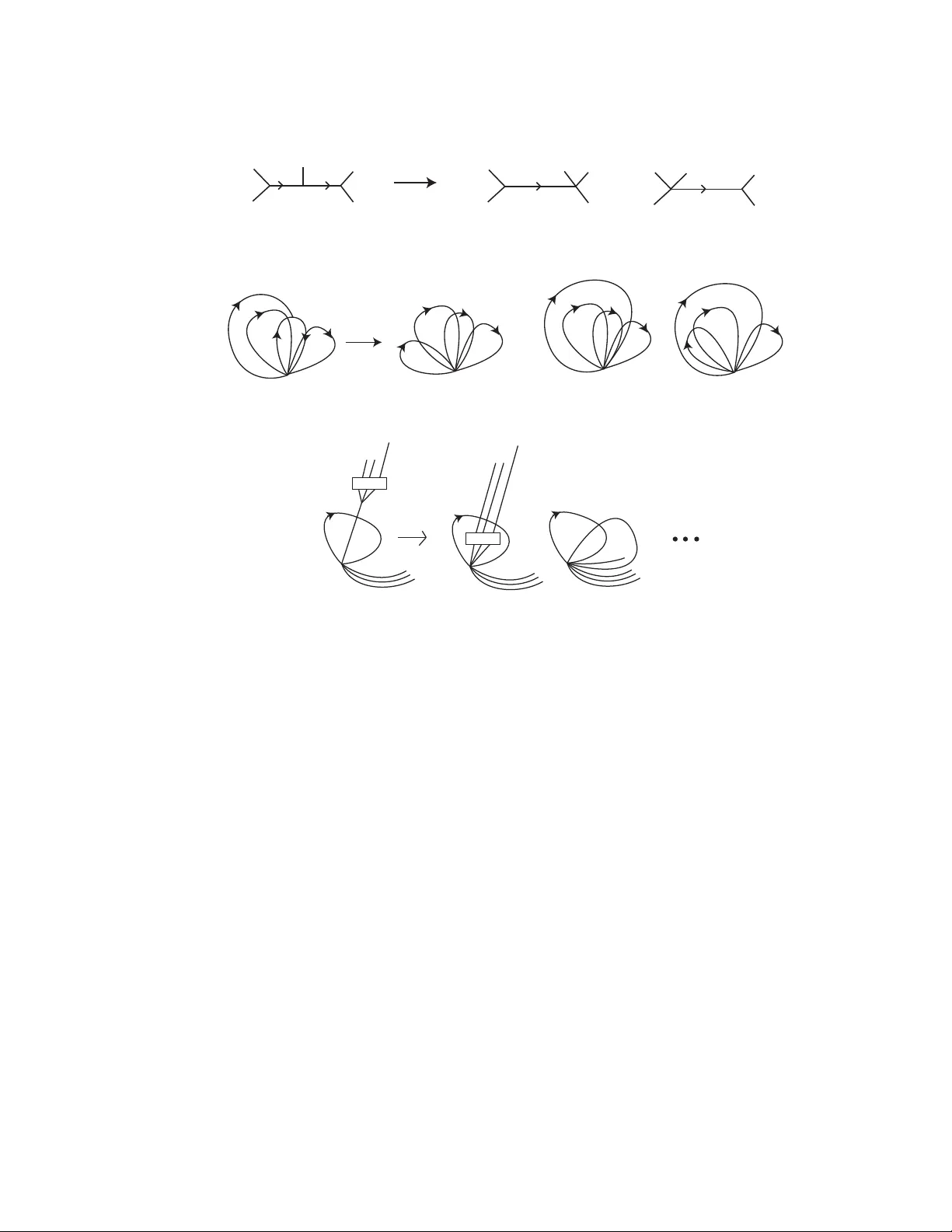
HAIR Y GRAPHS AND THE UNST ABLE HOMOLOGY OF Mo d( g , s ) , Out( F n ) AND Aut( F n ) JIM CONANT, MAR TIN KASSABO V, AND KAREN VOGTMANN Abstract. W e study a family of Lie algebras h O whic h are defined for cyclic op erads O . Using his graph homology theory , Kontsevic h iden tified the homology of tw o of these Lie algebras (corresp onding to the Lie and associative operads) with the cohomology of outer automorphism groups of free groups and mapping class groups of punctured surfaces, respectively . In this pap er we introduce a hairy gr aph homolo gy theory for O . W e sho w that the homology of h O embeds in hairy graph homology via a tr ac e map which generalizes the trace map defined by S. Morita. F or the Lie op erad w e use the trace map to find large new summands of the ab elianization of h O which are related to classical mo dular forms for SL 2 ( Z ). Using cusp forms we construct new cycles for the unstable homology of Out( F n ), and using Eisenstein series we find new cycles for Aut( F n ). F or the asso ciativ e operad we compute the first homology of the hairy graph complex b y adapting an argumen t of Morita, Sak asai and Suzuki, who determined the complete abelianization of h O in the asso ciativ e case. 1. Introduction A wide v ariet y of mathematical and ph ysical phenomena can be mo deled using trees and graphs, and it is not surprising that structures based on trees and graphs pla y an imp ortan t role in analyzing these phenomena. One such structure is the Lie algebra h V generated b y finite planar triv alent trees whose leav es are decorated with elemen ts of a symplectic v ector space V (see Section 2 for a precise definition of h V .) When one stabilizes by letting the dimension of V go to infinity , the resulting ob ject h ∞ is a fascinating and complicated Lie algebra, which arises naturally in sev eral areas of top ology and geometric group theory . These include the study of the Johnson filtration of the mapping class group of a surface [17, 23], finite-t ype inv ariants of 3-manifolds [4, 10, 20], and the homology of outer automorphism groups of free groups [5, 18, 19]. An imp ortan t first step in understanding h ∞ is to determine its abelianization. S. Morita [24] constructed a large ab elian quotien t of h V via his tr ac e map , which takes v alues in the p olynomial algebra k [ V ] . He conjectured that the image of the stabilized trace map is isomorphic to the en tire ab elianization of h ∞ [24, Conjecture 6.10]. How ever, in this pap er w e will show that the ab elianization is in fact quite a bit larger than this, with muc h ric her structure than anticipated. One use Morita made of his trace map was to construct a series of elemen ts of H ∗ ( h ∞ ), which he then identified with elements of H ∗ ( O ut ( F n )) using a theorem of M. Kon tsevic h [18, 19]. The new parts w e find of the abelianization of h ∞ allo w us to construct man y new homology classes for O ut ( F n ). 1 2 JIM CONANT, MAR TIN KASSABOV, AND KAREN VOGTMANN Morita’s trace can b e re-interpreted in terms of graphs, as was done in [6]; the natural target of the trace is then a vector space spanned by graphs consisting of one oriented cycle with some “hairs” attac hed, lab eled b y elemen ts of V . This p oin t of view leads to the cen tral construction of this pap er, which is an extension of the trace map to take into accoun t graphs of higher rank. The domain of this extension is the Chev alley-Eilen b erg c hain complex C • ( h V ), and the target is a “hairy graph” complex H V , spanned by orien ted graphs with lab eled hairs attac hed (see section 3). Our first main theorem is that after stabilization, this new trace map captures all of the ab elianization of h ∞ and in fact does ev en b etter, capturing the higher homology groups as w ell: Theorem 4.3L. T r : C • ( h V ) → H V is a chain map which induc es an inje ction on homolo gy H ∗ ( h ∞ ) → H ∗ ( H ∞ ) . The trace map is not surjective on homology , even after stabilization, but the image is large in a precise sense (Theorem 4.6), so the next task in determining the ab elianization of h ∞ is to analyze H 1 ( H V ). This breaks up as a direct sum according to the ranks r of the hairy graphs: H 1 ( H V ) = ∞ M i =0 H 1 ,r . It is easy to chec k that H 1 , 0 ∼ = V 3 V and H 1 , 1 ∼ = L ∞ k =0 S 2 k +1 ( V ), and to then confirm that this part is equal to the image of Morita’s original trace map. But higher-rank graphs also mak e large contributions to the ab elianization: Theorem 8.8. F or r ≥ 2 ther e is an isomorphism H 1 ,r ∼ = H 2 r − 3 (Out( F r ); k [ V ⊕ r ]) , wher e k [ V ⊕ r ] denotes the p olynomial algebr a gener ate d by V ⊕ r , and Out( F r ) acts on k [ V ⊕ r ] = k [ V ⊗ k r ] via the natur al GL( r, Z ) action on k r . These theorems together say that the ab elianization of h ∞ is a large subspace of a direct sum of certain t wisted cohomologies of Out( F r ). W e next sho w that the first new summand H 1 , 2 of H 1 ( H V ) can b e completely calculated using the Eichler-Shim ura isomorphism, whic h relates classical mo dular forms with twisted cohomology of SL 2 ( Z ). Theorem 8.10. L et s k denote the dimension of the sp ac e of classic al weight k cusp forms for SL 2 ( Z ) . Then H 1 , 2 ∼ = M k>` ≥ 0 ( S ( k,` ) V ) ⊕ λ k,` , wher e S ( k,` ) is the Schur functor for the p artition ( k, ) and λ k,` = 0 unless k + is even, in which c ase λ k,` = ( s k − ` +2 if is even s k − ` +2 + 1 if is o dd . HAIR Y GRAPHS AND THE UNST ABLE HOMOLOGY OF Mo d( g , s ) , Out( F n ) AND Aut( F n ) 3 Preliminary calculations indicate that H 1 , 3 is also highly nontrivial and the dimensions app ear related to mo dular forms, but w e will defer these calculations to another pap er. F or our main applications of Theorem 8.10 w e use the seminal w ork of M. Kon tsevich [18, 19], whic h relates the cohomology of h ∞ to the homology of outer automorphism groups of free groups. As Morita show ed, w edge pro ducts of elements of the ab elianization of h ∞ can b e pulled back to produce cocycles for h ∞ , whic h via Kon tsevic h’s theorem give rise to cycles in a chain complex for Out( F n ). It is remark able that in this wa y classes in the t wisted cohomology of Out( F 2 ) pro duce unt wisted rational homology classes for Out( F n ) for infinitely many v alues of n . F or example, we sho w how Theorem 8.10 allo ws us to pro duce cycles for Out( F n ) based on spaces of cusp forms: Theorem 10.4. Ther e is an emb e dding ^ 2 M 0 2 k ∗ → Z 4 k − 2 (Out( F 2 k +1 ); Q ) into cycles for Out( F 2 k +1 ) , wher e M 0 2 k is the ve ctor sp ac e of cusp forms for SL(2 , Z ) of weight 2 k . Using a v arian t of Kontsevic h’s metho d, Gray [13] has related the homology of Aut( F n ) to a certain twisted cohomology of h ∞ , and as another application of Theorem 8.10 we use his w ork to pro duce cycles based on Eisenstein series: Theorem 10.7. Ther e is a series of cycles e 4 k +3 ∈ Z 4 k +3 (Aut( F 2 k +3 ); Q ) which ar e r elate d to Eisenstein series. With the help of a computer we ha ve sho wn that the first t wo of these classes, e 7 and e 11 , represen t nontrivial homology classes. The class e 7 ∈ H 7 (Aut( F 5 ); Q ) coincides with a class found several years earlier b y F. Gerlits [11], by quite different metho ds. This class had not previously seemed to fit into the picture of classes coming from the ab elianization of h ∞ , but now does. In fact, at this p oint all kno wn rational homology classes for Aut( F n ) and Out( F n ), of whic h there are only a handful, arise from the ab elianization of h ∞ . The Lie algebra h V discussed ab ov e is actually just one example of a muc h more general construction. A labeled tree in h V can b e thought of as an element of the Lie op erad which has vectors lab eling its input/output slots. In a similar w a y one can define a Lie algebra h O V for any cyclic operad O (see Section 2). The graphical trace map T r is also defined in this generalit y , and tak es v alues in a hairy v ersion of O -graph homology (Sections 3 and 4). This O -graph homology theory HO V is similar to that defined in [5], except that the graphs are allo wed to hav e univ alen t vertices lab eled by vectors in V . This more general point of view is the one w e take throughout this pap er, and Theo- rem 4.3L is actually stated and pro ved as follows: Theorem 4.3. F or any cyclic op er ad O which is finite-dimensional in e ach de gr e e, T r ids a chain map which, after stabilization with r esp e ct to V , induc es an inje ction H ∗ ( h O ∞ ) → H ∗ ( HO ∞ ) . 4 JIM CONANT, MAR TIN KASSABOV, AND KAREN VOGTMANN F or the asso ciativ e op erad, Kontsevic h show ed that the homology of h O ∞ is related to the rational homology of the mapping class group [5, 18, 19]. In section 7.2 we adapt an argumen t of Morita, Sak asai and Suzuki [26] to compute the first homology group of the hairy O -graph complex in the case O = A ssoc . Their argument is part of their result that the ab elianization of h O ∞ is precisely equal to the piece determined by Morita in [25], and in Theorem 7.9 w e sho w how this also follo ws from the first homology computation together with injectivit y of the trace map. W e remark that the stable homology of b oth Mo d( g , s ) and Out( F n ) is w ell understo o d (see [9, 22]) but the unstable homology remains quite m ysterious, and all the classes we find in this pap er lie in the unstable range. Finally , in section 11 w e note that hairy Lie graph homology is related to the cohomology of mapping class groups of certain punctured 3-manifolds, as defined in [16]. Sp ecifically , let M n,s b e the compact 3-manifold obtained from the connected sum of n copies of S 1 × S 2 b y deleting the in teriors of s disjoint balls, and let Γ n,s b e the quotien t of the mapping class group of M n,s b y the normal subgroup generated b y Dehn twists along em b edded 2-spheres. Then hairy Lie graph homology is closely related to the cohomology of Γ n,s (Theorem 11.1). This pap er is the first in a series of tw o pap ers. In this pap er we ha ve concen trated on the theory needed to understand the abelianization of h O and applications to the homology of mapping class groups and automorphism groups of free groups. In the sequel w e will obtain a precise description of the image of the trace map and show that the Sp-mo dule decomp osition of the image corresp onds exactly to the GL-mo dule decomp osition of hairy graph homology . W e will also sho w ho w to use higher hairy graph homology to produce classes in the cohomology of h O , yielding ev en more p otential unstable homology classes for Aut( F n ), Out( F n ) and Mo d( g , s ). Finally , w e will explain connections b etw een hairy graph homology and Getzler and Kaprano v’s theory of mo dular operads, and also with Lo da y’s dihedral homology . Ac knowledgemen ts: The authors wish to thank F rancois Brunault for lo cating the ref- erence [14], Shigeyuki Morita for p oin ting out an error in an earlier version of Lemma 10.3 and the referee for sev eral very useful commen ts. Jonathan Gray w as instrumental in the calculation that e 11 6 = 0 in Theorem 10.7. The first author thanks Naoy a Enomoto for answ ering a relev ant MathOverflo w p ost. The first author w as supp orted by NSF gran t DMS-0604351, the second author w as supp orted b y NSF gran t DMS-0900932 and the third author w as supp orted by NSF grant DMS-1011857. 2. Review of the Lie algebra associa ted to a cyclic operad and its (co)homology All vector spaces in this paper will b e o ver a fixed field k of c haracteristic 0 and ha v e either finite or coun table dimension. In this section, w e also fix a cyclic op erad O in the category of k -v ector spaces. Let O (( m )) denote the v ector space spanned by op erad elemen ts with m input/output slots (an y one of which can serv e as the output for the other ( m − 1) inputs). By definition the symmetric group Σ m acts on O (( m )). W e will assume HAIR Y GRAPHS AND THE UNST ABLE HOMOLOGY OF Mo d( g , s ) , Out( F n ) AND Aut( F n ) 5 that the v ector spaces O (( m )) are finite-dimensional for eac h m , and we fix a basis for eac h O (( m )). 2.1. The Lie algebra L V = LO V . W e recall from [5] ho w to construct a Lie algebra from O and a symplectic vector space ( V , ω ). It will often b e con venien t to sp ecify a symplectic basis B for V . Our main example will b e the 2 n -dimensional vector space V n with the standard symplectic form and basis B n = { p 1 , . . . , p n , q 1 , . . . , q n } , i.e. the matrix of ω in the basis B n is 0 I − I 0 . W e will also often consider the direct limit V ∞ of the V n with resp ect to the natural inclusion, w ith basis B ∞ . F or x ∈ B ∞ the dual x ∗ is given b y p ∗ i = q i and q ∗ i = − p i . Definition 2.1. An O -spider is an op er ad element whose input/output slots λ (c al le d le gs) ar e e ach de c or ate d with an element x λ ∈ V . If the op er ad element is a b asis element of O and the lab els ar e in B , the spider is c al le d a basic O -spider . The Lie algebra LO V is generated (as a vector space) b y O -spiders; in particular the basic spiders generate LO V . Unless we need to sp ecify the op erad we will denote LO V simply b y L V , and LO V n b y L n . There is a v ery useful grading on L V giv en as follows: Definition 2.2. The degree of an O -spider is the numb er of le gs minus 2. W e denote b y L V [ [ d ] ] the subspace of L V generated b y spiders of degree d . More formally , w e hav e L V [ [ d ] ] ∼ = O (( d + 2)) ⊗ Σ d +2 V ⊗ ( d +2) and L V = M d ≥ 0 L V [ [ d ] ] . Tw o spiders s 1 and s 2 can b e fuse d into a single spider by using a leg λ 1 from the first as output and a leg λ 2 of the second as input and p erforming op erad comp osition. The un used legs retain their lab els, and the resulting O -spider is mu ltiplied by the symplectic pairing ω ( x λ 1 , x λ 2 ) of the lab els. W e denote the end result of this b y ( s 1 · s 2 ) ( λ 1 ,λ 2 ) . Note that if eac h s i is a basic spider, the co efficien t of the result is either 0 or ± 1. W e now define [ s 1 , s 2 ] = X e ∈ L 1 × L 2 ( s 1 · s 2 ) e where L i is the set of legs of s i . This brac ket gives L V the structure of a Lie algebra: an tisymmetry of the brac ket follows from antisymmetry of the symplectic form and the Jacobi iden tity is a consequence of asso ciativity of comp osition in the op erad. 6 JIM CONANT, MAR TIN KASSABOV, AND KAREN VOGTMANN 2.2. The symplectic action. Note that the degree of spiders is additiv e under brack et. In particular, spiders of degree 0 based on the identit y element of the op erad O generate a Lie subalgebra of L V , and spiders of p ositive degree generate another Lie subalgebra, denoted h O V , or simply h V if the op erad is understoo d. The subalgebra generated by degree 0 spiders based on the iden tit y element is isomorphic to sp V , and it acts on L V via the adjoint action, preserving degree. In particular, the action of sp V restricts to an action on h V . The symplectic group Sp V also acts on L V (and on h V ) by acting on the leg-lab els. The elemen ts of L V whic h are fixed b y the Sp V -action are precisely those that are killed by the sp V action. These are called the invariants of the action. The natural inclusion V n → V n +1 induces an inclusion h n → h n +1 , and stabilizing as n → ∞ one obtains h ∞ = lim − → h n . W e will be principally concerned with the homology of the positive degree subalgebra h ∞ of L ∞ since in the cases O = A ssoc and O = L ie it is the (primitive part of the symplectic inv arian ts of ) this homology which computes the cohomology of Out( F n ) and mapping class groups. 2.3. Chev alley-Eilen b erg differential. The Lie algebra homology of h V with trivial co efficien ts in k is computed using the exterior algebra V h V and the Chev alley-Eilen b erg differen tial ∂ Lie ( s 1 ∧ . . . ∧ s k ) = X i n , and apply this isomorphism to the lab els of β d,n ( z ) whic h are in W d . The result is still a cycle ˜ β d,n ( z ) but is now in V h ∞ . W e claim that the image of this cycle under T r ◦ p is equal to z . Since the symplectic pro duct is zero on the lab els of z , exp( − T )( z ) = z , so β d,n ( z ) = α d,n ( z ). Now α d,n ( z ) is obtained b y breaking all edges of graphs in z and labeling the resulting legs b y labels in W d . In ˜ β d,n ( z ) the lab els in W d are replaced b y labels in V ∞ . W e no w apply T r = exp( T ) ι to ˜ β d,n ( z ). The only matc hings of ι ˜ β d,n ( z ) which give non- zero terms when we apply exp( T ) are those which originally came from edges of z . The pro jection p then kills all terms of T r( ˜ β d,n ( z )) except the term which rematches all of the edges of z . In other w ords, p (T r( ˜ β d,n ( z )) = z . Since ev ery cycle is in the image of p ◦ T r, the induced map on homology is surjectiv e. Since H ∗ ( H + ∞ ) generates H ∗ ( H ∞ ) as a GL( V ∞ )-mo dule, Theorem 4.6 shows that the image of T r ∗ is at least large. In the sequel to this pap er, we will show that the Sp-mo dule decomp osition of the image of T r ∗ corresp onds exactly to the GL-decomp osition of H ∞ . HAIR Y GRAPHS AND THE UNST ABLE HOMOLOGY OF Mo d( g , s ) , Out( F n ) AND Aut( F n ) 15 5. Schur functors and the image of T r ∗ W e ha ve defined sev eral functors from the category of v ector spaces to itself. By clas- sical represen tation theory any such functor can b e decomp osed as a direct sum of Schur functors S λ indexed b y partitions λ . The S λ V are called Weyl mo dules ; they are non trivial irreducible representations of GL( V ) if the dimension of V is sufficiently large. The mo d- ule S λ V can b e defined using the irreducible represen tation P λ of the symmetric group Σ n corresp onding to the partition λ via S λ V = P λ ⊗ Σ n V ⊗ n , where the symmetric group acts on the tensor pow er V ⊗ n b y p erm uting the factors. If λ = ( k ) is the trivial partition of k , then S λ V is the k -th symmetric p ow er S k V , and if λ = (1 , 1 , . . . , 1) then S λ V is the k -th exterior p o wer V k V . If dim( V ) = n and λ = ( m, k − m ), then dim S ( m,k − m ) ( V ) = 2 m − k + 1 m + 1 n − 2 + ( k − m ) k − m n + m − 1 m . In general if λ is a partition of k , then S λ V is the image of the action of the Y oung symmetrizer c λ ∈ k [Σ k ] on V ⊗ k (see, e.g. [8]). If the vector space V has a symplectic structure then S λ V is also a representation of Sp( V ), but is not necessarily an irreducible represen tation. It do es hav e a large irreducible comp onen t denoted by S h λ i V . If V + is any Lagrangian subspace of V , then S h λ i V is generated as an Sp( V )-mo dule by S λ V + , pro vided that the dimension of V is large. Applying this to the functor giving the degree d comp onen t of H ∗ ( H V ), w e decomp ose H ∗ ( H V [ [ d ] ]) = M ( S λ V ) ⊕ m d,λ and Sp( V ) · H ∗ ( H V + [ [ d ] ]) = M ( S h λ i V ) ⊕ m d,λ W e will show in [3] that in fact Sp( V ) · H ∗ ( H V + [ [ d ] ]) coincides with im T r ∗ . 6. H 1 ( H ) and h ab for th e commut a tive operad Recall that the commut ative op erad C om (( n )) = k for all n ≥ 2, with all comp ositions induced b y multiplication in k . In this case all of the constructions w e ha ve given are very simple, esp ecially in dimension 1. W e go through them here as a w arm-up exercise. 6.1. The commutativ e Lie algebra. Basic commutativ e spiders can b e though t of as star graphs, i.e. connected graphs with one central vertex and all other vertices univ alent, lab eled b y basis elemen ts of V . Two spiders are fused b y identifying a leg of one spider with a leg of the other, then collapsing this leg and m ultiplying the result b y the symplectic pro duct of the leg lab els. In terms of Sc hur functors, for all d , the functor V LC om V [ [ d ] ] is simply LC om V [ [ d ] ] ∼ = S ( d +2) V ∼ = S d +2 V , where this is an isomorphism of GL( V )-mo dules. 16 JIM CONANT, MAR TIN KASSABOV, AND KAREN VOGTMANN 6.2. Comm utative hairy graph homology in dimension 1. A hairy graph is just a finite graph with no biv alent vertices, whose univ alent vertices are lab eled b y elements of V . Since there are no hairy graphs with 0 vertices C 0 H = 0 and the first homology of H is the quotien t of C 1 H by the image of ∂ H : C 2 H → C 1 H . The generators of C 1 H are hairy graphs G with one v ertex. If this vertex v has v alence at least 4, then the half-edges at v can b e partitioned in to tw o sets, each of size at least 2, such that no oriented edge has its half-edges in differen t pieces of the partition. W e can use this partition to blow up v in to an oriented edge e in a new hairy graph G 0 ; then the b oundary map just collapses e , and ∂ H G 0 = G . If v has v alence 3, then G cannot b e in the image of ∂ H b ecase ∂ H preserv es degree, and there are no graphs in C 2 H of degree 1. Therefore H 1 ( H ) is generated b y trip o ds and lo ops with one hair, but the lo ops with one hair ha ve an orien tation-reversing automorphism, so are zero. The lab els on the hairs of the trip o d give an isomorphism H 1 ( H ) ∼ = H 1 ( H )[ [1] ] ∼ = S 3 V = S (3) V . 6.3. The ab elianization of h . By the previous paragraph, w e need only consider spiders of degree 1. The trace of a basic degree 1 spider in h is either a trip o d (if all symplectic pairings on its lab els are 0), a trip o d plus a graph with one lo op and one hair (if there is one non-zero pairing), or a tripo d plus t wice a one-loop, one-hair graph (if there are tw o non-zero pairings). Thus the image of the trace map is isomorphic to one copy of S 3 V : h ab ∼ = im(T r ∗ ) ∼ = S 3 V = S h 3 i V . 7. H 1 ( H ) and h ab for th e associa tive operad F or the asso ciativ e op erad, A ssoc (( n )) is the k -v ector space with basis giv en b y all cyclic orders of { 1 , . . . n } . Compositions are induced b y amalgamating t w o cyclic orders consisten tly into one. The computations of H 1 ( H ) and h ab are more subtle than in the commutativ e case, but the basic plan is the same: we first compute the hairy graph homology H 1 ( H ) then compute the ab elianization h ab b y determining its image under T r ∗ in H 1 ( H ). The computation illustrates the p ow er of the trace map T r ∗ , allowing us to show that the abelianization is mostly trivial with relativ e ease. The ab elianization has one piece in degree 1 and one piece in degree 2 (computed by Morita [25]) but v anishes for all higher degrees. W e remark that in Morita’s pap er [25], the Lie algebra h is denoted b y a + . 7.1. The asso ciativ e Lie algebra. Basic asso ciative spiders are now planar star graphs, i.e. connected planar trees with one cen tral vertex and all other vertices univ alent and lab eled b y elements of V . The planar embedding can b e thought of as a cyclic ordering on the edges. Tw o A ssoc -spiders are fused b y iden tifying t wo univ alen t v ertices, collapsing the adjacen t edges and then multiplying the result b y the symplectic pro duct of the asso ciated lab els. F or all d we ha ve LA ssoc V [ [ d ] ] ∼ = [ V ⊗ d +2 ] Z d +2 , the quotient of V ⊗ d +2 b y the cyclic action which p ermutes the factors. In terms of Sc hur functors, for small d this decomp oses as • LA ssoc V [ [0] ] ∼ = S (2) V HAIR Y GRAPHS AND THE UNST ABLE HOMOLOGY OF Mo d( g , s ) , Out( F n ) AND Aut( F n ) 17 ∂ H Figure 2. Degree 1 graphs with planar cut v ertices are null-homologous. • LA ssoc V [ [1] ] ∼ = S (3) V ⊕ S (1 , 1 , 1) V • LA ssoc V [ [2] ] ∼ = S (4) V ⊕ S (2 , 2) V ⊕ S (2 , 1 , 1) V • LA ssoc V [ [3] ] ∼ = S (5) V ⊕ S (3 , 2) V ⊕ 2 S (3 , 1 , 1) V ⊕ S (2 , 2 , 1) V ⊕ S (1 , 1 , 1 , 1 , 1) V 7.2. Asso ciativ e hairy graph homology in dimension 1. The 1-c hains C 1 H are gen- erated b y basic hairy graphs G with one vertex v . The half-edges at v are cyclically ordered, and some of them ma y b e joined in pairs b y oriented edges e . Definition 7.1. The c entr al vertex v of G is a planar cut vertex if the half-e dges adjac ent to v c an b e p artitione d into two c ontiguous sets, e ach with at le ast two elements, so that every oriente d e dge has b oth of its half-e dges in the same pie c e of the p artition. F or example, if G is not a trip o d and G has tw o adjacen t hairs at v , then v is a planar cut v ertex. The boundary map on C 1 H is zero, so all elemen ts are cycles, and the first homology of H is the quotient of C 1 H b y the image of the b oundary op erator ∂ H : C 2 H → C 1 H . W e b egin with some observ ations ab out the image of this map. Lemma 7.2. L et G b e a gener ator of C 1 H , with c entr al vertex v . If v is a planar cut vertex, then G is in the image of ∂ H Pr o of. Since v is a planar cut vertex it can b e blown up in to a separating edge in a new A ssoc -graph G 0 . Then G = ∂ H ( G 0 ) (see Figure 2). Lemma 7.3. L et G b e a gener ator of C 1 H . If G 0 is obtaine d fr om G by sliding a hair at one end of an oriente d e dge of G along the e dge to the other end, then G 0 is homolo gous to G . Pr o of. Midw ay through the slide we ha ve a 2-v ertex O -graph with tw o oriented edges b et ween its vertices, whose b oundary is the difference of the original O -graph and the O graph obtained by sliding (see Figure 3). Thus mo dulo b oundaries, the tw o O -graphs are the same. W e denote the half-edges of an oriented edge e by e − and e + . Definition 7.4. Two oriente d e dges e and f cross if e − and e + sep ar ate f − and f + in the cyclic or dering. 18 JIM CONANT, MAR TIN KASSABOV, AND KAREN VOGTMANN v 1 ∂ H v 1 v 1 - Figure 3. Sliding a hair ov er an edge b a e a e b a eb + a b - eb - + - b + ∂ H e Figure 4. ∂ H ( G 0 ) = G + G e y b + 0 X X + ∂ H + e e e Figure 5. Clearing X from the interior of e Lemma 7.5. L et G b e a gener ator of C 1 H , and a an oriente d e dge of G . If a is cr osse d by exactly two oriente d e dges e and b , and if e cr osses no other oriente d e dges, then G is homolo gous to the gr aph G e y b obtaine d by sliding e acr oss b . Pr o of. Midw ay through the slide w e hav e a 2-v ertex O -graph G 0 with three oriented edges at one of its vertices. The original graph G is one term of ∂ H ( G ). The second term is the result of the slide. The third term, obtained b y contracting e , has a planar cut vertex, so is zero in homology (see Figure 4). Lemma 7.6. L et G b e a gener ator of C 1 H , let e b e an oriente d e dge of G , and let X b e a set of c ontiguous half-e dges b etwe en e + and e − which ar e not al l hairs. Then G is homolo gous to a sum of gr aphs which e ach have only one half-e dge in plac e of X . Pr o of. F orm a graph G 0 b y collecting all of the half-edges in X at a single second vertex and then joining the tw o vertices b y an orien ted edge e . Then G is one term of the b oundary of G 0 . The other terms all hav e only one half-edge in place of X (see Figure 5). Theorem 7.7. F or O = A ssoc , H 1 ( H )[ [1] ] is gener ate d by trip o ds and lo ops with one hair, H 1 ( H )[ [2] ] is gener ate d by lo ops with two hairs on opp osite sides of the lo op, and HAIR Y GRAPHS AND THE UNST ABLE HOMOLOGY OF Mo d( g , s ) , Out( F n ) AND Aut( F n ) 19 H 1 ( H )[ [ d ] ] = 0 for d > 2 . As GL( V ) -mo dules, we have H 1 ( H )[ [1] ] ∼ = S (3) V ⊕ S (1 , 1 , 1) V ⊕ V and H 1 ( H )[ [2] ] ∼ = S (1 , 1) V . Pr o of. This pro of is an adaptation of the pro of in [26] to our con text. Let G b e a generator of C 1 H , i.e. a basic hairy graph with one v ertex. W e may assume the cen tral vertex v is not a planar cut vertex, by Lemma 7.2 . The cyclic orderings at the v ertices of an O -graph G give G a ribb on graph structure, so that G can b e “fattened” to an orien ted surface with boundary , where w e think of the hairs as attached to the b oundary . If t wo hairs are attached to a single b oundary comp onen t, then unless G is a trip o d, the hairs can b e slid using Lemma 7.3 to b e adjacent, so that G is a b oundary b y Lemma 7.2. Thus, we may assume that G has at most one hair attached to eac h b oundary comp onent. If G has no oriented edges, then G must b e a trip o d, by Lemma 7.2. If G has one orien ted edge, then G is either a lo op with one hair or a lo op with t wo hairs, on opp osite sides of the lo op. If G has one hair it cannot b e the boundary of an ything since the v e rtex is triv alent, so G represents a non-trivial element of H 1 ( H ). If G has tw o hairs, then it also represents a non trivial homology class. F or if G = ∂ H G 0 , then G 0 w ould ha ve to con tain a graph which expands the 4-v alent vertex of G in to an edge. There is one suc h graph up to isomorphism, and it has trivial b oundary . Thus ∂ H G 0 6 = G . . If G has t wo orien ted edges, then since v is not a planar cut v ertex the surface m ust b e genus 1 with one b oundary comp onent and at most one hair. The half-edges at v are e − 1 e − 2 e + 1 e + 2 ( h ), where h is the (p ossible) hair. If there is no hair, the automorphism whic h cyclically p erm utes these half-edges e − 1 → e − 2 → e + 1 → e + 2 → e − 1 rev erses orien tation, so G is zero in C 1 H (see [2], pro of of Prop osition 2). If there is a hair, then using Lemma 7.3 the hair can b e slid across an edge to pro duce a homologous graph G 0 with the opp osite orien tation, showing that G = 0 in homology . No w supp ose G has at least 3 oriented edges. W e may assume they are all oriented in the same direction, say clo c kwise. Fix one orien ted edge e 0 and let X 0 b e the set of hairs and half-edges b etw een e − 0 and e + 0 . Note that X 0 cannot consist only of hairs, since then v w ould b e a planar cut vertex. Using Lemma 7.6, we see that G is homologous to a sum of hairy graphs G 0 , each with only one half-edge b etw een e − 0 and e + 0 ; we lab el this half-edge e − 1 . F or each G 0 , let X 1 b e the set of hairs and half-edges b etw een e − 1 and e + 1 other than e + 0 . Again note that X 1 cannot consist solely of hairs, since then v w ould b e a planar cut v ertex. Applying Lemma 7.6 again, w e see that G 0 is homologous to a sum of graphs with only e + 0 and one other half-edge, whic h we lab el e − 2 , b et ween e − 1 and e + 1 . W e con tin ue in this fashion un til w e run out of oriented edges. The last orien ted edge e k ma y hav e a single hair b etw een e + k − 1 and e + k and/or another after e + k . Th us our original graph G is homologous to a sum of graphs G 0 , eac h with oriented edges e 0 , . . . , e k ; the cyclic ordering on the half-edges is e − 0 e 1 − e + 0 e − 2 e + 1 . . . e − k e + k − 1 ( h 1 ) e + k ( h 2 ) , where the h i are p ossible hairs (See Figure 6 for the case with no hairs.) 20 JIM CONANT, MAR TIN KASSABOV, AND KAREN VOGTMANN e 0 e 4 e 3 e 2 e 1 e k-1 e k Figure 6. Standard form for generator of C 1 H . Using Lemma 7.5, in each G 0 w e ma y now slide e + 0 successiv ely o ver e 2 , e 4 , . . . , e 2[ k/ 2] to obtain a homologous graph G 00 . If k is ev en, then in G 00 the t wo half-edges of e 0 are adjacen t (possibly with a hair betw een), i.e. the vertex of G 00 is a planar cut vertex so G 00 is a b oundary . If k + 1 is o dd, then (after sliding the one p ossible hair around) G 00 is isomorphic to G 0 with the orientation on e k rev ersed , i.e. G 0 is homologous to − G 0 so is zero. The non-trivial classes which are represen ted by lo ops with 2 hairs form a copy of V 2 V . The an tisymmetry comes from the in volution whic h rotates the 4-v alen t vertex to exc hange the hairs, switching the edge orientation in the pro cess. The classes represented b y trip o ds corresp ond naturally to V ⊗ 3 mo dulo the cyclic action of Z 3 . The graph with one lo op and one hair gives a copy of V . Thus w e hav e shown H 1 ( H ) ∼ = ( V ⊗ 3 ) Z 3 ⊕ V ⊕ V 2 V , with the first t wo summands in degree 1 and the second in degree 2. R emark 7.8 . Let H ( g ,s ) b e the part of the hairy graph complex spanned b y hairy graphs that thic ken to a surface of gen us g with s ≥ 1 boundary comp onen ts. Let H 0 ( g ,s ) ⊂ H ( g ,s ) b e the sub complex of graphs without hairs. This is the standard ribb on graph complex which computes the cohomology of Mod( g , s ); in particular, H 1 ( H 0 ( g ,s ) ) ∼ = H 4 g +2 s − 5 (Mo d( g , s ); k ) (see [5], Section 4). Since graphs in H 0 ( g ,s ) ha ve degree d = 4 g + 2 s − 4, Theorem 7.7 giv es a purely graph homological pro of that H ∗ (Mo d( g , s ); k ) v anishes in its v cd for s ≥ 1 , 2 g + s − 2 > 1 . In fact, for this same range, one can sho w using the techniques of section 8 that H 1 ( H ( g ,s ) ) ∼ = H 4 g +2 s − 5 (Mo d( g , s ); ( k ⊕ V ) ⊗ s ), where the Mo d( g , s ) action on ( k ⊕ V ) ⊗ s factors through the epimorphism on to the symmetric group Mo d( g , s ) Σ s . Theorem 7.7 therefore also implies the v anishing of the cohomology of Mo d( g , s ) in its vcd with co efficien ts in any Σ s -mo dule. 7.3. The ab elianization of h . In [26], Morita, Sak asai and Suzuki compute the ab elian- ization of h . In this section w e p oint out how this follo ws from the computation of H 1 ( H ) and injectivit y of the trace map. HAIR Y GRAPHS AND THE UNST ABLE HOMOLOGY OF Mo d( g , s ) , Out( F n ) AND Aut( F n ) 21 Theorem 7.9. [26] F or O = A ssoc , h ab ∼ = [ V ⊗ 3 ] Z 3 ⊕ ^ 2 V / k ( ω 0 ) = S h 3 i V ⊕ S h 1 , 1 , 1 i V ⊕ S h 1 , 1 i V ⊕ S h 1 i V , wher e ω 0 = P i p i ∧ q i . Pr o of. The map T r ∗ is injectiv e, so to determine h ab it suffices to calculate the image T r ∗ ( h ab ) in H 1 ( H ). The trace map preserv es degree, so w e do this for degree 1 and 2 separately . The degree 1 part of h consists of spiders with three legs, and all of these represen t non trivial elemen ts of the ab elianization, since ev erything in the image of the brack et has at least four legs. Thus the degree 1 part of h ab is isomorphic to [ V ⊗ 3 ] Z 3 . The degree 2 part of h contains 4-legged spiders with lab els a, p N , b, q N arranged cycli- cally , where ω ( p N , q N ) = 1 is the only non-zero pairing. On the lev el of homology , the trace of suc h a spider is equal to the lo op with tw o hairs (representing a ∧ b ), since the other term (the spider b y itself ) is null-homologous. Th us the entire k ernel of ω : V 2 V → k is in the image of T r ∗ , and w e hav e im(T r ∗ ) ⊃ k er( ω ) ∼ = ^ 2 V / k ( ω 0 ) . The fact that the image cannot b e an y larger can be argued by hand or by app ealing to Morita’s calculation of the degree 2 piece. In [26] Morita, Sak asai and Suzuki com bined their results with Kon tsevich’s theorem to pro ve that the cohomology of mapping class groups v anishes in their virtual cohomological dimension. 8. H 1 ( H ) f or the Lie operad The Lie op erad has L ie (( n )) spanned b y planar uni-triv alen t trees with n leav es distinctly lab eled b y { 0 , . . . , n − 1 } , modulo the Jacobi identit y (IHX relation) and an tisymmetry relations. Comp osition is induced by joining tw o trees at univ alent vertices. 8.1. The Lie Lie algebra. W e can represen t a basic Lie spider by dra wing a planar unitriv alent tree and lab eling its lea v es with basis elemen ts v ∈ B . Tw o Lie spiders are fused by joining a leg of the first spider to a leg of the second and multiplying the result b y the symplectic product of the asso ciated leg labels. In terms of Sch ur functors, for small v alues of d we hav e • LL ie V [ [0] ] ∼ = S (2) V • LL ie V [ [1] ] ∼ = S (1 , 1 , 1) V • LL ie V [ [2] ] ∼ = S (2 , 2) V • LL ie V [ [3] ] ∼ = S (3 , 1 , 1) V • LL ie V [ [4] ] ∼ = S (4 , 2) V ⊕ S (3 , 1 , 1 , 1) V ⊕ S (2 , 2 , 2) V 22 JIM CONANT, MAR TIN KASSABOV, AND KAREN VOGTMANN v 1 v 5 v 4 v 3 v 2 1 2 3 Figure 7. A hairy Lie graph with rank 2 and degree 4 + 1 + 2 = 7 8.2. Hairy Lie graph homology in dimension 1. A hairy Lie graph is represented by an ordered disjoin t union of Lie spiders, with some leav es unlab eled and joined by orien ted edges. See Figure 7. In [5] Section 3.1, it w as sho wn that the Lie graph complex is isomorphic to the “forested graph complex” which has significantly simpler orientation data. In the presence of hairs, this isomorphism do es not quite go through, but one can still simplify the description of a hairy Lie graph slightly . In the hairy Lie graph of Figure 7, this can b e done b y removing the grey o v als and noticing that they could b e reco vered as a neigh b orho o d of the subgraph spanned by all vertices and unoriented edges. Thus, a hairy Lie graph ma y b e represented b y a uni-triv alent graph whose univ alent v ertices are labeled b y vectors in v and some of whose in ternal edges are oriented, with the prop erty that the subgraph G u spanned b y the unoriented edges is a forest con taining all of the vertices of G . Orientation data consists of ordering the components of the forest, and sp ecifying a cyclic ordering of the half edges incident to each triv alent vertex. The central edge in an IHX relation must b e an unorien ted edge. The 1-chains C 1 H are generated b y hairy graphs G suc h that the subgraph G u spanned b y unoriented edges is a (maximal) tree. The first homology of H is the quotient of C 1 H by the image of the b oundary op erator ∂ H : C 2 H → C 1 H . As in the asso ciative case, w e b egin with some observ ations about the image of ∂ H . Lemma 8.1. L et G b e a Lie gr aph in C 1 H . If some unoriente d e dge sep ar ates G into two non-trivial c omp onents, then G is in the image of ∂ H . Pr o of. Supp ose an edge e ∈ G u separates G into tw o non-trivial comp onents, i.e. com- p onen ts whic h are not a single v ertex. In the Lie graph H obtained b y orien ting e , the unorien ted subgraph H u has t w o comp onents, and all orien ted edges other than e hav e HAIR Y GRAPHS AND THE UNST ABLE HOMOLOGY OF Mo d( g , s ) , Out( F n ) AND Aut( F n ) 23 ∂ H v 1 v 2 v 3 = v 1 v 2 v 3 Figure 8. Attac hed unoriented tree b oth ends in one or the other of these components. Th us, all terms of ∂ H ( H ) are zero except for H e = ± G . In particular, if there is an unoriented tree attached to the rest of G at a single vertex, then G is in the image of ∂ H (see Figure 8). Th us, a generator of C 1 H may b e though t of as a connected graph G with orientations on the edges in the complemen t of some maximal tree T ⊂ G , and with single edges (called hairs ) attached to some of the edges of G . Lemma 8.2. If G is a Lie gr aph in C 1 H , then hairs attache d to the same unoriente d e dge of G may b e p ermute d mo dulo im ∂ H . Pr o of. This is a consequence of Lemma 8.1 and the IHX relation - + = 0 v w w v v w . Lemma 8.3. If G is a Lie gr aph in C 1 H , then the hairy Lie gr aph obtaine d by moving a hair to the other end of an oriente d e dge is e qual to G mo dulo im ∂ H . Pr o of. Notice that ∂ H v 1 = v 1 − v 1 Recall that the r ank of a hairy graph is its first Betti n umber. Since the b oundary op erator ∂ H preserv es rank, the chains C k H decomp ose into sub complexes C k H = M r C k,r H , where C k,r H is spanned b y connected hairy graphs of rank r . On the lev el of homology this giv es H k ( H ) = M r ≥ 0 H k,r ( H ) , 24 JIM CONANT, MAR TIN KASSABOV, AND KAREN VOGTMANN = (-1) 4 = = Figure 9. Orientation-rev ersing automorphism where H k,r ( H ) = H k ( C ∗ ,r H ). The next three prop ositions giv e elementary calculations of H 1 ,r for r ≤ 2. In the follo wing sections w e identify H 1 ,r for all r ≥ 2 with a certain t wisted cohomology of Out( F r ) and then calculate this t wisted homology for r = 2 in terms of mo dular forms. Prop osition 8.4. F or O = L ie the r ank zer o p art of H 1 ( H ) is H 1 , 0 ( H ) ∼ = V 3 V = S (1 , 1 , 1) V . Pr o of. A rank 0 Lie graph has no orien ted edges, so is a union of trees; since we are only lo oking at C 1 H there is only one tree. If this tree has more than 3 leav es then it is in the image of ∂ H . A tripo d, on the other hand, cannot b e in the image of ∂ H , so H 1 , 0 ( H ) is spanned b y trip o ds. If w e choose an ordering for the lab els of each tripo d, the map sending the lab els to their w edge pro duct is an isomorphism H 1 , 0 → V 3 V . Prop osition 8.5. F or O = L ie the r ank one p art of H 1 ( H ) is H 1 , 1 ( H ) ∼ = M k ≥ 0 S 2 k +1 V = M k ≥ 0 S (2 k +1) V . Pr o of. Define a map φ : C 1 , 1 H → M k ≥ 0 S 2 k +1 V b y setting φ ( G ) = 0 unless G is a single orien ted loop with hairs attac hed. F or such G , define φ ( G ) to b e the product of the lab els on its hairs. Note that the n umber of hairs m ust b e o dd, since otherwise G has an orientation rev ersing automorphism (see Figure 9), giving G = − G , i.e. G = 0 in H . The map φ is clearly surjectiv e, and we claim it induces an isomorphism on homology , i.e. that ker( φ ) = im( ∂ H ). An y graph which is not a hairy lo op is in im( ∂ H ) by Lemma 8.1 and φ is injectiv e on hairy lo ops, so k er( φ ) ⊆ im( ∂ H ). T o see the opp osite inclusion, let H b e a generator of C 2 , 1 H . Then H is represen ted b y t wo triv alent planar trees joined by one orien ted edge which connects them, plus another orien ted edge. If the second orien ted edge has b oth ends in one tree, then ∂ H ( H ) consists of one graph with a separating unorien ted edge, and φ ( ∂ H ( H )) = 0 . If the second oriented edge also joins the t wo trees, then ∂ H ( H ) has t wo terms, each an orien ted lo op with trees attached. By Lemma 8.2, they are actually the same graph mo dulo b oundaries. How ev er, the signs are opp osite, so ∂ H ( H ) = 0 . HAIR Y GRAPHS AND THE UNST ABLE HOMOLOGY OF Mo d( g , s ) , Out( F n ) AND Aut( F n ) 25 0 x y x y x y x y x y 0 0 Figure 10. IHX relation on hairy theta graph W e remark that it is not difficult to sho w that T r ∗ maps onto M k ≥ 1 S 2 k +1 V ⊂ H 1 , 1 ( H ), whic h recov ers the part of ab elianization constructed by Morita in [24]. Prop osition 8.6. F or O = L ie, H 1 , 2 ( H ) is isomorphic to the subsp ac e of the p olynomial ring k [ V ⊕ V ] char acterize d by the c onditions: (1) f ( x, y ) = f ( y , x ) ; (2) f ( x, y ) = − f ( − x, y ) ; (3) f ( x, y ) + f ( y , − x − y ) + f ( − x − y , x ) = 0 . Pr o of. The chain group C 1 , 2 ( H ) is generated by rank 2 triv alent graphs G with hairs attac hed. A maximal tree (in this case a single edge) is sp ecified, and the other edges are orien ted. T o calculate H 1 , 2 ( H ) we need to account for the relations in C 1 , 2 ( H ) arising from IHX and an tisymmetry and calculate the image of ∂ H ( C 2 , 2 ( H )). There are only tw o triv alent graphs in rank 2: the theta graph and the eyeglass graph, so C 1 , 2 decomp oses as T r i ⊕ Gl a , where T r i is generated by theta graphs and Gl a is generated by eyelass graphs. Any hairy graph based on the eyeglass graph is a b oundary b y Lemma 8.1, i.e. Gla ⊂ im( ∂ H ). Using IHX, we can push the hairs off of the tree edge of G ∈ T r i , decomp osing G as a sum of theta graphs with hairs only on the orien ted edges. If there is an ev en n um b er of hairs on one of these edges, the IHX relation using the tree edge, together with an tisymmetry relations, shows that G is zero mo dulo b oundaries: one term of the IHX relation is based on an ey eglass graph, and the other is equal to the first, giving 2 G = 0 (see Figure 10). Using an ti-s ymmetry relations, we can make G planar, put the tree edge in the center and flip eac h hair to the right-hand side of its orien ted edge. W e then associate to eac h edge the monomial formed by multiplying the labels on the hairs. W e consider eac h of these as a monomial in a separate copy of V , one with v ariables x and one with v ariables y , and form their product f ( x, y ). By Lemma 8.2 the order the hairs are attac hed is irrelev ant mo dulo b oundaries, and the monomial f ( x, y ) completely determines G . The fact that the 26 JIM CONANT, MAR TIN KASSABOV, AND KAREN VOGTMANN n umber of hairs on each oriented edge is o dd means the degree of f ( x, y ) is o dd in x and in y , which can b e rewritten as condition (2). The symmetry of the theta graph together with the an ti-symmetry relation in L ie im- p oses condition (1). Finally , condition (3) identifies the rest of the image of ∂ H . Let G 0 b e a generator of C 2 , 2 based on the theta graph. Then G 0 consists of tw o trip o ds connected by three orien ted edges, and ∂ H ( G 0 ) is a sum of three terms. Pushing the hairs off of the tree edge in each term corresp onds exactly to forming the summands of the third condition. Example. Let x 1 , . . . , x n , y 1 , . . . , y n b e co ordinate functions for V ⊕ V , where x i represen t the first factor and and y i the second. Supp ose k ≥ 2. Then define a p olynomial function f 2 k ( x 1 , . . . , x n , y 1 , . . . , y n ) = x 1 y 2 k − 1 2 − x 2 y 1 y 2 k − 2 2 + y 1 x 2 k − 1 2 − y 2 x 1 x 2 k − 2 2 . One may verify that f 2 k satisfies the three conditions abov e, so it represen ts a nontrivial homology class for H 1 , 2 with 2 k hairs. In particular, this pic ks up the first degree in which H 1 , 2 6 = 0, when the n umber of hairs is 4. In section 10.3, we will see that f 2 k is connected to the Eisenstein series, at least for lo w v alues of k . 8.3. H 1 ,r ( H ) and t wisted cohomology of Out( F n ) . In this section and the next w e will giv e deep er insigh t into the results of the calculation of H 1 , 2 , as w ell as giving a general form ula for H 1 ,r . This general formula is in terms of the cohomology of Out( F r ) with co efficien ts in the p olynomial ring k [ V ⊕ r ] = k [ V ⊗ k r ], where the action is via the quotient Out( F r ) → GL r and the standard action of GL r on k r . W e b egin by explaining how this is computed, in order to relate it to hairy graph homology . F or a detailed explanation of the relation b etw een (unhairy) Lie graph homology and the cohomology of Out( F r ) with trivial co efficien ts we refer to [5], section 3. The group Out( F n ) acts on a con tractible cub e complex K n , called the spine of Outer sp ac e (see [7]). Stabilizers of this action are finite, so by a standard argument (see, e.g. Bro wn’s b o ok [1]), the quotien t K n / Out( F n ) has the same cohomology as Out( F n ) with trivial rational coefficients. The argument adapts easily to the case of non-trivial co efficients in a rational represen tation as follows: Prop osition 8.7. L et X b e a c ontr actible C W c omplex on which a gr oup G acts with finite p oint stabilizers, let C ∗ ( X ) b e the c el lular c o chain c omplex for X , and supp ose that M is a G -mo dule which is a ve ctor sp ac e over a field of char acteristic 0 . Then C ∗ ( X ) ⊗ G M is a c o chain c omplex c omputing H ∗ ( G ; M ) . Pr o of. W e follow the discussion from [1]. Namely , on p.174, equation 7.10, there is a first-quadran t sp ectral sequence E 1 pq = M σ ∈ Σ p H q ( G σ , M σ ) ⇒ H ∗ ( G, M ) where Σ p is a set of represen tativ es of G -orbits of p -cells, G σ is the stabilizer of σ and M σ is M twisted b y the “orientation c haracter.” Dually , there is a first-quadran t sp ectral HAIR Y GRAPHS AND THE UNST ABLE HOMOLOGY OF Mo d( g , s ) , Out( F n ) AND Aut( F n ) 27 sequence E pq 1 = M σ ∈ Σ p H q ( G σ , M σ ) con verging to H ∗ ( G, M ). But G σ is finite, and M σ is a Q G σ -mo dule, so H q ( G σ , M σ ) = 0 for q > 0 (see, e.g. Corollary 10.2, p. 84 of [1]). Th us E p,q 1 = 0 for all q > 0, i.e. the sp ectral sequence collapses to simply a co c hain complex in the ro w q = 0. No w observe that E p, 0 1 = L σ ∈ Σ σ H 0 ( G σ , M σ ) = L σ ∈ Σ σ ( M σ ) G σ = C p ( X ) ⊗ G M . F or an y vector space W , denote by k [ W ] the ring of p olynomial functions on W . Note that k [ W ] is graded b y polynomial degree, i.e. k [ W ] = L k k [ W ] k , where k [ W ] k = S k W denotes homogeneous p olynomials of degree k . Theorem 8.8. F or O = L ie and r ≥ 2 ther e is a gr ade d isomorphism H 1 ,r ( H ) ∼ = H 2 r − 3 (Out( F r ); k [ V ⊕ r ]) , wher e H 1 ,r ( H ) is gr ade d by the numb er of hairs, and the gr ading on H 2 r − 3 (Out( F r ); k [ V ⊕ r ]) is given by p olynomial de gr e e: H 2 r − 3 (Out( F r ); k [ V ⊕ r ]) ∼ = M k ≥ 0 H 2 r − 3 (Out( F r ); k [ V ⊕ r ] k ) Pr o of. By Prop osition 8.7 applied to the s pine K r of Outer space, H 2 r − 3 (Out( F r ); M ) can b e computed using the co chain complex C ∗ = C ∗ K r ⊗ Out( F r ) M . Recall from [15] that eac h k -dimensional cub e of K r is determined b y a graph G equipp ed with a k -edge subforest Φ and a marking , whic h is a homotopy equiv alence g from G to a fixed rose R n whose p etals are identified with the generators of F n . The cub e ( G, Φ , g ) is orien ted b y ordering the edges of the forest Φ. The cob oundary op erator is a sum of tw o op erators δ E and δ C , whic h add an edge to the forest in all p ossible wa ys and expand a vertex into a forest edge in all p ossible w ays, resp ectively . The top-dimensional cub es of K r corresp ond to marked triv alent graphs with maximal trees, so are (2 r − 3)-dimensional. The (2 r − 4)-dimensional cub es corresp ond either to triv alent graphs or to graphs with one 4-v alen t vertex. Using δ C to expand the 4-v alent v ertex in the three p ossible wa ys gives the terms of the IHX relation, so the quotient ¯ C 2 n − 3 K r = C 2 n − 3 K r / im( δ C ) is generated b y triv alen t marked graphs modulo IHX relations using edges of their maximal trees, and H 2 r − 3 (Out( F r ); k [ V ⊕ r ]) = ¯ C 2 n − 3 K r ⊗ Out( F r ) k [ V ⊕ r ] / im( δ E ⊗ 1) . W e now turn to the hairy graph homology computation H 1 ,r ( H ) = C 1 ,r H / im( ∂ H ) . A generator G of C 1 H can b e represen ted (mo dulo anti-symmetry and IHX relations) by a planar triv alen t tree with some pairs of leav es joined b y orien ted edges and the rest lab eled b y elemen ts of V . If G has a separating unoriented edge whic h is not a hair then G is 28 JIM CONANT, MAR TIN KASSABOV, AND KAREN VOGTMANN a b oundary b y Lemma 8.1. If all separating edges are hairs, then removing these hairs results in a triv alen t c or e gr aph G . If any hairs are on unorien ted edges of G , then they ma y b e mov ed using IHX relations to the oriented edges. Using anti-symmetry relations, w e ma y flip each hair to the righ t-hand side of its oriented edge. Th us, as generators for H 1 ,r ( H ) w e may take triv alent graphs G of rank r such that the unorien ted edges form a maximal tree T and the oriented edges e hav e lab eled hairs attac hed to the right-hand side. Mo dulo im( ∂ H ), the order of the hairs on eac h oriented edge do es not matter. W e can now define the isomorphism f : C 1 ,r H / im( ∂ H ) → ¯ C ∗ K r ⊗ Out( F r ) k [ V ⊕ r ] / im( δ E ⊗ 1) . Let G b e a generator of C 1 ,r H , as describ ed abov e. T o get a marking g : G → R n , we collapse the unorien ted edges of G to obtain a rose G/T , then c ho ose a homeomorphism from G/T to the standard rose R n preserving the orientations on the edges. If g ( e ) = x i set m i ∈ k [ V ] equal to the pro duct of the lab els of the hairs on e . Then f ( G ) = ( G, T , g ) ⊗ m 1 . . . m r ∈ k [ V r ] . This map is well-defined and surjective; in particular it do es not dep end on the c hoice of the homeomorphism from G/T to R n since the symmetric group p ermuting the p etals of R n is a subgroup of Out( F r ). T o see that it is injectiv e, note that ∂ H coincides with δ E under this map. R emark 8.9 . This pro of do es not work to compute H i ( H ) for i > 1 since we allo wed ourselv es to slide hairs across oriented edges using Lemma 8.3. Unfortunately , there is no analogue of Lemma 8.3 for hairy graphs in C i H with i > 1. 8.4. H 1 , 2 ( H ) and mo dular forms. In this section, w e let k = C . F or r = 2 we ha ve iden tified H 1 , 2 ( H ) ∼ = H 1 (Out( F 2 ) , C [ V ⊕ V ]) . Since the ab elianization map F 2 → Z 2 induces an isomorphism Out( F 2 ) ∼ = GL 2 ( Z ) we can use the representation theory of GL 2 ( Z ) to calculate this group precisely . The answer in volv es the dimension s k of the space of w eight k cuspidal mo dular forms for SL 2 ( Z ) , whic h is zero if k is o dd or if k = 2. F or k > 2 ev en, it is given by s k = ( b k / 12 c − 1 if k ≡ 2 mo d 12 b k / 12 c if k 6≡ 2 mo d 12 . Recall also that the W eyl mo dule S ( k,` ) V is the irreducible represen tation of GL( V ) corre- sp onding to the partition ( k , ). Theorem 8.10. Ther e is a gr ade d isomorphism H 1 , 2 ( H ) ∼ = M k>` ≥ 0 ( S ( k,` ) V ) ⊕ λ k,` wher e λ k,` = 0 unless k + is even, in which c ase λ k,` = ( s k − ` +2 if is even s k − ` +2 + 1 if is o dd . HAIR Y GRAPHS AND THE UNST ABLE HOMOLOGY OF Mo d( g , s ) , Out( F n ) AND Aut( F n ) 29 The gr ading on H 1 , 2 ( H ) is by the numb er of hairs (=de gr e e - 2) and on L k>` ≥ 0 ( S ( k,` ) V ) ⊕ λ k,` is by k + . Pr o of. By Theorem 8.8, H 1 ( H ) ∼ = H 1 (Out( F 2 ); C [ V ⊕ V ]). Since the natural map from Out( F 2 ) to GL 2 ( Z ) is an isomorphism, w e may instead compute H 1 (GL 2 ( Z ); C [ V ⊕ V ]) . Set P V = C [ V ⊕ V ] = C [ V ⊗ C 2 ]. Then P V is a GL( V ) ⊗ GL 2 ( C )-mo dule, whic h by Sc hur-W eyl dualit y can b e decomp osed as P V = M λ S λ V ⊗ S λ C 2 . (See [12] p.218 and p.257.) The W eyl mo dule S λ C 2 is zero unless λ = ( k , l ) is a Y oung diagram with only t wo rows, and S ( k,l ) C 2 = C l ⊗ H k − l where H k − l is the space of homogeneous p olynomials of degree k − l , and C l is the one- dimensional GL 2 ( C )-represen tation given by the l th pow er of the determinant (see [8], Section 6.1). Th us H 1 (GL 2 ( Z ); P V ) = H 1 GL 2 ( Z ); M k ≥ l ≥ 0 S ( k,l ) V ⊗ C l ⊗ H k − l (1) ∼ = M k ≥ l ≥ 0 H 1 (GL 2 ( Z ); C l ⊗ H k − l ) ⊗ S ( k,l ) V . The cohomology 5-term exact sequence of the extension 1 → SL 2 ( Z ) → GL 2 ( Z ) → Z 2 → 1 reads 0 → H 1 ( Z 2 , C l ⊗ H m ) → H 1 (GL 2 ( Z ) , C l ⊗ H m ) → H 1 (SL 2 ( Z ) , C l ⊗ H m ) Z 2 → H 2 ( Z 2 , C l ⊗ H m ) → H 2 (GL 2 ( Z ) , C l ⊗ H m ) . Since H 1 ( Z 2 ; M ) = H 2 ( Z 2 ; M ) = 0 for any vector space M ov er a field of characteristic 0 this giv es H 1 (GL 2 ( Z ); C l ⊗ H m ) ∼ = H 1 (SL 2 ( Z ); C l ⊗ H m ) Z 2 ∼ = C l ⊗ H 1 (SL 2 ( Z ); H m ) Z 2 , where the generator of Z 2 acts on C l via m ultiplication by ( − 1) l . The computation is now completed using Eic hler-Shim ura theory (see, e.g. [14, p. 246- 247], ). The action of Z 2 is induced b y conjugation by = − 1 0 0 1 , and H 1 (SL 2 ( Z ); H m ) ∼ = H 1 + ⊕ H 1 − where H 1 + is the (+1)-eigenspace of the action, and H 1 − is the ( − 1)-eigenspace. These eigenspaces are giv en by H 1 + ∼ = M 0 m +2 , 30 JIM CONANT, MAR TIN KASSABOV, AND KAREN VOGTMANN where M 0 m +2 is the v ector space of w eight m + 2 cuspidal modular forms for the full modular group SL 2 ( Z ) and H 1 − ∼ = M 0 m +2 ⊕ E m +2 , where E m +2 = 0 if m is o dd or if m = 0, and otherwise E m +2 is the one dimensional space spanned by the Eisenstein series in degree m + 2. Therefore, if the action of GL 2 ( Z ) is standard, w e get H 1 (GL 2 ( Z ); H m ) ∼ = H 1 (SL 2 ( Z ); H m ) Z 2 ∼ = H 1 + ∼ = M 0 m +2 and if the action is t wisted by the determinant we get H 1 (GL 2 ( Z ); H m ) ∼ = H 1 (SL 2 ( Z ); H m ) Z 2 ∼ = H 1 − ∼ = M 0 m +2 ⊕ E m +2 . Since M ⊗ S ( k,l ) V ∼ = ( S ( k,l ) V ) dim M , plugging this result into expression (1) ab ov e giv es the theorem. Notice that the case m = 0 is special since E 2 = 0. In this case H 1 (GL 2 ( Z ); H 0 ) = 0, so that partitions where k = do not contribute. Here is a table of all W eyl mo dules which app ear in H 1 , 2 ( H ) for graphs with at most 14 hairs, i.e. k + l ≤ 14. The notation ( k , ) m means that S ( k,` ) V app ears m times. 2 4 6 8 10 12 14 (3 , 1) (5 , 1) (7 , 1) (10 , 0) (11 , 1) 2 (14 , 0) (5 , 3) (9 , 1) (9 , 3) (13 , 1) (7 , 3) (7 , 5) (12 , 2) (11 , 3) (9 , 5) 9. Comp arison to Morit a ’s tra ce In this section, w e describ e Morita’s trace map [24] using graphical insigh ts from [6], and see how it relates to the trace map T r defined in this pap er for the Lie case. It is defined on h V as follo ws: sum o ver connecting pairs of univ alent v ertices by an edge (direction arbitrarily fixed) and multiply b y the contraction of the co efficients of the in volv ed univ alent v ertices. (See Figure 11.) This yields a graph with a lo op and some attac hed trees. Each tree represents an elemen t of the free Lie algebra o ver V , which we can include in the free asso ciativ e algebra. Th us, reading around the circle in th e direction indicated b y the edge’s direction, we obtain an element of the free asso ciativ e algebra T ( V ). The free asso ciative algebra has an inv olution defined on words b y w 7→ ( − 1) | w | ¯ w , where | w | is the length of the w ord and ¯ w is the reversal of the w ord. In order to account for the am biguity of the circle’s orien tation, the image of this map will tak e v alues in T ( V ) mo dulo this inv olution. Now pro ject to the free commutativ e algebra generated by V : L ∞ k =0 S k V . Dividing this by the image of the inv olution on T ( V ), we are left with only the o dd pow ers L ∞ k =0 S 2 k +1 ( V ), and this is the target of Morita’s trace map: T r M : h V → ∞ M k =0 S 2 k +1 ( V ) HAIR Y GRAPHS AND THE UNST ABLE HOMOLOGY OF Mo d( g , s ) , Out( F n ) AND Aut( F n ) 31 v 1 v 2 v 3 v 4 v 5 v 6 7→ ω ( v 2 , v 6 ) v 1 v 3 v 4 v 5 + · · · 7→ ω ( v 2 , v 6 ) v 1 [ v 3 , v 4 ] v 5 + · · · Figure 11. The first step in defining Morita’s trace map. Sum ov er adding an edge to the tree in all p ossible wa ys, and read off the resulting elemen t in the free asso ciativ e algebra. After stabilizing, it is not difficult to sho w that T r M is surjectiv e, and that an y brac ket of t wo trees is in the kernel of this trace, so that this actually gives rise to a very interesting ab elian quotien t of the Lie algebra h ∞ . The k = 0 summand corresp onds to trees in h ∞ with a single triv alent v ertex, which cannot be brac kets of smaller trees by degree reasons. Such trees form an isomorphic copy of V 3 V ∞ inside of ( h ∞ ) ab , so T r M is not an isomorphism at this b ottom degree (degree 1). How ever, if we replace S 1 V ∞ = V ∞ b y V 3 V ∞ in the abov e direct sum, Morita conjectured that this is isomorphic to the entire ab elianization [24, Conjecture 6.1]. Consider the middle term in Figure 11. This was a conv enient graphical midwa y p oin t in calculating the Morita trace, but w e no w adopt the p oint of view that the v ector space spanned b y trees with an additional (dashed) edge is actually the natural target of the Morita trace. Indeed such graphs form a subspace of the hairy graph complex H . With this p oint of view, it is not to o hard to sho w that Morita’s trace map induces a map from the ab elianization to H 1 ( H ), which lands in the subspace of rank 1 graphs. The preceding discussion can b e summarized b y the follo wing prop osition. Prop osition 9.1. The Morita tr ac e T r M is e qual to the c omp osition ^ 1 h ∞ → ^ h ∞ T r − → H H 1 , 1 . 10. Cycles in the unst able homology of Mo d( g , s ) , Out( F n ) and Aut( F n ) F or each cyclic op erad O and symplectic vector space V , the ab elianization map h V → h ab V is a Lie algebra morphism, where the brac ket on h ab V is trivial. If O is finite dimensional at eac h lev el con tinuous cohomology is defined (see Definition 2.5) so abelianization induces a bac kwards map H ∗ c ( h ab V ) → H ∗ c ( h V ). T aking Sp-inv ariants giv es a map (2) P H ∗ c ( h ab V ) Sp → P H ∗ c ( h V ) Sp , where P denotes the submodule of primitiv e elements in the Hopf algebra H ∗ c ( h V ) Sp . Using the fact that the cohomology of a finite-dimensional ab elian Lie algebra is simply the 32 JIM CONANT, MAR TIN KASSABOV, AND KAREN VOGTMANN exterior algebra on its dual space, the domain of this map is often easy to compute and giv es rise to p otentially non-trivial elements in the image. F or O = A ssoc and O = L ie a theorem of Kontsevic h identifies P H ∗ c ( h V ) Sp for infinite- dimensional V with the homology of mapping class groups of punctured surfaces and outer automorphism groups of free groups, and a theorem of Gra y relates similar cohomology groups to the homology of Aut( F n ). In this section we show ho w to exploit these theorems together with the map (2) ab o ve to construct cycles for the homology of these groups. 10.1. Mapping class groups of punctured surfaces. Let Mod( g , s ) denote the map- ping class group of a surface of genus g with s punctures, i.e. the group of isotopy classes of homeomorphisms which preserve the set of punctures (not necessarily point wise). Set V n = k 2 n with the standard symplectic form and V ∞ = lim − → k 2 n ; write h n for h V n and h ∞ = h V ∞ . Kontsevic h’s theorem for O = A ssoc reads: Theorem 10.1. [5, 19, 18] F or O = A ssoc , P H k c ( h ∞ ) Sp ∼ = M s> 0 H 4 g +2 s − k − 4 (Mo d( g , s ); k ) . T o use the map (2) to find classes in H ∗ (Mo d( g , s )) we must now compute P H ∗ c ( h ab ∞ ) Sp . By Theorem 7.9 we hav e that h ab V ∼ = W 1 ⊕ W 2 where W 1 = [ V ⊗ 3 ] Z 3 and W 2 = ( V 2 V ) / k . In [25] Morita calculated that if dim V k , P ^ k W 2 Sp = ^ k W 2 Sp ∼ = ( k if k ≡ 1 mo d 4 and k ≥ 5 0 otherwise . Since the result of the calculation is indep endent of V we can take duals on the finite lev el and conclude that P H 4 r +1 c ( h ab ∞ ) Sp con tains a copy of k for each r ≥ 1. Applying the map (2) now gives a cocycle in P H 4 r +1 c ( h ∞ ) Sp for each r ≥ 1, which corresp onds via Kon tsevich’s theorem to a cycle in H 4 r +1 (Mo d(1 , 4 r + 1)). In [2] it was shown that all of these cycles in fact represen t non-trivial homology classes. W e hav e only used the degree 2 piece W 2 of the ab elianization to construct these homol- ogy classes. Using W 1 as well we can construct many more cycles; for example it is easy to compute that h ( V 2 W 1 ) ⊗ ( V 2 W 2 ) i Sp 6 = 0, giving 2-dimensional cycles for Mod(1 , 3) and Mo d(2 , 1). Ho wev er, we do not know whether these cycles are non-trivial in homology . In the sequel to this pap er we will sho w how to pro duce cycles on mo duli space (of any gen us) b y using classes in H k ( H ) for k > 1, potentially yielding ev en more unstable homology classes. 10.2. The outer automorphism group Out( F n ) . Again we set V n = k 2 n with the standard symplectic form, V ∞ = lim − → k 2 n , and write h n for h V n and h ∞ = h V ∞ . Kontsevic h’s theorem for O = L ie reads: HAIR Y GRAPHS AND THE UNST ABLE HOMOLOGY OF Mo d( g , s ) , Out( F n ) AND Aut( F n ) 33 Theorem 10.2. [5, 19, 18] F or O = L ie , P H k c ( h ∞ ) Sp is non-zer o only in even de gr e es 2 d , in which c ase P H k c ( h ∞ ) Sp [ [2 d ] ] ∼ = H 2 d − k (Out( F d +1 ); k ) . F ollowing the ab elianization map with the trace map yields Lie algebra morphisms h n → h ab n → H 1 ( H n ) where b oth h ab n and H 1 ( H n ) are though t of as ab elian Lie algebras, graded by degree. In degree d , these maps induce bac kwards maps X d 1 + ... + d k = d H 1 ( H n [ [ d 1 ] ]) ∗ ∧ . . . ∧ H 1 ( H n [ [ d k ] ]) ∗ → H ∗ ( h n )[ [ d ] ] , using the fact that H ∗ ( a ) = V a ∗ for finite-dimensional ab elian Lie algebras a . T aking the primitiv e part of the Sp-inv ariants and letting n go to infinity yields a map µ : lim ← − P ( X d 1 + ... + d k = d H 1 ( H n [ [ d 1 ] ]) ∗ ∧ . . . ∧ H 1 ( H n [ [ d k ] ]) ∗ ) Sp → P H ∗ c ( h ∞ ) Sp [ [ d ] ] . Th us by combining elemen ts of the first homology of the hairy graph complex, we obtain co cycles in P H ∗ c ( h ∞ ) Sp [ [ d ] ], which by Kontsevic h’s theorem can b e identified with cycles in H 2 d − k (Out( F d +1 ); k ). W e illustrate this with tw o concrete examples b elo w. 10.2.1. Morita’s original cycles. Morita’s original series of cycles was constructed from elemen ts of h ab V in degree d = 2 k − 1. When pushed b y the trace in to hairy graph homology , these corresp ond to H 1 , 1 ( H V )[ [2 k − 1] ] ∼ = S 2 k − 1 V = S 2 k − 1 V . In hairy graph homology , generators of H 1 , 1 ( H V )[ [2 k − 1] ] are represen ted b y orien ted lo ops with 2 k − 1 hairs attached, lab eled b y elements of V . A straigh tforward computation sho ws that W n, 2 k − 1 := [( S 2 k − 1 V n ) ∧ ( S 2 k − 1 V n )] Sp ∼ = k for large enough n . The generator of W n, 2 k − 1 corresp onds to t wo hairy lo ops, with the hairs on one paired with the hairs on the other; in particular the hair labels ha ve disapp eared and the generator is indep endent of V n . Since this graph is connected, it represen ts a primitive class. Since in a Hopf algebra the dual to the submo dule of primitives is primitive with resp ect to the dual Hopf algebra structure, w e get W ∗ n, 2 k − 1 ⊂ P ( S 2 k − 1 V n ) ∗ ∧ ( S 2 k − 1 V n ) ∗ Sp . Let W ∗ 2 k − 1 := lim ← − W ∗ n, 2 k − 1 . The image of the generator of W ∗ 2 k − 1 under the map µ ab o ve is in P H 2 c ( h ∞ ) Sp and under Kon tsevich’s theorem corresp onds to the k -th Morita class, in H 4 k − 4 (Out( F 2 k ); k ). See [6] for more details on these and other classes arising from the rank one part of the ab elianization. 10.2.2. New classes fr om cusp forms. Recall that H 1 ( H V ) ⊃ H 1 , 2 ( H V ) ⊃ ( S ( k,l ) V ) λ k,l . W e will use the piece with ( k , l ) = (2 m, 0) to construct new cohomology classes in P H 2 c ( h ∞ ) Sp . In this case the exp onent λ ( m, 0) is equal to s 2 m +2 , the dimension of the space M 0 2 m +2 of cusp forms of w eight 2 m + 2, and in fact w e ha ve ( S (2 m, 0) V ) 2 m +2 = M 0 2 m +2 ⊗ S (2 m, 0) V = M 0 2 m +2 ⊗ S 2 m V . 34 JIM CONANT, MAR TIN KASSABOV, AND KAREN VOGTMANN Lemma 10.3. ( M 0 2 m +2 ⊗ S 2 m V ) ∧ ( M 0 2 m +2 ⊗ S 2 m V ) Sp is isomorphic to V 2 ( M 0 2 m +2 ) . Pr o of. Let U = M 0 2 m +2 ⊗ S h 2 m i V = k s ⊗ S h 2 m i V . In order to compute h V 2 U i Sp , w e first compute [ U ⊗ U ] Sp , and then divide b y the alternating Z 2 -action. But notice that [ U ⊗ U ] Sp ∼ = ( k s ⊗ k s ) ⊗ S h 2 m i V ⊗ S h 2 m i V Sp ∼ = ( k s ⊗ k s ) ⊗ k , since by classical in v arian t theory , S h 2 m i V ⊗ S h 2 m i V Sp is one-dimensional, generated by ω 2 m for ω = P ( p i ⊗ q i − q i ⊗ p i ). No w to calculate h V 2 U i Sp , w e tak e the Z 2 in v ariants. Z 2 acts on the four-fold tensor pro duct k s ⊗ k s ⊗ S h 2 m i V ⊗ S h 2 m i V b y the rule a ⊗ b ⊗ c ⊗ d 7→ − b ⊗ a ⊗ d ⊗ c . Swapping the tensor factors of ω sends it to − ω , so the Z 2 action on the in v ariants is v ⊗ w ⊗ ω 2 m 7→ − w ⊗ v ⊗ ( − ω ) 2 m Th us, we get [( k s ⊗ k s ) ⊗ k ] Z 2 = V 2 ( k s ) = V 2 ( M 0 2 m +2 ). Generators of V 2 ( M 0 2 m +2 ) are represen ted in hairy graph homology b y t wo rank tw o hairy graphs with 2 m hairs each; the hairs on one are paired with the hairs on the other, resulting in a connected graph of rank 2 m + 3 (and degree 4 m + 4). So w e get ^ 2 ( M 0 2 m +2 ) ∗ ⊂ P [ H 1 ( H n [ [2 m + 2] ]) ∗ ∧ H 1 ( H n [ [2 m + 2] ]) ∗ ] Sp . Since this is indep endent of n , applying the map µ together with Kon tsevich’s theorem yields the follo wing result. Theorem 10.4. Ther e is an inje ction V 2 M 0 2 k ∗ → Z 4 k − 2 (Out( F 2 k +1 ); k ) into cycles for Out( F 2 k +1 ) . The first M 0 2 k with dimension at least 2 o ccurs when k = 12, yielding a cycle in Z 46 (Out( F 25 )). This is well b ey ond the range in which w e can compute whether this is a nonzero homology class. 10.3. The automorphism group Aut( F n ) . Kon tsevich’s theorems for mapping class groups and outer automorphism groups of free groups hav e b een adapted by Gray [13] to yield information ab out the homology of automorphism groups of free groups. The basic mo dification needed in hairy graph homology is to add a distinguished hair which marks a basep oint for the graph. T o keep trac k of the internal v ertex adjacent to the distinguished hair, we think of the op erad element coloring the v ertex as a co efficien t (with a distinguished v ertex). This complicates the algebra somewhat, as we now explain. Let L V denote the submodule of the free Lie algebra on V spanned b y elemen ts of degree at least 2. Then h V acts on L V b y deriv ations, and w e can form the homology groups H ∗ ( h V ; L V ). The homology H ∗ ( h V ; L V ) is not a Hopf algebra, but it is a Hopf mo dule o ver H ∗ ( h V ), where in general M is said to b e a Hopf mo dule ov er the Hopf algebra H if there are maps H ⊗ M → M (this is the mo dule structure) and M → H ⊗ M (this is the como dule structure) satisfying v arious compatibility axioms. The Hopf mo dule structure HAIR Y GRAPHS AND THE UNST ABLE HOMOLOGY OF Mo d( g , s ) , Out( F n ) AND Aut( F n ) 35 for H ∗ ( h V ; L V ) is defined similarly to the structure for homology with trivial co efficien ts as detailed in [5]; w e refer to [13] for details. Primitiv es in a Hopf mo dule are defined to b e solutions of the equation ∆( x ) = 1 ⊗ x , where ∆ is the coaction. Just as in the case of Hopf algebras, the dual of a Hopf mo dule is also a Hopf mo dule, and primitives get sent to primitiv es when taking duals. As in the case of trivial co efficients, primitivity translates to connectedess of graphs on the graph homology lev el. Theorem 10.5. [13] F or O = L ie, P H k ( h ∞ ; L ∞ ) Sp ∼ = M r ≥ 2 H 2 r − 1 − k (Aut( F r ); Q ) , wher e h ∞ acts on L ∞ by derivations. W e wan t to use the dual form of this isomorphism, so w e pause to in tro duce some notation. Let M n = ⊕ M n [ [ d ] ] be a graded vector space where each graded summand is finite dimensional. Supp ose · · · → M n → M n +1 → M n +2 · · · is a sequence of graded linear maps. Define M ∗ ∞ to b e the graded dual of lim n →∞ M n , i.e. M ∗ ∞ := M d lim ← − M n [ [ d ] ] ∗ . The dual statemen t of Theorem 10.5 is then P H k c ( h ∞ ; L ∗ ∞ ) Sp ∼ = M r ≥ 2 H 2 r − 1 − k (Aut( F r ); Q ) . The action of h ∞ on L ∞ induces an action of h ab ∞ on L ∞ = L ∞ / ( h ∞ · L ∞ ). Ab elianization h ∞ → h ab ∞ then induces a bac kwards map on contin uous cohomology H ∗ c ( h ab ∞ ; L ∗ ∞ ) → H ∗ c ( h ∞ ; L ∗ ∞ ) , where w e emphasize that L ∗ ∞ := M d lim ← − L ∗ V n [ [ d ] ] and similarly L ∗ ∞ := M d lim ← − L ∗ V n [ [ d ] ]. T aking Sp-in v ariants and then primitives gives P H ∗ c ( h ab ∞ ; L ∗ ∞ ) Sp → P H ∗ c ( h ∞ ; L ∗ ∞ ) Sp W e now w ant to relate the domain of this map to hairy graph homology . T o this e nd, let V 0 b e the v ector space generated by V and an additional hyperb olic pair of vectors b and b ∗ , and let [ h V 0 ] [ b e the subspace of h V 0 spanned by spiders where the lab el b app ears exactly once and b ∗ do es not app ear at all. The subspaces [ h ab V 0 ] [ and H [ V 0 are defined similarly . Lemma 10.6. The map β : L V → h V 0 which puts the lab el b on the r o ot induc es a surje ction L V [ h ab V 0 ] [ . Pr o of. The image of β lies in [ h V 0 ] [ , and after ab elianization we get a surjectiv e map to [ h ab V 0 ] [ . No w h V · L V is in the kernel of this map, since acting by an element of h V on L V corresp onds to taking a comm utator in h V 0 . 36 JIM CONANT, MAR TIN KASSABOV, AND KAREN VOGTMANN W e also hav e a map [ h ab V 0 ] [ → H 1 ( H V 0 ) [ induced by the trace. Altogether w e ha ve the follo wing chain of maps: ^ ( h ab ∞ ) ∗ ⊗ [ H 1 ( H [ V 0 ∞ )] ∗ → ^ ( h ab ∞ ) ∗ ⊗ [( h ab V 0 ∞ ) [ ] ∗ → ^ ( h ab ∞ ) ∗ ⊗ L ∗ ∞ → H ∗ ( h ∞ ; L ∗ ∞ ) , inducing P ^ ( h ab ∞ ) ∗ ⊗ ( H 1 ( H [ V 0 ∞ )) ∗ Sp → P H ∗ c ( h ∞ ; L ∗ ∞ ) Sp As in the last section, we can iden tify pieces of P V ( h ab ∞ ) ∗ ⊗ ( H 1 ( H [ V 0 ∞ )) ∗ Sp to give us classes in P H ∗ c ( h ∞ ; L ∗ ∞ ) Sp whic h corresp ond via Gray’s theorem to cycles for the homology of Aut( F n ). W e illustrate this in the following theorem. Theorem 10.7. Ther e is a series of cycles e 4 k +3 ∈ Z 4 k +3 (Aut( F 2 k +3 ); k ) for k ≥ 1 . Pr o of. Assume, to b egin with, that V (and therefore V 0 ) is finite dimensional. W e first iden tify some conv enient submodules of H 1 ( H [ V 0 ). In particular we lo ok at the part of H 1 , 2 with 2 k hairs. In Theorem 8.10, it is sho wn that the module S (2 k − 1 , 1) ( V 0 ) app ears with m ultiplicity s 2 k + 1, where the “+1” is con tributed by Eisenstein series. Let S [ (2 k − 1 , 1) ( V 0 ) ⊂ S (2 k − 1 , 1) ( V 0 ) b e the subspace generated by tensors where the v ector b app ears exactly once and its dual b ∗ do es not app ear at all. W e claim that S [ (2 k − 1 , 1) ( V 0 ) ∼ = V ⊗ S 2 k − 2 V . One w ay to see this is to get an explicit description of S (2 k − 1 , 1) ( V 0 ) via the exact sequence 0 → S 2 k V 0 → V ⊗ S 2 k − 1 V 0 → S (1 , 2 k − 1) ( V 0 ) → 0 . The left-hand map is defined by v 1 ⊗ · · · ⊗ v 2 k 7→ P 2 k i =1 v i ⊗ v 1 · · · ˆ v i · · · v 2 k . Any element in S [ (2 k − 1 , 1) ( V 0 ) can b e represented by an element v 0 ⊗ v 1 · · · v 2 k − 1 , where exactly one of the v i is equal to b . If v 0 = b , then mo dulo the image of the left-hand map, it can b e rewritten as a sum of terms where the b has mov ed to the righ t of the tensor. Thus S [ (2 k − 1 , 1) ( V 0 ) is spanned by elements v 0 ⊗ bv 1 · · · v 2 k − 2 , where v i ∈ V . These form a space isomorphic to V ⊗ S 2 k − 2 V as claimed. Let S 2 k − 1 V b e the summand of h ab V whose generators are represen ted b y an orien ted lo op with 2 k − 1 hairs attac hed. Then [ S 2 k − 1 V ⊗ S [ (2 k − 1 , 1) ( V 0 )] Sp ∼ = [ S 2 k − 1 V ⊗ ( V ⊗ S 2 k − 2 V )] Sp ∼ = k . Now taking the in verse limit as the dimension of V increases, we get a 1-dimensional subspace of ( h ab ∞ ) ∗ ⊗ ( H 1 ( H V 0 ∞ ) [ ) ∗ . This is represen ted by pairing the hairs of the lo op with 2 k − 1 hairs to the hairs of a theta graph with one basep oint hair and 2 k − 1 other hairs (see Figure 12 for k = 2). This graph is connected so represen ts a primitive class, whic h w e denote e 4 k − 1 , for k ≥ 2. Computer calculations sho w that the first tw o cycles e 7 and e 11 are non trivial in homol- ogy . This brings the total list of kno wn non trivial rational homology groups for Aut( F n ) and Out( F n ) to: H 4 (Out( F 4 ); Q ), H 8 (Out( F 6 ); Q ), H 12 (Out( F 8 ); Q ), H 4 (Aut( F 4 ); Q ), H 7 (Aut( F 5 ); Q ) and H 11 (Aut( F 7 ); Q ). The first three classes are part of Morita’s original series. The fact that H 12 (Out( F 8 ); Q ) 6 = 0 w as recen tly pro v en b y Gra y [13]. The fact that H 7 (Aut( F 5 ); Q ) 6 = HAIR Y GRAPHS AND THE UNST ABLE HOMOLOGY OF Mo d( g , s ) , Out( F n ) AND Aut( F n ) 37 Figure 12. Hairy Lie graph representation of e 7 0 w as prov en by Gerlits [11], though the in terpretation in terms of the Eisenstein series is new. R emark 10.8 . In all of these cases, except H 12 (Out( F 8 )) and H 11 (Aut( F 7 )) which are unkno wn, computer calculations due to Gerlits and Ohashi [11, 27] sho w that the homology spaces are one dimensional, so that these classes generate everythin g. 11. Hair y Lie graphs and automorphisms of punctured 3-manifolds Let M n,s b e the compact 3-manifold obtained from the connected sum of n copies of S 1 × S 2 b y deleting the in teriors of s disjoin t balls. In [16] the group Γ n,s is defined to b e the quotient of the mapping class group of M n,s b y the normal subgroup generated b y Dehn t wists along embedded 2-spheres. By a theorem of Laudenbac h [21] Γ n, 0 ∼ = Out( F n ) and Γ n, 1 ∼ = Aut( F n ). Hairy graph homology is related to the groups Γ n,s as follo ws. Let H n,s V b e the part of the hairy Lie graph complex generated b y connected graphs of rank n with s hairs. Theorem 11.1. Ther e ar e isomorphisms H k ( H n,s V ) ∼ = H 2 n + s − 2 − k (Γ n,s ; V ⊗ s ) Σ s ∼ = H 2 n + s − 2 − k (Γ n,s ; k ) ⊗ Σ s V ⊗ s , wher e the symmetric gr oup Σ s acts simultane ously on C ∗ (Γ n,s ) and V ⊗ s . When s = 0, w e reco ver the isomorphism H k ( H n, 0 ) ∼ = H 2 n − 2 − k (Out( F n ); k ) describ ed in [5], since the 0-hair part of the hairy graph complex is just the Lie graph complex. When s = 1, w e get H k ( H n, 1 V ) ∼ = H 2 n − 1 − k (Aut( F n ); k ) ⊗ V . Pr o of of The or em 11.1. This is a straightforw ard adaptation of the pro of for s = 0, using Prop osition 8.7 and the spaces A n,s defined in [16] in place of Outer s pace. What w e are calling hairs corresp ond to “thorns” in [16]. The only wrinkle is that in hairy graph homology hairs are labeled b y elemen ts of V and do not come with a distinguished ordering, as in the definition of A n,s . Hence to get an equalit y , w e need to tak e the coin v ariants under the action of the symmetric group which p ermutes the ordering on the thorns. This gives an isomorphism of H ∗ ( H n,s V ) with H ∗ ([ C ∗ (Γ n,s ) ⊗ V ⊗ s ] Σ s ) with some degree shift. Over the rationals, taking coin v ariants commutes with homology . So w e get an isomorphism H ∗ ([ C ∗ (Γ n,s ) ⊗ V ⊗ s ] Σ s ) ∼ = H ∗ (Γ n,s ; k ) ⊗ Σ s V ⊗ s . On the other hand C ∗ (Γ n,s ) ⊗ V ⊗ s ∼ = Hom( C ∗ (Γ n,s ) , V ⊗ s ), so we get H ∗ ([ C ∗ (Γ n,s ) ⊗ V ⊗ s ] Σ s ) ∼ = H ∗ (Hom( C ∗ (Γ n,s ) , V ⊗ s )) Σ s = H ∗ (Γ n,s ; V ⊗ s ) Σ s . 38 JIM CONANT, MAR TIN KASSABOV, AND KAREN VOGTMANN References [1] Ken Brown. Cohomology of Groups Gr aduate T exts in Mathematics , 87. Springer-V erlag, New Y ork- Berlin, 1982. x+306 pp. ISBN: 0-387-90688-6 [2] James Conan t. Ornate necklaces and the homology of the genus one mapping class group. Bul l. L ondon Math. Soc. , 39(6):881–891, 2007. [3] James Conant, Martin Kassabov and Karen V ogtmann. On hairy graph homology . In preparation. [4] James Conant, Rob Sc hneiderman and Peter T eichner. Geometric filtrations of string links and homology cylinders. arXiv:1202.2482v1 [math.GT] [5] James Conan t and Karen V ogtmann. On a theorem of Kontsevic h. Algebr. Ge om. T op ol , 3:1167–1224, 2003. [6] James Conant and Karen V ogtmann. Morita classes in the homology of automorphism groups of free groups. Ge om. T op ol. , 8:1471–1499 (electronic), 2004. [7] Marc Culler and Karen V ogtmann. Mo duli of graphs and automorphisms of free groups. Invent. Math. 84 (1986), no. 1, 91–119. [8] William F ulton and Joe Harris. Representation theory . A first course. Graduate T exts in Mathematics, 129. Readings in Mathematics. Springer-V erlag, New Y ork, 1991. xvi+551 pp. ISBN: 0-387-97527-6 [9] Soren Galatius. Stable Homology of Automorphism Groups of F ree Groups. Ann. of Math. (2) 173 (2011), no. 2, 705–768. [10] Sta vros Garoufalidis and Jerome Levine. T ree-level inv ariants of 3–manifolds, Massey pro ducts and the Johnson homomorphism. Graphs and patterns in mathematics and theoretical physics, v olume 73 of Pro c. Sympos. Pure Math., Amer. Math. So c., Providence, RI, (2005) 173–203. [11] F erenc Gerlits. Inv ariants in chain complexes of graphs Ph.D. thesis, Cornell Univ ersity 2002 [12] Roe Goo dman and Nolan W allach. Represen tations and in v ariants of the classical groups. Encyclop e dia of Mathematics and its Applic ations , 68. Cambridge Universit y Press, Cambridge, 1998. xvi+685 pp. ISBN: 0-521-58273-3 [13] Jonathan Gray . On the homology of automorphism groups of free groups Ph.D thesis, Universit y of T ennessee 2011 [14] Klaus Hab erland. Perioden von Mo dulformen einer V ariabler and Grupp encohomologie I (German) [P erio ds of mo dular forms of one v ariable and group cohomology I] Math. Nachr. 112 (1983), 245–282. [15] Allen Hatcher and Karen V ogtmann. Rational homology of Aut( F n ). Mathematic al R ese ar ch L etters , 5:759–780, 1998. [16] Allen Hatcher and Karen V ogtman. Homology stability for outer automorphism groups of free groups. Algebr aic and Geometric T op olo gy , 4:1253–1272, 2004 [17] Dennis Johnson. A survey of the T orelli group. —em Contemporary Math, 20:163–179, 1983 [18] Maxim Kontsevic h. F ormal (non) commutativ e symplectic geometry . The Gelfand Mathematic al Sem- inars, 1990–1992 , pages 173–187. [19] Maxim Kon tsevich. F eynman diagrams and low-dimensional top ology . First Eur op e an Congr ess of Mathematics , 2:97–121, 1992. [20] Jerome Levine. Homology cylinders: an enlargement of the mapping class group. Alg. and Ge om. T op olo gy , 1: 243–270, 2001. [21] F ran¸ cois Lauden bach. Sur les 2-sph ` eres dune v ari` et ´ e de dimension 3. A nn. of Math. 97 (1973) 5781 [22] Ib Madsen and Michael W eiss. The stable mo duli space of Riemann surfaces: Mumford’s conjecture. Ann. of Math. (2) 165 (2007), no. 3, 843–941. [23] Shigeyuki Morita. Ab elian quotients of subgroups of the mapping class group of surfaces. Duke Math Journal 70:699–726, 1993. [24] Shigeyuki Morita. Structure of the mapping class groups of surfaces: a surv ey and a prosp ect. 2:349–406 (electronic), 1999. [25] Shigeyuki Morita. Lie algebras of symplectic deriv ations and cycles on the moduli spaces. Ge ometry & T op olo gy Mono gr aphs 13 (2008) 335–354. HAIR Y GRAPHS AND THE UNST ABLE HOMOLOGY OF Mo d( g , s ) , Out( F n ) AND Aut( F n ) 39 [26] Shigeyuki Morita, T akuya Sak asai, and Masaaki Suzuki. Abelianizations of deriv ation Lie algebras of free asso ciativ e algebra and free Lie algebra. [27] Ry o Ohashi. The rational homology group of Out( F n ) for n ≤ 6. Exp erimen t. Math. 17 (2008), no. 2, 167–179.
Original Paper
Loading high-quality paper...
Comments & Academic Discussion
Loading comments...
Leave a Comment