Censored Truncated Sequential Spectrum Sensing for Cognitive Radio Networks
Reliable spectrum sensing is a key functionality of a cognitive radio network. Cooperative spectrum sensing improves the detection reliability of a cognitive radio system but also increases the system energy consumption which is a critical factor par…
Authors: Sina Maleki, Geert Leus
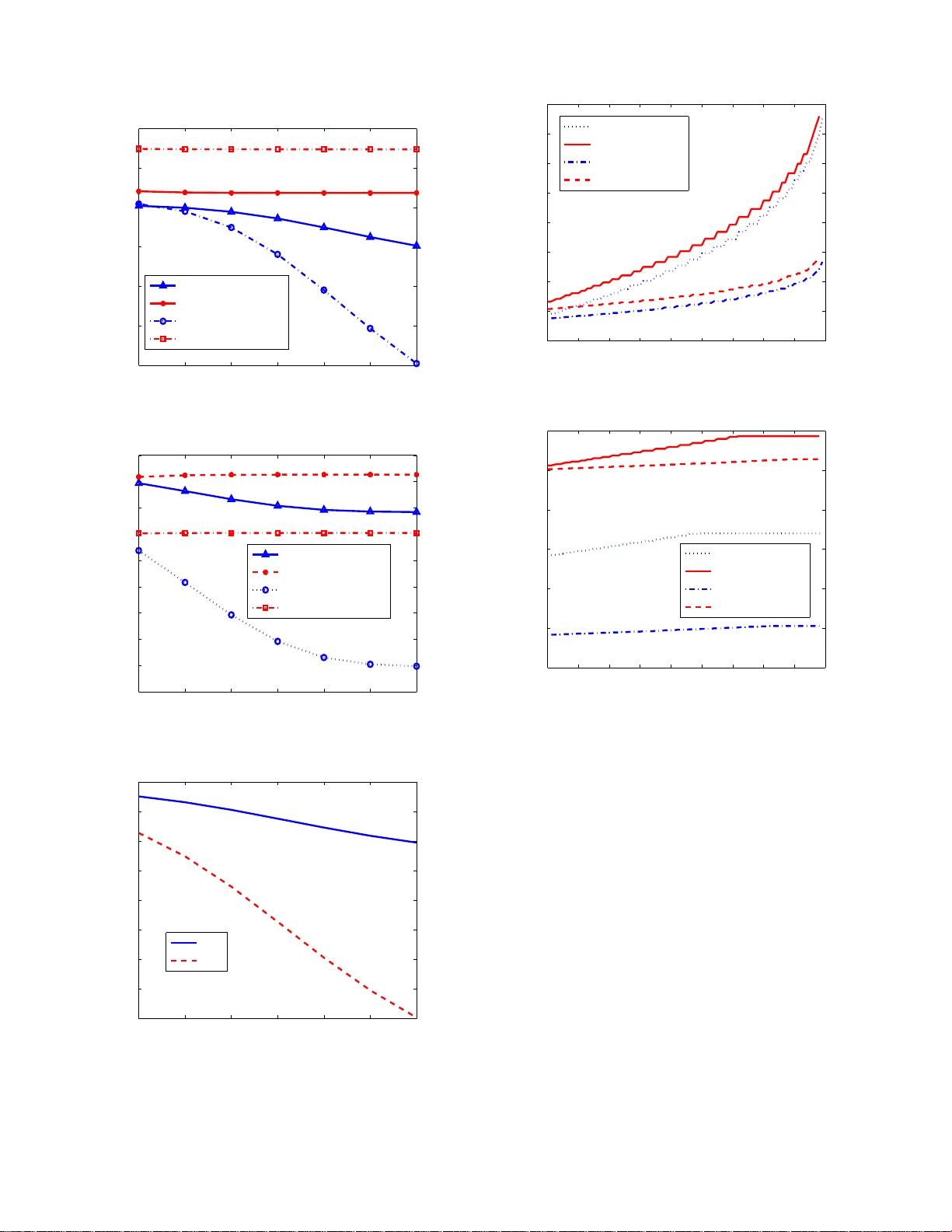
1 Censored T runcated Sequentia l Spectrum Sensing for Cogniti ve Radio Netw orks Sina Maleki Geert Leus Abstract Reliable spectrum sensing is a key functiona lity of a cognitive radio netw ork. Coopera ti ve spectrum sensing impr oves the detection r eliability of a cog nitive radio system but also incr eases the system energy consump tion which is a critical factor particularly fo r low-power wireless tec hnolog ies. A censored truncated sequential spectrum sensing techn ique is co nsidered as an energy-saving appr oach. T o design the und erlying sensing param eters, the m aximum average energy consump tion per sen sor is minimize d subject to a lower bound ed glo bal proba bility of d etection an d an up per b ound ed false alarm rate. This way both the interferen ce to the primary user due to m iss d etection and the network throu ghpu t as a result of a low false alar m rate a re contro lled. T o solve this problem, it is assumed th at the cognitive radios and fusion cen ter ar e aware o f the ir loca tion and mutual ch annel p roperties. W e compare the performan ce of the propo sed scheme with a fixed samp le size censor ing sche me und er different scenarios and show that for low-power cogn itiv e rad ios, censor ed tr uncated sequential sensin g outp erform s censoring . It is shown th at as the sensing energy per sample of the cog nitive radios increases, the energy efficiency o f the censored truncated sequen tial ap proach g rows significantly . Index T erms distributed spectrum sensing, sequen tial sensing, cogn itiv e radio networks, censoring, energy effi- ciency . S. Maleki and G. Leus are with the Faculty of E lectrical Engineering, Mathematics and Computer Science, Delft Univ ersity of T echnology , 2628 CD Delft, The Netherlands (e-mail: s.maleki@tudelft.nl; g.j.t.leus@tudelft.nl). Part of this paper has been presented at the 17th International Conference on Di gital Signal Processing, DSP 2011 , July 2011, Corfu, Greece. This work is supported in part by the NWO-ST W under the VICI pro gram (projec t 10 382). Manusc ript recei ve d date: Jan 5 , 20 12. Man uscript rev ised dates: May 16, 1012 and Jul 19, 2012 September 3, 2018 DRAFT 2 I . I N T RO D U C T I O N Dynamic sp ectrum access base d on cognitive radios has been prop osed in order to opportunistically use underutilized spectrum portions of the licens ed electromag netic sp ectrum [1]. Cogniti ve radios opportunistically sha re the sp ectrum while av oiding a ny h armful interference to the primary licen sed users. Th ey employ s pectrum se nsing to d etect the emp ty po rtions of the radio spec trum, also known as spectrum holes. Upon d etection of su ch a spec trum hole, cognitiv e radios dynamically share this ho le. Howe ver , a s soon as a primary use r app ears in the correspon ding ban d, the cogniti ve radios have to vacate the ba nd. As suc h, reliable spe ctrum sens ing b ecomes a key func tionality o f a cogniti ve radio n etwork. The hidden terminal problem and fading effects have bee n shown to limit the reliability of sp ec- trum sens ing. Distrib uted c ooperative d etection h as therefore be en p roposed to improve the detec tion performance of a cognitiv e radio n etwork [2], [3]. Du e to its simplicity and small de lay , a parallel detection configuration [4], is co nsidered i n this pa per wh ere e ach secondary radio continuously senses the spec trum in pe riodic sens ing slots. A loca l decision is then ma de at the radios an d sent to the fus ion center (FC), which ma kes a g lobal decision a bout the p resence (or absence ) of the primary user and feeds it b ack to the cog niti ve radios. Several fusion sch emes have been p roposed in the literature wh ich can b e categorized under soft a nd hard fus ion strategies [4], [5]. Hard schemes are mo re energy efficient than soft scheme s, and thus a hard fusion sch eme is adop ted in this pa per . More specifica lly , two po pular choice s are employed due to the ir simple implementa tion: the OR and the AND rule. T he OR rule dictates the primary use r pre sence to be a nnounc ed by the FC whe n a t leas t on e cog niti ve radio repo rts the prese nce of a primary user to the FC. On the o ther hand, the AND rule ask s the FC to vote for the absence of the p rimary use r if a t least o ne co gniti ve radio a nnounc es the abse nce o f the primary user . In this pap er , energy detection is employed for cha nnel sen sing which is a common approach to detect unknown signals [5], [6], and which leads to a compa rable d etection performance for hard and soft fus ion s chemes [3]. Energy consump tion is another critical issue. The ma ximum ene r gy cons umption of a low-po we r radio is limited by its battery . As a res ult, ene r g y efficient spec trum sens ing limiti n g the maximum energy consump tion of a co gniti ve rad io in a cooperativ e sens ing framework is the focus o f this paper . A. Contributions The s pectrum s ensing mo dule c onsume s energy in both the sensing an d transmiss ion s tages. T o achieve an ene r gy-efficient spec trum s ensing sch eme the following c ontributi ons are presented in this paper . • A combina tion of censoring a nd truncated seque ntial sensing is propos ed to save ener g y . Th e s ensors sequen tially sense the spe ctrum before reac hing a trunc ation point, N , where they a re forced to stop September 3, 2018 DRAFT 3 sensing. If the accu mulated energy of the collected sample ob servations is in a certain region (above an uppe r threshold, a , or belo w a lower threshold, b ) be fore the truncation p oint, a dec ision is sent to the FC. E lse, a censoring policy is used by the s ensor , and no b its will be sent. This way , a lar g e amount of ene rgy is sa ved for both sensing and transmission. In o ur paper , it is assumed that the cognitiv e radios a nd fusion c enter are aware of the ir location and mu tual chann el prop erties. • O ur goal is to minimize the maximum av erage e nergy c onsump tion per s ensor s ubject to a specific detection performance cons traint which is defined by a lower bo und on the global proba bility of detection and an up per bo und on the global probability o f f a lse alarm. In terms of cogniti ve radio system design, the probability of dete ction li mits the harmful interference to the primary use r a nd the false alarm rate controls the loss in spectrum util ization. The ideal case yields no interference and full sp ectrum utilization, but it is practica lly impos sible to re ach this point. Hen ce, current standards d etermine a bou nd on the detection performance to achieve an a ccep table interference and utilization lev el [7]. T o the best of our knowledge suc h a min-max optimization p roblem conside ring the average e nergy cons umption per s ensor has n ot yet b een cons idered in literature. • A nalytical expressions for the u nderlying parameters are deri ved and it is shown that the problem can be solved by a two-dimensional se arch for b oth the OR and AND rule. • T o reduce the c omputational complexity for the OR rule, a s ingle-threshold truncated sequ ential test is propos ed where each co gniti ve rad io sen ds a decision to the FC up on the detection of the primary user . • T o make a fair comparison of t h e proposed technique with current ener g y ef ficien t approaches , a fixed sample size censoring scheme is considered as a benchma rk (i t is simply called the censoring scheme throughout the res t of the pape r) where each senso r employs a censoring policy aft er collec ting a fixed number of samples. The censoring policy in this case works b ased on a lo we r threshold, λ 1 and an upper threshold, λ 2 . The decision is only b eing made if the accumu lated energy is no t in ( λ 1 , λ 2 ) . For this a pproach , it is shown that a single-thresho ld censo ring policy is optimal in terms of energy consumption for both the OR and AND rule. Moreover , a solution of the unde rlying problem is given for the OR and AND rule. B. Related wor k to c ensor ing Censoring has been thorou ghly in vestigated in wireless se nsor ne tworks and c ognitiv e radios [8]–[13]. It ha s been shown that cen soring is very effecti ve in terms of e nergy efficiency . In the early works, [8]– [11], t he d esign of censoring parame ters including lo wer and up per thres holds ha s been considered and September 3, 2018 DRAFT 4 mainly two problem form ulations have be en studied. In the Neyman-Pearson (NP) c ase, the miss-detection probability is minimized s ubject to a cons traint on the probab ility of f alse alarm and average network energy c onsumption [9]–[11]. In t he Baye sian c ase, on the other h and, the detec tion e rror proba bility is minimized subject to a constraint on the a verage network en ergy consump tion. Cen soring f o r cogniti ve radios is c onsidered in [12], [13]. In [12 ], a cen soring rule similar to the o ne in this paper is considered in order to limit the band width oc cupan cy of the cog niti ve ra dio network. Ou r fi xed sample size ce nsoring scheme is dif ferent in two ways. First, in [12], only the OR rule is considered an d the FC makes no decision in c ase it do es n ot rec eiv e any decision from the co gniti ve radios which is a mbiguous, s ince the FC ha s to make a fin al de cision, while in our paper , the FC reports the absen ce (for the OR rule) or the presenc e (for t h e AN D rule) o f the primary u ser , if no loc al de cision is rece i ved at the FC. Second, we giv e a clear op timization p roblem a nd express ion for the solution while this i s not presented in [12]. A combined sleep ing and censoring sch eme is conside red in [13]. The cen soring scheme in this paper is dif feren t in some ways . The optimization prob lem in the cu rrent pap er is d efined as the minimization of the maximum average ener g y consumption per se nsor while in [13], the total network energy consumption is minimized. For low-po we r radios, the problem in this paper makes more sens e since the energy of indi vidual radios is generally limit e d. In this pape r , the rece i ved SNRs by the cogniti ve radios are as sumed to be different wh ile in [13], the SNRs a re the same. Finally n ote that the s leeping policy of [13] ca n be easily incorporated in our propos ed censo red truncated seque ntial sensing leading to ev en highe r ene r gy savings. C. Related wor k to s equen tial sens ing Sequen tial dete ction as an a pproach to reduce the average n umber of sen sors req uired to reac h a decision is also studied comprehensively during the past decades [14]–[19]. In [14 ], [15 ], e ach sensor collects a sequ ence of observations, constructs a summary messa ge and passes it on to the F C and all other sensors. A Bayesian problem formulation comprising the mi n imization of the av erage error detection probability and s ampling time cost over all a dmissible decision policies at the FC an d all po ssible loca l decision functions at eac h se nsor is the n considered to determine the optimal stop ping an d decision rule. Further , a lgorithms to solve the optimization problem for both infinite and finite horizon are gi ven. In [16], an infinite horizon seq uential detection scheme based on the seq uential probability ratio test (SPR T) at both the sens ors a nd the FC is considered. W ald’ s analysis of error probability , [20], is e mployed to determine the thresholds at the sen sors a nd the FC. A combination of sequ ential d etection a nd censo ring is conside red in [17]. Each s ensor computes the LLR o f the rece i ved sample and send s it to the FC, September 3, 2018 DRAFT 5 if it is dee med to be in a certain region. The FC then collects the received LLRs an d as soon as their sum is lar ger than an upper threshold or smaller tha n a lower threshold, the decision is made and the sensors can stop se nsing. The LLRs are trans mitted in such a way that the larger LLRs are se nt sooner . It is sho wn that the number of transmissions considerably red uces a nd parti c ularly when the transmission energy is high, this approac h p erforms very well. However , our pape r employs a hard fusion scheme at the FC , our s equential scheme is finite horizon, and further a clear optimization problem is giv en to optimize the energy c onsumption. Since we emp loy the OR (or the AND) rule in our pap er , the FC can decide for the p resence (or absenc e) of the primary user by o nly receiving a single o ne (or zero). Hence, ordered transmission can be eas ily incorporated in our paper by stopping the sensing and transmission procedure as soon as one cognitiv e radio sends a one (or zero) to the FC. [18] proposes a seque ntial censoring s cheme where an SPR T is employed b y the FC an d so ft or hard loca l dec isions are sent to the FC according to a censoring policy . It i s d epicted that the number of trans missions d ecreas es but on the other hand the average sample number (ASN) inc reases. T herefore, [18] ignores the effect of sens ing on the en ergy consumption and focus es on ly on the transmission e nergy which for c urrent lo w-power radios is c omparable to the s ensing energy . A trunca ted sequ ential se nsing technique is e mployed in [19] to reduce the sensing time of a cognitiv e radio system. The thresholds are dete rmined such t hat a certain probability of f alse alarm and detection are obtained. In this pape r , we are e mploying a similar technique, except that in [19], a fter the truncation p oint, a single threshold scheme is used to make a fin al decision, while in o ur p aper , the s ensor decision is cen sored if no decision is ma de before the trunca tion point. Further , [19] con siders a single sens or detec tion scheme while we employ a distrib u ted coo perativ e sensing system and finally , in our paper an explicit optimization problem is gi ven to find the sensing parameters. The remaind er of the paper is organized as follows. In Section II, the fixed size c ensoring sch eme for the OR rule is d escribed, including the optimization problem a nd the a lgorithm to solve it. Th e sequential censoring scheme for t h e OR rule is pres ented in Section III. Analytical expres sions for the und erlying system parameters are deri ved an d the optimization problem is ana lyzed. In Section IV, the censo ring and sequen tial censoring sc hemes are prese nted and a nalyzed for the AND rule. W e discus s some numerical results in S ection V. Conclusions and ideas for further work are fina lly pos ed in Sec tion VI. I I . F I X E D S I Z E C E N S O R I N G P RO B L E M F O R M U L A T I O N A fixed s ize censoring scheme i s discus sed in this sec tion as a ben chmark f or the main contrib u tion of the pape r in Se ction III, which studies a combination of se quential sensing and c ensoring. A network September 3, 2018 DRAFT 6 (FC) . . . Cognitive Radio 1 Cognitive Radio 2 Cognitive Radio M Fusion Center . . . Fig. 1: Distributed s pectrum sensing co nfiguration of M cogn iti ve radios is cons idered unde r a cooperativ e sp ectrum s ensing sche me. A parallel detection configuration is employed as shown in F ig. 1. Each cognitive radio s ense s the spe ctrum an d makes a local decision ab out the presence or ab sence of the primary u ser a nd informs the FC b y employing a censoring policy . The fi nal decision is then made at t h e FC by employing the OR rule. Th e AND rule will be discussed in Section IV. Denoting r ij to be the i -t h sample receiv ed at the j -th cognitive radio, each radio solves a binary hypothesis tes ting problem a s follows H 0 : r ij = w ij , i = 1 , ..., N , j = 1 , ..., M H 1 : r ij = h ij s i + w ij , i = 1 , ..., N , j = 1 , ..., M (1) where w ij is additiv e white Gaus sian nois e with zero mean and variance σ 2 w . h ij and s i are the channel gain be tween the primary user and the j -th cognitive radio an d the transmitted primary use r s ignal, respectively . W e ass ume two models for h ij and s i . In the fi rst model, s i is a ssume d to be white Gaussian with ze ro mea n and variance σ 2 s , a nd h ij is a ssumed cons tant during e ach sen sing period and thus h ij = h j , i = 1 , . . . , N . In the second model, s i is assume d to b e deterministic and constant modulus | s i | = s , i = 1 , . . . , N , j = 1 , . . . , M a nd h ij is an i.i.d. Gaussian random proce ss with zero mea n and variance σ 2 hj . Note that the seco nd model actually repres ents a fast fading scenario. Althou gh e ach model requires a dif ferent type of chann el estimation, sinc e the recei ved signa l is still a z ero mean Gaussian random proc ess with some variance, n amely σ 2 j = h j σ 2 s + σ 2 w for the former model an d σ 2 j = sσ 2 hj + σ 2 w for the latter model, the analyses wh ich are gi ven in the follo wing se ctions a re valid for both models. The SNR of the received primary use r signal at the j -th c ognitiv e radio is γ j = | h j | 2 σ 2 s /σ 2 w under the first model and γ j = s 2 σ 2 hj /σ 2 w under the se cond model. Furthermore, h ij s i and w ij are ass umed s tatistically independ ent. An energy detector is e mployed by each cog niti ve s ensor which calculates the accumu lated energy over September 3, 2018 DRAFT 7 N obse rvation sa mples. Note that under ou r system model parameters, the en ergy detector is equiv alent to the op timal LLR detector [5]. T he received e nergy collected ov e r the N observation samples at the j -th radio i s given by E j = N X i =1 | r ij | 2 σ 2 w . (2) When the acc umulated ene rgy o f the observation samples is calcu lated, a c ensoring policy is e mployed at each radio where the local de cisions are sent to the FC only if they are deemed to be informativ e [13]. Censoring thresholds λ 1 and λ 2 are applied at each of the radios, where the range λ 1 < E j < λ 2 is ca lled the cen soring region. At the j -th radio, the local censoring d ecision rule is gi ven by send 1, de claring H 1 if E j ≥ λ 2 , no dec ision if λ 1 < E j < λ 2 , send 0, de claring H 0 if E j ≤ λ 1 . (3) It is well known [5] that under such a model, E j follo ws a central chi-square distrib ution with 2 N degrees o f freedom und er H 0 and H 1 . Therefore, the loc al probab ilities o f false alarm an d detection can be respe cti vely written a s P f j = P r ( E j ≥ λ 2 |H 0 ) = Γ( N , λ 2 2 ) Γ( N ) , (4) P d j = P r ( E j ≥ λ 2 |H 1 ) = Γ( N , λ 2 2(1+ γ j ) ) Γ( N ) , (5) where Γ( a, x ) is the incomplete gamma function giv e n by Γ( a, x ) = R ∞ x t a − 1 e − t dt , with Γ( a, 0) = Γ( a ) . Denoting C sj and C ti to b e the energy consume d by the j -th radio in s ensing pe r sample a nd transmission per bit, res pectively , the average energy con sumed for distributed se nsing per use r is gi ven by , C j = N C sj + (1 − ρ j ) C tj , (6) where ρ j = P r ( λ 1 < E j < λ 2 ) is den oted to be the average censoring rate. Note that C sj is fixed and only depend s o n the sampling rate and po wer co nsumption of the sensing module while C tj depend s o n the distance to the FC a t the time of the transmission. T herefore, in this paper , it is assume d that the cogn iti ve radio is aware of its location and the loca tion of the FC as well as the ir mutua l channe l properties or at least c an estimate the m. Defi ning π 0 = P r ( H 0 ) , π 1 = P r ( H 1 ) , δ 0 j = P r ( λ 1 < E j < λ 2 |H 0 ) a nd δ 1 j = P r ( λ 1 < E j < λ 2 |H 1 ) , ρ j is given by ρ j = π 0 δ 0 j + π 1 δ 1 j , (7) September 3, 2018 DRAFT 8 with δ 0 j = Γ( N , λ 1 2 ) Γ( N ) − Γ( N , λ 2 2 ) Γ( N ) , (8) δ 1 j = Γ( N , λ 1 2(1+ γ j ) ) Γ( N ) − Γ( N , λ 2 2(1+ γ j ) ) Γ( N ) . (9) Denoting Q c F and Q c D to be the respec ti ve global probability o f false alarm and detec tion, the target detection performance is then quantified by Q c F ≤ α a nd Q c D ≥ β , where α a nd β are pre-spec ified detection de sign parameters. Our go al is to determine the o ptimum ce nsoring thresholds λ 1 and λ 2 such that the maximum average ener g y cons umption per senso r, i.e., max j C j , is minimized subje ct to the constraints Q c F ≤ α and Q c D ≥ β . Hence, our op timization problem c an be formulated as min λ 1 ,λ 2 max j C j s.t. Q c F ≤ α, Q c D ≥ β . (10) In this se ction, the FC employs an OR rule to make the fina l decision which is de noted by D F C , i.e., D F C = 1 if the FC rece iv e s at least one local decision d eclaring 1, else D F C = 0 . This way , the glob al probability of f alse alarm a nd detec tion can b e derived as Q c F = P r ( D F C = 1 |H 0 ) = 1 − M Y j =1 (1 − P f j ) , (11) Q c D = P r ( D F C = 1 |H 1 ) = 1 − M Y j =1 (1 − P d j ) . (12 ) Note that sinc e all the cognitive radios employ the s ame upper threshold λ 2 , we ca n state that P f j = P f defined in (4). As a res ult, (11) becomes Q c F = 1 − (1 − P f ) M . (13) Since the FC decide s about the p resence of the primary us er only by receiving 1s (receiving no dec ision from a ll the sens ors is con sidered as absen ce of the primary us er) an d the se nsing time does no t dep end on λ 1 , it is a w aste of en ergy to send zeros to the FC and t hus, the optimal solution of (10) is o btained by λ 1 = 0 . Note that this is o nly the c ase for fixed-size cens oring, b ecaus e the energy consumption of each sen sor only v a ries by the transmission en ergy wh ile the s ensing energy is constant. This way (8) and (9) ca n be simplified to δ 0 j = 1 − P f and δ 1 j = 1 − P d j , and we only n eed to derive the optimal λ 2 . Since there is a one-to-one relationship between P f and λ 2 , by finding the optimal P f , λ 2 can also be easily deriv e d as λ 2 = 2Γ − 1 [ N , Γ( N ) P f ] (where Γ − 1 is define d over the seco nd argument). Co nsidering September 3, 2018 DRAFT 9 this res ult and defining Q c D = H ( P f ) , the optimal s olution of (10) is given by P f = H − 1 ( β ) as is shown in Appe ndix A. In the following section, a combina tion of censo ring and sequential sensing approac hes is presented which optimizes b oth the sensing a nd the tr a nsmission ene rgy . I I I . S E QU E N T I A L C E N S O R I N G P RO B L E M F O R M U L A T I O N A. System Mod el Unlike Se ction II, where each u ser c ollects a spe cific numb er of samples, in this section, e ach cogniti ve radio se quentially sense s the sp ectrum and u pon reaching a decision abo ut the p resence or absence of the p rimary u ser , it s ends the res ult to the FC by employing a c ensoring policy as introduce d in Sec tion II. The fina l dec ision is then made at the FC b y e mploying the OR rule. Here, a c ensored truncated sequen tial s ensing sche me is employed wh ere eac h cogniti ve rad io ca rries on se nsing until it reaches a decision while not passing a limit of N samp les. W e d efine ζ nj = P n i =1 | r ij | 2 /σ 2 w = P n i =1 x ij and a i = 0 , i = 1 , . . . , p , a i = ¯ a + i ¯ Λ , i = p + 1 , ..., N and b i = ¯ b + i ¯ Λ , i = 1 , ..., N , where ¯ a = a/σ 2 w , ¯ b = b/σ 2 w , 1 < ¯ Λ < 1 + γ j is a p redetermined co nstant, a < 0 , b > 0 and p = ⌊− a/σ 2 w ¯ Λ ⌋ [19]. W e assume tha t the SNR γ j is k nown or can be estimated. This way , the loc al decis ion rule in order to make a fin al decision is as follows send 1, declaring H 1 if ζ nj ≥ b n and n ∈ [1 , N ] , continue sens ing if ζ nj ∈ ( a n , b n ) and n ∈ [1 , N ) , no dec ision if ζ nj ∈ ( a n , b n ) a nd n = N , send 0, declaring H 0 if ζ nj ≤ a n and n ∈ [1 , N ] . (14) The probability dens ity func tion of x ij = | r ij | 2 /σ 2 w under H 0 and H 1 is a ch i-square distribution with 2 n degrees of freedom. Thus, x ij becomes exponentially distributed under both H 0 and H 1 . He nceforth, we obtain P r ( x ij |H 0 ) = 1 2 e − x ij / 2 I { x ij ≥ 0 } , (15) P r ( x ij |H 1 ) = 1 2(1 + γ j ) e − x ij / 2(1+ γ j ) I { x ij ≥ 0 } , (16) where I { x ij ≥ 0 } is the ind icator function. Defining ζ 0 j = 0 , the local probability of false alarm at the j -th cognitive rad io, P f j , can be written as P f j = N X n =1 P r ( ζ 0 j ∈ ( a 0 , b 0 ) , ..., ζ n − 1 j ∈ ( a n − 1 , b n − 1 ) , ζ nj ≥ b n |H 0 ) , (17) September 3, 2018 DRAFT 10 whereas the local proba bility of d etection, P d j , is obtained as foll ows P d j = N X n =1 P r ( ζ 0 j ∈ ( a 0 , b 0 ) , ..., ζ n − 1 j ∈ ( a n − 1 , b n − 1 ) , ζ nj ≥ b n |H 1 ) . (18) Denoting ρ j to be the average censoring rate at the j -th cognitiv e radio, and δ 0 j and δ 1 j to be the respective average c ensoring rate under H 0 and H 1 , we h ave ρ j = π 0 δ 0 j + π 1 δ 1 j , ( 1 9) where δ 0 j = P r ( ζ 1 j ∈ ( a 1 , b 1 ) , ..., ζ N j ∈ ( a N , b N ) |H 0 ) , (20) δ 1 j = P r ( ζ 1 j ∈ ( a 1 , b 1 ) , ..., ζ N j ∈ ( a N , b N ) |H 1 ) . (21) The other parameter that is important in any sequential detection s cheme is the av e rage samp le number (ASN) requ ired to reac h a decision. Den oting N j to be a random variable represen ting the n umber of samples required to announc e the presen ce or abs ence o f the primary user , the ASN for the j -th cogniti ve radio, deno ted as ¯ N j = E ( N j ) , can be de fined as ¯ N j = π 0 E ( N j |H 0 ) + π 1 E ( N j |H 1 ) , (22) where E ( N j |H 0 ) = N X n =1 nP r ( N j = n |H 0 ) = N − 1 X n =1 n [ P r ( ζ 0 j ∈ ( a 0 , b 0 ) , ..., ζ n − 1 j ∈ ( a n − 1 , b n − 1 ) |H 0 ) − P r ( ζ 0 j ∈ ( a 0 , b 0 ) , ..., ζ nj ∈ ( a n , b n ) |H 0 )] + N P r ( ζ 0 j ∈ ( a 0 , b 0 ) , ..., ζ N − 1 j ∈ ( a N − 1 , b N − 1 ) |H 0 ) , (23) and E ( N j |H 1 ) = N X n =1 nP r ( N j = n |H 1 ) = N − 1 X n =1 n [ P r ( ζ 0 j ∈ ( a 0 , b 0 ) , ..., ζ nj ∈ ( a n − 1 , b n − 1 ) |H 1 ) − P r ( ζ 0 j ∈ ( a 0 , b 0 ) , ..., ζ nj ∈ ( a n , b n ) |H 1 )] + N P r ( ζ 0 j ∈ ( a 0 , b 0 ) , ..., ζ N − 1 j ∈ ( a N − 1 , b N − 1 ) |H 1 ) . (24) September 3, 2018 DRAFT 11 Denoting a gain C sj to be the s ensing en ergy of one sample a nd C tj to be the trans mission e nergy of a decision bit at the j -th cogniti ve radio, the total average ene r g y cons umption at the j -th cogn iti ve radio now bec omes C j = ¯ N j C sj + (1 − ρ j ) C tj . (25) Denoting Q cs F and Q cs D to be the resp ectiv e global probabilities o f false alarm and d etection for the censore d truncated s equential ap proach, we defi ne our problem as the minimization of the maximum av erage energy co nsumption per se nsor subject to a co nstraint on the g lobal prob abilities of false alarm and de tection as follows min ¯ a, ¯ b max j C j s.t. Q cs F ≤ α, Q cs D ≥ β . (26) As in (11 ) and ( 1 2), un der the OR rule that is a ssumed in this se ction, the g lobal probability o f false alarm is Q cs F = P r ( D FC = 1 |H 0 ) = 1 − M Y j =1 (1 − P f j ) , (27) and the g lobal prob ability of detec tion is Q cs D = P r ( D FC = 1 |H 1 ) = 1 − M Y j =1 (1 − P d j ) . (28) Note that s ince P f 1 = · · · = P f M , it is again assu med that P f j = P f in this section. In t h e follo wing subsection, ana lytical e x pressions for the prob ability of false alarm and dete ction as well as the censoring rate a nd ASN a re extracted. B. P arameter an d Pr o blem A nalysis Looking at (17), (18), (19 ) and (22), we c an see tha t the joint probability distribution function of p ( ζ 1 j , ..., ζ nj ) is the fou ndation of all the equations. Sinc e x ij = ζ ij − ζ i − 1 j for i = 1 , ..., N , we have, p ( ζ 1 j , ..., ζ nj ) = p ( x nj ) p ( x n − 1 j ) ...p ( x 1 j ) . (29) Therefore, the joint p robability distribution function u nder H 0 and H 1 becomes p ( ζ 1 j , ..., ζ nj |H 0 ) = 1 2 n e − ζ nj / 2 I { 0 ≤ ζ 1 j ≤ ζ 2 j ... ≤ ζ nj } , (30) p ( ζ 1 j , ..., ζ nj |H 1 ) = 1 [2(1 + γ j )] n e − ζ nj / 2(1+ γ j ) I { 0 ≤ ζ 1 j ≤ ζ 2 j ... ≤ ζ nj } , (31) where I { 0 ≤ ζ 1 j ≤ ζ 2 j ... ≤ ζ nj } is aga in the i ndicator f u nction. September 3, 2018 DRAFT 12 The deriv ation of the loca l probability of false alarm and the ASN under H 0 in this work are similar to the o nes cons idered in [19] a nd [21]. The d if feren ce is that in [19], if the cogn iti ve radio doe s not rea ch a decision after N samples, it employs a single threshold dec ision policy to giv e a final decision about the presence o r ab sence of the cog niti ve radio, while in our work, n o decision is s ent in ca se none of the upper and lower thresholds are cros sed. Hence , to av o id introducing a cumb ersome detailed de ri vation of each parame ter , we can use the resu lts in [19] for our ana lysis with a small modification. Howe ver , note that t he p roblem formulation in this work is essentially different from the one in [19]. Further , since in our work the distrib ution of x ij under H 1 is exponential like the one under H 0 , unlike [19 ], we can a lso use the same ap proach to d eri ve a nalytical expression s for the loc al prob ability of detection, the AS N under H 1 , an d the ce nsoring rate. Denoting E n to be t h e event whe re a i < ζ ij < b i , i = 1 , ..., n − 1 a nd ζ nj ≥ b n , (17) becomes P f j = N X n =1 P r ( E n |H 0 ) . ( 32) where the analytical expre ssion for P r ( E n |H 0 ) is deri ved in Appendix B. Similarly for the loca l proba bility of de tection, we h av e P d j = N X n =1 P r ( E n |H 1 ) , (33) where the analytical expre ssion for P r ( E n |H 1 ) is deri ved in Appendix C. Defining R nj = { ζ ij | ζ ij ∈ ( a i , b i ) , i = 1 , ..., n } , P r ( R nj |H 0 ) and P r ( R nj |H 1 ) are obtained as follows P r ( R nj |H 0 ) = 1 2 n J ( n ) a n ,b n (1 / 2) , n = 1 , ..., N , (34) P r ( R nj |H 1 ) = 1 [2(1 + γ j )] n J ( n ) a n ,b n (1 / 2(1 + γ j )) , n = 1 , ..., N , (35) where J ( n ) a n ,b n ( θ ) is presented in App endix D a nd (23) a nd (24) become E ( N j |H 0 ) = N − 1 X n =1 n ( P r ( R n − 1 j |H 0 ) − P r ( R nj |H 0 )) + N P r ( R N − 1 j |H 0 ) = 1 + N − 1 X n =1 P r ( R nj |H 0 ) , (36) E ( N j |H 1 ) = N X n =1 n ( P r ( R n − 1 j |H 1 ) − P r ( R nj |H 1 )) + N P r ( R N − 1 j |H 1 ) = 1 + N − 1 X n =1 P r ( R nj |H 1 ) . (37) W ith (36 ) and ( 37), we can c alculate (22). This way , (20) an d (21) ca n be d eri ved as foll ows δ 0 j = P r ( R N j |H 0 ) = 1 2 N J ( N ) a N ,b N (1 / 2) , (38) δ 1 j = P r ( R N j |H 1 ) = 1 [2(1 + γ j )] N J ( N ) a N ,b N (1 / 2(1 + γ j )) . (39) September 3, 2018 DRAFT 13 W e can sh ow that the problem (26) is not c on vex. Therefore, the s tandard sy stematic optimization algorithms do not gi ve the global o ptimum for ¯ a an d ¯ b . Ho w ev er , a s is s hown in the follo wing lines, ¯ a and ¯ b are bound ed and therefore, a two-dimensiona l exhaus ti ve search is possible to find the globa l optimum. F irst of all, we have a < 0 a nd ¯ a < 0 . On the o ther ha nd, if ¯ a ha s to play a role in the sensing system, a t least on e a N should be positi ve, i.e., a N = ¯ a + N ∆ ≥ 0 which gi ves ¯ a ≥ − N ∆ . Hence, we obtain − N ∆ ≤ ¯ a < 0 . F urthermore, defining Q cs F = F ( ¯ a , ¯ b ) and Q cs D = G ( ¯ a , ¯ b ) , for a given ¯ a , it is easy to show tha t G − 1 (¯ a , β ) ≤ ¯ b ≤ F − 1 (¯ a, α ) (where F − 1 and G − 1 are de fined over the s econd argument). Before introduc ing a su boptimal problem, the follo wing theorem is presented. Theorem 1 . For a given local probability of detection and false alarm ( P d and P f ) and N , the censoring rate of the o ptimal censored truncated seq uential sensing ( ρ cs ) is less than the one of the cen soring scheme ( ρ c ). Proof . The proof is provided in Ap pendix E. W e s hould n ote that, in censore d truncated s equen tial sensing , a large amoun t of ene r g y is to b e saved on sens ing. Therefore, as is shown in Se ction V, as the s ensing energy of each sensor increase s, c ensored truncated sequential sensing outperforms cen soring in terms of energy efficiency . Howe ver , in cas e that the transmiss ion ene r g y is much higher than the s ensing e nergy , it may happen that censoring outpe rforms censore d truncated seq uential sens ing, bec ause of a higher c ensoring rate ( ρ cs > ρ c ). Henc e, one c orollary of Theorem 1 is t hat although t he optimal solution of (10) f o r a s pecific N , i.e., P d = 1 − (1 − β ) 1 / M and P f = H − 1 ( β ) , is in the feasible se t of (26) for a resulting ASN less tha n N , it does not nec essa rily guarantee that the resulting average ene r gy consump tion per sen sor of the ce nsored truncated sequ ential sensing a pproach is less than the one of the cen soring scheme, pa rticularly when the transmission e nergy is much higher than the sensing ene rgy per s ample. Solving (26) is complex in terms of the number of computations, and thus a two-dimensional exhausti ve search is not a lw ays a good s olution. Therefore, i n orde r to r each a good solution in a rea sonab le time, we set a < − N ∆ in order to obta in a 1 = · · · = a N = 0 . This way , we ca n relax one of the ar guments of (26) and on ly solve the following subop timal prob lem min ¯ b max j C j s.t. Q cs F ≤ α, Q cs D ≥ β . (40) Note that unlike Section II, here the zero lo wer threshold is not necessarily optimal. The reas on is that although the maximum cens oring rate is a chieved with the lo west ¯ a , the minimum ASN is a chieved with the highest ¯ a , and thus there is an inherent trade-off be tween a high censoring rate and a low ASN and a September 3, 2018 DRAFT 14 zero a i is no t nec essarily the op timal solution. Since the a nalytical express ions provided ea rlier are very complex, we now t ry to provide a new set of analytical expressions for different parame ters base d on the fact tha t a 1 = · · · = a N = 0 . T o find an a nalytical expression for P f j , we can de ri ve A ( n ) for the new paradigm as foll ows A ( n ) = Z ... Z Γ n I { 0 ≤ ζ 1 j ≤ ζ 2 j ... ≤ ζ n − 1 j } dζ 1 j ...dζ n − 1 j . (41) Since 0 ≤ ζ 1 j ≤ ζ 2 j ... ≤ ζ n − 1 j and a 1 = · · · = a N = 0 , the lower bound for eac h integral is ζ i − 1 and the up per b ound is b i , whe re i = 1 , ..., n − 1 . Thus we obtain A ( n ) = Z b 1 ζ 0 j Z b 2 ζ 1 j ... Z b n − 1 ζ n − 2 j dζ 1 j dζ 2 j ...dζ n − 1 j , (42) which acc ording to [21] i s A ( n ) = b 1 b n − 2 n ( n − 1)! , n = 1 , ..., N . (43) Hence, we h av e P f j = N X n =1 p n A ( n ) , (44) and p n = e − b n / 2 2 n − 1 . Similarly , for P d j , we o btain B ( n ) = Z b 1 ζ 0 j Z b 2 ζ 1 j ... Z b n − 1 ζ n − 2 j dζ 1 j dζ 2 j ...dζ n − 1 j = b 1 b n − 2 n ( n − 1)! , n = 1 , ..., N , (45) and thus P d j = N X n =1 q n B ( n ) , (46) where q n = e − b n / 2(1+ γ j ) [2(1+ γ j )] n − 1 . Furthermore, we note that for a 1 = · · · = a N = 0 , A ( n ) = B ( n ) = b 1 b n − 2 n ( n − 1)! , n = 1 , ..., N . It is eas y to see that R nj occurs unde r H 0 , if no false alarm happe ns until the n -th samp le. Therefore, the an alytical expression for P r ( R nj |H 0 ) is gi ven b y P r ( R nj |H 0 ) = 1 − n X i =1 p i A ( i ) , (47) and in the sa me way , for P r ( R nj |H 1 ) , we obtain P r ( R nj |H 1 ) = 1 − n X i =1 q i A ( i ) . (48) September 3, 2018 DRAFT 15 Putting (47) and (48) in (36) and ( 37), we obtain E ( N j |H 0 ) = 1 + N − 1 X n =1 1 − n X i =1 p i A ( i ) , (49) E ( N j |H 1 ) = 1 + N − 1 X n =1 1 − n X i =1 q i A ( i ) , (50) and inse rting (49 ) a nd (50) in ( 22), we obtain ¯ N j = π 0 1 + N − 1 X n =1 1 − n X i =1 p i A ( i ) ! + π 1 1 + N − 1 X n =1 1 − n X i =1 q i A ( i ) ! . (51) Finally , f rom (47) and (48), the cens oring rate can be ea sily obtained as ρ j = π 0 1 − N X i =1 p i A ( i ) + π 1 1 − N X i =1 q i A ( i ) . (52) Having t he ana lytical expressions f or (40), we c an easily find the optimal maximum average e nergy consump tion pe r s ensor by a line search over ¯ b . Similar to the censoring problem f ormulation, here the sensing thresh old is also bou nded by Q cs F − 1 ( α ) ≤ ¯ b ≤ Q cs D − 1 ( β ) . As we will see in Se ction V, ce nsored truncated sequen tial sens ing performs better than censored spectrum se nsing in te rms o f energy efficiency for low-po wer radios . I V . E X T E N S I O N T O T H E A N D RU L E So far , we have mainly focused on the OR rule. Howev e r , a nother rule which i s also simple in terms of implementation is the AND rule. Acc ording to the AND rule, D F C = 0 , if at leas t one cog niti ve radio reports a zero, e lse D F C = 1 . This w ay the global probabiliti es of false alarm an d de tection, c an be written respecti vely a s Q c F ,AND = Q cs F ,AND = P r ( D F C = 1 |H 0 ) = M Y j =1 ( δ 0 j + P f j ) , (53) Q c D,AND = Q cs D,AND = P r ( D F C = 1 |H 1 ) = M Y j =1 ( δ 1 j + P d j ) . (54) Note that (53) an d (54) hold for both the sequ ential censoring and cens oring sc hemes. Similar to the ca se for the OR rule, the problem is d efined so as to minimize the maximum average energy consu mption per sens or subject to a lower bound on the glob al probability of detection and an upper bound on the global proba bility of false alarm. In the follo wing two s ubsec tions, we are g oing to analyze the problem for cens oring a nd seq uential cen soring. September 3, 2018 DRAFT 16 A. AND r ule for fixed-sample size censoring The optimization problem for the c ensoring sch eme conside ring the AND rule at the FC, bec omes min λ 1 ,λ 2 max j C j s.t. Q c F ,AND ≤ α, Q c D,AND ≥ β . (55) where C j is d efined in (6). Since the FC dec ides for the a bsenc e o f the primary user by receiving at least one zero and the f a ct that the se nsing ener gy per sample is cons tant, the optimal upper thresh old λ 2 is λ 2 → ∞ . This w ay , cogn iti ve radios ce nsor all the resu lts for wh ich E j > λ 1 , and as a resu lt (53) an d (54) bec ome Q c F ,AND = P r ( D F C = 1 |H 0 ) = M Y j =1 δ 0 j , (56) Q c D,AND = P r ( D F C = 1 |H 1 ) = M Y j =1 δ 1 j . (57) where δ 0 j = P r ( E j > λ 1 |H 0 ) and δ 1 j = P r ( E j > λ 1 |H 1 ) . Since the thres holds are the same amo ng the cognitiv e radios , we ha ve δ 01 = δ 02 = · · · = δ 0 M = δ 0 . Since there i s a on e-to-one relationship betwee n λ 1 and δ 0 , by finding the o ptimal δ 0 , the o ptimal λ 1 can be easily deriv e d. As s hown i n Ap pendix F, we c an derive the o ptimal δ 0 as δ 0 = α 1 / M . This result is very important in the se nse that a s far a s the feasible set of (55 ) is not emp ty , the op timal solution of (55) is independe nt f rom the SNR. Note that the max imum average energy consu mption per se nsor still depends on the SNR via δ 1 j and is reducing as the SNR grows. B. AND r ule for censor ed truncated se quential sensing The optimization prob lem for the censored truncated seque ntial sensing scheme with the AND rule, becomes min ¯ a, ¯ b max j C j s.t. Q cs F ,AND ≤ α, Q cs D,AND ≥ β . (58) where C j is d efined in (25). Similar to the OR rule, we have − N ∆ ≤ ¯ a < 0 . Defining Q cs F ,AND = F AND (¯ a, ¯ b ) and Q cs D,AND = G AND (¯ a, ¯ b ) , for a gi ven ¯ a , we can s how that G − 1 AND (¯ a, β ) ≤ ¯ b ≤ F − 1 AND (¯ a , α ) (where F − 1 AND and G − 1 AND are defined over the seco nd argument). Therefore, the optimal ¯ a and ¯ b can aga in be derived by a bou nded two-dimensional sea rch, in a s imilar way as for the OR rule. September 3, 2018 DRAFT 17 V . N U M E R I C A L R E S U L T S A network of cog niti ve radios is cons idered for the numerical results. In s ome of the sce narios, for the s ake of simplicity , it is ass umed that all the se nsors experience the same S NR. T his way , it is easier to s how how the main pe rformance indicators inc luding the optimal ma ximum average energy consump tion pe r s ensor, ASN and cens oring rate c hange s wh en one of the underlying parameter of the system ch anges . Ho w ev er , to comply with the ge neral idea of the pape r , which is based on different receiv ed SNRs by cognitive radios, in other scena rios, the different co gniti ve radios experienc e dif feren t SNRs. Unles s otherwise mentioned, the res ults are based on the sing le-threshold strategy for c ensored truncated se quential sensing in case of the OR rule. Fig. 2a depicts the optimal maximum average energy consumption per se nsor versus the number of cognitiv e radios for the OR rule. The SNR is assu med to be 0 dB, N = 10 , C s = 1 and C t = 10 . Furthermore, the probab ility of false alarm a nd detec tion constraints are ass umed to be α = 0 . 1 and β = 0 . 9 as de termined by the IEEE 802.15.4 s tandard for cognitive radios [7 ]. It is shown for both h igh and low v a lues of π 0 that cen sored sequ ential sensing outperforms the ce nsoring scheme . Looking at Fig. 2b an d F ig. 2c, wh ere the resp ectiv e optimal censoring rate a nd o ptimal ASN a re sh own versus the number of cognitiv e radios, w e can deduce that the lower AS N i s p laying a key role i n a l ower e nergy consump tion of the censored seque ntial sensing. Fig. 2a a lso shows that as the numb er of coope rating cognitiv e radios increase s, the o ptimal maximum a verage ener gy consumption per s ensor d ecrease s and saturates, wh ile as shown in Fi g. 2 b a nd Fig. 2c, the optimal ce nsoring rate and optimal ASN inc rease. This way , the energy c onsumption tends to increase as a res ult of ASN growth and on the other hand inclines to d ecreas e due to the censo ring rate growth and that is the reason for saturation a fter a n umber of cognitiv e radios. Therefore, we can see tha t as the number of cogn iti ve radios increase s, a higher energy efficiency per s ensor can be achieved. Howe ver , after a number o f c ognitiv e radios, the maximum average energy cons umption per sensor remains almost at a c onstant level and by adding more co gniti ve rad ios no sign ificant en ergy saving per sen sor can be ac hiev ed while the total network energy cons umption also increases . Figures 3a, 3b and 3 c cons ider a scenario where M = 5 , N = 30 , C sj = 1 , C tj = 10 , α = 0 . 1 , β = 0 . 9 and π 0 can take a value of 0 . 2 o r 0 . 8 . The performanc e of the system versu s SNR is a nalyzed in this scenario for the OR rule. The ma ximum average energy consumption per sensor is dep icted in Fig. 3a . As for the earlier scenario, cen sored sequ ential sens ing giv es a higher ene r gy e fficiency compared to cen soring. While the op timal energy variation for the censo ring sc heme is almos t the same for all September 3, 2018 DRAFT 18 2 4 6 8 10 12 14 16 18 20 10 11 12 13 14 15 16 Number of cognitive radios Energy sequential censoring, π 0 =0.8 censoring, π 0 =0.8 sequential censoring, π 0 =0.2 censoring, π 0 =0.2 (a) 2 4 6 8 10 12 14 16 18 20 0.4 0.5 0.6 0.7 0.8 0.9 Number of cognitive radios Optimal censoring rate sequential censoring, π 0 =0.8 censoring, π 0 =0.8 sequential censoring, π 0 =0.2 censoring, π 0 =0.2 (b) 2 4 6 8 10 12 14 16 18 20 7.5 8 8.5 9 9.5 10 Number of cognitive radios Optimal ASN π 0 =0.8 π 0 =0.2 (c) Fig. 2: a) Optimal maximum average energy c onsumption pe r sens or versu s nu mber of cognitive radios, b ) Optimal cens oring rate versus number of cog niti ve radios, c) Optimal ASN versus numbe r of cog niti ve radios for the OR rule the co nsidered SNRs, t he censored s equen tial sche me’ s average e nergy c onsumption p er sens or reduces significantly as the SNR increas es. The reas on is that a s the SNR inc reases, the optimal ASN dramatically decreas es (almost 50% for γ = 2 dB and π 0 = 0 . 2 ). This shows that as the SNR increases , censored sequen tial sensing becomes ev e n more valuable and a s ignificant energy saving per sensor can be achieved compared with the on e tha t is achiev ed by censoring. Since the SNR chan ges with the channe l gain ( | h j | 2 September 3, 2018 DRAFT 19 −4 −3 −2 −1 0 1 2 22 24 26 28 30 32 34 SNR Energy sequential censoring, π 0 =0.8 censoring, π 0 =0.8 sequential censoring, π 0 =0.2 censoring, π 0 =0.2 (a) −4 −3 −2 −1 0 1 2 0.1 0.2 0.3 0.4 0.5 0.6 0.7 0.8 0.9 1 SNR Optimal censoring rate sequential censoring, π 0 =0.8 censoring, π 0 =0.8 sequential censoring, π 0 =0.2 censoring, π 0 =0.2 (b) −4 −3 −2 −1 0 1 2 14 16 18 20 22 24 26 28 30 SNR ASN π 0 =0.8 π 0 =0.2 (c) Fig. 3: a ) Optimal ma ximum average en ergy consump tion p er sens or versus SNR, b) Optimal cen soring rate versus SNR, c ) Optimal AS N versus SNR for the OR rule under the first model or σ 2 hj under the seco nd mode l), from Fig. 3a, the behavior of the s ystem with varying | h j | 2 or σ 2 hj can be deri ved, if the distr ibuti o n o f | h j | 2 or σ 2 hj is known. Figures 4a and 4b c ompare the performanc e of the single threshold ce nsored trunca ted seque ntial scheme with the one as suming two thresho lds, i.e, ¯ a a nd ¯ b for the OR rule. The idea is to find w hen the double thresho ld scheme with its highe r complexity becomes valuable. In these figu res, M = 5 , N = 10 , γ = 0 dB, C t = 10 , π 0 = 0 . 2 , 0 . 8 , and α = 0 . 1 , while β chang es from 0 . 1 to 0 . 99 . The sens ing ene r g y September 3, 2018 DRAFT 20 0.1 0.2 0.3 0.4 0.5 0.6 0.7 0.8 0.9 1 9.5 10 10.5 11 11.5 12 12.5 13 13.5 β Energy Double threshold, π 0 =0.2 Single threshold, π 0 =0.2 Double threshold, π 0 =0.8 Single threshold, π 0 =0.8 (a) 0.1 0.2 0.3 0.4 0.5 0.6 0.7 0.8 0.9 1 25 26 27 28 29 30 31 β Energy Double threshold, π 0 =0.2 Single threshold, π 0 =0.2 Double threshold, π 0 =0.8 Single threshold, π 0 =0.8 (b) Fig. 4: Optimal ma ximum average e nergy consump tion per sens or versus probability of detection constraint, β , for t he OR rule, a) C s = 1 , b) C s = 3 per sample, C s in Fig. 4a is a ssumed 1 , while in Fig. 4b it is 3 . It is sh own that as the sen sing ene r gy per sample increases , the e nergy ef ficien cy of the do uble threshold scheme also increases compared to the one of the single threshold scheme , particularly when π 0 is h igh. The reason is tha t when π 0 is high, a much lower ASN can be a chieved by the do uble threshold sc heme compared to the single threshold one. This gain in performanc e comes at the cos t of a higher computationa l complexity because of the two-dimensional search. September 3, 2018 DRAFT 21 15 20 25 30 16 18 20 22 24 26 28 30 32 Number of samples Energy sequential censoring, π 0 =0.5 censoring, π 0 =0.5 Fig. 5: Optimal ma ximum average energy c onsumption per sen sor versus number o f samples for the OR rule Fig. 5 depicts the optimal maximum average energy cons umption per sen sor versus the n umber of samples for the OR rul e and for a netw ork of M = 5 cogn iti ve radios where each radio experience s a dif feren t cha nnel gain and thus a diff erent SNR. Arranging the SNRs in a vector γ = [ γ 1 , . . . , γ 5 ] , we have γ = [1d B, 2dB, 3dB, 4dB, 5dB]. The other parameters are C s = 1 , C t = 10 , π 0 = 0 . 5 , α = 0 . 1 and β = 0 . 9 . As sh own in Fig. 5, by increasing the number of s amples and thus the total sensing energy , the sequen tial censoring energy efficiency also increa ses compa red to the censo ring scheme . For example, if we defin e the ef fi ciency of the ce nsored trunc ated sequential se nsing sc heme as the dif ference of the optimal maximum average energy co nsumption pe r se nsor of seq uential ce nsoring a nd ce nsoring divided by the optimal max imum a verage ener g y consumption p er sensor of censo ring, the efficiency increases approximately three t imes from 0.06 (for N = 15 ) to 0.19 (for N = 30 ). In Fig. 6 , the se nsing ene r g y per sample is C s = 10 wh ile the trans mission energy C t change s from 0 to 100 0. The g oal is to see how the optimal maximum average en ergy co nsumption per sensor change s with C t for the or rule and for a ne twork of M = 5 cognitive radios with γ = [1dB, 2dB, 3dB, 4dB, 5dB]. Th e other paramete rs of the network are N = 30 , π 0 = 0 . 5 , α = 0 . 1 and β = 0 . 9 . The b est saving for sequential cen soring is achieved when the trans mission energy is zero. Inde ed, we can see tha t as t h e trans mission ener gy increases the performance gain of seq uential cens oring reduce s comp ared to censoring. Howev e r , in lo w-power ra dios wh ere the sensing e nergy pe r sample a nd transmission ener gy are usually in the s ame range, se quential c ensoring p erforms much better than c ensoring in terms of September 3, 2018 DRAFT 22 0 200 400 600 800 1000 200 250 300 350 400 450 500 C t Energy sequential censoring, π 0 =0.5 censoring, π 0 =0.5 Fig. 6: Op timal maximum average ener gy cons umption per sensor versus transmission ene r gy for the OR rule energy e f ficiency as we can see i n Fig. 6. Fig. 7 depicts the optimal maximum average ener gy consu mption per senso r versus the sen sing energy per sa mple for both the AND and OR rule. For the sa ke of simplicity a nd tractability , the SNRs are assume d the sa me for M = 50 cogn iti ve radios. The othe r pa rameters are a ssume d to be N = 10 , C t = 10 , π 0 = 0 . 5 , γ = 0 dB, α = 0 . 1 and β = 0 . 9 . For both fusion rules, the dou ble thres hold scheme is employed. W e can see that the OR rule performs better for the low values of C s . Howev e r , as C s increases the AND rule d ominates and o utperforms the OR rule, particularly for high values of C s . The reason that the OR rule perform s better t han the AND rule at very low values o f C s is that the optimal censoring r a te for t he OR rule is higher than the optimal ce nsoring rate for t he AND r ule. Ho wever a s C s increases , the AND rule dominates the OR r ule in terms of energy efficiency d ue to the lower ASN. The optimal maximum av erage energy co nsumption per sensor versus π 0 is in vestigated in Fig. 8 for the AND and the OR rule. The und erlying parameters are assu med to be C s = 2 , C t = 10 , N = 10 , M = 50 , γ = 0 dB, α = 0 . 1 a nd β = 0 . 9 . It is shown that as the proba bility of the primary u ser ab sence increases , the optimal ma ximum average e nergy consumption per sensor reduces for the OR rule while it increases for the AND rule. This is ma inly due to the fact that for the OR rule, we are mainly interes ted to receive a ” 1” from the cognitive radios. Therefore, as π 0 increases , the proba bility o f rec eiving a ”1” decreas es, since t h e optimal cen soring rate increa ses. The opposite happ ens for the AND rule, since for the AND rule, recei ving a ”0 ” from the cogniti ve radios is considered to b e informati ve. September 3, 2018 DRAFT 23 0 2 4 6 8 10 0 10 20 30 40 50 60 70 80 90 C s Energy sequential censoring, π 0 =0.5, AND sequential censoring, π 0 =0.5, OR Fig. 7: Op timal ma ximum average ene r gy consump tion p er senso r versus sensing energy pe r samp le for AND an d OR rule 0 0.2 0.4 0.6 0.8 1 14.5 15 15.5 16 16.5 17 17.5 18 18.5 19 19.5 π 0 Energy sequential censoring, AND sequential censoring, OR Fig. 8: Op timal max imum av erage energy consu mption per sensor versus π 0 for AND and OR rule V I . S U M M A RY A N D C O N C L U S I O N S W e presented two energy e fficient techniqu es for a cogniti ve sens or n etwork. First, a censo ring sch eme has been discuss ed where e ach sensor employs a cens oring policy to reduce the energy c onsumption. Then a ce nsored truncated seque ntial a pproach has been propos ed based on the comb ination of censoring and seque ntial s ensing policies. W e defined our problem as the minimization of the maximum av e rage energy con sumption per se nsor subject to a global p robability of false a larm and detection constraint for September 3, 2018 DRAFT 24 the AND and the OR rules. The o ptimal lower threshold is shown to be z ero for the ce nsoring sch eme in case of the OR rule while for the AN D rule the op timal uppe r thresh old is shown to b e infinity. Fu rther , an explicit expression was gi ven to find the optimal solution for the OR rule a nd in ca se of the AND rule a closed for solution is deri ved. W e hav e further deriv e d the analytical expressions for the underlying parameters in the ce nsored seq uential s cheme and ha ve shown that although the p roblem is n ot conv ex, a bounded two-dimensional search is possible for both the OR rule and the AND r ule. Further , in case of the OR rule, we relaxed the lower threshold to obtain a line search proble m in order to reduce the computational c omplexity . Dif ferent sc enarios regarding transmission and sensing energy per sample as well as SNR, number of cognitiv e radios, nu mber of samples and detection performance constraints were simulated for low and high values of π 0 and for both the OR rule and the AND rule. It ha s been shown that under the practical ass umption of low-power radios, seque ntial ce nsoring o utperforms cen soring. W e con clude tha t for high values of the sensing en ergy per s ample, de spite its high c omputational co mplexity , the double threshold scheme developed f or the OR rule becomes more attracti ve. Further , it is shown that as the sensing energy per samp le inc reases compare d to the transmission en ergy , the AND rule performs better than the OR rule, while for very low values of the sensing energy per samp le, the OR rule outperforms the AND rule. Note that a systema tic solution for the ce nsored sequen tial problem formulation was n ot giv en in this paper , a nd thu s it is valuable to in vestigate a b etter a lgorithm to s olve the problem. W e a lso did not consider a c ombination of the prop osed s cheme with sleeping a s in [13], which can gen erate further energy savings. Our analys is was ba sed o n the OR rule and the AND rule, and thus e x tensions to other hard fusion rules co uld be interes ting. A P P E N D I X A O P T I M A L S O L U T I O N O F ( 1 0 ) Since the o ptimal λ 1 = 0 , (8) and (9) c an be simplified to δ 0 j = 1 − P f and δ 1 j = 1 − P d j and so (10) bec omes, min λ 2 max j N C sj + ( π 0 P f + π 1 P d j ) C tj s.t. 1 − (1 − P f ) M ≤ α, 1 − M Y j =1 (1 − P d j ) ≥ β . (59) September 3, 2018 DRAFT 25 Since there is a one -to-one relations hip be tween λ 2 and P f , i.e., λ 2 = 2Γ − 1 [ N , Γ( N ) P f ] (where Γ − 1 is defi ned over the second argument), (59) c an be f ormulated a s [22, p. 130], min P f max j N C sj + ( π 0 P f + π 1 P d j ) C tj s.t. 1 − (1 − P f ) M ≤ α, 1 − Q M j =1 (1 − P d j ) ≥ β . (60) Defining P f = F ( λ 2 ) = Γ( N , λ 2 2 ) Γ( N ) and P d j = G j ( λ 2 ) = Γ( N , λ 2 2(1+ γ j ) ) Γ( N ) , we can write P d j as P d j = G j ( F − 1 ( P f )) . Ca lculating the deri vati ve of C j with respe ct to P f , we fi nd that ∂ C j ∂ P f = ∂ C tj ( π 0 P f + π 1 P d j ) ∂ P f = C tj π 0 + ∂ P d j ∂ P f ≥ 0 , (61) where we use the f a ct that ∂ P d j ∂ P f = − 1 2 N Γ( N ) 2Γ − 1 [ N , Γ( N ) P f ] N − 1 e 2Γ − 1 [ N , Γ( N ) P f ] / 2(1+ γ j ) I { 2Γ − 1 [ N , Γ( N ) P f ] ≥ 0 } − 1 2 N Γ( N ) 2Γ − 1 [ N , Γ( N ) P f ] N − 1 e 2Γ − 1 [ N , Γ( N ) P f ] / 2 I { 2Γ − 1 [ N , Γ( N ) P f ] ≥ 0 } = e 2Γ − 1 [ N , Γ( N ) P f ](1 / 2(1+ γ j ) − 1 / 2) ≥ 0 . (62) Therefore, we can s implify (60) as min P f P f s.t. 1 − (1 − P f ) M ≤ α, 1 − Q M j =1 (1 − P d j ) ≥ β . (63) which c an be ea sily so lved by a line search over P f . Ho wever , since Q c D is a monoton ically increa sing function of P f , i.e. , Q c D = H ( P f ) = 1 − Q M j =1 (1 − G j ( F − 1 ( P f ))) a nd thus ∂ Q c D ∂ P f = ∂ Q c D ∂ P d j ∂ P d j ∂ P f = Q l = M l =1 ,l 6 = j (1 − P dl ) ∂ P d j ∂ P f ≥ 0 , we can further simplify the constraints in ( 63) as P f ≤ 1 − (1 − α ) 1 / M and P f ≥ H − 1 ( β ) . Thus, we obtain min P f P f s.t. P f ≤ 1 − (1 − α ) 1 / M , P f ≥ H − 1 ( β ) . (64) Therefore, if the feas ible set of (64) is n ot empty , t hen the optimal solution is giv e n by P f = H − 1 ( β ) . A P P E N D I X B D E R I V AT I O N O F P r ( E n |H 0 ) Introducing Γ n = { a i < ζ ij < b i , i = 1 , ..., n − 1 } and p n = 1 2 n − 1 e − b n / 2 , we c an write P r ( E n |H 0 ) = Z ... Z Γ n Z ∞ b n 1 2 n e − ζ nj / 2 I { 0 ≤ ζ 1 j ≤ ζ 2 j ... ≤ ζ nj } dζ 1 j ...dζ nj = p n Z ... Z Γ n I { 0 ≤ ζ 1 j ≤ ζ 2 j ... ≤ ζ n − 1 j } dζ 1 j ...dζ n − 1 j . (65) September 3, 2018 DRAFT 26 Denoting A ( n ) = R ... R Γ n I { 0 ≤ ζ 1 j ≤ ζ 2 j ... ≤ ζ n − 1 j } dζ 1 j ...dζ n − 1 j , we o btain A ( n ) = b 1 b n − 2 n ( n − 1)! , n = 1 , ..., p + 1 f ( n − 1) a n − 1 0 ( b n − 1 ) − I { n ≥ 3 } P n − 3 i =0 ( b n − 1 − b i +1 ) n − i − 1 ( n − i − 1)! 2 i e b i +1 2 P r ( E i +1 |H 0 ) , n = p + 2 , ..., q + 1 f ( n − 1) a n − 1 0 ( b n − 1 ) − P n i =0 f ( n − 1 − i ) ψ n − 1 i,a n − 1 ( b n − 1 )2 i e b i +1 2 P r ( E i +1 |H 0 ) , n = q + 2 , ..., N , (66) where a n − 1 0 = [ a 0 , . . . , a n − 1 ] . Denoting q to be the sma llest integer for which a q ≤ b 1 < b q , and c and d to be two non -negati ve real numbers satisfying 0 ≤ c < d , a n − 1 ≤ c ≤ b n and a n ≤ d , η 0 = 0 , η k = [ η 1 , ..., η k ] , 0 ≤ η 1 ≤ ... ≤ η k , the fun ctions f ( k ) η k ( ζ ) and the vector ψ n i,c in (66) a re as follo ws f ( k ) η k ( ζ ) = P k − 1 i =0 f ( k ) i ( ζ − η i +1 ) k − i ( k − i )! + f ( k ) k f ( k ) i = f ( k − 1) i , i = 0 , ..., k − 1 , k ≥ 1 , f ( k ) k = − P k − 1 i =0 f ( k − 1) i ( k − i )! ( η k − η i +1 ) k − i , f (0) 0 = 1 , (67) ψ n i,c = [ b i +1 , ..., b i +1 | {z } q , a q + i +1 , ..., a n − 1 , c | {z } n − q − i ] , i ∈ [0 , n − q − 2] [ b i +1 , ..., b i +1 , c | {z } n − i ] , i ∈ [ n − q − 1 , s − 1] b i +1 1 n − i , i ∈ [ s, n − 2] , (68) with s denoting the integer for wh ich b s < c ≤ b s +1 and f (0) η k ( ζ ) = 1 . A P P E N D I X C D E R I V AT I O N O F P r ( E n |H 1 ) Introducing q n = 1 [2(1+ γ j )] n − 1 e − b n / 2(1+ γ j ) , we c an write P r ( E n |H 1 ) = Z ... Z Γ n Z ∞ b n 1 [2(1 + γ j )] n e − ζ nj / 2(1+ γ j ) I { 0 ≤ ζ 1 j ≤ ζ 2 j ... ≤ ζ nj } dζ 1 j ...dζ nj = q n Z ... Z Γ n I { 0 ≤ ζ 1 j ≤ ζ 2 j ... ≤ ζ n − 1 j } dζ 1 j ...dζ n − 1 j . (69) September 3, 2018 DRAFT 27 Denoting B ( n ) = R ... R Γ n I { 0 ≤ ζ 1 j ≤ ζ 2 j ... ≤ ζ n − 1 j } dζ 1 j ...dζ n − 1 j , an d using the notations of Appe ndix B, we obtain B ( n ) = b 1 b n − 2 n ( n − 1)! , n = 1 , ..., p + 1 f ( n − 1) a n − 1 0 ( b n − 1 ) − I { n ≥ 3 } P n − 3 i =0 ( b n − 1 − b i +1 ) n − i − 1 ( n − i − 1)! [2(1 + γ j )] i e b i +1 2(1+ γ j ) P r ( E i +1 |H 1 ) , n = p + 2 , ..., q + 1 f ( n − 1) a n − 1 0 ( b n − 1 ) − P n − 3 i =0 f ( n − 1 − i ) ψ n − 1 i,a n − 1 ( b n − 1 )[2(1 + γ j )] i e b i +1 2(1+ γ j ) P r ( E i +1 |H 1 ) , n = q + 2 , ..., N . (70) A P P E N D I X D A N A LY T I C A L E X P R E S S I O N F O R J ( n ) a n ,b n ( θ ) Under θ > 0 , n ≥ 1 a nd 0 ≤ ζ 1 j ≤ ... ≤ ζ nj , ζ ij ∈ ( a i , b i ) , i = 1 , ..., n , the fun ction J ( n ) a n ,b n ( θ ) is defined as [19] J ( n ) a n ,b n ( θ ) = n X i =1 θ − i f ( n − i ) a n − i 0 ( a n ) e − θ a n − f ( n − i ) a n − i 0 ( b n ) e − θ b n − I { n ≥ 2 } n − 2 X k =0 g ( k ) a n ,b n ( θ ) , (71) where using the notations of App endix B, w e have [19] g ( k ) c,d = I ( k ) θ k − n e − θ b k +1 − P n − k i =1 θ − i f ( n − k − i ) b k +1 1 n − k − i ( d ) e − θ d , c ≤ b 1 , k ∈ [0 , n − 2] I ( k ) P n − k i =1 θ − i f ( n − k − i ) ψ n − i k,c ( c ) e − θ c − f ( n − k − i ) ψ n − i k,d ( d ) e − θ d , c > b 1 , k ∈ [0 , s − 1] I ( k ) θ k − n e − θ b k +1 − P n − k i =1 θ − i f ( n − k − i ) b k +1 1 n − k − i ( d ) e − θ d , c > b 1 , k ∈ [ s, n − 2] , (72) with I (0) = 1 a nd I ( n ) = f ( n ) a n 0 ( b n ) − I { n ≥ 2 } P n − 2 i =0 ( b n − b i +1 ) n − i ( n − i )! I ( i ) , n ∈ [1 , q ] f ( n ) a n 0 ( b n ) − P n − 2 i =0 f ( n − i ) ψ n i,a n ( b n ) I ( i ) , n ∈ [ q + 1 , ∞ ) . (73) A P P E N D I X E P RO O F O F T H E O R E M 1 Assume tha t P f and P d are the respective giv e n local probability of false a larm a nd detec tion. Denoting ρ c as the censoring rate for the optimal censoring scheme (64), we obtain 1 − ρ c = π 0 P f + π 1 P d , and denoting ρ cs as the censoring rate for the optimal ce nsored trunc ated sequential s ensing (26 ), based on what we h av e discus sed in Section II, we obtain 1 − ρ cs = π 0 ( P f + L 0 (¯ a , ¯ b )) + π 1 ( P d + L 1 (¯ a, ¯ b )) . Note that L k (¯ a , ¯ b ) , k = 0 , 1 , represents the probability tha t ζ n ≤ a n , n = 1 , . . . , N u nder H k which is non-negativ e. Hence, we can co nclude that 1 − ρ cs ≥ 1 − ρ c and thus ρ c ≥ ρ cs . September 3, 2018 DRAFT 28 A P P E N D I X F O P T I M A L S O L U T I O N O F ( 5 5 ) Since the optimal λ 2 → ∞ , (53 ) and (54) can be simplified to Q c F ,AND = δ M 0 and Q c D,AND = Q M j =1 δ 1 j and so ( 55) be comes, min λ 1 max j N C sj + ( π 0 (1 − δ 0 ) + π 1 (1 − δ 1 j )) C tj s.t. δ M 0 ≤ α, M Y j =1 δ 1 j ≥ β . (74) Since there is a one-to-one r elationship between λ 1 and δ 0 , i.e., λ 1 = 2Γ − 1 [ N , Γ( N ) δ 0 ] (where Γ − 1 is defi ned over the second argument), (74) c an be f ormulated a s [22, p. 130], min δ 0 max j N C sj + ( π 0 (1 − δ 0 ) + π 1 (1 − δ 1 j )) C tj s.t. δ M 0 ≤ α, Q M j =1 δ 1 j ≥ β . (75) Defining δ 0 = F AND ( λ 1 ) = Γ( N , λ 1 2 ) Γ( N ) and δ 1 j = G AND,j ( λ 1 ) = Γ( N , λ 1 2(1+ γ j ) ) Γ( N ) , we can write δ 1 j as δ 1 j = G AND ,j ( F − 1 ( δ 0 )) . Ca lculating the de ri vati ve of C j with respe ct to δ 0 , we find that ∂ C j ∂ δ 0 = ∂ C tj ( π 0 (1 − δ 0 ) + π 1 (1 − δ 1 j )) ∂ δ 0 = − C tj π 0 + ∂ (1 − δ 1 j ) ∂ δ 0 ≤ 0 , (76) where we use the f a ct that ∂ δ 1 j ∂ δ 0 = − 1 2 N Γ( N ) 2Γ − 1 [ N , Γ( N ) δ 0 ] N − 1 e 2Γ − 1 [ N , Γ( N ) δ 0 ] / 2(1+ γ j ) I { 2Γ − 1 [ N , Γ( N ) δ 0 ] ≥ 0 } − 1 2 N Γ( N ) 2Γ − 1 [ N , Γ( N ) δ 0 ] N − 1 e 2Γ − 1 [ N , Γ( N ) δ 0 ] / 2 I { 2Γ − 1 [ N , Γ( N ) δ 0 ] ≥ 0 } = e 2Γ − 1 [ N , Γ( N ) δ 0 ](1 / 2(1+ γ j ) − 1 / 2) ≥ 0 . (77) Therefore, we can s implify (75) as max δ 0 δ 0 s.t. δ M 0 ≤ α, Q M j =1 δ 1 j ≥ β . (78) Since Q c D,AND is a monotonically increas ing function of δ 0 , i.e. , Q c D,AND = H AND ( δ 0 ) = Q M j =1 ( G AND ,j ( F − 1 AND ( δ 0 ))) and thus ∂ Q c D,AND ∂ δ 0 = ∂ Q c D,AND ∂ δ 1 j ∂ δ 1 j ∂ δ 0 = Q l = M l =1 ,l 6 = j ( δ 1 l ) ∂ δ 1 j ∂ δ 0 ≥ 0 , we can further simplify the constraints in (78) as δ 0 ≤ α 1 / M and δ 1 j ≥ H − 1 ( β ) . T hus, we obtain max δ 0 δ 0 s.t. δ 0 ≤ α 1 / M , δ 1 j ≥ H − 1 ( β ) . (79) Therefore, if the feas ible set of (79) is n ot empty , t hen the optimal solution is giv e n by δ 0 = α 1 / M ( β ) . September 3, 2018 DRAFT 29 R E F E R E N C E S [1] Q. Z hao and B. M. S adler , “ A Survey of Dynamic Spectrum Access, ” IEE E Signal P r ocessing Magazine , pp 79-89, May 2007. [2] C. R. C. da Silva, B. Choi and K. Kim, “Cooperativ e Sensing among Cognitiv e Radios, ” Information Theory and Applications W orkshop , pp 120-123, 200 7. [3] S. M. Mishra, A. Sahai and R. W . Brodersen , “Cooperati ve Sensing amon g Cognitiv e Radios, ” IEEE International Confer ence on Communications , pp 1658-1 663, June 2006. [4] P . K. V arshney , “Distributed Detection and Data F usion”, Spring er , 1996. [5] S. M. Kay , “F undamentals of Statistical Signal Processing, V olume 2: Detection Theory”, P r entice Hall , 1998. [6] D. Cabric, S . M. Mishra and R. W . Brodersen, “Implementation issues in spectrum sensing for cognitiv e radios, ” Asilomar Confer ence on Signals, Systems and Computers , pp 772-77 6, Nov 2004. [7] C. R. Stev enson, C. Cordeiro, E . Sofer, and G. Chouinard, “Functional requirements for the 802.22 WRAN standard, ” IEEE T ech. Rep. 802.22-05/0007r46, Sept. 200 5. [8] S. Appadwedula, V . V . V eerav alli and D. L. Jones, “Decentralized Detection With Censoring Sensors, ” IEEE T ransactions on Signal Pr ocessing , pp 1362-137 3, Apr 2008. [9] S. Appadwedula, V . V . V eerav alli and D. L. Jones, “Energy-ef fi cient detection in sensor networks, ” I EEE Journa l on Selected Ar eas in Communications , pp 693-702, Apr 2005. [10] S. Appadwedula, V . V . V eerav alli and D . L . Jones, “Robust and locally-optimum decentralized detection with censoring sensors, ” IE EE Information Fusion , 2002. [11] C. Rago, P . Willett and Y . Bar-Shalom, “Censoring sensors: a low-commun i cation-rate scheme for distributed detection, ” IEEE T ransactions on A er ospace and Electr onic Systems , pp 554-568, Apr 1996. [12] C. S un, W . Zhang and K. B. L etaief, “Cooperati ve Spectrum S ensing for Cogniti ve Radios under Bandwidth Constraints, ” IEEE W ir eless Communications and Networking Confer ence , March 2007. [13] S. Maleki, A. Pandharipande and G . Leus, “E nergy-Ef ficient Distributed Spectrum Sensing for Cognitiv e Sensor Networks, ” IEEE Sensor s Journ al , vol.11, no.3, pp.565-5 73, March 2011. [14] V . V . V eerav alli, “S equential decision fusion: theory and applications”, Journa l of The Fr anklin Institute , vol. 336, issue. 2, pp.301-32 2, March 1999. [15] V . V . V eerav alli, T . Basar , H. V . Poor, “Decentralized sequential detection with a fusion center performing t he sequential test, ” IE EE T ransaction s on Information Theory , vol.39, no.2, pp.433 - 442, Mar 1993. [16] A. M. Hussain, “Multisensor distributed sequential detection, ” IEEE T ransactions on Aer ospace and Electr onic Systems, vol.30, no.3, pp.698-708, Jul 1994. [17] R. S. Blum, B. M. Sadler, “Energy Efficient Signal Detection in S ensor Networks U sing Ordered T ransmissions, ” IEE E T ransactions on Signa l Pr ocessing , vol.56, no.7, pp.3229 -3235, July 2008. [18] P . Addesso, S. Marano, and V . Matta, “Sequential S ampling in Sensor Networks for Detection With Censoring Nodes, ” IEEE T ransactions on Signal Processing , vol.55, no.11, pp.5497-5505, Nov . 2007. [19] Y . Xin, H. Zhang, “ A Simple S equential Spectrum Sensing Scheme for C ogniti ve Radios, ” submitted to IEEE Tr ansactions on Signal Pr ocessing , av ailable on http://arxiv .org/PS cache/arxi v/pdf/0905/0905.46 84v1.pdf . [20] A. W ald, “Sequential Analysis”, W iley , 1947 [21] R. C. W oodall, B. M. Kurkjian, “Exact Operating Characteristic for Truncated Sequential Life T ests i n the Exponential Case, ” The Annals of Mathematical Statistics , V ol. 33, No. 4, pp. 1403-14 12, Dec. 1962. September 3, 2018 DRAFT 30 [22] S. Boyd and L. V andenberg he, “Con vex Optimization”, Cambridge University Pr ess , 2004. Sina Maleki recei ved his B.Sc. de gree in electrical engine ering from Iran Univ ersity of Science and T echnolog y , T ehran, Iran, i n 2006, and his M.S. degree in electri cal engineering from Delft Unive rsity of T echnology , Delf t, The Netherlands, in 2009. From July 2008 to April 2009, he was an intern student at the Philips Research Center, Eindho ven, The Netherlands, working on spectrum sensing for cogniti ve radio networks. He then joined the Circuits and Systems Group at the Delft U ni versity of T echnology , where he is currently a Ph.D. student. He has serv ed as a re viewer for se veral journals and conferences. Geert Leus was born i n Leuven , Belgium, in 1973. He receiv ed t he electrical engineering degre e and the PhD degree in applied sciences from the Katholieke Uni versiteit Leuven, Belgium, in June 1996 and May 2000, respecti vely . He has been a Research Assistant and a Postdoctoral Fell o w of the Fund for Scientific Research - F landers, Belgium, from October 1996 till September 2003. During t hat period, Geert Leus was affiliated with the Electrical Engineering Department of the Katholieke Universiteit Leuven, B elgium. Currently , Geert L eus is an Associate Professor at the Faculty of Electrical Engineering, Math ematics and Computer Science of the Delft Univ ersity of T echnology , The Netherlands. Hi s research interests are in the area of signal processing for communications. Geert Leus r ecei ved a 2002 IEEE Signal Processing Society Y oung Author Best Paper A ward and a 2005 IEEE S ignal P rocessing S ociety Best Paper A ward. He was the Chair of the IEE E S ignal Processing for Communications and Networking T echnical Committee, and an Associate Editor for the IE EE T ransactions on S ignal Processing, the IEEE T ransactions on W i reless Communications, and the IEE E Signal P rocessing Letters. Curren tly , he is a mem ber of the IE EE Sensor Array and Multichannel T echnical Committee and serv es on the Editorial Board of the EURASIP Journal on Adv ances in Signal Processing. Geert Leus has been elev ated to IEEE Fellow . September 3, 2018 DRAFT 1 Censored T run cated Sequential Sp ectrum Sensing for Cogniti ve Radio N etw orks Sina Ma leki Geert Leu s Abstract —Reliable sp ectrum sensi ng is a key f unctionality of a cognitiv e radio n etwork. Cooperativ e spectrum sensing improv es the detection reliability of a cognitive radio system but also increases the system energ y consu mption which is a critical factor particularly fo r low-powe r wireless techn ologies. A censored truncated sequ ential sp ectrum sensing techniq ue is considered as an energy-sa ving approach. T o d esign the u nderlying sensin g parameters, the maximum avera ge energy consumption per sensor is minimized subject to a lower bounded global pro b ability of detection and an u pper bound ed false alarm rate. This way both the interference to th e p rimary user due to miss detection and the network throughput as a result of a low false alarm rate ar e controlled. T o solv e thi s p roblem, it is assumed that the cognitiv e radios and fusion center ar e aware of their location and mutual chann el properties. W e compare the p erfo rmance of the proposed scheme with a fixed sample size censoring scheme un der different scenarios and show that for low-power cognitive radios, censored truncated seq uential sensin g outp erfo rms censoring. It is shown th at as the sensing en ergy p er sample of the cognitive radios increases, the energy effi ciency of the censored truncated sequential app roach gro ws signifi cantly . Index T erms —distributed spectrum sensing, sequential sensing, cognitiv e radio n etworks, censoring, energy efficien cy . I . I N T RO D U C T I O N Dynamic spectrum access based on cognitive rad ios has been p roposed in order to o pportu nistically use u nderu tilized spectrum p ortions of the licensed electrom agnetic spectrum [1]. Cognitive radios oppo rtunistically share the spectr um while av oidin g any harmf ul interfere nce to the prima ry li- censed u sers. They emp loy spectru m sensing to detect the empty portio ns of the radio spectru m, also known as sp ectrum holes. Upon detection of such a spectrum hole, cognitive rad ios dynamica lly shar e this hole. Ho wever , as soon as a pr imary user appears in the co rrespon ding band , the cognitive radio s have to vacate the band. As such, r eliable spectrum sensing becomes a key fun ctionality of a cogn itiv e radio network. The hid den terminal problem and fading effects have been shown to limit the reliability o f spectrum sensing. Distributed cooper ativ e detection h as theref ore been p ropo sed to improve the d etection performan ce of a cognitive radio network [2], [3]. Due to its simplicity an d small delay , a par allel detectio n configur ation [ 4], is co nsidered in this pap er where each secondary radio continu ously senses the spectr um in per iodic sensing slots. A local decision is then m ade at the radios an d S. Mal eki and G. L eus are with the Facult y of Elect rical E ngineeri ng, Mathemat ics and Computer Science, Delft Uni versit y of T echnology , 2628 CD Delft, The Nether lands (e-mail: s.maleki@tudel ft.nl; g.j.t.leus@tudelft.nl ). Part of this paper has been presented at the 17th Internation al Confe rence on Digital Signal Processing, DSP 2011, July 2011, Corfu, G reece. This work is supported in part by the NWO-STW under the VICI program (project 10382). Manuscript recei ved date: Jan 5, 2012. Manuscript revise d dates: May 16, 1012 and Jul 19, 2012 sent to the fu sion center (FC), which makes a global decision about the presence (or absence) of the primary u ser and feeds it back to the cogn itiv e radios. Several fusion schemes ha ve been pr oposed in th e literature which can be categorized un der soft an d hard fu sion strategies [4], [5]. Hard sch emes ar e mo re energy efficient th an sof t schemes, an d thu s a hard fusion scheme is adopted in this pa per . More specifically , two popular choices are employed due to their simple implementa tion: the OR and th e AND r ule. The OR rule dictates th e prima ry user p resence to be an noun ced by the FC when at least on e cognitive ra dio rep orts the pr esence of a p rimary user to the FC. On the other ha nd, the A ND rule asks the FC to vote for the absenc e of the primary user if at least one cog nitiv e radio an noun ces the a bsence of the primar y user . In this paper, energy detection is employed for chan nel sensing which is a common ap proach to detect un known signals [5], [6], and which leads to a comparab le d etection per forman ce for hard and soft fusion scheme s [3]. Energy consumption is another cr itical issue. Th e maximu m energy consump tion of a low-power radio is limited by its battery . As a re sult, energy efficient spectru m sen sing limitin g the maximum energy consumption of a cogn itiv e radio in a cooper ativ e sensin g framework is the focus of this pa per . A. Contributions The spectrum sen sing module c onsumes energy in b oth the sensing an d transmission stag es. T o a chieve an energy- efficient sp ectrum sensing scheme the f ollowing contr ibutions are presented in this pa per . • A co mbinatio n of censoring and truncated sequential sensing is pr oposed to save energy . Th e sensors seq uen- tially sense th e spectrum before reachin g a truncatio n point, N , where they a re forced to stop sensing. If the accumulated energy of th e collected sample observations is in a certain region (above an uppe r thr eshold, a , or below a lo wer threshold, b ) befor e the truncation point, a decision is sent to the FC. Else, a censoring p olicy is used by the sensor, and no bits will b e sent. T his w ay , a large am ount o f en ergy is sa ved for both s ensing and transmission. In our paper , it is assumed that the cognitive radios and fu sion center are a ware o f their loc ation and mutual c hannel pro perties. • Ou r g oal is to minimize the maximum a vera ge en ergy consump tion per sensor subject to a spec ific detection perfor mance constraint which is defined by a lower bound on the g lobal probab ility of detection and an upper boun d on the global pro bability of false alar m. In terms of cog nitive radio system design , the pro bability of 2 detection limits the harmful interference to th e primary user an d the false alarm rate contro ls the loss in spectrum utilization. The ideal case yields no interfere nce and full spe ctrum utilization, but it is practically im possible to rea ch this point. Hen ce, curr ent standard s determin e a b ound o n the detectio n pe rforma nce to ac hieve an acceptable in terferenc e and utilization level [7]. T o the best of our knowledge such a min-max optimization problem con sidering th e average en ergy co nsumptio n per sensor has not yet been co nsidered in literatur e. • An alytical expr essions for the u nderlyin g parameters a re derived and it is shown th at the pr oblem can be solved by a two-dim ensional search for both the OR an d AND rule. • T o red uce th e computational co mplexity for the OR rule, a single- threshold truncated sequential test is pro posed where each cognitive radio sends a decision to the FC upon the detection of the primary user . • T o make a fair c omparison of the prop osed techn ique with cu rrent energy efficient ap proach es, a fix ed samp le size censoring sche me is considered as a bench mark ( it is simply called the censor ing scheme througho ut the rest of th e pap er) where each sensor em ploys a censoring policy after collecting a fixed number o f samples. Th e censoring po licy in th is case work s based on a lower threshold, λ 1 and an upp er threshold, λ 2 . The decision is only bein g m ade if the accumu lated energy is not in ( λ 1 , λ 2 ) . For this ap proach, it is shown that a single- threshold censorin g policy is o ptimal in term s of ene rgy consump tion fo r bo th the OR and AND rule. M oreover , a solution of the underly ing pro blem is gi ven for the OR and AND rule. B. Rela ted work to censoring Censoring has been tho rough ly in vestigated in wireless sen- sor networks and cognitive radio s [8] –[13]. It has been shown that censoring is very ef fe ctiv e in terms of energy ef ficiency . In the early works, [8]–[11], the design o f censoring param eters including lower and up per thre sholds h as been considered and mainly two problem formulation s ha ve been studied. In the Neyman-Pearson (NP) case, the miss-detection probability is minimized su bject to a constraint on the probability of false alarm and a verage network energy consumption [9]–[ 11]. I n the Bayesian case, on th e othe r hand, th e detectio n error probab ility is min imized subject to a constraint o n the average network energy consump tion. Censoring for cogn iti ve radios is considered in [1 2], [13]. In [1 2], a censor ing rule similar to th e one in this paper is considered in order to limit the bandwidth occupan cy of the co gnitive radio network. Ou r fixed sample size cen soring scheme is different in two ways. First, in [12], only the OR rule is consider ed an d the FC makes n o decision in case it does not receive any decision from the co gnitive radios which is ambigu ous, since the FC has to make a final decision, while in our pa per, the FC rep orts the ab sence (for the OR ru le) or the presenc e (for the A ND ru le) of the p rimary user , if no local decision is receiv ed at the FC. Second , we give a clear optimization prob lem and expression fo r the solution while this is not pre sented in [12]. A combin ed sleep ing and censoring schem e is con sidered in [13]. The censoring schem e in th is paper is different in some ways. The optim ization problem in the cu rrent p aper is defined as the minim ization of the maximum a verag e energy consum ption per sensor wh ile in [1 3], the total n etwork energy consumption is minimized. For low-po wer rad ios, the p roblem in this paper makes mo re sense since the energy of individual radios is gener ally limited. In th is paper , the recei ved SNRs by the cognitive radio s are assumed to be different wh ile in [13], the SNRs are the same . Finally note tha t the sleeping policy o f [13] ca n be easily incorpo rated in ou r pr oposed censor ed trunc ated sequential sensing leading to even high er en ergy savings. C. Related work to sequentia l sensing Sequential d etection as an appro ach to re duce the a verag e number of sensors required to reach a decision is also stud ied compreh ensively dur ing the past decades [14]–[19]. In [14], [15], e ach sen sor co llects a sequen ce of observations, con- structs a summary message and passes it on to the FC and all other sensor s. A Bayesian p roblem formulatio n comp rising the min imization of the av e rage error d etection probab ility and sampling time cost ov er all admissible d ecision policies at the FC and all possible local decision fu nctions at each sensor is then c onsidered to determ ine the optimal stopp ing and decision rule. Furth er , algorithms to solv e the optimizatio n problem for both infinite an d finite horizon ar e given. I n [16], an in finite h orizon sequen tial detection scheme based on th e sequential pr obability ratio test (SPR T) at both the sensors and the FC is consider ed. W ald’ s analy sis of error probability , [20], is employed to determine the thr esholds at the sensors and the FC. A combina tion of sequential detection and censorin g is co nsidered in [17]. E ach sen sor c omputes th e LL R of the received sample and sends it to the FC, if it is deemed to be in a ce rtain r egion. The FC then collects the received LLRs and as soon as their sum is larger than an u pper thresho ld or smaller than a lo wer th reshold, the decision is made an d the sensors can stop sen sing. Th e LLRs ar e transmitted in suc h a way that the larger L LRs are sen t sooner . It is shown that the number o f tran smissions co nsiderably red uces and par ticularly when the transmission energy is high , this ap proach perfor ms very well. Howe ver , our paper em ploys a hard fusion sche me at the FC, our sequ ential scheme is finite horizo n, a nd further a clear optimization prob lem is given to optimize the en ergy consump tion. Since we em ploy the OR (or the AND) rule in ou r paper, th e FC can dec ide for the pre sence (or absence) of the p rimary user by only r eceiving a single one (or zero ). Hence, ordered tran smission can be easily incorpora ted in our paper b y stopping the sensing and transmission pro cedure as soon as one cogn itiv e radio sen ds a one (o r zer o) to th e FC. [18] pro poses a sequ ential censoring sch eme wher e a n SPR T is employed by the FC and soft or hard local d ecisions are sent to th e FC accordin g to a censoring policy . It is depicted that the n umber of tran smissions d ecreases but on the other hand the average sample numbe r (ASN) in creases. Therefo re, [18] ignores the effect o f sensing on the energy consum ption and focuses only on the transmission energy which for current lo w- power radio s is compar able to the sensing en ergy . A tru ncated 3 sequential sensing techniqu e is employed in [19] to reduce the sensin g time of a cognitiv e rad io system. The th resholds are determined such that a certain probability of false alarm and d etection are obtained . In this pap er , we are employing a similar technique, except that in [19], after the truncation point, a single threshold scheme is used to make a fin al decision, while in our p aper, the senso r decision is censore d if no decision is made before th e tr uncation point. Further, [19] considers a single sensor d etection scheme while we employ a distributed cooperativ e sensing system and finally , in our paper an explicit optim ization prob lem is gi ven to find the sensing parameters. The remainder o f th e p aper is o rganized a s follows. In Section II, the fixed size censoring schem e for the OR rule is described, in cluding the optimiza tion prob lem and the algorithm to solve it. Th e sequ ential cen soring sch eme for th e OR rule is p resented in Section III. An alytical expr essions for the underlyin g system parameters are de riv ed and the optimization prob lem is analyz ed. In Section IV, the censor ing and seq uential cen soring schem es are presen ted and analyzed for th e AND ru le. W e discuss some numerica l results in Section V. Conclu sions and id eas f or fu rther work are finally posed in Section VI. I I . F I X E D S I Z E C E N S O R I N G P RO B L E M F O R M U L AT I O N A fixed size censorin g scheme is discussed in this section as a benchmark for the main contribution of th e pap er in Section III, which studies a com bination o f sequ ential sen sing and censoring . A network o f M cognitive radios is considere d under a co operative spectru m sensing scheme. A parallel detection configur ation is emp loyed as shown in Fig. 1. Eac h cognitive radio senses the spectr um and makes a local decision about the presen ce o r ab sence of the pr imary user and info rms the FC by employing a cen soring policy . The final decision is then mad e at th e FC by emp loying the OR r ule. The AND ru le will be discussed in Section IV. Denoting r ij to be the i -th sample received at the j -th co gnitive radio, each r adio solves a binary hyp othesis testing pro blem a s follows H 0 : r ij = w ij , i = 1 , ..., N , j = 1 , ..., M H 1 : r ij = h ij s i + w ij , i = 1 , ..., N , j = 1 , ..., M (1) where w ij is additive white Gaussian noise with zero mean and variance σ 2 w . h ij and s i are the chann el gain between the primary user and the j -th cognitive radio and th e tra nsmitted primary user sign al, respectively . W e assume two mo dels for h ij and s i . In the fir st model, s i is assumed to be white Gaussian with zero mean and variance σ 2 s , and h ij is assumed constant dur ing eac h sensing period and thus h ij = h j , i = 1 , . . . , N . In th e secon d mo del, s i is a ssumed to be d eterministic and co nstant modu lus | s i | = s , i = 1 , . . . , N , j = 1 , . . . , M and h ij is an i.i.d . Gaussian rand om process with zero mean and v arian ce σ 2 hj . Note that the second model actually represents a fast fading scenario. Although each model requires a different type of channel estimation, si nce the received signal is still a zer o mean Gau ssian ran dom process with some variance, name ly σ 2 j = h j σ 2 s + σ 2 w for the former model and σ 2 j = sσ 2 hj + σ 2 w for th e la tter m odel, the analy ses (FC) . . . Cognitive Radio 1 Cognitive Radio 2 Cognitive Radio M Fusion Center . . . Fig. 1: Distributed spe ctrum sensing con figuration which are gi ven in the follo win g sectio ns are v alid for both models. The SNR of the recei ved primary user sign al at the j -th cognitive radio is γ j = | h j | 2 σ 2 s /σ 2 w under the fir st model and γ j = s 2 σ 2 hj /σ 2 w under the second model. Fu rthermo re, h ij s i and w ij are assumed statistically indep endent. An energy detector is employed by each cognitive sensor which calcu lates the accumulated energy over N o bservation samples. No te that under our system model p arameters, the energy detector is equivalent to the optim al L LR detector [5] . The received energy collected over the N observation s amples at the j -th radio is given by E j = N X i =1 | r ij | 2 σ 2 w . (2) When th e accumu lated energy of the observation samples is calculated, a censor ing policy is e mployed at each r adio wher e the local decisions are sent to the FC on ly if they are deemed to be inform ativ e [1 3]. Censorin g thresh olds λ 1 and λ 2 are applied at each of the rad ios, where the range λ 1 < E j < λ 2 is called the censo ring region. At the j -th radio, th e local censoring decision rule is given by send 1, decla ring H 1 if E j ≥ λ 2 , no decision if λ 1 < E j < λ 2 , send 0, decla ring H 0 if E j ≤ λ 1 . (3) It is well known [5] th at under such a model, E j follows a cen tral chi-square distribution with 2 N degree s of freedo m under H 0 and H 1 . Therefore, the local pro babilities of false alarm and detection can b e respectively written a s P f j = P r ( E j ≥ λ 2 |H 0 ) = Γ( N , λ 2 2 ) Γ( N ) , (4) P d j = P r ( E j ≥ λ 2 |H 1 ) = Γ( N , λ 2 2(1+ γ j ) ) Γ( N ) , (5) where Γ( a, x ) is th e inco mplete gamm a functio n g iv en by Γ( a, x ) = R ∞ x t a − 1 e − t dt , with Γ( a, 0 ) = Γ( a ) . Denoting C sj and C ti to be the energy co nsumed b y the j -th radio in sensing per sample and tr ansmission per bit, respectively , the average energy co nsumed for distributed sensing per user is g iv en by , C j = N C sj + (1 − ρ j ) C tj , (6) where ρ j = P r ( λ 1 < E j < λ 2 ) is deno ted to b e th e average censoring rate. Note that C sj is fixed an d on ly depen ds o n the 4 sampling rate and power con sumption of the sensing modu le while C tj depend s on th e distan ce to the FC at the time of the transmission. Therefore, in this paper, it is assumed th at the cognitive radio is aware of its location and th e location of the FC as well as their mutual chan nel pro perties or at least can estimate the m. Defining π 0 = P r ( H 0 ) , π 1 = P r ( H 1 ) , δ 0 j = P r ( λ 1 < E j < λ 2 |H 0 ) and δ 1 j = P r ( λ 1 < E j < λ 2 |H 1 ) , ρ j is giv en by ρ j = π 0 δ 0 j + π 1 δ 1 j , (7) with δ 0 j = Γ( N , λ 1 2 ) Γ( N ) − Γ( N , λ 2 2 ) Γ( N ) , (8) δ 1 j = Γ( N , λ 1 2(1+ γ j ) ) Γ( N ) − Γ( N , λ 2 2(1+ γ j ) ) Γ( N ) . ( 9) Denoting Q c F and Q c D to be th e resp ectiv e glob al prob ability of false alarm and d etection, the target detection per forman ce is then q uantified b y Q c F ≤ α and Q c D ≥ β , where α and β are p re-specified detection d esign parameters. Our goal is to determine the optim um censoring thresho lds λ 1 and λ 2 such that the maximum a verage energy co nsumptio n per sensor, i.e., max j C j , is minimize d subject to th e constraints Q c F ≤ α and Q c D ≥ β . Hence, o ur optimizatio n prob lem can be formu lated as min λ 1 ,λ 2 max j C j s.t. Q c F ≤ α, Q c D ≥ β . (10) In this section, the FC employs an OR rule to make th e final decision wh ich is d enoted by D F C , i.e., D F C = 1 if the FC receives at least one local decision d eclaring 1 , else D F C = 0 . This way , the glo bal p robab ility o f false alarm and detection can be der iv ed as Q c F = P r ( D F C = 1 |H 0 ) = 1 − M Y j =1 (1 − P f j ) , (11) Q c D = P r ( D F C = 1 |H 1 ) = 1 − M Y j =1 (1 − P d j ) . ( 12) Note that since all the co gnitive radios emp loy the same up per threshold λ 2 , we ca n state that P f j = P f defined in (4). As a result, (11) beco mes Q c F = 1 − (1 − P f ) M . (13) Since the FC decides abo ut the pre sence o f the p rimary user o nly by receiving 1s ( receiving n o decision from all th e sensors is con sidered as absence of the primar y user) and the sensing time does not d epend on λ 1 , it is a w a ste of energy to send zer os to the FC an d thus, the optimal solution of (1 0) is obtain ed b y λ 1 = 0 . Note th at this is only the case fo r fixed-size censoring, because the energy consump tion o f each sensor only v aries by the transmission energy wh ile the sensing energy is constan t. This way (8) an d (9) can b e simplified to δ 0 j = 1 − P f and δ 1 j = 1 − P d j , and we o nly nee d to derive th e optimal λ 2 . Since there is a on e-to-on e r elationship between P f and λ 2 , by finding the optimal P f , λ 2 can a lso be easily deri ved as λ 2 = 2 Γ − 1 [ N , Γ( N ) P f ] (where Γ − 1 is defined over the second argu ment). Considering this result and defining Q c D = H ( P f ) , the optimal solutio n of (10) is gi ven by P f = H − 1 ( β ) as is shown in Appen dix A. In th e following section, a com bination of censor ing and sequential sensing app roache s is presented which optimizes both the sensing and the transmission energy . I I I . S E Q U E N T I A L C E N S O R I N G P R O B L E M F O R M U L AT I O N A. System Mode l Unlike Sectio n II, wh ere each u ser c ollects a specific number of samples, in this section , each co gnitive radio sequentially sen ses the spectru m a nd upon reach ing a dec ision about the presen ce or absen ce o f the p rimary user , it sends the result to the FC b y employing a censorin g policy as intro duced in Section II. Th e final decision is then made at the FC by employing the O R rule. Here, a censore d truncated sequential sensing scheme is employed where each cognitiv e radio carries on sensing u ntil it reaches a decision while not p assing a limit of N samples. W e defin e ζ nj = P n i =1 | r ij | 2 /σ 2 w = P n i =1 x ij and a i = 0 , i = 1 , . . . , p , a i = ¯ a + i ¯ Λ , i = p + 1 , ..., N and b i = ¯ b + i ¯ Λ , i = 1 , ..., N , where ¯ a = a/σ 2 w , ¯ b = b /σ 2 w , 1 < ¯ Λ < 1 + γ j is a predete rmined c onstant, a < 0 , b > 0 an d p = ⌊− a/σ 2 w ¯ Λ ⌋ [19]. W e assume that th e SNR γ j is known or can be estimated. This way , the local d ecision r ule in o rder to make a final decision is as fo llows send 1, declaring H 1 if ζ nj ≥ b n and n ∈ [1 , N ] , continue sensing if ζ nj ∈ ( a n , b n ) and n ∈ [1 , N ) , no decision if ζ nj ∈ ( a n , b n ) and n = N , send 0, declaring H 0 if ζ nj ≤ a n and n ∈ [1 , N ] . (14) The pro bability d ensity fun ction of x ij = | r ij | 2 /σ 2 w under H 0 and H 1 is a chi-square distribution with 2 n degrees of freedom . Thus, x ij becomes expo nentially distributed under both H 0 and H 1 . Hencefo rth, we o btain P r ( x ij |H 0 ) = 1 2 e − x ij / 2 I { x ij ≥ 0 } , (15) P r ( x ij |H 1 ) = 1 2(1 + γ j ) e − x ij / 2(1+ γ j ) I { x ij ≥ 0 } , (16) where I { x ij ≥ 0 } is the indicato r fu nction. Defining ζ 0 j = 0 , the local pr obability o f false alarm at the j -th co gnitive radio, P f j , can be wr itten as P f j = N X n =1 P r ( ζ 0 j ∈ ( a 0 , b 0 ) , ..., ζ n − 1 j ∈ ( a n − 1 , b n − 1 ) , ζ nj ≥ b n |H 0 ) , (17) whereas th e local pro bability of d etection, P d j , is obtain ed as follows P d j = N X n =1 P r ( ζ 0 j ∈ ( a 0 , b 0 ) , ..., ζ n − 1 j ∈ ( a n − 1 , b n − 1 ) , ζ nj ≥ b n |H 1 ) . (18) Denoting ρ j to be the average ce nsoring rate at the j -th cognitive ra dio, an d δ 0 j and δ 1 j to be the respec ti ve average censoring rate unde r H 0 and H 1 , we have ρ j = π 0 δ 0 j + π 1 δ 1 j , (19) 5 where δ 0 j = P r ( ζ 1 j ∈ ( a 1 , b 1 ) , ..., ζ N j ∈ ( a N , b N ) |H 0 ) , (20) δ 1 j = P r ( ζ 1 j ∈ ( a 1 , b 1 ) , ..., ζ N j ∈ ( a N , b N ) |H 1 ) . (21) The o ther param eter that is impor tant in any seque ntial de- tection scheme is the average sample num ber (ASN) req uired to reach a decision. Deno ting N j to be a rand om variable representin g the numbe r of samples require d to ann ounce the presence or absence o f the p rimary user , the ASN f or the j - th cognitive radio, d enoted as ¯ N j = E ( N j ) , can be de fined as ¯ N j = π 0 E ( N j |H 0 ) + π 1 E ( N j |H 1 ) , (22) where E ( N j |H 0 ) = N X n =1 nP r ( N j = n |H 0 ) = N − 1 X n =1 n [ P r ( ζ 0 j ∈ ( a 0 , b 0 ) , ..., ζ n − 1 j ∈ ( a n − 1 , b n − 1 ) |H 0 ) − P r ( ζ 0 j ∈ ( a 0 , b 0 ) , ..., ζ nj ∈ ( a n , b n ) |H 0 )] + N P r ( ζ 0 j ∈ ( a 0 , b 0 ) , ..., ζ N − 1 j ∈ ( a N − 1 , b N − 1 ) |H 0 ) , (23) and E ( N j |H 1 ) = N X n =1 nP r ( N j = n |H 1 ) = N − 1 X n =1 n [ P r ( ζ 0 j ∈ ( a 0 , b 0 ) , ..., ζ nj ∈ ( a n − 1 , b n − 1 ) |H 1 ) − P r ( ζ 0 j ∈ ( a 0 , b 0 ) , ..., ζ nj ∈ ( a n , b n ) |H 1 )] + N P r ( ζ 0 j ∈ ( a 0 , b 0 ) , ..., ζ N − 1 j ∈ ( a N − 1 , b N − 1 ) |H 1 ) . (24) Denoting a gain C sj to be th e sensing energy of one sample and C tj to be the tran smission energy of a decision bit at the j -th cog nitive radio, the total av e rage en ergy consump tion at the j -th cognitive radio n ow becom es C j = ¯ N j C sj + (1 − ρ j ) C tj . (25) Denoting Q cs F and Q cs D to be th e respecti ve globa l pro babil- ities of false alarm and detection for the censored truncated sequential appr oach, we define ou r problem a s the minim iza- tion of the maximu m av erage energy consum ption per sensor subject to a constraint on the global probabilities of false alarm and detection as f ollows min ¯ a, ¯ b max j C j s.t. Q cs F ≤ α, Q cs D ≥ β . (26) As in ( 11) and ( 12), under the OR r ule that is assumed in this section, the g lobal p robab ility of false alarm is Q cs F = P r ( D FC = 1 |H 0 ) = 1 − M Y j =1 (1 − P f j ) , (27) and the global pr obability of detection is Q cs D = P r ( D FC = 1 |H 1 ) = 1 − M Y j =1 (1 − P d j ) . (28) Note that since P f 1 = · · · = P f M , it is again assumed that P f j = P f in this section. In the follo wing subsection, analy tical e x pressions for th e probab ility of false alarm and detection as well as the censor- ing rate and ASN are extra cted. B. P arameter and Pr o blem Analysis Lookin g at (17), (18), (19) and (22), we can see that the joint pro bability distribution function of p ( ζ 1 j , ..., ζ nj ) is the found ation of all the equations. Since x ij = ζ ij − ζ i − 1 j for i = 1 , ..., N , we have, p ( ζ 1 j , ..., ζ nj ) = p ( x nj ) p ( x n − 1 j ) ...p ( x 1 j ) . (29) Therefo re, the joint p robab ility d istribution f unction un der H 0 and H 1 becomes p ( ζ 1 j , ..., ζ nj |H 0 ) = 1 2 n e − ζ nj / 2 I { 0 ≤ ζ 1 j ≤ ζ 2 j ... ≤ ζ nj } , (30) p ( ζ 1 j , ..., ζ nj |H 1 ) = 1 [2(1 + γ j )] n e − ζ nj / 2(1+ γ j ) I { 0 ≤ ζ 1 j ≤ ζ 2 j ... ≤ ζ nj } , (31) where I { 0 ≤ ζ 1 j ≤ ζ 2 j ... ≤ ζ nj } is again the indicator f unction. The deriv atio n of the local p robab ility of false alarm and the ASN und er H 0 in this work ar e similar to th e on es considered in [19] and [21]. T he difference is that in [19], if the co gnitive radio do es no t rea ch a decision after N samples, it e mploys a sing le th reshold dec ision po licy to g iv e a final d ecision about the presence or ab sence of the cognitive r adio, wh ile in our work, no d ecision is sent in case no ne of the upper an d lower threshold s are cr ossed. Hence, to avoid introdu cing a cumberso me detailed der iv ation of each parameter, we can use the results in [1 9] fo r our analysis with a sm all modificatio n. Howe ver, no te that the pro blem formu lation in th is work is essentially different from the o ne in [19]. Further, since in our work the d istribution of x ij under H 1 is expon ential like th e one under H 0 , unlike [ 19], we can also use the sam e appro ach to derive a nalytical expressions for the local prob ability of detection, the ASN un der H 1 , and the censor ing r ate. Denoting E n to be the ev en t where a i < ζ ij < b i , i = 1 , ..., n − 1 and ζ nj ≥ b n , (17) becom es P f j = N X n =1 P r ( E n |H 0 ) . (32) where the analy tical expression for P r ( E n |H 0 ) is derived in Append ix B. Similarly for the local p robab ility of detection, we have P d j = N X n =1 P r ( E n |H 1 ) , (33) where the analy tical expression for P r ( E n |H 1 ) is derived in Append ix C. Defining R nj = { ζ ij | ζ ij ∈ ( a i , b i ) , i = 1 , ..., n } , P r ( R nj |H 0 ) and P r ( R nj |H 1 ) are ob tained as follows P r ( R nj |H 0 ) = 1 2 n J ( n ) a n ,b n (1 / 2) , n = 1 , ..., N , (34 ) P r ( R nj |H 1 ) = 1 [2(1 + γ j )] n J ( n ) a n ,b n (1 / 2(1+ γ j )) , n = 1 , ..., N , (35) 6 where J ( n ) a n ,b n ( θ ) is pre sented in Appen dix D an d ( 23) and (24) become E ( N j |H 0 ) = N − 1 X n =1 n ( P r ( R n − 1 j |H 0 ) − P r ( R nj |H 0 ))+ N P r ( R N − 1 j |H 0 ) = 1+ N − 1 X n =1 P r ( R nj |H 0 ) , (36) E ( N j |H 1 ) = N X n =1 n ( P r ( R n − 1 j |H 1 ) − P r ( R nj |H 1 ))+ N P r ( R N − 1 j |H 1 ) = 1+ N − 1 X n =1 P r ( R nj |H 1 ) . (37) W ith (36) and (3 7), we can calculate (22). This way , (2 0) and (21) can b e d erived as follows δ 0 j = P r ( R N j |H 0 ) = 1 2 N J ( N ) a N ,b N (1 / 2) , (38) δ 1 j = P r ( R N j |H 1 ) = 1 [2(1 + γ j )] N J ( N ) a N ,b N (1 / 2(1 + γ j )) . (39) W e can show that the problem (26) is not conve x . Therefore, the stand ard systematic optimization algo rithms do not give the global optimum for ¯ a and ¯ b . Howe ver, as is shown in the following lines, ¯ a and ¯ b are bounded and therefore, a two- dimensiona l exhaustiv e search is possible to find th e global optimum . First of all, we have a < 0 and ¯ a < 0 . On the other hand, if ¯ a has to play a role in the sensing system, a t least one a N should be p ositiv e, i.e., a N = ¯ a + N ∆ ≥ 0 wh ich gives ¯ a ≥ − N ∆ . Hence, we o btain − N ∆ ≤ ¯ a < 0 . Fu rthermo re, defining Q cs F = F (¯ a, ¯ b ) and Q cs D = G (¯ a, ¯ b ) , fo r a gi ven ¯ a , it is easy to show that G − 1 (¯ a, β ) ≤ ¯ b ≤ F − 1 (¯ a, α ) (where F − 1 and G − 1 are define d over the second argumen t). Before introd ucing a suboptimal prob lem, the f ollowing theorem is pr esented. Theor e m 1 . For a given local probab ility of detection and false alarm ( P d and P f ) and N , the censo ring rate of the optimal censored truncated sequential sensing ( ρ cs ) is less than the one of the cen soring scheme ( ρ c ). Proof . Th e proof is provided in Appen dix E. W e should n ote that, in censor ed truncated sequential sens- ing, a large amoun t o f ene rgy is to be saved on sensin g. Therefo re, as is shown in Section V, a s th e sensing energy of each sensor increases, censored truncated sequential sensing outperf orms censoring in ter ms of energy efficiency . Howe ver , in case th at the transmission energy is m uch higher tha n the sensing energy , it may happ en that censoring outperfo rms censored truncate d sequ ential sensing, because of a h igher censoring rate ( ρ cs > ρ c ). Hence, one corollary of Theor em 1 is that althou gh the o ptimal so lution of (10) for a spec ific N , i.e ., P d = 1 − (1 − β ) 1 / M and P f = H − 1 ( β ) , is in the feasible set o f (26) f or a resu lting ASN les s than N , it do es not necessarily guaran tee that the resu lting average en ergy consump tion per sensor of the censored trun cated sequential sensing approac h is less than the on e o f the censo ring schem e, particularly when the tr ansmission energy is m uch higher than the sensing energy p er sample. Solving (2 6) is c omplex in terms of the numbe r of co mpu- tations, and thus a two-dimen sional e x haustive search is not always a good solution. T herefor e, in order to reach a good solution in a reasonable time , we set a < − N ∆ in orde r to obtain a 1 = · · · = a N = 0 . This way , we can relax one of the argu ments of (26) and o nly solve the following subo ptimal problem min ¯ b max j C j s.t. Q cs F ≤ α, Q cs D ≥ β . (40) Note that unlike Sectio n II, h ere the zer o lower th reshold is not nec essarily optimal. Th e reason is that altho ugh the maximum cen soring ra te is achieved with the lowest ¯ a , the minimum ASN is achieved with the h ighest ¯ a , and thus th ere is an in herent trade- off between a h igh censor ing r ate and a low ASN and a zero a i is no t necessarily the optimal solution. Since the analytical expressions p rovided earlier ar e very comp lex, we now try to provide a new set of analytical expressions for different par ameters based on the fact that a 1 = · · · = a N = 0 . T o find an analytical expression for P f j , we can deri ve A ( n ) for the new parad igm as follows A ( n ) = Z ... Z Γ n I { 0 ≤ ζ 1 j ≤ ζ 2 j ... ≤ ζ n − 1 j } dζ 1 j ...dζ n − 1 j . (41) Since 0 ≤ ζ 1 j ≤ ζ 2 j ... ≤ ζ n − 1 j and a 1 = · · · = a N = 0 , the lower bo und for each integral is ζ i − 1 and the upper bo und is b i , where i = 1 , ..., n − 1 . Th us we obtain A ( n ) = Z b 1 ζ 0 j Z b 2 ζ 1 j ... Z b n − 1 ζ n − 2 j dζ 1 j dζ 2 j ...dζ n − 1 j , (42) which accord ing to [2 1] is A ( n ) = b 1 b n − 2 n ( n − 1)! , n = 1 , ..., N . (43) Hence, we have P f j = N X n =1 p n A ( n ) , (44) and p n = e − b n / 2 2 n − 1 . Similarly , f or P d j , we obtain B ( n ) = Z b 1 ζ 0 j Z b 2 ζ 1 j ... Z b n − 1 ζ n − 2 j dζ 1 j dζ 2 j ...dζ n − 1 j = b 1 b n − 2 n ( n − 1)! , n = 1 , ..., N , ( 45) and thus P d j = N X n =1 q n B ( n ) , (46) where q n = e − b n / 2(1+ γ j ) [2(1+ γ j )] n − 1 . Further more, we n ote that for a 1 = · · · = a N = 0 , A ( n ) = B ( n ) = b 1 b n − 2 n ( n − 1)! , n = 1 , ..., N . It is easy to see tha t R nj occurs un der H 0 , if no false alarm happens until th e n -th sample. T herefor e, the analytical expression fo r P r ( R nj |H 0 ) is given by P r ( R nj |H 0 ) = 1 − n X i =1 p i A ( i ) , (47) and in the same way , f or P r ( R nj |H 1 ) , we obtain P r ( R nj |H 1 ) = 1 − n X i =1 q i A ( i ) . ( 48) 7 Putting (47) and (48) in ( 36) and (3 7), we obtain E ( N j |H 0 ) = 1 + N − 1 X n =1 1 − n X i =1 p i A ( i ) , (49) E ( N j |H 1 ) = 1 + N − 1 X n =1 1 − n X i =1 q i A ( i ) , (50) and inserting (4 9) an d (50) in (22), we o btain ¯ N j = π 0 1+ N − 1 X n =1 1 − n X i =1 p i A ( i ) ! + π 1 1+ N − 1 X n =1 1 − n X i =1 q i A ( i ) ! . (51) Finally , from ( 47) an d (48), the censoring rate can be easily obtained as ρ j = π 0 1 − N X i =1 p i A ( i ) + π 1 1 − N X i =1 q i A ( i ) . (52) Having the analytical expressions fo r (4 0), we can ea sily find th e op timal maxim um average energy consum ption per sensor by a line search o ver ¯ b . Similar to the censoring prob lem formu lation, here the sen sing th reshold is also boun ded by Q cs F − 1 ( α ) ≤ ¯ b ≤ Q cs D − 1 ( β ) . As we will see in Section V, censored truncated sequential sensing performs better than censored spectrum sensing in terms of energy ef ficiency for low-po wer rad ios. I V . E X T E N S I O N T O T H E A N D RU L E So far, we h av e ma inly foc used on the OR rule. Howev e r , another rule which is also simp le in terms of imp lementation is the AND rule. Ac cording to the AND rule, D F C = 0 , if at least one cognitive r adio repor ts a zero, else D F C = 1 . This way the glo bal pr obabilities of false a larm and detection, can be written respec ti vely as Q c F ,AND = Q cs F ,AND = P r ( D F C = 1 |H 0 ) = M Y j =1 ( δ 0 j + P f j ) , (53) Q c D,AND = Q cs D,AND = P r ( D F C = 1 |H 1 ) = M Y j =1 ( δ 1 j + P d j ) . (54) Note that ( 53) and (54) ho ld f or both th e sequential cen soring and censoring schemes. Similar to the case for the OR rule, the problem is defin ed so as to m inimize the maxim um average energy con sumption per sensor sub ject to a lower bound on the global p robab ility of detectio n an d an upp er b ound on the global p robab ility of false alarm . In the following two subsections, we are going to analyze the problem for censoring and sequential censo ring. A. AND rule for fixed- sample size cen soring The optim ization problem fo r the ce nsoring scheme c onsid- ering the AND ru le at the FC, beco mes min λ 1 ,λ 2 max j C j s.t. Q c F ,AND ≤ α, Q c D,AND ≥ β . (55) where C j is defin ed in (6). Since the FC decides for the absence of the primary user b y re ceiving at least one zero and the fact that the sensing en ergy per sample is con stant, the optimal up per thr eshold λ 2 is λ 2 → ∞ . This way , cogn itiv e radios censor all the results f or which E j > λ 1 , and as a result (53) and (54) becom e Q c F ,AND = P r ( D F C = 1 |H 0 ) = M Y j =1 δ 0 j , (56) Q c D,AND = P r ( D F C = 1 |H 1 ) = M Y j =1 δ 1 j . (5 7) where δ 0 j = P r ( E j > λ 1 |H 0 ) and δ 1 j = P r ( E j > λ 1 |H 1 ) . Since the thresholds are the same am ong the cognitive radio s, we have δ 01 = δ 02 = · · · = δ 0 M = δ 0 . Since th ere is a one-to - one relationship between λ 1 and δ 0 , by findin g th e optimal δ 0 , the optimal λ 1 can be easily derived. As s h own in Appendix F, we can der iv e the optima l δ 0 as δ 0 = α 1 / M . This r esult is very importan t in the sen se that as far as the feasible set of (55) is not empty , the o ptimal solution of (55) is ind epende nt fr om the SNR. No te tha t the m aximum average energy consumption per sensor still depen ds on the SNR via δ 1 j and is reducing as the SNR grows. B. AND rule for censored truncated sequen tial sensing The optimiz ation pro blem fo r the censore d tru ncated se- quential sensing scheme with the AND rule, becomes min ¯ a, ¯ b max j C j s.t. Q cs F ,AND ≤ α, Q cs D,AND ≥ β . ( 58) where C j is define d in (25). Similar to th e OR rule, we have − N ∆ ≤ ¯ a < 0 . Defining Q cs F ,AND = F AND (¯ a, ¯ b ) and Q cs D,AND = G AND (¯ a, ¯ b ) , for a giv en ¯ a , we can show that G − 1 AND (¯ a, β ) ≤ ¯ b ≤ F − 1 AND (¯ a, α ) (w here F − 1 AND and G − 1 AND are d efined over th e second argument). T herefo re, the optimal ¯ a an d ¯ b can again be derived by a bou nded two-dimensional search, in a similar way as for the OR rule. V . N U M E R I C A L R E S U LT S A n etwork of cognitive radios is considered for the numeri- cal resu lts. I n so me o f th e scena rios, f or the sake of simplicity , it is assum ed that all the sensors experience the same SNR. This way , it is easier to show how the main p erfor mance indicators inclu ding the o ptimal maximu m average energy consump tion pe r sensor, ASN and censoring rate change s when one of the un derlyin g pa rameter of the system chan ges. Howe ver, to comply with the general idea o f the p aper, which is ba sed on different r eceived SNRs by cognitive radio s, in oth er scenario s, the different cognitive rad ios experien ce different SNRs. Unless o therwise men tioned, the r esults a re based on the sin gle-thresh old strategy for censor ed truncated sequential sen sing in case of th e OR rule. Fig. 2 a d epicts th e o ptimal max imum average energy con- sumption p er sen sor versus the num ber of cog nitiv e radios for the OR rule. The SNR is assumed to b e 0 dB, N = 10 , 8 C s = 1 and C t = 10 . Furthe rmore, the probab ility of f alse alarm and detection c onstraints are assumed to be α = 0 . 1 and β = 0 . 9 as d etermined b y the IEEE 802 .15.4 standa rd for cognitive rad ios [7]. It is sho wn for both high and lo w values of π 0 that cen sored sequ ential sensing outperfor ms the c ensoring scheme. L ooking at Fig. 2 b and Fig. 2c, whe re the respective optimal censoring rate an d o ptimal ASN are shown versus the nu mber of cognitive rad ios, we can deduce th at the lower ASN is playing a key ro le in a lower ene rgy con sumption of the cen sored sequential sensing. Fig. 2 a also shows that as the number of co operatin g co gnitive ra dios increases, the op timal maximum average en ergy consumption per sensor decreases and satu rates, wh ile as shown in Fig. 2 b an d Fig. 2 c, the optimal cen soring rate and o ptimal ASN increase. This way , the energy con sumption tends to incr ease as a result of ASN growth an d on the other h and inclines to dec rease due to the censoring rate gr owth and that is th e reason fo r saturation after a number of cognitive rad ios. Th erefore , we can see that as th e numb er of cogniti ve radio s in creases, a h igher en ergy efficiency per sensor can be achie ved . Howe ver, after a nu mber of cognitive radios, the maximu m a verage energy consumption per s ensor remains almost at a constant level an d b y ad ding more cognitive r adios no significant energy saving p er senso r can be achieved while th e total network energy consu mption also increases. Figures 3a, 3b and 3c consider a scenario w here M = 5 , N = 30 , C sj = 1 , C tj = 10 , α = 0 . 1 , β = 0 . 9 and π 0 can take a value of 0 . 2 or 0 . 8 . The performa nce of the system versus SNR is an alyzed in th is scenario for th e OR rule. The maximum average energy consumption per sen sor is d epicted in Fig. 3a. As for the earlier scenario, censored sequential s ens- ing gives a hig her energy ef ficiency compared to censor ing. While the optimal energy variation for the cen soring scheme is almost the sam e f or all the co nsidered SNRs, the censor ed sequential scheme’ s average energy consumption per sensor reduces significan tly as the SNR increases. Th e reason is that as the SNR incre ases, the optima l ASN dr amatically de creases (almost 50% for γ = 2 dB and π 0 = 0 . 2 ). This sh ows that as the SNR increases, censored sequential sensin g becomes ev e n mo re valuable an d a significan t energy sa vin g per sensor can be ach iev ed compared with the one that is achieved b y censoring . Since the SNR changes with the channel gain ( | h j | 2 under the first model or σ 2 hj under the seco nd model), fr om Fig. 3a, the behavior of the system with varying | h j | 2 or σ 2 hj can be der iv ed , if the distribution of | h j | 2 or σ 2 hj is known. Figures 4a an d 4b com pare the per forman ce o f the single threshold censo red truncated sequ ential scheme with th e one assuming two thresholds, i.e, ¯ a and ¯ b fo r th e OR rule. The idea is to find when the dou ble th reshold scheme with its higher comp lexity bec omes valuable. In th ese figur es, M = 5 , N = 10 , γ = 0 dB, C t = 1 0 , π 0 = 0 . 2 , 0 . 8 , and α = 0 . 1 , while β change s fro m 0 . 1 to 0 . 99 . The sensing energy per sample, C s in Fig. 4a is assumed 1 , while in Fig. 4b it is 3 . It is shown that as the sensing e nergy per sample increases, the energy efficiency of th e d ouble thr eshold scheme also increases co mpared to the one of the single threshold scheme, particularly when π 0 is high. The re ason is th at when π 0 is high, a much lo wer ASN can be achie ved by the double thresh- 2 4 6 8 10 12 14 16 18 20 10 11 12 13 14 15 16 Number of cognitive radios Energy sequential censoring, π 0 =0.8 censoring, π 0 =0.8 sequential censoring, π 0 =0.2 censoring, π 0 =0.2 (a) 2 4 6 8 10 12 14 16 18 20 0.4 0.5 0.6 0.7 0.8 0.9 Number of cognitive radios Optimal censoring rate sequential censoring, π 0 =0.8 censoring, π 0 =0.8 sequential censoring, π 0 =0.2 censoring, π 0 =0.2 (b) 2 4 6 8 10 12 14 16 18 20 7.5 8 8.5 9 9.5 10 Number of cognitive radios Optimal ASN π 0 =0.8 π 0 =0.2 (c) Fig. 2: a) Op timal maximu m average energy consumption per sensor v e rsus numbe r of cognitive rad ios, b) Optimal censoring rate versus number of cogn iti ve radios, c) Optimal ASN versus number o f cog nitive radio s f or the OR ru le 9 −4 −3 −2 −1 0 1 2 22 24 26 28 30 32 34 SNR Energy sequential censoring, π 0 =0.8 censoring, π 0 =0.8 sequential censoring, π 0 =0.2 censoring, π 0 =0.2 (a) −4 −3 −2 −1 0 1 2 0.1 0.2 0.3 0.4 0.5 0.6 0.7 0.8 0.9 1 SNR Optimal censoring rate sequential censoring, π 0 =0.8 censoring, π 0 =0.8 sequential censoring, π 0 =0.2 censoring, π 0 =0.2 (b) −4 −3 −2 −1 0 1 2 14 16 18 20 22 24 26 28 30 SNR ASN π 0 =0.8 π 0 =0.2 (c) Fig. 3 : a) Optimal m aximum av er age en ergy consump tion per sensor versus SNR, b) Optimal censoring ra te versu s SNR, c) Optimal ASN versus SNR f or the OR rule 0.1 0.2 0.3 0.4 0.5 0.6 0.7 0.8 0.9 1 9.5 10 10.5 11 11.5 12 12.5 13 13.5 β Energy Double threshold, π 0 =0.2 Single threshold, π 0 =0.2 Double threshold, π 0 =0.8 Single threshold, π 0 =0.8 (a) 0.1 0.2 0.3 0.4 0.5 0.6 0.7 0.8 0.9 1 25 26 27 28 29 30 31 β Energy Double threshold, π 0 =0.2 Single threshold, π 0 =0.2 Double threshold, π 0 =0.8 Single threshold, π 0 =0.8 (b) Fig. 4: O ptimal maxim um av erage energy consumptio n p er sensor versus pro bability of dete ction constraint, β , fo r the OR rule, a) C s = 1 , b ) C s = 3 old scheme compared to the single threshold on e. This gain in perform ance comes at the cost of a high er co mputation al complexity becau se o f the two-dimen sional search. Fig. 5 depicts the optim al maximum a verage energy con- sumption p er sen sor versus the numb er of samp les for the OR rule and for a network of M = 5 cogn itiv e radios where each radio experiences a different channe l gain and thus a different SNR. Arrangin g th e SNRs in a vector γ = [ γ 1 , . . . , γ 5 ] , we have γ = [1d B, 2dB, 3dB, 4dB, 5dB]. The o ther parameter s are C s = 1 , C t = 10 , π 0 = 0 . 5 , α = 0 . 1 and β = 0 . 9 . As shown in Fig. 5, by inc reasing the numb er o f samples and th us the total sensing energy , the sequen tial censoring energy efficiency also increases compar ed to the censo ring scheme. For example, if we d efine the e fficiency of the censored truncated sequential sensing schem e as the difference of the optimal maximum av erage en ergy co nsumption p er sensor of sequential censoring and censoring di vid ed by th e optimal maximu m average energy consum ption per sensor of 10 15 20 25 30 16 18 20 22 24 26 28 30 32 Number of samples Energy sequential censoring, π 0 =0.5 censoring, π 0 =0.5 Fig. 5: O ptimal maxim um av erage energy consumptio n p er sensor versus n umber of samples fo r the OR rule 0 200 400 600 800 1000 200 250 300 350 400 450 500 C t Energy sequential censoring, π 0 =0.5 censoring, π 0 =0.5 Fig. 6: O ptimal maxim um av erage energy consumptio n p er sensor versus tr ansmission energy for th e OR rule censoring , th e efficiency incr eases appro ximately th ree times from 0.06 (fo r N = 1 5 ) to 0.19 (for N = 30 ) . In Fig. 6, the sensing en ergy per samp le is C s = 10 while the transmission ene rgy C t changes fr om 0 to 1000. The g oal is to see how the optimal max imum average energy consump tion per sensor ch anges with C t for the or rule and for a network of M = 5 cog nitiv e rad ios with γ = [1dB, 2dB, 3dB, 4 dB, 5dB]. The other param eters of the network are N = 3 0 , π 0 = 0 . 5 , α = 0 . 1 and β = 0 . 9 . The best saving for sequen tial censoring is ac hieved when the tran smission energy is zero. In deed, we can see th at as the transmission energy increases th e per forman ce gain o f sequential ce nsoring reduces compa red to cen soring. Howe ver, in low-power radios where the sensing energy per sample and transmission energy are usually in th e same range, sequ ential censor ing pe rforms much better than censor ing in terms of energy efficienc y as we can see in Fig . 6 . Fig. 7 dep icts the optimal maximum average en ergy con- sumption per sensor versus the sensing ene rgy per sam ple for 0 2 4 6 8 10 0 10 20 30 40 50 60 70 80 90 C s Energy sequential censoring, π 0 =0.5, AND sequential censoring, π 0 =0.5, OR Fig. 7: O ptimal maxim um av erage energy consumptio n p er sensor versus sen sing energy per sample f or AND and OR rule both the AND and OR ru le. For the sake o f simplicity an d tractability , the SNRs a re assume d the same for M = 50 cognitive radios. The oth er parame ters ar e assumed to be N = 1 0 , C t = 1 0 , π 0 = 0 . 5 , γ = 0 d B, α = 0 . 1 and β = 0 . 9 . For both fusion rules, the d ouble thresho ld sch eme is emp loyed. W e can see that the OR rule p erform s b etter fo r the lo w values of C s . Ho wever , as C s increases the AN D r ule dominates and outpe rforms the OR ru le, particularly for high values of C s . The reaso n th at the OR rule perfo rms better than the AND rule at very low values of C s is th at the optim al censoring rate f or the OR ru le is h igher than th e optim al censoring rate f or the AND rule. Howe ver as C s increases, the AND rule dominates th e OR ru le in ter ms of energy ef ficiency due to the lower ASN. The optimal maxim um a verage energy con sumption per sensor versus π 0 is investigated in Fig. 8 for the AND and the OR rule. The underlying parameter s are assumed to be C s = 2 , C t = 10 , N = 10 , M = 5 0 , γ = 0 dB, α = 0 . 1 and β = 0 . 9 . It is shown that as th e probability of the primary user absence increases, th e optima l maximum average energy consump tion per sensor red uces for the OR rule while it increases for the AND rule. This is mainly due to the fact tha t f or th e OR r ule, we are mainly interested to receive a ” 1” f rom the cog nitive radios. Th erefore, as π 0 increases, th e probability of receiving a ”1” decreases, since the optimal censoring rate increases. The opposite happ ens for the AN D rule, since for the AND rule, recei vin g a ”0” from the cognitiv e radios is considered to be infor mative. V I . S U M M A RY A N D C O N C L U S I O N S W e presen ted two energy ef ficient techniq ues for a cognitive sensor network. First, a cen soring schem e has been discussed where each sensor employs a censoring policy to reduce the energy consum ption. Th en a censo red tru ncated sequential approa ch has been proposed b ased o n the co mbinatio n of censoring and sequen tial sensing policies. W e d efined our problem as the m inimization of the max imum a verag e energy 11 0 0.2 0.4 0.6 0.8 1 14.5 15 15.5 16 16.5 17 17.5 18 18.5 19 19.5 π 0 Energy sequential censoring, AND sequential censoring, OR Fig. 8: O ptimal maxim um av erage energy consumptio n p er sensor versus π 0 for AND and OR ru le consump tion pe r sensor subject to a global pro bability o f false alarm and detec tion constraint for the AND an d the OR rules. Th e o ptimal lower threshold is sh own to be zero for the censoring scheme in case of the OR ru le while f or the AND rule th e op timal upper threshold is shown to be infinity . Furthe r , an exp licit expression was given to find the optimal solutio n fo r the OR rule and in case of th e AND rule a clo sed for solution is derived. W e have fu rther d erived the an alytical expressions for the underlyin g para meters in the censored sequential sch eme and hav e shown that althoug h the problem is no t conv ex, a bounded two-dim ensional search is possible for both the OR ru le an d th e AND rule. Further, in case o f the OR rule, we relaxed the lower threshold to obtain a line search problem in order to reduce th e computation al complexity . Different scenarios regarding tran smission and sensing en- ergy per samp le a s well as SNR, num ber o f cognitive r adios, number of samples and detection performan ce constraints were simulated for lo w and high values of π 0 and for both the OR rule and th e AN D rule. It h as be en shown that u nder the practical assumption of low-power ra dios, sequential censorin g outperf orms censoring. W e conclude that f or hig h values of the sensing en ergy per sample, d espite its h igh comp utational complexity , the doub le thresho ld schem e developed for the OR rule b ecomes more attr activ e. Fu rther, it is shown that as the sensing energy per sample increases compared to the transmission ene rgy , the AND rule performs better tha n the OR rule, while for very low values of the sensing energy p er sample, the OR ru le o utperfo rms the AND rule. Note that a systematic so lution f or the censored sequ ential problem formu lation was no t given in this pap er , an d thus it is valuable to in vestigate a better algorithm to so lve the pr oblem. W e a lso did not co nsider a c ombinatio n of the propo sed scheme with sleeping as in [13], which can gen erate fur ther energy savings. Our an alysis w as based on th e OR ru le and the AND ru le, and thus extensions to oth er hard f usion r ules could be interesting . A P P E N D I X A O P T I M A L S O L U T I O N O F ( 1 0 ) Since th e optima l λ 1 = 0 , (8) and (9) can be simplified to δ 0 j = 1 − P f and δ 1 j = 1 − P d j and so (10) beco mes, min λ 2 max j N C sj + ( π 0 P f + π 1 P d j ) C tj s.t. 1 − (1 − P f ) M ≤ α, 1 − M Y j =1 (1 − P d j ) ≥ β . (59 ) Since there is a one-to- one relatio nship between λ 2 and P f , i.e., λ 2 = 2Γ − 1 [ N , Γ( N ) P f ] (where Γ − 1 is defined over the second argument), (5 9) ca n be for mulated as [22, p.130 ], min P f max j N C sj + ( π 0 P f + π 1 P d j ) C tj s.t. 1 − (1 − P f ) M ≤ α, 1 − Q M j =1 (1 − P d j ) ≥ β . (60) Defining P f = F ( λ 2 ) = Γ( N , λ 2 2 ) Γ( N ) and P d j = G j ( λ 2 ) = Γ( N , λ 2 2(1+ γ j ) ) Γ( N ) , we can write P d j as P d j = G j ( F − 1 ( P f )) . Calculating the deriv ative of C j with resp ect to P f , we find that ∂ C j ∂ P f = ∂ C tj ( π 0 P f + π 1 P d j ) ∂ P f = C tj π 0 + ∂ P d j ∂ P f ≥ 0 , ( 61) where we use the fact that ∂ P d j ∂ P f = − 1 2 N Γ( N ) 2Γ − 1 [ N , Γ( N ) P f ] N − 1 e 2Γ − 1 [ N , Γ( N ) P f ] / 2(1+ γ j ) I { 2Γ − 1 [ N , Γ ( N ) P f ] ≥ 0 } − 1 2 N Γ( N ) 2Γ − 1 [ N , Γ( N ) P f ] N − 1 e 2Γ − 1 [ N , Γ( N ) P f ] / 2 I { 2Γ − 1 [ N , Γ( N ) P f ] ≥ 0 } = e 2Γ − 1 [ N , Γ( N ) P f ](1 / 2(1+ γ j ) − 1 / 2) ≥ 0 . (62) Therefo re, we can simplify ( 60) as min P f P f s.t. 1 − (1 − P f ) M ≤ α, 1 − Q M j =1 (1 − P d j ) ≥ β . (63) which can be easily solved by a line sear ch over P f . Howe ver, since Q c D is a monoto nically incr easing function of P f , i.e., Q c D = H ( P f ) = 1 − Q M j =1 (1 − G j ( F − 1 ( P f ))) and thus ∂ Q c D ∂ P f = ∂ Q c D ∂ P d j ∂ P d j ∂ P f = Q l = M l =1 ,l 6 = j (1 − P dl ) ∂ P d j ∂ P f ≥ 0 , we can fur- ther simplify the co nstraints in (63) as P f ≤ 1 − (1 − α ) 1 / M and P f ≥ H − 1 ( β ) . Thus, we ob tain min P f P f s.t. P f ≤ 1 − (1 − α ) 1 / M , P f ≥ H − 1 ( β ) . (64) Therefo re, if the feasible set o f (6 4) is not empty , then the optimal solution is given by P f = H − 1 ( β ) . A P P E N D I X B D E R I V A T I O N O F P r ( E n |H 0 ) Introd ucing Γ n = { a i < ζ ij < b i , i = 1 , ..., n − 1 } and p n = 1 2 n − 1 e − b n / 2 , we can write P r ( E n |H 0 ) = Z ... Z Γ n Z ∞ b n 1 2 n e − ζ nj / 2 I { 0 ≤ ζ 1 j ≤ ζ 2 j ... ≤ ζ nj } dζ 1 j ...dζ nj = p n Z ... Z Γ n I { 0 ≤ ζ 1 j ≤ ζ 2 j ... ≤ ζ n − 1 j } dζ 1 j ...dζ n − 1 j . ( 65) 12 Denoting A ( n ) = R ... R Γ n I { 0 ≤ ζ 1 j ≤ ζ 2 j ... ≤ ζ n − 1 j } dζ 1 j ...dζ n − 1 j , we obtain A ( n ) = b 1 b n − 2 n ( n − 1)! , n = 1 , ..., p + 1 f ( n − 1) a n − 1 0 ( b n − 1 ) − I { n ≥ 3 } P n − 3 i =0 ( b n − 1 − b i +1 ) n − i − 1 ( n − i − 1)! 2 i e b i +1 2 P r ( E i +1 |H 0 ) , n = p + 2 , ..., q + 1 f ( n − 1) a n − 1 0 ( b n − 1 ) − P n i =0 f ( n − 1 − i ) ψ n − 1 i,a n − 1 ( b n − 1 )2 i e b i +1 2 P r ( E i +1 |H 0 ) , n = q + 2 , ..., N , (66) where a n − 1 0 = [ a 0 , . . . , a n − 1 ] . Denoting q to be the smallest integer for which a q ≤ b 1 < b q , and c and d to b e two n on- negativ e real n umber s satisfying 0 ≤ c < d , a n − 1 ≤ c ≤ b n and a n ≤ d , η 0 = 0 , η k = [ η 1 , ..., η k ] , 0 ≤ η 1 ≤ ... ≤ η k , the function s f ( k ) η k ( ζ ) and the vector ψ n i,c in (66) are as follows f ( k ) η k ( ζ ) = P k − 1 i =0 f ( k ) i ( ζ − η i +1 ) k − i ( k − i )! + f ( k ) k f ( k ) i = f ( k − 1) i , i = 0 , ..., k − 1 , k ≥ 1 , f ( k ) k = − P k − 1 i =0 f ( k − 1) i ( k − i )! ( η k − η i +1 ) k − i , f (0) 0 = 1 , (67) ψ n i,c = [ b i +1 , ..., b i +1 | {z } q , a q + i +1 , ..., a n − 1 , c | {z } n − q − i ] , i ∈ [0 , n − q − 2 ] [ b i +1 , ..., b i +1 , c | {z } n − i ] , i ∈ [ n − q − 1 , s − 1] b i +1 1 n − i , i ∈ [ s, n − 2] , (68) with s d enoting the integer for whic h b s < c ≤ b s +1 and f (0) η k ( ζ ) = 1 . A P P E N D I X C D E R I V A T I O N O F P r ( E n |H 1 ) Introd ucing q n = 1 [2(1+ γ j )] n − 1 e − b n / 2(1+ γ j ) , we can write P r ( E n |H 1 ) = Z ... Z Γ n Z ∞ b n 1 [2(1 + γ j )] n e − ζ nj / 2(1+ γ j ) I { 0 ≤ ζ 1 j ≤ ζ 2 j ... ≤ ζ nj } dζ 1 j ...dζ nj = q n Z ... Z Γ n I { 0 ≤ ζ 1 j ≤ ζ 2 j ... ≤ ζ n − 1 j } dζ 1 j ...dζ n − 1 j . (69) Denoting B ( n ) = R ... R Γ n I { 0 ≤ ζ 1 j ≤ ζ 2 j ... ≤ ζ n − 1 j } dζ 1 j ...dζ n − 1 j , and using the notation s of Ap pendix B, we ob tain B ( n ) = b 1 b n − 2 n ( n − 1)! , n = 1 , ..., p + 1 f ( n − 1) a n − 1 0 ( b n − 1 ) − I { n ≥ 3 } P n − 3 i =0 ( b n − 1 − b i +1 ) n − i − 1 ( n − i − 1)! [2(1 + γ j )] i e b i +1 2(1+ γ j ) P r ( E i +1 |H 1 ) , n = p + 2 , ..., q + 1 f ( n − 1) a n − 1 0 ( b n − 1 ) − P n − 3 i =0 f ( n − 1 − i ) ψ n − 1 i,a n − 1 ( b n − 1 )[2(1 + γ j )] i e b i +1 2(1+ γ j ) P r ( E i +1 |H 1 ) , n = q + 2 , ..., N . (70) A P P E N D I X D A N A L Y T I C A L E X P R E S S I O N F O R J ( n ) a n ,b n ( θ ) Under θ > 0 , n ≥ 1 and 0 ≤ ζ 1 j ≤ ... ≤ ζ nj , ζ ij ∈ ( a i , b i ) , i = 1 , ..., n , the fun ction J ( n ) a n ,b n ( θ ) is defin ed as [19] J ( n ) a n ,b n ( θ ) = n X i =1 θ − i f ( n − i ) a n − i 0 ( a n ) e − θ a n − f ( n − i ) a n − i 0 ( b n ) e − θ b n − I { n ≥ 2 } n − 2 X k =0 g ( k ) a n ,b n ( θ ) , (71) where using the notatio ns of Append ix B, we have [19] g ( k ) c,d = I ( k ) θ k − n e − θ b k +1 − P n − k i =1 θ − i f ( n − k − i ) b k +1 1 n − k − i ( d ) e − θ d , c ≤ b 1 , k ∈ [0 , n − 2 ] I ( k ) P n − k i =1 θ − i f ( n − k − i ) ψ n − i k,c ( c ) e − θ c − f ( n − k − i ) ψ n − i k,d ( d ) e − θ d , c > b 1 , k ∈ [0 , s − 1 ] I ( k ) θ k − n e − θ b k +1 − P n − k i =1 θ − i f ( n − k − i ) b k +1 1 n − k − i ( d ) e − θ d , c > b 1 , k ∈ [ s , n − 2 ] , (72) with I (0) = 1 and I ( n ) = ( f ( n ) a n 0 ( b n ) − I { n ≥ 2 } P n − 2 i =0 ( b n − b i +1 ) n − i ( n − i )! I ( i ) , n ∈ [1 , q ] f ( n ) a n 0 ( b n ) − P n − 2 i =0 f ( n − i ) ψ n i,a n ( b n ) I ( i ) , n ∈ [ q + 1 , ∞ ) . (73) A P P E N D I X E P R O O F O F T H E O R E M 1 Assume that P f and P d are the respective g iv en loc al probab ility o f false a larm and detection. Denoting ρ c as the censoring rate for the o ptimal censoring scheme (64), we obtain 1 − ρ c = π 0 P f + π 1 P d , and d enoting ρ cs as the censoring rate f or the o ptimal censo red truncated sequ ential sensing (26), based o n what we have discussed in Section II, we obtain 1 − ρ cs = π 0 ( P f + L 0 (¯ a, ¯ b )) + π 1 ( P d + L 1 (¯ a, ¯ b )) . Note that L k (¯ a, ¯ b ) , k = 0 , 1 , represen ts the probability that ζ n ≤ a n , n = 1 , . . . , N und er H k which is n on-negative. Hence, we ca n co nclude tha t 1 − ρ cs ≥ 1 − ρ c and thus ρ c ≥ ρ cs . A P P E N D I X F O P T I M A L S O L U T I O N O F ( 5 5 ) Since the o ptimal λ 2 → ∞ , (53) an d (54) can be simplified to Q c F ,AND = δ M 0 and Q c D,AND = Q M j =1 δ 1 j and so (55) becomes, min λ 1 max j N C sj + ( π 0 (1 − δ 0 ) + π 1 (1 − δ 1 j )) C tj s.t. δ M 0 ≤ α, M Y j =1 δ 1 j ≥ β . (7 4) Since there is a one-to- one relatio nship between λ 1 and δ 0 , i.e., λ 1 = 2Γ − 1 [ N , Γ( N ) δ 0 ] (where Γ − 1 is defined over the second argument), (7 4) ca n be for mulated as [22, p.130 ], min δ 0 max j N C sj + ( π 0 (1 − δ 0 ) + π 1 (1 − δ 1 j )) C tj s.t. δ M 0 ≤ α, Q M j =1 δ 1 j ≥ β . (75) Defining δ 0 = F AND ( λ 1 ) = Γ( N , λ 1 2 ) Γ( N ) and δ 1 j = G AND,j ( λ 1 ) = Γ( N , λ 1 2(1+ γ j ) ) Γ( N ) , we can write δ 1 j as δ 1 j = G AND ,j ( F − 1 ( δ 0 )) . Calculating the deriv ative o f C j with respect to δ 0 , we find that ∂ C j ∂ δ 0 = ∂ C tj ( π 0 (1 − δ 0 ) + π 1 (1 − δ 1 j )) ∂ δ 0 = − C tj π 0 + ∂ (1 − δ 1 j ) ∂ δ 0 ≤ 0 , (76) where we use the fact that ∂ δ 1 j ∂ δ 0 = − 1 2 N Γ( N ) 2Γ − 1 [ N , Γ( N ) δ 0 ] N − 1 e 2Γ − 1 [ N , Γ( N ) δ 0 ] / 2(1+ γ j ) I { 2Γ − 1 [ N , Γ ( N ) δ 0 ] ≥ 0 } − 1 2 N Γ( N ) 2Γ − 1 [ N , Γ( N ) δ 0 ] N − 1 e 2Γ − 1 [ N , Γ( N ) δ 0 ] / 2 I { 2Γ − 1 [ N , Γ( N ) δ 0 ] ≥ 0 } = e 2Γ − 1 [ N , Γ( N ) δ 0 ](1 / 2(1+ γ j ) − 1 / 2) ≥ 0 . (77) 13 Therefo re, we can simplify ( 75) as max δ 0 δ 0 s.t. δ M 0 ≤ α, Q M j =1 δ 1 j ≥ β . (78) Since Q c D,AND is a monoto nically increasing function of δ 0 , i.e., Q c D,AND = H AND ( δ 0 ) = Q M j =1 ( G AND ,j ( F − 1 AND ( δ 0 ))) and thus ∂ Q c D,AND ∂ δ 0 = ∂ Q c D,AND ∂ δ 1 j ∂ δ 1 j ∂ δ 0 = Q l = M l =1 ,l 6 = j ( δ 1 l ) ∂ δ 1 j ∂ δ 0 ≥ 0 , we can fu rther simplify the constraints in (78) as δ 0 ≤ α 1 / M and δ 1 j ≥ H − 1 ( β ) . Thus, we ob tain max δ 0 δ 0 s.t. δ 0 ≤ α 1 / M , δ 1 j ≥ H − 1 ( β ) . (79) Therefo re, if the feasible set o f (7 9) is not empty , then the optimal solution is given by δ 0 = α 1 / M ( β ) . R E F E R E N C E S [1] Q. Zhao and B. M. Sadler , “ A Surve y of Dynamic Spectrum Access, ” IEEE Signal Pro cessing Mag azine , pp 79-89, May 2007. [2] C. R. C. da Silva , B. Choi and K. Kim, “Cooperati ve Sensing among Cogniti ve Radios, ” Information Theory and A pplicat ions W orkshop , pp 120-123, 2007. [3] S. M. Mishra, A. Sahai and R. W . Brodersen, “Coope rati ve Sensing among Cogniti ve Radi os, ” IEEE Internationa l Conf erence on Commu- nicati ons , pp 1658-1663, June 2006. [4] P . K. V arshney , “Distrib uted Detec tion and Data Fusion”, Springer , 1996. [5] S. M. Kay , “Fundamental s of Statistic al Signal Processing, V olume 2: Detect ion Theory”, P ren tice Hall , 1998. [6] D. Cabric, S. M. Mishra and R. W . Brodersen, “Implementat ion issues in spectrum sensing for cogniti ve radios, ” Asilomar Confer ence on Signals, Systems and Computer s , pp 772-776, Nov 2004. [7] C. R. S te venson, C. Cordeiro , E. Sofer , and G. Chouinard, “Functio nal require ments for the 802.22 WRAN standard, ” IEE E T ech. Rep. 802.22- 05/0007r46 , Sept. 2005. [8] S. Appadwedula , V . V . V eerav alli and D. L. Jones, “Decentrali zed Detec- tion Wi th Cen soring Sensors, ” IEEE Tr ansactions on Signal Pr ocessing , pp 1362-1373, Apr 2008. [9] S. A ppadwedul a, V . V . V eera valli and D. L. Jones, “Ener gy-effici ent detec tion in sensor netw orks, ” IEEE Journa l on Selected A re as in Communicat ions , pp 693-702, Apr 2005. [10] S. Appadwedula, V . V . V eera v alli and D. L. Jones, “Rob ust and local ly- optimum decentraliz ed detectio n with censoring s ensors, ” IEEE Informa- tion Fusion , 2002. [11] C. Rago, P . W illet t and Y . Bar -Shalom, “Censoring sensors: a lo w- communicat ion-rate scheme for distribute d detec tion, ” IE EE T ransactions on Aer ospace and E lectr onic Systems , pp 554-56 8, Apr 1996. [12] C. S un, W . Zhang and K. B. Letaief, “Cooperati ve Spectrum Sensing for Cogniti ve Radios under Bandwidth Constraints, ” IEEE W irel ess Com- municati ons and Networking Confere nce , Marc h 2007. [13] S. Maleki, A. Pandhari pande and G . L eus, “Energy-Ef ficient Distribut ed Spectrum Sensing for Cogniti ve Sensor Netw orks, ” IEEE Sensors Jour - nal , vol.11, no.3, pp.565-573, March 2011. [14] V . V . V eerav alli, “Sequentia l decision fusion: theory and applicati ons”, J ournal of The F ranklin Institute , vol. 336, issue. 2, pp.301-322, March 1999. [15] V . V . V eera valli, T . Basar , H. V . Poor , “Decentra lized sequentia l detection with a fusion center performi ng the sequenti al test, ” IEEE T ransactions on Information Theory , vol.39, no.2, pp.433-442, Mar 1993. [16] A. M. Hussain, “Multi sensor distri bute d s equenti al detectio n, ” IEE E T ransacti ons on Aer ospace and Electr onic Systems, vol . 30, no.3, pp.698- 708, Jul 1994. [17] R. S. Blum, B. M. Sadler , “Energ y Effic ient Signal Detection in Sensor Networ ks Using Ordered Transmissions, ” IEEE T ransactions on Signal Pr ocessing, vol.56, no.7, pp.3229-3235, July 2008. [18] P . Addesso, S. Marano, and V . Matta, “Sequent ial Sampling in Sensor Networ ks for D etect ion W ith Censoring Nodes, ” IEEE T ransactions on Signal Pr ocessing , vol .55, no.11, pp.5497-5505, Nov . 2007. [19] Y . Xin, H. Zhang, “ A Simple Sequent ial Spectrum Sensing Scheme for Cogniti ve Radios, ” s ubmitte d to IEEE T ransactions on Signal Processi ng , av ailable on htt p://ar xi v . org/PS cache /arxi v/pdf/0905/0905.4684v1.pdf . [20] A. W ald, “Sequenti al Analysis”, W iley , 1947 [21] R. C. W oodall, B. M. K urkjian, “Exa ct Operat ing Chara cteristic for Trun cated Sequential Life T ests in the Exponential Case, ” The Annals of Mathemat ical Statistics , V ol. 33, No. 4, pp. 1403-1412, Dec. 1962. [22] S. Boyd and L. V andenb erghe , “Con vex Optimization ”, Cambridge Univer s ity Press , 2004. Sina Maleki recei ved his B.Sc. degree in electrical enginee ring from Iran Uni versity of Scienc e and T echnol ogy , T ehran, Iran, in 2006, and his M.S. degre e in elec trical enginee ring from Delft Uni ver- sity of T echnolo gy , Delft, T he Netherlands, in 2009. From Jul y 2008 to April 2009, he was an intern student at the Philips Research Center , Eindhov en, The Netherla nds, working on spectrum sensing for cogniti ve radio networks. He then joined the Circuits and Systems Group at the Delft Unive rsity of T ech- nology , where he is currently a Ph.D. s tudent. H e has served as a revie wer for se veral journals and conferences. Geert Leus was born in Leuven, Belgium, in 1973. He recei ved the electrical engineering degree and the PhD degree in applied scienc es from the Kathol ieke Uni versiteit Leuven, Belgi um, in June 1996 and May 2000, respect i vel y . He has been a Research Assistant and a Postdoctor al Fel low of the Fund for Scien- tific Rese arch - Flan ders, Belgium, from Octobe r 1996 till September 2003. During that period, Geert Leus was affili ated with the Electric al Engineering Departmen t of the Katholiek e Uni versit eit Leuven , Belgiu m. Current ly , Geert L eus is an Ass ociat e Professor at the Facult y of Electrical E ngineeri ng, Mathematics and Computer Science of the Delft Uni versity of T echnology , The Netherla nds. His researc h intere sts are in the area of s ignal processing for communicatio ns. Geert Leus recei ved a 2002 IEEE Signal Processing Society Y oung Author Best Paper A ward and a 2005 IE EE Signal Processing Society Best Paper A ward. He was the Chair of the IE EE Signal Processing for Communications and Networking T echnic al Comm ittee , and an Assoc iate Editor for the IEEE Transact ions on Signal Processing, the IEE E Transact ions on Wirel ess Comm unicat ions, and the IEE E Signal Processing Letters. Currently , he is a m ember of the IEEE S ensor A rray and Multichannel T echnical Committee and serves on the Editorial Board of the E URASIP Journal on Advance s in Signal Processing. Geert Leus has been ele vate d to IEEE Fellow . This figure "sinapic.jpg" is available in "jpg" format from:
Original Paper
Loading high-quality paper...
Comments & Academic Discussion
Loading comments...
Leave a Comment