Generic rectangulations
A rectangulation is a tiling of a rectangle by a finite number of rectangles. The rectangulation is called generic if no four of its rectangles share a single corner. We initiate the enumeration of generic rectangulations up to combinatorial equivale…
Authors: Nathan Reading
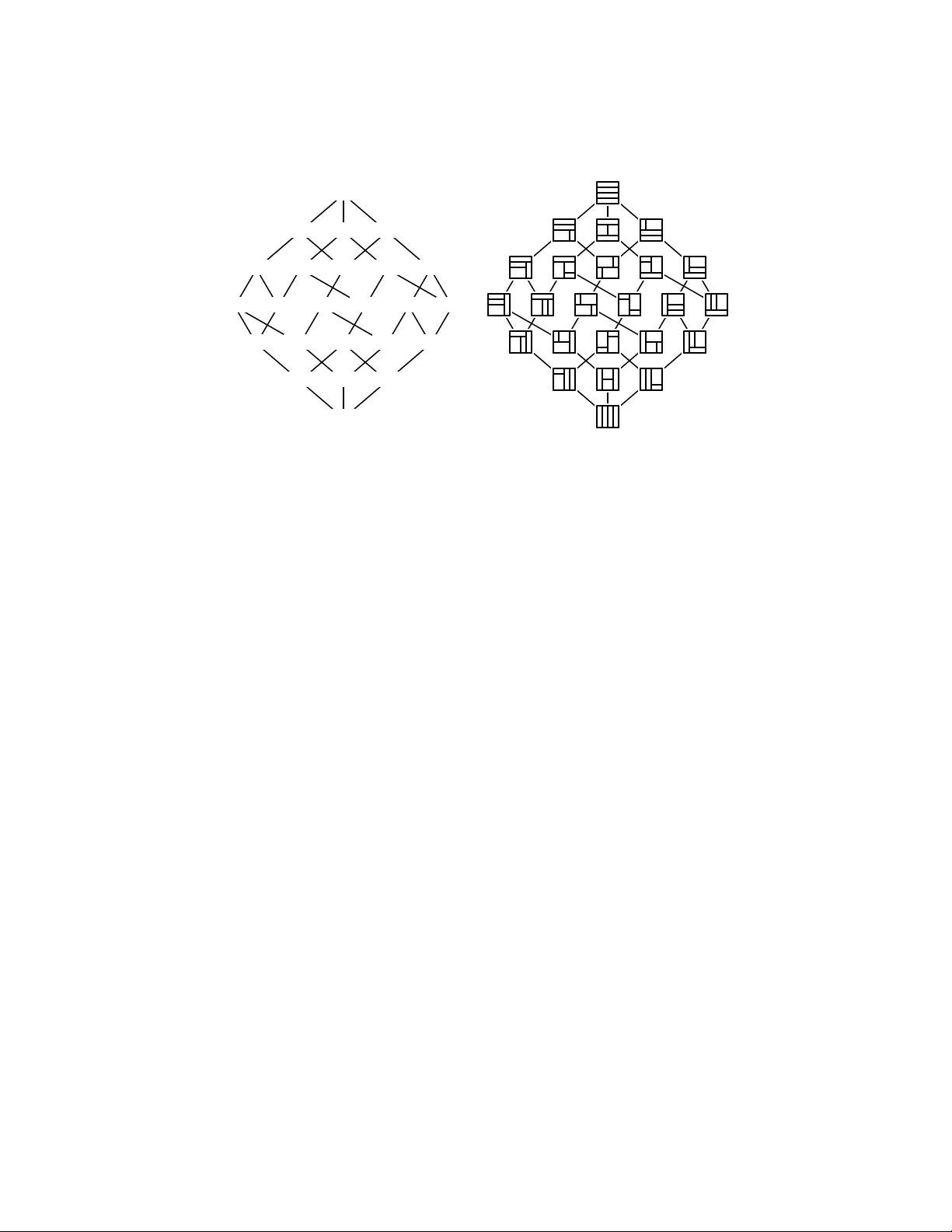
GENERIC RECT ANGULA TIONS NA THAN READING Abstract. A rectangulation is a tiling of a rectangle by a finite num ber of rectangles. The rectangulation is called generic if no four of its rectangles share a single corner. W e initiate the enumeration of generic rectangulations up to combinatorial equiv alence b y establishing an explicit bijection b etw een generic rectangulations and a set of permutations defined by a pattern-a voidance con- dition analogous to the definition of the twisted Baxter p ermutations. Contents 1. In tro duction 1 Note added in pro of 3 2. Clump ed p ermutations 3 3. The map from p ermutations to generic rectangulations 5 4. Main theorem 10 5. Remarks on enumeration 14 References 17 1. Introduction The main characters in this pap er are tilings of a rectangle by finitely many rectangles. A cr oss in such a tiling is a p oint whic h is a corner of four distinct tiles. Fixing a rectangle S and considering the space of all tilings of S by n rectangles, with a uniform probability measure, the set of tilings ha ving one or more crosses has measure zero. Thus w e call a tiling generic if it has no crosses. W e consider generic tilings up to the natural combinatorial equiv alence relation whic h we now describ e. W e orient S so that its edges are vertical and horizon tal. A rectangle U in a tiling R is b elow a rectangle V if the top edge of U intersects the b ottom edge of V (necessarily in a line segment rather than in a point). Similarly , U is left of V if the right edge of U intersects the left edge of V . A tiling R of a rectangle S is combinatorially equiv alent to a tiling R 0 of a rectangle S 0 if there is a bijection from the rectangles of R to the rectangles of R 0 that exactly preserv es the relations “b elo w” and “left of.” A generic r e ctangulation is the equiv alence class of a generic tiling. W e will often blur the distinction b etw een generic rectangula- tions (i.e. equiv alence classes) and e quiv alence class representativ es, in particular sp ecifying an equiv alence class by describing a sp ecific tiling. 2010 Mathematics Subje ct Classific ation. Primary 05A05, 05A19, 05B45. Ac knowledgmen ts: Thanks to Shirley Law for helpful conversations. Nathan Reading w as partially supported by NSA grant H98230-09-1-0056. 1 2 NA THAN READING n Generic rectangulations 1 1 2 2 3 6 4 24 5 116 6 642 7 3,938 8 26,194 9 186,042 10 1,395,008 11 10,948,768 12 89,346,128 13 754,062,288 14 6,553,942,722 n Generic rectangulations 15 58,457,558,394 16 533,530,004,810 17 4,970,471,875,914 18 47,169,234,466,788 19 455,170,730,152,340 20 4,459,456,443,328,824 21 44,300,299,824,885,392 22 445,703,524,836,260,400 23 4,536,891,586,511,660,256 24 46,682,404,846,719,083,048 25 485,158,560,873,624,409,904 26 5,089,092,437,784,870,584,576 27 53,845,049,871,942,333,501,408 T able 1. The num b er of generic rectangulations with n rectangles Our main result is a bijection b etw een generic rectangulations with n rectangles and a class of p ermutations in S n that we call 2 -clump e d p ermutations . These are the p ermutations that av oid the patterns 3-51-2-4, 3-51-4-2, 2-4-51-3, and 4-2-51-3, in the notation of Babson and Steingr ´ ımsson [5], which is explained in Section 2. The author’s counts of generic rectangulations, for small n , are shown in T able 1. W e define k -clump ed permutations in Section 2. F or no w, to place the 2-clump ed p erm utations in context, w e note that the 1-clump ed p ermutations are the twiste d Baxter p ermutations , whic h are in bijection with the b etter-known Baxter p er- mutations . Baxter p ermutations are also relev ant to the combinatorics of rectan- gulations. Indeed, Baxter p ermutations are in bijection [2, 19] with the mosaic flo orplans considered in the VLSI (V ery Large Scale Integration) circuit design literature [13]. Mosaic flo orplans are certain equiv alence classes of generic rectan- gulations. (A similar result linking equiv alence classes of generic rectangulations to pattern-a voiding permutations is given in [4].) In ligh t of results of [1], the bijection from Baxter permutations to mosaic floorplans can b e rephrased as a bijection to a sub class of the generic rectangulations that we call diagonal r e ctangulations , whic h figure prominently in this pap er. The symbol G n will denote the set of 2-clumped p ermutations. Let gRec n b e the set of generic rectangulations with n rectangles. The bijection from G n to gRec n is defined as the restriction of a map γ : S n → gRec n . W e show that γ is surjectiv e and that its fib ers are the congruence classes of a lattice congruence on the weak order on S n . W e do not prov e directly that the fib ers of γ define a congruence. Instead, we recognize the fibers as the classes of a congruence arising as one case of a construction from [17], where lattice congruences on the weak order are used to construct sub Hopf algebras of the Malven uto-Reutenauer Hopf algebra of p ermutations. The results of [17] show that the 2-clumped p ermutations are a set of congruence class representativ es. Th us the restriction of γ is a bijection from G n to gRec n . GENERIC RECT ANGULA TIONS 3 Note added in proof. After this paper w as accepted, the author became aw are of a substan tial literature studying generic rectangulations under the name r e ctangular dr awings . This literature includes some results on asymptotic enumeration as w ell as computations of the exact cardinality of gRec n for man y v alues of n . See, for example, [3, 11, 14]. In particular, the main result of this pap er answ ers an op en question p osed in [3, Section 5]. 2. Clumped permut a tions In this section, we define k -clump ed p erm utations. W e begin with a review of generalized pattern a v oidance in the sense of Babson and Steingr ´ ımsson [5]. Let y = y 1 · · · y k ∈ S k , and let ˜ y b e a word created by inserting a dash b et ween some letters of y 1 · · · y k , with at most one dash b etw een each adjacent pair. A subsequence x i 1 · · · x i k of x 1 · · · x n is an o c curr enc e of the pattern ˜ y in a p ermutation x ∈ S n if the following tw o conditions are satisfied: First, for all j, l ∈ [ k ] with j < l , the inequalit y x i j < x i l holds if and only if y i < y l holds. Second, if y j and y j +1 are not separated by a dash in ˜ y , then i j = i j +1 − 1. That is, the dashes indicate which elemen ts of the subsequence are not required to b e adjacen t in x . F or example, the subsequence 4512 of 45312 ∈ S 5 is an o ccurrence of the pattern 3-4-1-2, or an o ccurrence of the pattern 34-12, but not an occurrence of the pattern 3-41-2. If there is no o ccurrence of the pattern ˜ y in x , then w e say that x avoids ˜ y . T o define k -clump ed p ermutations, we first consider the twiste d Baxter p ermuta- tions , defined in [17] and sho wn in unpublished notes b y W est [18] to be in bijection with Baxter p ermutations. A published pro of can b e found in [15] or [12]. The t wisted Baxter p ermutations are the p ermutations that av oid the patterns 2-41-3 and 3-41-2. This pattern-av oidance condition on a p ermutation x = x 1 · · · x n can b e rephrased as follows: F or ev ery descen t x i > x i +1 , the v alues strictly b etw een x i +1 and x i are either all to the left of x i or all to the right of x i +1 . (The Bax- ter permutations are defined by a similar condition: They are the p ermutations a voiding 3-14-2 and 2-41-3.) In any p ermutation x , we define a clump asso ciated to a descent x i > x i +1 to b e a nonempt y maximal sequence of consecutive v alues strictly b etw een x i and x i +1 , all of whic h are on the same side of the entries x i x i +1 . No requiremen t is made on the positions, relativ e to eac h other, of the v alues in the clump. F or example, in the p ermutation 269153847 ∈ S 9 , there are four clumps asso ciated to the descent 9 > 1, namely 2, 345, 6, and 78. The pattern a voidance condition defining t wisted Baxter permutations is that eac h descent x i > x i +1 has at most one clump, so we refer to twisted Baxter p er- m utations as 1-clump ed p erm utations. More generally , a k -clump e d p ermutation is a p ermutation x suc h that each descent x i > x i +1 has at most k clumps. One can easily rephrase the definition of k -clump ed p ermutations in terms of general- ized patterns a v oidance (av oiding 2 k 2 ! k 2 + 1 ! generalized patterns if k is ev en or 2 k +1 2 ! k +1 2 ! generalized patterns if k is odd). F or example, the 2-clump ed p er- m utations, whic h pla y the cen tral role in this pap er, are the p ermutations av oiding 3-51-2-4, 3-51-4-2, 2-4-51-3, and 4-2-51-3. By conv ention, the only ( − 1)-clump ed p erm utation is the identit y . The 0-clump ed p ermutations are the p erm utations suc h that if x i > x i +1 then x i − 1 = x i +1 . Equiv alently , they are the permutations a voiding 31-2 and 2-31. These p erm utations in S n are in bijection with subsets of { 1 , 2 , · · · n − 1 } . The 3-clump ed permutations app ear not to hav e b een considered 4 NA THAN READING b efore. F or n from 1 to 9, the num b ers of 3-clump ed p ermutations are 1, 2, 6, 24, 120, 712, 4804, 35676 and 284816. The we ak or der on S k is a lattice whose co ver relations are x l y with x = x 1 · · · x k and y = y 1 · · · y k suc h that x i = y i +1 < y i = x i +1 for some i ∈ [ k − 1], with x j = y j for j 6∈ { i, i + 1 } . A join-irr e ducible p ermutation is a p ermutation x ∈ S k with exactly one descen t, meaning that, for some index i ∈ [ k − 1], we ha ve x i > x i +1 but x j < x j +1 for every j ∈ [ k − 1] with j 6 = i . (Suc h a p ermutation is join- irreducible in the weak order in the usual lattice-theoretic sense.) W e no w review a construction from [17, Section 9]. A join-irreducible element x ∈ S k is called untr anslate d if its unique descent x i > x i +1 has x i = k and x i +1 = 1. In this case, a scr amble of x is any p ermutation y suc h that y i = k , y i +1 = 1 and every en try j with 1 < j < k occurs to the left of p osition i in x if and only if it occurs to the left of position i in y . Let y b e a scram ble of x and let ˜ y be obtained from y by inserting a dash b etw een each pair of consecutive en tries except b et ween k and 1. W e sa y that the scram ble y of x o ccurs with adjac ent cliff if the pattern ˜ y o ccurs. Let C be any collection of untranslated join-irreducible elemen ts in S k , with k v arying, so that, for example, C may b e { 312 , 2413 } . The following is essen tially [17, Theorem 9.3]. Theorem 2.1. F or e ach n , ther e exists a unique c ongruenc e H ( C ) n on the we ak or der on S n with the fol lowing pr op erties: (i) A p ermutation z is the minimal element in its H ( C ) n -class if and only if, for every x ∈ C and al l scr ambles y of x , the p ermutation z avoids o c curr enc es of y with adjac ent cliff. (ii) Supp ose w l z in the we ak or der, and let z i and z i +1 b e the adjac ent entries of z that ar e swapp e d to c onvert z to w , with z i > z i +1 . Then w ≡ z mo dulo H ( C ) n if and only ther e exists x ∈ C , a scr amble y ∈ S k of x , and an o c curr enc e of ˜ y in z such that the entry of z c orr esp onding to the entry k in ˜ y is z i and the entry of z c orr esp onding to 1 in y is z i +1 . In [17], the congruence H ( C ) n is constructed for the purp ose of building com bi- natorial Hopf algebras. Here, we can take Theorem 2.1 as the definition of H ( C ) n . Prop ert y (i) in Theorem 2.1 is a direct restatement of [17, Theorem 9.3], while prop ert y (ii) is the k ey p oin t in the pro of of [17, Theorem 9.3]. It is easy and well- kno wn that in a congruence on a finite lattice, each congruence class is an in terv al. Th us a congruence is uniquely determined by the set of cov er relations w l z such that w ≡ z . F urthermore, the minimal p erm utations described in Property (i) are a system of congruence class represen tatives. Let Γ b e the congruence H ( { 35124 , 24513 } ) n on S n . Theorem 2.1 sp ecializes to the following: Prop osition 2.2. (1) A p ermutation is the minimal element in its Γ -class if and only if it is a 2 -clump e d p ermutation. (2) Supp ose x l y in the we ak or der, and let e and a b e the adjac ent entries that ar e swapp e d to c onvert y to x , with a < e . Then x ≡ y mo dulo Γ if and only if ther e ar e entries b , c , and d in y with a < b < c < d < e such that b and d ar e on the same side of ea , while c is on the other side of ea . GENERIC RECT ANGULA TIONS 5 More generally , for each k ≥ − 1, there is a congruence describ ed by Theorem 2.1 suc h that the minimal elemen ts of congruence classes are exactly the k -clump ed p erm utations. 3. The map from permut a tions to generic rect angula tions In this section, w e define a map γ from S n to gRec n . W e will see, in Section 4, that γ restricts to a bijection from the set of 2-clump ed permutations to gRec n . The key p oint in the pro of that γ restricts to a bijection will b e the fact that its fib ers are the congruence classes of the congruence Γ defined at the end of Section 2. T o define the map γ , we first consider a smaller class of rectangulations whic h w e call diagonal r e ctangulations and a map from permutations to diagonal rectangula- tions. The diagonal of the underlying rectangle S is the line segmen t connecting the top-left corner of S to the b ottom-right corner of S . Recall that eac h rectangulation is a combinatorial equiv alence class. A rectangulation is a diagonal rectangulation if it has a representativ e in which each rectangle’s interior intersects the diagonal. A diagonal rectangulation is in particular a generic rectangulation, b ecause if an y four rectangles hav e a common vertex, it is imp ossible for all of their interiors to in tersect the diagonal. Diagonal rectangulations hav e b een considered under other names, for example in [1, 9, 10]. W e now review, from [15], the definition of a map ρ from permutations to di- agonal rectangulations. Maps closely related to ρ hav e app eared prior to [15], for example in [1, 10]. T o define ρ , first dra w n + 1 distinct diagonal p oints on the di- agonal of S , with one of the p oints b eing the top-left corner of S and another b eing the b ottom-right corner of S . Number the spaces b etw een the diagonal p oin ts as 1 , 2 , . . . , n , from top-left to b ottom-righ t. Given x ∈ S n , read the sequence x 1 · · · x n from left to righ t and draw a rectangle for each entry according to the following recursiv e pro cedure: Let T b e the union of the left and bottom edges of S with the rectangles drawn in the first i − 1 steps of the construction. It will b e apparen t by induction that T is left- and bottom-justified. T o dra w the i th rectangle, consider the lab el x i on the diagonal. If the diagonal p oin t p immediately abov e/left of the label x i is not in T , then the top-left corner of the new rectangle is the rightmost p oint of T that is directly left of p . If p is in T (necessarily on the boundary of T ), then the top-left corner of the new rectangle is the highest p oint of T directly ab ov e p . If the diagonal p oint p 0 immediately b elow/righ t of the lab el x i is not in T , then the b ottom-righ t corner of the new rectangle is the highest p oint of T that is directly b elo w p 0 . If p 0 is in T then the b ottom-right corner of the new rectangle is the righ tmost p oint of T that is directly to the right of p 0 . Example 3.1. Figure 1 illustrates the map ρ . In each step, the new rectangle is sho wn in red (the darker gra y when not viewed in color), and the set T consists of the white rectangles together with the left and b ottom edges of S . The part of S not cov ered b y rectangles is shaded in light gra y . Giv en a diagonal rectangulation R , w e num b er the rectangles in R according to the p osition of their intersections with the diagonal, starting with rectangle 1, whic h contains the top-left corner of S and ending at rectangle n , which con tains the bottom-right corner of S . Th us, for example, in constructing the rectangulation ρ ( x ), w e first construct the rectangle n umbered x 1 , then the rectangle num b ered x 2 , 6 NA THAN READING 1 2 3 4 5 6 7 8 9 10 11 12 13 14 15 1 2 3 4 5 6 7 8 9 10 11 12 13 14 15 1 2 3 4 5 6 7 8 9 10 11 12 13 14 15 1 2 3 4 5 6 7 8 9 10 11 12 13 14 15 1 2 3 4 5 6 7 8 9 10 11 12 13 14 15 1 2 3 4 5 6 7 8 9 10 11 12 13 14 15 1 2 3 4 5 6 7 8 9 10 11 12 13 14 15 1 2 3 4 5 6 7 8 9 10 11 12 13 14 15 1 2 3 4 5 6 7 8 9 10 11 12 13 14 15 1 2 3 4 5 6 7 8 9 10 11 12 13 14 15 1 2 3 4 5 6 7 8 9 10 11 12 13 14 15 1 2 3 4 5 6 7 8 9 10 11 12 13 14 15 1 2 3 4 5 6 7 8 9 10 11 12 13 14 15 1 2 3 4 5 6 7 8 9 10 11 12 13 14 15 1 2 3 4 5 6 7 8 9 10 11 12 13 14 15 Figure 1. Steps in the construction of ρ (8 i 13 75 i 11 2 i 14 6 i 15 9 i 10 314 i 12 ) GENERIC RECT ANGULA TIONS 7 ← → ← → Figure 2. W all slides etc. Sa y a permutation x = x 1 · · · x n is c omp atible with a diagonal rectangulation R if and only if, for every i ∈ [ n ], the left and b ottom edges of the rectangle num b ered x i are con tained in the union of the left and b ottom edges of S with the rectangles n umbered x 1 , . . . , x i − 1 . Equiv alen tly , x is compatible with R if, for every i ∈ [ n ], the union of the rectangles num b ered x 1 , . . . , x i is left- and b ottom-justified. The follo wing fact is established in the proof [15, Proposition 6.2], whic h asserts that ρ is surjective. Prop osition 3.2. Given a diagonal r e ctangulation R , the fib er ρ − 1 ( R ) is the set of p ermutations in S n that ar e c omp atible with R . The following proposition, which is the concatenation of [15, Prop osition 4.5] and [15, Theorem 6.3], shows in particular that the fib ers of ρ constitute a congruence of the kind describ ed in Theorem 2.1. Prop osition 3.3. Supp ose x l y in the we ak or der, and let d and a b e the adjac ent entries that ar e swapp e d to c onvert y to x , with a < d . Then ρ ( x ) = ρ ( y ) if and only if ther e ar e entries b and c , with a < b < c < d , such that b and c ar e on opp osite sides of da in y . In some of the literature on flo orplanning for in tegrated circuits, generic rect- angulations are referred to as mosaic flo orplans , but in that literature, the term mosaic floorplan alwa ys implies a coarser equiv alence relation than the combinato- rial equiv alence used to define rectangulations as equiv alence classes. Sp ecifically , t wo generic rectangulations are equiv alen t as mosaic flo orplans if and only if they are related b y a sequence of what we call wal l slides . A wal l in a rectangulation R is a line segmen t in the underlying rectangle S , not contained in an edge of S , that is maximal with resp ect to the prop erty of not in tersecting the interior of any rec - tangle of R . A w all slide along a w all W is the operation taking tw o walls of R that end in W , from opp osite sides, and sliding them past eac h other, without changing an y of the other incidences in R . W all slides come in t wo orien tations, as illustrated in Figure 2. The follo wing is a v ery sp ecial case of [1, Theorem 4]. Prop osition 3.4. Given a generic r e ctangulation R , ther e exists a unique diagonal r e ctangulation R 0 such that R and R 0 ar e e quivalent as mosaic flo orplans. T o see Prop osition 3.4 as a special case of [1, Theorem 4], we need the definition of a diagonal rectangulation giv en in [15, Section 5]: Let X b e a set of n − 1 distinct p oin ts on the diagonal of S , none of which is the top-left corner or b ottom-right corner of S . T hen a diagonal rectangulation of ( S, X ) is a generic rectangulation suc h that every wall contains a point of X and such that ev ery point of X lies on a w all. By [15, Proposition 5.2], this definition is equiv alen t to the earlier definition. Supp ose R is a generic rectangulation and let R 0 b e the diagonal rectangulation that is equiv alent to R as a mosaic flo orplan. As b efore, n umber the rectangles in 8 NA THAN READING 12 4 1 3 10 9 15 6 14 2 11 5 7 13 8 Figure 3. A generic rectangulation R 0 according to the p osition of their in tersections with the diagonal, 1 to n from top-left to b ottom-right. Letting this num b ering propagate along wall slides in the ob vious w ay , w e obtain a num b ering of the rectangles of R . F or each v ertical w all W of R , we produce a p erm utation σ W of a subset of [ n ] as follows: Mo ving from the b ottom endp oint of W to the top endp oint of W , when we come to a wall W 0 that is inciden t to W on the left, we record the n umber of the rectangle that has its right edge in W and its b ottom edge in W 0 . When we come to a wall W 0 that is incident to W on the right, w e record the num b er of the rectangle that has its left edge in W and its top edge in W 0 . The resulting partial p ermutation σ W is called the wal l shuffle asso ciated to W , b ecause it is obtained b y sh uffling t wo sequences: the decreasing sequence of n umbers of rectangles whose righ t edge is con tained in W (excluding the b ottom such rectangle) from b ottom to top and the decreasing sequence of n um b ers of rectangles whose left edge is contained in W (excluding the top such rectangle) from b ottom to top. F or each horizontal wall W , we construct the wall shuffle asso ciated to W in a similar manner. Mo ving from the left endpoint of W to the right endp oint of W , when we come to a wall W 0 that is inciden t to W on the top, w e record the n umber of the rectangle that has its b ottom edge in W and its right edge in W 0 . When we come to a wall W 0 that is incident to W on the b ottom, w e record the num b er of the rectangle that has its top edge in W and its left edge in W 0 . The partial p ermutation σ W , in this case, is obtained by shuffling tw o increasing sequences: the sequence of num b ers of rectangles whose b ottom edge is contained in W (excluding the rightmost suc h rectangle) from left to righ t and the sequence of n um b ers of rectangles whose top edge is con tained in W (excluding the leftmost suc h rectangle) from left to right. Example 3.5. Figure 3 shows a generic rectangulation R whose asso ciated diagonal rectangulation R 0 is the rectangulation from Figure 1. The num b ering of rectangles is inherited from R 0 . T ables 2 and 3 show the w all shuffles asso ciated to R . Sp ecifying a generic represen tation R is equiv alent to sp ecifying the asso ciated diagonal rectangulation R 0 along with the wall shuffles for eac h wall. F or some w alls, there may b e only one shuffle p ossible, and this unique shuffle ma y b e empty . The shuffles may b e chosen arbitrarily (among shuffles of the appropriate rectangle n umbers) and indep enden tly for eac h wall, and each sequence of choices of R 0 and the wall sh uffles yields a different generic rectangulation. GENERIC RECT ANGULA TIONS 9 Rectangles left of wall Rectangles righ t of w all W all sh uffle 2 3 empty 5 6 empty 8, 7, 6 13, 11, 9 i 13 7 i 11 6 9 10 empty 3, 1 4 1 11, 10, 4 12 i 10 4 13 14 empty 14 15 empty T able 2. W all shuffles in v ertical walls of the rectangulation of Figure 3 Rectangles ab ov e w all Rectangles b elow w all W all sh uffle 1 2,3 3 2, 3, 4 5, 6, 9, 10 269 i 10 3 5, 6 7 5 9. 10 11 9 7 8 empty 11, 12 13, 14, 15 i 11 i 14 i 15 T able 3. W all shuffles in horizon tal walls of the rectangulation of Figure 3 When a wall slide is p erformed along a wall W , the mov e alters σ W b y swapping t wo adjacent en tries whic h n umber rectangles on opposite sides of W . Since a w all slide only changes the combinatorics locally , p erforming a wall slide along W do es not alter the wall sh uffle for an y other wall. W e now define the map γ : S n → gRec n . Let x = x 1 x 2 · · · x n ∈ S n and construct R 0 = ρ ( x ). Let W be a v ertical wall in R 0 and consider the rectangles in R 0 ha ving their righ t edges contained in W . By construction, the n umbers of these rectangles form a decreasing subsequence of x 1 x 2 · · · x n . Similarly , the n umbers of the rectangles in R 0 ha ving their left edges contained in W are a decreasing subsequence of x 1 x 2 · · · x n . Thus w e can sp ecify a w all shuffle σ W b y taking the subsequence of x 1 x 2 · · · x n consisting of the appropriate rectangle num bers. F or a horizon tal w all W , the num b ers of the rectangles having their top edges con tained in W form an increasing subsequence of x 1 x 2 · · · x n and the num b ers of the rectangles ha ving their top edges contained in W form an increasing subsequence of x 1 x 2 · · · x n , so, in this case as w ell, w e can sp ecify a w all shuffle for W b y taking an appropriate subsequence of x 1 x 2 · · · x n . The diagonal rectangulation R 0 together with all of these wall sh uffles define the generic rectangulation γ ( x ). Example 3.6. This is a con tinuation of Examples 3.1 and 3.5. Figure 1 sho ws the construction of ρ ( x ) for x = 8 i 13 75 i 11 2 i 14 6 i 15 9 i 10 314 i 12 . T o construct γ ( x ), we lo ok at each wall of ρ ( x ). F or example, ρ ( x ) has a horizontal w all W with rectangles 2, 3, and 4 abov e W and rectangles 5, 6, 9, and 10 b elow W . The restriction of x to the set { 2 , 3 , 6 , 9 , 10 } is 269 i 10 3. Th us γ ( x ) is a rectangulation that is mosaic equiv alent to ρ ( x ) and that has a w all shuffle 269 i 10 3. Considering similarly the 10 NA THAN READING 1234 2134 1324 1243 2314 3124 2143 1342 1423 3214 2341 3142 2413 1432 4123 3241 2431 3412 4213 4132 3421 4231 4312 4321 Figure 4. γ : S 4 → gRec 4 other fiv e horizontal walls of ρ ( x ) and the eight vertical walls of ρ ( x ), we see that γ ( x ) is the rectangulation sho wn in Figure 3. (Cf. T ables 2 and 3.) Example 3.7. Figure 4 shows the map γ applied to every p ermutation in S 4 . The p ermutations in S 4 are shown in the weak order, and the 24 rectangulations in gRec 4 are sho wn in the corresp onding order. As a byproduct of the results of Section 4, the map γ : S n → gRec n induces a lattice structure on gRec n suc h that γ is a surjective lattice homomorphism. 4. Main theorem In this section, we pro ve our main theorem. Theorem 4.1. The r estriction of γ is a bije ction fr om the set of 2 -clump e d p er- mutations in S n to the set of generic r e ctangulations with n r e ctangles. The pro of of Theorem 4.1 is accomplished by pro ving three prop ositions. Prop osition 4.2. The map γ : S n → gRec n is surje ctive. Pr o of. Let R 0 b e an y diagonal rectangulation and choose an arbitrary w all shuffle for each w all of R 0 . W e need to show that there exists x = x 1 x 2 · · · x n ∈ S n suc h that ρ ( x ) = R 0 and suc h that each chosen w all shuffle is a subsequence of x 1 x 2 · · · x n . That is, we need to show that the rectangles of R 0 can b e ordered consisten t with the requirements of Proposition 3.2 and with the wall sh uffles. Supp ose, for 1 ≤ i ≤ n , that w e ha ve chosen i − 1 rectangles in an order consistent with the requirements of Prop osition 3.2 and with the wall shuffles. W e will show that we can choose a rectangle in step i that also satisfies the requiremen ts. Since w e ha ve chosen consistent with Prop osition 3.2, the union T of the i − 1 rectangles c hosen with the left and b ottom edges of S , is a left- and b ottom-justified set. T o satisfy the requirement of Prop osition 3.2 in step i , we m ust chose a rectangle whose bottom and left edges are con tained in T . T o show that we can c ho ose such a rectangle consistent with the w all sh uffles, we extend an argument from the pro of of [15, Prop osition 6.2]. GENERIC RECT ANGULA TIONS 11 U j U j − 1 V T Figure 5. A figure illustrating the pro of of Prop osition 4.2 The top-right b oundary of T is a p olygonal path from the top-left corner of S to the b ottom-right corner of S , alwa ys moving directly right or directly down. Eac h p oin t where the path turns from moving down to mo ving righ t is the b ottom-left corner of a rectangle of R 0 that is not contained in T . W e index these rectangles U 1 , . . . , U m from top-left to b ottom-right. The left edge of U 1 is necessarily con- tained in T , or else w e were wrong to index it as U 1 . Thus if U 1 fails to hav e b oth its b ottom and left edges in T , then its bottom edge is not con tained in T . This implies that the left edge of U 2 is con tained in T . W e con tinue until we find the first j such that the b ottom edge of U j is contained in T . Since the b ottom edge of U m is in T , such a j exists. Necessarily , the left edge of U j is also contained in T . W e no w consider the walls con taining the edges of U j . First, let W l b e the wall con taining the left edge of U j . (If j = 1 and the left edge of U j is in the left edge of S , then there is no wall shuffle asso ciated to the left edge of U j .) Because the b ottom edge of U j − 1 is not contained in T , the top endp oin t of W l is contained in the b ottom edge of U j − 1 , as illustrated in Figure 5. (If j = 1 and the left edge of U j is not in the left edge of S , then the top vertex of W l is in the top edge of S .) W e conclude that all rectangles adjacent to and left of W l are contained in T . Th us w e can pic k U j in step i consistent with the wall sh uffle in W l . Second, let W t b e the wall containing the top edge of U j . If W t is also the w all con taining the bottom edge of U j − 1 , then since the b ottom edge of U j − 1 is not contained in T , the top-left corner p of U j is the top-right corner of another rectangle of R 0 . Since that other rectangle must intersect the diagonal, every p oin t on W t from p righ tw ards is ab ov e the diagonal. Th us U j − 1 is the righ tmost of the rectangles adjacent to and ab ov e W t , b ecause otherwise the bottom-right corner of U j − 1 is the b ottom-left corner of a rectangle of R 0 that do esn’t intersect the diagonal. Since the left edge of U j − 1 is con tained in T , all other rectangles adjacent to and ab ov e W t are constructed in steps 1 through i − 1. Thus w e can pick U j in step i consisten t with the wall sh uffle in W t . If W t is not the wall con taining the b ottom edge of U j − 1 , then the left endp oint of W t is also the top-left corner of U j . (This is the case that is illustrated in Figure 5.) In this case, U j is leftmost among rectangles adjacen t to and b elow W t , so U j do es not figure in the wall sh uffle in W t . W e hav e shown that pic king U j in step i is allo wed by Prop osition 3.2 and by the w all shuffles in the walls W l and W t . Let W r b e the w all containing the right edge of U j and let W b b e the w all containing the bottom edge of U j , if these exist. If j = m , then there is no w all W r and either there is no wall W b or U j is the 12 NA THAN READING righ tmost rectangle adjacen t to and abov e W b , so that U j do es not figure in the w all shuffle in W b . Th us if j = m , the rectangle U j can b e pick ed in step i . If, on the other hand, j < m , then U j can b e pick ed in step i if and only pic king it is allo wed b y the wall sh uffle in W r and by the w all shuffle in W b . Let W 0 l b e the wall containing the left edge of U j +1 and let W 0 t b e the wall con taining the top edge of U j +1 . W e will pro ve the following claim: If picking U j in step i is disallow ed b y the w all sh uffle in W r , or if it is disallow ed b y the w all sh uffle in W b , then the left edge of U j +1 is contained in T , and picking U j +1 in step i is allow ed by the w all shuffle in W 0 l and by the w all shuffle in W 0 t . First, supp ose that picking U j in step i is disallo wed by the w all shuffle in W r . If the b ottom endp oin t of W r is also the b ottom-righ t corner of U j (as sho wn in Figure 5), then U j is the low est of the rectangles adjacent to and left of W r . This w ould contradict the supp osition that pic king U j next is disallow ed by the w all sh uffle in W r , so we conclude that the wall W r con tinues b elow U j . Since the b ottom edge of U j is contained in T , it follo ws that the bottom right corner of U j is the next con vex corner of T . In particular, the wall shuffle in W r requires us to c ho ose U j +1 b efore U j . Since the w all W 0 l coincides with W r , we kno w that the wall sh uffle in W 0 l do es not prev ent us from choosing U j +1 next. Also, w e see that the left edge of U j +1 is contained in T : Otherwise the righ t edge of U j in tersects the left edge of U j +1 , making U j +1 the topmost of the rectangles adjacent to and right of W r (b ecause R 0 is a diagonal rectangulation). This contradicts the supp osition that picking U j next is disallow ed by the wall sh uffle in W r . F urthermore, we see that the top-left corner of U j +1 is strictly b elo w the conv ex corner of T separating U j from U j +1 : Otherwise, that conv ex corner is the corner of four rectangles of R 0 (including U j and U j +1 ). Thus U j +1 is the leftmost rectangle adjacent to and b elo w W 0 t , so it do es not figure in the wall sh uffle in W 0 t . Next, suppose that picking U j in step i is disallo wed by the w all sh uffle in W b . Let V b e leftmost among rectangles adjacent to and b elow W b that are not contained in T . The rectangle V is also shown in Figure 5. Since picking U j in step i is disallo wed by the wall sh uffle in W b , the rectangle V exists and comes before U j in the wall sh uffle for W b . The top endp oint of the wall W 0 l is the top-left corner of V , and in particular is contained in T . Thus all of the rectangles adjacen t to and left of W 0 l are in T , so that choosing U j +1 in step i is allow ed by the w all sh uffle in W 0 l . If V = U j +1 , then W 0 t = W b , and w e already kno w that the w all shuffle in W b requires us to pick V next. If V is not U j +1 , then the left endp oint of W 0 t is con tained in T , so U j +1 is the leftmost rectangle adjacent to and b elow W 0 t , and th us U j +1 do es not figure in the wall shuffle in W 0 t . In either case, the left edge of U j +1 is contained in T , and we ha v e prov ed the claim. If the b ottom edge of U j +1 is contained in T , then the claim implies that picking U j +1 in step i is allo wed b y Prop osition 3.2 and by the wall sh uffles in the w alls W 0 l and W 0 t . W e can th us argue for U j +1 just as we hav e argued ab ov e for U j . If the b ottom edge of U j +1 is not con tained in T , then we find the first k > j such that the b ottom edge of U k is contained in T , and start o ver as ab ov e, replacing U j with U k . Ev entually , w e will find a rectangle that can b e pick ed, because the b ottom edge of U m is con tained in T and b ecause, as men tioned ab ov e, wall sh uffle s in the w alls b elow U m and to the right of U m will never prev en t its being pic ked. Prop osition 4.3. Supp ose x l y in the we ak or der, and let e and a b e the adjac ent entries that ar e swapp e d to c onvert y to x , with a < e . Then γ ( x ) = γ ( y ) if and GENERIC RECT ANGULA TIONS 13 T p a p e a b c d e T p a U a p e U e p a b c d e (a) (b) Figure 6. Figures illustrating the pro of of Prop osition 4.3 only if ther e ar e entries b , c , and d in y , with a < b < c < d < e , such that b and d ar e on the same side of ea , while c is on the other side of ea . Pr o of. Both conditions in the prop osition imply that ρ ( x ) = ρ ( y ), b y the definition of γ and b y Prop osition 3.2. Throughout the pro of, let R 0 b e the diagonal rectan- gulation ρ ( x ) = ρ ( y ). W e claim that γ ( x ) = γ ( y ) if and only if U a and U e are not adjacen t to an y common w all of R 0 . Indeed, if U a and U e are not adjacent to any common wall of R 0 , then x and y must define the same wall shuffles on the walls of R 0 , so γ ( x ) = γ ( y ). Conv ersely , supp ose U a and U e are adjacen t to a common w all W of R 0 . The assumption that ρ ( x ) = ρ ( y ) rules out the p ossibility that U a and U e are b oth on the same side of W , so U a and U e are on opp osite sides of W . Since U a is c hosen immediately b efore U e when R 0 is constructed as ρ ( x ) but immediately after U e when constructing R 0 as ρ ( y ), w e see that a and e are b oth entries in σ W . That is, if W is v ertical, then neither U a nor U e is the b ottom-most rectangle ad- jacen t to W on the left, and neither U a nor U e is the topmost rectangle adjacen t to W on the right. Similarly , if W is horizon tal, neither of the t wo rectangles are the leftmost rectangle b elow W nor the rightmost rectangle ab ov e W . W e conclude that γ ( x ) 6 = γ ( y ) and w e hav e prov ed the claim. Supp ose there are entries b , c , and d in y , with a < b < c < d < e , such that b and d precede ea , but c follows ea . Let T be the union of the left and b ottom edges of S with the rectangles chosen b efore U a and U e when R 0 is constructed as ρ ( x ) or ρ ( y ). In the construction of R 0 as ρ ( x ), the rectangle U a is c hosen next, but in the construction of R 0 as ρ ( y ), the rectangle U e is chosen next. Th us b oth T ∪ U a and T ∪ U e are b ottom- and left-justified sets. Therefore, ev ery p oint of U e is strictly b elo w and strictly to the right of ev ery point of U a . See Figure 6.a, ignoring, for no w, the lab e ls p a and p e . In particular, U a and U e are not adjacent to a common w all of R 0 . By the claim, γ ( x ) = γ ( y ). Similarly , if there are en tries b , c , and d in y , with a < b < c < d < e , suc h that c precedes ea , but b and d follow ea , we see that every p oint of U e is strictly b elow and strictly to the right of every p oint of U a . See Figure 6.b, ignoring the lab els p , p a , and p e . In particular, U a and U e are not adjacen t to a common wall of R 0 , so γ ( x ) = γ ( y ). Con versely , supp ose γ ( x ) = γ ( y ). Let T b e as abov e. F or every concav e corner p of the top-right b oundary of T , there is a rectangle of U whose bottom-left corner is p . Let p a b e the b ottom-left corner of U a and let p e b e the b ottom-left corner 14 NA THAN READING of U e . Both p a and p e are conca ve corners of the boundary of T . There are t wo p ossibilities: The first is that, lo oking from top-left to b ottom-righ t at the concav e corners of the b oundary of T , there is some conca ve corner b etw een p a and p e . In this case, there exist en tries b , c , and d in y , with a < b < c < d < e , suc h that b and d are b efore ea , while c is after ea , as illustrated b y Figure 6.a. The second p ossibilit y is that, from top-left to b ottom-righ t, there are no other concav e corners b et ween p a and p e . Thus there is a single con vex corner p of T betw een p a and p e . Since R 0 equals b oth ρ ( x ) and ρ ( y ), b oth U a and U e ha ve their b ottom and left edges contained in T . If p is the b ottom-righ t corner of U a , or if p is the top-right corner of U e , then U a and U e are adjacen t to a common w all. By the claim, this is a con tradiction to the supposition that γ ( x ) = γ ( y ). Thus there exist entries b , c , and d in y , with a < b < c < d < e , such that c is b efore ea , while b and d are after ea , as illustrated in Figure 6.b. Prop osition 4.2 asserts that ev ery fib er of γ is nonempt y . The following prop osi- tion characterizes the fibers more exactly , and completes the pro of of Theorem 4.1. Prop osition 4.4. Each fib er of γ is a Γ -class. In p articular, e ach fib er of γ c ontains a unique 2 -clump e d p ermutation. Pr o of. By Prop osition 2.2.2 and Proposition 4.3, the fib ers of γ are unions of Γ- classes. Supp ose x and y are distinct p erm utations with γ ( x ) = γ ( y ). Then ρ ( x ) = ρ ( y ) and x and y are consistent with the same set of wall shuffles. W e will sho w that x and y are congruen t modulo Γ. Let i b e the smallest index suc h that x i 6 = y i . W e argue b y induction on n − i . There is some k > i such that y k = x i . Since γ ( x ) = γ ( y ), either the rectangle n umbered x i or the sequence of rectangles n umbered y i y i +1 · · · y k can be chosen next, consistent with the requiremen ts of Prop osition 3.2 and with the w all shuffles. W e conclude that the entry y k = x i do es not participate in any wall shuffles with an y of the en tries y i y i +1 · · · y k − 1 . Consider the sequence of permutations starting with y and moving the entry y k to the left one place at a time, without changing the relative p ositions of the other en tries, with the final en try y 0 in the sequence ha ving y k in p osition i . Then γ is constant on the sequence. Since eac h pair of adjacen t p ermutations in the se- quence is a cov ering pair in the weak order, each pair is related as described in Prop osition 4.3. But then Prop osition 2.2.2 sa ys that the en tire sequence is con- tained in one Γ-class, so that in particular y 0 and y are congruen t modulo Γ. Since γ ( x ) = γ ( y 0 ) and x and y 0 agree in p ositions 1 through i , by induction w e conclude that x and y 0 are congruent modulo Γ. Th us x and y are congruent modulo Γ. W e ha ve shown that each fib er of γ is a Γ-class. The second assertion of the prop osition follows b y Prop osition 2.2.1. 5. Remarks on enumera tion A pleasant formula was obtained in [7] for the n umber of Baxter permutations in S n : B ( n ) = n + 1 1 − 1 n + 1 2 − 1 n X k =1 n + 1 k − 1 n + 1 k n + 1 k + 1 . This formula applies to twisted Baxter (i.e. 1-clump ed) permutations and to diago- nal rectangulations as well. In this section, w e mak e sev eral remarks on the problem GENERIC RECT ANGULA TIONS 15 of enumerating generic rectangulations or 2-clump ed permutations. In particular, w e give some indications that the enumeration of 2-clump ed p ermutations will b e harder than the enumeration of 1-clump ed p ermutations. R emark 5.1 . One wa y to en umerate generic rectangulations is by sp ecializing a form ula of Conant and Mic haels [8]. This formula is a recursion, with signs, counting rectangulations according to the num b er of crosses. Thanks to Jim Conant for pro viding the results of his recursiv e calculations which v erify and extend T able 1. R emark 5.2 . Another approac h to en umerating 2-clump ed permutations is to apply the k ey idea from [7]. This approach appears not to lead to a formula for the num b er of generic rectangulations, but is useful computationally , as w e now explain. Supp ose x ∈ G n . F or eac h entry a in x , let β ( a ) = { b ∈ [ a + 1 , n ] : b is b efore a } . Then n + 1 can be placed b efore a in x to obtain another 2-clump ed permutation if and only if one of the following holds: β ( a ) = ∅ , β ( a ) = [ a + 1 , n ], β ( a ) = [ a + 1 , c ] for some c with a + 1 ≤ c < n , or β ( a ) = [ d, n ] for some d with a + 1 < d ≤ n . Notice that if a satisfies none of these requiremen ts, then even after n + 1 is inserted elsewhere to obtain a p ermutation x 0 ∈ G n +1 , the en try a in x 0 still satisfies none of the requirements. Notice also that n + 1 can b e inserted after all of the en tries of x to obtain a p erm utation in G n +1 . Accordingly , we enco de a 2-clump ed permutation by a string of letters as follo ws. Read through the elements of x from left to right, and for eac h elemen t a , write a letter in the string as follo ws: n (for “null” or “ n ”) if a = n . Assume a 6 = n in the following cases. e (for “empty”) if β ( a ) = ∅ . f (for “full”) if β ( a ) = [ a + 1 , n ]. l (for “low er”) if β ( a ) = [ a + 1 , c ] for some c with a + 1 ≤ c < n . u (for “upp er”) if β ( a ) = [ d, n ] for some d with a + 1 < d ≤ n . If none of these apply , then write nothing. F or example, for eac h of the p ermutations 2413, 4213, 3124 and 3142, the sym- b ol 5 can be inserted anywhere except b efore the symbol 1. The sequences of letters for these permutations are resp ectively en · f , n u · f , e · ln , and e · nf , with a dot “ · ” indicating an en try in the p erm utation that does not produce a letter. The resp ectiv e strings are enf , nuf , eln , and again enf . If we place the symbol n + 1 b efore a in x or if we place n + 1 after all en tries of x , we can construct the string of letters corresp onding to the new p ermutation x 0 b y the follo wing procedure. Insert the letter n in the string before the letter corresp onding to a or at the end of the string and alter letters b efore the insertion according to the follo wing rule: n b ecomes e , e is unc hanged, f b ecomes l , l is unc hanged, and u is deleted. Alter letters o ccurring after the insertion as follo ws: n b ecomes f , e b ecomes u , f is unchanged, l is deleted, and u is unc hanged. No w w e can disp ense with p erm utations en tirely and simply insert letters into strings, coun ting the resulting strings b y multiplicities. W e start with the string n , enco ding the p ermutation 1 ∈ G 1 . Inserting before or after the one letter in the string, we obtain en and nf , corresp onding to the p ermutations G 2 = { 12 , 21 } . Inserting in to these tw o strings, w e obtain the strings een (for 123), enf twice (for 132 and 231), n uf (for 312), eln (for 213), and nff (for 321). In the next round of insertions, deletions of letters come in to play , so that for example, inserting n after the e in eln , we obtain enf . This corresp onds to inserting 4 after 2 in 213 to obtain 2413. In all, there are 15 strings which represen t the 24 permutations in G 4 . 16 NA THAN READING The v alues sho wn in T able 1 are the results of a simple computer program that generates all strings and k eeps track of m ultiplicities. In contrast, represen ting 1-clump ed p ermutations (i.e. t wisted Baxter p ermuta- tions) b y strings leads to an enumeration formula. In this case the lo cations where n + 1 can b e inserted are the lo cations lab eled n , e , or f , with the same defini- tions as ab ov e. When n is inserted in to the string, the remainder of the string is altered as follows: Before the insertion, n becomes e , e is unc hanged, and f is deleted. After the insertion, n b ecomes f , e is deleted, and f is unchanged. All of the strings are of the form e i nf j , for i, j ≥ 0 and i + j ≤ n − 1. Define G ( n, i, j ) to b e the multiplicit y of the string e i nf j for 1-clump ed p ermutations in S n . Up to reindexing in n , the num b ers G ( n, i, j ) coincide with the n um b ers T n ( i, j ) in [7], and the obvious recurrence on G ( n, i, j ) coincides with the recurrence on T n ( i, j ). This recurrence can be solved as in [7], or by the generating function method of [6]. In particular, the generating tree for the t wisted Baxter p erm utations is isomor- phic to the generating tree for Baxter p ermutations. Indeed, the original proof [18] that twisted Baxter permutations biject with Baxter p erm utations proceeded b y establishing this isomorphism of generating trees. R emark 5.3 . Mallows [16] gav e a combinatorial interpretation for the terms in form ula for B ( n ) by p oin ting out that the term indexed by k coun ts Baxter permu- tations with k asc ents (or rises ). There are tw o dual w ays to define ascents: W e will say that a right asc ent is a pair of adjacent entries such that the left entry in the pair is smaller than the right entry in the pair. A left asc ent is a pair of en tries i and i − 1 with i − 1 app earing before i in the permutation. W e can similarly define right desc ents (left entry in the pair larger) and left desc ents ( i − 1 app earing after i ). Recall that the Baxter p ermutation are the permutations av oiding 3-14-2 and 2-41-3. It is easy to see that a giv en permutation is a Baxter p erm utation if and only if its inv erse is a Baxter p ermutation. (See e.g. [15, Corollary 4.2].) Thus, when coun ting Baxter permutations according to the num b er of ascents, it do es not matter whether we use right ascents or left ascen ts. F urthermore, it is immediate that a permutation is a Baxter p ermutation if and only if its reverse p ermutation is also a Baxter permutation. Thus the formula for Baxter p ermutations with a fixed n umber of ascen ts is the same as the form ula for Baxter permutations with a fixed num b er of descen ts. It is easy to see that the num b er of ascents in a p ermuta- tion x equals the n umber of v ertical w alls in the diagonal rectangulation ρ ( x ). Thus the formula for B ( n ) counts diagonal rectangulations according to the n umber of v ertical walls. The num b er of left ascents of x also equals the n umber of vertical walls in the generic rectangulation γ ( x ) and the num b er of left descents of x equals the num- b er of horizon tal walls. Thus by the symmetry of the rectangulations, counting 2-clump ed p erm utations by left descents is equiv alent to counting 2-clumped per- m utations by left ascents. Ho w ever, the in verse of a 2-clump ed p ermutation is not necessarily a 2-clumped permutation, so it matters whether w e tak e the left or right definitions of descents or ascen ts. Th us there are at least three reasonable statistics b y which to coun t: left ascents/descen ts, right ascents, or right descents. Compu- tations show that these three statistics are distributed differently , and suggest the follo wing conjecture: Conje ctur e 5.4 . Fix k ≥ 0 . Then for n ≥ 1 , the numb er of 2 -clump e d p ermutations in S n with exactly d right desc ents is a p olynomial p k ( n ) of de gr e e 3 d and le ading GENERIC RECT ANGULA TIONS 17 c o efficient d Y i =1 2 i ( i + 1)( i + 2) = 2 d +1 d !( d + 1)!( d + 2)! . The p olynomial p k ( n ) must hav e factors ( n − 1)( n − 2) · · · ( n − d ), so the p oint is to determine the p olynomial ˜ p k ( n ) of degree 2 d that results when these factors are taken out. The first few p olynomials app ear to b e ˜ p 0 ( n ) = 1, ˜ p 1 ( n ) = ( n 2 − 2 n + 3) / 3 , ˜ p 2 ( n ) = (5 n 4 − 36 n 3 + 142 n 2 − 279 n + 270) / 180 , and ˜ p 3 ( n ) = (14 n 6 − 213 n 5 + 1688 n 4 − 8361 n 3 + 26000 n 2 − 46884 n + 37800) / 15120 . It should b e emphasized that the p oint of the conjecture is to find a form ula enu- merating all 2-clumped p ermutations. The conjecture can b e prov ed for some small v alues of k , and pro ofs for additional v alues of k are of in terest only to the exten t to which they lead to a conjecture on the general form of p k ( n ). The other tw o statistics (left ascents/descen ts and righ t ascents) do not lead to p olynomial form ulas. In particular, counting 2-clump ed p ermutations b y left ascen ts, or equiv alen tly counting generic rectangulations by the n um b er of vertical w alls, app ears to b e hard. References [1] E. Ac kerman, G. Barequet, and R. Pinter, On the numb er of re ctangulations of a planar p oint set. J. Combin. Theory Ser. A 113 (2006), no. 6, 1072–1091. [2] E. Ac kerman, G. Barequet, and R. Pinter, A bije ction betwe en permutations and floorplans, and its applic ations. Discrete Appl. Math. 154 (2006), no. 12, 1674–1684. [3] K. Amano, S. Nakano, and K. Y amanak a, On the Numb er of R e ctangular Dr awings: Exact Counting and L ower and Upp er Bounds. IPSJ SIG Notes, 2007-AL-115-5, (2007), 33–40. [4] A. Asinowski, G. Barequet, M. Bousquet-M´ elou, T. Mansour, R. Pinter, Orders induce d by se gments in flo orplan partitions and (2-14-3,3-41-2)- avoiding permutations. Preprint, 2010 [5] E. Babson and E. Steingr ´ ımsson, Gener alize d permutation p atterns and a classific ation of the Mahonian statistics. S´ em. Lothar. Combin. 44 (2000), Art. B44b, 18 pp. (electronic). [6] M. Bousquet-M´ elou, F our classes of p attern-avoiding permutations under one r o of: gener at- ing tr e es with two lab els. Electron. J. Combin. 9 (2002/03), no. 2, Researc h pap er 19, 31 pp. (electronic). [7] F. R. K. Chung, R. L. Graham, V. E. Hoggatt Jr. and M. Kleiman, The numb er of Baxter p ermutations. J. Com bin. Theory Ser. A 24 (1978), no. 3, 382–394. [8] J. Conan t and T. Mic haels, On the numb er of tilings of a squar e by r e ctangles. Preprint, 2011. [9] S. Dulucq and O. Guibert, Stack wor ds, standar d tableaux and Baxter p ermutations. Discrete Math. 157 (1996), no. 1–3, 91–106. [10] S. F elsner, ´ E. F usy , M. Noy and D. Orden, Bije ctions for Baxter F amilies and Relate d Obje cts. J. Combin. Theory Ser. A, to app ear [11] R. F ujimaki and T. T ak ahashi, An Asymptotic Estimate of the Numb ers of R ectang ular Dr awings or Flo orplans. Pro c. 2009 IEEE International Symposium on Circuits and Systems (ISCAS2009), 856–859. [12] S. Giraudo, A lgebr aic and c ombinatorial structur es on Baxter permutations. Preprin t, 2010 [13] X. Hong, G. Huang, Y. Cai, J. Gu, S. Dong, C.-K. Cheng, Jun Gu, Corner Blo ck List: An Effe ctive and Efficient T opolo gic al R epr esentation of Non-Slicing Flo orplan. Proceedings of IEEE/ACM In ternational Conference on Computer-Aided Design (ICCAD2000) (ed. A CM, IEEE), 2000, 8–12. 18 NA THAN READING [14] Y. Inoue, T. T ak ahashi, and R. F ujimaki, Counting R e ctangular Drawings or Flo orplans in Polynomial Time. IEICE T rans. on F undamentals of Electronics, Communications and Computer Sciences E92-A (2009) no.4, 1115–1120. [15] S. Law and N. Reading, The Hopf algebr a of diagonal re ctangulations. Preprint, 2010 [16] C. L. Mallows, Baxter p ermutations rise again. J. Combin. Theory Ser. A 27 (1979), no. 3, 394–396. [17] N. Reading, L attic e c ongruences, fans and Hopf algebr as. J. Combin. Theory Ser. A 110 (2005) no. 2, 237–273. [18] J. W est, p ersonal communication, 2006. [19] B. Y ao, H. Chen, C.-K. Cheng and R. Graham, Flo or plan R epr esentations: Complexity and Conne ctions. ACM T rans. on Design Automation of Electronic Systems, 8 , 55–80, Jan. 2003. Dep ar tment of Ma thema tics, Nor th Car olina St a te University, Raleigh, NC, USA
Original Paper
Loading high-quality paper...
Comments & Academic Discussion
Loading comments...
Leave a Comment