Relative Computability and Uniform Continuity of Relations
A type-2 computable real function is necessarily continuous; and this remains true for relative, i.e. oracle-based computations. Conversely, by the Weierstrass Approximation Theorem, every continuous f:[0,1]->R is computable relative to some oracle. …
Authors: Arno Pauly, Martin Ziegler
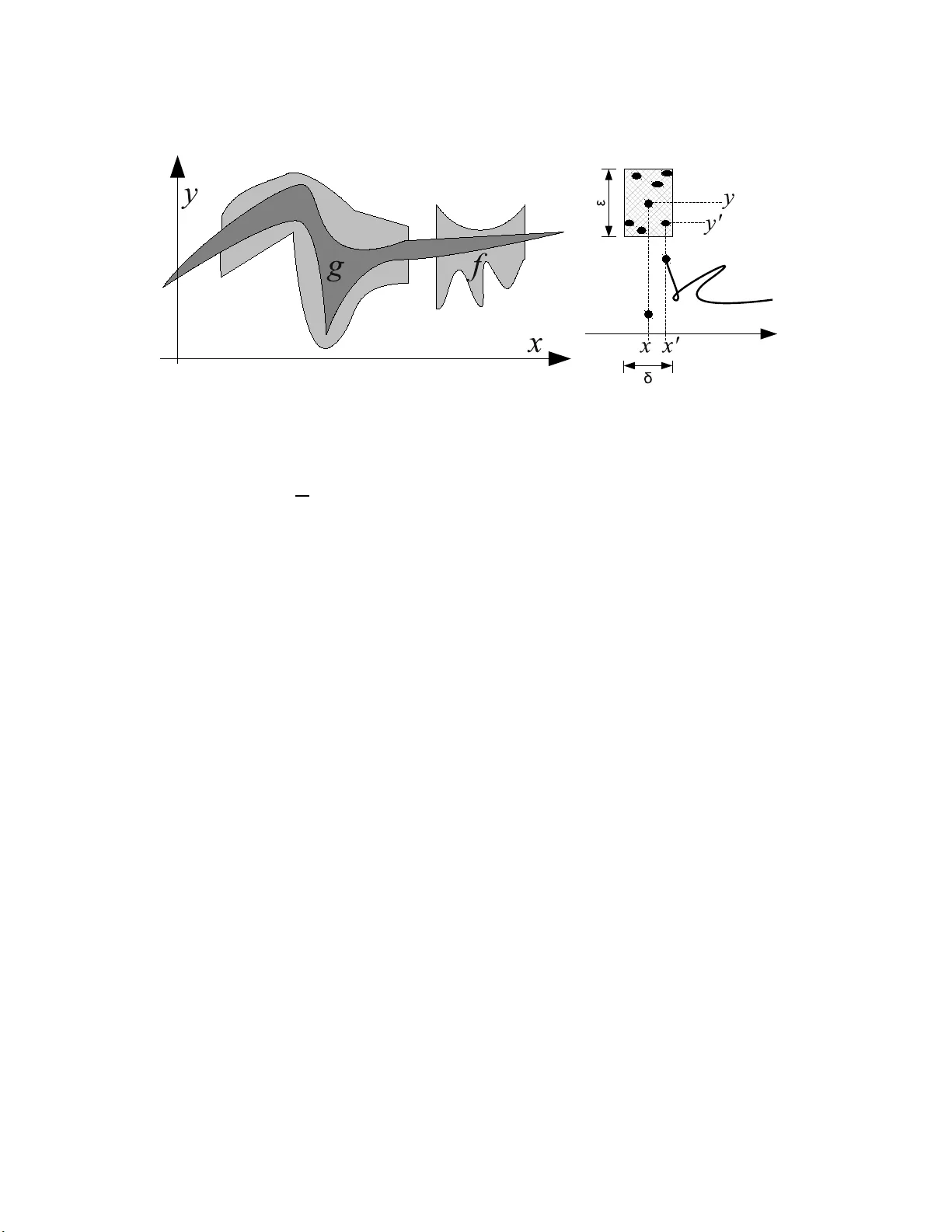
Relativ e Computabilit y and Uniform Con tin uit y of Relatio ns Arno P auly 1 and Martin Ziegler 2 1 Cam bridge Universit y 2 T ec hnisc he Universit¨ at Darmstadt Abstract. A type-2 computable real function is necessari ly con tinuous; and this remains true for relativ e, i.e. oracle-based compu tations. Conv ersely , b y the W eiers trass App ro ximation Theorem, every conti nuous f : [0 , 1] → R is computable relative to some oracle. In their searc h for a similar top ological characterization of relatively computable multi- v alued functions f : [0 , 1] ⇒ R (ak a rela tions), Bra ttk a and Hertling (1994 ) ha ve co nsidered tw o notions: w eak con tinuit y (whic h is weak er than relative computability) and strong contin u ity (which is stronger than relativ e computability). Observing that uniform conti nuit y p la ys a crucial role in the W eierstrass Theorem, we prop ose and compare several notions of uniform contin uit y for relations. Here, du e to the add itional quantification o ver v alues y ∈ f ( x ), new wa ys arise of (linearly) ordering quantifiers—yet none turns out as satisfactory . W e are thus led t o a notion of uniform contin uity based on the Henkin quan t ifier ; and prov e it necessary for relative comp u tabilit y of compact real relations. In fact iterating th is condition yields a strict hierarch y of notions each n ecessary , and th e ω -th level also sufficient, for relative computability . 1 In tro duction . . . . . . . . . . . . . . . . . . . . . . . . . . . . . . . . . . . . . . . . . . . . . . . . . . . . . . 1 2 Con tin uit y for Relations . . . . . . . . . . . . . . . . . . . . . . . . . . . . . . . . . . . . . . . . . . . . 2 2.1 . . . and Compu tabilit y of Relations . . . . . . . . . . . . . . . . . . . . . . . . . . . . . . 6 2.2 Motiv ation for Uniform Contin u it y . . . . . . . . . . . . . . . . . . . . . . . . . . . . . . 8 3 Henkin-Con tin uit y . . . . . . . . . . . . . . . . . . . . . . . . . . . . . . . . . . . . . . . . . . . . . . . . . 9 3.1 F urther Examples and Some Pr op erties . . . . . . . . . . . . . . . . . . . . . . . . . . 10 3.2 Other Characterizations and T o ols . . . . . . . . . . . . . . . . . . . . . . . . . . . . . . 12 3.3 Relativ e Computabilit y requir es Henkin-Contin u it y . . . . . . . . . . . . . . . . 14 3.4 . . . but Henkin-Contin u ity do es not imply Relativ e Compu tability . . . 15 4 Iterated Henkin-Contin uity . . . . . . . . . . . . . . . . . . . . . . . . . . . . . . . . . . . . . . . . . 16 4.1 Examples and Prop erties . . . . . . . . . . . . . . . . . . . . . . . . . . . . . . . . . . . . . . . 18 4.2 Infinitary Henkin Contin uity and the Main Result . . . . . . . . . . . . . . . . . 20 5 Conclusion . . . . . . . . . . . . . . . . . . . . . . . . . . . . . . . . . . . . . . . . . . . . . . . . . . . . . . . 22 1 In tro duction A simple count ing argument sho ws that not ev ery (total) in teger fu nction f : N → N can b e computable; on the other hand, eac h such function can b e enco d ed into an oracle O ⊆ { 0 , 1 } ∗ that renders it relativ ely computable. Ov er r eal n umbers , similarly , not ev ery total f : [0 , 1] → R can b e computable for cardinalit y reasons; and this remains tr ue for oracle mac hines. In fact it is fol klore in Recursiv e Analysis that an y function f computably mapping app r o ximations of real n um b ers x to appro ximations of f ( x ) must necessarily b e con tin uous; and the same remains true for oracle compu tations. Even more surp risingly , this implication can b e r eversed: If a (sa y , real) fu n ction f is con tin uous, then there exists an 2 Arno Pauly, Martin Ziegler oracle wh ic h rend ers f computable § . T his can for instance b e concluded from the W eierstrass Appro ximation Th eorem. A far r eac hin g generalization f rom the reals to so-called admissibly r epr esente d sp ac es is th e Kreitz -W eihrauch Theo rem , cf. e.g. [W eih00 , 3.2.11 ] and compare the Myhill -Shepherdson Theo rem in Domain Theory . T he equiv alence b et w een con tin uit y and relativ e compu tabilit y h as led D ana Scott to consider con tinuit y as an appro ximation to computabilit y . No w m an y computational problems are m ore natur ally expr essed as rela tions (i.e. m ul- tiv alued) r ather than as (single-v alued) fun ctions. F or instance w hen diagonalizing a giv en real symm etric matrix, one is in terested in some basis of eigen v ecto rs, not a sp ecific one. I t is th us natural to consider computations wh ic h , giv en x , inte nsionally choose and ou tp ut some v alue y ∈ f ( x ). In d eed, a multifunction may w ell b e computable yet admit no con tin uous single-v alued sele ction ; cf. e.g. [W eih00, Exer cise 5.1.13 ] or [Lu c k77]. Hence multiv alued- ness a v oids some of the top ologi cal restrictions of single-v alued fu nctions—but of course not all of them. S p ecifically it is easy to see that a multifunction f is relativ ely computable iff it admits a contin uous so-c alled r e alizer , that is a f unction mappin g a ny in fi nite binary string enco ding some x to an infin ite binary string enco din g some y ∈ f ( x ). Ho wev er the single-v alued case raises the hop e for an intrinsic c haracterizat ion of relativ e computabilit y of f , without referr al to Cantor space. Such an inv estigation has b een pursued in [BrHe94], yielding b oth n ecessary and sufficient conditions for a relation to b e computable relativ e to some oracle (which, there, is called r elative c ontinuity and w e shall d enote as r elative c omputability ). Bra ttk a and Her tl ing hav e established wh at r emains to-date the b est coun terpart to the Kr eitz-W eihrauc h Theorem for the multiv alued case: F act 1. L et X, Y b e sep ar able metric sp ac es and Y in addition c omplete. Th en a p ointwise close d r elation f : X ⇒ Y is r elatively c omputable iff it has a str ongly c ontinuous tightening ¶ Here, b eing p ointwise close d means that f ( x ) := { y ∈ Y : ( x, y ) ∈ f } is a closed subset for every x ∈ X . W e s hall freely switc h b et wee n the viewp oint of f : ⊆ X ⇒ Y b eing a relation ( f ⊆ X × Y ) and b eing a s et-v alued partial mappin g f : ⊆ X → 2 Y , x 7→ f ( x ). Suc h f is considered total (written f : X ⇒ Y ) if dom( f ) := { x ∈ X : f ( x ) 6 = ∅} coincides with X . F ollo win g [W eih08 , Definition 7 ], g is s aid to tighten f (and f to lo osen g ) if b oth dom( f ) ⊆ dom( g ) and ∀ x ∈ dom( f ) : g ( x ) ⊆ f ( x ) hold; see Figure 1a) and note that tighte ning is obvio usly reflexive and transitiv e. F urthermore write f [ S ] := S x ∈ S f ( x ) for S ⊆ X an d range( f ) := f [ X ]; also f | S := f ∩ ( S × Y ) and f | T := f ∩ ( X × T ) f or T ⊆ Y . Finally let f − 1 := { ( y , x ) : ( x, y ) ∈ f } denote th e inverse of f , i.e. such that ( f − 1 ) − 1 = f and range( f ) = dom( f − 1 ). 2 Con tin uit y for Relations F or multiv alued mappings, th e literature kno ws a v ariet y of easily confusable notions of con- tin uit y lik e [KlTh84, § 7 ] o r [ScNe07]. Some of them capture the in tuition that, up on input x , al l y ∈ f ( x ) occur a s output for some ‘n ondeterministic’ choi ce [B rat03, Section 7 ]; or that the ‘v alue’ f ( x ) b e p ro duced extensionally as a set [Spr e09]. Here we pur sue the original conception that, up on input x , some v alue y b e outpu t su b ject to the condition y ∈ f ( x ). § It has b een observed that a con tin uous function f : [0 , 1] → [0 , 1] will usually not h ave a le ast oracle rendering it comput able [Mill04 ] ¶ W e reserve the original term “restriction” to den ote either f | A := f ∩ ( A × Y ) or f | B := f ∩ ( X × B ) for some A ⊆ X or B ⊆ Y . Relative Computability and Uniform Con tinuit y of R elations 3 Fig. 1. a) F or a relation g (dark gra y) to tighten f (light gra y) means no more freedom (yet the p ossibilit y) to choose some y ∈ g ( x ) than to c ho ose some y ∈ f ( x ) (whenever possible). b) Illustrating ǫ – δ –contin uity in ( x, y ) for a relation (black) Definition 2. L et ( X , d ) and ( Y , e ) denote metric sp ac es and abbr eviate B ( x, r ) := { x ′ ∈ X : d ( x, x ′ ) < r } ⊆ X and B ( x, r ) := { x ′ ∈ X : d ( x, x ′ ) ≤ r } ; similarly for Y . Now fix some f : ⊆ X ⇒ Y and c al l ( x, y ) ∈ f a p oint of continuity of f if the fol lowing formula hold s (cf. Figur e 1b): ∀ ε > 0 ∃ δ > 0 ∀ x ′ ∈ B ( x, δ ) ∩ dom( f ) ∃ y ′ ∈ B ( y , ε ) ∩ f ( x ′ ) . a) Cal l f strongly continuous if every ( x, y ) ∈ f is a p oint of c ontinuity of f ; e quiv alently: ∀ x ∈ dom( f ) ∀ y ∈ f ( x ) ∀ ε > 0 ∃ δ > 0 ∀ x ′ ∈ B ( x, δ ) ∩ dom( f ) ∃ y ′ ∈ B ( y , ε ) ∩ f ( x ′ ) . b) Cal l f w eakly continuous if the fol lowing holds: ∀ x ∈ dom( f ) ∃ y ∈ f ( x ) ∀ ε > 0 ∃ δ > 0 ∀ x ′ ∈ B ( x, δ ) ∩ dom( f ) ∃ y ′ ∈ B ( y , ε ) ∩ f ( x ′ ) . c) Cal l f unifo rmly w eakly continuous if the fol lowing holds: ∀ ε > 0 ∃ δ > 0 ∀ x ∈ dom( f ) ∃ y ∈ f ( x ) ∀ x ′ ∈ B ( x, δ ) ∩ dom( f ) ∃ y ′ ∈ B ( y , ε ) ∩ f ( x ′ ) . d) Cal l f nonunifo rmly w eakly continuous if the fol lowing holds: ∀ ε > 0 ∀ x ∈ dom( f ) ∃ δ > 0 ∃ y ∈ f ( x ) ∀ x ′ ∈ B ( x, δ ) ∩ dom( f ) ∃ y ′ ∈ B ( y , ε ) ∩ f ( x ′ ) . e) Cal l f unifo rmly strongly continuous if the fol lowing holds: ∀ ε > 0 ∃ δ > 0 ∀ x ∈ dom( f ) ∀ y ∈ f ( x ) ∀ x ′ ∈ B ( x, δ ) ∩ dom( f ) ∃ y ′ ∈ B ( y , ε ) ∩ f ( x ′ ) . f ) Cal l f semi-unifo rmly strongly continuous if the fol lowing holds: ∀ ε > 0 ∀ x ∈ dom( f ) ∃ δ > 0 ∀ y ∈ f ( x ) ∀ x ′ ∈ B ( x, δ ) ∩ dom( f ) ∃ y ′ ∈ B ( y , ε ) ∩ f ( x ′ ) . Items a) and b ) are quoted fr om [BrHe94, Definition 2.1 ]. In the single-v alued case, quan- tifications o v er y ∈ f ( x ) and y ′ ∈ f ( x ′ ) drop out. Here, all a),b),d),f ) collapse to classical con tin uit y; and b oth c) and e) to uniform contin uity . In the multiv alued case, ho w ev er, these notions are easily seen distinct. Note for instance that in f ), δ ma y dep end on x but not on y ; wh ereas y ma y dep end on ε in c) but not in b). Logical connections b et w een the v arious notions are collected in the follo wing 4 Arno Pauly, Martin Ziegler Lemma 3. a) Str ong c ontinuity implies we ak c ontinuity b) but not vic e versa. c) We ak c ontinuity implies nonuniform we ak c ontinuity. d) Uniform we ak c ontinuity implies nonuniform we ak c ontinuity. e) L et f b e u niformly we akly c ontinuous and supp ose that f ( x ) ⊆ Y is c omp act for every x ∈ X . Then f is we akly c ontinuous. f ) U niform str ong c ontinuity implies semi-uniform str ong c ontinuity which in turn implies str ong c ontinuity. g) F or c omp act dom( f ) ⊆ X , nonuniform we ak c ontinuity implies uniform we ak c ontinuity. h) If f ( x ) ⊆ Y is c omp act for every x ∈ X , then str ong c ontinuity implies se mi- uniform str ong c ontinuity. j) If f ⊆ X × Y is c omp act and str ongly c ontinuous, it is uniformly str ongly c ontinuous. k) If f ⊆ X × Y is c omp act, then so ar e dom( f ) ⊆ X and f [ S ] ⊆ Y , for every close d S ⊆ X ; in p articular f ( x ) is c omp act. ℓ ) If X is c omp act and single-value d tota l f : X → Y is c ontinuous, then b oth f ⊆ X × Y and its inverse f − 1 ⊆ Y × X ar e c omp act. Note that the (classically trivial) implication from (we ak) un iform con tin uit y to (wea k) con- tin uit y in e) is based on the (again, classically trivial) h yp othesis that f ( x ) ⊆ Y b e compact. Similarly , th e classical fact that contin uity on a compact set classically yields uniform con ti- n uit y is generalized in g)+c). Fig. 2. a) Example of a un iformly weakly con tinuous b ut not w eakly contin uous rela tion. b) A semi-uniformly strongly conti nuous relation which is n ot uniformly strongly contin uous. c) A compact, wea kly and uniformly w eakly contin uous relation which is not comput ab le relative to any oracle. Pr o of. Items a),c), d), and f ) are obvious. b) is d ue to [BrHe94, Proposition 2.3(3) ]; cmp. Example 4d). e) Fix x ∈ dom( f ). By h yp othesis there exists, to ev ery ε = 1 /n , some δ n and y n ∈ f ( x ) with: ∀ x ′ ∈ B ( x, δ n ) ∩ d om( f ) ∃ y ′ ∈ B ( y n , 1 /n ) ∩ f ( x ′ ). No w since f ( x ) is compact, th ere some subs equ ence y n m of y n con v erges to, sa y , y 0 ∈ f ( x ) with d ( y n m , y 0 ) ≤ 1 /m . W e claim that this y 0 (whic h d o es n ot dep end on ε an ymore) satisfies ∀ ε = 2 /m > 0 ∃ δ := δ n m > 0 ∀ x ′ ∈ B ( x, δ ) ∩ dom( f ) ∃ y ′ ∈ B ( y 0 , ε ) ∩ f ( x ′ ) . Indeed, to arbitrary x ′ ∈ B ( x, δ n m ) ∩ dom( f ), th e hyp othesis yields some y ′ ∈ B ( y , 1 / m ) ∩ f ( x ′ ). Then, by triangle in equalit y , it follo ws y ′ ∈ B ( y 0 , 2 /m ). Note th at a differen t x may require a different subsequence n m ; hence δ may b eco me dep end ent on x ev en if it did not b efore. Relative Computability and Uniform Con tinuit y of R elations 5 g) W e claim that Definition 2d) is equiv alen t to th e form ula ∀ ε > 0 ∀ x ∈ dom( f ) ∃ δ > 0 : Φ ( f , ε, x, δ ) (1) where Φ ( f , ε, x, δ ) abbreviates the pr edicate ∀ x ′ ∈ B ( x, δ ) ∩ dom( f ) ∃ y ′ ∈ f ( x ′ ) ∀ x ′′ ∈ B ( x, δ ) ∩ dom( f ) ∃ y ′′ ∈ f ( x ′′ ) : e ( y ′ , y ′′ ) < ε Indeed, x ′ , x ′′ ∈ B ( x, δ ) yield y ′ ∈ f ( x ′ ) ∩ B ( y , ε ) and y ′′ ∈ f ( x ′′ ) ∩ B ( y , ε ), hence e ( y ′ , y ′′ ) < 2 ε by triangle inequalit y; and, con v ersely , x ′ := x yields y ∈ f ( x ). Next observe that, aga in b y triangle inequalit y , Φ ( f , ε, x, δ ) implies Φ ( f , ε, z , δ / 2) for all z ∈ B ( x, δ/ 2) ∩ dom( f ). No w for arbitrary b ut fixed ε and to ev ery x ∈ d om( f ) there exists b y hypothesis some 0 < δ = δ ( x ) suc h that Φ f , ε, x, δ ( x ) holds. The op en sets B x, δ ( x ) / 2 co ver dom( f ); and b y compactness, finitely man y of them suffice to do so: sa y , B x, δ ( x i ) / 2 , i = 1 , . . . , I . No w tak e ¯ δ > 0 as the minimum o ve r these finitely many δ ( x i ) / 2: it will satisfy Φ ( f , ε, ¯ y , ¯ δ ) for all ¯ y ∈ dom( f ). h) Similarly to g), consider the pred icate ∀ ε > 0 ∀ x ∈ dom( f ) ∀ y ∈ f ( x ) ∃ δ ∈ (0 , ε ) ∀ x ′ , x ′′ ∈ B ( x, δ ) ∩ dom( f ) ∀ y ′ ∈ f ( x ′ ) ∩ B ( y , δ ) ∃ y ′′ ∈ f ( x ′′ ) ∩ B ( y ′ , ε ) | {z } =: Φ ( f ,ε, x,y ,δ ) and note that it is equiv alen t to strong con tin uit y: T he r estriction to δ < ε is no loss of generalit y; y ′ ∈ B ( y , δ ) and y ′′ ∈ f ( x ′′ ) ∩ B ( y , ε ) according to b) implies e ( y ′ , y ′′ ) < δ + ε < 2 ε arbitrary; wh ereas, conv ersely , strong con tin uit y is reco v ered with x ′ := x and y ′ := y . Finally , Φ ( f , ε, x, y , δ ) implies Φ ( f , ε, x, ¯ y , δ/ 2) for all ¯ y ∈ B ( y , δ/ 2). No w th e balls B y , δ ( y ) / 2 , y ∈ f ( x ), co v er f ( x ); and by compactness, finitely man y of them suffi ce to do so. j) This time abbr eviate Φ ( f , x, y , ε, δ ) := ∀ x ′ ∈ B ( x, δ ) ∩ dom( f ) ∃ y ′ ∈ f ( x ′ ) ∩ B ( y , ε ) and obs er ve that strong cont in uit y ∀ ε > 0 ∀ ( x, y ) ∈ f ∃ δ > 0 Φ ( f , x, y, ε/ 2 , δ ) is equiv alen t to ∀ ε > 0 ∀ ( x, y ) ∈ f ∃ δ > 0 Φ ( f , x, y , ε, δ / 2). Moreo v er, Φ ( f , x, y , ε/ 2 , δ ) and ( ¯ x, ¯ y ) ∈ f ∩ B ( x, δ/ 2) × B ( y , ε/ 2) together imply Φ ( f , ¯ x, ¯ y , ε, δ/ 2). F or fixed ε > 0 ther e exists b y h yp othesis to eac h ( x, y ) ∈ f s ome δ = δ ( x, y ) suc h that Φ ( f , x, y, ε/ 2 , δ ). The op en b alls B x, δ ( x, y ) / 2) × B ( y , ε/ 2), ( x, y ) ∈ f , thus co ver f ; and by compactness, already finitely man y of them suffice to do so. T aking ¯ δ as the minim um of their corresp ondin g δ ( x, y ), w e conclude that Φ ( f , x, y , ε, ¯ δ / 2) holds for all ( x, y ) ∈ f : un iform strong contin uity . k) Let U i ⊆ X ( i ∈ I ) denote an op en co v ering of dom( f ). T h en U i × Y is an op en co v ering of f , hence con tains a fin ite sub co ver: whose pr o jectio n onto the fi rst comp onent is a finite sub cov er of U i . Similarly , let V j ⊆ Y ( j ∈ J ) denote an op en co v ering of f [ S ] ⊆ Y . Then X × V j , together with ( X \ S ) × Y , constitutes an op en cov ering of f ; hence con tains a fin ite su b co ver: and the corresp ond ing V j yield a fi nite sub co ver of f [ S ]. Finally , S := { x } is closed and thus also f [ S ] = f ( x ). ℓ ) Let ( x n , y n ) ⊆ f b e a sequen ce. Sin ce ( x n ) ⊆ X compact, it has a conv erging su b sequence; w.l.o.g. ( x n ) itself. No w b y con tin u it y and single-v aluedness, y n = f ( x n ) → f ( x ) conv erges. Th us, f is compact; and homeomorphic to f − 1 . ⊓ ⊔ 6 Arno Pauly, Martin Ziegler W e say that f is p ointwise compact if f ( x ) ⊆ Y is compact for ev ery x ∈ dom( f ). Any single- v alued f automatically satisfies this condition; wh ic h in turn implies b eing p ointwise close d as r equired in F act 1. Po in t wise compactness is essentia l for un iform we ak cont in uit y to imp ly w eak contin uity in Lemma 3e): Example 4. a) The multifunction fr om [Zieg09, Exa mple 27c] , namely f : [ − 1 , +1] ⇒ [0 , 1] , 0 ≥ x 7→ [0 , 1) , 0 < x 7→ { 1 } depicte d in Figur e 2a), is uniformly we akly c ontinuous b u t not we akly c ontinuous. b) The multifunction g : [0 , 1] ⇒ [0 , 1] with graph ( g ) = [0 , 2 / 3) × { 0 } ∪ (1 / 3 , 1] × { 1 } depicte d in Figur e 2b) has c omp act dom( g ) and g ( x ) for every x but graph( g ) is not c omp act. Mor e over, g is semi-uniformly str ongly c ontinuous but not u niformly str ongly c ontinuous. c) The r elation Q × ( R \ Q ) ∪ ( R \ Q ) × Q fr om [BrHe94, Example 7.2 ] is uniformly str ongly c ontinuous. d) Inspir e d by [BrHe94, Proposition 2.3(3) ] , the r elation g : [ − 1 , +1] ⇒ [ − 1 , +1] depicte d in Figur e 2c) with gr aph { ( x, 0) : x ≤ 0 } ∪ { ( x, − 1) : x > 0 } ∪ x, 1+( − 1) n n +1 : n ∈ N , 1 / ( n + 1) ≤ x ≤ 1 /n (2) is c omp act and b oth we akly c ontinuous and u ni f ormly we akly c ontinuous but not str ongly c ontinuous. Pr o of. a) T o assert u n iform weak con tin uit y , consider δ = δ ( ε ) := ε . Moreo v er let y = y ( x, ε ) := 1 for x > 0 and y ( x, ε ) := 1 − ε/ 2 for x ≤ 0. Then, in case x ′ > 0, c ho ose y ′ := 1; and in case x ′ ≤ 0, chose y ′ := 1 − ε / 2. Supp ose f is we akly con tin uous at x := 0, i.e. there exists some appropriate y ∈ f ( x ) = [0 , 1) . The consider ε := 1 − y and the induced δ > 0 as we ll as x ′ := δ / 2: No y ′ ∈ f ( x ′ ) = { 1 } can satisfy ε > | y ′ − y | = 1 − y , con tradiction. b) Note d om( g ) = [0 , 1] and g ( x ) = { 0 } for x ≤ 1 / 3, g ( x ) = { 0 , 1 } for 1 / 3 < x < 2 / 3, and g ( x ) = { 1 } for x ≥ 2 / 3: all compact. C oncerning semi-uniform strong con tin uit y , for x ≤ 1 / 3 let δ := 1 / 3 and y ′ := 0 = y ; for x ≥ 2 / 3 let δ := 1 / 3 and y ′ := 1 = y ; whereas for 1 / 3 < x < 2 / 3, choose δ := min(2 / 3 − x, x − 1 / 3) an d y ′ := y . Uniform strong con tin uit y leads to a con tradiction when considering x := 1 / 3 + δ / 2 and y := 1 and x ′ := 1 / 3. c) Let δ := 1; then observe that Q is d ense in R \ Q and R \ Q is den se in Q . d) Concernin g wea k cont in uit y , in case x ≤ 0 c ho ose y := 0 and δ := ε : then, to x ′ ∈ B ( x, δ ), y ′ := 0 will d o for x ′ ≤ 0 as w ell as for ev ery x ′ ∈ [1 / ( n + 1) , 1 /n ] with n o dd; and y ′ := 2 / ( n + 1) f or x ′ ∈ [1 / ( n + 1) , 1 /n ] with ev en n . In case x > 0 c ho ose y := − 1 and δ := x ; then x ′ ∈ B ( x, δ ) implies x ′ > 0 and y ′ := − 1 works. Regarding uniform weak contin uity , let δ := ε and distinguish cases x < ε and x ≥ ε . In the former case , y := 0 will d o for x ≤ 0 and for x ∈ [1 / ( n + 1) , 1 /n ] with n o d d; and y := 2 / ( n + 1) for x ∈ (0 , ε ) ∩ [1 / ( n + 1) , 1 / n ] with ev en n . In the lat ter case, y := − 1 w orks. Strong con tin uit y is violated, e.g., at ( x, y ) = (1 / 2 , 2 / 3) for ε := 1 / 4. ⊓ ⊔ 2.1 Con tin uit y and Computabilit y of Relat ions Recall that (relativ e) computabilit y of a m ultifunction f : ⊆ R ⇒ R means that some (oracle) T uring machine can, up on input of any sequ ence of in teger fr actions a n /b n with | x − a n /b n | ≤ Relative Computability and Uniform Con tinuit y of R elations 7 2 − n for every n ∈ N and some x ∈ dom( f ), output a sequence u m /v m of in teger fractions with | y − u m /v m | ≤ 2 − m for eve ry m ∈ N and some y ∈ f ( x ). More generally , a multifunction f : ⊆ A ⇒ B b et ween repr esen ted spaces ( A, α ) and ( B , β ) is consid ered (relat iv ely) computable if it admits a (relativ ely) computable ( α, β )–realizer, that is a fun ction F : ⊆ { 0 , 1 } ω → { 0 , 1 } ω mapping ev ery α –name of some a ∈ dom( a ) to a β –name of some b ∈ f ( a ) [W eih00, Definition 3.1.3 ]. Lemma 5. Define the c omp osition o f multifunction f : ⊆ X ⇒ Y and g : ⊆ Y ⇒ Z as g ◦ f := ( x, z ) x ∈ X , z ∈ Z , f ( x ) ⊆ dom( g ) , ∃ y ∈ Y : ( x, y ) ∈ f ∧ ( y , z ) ∈ g } . (3) a) id X tightens f − 1 ◦ f ; if f is single-value d, then f ◦ f − 1 = id range( f ) . b) If f ′ tightens f and g ′ tightens g , then g ′ ◦ f ′ tightens g ◦ f . c) If range( f ) ⊆ d om( g ) holds and b oth f and g ar e c omp act, then so is g ◦ f . d) If range( f ) ⊆ dom( g ) holds and if b oth f and g map c omp act sets to c omp act sets, then so do es g ◦ f . e) Fix r epr esentations α for X and β for Y . A multifunction F : ⊆ { 0 , 1 } ω ⇒ { 0 , 1 } ω tightens β − 1 ◦ f ◦ α iff β ◦ F ◦ α − 1 tightens f . f ) A function F : ⊆ { 0 , 1 } ω → { 0 , 1 } ω is an ( α, β ) –r e alizer of f iff F tightens β − 1 ◦ f ◦ α iff β ◦ F ◦ α − 1 tightens f . Motiv ated by f ), let us call a multifunction F as in e) an ( α, β )– multir e alizer of f . Pr o of. a) Note f ( x ) ⊆ dom( f − 1 ) and f − 1 ◦ f = { ( x, x ′ ) : ∃ y : ( x, y ) , ( x ′ , y ) ∈ f } . b) Note dom( g ◦ f ) = { x ∈ d om( f ) : f ( x ) ⊆ dom( g ) } ; hence dom( f ) ⊆ dom( f ′ ) ∧ dom( g ) ⊆ dom( g ′ ) ∧ f ( x ) ⊇ f ′ ( x ) ∧ g ( y ) ⊇ g ′ ( y ) implies dom( g ◦ f ) ⊆ d om( g ′ ◦ f ′ ) as well as g ′ ◦ g ′ ( x ) = { z : ∃ y ∈ f ′ ( x ) : z ∈ g ′ ( y ) } ⊆ g ◦ f ( x ); cmp. [W eih08 , Lemma 8.3 ]. c) Since r ange( f ) ⊆ dom( g ), g ◦ f is the image of compact f × range( g ) ∩ dom( f ) × g ⊆ X × Y × Z un der the con tin uous p ro jection Π 1 , 3 : X × Y × Z ∋ ( x, y , z ) 7→ ( x, z ) ∈ X × Z . d) immediate f rom g ◦ f [ S ] = g f [ S ] , holding und er the hyp othesis range( f ) ⊆ dom( g ). e) If F tigh tens β − 1 ◦ f ◦ α , then β ◦ F ◦ α − 1 tigh tens β ◦ β − 1 ◦ f ◦ α ◦ α − 1 due to b); whic h in turn coincides with id X ◦ f ◦ id Y = f according to a). Con v ersely , F = id { 0 , 1 } ω ◦ F ◦ id { 0 , 1 } ω tight ens β ◦ β − 1 ◦ F ◦ α ◦ α − 1 b y a); which in turn tigh tens β − 1 ◦ f ◦ α by hyp othesis and by b). f ) F b eing an ( α, β )–realizer of f means dom( F ) ⊇ dom( f ◦ α ) and β F ( ¯ σ ) ∈ f α ( ¯ σ ) for ev ery ¯ σ ∈ dom( f ◦ α ) = d om( β − 1 ◦ f ◦ α ); now apply e). ⊓ ⊔ The ab ov e notion comp osition for relations is, lik e that of ‘tig h tening’, from [W eih08 , Se c- tion 3 ]. Mapping compact sets to compact sets is a pr op ert y which turns out usefu l b elo w. It includ es b oth compact relatio ns (Lemma 3k) and con tinuous f unctions: Example 6. a) L et f : X → Y b e a single-value d c ontinuous fu nction. Then f maps c omp act sets to c omp act sets. b) The inverse ( ρ d sd ) − 1 of the d -dimensional signe d digit r epr esentation maps c omp act set to c omp act sets. c) The functions id : x → x and sgn : R → {− 1 , 0 , 1 } b oth map c omp act sets to c omp act sets; however their Cartesian pr o duct id × sgn do es no t map c omp act { ( x, x ) : − 1 ≤ x ≤ 1 } to a c omp act set. 8 Arno Pauly, Martin Ziegler Indeed, the signed digit rep resen tation ρ sd is w ell-kno wn pr op er [W eih00 , p p.209-21 0], i.e. preimages of compact sets are compact. F o cusing on complete sep arable metric spaces and p oin t wise compact multifunctions, strong con tin uit y is in view of F act 1 (in general strictly) stronger than relativ e computabilit y; whereas w eak contin uity is (again in general strictly) weak er than r elativ e computabilit y: Example 7. a) The r elation (2) fr om E xample 4d) is not c omputable r elative to any or acle. b) The r elation fr om Example 4c) is (uniformly str ongly c ontinuous bu t, lacking p ointwise c omp actness) not c omputable r elative to any or acle. c) The closur e of the r elation fr om Example 4b), that is with gr aph [0 , 2 / 3] × { 0 } ∪ [1 / 3 , 1] × { 1 } , is c omputa ble but not str ongly c ontinuous. Pr o of. a) b y contradicti on: Supp ose so me orac le mac hine M computes th is relatio n. On inp ut of the rational sequen ce (0 , 0 , 0 , . . . ) as a ρ –name of x := 0 it th us outputs a ρ –name of y = 0, i.e. a rational s equence ( p m ) with | p m | < 2 − m . In particular it prin ts p 1 > − 1 / 2 after ha ving r ead only fin itely many elemen ts fr om the input sequence; sa y , up to the ( N − 1)-st elemen t. No w consider the b eh avior of M on the input sequence (0 , 0 , . . . , 0 , 2 − N , 2 − N , . . . ) as ρ –name of x ′ := 2 − N : Its outpu t sequ ence ( p ′ m ) will, again, b egin with p ′ 1 = p 1 > − 1 / 2 and thus cannot b e a ρ –name of − 1. S ince g ( x ′ ) = {− 1 , 0 , 2 / (1 + 2 N ) } , it must therefore satisfy | p ′ m − y | < 2 − m for all m and for one of y = 0 =: y 0 or y = 2 / (1 + 2 N ) =: y 1 . In particular, p ′ N +1 satisfies y j ∈ B ( p ′ N +1 , 2 − N − 1 ) 6∋ y 1 − j for the unique j ∈ { 0 , 1 } with y = y j and is prin ted up on reading only the first, sa y , N ′ ≥ N elemen ts of (0 , 0 , . . . , 2 − N , 2 − N , . . . ). Finally it is easy to exte nd th is fi n ite sequence to a ρ –name of some x ′′ close to x ′ with y j 6∈ g ( x ′′ ) ∋ y 1 − j ; and u p on th is inpu t M w ill now, again, output elements p ′ 1 , . . . , p ′ N +1 whic h, ho w ev er, cannot b e extended to a ρ –name of any y ′′ ∈ g ( x ′′ ): con tradiction. b) see [BrHe94, p.24]. c) Immediate. ⊓ ⊔ F or relations with d iscrete r an ge, on the other han d , we h av e Theorem 8. L et X , Y b e c omputable metric sp ac es [W eih00, Def inition 8.1.2 ] . If Y is discr ete and f : ⊆ X ⇒ Y we akly c ontinuous, then f is r elatively c omputable. Pr o of. Since Y is discrete, ε := min y 6 = y ′ d ( y , y ′ ) > 0. No w to y ∈ Y consider the set U y := x ∈ dom( f ) : ∃ δ > 0 ∀ x ′ ∈ B ( x, δ ) ∩ dom( f ) ∃ y ′ ∈ f ( x ′ ) ∩ B ( y , ε ) and n ote that it is op en in dom( f ) b ecause y ′ ∈ B ( y , ε ) requires y ′ = y . Hence U y = d om( f ) ∩ S j ∈ N B ( q j,y , 1 /n j,y ) for certain n j,y ∈ N and q j,y from the fi xed dens e su bset of X . No w consider an enco ding of (names of ) these q j,y and n j,y as oracle. Then, giv en x ∈ dom( f ), searc h f or some ( j, y ) w ith x ∈ B ( q j,y , 1 /n j,y ) ⊆ U y : when found, s u c h y by constru ction b elongs to f ( x ) and , conv ersely , w eak con tin uit y asserts x to b elong to U y for some y . ⊓ ⊔ 2.2 Motiv ation for Uniform Contin uity Man y pr o ofs of uncomputabilit y of relations or of top ological low er b ounds [Zieg09] app ly w eak con tin uit y as a n ecessary condition: mer ely necessary , in view of th e ab ov e example, and th us of limited applicabilit y . The rest of this work th us explores top ological co nditions stronger than we ak con tin uit y yet necessary f or r elativ e compu tability . Relative Computability and Uniform Con tinuit y of R elations 9 Uniform con tin uit y of functions is su c h a s tr onger notion — a nd an important concept of its o wn in mathematical analysis — yet d o es not straight forwa rdly (or at least not unanim ou s ly) extend to multifunctions. Guided by the equiv alence b et wee n uniform con tin uit y and relativ e computabilit y for f u nctions w ith compact graph, our aim is a top olog ical c h aracterizati on of oracle-co mputable compact real r elations. One suc h c h aracterizati on is F act 1; how ev er we w ould lik e to a v oid (second-order) qu an tifying o v er tightenings. T o this end observe that ev ery (relativ ely) computable function f is (relativ ely) effectiv ely lo cally un iformly con tin uous [W eih00 , Theore m 6.2.7 ], that is, uniformly con tinuous o n ev ery compact subset K ⊆ dom( f ) [KrW e87 ]: ∀ ε > 0 ∃ δ > 0 ∀ x ∈ K ∀ x ′ ∈ B ( x, δ ) ∩ K : d f ( x ) , f ( x ′ ) < ε . This s u ggests to lo ok for r elated concepts f or multifunctions, i.e. wh ere δ do es n ot dep end on x . Uniform weak con tin uit y in the sense of Definition 2c), ho w ev er, fails to strengthen w eak con tin uit y b ecause it allo ws y to dep end on ε . 3 Henkin-Con t in uit y In view of the ab ov e discussion, we seek for an order on the f our quantifiers ∀ x ∈ dom( f ) , ∃ y ∈ f ( x ) , ∀ ε > 0 , ∃ δ > 0 suc h that y does not dep end on ε and δ does not dep end on x . Th is cannot b e expressed in classical first-order logic and h as spurr ed the introd uction of the non -classical so-called Henkin Quantifier [V aan07 ] Q H ( x, y , ε, δ ) = ∀ x ∃ y ∀ ε ∃ δ where the suggestiv e writing indicates that very condition: that y ma y dep end on x but n ot on ε while δ ma y d ep end on ε bu t not on x . W e th us adopt from [Bees85, p.380] the follo w in g k Definition 9. Cal l f Henkin-continuous if the fol lowing holds: ∀ ε > 0 ∃ δ > 0 ∀ x ∈ dom( f ) ∃ y ∈ f ( x ) ! ∀ x ′ ∈ B ( x, δ ) ∩ dom( f ) ∃ y ′ ∈ B ( y , ε ) ∩ f ( x ′ ) . (4) Observe that uniform s tr ong cont in uit y imp lies Henkin-con tin uit y; from whic h in turn f ol- lo w s b oth wea k con tin uit y and u niform w eak con tin uit y . In fact, Henkin -con tinuit y is strictly stronger than the latter t w o: Example 10. a) The r elation g fr om Examples 4d) and 7a) is (c omp act and b oth we akly c ontinuous and uniformly we akly c ontinuous but) not Henkin- c ontinuous. b) It do es, however, satisfy ∀ ε > 0 ∃ δ > 0 ∀ x, x ′ ∃ y ∈ g ( x ) ∃ y ′ ∈ g ( x ′ ) x ′ ∈ B ( x, δ ) → y ′ ∈ B ( y , ε ) . c) The r elations fr om Examples 4b) and 7c) ar e (c omputable and) Henkin- c ontinuous. k Its generalization from metric t o u niform spaces is immediate but b eyond our purp ose. 10 Arno Pauly, Martin Ziegler Pr o of. a) b y contradictio n: Supp ose y = y ( x ) sat isfies Equatio n (4). No w let ε := 1 / 2 an d consider δ := δ ( ε ) ac cording to Equatio n (4 ). Then y ( x ) = − 1 is imp ossible for all 0 < x < δ , as x ′ := ( x − δ ) / 2 < 0 imp lies g ( x ′ ) = { 0 } whic h is disjoin t to B ( y , ε ). No w consider ε ′ := δ · 2 / 3 and δ ′ := δ ( ε ′ ). W e claim that y ( x ) = − 1 is n ecessary for all x > ε ′ , this leading to a cont radiction for δ · 2 / 3 < x < δ . In deed, in case y ( x ) = x , rational x ′ ∈ B x, min { δ ′ , δ/ 3 } implies g ( x ′ ) = { 0 } whic h is disjoin t to B ( y , ε ′ ); whereas in case y ( x ) = 0, irrational x ′ ∈ B x, min { δ ′ , δ/ 3 } implies g ( x ′ ) = { x ′ } which is disjoint to B ( y , ε ′ ). b) Let δ := ε and tak e y := − 1 in case x, x ′ > 0; y := 0 in case x ≤ 0; and { y } := g ( x ) ∩ [0 , 1] in case x ′ ≤ 0 < x . c) F or x ≤ 1 2 c ho ose y := 0 and f or x > 1 2 c ho ose y := 1; indep enden tly , choose δ := 1 6 . ⊓ ⊔ 3.1 F urther Examples and Some Pro p erties Recall that, for single-v alued f unctions, Henkin-con tin uit y coincides w ith uniform contin uity . Example 11. R e c al l f r om the T yp e-2 The ory of E ff e ctivity (TTE) the Cauchy r epr esenta- tion ρ C [W eih00, Definition 4.1.5 ] and the signe d digit r epr esentation ρ sd [W eih00, Defi- nition 7.1.4 ] of r e al numb ers. a) ρ sd : ⊆ { 0 , 1 } ω → R is not u ni f ormly c ontinuous b) nor is the r estriction ρ C | [0 , 1] : ⊆ { 0 , 1 } ω → [0 , 1] ; cmp. [W eih00, Example 7.2.3 ] . c) However for every c omp act K ⊆ R , the r e striction ρ sd | K : ⊆ { 0 , 1 } ω → K is unif ormly (i.e. Henkin-) c ontinuous; d) and so ar e the r estrictions ρ C | C : C → R and ρ sd | C : C → R for any c omp act C ⊆ { 0 , 1 } ω . e) ρ − 1 C : R ⇒ { 0 , 1 } ω , R ∋ x 7→ { ¯ σ : ρ C ( ¯ σ ) = x } , the inverse of the Cauchy r epr esentation, is Henkin-c ontinuous. f ) L et h · , · i : N × N → N b e an inte g er p airing function with h n, m i ≥ n + m for every n, m ∈ N . Then the string p airing function { 0 , 1 } ω × ω → { 0 , 1 } ω , ( b h n,m i ) n,m ∈ ω 7→ ( b k ) k ∈ ω is 1-Lipschitz (and thus uniformly) c ontinuous. Pr o of. a) Consider some large inte ger x = 2 k ∈ N w ith ρ sd –name 10 · · · 0.0 · · · (eac h digit 0 , 1 , ¯ 1 , and the p oin t . encoded as a constan t-length string ov er { 0 , 1 } ∗ ). Then mod ifying this name ¯ σ at the k -th p osition affects the v alue ρ sd ( ¯ σ ) by an absolute v alue of 1. In particular, to ε := 1, δ > 0 satisfying d ( ¯ σ , ¯ τ ) < δ ⇒ d ρ sd ( ¯ σ ) , ρ sd ( ¯ τ ) < ε m ust dep end on the v alue of x = 2 k , i.e. on ¯ σ . b) Fix k ∈ N , and consider in tegers a n := 2 k + n and b n := 3 · 2 k + n . Hence the concatenation ¯ σ of binary -enco d ed numerators a n and d enominators b n constitutes a ρ C –name of x := 1 / 3. Note that the s econdm ost-significan t d igit of b 1 resides r oughly at p osition # k in ¯ σ . Hence switc hing to a ′ n := a n and b ′ n := 2 · 2 k + n yields ¯ σ ′ of metric distance to ¯ σ of order δ = 2 − k ; whereas the v alue x ′ = ρ C ( ¯ σ ′ ) = 1 / 2 c hanges by ε = 1 / 6. c) First consider the case K = [0 , 1]. Then, mo difyin g the k -th digit b k ∈ { 0 , +1 , − 1 } of a signed d igit expans ion P ∞ n =0 b n 2 − n affects its v alue by no more than 2 − k . In the general case, let 2 ℓ denote a b ound on K . Then, similarly , mo difying the k -th p osition of a signed digit expansion P ∞ n = − N b n 2 − n affects its v alue by no more than 2 ℓ − k . Relative Computability and Uniform Con tinuit y of R elations 11 d) Like any admissible represen tation, ρ C and ρ sd are con tin u ous; hence un if orm ly c on tin uous on compact subsets. e) T o ε = 2 − k > 0 let δ := 2 − k . Now consider arbitrary x ∈ R and as ρ C –name ¯ σ the (binary enco dings of numerators and denominators of the) dyadic sequence q n := ⌊ x · 2 n +1 ⌋ / 2 n +1 . In f act it holds | x − q n | ≤ 2 − n − 1 ≤ 2 − n . No w x ′ ∈ B ( x ′ , δ ) has | x ′ − q n | ≤ 2 − k + 2 − n − 1 ≤ 2 − n for n ≤ k − 1 . T herefore the fir st k − 1 elemen ts of ( q n ), and in particular the fi rst k − 1 sym b ols of ¯ σ , extend to a ρ C –name ¯ τ of x ′ ; i.e. suc h that d ( ¯ σ , ¯ τ ) < ε . f ) Mo difying the the argument at index ( n, m ) affects the im age at ind ex h n, m i ≥ n + m , i.e. the metric at w eigh t ≤ 2 − ( n + m ) . ⊓ ⊔ A classical prop ert y b oth of con tin uit y and u n iform con tin u it y is closur e und er restriction and under comp osition. Also Henkin-con tin uit y passes these (appropriately generalized) san ity c hec ks: Observ ation 12. a) L et f : ⊆ X × Y b e Henkin-c ontinuous and tighten g : ⊆ X × Y . Then g is Henkin- c ontinuous, to o. b) If f : ⊆ X × Y and g : ⊆ Y × Z ar e Henkin-c ontinuous, then so is g ◦ f ⊆ X × Z . Pr o of. a) F or g lo osening f and in the defin ition of Henkin-con tin uit y of g , the universal quan tifiers range o ve r a subs et, and the existenti al qu an tifiers range ov er a sup erset, o f those in the defin ition of Henkin-con tin uit y of f . b) By hyp othesis, we hav e ∀ ε > 0 ∃ δ > 0 ∀ y ∈ dom( g ) ∃ z ∈ g ( y ) ! ∀ y ′ ∈ B ( y , δ ) ∩ dom( g ) ∃ z ′ ∈ B ( z , ε ) ∩ g ( y ′ ) (5) ∀ δ > 0 ∃ γ > 0 ∀ x ∈ dom( f ) ∃ y ∈ f ( x ) ! ∀ x ′ ∈ B ( x, γ ) ∩ dom( f ) ∃ y ′ ∈ B ( y , δ ) ∩ f ( x ′ ) (6) Th us, to ε > 0, tak e δ > 0 according to Equ ation (5) and in tu rn γ > 0 according to Equation (6). Sim ilarly , to x ∈ dom( g ◦ f ) ⊆ dom( f ), tak e y ∈ f ( x ) ⊆ dom( g ) according to Equations (6) and (3); and in turn z ∈ g ( y ) according to E quation (5). Th is z thus b elongs to g ◦ f ( x ) and was obtained in dep endently of ε , nor do es γ dep end on x . Moreo v er to x ′ ∈ B ( x, γ ) ∩ dom( g ◦ f ) there is a y ′ ∈ B ( y , δ ) ∩ f ( x ′ ) ⊆ B ( y , δ ) ∩ d om( g ); to w hic h in turn th ere is a z ′ ∈ B ( z , ε ) ∩ g ( y ′ ), i.e. z ′ ∈ B ( z , ε ) ∩ g ◦ f ( x ′ ). ⊓ ⊔ The follo w ing fu rther example in Item b) turn s out as rather useful: Prop osition 13 . a) Every x ∈ R has a signe d digit exp ansion x = X ∞ n = − N a n 2 − n , a n ∈ { 0 , 1 , ¯ 1 } (7) with no c onse cutive digit p air 11 nor ¯ 1 ¯ 1 nor 1 ¯ 1 nor ¯ 11 . b) F or k ∈ N , e ach | x | ≤ 2 3 · 2 − k admits such an exp ansion with a n = 0 for al l n ≤ k . And, c onversely, x = P ∞ n = k +1 a n 2 − n with ( a n , a n +1 ) ∈ { 10 , ¯ 10 , 01 , 0 ¯ 1 , 00 } for every n r e quir es | x | ≤ 2 3 · 2 − k . c) L et x = P ∞ n = − N a n 2 − n b e a signe d digit exp ansion and k ∈ N such that ( a n , a n +1 ) ∈ { 10 , ¯ 10 , 01 , 0 ¯ 1 , 00 } for e ach n > k . Then every x ′ ∈ [ x − 2 − k / 3 , x + 2 − k / 3] admits a signe d digit exp ansions x ′ = P ∞ n = − N b n 2 − n with a n = b n ∀ n ≤ k . 12 Arno Pauly, Martin Ziegler d) L et Σ := { 0 , 1 , ¯ 1 , . } . The inverse ρ − 1 sd : R ⇒ Σ ω of the signe d digit r epr esentation is Henkin-c ontinuous. Pr o of. a) Start with an arbitrary signed d igit expansion ( a n ) of x and rep lace, starting from the most s ignifican t digits, i) any o ccurr ence of 011 w ith 10 ¯ 1 , ii) any o ccurren ce of 0 ¯ 1 ¯ 1 w ith ¯ 101 , iii) any o ccurrence of 01 ¯ 1 w ith 001 , iv) any o ccurr ence of 0 ¯ 11 with 00 ¯ 1 . Note that these s u bstitutions do not affect the v alue P ∞ n = − N a n 2 − n . Moreo ver th e ab o v e four cases are the only p ossible inv olving one of 11 or ¯ 1 ¯ 1 or 1 ¯ 1 or ¯ 11 b ecause, by induction h yp othesis and pro ceeding fr om left (most signifi cant) to righ t, n o su c h com bination was left b efor e of the current p osition. On th e other h and, rewriting Ru le i) may w ell introd uce a new o ccurrence of 11 b efore the current p osition; this is illustrated in the example of 0101011 . Similarly for ¯ 1 ¯ 1 in R u le ii). Therefore, we apply the rules in t w o lo ops: • An infi nite outer one for n = − N , . . . , 0 , 1 , 2 , . . . , main taining that neither 11 nor ¯ 1 ¯ 1 n or 1 ¯ 1 n or ¯ 11 o ccurs b efore p ositio n n • one app licatio n of ru les i) to iv) to remov e a p ossible o ccurr ence at p osition n • follo w ed by a fin ite inner lo op for j running from n bac k to − N , iterativ ely remo vin g o ccurrences wh ich ma y hav e b een newly introdu ced at p osition j . Observe that, after eac h termin ation of the inner lo op, n o o ccurrence remains b efore or at p osition n . Hence the pro cess co n v erges and yields a n equiv alen t signed d igit expansion with the desired pr op ert y . b) Sh if tin g/scaling r educes to the case k = 0; and negation to the case x > 0. 2 3 = 0 . 1010 . . . is an expansion with the claimed prop er ties. So tur n to 0 < x < 2 3 and, indirectly , w.l.o.g. s u pp ose a 0 = 1 . Ex tend this to a signed d igit expans ion of least v alue P ∞ n =0 a n 2 − n = x with no consecutiv e 11 , ¯ 1 ¯ 1 , 1 ¯ 1 , ¯ 11 . Due to monotonicit y , this is atta ined b y includ ing digit ¯ 1 whenever admissible, namely 1 . 0 ¯ 10 ¯ 1 . . . of v alue x = 2 3 : a contradicti on. F or the con v erse, similarly observ e that 0 . 1010 . . . has the largest v alue among all s igned digit expansions with the claimed prop erties; and its v alue is 2 3 . c) Let x ′′ := P k n = − N a n 2 − n and observ e that x − x ′′ = P ∞ n = k +1 a n 2 − n is by hyp othesis a signed d igit expans ion satisfying ( a n , a n +1 ) ∈ { 10 , ¯ 10 , 01 , 0 ¯ 1 , 00 } for all n ≥ k + 1, hence 0 ≤ x − x ′′ ≤ 2 3 · 2 − k b y b). In addition with the hyp othesis | x − x ′ | ≤ 2 − k / 3, we conclude that x ′ − x ′′ = ( x ′ − x ) + ( x − x ′′ ) ∈ [ − 1 3 · 2 − k , 2 − k ] admits a s igned digit expans ion (p ossibly usin g com binations like 11 ) x ′ − x ′′ = P ∞ n = k +1 b n 2 − n . Th us x ′ = ( x ′ − x ′′ ) + x ′′ = P k n = − N a n 2 − n + P ∞ n = k +1 b n 2 − n is an expansion with the claimed prop erties. d) T o 2 − k ≥ ε > 0 let δ := 2 3 ε . T o x ∈ R let ¯ σ b e a ρ sd –name ¯ σ [W eih00, Definition 7.2.4 ] enco ding the signed d igit expansion ( a n ) of x according to a). Due to c), ev ery x ′ ∈ B ( x, δ ) ⊆ B ( x, · 2 − ( k − 1) / 3) admits a signed d igit expansion ( b n ) coinciding with ( a n ) for all n ≤ k − 1. S ince ev ery ρ sd –name includes the bin ary separator sym b ol, an appr opriate name ¯ σ ′ enco ding ( b n ) agrees with ¯ σ for at least the fi rst k + 1 sy mb ols, i.e. has distance at m ost 2 − k ≤ ε . ⊓ ⊔ 3.2 Other C ha racterizations and T ools Let us call a mapping λ : N → N a mo dulu s ; and sa y that a multifunction f : ⊆ X ⇒ Y is λ -continuous i n ( x, y ) ∈ f if, to every m ∈ N and eve ry x ′ ∈ d om( f ) ∩ B ( x, 2 − λ ( m ) ) there exists Relative Computability and Uniform Con tinuit y of R elations 13 some y ′ ∈ f ( x ′ ) ∩ B ( y , 2 − m ). Here, B ( x, r ) := { x ′ ∈ X : d ( x, x ′ ) ≤ r } denotes the closed ball of radius r around x . No w Sk olemiza tion of “ ∀ ε > 0 ∃ δ > 0” yields Observ ation 14. A multifunction f : ⊆ X ⇒ Y is Henkin-c ontinuous i ff ther e exists a mo dulus λ su ch that, for e v ery x ∈ dom( f ) , ther e exists y ∈ f ( x ) such that f is λ -c ontinuous in ( x, y ) ; e quivalently: if, for every x ∈ d om( f ) , f admits some single- value d total sele ction f x : X → Y λ -c ontinuous in x, f x ( x ) (but p ossibly not c ontinuous anywher e e lse, se e E xample 16 b elow). Definition 15. a) F or L > 0 , a multifunction f : ⊆ X ⇒ Y is L -Lipschitz i f ∀ x ∈ dom( f ) ∃ y ∈ f ( x ) ∀ x ′ ∈ d om( f ) ∃ y ′ ∈ B y , L · d ( x, x ′ ) ∩ f ( x ′ ) . (8) b) Cal l a family f i : ⊆ X i ⇒ Y i ( i ∈ I ) of multifunctions equicontinuous if they shar e a c ommon mo dulus in the sense that the fol lowing holds: ∀ ε > 0 ∃ δ > 0 ∀ i ∈ I ∀ x ∈ dom( f i ) ∃ y ∈ f i ( x ) ∀ x ′ ∈ B ( x, δ ) ∃ y ′ ∈ B ( y , ε ) ∩ f ( x ′ ) . (9) So ev er y Lip sc hitz relation is Henkin -con tin u ous; and ev ery family of total L -Lipschitz rela- tions is equicon tin uous. Th e pro of of Pr op osition 13d) r ev eals Item a) of the follo wing Example 16. a) F or Σ = { 0 , 1 , ¯ 1 , . } , the inverse ρ − 1 sd : R ⇒ Σ ω of th e signe d digit r epr e- sentation ∗∗ , is 3 2 -Lipschitz. b) The r elation f := (0 , 0) ∪ [ k ∈ N 2 − k , max { 1 , 3 · 2 − k } × 2 − k ⊆ [0 , 1] × [0 , 1] . depicte d in Figur e 3 is c omp act and 1-Lipschitz. Mor e over, f is c omputable bu t has no lo c al ly c ontinuous sele ction in x 0 = 0 . Fig. 3. Computable compact relation with no lo cally contin uous selection in x 0 = 0. Concerning Example 16b), the ratio min {| y − y ′ | : y ∈ f ( x ) , y ′ ∈ f ( x ′ ) }| / | x − x ′ | b ecomes w orst for x = 2 · 2 − k − 1 − ε (hence f ( x ) = { 2 − k − 1 } , i.e. y = 2 − k − 1 ) and x ′ = 3 · 2 − k − 1 + ε ∗∗ Note that p roceeding from alph abet Σ to { 0 , 1 } 2 affects t h e Lipschitz constant by a factor of 2. 14 Arno Pauly, Martin Ziegler (hence f ( x ′ ) = { 2 − k } , i.e. y = 2 − k ). Moreo v er every ( x, y ) ∈ f satisfies x/ 3 ≤ y ≤ x . Thus the follo wing algorithm computes f : Give n x ∈ [0 , 1] in form of a nested sequence [ a n , b n ] of in terv als with rational end p oints b n − a n ≤ 2 − n − 1 , test w hether [ a n , b n ] ⊆ [2 − n , 3 · 2 − n ] h olds: if not, output [ a n / 3 , b n ] and pro ceed to in terv al # n + 1, otherwise switc h to outputting the constan t sequence [2 − n , 2 − n ]. Note that for x = 0, th e output sequence [ a n / 3 , b n ] will indeed con v erge to y = 0. In case 3 · 2 − k − 1 < x ≤ 2 · 2 − k on the other hand, [ a k , b k ] ⊆ [2 − k , 3 · 2 − k ] holds and will result in the output of y = 2 − k ∈ f ( x ), complian t with p ossible previous in terv als [ a n / 3 , b n ] ⊇ [ x/ 3 , x ] ⊇ f ( x ). I n the fi n al case 2 · 2 − k − 1 < x ≤ 3 · 2 − k − 1 , at least one of [ a k , b k ] ⊆ [2 − k , 3 · 2 − k ] and [ a k , b k ] ⊆ [2 − k − 1 , 3 · 2 − k − 1 ] holds; hen ce the algorithm will pro du ce 2 − n either for n = k o r for n = k + 1. ⊓ ⊔ Prop osition 17 . a) I denote an or dinal and f i : ⊆ X ⇒ Y ( i ∈ I ) an e quic ontinuous family of p ointwise c omp act multifunctions and de cr e asing in the sense that f j tightens f i whenever j > i . Th en f ( x ) := T i : f i ( x ) 6 = ∅ f i ( x ) is again p ointwise c omp act and Henkin- c ontinuous a tightening of e ach f i . Mor e over, if al l f i ar e λ -c ontinuous, then so is f . b) L et f : X ⇒ Y b e λ -c ontinuous and p ointwise c omp act for some mo dulus λ . Then f has a minimal λ - c ontinuous p ointwise c omp act tightening. Pr o of. a) Since the case of a fin ite I is trivial, it su ffices to treat the case I = N of a sequ en ce; the general case then follo ws by transfinite induction. Let x ∈ dom( f i ). Then f j ( x ) ⊆ f i ( x ) for eac h j > i , and hence f ( x ) = T j ≥ i f j ( x ) ⊆ f i ( x ) is (compact an d ) the in tersection of non-empt y compact decreasing sets: f ( x ) 6 = ∅ , x ∈ dom( f ). Moreo ver let ε > 0 b e arbitrary and consider an appropriate δ according to Equ ation (9) ind ep endent of x ; similarly tak e y j ∈ f j ( x ) ind ep endent of ε as asserted b y equicont in uit y . Then the sequence ( y j ) j >i b elongs to compact f j ( x ) and th u s has some accumulatio n p oint y ∈ f j ( x ) ⊆ f i ( x ) for eac h j : thus yields y ∈ f ( x ) ind ep endent of ε . W.l.o.g y j → y b y pr o ceeding to a subsequ ence. No w let d ( x, x ′ ) ≤ δ . Then b y hyp othesis there exists y ′ j ∈ f j ( x ′ ) w ith d ( y j , y ′ j ) ≤ ε ; and, again, an a pprop r iate subsequ en ce of ( y ′ j ) co n v erges to some y ′ ∈ f ( x ′ ). Mo reo v er, d ( y , y ′ ) ≤ d ( y , y j ) + d ( y j , y ′ j ) + d ( y ′ j , y ′ ) ≤ d ( y , y j ) + ε + d ( y ′ , y ′ j ) → ε . b) Consider the family F of a ll λ -con tin uous and p oint wise compact tigh tenings of f . Ac- cording to a), these f orm a dir e cte d c omplete p artial or der ( dcp o ) with r esp ect to total restriction. More explicitly , ap p ly Zorn’s Lemma to get a maximal c hain ( f i ), i ∈ I . T h en a) asserts that g ( x ) := T i : f i ( x ) 6 = ∅ f i ( x ) defin es a λ -con tin u ous and p oint wise compact tigh t- ening of f . In f act a m inimal one: If h ∈ F tightens g , then h = f j for some j ∈ I b ecause of the maximalit y of ( f i ) i ∈ I ; h en ce g ti gh tens f j . ⊓ ⊔ 3.3 Relativ e Computa bilit y requires Henkin-Con tin uit y With the ab o ve examples and to ols, it is no w easy to establish Theorem 18. L et K ⊆ R b e c omp act. a) If f : K ⇒ R is c omputable r elative to some or acle, th en it is He nk i n-c ontinuous. b) Mor e pr e cisely supp ose F : ⊆ { 0 , 1 } ω ⇒ { 0 , 1 } ω is a Henkin-c ontinuous ( ρ sd , ρ sd ) – multi r e alizer of f : K ⇒ R (r e c al l L emma 5) which maps c omp act sets to c omp act sets. Then f itself must b e Henkin-c ontinuous, to o; and has a He nk i n-c ontinuous tightening g : K ⇒ R mapping c omp act sets to c omp act sets. Relative Computability and Uniform Con tinuit y of R elations 15 c) Conversely, if f : K ⇒ R is Henkin- c ontinuous and maps c omp act sets to c omp act sets, then F := ρ − 1 sd ◦ f ◦ ρ sd | K is a Henkin-c ontinuous ( ρ sd , ρ sd ) –multir e alizer of f which maps c omp act sets to c omp act sets. Pr o of. a) Recall [W eih00 , Se ction 3 ] th at a real relation is r elativ ely computable iff it has a contin uou s ( ρ, ρ )–realizer; equiv alen tly [W eih00 , Theorem 7.2.5.1 ]: a con tinuous ( ρ sd , ρ sd )–realize r F . In particular, single-v alued F maps c ompact sets to compact sets. Moreo ver, F is a ( ρ sd , ρ sd )–m ultirealize r acc ording to Lemma 5f ); and has d om( F ) = dom( ρ sd | K ) compact [W eih00, pp.209-21 0], hence is ev en uniformly con tin uous, i.e. Henk in - con tin uous. No w apply b ). b) Prop osition 13d) asserts ρ − 1 sd to b e Henkin -con tinuous; and so is ( ρ sd | K ) − 1 = ( ρ − 1 sd ) | K , cmp. Observ ation 12 a). No w range ( ρ sd | K ) − 1 = ρ − 1 sd [ K ] is co mpact; whic h F maps by h yp othesis to some compact set C ⊆ { 0 , 1 } ω . Therefore ρ sd | C is uniformly (i.e. Henkin- ) cont in uous (Example 11d); and so is ρ sd | C ◦ F ◦ ( ρ sd | K ) − 1 (Observ ation 12b); w hic h, b ecause of C = range F ◦ ( ρ sd | K ) − 1 , co incides with g := ρ sd ◦ F ◦ ρ − 1 sd . No w this g b y h yp othesis tighte ns f ; h ence f is also Henkin-con tin uous (Observ ation 12a). Moreo v er, g maps c ompact sets to compact sets according to Lemma 5d) b ecause eac h subterm ρ − 1 sd [W eih00, pp .209-2 10], F (h yp othesis), and ρ sd (con tin u ous) do es so. c) Again, ρ sd | K and ρ − 1 sd are Henkin-con tinuous b y Example 11 c) and Prop osition 13d); hence so is the co mp osition F (Ob s erv ation 1 2a). F maps co mpact sets to compact sets according to Lemma 5d); n ote that r an ge( f ) ⊆ R = dom( ρ − 1 sd ) and range( ρ sd | K ) = K = dom( f ). Finally , Lemma 5a+b) shows f to tight en ρ sd ◦ F ◦ ρ − 1 sd . ⊓ ⊔ 3.4 Henkin-Con tin uit y do es not imply Relativ e Computability The relation from Example 4c) is Henkin-contin uous but not relativ ely co mputable. On the other hand, it violates the n atural condition of (p oin twise) compactness. In stead, we mo dify Example 16 to obtain (coun ter-) Example 19. L et f + := ( −∞ , 0] × { 0 } ∪ x, ( − 1) n / ( n + 1) : n ∈ N , 1 / ( n + 1) ≤ x ≤ 1 /n f − := [0 , ∞ ) × { 1 } ∪ − x, 1 + ( − 1) n / ( n + 1) : n ∈ N , 1 / ( n + 1) ≤ x ≤ 1 /n Then f 1 := f + ∪ f − : [ − 1 , +1] ⇒ [ − 1 , +2] is c omp act, total, and 1-Lipschitz (h enc e Henkin- c ontinuous), but not r e latively c omputable; se e Figur e 4. Pr o of. Both f + and f − are closed and b ounded and total. Moreo ver, the restriction f + [ − 1 , 0] is 1-Lipschitz: T o x ≤ 0 set y := 0 and δ := ε (1-Lipsc hitz); now if x ′ ≤ 0, y ′ := 0 w ill do; and if 0 < x ′ < δ , consider n ∈ N with 1 / ( n + 1) ≤ x ′ ≤ 1 /n , y ′ := ( − 1) n / ( n + 1) ∈ f + ( x ′ ) has | y ′ − y | = 1 / ( n + 1) ≤ x ′ < δ = ε . Similarly , f − [0 , 1] is 1-Lipsc hitz; hence f 1 is 1-Lipsc hitz—but not relativ ely computable: Giv en a n ame of x = 0, the putativ e r ealizer has the c hoice of pro du cing either a name of y + = 0 or of y − = 1: kno wing x only up to some δ = 1 /n , n ∈ N . In the firs t case, i.e. already tied to f + , sw itch to an input x ′ := 1 / ( n + 1): clearly a p oin t of discon tin uit y of f + . A s imilar con tradiction arises in the second case. ⊓ ⊔ 16 Arno Pauly, Martin Ziegler Fig. 4. A compact total 1-Lipschitz b ut not relatively computable relation. (Dashed lines indicate alignmen t and are not part of th e graph) 4 Iterated Henkin-Con tin uity (Coun ter-)Example 19 suggests to strengthen Definition 9: Definition 20. Cal l a tota l †† multifunction f : X ⇒ Y doubly Henkin-continuous iff the fol lowing hold s: ∀ ε > 0 ∃ δ > 0 ∀ x ∈ X ∃ y ∈ f ( x ) ! ∀ ε ′ > 0 ∃ δ ′ > 0 ∀ x ′ ∈ B ( x, δ ) ∃ y ′ ∈ f ( x ′ ) ∩ B ( y , ε ) ! ∀ x ′′ ∈ B ( x ′ , δ ′ ) ∃ y ′′ ∈ f ( x ′′ ) ∩ B ( y ′ , ε ′ ) Even mor e gener al ly, ℓ -fold Henkin-continuit y ( ℓ ∈ N ) is to me an ∀ ε 1 > 0 ∃ δ 1 > 0 ∀ x 1 ∈ X ∃ y 1 ∈ f ( x 1 ) ! ∀ ε 2 > 0 ∃ δ 2 > 0 ∀ x 2 ∈ B ( x 1 , δ 1 ) ∃ y 2 ∈ f ( x 2 ) ∩ B ( y 1 , ε 1 ) ! · · · · · · ∀ ε ℓ > 0 ∃ δ ℓ > 0 ∀ x ℓ ∈ B ( x ℓ − 1 , δ ℓ − 1 ) ∃ y ℓ ∈ f ( x ℓ ) ∩ B ( y ℓ − 1 , ε ℓ − 1 ) ! ∀ x ℓ +1 ∈ B ( x ℓ , δ ℓ ) ∃ y ℓ +1 ∈ B ( y ℓ , ε ℓ ) ∩ f ( x ℓ +1 ) . (10) Generalizing Examp le 19, we observ e that this notion indeed giv es rise to a pr op er hierarch y: Example 21 (Hierarc h y). T o every ℓ ∈ N ther e exists a c omp act total r elation f ℓ : [ − 1 , 1] ⇒ [ − 1 , 2] which is ℓ -fold Henkin-c ontinuous but not ( ℓ + 1) -fold H enkin-c ontinuous. T o th is end, consid er ℓ = 1 and recall that the relation in Figure 4 is (1- fold) Henkin- con tin uous. T o x = 0 w.l.o.g. supp ose y = 0 is c hosen and to ε := 1 / 4 some δ > 0. No w consider x ′ := 1 /n < δ : Sin ce f + is d iscon tin uous at x ′ , b oth choice s y ′ = s ( − 1) n / ( n + 1) and y ′ = − ( − 1) n / ( n + 2) from f ( x ′ ) con tradict 2-fold Henkin-con tin uit y for some x ′′ = x ′ ± ε ′ . Figure 5 depicts an iteration f 2 of Figure 4 w hic h, similarly , can b e seen 2-fold Henkin- con tin uous bu t not 3-fold. R ep eating th is iteration, one obtains a fractal sequence f ℓ with the claimed p rop erties. †† This requ irement is employ ed only for notational convenience and can alwa y s b e satisfied by pro ceeding to the restriction f | dom( f ) . Relative Computability and Uniform Con tinuit y of R elations 17 Fig. 5. A compact total 2-fold, but not 3-fold, Henkin-continuous relati on Man y prop erties of Henkin-contin uity translate to the iterated case: Lemma 22. Fix ℓ ∈ N . a) If f is ( ℓ + 1) -fold Henkin-c ontinuous, it is also ℓ -fold Henkin-c ontinuous; but not ne c e s- sarily vic e versa. b) If f : X ⇒ Y is u niformly str ongly c ontinuous (and in p articular if f : X → Y i s uniformly c ontinuous), it is ℓ - fold H enkin-c ontinuous for e v ery ℓ . c) If f : X × Y is ℓ -fold Henkin-c ontinuous and tightens g : ⊆ X × Y , then g is ℓ - fold Henkin-c ontinuous (on dom( g ) ) as wel l. d) If f : X × Y and g : Y × Z ar e b oth ℓ - fold Henki n-c ontinuous, then so is g ◦ f (on dom( g ◦ f ) ). Pr o of. a) The first claim is obvious; failure of the conv erse is d emons trated in Example 21. b) immediate in duction. c) As in the pro ofs of Observ ation 12a), g restricts the r ange of the unive rsal quantifiers o ccurring in Equations (10) and extends the range of the existen tial qu antifiers. d) By hyp othesis we hav e Equ ation (10) f or f and the follo wing for g : ∀ δ 1 > 0 ∃ γ 1 > 0 ∀ y 1 ∈ Y ∃ z 1 ∈ g ( y 1 ) ! ∀ δ 2 > 0 ∃ γ 2 > 0 ∀ y 2 ∈ B ( y 1 , γ 1 ) ∃ z 2 ∈ f ( y 2 ) ∩ B ( z 1 , δ 1 ) ! · · · · · · ∀ δ ℓ > 0 ∃ γ ℓ > 0 ∀ y ℓ ∈ B ( y ℓ − 1 , γ ℓ − 1 ) ∃ z ℓ ∈ f ( y ℓ ) ∩ B ( z ℓ − 1 , δ ℓ − 1 ) ! ∀ y ℓ +1 ∈ B ( y ℓ , γ ℓ ) ∃ z ℓ +1 ∈ B ( z ℓ , δ ℓ ) ∩ f ( y ℓ +1 ) . No w in ductiv ely , to ε k +1 > 0 and to x k +1 ∈ dom( g ◦ f ) ∩ B ( x k , δ k ), there exist δ k +1 > 0 indep end en t of x k +1 and y k +1 ∈ f ( x k +1 ) ∩ B ( y k , ε k ) in dep end en t of ε k +1 ; to whic h in turn there exist γ k +1 > 0 indep end en t of y k +1 and z k +1 ∈ g ( y k +1 ) ∩ B ( z k , δ k ) indep en den t of δ k . ⊓ ⊔ 18 Arno Pauly, Martin Ziegler 4.1 Examples and Propert ies Note that δ 2 in Equation (10 ), although indep end en t of x 2 , ma y well d ep end on x 1 : whic h p erhaps do es not en tirely express wh at migh t b e exp ected from a notion of u niform con tin uit y for r elations. On th e other h and, ju st like con tin uit y on a compact set is in the single-v alued case equiv alen t to u niform con tin uit y , we establish Lemma 23. F or c omp act X , total f : X ⇒ Y , and ℓ ∈ N , the fol lowing ar e e quivalent: i) f is ℓ -fold Henkin-c ontinuous ii) ∀ ε > 0 ∃ δ > 0 ∀ x 1 ∈ X ∃ y 1 ∈ f ( x 1 ) ∀ x 2 ∈ X ∃ y 2 ∈ Y · · · ∀ x ℓ ∃ y ℓ ∀ x ℓ +1 ∃ y ℓ +1 ! ^ ℓ k =1 x k +1 ∈ B ( x k , δ ) → y k +1 ∈ f ( x k +1 ) ∩ B ( y k , ε ) (11) iii) Ther e exists a total function λ : N → N such that ∀ x 1 ∃ y 1 ∈ f ( x 1 ) ∀ m 1 ∈ N ∀ x 2 ∈ B ( x 1 , 2 − λ ( m 1 ) ) ∃ y 2 ∈ f ( x 2 ) ∩ B ( y 1 , 2 − m 1 ) ∀ m 2 ∈ N ∀ x 3 ∈ B ( x 2 , 2 − λ ( m 2 ) ) ∃ y 3 ∈ f ( x 3 ) ∩ B ( y 2 , 2 − m 2 ) · · · · · · ∀ m ℓ ∈ N ∀ x ℓ +1 ∈ B ( x ℓ , 2 − λ ( m ℓ ) ) ∃ y ℓ +1 ∈ f ( x ℓ +1 ) ∩ B ( y ℓ , 2 − m ℓ ) . (12) F or non-c omp act X , it stil l holds ‘i ) ⇐ i i) ⇔ iii)”. W e call λ as in iii) a mo dulus of ℓ -fold Henkin-continuity of f . Pr o of. Note that δ k in Equation (10) ma y dep end on x 1 , . . . , x k − 1 ; and y k on ε 1 , . . . , ε k − 1 . ii) ⇒ i): App ly Eq u ation (11) to ε := min { ε 1 , . . . , ε ℓ } and tak e δ 1 := · · · = : δ ℓ := δ in (10). i) ⇒ ii): Recall that ∀ ε k ∃ δ k ∀ x k ∃ y k clearly implies ∀ ε k ∀ x k ∃ δ k ∃ y k . Moreo v er we ma y replace the op en balls B ( x k , δ k ) with their top ological closur es B ( x k , δ k ) by redu cing δ k a bit. No w exp loit compactness and sligh tly extend (the pro of of ) Lemma 3g) to see that δ k can b e c ho- sen indep enden t of x 1 , . . . , x k , that is, ∀ ε j ∀ x k ∈ B ( x k − 1 , δ k − 1 ) ∃ y k ∃ δ j ∀ x k +1 ∃ y k +1 implies ∀ ε j ∃ δ j ∀ x k ∈ B ( x k − 1 , δ k − 1 ) ∃ y k ∀ x k +1 ∃ y k +1 for ev ery 1 ≤ j ≤ k ≤ ℓ . More f orm ally , let Φ ( δ j , x k , δ k ) den ote the f orm ula ∃ y k ∈ f ( x k ) ∩ B ( y k − 1 , ε k − 1 ) ∀ x k +1 ∈ B ( x k , δ k ) · · · Then, by hyp othesis, to ε j > 0 and arbitrary bu t fi xed x k ∈ B ( x k − 1 , δ k − 1 ), there ex- ists δ j = δ j ( x k ) > 0 s u c h that Φ ( δ j , x k , δ k ) holds . No w by triangle inequ ality , every x ′ k ∈ B ( x k , δ k / 2) ∩ B ( x k − 1 , δ k − 1 ) satisfies Φ δ j ( x k ) , x ′ k , δ k / 2 . Th e relativ ely op en balls B ( x k , δ k / 2) ∩ B ( x k − 1 , δ k − 1 ) cov er compact B ( x k − 1 , δ k − 1 ) ⊆ X , h ence finitely many of them suffice to do so. An d these in d uce finitely many δ j ( x k ), suc h that their min im um δ j satisfies Φ ( δ j , x ′ k , δ k / 2) for ev ery x ′ k ∈ B ( x k − 1 , δ k − 1 ). Inductive ly swapping quantifiers as justified ab ov e, we d educe ∀ ε 1 > 0 ∃ δ 1 > 0 ∀ x 1 ∈ X ∃ y 1 ∈ f ( x 1 ) ! ∀ ε 2 > 0 ∃ δ 2 > 0 · · · ∀ ε ℓ > 0 ∃ δ ℓ > 0 ∀ x 2 ∈ B ( x 1 , δ 1 ) ∃ y 2 ∈ f ( x 2 ) ∩ B ( y 1 , ε 1 ) · · · · · · ∀ x ℓ ∈ B ( x ℓ − 1 , δ ℓ − 1 ) ∃ y ℓ ∈ f ( x ℓ ) ∩ B ( y ℓ − 1 , ε ℓ − 1 ) ∀ x ℓ +1 ∈ B ( x ℓ , δ ℓ ) ∃ y ℓ +1 ∈ B ( y ℓ , ε ℓ ) ∩ f ( x ℓ +1 ) Relative Computability and Uniform Con tinuit y of R elations 19 and, b y one further step, obtain ind ep endence of δ 2 , . . . , δ ℓ ev en from x 1 ∈ X : ∀ ε 1 ∃ δ 1 ∀ ε 2 ∃ δ 2 · · · ∀ ε ℓ ∃ δ ℓ ∀ x 1 ∈ X ∃ y 1 ∈ f ( x 1 ) ! ∀ x 2 ∈ B ( x 1 , δ 1 ) ∃ y 2 ∈ f ( x 2 ) ∩ B ( y 1 , ε 1 ) · · · · · · ∀ x ℓ ∈ B ( x ℓ − 1 , δ ℓ − 1 ) ∃ y ℓ ∈ f ( x ℓ ) ∩ B ( y ℓ − 1 , ε ℓ − 1 ) ∀ x ℓ +1 ∈ B ( x ℓ , δ ℓ ) ∃ y ℓ +1 ∈ B ( y ℓ , ε ℓ ) ∩ f ( x ℓ +1 ) Apply this to giv en ε > 0 b y c ho osing let ε 1 := · · · =: ε ℓ := ε and taking δ := min { δ 1 , . . . , δ ℓ } . ii) ⇒ iii): F or m ∈ N set ε := 2 − m , apply ii) to obtain some δ = δ ( m ), and d efine λ ( m ) := ⌈ log 2 (1 /δ ) ⌉ . W e sh ow inductiv ely that this satisfies Equation (12). T o x 1 ∈ X , ii) yields some y 1 ∈ f ( x 1 ) ind ep endent of ε ; now giv en furtherm ore m 1 ∈ N , apply ii) to ε := 2 − m 1 and obtain some δ > 0 (wh ic h b y construction dominates 2 − λ ( m 1 ) ) and to ev ery x 2 ∈ B ( x 1 , 2 − λ ( m 1 ) ) some y 2 ∈ f ( x 2 ) ∩ B ( y 1 , 2 − m 1 ); next, to m 2 ∈ N , ii) with ε := 2 − m 2 yields some δ ≥ 2 − λ ( m 2 ) and to ev ery x 3 ∈ B ( x 2 , 2 − λ ( m 2 ) ) some y 3 ∈ f ( x 3 ) ∩ B ( y 2 , 2 − m 2 ); and so on. iii) ⇒ ii): T o ε > 0, tak e m := ⌈ log 2 (1 /ε ) ⌉ and δ := 2 − λ ( m ) with λ : N → N according to iii). Th en b y Equation (12) inductiv ely , to ev ery m k := m and ev ery x k +1 ∈ B ( x k , δ ) = B ( x k , 2 − λ ( m k ) ), there exists some y k +1 ∈ f ( x k +1 ) ∩ B ( y k , 2 − m k ) ⊆ B ( y k , ε ). ⊓ ⊔ Observ ation 24. If th e family f i : X i ⇒ Y i ( i ∈ I ) is ℓ -fold Henkin- equi c ontinuous in the sense of have a c ommon mo dulus λ of ℓ -fold Henkin-c ontinuity, this wil l also b e a mo dulus of ℓ -fold H enkin-c ontinuity for Q i ∈ I f i : Q i ∈ I X i ⇒ Q i ∈ I Y i with r esp e ct to the maximum metrics d ( x i ) , ( x ′ i ) = max i ∈ I d i ( x i , x ′ i ) and d ( y i ) , ( y ′ i ) = max i ∈ I d i ( y i , y ′ i ) . Note also that equiv alence of th e Cauc hy repr esen tation ρ to the signed digit represen tation ρ sd means th at its inv erse ρ − 1 sd : R ⇒ Σ ω b e compu table. Hence F act 1 asserts that ρ − 1 sd has a strongly con tinuous (and w.l.o.g. p oint wise compact) tigh tening. W e no w strengthen this as w ell as Prop osition 13c)+d): Prop osition 25 . a) L et x = P ∞ n = − N a n 2 − n b e a signe d digit exp ansion and k ∈ N such that ( a n , a n +1 ) ∈ { 10 , ¯ 10 , 01 , 0 ¯ 1 , 00 } for e ach n > k . Then every x ′ ∈ B ( x, 2 − k / 6 ) admits a signe d digit exp ansion x ′ = P ∞ n = − N b n 2 − n satisfying a n = b n ∀ n ≤ k and ( b n , b n +1 ) ∈ { 10 , ¯ 10 , 01 , 0 ¯ 1 , 00 } for al l n > k + 1 . b) L et D := ¯ σ ∈ dom( ρ sd ) : σ N = . , ( σ n , σ n +1 ) ∈ { 10 , ¯ 10 , 01 , 0 ¯ 1 , 00 } ∀ n > N . Then ( ρ sd | D ) − 1 : R ⇒ D tightens the signe d digit r epr esentation and i s unif ormly str ongly c ontinuous with δ (2 − n − 1 ) := 2 − n / 6 . c) In p articular, ρ − 1 sd is ℓ - f old Henkin-c ontinuous for ev ery ℓ ∈ N with mo dulus λ : m 7→ m + 2 . Pr o of. a) First consider the case a k +1 = 0. Th en x ′′ := P k n = − N a n 2 − n = P k +1 n = − N a n 2 − n has 0 ≤ x − x ′′ ≤ 2 − k / 3 d ue to Prop osition 13b). Hence x ′ − x ′′ = ( x ′ − x ) + ( x − x ′′ ) ∈ [ − 2 − k / 6 , 2 − k / 2] ⊆ [ − 2 3 · 2 − k , + 2 3 · 2 − k ] has, again according to Pr op osition 13b), a signed digit expansion x ′ − x ′′ = P ∞ n = k +1 b n 2 − n with ( b n , b n +1 ) ∈ { 10 , ¯ 10 , 01 , 0 ¯ 1 , 00 } for all n . This yields x ′ = ( x ′ − x ′′ ) + x ′′ = P k n = − N a n 2 − n + P ∞ n = k +1 b n 2 − n an expansion with th e claimed p rop erties. It remains to co nsider the case a k +1 = 1 (and a k +1 = ¯ 1 pro ceeds analog ously). Here th e hy- p othesis on ( a n , a n +1 ) asserts a k +2 = 0 . Ther efore x ′′ := P k + 1 n = − N a n 2 − n = P k +2 n = − N a n 2 − n 20 Arno Pauly, Martin Ziegler has 0 ≤ x − x ′′ ≤ 2 − k / 6 d ue to Prop osition 13b). Hence x ′ − x ′′ = ( x ′ − x ) + ( x − x ′′ ) ∈ [ − 2 − k / 6 , 2 − k / 3] ⊆ [ − 2 3 · 2 − ( k + 1) , + 2 3 · 2 − ( k + 1) ] has, again according to P r op osition 13b), a signed digit expansion x ′ − x ′′ = P ∞ n = k + 2 b n 2 − n with ( b n , b n +1 ) ∈ { 10 , ¯ 10 , 01 , 0 ¯ 1 , 00 } for all n . Th is yields x ′ = ( x ′ − x ′′ ) + x ′′ = P k +1 n = − N a n 2 − n + P ∞ n = k +2 b n 2 − n an expansion with the claimed prop erties. b) According to a), ev ery x ′ admits a signed d igit expansion x ′ = P ∞ n = − N b n 2 − n with ( b n , b n +1 ) ∈ { 10 , ¯ 10 , 01 , 0 ¯ 1 , 00 } , i.e. enco d ing a ρ sd –name ¯ σ ∈ D . Morev er, to eac h expan- sion x = P ∞ n = − N a n 2 − n with ( a n , a n +1 ) ∈ { 10 , ¯ 10 , 01 , 0 ¯ 1 , 00 } corresp onding to a ρ sd –name ¯ σ ∈ D and eac h k ∈ N , a) asserts that also eve ry x ′ ∈ B ( x, 2 − k / 6) admits a ρ sd –name ¯ σ ′ ∈ D ∩ B ( ¯ σ , 2 − k − 1 ): the − 1 arising b ecause the d igit . is also s h ared b y b oth ¯ σ and ¯ σ ′ . c) follo ws f rom b ) in view of Lemma 22b). ⊓ ⊔ 4.2 Infinitary Henkin Con tin uit y and the Main Result Lemma 26. F or a total, p ointwise c omp act multifunction f : X ⇒ Y , the fol lowing ar e e quivalent: i) f admits a mo dulus λ of ℓ -fold Henkin-c ontinuity indep e ndent of ℓ ∈ N ii) the fol lowing infinitary formula holds: ∃ δ 1 , δ 2 , · · · , δ ℓ , · · · > 0 ∀ x 1 ∈ X ∃ y 1 ∈ Y ∀ x 2 ∈ X ∃ y 2 ∈ Y · · · ∀ x ℓ ∈ X ∃ y ℓ ∈ Y · · · : y 1 ∈ f ( x 1 ) ∧ ^ ℓ ∈ ω x ℓ +1 ∈ B ( x ℓ , δ ℓ ) → y ℓ +1 ∈ f ( x ℓ +1 ) ∩ B ( y ℓ , 2 − ℓ ) (13) Naturally , F orm ula (13) is endo w ed with the semanti cs of an infi nite tw o-pla y er game (and w e mak e s u re n ot to rely on determinacy). F or a more in -depth bac kground on infinitary logics, the reader ma y refer to [Keis65,KeKn04]. Pr o of. i) ⇒ ii): F or eac h m ∈ N let δ m := λ ( m ). No w apply Equ ation (12) to m 1 := 1 , m 2 := , · · · , m ℓ := ℓ · · · : Fix ℓ ; then, to x 1 ∈ X there exists y ( ℓ ) 1 ∈ f ( x 1 ); to x 2 ∈ B ( x 1 , δ 1 ) = B ( x 1 , 2 − λ ( m 1 ) ) there exists y ( ℓ ) 2 ∈ f ( x 2 ) ∩ B ( y 1 , 2 − 1 ); and , inductive ly , to x ℓ +1 ∈ B ( x ℓ , δ ℓ ) = B ( x ℓ , 2 − λ ( m ℓ ) ) there exists y ( ℓ ) ℓ +1 ∈ f ( x ℓ +1 ) ∩ B ( y ℓ , 2 − ℓ ). Note th at the y ( ℓ ) k indeed d ep end on ℓ since the hypothesis asserts λ to b e a mo du lus of ℓ -fold Henkin-conti nuit y f or ev ery fixed ℓ only . On the other hand , for eac h suc h ℓ , the sequence ( y ( ℓ ) k ) k ‘liv es’ in " k f ( x k ); wh ic h is compact according to T ychonoff : recall our hyp othesis that f b e p oin twise compact. Hence the sequence of sequences ( y ( ℓ ) k ) k ℓ has a subsequence con v erging to some ( y k ) k ∈ " k f ( x k ); and y ( ℓ ) k +1 ∈ B ( y ( ℓ ) k , 2 − k ) implies y k +1 ∈ B ( y k , 2 − k ). ii) ⇒ i): F or eac h m ∈ N let λ ( m ) := ⌈ log 2 (1 /δ m ) ⌉ . W e fir st assert this to b e a mo du lus of 2-fold Henkin-conti nuit y: F or x 1 ∈ X , apply Equation (13) to x 1 =: x ′ 1 =: x ′ 2 =: · · · =: x ′ m 1 and obtain ( y ′ 1 , . . . , y ′ m as well as) a y ′ m 1 =: y 1 ∈ f ( x ) suc h that for ev ery x ′ m 1 +1 := x 2 ∈ B ( x 1 , 2 − λ ( m 1 ) ) ⊆ B ( x ′ m 1 , δ m 1 ) there exists some y 2 := y ′ m 1 +1 ∈ f ( x 2 ) ∩ B ( y 1 , 2 − m 1 ). No w iterating this argumen t inductiv ely sho ws λ to b e a modu lus of ℓ -fold Henkin- con tin uit y for eve ry ℓ ∈ N . ⊓ ⊔ Let us say that f is ω -fold Henkin-con tin uous if it satisfies Equation (13). On Can tor space, this ma y b e regarded as a u niform v ersion of K¨ onig’s L emma ; cmp. [Kohl02]. And indeed we ha v e Relative Computability and Uniform Con tinuit y of R elations 21 Prop osition 27 . Supp ose F : ⊆ { 0 , 1 } ω ⇒ { 0 , 1 } ω maps c omp act sets to c omp act sets and is ω -fold Henkin-c ontinuous. Then F admits a uniformly c ontinuous total sele ction G : dom( F ) → { 0 , 1 } ω . Mor e p r e cise ly if λ is a mo dulus of ℓ -fold Henkin-c ontinuity of F for every ℓ , then λ is also a mo dulus of c ontinuity of G . Pr o of. Note that the tria ngle inequalit y in { 0 , 1 } ω strengthens to d ( ¯ x, ¯ z ) ≤ max { d ( ¯ x, ¯ y ) , d ( ¯ y , ¯ z ) } . Moreo ver it is no loss of generalit y to supp ose δ ℓ = 2 − λ ( ℓ ) > δ ℓ +1 for eac h ℓ in Equ ation (13). No w w ith [W eih00 , Lem ma 2.1.11.2 ] in mind, we first construct a ‘blo ck- monotone’ partial mapping g : ⊆ { 0 , 1 } ∗ → { 0 , 1 } ∗ ; more sp ecifically: g : { 0 , 1 } λ ( ℓ ) → { 0 , 1 } ℓ for ev ery ℓ ∈ N suc h th at g ( a ) is (d efined and) an initial substring of g ( ab ) wh enev er a ∈ { 0 , 1 } λ ( ℓ ) and b ∈ { 0 , 1 } λ ( ℓ +1) − λ ( ℓ ) satisfy ab ∈ d om( g ). The construction p ro ceeds inductiv ely as follo ws: F or x 1 ∈ { 0 , 1 } λ (1) , consider some ¯ x 1 ∈ d om( F ) extending x 1 , i.e. ¯ x 1 ∈ x 1 ◦ { 0 , 1 } ω . If n o suc h ¯ x 1 exists, g ( x 1 ) shall b e undefi n ed; otherwise there is by hyp othesis some ¯ y 1 ∈ F ( ¯ x 1 ) satisfying the matrix of Equ ation (13): th en define g ( x 1 ) := y 1 := ¯ y 1 | ≤ 1 , the fi rst sym b ol of ¯ y 1 . F or x 2 ∈ x 1 ◦ { 0 , 1 } λ (2) − λ (1) , if there exists some ¯ x 2 ∈ ( x 2 ◦ { 0 , 1 } ω ) ∩ dom( F ), it h olds ¯ x 2 ∈ B ( ¯ x 1 , 2 − λ (1) ) and w e may set g ( x 2 ) := y 2 := ¯ y 2 | ≤ 2 with ¯ y 2 ∈ F ( ¯ x 1 ) ∩ ( y 1 ◦ { 0 , 1 } ω ) according to Equation (13). Inductive ly , f or x ℓ +1 ∈ x ℓ ◦ { 0 , 1 } λ ( ℓ +1) − λ ( ℓ ) , if ∅ 6 = ( x ℓ +1 ◦ { 0 , 1 } ω ) ∩ dom( F ) ∋ ¯ x ℓ +1 , set g ( x ℓ +1 ) := y ℓ +1 := ¯ y ℓ +1 | ≤ ℓ with ¯ y ℓ +1 ∈ F ( ¯ x ℓ ) ∩ ( y ℓ ◦ { 0 , 1 } ω ) according to E q u ation (13). No w observe that ∅ 6 = ( x ℓ +1 ◦ { 0 , 1 } ω ) ∩ d om( F ) implies ∅ 6 = ( x ℓ ◦ { 0 , 1 } ω ) ∩ d om( F ); hence, for ¯ x ∈ dom( F ), g ( ¯ x | ≤ λ ( ℓ ) ) is defined for every ℓ . Since g is ‘blo ck-mo notone’ in the ab ov e sense, G ( x ) := lim ℓ g ( ¯ x | ≤ λ ( ℓ ) ) ◦ 0 ω is wel l-defined on dom( F ); and contin uous w ith mo d ulus λ via its construction through g . Moreo ver, ¯ y := G ( ¯ x ) satisfies by defin ition ¯ y = lim ℓ ¯ y ℓ with ¯ y ℓ +1 ∈ B ( ¯ y ℓ , 2 − ℓ ) ∩ F ( ¯ x ℓ +1 ) for some ¯ x ℓ +1 ∈ B ( ¯ x, 2 − ℓ ); h ence ( ¯ x ℓ , ¯ y ℓ ) is a s equence in F con v erging to ( ¯ x, ¯ y ) with ¯ x ∈ dom( F ). By hypothesis, F maps compact { ¯ x ℓ : ℓ } ∪ { ¯ x } to a compact set con taining { ¯ y ℓ } , requiring ( ¯ x, ¯ y ) ∈ F : G is a selection of F . ⊓ ⊔ W e can no w strengthen Th eorem 18: Theorem 28. Fix c omp act K ⊆ R d . a) L et f : K ⇒ R b e c omputa ble r elative to or acle O . Then ther e exists g : K ⇒ R tightening f which is stil l c omputable r elative to O and maps c omp act sets to c omp act sets. b) If f : K ⇒ R is r elatively c omputable, it is ω -fold Henkin-c ontinuous. c) Supp ose f : K ⇒ R maps c omp act sets to c omp act sets and is ω - fold Henkin-c ontinuous. Then f i s r elatively c omputable. This theorem pro vides the desired top ological charac terization of relativ e computabilit y: Corollary 29. F or X := [0 , 1] d , a total r elation f : X ⇒ R mapp ing c omp act sets to c om- p act sets (and in p articular one with c omp act gr aph) is r e latively c omputable iff it satisfies Equation (13). Pr o of (The or em 28). a) By hyp othesis, f admits an O -compu table (and thus contin uous) ( ρ d sd , ρ sd )–realize r F : ⊆ { 0 , 1 } ω → { 0 , 1 } ω on compact dom( F ) = dom ρ d sd K , i.e. mapping compact sets to com- pact sets. And so do es ( ρ d sd ) − 1 (Example 6b) and con tin uous ρ sd . Thus, again acc ording to Lemma 5d), also g := ρ sd ◦ F ◦ ( ρ d sd ) − 1 : K ⇒ R maps compact sets to compact sets; and tigh tens f (Lemma 5f ); and is computable r elativ e to O . 22 Arno Pauly, Martin Ziegler b) According to a) and L emma 22c) w e ma y w.l.o.g. supp ose that f maps compact sets to compact sets and in particular that C := f [ K ] is compact. Com bining Prop osi- tion 25c) with Observ ation 24 and Example 11f ) shows ( ρ d sd ) − 1 : R d ⇒ { 0 , 1 } ω to b e ω -fold Henkin-conti nuous. By hyp othesis, f admits a contin uous ( ρ d sd , ρ sd )–realize r F : ⊆ { 0 , 1 } ω → { 0 , 1 } ω on compact dom( F ) = d om( ρ d sd K ); in particular, F is uniformly con tin uous. Mo reo v er, ρ sd | C ◦ F ◦ ρ d sd K − 1 : K ⇒ C ⊆ R ti gh tens f (Lemma 5f ) with dom( ρ sd | C ) compact, hence ρ sd | C : ⊆ { 0 , 1 } → C is u niformly con tin uous. No w ap p ly Lemma 22b)+c)+d) to conclude that b oth ρ sd | C ◦ F ◦ ( ρ d sd ) − 1 and f are ω -fold He nkin- con tin uous. c) As in the pro of of Theorem 18c), observ e that F := ρ − 1 sd ◦ f ◦ ρ d sd K is ω -fold Henkin- con tin uous according to Prop osition 25c) and Lemma 22b)+c)+d). An d F maps compact sets to compact sets (Lemma 5d). Hence F adm its a cont in uous selection G on dom( F ) = dom ρ d sd K due to Prop osition 27 . This is a con tinuous (and hence relat iv ely computable) ( ρ d sd , ρ sd )–realize r of f . ⊓ ⊔ 5 Conclusion W e ha v e p rop osed a hierarc h y of notions of uniform contin uity for real relations based on the Henkin qu an tifier; and sho wn its ω -th lev el to c haracterize relativ e computabilit y in the compact case. Our cond ition ma y b e considered descriptionally simpler than the p revious c haracteriza- tion from [BrHe94]. Indeed, although Equation (1 3) do es emplo y coun tably infin itary logic, F act 1 ev en quantifies o v er sub sets of u n coun table R . Question 30 . D o es The or em 28 extend fr om c omp act subsets K of R d to gener al c omp act metric sp ac es? A promising candidate replacemen t for ρ d sd K is pro vided in [BdBP10, Proposition 4.1 ]. But is its inv er s e ω -fold Henkin-con tin uous (or do es ev en admit a u n iformly strongly conti nuous tigh tening) ? A cknow le dgements: The last au th or is grateful to Ulrich K ohlenb ach for p oint ing out that already M.J . Bee son had observed the r elev ance of the Henkin quantifier to cont in uit y in constructiv e mathematics; and to Klaus Weihra uch for pro viding the ‘righ t’ notion of comp osition for relations. References [Barw76 ] J. Bar wise : “Some A pplications of Henkin Quantifiers” , pp.47–63 in I sr ael Journal of Mathematics vol . 25 (1976). [BdBP10] V . Bra ttka, M. de Brecht, A. P aul y : “Closed Choice and a U niform Low Basis Theorem”, t o app ear in Annals of Pur e and Applie d L o gic ; a v ailable at [Bees85] M. J. Beeson : “ F oundations of C onstruct ive Mathematics ”, in Springer’s Series of Mo dern Surveys in Mathematics Series 3 V olume 6 (1985). [Brat03] V. Bra ttka : “Computabilit y o ver T op ological Structures”, pp.93–13 6 in Computability and M o dels (S.B.Coop er and S.S. Goncharo v, Ed ts), S pringer (2003). [BrHe94] V. Bra ttka, P. Her tling : “Contin uit y and Computability of Relati ons”, Inf ormatik Berichte vol . 164 , F ernUniversit¨ at in H agen (1994). Relative Computability and Uniform Con tinuit y of R elations 23 [Keis65] H.J. Keisler : “Some Ap plications of Infinitely Long F ormulas” , pp.339–349 in The Journal of Symb oli c L o gic vol. 30:3 (1965). [KeKn04] H.J. Ke isler, J.F. K night : “Barwise : Infinitary Logic and Admissible Sets”, pp.4–36 in The Bul l etin of Symb oli c L o gi c vol. 10:1 (2004). [KlTh84] E. Klein, A.C. Thompson : “ The ory of Corr esp ondenc es, Including Appplic ations to Mathematic al Ec onomics ”, Canadian Mathematical Society Series of Monographs an d Adv anced T exts, Wiley (1984). [Kohl02] U . Kohl enbach : “On Uniform W eak K ¨ onig’s Lemma”, pp.103 –116 in Ann. Pur e Appl. L o gic vol. 114 (2002). [KrW e87] C. Kre itz, K. W eihrauch : “Compactness in Constructiv e Analysis Revisited”, pp .29–38 in Annals of Pur e and Applie d L o gi c vol. 36 ( 1987). [Luck77 ] H. Luckhardt : “A F un d amental Effect in Computations on R eal Numbers”, pp.321–324 in The o- r etic al Com puter Scienc e vol. 5 (1977). [Mill04 ] J. Miller : “Degrees of Unsolv abilit y of Contin uous F unctions”, pp.555-584 in Journal of Symb olic L o gic vol. 69:2 (2004). [ScNe07] P. Schodl, A. N eumaier : “Con t inuit y Notions for Multi-V alued Mappings”, pre-p rint http://www .mat.univie .ac.at/~neum/ms/continuity.pdf (2007). [Spre09] D. Spree n : “Effectivity and effective conti nuit y of multifunctions”, pp.602–640 in The Journal of Symb oli c L o gic vol. 75:2 (2010). [V aan07] J. V¨ a¨ an¨ anen: “ Dep endenc e L o gi c ”, Cambridge Universit y Press (2007). [W eih00] K. Wei hrauch : “ Computable Analysis ”, Springer (2000). [W eih08] K. Wei hrauch : “The Computab le Multi-F unctions on Multi-represen ted Sets are Closed under Programming”, pp.801–844 in Journal of Universal Computer Scienc e vo l. 14:6 (2008). [Zieg09] M. Zi egler : “Real Comput ation with Least Discrete A d vice: A Complexity Theory of Nonuniform Computabilit y”, to app ear in Annals of Pur e and Applie d L o gic ; preprin t http://arx iv.org/abs/ 0811.3782
Original Paper
Loading high-quality paper...
Comments & Academic Discussion
Loading comments...
Leave a Comment