Network impact on persistence in a finite population dynamic diffusion model: application to an emergent seed exchange network
Dynamic extinction colonisation models (also called contact processes) are widely studied in epidemiology and in metapopulation theory. Contacts are usually assumed to be possible only through a network of connected patches. This network accounts for…
Authors: Pierre Barbillon, Mathieu Thomas, Isabelle Goldringer
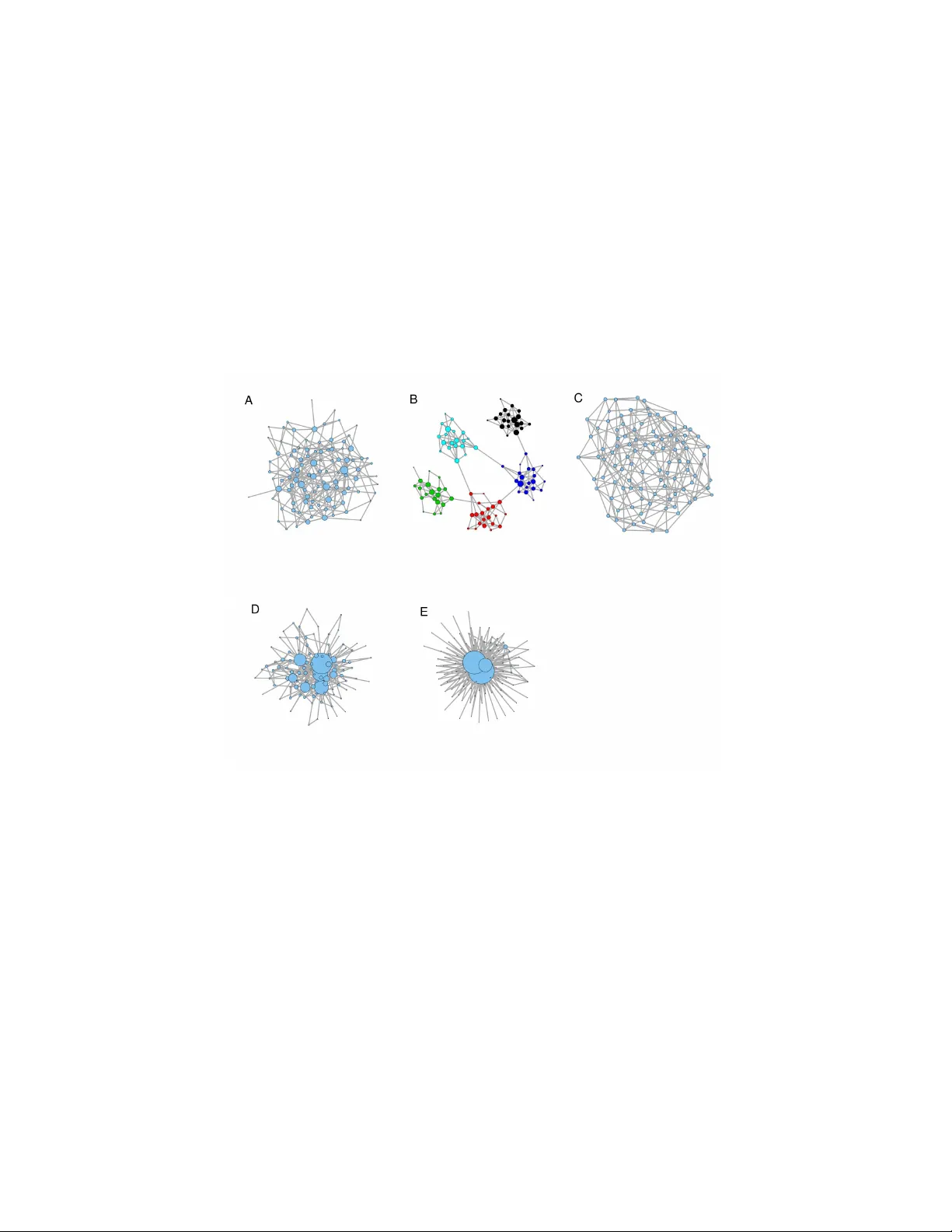
Net w ork impact on p ersistence in a finite p opulation dynamic diffusion mo del: application to an emergent seed exc hange net w ork Pierre Barbillon ∗ † AgroP arisT ec h / UMR INRA MIA, F-75005 P aris, F rance INRA, UMR 518, F-75005 P aris, F rance Mathieu Thomas ∗ AgroP arisT ec h / UMR INRA MIA, F-75005 P aris, F rance INRA, UMR 518, F-75005 P aris, F rance Isab elle Goldringer INRA, UMR 0320 / UMR 8120 G ´ en ´ etique V ´ eg ´ etale, F-91190 Gif-sur-Yv ette, F rance F r ´ ed ´ eric Hospital INRA, UMR 1313 G ´ en ´ etique Animale et Biologie In t´ egrativ e, F-78352 Jouy-en-Josas, F rance St ´ ephane Robin AgroP arisT ec h / UMR INRA MIA, F-75005 P aris, F rance INRA, UMR 518, F-75005 P aris, F rance Abstract Dynamic extinction colonisation mo dels (also called con tact pro cesses) are widely studied in epidemiology and in metap opulation theory . Con tacts are usually assumed to be possible only through a netw ork of connected patches. This netw ork accounts for a spatial landscap e or a social organisation of interactions. Thanks to so cial net- w ork literature, heterogeneous net w orks of con tacts can be considered. A ma jor issue is to assess the influence of the netw ork in the dynamic model. Most w ork with this common purpose uses deterministic mo dels or an approximation of a sto c has- tic Extinction-Colonisation mo del (sEC) which are relev ant only for large netw orks. When working with a limited size net work, the induced sto c hasticity is essen tial and has to b e taken into account in the conclusions. Here, a rigorous framework is pro- p osed for limited size netw orks and the limitations of the deterministic appro ximation ∗ These authors con tributed equally to this work. † Corresp onding author: 16 rue Claude Bernard, 75231 P aris Cedex 05, pierre.barbillon@agroparistec h.fr 1 are exhibited. This framework allows exact computations when the num ber of patc hes is small. Otherwise, sim ulations are used and enhanced by adapted simulation tec h- niques when necessary . A sensitivity analysis was conducted to compare four main top ologies of netw orks in contrasting settings to determine the role of the net work. A challenging case was studied in this con text: seed exchange of crop sp ecies in the R ´ eseau Semences P aysannes (RSP), an emergent F rench farmers’ organisation. A sto c hastic Extinction-Colonisation mo del was used to characterize the consequences of substan tial changes in terms of RSP’s so cial organisation on the abilit y of the system to maintain crop v arieties. Keyw ords: metap opulation; so cial netw ork; finite-population model; sensitivit y anal- ysis; seed exchange net work. 1 In tro duction T o deal with the persistence of a metapopulation in a dynamic extinction-colonisation mo del, sev eral studies ha v e used deterministic mo dels where the ev olution is describ ed b y differential equations (see Levins, 1969; Hanski and Ov ask ainen, 2000; Sol´ e and Bas- compte, 2006). These mo dels are grounded on an asymptotic appro ximation in the n umber of patc hes. The same mo dels are used in epidemiology (SIS: Susceptible Infected Suscepti- ble model). More recen tly , some studies hav e dealt with the stochastic effect due to a finite and limited num b er of patc hes/actors. Chakrabarti et al. (2008) ha ve prop osed an approx- imation in the sto c hastic mo del which leads to conclusions similar to the ones obtained with deterministic mo dels. Gilarranz and Bascompte (2012) hav e sho wn by simulations the impact of sto c hasticity due to a limited num b er of patches and they hav e underscored the differences with the results obtained with deterministic mo dels when comparing the abilit y of differen t net works to conserv e a metap opulation. How ev er, their results dep end only on the ratio of the extinction rate to the colonisation rate which is not relev an t in a sto c hastic mo del. Indeed, the same ratio v alues with different v alues of the extinction and colonisation rates can lead to very different situations for the dynamic of the metap opu- lation. In this pap er, w e study the same sto c hastic model as Gilarranz and Bascompte (2012). The patches can b e in only tw o states: o ccupied or empty . The dynamic consists in a succession of extinction ev en ts follow ed b y colonisation ev ents. W e provide a rigorous theoretical basis to this model whic h explains the different behaviours observed in the sim ulations. Indeed, the stochastic mo del is a Mark ov chain and its transition matrix can b e constructed as done by Day and P ossingham (1995). F rom this, we deduce that there is a unique p ossible equilibrium which is the absorbing state when all patc hes are empt y . Moreo ver, the steady state whic h can b e observ ed where the num ber of o ccupied patc hes seems to ha ve reac hed an equilibrium corresp onds to a so-called quasi-stationary 2 distribution of the Marko v chain (Darro c h and Seneta, 1965; M ´ el ´ eard and Villemonais, 2012). On this basis, in order to assess the p ersistence of a metap opulation, w e prop ose criteria which are adapted to the sto c hastic context. In particular, since the metapopula- tion will become extinct in an y case, w e decide to fix a limited time-horizon and to pro vide conclusions relying on this time-horizon. W e also sho w the limitations of the asymptotic appro ximation. F urthermore, this approac h leads to exact computations provided that the num ber of patches is not to o large. Otherwise, sim ulations can b e conducted and enhanced b y mo dified simulation techniques when necessary . The goal of this study is to measure the impact of the interaction net work which describ es the relationships b et ween patches (during colonisation even ts) on the b eha viour of the dynamic mo del. F ollowing the metap opulation mo del, the netw ork used to account for heterogeneous spatial organisation (Gilarranz and Bascompte, 2012) can also b e used to account for a so cial organisation (Read et al., 2008). Indeed, this w ork was designed in the con text of so cial netw orks of farmers who exc hange seeds, an important so cial pro cess in the diffusion and main tenance of crop bio div ersit y (reviewed in Thomas et al., 2011). W e assume that seeds spread through farmers’ relationships lik e an epidemiological pro cess as suggested by P autasso et al. (2013). Relying on the study of the R ´ eseau Semences P a ysannes (RSP) which is a F rench net work of farmers inv olv ed in seed exc hange of heirlo om crop sp ecies (Demeulenaere et al., 2008; Demeulenaere and Bonneuil, 2011; Thomas et al., 2012), w e compare differen t scenarios of social organisation and attest their effects on the p ersistence of one crop v ariet y . In the follo wing, the net work is assumed to b e non-orien ted and is denoted by G . In the deterministic work (Hanski and Ov ask ainen, 2000) or in approximation of the stochas- tic mo del (Chakrabarti et al., 2008), the leading eigenv alue of the adjacency matrix of G is sufficient to describ e the impact of the net work on p ersistence. W e sho w that this is no longer true in a sto c hastic mo del. W e prop ose to study four main net work top ologies whic h represent really distinct organisations. These top ologies are determined b y genera- tiv e mo dels: an Erd˝ os-R´ enyi mo del (Erd˝ os and R ´ en yi, 1959), a comm unity mo del (where connection inside a comm unity is more likely than b et w een tw o patches from different comm unities), a preferential attac hment mo del (Alb ert and Barab´ asi, 2002) and a “lat- tice” mo del where no des all hav e approximately the same degree. In section 2, a full description and an analysis of the sEC model are provided together with the algorithms used in sim ulations. The limits of the deterministic approximation are presen ted. The top ologies for net works are detailed in section 3. W e conducted a sensitivit y analysis to measure the impact of the top ology in con trasting settings. The results are presented in section 4. A motiv ating application of this w ork in section 5 studied the p ersistence of one crop v ariet y in a farmers’ netw ork of seed exchange. 3 2 Mo del 2.1 Notations The follo wing notations are used: n n umber of patches (farms) G in teraction netw ork b et w een patches p densit y of the net work n edg es n umber of edges e extinction rate c colonisation rate n g en n umber of studied generations Z t state of the system # Z t n umber of o ccupied patches for state Z t P (# Z t > 0)) Probabilit y of p ersistence at generations t E (# Z t ) Exp ected num b er of o ccupied patches at generations t 2.2 Mo del definition The model describes the presence or absence of a crop v ariety on n differen t farms (patches according to metap opulation vocabulary) during a discrete time evolution pro cess. This metap opulation is iden tified with a netw ork G with n no des (farms) and adjacency matrix A = [ a ij ] i,j w ere a ij = 1 if patches i and j are connected ( i ∼ j ) and 0 otherwise. This matrix is symmetric whic h means that a relation b et ween tw o patches is recipro cal. W e further denote b y Z i,t the o ccupancy of patch i ( i = 1 . . . n ) at time t , namely Z i,t = 1 if patch i is occupied at time t and 0 otherwise. The vector Z t = [ Z i,t ] i depicts the comp osition of the whole metap opulation at time t . A time s tep corresp onds to a generation of culture. Bet ween tw o generations, t w o ev ents can o ccur: extinction and colonisation with resp ectiv e rates e and c . Within each time step, extinction even ts first take place and o ccur in o ccupied patc hes independently of the others, with a probability e , supp osed to be constant o v er patches and time. Colonisa- tions even ts then take place and are only p ossible b et ween patc hes linked according to the static relational net work G . An empty patch can b e colonised b y an o ccupied patc h with a probabilit y c . This probabilit y is also assumed constant ov er link ed patches and time steps. Thus, the probability that the patch i , if empt y at generation t , is not colonised b et w een generations t and t + 1 is equal to (1 − c ) o i,t where o i,t is the num ber of occupied patc hes at generation t linked to the patc h i : o i,t = P j a ij Z j,t . This model is similar to the one prop osed in Gilarranz and Bascompte (2012) and also to the epidemic model used in Chakrabarti et al. (2008). It can also b e seen as a particular case of the mo dels discussed in Adler and Nuernberger (1994); Da y and P ossingham (1995); Hanski and Ov ask ainen 4 (2000). 2.3 Mo del prop erties As recalled in Da y and Possingham (1995), the sto c hastic pro cess ( Z t ) t ∈ N is a discrete time Marko v chain with 2 n p ossible states. The matrices describing the colonisation C and the extinction E can b e constructed and the transition matrix of ( Z t ) t ∈ N is obtained as the pro duct of these t wo matrices: M = E · C . W e assume here that Z t is irreducible and ap eriodic whic h is ensured if the adjacency matrix A of the so cial netw ork has only one connected comp onen t. In the sequel, we denote by λ B ,k the k th eigen v alue of any matrix B . Indeed, the leading eigen v alue of M is λ M , 1 = 1, its multiplicit y is 1 and the corresp onding eigenv ector is the stationary distribution. If e > 0, this unique stationary distribution consists of b eing stuck in one state, denoted by 0 and called absorbing state or coffin state. The coffin state corresp onds to all patc hes empty which means that the v ariety is extinct. Thus, if Z t = 0, for any s > t , Z s = 0. W e denote by T 0 the extinction time: T 0 = inf { t > 0 , # Z t = 0 } . Since the num b er of states is finite, P z ( T 0 < ∞ ) = 1 for an y initial state z ( P z denotes the probabilit y measure associated with the c hain Z t and initial state Z 0 = z ). The second eigen v alue λ M , 2 go verns the rate of con vergence tow ard the absorbing state, i.e. P z ( T 0 > t ) = P z (# Z t > 0) = O ( λ t M , 2 ) . (1) The smaller this eigenv alue is, the faster the conv ergence is. Hence, w e can study the probabilit y of extinction in a given num ber of generations or the mean time to extinction for an initial condition on o ccupancies at generation 0, a netw ork and a set of parameters. 2.3.1 Quasi-stationary phase Although extinction is almost sure, the probabilit y of reaching extinction in a realistic n umber of generations can still b e small. In that case, we aim to study the b ehaviour of this dynamic b efore extinction. In some cases, the Mark ov chain Z t conditioned to non- extinction { T 0 > t } conv erges tow ard a so-called quasi-stationary distribution (Darro c h and Seneta, 1965; M ´ el ´ eard and Villemonais, 2012). This quasi-stationary distribution ex- ists and is unique provided that Z t is irreducible and aperio dic. Note that quasi-stationary distribution may also exist in reducible c hains (v an Do orn and Pollett, 2009). The transi- tion matrix on the transient states, denoted by R , has dimension (2 n − 1) × (2 n − 1) and is defined as a sub-matrix of M by deleting its first ro w and its first column, corresp onding to the coffin state. If it exists, the quasi-stationary distribution is given by normalizing the eigenv ector of the reduced matrix R asso ciated with its leading e igen v alue λ R, 1 . W e 5 denote b y α this distribution o ver the transien t states. It can b e noticed that λ R, 1 = λ M , 2 . As stated in Darro c h and Seneta (1965); M´ el´ eard and Villemonais (2012), sup z ,z 0 transient states | P z ( Z t = z 0 | T 0 > t ) − α z 0 | = O | λ R, 2 | λ R, 1 t ! . (2) Therefore, the quasi-stationary distribution is met in practice if the Marko v chain con- v erges faster tow ard it than to ward the absorbing state whic h corresp onds to | λ R, 2 | /λ R, 1 << λ R, 1 . Building the transition matrix allows an exact study of the dynamic of the v ariet y p ersistence. How ev er, due to its large size: 2 n × 2 n , building such a matrix and seeking its eigen v alues is not p ossible for n > 10. Therefore, for bigger n , we ha ve to run simulations. 2.3.2 Large net w ork approximation Another solution is to use an appro ximate version of the model as prop osed by Chakrabarti et al. (2008). They describ e the recurrence relation b et ween the probabilities of o ccupan- cies at generation t + 1 and these probabilities at generation t . In the computation of the recurrence relation, they consider the o ccupancies of the patches at generation t as indep enden t of eac h other. Thus, their relation inv olv es only the n patc hes and not all of the 2 n p ossible configurations. This approximation leads to the follo wing relation: p i,t +1 = 1 − ζ i,t +1 p i,t e − ζ i,t +1 (1 − p i,t ) , (3) where p i,t is the probabilit y of o ccupancy of patch i at generation t and ζ i,t is the probabilit y that patc h i is not colonised at generation t . The follo wing equation derives from the indep endence approximation: ζ i,t +1 = Y j ∼ i (1 − cp j,t ) . F rom this appro ximation, they deriv e a fron tier betw een a pure extinction and an equi- librium phase dep ending on e , c and λ A, 1 the leading eigenv alue of the adjacency matrix A of the netw ork. If e/c is ab ov e λ A, 1 , a pure extinction shall take place, if it is b elow, the patc h o ccupancy shall reach an equilibrium where the num b er of o ccupied patc hes v aries around a constant num b er. More sp ecifically , if e/c > λ A, 1 , the o ccupancy probabilities ( p i,t ) tend to 0 (0 is a stable fixed p oin t). Moreov er, in the case where e/ [ c (1 − e )] > λ A, 1 , the decay ov er time of the p i,t is exp onen tial, p i,t = O ((1 − e + c (1 − e ) λ 1 ,A ) t ) for any 1 ≤ i ≤ n . Otherwise, if e/c < λ A, 1 , there exists a fixed p oin t with non-zero probabilities of o ccupancies. This non-zero equilibrium clashes with the almost sure conv ergence of the Mark ov c hain tow ard the coffin state. 6 Figure 1: Num b er of o ccupied patches for replications from the dynamic mo del o ver 100 generations, netw ork fixed and parameters fixed at c = 0 . 05 and e = 0 . 25 (black solid lines) or e = 0 . 05 (grey broken lines). The initial state w as chosen suc h that all patches are o ccupied. The fron tier e/c = λ A, 1 is also found to b e a relev an t threshold for persistence in deter- ministic mo dels suc h as the Levins mo del (Levins, 1969) and its spatially realistic versions (Hanski and Ov ask ainen, 2000; Sol ´ e and Bascompte, 2006). In a sto c hastic mo del, extinc- tion ev en tually tak es place since there is an absorbing state. F rom the previous statements on the quasi-stationary distribution, observing an equilibrium phase on simulations as in Gilarranz and Bascompte (2012) actually corresp onds to a phase where the Mark ov c hain relaxes in its quasi-stationary distribution and do es not reach the absorbing state during the finite num ber of generations. As an example, for a netw ork with 100 patches, we presen t tw o t ypical cases in Figure 1: when extinction is likely in 100 generations (replica- tions in solid blac k lines) and when a quasi-equilibrium is reached (replications in broken grey lines). If the sim ulations are run long enough, the quasi-equilibrium will b e left and the system will conv erge to the coffin state. 2.3.3 Finite horizon study In a sto c hastic mo del, an extinction threshold do es not make sense. W e advocate fo cusing on quan tities suc h as the extinction probability in a giv en realistic num b er of generations and the mean num b er of o ccupied patc hes at this generation. W e aim to study the impact 7 of the netw ork on p ersistence through its impact on these t w o quan tities. Moreo v er, the impact of e and c m ust also b e taken into accoun t and not only through the ratio e/c . Indeed, tw o settings with the same ratio e/c lead to v ery differen t results in a sto c hastic mo del according to the order of magnitude of e and c . F or a fixed netw ork with 10 no des and for a fixed netw ork with 100 no des, w e computed (exactly with 10 no des, estimated with 100 no des) the probabilit y of extinction in 100 generations P z 0 ( T 0 ≤ 100) = P z 0 (# Z 100 = 0) for differen t v alues of e and c . Here, the initial state z 0 is c hosen such that all patches are o ccupied. The color maps of these probabilities are display ed in Figure 2 A and 2 B . A B Figure 2: Probabilities of extinction in 100 generations for v arying v alues of e and c : ( A ) 10 no des,( B ) 100 nodes. The white line corresp onds to the level e/c = λ A, 1 whic h is the frontier obtained when using the large net work appro ximation. As observed in this case of a finite net work, this line fails to separate cases with a high probabilit y of extinction from the others. F urther- more, as we wan t to tak e the stochasticit y of the mo del due to a finite n umber of patc hes in to account, a threshold would not b e relev an t. Actually , there exists a fuzzy band where there is very little confidence in the b eha vior of the system. F rom these remarks, we decided to conduct finite horizon analyses in the following sections. The time horizon w as c hosen with resp ect to the application. Both, the proba- bilit y of p ersistence and the mean n umber of o ccupied patches were studied to quantify the impact of the net work topology in different settings depending on the v alues of the pa- rameters e and c . The next section presen ts metho ds for sim ulation when the probabilit y of p ersistence is hard to compute. 8 2.4 Metho ds for simulations Since the mo del is a Marko v c hain in a finite state space, sim ulating is quite easy . Hence, the probability of p ersistence after 100 generations P ( T 0 > 100) and the mean num b er of o ccupied patc hes at the 100 th generation E (# Z 100 ) can b e estimated. Ho wev er, in cases where p ersistence is v ery lik ely or very unlikely , a large num ber of sim ulations are necessary to ac hieve precision in the estimate of the p ersistence probability . Indeed, w e can face tw o kinds of rare even ts: rare extinction, or rare p ersistence. Some techniques related to the estimation of probabilities of rare even ts were used. They are based on imp ortance sampling and in teracting particle systems. 2.4.1 Rare p ersistence A very simple interacting particle system (Del Moral and Doucet, 2009) is efficient in this case. The idea is to consider sim ultaneous tra jectories (particles) and regenerate the ones whic h hav e b een trapped in the coffin state (extinction) among the surviving particles. Algorithm 1 • Initialisation: N particles set at Z i 0 = (1 , . . . , 1) for an y i = 1 , . . . , N . • Iterations: t = 1 , . . . , 100: – Mutation Each particle ev olves indep enden tly according to the Mark ov mo del (obtaining ˜ Z i t from Z i t − 1 b y simulation). – Sele ction/R e gener ation: If ˜ Z i t = 0, then Z i t is randomly c hosen among the surviving particles ˜ Z j t 6 = 0. Otherwise Z i t = ˜ Z i t . Compute # E t = P N i =1 I ( ˜ Z i t = 0) / N . Note that the pro duct Q 100 t =1 # E t is then an un biased estimator of P ( T 0 ≤ 100) (Del Moral and Doucet, 2009). A sufficien t num ber of particles N must b e c hosen to ensure that not all the particles die during a mutation step. 2.4.2 Rare extinction If the probability of p ersistence is high, a lot of sim ulations are necessary to observe at least one extinction. If no extinction is observed, then the estimate of the extinction probabilit y is zero. T o improv e the estimator, w e ha ve to make extinction more likely in the simulation and to apply a correction in the final estimator suc h that the estimator is still unbiased. Two metho ds are prop osed to ac hieve this goal: an imp ortance sampling metho d and a splitting metho d (Rubino and T uffin, 2009). 9 The imp ortance sampling is applied on the extinction phase by increasing the extinc- tion rate e in the simulations. Indeed, since extinction o ccurs indep enden tly in patc hes, the ratios due to the change in distribution is tractable. Algorithm 2 • Initialisation: Z 0 = (1 , . . . , 1), a vector ( e I S 1 , . . . , e I S 100 ) with size the n umber of generations of t wisted extinction rate (the t wisted rate is not necessarily the same throughout generations) is chosen. • Iterations: t = 1 , . . . , 100: – Extinction Extinction is sim ulated with the corresp onding twisted extinction rate e I S t and the ratio is computed as r t = e e I S t d t · 1 − e 1 − e I S t # Z t − 1 − d t , where d t is the num b er of extinction even ts which o ccur at generation t and # Z t − 1 − d t giv es the num b er of o ccupied patches which do not b ecome extinct at generation t . – Colonisation: Colonisation is applied according to the mo del. Hence, the un biased estimator of P ( T 0 ≤ 100) for N simulations obtained according to the previous algorithm (( Z i t ) t ∈{ 0 , 100 } with ratios ( r i t ) t ∈{ 0 , 100 } , i = 1 , . . . , N ) is 1 N N X i =1 100 Y t =1 r i t × I ( Z i t = 0) . Since the simulations / particles do not in teract, the computation can b e done in parallel. Although the v ariance of this estimator is not tractable in a closed form, it can still b e sho wn that the v ariance is smaller if the vector ( e I S 1 , . . . , e I S 100 ) is chosen such that e I S t increases with t . Another solution is to use a splitting technique. The rare even t, which is extinction here, is split into in termediate less rare even ts. The extinction corresp onds to zero o ccupied patc hes at generation 100. An intermediate rare even t is the n umber of o ccupied patc hes b eing less than a given threshold S at an y generation b et w een 0 and 100. A sequence of thresholds S 1 ≥ S 2 · · · ≥ S p is fixed and the probability of extinction in 100 generations reads as P ( Z 100 = 0) = P ( ∃ t, Z t = 0) = P ( ∃ t, Z t ≤ S 1 ) × P ( ∃ t, Z t ≤ S 2 |∃ t, Z t ≤ S 1 ) × · · · × P ( ∃ t, Z t = 0 |∃ t, Z t ≤ S p ) , 10 where ∃ t means implicitly ∃ t ≤ 100 and Z t ≤ S p means # Z t ≤ S p . The algorithm will keep the tra jectories that hav e crossed the first threshold (the tra- jectories for which there is at least one state with a n umber of o ccupied patches b elo w S 1 ). F rom these successful tra jectories, offspring are generated from the time of the first crossing and then are kept if they cross the second threshold and so on. The ratio of the successful tra jectories ov er the total num b er of simulated tra jectories b et w een threshold S m − 1 and S m is used to estimate the probabilities P ( ∃ t, Z t ≤ S m |∃ t, Z t ≤ S m − 1 ). The splitting algorithm w e use is in a fixed success setting that is to sa y the algorithm waits for a giv en num ber of regenerated tra jectories to cross each threshold b efore moving to the next threshold. Hence, this setting preven ts degeneracy of the tra jectories (no tra jectory manages to cross a threshold) and the precision is controlled in spite of the computational effort (Amrein and K ¨ unsc h, 2011). Algorithm 3 • Initialisation: N particles set to Z i 0 = (1 , . . . , 1) for an y i = 1 , . . . , N . Cho ose the sequence of decreasing thresholds S 1 , . . . S p and the num ber of successes n success . By con ven tion, S p +1 = 0. Set the b eginning level of tra jectories L i 0 = 0 and starting state Z i 0 = (1 , . . . , 1) for i = 1 , . . . , n success . • F or eac h threshold S m , 1 ≤ m ≤ p + 1 , set s = 0 and k m = 0 and rep eat until s = n succes : – Do k m = k m + 1. – Cho ose uniformly i ∈ { 1 , . . . , n success } . – Sim ulate a tra jectory from generation L i m − 1 at state Z i m − 1 : ( Z t ) L i m − 1 ≤ t ≤ 100 . – If there exists t such that Z t ≤ S m , do 1. s = s + 1, 2. L s m = inf { t, Z t ≤ S m } , 3. Z s m = Z L s m . The un biased estimator of the extinction probability is then: p +1 Y m =1 n succes − 1 k m − 1 . The fixed success setting ensures the non-degeneracy of the tra jectories. Ho wev er, there is no control on the complexity of the algorithm. As a by-product, this algorithm also pro vides estimations of the probabilities that the tra jectories cross the in termediate thresh- olds. 11 The case of rare extinction is more difficult since there is no obvious metho d for effi- cien tly computing the probabilit y unlike the case of rare p ersistence. In the tw o algorithms presen ted ab o ve, the efficiency relies on the tuning of parameters, namely the twisted ex- tinction rates in Algorithm 2 and the sequence of thresholds in Algorithm 3. In the present study , these parameters ha v e b een set man ually; the definition of a general tuning strategy is out of the scop e of this article. 3 Net w ork top ology In the following we assume that the top ology of a netw ork accoun ts for a kind of so cial organisation among patches. The main features of a top ology are emphasised in order to make the differences app ear clearly . The top ologies w e compare are well known in the literature, but we adapt the simulation mo dels in order to limit the v ariabilit y by con trolling the n umber of edges. Once a n umber of edges is set (denoted by n edg es ), a top ology consists in a wa y to distribute edges. T o describ e the top ology of a netw ork, the distribution of the degrees of no des is p ertinen t. W e alwa ys work under the constrain t of a net work with a single comp onen t. The pack age igraph (Csardi and Nepusz, 2006) in R w as used for sim ulating netw orks for certain top ologies and for plotting. W e recall that w e assume that the net work G is non-orien ted. 3.1 Erd˝ os-R ´ en yi mo del This random graph mo del was in tro duced b y Erd˝ os and R´ enyi (1959) and is defined as follo ws: for a c hosen n umber of edges n edg es , the net work is constructed by choosing uniformly among all the p ossible edges n 2 . When the n umber of no des is large, the distribution of the degrees of no des is close to a P oisson distribution (Alb ert and Barab´ asi, 2002). 3.2 Comm unit y mo del The comm unity model w as used to tak e into accoun t cases where netw orks are organised through communities. Inside a communit y , the no des are connected with a high probability whereas the connection probability is weak b et w een tw o no des belonging to t wo different comm unities. The spirit of this mo del is dra wn from Stochastic Block Mo del (No wic ki and Snijders, 2001). The comm unity sizes are set to b e equal, the in tra-communit y and the in ter-communit y connection probabilities are the same in order to reduce the n umber of parameters for defining such a net work. This mo del is then tuned by the n umber of edges, the n umber of communities and the ratio of the in tra connection probability o v er the inter connection probabilit y (this ratio is greater than 1 in order to fa vour intra connection). 12 Figure 3: Simulation of netw orks with 100 no des and 247 edges according to Erd˝ os-R´ enyi mo del ( A ), communit y mo del ( B ), lattice mo del ( C ), preferential attac hment mo del with p o w er 1 ( D ) and p o w er 3 ( E ). The size of a no de is prop ortional to its degree. 13 3.3 Lattice mo del W e made an abusive use of the w ord lattice, by considering graphs with quasi-equal degrees. The lattice mo del stands for organizations built on the basis of the spatial neigh b orho od. W e prop ose a simulation mo del which is flexible since it works for any n umber of no des and edges. The main idea is to fix the smallest upp er b ound on the degree of a no de for given num b ers of no des and edges. This upp er b ound is computed as the flo or integer num b er of 2 n edg es /n . First, a one dimension lattice is created in order to ensure a single comp onen t graph. Then, edges are added sequentially with a uniform distribution b et ween no des which ha v e not reac hed the b ound on their degree. Hence, in suc h a graph, all no des hav e quite the same role and imp ortance. 3.4 Preferen tial attac hment mo del This version of the preferential attac hment mo del was prop osed b y Barab´ asi and Alb ert (1999). It w as designed to mo del gro wing netw orks and to capture the p o wer-la w tail of the degree distribution which was noticed in real net works in many fields of application. The no des are added sequentially . In each step, a single no de is added and is connected to the no des already in the netw ork with probabilit y P (connection to no de N k ) ∝ deg r ee ( N k ) b , where the p ow er b is c hosen in order to tune the strength of the preferen tial attac hment. This generativ e mo del tends to create no des with a high degree whic h hav e a central role in the net work. It is clearly opp osed to the lattice mo del whic h makes the degrees quasi homogeneous. T o b e able to fix the n umber of no des and the n um b er of edges independently , we dra w uniformly a sequence of edges added for eac h new no de with the constrain t that there is at least one edge (ensuring the single comp onent net w ork) and that the n umber of edges to b e added is less than the num ber of no des already in the net work at a giv en step. 4 Global analysis of the impact of the top ology The aim was to conduct a sensitivit y analysis based on the c hosen outputs of the sto c hastic mo del (mean num b er of o ccupied patc hes and the p ersistence probability at generation 100: E (# Z 100 ) and P (# Z 100 > 0)) with resp ect to its parameters: the extinction rate e , the colonisation rate c and the graph G . The graph is parameterised by its density d whic h is equiv alent to the num b er of edges or the mean degree and its top ology i.e. the distribution of the edges given a total num b er of edges. The v ariation range of the parameters w as fixed in order to induce a context of weak, middle and strong extinction 14 since the aim is to study the impact of the net w ork top ology in con trasted situations (see T able 1 for the v alues used for the full factorial design of exp erimen ts). The analyses w ere done for t wo cases for n = 10 patches and n = 100 patches. F or n = 10, exact computations were still achiev able while for n = 100, the simulation metho ds presen ted in 2.4 w ere used. W e ensured that the sim ulations had reac hed a sufficien t degree of precision to consider that the part of v ariability in the outputs due to the estimation metho d w as negligible in comparison with the v ariation due to the input parameter v ariation. Five kinds of netw orks w ere compared: an Erd˝ os-R ´ en yi net work, a comm unity netw ork, a “lattice” netw ork, and tw o preferential attac hment net w orks with p o wers 1 and 3. F or the comm unity mo del, only one communit y setting was studied and the ratio of intra versus in ter connection probabilit y w as se t at 100. When n = 10, the patches w ere equally split in to tw o communities. When n = 100, the patches were equally split in to five comm unities. F or each netw ork structure, ten replicate netw orks were built with randomly generated edges. 10 patc hes 100 patc hes e { 0 . 05 , 0 . 10 , 0 . 15 } { 0 . 10 , 0 . 20 , 0 . 25 } c { 0 . 01 , 0 . 05 , 0 . 10 } { 0 . 001 , 0 . 005 , 0 . 010 } d { 30% , 50% , 70% } { 5% , 10% , 30% } T able 1: V alues for exploration of the mo del with 10 patches or 100 patc hes The sensitivit y analyses w ere based on an analysis of v ariance. The influence of the parameters and their interaction on P (# Z 100 > 0) (actually the logit of this probability) and on E (# Z 100 ) were assessed. The only source of v ariability was the randomness in the graph generation. W e recall that for n = 10 the computations are exact and for n = 100, the estimates are precise enough to ensure the significance. All these linear mo dels had a co efficien t of determination R 2 greater than 99 . 9%. As exp ected, the parameters e , c and d were b y far the most imp ortan t since a large range of v ariation was explored for eac h of these parameters and since any of these parameters could drive the system to extreme situations where extinction is likely or rare. Nev ertheless, the top ology was still significan t. As suggested by the significance of high order in teractions, esp ecially the ones in volving top ology , a top ology w as not found to b e uniformly (whatever the v alues of e , c or d ) b etter (according to P (# Z 100 > 0) or to E (# Z 100 )) than the others. The comparison based on E (# Z 100 ) has shown an in v ersion in the ranking of the top ologies whic h was similar to the one noticed by Gilarranz and Bascompte (2012). This in version app eared with b oth n = 10 and n = 100 patches. When the combination of v alues of e , c and d ensured p ersistence with a high probability , the best top ologies were those with a b etter balance in degree distribution suc h as the lattice, ER and communit y 15 top ologies. How ever, although the difference in mean w as found significan t, the order of magnitude of this difference was only of a few patches ( ≈ 5) for n = 100 patches. On the other hand, the top ologies leading to some very connected patches (hub) suc h as the preferen tial attachmen t top ologies (esp ecially when the p o wer parameter is set at 3) max- imized the num b er of o ccupied patches when the p ersistence in the system is threatened in 100 generations. In that case, the differences were more con trasted b et ween top ologies. When the top ologies w ere compared according to P (# Z 100 > 0), the same kind of in version was noticed for n = 10 patches. How ev er, the balanced top ologies (lattice, ER and comm unity) w ere found to b e b etter in settings where the probabilit y of p ersistence is greater than 99 . 5%. In other cases when the p ersistence was more jeopardized, the prefer- en tial attachmen t top ologies were the b est. With n = 100 patc hes, w e hav e only observ ed the b etter resistance of preferential attachmen t top ologies and also their crucial role in critical situations where p ersistence and extinction had pretty muc h the same probabilit y of o ccurring. Ho wev er, we were not able to obtain settings where the p ersistence proba- bilit y was greater for any of the balanced top ologies than for the preferen tial attac hment top ology , even though we hav e computed it with Algorithms 2 and 3 for settings where the order of magnitude of the p ersistence probability is 1 − 10 − 15 . Figure 4 A illustrates the crucial role of the top ology in the chosen setting. The pref- eren tial attachmen t top ology with p o wer 3 ensured the p ersistence probabilit y in 100 gen- erations to b e greater than 0 . 6 while the ER, lattice and comm unity top ologies hav e led to a probability of p ersistence smaller than 0 . 05. Figure 4 B displays the mean n umber of o ccupied patches conditionally to p ersistence. This figure shows that the quasi-stationary distributions for the preferen tial attachmen t top ologies hav e led to mean n umbers of o c- cupied patc hes which were close to 15 while these conditional mean num bers were close to 5 for the other three top ologies. Since the num ber of o ccupied patches was to o close to 0 in this quasi-equilibrium, the system had a very low probability of relaxing for a while in its quasi-stationary distribution. Conclusion F rom this study , we hav e determined that the role of the top ology is not alw ays crucial. But in some settings, it has a key impact on p ersistence probabilit y and th us on the mean n umber of o ccupied patches. Thanks to sharp computations of the p ersistence probabilities, the differences b et w een the top ologies were also highlighted on the basis of rare ev ents (rare p ersistence or rare extinction). The preferential attachmen t top ology is generally more resistan t according to this probabilit y especially when the p ersistence is jeopardized. Nevertheless, concerning the o ccupancies, balanced top ologies can p erform a little b etter even though they still ha v e a smaller probability of p ersistence than do the preferen tial attac hment top ologies. As an example, Figure 5 A and 5 B display 16 A B Figure 4: ( A ) Probabilit y of p ersistence and ( B ) mean n umber of o ccupied patches, in v arying t generations (based on 20 replications of the net work for a given top ology) for n = 100, c = 0 . 01, e = 0 . 25 and d = 30%. COM: comm unity netw ork, ER: Erd˝ os-R´ enyi net work, LA T: Lattice net work, P A1: preferential attac hment net w ork with pow er 1, P A3: preferen tial attachmen t with p o wer 3. P (# Z 100 > 0) and E (# Z 100 ) in a particular setting. Eac h of these tw o criteria may rank the settings including the top ology in different orders. The communit y top ology ma y b e a little more sensitiv e to extinction than are ER or lattice top ologies but they are globally equiv alen t for this dynamic mo del. Even if it is quite ob vious, we mention that it w as noticed that the role of the top ology is enhanced when the density is higher, when c is greater and when the num b er of patc hes is greater. 5 Application to seed diffusion among farmers: the case study of the emergence of the R ´ eseau Semences P a ysannes 5.1 Con text Our first application of the sEC mo del was to describ e an emergen t farmers’ mov emen t in volv ed in seed exc hange of crops and vegetables in F rance. F rom the beginning of the 1990’s in Europ e, new farmers’ organisations ha ve emerged with the aim of sharing practices and seeds (Bo cci and Chable, 2008). In a preliminary study , Demeulenaere and Bonneuil iden tified the global so cial dynamics in the context of the “R´ eseau Semences 17 A B Figure 5: Bo xplots of the probabilities of p ersistence o ver 100 generations ( A ) and the n umber of o ccupied patches at generation 100 ( B ), computed with 10 replications of eac h net work top ology . COM: communit y net work, ER: Erd˝ os-R´ en yi netw ork, LA T: Lattice net work, P A1: preferential attachmen t netw ork with p o w er 1, P A3: preferen tial attach- men t with p ow er 3. P aysannes” (RSP), a F renc h national farmers’ organisation created in 2003 (Demeulenaere and Bonneuil, 2011). They describ ed this so cial mov ement highlighting emergent rules and giving a semi-quan titative picture of the dynamics of this s ocial organisation. They fo cused their study on one of the RSP’s subgroups sp ecialized in bread wheat ( T riticim aestivum ). Based on informants of the RSP , they identified key actors. They p erformed 10 exhaustive interviews to collect data on which v arieties w ere present in the fields of the farmers and from whom they were obtained. Additional information suc h as to whom farmers pro vided v arieties w as less informed. They completed data collection with 8 additional semi-directive interviews and 7 phone interviews. They collected 778 distinct records of seed exc hange ev ents among 160 actors b et w een 1970 and 2005. These seed exc hanges in v olved 175 differen t v arieties of bread wheat. After po oling all the information collected b et w een 1970 and 2005, a directed seed circulation netw ork was drawn where an edge connects t wo farmers who hav e carried out at least one seed diffusion ev ent during this perio d. Three connected comp onen ts w ere iden tified: one gian t comp onen t (152 no des, Fig. 6 A ) and t wo small ones (5 and 3 no des resp ectively , not shown). The av erage colonisation rate ( c ) was estimated as the n um b er of diffusion ev ents p er v ariet y per farmer p er year. The num b er ranged o ver time from 0.03 to 0.66. 5.2 Question, approac h and assumption In the context of an emergent self-organized system, a crucial question is to what exten t do c hanges in so cial organisation impact the global ability of the system to main tain v arieties? Relying on our kno wledge ab out RSP ev olution, three netw ork top ologies and t w o net- w ork sizes were sim ulated to represent ev olution of this so cial organisation, assuming that seed exchange netw orks were embedded in more complex so cial netw orks. Fiv e scenarios w ere defined to pro vide a framew ork for studying the impact of such so cial c hange. They 18 A B Figure 6: ( A ) Summary netw ork of bread wheat seed circulation among 152 farmers dra wn from data collected based on 10 interviews co vering a p eriod from 1970 to 2005. ( B ) Subgraph of the reliable seed circulation even ts from 1970 to 2005 based on the 10 in terviews and used to estimate ˆ p 50 . Interview ed p eople are in dark grey and mentioned p eople in ligh t grey . are described in the next section. Then, the sEC model was used to represen t the dynamic pro cess of seed circulation and extinction for each netw ork top ology . A dedicated sensi- tivit y analysis was designed to explore sp ecific ranges of e and c in a short time window. W orking at this time scale was motiv ated by the rapid c hange in so cial organisation of suc h systems. The probabilit y of p ersistence and the exp ected n umber of occupied patc hes w as assessed for each scenario to compare the abilit y of the system to maintain the v ariety circulating in the netw ork. Using the sEC mo del in the context of seed systems assumed that farmers alwa ys w anted to recov er the v ariet y after losing it. In addition, w e assumed that all farmers had the same b eha viour, having the same ability: 1) to host a seed lot of a v ariet y through the seed diffusion pro cess (uniform colonisation probability , c ) and 2) to lose it through a sto c hastic pro cess of extinction (uniform extinction probability , e ). This assumption was made to highlight the p osition in the net work indep enden tly of individual characteristics. 5.3 Scenarios of ev olution Rapid ev olution of the so cial organisation can b e qualitatively depicted through three main phases. This description relies on a participan t observ ation study (Demeulenaere and Bonneuil, 2011) during farmers’ meetings b et w een 2003 and 2012. During the first 19 phase, sev eral dozen farmers were invited to participate in national meetings. A t the b eginning, only a few exc hanged seed with a limited kno wledge of eac h other. F or this reason, we assumed random seed exchanges among farmers using an Erd˝ os-Renyi net work (ER). After several meetings, a few farmers b ecame more p opular and more central in seed diffusion. W e mo delled this s tage using a preferential attachmen t (P A) algorithm for designing the net w ork topology and accoun ting for a more imp ortan t role of a few farmers. Ev entually , the n umber of farmers exchanging seeds highly increased. A t the same time, a change was observed from national m eetings to more local even ts thanks to the creation of lo cal as sociations inv olv ed in seed exchange (from 0 to 17 b et ween 2003 and 2012). W e considered the communit y mo del (COM) following the sto c hastic blo c k mo del as an appropriate net w ork model to mimic this new organisation with most seed exchange at the lo cal scale (within groups) and rare even ts at the global scale (long distance and among groups). Based on these observ ations, five scenarios were defined for analysing the impact of change in so cial organisation on the ability of the self-organised system to main tain v arieties (T able 2): • 1: random seed exchanges among few farmers (ER:50) • 2: scale-free seed exchanges among few farmers (P A:50) • 3: communit y-based seed exchanges among many farmers (COM:500) • 4: random seed exchanges among man y farmers (ER:500) • 5: scale-free seed exchanges among man y farmers (P A:500) First, we compared the results obtained for scenarios 1 and 2 to study the ev olution of the system capacit y to main tain v arieties after a change in so cial organisation in the con text of small size p opulation. Then, scenario 3 was compared to scenarios 4 and 5 to understand the consequence of a new so cial configuration in maintaining crop diversit y after an increase in the netw ork size. 5.4 Sensitivit y analysis This additional sensitivit y analysis is required to draw conclusions ab out the scenarios in the context of the RSP study (differen t num b er of patc hes, ranges of e and c and a shorter time horizon). T o initialize the simulations, each actor owned only one and the same v ariety . W e defined three levels of ev ent frequency to mimic different global b eha viours in terms of seed circulation and maintenance: lo w frequency with e = 0 . 1, in termediate frequency with e = 0 . 5 and high frequency with e = 0 . 8. It w as chosen to in vestigate tw o v ariety statuses: p opular and rare v arieties. W e considered that rare v arieties w ere less diffused with an e/c ratio of 5 compared to 1 for the p opular ones. W e fitted the density 20 of the small net work ( n = 50) to the densit y of the observed net work (6 B ) whic h giv es ˆ p 50 = 0 . 21 F or scenarios 3 − 5 with netw orks of size 500, density w as considered equal to ˆ p 500 = ˆ p 50 / (500 / 50) = 0 . 021, considering that p eople shared the same a verage degree whatever the size of the netw ork. This framework allow ed us to inv estigate the impact of top ological prop erties of re- lational netw orks on the dynamic of the system and more sp ecifically on the probability of p ersistence of v arieties after 30 generations, P (# Z 30 > 0), and the relativ e exp ected n umber of oc cupied patc hes after 30 generations, E (# Z 30 ). The choice of 30 generations corresp onded to the time scale of observed seed exchange. In addition, we considered that suc h so cial organisation in the con text of emergent so cial mov ements is rapidly evolving without reaching a real equilibrium. Longer sim ulations seemed to be less informative for understanding prop erties of this self-organised system. Scenario Comparison n v er tex n edg e top o e ratio e/c 1a 1 50 263 ER { 0 . 1; 0 . 5; 0 . 8 } 1 1b 1 50 263 ER { 0 . 1; 0 . 5; 0 . 8 } 5 2a 1 50 263 P A { 0 . 1; 0 . 5; 0 . 8 } 1 2b 1 50 263 P A { 0 . 1; 0 . 5; 0 . 8 } 5 3a 2 500 2682 COM ∗ { 0 . 1; 0 . 5; 0 . 8 } 1 3b 2 500 2682 COM ∗ { 0 . 1; 0 . 5; 0 . 8 } 5 4a 2 500 2682 ER { 0 . 1; 0 . 5; 0 . 8 } 1 4b 2 500 2682 ER { 0 . 1; 0 . 5; 0 . 8 } 5 5a 2 500 2682 P A { 0 . 1; 0 . 5; 0 . 8 } 1 5b 2 500 2682 P A { 0 . 1; 0 . 5; 0 . 8 } 5 T able 2: Description of the 5 scenarios ( ∗ :the COM mo del is defined for 10 groups of 50 farmers with a probability of connecting people from the same communit y 10 times higher than the probability of connecting tw o p eople from differen t communities). 5.5 Results Small netw orks: scenarios 1 and 2 The change in netw ork top ology was the main difference b et w een scenarios 1 and 2. F or the p opular v arieties, ( e/c = 1), P A only show ed a lo wer probability of p ersisting ( P (# Z 30 > 0)) and a lo wer exp ected num b er of o ccupied farms ( E (# Z 30 )) for the higher v alues of e and c compared to ER (T able 3). F or rare v arieties, more susceptible to extinction ( e/c = 5), an inv ersion b etw een ER and P A w as observ ed in terms of ability to maintain the resource ( P (# Z 30 > 0)) for in termediate v alues of e and c , b efore decreasing to zero for the highest v alues (T able 3). This trend w as confirmed by the exp ected num b er of o ccupied patches. 21 e P (# Z 30 > 0) E (# Z 30 ) e/c = 1 0.1 E R = P A = 1 E R ∼ P A = 44 0.5 E R = P A = 1 E R & P A = 44 0.8 E R = 0 . 9 > P A = 0 . 7 E R = 37 > P A = 25 e/c = 5 0.1 E R = P A = 1 P A & E R = 25 0.5 P A = 0 . 8 E R = 0 . 3 P A = 13 E R = 3 0.8 P A = E R = 0 P A = E R = 0 T able 3: Summary results of persistence probability ( P (# Z 30 > 0)) and exp ected num b er of o ccupied farms after 30 generations ( E (# Z 30 )) for 50 farmers, with ∼ : difference lo wer than 2%, > : difference b et w een 10 − 50%, : difference higher than 50%. e P (# Z 30 > 0) E (# Z 30 ) e/c = 1 0.1 P A = E R = C O M = 1 E R ∼ C O M & P A = 425 0.5 P A = E R = C O M = 1 E R ∼ C O M & P A = 427 0.8 P A ∼ E R = C O M = 1 E R ∼ C O M = 382 > P A = 314 e/c = 5 0.1 P A = E R = C O M = 1 E R ∼ C O M ∼ P A = 249 0.5 E R ∼ C O M ∼ P A = 1 P A = 193 E R C O M = 40 0.8 P A = 0 . 5 E R = C O M = 0 P A = 43 > E R = C O M = 0 T able 4: Summary results of persistence probability ( P (# Z 30 > 0)) and exp ected num b er of o ccupied farms after 30 generations ( E (# Z 30 )) for 500 farmers, with ∼ : difference low er than 2%, & : difference b et w een 2 − 10%, > : difference b et ween 10 − 50%, : difference higher than 50%. In b oth cases ( e/c = 1 and e/c = 5), the results are consistent with section 4: the balanced distribution of degree in ER netw orks conferred a higher p ersistence probabilit y and a higher relative o ccupancy compared with a more hierarchical organisation (P A) in the context of safe situations. It is the heterogeneity of the degree distribution that conferred more p ersistence in the con text of critical extinction. Larger net w orks: scenarios 3, 4 and 5 They are characterized b y the larger num ber of actors. COM configuration w as compared to initial top ologies: ER and P A netw orks. Sim ulation results show ed an equiv alent P (# Z 30 > 0) = 1, whatev er the frequency of ev en t (lo w or high c and e ) and the netw ork top ology (T able 4) for p opular v arieties ( e/c = 1). Th us, with suc h parameter v alues it w as not likely that a v ariet y disappeared whatev er the top ology . Increasing the n umber of actors from 50 to 500 induced a substantially higher exp ected n umber of o ccupied farms for ER and COM top ologies compared to P A (T able 4). The opp osite b eha vior was observ ed for rare v arieties ( e/c = 5). W e noticed that ER and COM provided similar results whatev er the conditions. 22 5.6 Role of the so cial net w ork top ology on v ariet y p ersistence and rec- ommendations Role of the so cial net work top ology Differen t factors influenced the distribution and p ersistence of v arieties. The num b er of farmers as well as e and c parameters were ob viously the most imp ortan t ones. The increase in the num b er of participating farmers from the creation of the RSP has substantially improv ed the probability of maintaining rare and p opular v arieties within the system. The net work topology did not alw ays ha ve an incidence on p ersistence. When it was the case, it w as not alwa ys the same top ology that outp erformed the others dep ending on the situation. Suc h b ehaviour dep ended on the status of the v ariet y under consideration. Popular v arieties were b etter maintained with ER or COM top ologies because of the balanced degree that av oids local extinctions, whereas rare v arieties p ersisted b etter with P A topology . In the case of rare v arieties, P A top ology with few farmers as hubs allow ed the v ariet y to b e quickly redistributed through the net work after lo cal extinctions. Relying on simulation results, we sho wed that the self-organized tra jectory of the RSP from small ER, then to small P A to large COM impro ved the efficiency of the system at maintaining popular v arieties compared with rare v arieties. The COM netw ork mo del seems to be a realistic topology for large net w orks since local meetings with a subset of the farmers are easier to organize. In this context, a communit y is driven b y the lo cal meetings and farmers participating in the same meeting are likely to b e connected. In COM, v ery few farmers are linked to farmers from other communities. Nevertheless, w e observed that it led to the same ability for p ersistence and o ccupancy as did the ER netw ork. These findings illustrated the indep endence b et ween the ability to maintain a v ariet y and the connection within comm unity and across communities in the context of p opular v arieties. A detailed sensitivity analysis of the COM parameters would allow one to assess whether some COM configurations depart from ER b ehaviour. This sensitivit y analysis could b e extended to the study of a mixture mo del with COM and P A top ologies. Such top ologies w ould allow one to mo del an even more realistic situation accounting for a p ersisten tly higher degree of a few farmers within and across comm unities. It was not p ossible to forecast the behaviour of the mo del using only the e/c ratio due to complex interactions with the size of the netw ork and the t yp e of top ology . Recommendations for future studies on seed systems Sensitivit y analysis on the extinction-colonisation mo del confirmed that e and c parameters were the most con tribut- ing factors to the ability of the system to maintain a v ariet y . T op ological parameters like the density of the netw ork also lo ok ed imp ortan t. Unfortunately , suc h data hav e not yet b een collected. One of the reasons is that seed systems are rapidly c hanging, often infor- mal or ev en illegal dep ending on the coun try legislation. Nev ertheless, our work sho wed that a go o d knowledge of even t frequency (extinction rate and seed exchange rate), of the status of the v ariety (rare or p opular) in addition to the densit y of the social net w ork could 23 pro vide imp ortan t clues to the health of the seed system. Thus, particular attention has to b e paid to these particular quantities in future studies to strengthen our understanding of the sustainability and health of seed systems. 6 Conclusion This study aimed to in v estigate the role of the netw ork top ology in a dynamic extinction colonisation mo del. Ob viously , the num b er of edges was the most imp ortan t feature of the net work. The top ology (distribution of the edges) impact w as less imp ortant but not negligible and its impact depended on the other parameters (extinction rate e , colonisation rate c and num b er of edges). In section 2, w e hav e highlighted the limits of describing a sto c hastic dynamic extinction colonisation mo del only b y the ratio e/c . As noticed in section 4, if the relev an t parameters led to a probable extinction, netw orks with high degree no des (P A) w ere more resistant than netw orks with balanced degrees (LA T, ER or COM). On the con trary , if p ersistence w as quite certain, more patc hes were o ccupied in balanced net works than in the P A net works. The communit y structure (COM) and ER show ed similar prop erties with resp ect to p ersistence and o ccupancy . These results obtained for small netw orks and after a short time p eriod w ere consisten t with those obtained for large netw orks after reac hing a quasi-equilibrium state as shown b y Gilarranz and Bascompte (2012). Nevertheless, the necessity to prop erly estimate the p ersistence probabilit y and the exp ected o ccupancy in strongly stochastic conditions w as p oin ted out and a sp ecific pro cedure was pro vided. F ranc (2004); Peyrard et al. (2008) prop osed more accurate approximations of the sEC mo del to determine the b eha viour of the system close to critical situations. They demonstrated the imp ortance of particular geometrical features of the netw ork suc h as the clustering co efficien t and the square clustering co efficien t for describing the impact of the net w ork in the ev olution of the system. F urther studies should b e conducted to determine the role of these features in a limited netw ork size. Suc h work could contribute to feeding the thoughts for further discussions with farmer organisations and communit y seed systems, particularly on the w ay to monitor p opular and rare v arieties circulating in the system. This study impro v ed our understanding of the role of the so cial organisation in maintaining crop div ersit y in suc h emergent self-organised systems. 7 Ac kno wledgemen ts The authors of the pap er w ant to thank the farmers of the R´ eseau Semences Pa ysannes who accepted to devote a part of their time discussing the questions of seed exchange. The authors also thank the participants of the NetSeed and MIRES consortia for their fruitful discussions. NetSeed is a pro ject funded by the F ondation p our la Rec herche sur la Bio div ersit ´ e (FRB), P aris, F rance and hosted by the Centre de Synth ` ese et d’Analyse 24 sur la Bio div ersit ´ e (CESAB), Aix-en-Prov ence, F rance. MIRES is a worki ng group on mo delling seed exc hanges funded by the R ´ eseau National des Syst ` emes Complexes, P aris, F rance. Mathieu Thomas is a postdo ctoral fello w who obtained the gran t “Con trat Jeunes Scien tiques” from the Institut National de la Recherc he Agronomique, F rance. 25 References Adler, F. and Nuern b erger, B. (1994). Persistence in patc hy irregular landscap es. Theoretical P opulation Biology, 45(1):41 – 75. Alb ert, R. and Barab´ asi, A.-L. (2002). Statistical mechanics of complex netw orks. Reviews of Mo dern Ph ysics, 74(1):47–97. Amrein, M. and K ¨ unsc h, H. R. (2011). A v ariant of imp ortance splitting for rare even t estimation: Fixed num b er of successes. ACM T ransactions on Mo deling and Computer Sim ulation, 21(2):13:1–13:20. Barab´ asi, A.-L. and Alb ert, R. (1999). Emergence of scaling in random netw orks. Science, 286(5439):509–512. Bo cci, R. and Chable, V. (2008). P easant seeds in europe: Stak es and prosp ects. Cahiers Agricultures, 17(2):216–21. Chakrabarti, D., W ang, Y., W ang, C., Lesko v ec, J., and F aloutsos, C. (2008). Epidemic thresholds in real netw orks. ACM T ransactions on Information and System Security, 10(4):1:1–1:26. Csardi, G. and Nepusz, T. (2006). The igraph soft w are pack age for complex netw ork researc h. In terJournal, Complex Systems:1695. Darro c h, J. N. and Seneta, E. (1965). On quasi-stationary distributions in absorbing discrete-time finite Marko v c hains. Journal of Applied Probabilit y, 2(1):88–100. Da y , J. R. and Possingham, H. P . (1995). A sto c hastic metap opulation mo del with v ari- abilit y in patch size and p osition. Theoretical P opulation Biology, 48:333–360. Del Moral, P . and Doucet, A. (2009). Particle metho ds: An introduction with applications. Rapp ort de rec herche RR-6991, INRIA. Demeulenaere, E. and Bonneuil, C. (2011). Des Semences en partage : construction so- ciale et identitaire d’un collectif ”pa ysan” autour de pratiques semenci ` eres alternatives. T echniques & Culture, 57(2011/2):202–221. Demeulenaere, E., Bonneuil, C., Balfourier, F., Basson, A., Berthellot, J., Chesneau, V., F ert´ e, H., Galic, N., Kastler, G., Ko ening, J., Mercier, F., Pa y ement, J., P ommart, A., Ronot, B., Rousselle, Y., Supiot, N., Zaharia, H., and Goldringer, I. (2008). ´ etude des compl ´ emen tarit´ es en tre gestion dynamique ` a la ferme et gestion statique en collection: cas de la v ari ´ et ´ e de bl ´ e Rouge de Bordeaux. Les Actes du BRG, 7:117– 138. 26 Erd˝ os, P . and R ´ enyi, A. (1959). On random graphs, I. Publicationes Mathematicae Debrecen, 6:290–297. F ranc, A. (2004). Metap opulation dynamics as a con tact pro cess on a graph. Ecological Complexit y, 1(1):49 – 63. Gilarranz, L. J. and Bascompte, J. (2012). Spatial netw ork structure and metapopulation p ersistence. Journal of Theoretical Biology, 297(0):11 – 16. Hanski, I. and Ov ask ainen, O. (2000). The metapopulation capacit y of a fragmented landscap e. Nature, 404:755–758. Levins, R. (1969). Some demographic and genetic consequences of environmen tal hetero- geneit y for biological con trol. Bulletin of the ESA, pages 237–240. M ´ el ´ eard, S. and Villemonais, D. (2012). Quasi-stationary distributions and p opulation pro cesses. Probability Surv eys, 9:340–410. No wicki, K. and Snijders, T. A. B. (2001). Estimation and prediction for stochastic blo c kstructures. Journal of the American Statistical Asso ciation, 96(455):1077–1087. P autasso, M., Aistara, G., Barnaud, A., Caillon, S., Clouvel, P ., Co omes, O. T., Delˆ etre, M., Demeulenaere, E., Santis, P . D., D¨ oring, T., Eloy , L., Emp eraire, L., Garine, E., Goldringer, I., Jarvis, D., Joly , H. I., Leclerc, C., Louafi, S., Martin, P ., Massol, F., McGuire, S., McKey, D., Padoch, C., Soler, C., Thomas, M., and T ramon tini, S. (2013). Seed exchange netw orks for agrobio div ersit y conserv ation. A review. Agronomy for Sustainable Dev elopment, 33(1):151–175. P eyrard, N., Diec kmann, U., and F ranc, A. (2008). Long-range correlations impro v e understanding of the influence of netw ork structure on contact dynamics. Theoretical P opulation Biology, 73(3):383–394. Read, J. M., Eames, K. T. D., and Edmunds, W. J. (2008). Dynamic so cial netw orks and the implications for the spread of infectious disease. Journal of The Roy al So ciet y In terface, 5(26):1001–1007. Rubino, G. and T uffin, B., editors (2009). Rare ev en t simulation using Monte Carlo metho ds. Wiley . Sol ´ e, R. V. and Bascompte, J. (2006). Self-Organization in Complex Ecosystems. Prince- ton Univ ersity Press. Thomas, M., Dawson, J. C., Goldringer, I., and Bonneuil, C. (2011). Seed exchanges, a key to analyze crop diversit y dynamics in farmer-led on-farm conserv ation. Genetic Resources and Crop Evolution, 58(3):321–338. 27 Thomas, M., Demeulenaere, E., Dawson, J. C., Khan, A. R., Galic, N., Jouanne-Pin, S., Remoue, C., Bonneuil, C., and Goldringer, I. (2012). On-farm dynamic management of genetic diversit y: the impact of seed diffusions and seed saving practices on a p opulation- v ariety of bread wheat. Evolutionary Applications, 5(8):779–795. v an Do orn, E. and Pollett, P . (2009). Quasi-stationary distributions for reducible absorbing Mark ov c hains in discrete time. Mark ov Processes and Related Fields, 15(2):191–204. 28
Original Paper
Loading high-quality paper...
Comments & Academic Discussion
Loading comments...
Leave a Comment