Active Learning for Crowd-Sourced Databases
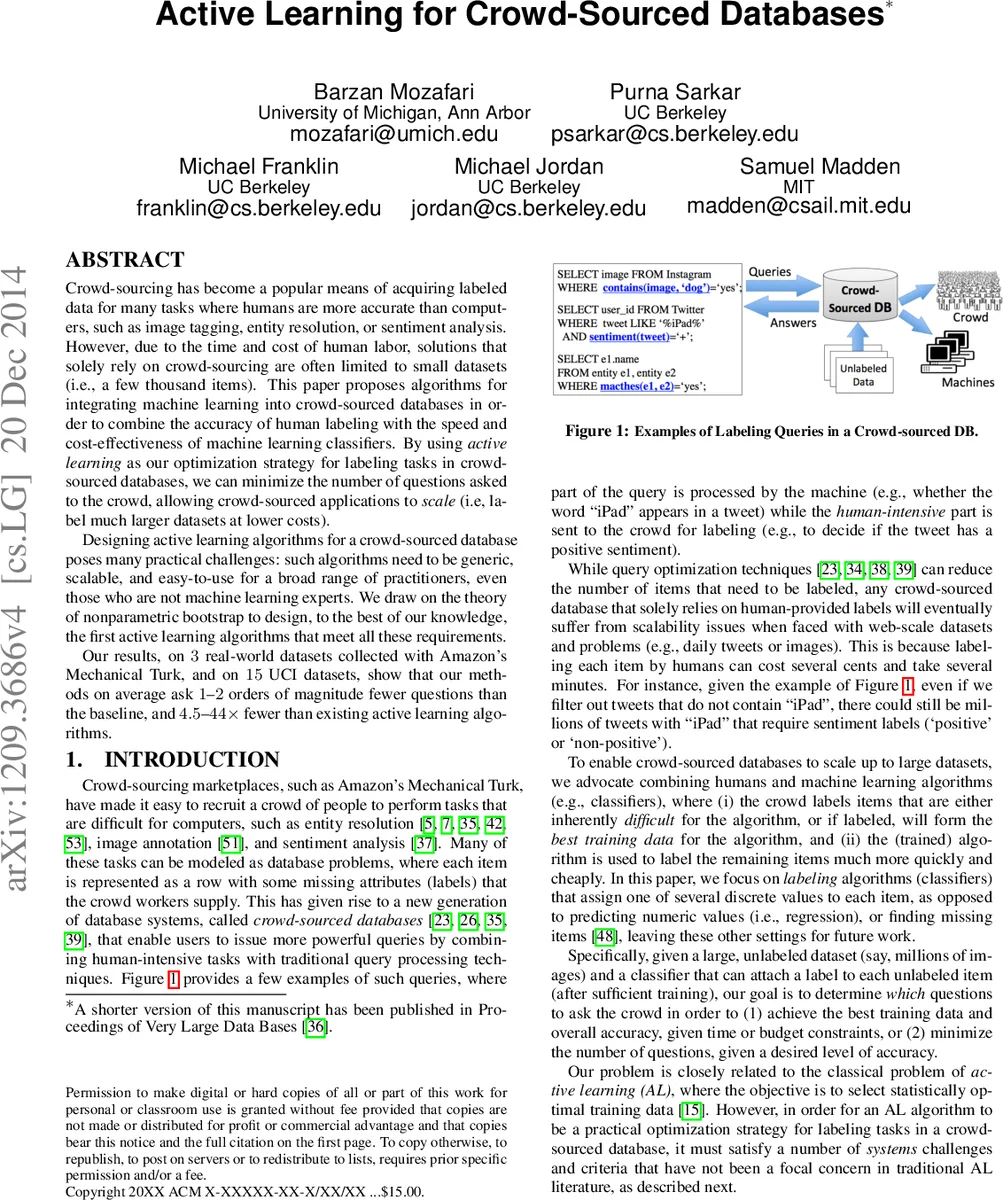
Crowd-sourcing has become a popular means of acquiring labeled data for a wide variety of tasks where humans are more accurate than computers, e.g., labeling images, matching objects, or analyzing sentiment. However, relying solely on the crowd is often impractical even for data sets with thousands of items, due to time and cost constraints of acquiring human input (which cost pennies and minutes per label). In this paper, we propose algorithms for integrating machine learning into crowd-sourced databases, with the goal of allowing crowd-sourcing applications to scale, i.e., to handle larger datasets at lower costs. The key observation is that, in many of the above tasks, humans and machine learning algorithms can be complementary, as humans are often more accurate but slow and expensive, while algorithms are usually less accurate, but faster and cheaper. Based on this observation, we present two new active learning algorithms to combine humans and algorithms together in a crowd-sourced database. Our algorithms are based on the theory of non-parametric bootstrap, which makes our results applicable to a broad class of machine learning models. Our results, on three real-life datasets collected with Amazon’s Mechanical Turk, and on 15 well-known UCI data sets, show that our methods on average ask humans to label one to two orders of magnitude fewer items to achieve the same accuracy as a baseline that labels random images, and two to eight times fewer questions than previous active learning schemes.
💡 Research Summary
The paper addresses a fundamental scalability bottleneck in crowd‑sourced databases: the high monetary and temporal cost of obtaining human labels for large data sets. While crowdsourcing platforms such as Amazon Mechanical Turk excel at tasks that are difficult for computers (e.g., image tagging, entity resolution, sentiment analysis), relying exclusively on the crowd limits practical applications to only a few thousand items because each label costs several cents and takes minutes to acquire. The authors propose to integrate machine learning (ML) with crowdsourcing through active learning (AL), thereby asking the crowd to label only the most informative items and using a trained classifier to label the rest automatically.
A key contribution is the design of two novel AL algorithms—Uncertainty and MinExpError—that satisfy five practical design criteria essential for database systems: (1) Generality (applicable to any classifier), (2) Black‑box treatment (no need to modify the classifier’s internals), (3) Batching (selecting many items at once from a large pool), (4) Parallelism (embarrassingly parallel computation), and (5) Noise management (handling noisy crowd answers). Both algorithms rely on non‑parametric bootstrap theory. By repeatedly resampling the training data and re‑training the classifier, the bootstrap provides an empirical distribution of predictions for each unlabeled item without any assumptions about the underlying model. This makes the approach classifier‑agnostic and allows the classifier to be treated as a black box.
Uncertainty scores each unlabeled item by the variance (or entropy) of its bootstrap predictions; items with the highest uncertainty receive the highest scores and are sampled (via weighted sampling) for crowd labeling. This method is computationally cheap and works well when the initial labeled set is reasonably informative.
MinExpError goes further: for each candidate item it estimates the expected reduction in overall classification error if that item were labeled and added to the training set. The expectation is computed using the bootstrap‑derived error distribution, effectively combining current model accuracy with item‑level uncertainty. Although more expensive than Uncertainty, MinExpError yields higher accuracy, especially in the “up‑front” scenario where all crowd queries are issued in a single batch.
To mitigate crowd noise, the authors introduce Partitioning‑Based Allocation (PBA), an integer‑linear‑programming technique that partitions the unlabeled pool according to estimated difficulty (derived from bootstrap uncertainty). Each partition receives a tailored redundancy level: easy items are labeled by few workers, while hard items receive more redundant labels. This adaptive redundancy dramatically reduces total cost compared to naïve uniform redundancy.
The paper distinguishes two operational modes:
- Up‑front scenario – a single batch of items is selected based on the initial labeled set; the classifier is trained once and immediately labels the remaining items while the crowd answers the batch.
- Iterative scenario – multiple rounds of selection, labeling, and retraining are performed, allowing the model to incorporate crowd feedback progressively.
Experiments were conducted on three real‑world MTurk data sets (image tagging, entity matching, sentiment analysis) and fifteen benchmark UCI data sets. The proposed methods were compared against (a) passive random sampling, (b) state‑of‑the‑art general‑purpose AL methods (e.g., IW‑AL, MarginSampling), and (c) domain‑specific AL techniques (e.g., CrowdER, CVHull, Bootstrap‑LV). Results show that, on average:
- The number of crowd queries required to reach the same accuracy is 100× (up‑front) and 7× (iterative) fewer than passive learning.
- Compared with the best existing general AL algorithm, the proposed methods need 4.5–44× fewer queries.
- Against domain‑specific methods, the savings range from 2× to over 10×, depending on the task.
- MinExpError consistently outperforms Uncertainty in the up‑front mode, while both perform similarly in the iterative mode.
Because bootstrap scores are computed independently for each resample, the ranking step is trivially parallelizable across cores or nodes, satisfying the parallelism requirement. The black‑box nature means any off‑the‑shelf classifier (SVM, decision trees, neural nets, etc.) can be plugged in without code changes.
In summary, the paper delivers the first active‑learning framework that simultaneously meets generality, black‑box compatibility, batching, parallel execution, and noise‑aware labeling—requirements that prior AL research largely ignored. By leveraging bootstrap theory and an adaptive redundancy scheme, the authors demonstrate substantial cost reductions while maintaining or improving classification quality, thereby making crowd‑sourced databases viable for web‑scale applications. Future work includes extending the approach to multi‑class and regression problems, refining the partitioning strategy, and providing tighter theoretical guarantees on the bootstrap‑based error estimates.
Comments & Academic Discussion
Loading comments...
Leave a Comment