Nonlinear Channel Estimation for OFDM System by Complex LS-SVM under High Mobility Conditions
A nonlinear channel estimator using complex Least Square Support Vector Machines (LS-SVM) is proposed for pilot-aided OFDM system and applied to Long Term Evolution (LTE) downlink under high mobility conditions. The estimation algorithm makes use of …
Authors: Anis Charrada, Abdelaziz Samet
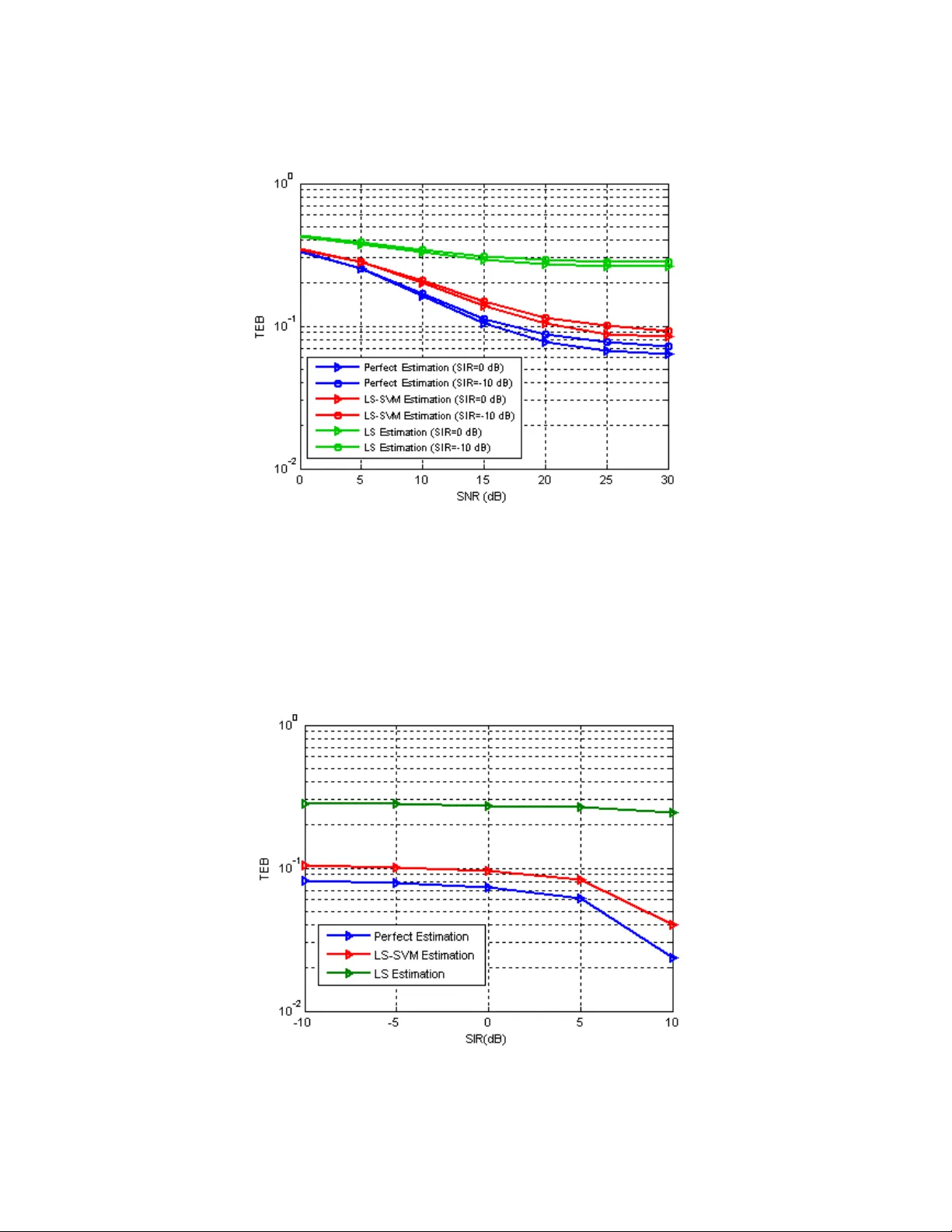
International J ournal of Wirel ess & Mobile Netw orks (IJWMN) V ol. 3, No. 4, Au gust 2011 DOI : 10.512 1/ijwmn.2011. 3412 175 N ONLI NEAR C HANNEL E STIMA TION FO R OFDM S YSTEM B Y COMPLEX LS-SVM U NDER H IGH M OBILITY C ONDI TIONS Anis Charrada 1 and A b delaziz S amet 2 1 and 2 CSE Research Unit, T unisia Polytechn i c School, Carthage U niversity, Tunis, Tu nisia . 1 anis.cha rrada@gmail. com, 2 abdelazi z.samet@ept.rnu. tn A BSTRACT A nonlinear channel estimat or usin g complex Least Square Sup port Vector Machi nes (LS- SVM) is proposed f or pilot-aide d OFDM syste m and appli ed to Lo ng Term Evol ution (LTE) downlink under hi gh mobility conditions. The estimati on a lgorithm makes use of the reference signals to e stimate t he total frequency re sponse of the highly selectiv e multipath ch annel in the presence of n on-Gaussian im pulse noise interf ering with pil ot signals. Th u s, the a lgorithm map s trained data in to a high dimensi onal feature space and uses t he structur al risk mi nimization ( SRM) princi ple to carry out t he regressio n estimation for the frequency resp onse fu nction of the highly selective channel. The simul ations show the effectiveness of the pr oposed method w hich has good performance and high p recisio n to track the v ar iations of the fading channels c ompared to the c onventional LS met hod and it is robust at high speed mo bility. Keyword s Complex L S-SVM, Mercer's k ernel, nonlinear channel estimati on, impulse noise, OF DM, LTE. 1. I NTRODUC TION Channel estimation in wireless OFDM systems is an active research area, especially in the case of frequency selec tive time varying multipath fading channels. Several estimation algorithms have been developed, such t hat LS [ 1], MMSE [ 2] and estimation wi th decision f eedb ack [ 3]. Channel estimation by neural network i s also described in [4]. However, in a practical environment where non-Gaussian impuls e noise can b e present, th e classical estimation methods may not be effective for t h is impulse noise. The use of Support Vector Machines (SVMs) has already been proposed to solve a variety of signal processing and digital communications p rob lems. Signal equalization and d ete ction for multicarrier MC-CDMA system is presented in [5]. Also, adaptive multiuser detector for d irec t sequence CDMA signals in multi path channels is developed in [6]. In all these applications, SVM methods outperform class ical approaches due to its improved ge neralization capabilities. Here, a proposed SVM rob ust version for n onlinear channel estimation in the presence o f non - Gaussian impulse noise that i s spec ifically adapted t o pilot-aided OFDM structure is presented. In fact, impulses of shor t durati on are unpredictable and contain sp e ctral components on all subchannels which impact the dec ision of the transmitted symb ols on all subcarriers. The channel estimation algorithm is based on the nonlinea r least square support vector machines ( L S- SVM) method in o rder to improve communication efficiency and quality o f OFDM systems. The pr inciple of th e proposed nonlinear LS-SVM algorithm i s to exploit the information provided by the reference signal t o estimate the channel frequency response. In highly selective multipath fading channel, where complicated nonl inea rities can be present, the International J ournal of Wirel ess & Mobile Netw orks (IJWMN) V ol. 3, No. 4, Au gust 2011 176 estimation precision can be lowed by using line ar method. So, we adapt the nonlinea r LS-SVM algorithm which transforms the nonlinear estimation in l ow dimensional space i nto the l inear estimation in high dimensional s pace, so it improves the estima tion precision. In thi s contribution, the proposed nonl ine ar complex LS-SVM technique is a pplied to LTE downlink highly selective channel using pilot symbols. For the pur pose of compa rison with conventional LS algorithm, we develop th e n onlinea r LS-SVM algorithm in t e rms of the RBF kernel. Simulat i on section illustrates the advantage of this algorit hm over LS algorithm in high mobility environment. The nonlinear complex LS-SVM method shows good result s under high mobility conditions due to its improve d generalization a bility. The sch e me of t he paper is as foll ows. Section 2 briefly intr oduce s the OFDM system mod el. We present t he f ormula tion of the p roposed non line ar complex LS-SVM channel es timation method in section 3. Section 4 presents the simulation results when c omparing wit h LS standard algorithm. Finally, in sec tion 5, conclusions are drawn. 2. S YSTEM M ODEL The OFDM sys tem model cons ists fi rstly of mapping binary data streams into c omplex symbols by means of QAM modulation . Then data are transmitted in frames by means of serial-to- parallel conversion. Some pilot symbols are inserted i nto each d ata frame which is modula ted to subcarriers through IDFT. These pilot symbols are inserted for ch anne l estimation purposes. The IDFT is used to transform the data sequence into time domain signal as follow: One guard interval is i nserted between eve ry two OFDM symbols i n order to eliminate inter- symbol i nterference (ISI). This guard time includes the cyclically extended part of the OFDM symbol in order to pr e serve orthogonality an d eliminate inter-carrier int e rference (ICI). It is well known that if the channe l i m pulse response has a maximum of res olvable paths, t hen t he GI must be at least equal to [7]. Thus, for the OF DM s ystem comprising subcarriers which occ upy a bandwidth , e ach OFDM symbol is transmitted in ti me and includes a cyclic prefix of duration . Therefore, the duration of each OFDM symbol is . Every two adjacent subcarriers are spaced by . T he output sig nal of the OFDM system is converted into serial signa l by parallel to se rial conve rter. A c omplex white Gaussian noise process with power spec tral density is added through a fre quency selective time v arying multipath fading channel. In a practical environment, impulse noise can be pr es ent, and t he n the channel become s nonlinear with non Gauss ian impul se noise. The impu lse noise can si gnificantly influ e nce the performance of th e OFDM communication system for many r eas ons. First, the time of the arrival of an impulse is u npredictab le and shapes of t he impulses are not known and they vary considerably. Moreover, impulses usually have very high amplitude, and thus high energy, which can be much greater than the ene rgy of the useful signal [8]. The impulse noise is modeled as a Bernoulli-Gaussian process and it was generated with the Bernoulli-Gaussian process function where is a random pr oce ss with Gaussian distribution and power , and where is a random process with probability [9] (2) International J ournal of Wirel ess & Mobile Netw orks (IJWMN) V ol. 3, No. 4, Au gust 2011 177 At the receiver, and after re mov ing guard t ime, the discrete-time baseband OFDM signal for the system including impulse noise is where are time do ma in samples and is the channel's frequency response at the frequency. The sum of both terms of t he AWGN nois e and impu lse noise constitute the total noise g iven by . Let the subset of pilot subcarriers and the pilot interval in frequency domain. Over this subse t, channel's frequency re s ponse c a n b e estimated, and then interpolated over other subcarriers . These remaining subchannels are interpolated b y t he nonl inear complex LS-SVM algorithm. The OFDM s ystem can be expressed as where and are complex pilot and data symbol respectively , transmitted at the s ubcarrier. Note that, pilot insertion in the subc arriers of every OFDM symbol must satisfy the demand of the sampling theory a nd uniform distribution [10]. After DFT transformation, becomes Assuming that ISI are eliminated, therefore where represe nts the sum of the AWGN noi se and i mpulse noise in the frequency domain, respec tively. (6) may be presente d in matrix notation where and International J ournal of Wirel ess & Mobile Netw orks (IJWMN) V ol. 3, No. 4, Au gust 2011 178 3. N ONLINEAR C OMPLEX LS-SVM E STIMATOR First, let t he OFDM fr ame contains OFDM symbols which every symbol in c ludes subcarriers. As eve ry OFDM symbol has uniformly distributed pilot sy mbols, the transmitting pilot sy mbols are , where and are labels in time domain and frequency domain respective ly. The proposed channel estimation method is based on nonlinear complex LS-SVM algorithm which has two separate phases: training phase and estimation phase. In training phas e , w e estimate first the subchannels pilot symbols according to LS criterion to strike [11], as where and are the receive d pilot symbo ls and the estimated frequenc y res ponses for the OFDM sym bol at pilot positions , respec tively. Then, i n the estimation phase and b y the interpol a tion mechanism, frequency responses o f data subchannels ca n be determined. Therefore, frequency resp onses of all the OFDM subcarriers are where , and is the interpolating function, which is determine d by the nonlinear complex LS-SVM a pproach. In high mobility e nvironments, whe re the fading cha nnels present very c omplicated nonlinearities especially i n deep fading case, t he l inear approaches cannot achieve high estimation precision. Therefore, we adapt here a nonlinear complex LS-SVM technique since SVM is sup e rior i n solving nonli nea r, small samples and high dimensional pattern recognition [10]. Therefo re, we map the in put vectors t o a higher dimensional feature space ( possibly infinity) by means of nonlinear transformation . Thus, th e regula rization term i s referred to t he regression vector in the RKHS. The following regression function is then where is the weight vector, is the bias t erm well known in the SVM literature and residuals accou nt for the effec t of both approxima tion errors an d noise. In the SVM framework, the optimality crit er ion is a regularize d and constrained version of the regularized LS criterion . In general, SVM algorit hms mini mize a regularized c ost f unction of the residuals, usuall y the Vapnik’s cost function [9]. A robust cost fu ncti on is introduced to improve the performance of the estimation algorithm which is -Huber robust cost fu nc tion, given by [12] where , is the insensitive parameter which i s positive s calar that represents the insensitivity to a l ow n oise level, parameters and control essentially the t rade -off between the regularization and th e losses, and r epresent t he relevance of the residuals that are in the linear or in the quadratic cost zone, respectively. Th e cost function is linear for errors above , and quadratic for errors between and . Note t hat, errors lower than are ignored in the International J ournal of Wirel ess & Mobile Netw orks (IJWMN) V ol. 3, No. 4, Au gust 2011 179 zone. On the o ther hand, t he q ua dratic cost zone uses the of errors, which is appropriate for Gaussian nois e, and the linear cost zone limits the e ffect o f sub- Gaussian noise [13]. Therefore, the -Huber robust cost function can b e adapted to different kinds of noise. Since is complex, l e t , where and represe nt real and imaginary parts, respectively. Now, we can state the primal problem as minimizing constrained to for , where and are slack va riables whic h stand for pos itive and negative errors in the real pa rt, respectively. and are the errors for the imagina ry parts. a nd are the set of samples for which: real part of the residuals are in the quadratic zone; : real part of the residuals are in the linear zone; : imaginary part of the residuals are in the quadra tic zone; : imaginary part of the residuals are in the linear zon e. To transform t he minimization of the primal functional (13) subject t o constraints in (14), int o the optimization of the dual functional, we must first i ntroduce the constraints into the primal functional. Thus, the primal dual functiona l is as follow: International J ournal of Wirel ess & Mobile Netw orks (IJWMN) V ol. 3, No. 4, Au gust 2011 180 with th e Lag range multipliers (or dual variables) const rained to , , , , , and . According to Karush-Kuhn-Tuc ker (KKT) conditions [12] , and , . (16 ) Then, by m aking zero the pr ima l-dual function a l gradient wit h respect to , we ob tain an optimal solution for the weig hts where with are the Lagrange multipliers for r ea l and imaginary part of the residuals and are the pilot positions. We define the Gram matrix a s where is a Mercer’s kernel which represent in t his contribution the RBF kernel m atrix which allows obviating the explicit knowledge of the nonlinear mapping . A compact form of t he f unctiona l problem can be stated in matrix format by placing optimal solution into the primal dual functional and g rouping terms. Then, the dual problem consists of maximizing constrained to , wh e re ; I and 1 are the identity matrix and t he all-ones column vector, respectively; is the vector whi c h contains the corresponding dual variables, with the other subsets being similarly represented. The w e ight vector ca n be obtained by optimizing (1 9) with respect to and then substituting into (17). Therefore, and after training phase, frequency responses at all subcarriers in each OFDM symbol can be obtained by SVM interpolation for . Not e that, t he obtained subset of Lagrange multipliers which are nonzero will provide with a sparse solution. As usual in the SVM framework, the free paramete r of the kernel and the free pa rameters of the cost f unction have to be fixed by some a p riori know ledge of the problem, or by using s ome validation set of observations [9]. International J ournal of Wirel ess & Mobile Netw orks (IJWMN) V ol. 3, No. 4, Au gust 2011 181 4. S IMULA TION RESULTS We consider the channel impulse re sponse of the frequency-selective fading channel model which can be written as where is the impulse response representing the complex attenuation of the path, is the random d e lay of the path and is th e numb e r of multipath replicas. The sp ecifica tion parameters of an extended vehic ular A model (EVA) for downlink LTE system with the excess tap delay and the r e lative power for eac h path of the channel are shown i n table 1. These parameters are defined by 3GPP standard [14]. Table 1. Exte nded Vehicular A model (EVA) [14]. Excess tap delay [ns] Relati ve power [dB] 0 0.0 30 -1.5 150 - 1.4 310 -3.6 370 -0.6 710 - 9.1 1090 -7.0 1730 - 12.0 2510 -16.9 In o rder to demons trate the effectiveness of our proposed technique and evaluate the performance, two objective criteria, the si g nal-to-noise r atio (SNR) and signal-to- impulse ratio (SIR) are used. The SNR and SIR are given by [9] and Then, we simulate the O FDM downlink LTE system with paramete rs presented in table 2. The nonlinear complex LS -SVM estima te a number of OFDM symbols in the range o f 140 sym bols, corresponding t o one radio frame LT E. Note t hat, t he LTE radio f ram e du ra tion is 10 ms [ 15], which is divided i nt o 10 subframe s. Each subfr a me is further divided into t wo slots, each of 0.5 ms duration. For the purpose of evaluation the performance o f the nonlinear complex LS-SVM algorithm under hi g h mobility conditions, we consider a scenario for downlink LTE s ystem for a mobile speed equal to 350 Km/h. Accordingly, we take into account the impulse noise with wh ich was a dded t o the reference signals with different rates of SIR and it ranged from -10 to 10 dB. Internati o nal J o urnal o f Wire l e s s & M o b i l e N e t w o r k s ( I J W M N ) V o l . 3 , Table 2. Pa r a m e te r s o f s i m u la ti o n s [ 1 5 ] , [ 1 6 Parame ter s OFDM sys t e m Constellati o n Mobile Spe e d ( K m /h ) (µ s) (GHz) (KHz) B (MHz) Size of DF T /I D F T Number of Figure (1) presents the variations in t im e a n d in f r e q u e n c y o f th e c h a n n e l f r e q u e n c y r e s p o n s e f o r the considered scenario. Figure (2) shows the performan c e o f th e L S a n d n o n lin e a r c o m p l e x L S prese nce of addi tive G aussian no is e a s a f u n c t io n o f S N R f o r SI R = 0 a n d poor performance i s noticea bly e x h i b it e d b y L S a n d nonlinear com plex LS-SVM. Figure 1. Variations in t i m e a n d i n f r e q u e n c y o f t h e c h a n n e l f r e q u e n c y r e s p o n s e f o r I n t e r n a t i o n a l J o u r n a l o f W i r ele ss & Mobile Networ ks (IJWMN) V ol. 3, No. 4, Au gust 2 0 1 1 P aramete rs of simulations [15],[16 ] and [17]. P a r a m e t e rs Specifications O F D M s y stem LTE/Downlink C o n s t e l l a t ion 16-QAM M o b i l e S p eed (Km/h) 350 72 2.15 15 5 S i z e o f D F T/IDFT 512 N u m b e r o f paths 9 p r e s e n t s t h e v a r i a t i o n s in time and in frequency of the channel frequency r e s p o n s e f o r s h o w s t h e p e r f o r m a n ce of the L S and nonlinea r complex LS - SVM algor i t h m s i n t h e p r e s e n c e o f a d d i t i v e G a u s s i a n n oise as a function of SNR fo r SIR=0 and - 10 dB resp e c t i v e l y . A p o o r p e r f o r m a n c e i s n o t i c e a b l y exhibi ted by LS and better performance is ob s e r v e d w i t h F i g u r e 1 . V a r i a t i o n s i n t ime and in frequency of the cha nnel frequency respo n s e f o r mobile spee d =350 Km/h. N o . 4 , A u g u s t 2011 182 p r e s e n t s t h e v a r i a t i o n s i n t i m e a n d i n f r e q u e n c y o f t h e c h a n n e l f r e q u e n c y response for S V M a l g o r ithms in the 1 0 d B r e s pecti v ely. A p e r f o r m a n c e i s o b served wi th F i g u r e 1 . V a r i a t i o n s i n t i m e a n d i n f r e q u e n c y o f t h e c h a n n e l f r e q u e n c y r e s p onse for International Journal of Wirel ess & Mobile Netw orks (IJWMN) V ol. 3, No. 4, A ugust 2011 183 Fig ure (3) p res ents a comparison between LS and no nlinear complex LS-SVM in the presence of additive impulse noise for SNR=20 dB. T he c omparison of the se me thods reveals that nonlinear complex LS-SVM outperform L S estimator in h igh mobility conditions especially f or high SNR as c onfirmed by figure (4) for SNR=30 dB. Figure 2. BER as a function of SNR for a mobile speed at 350 Km/h for SIR=0 and -10 dB with p=0.2. Figure 3. BE R as a function of SIR for a mobile speed at 350 Km/h for SNR=20 dB with p=0.2. International Journal of Wirel ess & Mobile Netw orks (IJWMN) V ol. 3, No. 4, A ugust 2011 184 5. C ONCLUSION In this contribution, we have presented a new nonlinear c omplex LS-SVM based channel estima tion technique for a downlink LTE system under high mobility conditions in the presence of non-Gauss ian impulse noise interfering with OFDM reference symbols. The pr oposed method is based on l e arning process that uses training sequence to es timate the channel variations. Ou r formulation is based on nonlinear complex LS-SVM specifically developed for pilot-based OFDM systems. Si mulations have confir m ed t he capabilities of the proposed nonlinear complex LS-SVM in t he presence of Gaussia n and impulse noise interfering with the pi lot symbols fo r a high mobile speed wh en compared to LS standard method. The proposal takes into account the temporal-spectral relati onship of the OFDM signal f or hi g hly selective chan nels. The Gram matrix using RBF kernel lead t o a significant ben efit f o r OFDM commun ications espec ially in those scenarios in wh ich impu lse noise and d eep fa ding are prese nts. R EFEREN CES [1] C. L im, D. Han, “Robu st LS channel esti ma tion w ith phase rotatio n for single frequency netw o rk in OFDM,” IEE E Transac tions on Consumer Electronics , Vol. 52, pp. 1173–1178, 2006. [2] S. G alih, T. Adio no and A. K um iawan, “ L ow Comp lexity MMSE Channel Estimatio n by Weight Matrix Elements Sampling f o r Dow nlink OFDMA Mobi le WiMAX Sy stem,” Internationa l Journal of Compu t er Science and Network Security (I JCSNS) , February 2010. [3] A. Ba y na st, A. Sabharwal, B. Aazhang, “Ana lysis of Decisi on-Feedback Based Br oadband OFDM S y s tems,” Confe rence on Signal s Systems & Com puters ACSSC, 20 06. Figure 4. BE R as a function of SIR for a mobile speed at 350 Km/h for SNR=30 dB with p=0.2. International J ournal of Wirel ess & Mobile Netw orks (IJWMN) V ol. 3, No. 4, Au gust 2011 185 [4] A. Omri, R. Bou allegue, R. Hamila and M. Hasna, “Channel estimation for LTE uplink sys tem by perce ptro n neural network ,” International Journal of Wireless & Mobile Networks (I JW MN) , Vol. 2, no. 3, pp. 155 – 1 65, A ug ust 2010. [5] S. Rahman, M. Saito, M. Okada and H. Yamamot o, “An MC-CDMA si g na l equalization and detection scheme based o n suppo rt vector machines,” Proc. of 1 st I n ternational Symposium on Wireless Communication Systems , Vol. 1, pp. 11–15, 2004. [6] S. Chen, A. K. Samingan and L. Hanzo, “Support vecto r machine multiuser receiver for DS- CDMA sig nals in multipath channels,” IEEE Trans. on Neural Networks , Vol. 12, no . 3, pp. 604–61 1, 2001 . [7] M. J . Fernández-Getino G arcía, J. M. P áez-Borrallo, and S. Zazo, “DFT-based channel estimation in 2D-pilot-sy mbol-aided OFDM wir eless sy stems,” IEEE Vehicular Tec hno l ogy Conf ., vol. 2, pp. 815–819, 2001. [8] M. Slisko vic, “Signal processing algorithm for OFDM channel with impulse noise,” IEEE conf. on Electronics, Circuits and Systems , pp. 222–225 , 2000. [9] J. L. Rojo-Á lvarez, C. F i g ue ra-Pozuelo , C. E. Martínez-Cruz, G. Ca mp s-Valls, F. Alo nso- Atienza, M. Martínez-Ramón, “Nonun iform Interpolatio n of Noisy Signals U si ng Suppo rt Vector Machines,” IEEE Tra ns. Signal p rocess . , vol. 55, no.48, pp. 4116– 4126, 2007. [10] L. Nanping, Y. Yuan, X. Kewen, and Z. Zhiwei, “Study on Channel Estimation Technolo gy in OFDM sy st em,” IEEE Computer Socie ty Conf. , pp.773–776, 2009. [11] S. Coleri, M. Er g e n and A. P uri, “Channel estimation te chni ques based on pilot a rrangeme nt in OFDM sy st ems,” IEEE Trans. on broad casting, vo l. 48, no.3, pp. 2 2 3-229, 2002 . [12] M. Martínez Ra món, N. Xu, and C. G. Christodoulou, “Bea mforming Using S upport Vector Machines,” IEEE antennas and wireless pro pagation J. , vol. 4, 2 005. [13] M. J. Ferná ndez-Getino Garcí a, J. L. Rojo-Álvarez , F. Alons o -Atienza, and M. Martí nez-Ramón, “Support Vect or Machines fo r R obust Cha nnel E stimation in O F DM,” IEEE signal proc ess. J. , vol. 13, no. 7, 2 006. [14] 3rd Ge neration Partnership Project, “Technical Specificati on Group Radio Access Network: evolved U n iversal Terrestria l Radio Access ( UTRA): Ba se Station (BS) radio t ransmission a nd reception,” TS 36.10 4 , V8.7.0, September 2009. [15] 3rd Generation Pa rtnership Project, “Technica l Specifi cation Group Radio Access Network: evolved Univer sal Terrestrial Radio Acc ess (UTRA): P hysical Cha nnels and M odulation la y er, ” TS 36.211 , V8.8.0, September 200 9. [16] 3rd Generati on Pa rtnership Project, “Technica l Specifi cation Group Radio Access Network: Physical layer aspects for evolved Universal T errestrial Radi o A cce ss (UTRA) ,” TR 25.814 , V7.1.0, Se ptember 2006. [17] 3rd Generation Partnership Project, “Tech nical Specification Group Radio Access Net wo rk: evolved U niversal Terrestrial Radi o A ccess (U TRA): Ph ysical la y er procedure s,” TS 36.21 3 , V8.8.0, Se ptember 2009.
Original Paper
Loading high-quality paper...
Comments & Academic Discussion
Loading comments...
Leave a Comment