A systematic literature review of cloud computing in eHealth
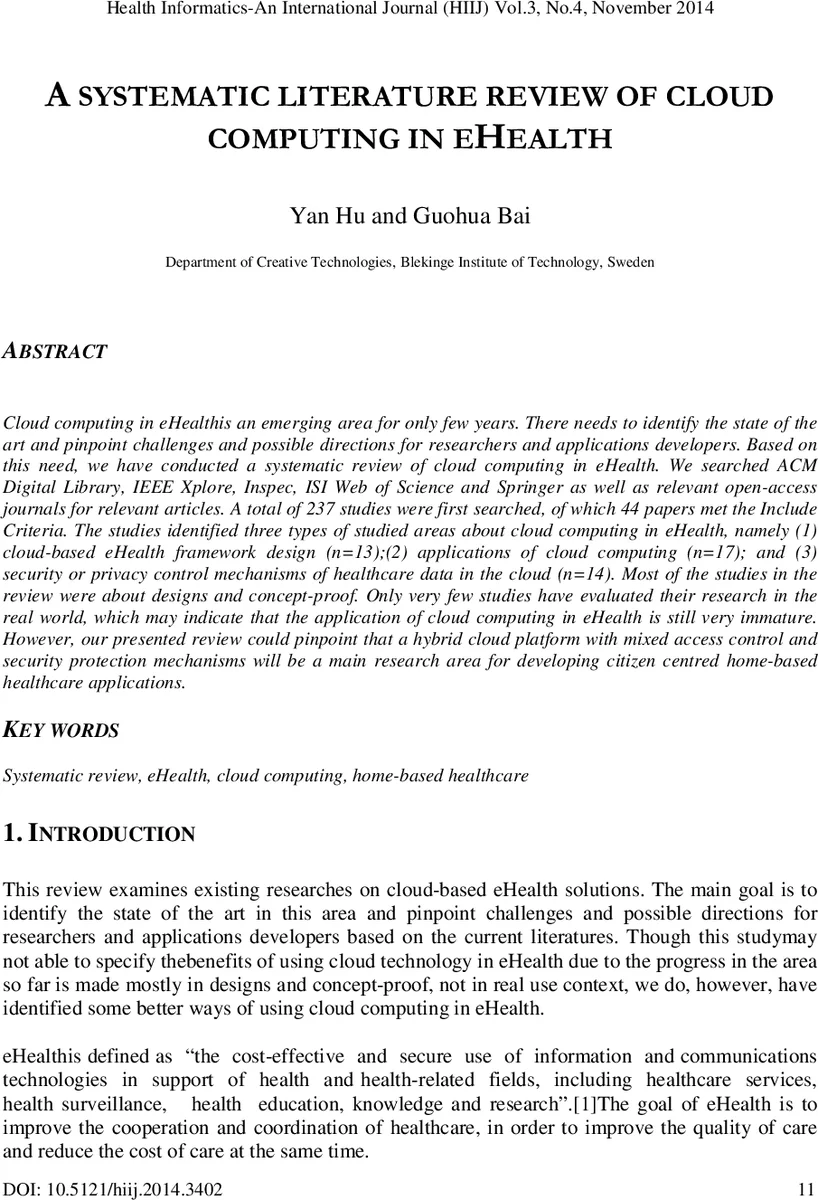
Cloud computing in eHealth is an emerging area for only few years. There needs to identify the state of the art and pinpoint challenges and possible directions for researchers and applications developers. Based on this need, we have conducted a systematic review of cloud computing in eHealth. We searched ACM Digital Library, IEEE Xplore, Inspec, ISI Web of Science and Springer as well as relevant open-access journals for relevant articles. A total of 237 studies were first searched, of which 44 papers met the Include Criteria. The studies identified three types of studied areas about cloud computing in eHealth, namely (1) cloud-based eHealth framework design (n=13); (2) applications of cloud computing (n=17); and (3) security or privacy control mechanisms of healthcare data in the cloud (n=14). Most of the studies in the review were about designs and concept-proof. Only very few studies have evaluated their research in the real world, which may indicate that the application of cloud computing in eHealth is still very immature. However, our presented review could pinpoint that a hybrid cloud platform with mixed access control and security protection mechanisms will be a main research area for developing citizen centred home-based healthcare applications.
💡 Research Summary
This paper presents a systematic literature review of cloud computing applications in eHealth. Recognizing that cloud‑based eHealth is a nascent field, the authors aimed to map the state‑of‑the‑art, identify challenges, and suggest future research directions. They searched five major bibliographic databases—ACM Digital Library, IEEE Xplore, Inspec, ISI Web of Science, and Springer—plus relevant open‑access journals, using the Boolean query (Cloud) AND (eHealth OR “electronic health” OR e‑health). The initial search retrieved 237 records; after applying predefined inclusion and exclusion criteria (e.g., direct relevance to both eHealth and cloud technology, English language, exclusion of pure reviews, business reports, and non‑technical papers), 44 papers were selected for full analysis.
The authors classified the selected studies into three thematic groups: (1) cloud‑based eHealth framework design (13 papers), (2) applications of cloud computing in eHealth (17 papers), and (3) security or privacy control mechanisms for healthcare data in the cloud (14 papers). The majority of the works are conceptual designs, proof‑of‑concept prototypes, or early‑stage implementations; only a handful report real‑world deployments or extensive empirical evaluations, indicating that the field is still immature.
In the framework design category, researchers propose architectures that leverage cloud storage for sensor‑generated clinical data, national‑level health information exchanges, virtual research environments, patient self‑management platforms, and interoperable EHR/PHR standards. These designs typically combine cloud scalability with access‑control and encryption layers, yet they lack performance or security validation in operational health settings.
The application category showcases a variety of use cases across public, private, and hybrid clouds. Public‑cloud implementations include patient‑to‑patient support systems on Google App Engine, Azure‑based mobile health data collection, and Amazon EC2‑hosted health‑cloud exchanges. Private‑cloud studies focus on semantic and syntactic interoperability, queuing‑theory performance modeling, and lifelong personal health records built via virtualization. Hybrid‑cloud examples blend private storage for sensitive clinical records with public‑cloud repositories for daily self‑monitoring data, aiming to balance cost, accessibility, and privacy.
Security and privacy mechanisms form the third pillar. The most frequently cited techniques are Attribute‑Based Encryption (ABE) and Identity‑Based Encryption (IBE), often combined to support multi‑level access (normal vs. emergency). Role‑Based Access Control (RBAC) extensions, task‑based control, and privacy‑aware RBAC models are proposed to enforce fine‑grained permissions. Additional protective measures such as trusted virtual domains, watermarking, secure indexing, and secret‑sharing schemes are also discussed.
The discussion highlights several overarching insights: (i) cloud computing’s large storage capacity and on‑demand elasticity are attractive for handling the massive data volumes generated by modern health monitoring; (ii) pay‑as‑you‑go pricing can reduce operational costs for health institutions; (iii) patient‑centric models, enabled by ubiquitous cloud access, can empower self‑management and health education; (iv) security and privacy remain the primary barriers, especially concerning legal compliance and data confidentiality; (v) most research originates from developed countries, though emerging contributions from China, India, and the UAE are noted.
The authors acknowledge limitations of their review, including potential missed synonyms for “eHealth,” the relatively small corpus due to the field’s youth, and the predominance of conference papers lacking rigorous validation. Consequently, they caution against overgeneralizing the findings.
In conclusion, the review asserts that cloud computing holds promise for eHealth, particularly through hybrid cloud architectures that integrate private and public resources with mixed access‑control and security mechanisms. Such configurations could support citizen‑centered, home‑based healthcare systems where patients retain ownership of their data and dictate sharing policies. The paper calls for more empirical studies, real‑world deployments, and interdisciplinary collaborations to advance cloud‑enabled eHealth from concept to practice.
Comments & Academic Discussion
Loading comments...
Leave a Comment