Wi-Fi Gesture Recognition on Existing Devices
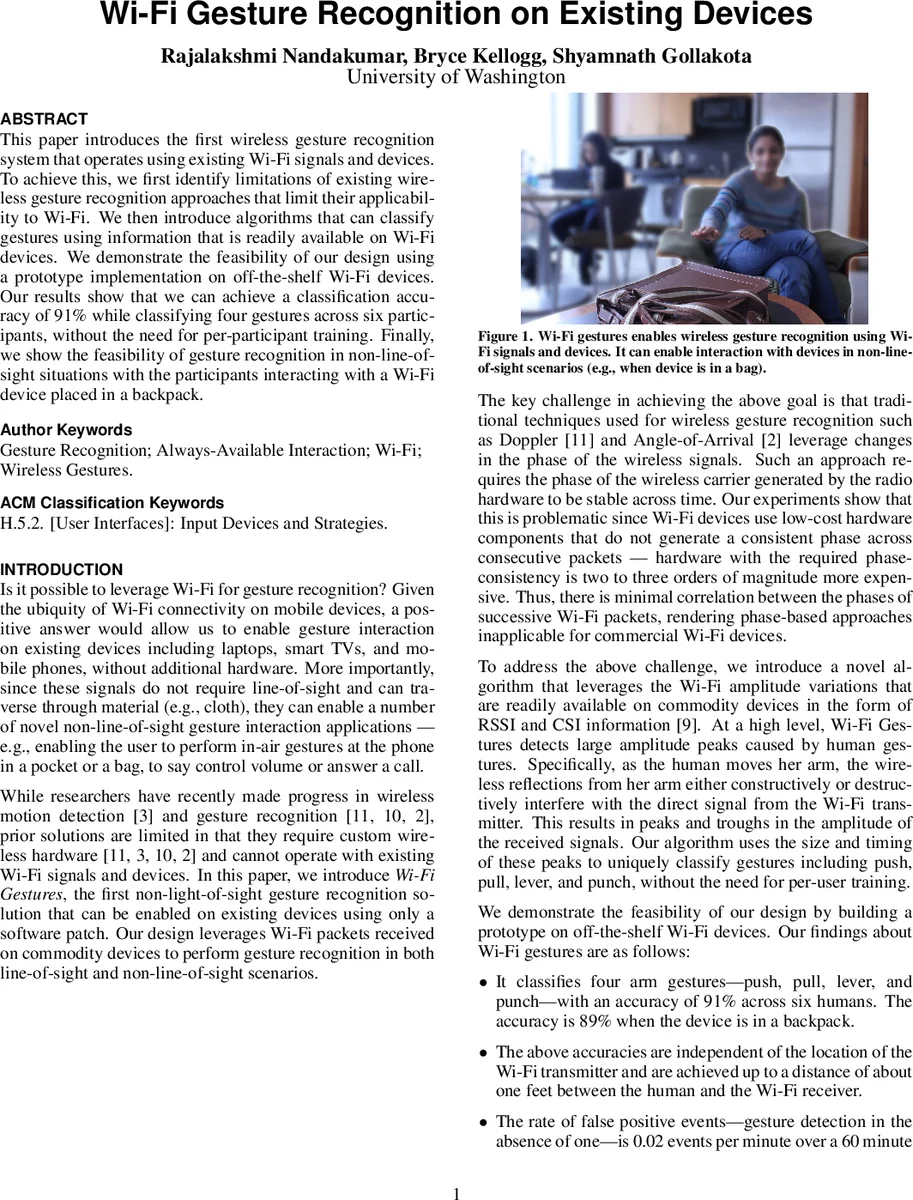
This paper introduces the first wireless gesture recognition system that operates using existingWi-Fi signals and devices. To achieve this, we first identify limitations of existing wireless gesture recognition approaches that limit their applicability to Wi-Fi. We then introduce algorithms that can classify gestures using information that is readily available on Wi-Fi devices. We demonstrate the feasibility of our design using a prototype implementation on off-the-shelf Wi-Fi devices. Our results show that we can achieve a classification accuracy of 91% while classifying four gestures across six participants, without the need for per-participant training. Finally, we show the feasibility of gesture recognition in non-line-ofsight situations with the participants interacting with a Wi-Fi device placed in a backpack.
💡 Research Summary
The paper presents “Wi‑Fi Gestures,” the first wireless gesture‑recognition system that operates solely on commodity Wi‑Fi hardware without any custom radios or additional sensors. The authors begin by identifying a fundamental obstacle: existing wireless gesture‑recognition approaches (e.g., Doppler‑based or angle‑of‑arrival methods) rely heavily on stable phase information, which is unavailable on low‑cost Wi‑Fi chipsets because their oscillators drift and the phase of successive packets is essentially uncorrelated. To overcome this, the authors pivot to using only amplitude‑related channel metrics—Received Signal Strength Indicator (RSSI) and Channel State Information (CSI)—which are readily exposed by Intel 5300‑based Wi‑Fi cards.
The system pipeline consists of three stages: signal conditioning, peak detection, and gesture classification. First, because Wi‑Fi uses CSMA/CA, packet arrivals are irregular. The authors apply one‑dimensional linear interpolation to generate uniformly spaced samples at 1 kHz, then low‑pass filter the series to suppress high‑frequency noise while preserving the slower dynamics of human motion. A moving‑average subtraction removes long‑term bias, yielding a zero‑mean “conditioned channel” trace that highlights only transient amplitude changes caused by a moving arm.
In the peak‑detection stage, the algorithm scans the conditioned trace for large excursions. A candidate peak must exceed 1.5 × the mean amplitude of the conditioned signal, and at least one peak in a candidate gesture must be more than one standard deviation above the noise floor. Isolated spikes are discarded, and only groups of peaks that satisfy these criteria are retained, reducing false detections from random glitches.
Classification exploits the temporal ordering and magnitude of the retained peaks. Four gestures are defined: push, pull, punch, and lever. A push gesture produces a monotonic increase in peak height as the hand approaches the receiver; a pull gesture shows a monotonic decrease. A punch yields an increase‑decrease‑increase pattern, while a lever yields increase‑decrease‑increase‑decrease. The current prototype hard‑codes these patterns; however, the authors note that a learning‑based model could replace the rule‑based approach for scalability.
The prototype is built on a Dell Inspiron laptop (Intel 5300 transmitter) and an Asus Eee PC (Intel 5300 receiver). CSI is captured using the Intel CSI Toolkit. Experiments involve six participants (four male, two female) performing each gesture 20 times in two scenarios: line‑of‑sight (receiver on a table) and non‑line‑of‑sight (receiver placed inside a backpack). Classification accuracy averages 91 % in the line‑of‑sight case and 89 % when the device is in a backpack. Per‑gesture accuracies range from ~83 % (punch) to ~97 % (pull). Misclassifications are primarily attributed to participant fatigue and inconsistent arm motion.
Additional studies examine robustness to transmitter location (four random positions, including a different room) and to packet transmission rate. Accuracy varies by only 2–3 % across locations, confirming that the algorithm depends on relative amplitude changes rather than absolute channel values. Accuracy improves with higher packet rates, plateauing near the maximum rate supported by the hardware.
To mitigate false positives in a busy office environment (13 occupants), the system incorporates a “start gesture” (a lever motion) that must be performed before normal detection begins. Without this guard, the system registers ~2.3 false events per minute; with the start gesture, the false‑positive rate drops to 0.02 events per minute over a 60‑minute observation period.
The authors conclude that amplitude‑based Wi‑Fi gesture recognition is feasible, cost‑effective, and works in non‑line‑of‑sight conditions, opening the door to ubiquitous, sensor‑free interaction on existing devices such as laptops, smartphones, and smart TVs. Future work includes extending the gesture set, integrating data from multiple APs to reduce reliance on high packet rates, and applying machine‑learning classifiers to improve robustness and scalability.
Comments & Academic Discussion
Loading comments...
Leave a Comment