A Conversation with Howell Tong
The following conversation is partly based on an interview that took place in the Hong Kong University of Science and Technology in July 2013.
Authors: Kung-Sik Chan, Qiwei Yao
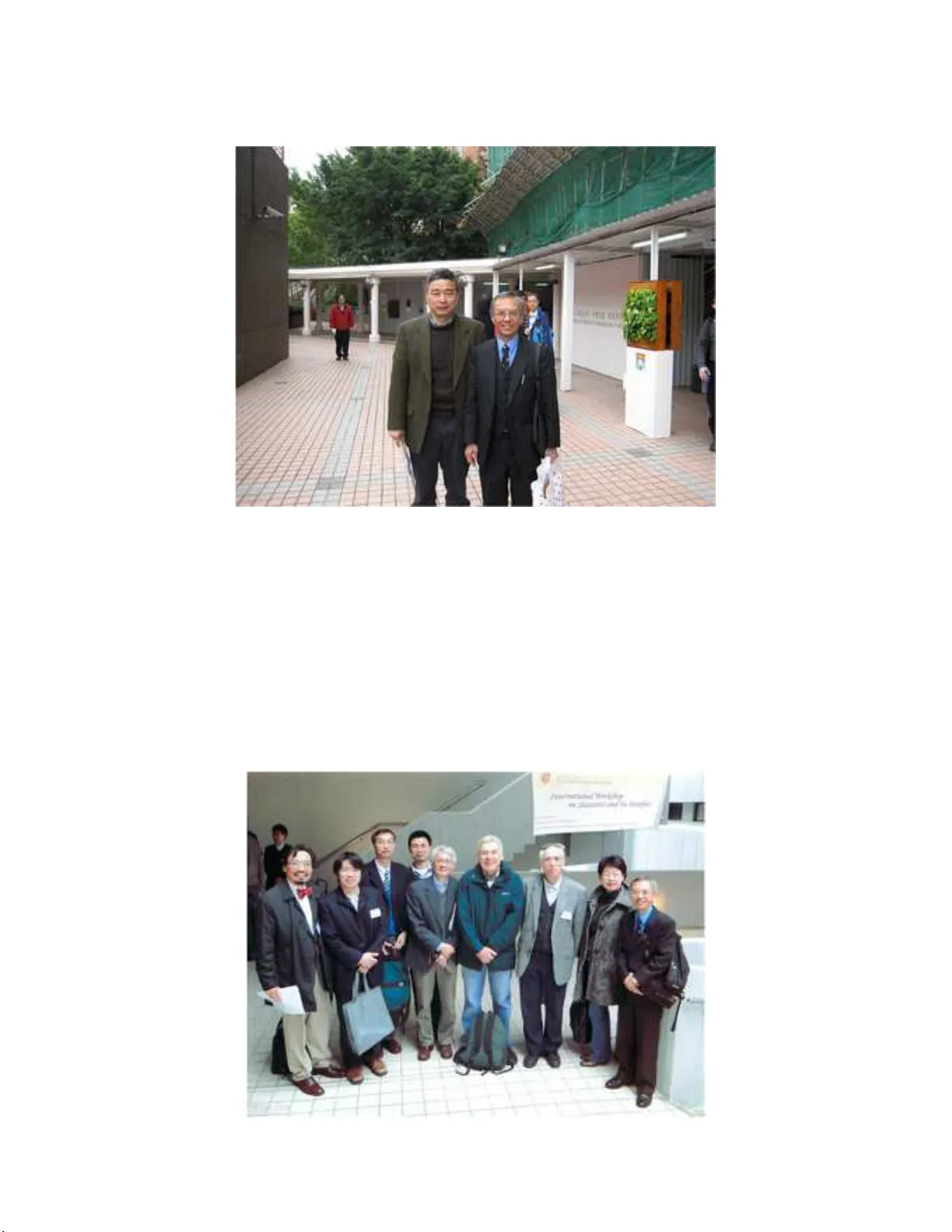
Statistic al Scienc e 2014, V ol. 29, No. 3, 425– 438 DOI: 10.1214 /13-STS464 c Institute of Mathematical Statisti cs , 2014 A Conversation with Ho w ell T ong Kung-Sik Chan and Qiw ei Y a o Abstr act. Ho well T ong has b een an Emeritus Professor of Statistics at the London S c ho ol of Economics since O ctob er 1, 2009. He w as app oin ted to a lectureship at the Univ ersit y of Manc hester Institute of S cience and T ec h nology shortly after he started his Master program in 1968. He re- ceiv ed his Ph.D. in 197 2 u n der the sup ervision of Maur ice Priestley , th us making him an aca demic grandson of Maurice Ba rtlett. He sta y ed at UMIST until 1982, when he to ok u p the F ounding Chair of Statistics at the Chinese Universit y of Hong Kong. In 198 6, he returned to the UK, as the first Ch inese to hold a Chair of S tatistics in the h istory of the UK, by accepting the C hair at the Univ ersit y of Ken t at Can terbur y . He sta ye d there un til 1997, when he we nt to the Univ ersity of Hong Kong, first as a Distinguished Visiting Professor, and then as the Ch air Pr ofessor of Statistics. A t the Universit y of Hong K ong, he ser ved as a Pro-Vice- Chancellor and w as th e F ounding Dean of the Gradu ate School. He w as app ointe d to his C hair at the London Sc h o ol of Economics in 1999. He is a pioneer in the field of nonlinear time series analysis and has b een a sci- en tific leader b oth in Hong Kong and in the UK. His wo rk on th reshold mo dels has had lasting influence b oth on theory and app lications. He h as dra wn imp ortant connections b et we en time series and deterministic dy- namical systems, linkin g s tatistics with c haos theory , and th e mo dels he has d ev elop ed ha ve found significan t app lications in fields as diverse as economics, epidemiology and ecolo gy . He has made nov el con tributions to nonp arametric and semi-parametric statistics, esp ecially in mo del s e- lection and dimension reduction for time series d ata. He has written f our b o oks (one with Kung-Sik Chan and another w ith Bing Cheng) and o v er 162 pap ers (sometimes with collaborators) in Statistics, Ecology , Actu- arial Science, Con trol Engineering, R eliabilit y , Meteo rology , W ater En- gineering, Engineering Mathematics and Mathemat ical E ducation. His 1990 monograph Non-line ar Time Series A nalysis—A Dynamic al Sys- tem Appr o ach is a classic. He is a F oreign Mem b er of the Norw egian Academ y of Science and Letters, an elect ed mem b er of the I S I, a F ello w of IMS and an Honorary F ello w of the Institute of Actuaries (UK). He w on a Chin ese National Natural Science Prize (Class I I) in 2000 and the Ro yal Statistical So ciet y a warded him the Guy Medal in Silv er in 2007. The follo w in g con v ersation is p artly based on an interview that to ok place in the Hong Kong Univ ersit y of Science and T echnolog y in July 2013. Kung-Sik Chan is Pr ofessor of Statist ics, Dep artm ent of Statistics & A ctuarial Scienc e, University of Iowa, Iowa City, Iowa 5224 5, US A e- mail: kung-sik-chan@uiowa.e du . Qiwei Y ao is Pr ofessor of Statistics, Dep artment of Statistics, L ondon Scho ol of Ec onomics and Politic al Scienc e, Unite d Kingdom e-mail: q.yao@lse.a c.uk . 1 2 K.-S. CHAN A ND Q. Y AO Fig. 1. Howel l with hi s childho o d her o, Pr ofessor L o o Keng HUA, and M ary T ong, at T ong’s home in Poynton, Cheshir e, UK, 1979. QY: Y ou were sup ervised b y Maurice Priestley for y our do ctorate. What was your thesis on? HT: My do ctoral thesis w as entitl ed “Some prob- lems in the sp ectral analysis of biv ariate nons ta- tionary sto c hastic pr o cesses.” It was an extension of Maurice Priestley’s ev olutionary sp ectral analysis, whic h he prop osed in 1965, from the u niv ariate case to the b iv ariate case, including b oth th e op en-lo op and close-lo op systems. T he conte nts of the thesis formed the basis of a joint pap er whic h Maurice and I read to the Ro y al Statistic al S o ciet y in 1972. I can still remem b er th e o ccasion w ell, as it was my first taste of academic subtlet y in Britain. I must tell yo u that a British s tatisticia n can d o a clean demolition job at an RSS discussion m eeting, without ev en sho wing his hammer. (I hop e y ou will forgiv e me for b eing gender blind wh en I sp eak.) It has b een said that one has to b e courageous or fo ol- hardy to read a pap er to the RSS. I ha v e learn t a lot b esides the demolition skill sin ce then, by attending RSS discuss ion meetings in London. The fran k n ess of views is v ery helpful, as muc h for the r eaders as for the authors, b ecause it enables ev eryb o dy to h av e a more critical assessment of the strengths and we ak- nesses of the presen ted wo rk. Of c ourse, there will alw a ys b e cases of premature eup horia as well as cases of misp laced cold shoulder. Despite its imp er- This is an electro nic reprint of the original article published by the Institute of Mathematical Statistics in Statistic al Scienc e , 2014, V ol. 29 , No. 3, 4 25–4 38 . This reprint differs from the original in pag ina tion a nd t yp ogr aphic deta il. fection, I d o not think that I am alone in sayi ng that the forum remains the b est in the statistical w orld. In man y w a ys, it h as made the RSS unique. Returning to m y do ctoral thesis, I think muc h of it is no w out of date a nd mostly of little pr actical significance. I am esp ecially disapp oin ted with the fact that the e vo lutionary coherency sp ectrum for nonstationary time series tur ns out to b e time in- v arian t. Ho wev er, there is p erhaps a curious little result in the thesis whic h y ou migh t find in terest- ing. It concerns the function exp { i ( kω t + ω 0 t 2 ) } , ω 0 b eing a fixed constan t. I sho wed th at this frequency- mo dulated w av e adm its no generaliz ed frequency in Priestley’s sense. In fac t, I am inclined to tak e the view th at for frequency-mo d ulated w a ves the w a v elet approac h is more natural. In the 1990s, Bing Cheng and I develo p ed a wa ve let represent ation for a general sto c hastic pro cess. F or the mo delling of nonstationary time series, I think that the p iecewise stationary approac h int ro- duced by T ohr u Ozaki and m yself in 1975 is a v ery practical one. Sp ecifically , as eac h new “short” blo ck of data arrive s, w e c hec k if the AR mod el fitted to the latest blo ck needs to b e c h an ged. If it d o es, then a new AR mo d el is the latest state of th e system, otherwise the p revious state stays. Th is appr oac h is ideally suited for real-time implement ation. I un- derstand that Professor Genshiro Kitaga wa and his marine engineering colleagues h av e built many su c- cessful auto-pilots f or b oats based on this app roac h , under the guidance of the late Professor Ak aik e. QY: Can y ou tell us something ab out the early part of y our career in higher education? HT: My first job in higher education w as a lec - tureship at the then North er n P olytec hnic, London, UK, in 1967. Remem b er I had only a B.Sc. degree! I to ok the job f or t wo reasons: (1) T o help m y father financially b ecause m y mother had j ust joined us in London from Hong Kong, having w aited for sev en long y ears; (2) I lost my passion for Algebra. When I graduated from the Univ ersit y of Manch- ester Institute of Science and T ec hnology (no w merged with th e Univ ersit y of Manc hester) in 1966, I w as v ery k een on Alge bra. So I we nt to Q u een Mary College of the Univ ersit y of Lond on on a p ost- graduate studen tship funded by the UK Science and Engineering Researc h Council. The general e xp ec- tation w as to do a Ph.D. in Algebra. A t that time, QMC was the hot hou s e of Algebra in the UK, under the inspiring leadership of P rofes- sor Kurt Hirsc h. He came to the UK to escap e from A CONVERS A TIO N W ITH HOWELL TONG 3 Hitler’s Germany , lik e man y of his con temp oraries including Bernard Neumann , Hanna Neumann, P aul M. Cohn and others. He was my men tor. I re- mem b er attending courses on Homolo gical Algebra, Group Represen tation Theory and others. I ev en at- tended seminars giv en b y Sau n ders MacLane a nd other leading alg ebraists. One of the first things that Professor Hirsc h ask ed me w as “Ha ve y ou studied Leb esgue integrat ion at UMIST ?” When he heard that I had not, he said, “In that case, Mr. T ong, y ou are only h alf-educated. I s u ggest that you attend a course on it in our inter-col legiate p ostgraduate pro- gramme.” As there w as n o d edicated Leb esgue Integratio n in that year’s programme, I c hose a course on Prob- abilit y T heory (via Measure Theory). The lecturer w as none other than Professor Harry Reuter from Imp erial College, London. Much later I learned that he w as famous for his collab orativ e work with Da vid Kendall on birth -and-death pro cesses etc. Again, h e, the son of the So cialist May or of Magdebur g, came as a yo un g man to the UK to escap e Hilt er’s Ger- man y; he was lo ok ed after b y the C am bridge math- ematical analyst, Professor Ch arles Bur kill, and his c h aritable wife, Greta Braun . Pr ofessor Reuter was suc h a w onderfu l lecturer that he got m e h o ok ed. In fact, his co urse made me reconsider my ent ire aca - demic direction. I d ecided that Probabilit y would b e far more fun and usefu l. The d ecision to quit Algebra w as not painful. On e must alw a ys follo w one’s passion. So, I can honestly claim that I wa s facilitated by a famous alge braist in to Statistics. (In doing so, I dropp ed from the 13th generation of academic de- scendan ts of Sir Issac Newton to the 14th, according to the Mathematics Genealogy Pr o ject!) Y ou see, I ha v e had exp eriences of discon tinuous decisions more than once in m y life. Th resholds ha v e b een truly an inte gral part of m y life in more senses than one. As it turned out, I sta y ed at the Northern P oly- tec hn ic for just one y ear. My teac hing dut y was not hea vy and I had f ree time to r ead around. I r ead sev- eral b o oks on probabilit y and stoc hastic pro cesses. F or example, I c ame across the delightful b o ok on the theory o f time series b y Akiv a Y aglom, w h ic h kindled m y in terest in the sub j ect. Man y y ears later, I w as able to thank Akiv a in p ers on for his in tro duc- tion. I met him in 1986 at the First Bernoulli W orld Congress h eld at T ashken t in the former USSR; w e w ere b oth walking up the Hea venly Mountai n Fig. 2. W ith Akiva Y aglom and his wife at the fo ot of the Tian Shan Mountain on the T ashkent side, 1986. (or Tianshan) from the S o viet side. W e b ecame in- stan t friends. Do yo u k n o w that the theoretical un- derpinn in gs of the ARIMA mo del made p opular b y George Bo x and Gwilym Jenkins w ere already laid rather fully b y him in 1955? I learned this fact from P eter Whittle’s c harming b o ok P r e diction and R e gu- lation , first pu blished in 1963, when he w as Professor of Statistics at Manc hester. The b o ok con tains man y gems and has remained one of m y fa vo urites since m y da ys at the Northern P olytec hn ic. Another b o ok that also captur ed m y atten tion w as the one by Ulf Grenander and Murr a y Rosenblatt en titled Analysis of Stationary Time Series (19 57). Y ou kno w , in m y da y there were n ot to o many b o oks on time series. One could probably count them on the fin gers of one or t wo hands. A t the Northern P olytec h nic, there w as then a small study group on forecasting led b y Dr. W ar- ren Gilc hrist, wh o later mo v ed to head the Statis- tics Departmen t at the Sheffield P olytec h n ic, no w called the Sheffield Hallam Universit y . I w en t along mainly to listen. T hen one da y I was aske d if I w ould lik e to s p eak to the group on a pap er of my c hoice. I happ ened to b e stu dying Jim Durbin’s Biometrika pap er on the fitting of a mo ving a v erage mo d el via a long autoregression. I r emem b er sho wing the group all m y ca lculations, whic h help ed me under- stand the pap er and s urvive m y first seminar. Little could I foresee at the time that m y path wo uld cross Durbin’s sev er al times later in m y life. When Priest- ley’s name wa s men tioned at one of the meetings of 4 K.-S. CHAN A ND Q. Y AO Fig. 3. Edinbur gh W orkshop on Nonline ar T i me Series Howel l or ganise d in 1989 (left to right ignoring r ow numb er: Wai-Ke- ung Li , R uey Tsay, Coli n Sp arr ow, Russel l Gerr ar d, John L ane, Murr ay R osenblatt, Gudmundur Gudmundss on, John Petruc- c el li, Tze-Liang L ai, T ony L awr anc e, Peter R obinson, Domini c Gue gan, T. K . Br own, Pham D inh T uan, Timo T er asvirta, R o dney Wolff, Clive Gr anger, Peter Fisk, David Cox, Martin Casdagli, Jonathan T awn, T ohru Ozaki, Gr anvil le T unni cliffe Wilson, Howel l T ong, Dag Tjostheim, Ed McKenzie, Peter L ewis, R ichar d Smith, Nevil le Davies, David Jones, Kung-Sik Chan, Zhao-Guo Chen). the study group, I lo ok ed up some of h is pap ers, after whic h I knew that I would h a v e to retur n to UMIST! Y ou see, Maurice came to UM IST just when I w as starting my final un d ergraduate yea r; h e lec- tured to us on mathematica l statistic s and sto c has- tic p ro cesses. W e at UMIST had excellen t exp osure to Statistics through Pet er W allington and Maurice Priestley . T he former wo rked on queuing theory un- der Dennis Lind ley . The only trouble was that they made the sub ject LOO K so easy that tw o of the more academically inclined stud ents, including my- self, opted for something more abstract lik e Alge- bra! Fig. 4. ISI me eting i n Paris, 1989. L eft to right: Mauric e Priestley, T ata Subb a R ao, Mary T ong, Anna T ong, Ritei Shib ata, Haruku Shib ata, Nancy Priestley, Howel l T ong. A CONVERS A TIO N W ITH HOWELL TONG 5 Fig. 5. International Confer enc e on Fi nancial Statistics, Hong Kong, 1999. T o cut a long story sh ort, Maurice welc omed me b ac k . I n fact, thanks to an o versigh t on the part of the head of departmen t (Maurice w as not the Ho.D.), I w as app oin ted as a demonstrator to comp ensate for the S ER C p ostgraduate studen tship that th e Ho.D. forgot to apply on my b ehalf. The u p- shot w as that I started my univ ersit y teac hing caree r as a p ostgraduate stud en t and joined the univ ersit y p ension sc heme at quite a yo ung ag e. This turned out to b e very b eneficial man y years later wh en my unive rsity p ension (b ased on defined b enefits) w as calculate d. QY: What m ad e y ou s h ift fr om f requency-domain to time-domain in your researc h in time series anal- ysis? HT: As w e al l kno w, the history o f time series analysis switc hes to and fro betw een the time do- main and the frequ en cy domain. I started my re- searc h from the f requency-domain end. I stay ed with it for a few y ears. Then in 1973, Maur ice, Subb a Rao and I got a researc h gran t, with whic h Professor Hi- rotugu Ak aik e of J apan wa s in vited to visit us for six mon ths. Hiro’s visit mark ed the b eginning of the end of my frequency-domain r esearch. Let me elab orate. The fir s t ph ase of Hiro’s time series r esearc h h ad b een almost exclusivel y frequency-domain. He was in fact an in ternational figur e in the area. Then he started his collab orativ e research in designing a feed- bac k con troller for a cemen t kiln. T o his disma y , he disco ve red that in the pr esence of f eedb ac k, the frequency-domain approac h wa s inadequate due to a serious bias problem asso ciated with the estima - tion of the frequency-resp onse function. His findings w ere r ecorded in the Pr o c e e dings of Sp e ctr al A naly- sis of Time Series edited b y Bernard Harris in 1967. This impressiv e piece of w ork led to the in vitation from UMIST. His visit ga ve me ample opp ortunities to learn from h is exp eriences. He w as wo rking on h is fun - damen tal state –space work at the time, which cul- minated in identifying a state as a basis ve ctor of the predictor space of a second-order stationary m ulti- v ariate time series. His v ast kno wledge imp r essed me deeply , so I d ecided to visit his institute in T oky o, Japan. He w as v ery supp ortiv e of m y wish. In the ev en t, I w as aw arded a Ro y al So ciet y Japan F ello w- ship w ithout any trou b le. I guess that I could we ll ha v e b een the only applican t, as th e fashion of the da y in the UK wa s to go w est w ards. The six mont hs I sp ent at Hiro’s institute c ompleted my (in ve rse) F ourier tr ansform and I returned to the UK as a predominantly time-domain p erson. I hav e already related the transformation pr o cess in m y obituary of Professor Ak aike published by b oth the R oy al Sta- tistical So ciet y and the Ins titute of Mathematical 6 K.-S. CHAN A ND Q. Y AO Fig. 6. Hir otugu Aka ike enjoying Howel l’s after-dinner sp e e ch at a c onfer enc e honoring A kaike, Y okohama, 2003. Statistics. Th erefore, I shall not r ep eat the account here, except to sa y t hat h is p ers on al mini-libr ary pla y ed a vital r ole. KSC: Y our earlier wo rks in time series analysis w ere all linear. What made y ou d ecide to s w itc h to nonlinearit y? HT: Again it had to do with an RSS discussion meeting. On 18th Ma y , 1977, I read a v ery sh ort pa- p er to the RSS, as one of three discussion pap ers. At the meeting, tw o features w ere highligh ted, namely , time-irrev er s ibilit y and limit cycles. I can remem b er the c hallenging problem p osed by Dr. Granvill e T un - nicliffe Wilson: “W ould w e not p r efer a mod el whic h in the absence of suc h (he mean t rand om) d istur- bances w ou ld exhibit stable p erio dic deterministic b ehavio r—a limit cycle?” I decided to take up the c h allenge. Coinciden tally , around the same time, the Sw edish con trol engineer, Professor K. Astr¨ om, ga v e a semi- nar at UMIST. He describ ed a b ilinear con trol sys- tem, in which the output is not jus t a simple lin- ear f u nction of p ast (control) in put and past output but also their cross pro ducts. F or time series ana- lysts, an obvio us w ay to imitate this f r amew ork is b y replacing th e cont rol input b y a sto chastic n oise. (Of co urs e, in doing so w e are replacing a manip- ulated v ariable by an un ob s erv able one!) I play ed around with this idea f or a bit and ev en published something on it. Ho wev er, very quickly I con vinced m yself that w as probably not the b est w ay to address Granville’ s c h allenge: if I switch off th e driving noise, the system w ould grind to a halt! One day , as I w as mowing m y Fig. 7. Howel l r e c eiving the 2007 Guy Me dal in Silver f r om Pr esident Ti m Holt. la w n , strip by str ip, it da wned on me that a piece - wise linear mo del w ould b e a goo d candidate. The rest is history , whic h you kn ow I ha ve recounted in the article “Birth of the threshold time series mo del” in Statistic a Sinic a (2 007). Actually , the earliest mention of the id ea ca n b e traced to m y con tribu tion to the discussion of T ony La wrance and N. T. Kottego da on mo d elling of riv erflo w time series in 1976. There wa s an interest- ing follo w-up . A t the time, it seems that my friend T on y co uld not s ee an y relev ance of the thresh old idea to riverflo w time s er ies mo delling. I am sure this was my fault. So, understandably he complained that I and one other con trib u tor w ere “follo win g a traditio n of the Societ y in taking the opp ortu- nit y to p ublicize th eir forthcoming wo rks—at the exp ense of other authors’ reprin t c harges.” I hope that su bsequent app lications of th e th r eshold mo del in riv erfl o w time series mo delling and linking of the La wrance–Lewis’s exp onential autoregressiv e mo d el to the thresh old mo d el h a v e con vinced him that the additional reprin t c harges were p erhaps n ot unjus- tified. KSC: Can you tell u s more ab ou t the dev elopmen t of the threshold m o dels, including their im p act on ecolog y , economics and finan ce and other areas? HT: I ha v e give n a fairly detailed o v erview in m y article “Thr eshold mo dels in time series analysis— 30 years on” in Statistics and Its Interfa c e (201 1). I sincerely hop e th at the mo del will con tinue to en - jo y its p opularit y with users from d iv erse disciplines. It makes me a v ery h app y man when I see app lica- tions of th e mo d el in econometrics, economics, fi- nance, ecology , epidemiology , psycholog y , hydrology A CONVERS A TIO N W ITH HOWELL TONG 7 Fig. 8. Nils Chri stian Stenseth and Howel l , i n Hong Kong, 2008. and man y others. F rankly , some of the app lication areas are b ey ond m y wildest dream. F or example, just the other da y m y atten tion was dr a wn to co ve r song detection and bip olar disord er via the th resh- old mo del. It would b e wo nder f ul if someb o dy co uld put all the most successful applications in b o ok form. Hin t, hin t. . . No w the basic idea of the th reshold mo del is v ery simple: divide the state space int o regimes and rule eac h with a simple linear mo del. It has a non- parametric fl a vor within a p arametric framework. Of course, if we divide the state sp ace arbitrarily finely , as in a spline approac h, w e gain generalit y at the exp ense of loss of parsimon y or in terp r etabil- it y . S uccessful applicat ions of the threshold mo del ha v e shown that, in many real applications, tw o or three regimes will often suffice. Esp ecially encourag- ing is the fact that quite often the regimes are inter- pretable. In mathematics, the idea of p iecewise lin- earizatio n is, of course, v ery old. In oscilla tions the- ory , the form er Soviet mathematicians, Androno v and K h aikin, had in tro du ced an d studied (n early) Fig. 9. Mary, Peter Whittle and Howel l, in Hong Kong, 2009. exhaustiv ely piecewise linear different ial equations in the 1930s. In statistics, we had t w o-phase linear regressions and T ukey’s regressogram a long time ago, but it seems that they had m ade n o or little impact on time series mo d elling, till the launc hin g of the thresh old autoregressive m o del and more gen- erally the threshold pr inciple. I must sa y th at f r om the standp oint of sto c hastic dynamical systems, th e incorp oration of time in a regression framew ork is a paradigm-shifting step b ecause without time th ere is no d ynamics. This is wh y I hail Y ule’s in ve ntio n of th e autoreg ressive model as o ne of the greatest rev olutions in stati stical mo delling b ecause it us h - ered in the era of dyn amic (as against static) mo d- elling. I fin d it unf ortu nate that some recen t t ext- b o oks ha ve b lurred the distinction b et ween a d y- namic mo del and a static mo del. Bruce Hansen ( 2011 ) has gi ve n an extensiv e re- view of the impact of the threshold mo del in econo- metrics and economics. Without any doubt, it is in econometrics/e conomics that the threshold m o del has made its greatest impact. More recen tly , the in - fluence seems to b e spilling in to the field of finance including actuarial science. Another significan t area of app lication is ecolog y . Of course, y ou, Kung-Sik, h av e done s ome marve l- lous join t wo rk w ith our dear friend , Nils Chr istian Stenseth of Norw a y . Y ou ha v e co vered so muc h of the animal kin gdom: mink, lynx, rodent, lemming and so on. Y our more recen t wo rk with your for- mer d o ctoral student, No elle S amia, and Nils Chris- tian’s tea m on plague epidemics using d ata from Kazakhstan is truly w onderfu l. As your pap ers ha v e sho wn yet again, often it is through real applicatio ns that real pr ogress on the implementa tion of what I 8 K.-S. CHAN A ND Q. Y AO ha v e called the Thresh old Principle can b e made. Y ou ha v e implemen ted the principle for count data. I don’t w ant to embarrass yo u, Kung-Sik, b ut I must sa y that the implemen tation is a truly remark able con tribution. Of course, regimes can b e delineated either sh arply or smo othly . Coming from Hong Kong, I am rather happy with a sh arp b order! W ell, the self-e xciting threshold a utoregressive (SET AR) mod el uses a sharp delineation. Ho wev er, some p eople are less receptiv e to sharp delineations. In this case, w e can consider a softer delineation, for example, a smo oth (p erhaps “soft” is a b etter word) thresh old autore- gressiv e mo del. Y ou, Kung-Sik, and I ha ve actually dev elop ed quite a co mpr eh ensiv e m etho dology and w e ha v e ev en giv en it the acron ym of ST AR mo del. The idea has apparently attrac ted considerable atten tion in the eco nometrics literat ure, under the same acronym. I could perh aps mak e one or t wo remarks her e. F or simplicit y , let u s consider a one- threshold mo d el. If the estimated threshold is in the vicinit y of small probabilit y , for example, near the tail or an an ti-mo de of the marginal distribution, then it tells u s that th er e is pr ob ab ly insufficient in- formation in the data on the fun ctional form of the mo del there. In that case, whether w e u s e an indica- tor function as in the S E T AR mo del or a more so- phisticated smo oth fu nction as in the ST AR m o del is of secondary imp ortance. After all, all mo dels are wrong. When c ho osing b et w een a S ET AR mo del and a S T AR mo d el, a more relev ant question is w h ic h one is more useful and in terpretable. More recen tly , you, Kung-Sik, Shiqing Ling, Dong Li and I h a v e sho wn systematically how the thresh- old approac h can provide p o w erful tools to mo del conditional heteroscedasticit y in finance, en viron- men t, ecolo gy and others. W e ha v e exploited the mixture of distributions in the d riving noise of the threshold approac h. So f ar I hav e fo cused m y answer on a univ ariate time s er ies. Although there are generalizat ions of the threshold mo del to multiv ariate time series, I think m uc h w ork remains to b e done. O ne ke y question is the delineation of regimes for a p -dimensional state space. Th e top ograph y can b e quite v ast. T o o v ast p erhap s ? My gut feelings are that it is s till p ossible to construct an efficien t searc h algorithm. Besides the question of sharp and smo oth d elin- eation, there is also the one to do with observ able or hidden threshold v ariables. I m ust tell y ou that I wasted an excellen t r esearc h pr oblem of Mark o v- c h ain drive n T AR mo d el in 1983 b y assigning it to the w r ong stu den t; I should ha ve passed it to y ou, Kung-Sik, a nd y ou w ould ha ve crac ke d it in three mon ths. The idea w as there in the p ap er I read to the RSS in 1980 (page 285, line 12 from b elo w). Sometimes, w e can ev en consider partially observ- able and partially hidden threshold v ariables. I hav e giv en a discussion in m y 2011 recoun t in Statist ics & Its Interfac e . KSC: On looking bac k, the thresh old id ea is v ery natural. No wada ys the idea is applied in man y ar- eas, for example, ecology , economics and so on. An d the T AR mo d els are often featured very su b stan- tially in elemen tary text-b o oks, for example, W alter Ender’s A pplie d Ec onometric Time Series A nalysis and Cr y er and Chan ’s Time Series Ana lysis: With Applic ations in R . Y et, the idea seems to ha v e tak en quite some time b efore it wa s un iv ersally accepted. Don’t y ou think that this is a little o dd ? HT: W ell, it w as probably m y fault as m uc h as y ours f or not b eing goo d sale smen! More serious ly , as I hav e hint ed at earlier, the history of statistics is full of cases of b elated recognition as well as pre- mature enth u siasm. Of course, there are al so cases of instant recognitio n that ha ve withsto o d the test of time. Lik e man y o ther professions, v alue judg- men ts by statisticians can sometimes b e m ore sub- jectiv e than scien tific. I p refer to let TIME b e the judge. I can remem b er Hiro Ak aike s a y in g to me man y years ago (p erh aps it was in the 1970s), “I rec k on that AIC could probably survive 30 years.” Y ou see, ev en he had made the wr ong p rediction ab out his o wn baby! QY: Y ou ha ve also had keen interest in c haos. How do es chao s fit in with statistics in general and time series in particular? HT: The p rimary ob ject of stu dy in S tatistics is c h ance or, equiv alently , randomness. The traditional view in statistics seems to place randomness at one end and determinism at the other. And it would b e heresy to mix the t wo . In f act, ev ery statistician carries with him ε ’s ev erywhere, as if he o w es h is en tire existence to them. If y ou ask him where his ε ’s come f r om, h e would giv e y ou a long list of sources, whic h is u sually all right as far as it goes, except for the likel y absence of one very significant in gredien t. Let me digress first. Supp ose I toss a coin in th is ro om. I hop e you will agree that it is a r easonably close system free from external disturb ances. No w, I can write do wn the A CONVERS A TIO N W ITH HOWELL TONG 9 Fig. 10. Qiwei Y ao and Howel l in Hong Kong, 2009, with Wai-Keung Li and Mike So in the b ackgr ound. precise equations of motion of the coin by app ealing to Newtonian mec hanics. But I also know I cann ot predict its outcome with certain t y , if I giv e it a goo d thro w. Wh y? Where is the source of rand omn ess? As long ag o as the b eginn in g of the 20th Cen tury , H. Poincar ´ e already includ ed sensitivity to initia l conditions as a significant s ource of rand omness. So, ev en the most basic generator o f rand omness used b y a stat istician is a deterministic system; its ran- domness is du e to what is called chaos by th e dy- namicists. Th us, what excuses can statisticia ns hav e to ignore chao s? R ather than b urying our h eads in the sand , I suggest that it is more constru ctiv e f or us statisticia ns to learn more ab out c haos and mak e our con tributions. Another in teresting example is to d o with p oint pro cesses. Within the setup discuss ed in Fig. 11. P. S. Wong, C. K. Ing, N. H. Chan, W. Wu, K. L. Tsui, Peter Hal l , T. L. L ai , R. Li u and Howel l , at the Chinese University of Hong Kong, in 2009. 10 K.-S. CHAN A ND Q. Y AO Da vid Co x and W alter Smith ( 1954 ), we can identi fy a connection b et wee n p oin t pr o cesses and c haos via the circle map: x n = x n − 1 + Θ , x 0 = 0 ( n = 1 , 2 , . . . ), where w e observ e y n = x n mo d 1. Note that for irra- tional Θ , y is uniformly distributed on [0 , 1). I re- ferred to this connection in my reply to Da vid in my 1995 d iscussion p ap er in the Sc andinavian Journa l of Statistics . Y ou ask ed ab ou t time series. It turn s out that man y n onlinear ti me series mo d els in stat istics do generate c haos when we s witc h off the driving n oise. That is wh at mak es them so endearing! In a sense, there is the inherent r andomness due to c haos of the underlying deterministic system (I ha v e called it the sk eleton elsewhere), as well as the other rand omness due to the random dr iving force, p erhaps reflecting the fact that we are dealing with a co mplex sys- tem with m ultiple sour ces of r andomness, some, but usually not all, of w hic h can b e explained with some degree of precision. If we accept the ab ov e argumen t, then a n atu- ral qu estion is ho w to defin e initial-v alue sensitivit y of a sto chastic d ynamical system. Of course, Qiw ei, y ou kno w the answe r very well , as w e ha ve wr itten ab out the topic. It tu rns out that the conv enti onal approac h adopted b y the deterministic d y n amicists is inadequ ate, as it ignores the diffusion due to th e existence of m ultiple sources of rand omn ess. In stead of lo oking at the mo v emen t of state x f rom one time instan t to the next as th ey d o in d eterministic dy- namics, we n o w look at the mo v emen t of one d is- tribution F ( x ) from one time instan t to the next. Since the fo cus is no w on the distr ib ution, we hav e to generalize th e w a y we measure the sensitivit y of the m o vemen t to in itial v alues (i.e., initial d istri- butions). W e introd uced a sto c hastic coun terpart of the Lyapuno v exp onent. This exp erience sh ows the b enefit of having statisticia ns inv olve d in th e study of deterministic c haos. KSC: Y ou in teracted with p eople outsid e stati s- tics. Ho w did that come ab out? HT: Mostly b y c hance and more imp ortan tly b y taking adv an tage of it. It is imp ortan t to enj o y lis- tening and ha ve a sense of c uriosity . F or example, I colla b orated with Dr. Gud m und sson of Iceland b e- cause I remembered that he w as w orking on geo- physic al problems wh en he w as a p ost-do ctoral r e- searc h fello w at UMIST . I met him th ere w hen I w as a researc h studen t, and I listened to him and remem b ered what he had told m e. So, man y y ears later, I con tacted him w hen I w as in terested in riv er- flo w time series. Another example is P r ofessor Nils Christian Stenseth. I met him via his do ctoral stu- den t Ottar Bjørnstad, w ho con tacted me and in vited me to visit his department. I w en t to O slo, listened to h im and his colleagues and found the team th ere ideally p laced for collaborative research. No wa days, the inte rnet is w ond er f ully con v enient . Sometimes, I ha v e n ot ev en ever met m y co-authors in p erson. QY: Be sides time series a nalysis, you ha v e al so w ork ed in other areas of statistics, for example, Mark o v c hain mo delling, reliabilit y , dimension re- duction. What motiv ated y ou? HT: They w ere mostly my part-time activities for a bit of fun, except for dimension redu ction, whic h was serious bus in ess. By ab out th e mid-199 0s, I knew I had to get in to n onparametrics and semi- parametrics. But they were develo ping v ery rapid ly . It was not easy for me to k eep up, esp ecially at a time wh en I w as heavily inv olv ed with ad m inistra- tion. Luc kily , Bing Cheng and y ou, Qiw ei, arrived in Can terbury , UK. I h a v e learned so m uch from y ou. Thank you v ery m uc h! As for dimension r eduction, there is an in teresting story b ehind it. As y ou k n o w, the area actually laid outside m y normal exp ertise in the 1990s. I wa s starting my sabbatical lea ve at the Universit y of Hong Kong from the Unive rsity of Kent , UK, initiall y for three ye ars—I w as luc ky . I knew that Dr. Lixing Zhu of th e department (no w c h air professor at Baptist Univ ersit y , Hong Kong) w as an exp ert in semi-parametrics. So, I discussed dimension reduction with him. I wa s not impressed with the need in the literat ur e to under-smo oth th e estimator of the nonparametric function. It migh t also b e then or p erh ap s a little later w hen I ques- tioned the efficac y o f tec h niques such as the sliced in v erse regression estimation for time series b ecause time-irrev er s ibilit y is the ru le in real time series. Lix- ing shared my concerns bu t was h imself v ery bu s y with other researc h problems, so he mentioned the problem to on e of Professor W ai-Keung Li’s n ew re- searc h studen ts, Yingcun Xia. Yingcun was an ex- ceptionally br ight student. T o cut a long story short, his do ctoral thesis formed th e basis of a join t discus- sion pap er on MA VE whic h I, on b ehalf of the four authors, r ead to the RSS in 2002 . The tric k wa s to estimate b oth th e nonparametric part and the p ara- metric part jointly . In this wa y under-smo othing is rendered unnecessary . KSC: W e all kno w that you ha ve held senior ad- ministrativ e p ositions in fiv e u niv ersities across t w o A CONVERS A TIO N W ITH HOWELL TONG 11 Fig. 12. Howel l with c ol le agues at the Nonli ne ar Time Series Workshop in National Singap or e University, 2011; fr om left to right and ignoring r ows: Dong Li, Qiwei Y ao, Kung-Sik Chan, M ike So, Peter Br o ckwel l, Ken Siu, R ainer Dahlhaus, Zudi Lu, Mar c Hal lin, Cheng Xi ang, R ichar d Davi s, Yingcun Xi a, Ying Chen, R ong Chen, Howel l T ong, Myung Se o, Shiqing Ling, Simone Giannerini, Cathy Chen, Azam Pi rmor adian. Fig. 13. Howe l l and Murr ay R osenblatt, af ter t he former r e c eive d the Distinguishe d A chi evement Awar d fr om the In- ternational Chinese Statistic al Asso ci ation at the Joint Sta- tistic al M e eting at San Di e go, USA, in Jul y 2012. con tinen ts. Can y ou share y our exp erience with us please? P erhaps y ou could b egin with the Chinese Univ ersit y of Hong Kong. HT: After w orking at UMIST for 14 y ears, I th ough t it was h igh time for me to return to my birth p lace, Hong Kong. T here was a newly created Departmen t of Statistic s at CUHK around 1981 and a new chair of statistics was adv ertised, to whic h I applied su ccessfully . Th e new d epartmen t in 1982 consisted of 5 facult y members including m yself, one senior lecturer and three lecturers. (CUHK follo w ed the British s y s tem at th at time.) There w ere also one assistan t computer officer (that was y ou Ku ng-Sik), one s ecretary a nd one m essenger b o y . Although I w as the foun ding c hair p rofessor, actually I d id not app oint them; all the facult y memb ers w ere trans- ferred from th e Departmen t of Mathematics and all the lecturers w ere formerly stud ents of the senior lecturer. F ortunately w e got o n v ery w ell indeed. Staff and gradu ate students had r egular dim-sum lunc hes at a lo cal restauran t. W e shared the cost, the sen iors pa ying more, of course—a w ork able so- cialist sys tem! The biggest c hallenge was actually curriculum design. W e deci ded th at our first yea r undergradu ates sh ou ld receiv e go o d groundings in the guiding principles of our sub ject rather than r ou- 12 K.-S. CHAN A ND Q. Y AO Fig. 14. Howel l wi th a gr oup of p ost-gr aduate students at National University of Singap or e, 2012. tine mathematical manipulations. I was vot ed to b e the guinea p ig. It was fu n and I learnt a lot m yself ! Professor George Tiao was our ext ernal e xaminer (another British practice ) and he was most helpfu l and supp ortiv e. He made p lent y of constru ctive sug- gestions and ga ve us ev ery encouragemen t. He has b een mainta ining excellen t r elationship with CUHK and many other tertiary institutions in Hong Kong ev er since. KSC: What made you decide to lea ve CUHK in 1986? HT: My decision to leav e CUHK had nothing to do with lo cal p olitics of the time. I w as quite happ y at CUHK and my vice-c hancellor (equiv alen t to a unive rsity president in the US) wa s v ery h appy to o with the dev elopmen t of my department and th e de- partmen t has remained in v ery go o d shape to this da y . In fact, it all happ ened qu ite b y c h ance when I wa s visiting Professor David Co x’s d epartmen t at Imp erial C ollege, Lond on. One da y , Da vid told me that a c hair was to b e adv ertised b y th e Unive r- sit y of Ken t at Canterbury , UK. He suggested that I could ha v e a go if I was in terested in return ing to the UK. W ell, I do not kno w to this day why UK C decided to app oin t me in stead of an y one o f three other ve ry str on g candidates. As it turn ed out, the biggest challe nge was how to manage a not so un ited mathematics departmen t, consisting of pure mathematicians, applied mathematicians and statisticia ns. There were three sections, three bu d- get holders and all in one department. A bit crazy! A y ear o r t wo afte r my arr iv al, the vice-c hancellor app ointe d me as the director of my department (di- rectorship w as by app ointmen t then). When I b e- came a ware of the wish of the univ ersit y to build up statistics and act uarial science by ru nning do wn (pure and applied) mathematics, I remind ed the vice-c hancellor fi r st the history of Thomas Bec ket and then m y plan. As the dir ector of m y d epart- men t, I could not p ossibly ru n do wn tw o sections to fatten up the third, especially when the latter w as asso ciated with me. Ho wev er, I could bu ild up statis- tics without harming m athematics b y (i) taking ad- v an tage of the donation secured b y m y predecessor from th e Bla c k Horse fi nancial group to build a solid base for actuarial science; (i i) taking o ve r a ma j or p ortion of the managemen t s cience group whic h was b eing or ab out to b e re-organised; (iii) consolidating statistica l consu lting activities and service provisio n to Pfizer, whose UK base was nearby . By the time I stepp ed down as director in 1 993, the statistics group (includ in g actuarial science and the consult- ing arm) grew to more than 30 f ull-time staff work- ing u nder one r o of, p ossibly the bigg est in th e UK then. Our researc h rating also wen t up from 2 when I joined to 4 when I stepp ed do wn. QY: Y es, I can remember those exciting da ys when I joined y ou in 1990. Then y ou wen t to Hong Kong in 1997. Can y ou tak e u s th r ough that p erio d please? A CONVERS A TIO N W ITH HOWELL TONG 13 HT: Again it w as pur ely by chance that I wen t to Hong Kong, this time to th e Univ ersit y of Hong Kong. Y ou see, HKU had a new and very ent er- prising vice-c h ancellor, P rofessor Patric k Chen g. He w as working v ery h ard to tur n HKU from a s leepy teac hing-orient ed univ ers ity creat ed in the colonial da ys to a researc h-vibrant mo dern universit y . He w as in v esting huge resources in attracting p eople from all roun d the world to HKU b y creating p o- sitions su c h as distinguished visiting p rofessorships. A long-time fello w time series analyst, Dr. (no w Chair Professor) W ai-Keung Li, seized the opp ortu - nit y and was instrumental in getting me app oin ted. I a rrived in HKU in 1997 on a 3-y ear sabb atical lea ve (without pa y , of course) from UKC. A t that time, UK C also had a new vice-c hancellor, Profes- sor Robin S ibson. It w as he wh o gran ted me the lea ve. QY: Y ou w ere a visito r and y et y ou b ecame the founding d ean of their graduate school. Ho w did that come ab out? HT: W ell, it w as all due to m y big m ou th as usual. My p erp etual problem! After m y arriv al at HKU, one morning W ai-Keung (who w as HoD) said to me, “Ho well, as you are a c hair p rofessor, I’d suggest that y ou attend our sen ate meeting this afterno on if y ou can spare the time. Y ou see, I cannot go b e- cause I h a ve some dep artmental matt ers to attend to. Anyw a y , it might b e fu n for you to see ho w w e op erate at HKU.” It tu rned ou t that the con tro ve r- sial item on the agenda was th e establishment of a graduate school at HKU. The d ebate was getting really h eated. It d id not take me long to realize that man y of those who opp osed setting up a graduate sc ho ol w ere professors who came from Britain ten or t we nt y yea rs previously du ring the colonial days. Y ou can tell from their accen ts! I could see that the vice-c hancellor and h is team w ere getting no where. A t this p oint, I though t I had to sa y somet hing. So, I said, “As someb o d y who has j ust arrived from Britain, I wo uld lik e to in form senate mem b ers, es- p ecially those w ho left that coun try man y y ears ago, that the concept of a graduate sc ho ol, no doubt an American concept, is b eing adopted by a r apidly in - creasing num b er of un iv ersities in Britain. I f eel that this is an ir rev ersible trend w orld-wide.” After that, the debate su b sided and the m otion w as carried. T he follo win g morning, the vice-c hancellor rang me up. After th anking me for m y in terven tion, he in vited me to b e the founding dean. The r est is history . My wife jok ed with m e afterw ards, sa ying “I though t y ou w an ted to escape to Hong Kong in ord er to hav e p eace and quiet. See what you ha v e done. Serv es you righ t w ith y our big mouth!” W ell setting up a gradu- ate sc ho ol at HKU w as challe nging, b ecause m y first job w as to p ersuade nine faculties to relinquish th eir p ow er to th e graduate sc ho ol, abide b y some com- mon rules and regulations and to accept sup ervision b y the Gradu ate Sc ho ol. I had tw o associate deans (Professors John Malpas and Anthon y Y eh) and one senior administrator (Mrs. Yv onne Ko o) from the registry to assist me—w e called ourselv es the gang of four. W e literally set do wn all the rules and regula- tions, d o wn to th e wa y we handled reference letters. W e alwa ys sent a thank-you lett er to eac h referee enclosing a copy of his/her reference lette r. This is a goo d w a y to un co ver monk ey busin ess. In just a few years, we succeeded in improving our thesis com- pletion rate (after constant monitoring of progress) and emplo yabilit y of our graduate students (w e ran a small num b er of compulsory language -enhancing and skill-emp o we ring cours es). KSC: And y ou also b ecame a pro-vice-c hancellor (equiv alen t to a vice-president in th e US system)! HT: Y es, I did serv e as PV C to thr ee V Cs at HKU. My p ortfolio c h anged from one V C to the n ext and it included, at differen t times, r esearc h , admin istr ation and dev elopment. T h e names did not mean m uc h b e- cause the dividin g line was n ot sharp. My researc h p ortfolio did mean that I was in c harge of th e uni- v ersit y’s all imp ortan t submission of researc h out- put to the Hong Kong Universit y and P olytec h nic Gran ts Committee, who d ecides our budget. T he w ork wa s tedious but it had to b e done metho d- ically and co lleagues h ad to b e handled delica tely and with compassion. I remember visiting a num b er of departments and c hatting to all the 60 or so h eads of departmen ts. KSC: Y ou hav e collab orated with many p eople, mostly yo unger than you, in researc h. Can yo u share y our exp erience with us ? HT: I ha ve alwa ys enjo yed y oung companies. They are without bagga ge, full of vitalit y and can think the unthink able. My exp erience suggests to me that it is far easier sh aring craz y ideas w ith the young than with the old. T he old tends to r eact almost immediately by saying, “They are wr on g” or “They are trivial.” But the y oung wo uld say , “Oh, that is in teresting. Let’s see!” I also think that it is the du t y of eve ry statistici an to w ork, from time to time, with someb o dy y ounger than h im s elf, f or otherwise there is no hop e for the profession. 14 K.-S. CHAN A ND Q. Y AO QY: Now th at yo u hav e retired from the London Sc ho ol of Economics, how do you o ccup y yo ur time? HT: No w that I ha v e retired from th e c h air from whic h Professor J im Durbin also retired, it seems that I am as b usy as ev er. The freedom from admin- istration h as giv en me more time to think (hop efully deep er), tra ve l and try other th in gs. (I did enjo y ad- ministration when I had to do it. Y ou see, I sa w no p oint in complaining and m aking mysel f miserable.) No w , with m y wife su ddenly b ecoming a qualified k eep-fit instructor in her retiremen t, I ha ve b een p ersu aded to exercise more r egularly than I used to. I also try to k eep up with th e statistical liter- ature an d con tinue doing some researc h. I am not displeased with some of the r ecen t results I shared with young colleagues. As a m atter of f act, Yingcun and I publish ed a discu s sion pap er in Statistic al Sci- enc e in 2011. W e argue that, for dep en den t data, the MLE and its equiv alent s are not necessarily the most efficacious when w e kno w that the mo del is wrong. F or example, for a wr ong time series mo del, conv en- tional metho ds still t ypically rely on fu nctionals of the one-step-ahead pr edictors. W e ha v e c hallenged them. More recen tly , Kung-Sik, Shiqing Ling, Dong Li and m yself ha ve just h ad our pap er on condition- ally h eteroscedastic AR mo dels with thresholds ac- cepted by Statistic a Sinic a , to do with the thr eshold approac h. I hav e joined th e Universit y for the 3rd Age, through whic h I ha ve p articipated in activities that I ha v e nev er imagined I could do. F or example, I en- jo y ed the co urs e on b o ok-binding. In fact, I ha v e turned m y cop y of Peter Whittle’s c harming little b o ok Pr e diction and R e gulation from a p o orly p ro- duced pap erbac k v ersion in to an acceptable hard- bac k. Do y ou kn o w that Pete r is also a b o okbin der? I disco v ered this fact when I sho wed him the finished pro du ct. Moreo ver, I am now able to ind ulge myself more in History , Literature and Philosophy . One re- gret is that I am n ot trilingual or b etter. I w ould lo v e to b e able to enjo y , for example, War and Pe ac e in Russian. So muc h is often lost in translatio n. Just compare Witter Bynner’s translation (p ossibly the b est a v ailable): “. . . Thou gh I ha ve for m y b o dy no w ings lik e those of the br igh t-coloured pho enix, Y et I fee l the h armonious h eart-b eat of the Sacred Unicorn. . . ” with the famous original v erse of Li S hangyin (ca. 813–8 58). I ha v e d igressed! T o me, r etiremen t is one LONG (I hop e) sabb ati- cal lea ve that has op ened do ors in to man y fascinat- ing a ven ues. I recommend it! REFERENCES Co x, D. R. and Smith, W. L. (1954). On the sup erp osition of renewa l pro cesses. Biometrika 41 91–99. MR0062995 Hansen, B. E. (2011). Threshold autoregressio n in eco- nomics. Stat. Interfac e 4 123–127. MR2812805
Original Paper
Loading high-quality paper...
Comments & Academic Discussion
Loading comments...
Leave a Comment