LR characterization of chirotopes of finite planar families of pairwise disjoint convex bodies
We extend the classical LR characterization of chirotopes of finite planar families of points to chirotopes of finite planar families of pairwise disjoint convex bodies: a map \c{hi} on the set of 3-subsets of a finite set I is a chirotope of finite …
Authors: Luc Habert, Michel Pocchiola
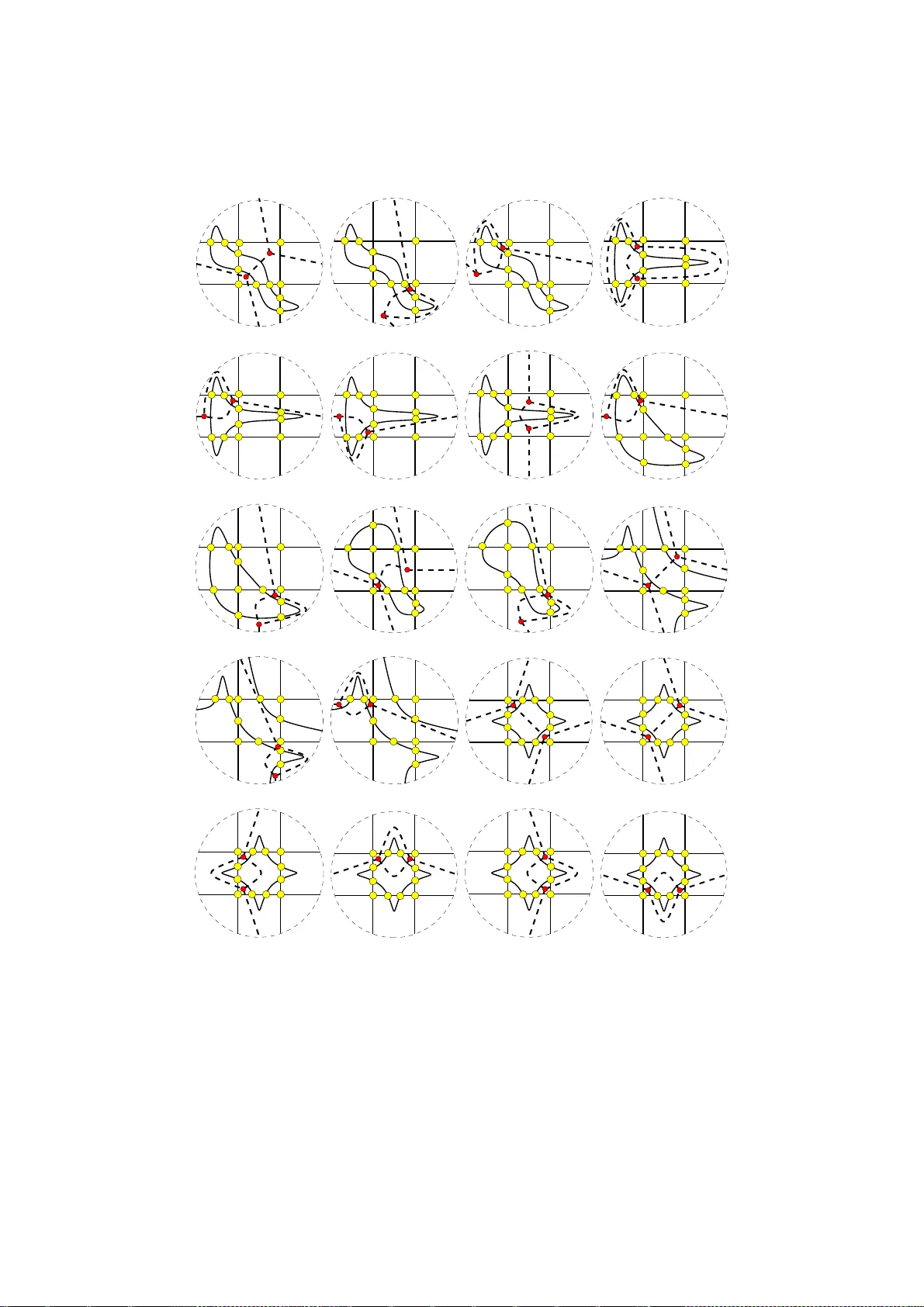
LR CHARA CTERIZA TION OF CHIR OTOPES OF FINITE PLANAR F AMILIES OF P AIR WISE DISJOI NT CONVEX BODIES LUC HABER T AND MICHEL POCCHIOLA Abstra ct. W e extend the classical LR characteriza tion of chiroto p es of finite planar families of p oints to c h irotopes of finite planar families of p airwise disjoin t conve x b od ies: a map χ on the set of 3-subsets of a finite set I is a chirotope of fi nite planar families of p airwise disjoin t conv ex b od ies if and only if for every 3-, 4-, and 5-sub set J of I the restriction of χ to the set of 3-subsets of J is a chirotope of finite p lanar families of pairwis e d isjoint con vex b od ies. Our m ain to ol is the p olarit y map, i.e., the map that assigns to a conv ex b o dy the set of lines missing its interior, from which we derive the key n otion of arrangemen ts of double p seud olines, introd u ced for the first time in this pap er. Keywords. Conv exity , discrete geometry , pro jectiv e p lanes, p seudoline arrangements, chiro top es. Abbreviated vers ions in Abstracts of the 12th Europ ean W orkshop Comput. Geom. pages 211–214, Marc h 2006, Delph es, Greece, in the p oster session of the W orkshop on Geometric an d T op ological Combinatorics (satellite conference of ICM 2006), Septem- b er 2006, A lcala d e Henares, Spain, and in Proc. 25th Annu. ACM Symp os. Comput. Geom. (SCG09), p ages 314–323 , Jun e 2009, Aahrus, Denmark. Date : No vem b er 8, 2018. MP was partially supp orted by the TEOMA TRO grant ANR -10-BLAN 0207. 1 2 LUC HABER T AND MICHEL POCCHIOLA Contents 1. Introduction 3 1.1. Cross s u rfaces and p ro jectiv e planes 3 1.2. Definitions and main r esu lts 6 1.3. Organization of the p aper 14 2. Homotop y theorem 15 2.1. Thin arrangement s of d ouble p seudolines 15 2.2. The pump in g lemma 16 2.3. Martagons 20 3. Geometric representat ion theorem 23 3.1. Nod es and no de cycles of an arrangement 23 3.2. Raip onces 26 3.3. Stabilit y under mutat ions 28 4. Cycles, cocycles and chirotopes 34 4.1. Side cycles 34 4.2. Chirotop es 40 4.3. Co cycles 41 5. LR c haracterizatio n 49 5.1. Arrangements of genus 1 , 2 , . . . 49 5.2. Pumpin g lemma and mutations 62 5.3. Separation lemma 67 6. An extension and a refin ement 74 7. Conclusion and open pr oblems 79 Ac knowledgmen ts. 80 References 81 App endix A. Arrangements of p seudolines 83 A.1. LR c haracterization 83 A.2. Chirotop es of sm all s ize 84 A.3. Enlargement theorem 87 App endix B. Chirotop es of fi nite p lanar families of p oints 88 App endix C. Basics of conv exit y in pr o jectiv e planes 91 C.1. Bac kground material on neutr al and affine planes 91 C.2. Conv exity and duality in neutral planes 92 C.3. Conv exity and duality in pro jective planes 95 Nov ember 8, 2018 3 1. Introduction The term planar in the title makes reference to real tw o-dimen s ional pro jectiv e planes. W e review w hat we n eed of the basics of r eal two -dimensional p ro jectiv e planes and es- p ecially th e notion of con ve x b ody b efore introducing the notion of chirotope, explaining the main result of the pap er and the main lines of its pro of. 1.1. Cross surfaces and pro jectiv e planes. W e assume th at the r eader is familiar with basic notions of alg ebraic and com bin atorial top ology like homeomorphism, ho- motop y , fundamental group, cov ering, etc., found , for example, in [35, c hap. 0 and 1]. The f ollo w ing standard notions, b asic r esults and terminology asso ciated with p ro jectiv e planes will b e us ed throughout the pap er; they are mainly tak en from [48, 28, 45, 49] (1) A c lose d (op en) top olo gic al disk or close d (op en) two-c el l is a top ological space homeomorphic to the un it closed (op en) disk of R 2 . An orientation of a top olog- ical d isk is a one-to-one parametrizatio n of the topological disk by the unit disk of R 2 , defined u p to d irect homeomorphism, and an oriente d top olo gic al disk is a topological disk endow ed with an orien tation. Orien tations will b e indicated in our dr a wings by a little orien ted circle in the interior of th e disk or by an arro w on its b ound ary . (2) A cr oss surfac e 1 is a topological space homeomorphic to the “standard ” cross surface RP 2 , quotient of the u n it sph er e S 2 of R 3 under identificat ion of ant ip od al p oint s; cross surfaces will b e represented in our drawings by circular diagrams with an tip od al b oundary p oints identified, as illustrated in Fig. 1a. (3) An op en cr ossc ap or op en M ¨ obius strip is a top ologic al space homeomorphic to a cross sur face with one p oint or one closed top ologica l disk d eleted; an op en crosscap is a noncompact surface and its one-p oint compactification (the space obtained by addin g to the crosscap a p oint at infi nity) is a cross surface. (4) A pseudo ci r cle is a simp le closed curve embedd ed in a c ross su rface; the con- nected comp on ents of the complement of a ps eudo circle in its underlying cross surface are called its op en sides , or simp ly its sides . An oriente d pseudo cir cle is a pseudo circle en dow ed with an orientation (i.e., a one-to-one parametrization of the pseudo circle by S 1 , defin ed up to direct homeomorph ism ), indicated in our drawings by an arro w; as u s ual the in tersection of t wo orien ted ps eudo circles is the intersection of their unoriented versions. (5) A pseudoline is a non-separating p seudo circle and a double pseudoline or pseudo- oval is a separating p seudo circle; cf. F ig. 1b and 1c. There is a unique isomor- phism class of p seudolines, i.e., given tw o pseu d olines, one is the image of th e other b y a h omeomorphism of their u nderlying cross s u rfaces; in particular the complemen t of a pseudoline is an op en tw o-cell. Similarly for doub le pseudolines: there is a u nique isomorphism class of double pseu dolines and the complement of a double pseud oline has two connected components (an op en tw o-cell and an op en crosscap). The c or e pseu d olines of a doub le pseudoline are the p seudolines con tained in its crosscap side; cf. Fig . 1c, and 1d. (6) A pr oje ctive plane is a top ological p oint -line incidence geometry ( P , L ) w hose p oint space P is a cross sur face, w hose lin e space L is a subs pace of th e sp ace of 1 W e follow the J. H . Con wa y’s prop osition to call a sphere with one crosscap a cr oss surfac e ; cf. [22]. 4 LUC HABER T AND MICHEL POCCHIOLA P S f r a g r e p l a c e m e n t s (a) (b) (c) (d) Figure 1. (a) A cross sur face represente d by a circular diagram with ant ip o d al b oundary p oints identi fied; (b) a p seudoline; (c) a doub le pseu- doline with one of its core p seudolines drawn in dashed and with its disk side in white; (d) an orien ted double pseu d oline with one of its core ori- ent ed pseudolines d rawn in dashed pseudolines of P , and wh ose in ciden ce relations are the membersh ip r elations; as usual the dual of a p oint p of a p r o jectiv e plane is denoted p ∗ and is defined as its set of incident lines. The duality principle for pro jective planes asserts that the dual ( L , P ∗ ) of a pro jectiv e plane ( P , L ) is still a pro jectiv e plane, i.e., L is a cross sur face and P ∗ , the set of p ∗ as p ranges o ver P , is a sub s pace of the space of p seudolines of L . In particular the dual of a finite set of p oints is an arr angement of pseudolines , i.e., a fi nite set of pseudolines (living in the same cross sur face) that intersect pairw ise in exactly one p oint; the basics of pseudoline arrangement s used in the pap er are r eview ed in App endix A. A p ro jectiv e plane is isomorphic to its bidu al via the map that assigns to a p oint its dual and to a line the set of duals of its p oints. (7) The standard pro jectiv e p lane is defined as the standard cross surface RP 2 to- gether with the image of th e sp ace of great circles of S 2 under the canonical p ro- jection S 2 → RP 2 . (Equiv alently the standard p ro jectiv e plane can b e defin ed as the p ro jectiv e completion of the Eu clidean p lane.) The standard p ro jectiv e plane is isomorphic to its dual via the map ϕ that assigns to the p oint ( u, v , w ) ∈ S 2 the great circle with equation ux + v y + w z = 0 and that assigns to the great circle with equation ux + v y + w z = 0, for ( u, v , w ) ∈ S 2 , th e p en cil of circles through the p oint ( u, v , w ) . A c onvex b o dy is a closed subset of the p oint s p ace of a p r o jectiv e plane whose intersect ion with any line of the plane is a (necessarily closed) line segment; the p olar of a conv ex b od y U , denoted U ⋄ , is the set of lines of the p lane missing th e inte rior of the conv ex b od y an d its dual , denoted U ∗ , is the set of lines of the plane inte rsecting the b ody but not its interior, tangents for sh ort. F or example, for ( u, v , w ) ∈ S 2 and h ∈ (0 , 1), the disk in the standard pro jective plane with equation (1) | ux + v y + w z | ≥ (1 − h 2 ) 1 / 2 is a conv ex b o dy , its p olar is the disk with equation | ux + v y + wz | ≥ h , and its dual is the circle with equation | ux + v y + w z | = h . Sim ilarly for finitely generated (p oint ed and Nov ember 8, 2018 5 full-dimensional) cones of the standard pro jectiv e plane: the p olar of the cone generated by th e ve ctors ( u i , v i , w i ) ∈ S 2 , w i > 0, is the p olyhedr al cone intersecti on of the half- spaces u i x + v i y + w i z ≥ 0, z ≥ 0. As illustrated in these examples, a con ve x b od y of a pro jectiv e plane is a closed top ological disk, its p olar is a con vex b od y of the dual pro jectiv e plane, and its dual is the b oun dary of its p olar, hence a doub le pseudoline. F urthermore, p olarit y extends to oriented conv ex b o d ies: the p olar of an orient ed conv ex b od y has a natural orientat ion, inh erited from the orien tation of the b od y , compatible with the reorientatio n op eration. (In the case where there is exactly one tangent through eac h b oundary p oint and only one touc hing p oint p er tangent the orientati on of the p olar inherited from the orientation f is simp ly defined as the extension to the un it closed d isk of the map th at assigns to u ∈ S 1 the tangent to the conv ex b o dy thr ough the b oundary p oint f ( u ) of U . The general case follo ws once it is observed that the set of b oundary p oint s through w hich p asses a proper int erv al of tangents and the s et of proper line segmen ts included in the b oun dary are both co untable.) La st but not least, we take for granted that, up to homeomorphism, the d u al arrangement of a pair of disjoint con vex b o dies of a pr o jectiv e plane is the u nique arrangement of tw o double p s eudolines that intersect transversely in four p oint s and in d uce a cellular decomp osition of their underlying cross su rface. Theorem 1. A c onvex b o dy of a pr oje ctive plane is a top olo gic al disk, its p olar is a c onvex b o dy of the dual pr oje ctive plane, and its dual is the b oundary of its p olar (henc e a double pseudoline). F urthermor e, up to home omorph ism, the dual arr angement of a p air of disjoint c onvex b o dies of a pr oje ctive plane i s the unique c el lular arr angement of two double pseudolines that i nterse ct tr ansversely in four p oints; in p articular, two disjoint c onvex b o dies shar e exactly four c ommon tangents, the arr angement of these four tangents is simple, and the set of lines missing the two b o dies is nonempty. Pr o of. No pro ofs of these basic prop erties are av ailable in the literature on conv exity in pro jective planes that we b ecame aw are [7, 8, 9 , 11, 12, 14, 15, 16, 36, 39, 52]. F or completeness we offer pro ofs in App end ix C. Fig. 2a sho ws a pair of disjoin t conv ex bo dies with the arrangement of their four common tangents. Eac h b o dy is ind exed, oriented and marked with an interior p oint. P S f r a g r e p l a c e m e n t s U V U ∗ V ∗ u ∗ v ∗ u v (a) (b) Figure 2. (a) Two d isjoint oriented conv ex b o dies with their common tangen ts and (b ) their dual arrangement 6 LUC HABER T AND MICHEL POCCHIOLA Fig. 2b shows its du al arrangement. T he automorp h ism group of the d ual arr angemen t is trivial, the p erm utation group of a 2-set or the dihedral group of order 8 (group of automorphisms of the squ are) dep end ing on whether orientati on and indexing of the pseudo circles are b oth take n into accoun t, the orientation of the pseudo circles is taken into a ccount but not th eir indexin g, or neither the orienta tion n or the ind exing are tak en into account. Observe that the d ual arrangemen t do es not enco de the n ature of the conta cts b etw een the con v ex b od ies and th eir common tangents. Thereafter, the four common tangents of tw o disj oin t conv ex b o dies will b e called their bi tangents . 1.2. Definitions and main results. Th roughout th e pap er, we use the words c onfigu- r ation of c onvex b o dies for a fin ite family of p airw ise disjoint con vex b odies of a pr o jectiv e plane and we use, un less sp ecified otherwise, the wo rds arr angement of double pseudo- lines for a finite family of double pseu d olines of a cross su rface w ith the prop erty that its s ubfamilies of size tw o are homeomorphic to the dual arrangemen t of a (hen ce any) configuration of two conv ex b o dies; cf. Theorem 1. The rhombicub e o ctahe dr on or hemi- rhombicub e o ctahe dr on arr angement is the arrangement of doub le pseudolines comp osed of the 3 circles of th e standard pro jective plane with cent ers (1 , 0 , 0), (0 , 1 , 0), (0 , 0 , 1) and r adius arccos 1 / 2 or, to say it d ifferent ly , with equations are | x | = 1 / 2, | y | = 1 / 2 and | z | = 1 / 2. Its face p oset is that of the pro jectiv e version of the rhombicub eoctahedron (hence the name), one of the 13 Archimedean solids. T h e cub e or hemi-cub e arr ange- ment is the arrangement of d ouble pseu d olines composed of the 3 circles of the standard pro jectiv e plane with equations | x | = 1 / √ 3, | y | = 1 / √ 3 and | z | = 1 / √ 3. Its face p oset is obtained from that of the pro jective version of the cub e (the hemi-cub e) by replacing its 1-cells by d igons; cf. Fig . 3. W e extend in the natural wa y the basic termin ology P S f r a g r e p l a c e m e n t s α γ M ( γ ) P ∞ 1 - c e l l 2 - c e l l 0 - c e l l M ∅ ( a ) ( b ) ( c ) ( d ) (a) (b) (c) (d) 1 2 3 splitting merging → ← Figure 3. (a) The rh ombicubeo ctahedron arrangement; (b) an in d exed and oriented v ersion of the rhombicubeo ctahedron arrangemen t; (c) the cub e (or h emi-cub e) arrangement; (d) an arr angemen t of three d ouble pseudolines obtained fr om the h emi-cub e arrangement by a splitting mu- tation of arr an gements of pseudolines to arr angement s of dou b le p s eudolines. In particular we use the following terminology . (1) A verte x of an arr angement is or dinary if exactly two curves of the arrangement meet at that vertex. An arr an gement is simple if all vertices of it are ordinary . Three vertices of the arrangement of Fig. 3d are ord inary; three are n ot. The rhombicubeo ctahedron arrangement is simple; the hemi-cub e arrangemen t is not. Nov ember 8, 2018 7 (2) A mutation is a homotop y of arrangemen ts during which only one of the curves of the arrangement is moving and only one of the inciden ce relations b et wee n the mo ving cur ve and the ve rtices of the cell complex in duced by the other cur ve s c hanges its v alue, s wa pping f rom false to true (first case) or fr om tru e to false (second case): In the fir s t case we sp eak of a mer ging mutation and in second case we s p eak of a splitting mutation. Fig. 3c and 3d show arrangements of thr ee double ps eudolines th at are related by mutatio ns of m er ging and splitting. (3) The flag diagr am of an arrangement is the 3-v alent graph on its set of flags (maximal simplices of its first barycentric sub division) whose edges are the pairs of adjacent fl ags, each edge b eing lab eled by the numeral 0 , 1 or 2 dep ending on whether the flags of the edge differ by their 0-, 1-, or 2-cells; one can also think a flag diagram as the Cayley graph of th e group generated by the 0-, 1- an d 2-flag op er ators, denoted σ 0 , σ 1 and σ 2 in the sequel, w hich are the inv olutive operators on the set of flags th at exc hange tw o adj acen t flags that differ by their 0-, 1-, or 2-cells, r esp ectiv ely . Fig 4a an d 4 b show the (geomet ric version of the) first barycentric sub division and the fl ag diagram of an arrangement of tw o doub le pseudolines. Fig. 4c and 4d s how this for th e hemi-cub e arrangement. (4) An indexe d arr angement of oriente d double pseudolines is a on e-to-one map that assigns to eac h ind ex of a finite set of indices an oriented double pseu d oline of a cross surface s uch that the image o f the map is an arrangement of oriente d double ps eudolines. (5) The isomorphism c lass of an arrangement is its set of homeomorphic images: in other words, tw o arrangements are called isomorph ic if one is the image of the other by a h omeomorphism of their und erlying cross su rfaces. Th e isomorphism class of an indexed arrangement of oriented doub le p s eudolines is defined in a similar wa y . (6) Let ∆ be a finite abstract simplicial complex. A ∆ -chir otop e is a map on ∆ that assigns to the simplex J a n isomorphism class of arrangement s of orient ed double p seudolines indexed by J with the p rop erty that if J ′ is a sub set of J then χ ( J ′ ) is a sub arrangement of χ ( J ). The χ ( J ), J ∈ ∆, are called the entries of the ∆-chirotope χ . A k -chir otop e on the indexing set I is a ∆-c hirotope whose domain ∆ is the complex of su bsets of size at m ost k of I , and a chir otop e is the restriction of a 3-chirotope to the set of 3-sub sets of its domain. (7) F or any in d exed arrangemen t of oriented double pseu dolines Γ and any simplicial complex ∆ on the indexing set of Γ the ∆ -c hir otop e of Γ is the map χ Γ on ∆ that assigns to J ∈ ∆ the isomorphism class of the s u barrangement of Γ indexed by J . Arrangements of d ouble p seudolines are conv eniently represented by their fl ag d iagrams, in view of the follo wing tw o prop erties: (1) t wo arrangements are isomorphic if and only if their flag diagrams are isomorphic, cf. [2, App end ix 4.7]; and (2) the group of automorphisms of a n arrangemen t (b y defin ition quotien t of the group of self-homeomorphisms of the arrangement by its subgroup of self-homeo- morphisms isotopic to th e identit y m ap ) is isomorphic to the grou p of automor- phisms of its flag diagram or, equ iv alen tly , to the centralizer of the flag op erators 8 LUC HABER T AND MICHEL POCCHIOLA in the group of p ermutations of the fl ags. Note that an automorp h ism is defin ed by the image of one flag since the face p oset of an arrangement is flag-connected. Example 1. Th e automorph ism group of an arrangemen t of tw o double pseudolines is the d ihedral of ord er 8, the group of automorphisms of the squ are. Th e automorphisms τ 1 and τ 2 defined by τ 1 ( F ) = σ 1 ( F ) and τ 2 ( F ) = σ 0 ( F ) where F is any one of the 8 flags of the tetragon intersect ion of the crosscap sides of the dou b le pseudolines of the arrangement are an example of pair of generators of this group, for wh ic h τ 2 1 = τ 2 2 = 1 and ( τ 2 τ 1 ) 4 = 1 is a complete set of relations; cf. Fig. 4a and Fig. 4b. P S f r a g r e p l a c e m e n t s 1 2 3 4 5 6 7 8 1 ′ 2 ′ 3 ′ 4 ′ 5 ′ 6 ′ 7 ′ 8 ′ 1 ′ ′ 2 ′ ′ 3 ′ ′ 4 ′ ′ 5 ′ ′ 6 ′ ′ 7 ′ ′ 8 ′ ′ F F 2 4 8 2 A Z 1 1 1 1 1 1 1 1 1 1 1 1 1 1 1 1 1 1 1 1 1 1 1 1 1 1 1 1 1 1 1 1 1 1 1 1 1 1 1 1 2 2 2 2 2 2 2 2 2 2 2 2 2 2 2 2 2 2 2 2 2 2 2 2 2 2 2 2 2 2 2 2 2 2 2 2 2 2 2 2 0 0 0 0 0 0 0 0 0 0 0 0 0 0 0 0 0 0 0 0 0 0 0 0 0 0 0 0 0 0 0 0 0 0 0 0 0 0 0 0 0 0 0 0 0 0 0 0 0 0 0 0 0 0 0 0 F F τ 1 ( F ) τ 1 ( F ) τ 2 ( F ) τ 2 ( F ) τ 3 ( F ) ( a ) ( b ) ( c ) ( d ) (a) (b) (c) (d) Figure 4. (a) Th e firs t barycentric sub d ivision of an arrangement of t wo double pseu dolines and (b) its flag diagram together with a pair τ 1 , τ 2 of generators of its au tomorp h ism group, implicitly defined b y the images of the fl ag F ; (c) the first b arycent ric sub division of the h emi-cub e arrangement and (d) its flag d iagram together with a trip le τ 1 , τ 2 , τ 3 of generators of its automorphism group, implicitly defin ed by the images of the fl ag F Nov ember 8, 2018 9 Example 2. The automorphism group of the h emi-cub e arrangement is the p erm utation group of a 4-set. The automorphisms τ 1 , τ 2 and τ 3 defined by τ 1 ( F ) = σ 1 ( F ) , τ 2 ( F ) = σ 0 ( F ), and τ 3 ( F ) = σ 1 σ 2 σ 1 σ 2 ( F ) where F is any one of the 3 × 8 fl ags of the 3 tetragons of the arrangement (ea c h tetragon is the inte rsection of the crosscap sides of a pair of d ouble pseu dolines) are an example of triple of generators of this group , for which τ 2 1 = τ 2 2 = τ 3 3 = 1, ( τ 1 τ 2 ) 4 = 1, τ 1 τ 3 = τ 2 3 τ 1 and τ 2 τ 3 = τ 3 ( τ 1 τ 2 ) 2 is a complete set of relations; cf. Fig. 4c and Fig. 4d. Besides (appropr iately labeled) flag diagrams, tw o other co dings of ind exed arrange- ments of oriented double p seudolines are used in th e pap er. Both are d efined using the idea of signe d indic es , namely the original in dices i 1 , i 2 , . . . , i n and their complements i 1 , . . . , i n ; the original indices are said to b e p ositiv e, their complements are said to b e negativ e, and the complement of a negativ e ind ex is its p ositive version; cf [40, page 12]. Ind exed arrangements of oriente d d ouble pseud olines are now extended to n egativ e indices by assigning to a negativ e index the reorient ed version of the d ouble pseudoline assigned to its complemen t. In th is introduction we only give the definition of one of these t wo co dings, namely the cod ing by side cycles . Let Γ b e an in dexed arrangement of orien ted double pseudolines. Its coding by side cycles assigns to eac h (p ositiv e and negativ e) ind ex of Γ tw o circular words on the set of indices: the first one is called its side cycle of disk typ e and the second one is called its side cycle of cr ossc ap typ e . The side cycle of disk type assigned to the index i is the circular sequence of indices of the dou b le pseu d olines crossed by the sid e wheel of a sidecar rolling on Γ i , side wh eel on the disk side o f Γ i , that are (locally) oriented a wa y from Γ i . Similarly the side cycle of crosscap type assigned to the index i is the circular sequence o f indices o f the double pseudolines crossed by the side wh eel of a sidecar rolling on Γ i , sid e wheel on the crosscap side of Γ i , th at are (lo cally) orient ed a wa y from Γ i . Note that the side cycles of d isk (crosscap) type assigned to an ind ex and to its complement are rev erse to one another and that f or sim p le arrangements the side cycle of disk typ e assigned to an index is the complement of its side cycle of crosscap t yp e and vice versa. W e s how in Section 4 that the isomorphism class of an in d exed arrangement of oriented double pseud olines dep ends only on its side cycles. Example 3. T he side cycles of disk t yp e and crosscap type of the rhombicubeo ctahedron arrangement of Fig. 3b are 1 : 2233 22 33 2 : 3311 33 11 3 : 1122 11 22 and 1 : 22332233 2 : 33113311 3 : 11221122 Example 4. The side cycles of d isk type and crosscap t yp e of the hemi-cub e arrange- ment of Fig. 5a are 1 : 32 233223 2 : 31133113 3 : 21122112 and 1 : 23322332 2 : 13311331 3 : 122 11221 . 10 LUC HABER T AND MICHEL POCCHIOLA Similarly the sid e cycles of d isk type and crosscap type of the arrangement of Fig. 5b (obtained from that of Fig. 5a by a sp litting mutation) are 1 : 32 233223 2 : 31133113 3 : 21122112 and 1 : 32322332 2 : 3 1311331 3 : 212 11221 . Note that these tw o arrangements ha ve the same side cycles of d isk typ e but differ in their s ide cycles of crosscap type. P S f r a g r e p l a c e m e n t s 1 1 1 1 1 2 2 2 2 2 3 3 3 3 3 1 1 1 1 2 2 2 2 3 3 3 3 1 2 3 A B C D (a) (b) Figure 5. (a) Th e first barycentric sub d ivision of the one-skele ton of an ind exed and orient ed v ersion of th e hemi-cub e arr angement : each edge of the s u b division is lab eled with the index of the signed su p p orting curve of the edge that is, locally on the edge, orien ted aw a y from the ve rtex of th e arrangement to which the edge is incident; (b ) an indexed and orient ed ve rsion of the arrangement of Fig. 3d W e are now ready to state the first main result of the p ap er. It is a dir ect extension of the rank three case or pseu doline case of the F olkman-Lawrence LR characte rization (LR f or lo cal r ealizabilit y) of chirotopes of arrangements of p seudohyperp lanes [21]. Theorem 2. The map that assigns to an i somorp hism class of indexe d arr angements of oriente d double pseudolines its chir otop e is one-to-one and its r ange i s the set of maps χ on the set of 3 -subsets of a finite set I such that for every 3 -, 4 -, and 5 -subset J of I the r estriction of χ to the set of 3 -subsets of J is a chir otop e of arr angements of double pseudolines. In other terms, the map which assigns to an isomorphism class of indexe d arr angements of double pseudolines its 3 chir otop e is one-to-one and that which assigns its 5 -chir otop e is (one-to-one and) onto. The main lin es of its pro of are the following. Concerning the r ange part we p roceed in three steps. First, we extend the notio n of double p s eudoline arr angemen ts by relaxing the condition on the arrangement w hich sa ys that the genus of its und erlying nonorientable su rface is 1 w h ile r etaining lo cally in the vicinity of a cur ve of th e arrangement , the n otions of d isk side and crosscap Nov ember 8, 2018 11 side. (Th e un derlying su rface of a subarr an gement of s ize at least 2 is the one obtained by gluing to p ologica l disks al ong the b ou n daries of a closed tubular neigh b orh oo d o f the curves of the su barrangement in the u nderlying surface of the wh ole arrangement. Thus, a sub arrangement do es not n ecessarily live in a sur face whose genus is that of the u nderlying su rface of the whole arr angemen t. By conv ention the u nderlying s urface of a subarr angemen t of size zero or one is a cross sur f ace.) Second, we sh o w th at the map that assigns to an isomorph ism class of indexe d arr angements of oriente d double pseudolines its 5 -chir otop e is one-to-one and onto. Th ird, we characterize among these arrangement s those living in a cr oss surfac e as those whose sub arr angements of size at most 5 live i n a cr oss surfac e. T o p rov e that the arrangements living in a cross sur face are those whose subarr an gements of size at most 5 liv e in a cross surface it can b e argued that the mutati on graph s of the latter are conn ected or that for any pair F F ′ of d istinct faces of an arrangement living in a cross surf ace, there exists a subarrangement of size at most 3 whose faces cont aining F and F ′ are d istinct, the se p ar ation pr op erty for short. Thus, a bypro duct of our stu dy is the following direct extension of the Ringel h omotopy theorem for arrangement s of ps eudolines [46]. Theorem 3. Any two arr angements of double pseudolines of the same size and living in the same cr oss surfac e ar e homoto pic via a finite se quenc e of mutations fol lowe d by an isotopy; in other wor ds, mutation gr aphs ar e c onne cte d. F urther analysis of the separation prop erty leads us to prov e that an arr an gement of double pseudolines whose subarrangements of size at m ost 4 liv e in cross surfaces, live s in a cross sur face or its subarr angemen ts of size 4 b elong to a well-defined class of few tens of arrangements. Therefore, a computer c hec k of the conjecture that the arrangements of d ouble pseudolines livin g in cross su rfaces are those whose s u barrangements of size at most 4 live in cross surf aces is doable with mo d est computing ressources. This computer c heck will the s u b ject of another pap er. That’s all for the range part. Concerning the one-to -one part we pro ceed b y induction on the n umber of double pseudolines, th e crucial case b eing the base case of 4 doub le pseudolines and, more sp ecifically , the base case of 4 doub le pseudolines with a c hosen one whose intersections with eac h of th e others are ordinary and occur in consecutiv e r uns, T ¨ urkenbund or martagons 2 for short. F ortunately the list of martagons on 4 d ouble p seudolines is easily calculated by hand f rom the exhaustive list of simple arrangements of 3 d ouble pseudolines wh ic h in tur n is (less) easily ca lculated b y hand u sing the co nnectedness of m utation graphs. It turns out that there are only tw o martago ns on four double pseudolines and that each dep ends only on its chirotope. W e come n o w to the definition of chirotopes of configurations of con vex b o dies. Our definition is a n atural extension of the classical definition of c hirotop es of configurations of p oints o f the standard pro jective plane; cf. App endix B. As for arrangement s of double pseu d olines, indexed configurations of orient ed co nv ex bo dies are extended to negativ e ind ices by assignin g to a negativ e index the reoriented version of the conv ex b od y assigned to its complement. 2 “Da stehn sie also, die Gesch wisterkinder, links bl ¨ ut der T ¨ urken bund, bl ¨ ut wild, bl ¨ ut wie nirgends, und rec hts, da steht die R apunzel, und Dianth us sup erbus, die Prac htnelk e, steht nic ht we it dav on.” Gespr ¨ ac h im Gebirg, Paul Celan. 12 LUC HABER T AND MICHEL POCCHIOLA Let ∆ b e an ind exed configuration of orien ted conv ex b odies of a pr o jectiv e plane ( P , L ), let τ b e a line of ( P , L ), let R τ b e the equiv alence relation on P generated by the pairs of p oints b elonging to a same lin e segment of ∆ ∩ τ , and let ω τ : P → P / R τ b e the asso ciated quotient m ap . W e defin e (1) the c o cycle of ∆ at τ or the c o c ycle of τ with r esp e ct to ∆ or th e c o cyc le of the p air (∆ , τ ) as the homeomorphism class of the image of the pair (∆ , τ ) under ω τ , i.e., the set of ( ϕω τ ∆ , ϕω τ τ ) as ϕ ranges o ve r the set of homeomorphisms with domain P / R τ ; (2) a bitangent c o cycle or zer o-c o cycle as a cocycle at a bitangent; (3) the i somorphism class of ∆ as the set of confi gu r ations th at h a ve the same set of bitangent co cycles as ∆, hence th e same set of co cycles as ∆ (u s e a simple p erturbation argument); and (4) the chir otop e of ∆ as th e map th at assigns to each 3-subset J of the in dexing set of ∆ the isomorph ism class of the su bfamily indexed by J . Fig. 6 depicts th e bitangent co cycles of an indexed configuration of thr ee oriented con vex b od ies. O bserve that the co cycle of a tangent to a b o dy do es not enco de th e nature, P S f r a g r e p l a c e m e n t s 1 1 1 1 2 2 2 2 3 3 3 3 1 2 3 A B C D A B C D 2 1 2 • 1 • , 2 1 , 2 1 2 1 2 1 1 , 2 1 • 2 • 3 • 1 • 3 • 2 • 1 • 2 • 3 • 1 • 3 • 2 • (a) (b) ( c ) Figure 6. (a) The du al configuration of an ind exed and oriente d v er- sion of the hemi-cube arrangemen t together with its bitangen ts (these bitangen ts are all tritangen ts and are labeled A, B , C and D to ease the corresp ondance b et wee n the diagrams); (b) its bitangent cocycles with their s ignatures line segmen t or p oint, of the intersectio n b et ween the tangent and the b o dy since the map ω τ reduces this intersecti on to a p oint. A co cycle is conv eniently r epresented by its Nov ember 8, 2018 13 signatur e : a set of words on the signed indices plu s the extra symb ol • that is d efined as f ollo w s. Let D τ b e the closed 2-cell obtained by cutting P / R τ along the line τ / R τ , let ν τ : D τ → P / R τ b e the indu ced canonical pro jection, let Σ τ b e the set of connected compon ents of the pre-images und er ν τ of the (ind exed and orien ted) conv ex b o dies of ∆ (the card inalit y of Σ τ is twice th e number of con vex b od ies inte rsected by τ plus the num b er of b o dies missed by τ ), let ǫ b e an orienta tion of D τ and let ǫ b e its opp osite. The sig natur e of the p air (∆ , τ ) or the signatur e of ∆ at τ is then defined as the p air of signatur es of the triples (∆ , τ , ǫ ) and (∆ , τ , ǫ ) where the signatur e of a triple (∆ , τ , ǫ ) is the s et of indices of th e elemen ts of Σ τ with orientatio n ǫ conta ined in the interior of D τ plus the circular s equ ence of indices of the elemen ts of Σ τ with orientatio n ǫ encounte red when walking along the b oundary of D τ according to the orienta tion ǫ with the conv ention that the indices indexing p oints are r eplaced by the extra symbol • . S in ce the signature of the triple (∆ , τ , ǫ ) is obtained from that of the triple (∆ , τ , ǫ ) by replacing eac h of its elements by the reversal of its complement (with the conv ention th at • is its o wn complement) the s ignature of (∆ , τ ) can b e r epresented by any of its t wo element s. Clearly the co cycle of a pair (∆ , τ ) dep ends only on its signature and vice-v ersa. Fig. 7 depicts th e b itangent cocycles of configurations of tw o and three conv ex b od ies together with their signatur es. P S f r a g r e p l a c e m e n t s 1 1 1 1 1 1 2 2 2 2 2 2 3 3 3 3 3 3 3 12 •• 123 ••• 1 • 2 • 3 • 12 •• , 3 1 32 • 3 • 3123 •• 8 24 24 24 24 4 Figure 7. T he bitangent cocycles on the ind exing set { 1 , 2 } and { 1 , 2 , 3 } : eac h b itangen t co cycle is lab eled at at its b ottom left with its signature and at its b ottom right with its num b er of r eorien ted and reind exed ve r- sions: thus the num b er of bitangent cocycles on a given set of tw o ind ices is exactly the num b er (4) of bitangen ts of a pair of d isj oint conv ex b odies, and the number of bitangent co cycles on a given set of th r ee indices is 8 + 4 × 24 = 104. 14 LUC HABER T AND MICHEL POCCHIOLA W e are now ready to state the second main resu lt of the pap er. Its onto part is called the ge ometric r epr esentation the or em for arr angements of double pseudolines thereafter. Theorem 4. The map that assigns to an indexe d c onfigur ation of oriente d c onvex b o d- ies the isomorphism class o f its dual ar r angement is c omp atible with the isomorphism r elation on indexe d c onfigur ations of oriente d c onvex b o dies. F urthermor e the induc e d quotient map is one-to-one and onto, i.e., any arr angement of double pseudolines is isomorph ic to the dual arr angement of a c onfigur ation of c onvex b o dies. The main lin es of its pro of are the following. Compatibilit y and one-to-o ne p arts are easy consequences of t wo basic prop erties of cocycles: first, the injectivit y of the map that assigns to eac h cell of the dual arrangement of an ind exed configuration of tw o oriented con ve x b od ies the co cycle of the configuration at some (hence any) element of the cell, and, second, th e inj ectivit y of the map that assigns to a bitangen t cocycle of an indexed family of at least three orien ted conv ex b od ies the sub -cocycles obtained by remo ving in turn eac h of the con vex b od ies. Concerning the onto p art we sh o w that the pr op ert y of b eing isomorphic to the d ual arrangement of a configuration of conv ex b odies is inv ariant u nder mutation (mutation graphs b eing connected the result f ollo w s). T o this en d we fi r st sho w that the isomorphism class of th e dual arrangement of an ind exed configuration of oriented con ve x b o dies dep ends only on the isomorphism class of its (appropriately) indexed arrangement of bitangents, its R apunzel or r aip onc e for short. Then we easily c haracterize the class of raip onces, using the enlar gement the or e m for pseudoline arr angements of Goo dman, Polla c k, W enger and Zamfirescu [28]; cf. Ap p endix A. And finally we explain how to push back a mutation at the lev el of raip on ces (the r esulting operation is n ot a mutation). Combining Theorems 2 and 4 we get the result announced in th e abstract, namely: Theorem 5. The map that assigns to an isomorphism class of indexe d c onfigur ations of oriente d c onvex b o dies its chir otop e is one- to-one and its r ange is the set of maps χ on the set of 3 -subsets of a finite set I such that for every 3 -, 4 -, and 5 -subset J of I the r estriction of χ to the set of 3 -subsets of J is a chir otop e of c onfigur ations of c onvex b o dies. 1.3. Organization of the pap e r. The pap er is organized as follo ws. In S ection 2 we prov e that mutation graphs are connected (Theorem 3) and we u s e th is connectedness result to compute the isomorphism classes of simp le arrangements of three d ouble pseu- dolines and th e martagons on th ree and four double pseud olines. I n S ection 3 we sh o w, again using th e connectedness of mutatio n graphs prov ed in Section 2, that any arrange- ment of double p seudolines is isomorphic to the dual arrangement of a configu r ation of con vex b o dies (onto part of Th eorem 4). In S ection 4 we pro ve that the isomorphism class of an indexed arrangement of oriented double pseudolines dep end s only on its chi- rotope (Theorem 2) and we prov e that the map that assigns to a confi gu r ation of conv ex b od ies the isomorphism class of its dual arrangement is compatible with the isomorp hism relation on confi gurations of con vex b o dies and that the ind uced quotien t map is one- to-one (Theorem 4). In S ection 5 we introduce the arrrangements of double p s eudolines living in nonorientable surfaces of arbitrary genus and we prov e the LR charac terization of chirotopes of ind exed arrangements of oriented double pseudolines living in cross sur - faces (Theorem 2). Still in Section 5 we offer results in strong sup p ort of the conjecture Nov ember 8, 2018 15 that the arrangemen ts living in cross surfaces are those whose subarrangements of s ize at most 4 live in cross su rfaces. In Section 6 we discuss arr angements of pseudo cir cles (as natural extensions of b oth arrangements of p seudolines and arrangements of d ouble pseudolines), cr ossc ap or M ¨ obius arr angements and their fibr ations (a s dual arrange- ments of affine configurations of conv ex b o dies with, in p articular, a p ositive answer to a question of Goo dman and Pol lac k ab out the realizabilit y of their doub le p ermutation sequences by affine configurations of pairwise disjoint conv ex b o dies). W e conclude in the seven th and last section with a list of op en pr ob lems suggested by this researc h. 2. Homotop y th e orem In this section we pr o ve that any t wo arrangements of double pseu dolines with the same number of double ps eudolines and living in the same cross s u rface are homotopic via a fi nite sequence of mutations follo we d by an isotopy; cf. Th eorem 3. W e pro ceed into tw o steps: (1) firstly , in order to b enefit from Ringel’s homotopy theorem for arrangements of pseudolines, we embed the collecti on of isomorphism classes of simp le arrange- ments of pseudolines into the collec tion of isomorphism classes of arrangement s of d ouble p seudolines; the em b edding is canonical and is b ased on the notion of thin arrangement of double pseudolines; (2) secondly (and this is the core of our pro of ) we introduce a ‘pum ping’ device to come d o wn to the case of arrangements of p seudolines. W e also provide representati ves of the isomorphism classes of simple arrangement s of three d ou b le ps eu dolines and we us e these representativ es to compute the full list of martagons on three and four double p seudolines. Recall that martagons are arrange- ments that p lay a sp ecial r ˆ ole in the p ro of that the iso morphism class of an indexed arrangement of oriented double pseud olines dep ends only on its chirotope. 2.1. Thin arrangemen ts of double pseudolines. A simple arrangement of d ouble pseudolines is thin if the crosscap sides of its double ps eu dolines are free of vertices. A thin arrangement of d ouble pseudolines Γ ∗ is a double of a simp le arrangement of ps eu - dolines Γ (or Γ is a c or e arrangement of pseudolines of Γ ∗ ) if there exists a on e-to-one corresp ondence b etw een Γ and Γ ∗ such that any pseudoline of Γ is a core pseudoline of its corresp onding doub le pseudoline in Γ ∗ . F or example the r hombicubeo ctahedron arrangement is thin and is th e double of the octahedron arr angemen t, the unique sim- ple arrangemen t of 3 pseudolines; cf. Fig. 8. The follo w ing t wo lemmas are simple consequences of th e defin itions. Lemma 6. The map that assigns to a simple arr angement of pseudolines its set of doubles induc es a one-to-one and onto c orr esp ondenc e b etwe en th e set of isomorphism classes of simple arr angements of pseudolines and the set of isomorphism classes of thin arr angements of double pseudolines. Lemma 7. L et Γ and Γ ′ b e two simple arr angements of pseudolines and let Γ ∗ and Γ ′∗ b e double versions of Γ and Γ ′ . Assume that Γ and Γ ′ ar e c onne cte d by a se quenc e of two mutations (a mer ging mutation fol lowe d by its ‘symmetric’ splitting mutation) during which the moving pseudoline is Γ i . Then Γ ∗ and Γ ′∗ ar e ho motopic via a se quenc e of sixte en mutations during which the only moving double pseudoline is Γ ∗ i . 16 LUC HABER T AND MICHEL POCCHIOLA P S f r a g r e p l a c e m e n t s α γ M ( γ ) P ∞ 1 - c e l l 2 - c e l l 0 - c e l l M ∅ ( a ) ( b ) ( c ) ( d ) (a) (b) ( c ) ( d ) 1 2 3 s p l i t t i n g m e r g i n g → ← Figure 8. (a) The o ctahedron arrangement and (b) its double, the rhombicubeo ctahedron arr angemen t 2.2. The pumping lemma. W e come now to th e statemen t of our pu mping lemma and to th e p r oof of our homotopy theorem. Lemma 8 (Pum p ing Lemma) . L et Γ b e a simple arr angement of double pseudolines, and γ ∈ Γ . A ssume that ther e is a vertex of the arr angement Γ lying in the cr ossc ap side of γ . Then ther e is a triangular two-c el l of the arr angement Γ c ontaine d in the cr ossc ap side of γ with a side supp orte d by γ . Pr o of. Let P b e the u n derlying cross su r face of Γ and let p : e P → P b e a 2-sheeted unbranc hed co ve ring of P . F or example the tw o relations α 1 α 2 = 1 α 2 α 1 = 1 define a 2-sheeted unbranched cov ering of the cross surface defi n ed by the relation αα = 1; cf. [42, 37]. The tw o lifts u n der p of a curv e τ of Γ are denoted τ + and τ − , and the set of lifts of the curv es of Γ is denoted e Γ. Fig. 9a shows a su barrangement of tw o double pseud olines and Fig. 9b shows its 2-sheeted unbranc hed cov ering. W e n ote that P S f r a g r e p l a c e m e n t s γ + γ − α α α 1 α 1 α 2 α 2 B B ∗ τ τ τ ′ τ ′ τ + τ + τ − τ − τ ′ + τ ′ − B B ′ (a) (b) ( c ) Figure 9. (a) An arrangement of tw o d ouble pseudolines; (b) its 2- sheeted u nbranc hed cov erin g t wo curves of e Γ ha ve exactly 0 or 2 intersecti on p oint s dep end ing on w h ether they are the lifts of the s ame curve in Γ, or not. By conv ent ion if B is one of th e tw o inte rsection Nov ember 8, 2018 17 p oint s of t wo crossing curves of e Γ then the other one is d enoted B ∗ , as illustrated in Fig. 9b. Let C b e the cylinder of e P b ound ed by γ + and γ − . W e introduce the f ollowing terminology . (1) A γ - curve supp orte d by γ ′ ∈ Γ, γ ′ 6 = γ , is a maximal su b curve of γ ′ + or γ ′ − con tained in the cylinder C . Observe that th ere are four γ -curves sup p orted by γ ′ (t wo p er lift of γ ′ ) and that a γ -cur ve has an endp oint on γ + and the other one on γ − . Th e γ -curve with endp oint B on γ + is d enoted cur v e γ ( B ) . (2) An arr angement of γ -cu rves is a set of γ -curves emb edded in the cylinder C. The cell d ecomposition of the cylinder C induced by an arrangement of tw o γ -curves dep ends only on the number of intersec tion p oin ts, as dep icted in Fig. 10. P S f r a g r e p l a c e m e n t s γ + γ + γ + γ − γ − γ − α α 1 α 2 B B ∗ τ τ τ ′ τ ′ τ + τ − τ ′ + τ ′ − B B B B ′ B ′ B ′ ( a ) ( b ) Figure 10. Th e 3 p ossible arrangements of t wo γ -curves (3) A γ -triangle is a triangular face of th e arrangement of t wo cr ossin g γ -curves with a s id e sup p orted by γ + ; the vertex of a γ -triangle not on γ + is called its ap ex and the sid e of a γ -triangle su pp orted by γ + is called its b ase side . The interior and the exterior of th e b ase side of a γ -triangle T , considered as a subset of γ + , are den oted Int γ ( T ) and Ext γ ( T ), resp ectiv ely . (4) A γ -triangle is admissible if one of its tw o sides with the ap ex as an endp oint is an ed ge of e Γ. P S f r a g r e p l a c e m e n t s ( a ) ( b ) ( c ) ∆ C ( Y , Y ′ ) C ( B , B ′ , Y ) C ( B , B ′ , Y ′ ) C ( B , B ′ , B ′ ′ ) X X X Y ′ Y ′ Y ′ Y Y Y T T T ′ T ′ ′ A A A ′ A ′ ′ A ′ ′ ′ A ( 4 ) B B B ′ B ′ B ′ ′ B ′ ′ ′ B ( 4 ) B ( 5 ) B ′ ∗ B ′ ′ ∗ B ′ ′ ′ ∗ T ′ A ′ ∗ T ′ ′ ′ B ′ ′ ∈ E x t γ ( T ) B ′ ′ ∈ I n t γ ( T ) (a) (b) (c) ( d ) ( e ) ( f ) ( g ) Figure 11. The admissib le γ -triangle ∆ encloses the admissible γ - triangle T 18 LUC HABER T AND MICHEL POCCHIOLA (5) An admissib le γ -triangle ∆ = X Y Y ′ with ap ex X an d ed ge side X Y is s aid to enclose an admissible γ -triangle T = AB B ′ with ap ex A and edge side AB if T is included in ∆ an d walking along the base side of ∆ from Y to Y ′ we en counte r B ′ b efore B , thus the arrangement of the f ou r γ -cur ves curv e γ ( Y ), curve γ ( Y ′ ), curv e γ ( B ), curv e γ ( B ′ ) is, up to homeomorphism, one of those implicitly dep icted in Fig. 11a in case B 6 = Y ′ or one of th ose implicitly depicted in Fig. 11b in case B = Y ′ . Lemma 9. Ther e is at le ast one admissible γ -triangle. Pr o of. Since b y assumption there is a vertex of Γ in the crosscap side of the double pseudoline γ , there is a γ -triangle, say T = AB B ′ with ap ex A . Let A ′ b e the vertex of e Γ th at follows B ′ on th e side B ′ A of T . Then A ′ is the ap ex of an admissible γ -triangle T ′ = A ′ B ′ B ′′ with edge s ide A ′ B ′ . This pro ves th at there is at least one admissible γ -triangle. No w let T = AB B ′ b e an admissib le γ -triangle with ap ex A and ed ge side AB , let A ′ b e the vertex of e Γ th at follo w s B ′ on th e side B ′ A of T , and let T ′ = A ′ B ′ B ′′ b e the admissible γ -triangle with ap ex A ′ and with edge side A ′ B ′ . A simple use of th e Jordan curve theorem leads to the follo w ing thr ee lemmas concerning the relativ e p ositions T with resp ect to T ′ , p ossibly in the presence of a third adm issible γ -triangle ∆ en closing T . Fig. 12a, 12b , 12c, and 12d illustrate these lemmas. Lemma 10. Assume that T = T ′ . Then T i s a triangular two-c el l of e Γ . Lemma 11. Assume that T 6 = T ′ and that B ′′ ∈ Int γ ( T ) . Then curve γ ( B ′′ ) c r osses the side B ′ A of T exactly onc e (at A ′ ) and Int γ ( T ′ ) i s c ontaine d in In t γ ( T ) . Lemma 12. Assume that T 6 = T ′ and that B ′′ ∈ Ex t γ ( T ) . Then (1) curv e γ ( B ′ ) and curve γ ( B ′′ ) c r oss twic e (at A ′ and A ′ ∗ ) on the side B ′ A of T , (2) In t γ ( T ) and Int γ ( T ′ ) ar e disjoint, (3) B ′ ∗ and B ′′ ∗ ∈ Ex t γ ( T ) ∩ Ext γ ( T ′ ) , and (4) walking along Ext γ ( T ) ∩ Ext γ ( T ′ ) fr om B ′′ to B we e nc ounter suc c essively the p oints B ′′ ∗ and B ′ ∗ . F urthermor e if ∆ encloses T then ∆ encloses T ′ . Consider now the sequence of admissible γ -triangles T 0 , T 1 , T 2 , . . . defined in ductivel y by T 0 = T and T k +1 = T ′ k for k ≥ 0. A simple combination of Lemmas 12 , and 11 leads to the conclusion that the sequence T k is stationary . According to Lemma 10 the pumpin g lemma follows. Remark 1. The pro of of the p umping lemma invol ves only subarrangements of s ize at most 6; cf. Fig. 12d. A slig htly more ca reful analysis sh o ws that only the subar- rangement s of size at most 5 are relev ant. Th is key feature is exploited in Section 5 to extend the classical LR charac terization of chirotopes of arrangements of p seudolines to c hirotop es of arr angemen ts of doub le p seudolines; cf. Theorem 2. Remark 2. Th e pu mping lemma asserts that a certain instance of the pr oblem of swee ping a sph er ical arrangement of pseudo circles crossing pairwise in 0 or 2 p oints has a p ositive answer. This problem is stud ied in full generalit y by J. S no eyink and J. Nov ember 8, 2018 19 P S f r a g r e p l a c e m e n t s (a) (b) (c) (d) X Y ′ Y T , T ′ A, A ′ T T T T ′ T ′ T ′ T ′ ′ A A A A ′ A ′ A ′ A ′ ′ A ′ ′ ′ A ( 4 ) B B B B B ′ B ′ B ′ B ′ B ′′ B ′′ B ′′ B ′ ′ ′ B ( 4 ) B ( 5 ) B ′ ∗ B ′′ ∗ B ′ ′ ′ ∗ T ′ A ′ ∗ A ′ ∗ T ′ ′ ′ ∆ γ + γ + γ + γ + γ − γ − γ − γ − Figure 12. Relativ e p ositions of an admissible γ -triangle T and its de- rived admissib le γ -triangle T ′ Hershberger [50] and, as p ointed to us by an anonymous referee, the pu mping lemma can b e d erive d fr om their results. (It is necessary to u s e b oth Theorem 3.1 and Lemma 5.2 of [50].) W e are n o w ready for the pro of of our h omotop y theorem. Theorem 3. Any two arr angements of double pseudolines of the same size and living in the same cr oss surfac e ar e homoto pic via a finite se quenc e of mutations fol lowe d by an isotopy; in other wor ds, mutation gr aphs ar e c onne cte d. Pr o of. Clearly any arr angemen t of d ouble pseud olines is homotopic, via a finite sequen ce of splitting mutati ons, to a simp le one. No w by a rep eated application of the pum ping lemma we see easily that any simple arrangement of double pseud olines is homotopic, via a fi n ite sequence of muta tions, to a simple thin one. It r emains to use Lemma 6, Lemma 7 20 LUC HABER T AND MICHEL POCCHIOLA and the h omotop y theorem of Ringel for arrangements of pseudolines to conclude the pro of. F or th e sak e of completeness, we menti on that one of the standard w a ys to prov e the Ringel’s homotop y theorem for arrangemen ts of pseudolines is to sho w that any arrangement of pseudolines is homotopic, via a finite s equence of mutations follo wed by an isotopy , to a cyclic arrangement of pseud olines using avant la lettr e the follo wing sp ecializa tion to arr angemen ts of p seudolines of our pumpin g lemma for arrangements of double p s eudolines (think of a pair of pseudolines as a pinched double pseudoline). Lemma 13 (Pumping Lemma for Arr angemen ts of Pseudolines) . L et Γ b e a simple arr angement of pseudolines, let γ , γ ′ ∈ Γ , γ 6 = γ ′ , and let M ( γ , γ ′ ) b e one of the two two-c el ls of the sub arr angement { γ , γ ′ } . Assume that ther e exists a vertex of the arr ange- ment Γ lying in M ( γ , γ ′ ) . Then ther e exists a triangular two-c el l of the arr angement Γ c ontaine d i n M ( γ , γ ′ ) with a side supp orte d by γ ′ and a vertex c ontaine d in M ( γ , γ ′ ) . Pr o of. The pro of is stand ard and will not b e r ep eated h ere; see e.g. [10]. Remark 3. The pro of of the p umping lemma for arrangements of pseudolines inv olves only subarr angemen ts of size 4. Th is ob s erv ation will b e u sed in Section 5 to give a new pro of of the classical LR characterizat ion of c hirotop es of indexed arrangements of orient ed pseudolines. (F or h istorical comments on the v arious p r oofs of the LR char- acterizat ion of c hirotop es of in dexed arrangements of orien ted ps eudolines and, more generaly , pseudo-hyperp lanes, we r efer to [3, 4, 5].) Remark 4. At this p oint it is natural to ask if the space of one-extensions of an ar- rangement of dou b le pseudolines is connected u nder mutatio ns, as is the s p ace of one- extensions of an arrangement of pseudolines [26, 2, 53]. (A one-extension of an ar- rangement of n pseudolines Γ is a arran gement of n + 1 pseu d olines Γ ′ of which Γ is a sub-arrangement.) A p ositive answer to that question, pro vid ing the key to a pr acti- cal en umeration algorithm for s imple arrangemen ts of at most 5 doub le pseud olines, is giv en in [20]. The pro of p resented in [20] of th is connectedness result is based on an enhanced version of the pu mping lemma which says that, given a doub le pseudoline γ of an arran gement Γ with the pr oper ty that the vertices of the arrangement Γ lying on the curve γ are ordinary , either there are (at least) tw o fans con tained in the crosscap side of the doub le pseudoline γ with base sides su pp orted by γ or there are n o vertice s of th e arrangemen t con tained in the crosscap s id e of γ . The enhanced ve rsion of the pumpin g lemma can b e easily prov ed us in g the geometric represen tation theorem for arrangement s of d ouble pseudolines. It will b e inte resting to h a ve a direct p roof of it since, as explained in [20], the g eometric represent ation theorem for arrangemen ts of double pseudolines can b e derived from it. 2.3. Martagons. The exhaustive list of isomorph ism cla sses of simple arrangements of three double ps eu dolines is depicted in Fig. 13. This list w as first established by hand, using the conn ectedness of the corr esp onding mutation graph. Th e adjacency list Nov ember 8, 2018 21 representati on of this graph is the follo wing: C 04 adjacen t to C 07 C 07 : C 04 , C 15 , C 18 C 15 : C 07 , C 25 1 , C 25 2 C 18 : C 07 , C 25 1 , C 37 C 22 : C 25 2 C 25 1 : C 15 , C 18 , C 32 , C 33 , C 43 C 25 2 : C 15 , C 22 , C 33 , C 36 C 32 : C 25 1 C 33 : C 25 1 , C 25 2 C 36 : C 25 2 C 37 : C 18 , C 43 , C 64 C 43 : C 25 1 , C 37 C 64 : C 37 where C α denotes the arrangement wh ose 2-sequence of its num b ers of 2-cells of size 2 and 3 is α . Suc h a sequence identifies a unique isomo rphism class of arrangements, with one exception: the s equence 25 ident ifies tw o isomorp hism classes (which ha ve also the same numbers of two -cells of size 4,5,6, etc). T o distinguish th em we use the sequences 25 1 and 25 2 , w here the sub script stands for the order of the automorphism group of the corresp ondin g arrangement. Th e ord ers of the automorphism group s of the arrangement s are rep orted at the b ottom right of the arr angemen ts in Fig. 13. Thus there are 13 isomorphism classes of arrangement s of three double p seudolines and 216 isomorphism classes of ind exed arrangemen ts of thr ee oriented double pseud olines on a giv en set of three indices (and not 214 as ind icated by error in [20]). This latter number is compu ted as th e su m X k ≥ 1 3!2 3 k g k where g k is the num b er of arrangements with group of automorphism s of ord er k . F or the num b er of isomorphism classes of arrangements of four doub le pseudolines and for the number of isomorph ism classes of simple arrangements of five double pseu dolines we refer to [20]. Using the exhaustive list of simple arrangement s of three doub le pseudolines we now compute the martagons on three and four dou b le pseudolines. Recall the defin ition of martagons. An arrangement of n ≥ 3 double pseu d olines Γ is called a martagon with r esp e ct to a double pseudoline γ of Γ if the ve rtices of the arr angemen t on the curve γ are ordinary and if for any γ ′ ∈ Γ, γ ′ 6 = γ , no pair of distinct elements v , v ′ of (2) [ γ ′′ ∈ Γ: γ ′′ 6 = γ ′ ,γ γ ′′ ∩ γ is sep arated on the curve γ by a p air of distinct elements u, u ′ of γ ′ ∩ γ ; in other words, the four intersect ion p oints of γ ′ and γ are ordinary and app ear consecutively on th e curve γ . F or example the arrangements C 22 and C 32 of Fig . 13 are martagons with resp ect to the cu rved double pseudoline. Fig. 14 depicts examples of m artagons on th ree and four double pseudolines. Observ e th at the subarrangements of size three of M 1 are 22 LUC HABER T AND MICHEL POCCHIOLA P S f r a g r e p l a c e m e n t s 8 7 6 5 4 3 2 0 4 9 0 0 0 0 7 3 3 0 0 1 8 1 0 3 0 2 5 2 3 1 0 0 7 3 3 0 0 3 7 0 0 0 3 1 5 4 3 0 0 2 5 2 3 1 0 4 3 3 0 2 1 2 5 2 3 1 0 3 3 3 3 1 0 3 2 6 0 2 0 2 5 2 3 1 0 2 5 2 3 1 0 3 2 6 0 2 0 2 2 8 0 1 0 2 5 2 3 1 0 3 6 0 0 4 0 6 4 0 0 0 0 3 A B C 24 1 2 2 4 6 1 C 0 4 9 0 0 0 C 0 7 3 3 0 0 C 1 8 1 0 3 0 C 2 5 2 3 1 0 C 0 7 3 3 0 0 C 3 7 0 0 0 3 C 1 5 4 3 0 0 C 2 5 2 3 1 0 C 4 3 3 0 2 1 C 2 5 2 3 1 0 C 3 3 3 3 1 0 C 3 2 6 0 2 0 C 2 5 2 3 1 0 C 2 5 2 3 1 0 C 3 2 6 0 2 0 C 2 2 8 0 1 0 C 2 5 2 3 1 0 C 3 6 0 0 4 0 C 6 4 0 0 0 0 3 C 04 C 0 7 C 1 8 C 2 5 C 0 7 C 3 7 C 1 5 C 2 5 2 3 1 0 C 4 3 C 2 5 C 3 3 C 3 2 C 2 5 2 C 2 5 1 C 3 2 C 2 2 C 2 5 C 3 6 C 6 4 P S f r a g r e p l a c e m e n t s 8 7 6 5 4 3 2 0 4 9 0 0 0 0 7 3 3 0 0 1 8 1 0 3 0 2 5 2 3 1 0 0 7 3 3 0 0 3 7 0 0 0 3 1 5 4 3 0 0 2 5 2 3 1 0 4 3 3 0 2 1 2 5 2 3 1 0 3 3 3 3 1 0 3 2 6 0 2 0 2 5 2 3 1 0 2 5 2 3 1 0 3 2 6 0 2 0 2 2 8 0 1 0 2 5 2 3 1 0 3 6 0 0 4 0 6 4 0 0 0 0 3 A B C 2 4 1 2 2 4 6 1 C 0 4 9 0 0 0 C 0 7 3 3 0 0 C 1 8 1 0 3 0 C 2 5 2 3 1 0 C 0 7 3 3 0 0 C 3 7 0 0 0 3 C 1 5 4 3 0 0 C 2 5 2 3 1 0 C 4 3 3 0 2 1 C 2 5 2 3 1 0 C 3 3 3 3 1 0 C 3 2 6 0 2 0 C 2 5 2 3 1 0 C 2 5 2 3 1 0 C 3 2 6 0 2 0 C 2 2 8 0 1 0 C 2 5 2 3 1 0 C 3 6 0 0 4 0 C 6 4 0 0 0 0 3 C 0 4 C 07 C 1 8 C 2 5 C 0 7 C 3 7 C 1 5 C 2 5 2 3 1 0 C 4 3 C 2 5 C 3 3 C 3 2 C 2 5 2 C 2 5 1 C 3 2 C 2 2 C 2 5 C 3 6 C 6 4 P S f r a g r e p l a c e m e n t s 8 7 6 5 4 3 2 0 4 9 0 0 0 0 7 3 3 0 0 1 8 1 0 3 0 2 5 2 3 1 0 0 7 3 3 0 0 3 7 0 0 0 3 1 5 4 3 0 0 2 5 2 3 1 0 4 3 3 0 2 1 2 5 2 3 1 0 3 3 3 3 1 0 3 2 6 0 2 0 2 5 2 3 1 0 2 5 2 3 1 0 3 2 6 0 2 0 2 2 8 0 1 0 2 5 2 3 1 0 3 6 0 0 4 0 6 4 0 0 0 0 3 A B C 2 4 1 2 2 4 6 1 C 0 4 9 0 0 0 C 0 7 3 3 0 0 C 1 8 1 0 3 0 C 2 5 2 3 1 0 C 0 7 3 3 0 0 C 3 7 0 0 0 3 C 1 5 4 3 0 0 C 2 5 2 3 1 0 C 4 3 3 0 2 1 C 2 5 2 3 1 0 C 3 3 3 3 1 0 C 3 2 6 0 2 0 C 2 5 2 3 1 0 C 2 5 2 3 1 0 C 3 2 6 0 2 0 C 2 2 8 0 1 0 C 2 5 2 3 1 0 C 3 6 0 0 4 0 C 6 4 0 0 0 0 3 C 0 4 C 0 7 C 18 C 2 5 C 0 7 C 3 7 C 1 5 C 2 5 2 3 1 0 C 4 3 C 2 5 C 3 3 C 3 2 C 2 5 2 C 2 5 1 C 3 2 C 2 2 C 2 5 C 3 6 C 6 4 P S f r a g r e p l a c e m e n t s 8 7 6 5 4 3 2 0 4 9 0 0 0 0 7 3 3 0 0 1 8 1 0 3 0 2 5 2 3 1 0 0 7 3 3 0 0 3 7 0 0 0 3 1 5 4 3 0 0 2 5 2 3 1 0 4 3 3 0 2 1 2 5 2 3 1 0 3 3 3 3 1 0 3 2 6 0 2 0 2 5 2 3 1 0 2 5 2 3 1 0 3 2 6 0 2 0 2 2 8 0 1 0 2 5 2 3 1 0 3 6 0 0 4 0 6 4 0 0 0 0 3 A B C 2 4 1 2 2 4 6 1 C 0 4 9 0 0 0 C 0 7 3 3 0 0 C 1 8 1 0 3 0 C 2 5 2 3 1 0 C 0 7 3 3 0 0 C 3 7 0 0 0 3 C 1 5 4 3 0 0 C 2 5 2 3 1 0 C 4 3 3 0 2 1 C 2 5 2 3 1 0 C 3 3 3 3 1 0 C 3 2 6 0 2 0 C 2 5 2 3 1 0 C 2 5 2 3 1 0 C 3 2 6 0 2 0 C 2 2 8 0 1 0 C 2 5 2 3 1 0 C 3 6 0 0 4 0 C 6 4 0 0 0 0 3 C 0 4 C 0 7 C 1 8 C 2 5 C 0 7 C 37 C 1 5 C 2 5 2 3 1 0 C 4 3 C 2 5 C 3 3 C 3 2 C 2 5 2 C 2 5 1 C 3 2 C 2 2 C 2 5 C 3 6 C 6 4 P S f r a g r e p l a c e m e n t s 8 7 6 5 4 3 2 0 4 9 0 0 0 0 7 3 3 0 0 1 8 1 0 3 0 2 5 2 3 1 0 0 7 3 3 0 0 3 7 0 0 0 3 1 5 4 3 0 0 2 5 2 3 1 0 4 3 3 0 2 1 2 5 2 3 1 0 3 3 3 3 1 0 3 2 6 0 2 0 2 5 2 3 1 0 2 5 2 3 1 0 3 2 6 0 2 0 2 2 8 0 1 0 2 5 2 3 1 0 3 6 0 0 4 0 6 4 0 0 0 0 3 A B C 2 4 1 2 2 4 6 1 C 0 4 9 0 0 0 C 0 7 3 3 0 0 C 1 8 1 0 3 0 C 2 5 2 3 1 0 C 0 7 3 3 0 0 C 3 7 0 0 0 3 C 1 5 4 3 0 0 C 2 5 2 3 1 0 C 4 3 3 0 2 1 C 2 5 2 3 1 0 C 3 3 3 3 1 0 C 3 2 6 0 2 0 C 2 5 2 3 1 0 C 2 5 2 3 1 0 C 3 2 6 0 2 0 C 2 2 8 0 1 0 C 2 5 2 3 1 0 C 3 6 0 0 4 0 C 6 4 0 0 0 0 3 C 0 4 C 0 7 C 1 8 C 2 5 C 0 7 C 3 7 C 15 C 2 5 2 3 1 0 C 4 3 C 2 5 C 3 3 C 3 2 C 2 5 2 C 2 5 1 C 3 2 C 2 2 C 2 5 C 3 6 C 6 4 P S f r a g r e p l a c e m e n t s 8 7 6 5 4 3 2 0 4 9 0 0 0 0 7 3 3 0 0 1 8 1 0 3 0 2 5 2 3 1 0 0 7 3 3 0 0 3 7 0 0 0 3 1 5 4 3 0 0 2 5 2 3 1 0 4 3 3 0 2 1 2 5 2 3 1 0 3 3 3 3 1 0 3 2 6 0 2 0 2 5 2 3 1 0 2 5 2 3 1 0 3 2 6 0 2 0 2 2 8 0 1 0 2 5 2 3 1 0 3 6 0 0 4 0 6 4 0 0 0 0 3 A B C 2 4 1 2 2 4 6 1 C 0 4 9 0 0 0 C 0 7 3 3 0 0 C 1 8 1 0 3 0 C 2 5 2 3 1 0 C 0 7 3 3 0 0 C 3 7 0 0 0 3 C 1 5 4 3 0 0 C 2 5 2 3 1 0 C 4 3 3 0 2 1 C 2 5 2 3 1 0 C 3 3 3 3 1 0 C 3 2 6 0 2 0 C 2 5 2 3 1 0 C 2 5 2 3 1 0 C 3 2 6 0 2 0 C 2 2 8 0 1 0 C 2 5 2 3 1 0 C 3 6 0 0 4 0 C 6 4 0 0 0 0 3 C 0 4 C 0 7 C 1 8 C 2 5 C 0 7 C 3 7 C 1 5 C 2 5 2 3 1 0 C 43 C 2 5 C 3 3 C 3 2 C 2 5 2 C 2 5 1 C 3 2 C 2 2 C 2 5 C 3 6 C 6 4 P S f r a g r e p l a c e m e n t s 8 7 6 5 4 3 2 0 4 9 0 0 0 0 7 3 3 0 0 1 8 1 0 3 0 2 5 2 3 1 0 0 7 3 3 0 0 3 7 0 0 0 3 1 5 4 3 0 0 2 5 2 3 1 0 4 3 3 0 2 1 2 5 2 3 1 0 3 3 3 3 1 0 3 2 6 0 2 0 2 5 2 3 1 0 2 5 2 3 1 0 3 2 6 0 2 0 2 2 8 0 1 0 2 5 2 3 1 0 3 6 0 0 4 0 6 4 0 0 0 0 3 A B C 2 4 1 2 2 4 6 1 C 0 4 9 0 0 0 C 0 7 3 3 0 0 C 1 8 1 0 3 0 C 2 5 2 3 1 0 C 0 7 3 3 0 0 C 3 7 0 0 0 3 C 1 5 4 3 0 0 C 2 5 2 3 1 0 C 4 3 3 0 2 1 C 2 5 2 3 1 0 C 3 3 3 3 1 0 C 3 2 6 0 2 0 C 2 5 2 3 1 0 C 2 5 2 3 1 0 C 3 2 6 0 2 0 C 2 2 8 0 1 0 C 2 5 2 3 1 0 C 3 6 0 0 4 0 C 6 4 0 0 0 0 3 C 0 4 C 0 7 C 1 8 C 2 5 C 0 7 C 3 7 C 1 5 C 2 5 2 3 1 0 C 4 3 C 2 5 C 3 3 C 3 2 C 2 5 2 C 2 5 1 C 3 2 C 22 C 2 5 C 3 6 C 6 4 P S f r a g r e p l a c e m e n t s 8 7 6 5 4 3 2 0 4 9 0 0 0 0 7 3 3 0 0 1 8 1 0 3 0 2 5 2 3 1 0 0 7 3 3 0 0 3 7 0 0 0 3 1 5 4 3 0 0 2 5 2 3 1 0 4 3 3 0 2 1 2 5 2 3 1 0 3 3 3 3 1 0 3 2 6 0 2 0 2 5 2 3 1 0 2 5 2 3 1 0 3 2 6 0 2 0 2 2 8 0 1 0 2 5 2 3 1 0 3 6 0 0 4 0 6 4 0 0 0 0 3 A B C 2 4 1 2 2 4 6 1 C 0 4 9 0 0 0 C 0 7 3 3 0 0 C 1 8 1 0 3 0 C 2 5 2 3 1 0 C 0 7 3 3 0 0 C 3 7 0 0 0 3 C 1 5 4 3 0 0 C 2 5 2 3 1 0 C 4 3 3 0 2 1 C 2 5 2 3 1 0 C 3 3 3 3 1 0 C 3 2 6 0 2 0 C 2 5 2 3 1 0 C 2 5 2 3 1 0 C 3 2 6 0 2 0 C 2 2 8 0 1 0 C 2 5 2 3 1 0 C 3 6 0 0 4 0 C 6 4 0 0 0 0 3 C 0 4 C 0 7 C 1 8 C 2 5 C 0 7 C 3 7 C 1 5 C 2 5 2 3 1 0 C 4 3 C 2 5 C 33 C 3 2 C 2 5 2 C 2 5 1 C 3 2 C 2 2 C 2 5 C 3 6 C 6 4 P S f r a g r e p l a c e m e n t s 8 7 6 5 4 3 2 0 4 9 0 0 0 0 7 3 3 0 0 1 8 1 0 3 0 2 5 2 3 1 0 0 7 3 3 0 0 3 7 0 0 0 3 1 5 4 3 0 0 2 5 2 3 1 0 4 3 3 0 2 1 2 5 2 3 1 0 3 3 3 3 1 0 3 2 6 0 2 0 2 5 2 3 1 0 2 5 2 3 1 0 3 2 6 0 2 0 2 2 8 0 1 0 2 5 2 3 1 0 3 6 0 0 4 0 6 4 0 0 0 0 3 A B C 2 4 1 2 2 4 6 1 C 0 4 9 0 0 0 C 0 7 3 3 0 0 C 1 8 1 0 3 0 C 2 5 2 3 1 0 C 0 7 3 3 0 0 C 3 7 0 0 0 3 C 1 5 4 3 0 0 C 2 5 2 3 1 0 C 4 3 3 0 2 1 C 2 5 2 3 1 0 C 3 3 3 3 1 0 C 3 2 6 0 2 0 C 2 5 2 3 1 0 C 2 5 2 3 1 0 C 3 2 6 0 2 0 C 2 2 8 0 1 0 C 2 5 2 3 1 0 C 3 6 0 0 4 0 C 6 4 0 0 0 0 3 C 0 4 C 0 7 C 1 8 C 2 5 C 0 7 C 3 7 C 1 5 C 2 5 2 3 1 0 C 4 3 C 2 5 C 3 3 C 3 2 C 2 5 2 C 2 5 1 C 32 C 2 2 C 2 5 C 3 6 C 6 4 P S f r a g r e p l a c e m e n t s 8 7 6 5 4 3 2 0 4 9 0 0 0 0 7 3 3 0 0 1 8 1 0 3 0 2 5 2 3 1 0 0 7 3 3 0 0 3 7 0 0 0 3 1 5 4 3 0 0 2 5 2 3 1 0 4 3 3 0 2 1 2 5 2 3 1 0 3 3 3 3 1 0 3 2 6 0 2 0 2 5 2 3 1 0 2 5 2 3 1 0 3 2 6 0 2 0 2 2 8 0 1 0 2 5 2 3 1 0 3 6 0 0 4 0 6 4 0 0 0 0 3 A B C 2 4 1 2 2 4 6 1 C 0 4 9 0 0 0 C 0 7 3 3 0 0 C 1 8 1 0 3 0 C 2 5 2 3 1 0 C 0 7 3 3 0 0 C 3 7 0 0 0 3 C 1 5 4 3 0 0 C 2 5 2 3 1 0 C 4 3 3 0 2 1 C 2 5 2 3 1 0 C 3 3 3 3 1 0 C 3 2 6 0 2 0 C 2 5 2 3 1 0 C 2 5 2 3 1 0 C 3 2 6 0 2 0 C 2 2 8 0 1 0 C 2 5 2 3 1 0 C 3 6 0 0 4 0 C 6 4 0 0 0 0 3 C 0 4 C 0 7 C 1 8 C 2 5 C 0 7 C 3 7 C 1 5 C 2 5 2 3 1 0 C 4 3 C 2 5 C 3 3 C 3 2 C 25 2 C 2 5 1 C 3 2 C 2 2 C 2 5 C 3 6 C 6 4 P S f r a g r e p l a c e m e n t s 8 7 6 5 4 3 2 0 4 9 0 0 0 0 7 3 3 0 0 1 8 1 0 3 0 2 5 2 3 1 0 0 7 3 3 0 0 3 7 0 0 0 3 1 5 4 3 0 0 2 5 2 3 1 0 4 3 3 0 2 1 2 5 2 3 1 0 3 3 3 3 1 0 3 2 6 0 2 0 2 5 2 3 1 0 2 5 2 3 1 0 3 2 6 0 2 0 2 2 8 0 1 0 2 5 2 3 1 0 3 6 0 0 4 0 6 4 0 0 0 0 3 A B C 2 4 1 2 2 4 6 1 C 0 4 9 0 0 0 C 0 7 3 3 0 0 C 1 8 1 0 3 0 C 2 5 2 3 1 0 C 0 7 3 3 0 0 C 3 7 0 0 0 3 C 1 5 4 3 0 0 C 2 5 2 3 1 0 C 4 3 3 0 2 1 C 2 5 2 3 1 0 C 3 3 3 3 1 0 C 3 2 6 0 2 0 C 2 5 2 3 1 0 C 2 5 2 3 1 0 C 3 2 6 0 2 0 C 2 2 8 0 1 0 C 2 5 2 3 1 0 C 3 6 0 0 4 0 C 6 4 0 0 0 0 3 C 0 4 C 0 7 C 1 8 C 2 5 C 0 7 C 3 7 C 1 5 C 2 5 2 3 1 0 C 4 3 C 2 5 C 3 3 C 3 2 C 2 5 2 C 25 1 C 3 2 C 2 2 C 2 5 C 3 6 C 6 4 P S f r a g r e p l a c e m e n t s 8 7 6 5 4 3 2 0 4 9 0 0 0 0 7 3 3 0 0 1 8 1 0 3 0 2 5 2 3 1 0 0 7 3 3 0 0 3 7 0 0 0 3 1 5 4 3 0 0 2 5 2 3 1 0 4 3 3 0 2 1 2 5 2 3 1 0 3 3 3 3 1 0 3 2 6 0 2 0 2 5 2 3 1 0 2 5 2 3 1 0 3 2 6 0 2 0 2 2 8 0 1 0 2 5 2 3 1 0 3 6 0 0 4 0 6 4 0 0 0 0 3 A B C 2 4 12 2 4 6 1 C 0 4 9 0 0 0 C 0 7 3 3 0 0 C 1 8 1 0 3 0 C 2 5 2 3 1 0 C 0 7 3 3 0 0 C 3 7 0 0 0 3 C 1 5 4 3 0 0 C 2 5 2 3 1 0 C 4 3 3 0 2 1 C 2 5 2 3 1 0 C 3 3 3 3 1 0 C 3 2 6 0 2 0 C 2 5 2 3 1 0 C 2 5 2 3 1 0 C 3 2 6 0 2 0 C 2 2 8 0 1 0 C 2 5 2 3 1 0 C 3 6 0 0 4 0 C 6 4 0 0 0 0 3 C 0 4 C 0 7 C 1 8 C 2 5 C 0 7 C 3 7 C 1 5 C 2 5 2 3 1 0 C 4 3 C 2 5 C 3 3 C 3 2 C 2 5 2 C 2 5 1 C 3 2 C 2 2 C 2 5 C 36 C 6 4 P S f r a g r e p l a c e m e n t s 8 7 6 5 4 3 2 0 4 9 0 0 0 0 7 3 3 0 0 1 8 1 0 3 0 2 5 2 3 1 0 0 7 3 3 0 0 3 7 0 0 0 3 1 5 4 3 0 0 2 5 2 3 1 0 4 3 3 0 2 1 2 5 2 3 1 0 3 3 3 3 1 0 3 2 6 0 2 0 2 5 2 3 1 0 2 5 2 3 1 0 3 2 6 0 2 0 2 2 8 0 1 0 2 5 2 3 1 0 3 6 0 0 4 0 6 4 0 0 0 0 3 A B C 24 1 2 2 4 6 1 C 0 4 9 0 0 0 C 0 7 3 3 0 0 C 1 8 1 0 3 0 C 2 5 2 3 1 0 C 0 7 3 3 0 0 C 3 7 0 0 0 3 C 1 5 4 3 0 0 C 2 5 2 3 1 0 C 4 3 3 0 2 1 C 2 5 2 3 1 0 C 3 3 3 3 1 0 C 3 2 6 0 2 0 C 2 5 2 3 1 0 C 2 5 2 3 1 0 C 3 2 6 0 2 0 C 2 2 8 0 1 0 C 2 5 2 3 1 0 C 3 6 0 0 4 0 C 6 4 0 0 0 0 3 C 0 4 C 0 7 C 1 8 C 2 5 C 0 7 C 3 7 C 1 5 C 2 5 2 3 1 0 C 4 3 C 2 5 C 3 3 C 3 2 C 2 5 2 C 2 5 1 C 3 2 C 2 2 C 2 5 C 3 6 C 64 Figure 13. Repr esent ativ es of the thir teen isomorphism classes of simp le arrangement s of three doub le ps eu dolines. In this fi gure each isomorp hism class is lab eled at its b ottom left with a s y mb ol to n ame th e arran gement and at its b ottom right with the ord er of its automorph ism group C 22 (3 times) and C 04 , and those of M 2 are C 22 and C 32 , b oth 2 times. The reader will hav e no difficulties adding to these examples martagons of arbitrary size. W e leav e the ve rification of th e following lemma to the reader. Lemma 14. The only martagons on thr e e and four double pseudolines ar e the arr ange- ments of Fig. 14. Nov ember 8, 2018 23 P S f r a g r e p l a c e m e n t s 3 2 6 0 2 0 2 2 8 0 1 0 Γ 1 ( X , Y , Z ) Γ 1 0 ( X , Y , Z ) Γ 2 ( X , Y , Z ) Γ 1 1 ( X , Y , Z ) 2 3 4 1 X Y Z C 22 C 32 M 1 M 2 4 2 6 2 Figure 14. Martagons w ith resp ect to the doub le pseudoline that do not intersect the dashed pseu doline, red in colored p d f, on three an d four double pseudolines. In this figure each d ouble pseudoline w hose crosscap side is free of vertices is simply represented by one of its core pseu d olines 3. Geometric rep r esent a tion theo r em In this section we prov e the Ge ometric R epr esentation The or em for doub le p seudoline arrangement s announ ced in the in tro du ction: an y arrangement of double pseudolines is isomorphic to the d ual arrangement of a configuration of conv ex b od ies. T h e main idea of the pro of is to sh o w that the prop erty on the set of arrangemen ts of doub le pseudolines of b eing the dual arr angement of a c onfigur ation of c onvex b o dies , is stable under mutat ions. T he main ingred ien ts of the pro of are (1) the connectedness of mutation graphs; (2) the co ding of the isomorph ism class of an indexed arrangement of oriented double pseudolines by its family of no de cycles ; (3) the r aip onc es : we n ame thus the (appropr iately) indexed arrangements of b itan- gen ts of ind exed configur ations of oriented conv ex b o d ies; (4) the existence of a p ro jectiv e plane extension for any arrangemen t of pseudo- lines [28]. 3.1. No des and no de cycles of an arrangemen t . Let Γ b e an indexed arrangement of orien ted double pseudolines and let v (Γ) b e the indexed family of vertices of Γ defi n ed by the f ollowing three conditions: (1) the indexing set of v (Γ) is the set of un ordered pairs ij (= j i ) of signed indices of Γ with the prop erty that i 6 = j ; (2) the v α (Γ), α ∈ { ij, ij, ij , ij } , are the f ou r intersectio n p oints of the double p seu- dolines Γ i and Γ j ; (3) wa lking along the double pseudoline Γ i we encount er the v α (Γ), α ∈ { ij, i j, ij , ij } , in cyclic order v ij (Γ) , v ij (Γ) , v ij (Γ) , v ij (Γ), as illustrated in Fig. 15a. The reader will easily chec k that the family v (Γ) is well-defined. The set of no des of Γ, d en oted V (Γ), is th e quotien t of the in d exing set of v (Γ) under the relation “to index the same vertex of Γ” and the indexed family of no de cycles of Γ, d en oted C (Γ), is the indexed family of circular sequ en ces of no des of Γ that correspond to the circular sequences of vertices o f Γ encoun tered w hen w alking 24 LUC HABER T AND MICHEL POCCHIOLA P S f r a g r e p l a c e m e n t s (a) (b) (c) i j ij ij i j ij 1 1 2 2 3 3 A B C D { 1 2 , 1 3 , 2 3 } { 1 2 , 1 3 , 2 3 } { 1 2 , 1 3 , 2 3 } { 1 2 , 1 3 , 2 3 } 23 12 13 12 , 13 , 23 12 , 13 , 2 3 12 , 13 , 2 3 12 , 1 3 , 23 12 , 13 , 23 12 , 13 , 23 12 , 13 , 23 Figure 15. In dexed families of vertic es of indexed arrangemen ts of tw o and three oriented d ou b le pseudolines along th e doub le pseudolines of Γ, eac h circular sequence b eing indexed by the index of the doub le pseud oline on wh ic h is done th e walk. Note th at the cycles assigned to an index and its complemen t are r everse to one another. F or example for th e h emi-cub e arrangement of Fig. 15b one has V (Γ) = { A, B , C, D } , C 1 (Γ) = AB C D , C 2 (Γ) = AC B D , and C 3 (Γ) = AB D C w here A = { 12 , 13 , 23 } B = { 12 , 13 , 2 3 } C = { 1 2 , 13 , 23 } D = { 12 , 13 , 23 } . Similarly for the arrangement of Fig. 15c, obtained from the hemi-cub e arrangement of Fig. 15b by a splitting mutation, one h as V (Γ) = { A, B , C, D , E , F } , C 1 (Γ) = E F B C D , C 2 (Γ) = E AC B D , and C 3 (Γ) = AF B D C wh ere A = { 23 } E = { 12 } F = { 13 } B = { 12 , 13 , 2 3 } C = { 12 , 1 3 , 23 } D = { 12 , 13 , 23 } . The family C (Γ) tur ns out to b e a cod in g of the isomorp hism class of Γ . Theorem 15. Two indexe d arr angements of oriente d double pseudolines ar e isomorphic if and only if they have the same indexe d family of no de cycles. Pr o of. Let Γ b e an in d exed arrangement of oriented double pseu d olines, let F (Γ) b e the set of flags of the cell p oset X (Γ) of Γ and let σ i (Γ) : F (Γ) → F (Γ), i ∈ { 0 , 1 , 2 } , b e its flag oper ators. The no de, index and side of a fl ag F ∈ F (Γ) are (1) the no de of Γ corresp onding to the zero-cell of F ; (2) the index of the supp orting double pseu d oline of the one-cell of F that is outgoing at the zero-cell of F ; Nov ember 8, 2018 25 (3) the symbol µ or its complement µ dep endin g on whether the two -cell of F is con tained in the crosscap side of th e supp orting double pseudoline of the one-cell of F or is contained in its disk side. Fig. 16 sh o ws the first barycent ric sub division of an indexed arrangement of t wo oriented double pseudolines where eac h flag is lab eled, usin g the ob vious c onv ention, with its no d e, ind ex and side. Let I b e the set of p ositive indices of Γ, let b F (Γ) = { ( A, ν, η ) | ν ∈ P S f r a g r e p l a c e m e n t s i i i i j j j j j j j j i i i i ij ij ij ij µ µ µ µ µ µ µ µ µ µ µ µ µ µ µ µ µ µ µ µ µ µ µ µ µ µ µ µ µ µ µ µ Figure 16. The firs t barycent ric sub division of an in dexed arrangement of t wo orien ted double pseudolines where eac h flag is lab eled with its no de, index and side I ∪ I , A ∈ C ν (Γ) , η ∈ { µ, µ }} , let ω (Γ) : F (Γ) → b F (Γ) b e th e (one-to-one and onto) map that assigns to the fl ag F the triple comp osed of the nod e, ind ex and side of F and, for i ∈ { 0 , 1 , 2 } , let b σ i (Γ) = ω (Γ) σ i (Γ) ω (Γ) − 1 . T able 1 gives the table of the op erator b σ 1 (Γ) in the case where Γ is an arrangement of t wo double p s eudolines. F ( { ij } , i, µ ) ( { ij } , i, µ ) ( { ij } , i , µ ) ( { ij } , i , µ ) b σ 1 (Γ)( F ) ( { i j } , j, µ ) ( { ij } , j , µ ) ( { ij } , j, µ ) ( { ij } , j , µ ) T able 1. T able of the op erator b σ 1 (Γ) in th e case wh ere Γ is an in dexed arrangement of tw o oriented d ouble pseudolines with signed ind exing set { i, i, j, j } Clearly tw o arrangement s of oriented d ouble p seudolines Γ and Γ ′ are isomorphic if and only if for any i ∈ { 0 , 1 , 2 } the op erators b σ i (Γ) and b σ i (Γ ′ ) coincide. T herefore pr oving our theorem comes do wn to pr o ving that the op erators b σ i (Γ), i ∈ { 0 , 1 , 2 } , dep en d only on th e indexed family C (Γ) . W e define µ = µ . Clearly 26 LUC HABER T AND MICHEL POCCHIOLA (1) b σ 2 (Γ)( A, ν , η ) = ( A, ν, η ); (2) b σ 0 (Γ)( A, ν , η ) = ( A ′ , ν , η ) w here A ′ is the s uccessor of A in the cycle C ν (Γ). Thus it remains to explain why b σ 1 (Γ) dep end s only on C (Γ) . (Actuall y it dep end s only on V (Γ).) F or J ⊆ I w ith at least t wo elements let Γ | J b e the restriction of Γ to J and le t i J : b F (Γ | J ) → b F (Γ) b e the induced canonical injection (note that i J is the identit y map on the t wo last co ordinates). F or F ∈ b F (Γ), let U ( F ) b e the set of F J = i J b σ 1 (Γ | J )( i J ) − 1 ( F ) where J ranges ov er the set of 2-subs ets o f I composed o f the index of F and one of the ind ices o ccur ing in its n o de, and en d o w U ( F ) with the dominance relation ≺ F defined by F J ≺ F F K if F K = ( b σ 2 (Γ)( F J )) J ∆ K where as usual J ∆ K denotes the set symm etric difference op erator. C learly ≺ F is a total ord er and b σ 1 (Γ)( F ) = min ≺ F U ( F ) . It follows that we can restrict our atten tion to the case wher e the size of the set of indices is t wo . T he th eorem follows. Remark 5. In the p reliminary v ersions [30, 31] of the pap er we used the notat ions v ij 1 (Γ) , v ij 2 (Γ) , v ij 3 (Γ) and v ij 4 (Γ) for the vertices v ij (Γ) , v ij (Γ) , v ij (Γ) and v ij (Γ) of the arrangement Γ. The new nota tions are better in that they are compatible with th e op er ation of changing sign. 3.2. Raip onces. Recall that a cyclic arrangement of pseud olines is a simp le arran ge- ment of pseudolines w ith the prop erty that the maxim um of its t wo- cell sizes is its num b er of p seudolines. T he simp le arrangements of size at most 5 are cyclic. Fig. 17 shows cyclic arrangements of three, four, fiv e and six p seudolines. The iso morphism P S f r a g r e p l a c e m e n t s A B C D i j ∇ i j ( L ) ∇ j i ( L ) ∇ 1 ( L 0 ) ∇ 2 ( L 0 ) ∇ 3 ( L 0 ) L i j 1 L i j 2 L i j 3 L i j 4 1 2 3 Figure 17. Cy clic arrangemen ts of 3, 4, 5 and 6 pseu d olines w ith their cen tral cells mark ed with a little blac k b ullet (red in colored p df ) class of a cyclic arr angemen t of pseud olines d ep ends only of its number of pseudolines; in particular the num b er of tw o-cells r ealizing the maximum of their sizes is 2, 4, 3 or 1 dep ending on w hether the num b er of pseudolines of the arrangement is 2, 3, 4, or larger than 4. A tw o-cell realizing the maxim um of the tw o-cell sizes of a cyclic arrangement of pseudolines is called a c entr al c el l of the arrangement. W e isolate a simp le lemma that will b e r ep eatedly u sed in the sequel. Lemma 16. L et L b e a cyclic arr angement of n ≥ 3 pseudolines, let ∇ b e a c entr al c el l of L and let L 1 , L 2 , . . . , L n b e the cir cular list of pseudolines of L e nc ounter e d when walking along the b oundary of ∇ . L e t K b e a pseudoline such that (1) K is tangent to ∇ at the interse ction p oint of L 1 and L 2 and (2) the family L ′ = L \ { L 1 , L 2 } ∪ { K } is an arr angement of pseudolines. Then (1) L ′ is cyclic and (2) ∇ is c ontaine d in a c entr al c el l ∇ ′ of L ′ such that walking along the b oundary of ∇ ′ we enc ounter the pseudolines of L ′ in the cir cular or der K , L 3 , L 4 , . . . , L n . Nov ember 8, 2018 27 W e are n o w ready to define the raip onces. A r aip onc e L on a finite set of indic es I is a s im p le indexed arrangement of p seudolines such th at (1) the indexing set of L is the set of unord ered p airs ij (= j i ) of signed indices of I with the pr op ert y that i 6 = j ; (2) for any i ∈ I and any j ∈ I , i 6 = j , the sub arrangement of L wh ose ps eudo- lines are the L α , α ∈ { ij, ij, ij , ij } , is an arrangement of f our p s eudolines; w e denote by ∇ i,j its unique oriented tw o-cell su c h that walking along its b ound - ary we encounter the p seudolines L α , α ∈ { ij, i j, ij , ij } , in the circular order L ij , L ij , L ij , L ij , as illustrated in Fig. 18a; note that ∇ i,j and ∇ j,i are by con- P S f r a g r e p l a c e m e n t s A A B B C C D D E F i j ∇ i,j ∇ j,i ∇ 1 ( L ) ∇ 2 ( L ) ∇ 3 ( L ) ∇ 1 ∇ 1 ∇ 2 ∇ 2 ∇ 3 ∇ 3 L ij L ij L i j L ij 1 2 3 (a) (b ) (c) Figure 18. (a) A raip once on the indexing set { i, j } ; (b) a raip once on the ind exing set { 1 , 2 , 3 } comp osed of 4 pseudolines: A = L 12 = L 13 = L 23 , B = L 12 = L 13 = L 23 , C = L 1 2 = L 13 = L 2 3 , D = L 12 = L 1 3 = L 23 . (c) a raip once on the indexing set { 1 , 2 , 3 } co mp osed of 6 pseudolines: A = L 23 , E = L 12 , F = L 13 , B = L 12 = L 13 = L 23 , C = L 12 = L 13 = L 2 3 , D = L 12 = L 13 = L 23 struction d isjoint and that their closures share two vertice s but no edge; (3) for any i ∈ I the su barrangement of L whose pseu dolines are the L α , α ∈ { ij, ij, ij , ij } , j ∈ I \ i , is cyclic an d walking along the b ound ary of one of its oriented cen tral cells we encount er for any j ∈ I \ i the pseudolines L α , α ∈ { ij, ij, ij , ij } , in the circular order L ij , L ij , L ij , L ij ; this oriented central cell, denoted ∇ i , is necessarily the intersectio n of the ∇ i,j , j ∈ I \ i . T h e indexed family of ∇ i is called the family of c entr al c el ls of L . Let L b e a raip once, let V ( L ) b e the quotient of the ind exin g set of L und er the r elation “to ind ex the same p seudoline of L ” and let C ( L ) b e the ind exed family of circular sequences of elemen ts of V ( L ) encountered when walking along the (oriented) b oundaries of the cent ral cells of L , each sequence b eing indexed w ith the in dex of th e central cell on the b ou n dary of which is d one the wa lk. An elemen t of C ( L ) will b e called a cycle of L . The reader will easily chec k that th e families of cycles of the raip onces of Fig. 18a, 18b 28 LUC HABER T AND MICHEL POCCHIOLA and 18c coi ncide with the f amilies of c ycles of the indexed arrangements of oriented double pseudolines of Fig. 15a, 15b and 15c. No w let ∆ b e an indexed configuration of oriented con ve x b o dies with the p rop erty that its arr angemen t of bitangents is simple and let ∆ ∗ b e its dual (indexed and oriented) arrangement . C learly the indexed family v (∆ ∗ ) of vertic es of ∆ ∗ —see Section 3.1 for its definition—is a raip once on the indexing set of ∆, called the r aip onc e of ∆ th er eafter. The following lemma claims that any raiponce is the raip once of an indexed configuration of orient ed conv ex b o dies an d th at th e map that assigns to an indexed configuration of con vex b o dies the isomorp hism class of its d ual arrangement can b e factorized through the m ap that assigns to an indexed confi guration of oriente d conv ex b od ies its raip once. The pro of is easy . Lemma 17. L et L b e a r aip onc e on the indexing set I , let ∇ b e its indexe d family of c entr al c el ls, let G b e a pr oje ctive plane extension of L , and let R ( L, G ) b e the class of indexe d c onfigur ations of oriente d c onvex b o dies ∆ of G with indexing set I such that for any i ∈ I (1) ∆ i is inscrib e d in the c entr al c el l ∇ i , and (2) the orientations of ∆ i and ∇ i ar e c oher ent. Then (1) R ( L, G ) is nonempt y, and (2) for any ∆ ∈ R ( L, G ) , the r aip onc e o f ∆ is L and the iso morphism class of its dual arr angement ∆ ∗ dep e nds only on L. Pr o of. The fi rst p oint is clear sin ce by construction the closures of the ∇ i inte rsect pairwise in at most two vertice s. Similarly the second p oint is clear since by construction V (∆ ∗ ) = V ( L ) and C (∆ ∗ ) = C ( L ). A c ompletion of a raip once L is an indexed configuration of oriented con vex b o dies whose raip once is L , and a primal r epr esentation of an indexed arrangement of orien ted double pseud olines Γ is a raip once L with the prop erty that the isomorphism class of the dual arrangements of its completions is the isomorphism class of Γ . F or example the raip onces of Fig. 18a, 18b and 18c are primal representat ions of the ind exed arr an gements of orien ted doub le p seudolines of Fig. 15a, 15b and 15c, resp ectiv ely . According to the previous discussion the prop erties ‘to b e the dual arr angemen t of a family of p airwise disjoint conv ex b o dies’ and ‘to hav e a primal repr esent ation’ are equiv alent. The next step is dev oted to the pro of that this last pr op ert y is stable under mutatio ns. Remark 6. The dual arrangement of the family of cen tral cells of a p rimal r epresenta tion of an arrangement of doub le p seudolines is, up to h omeomorphism, obtained from the arrangement of double pseudolines by shrinkin g its digons into edges. (H ere th e duality is d efined w ith r esp ect to any p ro jectiv e plane extension of the primal repr esent ation.) 3.3. Stability unde r mutations. Theorem 18. L et Γ and Γ ′ b e two indexe d arr angements of oriente d double pseudolines r elate d by a mutation. Then Γ has a primal r epr esentation if and only if Γ ′ has a primal r epr e se ntation. Nov ember 8, 2018 29 Before embarking on the p ro of we isolate a simp le prop erty of primal rep resenta tions. The pro of is easy . Lemma 19. L et L b e a pr imal r epr esentation of an indexe d arr angement of oriente d double pseudolines Γ , let ∇ b e its indexe d family of c entr al c el ls, let σ b e a one-c el l of Γ supp orte d by the curve Γ i , let v α and v β b e endp oints of σ . Then L α and L β ar e c onse cutive pseudolines of the b oundary of ∇ i and for any i ndex j 6 = i of the indexing set of Γ one has (1) σ is c ontaine d in the cr ossc ap side of Γ j if and only if the arr angement of pseu- dolines L α , L β , L ij , L ij , L i j , and L ij is the one depicte d in Fig. 19a; (2) σ i s c ontaine d in the disk side of Γ i if and only if the arr angement of pseudolines L α , L β , L ij , L ij , L ij , and L ij is the one depicte d in Fig. 19b. P S f r a g r e p l a c e m e n t s ij ij ij ij ij ij ij ij ij ij ij ij ij ij ij ij α α α α β β β β i i j j ∇ i,j ∇ i,j ∇ j,i ∇ j,i (a) (b) ( c ) ( d ) ( e ) ( f ) ( g ) Figure 19. Dictionnary b etw een the relativ e positions o f an ed ge σ supp orted b y the double p seudoline Γ j and a double pseudoline Γ i of an indexed arrangement Γ of orient ed double pseudolines and the r ela- tiv e p ositions of the corresp onding central cells ∇ i and ∇ j of a primal representati on of Γ Pr o of of The or em 18. Let L b e a pr imal representation of an arrangement of oriented double pseudolines Γ, and consider a mutation connecting Γ to an arrangement Γ ′ . Ou r goal is to sh o w that Γ ′ has a primal representat ion L ′ . Without loss of generality one can assume that Γ is the dual arrangement of a completion ∆ of L. 30 LUC HABER T AND MICHEL POCCHIOLA W e fi rst examine the case of a merging mutat ion. Let Σ b e the complex of adjacent triangular t wo- cells of Γ inv olved in the merging mutat ion and let e Σ b e one of its tw o lifts in a tw o-co vering of the underlying cross surface. W e consider the s et of vertices of e Σ as an arrangement Ψ of oriented pseud olines and we introduce the sub arrangement Ψ 0 composed of the three vertices of the b oundary ∂ e Σ of e Σ and the one level ℓ of Ψ 0 with resp ect to its unique tw o-cell σ 0 with cyclic b oun d ary; note th at ℓ is by constru ction a ps eu doline and that any pseudoline in L n ot in Ψ crosses ℓ in at most th r ee p oints. Fig. 20 depicts the complex Σ of a merging mutatio n, the subarrangement Ψ 0 with its cyclic tw o-cell σ 0 marked, and the one-lev el ℓ of Ψ 0 with resp ect to σ 0 . P S f r a g r e p l a c e m e n t s σ 0 σ 0 ℓ moving c urve (a) (b) (c) Figure 20. (a) The complex Σ of triangular tw o-cells inv olv ed in the merging mutatio n connecting Γ to Γ ′ ; (b) the arrangement Ψ 0 composed of the vertice s of the b oundary of the complex e Σ; an d (c) the on e-level ℓ of the arr angemen t Ψ 0 Let L ′ b e the in dexed family of pseud olines defined by (3) L ′ τ = ( ℓ if L τ is a vertex of Σ; L τ otherwise , where τ r anges ov er the indexing set of L . Lemma 20. We claim that (1) L ′ is a simple arr angement of pseudolines; (2) L ′ is a primal r epr esentation of the arr angement Γ ′ . Pr o of. Let K b e the set of indices of the sup p orting d ouble pseudolines of the one-cells of Σ, let K ′ ⊆ K b e the set of three indices of the th ree sup p orting d ouble p s eudolines of the three sides of th e b oun dary of Σ, and let w ∈ K ′ b e the index of the mo ving curve of the mutation. W e denote by b w the ve rtex of the b oundary of Σ opp osite the side su pp orted by Γ w , and f or any t ∈ K \ { w } we denote by b t the vertex of Σ where the double p seudolines Γ t and Γ w inte rsect. Let Ψ + 0 b e the arr angemen t Ψ 0 augment ed with the line b t if t ∈ K \ K ′ ; the arrangement Ψ if t = w ; the arrangement Ψ 0 otherwise. W e denote by L ∗ the sub-raip once of L obtained by deleting the L ij with i ∈ K \ K ′ . The indexed families of cen trals cells of L and L ∗ are d enoted ∇ and ∇ ∗ , resp ectiv ely . Finally let b u 1 , b u 2 , . . . , b u m b e the s equ ence of vertices 6 = b w of Σ order ed along Γ w . Nov ember 8, 2018 31 P S f r a g r e p l a c e m e n t s S Σ ⊂ D (Γ t ) S Σ ⊂ D (Γ t ) S Σ ⊂ M (Γ t ) S Σ ⊂ M (Γ t ) ∇ t ∇ t ∇ t ∇ t ∇ t ∇ t ∇ t t ∈ I \ K b t b t b t b t b w b w b w b w b w b w b w b w t ∈ K ′ \ { w } S Σ ⊂ D (Γ w ) S Σ ⊂ D (Γ w ) S Σ ⊂ D (Γ w ) S Σ ⊂ M (Γ w ) S Σ ⊂ M (Γ w ) S Σ ⊂ M (Γ w ) t ∈ K \ K ′ b u 1 b u 1 b u 1 b u 1 b u 2 b u 3 b u 4 b u m b u m b u m b u m ∇ w ∇ w ∇ w ∇ ∗ w ∇ ∗ w t = w Figure 21. Relative p osition of ∇ t in the arrangement Ψ 0 + Applying Lemm a 19 to the one-cells of e Σ (and using in duction on the s ize of K \ K ′ ) we see easily that the relativ e p osition of ∇ t in the arrangement Ψ + 0 dep ends only on wh ether the triangular t wo- cells of Σ are contained in the disk side D (Γ t ) of Γ t or cont ained in the crosscap side M (Γ t ) of Γ t , as indicated in Fig. 21. F ur thermore one can also chec k that (1) for an y t ∈ K \ { w } th e p seudoline ℓ is tangen t to ∇ t at the inte rsection p oint of b w and b t ; (2) the pseudolines in Ψ \ Ψ 0 cross the p s eudoline ℓ all in three p oints or all in one p oint ; (3) the arrangement Ψ is cyclic; 32 LUC HABER T AND MICHEL POCCHIOLA (4) the relative p osition of ∇ ∗ w in the arrangement Ψ 0 dep ends only on whether the triangular two -cells of Σ are con tained in D (Γ w ) or in M (Γ w ) as indicated in Fig. 21; in particular we note that ℓ is tangent to ∇ ∗ w at the intersectio n p oint of b u 1 and b u m . Pic k now a p s eudoline ℓ ′ such that L ∪ { ℓ ′ } is a simple arrangement of pseudolines. Assume that ℓ ′ and ℓ cross three times. C learly ℓ ′ a vo ids the cyclic tw o-cell of Ψ 0 and consequently—thanks to our pr evious discussion on th e p osition of the ∇ t in the arrangement Ψ + 0 — ℓ ′ is transve rsal to any ∇ t , t ∈ I \ ( K \ K ′ ), not con tained in σ 0 . It follo ws that ℓ ′ / ∈ L \ Ψ and, consequ ent ly , ther e is no pseudoline of L \ Ψ crossing ℓ three times: thus L ′ is a simp le arran gement of ps eu dolines. W e now pro ve that L ′ is a raip once an d a pr imal representati on of Γ ′ . Giv en a subfamily S of L we defin e S ′ to b e the corresp ond in g s ubfamily of L ′ . F or any index i ∈ I let M i b e the arran gement of pseud olines composed of the L α , α ∈ { ij, i j, ij , ij } , j ∈ I \ { i } , and let N ij = M i ∩ M j , i 6 = j ∈ I . Observe that N ij con tains at most one elemen t of Σ and that ℓ / ∈ L : consequently N ′ ij is an arr angemen t of fou r p seudolines. By construction (4) M ′ t = M t \ { b w, b t } ∪ { ℓ } if t ∈ K \ { w } ; M t \ Σ ∪ { ℓ } if t = w ; M t otherwise . Since for any i ∈ K \ { w } th e pseud oline ℓ is tangen t to ∇ i at the intersection p oint of b w and b t , and since ℓ is tangent to ∇ ∗ w at the intersection point of b u 1 and b u m it follo ws, according to Lemma 16, th at for any i th e arrangement M ′ i is cyclic, that ∇ i is con tained in one of its central tw o-cells ∇ ′ i , and th at walking along its b oundary (oriented according to the orientatio n of ∇ i ) we encount er for any j ∈ I \ i the p seudolines L ′ α , α ∈ { ij, ij, ij , ij } , in the circular ord er L ′ ij , L ′ ij , L ′ ij , L ′ ij ; co nsequently L ′ is a raip once and is (by construction) a primal representation of Γ ′ . W e n o w examine the case of a splitting mutat ion. Let K b e the set of ind ices of the double pseudolines inv olved in th e splitting mutat ion, let w b e the index of th e mo ving double pseud oline, let b w be th e vertex invol ved in the mutat ion, and for any v ∈ K \ { w } let x ( v ) ∈ { w v , w v , wv , w v } defin ed by th e condition L x ( v ) = b w. Let w ∗ b e a double pseudoline containing b w in its crosscap side such that any pseu- doline of L crosses w ∗ in exactly tw o p oints and su c h that no vertex of the arrangemen t L b elongs to the M ¨ obius strip M ( w ∗ ) b ounded by w ∗ . The p seudolines of L indu ce a decomp osition of M ( w ∗ ) int o quad r ilateral regions. In particular the trace of the central cell of the raip once L in dexed by w onto M ( w ∗ ) is one of its qu adrilateral regions that we shall denote by Q . W e denote by S and S ∗ the sides of Q sup p orted by b w and w ∗ , resp ectiv ely , an d we d enote by Q ′ the second qu adrilateral region of M ( w ∗ ) b ound ed by S . Let B 1 b e a generic p oin t of Q if b w ∈ D (Γ ′ w ); otherwise let B 1 b e a generic p oin t of Q ′ . Nov ember 8, 2018 33 P S f r a g r e p l a c e m e n t s σ 0 ℓ moving curve b w w ∗ A 1 A 2 A 3 A 4 B 1 B 1 B 2 B i B i B i B i B j B j B j B j B 4 S Q Q ′ b w ∈ D (Γ ′ w ) b w ∈ M (Γ ′ w ) (a) (b) (c) Figure 22. S tabilit y un der sp litting mutations F or any i ∈ K \ { w } we insert a generic p oint B i on the interior of th e edge of the cen tral cell of L indexed by i sup p orted by b w , and we insert in the underlying p seudoline arrangement of L a pseudoline ℓ i such th at (1) ℓ i goes through the p oints B 1 and B i , and is contai ned in M ( w ∗ ); (2) the vertices of L ∪ Ψ are simp le, except B 1 ; and we p erturb the p encil of pseud olines ℓ i in the vicinit y of B 1 into a cyclic arrangement ℓ ∗ i with a central cell conta ining S ∗ or S d ep ending on whether b w ∈ D (Γ ′ w ) or n ot. No w let L ′ b e the in dexed family of p seudolines defin ed by L ′ τ = ( ℓ ∗ v if τ = x ( v ) w ith v ∈ K \ { w } ; L τ otherwise, where τ ranges ov er the indexing set of L . A simp le case analysis s hows that L ′ is a well- defined raip on ce and is a primal representat ion of Γ ′ . Details are left to the reader. Remark 7. Our pro of of the Geometric Representatio n Th eorem is constructive . F or an alternative construction see [20]. 34 LUC HABER T AND MICHEL POCCHIOLA 4. Cycles, cocy cles and chirotopes In this section we prov e that (1) the isomorphism class of an ind exed arrangement of orient ed doub le pseu dolines dep ends only on its family of isomorphism classes of subarrangements of size three, i.e., dep end s only on w hat we hav e called its chirotope; and that (2) the map that assigns to an in dexed configuration of oriente d conv ex b o dies the isomorphism class of its du al arran gement is compatible w ith th e isomorphism relations on the set of configurations of con vex b odies, and it indu ces a one-to-one corresp onden ce b et wee n the set of isomorphism classes of indexed configurations of oriented conv ex b od ies and the set of isomorp hism classes of indexed arrangements of oriented dou b le pseudolines. The m ain in gred ient s of our pr oof are (1) the co ding of the isomorph ism class of an indexed arrangement of oriented double pseudolines by its family of side cycles; (2) the list of m artagons on thr ee and four d ouble pseudolines, established in Sec- tion 2; (3) the injectivity of the map that assigns to eac h cell of th e dual arr angemen t of an indexed configuration of two oriented con vex bo dies the cocycle of the configuration at some (hence any) elemen t of the cell; and (4) the inj ectivit y of the m ap that assigns to a b itangen t co cycle of an ind exed family of at least three oriente d conv ex b od ies the sub -cocycles obtained by removing in turn each of the conv ex b o dies. 4.1. Side cycles. W e rep eat the definition of side cycles give n in the introd uction. L et Γ b e an ind exed arrangement of oriented dou b le pseudolines and r ecall that Γ is extended to the negative in dices by assigning to a negative ind ex th e reoriente d version of the orient ed doub le p seudoline assigned to its p ositive v ersion. T he side cycle of disk typ e assigned to the (signed) indice i , denoted D i , is the circular sequ ence of indices of th e double p seudolines crossed by the side wheel of a sidecar rolling on Γ i , side wh eel on the disk side of Γ i , that are (locally) oriente d aw a y from Γ i . Sim ilarly the side cycle of cr ossc ap typ e assigned to th e in dex i , denoted M i , is the circular s equence of indices of the doub le pseud olines crossed by th e side wheel of a sidecar r olling on Γ i , side wheel on the crosscap side of Γ i , that are (lo cally) orien ted aw ay from Γ i . Note that the side cycles of disk (crosscap) t yp e assigned to an index and its complement are r ev erse to one another and that for simp le arrangements the s ide cycle of d isk type assigned to an index is the complement of its side cycle of cr osscap type and vice ve rsa. Example 5. Th e side cycles of disk type of an arr angement Γ on t wo dou b le pseudolines, sa y indexed by i, j , are i : j j j j j : i i i i. This can be easily read in Fig. 23 where we h a ve display ed the first barycentric su b di- vision of the one-skele ton of th e arr angement and labeled eac h edge of th e sub division with the index of the s u pp orting double p seudoline of the edge that is, locally on the edge, oriente d aw a y from the vertex of th e arrangement to which the edge is incident. Observe that eac h symb ol in these cycles corresp onds in the n atural wa y to a unique no d e of the arrangement, namely the linear sequence of symb ols j j j j corresp ond s to the linear sequence of no d es { ij }{ i j }{ ij }{ ij } , as illus trated in Fig. 23. The side cycles of Nov ember 8, 2018 35 crosscap type of Γ coincide with its side cycles of disk type but now th e linear sequ en ce of symbols j j j j corresp onds to the linear sequence of no des { ij }{ ij }{ ij }{ i j } . P S f r a g r e p l a c e m e n t s i i i i i i i i j j j j j j j j ij ij ij ij Figure 23. The first barycentric sub d ivision of the one-skele ton of an arrangement of tw o double pseudolines: eac h edge of the sub division is labeled with the signed index of its signed supp orting curve that is, lo cally on the edge, oriented aw ay fr om the vertex of th e arrangement to which the edge is in cident Let Γ b e an in dexed arrangement of oriente d double p seudolines with indexing set I , let D i b e its side cycles of disk type and M i those of crosscap t yp e. Let S i b e the result of replacing in D i the linear subsequences j j j j , j 6 = i , b y th e linear sequences { ij }{ i j }{ ij }{ ij } ; similarly let T i b e the result of replacing in M i the linear sub sequences j j j j , j 6 = i , by th e linear sequences { ij }{ i j }{ ij }{ ij } . Clearly there is a one-to -one corresp ondence b et wee n the v ertices of th e arrangement lying on the curve ind exed by i and th e maximal factors { i 1 j 1 }{ i 2 j 2 }{ i 3 j 3 } . . . { i k j k } of S i with j l / ∈ { j l ′ , j l ′ } for all 1 ≤ l < l ′ ≤ k that app ear in reve rse order { i k j k } . . . { i 3 j 3 }{ i 2 j 2 }{ i 1 j 1 } in T i , pr ime factors for sh ort. More pr ecisely: (1) the n ode of verte x v asso ciated with th e p rime factor { i 1 j 1 }{ i 2 j 2 }{ i 3 j 3 } . . . { i k j k } of S i is the set of { i l j l } ⊗ { i l ′ j l ′ } , 1 ≤ l ≤ l ′ ≤ k , where { i l j l } ⊗ { i l ′ j l ′ } is th e elemen t of the 4-set { j l j l ′ , j l j l ′ , j l j l ′ , j l j l ′ } in dexing the intersection p oint of Γ j l and Γ j l ′ that coincides with v . As illustrated in Fig. 24 (wh ic h depicts implicitly the 4 × 4 p ossible no des inv olving three curves indexed by i, j and j ∗ where i ∈ I , j, j ∗ ∈ I ∪ I and where the dashed sides stand for the crosscap sides) this element dep ends solely on the information con tained in the (ordered) pair { i l j l }{ i l ′ j l ′ } , and the multiplication table of ⊗ is the f ollo w in g { ij } ⊗ { ij } = { j i } { ij } ⊗ { ij ∗ } = { j j ∗ } { ij } ⊗ { ij ∗ } = { j j ∗ } { ij } ⊗ { ij ∗ } = { j j ∗ } { ij } ⊗ { ij ∗ } = { j j ∗ } 36 LUC HABER T AND MICHEL POCCHIOLA P S f r a g r e p l a c e m e n t s i i i i j j j j j ∗ j ∗ j ∗ j ∗ i i i i j j j j j ∗ j ∗ j ∗ j ∗ { ij }{ ij ∗ } { ij }{ ij ∗ } { ij }{ ij ∗ } { ij }{ ij ∗ } Figure 24. Implicit description of the 4 × 4 p ossible no des inv olving three curves ind exed by i, j and j ∗ where i ∈ I , j, j ∗ ∈ I ∪ I . The dashed sides stand for the crosscap sides where i ∈ I , j, j ∗ ∈ I ∪ I with j / ∈ { j ∗ , j ∗ } ; (2) Conv ersely , the prime factor of S i corresp onding to ve rtex v is the sequence of { η j } , η ∈ { i, i } , that b elong to the no de N of v , ordered according to the dominance r elation { η j } ≺ { η ′ j ′ } if { η j } ⊗ { η ′ j ′ } ∈ N . Thus n od e cycles and side cycles carry exactly the s ame inform ation ab ou t the arr ange- ment. Since, according to Theorem 15, two in dexed and oriented arrangemen ts are isomorphic if and only if they hav e the same family of no de cycles we get Theorem 21. Two indexe d arr angements of oriente d double pseudolines ar e isomorphic if and only if they have the same family of side cycles. Let X b e an arrangement of doub le pseudolines, let X ∗ b e an in d exed and oriented ve rsion of X and r ecall that we hav e extended X ∗ to the complement s of the original indices by assigning to a negativ e index the reorient ed version of the d ouble pseudoline assigned to its complemen t. Let G b e the group of p ermutations of the s igned indices which are compatible with th e op eration of taking the complement, let G X ∗ b e the stabilizer of X ∗ , i.e ., the su bgroup of G w hose elements are the p ermutati ons σ such that X ∗ σ and X ∗ are iso morphic, and let G X b e the group of automorphisms of X , which we think of as a subgroup of the group of p ermutations of the signed (or oriented) double pseu d olines of the arrangement . Clearly the map that assigns to σ ∈ G X its conjugate X − 1 ∗ σ X ∗ ∈ G under X ∗ is a monomorph ism of G X ont o G X ∗ . Thus we can see G X as a sub group G X ∗ of G and the number of d istinct indexed and oriente d versions of X is the index [ G : G X ∗ ] of G X ∗ in G . In the sequel we use the notation X ( σ ) for the arrangement X ∗ σ , σ ∈ G ; hence X (1) = X ∗ , wh ere 1 is the unit of G . Example 6. L et Z b e the hemi-cub e arran gement and let Z ∗ = Z (123) b e one of its indexed and orien ted ve rsion on the indexing set { 1 , 2 , 3 } ; cf. Fig. 25. The group G Z is, as explained in Section 1 , S 4 . Thus the num b er of distinct indexed and oriente d v ersions of Z is 3!2 3 / 24 = 2. Th e group G Z ∗ is of order 24 generated by the p ermutations 132 and 123 and 23 1 (which corresp on d to the automorphisms τ 1 , τ 2 and τ 3 of Section 1), Nov ember 8, 2018 37 resp ectiv ely . Its tw o cosets are G Z ∗ = 123 231 312 123 231 312 123 231 312 1 23 231 312 213 321 132 3 21 132 213 132 213 321 213 321 132 , (213) G Z ∗ = 213 321 132 213 321 132 213 321 132 2 13 321 132 123 231 312 3 12 123 231 231 312 123 123 231 312 . P S f r a g r e p l a c e m e n t s 1 1 2 2 3 3 24 2 Z Z (123) Z (123) 2 2 3 3 2 2 3 3 1 1 3 3 1 1 3 3 1 1 2 2 1 1 2 2 2 2 3 3 2 2 3 3 1 1 3 3 1 1 3 3 1 1 2 2 1 1 2 2 Figure 25. Th e hemi-cub e arrangement and t wo of its ind exed and ori- ent ed ve rsions on the ind exing set { 1 , 2 , 3 } Example 7. As illustrated in Fig. 26 th e t wo families of cycles on the indexin g set { 1 , 2 , 3 , 4 } 1 : 22 2233334444 2 : 441 13 3441133 3 : 221 14 4221144 4 : 331 12 2331122 and 1 : 222233334444 2 : 331144331144 3 : 224411224411 4 : 221122331133 are the side cycles of disk type of indexed and oriented versions of th e tw o martagons M 1 and M 2 on four doub le pseud olines, depicted in Fig. 14. The automorphism group of M 1 is S 3 (dihedral group D 3 ) generated by the inv olutions 1324 an d 1243, for example. The automorphism group of M 2 is of ord er 2 generated by the p ermutation 1324. W e close this section by introducing, in Fig. 27 and 28, one oriented and indexed ve rsion of each of the thirteen simple arr an gements of three doub le pseudolines of Fig. 13. W e let the r eader chec k that the four su barrangements of size three of M 1 (1234 ) are C 22 (123), C 22 (134), C 22 (142) and C 04 (234). Similarly the f our subarr angement s of s ize three of th e martagon M 2 (1234 ) are C 22 (123), C 22 (42 3), C 32 (142), C 32 (143) . 38 LUC HABER T AND MICHEL POCCHIOLA P S f r a g r e p l a c e m e n t s 3 2 6 0 2 0 2 2 8 0 1 0 Γ 1 ( X , Y , Z ) Γ 1 0 ( X , Y , Z ) Γ 2 ( X , Y , Z ) Γ 1 1 ( X , Y , Z ) 2 3 4 1 X Y Z 1 1 2 2 3 3 4 4 M 1 (1234 ) M 2 (1234 ) 4!2 4 / 6 4!2 4 / 2 Figure 26. Orient ed and indexed versions of the martagons on 4 d ouble pseudolines P S f r a g r e p l a c e m e n t s 0 4 9 0 0 0 0 7 3 3 0 0 1 8 1 0 3 0 2 5 2 3 1 0 0 7 3 3 0 0 3 7 0 0 0 3 1 5 4 3 0 0 2 5 2 3 1 0 4 3 3 0 2 1 2 5 2 3 1 0 3 3 3 3 1 0 3 2 6 0 2 0 2 5 2 3 1 0 2 5 2 3 1 0 3 2 6 0 2 0 2 2 8 0 1 0 2 5 2 3 1 0 3 6 0 0 4 0 6 4 0 0 0 0 3 1 2 3 2 C 04 (123) 2233 2233 3311 3311 1122 1122 P S f r a g r e p l a c e m e n t s 0 4 9 0 0 0 0 7 3 3 0 0 1 8 1 0 3 0 2 5 2 3 1 0 0 7 3 3 0 0 3 7 0 0 0 3 1 5 4 3 0 0 2 5 2 3 1 0 4 3 3 0 2 1 2 5 2 3 1 0 3 3 3 3 1 0 3 2 6 0 2 0 2 5 2 3 1 0 2 5 2 3 1 0 3 2 6 0 2 0 2 2 8 0 1 0 2 5 2 3 1 0 3 6 0 0 4 0 6 4 0 0 0 0 3 1 2 3 2 C 0 4 ( 1 2 3 ) 2 2 3 3 2 2 3 3 3 3 1 1 3 3 1 1 1 1 2 2 1 1 2 2 1 2 3 2233 2323 3131 3311 112 12122 C 07 (123) 8 P S f r a g r e p l a c e m e n t s 0 4 9 0 0 0 0 7 3 3 0 0 1 8 1 0 3 0 2 5 2 3 1 0 0 7 3 3 0 0 3 7 0 0 0 3 1 5 4 3 0 0 2 5 2 3 1 0 4 3 3 0 2 1 2 5 2 3 1 0 3 3 3 3 1 0 3 2 6 0 2 0 2 5 2 3 1 0 2 5 2 3 1 0 3 2 6 0 2 0 2 2 8 0 1 0 2 5 2 3 1 0 3 6 0 0 4 0 6 4 0 0 0 0 3 1 2 3 2 C 0 4 ( 1 2 3 ) 2 2 3 3 2 2 3 3 3 3 1 1 3 3 1 1 1 1 2 2 1 1 2 2 1 2 3 2 2 3 3 2 3 2 3 3 1 3 1 3 3 1 1 1 1 2 1 2 1 2 2 C 0 7 ( 1 2 3 ) 8 1 2 3 32332322 11313313 21212121 C 18 (123) 12 P S f r a g r e p l a c e m e n t s 0 4 9 0 0 0 0 7 3 3 0 0 1 8 1 0 3 0 2 5 2 3 1 0 0 7 3 3 0 0 3 7 0 0 0 3 1 5 4 3 0 0 2 5 2 3 1 0 4 3 3 0 2 1 2 5 2 3 1 0 3 3 3 3 1 0 3 2 6 0 2 0 2 5 2 3 1 0 2 5 2 3 1 0 3 2 6 0 2 0 2 2 8 0 1 0 2 5 2 3 1 0 3 6 0 0 4 0 6 4 0 0 0 0 3 1 2 3 2 C 0 4 ( 1 2 3 ) 2 2 3 3 2 2 3 3 3 3 1 1 3 3 1 1 1 1 2 2 1 1 2 2 1 2 3 2 2 3 3 2 3 2 3 3 1 3 1 3 3 1 1 1 1 2 1 2 1 2 2 C 0 7 ( 1 2 3 ) 8 1 2 3 3 2 3 3 2 3 2 2 1 1 3 1 3 3 1 3 2 1 2 1 2 1 2 1 C 1 8 ( 1 2 3 ) 1 2 1 2 3 C 37 (123) 8 32323322 11313133 22112121 P S f r a g r e p l a c e m e n t s 0 4 9 0 0 0 0 7 3 3 0 0 1 8 1 0 3 0 2 5 2 3 1 0 0 7 3 3 0 0 3 7 0 0 0 3 1 5 4 3 0 0 2 5 2 3 1 0 4 3 3 0 2 1 2 5 2 3 1 0 3 3 3 3 1 0 3 2 6 0 2 0 2 5 2 3 1 0 2 5 2 3 1 0 3 2 6 0 2 0 2 2 8 0 1 0 2 5 2 3 1 0 3 6 0 0 4 0 6 4 0 0 0 0 3 1 2 3 2 C 0 4 ( 1 2 3 ) 2 2 3 3 2 2 3 3 3 3 1 1 3 3 1 1 1 1 2 2 1 1 2 2 1 2 3 2 2 3 3 2 3 2 3 3 1 3 1 3 3 1 1 1 1 2 1 2 1 2 2 C 0 7 ( 1 2 3 ) 8 1 2 3 3 2 3 3 2 3 2 2 1 1 3 1 3 3 1 3 2 1 2 1 2 1 2 1 C 1 8 ( 1 2 3 ) 1 2 1 2 3 C 3 7 ( 1 2 3 ) 8 3 2 3 2 3 3 2 2 1 1 3 1 3 1 3 3 2 2 1 1 2 1 2 1 1 2 3 C 15 (123) 24 33223223 3 1313131 11221221 P S f r a g r e p l a c e m e n t s 0 4 9 0 0 0 0 7 3 3 0 0 1 8 1 0 3 0 2 5 2 3 1 0 0 7 3 3 0 0 3 7 0 0 0 3 1 5 4 3 0 0 2 5 2 3 1 0 4 3 3 0 2 1 2 5 2 3 1 0 3 3 3 3 1 0 3 2 6 0 2 0 2 5 2 3 1 0 2 5 2 3 1 0 3 2 6 0 2 0 2 2 8 0 1 0 2 5 2 3 1 0 3 6 0 0 4 0 6 4 0 0 0 0 3 1 2 3 2 C 0 4 ( 1 2 3 ) 2 2 3 3 2 2 3 3 3 3 1 1 3 3 1 1 1 1 2 2 1 1 2 2 1 2 3 2 2 3 3 2 3 2 3 3 1 3 1 3 3 1 1 1 1 2 1 2 1 2 2 C 0 7 ( 1 2 3 ) 8 1 2 3 3 2 3 3 2 3 2 2 1 1 3 1 3 3 1 3 2 1 2 1 2 1 2 1 C 1 8 ( 1 2 3 ) 1 2 1 2 3 C 3 7 ( 1 2 3 ) 8 3 2 3 2 3 3 2 2 1 1 3 1 3 1 3 3 2 2 1 1 2 1 2 1 1 2 3 C 1 5 ( 1 2 3 ) 2 4 3 3 2 2 3 2 2 3 3 1 3 1 3 1 3 1 1 1 2 2 1 2 2 1 1 2 3 C 43 (123) 24 2 3323322 11331133 22112112 Figure 27. Indexed and oriented v ersions of the arrangemen ts C 04 , C 07 , C 18 , C 37 , C 15 , C 43 . Eac h diagram is lab eled at its top right by its num b er of (d istinct) reindexed and reoriented versions and at its b ottom right by its side cycles of d isk t yp e Nov ember 8, 2018 39 P S f r a g r e p l a c e m e n t s 0 4 9 0 0 0 0 7 3 3 0 0 1 8 1 0 3 0 2 5 2 3 1 0 0 7 3 3 0 0 3 7 0 0 0 3 1 5 4 3 0 0 2 5 2 3 1 0 4 3 3 0 2 1 2 5 2 3 1 0 3 3 3 3 1 0 3 2 6 0 2 0 2 5 2 3 1 0 2 5 2 3 1 0 3 2 6 0 2 0 2 2 8 0 1 0 2 5 2 3 1 0 3 6 0 0 4 0 6 4 0 0 0 0 3 1 2 3 12 C 22 (123) 33332222 33 113311 22 112211 3 P S f r a g r e p l a c e m e n t s 0 4 9 0 0 0 0 7 3 3 0 0 1 8 1 0 3 0 2 5 2 3 1 0 0 7 3 3 0 0 3 7 0 0 0 3 1 5 4 3 0 0 2 5 2 3 1 0 4 3 3 0 2 1 2 5 2 3 1 0 3 3 3 3 1 0 3 2 6 0 2 0 2 5 2 3 1 0 2 5 2 3 1 0 3 2 6 0 2 0 2 2 8 0 1 0 2 5 2 3 1 0 3 6 0 0 4 0 6 4 0 0 0 0 3 1 2 3 1 2 C 2 2 ( 1 2 3 ) 3 3 3 3 2 2 2 2 3 3 1 1 3 3 1 1 2 2 1 1 2 2 1 1 1 2 3 24 C 33 (123) 2 3323223 33 113113 12112221 P S f r a g r e p l a c e m e n t s 0 4 9 0 0 0 0 7 3 3 0 0 1 8 1 0 3 0 2 5 2 3 1 0 0 7 3 3 0 0 3 7 0 0 0 3 1 5 4 3 0 0 2 5 2 3 1 0 4 3 3 0 2 1 2 5 2 3 1 0 3 3 3 3 1 0 3 2 6 0 2 0 2 5 2 3 1 0 2 5 2 3 1 0 3 2 6 0 2 0 2 2 8 0 1 0 2 5 2 3 1 0 3 6 0 0 4 0 6 4 0 0 0 0 3 1 2 3 1 2 C 2 2 ( 1 2 3 ) 3 3 3 3 2 2 2 2 3 3 1 1 3 3 1 1 2 2 1 1 2 2 1 1 1 2 3 2 4 C 3 3 ( 1 2 3 ) 2 3 3 2 3 2 2 3 3 3 1 1 3 1 1 3 1 2 1 1 2 2 2 1 1 2 3 C 32 (123) 24 33332222 3 1133113 22 112211 P S f r a g r e p l a c e m e n t s 0 4 9 0 0 0 0 7 3 3 0 0 1 8 1 0 3 0 2 5 2 3 1 0 0 7 3 3 0 0 3 7 0 0 0 3 1 5 4 3 0 0 2 5 2 3 1 0 4 3 3 0 2 1 2 5 2 3 1 0 3 3 3 3 1 0 3 2 6 0 2 0 2 5 2 3 1 0 2 5 2 3 1 0 3 2 6 0 2 0 2 2 8 0 1 0 2 5 2 3 1 0 3 6 0 0 4 0 6 4 0 0 0 0 3 1 2 3 1 2 C 2 2 ( 1 2 3 ) 3 3 3 3 2 2 2 2 3 3 1 1 3 3 1 1 2 2 1 1 2 2 1 1 1 2 3 2 4 C 3 3 ( 1 2 3 ) 2 3 3 2 3 2 2 3 3 3 1 1 3 1 1 3 1 2 1 1 2 2 2 1 1 2 3 C 3 2 ( 1 2 3 ) 2 4 3 3 3 3 2 2 2 2 3 1 1 3 3 1 1 3 2 2 1 1 2 2 1 1 1 2 3 24 C 25 2 (123) 2 3332223 33 113131 12112212 P S f r a g r e p l a c e m e n t s 0 4 9 0 0 0 0 7 3 3 0 0 1 8 1 0 3 0 2 5 2 3 1 0 0 7 3 3 0 0 3 7 0 0 0 3 1 5 4 3 0 0 2 5 2 3 1 0 4 3 3 0 2 1 2 5 2 3 1 0 3 3 3 3 1 0 3 2 6 0 2 0 2 5 2 3 1 0 2 5 2 3 1 0 3 2 6 0 2 0 2 2 8 0 1 0 2 5 2 3 1 0 3 6 0 0 4 0 6 4 0 0 0 0 3 1 2 3 1 2 C 2 2 ( 1 2 3 ) 3 3 3 3 2 2 2 2 3 3 1 1 3 3 1 1 2 2 1 1 2 2 1 1 1 2 3 2 4 C 3 3 ( 1 2 3 ) 2 3 3 2 3 2 2 3 3 3 1 1 3 1 1 3 1 2 1 1 2 2 2 1 1 2 3 C 3 2 ( 1 2 3 ) 2 4 3 3 3 3 2 2 2 2 3 1 1 3 3 1 1 3 2 2 1 1 2 2 1 1 1 2 3 2 4 C 2 5 2 ( 1 2 3 ) 2 3 3 3 2 2 2 3 3 3 1 1 3 1 3 1 1 2 1 1 2 2 1 2 1 2 3 48 C 25 1 (123) 23 232233 1 3133311 12122112 P S f r a g r e p l a c e m e n t s 0 4 9 0 0 0 0 7 3 3 0 0 1 8 1 0 3 0 2 5 2 3 1 0 0 7 3 3 0 0 3 7 0 0 0 3 1 5 4 3 0 0 2 5 2 3 1 0 4 3 3 0 2 1 2 5 2 3 1 0 3 3 3 3 1 0 3 2 6 0 2 0 2 5 2 3 1 0 2 5 2 3 1 0 3 2 6 0 2 0 2 2 8 0 1 0 2 5 2 3 1 0 3 6 0 0 4 0 6 4 0 0 0 0 3 1 2 3 1 2 C 2 2 ( 1 2 3 ) 3 3 3 3 2 2 2 2 3 3 1 1 3 3 1 1 2 2 1 1 2 2 1 1 1 2 3 2 4 C 3 3 ( 1 2 3 ) 2 3 3 2 3 2 2 3 3 3 1 1 3 1 1 3 1 2 1 1 2 2 2 1 1 2 3 C 3 2 ( 1 2 3 ) 2 4 3 3 3 3 2 2 2 2 3 1 1 3 3 1 1 3 2 2 1 1 2 2 1 1 1 2 3 2 4 C 2 5 2 ( 1 2 3 ) 2 3 3 3 2 2 2 3 3 3 1 1 3 1 3 1 1 2 1 1 2 2 1 2 1 2 3 4 8 C 2 5 1 ( 1 2 3 ) 2 3 2 3 2 2 3 3 1 3 1 3 3 3 1 1 1 2 1 2 2 1 1 2 1 2 3 4 C 36 (123) 3 2332322 3131 1313 1 1212212 P S f r a g r e p l a c e m e n t s 0 4 9 0 0 0 0 7 3 3 0 0 1 8 1 0 3 0 2 5 2 3 1 0 0 7 3 3 0 0 3 7 0 0 0 3 1 5 4 3 0 0 2 5 2 3 1 0 4 3 3 0 2 1 2 5 2 3 1 0 3 3 3 3 1 0 3 2 6 0 2 0 2 5 2 3 1 0 2 5 2 3 1 0 3 2 6 0 2 0 2 2 8 0 1 0 2 5 2 3 1 0 3 6 0 0 4 0 6 4 0 0 0 0 3 1 2 3 1 2 C 2 2 ( 1 2 3 ) 3 3 3 3 2 2 2 2 3 3 1 1 3 3 1 1 2 2 1 1 2 2 1 1 1 2 3 2 4 C 3 3 ( 1 2 3 ) 2 3 3 2 3 2 2 3 3 3 1 1 3 1 1 3 1 2 1 1 2 2 2 1 1 2 3 C 3 2 ( 1 2 3 ) 2 4 3 3 3 3 2 2 2 2 3 1 1 3 3 1 1 3 2 2 1 1 2 2 1 1 1 2 3 2 4 C 2 5 2 ( 1 2 3 ) 2 3 3 3 2 2 2 3 3 3 1 1 3 1 3 1 1 2 1 1 2 2 1 2 1 2 3 4 8 C 2 5 1 ( 1 2 3 ) 2 3 2 3 2 2 3 3 1 3 1 3 3 3 1 1 1 2 1 2 2 1 1 2 1 2 3 4 C 3 6 ( 1 2 3 ) 3 2 3 3 2 3 2 2 3 1 3 1 1 3 1 3 1 1 2 1 2 2 1 2 1 2 3 22332233 3 3113311 1 1221122 C 64 (123) 2 Figure 28. Indexed and oriented v ersions of the arrangemen ts C 22 , C 33 , C 32 , C 25 2 , C 25 1 , C 36 , C 64 . Eac h d iagram is lab eled at its top right by its num b er of (distinct) reind exed and reorient ed versions and at its b ottom r ight by its side cycles of disk type 40 LUC HABER T AND MICHEL POCCHIOLA 4.2. Chirotop e s. W e are now ready to s h o w th at the isomorph ism class of an arrange- ment of oriented double pseudolines dep ends only on its chirotope; cf. first part of Theorem 2. Theorem 22. The map that assigns to an isomorphism class of indexe d arr angements of oriente d double pseudolines its chir otop e is one-to-one. Pr o of. Let Γ b e an in dexed arrangement of orien ted d ouble pseud olines. According to Th eorem 15 the isomorph ism class of Γ dep ends only on the family of cycles of Γ; therefore it is sufficient to show that the family of cycles of Γ dep end s only on the c hirotop e of Γ. Clearly the set of no des of Γ d ep en ds only on the chirotope of Γ, and clearly we can restrict our attentio n to the case where Γ has f ou r elements, say Γ 1 , Γ 2 , Γ 3 and Γ 4 . W e now show that the cycle of Γ indexed by 1 d ep ends only on th e chirotope of Γ. W e write N ( k ), k ∈ { 2 , 3 , 4 } , f or the set of n od es of Γ indexing the intersect ion p oints of Γ 1 and Γ k , N ( k , k ′ , . . . ) for N ( { k , k ′ , . . . } ), and for any A, A ′ ∈ N (2 , 3 , 4), A 6 = A ′ , we write [ A, A ′ ] for the set of X ∈ N (2 , 3 , 4), including A and A ′ , that app ear b etw een A and A ′ on the cycle of Γ indexed by 1. Let A, A ′ ∈ N (2), A 6 = A ′ , and let B , B ′ ∈ N (2 , 3 , 4). W e sa y that the p air ( A, A ′ ) separates the pair ( B , B ′ ) if B ∈ [ A, A ′ ] and B ′ ∈ [ A ′ , A ]. Clearly one can d ecide, us ing only th e chirotope of Γ, (1) whether B b elongs to the interv al [ A, A ′ ] or not; and (2) whether the pair ( A, A ′ ) separates the p air ( B , B ′ ) or not. Assume that a pair ( A, A ′ ) of distinct element s of N (2) separates a p air ( B , B ′ ) of elemen ts of N (3 , 4). (In p articular this happ ens if one of the intersection p oints b etw een Γ 1 and Γ 2 is not an ord inary vertex of the arrangement Γ.) In that case a pair X, Y of d istinct elemen ts of N (3 , 4) lying in the op en interv al [ A, A ′ ] \ { A, A ′ } app ears in the linear order X Y in the inte rv al [ A, A ′ ] if and only if B ′ , X , Y app ear in the cyclic order B ′ X Y on the cycle of the arr angemen t { Γ 1 , Γ 3 , Γ 4 } indexed by 1. Consequently the cycle of Γ indexed by 1 dep ends only on the c hirotop e of Γ and we are don e. Similarly we are done if a pair of distinct elements of N (3) sep arates a pair of elemen ts of N (2 , 4), or if a pair of distinct elements of N (4) separates a pair of elements of N (2 , 3). Thus it remains to examine the case where for ev ery k ∈ { 2 , 3 , 4 } no p air of distinct elemen ts of N ( k ) separates a p air of elements of N ( { 2 , 3 , 4 } \ { k } ), i.e., using the terminology introduced in the previous section, the case where the arrangement Γ is a martagon with resp ect to Γ 1 . According to Lemma 14 and the n otations introd uced in Example 7, this means that, up to p ermutat ion of the ind ices 1 , 2 , 3 , 4 and their negative s, Γ = M 1 (1234 ) or Γ = M 2 (1234 ). The theorem follows. Indeed if the chirotope of Γ is the chiroto p e of M 1 (1234 ) then the family of side cycles (of disk t yp e) of Γ is necessarily either the family C 1 : 22 2233334444 C 2 : 441 133441133 C 3 : 221 144221144 C 4 : 331 122331122 Nov ember 8, 2018 41 of side cycles of M 1 (1234 ) or the family C ∗ 1 : 3 3 3322224444 C ∗ 2 : 4 41 133441133 C ∗ 3 : 2 21 144221144 C ∗ 4 : 3 31 122331122 obtained fr om the family C by sw itching the blocks 22 22 and 3333 in the cycle assigned to 1 and by leaving the other cycles u nchanged. T o rule out C ∗ from the set of families of cycles of doub le pseudoline arrangements it remains to observe that the p ermutations that carry C 1 ont o C ∗ 1 are exactly the 4 p ermutatio ns 1324 , 1243 , 1432 , 1234 and that none of these 4 p erm utations lea ves unchanged th e triplet C 1 , C 2 , C 3 . S imilarly if the chirotope of Γ is the chiroto p e of M 2 (1223 4) then the family of side cycles of Γ is either the family C 1 : 222233334444 C 2 : 331144331144 C 3 : 224411224411 C 4 : 221 122331133 of side cycles of M 2 (1234 ) or the family C ∗ 1 : 333322224444 C ∗ 2 : 331144331144 C ∗ 3 : 224411224411 C ∗ 4 : 221122331133 obtained f rom the family C by sw itc hing the blo cks 22 22 and 3333 in the cycle assigned to 1 and by lea ving the other cycles inv ariant. Again to rule out C ∗ from the set of families of cycles of doub le pseudoline arrangements it remains to observe that the p ermutations that carry C 1 ont o C ∗ 1 are exactly the t wo p er mutations 1324 , 1234 , and that none of these 2 p erm utations lea ve s inv ariant the cycle C 4 . (In Section 5 we interpret the C ∗ as side cycles of arrangements of double pseudolines living in a triple cross surface.) 4.3. Co cycles . Let ∆ b e an ind exed configuration of orient ed con vex b od ies of a p ro- jectiv e plane ( P , L ) and let τ be a line of ( P , L ). Recall that we h av e defin ed (1) the c o cycle of ∆ at τ or the c o c ycle of τ with r esp e ct to ∆ or th e c o cyc le of the p air (∆ , τ ) as th e h omeomorph ism class of the image of the pair (∆ , τ ) u nder the quotien t m ap ω τ : P → P / R τ relativ e to the equiv alence relation R τ on P generated by the pairs of p oin ts lying on a same line segment of ∆ ∩ τ ; (2) a bitangent c o cycle or zer o-c o cycle as a cocycle at a bitangent; (3) the i somorphism class of ∆ as the set of confi gu r ations th at h a ve the same set of b itangen t co cycles as ∆; and (4) the chir otop e of ∆ as th e map th at assigns to each 3-subset J of the in dexing set of ∆ the isomorph ism class of the su bfamily indexed by J . T o these four d efi nitions we add the follo wing one (5) the c o cycle map of ∆ is the map that assigns to eac h cell σ of the dual arrangement of ∆ the co cycle of ∆ at some (hence any) element of σ . 42 LUC HABER T AND MICHEL POCCHIOLA Fig. 29 depicts, u p to reorienta tion and reindexing of the conv ex b o dies, the cocycles of families of tw o and thr ee pairwise disjoint conv ex b o dies with r esp ectiv e in dexing sets { 1 , 2 } and { 1 , 2 , 3 } ; in this figur e eac h circular d iagram is labeled at its b ottom right by its number of reoriente d and r eindexed ve rsions and at its b ottom left by its signature, a natur al codin g of the co cycle introduced in Section 1 and that we will not rep eat here. Fig. 30 depicts examples of cocycle maps of famili es of one, t wo, and three pairwise disjoint conv ex b o dies with resp ective ind exin g sets { 1 } , { 1 , 2 } , and { 1 , 2 , 3 } . In particular one can easily chec k that the cocycle map of a family of tw o b od ies is one-to-one. Lemma 23. Co cycle maps of families of two disjoint c onvex b o dies ar e one-to-one. W e are now ready to prov e that the map that assigns to an ind exed configuration of orien ted con vex bo dies the isomorphism class of its dual arrangement is compati- ble with th e isomorp hism relation on families of conv ex b od ies, and that th e qu otien t map is one-to-one (and on to). Th is means, for example, that the signatures { 1 • 2 • 3 •} , { 1 • 3 • 2 •} , { 1 • 2 • 3 •} , { 1 • 3 • 2 •} of the bitangent co cycles of th e configur ation of three con- ve x b o d ies d epicted at the b ottom left of Fig. 30 is a cod in g of the isomorp hism class of the d ual arr angemen t of th e configur ation. Theorem 24. L et ∆ and ∆ ′ b e two indexe d c onfigur ations of oriente d c onvex b o dies. Then the fol lowing four assertions ar e e quivalent: (1) ∆ and ∆ ′ have the same chir otop e; (2) ∆ and ∆ ′ have isomorphic dual arr angements; (3) ∆ and ∆ ′ have isomorphic c o cycle maps; (4) ∆ and ∆ ′ have the same set of 0 -c o cycles (i.e., ar e isomorp hic). Pr o of. Some implications are clear: (i) (4) ⇒ (1); (ii) (4) , (2) ⇒ (3), using a p erturbation argument; (iii) (1 ) , (2) ⇒ (4), b ecause the family of 0-co cycles of ∆ dep ends only on the family of cocycle-labeled versions of the du al arrangements of subfamilies of three b od ies and on th e isomorp hism class of the dual arrangemen t of ∆; (iv) (3) ⇒ (4) , (2) , (1) . W e now p ro ve that (1) ⇔ (2) . W e first p rov e that (2) ⇒ (1) . Let V b e the (fi n ite) s et of signatures µ (∆ , τ ) of the pairs (∆ , τ ) as ∆ r anges o ver the set of families of n ≥ 3 c onv ex bo dies indexed by { 1 , 2 , 3 , . . . , n } and where τ ranges o ver the set of bitangents of ∆. W e lea ve th e ve rification of the following pr op ert y of the set V to the reader: the map that assigns to any element µ (∆ , τ ) of V the set of µ (∆ ′ , τ ) wh er e ∆ ′ ranges ov er the set of subfamilies of size n − 1 of ∆ is one-to-one: see T able 2 for the case n = 3; this prov es that (2) ⇒ (1) . W e no w p rov e that (1) ⇒ (2) . It is sufficient to prov e it for families of three b o dies. Let I b e th e indexing set of ∆, let I b e the set of p airs ( i, J ) w here i ranges ov er I and where J ranges ov er the s et of 3-subsets of I that contains i , and for ( i, J ) ∈ I let C i,J b e th e circular ordering of the bitangent s v α , α ∈ { ij, ij, ij , ij | j ∈ I \ i } , along the (orien ted) du al curve ∆ ∗ i of ∆ i . According to Theorem 15 the isomorph ism class of the dual arrangement of ∆ dep ends only on the family of C i,J , ( i, J ) ∈ I . Thus proving that Nov ember 8, 2018 43 P S f r a g r e p l a c e m e n t s 1 1 1 1 1 1 1 1 1 1 1 1 1 1 1 1 1 1 1 1 1 1 1 2 2 2 2 2 2 2 2 2 2 2 2 2 2 2 2 2 2 2 2 2 2 2 2 3 3 3 3 3 3 3 3 3 3 3 3 3 3 3 3 3 1 2 3 1 3 2 2 3 1 12 •• 123 ••• 1 • 2 • 3 • 1 2 • • • 3 12 •• , 3 132 • 3 • 3123 •• 1 3 • • , 2 1 2 3 • 2 • 1 3 2 • • 2 2 3 • • , 1 2 1 3 • 1 • 2 3 1 • • 1 24 24 24 24 24 12 12 8 8 6 4 4 4 4 4 2 2 1 1 • , 2 , 3 2 12 • , 3 23123 • 1 , 2 , 3 11 , 2 , 3 121 2 , 3 123123 212 • 1 • , 2 1 , 2 1212 11 , 2 Figure 29. Co cycles of indexed configurations of t wo and three oriented con vex b o dies. Each co cycle is lab eled at its b ottom left with its signature and at its b ottom right by its number of reoriente d and reindexed versions (1) ⇒ (2) comes down to proving th at the C i,J dep end only on the c hirotop e of ∆ . Th is latter statement is a simple consequence of th e follo wing tw o obs er v ations: 44 LUC HABER T AND MICHEL POCCHIOLA P S f r a g r e p l a c e m e n t s 1 • 1 11 2 • , 1 1 , 2 1 • , 2 11 , 2 12 •• 12 1 • 12 12 212 • 21 •• 1 , 2 1 • , 2 2 • , 1 2 2 , 1 1 2 •• 2 1 •• 121 • 212 • 1 • 3 • 2 • 1 • 2 • 3 • 1 • 3 • 2 • 1 • 2 • 3 • 1 1 1 2 2 3 A A A A A A B B B B B B C C C C C C D D D D D D 1 1 1 2 2 3 Figure 30. Indexed configurations of one, tw o and three orien ted conv ex b od ies and the co cycle lab eled versions of their dual arr an gements (1) for any j ∈ I \ { i } , the four v ertices v α , α ∈ { ij, ij, ij , ij } , app ear by definition in the circular order v ij , v ij , v ij , v ij along ∆ ∗ i ; (2) for any j ∈ I \ { i } and an y α ∈ { ij, ij, ij , ij } th e p osition of v α with resp ect to the v β , β ∈ { ik , ik , ik , ik } , k ∈ I \ { i, j } , dep en d s only on the chiroto p e of ∆ for the co cycle map is one-to-one for families of tw o b o dies. Nov ember 8, 2018 45 µ (123 , τ ) µ (12 , τ ) µ (13 , τ ) µ (23 , τ ) 123 ••• 12 •• 13 •• 23 •• 1 • 2 • 3 • 12 •• 31 •• 23 •• 12 •• , 3 12 •• 1 • , 3 2 • , 3 132 • 3 • 12 •• 313 • 323 • 3123 •• 12 •• 313 • 323 • T able 2. The map that assigns to a bitangent cocycle of a family of three conv ex b odies its su b -cocycles on t wo b od ies is one-to-one Remark 8. It is incorrect to sa y , as we did in [31], that co cycle maps are one-to-o ne. Ho wev er one can show that th e space of transversals with given cocycle is connected. This ca n b e used, as explained in the forthcoming paper [23], to extend to the pr o- jectiv e setting one of the W enger’s generalizatio ns of the Hadwiger’s T ransversal Theo- rem [33, 54] : L et ∆ 1 , ∆ 2 , . . . , ∆ n b e a finite indexe d family of at le ast 4 p airwise disjoint oriente d c onvex b o dies of a pr oje ctive plane with the pr op erty that for any quadruplet of indic es i < j < k < l th er e is a line whose signatur e with r esp e ct to the subfamily ∆ i , ∆ j , ∆ k , ∆ l is ij k l ij kl . Then ther e is a line whose signatur e with r esp e ct to the family ∆ is 123 . . . n 123 . . . n . Fig. 31, 32 and 33 depict the zero-co cycle lab eled versions of the thirteen indexed and orient ed simple arr angemen ts on thr ee doub le ps eudolines of Fig. 27 and 28. 46 LUC HABER T AND MICHEL POCCHIOLA P S f r a g r e p l a c e m e n t s 2 C 64 (123) 1 2 3 3 12 • 1 • 213 • 1 • 312 • 1 • 213 • 1 • 321 • 2 • 1 32 • 3 • 321 • 2 • 13 2 • 3 • 123 • 2 • 231 • 3 • 231 • 3 • 1 23 • 2 • Figure 31. The zero-co cycle lab eled version of the arrangement C 64 (123) Nov ember 8, 2018 47 P S f r a g r e p l a c e m e n t s 1 2 3 C 04 (123) 2 3 2 •• , 1 23 •• , 1 3 2 •• , 1 23 •• , 1 31 •• , 2 12 •• , 3 3 1 •• , 2 1 2 •• , 3 13 •• , 2 21 •• , 3 21 •• , 3 1 3 •• , 2 P S f r a g r e p l a c e m e n t s 1 2 3 C 0 4 ( 1 2 3 ) 2 3 2 •• , 1 2 3 •• , 1 3 2 •• , 1 2 3 •• , 1 3 1 •• , 2 1 2 •• , 3 3 1 •• , 2 1 2 •• , 3 1 3 •• , 2 2 1 •• , 3 2 1 •• , 3 1 3 •• , 2 C 07 (123) 8 • 3 2 • , 1 • 2 3 • , 1 1 • 3 1 2 • 1 •• 3 , 2 1 2 •• , 3 1 •• 3 , 2 1 2 •• , 3 1 3 •• , 2 1 •• 2 , 3 1 • 3 • 2 3 1 2 3 • 2 • 32 •• , 1 23 •• , 1 3 2 •• , 1 23 •• , 1 31 •• , 2 12 •• , 3 3 1 •• , 2 1 2 •• , 3 13 •• , 2 21 •• , 3 2 1 •• , 3 1 3 •• , 2 3 1 2 • 1 • 2 1 3 • 1 • 312 • 1 • 2 1 3 • 1 • 3 2 1 • 2 • 1 3 2 • 3 • 3 2 1 • 2 • 1 3 2 • 3 • 1 2 3 • 2 • 2 3 1 • 3 • 231 • 3 • 1 23 • 2 • P S f r a g r e p l a c e m e n t s 1 2 3 C 0 4 ( 1 2 3 ) 2 3 2 •• , 1 2 3 •• , 1 3 2 •• , 1 2 3 •• , 1 3 1 •• , 2 1 2 •• , 3 3 1 •• , 2 1 2 •• , 3 1 3 •• , 2 2 1 •• , 3 2 1 •• , 3 1 3 •• , 2 C 0 7 ( 1 2 3 ) 8 • 3 2 • , 1 • 2 3 • , 1 1 • 3 1 2 • 1 •• 3 , 2 1 2 •• , 3 1 •• 3 , 2 1 2 •• , 3 1 3 •• , 2 1 •• 2 , 3 1 • 3 • 2 3 1 2 3 • 2 • 3 2 •• , 1 2 3 •• , 1 3 2 •• , 1 2 3 •• , 1 3 1 •• , 2 1 2 •• , 3 3 1 •• , 2 1 2 •• , 3 1 3 •• , 2 2 1 •• , 3 2 1 •• , 3 1 3 •• , 2 3 1 2 • 1 • 2 1 3 • 1 • 3 1 2 • 1 • 2 1 3 • 1 • 3 2 1 • 2 • 1 3 2 • 3 • 3 2 1 • 2 • 1 3 2 • 3 • 1 2 3 • 2 • 2 3 1 • 3 • 2 3 1 • 3 • 1 2 3 • 2 • 12 C 18 (123) 3 2 •• , 1 2 13 • 1 • 312 • 1 • 23 •• , 1 3 21 • 2 • 1 32 • 3 • 1 2 •• , 3 3 1 •• , 2 21 •• , 3 13 •• , 2 231 • 3 • 1 23 • 2 • P S f r a g r e p l a c e m e n t s 1 2 3 C 0 4 ( 1 2 3 ) 2 3 2 •• , 1 2 3 •• , 1 3 2 •• , 1 2 3 •• , 1 3 1 •• , 2 1 2 •• , 3 3 1 •• , 2 1 2 •• , 3 1 3 •• , 2 2 1 •• , 3 2 1 •• , 3 1 3 •• , 2 C 0 7 ( 1 2 3 ) 8 • 3 2 • , 1 • 2 3 • , 1 1 • 3 1 2 • 1 •• 3 , 2 1 2 •• , 3 1 •• 3 , 2 1 2 •• , 3 1 3 •• , 2 1 •• 2 , 3 1 • 3 • 2 3 1 2 3 • 2 • 3 2 •• , 1 2 3 •• , 1 3 2 •• , 1 2 3 •• , 1 3 1 •• , 2 1 2 •• , 3 3 1 •• , 2 1 2 •• , 3 1 3 •• , 2 2 1 •• , 3 2 1 •• , 3 1 3 •• , 2 3 1 2 • 1 • 2 1 3 • 1 • 3 1 2 • 1 • 2 1 3 • 1 • 3 2 1 • 2 • 1 3 2 • 3 • 3 2 1 • 2 • 1 3 2 • 3 • 1 2 3 • 2 • 2 3 1 • 3 • 2 3 1 • 3 • 1 2 3 • 2 • 1 2 C 1 8 ( 1 2 3 ) 3 2 •• , 1 2 1 3 • 1 • 3 1 2 • 1 • 2 3 •• , 1 3 2 1 • 2 • 1 3 2 • 3 • 1 2 •• , 3 3 1 •• , 2 2 1 •• , 3 1 3 •• , 2 2 3 1 • 3 • 1 2 3 • 2 • 8 C 37 (123) 32 •• , 1 2 3 •• , 1 3 2 •• , 1 2 3 •• , 1 3 1 •• , 2 1 2 •• , 3 3 1 •• , 2 1 2 •• , 3 13 •• , 2 2 1 •• , 3 2 1 •• , 3 1 3 •• , 2 3 1 2 • 1 • 213 • 1 • 312 • 1 • 213 • 1 • 321 • 2 • 1 32 • 3 • 321 • 2 • 13 2 • 3 • 1 2 3 • 2 • 2 3 1 • 3 • 231 • 3 • 1 23 • 2 • P S f r a g r e p l a c e m e n t s 1 2 3 C 0 4 ( 1 2 3 ) 2 3 2 •• , 1 2 3 •• , 1 3 2 •• , 1 2 3 •• , 1 3 1 •• , 2 1 2 •• , 3 3 1 •• , 2 1 2 •• , 3 1 3 •• , 2 2 1 •• , 3 2 1 •• , 3 1 3 •• , 2 C 0 7 ( 1 2 3 ) 8 • 3 2 • , 1 • 2 3 • , 1 1 • 3 1 2 • 1 •• 3 , 2 1 2 •• , 3 1 •• 3 , 2 1 2 •• , 3 1 3 •• , 2 1 •• 2 , 3 1 • 3 • 2 3 1 2 3 • 2 • 3 2 •• , 1 2 3 •• , 1 3 2 •• , 1 2 3 •• , 1 3 1 •• , 2 1 2 •• , 3 3 1 •• , 2 1 2 •• , 3 1 3 •• , 2 2 1 •• , 3 2 1 •• , 3 1 3 •• , 2 3 1 2 • 1 • 2 1 3 • 1 • 3 1 2 • 1 • 2 1 3 • 1 • 3 2 1 • 2 • 1 3 2 • 3 • 3 2 1 • 2 • 1 3 2 • 3 • 1 2 3 • 2 • 2 3 1 • 3 • 2 3 1 • 3 • 1 2 3 • 2 • 1 2 C 1 8 ( 1 2 3 ) 3 2 •• , 1 2 1 3 • 1 • 3 1 2 • 1 • 2 3 •• , 1 3 2 1 • 2 • 1 3 2 • 3 • 1 2 •• , 3 3 1 •• , 2 2 1 •• , 3 1 3 •• , 2 2 3 1 • 3 • 1 2 3 • 2 • 8 C 3 7 ( 1 2 3 ) 3 2 •• , 1 2 3 •• , 1 3 2 •• , 1 2 3 •• , 1 3 1 •• , 2 1 2 •• , 3 3 1 •• , 2 1 2 •• , 3 1 3 •• , 2 2 1 •• , 3 2 1 •• , 3 1 3 •• , 2 3 1 2 • 1 • 2 1 3 • 1 • 3 1 2 • 1 • 2 1 3 • 1 • 3 2 1 • 2 • 1 3 2 • 3 • 3 2 1 • 2 • 1 3 2 • 3 • 1 2 3 • 2 • 2 3 1 • 3 • 2 3 1 • 3 • 1 2 3 • 2 • 24 C 15 (123) 1321 •• 213 • 1 • 32 •• , 1 23 •• , 1 3 213 •• 1 32 • 3 • 3 1 •• , 2 1 2 •• , 3 13 •• , 2 31 •• , 2 21 •• , 3 13 •• , 2 P S f r a g r e p l a c e m e n t s 1 2 3 C 0 4 ( 1 2 3 ) 2 3 2 •• , 1 2 3 •• , 1 3 2 •• , 1 2 3 •• , 1 3 1 •• , 2 1 2 •• , 3 3 1 •• , 2 1 2 •• , 3 1 3 •• , 2 2 1 •• , 3 2 1 •• , 3 1 3 •• , 2 C 0 7 ( 1 2 3 ) 8 • 3 2 • , 1 • 2 3 • , 1 1 • 3 1 2 • 1 •• 3 , 2 1 2 •• , 3 1 •• 3 , 2 1 2 •• , 3 1 3 •• , 2 1 •• 2 , 3 1 • 3 • 2 3 1 2 3 • 2 • 3 2 •• , 1 2 3 •• , 1 3 2 •• , 1 2 3 •• , 1 3 1 •• , 2 1 2 •• , 3 3 1 •• , 2 1 2 •• , 3 1 3 •• , 2 2 1 •• , 3 2 1 •• , 3 1 3 •• , 2 3 1 2 • 1 • 2 1 3 • 1 • 3 1 2 • 1 • 2 1 3 • 1 • 3 2 1 • 2 • 1 3 2 • 3 • 3 2 1 • 2 • 1 3 2 • 3 • 1 2 3 • 2 • 2 3 1 • 3 • 2 3 1 • 3 • 1 2 3 • 2 • 1 2 C 1 8 ( 1 2 3 ) 3 2 •• , 1 2 1 3 • 1 • 3 1 2 • 1 • 2 3 •• , 1 3 2 1 • 2 • 1 3 2 • 3 • 1 2 •• , 3 3 1 •• , 2 2 1 •• , 3 1 3 •• , 2 2 3 1 • 3 • 1 2 3 • 2 • 8 C 3 7 ( 1 2 3 ) 3 2 •• , 1 2 3 •• , 1 3 2 •• , 1 2 3 •• , 1 3 1 •• , 2 1 2 •• , 3 3 1 •• , 2 1 2 •• , 3 1 3 •• , 2 2 1 •• , 3 2 1 •• , 3 1 3 •• , 2 3 1 2 • 1 • 2 1 3 • 1 • 3 1 2 • 1 • 2 1 3 • 1 • 3 2 1 • 2 • 1 3 2 • 3 • 3 2 1 • 2 • 1 3 2 • 3 • 1 2 3 • 2 • 2 3 1 • 3 • 2 3 1 • 3 • 1 2 3 • 2 • 2 4 C 1 5 ( 1 2 3 ) 1 3 2 1 •• 2 1 3 • 1 • 3 2 •• , 1 2 3 •• , 1 3 2 1 3 •• 1 3 2 • 3 • 3 1 •• , 2 1 2 •• , 3 1 3 •• , 2 3 1 •• , 2 2 1 •• , 3 1 3 •• , 2 24 C 43 (123) 1321 •• 213 • 1 • 3 2 •• , 1 2 3 •• , 1 3213 •• 1 32 • 3 • 3 1 •• , 2 1 2 •• , 3 13 •• , 2 31 •• , 2 2 1 •• , 3 1 3 •• , 2 3 1 2 • 1 • 2 1 3 • 1 • 312 • 1 • 213 • 1 • 3 2 1 • 2 • 1 3 2 • 3 • 321 • 2 • 13 2 • 3 • 1 2 3 • 2 • 2 3 1 • 3 • 231 • 3 • 1 23 • 2 • Figure 32. Z ero-cocycle labeled versions of the arrangemen ts C 04 (123) , C 07 (123) , C 18 (123) , C 37 (123) , C 15 (123) , C 43 (123) 48 LUC HABER T AND MICHEL POCCHIOLA P S f r a g r e p l a c e m e n t s 1 2 3 12 C 22 (123) 1321 •• 213 • 1 • 1 321 •• 213 • 1 • 1 3 •• , 2 21 •• 3 3 1 •• , 2 12 •• , 3 13 •• , 2 31 •• , 2 12 •• , 3 21 •• , 3 3 P S f r a g r e p l a c e m e n t s 1 2 3 1 2 C 2 2 ( 1 2 3 ) 1 3 2 1 •• 2 1 3 • 1 • 1 3 2 1 •• 2 1 3 • 1 • 1 3 •• , 2 2 1 •• 3 3 1 •• , 2 1 2 •• , 3 1 3 •• , 2 3 1 •• , 2 1 2 •• , 3 2 1 •• , 3 24 C 33 (123) 1321 •• 213 • 1 • 1 321 •• 2 3 •• , 1 3213 •• 2132 •• 3 1 •• , 2 1 2 •• , 3 13 •• , 2 31 •• , 2 12 •• , 3 21 •• , 3 3 1 2 • 1 • 2 1 3 • 1 • 3 1 2 • 1 • 213 • 1 • 3 2 1 • 2 • 1 3 2 • 3 • 321 • 2 • 13 2 • 3 • 1 2 3 • 2 • 2 3 1 • 3 • 2 3 1 • 3 • 1 2 3 • 2 • P S f r a g r e p l a c e m e n t s 1 2 3 1 2 C 2 2 ( 1 2 3 ) 1 3 2 1 •• 2 1 3 • 1 • 1 3 2 1 •• 2 1 3 • 1 • 1 3 •• , 2 2 1 •• 3 3 1 •• , 2 1 2 •• , 3 1 3 •• , 2 3 1 •• , 2 1 2 •• , 3 2 1 •• , 3 2 4 C 3 3 ( 1 2 3 ) 1 3 2 1 •• 2 1 3 • 1 • 1 3 2 1 •• 2 3 •• , 1 3 2 1 3 •• 2 1 3 2 •• 3 1 •• , 2 1 2 •• , 3 1 3 •• , 2 3 1 •• , 2 1 2 •• , 3 2 1 •• , 3 3 1 2 • 1 • 2 1 3 • 1 • 3 1 2 • 1 • 2 1 3 • 1 • 3 2 1 • 2 • 1 3 2 • 3 • 3 2 1 • 2 • 1 3 2 • 3 • 1 2 3 • 2 • 2 3 1 • 3 • 2 3 1 • 3 • 1 2 3 • 2 • 24 C 32 (123) 1321 •• 213 • 1 • 312 • 1 • 1231 •• 3 213 •• 1 32 • 3 • 1 3 •• , 2 31 •• , 2 31 •• , 2 13 •• , 2 231 • 3 • 31 23 •• P S f r a g r e p l a c e m e n t s 1 2 3 1 2 C 2 2 ( 1 2 3 ) 1 3 2 1 •• 2 1 3 • 1 • 1 3 2 1 •• 2 1 3 • 1 • 1 3 •• , 2 2 1 •• 3 3 1 •• , 2 1 2 •• , 3 1 3 •• , 2 3 1 •• , 2 1 2 •• , 3 2 1 •• , 3 2 4 C 3 3 ( 1 2 3 ) 1 3 2 1 •• 2 1 3 • 1 • 1 3 2 1 •• 2 3 •• , 1 3 2 1 3 •• 2 1 3 2 •• 3 1 •• , 2 1 2 •• , 3 1 3 •• , 2 3 1 •• , 2 1 2 •• , 3 2 1 •• , 3 3 1 2 • 1 • 2 1 3 • 1 • 3 1 2 • 1 • 2 1 3 • 1 • 3 2 1 • 2 • 1 3 2 • 3 • 3 2 1 • 2 • 1 3 2 • 3 • 1 2 3 • 2 • 2 3 1 • 3 • 2 3 1 • 3 • 1 2 3 • 2 • 2 4 C 3 2 ( 1 2 3 ) 1 3 2 1 •• 2 1 3 • 1 • 3 1 2 • 1 • 1 2 3 1 •• 3 2 1 3 •• 1 3 2 • 3 • 1 3 •• , 2 3 1 •• , 2 3 1 •• , 2 1 3 •• , 2 2 3 1 • 3 • 3 1 2 3 •• 24 C 25 2 (123) 1321 •• 213 • 1 • 1 321 •• 23 •• , 1 3 213 •• 2132 •• 31 •• , 2 1 2 •• , 3 13 •• , 2 31 •• , 2 12 •• , 3 21 •• , 3 P S f r a g r e p l a c e m e n t s 1 2 3 1 2 C 2 2 ( 1 2 3 ) 1 3 2 1 •• 2 1 3 • 1 • 1 3 2 1 •• 2 1 3 • 1 • 1 3 •• , 2 2 1 •• 3 3 1 •• , 2 1 2 •• , 3 1 3 •• , 2 3 1 •• , 2 1 2 •• , 3 2 1 •• , 3 2 4 C 3 3 ( 1 2 3 ) 1 3 2 1 •• 2 1 3 • 1 • 1 3 2 1 •• 2 3 •• , 1 3 2 1 3 •• 2 1 3 2 •• 3 1 •• , 2 1 2 •• , 3 1 3 •• , 2 3 1 •• , 2 1 2 •• , 3 2 1 •• , 3 3 1 2 • 1 • 2 1 3 • 1 • 3 1 2 • 1 • 2 1 3 • 1 • 3 2 1 • 2 • 1 3 2 • 3 • 3 2 1 • 2 • 1 3 2 • 3 • 1 2 3 • 2 • 2 3 1 • 3 • 2 3 1 • 3 • 1 2 3 • 2 • 2 4 C 3 2 ( 1 2 3 ) 1 3 2 1 •• 2 1 3 • 1 • 3 1 2 • 1 • 1 2 3 1 •• 3 2 1 3 •• 1 3 2 • 3 • 1 3 •• , 2 3 1 •• , 2 3 1 •• , 2 1 3 •• , 2 2 3 1 • 3 • 3 1 2 3 •• 2 4 C 2 5 2 ( 1 2 3 ) 1 3 2 1 •• 2 1 3 • 1 • 1 3 2 1 •• 2 3 •• , 1 3 2 1 3 •• 2 1 3 2 •• 3 1 •• , 2 1 2 •• , 3 1 3 •• , 2 3 1 •• , 2 1 2 •• , 3 2 1 •• , 3 48 C 25 1 (123) 3 2 •• , 1 2 3 •• , 1 3 2 •• , 1 2 3 •• , 1 3 1 •• , 2 1 2 •• , 3 3 1 •• , 2 1 2 •• , 3 13 •• , 2 21 •• , 3 2 1 •• , 3 1 3 •• , 2 213 • 1 • 321 • 2 • 13 2 • 3 • 2 13 • 1 • 3 21 • 2 • 1321 •• 2132 •• 12 •• , 3 21 •• , 3 P S f r a g r e p l a c e m e n t s 1 2 3 1 2 C 2 2 ( 1 2 3 ) 1 3 2 1 •• 2 1 3 • 1 • 1 3 2 1 •• 2 1 3 • 1 • 1 3 •• , 2 2 1 •• 3 3 1 •• , 2 1 2 •• , 3 1 3 •• , 2 3 1 •• , 2 1 2 •• , 3 2 1 •• , 3 2 4 C 3 3 ( 1 2 3 ) 1 3 2 1 •• 2 1 3 • 1 • 1 3 2 1 •• 2 3 •• , 1 3 2 1 3 •• 2 1 3 2 •• 3 1 •• , 2 1 2 •• , 3 1 3 •• , 2 3 1 •• , 2 1 2 •• , 3 2 1 •• , 3 3 1 2 • 1 • 2 1 3 • 1 • 3 1 2 • 1 • 2 1 3 • 1 • 3 2 1 • 2 • 1 3 2 • 3 • 3 2 1 • 2 • 1 3 2 • 3 • 1 2 3 • 2 • 2 3 1 • 3 • 2 3 1 • 3 • 1 2 3 • 2 • 2 4 C 3 2 ( 1 2 3 ) 1 3 2 1 •• 2 1 3 • 1 • 3 1 2 • 1 • 1 2 3 1 •• 3 2 1 3 •• 1 3 2 • 3 • 1 3 •• , 2 3 1 •• , 2 3 1 •• , 2 1 3 •• , 2 2 3 1 • 3 • 3 1 2 3 •• 2 4 C 2 5 2 ( 1 2 3 ) 1 3 2 1 •• 2 1 3 • 1 • 1 3 2 1 •• 2 3 •• , 1 3 2 1 3 •• 2 1 3 2 •• 3 1 •• , 2 1 2 •• , 3 1 3 •• , 2 3 1 •• , 2 1 2 •• , 3 2 1 •• , 3 4 8 C 2 5 1 ( 1 2 3 ) 3 2 •• , 1 2 3 •• , 1 3 2 •• , 1 2 3 •• , 1 3 1 •• , 2 1 2 •• , 3 3 1 •• , 2 1 2 •• , 3 1 3 •• , 2 2 1 •• , 3 2 1 •• , 3 1 3 •• , 2 2 1 3 • 1 • 3 2 1 • 2 • 1 3 2 • 3 • 2 1 3 • 1 • 3 2 1 • 2 • 1 3 2 1 •• 2 1 3 2 •• 1 2 •• , 3 2 1 •• , 3 4 C 36 (123) 1321 •• 23 •• , 1 1 321 •• 23 •• , 1 213 2 •• 2132 •• 3 1 •• , 2 1 2 •• , 3 13 •• , 2 31 •• , 2 12 •• , 3 21 •• , 3 Figure 33. Z ero-cocycle labeled versions of the arrangemen ts C 22 (123) , C 33 (123) , C 32 (123) , C 25 2 (123) , C 25 1 (123) and C 36 (123) Nov ember 8, 2018 49 5. LR char acteriza tion In this section we prov e the LR charac terization of chirotopes of double p s eudoline arrangement s; cf. Theorem 2. As said in the introduction, the pr oof go es through the notion of arrangements of double pseudolines living in nonorientable surfaces of an y gen us. In add ition, we apply th e same pr oof tec hnique to give tw o new pr o ofs of the classical L R characterizat ion of chirotopes of pseud oline arrangements. 5.1. Arrangemen ts of gen us 1 , 2 , . . . . By an arrangement of double pseu d olines of gen us g ≥ 1 we mean a fi nite f amily Γ of at least t wo simp le closed cur ve s cellularly em b edded in a compact nonorient able surface P Γ of gen us g with the proper ty that there exist closed tub u lar neighborh o o ds R i of the Γ i (ribb ons f or sh ort) su c h that (1) for any su bfamily ζ of Γ the union of its r ibb ons, d enoted R ζ , is a closed tub u lar neighborho od of the union of its cur ves; the compact surface obtained by attach- ing top ological disks to the b oundary curves of R ζ , usin g homeomorphisms for the attaching maps, is denoted P ζ ; (2) an y s u bfamily ζ of Γ of size 2 considered as em b edded not in P Γ but in P ζ is homeomorphic to the du al arrangement of some (hen ce any) configuration of tw o con vex b od ies; (3) for any Γ i , Γ j ∈ Γ the inte rsection of the ribb on R i of Γ i and the disk side of Γ i in the su b arrangement Γ i , Γ j is in dep endent of Γ j . Thus arrangements of double pseudolines of genus 1 a re the arrangemen ts o f double pseudolines as defined in the previous sections. Fig. 35 depicts tw o embeddings in 3- space of the tub u lar neighborh o o d of an arr angement of t wo doub le pseudolines (thus a union of t wo r ibb ons). A horizont al dashed line s egmen t indicates the p r esence of a half- P S f r a g r e p l a c e m e n t s 1 2 12 12 1 2 12 1 1 2 2 3 3 3 3 4 4 4 4 5 5 5 5 Figure 34. Two emb eddings in 3-space of the tub ular neigh b orho od of an in dexed arrangement of tw o oriented double pseudolines t wist (180 degrees) of the ribb on crossed by th e line segment and the numbers, in the right d iagram, lab el the corners of the p olygonal b oundary cur ve s of th e neighborh o o d (the corners of a p olygo nal boun d ary cur ve b eing lab eled by the same number). W e extend in the natural wa y to the class of arrangements of doub le pseudolines of arbitrary gen us the notions of th inness, mutatio ns, isomorph ism classes, n od e cycles (you must not forget the binary op eration ⊗ ), sid e cycles of disk and crosscap type together with 50 LUC HABER T AND MICHEL POCCHIOLA their p r ime factors, (∆-)c hirotop es, and so one asso ciated with the class of arran gements of d ouble p seudolines of genus 1. As for arrangements of genus 1, the isomorp hism class of an arrangemen t of any gen us d ep ends only on its f amily of side cycles, with the net b enefit that there is n o w a very simp le characteriz ation of cycles th at arose as sid e cycles of simple arrangements: a family of cir cular se quenc es D i , i ∈ I , is the family of side cycles of disk typ e of a simple arr angement of oriente d double pseudolines indexe d by I if and only i f the D i ar e shuffles of the elementary cir cular se quenc es j j j j , j 6 = i . Th e case of any arr angemen ts is h ardly more complicated : only the cond ition that p rime f actors occur consistently on side cycles has to b e taken in accoun t; the exact formulation is p ostp oned to the end of the s ection. In this broader context th e (range part of the) LR charact erization of chiroto p es of arrangements of doub le pseu dolines of genus 1 is a direct consequence of the tw o following theorems. Theorem 25. The map which assigns to an isomorph ism class of indexe d arr angements of oriente d double pseudolines its 4 -chir otop e is one-to-one and that which assigns its 5 -chir otop e is (one-to-one and) onto. Theorem 26. The c lass of arr angements of double pseudolines of genu s 1 i s the class of arr angements of double pseudolines whose sub arr angements of si ze at most 5 ar e of genus 1 . In a similar wa y , we introd u ce the notion of arrangements of p seudolines of arbitrary gen us (ribb ons are now crosscaps) and we extend the related terminology : mutations, isomorphism classes, side cycles, (∆-)chirotopes, and so on. F urthermore, exactly as we did f or the collection of isomorphism classes of simple arrangements of pseudolines of gen us 1, we embed the collect ion of isomorp hism classes of simp le arrangements of p seu- dolines into the collection of isomorp hism classes of arrangements of double p s eudolines via the supp ort of the isomorphism classes of thin arrangements of doub le pseudolines. Fig. 35 shows an embedd ing in 3-space of the tubular n eigh b orho od of an in dexed ar- rangement of t wo oriented pseudolines. Again, in this broader context, the classical P S f r a g r e p l a c e m e n t s 1 2 1 2 1 2 1 2 1 2 1 2 3 4 5 Figure 35. Embeddin g in 3-space of the tub ular neighborh oo d of an indexed arr an gement of tw o oriented pseudolines LR c haracterizatio n of c hirotop es of arrangements of pseudolines of gen us 1 is a direct consequence of the two follo wing theorems. Nov ember 8, 2018 51 Theorem 27. The map which assigns to an isomorph ism class of indexe d arr angements of oriente d pseudolines its 3 -chir otop e is one-to-one and that which assigns its 5 -c hir otop e is (one-to-one and) onto. Theorem 28. The class of arr angements of pseudolines of genus 1 is the class of ar- r angements pseudolines whose su b arr angements of size at most 4 ar e of genus 1 . Before proving these theorems (and discu ss improv ed versions of Th eorems 26 and 28) we give f ew examples of arrangements. Example 8. Fig. 36a depicts a family of thr ee cur ve s cellularly embedd ed in a K lein b ottle (decomposed by th e curves into 2 d igons, 2 trigons, 6 tetragons, 1 h exagon and 1 o ctagon) that fulfills condition (2) but not condition (3) of the d efinition of an ar- rangement of double pseudolines: the disk s id e of th e green curve in the arrangement composed of the green and red curves and the disk side of the green curve in the arrange- ment composed of the green and blac k cur ves intersect the ribb on of the green curve in t wo distinct cylind ers (on th e other hand, disk and crosscap sid es of the red and b lac k curves are well-defined). Fig. 36b depicts an arrangement of three curves, obtained by adding tw o twists on the green curve of the configuration of Fig. 36a. It is composed of P S f r a g r e p l a c e m e n t s i j k i j k 1 1 2 2 3 3 12 13 23 M γ γ γ γ γ γ γ γ γ γ γ γ 8 8 8 8 8 8 8 8 (a) (b) Figure 36. (a) A family of three curves cellularly embedded in a Klein b ottle that fulfills condition (2) but not condition ( 3) of th e defin ition of an arran gement of double pseud olines; (b) An arrangement of th ree curves living in a doub le Klein b ottle 2 d igons, 6 tetragons, 1 o ctagon and 1 do decagon (the corners of the o ctagon are lab eled with the numeral 8 and those of the do decagon by the letter γ ). It liv es in a double Klein b ottle . Its n od e cycles are the same as those of the p revious example, i.e., 1 : 12 , 12 , 12 , 12 , 13 , 13 , 13 , 1 3 2 : 21 , 21 , 21 , 21 , 23 , 23 , 23 , 2 3 3 : 3 1 , 32 , 3 2 , 31 , 31 , 32 , 3 2 , 31 . 52 LUC HABER T AND MICHEL POCCHIOLA Example 9. Fig. 37 depicts em b edd ings in 3-space of tubular neigh b orho od s of t wo arrangement s on three cur ve s. Again the horizonta l dash ed line segments indicate the presence of h alf-t wists (180 degrees) of the ribb ons of the tub ular n eigh b orho od . Both P S f r a g r e p l a c e m e n t s 8 8 8 8 8 8 8 8 9 9 9 9 9 9 9 9 9 1 1 2 2 3 3 Figure 37. Tw o arrangements on three curves living in a double Klein b ottle liv e in a sphere with 4 crosscaps (a double Klein b ottle) d ecomposed b y the curves into 1 trigon, 7 tetrago ns, 1 octagon and 1 n on agon. (In the left d iagram the corners of th e octagon are lab eled by the numeral 8 and th ose of th e n on agon by the numeral 9.) If we orient clockwise the curves and use, resp ectiv ely , the indices 1, 2 and 3 for the green, blue and red curves, then the side cycles of disk type of the arrangements are, resp ectively , 1 : 22223333 2 : 3311331 1 3 : 22112 21 1 and 1 : 22332233 2 : 33113311 3 : 22112211 . Observe that the first arrangement is a martagon (with resp ect to and only to the green curve) but the s econd one is not and that these two arr angement s are connected by a sequence of f our mutations. Example 10. Fig. 38 depicts embeddings in 3-space of tubular n eigh b orho o d s of tw o thin arr an gements on thr ee cur ve s. The fi rst arrangement live s in a cross su rface de- composed b y the cur ve s into 4 trigons and 9 tetragons, and the second one in a surf ace with 3 crosscaps decomp osed by the curves into 2 hexagons and 9 tetragons. Their side cycles of d isk type are, resp ectively , 1 : 2233 2233 2 : 3311 3311 3 : 11221122 and 1 : 2233 22 33 2 : 3311 33 11 3 : 11221122 . These tw o arrangements are doubles of those of Fig 39. Note that a family of circular sequences D i , i ∈ I , is the family of side cycles of disk typ e of a thin arrangement of orient ed doub le pseudolines indexed by I if and only if the D i are the images u n der th e morphism ϕ ( x ) = xx of the side cycles of a simple arr an gement of orien ted pseudolines indexed by I . Nov ember 8, 2018 53 P S f r a g r e p l a c e m e n t s 1 1 2 2 3 3 Figure 38. Tw o thin arrangements of th ree dou b le p s eudolines P S f r a g r e p l a c e m e n t s 1 1 2 2 3 3 Figure 39. Tw o arrangements of three pseudolines Example 11. Fig. 39 depicts embeddings in 3-space of tubular n eigh b orho o d s of tw o arrangement s of thr ee pseudolines. Th e fi rst arrangement lives in a cross s u rface d e- composed by the cur ve s into 4 trigons, and the second one in a surface with 3 crosscaps decomp osed by the curves into 2 hexagons. T h eir s ide cycles are, resp ectivel y , 1 : 23 23 2 : 31 31 3 : 12 12 and 1 : 23 23 2 : 31 31 3 : 1 212 . These tw o arr angemen ts are core arrangements of those of Fig 38. Note that a f amily of circular s equences D i , i ∈ I , is the family of side c ycles of a simple arrangement of orien ted p seudolines indexed by I if and only if the D i are antip o dal shuffles of the elemen tary circular sequences j j , j 6 = i . (Here antipo dal means that j and j occur at p ositions that differ by the maximum amount, i.e., the cardinalit y of I minus 1.) 54 LUC HABER T AND MICHEL POCCHIOLA Example 12. Fig. 40 depicts the cell complex of a s im p le arrangement of th ree o ctagonal curves (colored r ed, green and pur ple in colored p d f ) τ 1 = 1 a 2 b 3 c 4 d 5 e 6 f 7 g 8 h τ 2 = ˆ 1ˆ a ˆ 2 ˆ b ˆ 3 ˆ c ˆ 4 ˆ d ˆ 5 ˆ e ˆ 6 ˆ f ˆ 7 ˆ g ˆ 8 ˆ h, τ 3 = ˜ 1˜ a ˜ 2 ˜ b ˜ 3 ˜ c ˜ 4 ˜ d ˜ 5 ˜ e ˜ 6 ˜ f ˜ 7 ˜ g ˜ 8 ˜ h, living in a triple cross surf ace as one can chec k by calculating the Euler charact eristic of the sur face. In the figure the cell complex is augmente d with its dual graph (oriented arbitrarily at our conv en ience). Using the sym b ol of an edge of the cell complex to P S f r a g r e p l a c e m e n t s a a ˆ a ˆ a ˜ a ˜ a b b ˆ b ˆ b ˜ b ˜ b c c ˆ c ˆ c ˜ c ˜ c d d ˆ d ˆ d ˜ d ˜ d e e ˆ e ˆ e ˜ e ˜ e f f ˆ f ˆ f ˜ f ˜ f g g ˆ g ˆ g ˜ g ˜ g h h ˆ h ˆ h ˜ h ˜ h 1 2 3 4 5 6 7 8 9 10 11 4 , ˆ 5 4 , ˆ 5 4 , ˆ 5 4 , ˆ 5 ˜ 4 , 5 ˜ 4 , 5 ˜ 4 , 5 ˜ 4 , 5 ˆ 4 , ˜ 5 ˆ 4 , ˜ 5 ˆ 4 , ˜ 5 ˆ 4 , ˜ 5 1 , ˆ 8 1 , ˆ 8 1 , ˆ 8 1 , ˆ 8 ˜ 1 , 8 ˜ 1 , 8 ˜ 1 , 8 ˜ 1 , 8 ˆ 1 , ˜ 8 ˆ 1 , ˜ 8 ˆ 1 , ˜ 8 ˆ 1 , ˜ 8 2 , ˆ 6 2 , ˆ 6 2 , ˆ 6 2 , ˆ 6 3 , ˆ 7 3 , ˆ 7 3 , ˆ 7 3 , ˆ 7 ˜ 2 , 6 ˜ 2 , 6 ˜ 2 , 6 ˜ 2 , 6 ˜ 3 , 7 ˜ 3 , 7 ˜ 3 , 7 ˜ 3 , 7 ˆ 2 , ˜ 6 ˆ 2 , ˜ 6 ˆ 2 , ˜ 6 ˆ 2 , ˜ 6 ˆ 3 , ˜ 7 ˆ 3 , ˜ 7 ˆ 3 , ˜ 7 ˆ 3 , ˜ 7 Figure 40. An arrangement of th r ee d ou b le pseud olines living in a triple cross sur f ace. T h e double pseudolines are d rawn red, green and pu rple in colored p df denote its dual we get a dual presentatio n composed of a system of 12 equ ations in 24 Nov ember 8, 2018 55 symbols a ˆ f = ˆ eb a ˆ h = ˆ gh c ˆ f = ˆ g b c ˆ d = ˆ ed ˜ af = e ˜ b ˜ ah = g ˜ h ˜ cf = g ˜ b ˜ cd = e ˜ d ˆ a ˜ f = ˜ e ˆ b ˆ a ˜ h = ˜ g ˆ h ˆ c ˜ f = ˜ g ˆ b ˆ c ˜ d = ˜ e ˆ d providing evidence that this system of cur ve s is a wel l-defined arrangement , as illustrated in Fig. 41 where the sh aded regions denote the crosscap sides of the cur ve s. W e bu ilt it P S f r a g r e p l a c e m e n t s ˆ g ˆ e ˜ c ˜ a c a ˜ g ˜ e ˆ c ˆ a g e ˆ h ˆ d ˜ h ˜ d d h f ˜ b ˆ f ˆ b ˜ f b ˆ g ˆ e ˜ c ˜ a c a ˜ g ˜ e ˆ c ˆ a g e ˆ h ˆ d ˜ h ˜ d d h f ˜ b ˆ f ˆ b ˜ f b 1 2 3 4 5 6 7 8 ˜ 1 ˜ 2 ˜ 3 ˜ 4 ˜ 5 ˜ 6 ˜ 7 ˜ 8 ˆ 1 ˆ 2 ˆ 3 ˆ 4 ˆ 5 ˆ 6 ˆ 7 ˆ 8 1 1 2 2 2 2 2 2 2 2 3 3 3 4 4 4 4 4 4 4 4 5 5 6 6 6 6 6 6 6 6 7 7 7 7 8 8 8 8 9 9 9 10 10 10 10 11 11 Figure 41. An arrangement of th r ee d ou b le pseud olines living in a triple cross su rface as the simp le arr an gement with side cycles (of disk type) 1 : 22 223333 2 : 33 331111 3 : 11112222 (this can b e read easily on the dual presenta tion). Observe that it is a martagon with resp ect to each of its three curves. 56 LUC HABER T AND MICHEL POCCHIOLA Example 13. The thin 3-c h irotope χ on the indexing set { 1 , 2 , 3 , 4 , 5 } with ent ries C 04 (123) C 04 (124) C 04 (125) C 04 (134) C 04 (145) C 04 (234) C 04 (245) C 04 (345) C 04 (153) C 04 (253) admits a 4-extension (i.e., χ is the restriction of a 4-chirotope), depicted in Fig. 42, but P S f r a g r e p l a c e m e n t s 1 2 2 2 2 3 3 3 3 4 4 4 4 5 5 5 5 1 1 1 1 1234 1245 1235 1345 2345 Figure 42. A 4-c hirotope on the ind exin g set { 1 , 2 , 3 , 4 , 5 } that is not a 5-c h irotope no 5-extension b ecause there is n o cycle invo lving the indices 2 , 3 , 4 , 5 and their nega- tiv es exactly twice in which the side cycles of disk t yp e 2233 2233 , 2244224 4 , 2255225 5 , 3344 3344 , 44554455, 55335533 assigned to th e index 1 of the entries C 04 (123), C 04 (124), C 04 (125), C 04 (134), C 04 (145) and C 04 (153) of χ are sub cycles. The same conclusion holds if we interpret the entries as entries of a 3-chirotope of pseud oline arrangements. Example 14. Th e simp le 3-chiroto p e on the indexing set { 1 , 2 , 3 , 4 } with entries C 64 (123), C 64 (124), C 64 (134), C 64 (234) is th e chirotope of a u nique simp le arr an gement Υ on four curves wh ose side cycles of disk type are 1 : 2 23344223344 2 : 3 34411334411 3 : 4 41122441122 4 : 1 12233112233 . Nov ember 8, 2018 57 The su r face is a sp h ere w ith 7 crosscaps decomp osed by th e curves into 19 tw o-cell s (12 digons, 3 octagons, and 4 do decagons) pu t toget her according to the follo wing presenta- tion: 1 : a ˆ a − 1 = 1 2 : g ˆ g = 1 3 : ˆ i ˜ f − 1 = 1 4 : ˆ c ˜ l − 1 = 1 5 : ˜ b ˇ f − 1 = 1 6 : ˜ h ˇ l = 1 7 : e ˇ b − 1 = 1 8 : k ˇ h = 1 9 : c ˜ d − 1 = 1 10 : i ˜ j = 1 11 : ˆ k ˇ d − 1 = 1 12 : ˆ e ˇ j = 1 13 : ˆ b − 1 b ˜ c − 1 ˇ g l ˆ l − 1 ˇ e ˜ a − 1 = 1 14 : ˇ a ˜ g ˆ j − 1 ˇ cf − 1 ˆ h − 1 ˜ ed − 1 = 1 15 : ˆ f h ˜ k ˆ d ˇ k ˜ ij ˇ i = 1 16 : a ˆ b ˜ l − 1 ˆ d ˇ j − 1 ˆ f g − 1 ˆ h ˜ f ˆ j ˇ d ˆ l = 1 17 : ˆ ab ˜ dd ˇ bf ˆ g − 1 h ˜ j − 1 j ˇ h − 1 l = 1 18 : ˜ e ˆ i ˜ g ˇ l − 1 ˜ ii − 1 ˜ k ˆ c − 1 ˜ a ˇ f ˜ cc = 1 19 : ˆ c ˆ k ˇ e ˜ b ˇ g k − 1 ˇ i ˆ e − 1 ˇ k ˜ h − 1 ˇ ae = 1 where Υ 1 = abcdef g hij k l Υ 2 = ˆ a ˆ b ˆ c ˆ d ˆ e ˆ f ˆ g ˆ h ˆ i ˆ j ˆ k ˆ l Υ 3 = ˜ a ˜ b ˜ c ˜ d ˜ e ˜ f ˜ g ˜ h ˜ i ˜ j ˜ k ˜ l Υ 4 = ˇ a ˇ b ˇ c ˇ d ˇ e ˇ f ˇ g ˇ h ˇ i ˇ j ˇ k ˇ l. A dual pr esent ation is given by the follo wing system of 24 equ ations in 48 symbols a ˆ b = ˆ ab ˆ g f = g ˆ h g ˆ f = ˆ g f a ˆ l = ˆ al c ˜ e = ˜ dd ˜ j h = i ˜ k i ˜ i = ˜ j j ˜ db = c ˜ c e ˇ c = ˇ bf ˇ hj = k ˇ i k ˇ g = ˇ hl ˇ bd = e ˇ a ˆ i ˜ g = ˜ f ˆ j ˆ c ˜ a = ˜ l ˆ b ˆ c ˜ k = ˜ l ˆ d ˜ f ˆ h = ˆ i ˜ e ˆ k ˇ e = ˇ d ˆ l ˇ j ˆ d = ˆ e ˇ k ˆ e ˇ i = ˇ j ˆ f ˇ d ˆ j = ˆ k ˇ c ˜ b ˇ g = ˇ f ˜ c ˇ l ˜ g = ˜ h ˇ a ˜ h ˇ k = ˇ l ˜ i ˇ f ˜ a = ˜ b ˇ e where we u se the same symbol to denote an edge and its d ual; the d ual presentatio n is also d epicted in Fig. 43. 58 LUC HABER T AND MICHEL POCCHIOLA P S f r a g r e p l a c e m e n t s i j 1 i j 2 i j 3 i j 4 − − − + + − + + 1 1 2 2 3 3 4 4 5 5 6 6 7 7 8 8 9 9 10 10 11 11 12 12 13 13 13 13 13 13 13 13 14 14 14 14 14 14 14 14 15 15 15 15 15 15 15 15 16 16 16 16 16 16 16 16 16 16 16 16 17 17 17 17 17 17 17 17 17 17 17 17 18 18 18 18 18 18 18 18 18 18 18 18 19 19 1 9 19 19 19 19 19 19 19 19 19 a a b b c c d d e e f f g g h h i i j j k k l l ˆ a ˆ a ˆ b ˆ b ˆ c ˆ c ˆ d ˆ d ˆ e ˆ e ˆ f ˆ f ˆ g ˆ g ˆ h ˆ h ˆ i ˆ i ˆ j ˆ j ˆ k ˆ k ˆ l ˆ l ˜ a ˜ a ˜ b ˜ b ˜ c ˜ c ˜ d ˜ d ˜ e ˜ e ˜ f ˜ f ˜ g ˜ g ˜ h ˜ h ˜ i ˜ i ˜ j ˜ j ˜ k ˜ k ˜ l ˜ l ˇ a ˇ a ˇ b ˇ b ˇ c ˇ c ˇ d ˇ d ˇ e ˇ e ˇ f ˇ f ˇ g ˇ g ˇ h ˇ h ˇ i ˇ i ˇ j ˇ j ˇ k ˇ k ˇ l ˇ l Figure 43. The dual p resenta tion of th e unique arrange- ment on four curves whose chirotope is the one with entries C 64 (123) , C 64 (124) , C 64 (134) , C 64 (234). The underlying surface of this arrangemen t is a sph ere with 7 crosscaps Nov ember 8, 2018 59 Example 15. Th e c hirotop e of th e martagon M 1 (1234 ) is the chirotope o f a seco nd martagon M ∗ 1 (1234 ) defined by the (side) cycles (of disk type) 1 : 222233334444 2 : 334411334411 3 : 442211442211 4 : 223311223311 which are obtained fr om th e cycles of M 1 (1234 ) b y simply c hanging the ord er of the blocks 2222, 3333, and 4444 in the cycle indexed by 1. T his arrangement lives in a triple cross s u rface that is d ecomp osed by the curves into 3 d igons, 15 tetragons, 3 p entagons, 1 h exagon and 1 nonagon. Note that this arr angemen t has n o triangular faces. S im ilarly the chiroto p e of th e martagon M 2 (1234 ) is the chirotope of a second martagon M ∗ 2 (1234 ) defined by the cycles 1 : 222244443333 2 : 331144331144 3 : 224411224411 4 : 221122331133 . This arrangement lives in a triple cross surface, decomp osed by the curves into 4 digons, 14 tetrago ns, 3 p entago ns, 1 octagon and 1 non agon. Graphical representations of (tubu- lar neighborho o d s of ) these arrangements are given in Fig. 44. P S f r a g r e p l a c e m e n t s 3 2 6 0 2 0 2 2 8 0 1 0 Γ 1 ( X , Y , Z ) Γ 1 0 ( X , Y , Z ) Γ 2 ( X , Y , Z ) Γ 1 1 ( X , Y , Z ) 1 1 1 1 2 2 2 2 3 3 3 3 4 4 4 4 M 1 M 2 M ∗ 1 M ∗ 2 Figure 44. The four martagons on four doub le ps eudolines. T wo live in a cross su rface and tw o in a triple cr oss surface 60 LUC HABER T AND MICHEL POCCHIOLA Example 16. The 3-c h irotope on the indexing set { 1 , 2 , 3 , 4 } w ith en tr ies C 32 (123), C 32 (124), C 32 (134), C 32 (234) is not the chirotope of an arrangement b ecause the 3 side cycles indexed by 3 of the entries C 32 (123), C 32 (134), C 32 (234), namely 1 1221122, 41144114, an d 4 2244224, understo o d as p artial circular ord ers on th e indices 1 , 2 , 4 and their negativ es, are incompatible. Similarly for the 3-chirotope on { 1 , 2 , 3 , 4 } w ith entries C 22 (123), C 22 (423), C 32 (124) , C 32 (134). Example 17. E x amp le 14 generalizes to any num b er of indices, i.e., the C 64 ( ij k ), where 1 ≤ i < j < k ≤ n , are the entrie s of the chiroto p e of an arrangement on n curves. F or n = 5 , 6 , 7 , 8 , 9 we get surfaces of gen u s 14 , 21 , 33 , 43 , 58 decomp osed by the curves into t wen ty 2-gons, one 5-gon, on e 10-gon, five 16-gons, one 25-gon for n = 5; thirty 2-gons, five 12-go ns and six 20-gons for n = 6; forty-t wo 2-gons, one 7-gon, t wo 14-gons, seven 24-go ns, one 49-g on for n = 7; fi fty- six 2-gons, seven 16-gons, eight 28-gons, for n = 8; and seven ty- tw o 2-gons, one 9-gon, three 18-gons, three 27-gons, nine 32-gons for n = 9. Bac k to the pro of of Theorems 25, 26 , 27, and 28. The pr oof needs some preparations. Giv en a sequ ence B = { i 1 j 1 }{ i 2 j 2 }{ i 3 j 3 } . . . { i k j k } , i l ∈ { i, i } , we denote by B ⊗ j p the sequ ence α p +1 α p +2 . . . α k α p α 1 α 2 . . . α p − 1 or its reverse α p − 1 α p − 2 . . . α 2 α 1 α p α k m . . . α p +2 α p +1 , d ep en ding on wh ether i p = i or i p = i , wh ere α q = { i p j p } ⊗ { i q j q } if p < q ≤ k { i p j p } if q = p { i q j q } ⊗ { i p j p } if 1 ≤ q < p . W e lea ve the verification of the following pr op erty to the reader: if B is a pr ime factor of the side cycle of disk type ind exed by i of an arrangement of d ouble pseudolines then B ⊗ j p is the corresp ond ing pr ime factor of th e s id e cycle of disk type indexed by j p . R ou tin e considerations that we leav e to th e reader yield the f ollo w ing characterizat ions of families of cycles th at arose as families of side cycles of arrangemen ts of doub le pseu d olines and those that arose as families of side cycles of arrangements of pseudolines. Lemma 29. L et I b e a finite set of (at le ast 2) indic es, let D i and M i , i ∈ I , b e two families of cir cular wor ds on the signe d version ˆ I of I , with the pr op erty that D i and M i ar e shuffles of the elementary cycles j j j j , j 6 = i , let S i b e the r esult of r eplacing in D i the line ar subse q u enc es j j j j , j 6 = i , by the line ar se quenc es { ij }{ i j }{ ij }{ ij } , let T i b e the r esult of r eplacing in M i line ar subse quenc es j j j j , j 6 = i , b y the line ar se quenc es { ij }{ i j }{ ij }{ ij } , and let S i and T i b e the r eversal of S i and T i , r esp e ctively. Then the D i and M i ar e the side cycles of disk typ e and cr ossc ap typ e of an ar r angement Γ of oriente d double pseudolines indexe d by I i f and only if ther e exist blo ck de c omp ositions B i 1 B i 2 . . . B in i of the S i , i ∈ I , wher e B im = { i 1 j m 1 }{ i 2 j m 2 }{ i 3 j m 3 } . . . { i k j mk m } , 1 ≤ m ≤ n i , with j m l / ∈ { j m l ′ , j m l ′ } for al l 1 ≤ l < l ′ ≤ k m , such that (1) T i = B ∗ i 1 B ∗ i 2 . . . B ∗ in i wher e B ∗ im is the r eve rsal of B im (note that the p air S i , T i determine their blo ck de c omp ositions); (2) ( B im ) ⊗ j mp is one of the blo cks of the blo ck de c omp osition of S j mp . Nov ember 8, 2018 61 Lemma 30. L et I b e a finite set of (a t le ast 2) indic es, let C i , i ∈ I , b e a f amily of cir cular wor ds on the signe d version ˆ I of I , with the pr op erty that the C i ar e shuffles of the elementary cycles j j , j 6 = i , and let C i b e the r e versal of C i . Then the C i ar e the side cycles of an arr angement Γ of oriente d pseudolines indexe d by I if and only if ther e exist blo ck de c omp ositions B i 1 B i 2 . . . B in i B ′ i 1 B ′ i 2 . . . B ′ in i of the C i , i ∈ I , wher e B im = j m 1 j m 2 j m 3 . . . j mk m , 1 ≤ m ≤ n i , with j m l / ∈ { j m l ′ , j m l ′ } for al l 1 ≤ l < l ′ ≤ k m , such that (1) B ′ im is the c omplement of the r eversal of B im (note that this c ondition determines the blo ck de c omp osition of C i ); (2) j m 2 j m 3 . . . j mk m i i s one of the blo cks of the blo ck de c omp osition of C j m 1 . Remark 9. According to Lemma 29, the number b n of simple indexed arrangements of orient ed doub le p seudolines on a given set of n indices is th e n -th p o wer of the num b er of shuffles of the n − 1 circular sequences j j j j , 1 ≤ j ≤ n , j 6 = 1, or, equiv alently , the n -th p o wer of the pro duct of the num b er of p ermutations of a multiset of 4 n − 5 elements of multiplici ties 3 , 4 , 4 , . . . , 4 and the num b er of cyclic shifts of the n − 2 lin ear sequences j j j j , 2 < j ≤ n . Hence, us ing the standard notation for multinomial co efficien ts, b n = 4 n − 2 4 n − 5 3 , 4 , 4 , . . . , 4 n . The first v alues are : b 2 = 1 2 , b 3 = 140 3 , b 4 = 184800 4 and b 5 = 100900 80005 5 . Similarly , acco rding to Lemma 30, the n umber c n of simple indexed arrangements of orient ed pseudolines on a given set of n indices is the n -th p ow er of the n umber of ant ip o d al s huffles of the n − 1 circular sequences j j , 1 ≤ j ≤ n , j 6 = 1, or, equ iv alen tly , the n -th p ow er of the num b er of signed p erm utations on a set of n − 2 elements. Hence c n = 2 n − 2 ( n − 2)! n . The firs t v alues are : c 2 = 1 2 , c 3 = 2 3 , c 4 = 8 4 = 4096 and c 5 = 48 5 = 254803968 . It will b e interesting to hav e closed formulae also for n onsimple arrangements. Pr o of of The or em 25. Let I b e finite ind exin g s et, let ∆ 5 b e the complex of su bsets of size at most 5 of I , let χ b e a 5-chiroto p e on the ind exin g set I , and for J ∈ ∆ 5 , let D i ( J ) and M i ( J ) b e the families of sid e cycles of th e entry χ ( J ) of χ . Proving the theorem b oils down to pr o ve that for any ind ex i ∈ I there exists (1) a unique shuffle D i of the elementa ry cycles j j j j , j 6 = i , of w hich th e D i ( J ), i ∈ J ∈ ∆ 5 , are su b cycles; (2) a un ique shuffle M i of th e elemen tary cycles j j j j , j 6 = i , of which the M i ( J ), i ∈ J ∈ ∆ 5 , are su b cycles; and that (3) the tw o families of cycles D i and M i are the families of side cycles of an arrange- ment of oriented doub le pseudolines indexed by I whose 5-c hirotop e is χ . F or X ∈ { D , M } and i ∈ I , let R X i b e the ternary relation defined on distinct elemen ts α = i α j α ∈ { ij, ij, ij , ij | j ∈ I \ i } , by ( α, α ′ , α ′′ ) ∈ R X i if α , α ′ and α ′′ app ear in this order on the cycle X i ( { i, j α , j α ′ , j α ′′ } ) and let B X i , i ∈ I , b e the bin ary relation defined on distinct element s α = i α j α ∈ { ij, ij, ij , ij | j ∈ I \ i } , by ( α, α ′ ) ∈ B X i if α and 62 LUC HABER T AND MICHEL POCCHIOLA α ′ app ear in th is ord er in the same prime factor of the prime factor d ecomposition of X i ( { i, j α , j α ′ } ). Clearly (1) R X i is well- defined; (2) for every trip le ( α, α ′ , α ′′ ) one h as ( α, α ′ , α ′′ ) ∈ R X i or (exclusive) ( α, α ′′ , α ′ ) ∈ R X i ; (3) if ( α, α ′ , α ′′ ) ∈ R X i then ( α ′ , α ′′ , α ) ∈ R X i ; (4) R X i is tr ansitiv e, i.e., if ( α, α ′ , α ′′ ) ∈ R X i and ( α, α ′′ , α ′′′ ) ∈ R X i then ( α, α ′ , α ′′′ ) ∈ R X i (b ecause X i ( i, j α , j α ′ , j α ′′ ), X i ( i, j α , j α ′′ , j α ′′′ ), and X i ( i, j α , j α ′ , j α ′′ ) are sub- cycles of X i ( i, j α , j α ′ , j α ′′ , j α ′′′ )); (5) B X i is well-defined; (6) if ( α, α ′ ) ∈ B X i and ( α ′ , α ′′ ) ∈ B X i then ( α, α ′′ ) ∈ B X i ; (7) if ( α, α ′′ ) ∈ B X i and ( α, α ′ , α ′′ ) ∈ R X i then ( α, α ′ ) ∈ B X i and ( α ′ , α ′′ ) ∈ B X i ; (8) if ( α, α ′ ) ∈ B X i then ( α ′ , α ) ∈ B X i . This prov es that the shuffle X i of the elementa ry cycles j j j j , j 6 = i , giv en by the ternary relation R X i , is the un ique shuffle of the element ary cycles j j j j , j 6 = i , of which the X i ( J ), i ∈ J ∈ ∆ 5 , are sub cycles and that there is a u nique blo ck decomp osition B i 1 B i 2 . . . B in i of D i , where B im = { i 1 j m 1 }{ i 2 j m 2 }{ i 3 j m 3 } . . . { i k j mk m } , 1 ≤ m ≤ n i , with j m l / ∈ { j m l ′ , j m l ′ } for all 1 ≤ l < l ′ ≤ k m , (the one given by the binary relation B X i ) such that T i = B ∗ i 1 B ∗ i 2 . . . B ∗ in i where B ∗ im is the rev ersal of B im . Since b y constru ction B ⊗ j p is one of the b locks of the b lock decomposition of S j mp we are done, thanks to Lemma 29. Pr o of of The or em 27. Similar to the pr oof of Theorem 25. W e come now to the pro of of Theorems 26 and 28. As s aid in the introduction, to prov e Theorem 26, it can b e argued that the mutati on graph on th e space of arrangemen ts of double p seudolines of given size wh ose subar- rangement s of size at most 5 are of genus 1 is connected, or that for any pair of distinct faces of an arrangement of d ouble pseud olines of gen us 1 there exists a sub arrangement of size at most 3 whose corresp ondin g faces are distinct. Similarly , to p rov e Th eorem 28, it can b e argued that the mutatio n graph on the space of arrangements of p seudolines of giv en size wh ose subarr angemen ts of size at most 4 are of gen us 1 is connected, or that for any p air of d istinct faces of an arrangement of pseudolines of gen us 1 there exists a su barrangement of size at most 2 whose corresp ond ing faces are distinct. W e set out indep endently these tw o argum ent s in the tw o next sections. 5.2. Pumping lemma and m utations. W e pro ve the connectedness of th e mutat ion graph on th e space of arrangemen ts of double p seudolines of given size wh ose subar- rangement s of s ize at most 5 are of gen us 1 and the connectedness of the mutat ion graph on th e sp ace of arrangements of pseudolines of given size wh ose su barrangements of size at most 4 are of genus 1 . The pro of is based on the following abstractions of the pump ing lemmas of S ection 2. Lemma 31. L et Γ b e a simple arr angement of double pseudolines whose sub arr angements of size at most 5 ar e of genus 1 and let γ ∈ Γ . Assume that ther e exi sts a vertex v of the arr angement Γ c ontaine d in the cr ossc ap side of γ in the sub arr angement of size Nov ember 8, 2018 63 thr e e c omp ose d of γ and the tw o double pseudolines cr ossing at v . Then ther e exists a triangular 2 -c el l of the arr angement Γ with a side supp orte d by γ and a vertex w supp orte d by the cr ossc ap side o f γ in the sub arr angement c omp ose d of γ and the two double pseudolines cr ossing at w . Lemma 32. L et Γ b e a simple arr angement of pseudolines whose sub arr angements of size at most 4 ar e of genus 1 , let γ , γ ′ ∈ Γ , γ 6 = γ ′ , and let M ( γ , γ ′ ) b e one of two 2 -c el ls of size 2 of the sub arr angement { γ , γ ′ } . Assume that ther e e xists a ve rtex v of the arr angement Γ c ontaine d in M ( γ , γ ′ ) in the sub arr angement of size f our c omp ose d of γ , γ ′ and the two pseudolines cr ossing at v . Then ther e exists a triangular 2 -c el l of the arr angement Γ c ontaine d in M ( γ , γ ′ ) with a side supp orte d by γ in the sub arr angement c omp ose d of γ , γ ′ and the two pseudolines cr ossing at the vertex w opp osite the side supp orte d by γ . Pr o of of L emma 31. Let p Γ : e P Γ → P Γ b e a 2-sheeted unbranched cov er in g of P Γ which is closed and orientable. F or example the t wo relations c 1 c ′ 1 c 2 c ′ 2 . . . c g c ′ g = 1 c ′ 1 c 1 c ′ 2 c 2 . . . c ′ g c g = 1 define a closed and orientable 2-sheeted unbranc hed cov er in g of the nonorientable surface of gen us g defi n ed by th e r elation c 1 c 1 c 2 c 2 . . . c g c g = 1 . F or any subarrangement ζ of Γ of size at least 2 the restriction of p Γ to the p air p − 1 Γ ( R ζ ), R ζ extends naturally to a closed and orienta ble 2-sheeted unbranc hed co v ering p ζ : e P ζ → P ζ of the nonorientable surface P ζ . Without loss of generalit y we assu me that the surfaces P ζ inte rsect pairw ise only along their common r ibb ons, i.e., P ζ ∩ P ζ ′ = R ζ ′′ where ζ ′′ = ζ ∩ ζ ′ . Similarly we assu me that th e sur faces e P ζ inte rsect pairwise only along th eir common ribb ons. T he tw o lifts P S f r a g r e p l a c e m e n t s γ + γ − α α α 1 α 1 α 2 α 2 B B ∗ τ τ τ ′ τ ′ τ + τ + τ − τ − τ ′ + τ ′ − B B ′ (a) (b) ( c ) Figure 45. (a) A su b arrangement of tw o double pseudolines; (b ) its 2-sheeted u nbranc hed cov ering under p Γ of a curve τ of Γ are den oted τ + and τ − , and the set of lifts of the cu r ves of Γ is denoted e Γ. Fig. 45a shows a su b arrangement of tw o double pseudolines and Fig. 45b shows its 2-sheeted unbranched cov ering. W e note that t wo cur ves of e Γ ha ve exactly 0 or 2 intersec tion p oin ts dep ending on whether they are the lifts of the same curve in Γ, or n ot. By conv ention if B is one of th e tw o intersectio n p oints of tw o crossin g cur ves of e Γ th en th e other one is denoted B ∗ , as illustrated in Fig. 45b. F or ζ subarr an gement of 64 LUC HABER T AND MICHEL POCCHIOLA Γ of size 2 , 3 , 4 or 5 cont aining γ we denote by C ζ the cylinder of the spher e e P ζ b ounded by γ + and γ − . W e introd uce th e f ollo w ing termin ology . (1) A γ - curve supp orte d by γ ′ ∈ Γ, γ ′ 6 = γ , is a maximal su b curve of γ ′ + or γ ′ − con tained in the cylinder C ζ where ζ = { γ , γ ′ } . O bserve that there are four γ -curves supp orted by γ ′ (t wo p er lift of γ ′ ) and that a γ -curve has an endp oint on γ + and the other one on γ − . The γ -curve w ith endp oint B on γ + is denoted curv e γ ( B ) . (2) An arr angement of γ -curves is a set of at most f ou r γ -curves emb edded in the cylinder C ζ where ζ is the set of supp orting curves of the at most four γ -curves augment ed with γ . The cell complex of an arrangement of tw o γ -curve s d ep en ds only on the number of intersect ion p oint s, as depicted in Fig. 46. P S f r a g r e p l a c e m e n t s γ + γ + γ + γ − γ − γ − α α 1 α 2 B B ∗ τ τ τ ′ τ ′ τ + τ − τ ′ + τ ′ − B B B B ′ B ′ B ′ ( a ) ( b ) ( c ) Figure 46. Th e 3 p ossible arrangements of t wo γ -curves (3) A γ -triangle is a triangular face of th e arrangement of t wo cr ossin g γ -curves with a s id e sup p orted by γ + ; the vertex of a γ -triangle not on γ + is called its ap ex and the sid e of a γ -triangle su pp orted by γ + is called its b ase side . The interior and the exterior of th e b ase side of a γ -triangle T , considered as a subset of γ + , are den oted Int γ ( T ) and Ext γ ( T ), resp ectiv ely . (4) A γ -triangle is admissible if one of its tw o sides with the ap ex as an endp oint is an ed ge of e Γ. P S f r a g r e p l a c e m e n t s ( a ) ( b ) ( c ) ∆ C ( Y , Y ′ ) C ( B , B ′ , Y ) C ( B , B ′ , Y ′ ) C ( B , B ′ , B ′ ′ ) X X X X Y ′ Y ′ Y ′ Y ′ Y Y Y Y T T T T T ′ T ′ ′ A A A A A ′ A ′ ′ A ′ ′ ′ A ( 4 ) B B B B B ′ B ′ B ′ B ′ B ′ ′ B ′ ′ ′ B ( 4 ) B ( 5 ) B ′ ∗ B ′ ′ ∗ B ′ ′ ′ ∗ T ′ A ′ ∗ T ′ ′ ′ B ′ ′ ∈ E x t γ ( T ) B ′ ′ ∈ I n t γ ( T ) (a) (b ) (c) (d) ( e ) ( f ) ( g ) Figure 47. The admissib le γ -triangle ∆ encloses the admissible γ - triangle T (5) An admissib le γ -triangle ∆ = X Y Y ′ with ap ex X an d ed ge side X Y is said to enclose an admissible γ -triangle T = AB B ′ with ap ex A and edge side AB if T Nov ember 8, 2018 65 is included in ∆ an d walking along the base side of ∆ from Y to Y ′ we en counte r B ′ b efore B . Thus the arrangement of the four γ -curves cur v e γ ( Y ), curv e γ ( Y ′ ), curv e γ ( B ), curv e γ ( B ′ ) is, up to homeomorphism, one of those implicitly dep icted in Fig. 47a ( B 6 = Y ′ ) or Fig. 47b ( B = Y ′ ); and , consequently , one of those im- plicitly depicted in Fig. 47c or Fig. 47d since one can easily p r o ve that curv e γ ( B ′ ) crosses the sid e X Y ′ only once. Lemma 33. Ther e is at le ast one admissible γ -triangle. Pr o of. Since b y assumption there is a vertex of Γ in the crosscap side of the double pseudoline γ in the subarrangement composed of γ and the t wo double p seudolines meeting at the vertex, there is a γ -triangle, say T = AB B ′ with apex A . Let A ′ b e the ve rtex of e Γ that follo ws B ′ on the sid e B ′ A of T . Then A ′ is the ap ex of an admissible γ -triangle T ′ = A ′ B ′ B ′′ with ed ge side A ′ B ′ . Th is p rov es that there is a t lea st one admissible γ -triangle. Let T = AB B ′ b e an admissible γ -triangle with ap ex A and ed ge side AB , and let A ′ b e the verte x of e Γ that follo ws B ′ on the side B ′ A of T . T hen A ′ is the apex of an admissible γ -triangle T ′ = A ′ B ′ B ′′ with edge side A ′ B ′ . A simple use of the J ordan curve theorem leads to the follo wing f our lemmas that control the relativ e p ositions of the base sides of T and T ′ , p ossibly in th e presence of a th ird ad m issible γ -triangle ∆ = X Y Y ′ with ap ex X and edge side X Y enclosing T . Fig. 48 a, 48b, 48c, and Fig. 49. P S f r a g r e p l a c e m e n t s (a) (b) (c) C ( B , B ′ ) C ( B , B ′ , B ′ ′ ) T , T ′ A, A ′ T T ′ T ′ T ′ ′ A A A ′ A ′ A ′ ′ A ′ ′ ′ A ( 4 ) B B B B ′ B ′ B ′ B ′′ B ′′ B ′ ′ ′ B ( 4 ) B ( 5 ) B ′ ∗ B ′′ ∗ B ′ ′ ′ ∗ T ′ A ′ ∗ T ′ ′ ′ Figure 48. Relativ e p ositions of an admissible γ -triangle T and its de- rived admissible γ -triangle T ′ : (a) A = A ′ , T = T ′ ; (b) B ′′ ∈ Int γ ( T ); (c) B ′′ ∈ Ex t γ ( T ) Lemma 34. Assume that T = T ′ . Then T i s a triangular two-c el l of e Γ . Lemma 35. Assume that T 6 = T ′ and that B ′′ ∈ Int γ ( T ) . Then: (1) cu r v e γ ( B ′′ ) cr osses the side B ′ A of T exactly onc e (at A ′ ) and (2) In t γ ( T ′ ) i s c ontaine d in In t γ ( T ) . Lemma 36. Assume that T 6 = T ′ and that B ′′ ∈ Ex t γ ( T ) . Then: (1) curv e γ ( B ′ ) and curve γ ( B ′′ ) c r oss twic e (at A ′ and A ′ ∗ ) on the side B ′ A of T , (2) In t γ ( T ) and Int γ ( T ′ ) ar e interior disjoint, (3) B ′ ∗ and B ′′ ∗ ∈ Ex t γ ( T ) ∩ Ext γ ( T ′ ) , and 66 LUC HABER T AND MICHEL POCCHIOLA (4) walking along Ext γ ( T ) ∩ Ext γ ( T ′ ) fr om B ′′ to B we e nc ounter suc c essively the p oints B ′′ ∗ and B ′ ∗ . F urthermor e if ∆ encloses T , then ∆ encloses T ′ . P S f r a g r e p l a c e m e n t s ( a ) ( b ) ( c ) ∆ C ( Y , Y ′ ) C ( B , B ′ , Y ) C ( B , B ′ , Y ′ ) C ( B , B ′ , B ′ ′ ) X X Y ′ Y ′ Y Y T T ′ T ′ ′ A A A A ′ A ′ A ′ A ′ ′ A ′ ′ ′ A ( 4 ) B B B B ′ B ′ B ′ B ′′ B ′′ B ′ ′ ′ B ( 4 ) B ( 5 ) B ′ ∗ B ′ ′ ∗ B ′ ′ ′ ∗ T ′ A ′ ∗ A ′ ∗ A ′ ∗ T ′ ′ ′ B ′ ′ ∈ E x t γ ( T ) B ′ ′ ∈ I n t γ ( T ) ( a ) ( b ) ( c ) ( d ) (a) (b) (c) Figure 49. (a) ∆ encloses T ; (b) B ′′ ∈ Ex t γ ( T ); (c) ∆ encloses T ′ Pr o of. W e only comment the fur thermore part. Let Υ b e the arrangement of the thr ee γ -curves cu rv e γ ( Y ) , cur v e γ ( Y ′ ) , cur ve γ ( B ′ ) and let Υ ′ b e the arrangement of the t wo γ - curves cu r v e γ ( B ′ ) and curve γ ( B ′′ ), b oth arrangements b eing augmente d w ith the p oints A, B , A ′ and A ′ ∗ . According to the previous discussion Υ is, up to homeorphism, one of those imp licitly dep icted in Fig. 49a (we omit the case Y ′ = B ). Similarly Υ ′ is, up to homeorphism, one of those implicitly depicted in Fig. 49b. Again u sing the J ordan curve theorem we see easily that the only compatible sup erp ositions of these tw o arrangement s are, up to homeorph ism, those implicitly depicted in Fig. 49c. The lemma follows. Consider now the sequence of admissible γ -triangles T 0 , T 1 , T 2 , . . . defined in ductivel y by T 0 = T and T k +1 = T ′ k for k ≥ 0. A simple com bination of Lemmas 36 and 35 leads to the conclusion th at the sequence T k is stationary . According to Lemma 34 the lemma follo ws. Pr o of of L emma 32. As the pro of uses similar ideas to the p roof of th e previous lemma with a muc h simp ler case analysis, we omit it. Theorem 37. The mutation gr aph on the sp ac e of pseudoline ar r angements of given size whose sub arr angements of size at most 4 ar e of genus 1 is c onne cte d. Pr o of. A go o d arrangement is an arrangement of pseudolines wh ose sub arrangements of size at most 4 are of genus 1. Clearly any goo d arrangement is connected, via a finite sequence of splitting mutations, to a go o d simple arrangement. Then by a rep eated ap- plication of L emm a 32 we see that any go o d simp le arrangement of size n + 1 is connected, via a fin ite sequence of mutations, to a goo d simple arrangement of ps eudolines obtained from a goo d simple arr an gement of size n by add ing a copy of on e of its pseudolines as indicated in Fig. 50. The resu lt follows by induction. Theorem 38. The mutation gr aph on the sp ac e of double pseudoline arr angements of given size whose sub arr angements of size at most 5 ar e of genus 1 is c onne c te d. Nov ember 8, 2018 67 P S f r a g r e p l a c e m e n t s α α α α Figure 50. Add ing a copy of a pseud oline in a p seudoline arr angemen t is carried out in th e vicinity of the pseud oline. The choic e of the p osition of intersection p oint b etw een th e pseud oline and its copy is arb itrary Pr o of. A go o d arr angemen t is an arrangement of double p seudolines whose subarr an ge- ments of size at most 5 are of genus 1. C learly any goo d arrangemen t is co nnected, via a finite sequen ce of splitting mutations, to a goo d simple arrangement. By a re- p eated application of Lemma 31 we s ee that any goo d simple arrangement is connected, via a finite sequence of mutations, to a goo d thin arrangement. The results follo ws thanks to Th eorem 37 an d the one-to-one corresp ondence b etw een isomorphism classes of sim p le p seudoline arrangement s and isomorp hism classes of thin doub le pseud oline arrangement s. Pr o of of The or em 26. According to Theorem 38 the mutation graph on the space of double pseud oline arrangements of giv en size whose subarran gements of size at most 5 are of gen us 1 is connected. S in ce a mutation do es not c hange the Euler characteristic of the underlying su rface of an arrangement this prov e that a double pseudoline arr an gement whose subarrangements of size at most 5 are of genus 1 is of genus 1. Pr o of of The or em 28. According to Theorem 37 the mutation graph on the space of pseudoline arrangement s of give n size whose subarr angemen ts of size at most 4 are of gen us 1 is connected. Since a mutation do es not change the Euler c h aracteristic of the underlying s u rface of an arran gement this pr o ve that a p seudoline arrangement whose subarrangements of size at most 4 are of genus 1 is of genus 1. 5.3. Separation lemma. W e come now to the ann ounced alternativ e pro ofs of Th eo- rems 26 and 28 b efore discu s sing im p rov ed ve rsions of b oth. In p articular we offer results in strong sup p ort of the conjecture that an arrangement of double ps eudolines wh ose subarrangements of size at most 4 are of genus 1 is of genus 1. The alternativ e pr oofs are based on the following related tw o observ ations Lemma 39 (S ep aration Lemma) . L e t F and F ′ b e two distinct fac es of an arr angement of pseudolines Γ of genus 1 . Then ther e exists a sub arr angement of Γ of size 2 whose fac es A and A ′ c ontaining F and F ′ ar e distinct. Pr o of. Let [ F ] and [ F ′ ] b e the subarrangements of Γ comp osed of the supp orting curves of the sides of F and F ′ , resp ectivel y . Clearly the faces of the su barrangement [ F ] con taining F and F ′ are distinct. Th erefore one can assume that Γ = [ F ] = [ F ′ ] is a cyclic arrangement with at least tw o central cells. Then the r esult follows fr om the classification of cyclic p seudoline arr angement s of genus 1 that was recalled in Section 3.2. Lemma 40 (S ep aration Lemma) . L e t F and F ′ b e two distinct fac es of an arr angement of double pseudolines Γ of genus 1 . Then ther e exists a sub arr angement of Γ of size at most 3 whose fac e s A and A ′ c ontaining F and F ′ ar e distinct. 68 LUC HABER T AND MICHEL POCCHIOLA Pr o of. F or the restricted class of thin arrangements the result follo ws from Lemma 39 and th e on e-to-one corresp ondence b et ween the class of isomorph ism classes of s im p le pseudoline arrangements and the class of isomorph ism classes of thin double ps eudo- line arrangements. The general case follows easily fr om the connectedness of mutation graphs. W e are now ready for the alternative pr oofs. Let Γ b e an arrangement, let γ ∈ Γ, an d set Γ ′ = Γ \ { γ } . End o w γ with an orien tation and introduce the set A (Γ , γ ) of pairs of consecutiv e n od es N N ′ of the no de cycle of γ in the arrangement Γ such th e face F of Γ ′ that γ enters at N and the face of Γ ′ that γ leav es at N ′ are d ictinct, as illustrated in Fig. 51a, and the set B (Γ , γ ) of pairs of pairs of consecutiv e n od es N N ′ and M M ′ of the no de cycle of γ in the arrangement Γ such that (1) γ enters at N and M and lea ves at N ′ and M ′ the same face F of Γ ′ , (2) the pair N N ′ separates the pair M M ′ on the b oundary of F , as illustr ated in Fig. 51b. Clearly the genus of Γ ′ is less than the genus of Γ with equality if and only if A (Γ , γ ) and B (Γ , γ ) are b oth empty . P S f r a g r e p l a c e m e n t s F F F ′ N N N ′ N ′ M M ′ (b) (a) Figure 51. (a) N N ′ ∈ A (Γ , γ ) ; (b) N N ′ M M ′ ∈ B (Γ , γ ) Se c ond pr o of of The or em 26. Let Γ b e an arrangement of d ouble p seudolines whose sub - arrangement s of size at most 5 are of genus 1. Our goal is to prov e that Γ is of genus 1. W e pro ceed by indu ction on the size n of Γ. Th e base case n ≤ 5 is clear. Assume n ≥ 6, let γ ∈ Γ and assum e that Γ \ { γ } is of gen us 1. W e sho w that A (Γ , γ ) and B (Γ , γ ) are b oth empty . Without loss of generalit y we can assume th at Γ is a simple arrangement. W e first show that A (Γ , γ ) is empty . Let N N ′ b e a pair of consecutive no des of the no d e cycle of γ in the arrangement Γ. Let Γ ′′ b e a subarrangement of Γ ′ of size at most 3 and let A b e a face of Γ” . W e let the reader c hec k that the f ollowing four claims are equiv alen t (1) N is conta ined in A or γ enters A at N ; (2) N ′ is contained in A or γ lea ve s A at N ′ ; (3) F is contained in A ; (4) F ′ is cont ained in A . Nov ember 8, 2018 69 According to Lemma 40 it follows that F = F ′ . Hence A (Γ , γ ) is empty . It remains to obs erve that if N N ′ M M ′ ∈ B (Γ , γ ) then N N ′ M M ′ ∈ B (Γ ′′ , γ ) wh ere Γ ′′ is the subarrangement of Γ comp osed of γ a nd the (at most 4) cur ves of Γ th at γ crossed at N , N ′ , M and M ′ to complete the pr oof. Se c ond pr o of of The or em 28. Let Γ b e an arrangement of ps eu dolines whose subarrange- ments of size at most 4 are of genus 1. Our goal is to prov e that Γ is of genus 1. W e pro ceed by induction on the s ize n of Γ. The b ase case n ≤ 4 is clear. Assume n ≥ 5, let γ ∈ Γ and assum e that Γ \ { γ } is of gen us 1. W e sho w that A (Γ , γ ) and B (Γ , γ ) are b oth empty . Without loss of generalit y we can assume th at Γ is a simple arrangement. W e first show that A (Γ , γ ) is empty . Let N N ′ b e a pair of consecutive no des of the no d e cycle of γ in the arrangement Γ. Let Γ ′′ b e a subarrangement of Γ ′ of size at most 2 and let A b e a face of Γ” . W e let the reader c hec k that the f ollowing four claims are equiv alen t (1) N is conta ined in A or γ enters A at N ; (2) N ′ is contained in A or γ lea ve s A at N ′ ; (3) F is contained in A ; (4) F ′ is cont ained in A . According to Lemma 39 it follows that F = F ′ . Hence A (Γ , γ ) is empty . It remains to observe that if N N ′ M M ′ ∈ B (Γ , γ ) then M is the initial no de of a pair of no des in A (Γ ′′ , γ ) where Γ ′′ is th e su barrangement of Γ comp osed of γ and the 3 curves of Γ that γ crossed at N , N ′ and M to complete the pro of. W e now discu s s the impr o ved versions of Theorems 26 and 28 . They are consequences of improv ed versions of th e separation lemmas, obtained by looking at t wo- co verings of arrangement s. The case of pseudoline arr angemen ts is particularly simple. Lemma 41 (Separation Lemma) . L et GG ′ b e a p air of distinct fac es of an unbr anche d 2 -c overing e Γ of an arr angement of pseudolines Γ of size 2 and genus 1. Then ther e e xists a sub arr angement Γ ′ of Γ of size 1 who se fac es A and A ′ in e Γ ′ c ontaining G and G ′ ar e distinct. Pr o of. Obvious; cf. Fig. 52. P S f r a g r e p l a c e m e n t s G G ′ α α α 1 α 1 α 2 α 2 (a) (b) ( c ) Figure 52. (a) An arrangement of tw o pseud olines; (b) its 2-sheeted unbranc hed co ve ring 70 LUC HABER T AND MICHEL POCCHIOLA Theorem 42. L et Γ b e an arr angement pseudolines whose sub arr angements o f size 3 ar e of genus 1 . Then Γ is of genus 1 . Pr o of. W e argue exactly as in th e proof of T heorem 26 except that w e work in a 2- co v ering of Γ in ord er to use Lemma 41 instead of Lemma 39. The case of arrangements of double pseudolines r equires a little more work. Let Γ b e an arr angemen t of double p s eudolines of genus 1 and let F F ′ b e a pair of distinct faces of Γ. A S-witness of F F ′ is a subarrangement of Γ w hose faces A an d A ′ con taining F and F ′ are d istinct. The S-numb er of F F ′ is th e min imum of the sizes of its S-witnesses. Thus our Separation Lemma asserts that the S-number of F F ′ is 1 , 2 or 3. In case the S -number of F F ′ is 3 we sa y that the pair F F ′ is a critic al p air of Γ. In case F F ′ is a critica l pair and Γ is of size 3 we d efine the critic al gr aph o f F F ′ as the graph with tw o v ertices and three edges embed d ed in the cross surface of the arrangement whose vertices are tw o arb itrary p oints a and a ′ c hosen in F and F ′ and whose edges are three paths joining a to a ′ , each path av oiding tw o of the three curves (and crossing n ecessarily the thir d one) of th e arrangement. It is no hard to see that the critical graph is unique up to ambien t isotopy . Fig. 53 and 54 show the critical pairs of the arrangements of size 3 together with their associated critica l graph s. (The arrangement s C 04 and C 07 hav e no critical pairs.) A crucial obs er v ation is that critical graphs co ntain pseudolines with t wo exceptions: one of the critical graphs the three critical pairs of C 22 and on e of the critical graph s of the four critical pairs of C 32 are free of pseud olines. Let us call T- critic al a critical pair wh ose critical graph is f ree of pseudolines and F-c ritic al a critical pair whose critical graph conta ins pseudolines (T is for truly and F is f or falsely). Hence our S eparation Lemma can b e completed as follo ws Lemma 43 (Separation Lemma) . L et GG ′ b e a p air of distinct fac es of an unbr anche d 2-c overing e Γ of an arr angement of double pseudolines Γ of size 3 and genus 1. Then ther e exists a sub arr angement Γ ′ of Γ of size at most 2 whose fac es A and A ′ in e Γ ′ c ontaining G and G ′ ar e distinct unless the p air GG ′ is one of the two lifts of a T-critic al p air F F ′ of Γ with the pr op e rty that their fac es ar e c onne cte d by the lift of the c orr esp onding critic al g r aph. Lemma 44. L et Γ b e an arr angement of size 5 whos e sub arr angements of size 4 ar e of genus 1 , let γ ∈ Γ and assume that B (Γ , γ ) is nonempty. Then A (Γ , γ ) is nonempty. Pr o of. Let ( N N ′ , M M ′ ) ∈ B (Γ , γ ) with the pr op erty th at there is no ( N N ′ , X X ′ ) ∈ B (Γ , γ ) s u ch that N N ′ , M M ′ , X X ′ app ear is this order on the no de cycle of γ in the arrangement Γ. Let ν ′ b e the curve crossed by γ at N . Let M ′′ b e successor of M ′ in the n od e cycle of γ . Let L ′ b e th e fir st no de of the no de cycle of γ , not su pp orted by ν ′ , that f ollows M ′ , and let L b e its p redecessor. A simple case analysis sho ws that either LL ′ ∈ A (Γ , γ ) or M ′ M ′′ ∈ A (Γ , γ ). Hence A (Γ , γ ) is nonempty and we are don e. Theorem 45. L et Γ b e an arr angement of size 5 whose sub arr angements of size 4 ar e of g enus 1 . Then Γ is of genus 1 or Γ c ontains at le ast one of the two sub arr angements C 22 and C 32 . Pr o of. W e argue exactly as in th e proof of T heorem 26 except that w e work in a 2- co v ering of Γ in ord er to use Lemma 43 instead of Lemma 40. Nov ember 8, 2018 71 P S f r a g r e p l a c e m e n t s 8 7 6 5 4 3 2 24 1 2 2 4 6 1 C 04 C 0 7 C 1 8 C 2 5 C 0 7 C 3 7 C 1 5 C 2 5 2 3 1 0 C 4 3 C 2 5 C 3 3 C 3 2 C 2 5 2 C 2 5 1 C 3 2 C 2 2 C 2 5 C 3 6 C 6 4 P S f r a g r e p l a c e m e n t s 8 7 6 5 4 3 2 2 4 1 2 2 4 6 1 C 0 4 C 07 C 1 8 C 2 5 C 0 7 C 3 7 C 1 5 C 2 5 2 3 1 0 C 4 3 C 2 5 C 3 3 C 3 2 C 2 5 2 C 2 5 1 C 3 2 C 2 2 C 2 5 C 3 6 C 6 4 P S f r a g r e p l a c e m e n t s 8 7 6 5 4 3 2 2 4 1 2 2 4 6 1 C 0 4 C 0 7 C 18 C 2 5 C 0 7 C 3 7 C 1 5 C 2 5 2 3 1 0 C 4 3 C 2 5 C 3 3 C 3 2 C 2 5 2 C 2 5 1 C 3 2 C 2 2 C 2 5 C 3 6 C 6 4 P S f r a g r e p l a c e m e n t s 8 7 6 5 4 3 2 2 4 1 2 2 4 6 1 C 0 4 C 0 7 C 1 8 C 2 5 C 0 7 C 37 C 1 5 C 2 5 2 3 1 0 C 4 3 C 2 5 C 3 3 C 3 2 C 2 5 2 C 2 5 1 C 3 2 C 2 2 C 2 5 C 3 6 C 6 4 P S f r a g r e p l a c e m e n t s 8 7 6 5 4 3 2 2 4 1 2 2 4 6 1 C 0 4 C 0 7 C 1 8 C 2 5 C 0 7 C 37 C 1 5 C 2 5 2 3 1 0 C 4 3 C 2 5 C 3 3 C 3 2 C 2 5 2 C 2 5 1 C 3 2 C 2 2 C 2 5 C 3 6 C 6 4 P S f r a g r e p l a c e m e n t s 8 7 6 5 4 3 2 2 4 1 2 2 4 6 1 C 0 4 C 0 7 C 1 8 C 2 5 C 0 7 C 37 C 1 5 C 2 5 2 3 1 0 C 4 3 C 2 5 C 3 3 C 3 2 C 2 5 2 C 2 5 1 C 3 2 C 2 2 C 2 5 C 3 6 C 6 4 P S f r a g r e p l a c e m e n t s 8 7 6 5 4 3 2 2 4 1 2 2 4 6 1 C 0 4 C 0 7 C 1 8 C 2 5 C 0 7 C 3 7 C 15 C 2 5 2 3 1 0 C 4 3 C 2 5 C 3 3 C 3 2 C 2 5 2 C 2 5 1 C 3 2 C 2 2 C 2 5 C 3 6 C 6 4 P S f r a g r e p l a c e m e n t s 8 7 6 5 4 3 2 2 4 1 2 2 4 6 1 C 0 4 C 0 7 C 1 8 C 2 5 C 0 7 C 3 7 C 1 5 C 2 5 2 3 1 0 C 43 C 2 5 C 3 3 C 3 2 C 2 5 2 C 2 5 1 C 3 2 C 2 2 C 2 5 C 3 6 C 6 4 P S f r a g r e p l a c e m e n t s 8 7 6 5 4 3 2 2 4 1 2 2 4 6 1 C 0 4 C 0 7 C 1 8 C 2 5 C 0 7 C 3 7 C 1 5 C 2 5 2 3 1 0 C 43 C 2 5 C 3 3 C 3 2 C 2 5 2 C 2 5 1 C 3 2 C 2 2 C 2 5 C 3 6 C 6 4 P S f r a g r e p l a c e m e n t s 8 7 6 5 4 3 2 2 4 1 2 2 4 6 1 C 0 4 C 0 7 C 1 8 C 2 5 C 0 7 C 3 7 C 1 5 C 2 5 2 3 1 0 C 43 C 2 5 C 3 3 C 3 2 C 2 5 2 C 2 5 1 C 3 2 C 2 2 C 2 5 C 3 6 C 6 4 P S f r a g r e p l a c e m e n t s 8 7 6 5 4 3 2 2 4 1 2 2 4 6 1 C 0 4 C 0 7 C 1 8 C 2 5 C 0 7 C 3 7 C 1 5 C 2 5 2 3 1 0 C 43 C 2 5 C 3 3 C 3 2 C 2 5 2 C 2 5 1 C 3 2 C 2 2 C 2 5 C 3 6 C 6 4 P S f r a g r e p l a c e m e n t s 8 7 6 5 4 3 2 2 4 1 2 2 4 6 1 C 0 4 C 0 7 C 1 8 C 2 5 C 0 7 C 3 7 C 1 5 C 2 5 2 3 1 0 C 4 3 C 2 5 C 3 3 C 3 2 C 2 5 2 C 2 5 1 C 3 2 C 22 C 2 5 C 3 6 C 6 4 P S f r a g r e p l a c e m e n t s 8 7 6 5 4 3 2 2 4 1 2 2 4 6 1 C 0 4 C 0 7 C 1 8 C 2 5 C 0 7 C 3 7 C 1 5 C 2 5 2 3 1 0 C 4 3 C 2 5 C 3 3 C 3 2 C 2 5 2 C 2 5 1 C 3 2 C 22 C 2 5 C 3 6 C 6 4 P S f r a g r e p l a c e m e n t s 8 7 6 5 4 3 2 2 4 1 2 2 4 6 1 C 0 4 C 0 7 C 1 8 C 2 5 C 0 7 C 3 7 C 1 5 C 2 5 2 3 1 0 C 4 3 C 2 5 C 3 3 C 3 2 C 2 5 2 C 2 5 1 C 3 2 C 22 C 2 5 C 3 6 C 6 4 Figure 53. C ritical pairs of the arrangement s C 18 , C 37 , C 15 , C 43 , and C 22 together with their asso ciated critical graphs. The arrangements C 04 and C 07 hav e n o critical pairs W e arrive at the resu lt ann ounced in the introdu ction. A marke d c ritic al arr angement is an arrangement of size 4 and genus 1 toget her with a pair F F ′ of distinct faces (the mark) s u ch that (1) the S-number of F F ′ is 3; (2) for any S-witness of F F ′ of size 3 the critica l pair AA ′ con taining F F ′ is T- critical; (3) the S-w itn esses of F F ′ of size 3 are tw o in num b er. Fig. 55 sh ows three mark ed critical arrangements : the tw o S-witnesses of size 3 of the mark are obtained by remo ving the cur ve s lab eled τ and τ ′ . Obs er ve that the t wo last hav e the same u nderlying critical arrangement. It is no hard to see that an y 72 LUC HABER T AND MICHEL POCCHIOLA P S f r a g r e p l a c e m e n t s 8 7 6 5 4 3 2 2 4 1 2 2 4 6 1 C 0 4 C 0 7 C 1 8 C 2 5 C 0 7 C 3 7 C 1 5 C 2 5 2 3 1 0 C 4 3 C 2 5 C 33 C 3 2 C 2 5 2 C 2 5 1 C 3 2 C 2 2 C 2 5 C 3 6 C 6 4 P S f r a g r e p l a c e m e n t s 8 7 6 5 4 3 2 2 4 1 2 2 4 6 1 C 0 4 C 0 7 C 1 8 C 2 5 C 0 7 C 3 7 C 1 5 C 2 5 2 3 1 0 C 4 3 C 2 5 C 33 C 3 2 C 2 5 2 C 2 5 1 C 3 2 C 2 2 C 2 5 C 3 6 C 6 4 P S f r a g r e p l a c e m e n t s 8 7 6 5 4 3 2 2 4 1 2 2 4 6 1 C 0 4 C 0 7 C 1 8 C 2 5 C 0 7 C 3 7 C 1 5 C 2 5 2 3 1 0 C 4 3 C 2 5 C 33 C 3 2 C 2 5 2 C 2 5 1 C 3 2 C 2 2 C 2 5 C 3 6 C 6 4 P S f r a g r e p l a c e m e n t s 8 7 6 5 4 3 2 2 4 1 2 2 4 6 1 C 0 4 C 0 7 C 1 8 C 2 5 C 0 7 C 3 7 C 1 5 C 2 5 2 3 1 0 C 4 3 C 2 5 C 3 3 C 3 2 C 2 5 2 C 2 5 1 C 32 C 2 2 C 2 5 C 3 6 C 6 4 P S f r a g r e p l a c e m e n t s 8 7 6 5 4 3 2 2 4 1 2 2 4 6 1 C 0 4 C 0 7 C 1 8 C 2 5 C 0 7 C 3 7 C 1 5 C 2 5 2 3 1 0 C 4 3 C 2 5 C 3 3 C 3 2 C 2 5 2 C 2 5 1 C 32 C 2 2 C 2 5 C 3 6 C 6 4 P S f r a g r e p l a c e m e n t s 8 7 6 5 4 3 2 2 4 1 2 2 4 6 1 C 0 4 C 0 7 C 1 8 C 2 5 C 0 7 C 3 7 C 1 5 C 2 5 2 3 1 0 C 4 3 C 2 5 C 3 3 C 3 2 C 2 5 2 C 2 5 1 C 32 C 2 2 C 2 5 C 3 6 C 6 4 P S f r a g r e p l a c e m e n t s 8 7 6 5 4 3 2 2 4 1 2 2 4 6 1 C 0 4 C 0 7 C 1 8 C 2 5 C 0 7 C 3 7 C 1 5 C 2 5 2 3 1 0 C 4 3 C 2 5 C 3 3 C 3 2 C 2 5 2 C 2 5 1 C 32 C 2 2 C 2 5 C 3 6 C 6 4 P S f r a g r e p l a c e m e n t s 8 7 6 5 4 3 2 2 4 1 2 2 4 6 1 C 0 4 C 0 7 C 1 8 C 2 5 C 0 7 C 3 7 C 1 5 C 2 5 2 3 1 0 C 4 3 C 2 5 C 3 3 C 3 2 C 25 2 C 2 5 1 C 3 2 C 2 2 C 2 5 C 3 6 C 6 4 P S f r a g r e p l a c e m e n t s 8 7 6 5 4 3 2 2 4 1 2 2 4 6 1 C 0 4 C 0 7 C 1 8 C 2 5 C 0 7 C 3 7 C 1 5 C 2 5 2 3 1 0 C 4 3 C 2 5 C 3 3 C 3 2 C 25 2 C 2 5 1 C 3 2 C 2 2 C 2 5 C 3 6 C 6 4 P S f r a g r e p l a c e m e n t s 8 7 6 5 4 3 2 2 4 1 2 2 4 6 1 C 0 4 C 0 7 C 1 8 C 2 5 C 0 7 C 3 7 C 1 5 C 2 5 2 3 1 0 C 4 3 C 2 5 C 3 3 C 3 2 C 2 5 2 C 25 1 C 3 2 C 2 2 C 2 5 C 3 6 C 6 4 P S f r a g r e p l a c e m e n t s 8 7 6 5 4 3 2 2 4 1 2 2 4 6 1 C 0 4 C 0 7 C 1 8 C 2 5 C 0 7 C 3 7 C 1 5 C 2 5 2 3 1 0 C 4 3 C 2 5 C 3 3 C 3 2 C 2 5 2 C 25 1 C 3 2 C 2 2 C 2 5 C 3 6 C 6 4 P S f r a g r e p l a c e m e n t s 8 7 6 5 4 3 2 2 4 12 2 4 6 1 C 0 4 C 0 7 C 1 8 C 2 5 C 0 7 C 3 7 C 1 5 C 2 5 2 3 1 0 C 4 3 C 2 5 C 3 3 C 3 2 C 2 5 2 C 2 5 1 C 3 2 C 2 2 C 2 5 C 36 C 6 4 P S f r a g r e p l a c e m e n t s 8 7 6 5 4 3 2 2 4 12 2 4 6 1 C 0 4 C 0 7 C 1 8 C 2 5 C 0 7 C 3 7 C 1 5 C 2 5 2 3 1 0 C 4 3 C 2 5 C 3 3 C 3 2 C 2 5 2 C 2 5 1 C 3 2 C 2 2 C 2 5 C 36 C 6 4 P S f r a g r e p l a c e m e n t s 8 7 6 5 4 3 2 2 4 12 2 4 6 1 C 0 4 C 0 7 C 1 8 C 2 5 C 0 7 C 3 7 C 1 5 C 2 5 2 3 1 0 C 4 3 C 2 5 C 3 3 C 3 2 C 2 5 2 C 2 5 1 C 3 2 C 2 2 C 2 5 C 36 C 6 4 P S f r a g r e p l a c e m e n t s 8 7 6 5 4 3 2 24 1 2 2 4 6 1 C 0 4 C 0 7 C 1 8 C 2 5 C 0 7 C 3 7 C 1 5 C 2 5 2 3 1 0 C 4 3 C 2 5 C 3 3 C 3 2 C 2 5 2 C 2 5 1 C 3 2 C 2 2 C 2 5 C 3 6 C 64 P S f r a g r e p l a c e m e n t s 8 7 6 5 4 3 2 24 1 2 2 4 6 1 C 0 4 C 0 7 C 1 8 C 2 5 C 0 7 C 3 7 C 1 5 C 2 5 2 3 1 0 C 4 3 C 2 5 C 3 3 C 3 2 C 2 5 2 C 2 5 1 C 3 2 C 2 2 C 2 5 C 3 6 C 64 P S f r a g r e p l a c e m e n t s 8 7 6 5 4 3 2 24 1 2 2 4 6 1 C 0 4 C 0 7 C 1 8 C 2 5 C 0 7 C 3 7 C 1 5 C 2 5 2 3 1 0 C 4 3 C 2 5 C 3 3 C 3 2 C 2 5 2 C 2 5 1 C 3 2 C 2 2 C 2 5 C 3 6 C 64 P S f r a g r e p l a c e m e n t s 8 7 6 5 4 3 2 24 1 2 2 4 6 1 C 0 4 C 0 7 C 1 8 C 2 5 C 0 7 C 3 7 C 1 5 C 2 5 2 3 1 0 C 4 3 C 2 5 C 3 3 C 3 2 C 2 5 2 C 2 5 1 C 3 2 C 2 2 C 2 5 C 3 6 C 64 P S f r a g r e p l a c e m e n t s 8 7 6 5 4 3 2 24 1 2 2 4 6 1 C 0 4 C 0 7 C 1 8 C 2 5 C 0 7 C 3 7 C 1 5 C 2 5 2 3 1 0 C 4 3 C 2 5 C 3 3 C 3 2 C 2 5 2 C 2 5 1 C 3 2 C 2 2 C 2 5 C 3 6 C 64 P S f r a g r e p l a c e m e n t s 8 7 6 5 4 3 2 24 1 2 2 4 6 1 C 0 4 C 0 7 C 1 8 C 2 5 C 0 7 C 3 7 C 1 5 C 2 5 2 3 1 0 C 4 3 C 2 5 C 3 3 C 3 2 C 2 5 2 C 2 5 1 C 3 2 C 2 2 C 2 5 C 3 6 C 64 Figure 54. Critical pairs of th e arr angement s C 33 , C 32 , C 25 2 , C 25 1 , C 32 , C 22 , C 25 , C 36 , and C 64 together with their asso ciated critical graphs marked critical arr angemen t is connected to one of these thr ee by a sequen ce of mutatio ns resp ecting the mark. It follows that marked critical arran gements are few d ozens : this Nov ember 8, 2018 73 num b er shou ld b e compared to the num b er (6570) of simp le arrangement s of s ize 4 and gen us 1; cf. [20]. P S f r a g r e p l a c e m e n t s τ τ τ τ τ τ τ ′ τ ′ τ ′ τ ′ τ ′ τ ′ Figure 55. Th ree m arked critical arr angemen ts. In these diagrams the double pseudolines whose crosscap s ides are free of vertices are simply represented by one of their core pseudolines Theorem 46. L et Γ b e an arr angement of double pseudo lines of size 5 whose sub ar- r angements of size 4 ar e of genus 1 . Then Γ is of genus 1 or its sub arr angements of si ze 4 ar e critic al arr angements. Pr o of. Let γ ∈ Γ and assume that A (Γ , γ ) is nonempty . Let N N ′ ∈ A (Γ , γ ) . T he curves crossing γ at N and N ′ are den oted τ a nd τ ′ , the face th at γ enters at N is denoted F , and th e face that γ lea ves at N ′ is denoted F ′ . W e let the reader chec k the follo wing four claims (1) The S-number of F F ′ is 3; (2) for any S-witness of size 3 th e critical pair AA ′ con taining F F ′ is T-critical; (3) τ 6 = τ ′ ; (4) the S-w itn esses of F F ′ are Γ \ { γ , τ } and Γ \ { γ , τ ′ } ; from which it follo ws that Γ ′ marked at F F ′ is a marked critical arrangement. As said in the introduction, Theorem 46 shows that a computer chec k of th e conjecture that the arr angemen ts of doub le pseudolines living in cross s u rfaces are those whose subarrangements of size at most 4 live in cross surfaces, is d oable with modest compu ting ressources. T his computer chec k will the sub ject of another paper. 74 LUC HABER T AND MICHEL POCCHIOLA 6. An ext ension and a refineme n t In this sixth and p enultimate section we discuss arr angements of pseudo cir cles , cr oss- c ap or M ¨ obius arr angements and the fibr ations of the latter. The m aterial on fibrations wa s partially motiv ated by the question raised by J. E. Go od man and R. Po llac k in [24] ab ou t the realizabilit y of their so-c alled double p ermutation sequences by families of pairwise disjoint conv ex b o dies of affine top ologica l planes. Define an oval as the b oundary of a con vex b o dy of a pr o jectiv e p lane and th e dual of an oval as th e set of lines touching the ov al but not its d isk side. An arr angement of pseudo cir cles is a fi nite family of pseudocircles embedd ed in a cross surface, with the prop erty that its su bfamilies of s ize t wo are homeomorphic to the dual arrangement of tw o p oints, tw o disjoint o v als, or one p oin t and one ov al which are not incident. Observe that arrangements of pseud ocircles extend b oth arrangements of pseudolines and arrangements of doub le pseud olines. Fig. 56 depicts representati ves of the isomorphism classes of arr angemen ts of two pseudo circles. T he or der of an arr an ge- P S f r a g r e p l a c e m e n t s α γ M ( γ ) P ∞ 1 - c e l l 2 - c e l l 0 - c e l l M ∅ ∞ Figure 56. Arrangements on tw o pseudo circles ment of p seudo circles is defin ed as the isomorph ism class of the p oset of the b icolored curves of the arrangement ordered by reve rse inclusion of their disk sides w here by con ven tion a pseu doline is colored in blu e ( • ) and a dou b le pseudoline is colored in red ( ). F or example the orders of the arrangements depicted in th e ab ov e figure are { → } , { , } , { • → ) } , { • , • } , and { • , } . According to Th eorem 1 examples of arrangements of pseudo circles are given by the du al arr an gements of finite f amilies of pairwise d isjoint ov als and p oints of pro jective p lanes. Minor adaptations in our pro of of the pum ping lemma for arrangements of double pseu dolines yield the following pum ping Nov ember 8, 2018 75 lemma for arrangements of pseud ocircles. W e denote b y D ( γ ) the disk side of a d ouble pseudoline γ . Lemma 47 (Pump ing Lemma for Arrangements of Pseudo circles) . L et Γ b e a simple arr angement of pseudo cir cles, let γ ∈ Γ b e a double pseudoline of Γ , let Γ ′ b e the set γ ′ ∈ Γ suc h that D ( γ ′ ) ⊃ D ( γ ) , and let M b e the tr ac e on the cr ossc ap side of γ of the 2-c el l of th e arr angement Γ ′ that c ontains D ( γ ) . Assume that ther e i s a v ertex of th e arr angement Γ lying in M . Then th er e is a triangular tw o-c el l o f th e arr angement Γ c ontaine d i n M with a side supp orte d by γ . Minor v ariations in our pro ofs of Theorems 3, 4, and 2 based on the ab ov e pump ing lemma lead to dir ect extensions of these theorems mo dulo the following elemen tary dictionnary: arrangement s of d ouble p seudolines ← → arrangements of pseudo circles con vex b od ies ← → o v als and p oints size ← → order In particular Theorem 48. Any arr angement of pseudo c ir cles is isomorphic to the dual family of a finite family of p airwise disjoint ovals and p oints of a pr oje ctive plane. F or the num b ers of isomorphism classes of simple arrangemen ts with trivial order ( { • , . . . , • , , . . . , } ) on at most five curves we refer to [20], wh ere th ese arrangements are called mixed arrangements. W e no w discuss a refinement of Theorem 48 in the context o f cr ossc ap or M ¨ obius arr angements and their fibr ations. Let M b e a M ¨ obius strip, let M = M ∪ {∞} b e its one-point compactification, and recall that M is a cross su rface. Define a arr angement of pseudo cir cles in M as a arrangement of pseudo circles in M with the prop erty that the intersection of the disk sides of its pseud olines and doub le pseudolines is non emp ty and contains the p oint at in finity; defin e a fibr ation of an arrangement of pseudo circles Γ in M as a su p -arrangement Γ ′ of Γ in M comp osed of the pseud ocircles of Γ and of the pseudolines of a p encil of p seudolines thr ough the p oint at infinity with the p rop erty th at any pseudoline of the p encil goes th rough a vertex of Γ and any v ertex of Γ is incident to a pseudoline of the p encil. Fig. 57 sh o ws an arr angemen t of tw o double pseud olines in a M ¨ obius strip an d representativ es of its thr ee p ossible isomorphism classes of fibr ations. According to Theorem 48 we see easily that any arr angement of pseudo circles Γ in M is the d u al arrangement of a family of pairwise disjoint ov als and p oin ts of a pro jective plane G with line space M , with the prop erty that the line at infinity ∞ a vo ids the o v als and the p oints of the family . Consequent ly the family Γ ′ composed of the pseudo circles of Γ and of the d ual pseud olines of the inte rsection p oints of th e line at infinity w ith the v ertices of Γ is a fibration of Γ . This fibration is d en oted Γ G . Conv ersely let Γ ′ b e a fi b ration of Γ. Does there exist a p r o jectiv e plane G suc h that Γ ′ = Γ G ? Applying Theorem 48 to Γ ′ we obtain a p ositiv e answer to that q u estion. Theorem 49. L et M b e a M ¨ obius strip and let Γ ′ b e a fibr ation of an arr angement of pseudo cir cles Γ in M . Then Γ is the dual family of a finite family of p airwise disjoint ovals and p oints of a pr oje c tive plane G with line sp ac e M such that Γ ′ = Γ G . 76 LUC HABER T AND MICHEL POCCHIOLA P S f r a g r e p l a c e m e n t s ∞ ∞ ∞ ∞ Figure 57. An arr angemen t of two d ou b le pseudolines in a M ¨ obius strip with representat ives of its three isomorphism classes of fib rations In particular the ab ov e theorem answers p ositively the question raised by J. E. Go od - man and R. Polla c k in [24] and [13, Problem 20] ab out the realizabilit y of their so-called double p ermutation sequences and, more generally , allo wable interv al sequ ences by fam- ilies of pairwise d isjoint conv ex b o dies of real t wo-dimensional affine top ological planes. Indeed double p ermutation sequences and allo wable interv al sequ en ces are simp ly a cod- ing of isomorph ism classes of our fibrations. F or example the allow able interv al sequences codin g the three isomorp h ism classes of fibrations of an arran gement of t wo d ouble pseu- dolines in dexed by { 1 , 2 } are the f ollo w in g (5) 2 2 2 1 1 2 1 1 2 1 1 2 1 1 2 1 1 2 2 2 , 2 2 1 1 2 1 2 1 1 2 1 2 1 1 2 2 , 2 2 1 1 1 2 1 2 2 1 1 2 2 1 2 1 1 1 2 2 . W e refer to [13, 24] for the p recise definition of double p ermutati on sequences and that of allo wable interv al sequences. F or recen t app lications of these notions see [44, 43]. W e co nclude with the statements of the coun terparts o f Theorems 3 and 2 in the con text of arran gements in M ¨ obius strips. Theorem 50. L et M b e a M ¨ obius strip. Any two arr angements of pseudo cir cles in M of the same or der ar e homotop ic in M via a finite se quenc e of mutations fol lowe d by an isotopy. An arr an gement of oriented pseudo circles is termed acyclic if the orientat ions of th e pseudo circles are coherent, in the s ense th at the pseudo circles are oriented according to the choic e of a g enerator of th e (infinite cyclic) fun damental group of th e underlying M ¨ obius strip. Theorem 51. The map that assigns to an isomorphism class of M ¨ obius arr angements of pseudo cir cles its chir otop e is one-to-one and its r ange is the set of map s χ define d on the set of 3 -subsets of a finite set I such that for every 3 -, 4 -, and 5 -subset J of I the r estriction of χ to the set of 3 -subsets of J is a chir otop e of M ¨ obius arr angements of pseudo cir cles. F urthermor e the same r esult holds for the class of acyclic M ¨ obius ar- r angements of pseudo cir cles. Note that our h omotop y theorem for M ¨ obius arrangements p rovides an algorithm to enumerate the isomorphism classes of M ¨ obius arrangements by trav ersing the asso ciated Nov ember 8, 2018 77 mutat ion graphs. W e hav e implemente d this algorithm to enumerate the isomorphism classes of the simple M ¨ obius arrangement s of double pseudolines. Preliminary coun ting results (confirmed by tw o indep end ent implement ations) are rep orted in th e follo wing table n 1 2 3 4 a n 1 1 118 541820 b n 1 1 22 22620 c n 1 1 16 11502 d n 1 1 12 5955 Here th e index n refers to the num b er of double pseud olines, a n is the num b er of iso- top y c lasses of simple indexed arran gements of double pseud olines, b n is the num b er of isotop y classes of simple arr angement s of d ou b le pseudolines, c n is the number of isomorphism classes of simp le arrangement s of doub le pseudolines, and d n is the num- b er of isomorphism classes of simple arrangements of double p seudolines consider ed as pro jectiv e arrangements. Fig. 58 d epicts representativ es of the 22 isomorphism classes of non indexed arrangements of three d ouble pseudolines: Each diagram is labeled at its b ottom left with a symbol to name it (of typ e M α where α is the 2-sequence of its num b ers of 2-cells of size 2 and 3 p ossibly follo wed, b et ween b r ac ke ts, with the size of the unboun ded 2-cell of th e arrangemen t in the case where there are several arr angemen ts with the same 2-sequence; M α and M ⋆ α are mirror images of one another) and is labeled at its b ottom righ t with the size of its automorph ism group ; thus the number (118) of simple c hirotop es of f amilies of three p airwise disjoint conv ex b o dies on a given ind exing set of size 3 can b e computed as the su m X k ≥ 1 3! k g k = 6 1 × 18 + 6 2 × 2 + 6 3 × 2 where g k is the n u mber of arrangements of Fig. 58 with group of automorphisms of order k . Finally we mention that th ere are 531 (simple and non simple) chirotopes on a giv en indexing s et of size 3; cf. [20]. It is interesting to mention that the canonical embedding of Lemma 6 can be ex- tended, in the case of M ¨ obius arran gements, to the whole class of simple and n on simp le arrangement s as explained b elow. Define a p encil of doub le pseudolines as a M ¨ obius arrangement of doub le pseud olines with th e prop erty that any of its subarrangements h as only tw o external vertices, i.e., only tw o ve rtices in th e b ound ary of the t wo-c ell that contains the p oint at infin it y of the one-p oin t compactification of the u nderlying M ¨ obius strip. Fig. 59 shows p encils of t wo, three, four and five d ouble p seudolines; it is not hard to see that the isotop y class of a p encil of double pseudolines dep end s only on its number of double pseudolines. No w a M ¨ obius arrangement of double pseud olines is termed thin if an y of its s ubarrangements whose double p seudolines hav e asso ciated M ¨ obius strips with nonempty in tersection is a p encil of d ouble pseu d olines—to put it differently , a M ¨ obius arr an gement of doub le pseudolines is thin if the crosscap sides of its doub le pseud olines are fr ee of external ve rtices—and a M ¨ obius arr angement of double pseud olines Γ ∗ is termed a double of a M ¨ obius p s eudoline arrangement Γ if there exists a one-to-one corresp ondence b etw een Γ and Γ ∗ such th at 78 LUC HABER T AND MICHEL POCCHIOLA P S f r a g r e p l a c e m e n t s 8 7 6 5 4 3 2 M 04 M 0 7 M 1 8 M 3 7 M 1 5 ( 2 ) M 1 5 ( 3 ) M ⋆ 1 5 ( 3 ) M 4 3 M 3 3 M ⋆ 3 3 M 2 5 2 ( 2 ) M 2 5 2 ( 3 ) M ⋆ 2 5 ( 2 ) M 2 5 1 ( 3 ) M 2 5 1 ( 2 ) M ⋆ 2 5 1 ( 3 ) M ⋆ 2 5 1 ( 2 ) M 3 2 M ⋆ 3 2 M 2 2 ( 4 ) M 2 2 ( 2 ) M 3 6 A B C 3 1 2 P S f r a g r e p l a c e m e n t s 8 7 6 5 4 3 2 M 0 4 M 07 M 1 8 M 3 7 M 1 5 ( 2 ) M 1 5 ( 3 ) M ⋆ 1 5 ( 3 ) M 4 3 M 3 3 M ⋆ 3 3 M 2 5 2 ( 2 ) M 2 5 2 ( 3 ) M ⋆ 2 5 ( 2 ) M 2 5 1 ( 3 ) M 2 5 1 ( 2 ) M ⋆ 2 5 1 ( 3 ) M ⋆ 2 5 1 ( 2 ) M 3 2 M ⋆ 3 2 M 2 2 ( 4 ) M 2 2 ( 2 ) M 3 6 A B C 3 1 2 P S f r a g r e p l a c e m e n t s 8 7 6 5 4 3 2 M 0 4 M 0 7 M 18 M 3 7 M 1 5 ( 2 ) M 1 5 ( 3 ) M ⋆ 1 5 ( 3 ) M 4 3 M 3 3 M ⋆ 3 3 M 2 5 2 ( 2 ) M 2 5 2 ( 3 ) M ⋆ 2 5 ( 2 ) M 2 5 1 ( 3 ) M 2 5 1 ( 2 ) M ⋆ 2 5 1 ( 3 ) M ⋆ 2 5 1 ( 2 ) M 3 2 M ⋆ 3 2 M 2 2 ( 4 ) M 2 2 ( 2 ) M 3 6 A B C 3 1 2 P S f r a g r e p l a c e m e n t s 8 7 6 5 4 3 2 M 0 4 M 0 7 M 1 8 M 37 M 1 5 ( 2 ) M 1 5 ( 3 ) M ⋆ 1 5 ( 3 ) M 4 3 M 3 3 M ⋆ 3 3 M 2 5 2 ( 2 ) M 2 5 2 ( 3 ) M ⋆ 2 5 ( 2 ) M 2 5 1 ( 3 ) M 2 5 1 ( 2 ) M ⋆ 2 5 1 ( 3 ) M ⋆ 2 5 1 ( 2 ) M 3 2 M ⋆ 3 2 M 2 2 ( 4 ) M 2 2 ( 2 ) M 3 6 A B C 3 1 2 P S f r a g r e p l a c e m e n t s 8 7 6 5 4 3 2 M 0 4 M 0 7 M 1 8 M 3 7 M 15(2) M 1 5 ( 3 ) M ⋆ 1 5 ( 3 ) M 4 3 M 3 3 M ⋆ 3 3 M 2 5 2 ( 2 ) M 2 5 2 ( 3 ) M ⋆ 2 5 ( 2 ) M 2 5 1 ( 3 ) M 2 5 1 ( 2 ) M ⋆ 2 5 1 ( 3 ) M ⋆ 2 5 1 ( 2 ) M 3 2 M ⋆ 3 2 M 2 2 ( 4 ) M 2 2 ( 2 ) M 3 6 A B C 3 1 2 P S f r a g r e p l a c e m e n t s 8 7 6 5 4 3 2 M 0 4 M 0 7 M 1 8 M 3 7 M 1 5 ( 2 ) M 15(3) M ⋆ 1 5 ( 3 ) M 4 3 M 3 3 M ⋆ 3 3 M 2 5 2 ( 2 ) M 2 5 2 ( 3 ) M ⋆ 2 5 ( 2 ) M 2 5 1 ( 3 ) M 2 5 1 ( 2 ) M ⋆ 2 5 1 ( 3 ) M ⋆ 2 5 1 ( 2 ) M 3 2 M ⋆ 3 2 M 2 2 ( 4 ) M 2 2 ( 2 ) M 3 6 A B C 3 1 2 P S f r a g r e p l a c e m e n t s 8 7 6 5 4 3 2 M 0 4 M 0 7 M 1 8 M 3 7 M 1 5 ( 2 ) M 1 5 ( 3 ) M ⋆ 15(3) M 4 3 M 3 3 M ⋆ 3 3 M 2 5 2 ( 2 ) M 2 5 2 ( 3 ) M ⋆ 2 5 ( 2 ) M 2 5 1 ( 3 ) M 2 5 1 ( 2 ) M ⋆ 2 5 1 ( 3 ) M ⋆ 2 5 1 ( 2 ) M 3 2 M ⋆ 3 2 M 2 2 ( 4 ) M 2 2 ( 2 ) M 3 6 A B C 3 1 2 P S f r a g r e p l a c e m e n t s 8 7 6 5 4 3 2 M 0 4 M 0 7 M 1 8 M 3 7 M 1 5 ( 2 ) M 1 5 ( 3 ) M ⋆ 1 5 ( 3 ) M 43 M 3 3 M ⋆ 3 3 M 2 5 2 ( 2 ) M 2 5 2 ( 3 ) M ⋆ 2 5 ( 2 ) M 2 5 1 ( 3 ) M 2 5 1 ( 2 ) M ⋆ 2 5 1 ( 3 ) M ⋆ 2 5 1 ( 2 ) M 3 2 M ⋆ 3 2 M 2 2 ( 4 ) M 2 2 ( 2 ) M 3 6 A B C 3 1 2 P S f r a g r e p l a c e m e n t s 8 7 6 5 4 3 2 M 0 4 M 0 7 M 1 8 M 3 7 M 1 5 ( 2 ) M 1 5 ( 3 ) M ⋆ 1 5 ( 3 ) M 4 3 M 3 3 M ⋆ 3 3 M 2 5 2 ( 2 ) M 2 5 2 ( 3 ) M ⋆ 2 5 ( 2 ) M 2 5 1 ( 3 ) M 2 5 1 ( 2 ) M ⋆ 2 5 1 ( 3 ) M ⋆ 2 5 1 ( 2 ) M 3 2 M ⋆ 3 2 M 2 2 ( 4 ) M 22(2) M 3 6 A B C 3 1 2 P S f r a g r e p l a c e m e n t s 8 7 6 5 4 3 2 M 0 4 M 0 7 M 1 8 M 3 7 M 1 5 ( 2 ) M 1 5 ( 3 ) M ⋆ 1 5 ( 3 ) M 4 3 M 3 3 M ⋆ 3 3 M 2 5 2 ( 2 ) M 2 5 2 ( 3 ) M ⋆ 2 5 ( 2 ) M 2 5 1 ( 3 ) M 2 5 1 ( 2 ) M ⋆ 2 5 1 ( 3 ) M ⋆ 2 5 1 ( 2 ) M 3 2 M ⋆ 3 2 M 22(4) M 2 2 ( 2 ) M 3 6 A B C 3 1 2 P S f r a g r e p l a c e m e n t s 8 7 6 5 4 3 2 M 0 4 M 0 7 M 1 8 M 3 7 M 1 5 ( 2 ) M 1 5 ( 3 ) M ⋆ 1 5 ( 3 ) M 4 3 M 33 M ⋆ 3 3 M 2 5 2 ( 2 ) M 2 5 2 ( 3 ) M ⋆ 2 5 ( 2 ) M 2 5 1 ( 3 ) M 2 5 1 ( 2 ) M ⋆ 2 5 1 ( 3 ) M ⋆ 2 5 1 ( 2 ) M 3 2 M ⋆ 3 2 M 2 2 ( 4 ) M 2 2 ( 2 ) M 3 6 A B C 3 1 2 P S f r a g r e p l a c e m e n t s 8 7 6 5 4 3 2 M 0 4 M 0 7 M 1 8 M 3 7 M 1 5 ( 2 ) M 1 5 ( 3 ) M ⋆ 1 5 ( 3 ) M 4 3 M 3 3 M ⋆ 33 M 2 5 2 ( 2 ) M 2 5 2 ( 3 ) M ⋆ 2 5 ( 2 ) M 2 5 1 ( 3 ) M 2 5 1 ( 2 ) M ⋆ 2 5 1 ( 3 ) M ⋆ 2 5 1 ( 2 ) M 3 2 M ⋆ 3 2 M 2 2 ( 4 ) M 2 2 ( 2 ) M 3 6 A B C 3 1 2 P S f r a g r e p l a c e m e n t s 8 7 6 5 4 3 2 M 0 4 M 0 7 M 1 8 M 3 7 M 1 5 ( 2 ) M 1 5 ( 3 ) M ⋆ 1 5 ( 3 ) M 4 3 M 3 3 M ⋆ 3 3 M 2 5 2 ( 2 ) M 2 5 2 ( 3 ) M ⋆ 2 5 ( 2 ) M 2 5 1 ( 3 ) M 2 5 1 ( 2 ) M ⋆ 2 5 1 ( 3 ) M ⋆ 2 5 1 ( 2 ) M 32 M ⋆ 3 2 M 2 2 ( 4 ) M 2 2 ( 2 ) M 3 6 A B C 3 1 2 P S f r a g r e p l a c e m e n t s 8 7 6 5 4 3 2 M 0 4 M 0 7 M 1 8 M 3 7 M 1 5 ( 2 ) M 1 5 ( 3 ) M ⋆ 1 5 ( 3 ) M 4 3 M 3 3 M ⋆ 3 3 M 2 5 2 ( 2 ) M 2 5 2 ( 3 ) M ⋆ 2 5 ( 2 ) M 2 5 1 ( 3 ) M 2 5 1 ( 2 ) M ⋆ 2 5 1 ( 3 ) M ⋆ 2 5 1 ( 2 ) M 3 2 M ⋆ 32 M 2 2 ( 4 ) M 2 2 ( 2 ) M 3 6 A B C 3 1 2 P S f r a g r e p l a c e m e n t s 8 7 6 5 4 3 2 M 0 4 M 0 7 M 1 8 M 3 7 M 1 5 ( 2 ) M 1 5 ( 3 ) M ⋆ 1 5 ( 3 ) M 4 3 M 3 3 M ⋆ 3 3 M 25 2 (2) M 2 5 2 ( 3 ) M ⋆ 2 5 ( 2 ) M 2 5 1 ( 3 ) M 2 5 1 ( 2 ) M ⋆ 2 5 1 ( 3 ) M ⋆ 2 5 1 ( 2 ) M 3 2 M ⋆ 3 2 M 2 2 ( 4 ) M 2 2 ( 2 ) M 3 6 A B C 3 1 2 P S f r a g r e p l a c e m e n t s 8 7 6 5 4 3 2 M 0 4 M 0 7 M 1 8 M 3 7 M 1 5 ( 2 ) M 1 5 ( 3 ) M ⋆ 1 5 ( 3 ) M 4 3 M 3 3 M ⋆ 3 3 M 2 5 2 ( 2 ) M 2 5 2 ( 3 ) M ⋆ 25(2) M 2 5 1 ( 3 ) M 2 5 1 ( 2 ) M ⋆ 2 5 1 ( 3 ) M ⋆ 2 5 1 ( 2 ) M 3 2 M ⋆ 3 2 M 2 2 ( 4 ) M 2 2 ( 2 ) M 3 6 A B C 3 1 2 P S f r a g r e p l a c e m e n t s 8 7 6 5 4 3 2 M 0 4 M 0 7 M 1 8 M 3 7 M 1 5 ( 2 ) M 1 5 ( 3 ) M ⋆ 1 5 ( 3 ) M 4 3 M 3 3 M ⋆ 3 3 M 2 5 2 ( 2 ) M 25 2 (3) M ⋆ 2 5 ( 2 ) M 2 5 1 ( 3 ) M 2 5 1 ( 2 ) M ⋆ 2 5 1 ( 3 ) M ⋆ 2 5 1 ( 2 ) M 3 2 M ⋆ 3 2 M 2 2 ( 4 ) M 2 2 ( 2 ) M 3 6 A B C 3 1 2 P S f r a g r e p l a c e m e n t s 8 7 6 5 4 3 2 M 0 4 M 0 7 M 1 8 M 3 7 M 1 5 ( 2 ) M 1 5 ( 3 ) M ⋆ 1 5 ( 3 ) M 4 3 M 3 3 M ⋆ 3 3 M 2 5 2 ( 2 ) M 2 5 2 ( 3 ) M ⋆ 2 5 ( 2 ) M 25 1 (3) M 2 5 1 ( 2 ) M ⋆ 2 5 1 ( 3 ) M ⋆ 2 5 1 ( 2 ) M 3 2 M ⋆ 3 2 M 2 2 ( 4 ) M 2 2 ( 2 ) M 3 6 A B C 3 1 2 P S f r a g r e p l a c e m e n t s 8 7 6 5 4 3 2 M 0 4 M 0 7 M 1 8 M 3 7 M 1 5 ( 2 ) M 1 5 ( 3 ) M ⋆ 1 5 ( 3 ) M 4 3 M 3 3 M ⋆ 3 3 M 2 5 2 ( 2 ) M 2 5 2 ( 3 ) M ⋆ 2 5 ( 2 ) M 2 5 1 ( 3 ) M 2 5 1 ( 2 ) M ⋆ 25 1 (3) M ⋆ 2 5 1 ( 2 ) M 3 2 M ⋆ 3 2 M 2 2 ( 4 ) M 2 2 ( 2 ) M 3 6 A B C 3 1 2 P S f r a g r e p l a c e m e n t s 8 7 6 5 4 3 2 M 0 4 M 0 7 M 1 8 M 3 7 M 1 5 ( 2 ) M 1 5 ( 3 ) M ⋆ 1 5 ( 3 ) M 4 3 M 3 3 M ⋆ 3 3 M 2 5 2 ( 2 ) M 2 5 2 ( 3 ) M ⋆ 2 5 ( 2 ) M 2 5 1 ( 3 ) M 25 1 (2) M ⋆ 2 5 1 ( 3 ) M ⋆ 2 5 1 ( 2 ) M 3 2 M ⋆ 3 2 M 2 2 ( 4 ) M 2 2 ( 2 ) M 3 6 A B C 3 1 2 P S f r a g r e p l a c e m e n t s 8 7 6 5 4 3 2 M 0 4 M 0 7 M 1 8 M 3 7 M 1 5 ( 2 ) M 1 5 ( 3 ) M ⋆ 1 5 ( 3 ) M 4 3 M 3 3 M ⋆ 3 3 M 2 5 2 ( 2 ) M 2 5 2 ( 3 ) M ⋆ 2 5 ( 2 ) M 2 5 1 ( 3 ) M 2 5 1 ( 2 ) M ⋆ 2 5 1 ( 3 ) M ⋆ 25 1 (2) M 3 2 M ⋆ 3 2 M 2 2 ( 4 ) M 2 2 ( 2 ) M 3 6 A B C 3 1 2 P S f r a g r e p l a c e m e n t s 8 7 6 5 4 3 2 M 0 4 M 0 7 M 1 8 M 3 7 M 1 5 ( 2 ) M 1 5 ( 3 ) M ⋆ 1 5 ( 3 ) M 4 3 M 3 3 M ⋆ 3 3 M 2 5 2 ( 2 ) M 2 5 2 ( 3 ) M ⋆ 2 5 ( 2 ) M 2 5 1 ( 3 ) M 2 5 1 ( 2 ) M ⋆ 2 5 1 ( 3 ) M ⋆ 2 5 1 ( 2 ) M 3 2 M ⋆ 3 2 M 2 2 ( 4 ) M 2 2 ( 2 ) M 3 6 A B C 3 1 2 P S f r a g r e p l a c e m e n t s 8 7 6 5 4 3 2 M 0 4 M 0 7 M 1 8 M 3 7 M 1 5 ( 2 ) M 1 5 ( 3 ) M ⋆ 1 5 ( 3 ) M 4 3 M 3 3 M ⋆ 3 3 M 2 5 2 ( 2 ) M 2 5 2 ( 3 ) M ⋆ 2 5 ( 2 ) M 2 5 1 ( 3 ) M 2 5 1 ( 2 ) M ⋆ 2 5 1 ( 3 ) M ⋆ 2 5 1 ( 2 ) M 3 2 M ⋆ 3 2 M 2 2 ( 4 ) M 2 2 ( 2 ) M 36 A B C 3 1 2 P S f r a g r e p l a c e m e n t s 8 7 6 5 4 3 2 M 0 4 M 0 7 M 1 8 M 3 7 M 1 5 ( 2 ) M 1 5 ( 3 ) M ⋆ 1 5 ( 3 ) M 4 3 M 3 3 M ⋆ 3 3 M 2 5 2 ( 2 ) M 2 5 2 ( 3 ) M ⋆ 2 5 ( 2 ) M 2 5 1 ( 3 ) M 2 5 1 ( 2 ) M ⋆ 2 5 1 ( 3 ) M ⋆ 2 5 1 ( 2 ) M 3 2 M ⋆ 3 2 M 2 2 ( 4 ) M 2 2 ( 2 ) M 3 6 A B C 3 1 2 Figure 58. Representativ es of the 22 isomorph ism classes of simple non indexed arr an gements on three doub le pseudolines Nov ember 8, 2018 79 P S f r a g r e p l a c e m e n t s ∞ ∞ ∞ ∞ Figure 59. Pencils of 2, 3, 4, an d 5 double pseud olines (1) an y pseudoline of Γ is con tained in the cr osscap side of its corresp onding double pseudoline in Γ ∗ , and (2) an y subarrangement of Γ ∗ is a p en cil of double pseud olines if and o nly if the corresp onding su barrangement of Γ is a p encil of p seudolines. In this M ¨ obius setting L emma 6 can b e read as follows. Lemma 52. L et M b e a M ¨ obius strip. The map that assigns to a n arr angement of pseudolines in M its set of double versions induc es a one- to-one and onto c orr esp ondenc e b etwe en the set of isotopy classes of pseudoline arr angements in M and the set of isotopy classes of thin double pseudoline arr angements in M . 7. Conclusion and op en problems W e hav e introduced the notion of arrangement s of double pseudolines as a combina- torial abstraction of families of p airwise disjoint conv ex b o dies of pro jectiv e planes and we hav e extended to that setting well-kno wn fundamental pr op erties of arrangements of pseudolines. Seve ral open questions are raised by our work. W e mention five of them b elow. The cell p oset of a simp le arrangement of pseu dolines presented by its chirotope is computable in optimal quadratic time an d linear working space; cf. [18]. Can we ac hieve similar b ounds for arrangements of double pseudolines presented by their chiroto p es? Progress in this d irection using the n otion of pseud otriangulation is rep orted in our companion p ap er [32]. There is a closed f ormula, due to R. Stanley , counting th e num b er r n of wiring repr e- senta tions of simple M ¨ obius arrangement s of n ps eudolines, namely r n = n 2 ! (2 n − 3)(2 n − 5) 2 (2 n − 7) 3 · · · 5 n − 3 3 n − 2 . Most of th e p r oofs of this formula, if not all, are based on connections b etw een standard Y oung T ableaux, redu ced words and arrangements of p seudolines; cf. [51, 17, 41, 34, 19]. Are there similar conn ections for M ¨ obius arr angemen ts of double pseud olines? Is there any similar formula counting the num b er of wiring representa tions of simple M ¨ obius arrangement s of d ouble p seudolines? Say that an arrangement of n doub le pseud olines is realizable if it is the dual of a family of n disjoint disks of the standard tw o-dimensional p ro jectiv e plane RP 2 . In th at case one can think of the arrangement as the trace on th e un it s p here of R 3 of a cen trally 80 LUC HABER T AND MICHEL POCCHIOLA symmetric affine arran gement of 2 n planes with the prop erty that the distance to the origin of any lin e defined as the intersec tion of d of these p lanes is less than 1. Th e open question is then the following : Is any arr angement of doub le p seudolines the trace on the u nit s p here of a centrally symmetric affine arrangement of pseu doplanes in R 3 ? Arrangements of doub le pseud olines are dual families of families of pairwise disjoint con vex b o dies of p ro jectiv e planes. What is the smallest example w h ic h is n ot realizable as th e d ual of a family of pairwise d isjoint disks of the standard pro jectiv e plane RP 2 ? (By a disk we mean a conv ex b o dy wh ose b ou n dary is a circle, i.e., th e intersectio n of the u nit s p here of R 3 with an affine plane.) Arrangements of double pseudolines generalize arrangements of pseud olines. What are the similar generalizations for arrangements of pseudohyp erplanes of dimensions 4, 5, etc.? A generaliz ation that comes naturally to mind defin es (1) a double pseudo- hyperplane as the image of the hyp ersurf ace x 1 = ± 1 / √ 2 of the pro jectiv e space RP d (defined as the quotient of the u nit sp here of R d +1 under the antipo dal map) u nder a self-homeomorphism of RP d , and (2) an arrangement of double pseud ohyperplanes as a finite family of doub le pseudohyp er p lanes with the prop erty that its s u bfamilies of size d are th e images of the arrangemen t composed of the d hypersu r faces x i = ± 1 / √ 2 d , i = 1 , 2 , . . . , d , u nder a self-homeomorphism of RP d . Two questions arise naturally : (1) Do es the isomorphism class of a (i ndexed and oriente d) double pseudohyp erplane arrangement d ep end only on its chirotope, i.e., the family of isomorph ism classes of its subarrangements of size d + 1? (2) Does the class of chirotopes of d ouble pseudohyp er- plane arrangements coincide with the class of maps that assigns to eac h ( d + 1)-subset of indices an isomorphism class of arrangements of doub le p seudohyperp lanes indexed by that ( d + 1)-subset and whose restrictions to the sets of ( d + 1)-subsets of ( d + 3)-subsets of indices are chirotopes of double pseudohyp erplane arrangements? A cknowledgments. W e thank G ¨ unter Rote for the f ruitful discussions we hav e had on the p u mping lemma during its visit at the Ecole n ormale su p´ erieure in O ctober 2005, the Mezzenile research group for its constant supp ort and for providing u s an indep endent implemen tation of the enumeration algorithm for cr osscap arrangements of d ouble pseudolines describ ed in this pap er, Ricky Polla ck f or his constructive criticism, his p atience and generosit y , the anonymous referees for their ve ry helpf u l critical comments on the fir st drafts, and an anonymous r eferee f or h is insightful feeback on the p umping lemma. Nov ember 8, 2018 81 Referen ces [1] M. Berger. G´ eom´ etrie: Convexes et Polytop es, Pol y ` edr es R´ eguli ers, Air es et V olum es , volume 3. Cedic/F ernand Nathan, 1978. [2] A. Bj ¨ orner, M. Las V ergnas, B. S turmfels, N. White, and G. M. Z iegler. Oriente d Matr oids . Cam- bridge Un ivers ity Press, Cambridge, 2 edition, 1999. [3] J. Bok ow ski. Computational Oriente d Matr oids . Cambridge, 2006. [4] J. Bok o wski, S. King, S. Mock, and I. S treinu. The topological repre- senta tion of orien ted matroids. Disc. Comput. Ge om. , 33(4):645– 668, 2005. http://www .springerli nk.com/conte nt/q2034875503tt 61u/fulltext.pdf . [5] J. Boko wski, S. Mock, and I . Streinu. O n the F olkman-Lawrence top ological representatio n th eorem for oriented matroids of rank 3. Eur op e an J. Combinatorics , 22(5):601–615, 2001. [6] H. Busemann and H. Salzmann. Metric collineations and inv erse problems. Math. Z. , 87(1):214–240, F eb. 1965. [7] J. Can tw ell. Geometric conv exity . I. Bul l. Inst. Math. A c ad. Si ni c a , 2:289–30 7, 1974. [8] J. Can tw ell. Geometric conv exity . II : T op ology . Bul l. Inst. Math. A c ad. Sinic a , 6:303– 311, 1978. [9] J. Can tw ell and D . C. Ka y . Geometric conv exity . I I I: Em b eddings. T r ans. Amer. Math. So c. , 246:211 –230, 1978. [10] R. Cordovil. S ur les matroides orient ´ es de rang 3 et les arrangements de pseud odroites dans le plan pro jectif r´ eel. Eur op e an J. Combinatorics , 3:307–318, 1982. [11] J. de Gro ot and H. de V ries. Conv ex sets in pro jective geometry . C om p ositio Mathematic a , 13:113– 118, 1958. [12] D. D ekker. Con vex regions in p ro jective n -space. Amer. Math. M onthly , 62(6):430–431, 1955. [13] R. D handapani, J. E. Goo dman, A . Holmsen, and R. Polla ck. I nterv al sequences and the combina- torial enco ding of planar familie s of pairwise disjoint conv ex sets. R ev. R oum. M ath. Pur es Appl. , 50(5–6):53 7–553, 2005. [14] R. Dh andapani, J. E. Goo dman, A. Holmsen, R . Poll ack, and S. Smoro dinsky . Conv exity in t opo- logical affine planes. Disc. Comput. Ge om. , 38:243– 257, 2007. [15] J.-P . Doignon. Caract ´ erisations d’espaces de Pa sch-P eano. Bul l. A c ad. R oy. Belg. Cl . Sci. , 62(5):679 – 699, 1976. [16] M. Drandell. Generalized conv ex sets in the plane. D uke Math. J. , 19:537– 547, 1952. [17] P . Edelman and C. Greene. Balanced tableaux. A dv. Math. , 63:42– 99, 1987. [18] H. Edelsbrun n er and L. J. Guibas. T op ologically sweeping an arrangement. J. Comput. Syst. Sci. , 38(1):165– 194, 1989. Corrigendum in 42 (1991), 249–251. [19] S. F elsner. The skeleton of a red uced word and a correspond ence of Edelman and Greene. The Ele ctr onic Journal of Com bi natorics , 8(1):R8, 2001. [20] J. F ert ´ e, V. Pilaud, and M. Pocchiola . On the num b er of simple arrangements of five double pseudo- lines. Disc. Comput. Ge om. , 45(2):279– 302, 2011. Sp ecial issue on T ransversal and Helly- typ e The- orems in Geometry , Com binatorics and T op ology . A preliminary version app eared in the abstracts 18th fall W orkshop Comput . Geom., T roy , 2008 (FWCG 2008). DOI: 10.1007/s004 54-010-9298-4. [21] J. F olkman and J. Lawrence. Oriented matroids. J. Combinatorial The ory Ser. B , 25:199– 236, 1978. [22] G. K. F rancis and J. R. W eeks. Conw ays’s ZIP pro of. Amer. Math. Monthly , 106(5):393–39 9, May 1999. [23] X. Goaoc and M. Pocchiola. Pro jectiv e versi on of the Hadwiger’s transvers al theorem, 2013. In preparation. [24] J. Goo dman and R. Poll ack. The combinatorial enco ding of disjoin t conv ex sets in the plane. Com- binatoric a , 28(1):69–8 1, 2008. [25] J. E. Go odman . Proof of a conjecture of Burr, Gr ¨ unbaum and Sloane. Di scr ete Math. , 32:27–35, 1980. [26] J. E. Go odman . Pseudoline arrangements. In J. E. Goo dman and J. O ’R ourke, editors, Handb o ok of Discr ete and Computational Ge om etry , chapter 5, p ages 97–128. Chapman & Hall/CR C, 2004. [27] J. E. Goo dman and R. Pollac k. Semispaces of configurations, cell complexes of arrangements. J. Combin. The ory Ser. A , 37:257–2 93, 1984. 82 LUC HABER T AND MICHEL POCCHIOLA [28] J. E. Go o dman, R. Polla ck, R. W en ger, and T. Zamfirescu. Arrangements and top ological planes. Amer . M ath. Monthly , 101(9):866–87 8, Nov. 1994. [29] B. Gr ¨ unbaum. Arr angements and Spr e ads . Regional Conf. Ser. Math. A merican Mathematical So- ciet y , Providence, RI , 1972. [30] L. Hab ert and M. P o cc hiola. An homotopy theorem for arrangements of dou b le pseudolines. In Ab str acts 12th Eur op e an Workshop Comput. Ge om. , pages 211–214, 2006. [31] L. Hab ert and M. Pocchiol a. A rrangements of double p seudolines. I n Pr o c. 25th Ann. ACM Symp os. Comput. Ge om. , pages 314–323, june 2009. [32] L. H abert and M. P o cchiola. Computing pseudotriangulations via branched cove ring. Di sc. C om put. Ge om. , 48(3):518–579 , 2012. [33] H. H adwiger. ¨ Ub er eib ereiche mit gemeinsamer treffgeraden. Portugal Math. , 16(1):23–29, 1957. [34] M. Haiman. Dual equiv alence with applications, including a conjecture of pro ctor. Discr ete Math. , 99:79–1 13, 1992. [35] A. H atcher. Algebr aic T op olo gy . Cambridge Un iversi ty Press, 2001. [36] W. Holszt ynski, J. Mycielski, G. C. O’Brien, and S. Swierczko wski. Closed curves on sph eres. Amer. Math. Monthly , 115(2):149– 153, 2008. [37] R. C. James. Combinatori al topology of surfaces. In A. K. Stehn ey , T. K . Milnor, J. E. D’Atri, and T. F. Banc hoff, editors, Sele cte d p ap ers on ge om etry , volume 4 of The R aymond W. Brink Sele cte d Mathematic al Pap ers , pages 79–114. The Mathematical Association of A merica, 1979. R eprint from Mathematics Magazine, vol. 20 (1955), pp. 1–39. [38] F. B. K alhoff. Oriented rank three matroids and p ro jective planes. Eur op e an J. Combinatorics , 21:347– 365, 2000. [39] D. C. Ka y and E. W. W omble. Axiomatic conv exit y theory and relationships b etw een the Carath ´ eod ory , Helly , an d Radon num b ers. Pacific J. Math. , 38(2):471 –485, 1971. [40] D. E. Knuth. Axioms and Hul ls , vol ume 606 of Le ctur e Notes Comput. Sci. Springer-V erlag, Hei- delb erg, Germany , 1992. [41] A. Lascoux and M.-P . Sch ¨ utzenberger. S tructure de Hopf de l’anneau d e cohomologie et de l’anneau de Grothen diek d’une v ari´ et ´ e de drapeaux . Comptes R endus des s´ eanc es de l ’ A c ad ´ emie des Scienc es, S ´ erie I , 295:629–63 3, 1982. [42] W. S. Massey . A Basi c Course i n Algebr ai c T op olo gy . Springer-V erlag, 1991. [43] M. Novic k . Allow able interv al sequences and line transversals in t he plane. Di sc. Comput. Ge om. , 48:1058 –1073, 2012. [44] M. N ovic k. Allo w able interv al sequences and separating conv ex sets in t he plane. Disc. Comput. Ge om. , 47(2):378–392 , 2012. [45] B. Pols ter and G. Steinke. Ge ometries on Surfac es . Number 84 in En cy cloped ia of Mathematics and its ap p lications. Cambridge, 2001. [46] G. Ringel. T eilungen der Eb ene durch Geraden od er top ologisc he Geraden. Math. Z. , 64:79–102 , 1956. [47] G. Ringel. ¨ Ub er Geraden in allgemeiner Lage. Elemente der Math. , 12:75–8 2, 1957. [48] H. Salzmann, D. Betten, T. Grund h ¨ ofer, H. H ¨ ahl, R. L ¨ ow en, and M. Stropp el. Comp act pr oje ctive planes . Nu mber 21 in De Gruyter exp ositions in mathematics. W alter de Gruyter, 1995. [49] H. R . Salzmann. T opological planes. A dv. Math. , 2:1–60, 1968. [50] J. Sn oey in k and J. Hershberger. Sweeping arrangements of curves. I n Discr ete and C omputational Ge ometry: Pap ers fr om the DIMACS Sp e cial Y e ar , pages 309–349 . A merican Mathematical So ciety , Association for Computing Mac hinery , Providence, RI, 1991. [51] R. St an ley . O n the num b er of reduced d ecompositions of elements of Co xeter groups. Eur op e an J. Combin. , 5:359– 372, 1984. [52] J. Stolfi. Oriente d Pr oj e ctive Ge ometry: A F r amework for Ge ometric Computations . A cademic Press, New Y ork, NY, 1991. [53] B. S turmfels and G. M. Ziegler. Extension spaces of oriented matroids. Disc. Comput. Ge om. , 10:23–4 5, 1993. [54] R. W enger. A generalizati on of Hadwiger’s transversal th eorem to intersecting sets. Discr ete Comput. Ge om. , 5:383–388 , 1990. Nov ember 8, 2018 83 Appendix A. Arrangem ents of pseudo lines W e review the basics of arr angemen ts of ps eu dolines that fall within the general scop e of the p ap er. A.1. LR c haracterization. An arr angement of pseudolines is a finite set of pseud olines living in the same cross surface with the prop erty that any tw o ps eu dolines intersect in exactly one p oin t. T wo arrangements of pseudolines are isomorphic if one is the image of the other by an homeomorphism of their underlying cross su rfaces. Fig. 60 depicts rep- resenta tive s of the isomorp hism classes of arrangements of at most fi ve pseudolines. The P S f r a g r e p l a c e m e n t s A B C D E F G H I J 2 8 24 1 2 24 1 2 16 10 4 8 16 20 Figure 60. Representa tive s of th e isomorph ism classes of arrangements of one, tw o, three, four and five p seudolines. Each d iagram is lab eled at its b ottom right by the size of its automorphism grou p and at its b ottom left by a symb ol to name it question of u nderstandin g the isomorph ism relation b etw een arrangements of ps eu dolines wa s addressed and solved by Ringel [46, 47] for simple arrangements and by F olkman and Lawrence [21] for any arrangements—moreo ver, in th e broader context of arrange- ments of pseudohyperplanes—essentially as indicated in the follo w in g theo rem where the term chir otop e applied to an in dexed arr angemen t of oriented pseudolines means the 84 LUC HABER T AND MICHEL POCCHIOLA map that assigns to each 3-subset of indices of the arr angemen t the isomorphism class of the s u barrangement ind exed by this 3-subset. Theorem 53 ([46, 47, 21] ). The map that assigns to an isomorph ism class of indexe d arr angements of oriente d pseudolines i ts chir otop e is one-to-one and its r ange is the set of maps χ define d on the set of 3 -subsets of a finite set I such that for eve ry 3 - , 4 -, and 5 -subset J of I the r estriction of χ to the set of 3 -subsets of J is a chir otop e of indexe d arr angements of oriente d pseudolines. A.2. Chirotop es of small size. The ab ov e theorem can b e complemente d by a compre- hensive descrip tion of the indexed and oriented arrangements on 3, 4 and 5 pseudolines as we now explain. W e use the idea of signed indices of an indexing set, namely the orig- inal in dices i 1 , i 2 , . . . , i n and th eir complemen ts i 1 , . . . , i n . The original indices are s aid to b e p ositiv e, their complement s are s aid to b e n egativ e, and we d efine the complement η of a negativ e in dex η as its p ositive version. Let X b e an arrangement of p seudolines, let X ∗ b e an in dexed and oriented version of X and extend X ∗ to the complements of the original in dices by assigning to a negativ e index the reoriented version of the pseud oline assigned to its complemen t. Let G b e the group of p ermutations of the s igned indices which are compatible with the complement op eration and let G X b e the group of auto- morphisms of X . Clearly the map that assigns to σ ∈ G X its conjugate X − 1 ∗ σ X ∗ ∈ G under X ∗ is a monomorphism of G X into G . Thus we can see G X as a s ubgroup G X ∗ of G and the number of distinct in dexed and oriented versions of X is the index [ G : G X ∗ ] of G X ∗ in G . In the sequel we use the n otation X ( σ ) for the arrangemen t X ∗ σ , σ ∈ G ; hence X (1) = X ∗ , wh ere 1 is the unit of G . Example 18. Fig. 61 depicts an arrangemen t H on 5 p seudolines, its first b arycen- tric sub division, and one o f its ind exed and orient ed ve rsions H ∗ on the indexing set { 1 , 2 , 3 , 4 , 5 } . The group G H is D 4 generated, for example, by the automorphism σ 12 that exc hanges the flags numbered 1 and 2 in the figure and the au tomorp h ism σ 18 that exc hanges the flags numbered 1 and 8 in the figur e. Thus th e number of distinct ind exed (on a giv en set of indices) and oriented ve rsions of H is 5!2 5 / 8 = 480. T he group G H ∗ is generated by the p er mutations 1 5423 and 13245 w hich correspon d to the automorph isms σ 12 and σ 18 , resp ectiv ely . P S f r a g r e p l a c e m e n t s A ( 1 2 3 ) B ( 1 2 3 ) C ( 1 2 3 4 ) D ( 1 2 3 4 ) E ( 1 2 3 4 ) F ( 1 2 3 4 5 ) G ( 1 2 3 4 5 ) H H H (1234 5) I ( 1 2 3 4 5 ) J ( 1 2 3 4 5 ) 2 4 1 6 3 2 2 4 3 8 4 9 6 0 8 8 480 2 4 0 1 9 2 1 2 3 4 5 1 2 3 4 5 6 7 8 Figure 61. An arrangement on 5 pseudolines, its fir st barycentric sub- division, an d one of its indexed and oriented versions Nov ember 8, 2018 85 Fig. 62 d epicts one indexed an d oriente d version of eac h of the isomorphism classes of arrangement s of three and four p seudolines; eac h diagram is lab eled at its b ottom right by its num b er of distinct r eindexings (on a given set of ind ices) and reorientati ons. Th us P S f r a g r e p l a c e m e n t s 1 2 3 4 5 1 2 3 1 3 2 1 2 5 3 1 3 5 4 2 3 5 4 1 1 1 1 1 2 2 2 2 2 3 3 3 3 3 4 4 4 2 4 16 32 2 4 A (123) B (123) C (1234) D (1234) E (1234) Figure 62. Isomorphism classes of arr angemen ts of three and f our orient ed pseudolines in d exed by 1 , 2 , 3 , 4 the arrangement A has 2 distinct in d exed and orien ted v ersions. The group G A ∗ is S 4 generated, f or example, by the p ermutations 132, 123 and 231 and its 2 cosets are G A ∗ = 123 231 312 123 231 312 123 231 312 123 231 312 21 3 321 132 3 21 132 213 132 213 321 213 321 132 , (213) G A ∗ = 213 321 132 213 321 132 213 321 132 213 321 132 12 3 231 312 3 12 123 231 231 312 123 123 231 312 . Similarly the num b er of distinct indexed and oriented versions of the arr an gement B is 4. The group G B ∗ is S 3 × Z 2 , generated f or example by the p ermutatio ns 231 , 213 , 1 23 and its 4 cosets are G B ∗ = 123 231 312 213 321 132 123 231 312 213 321 132 , ( 123) G B ∗ = 123 231 312 2 13 321 132 1 23 231 312 213 321 132 , 86 LUC HABER T AND MICHEL POCCHIOLA (1 23) G B ∗ = 1 23 231 312 213 321 132 123 231 312 213 321 132 , (12 3 ) G B ∗ = 12 3 231 312 21 3 321 132 123 231 312 213 321 132 . Fig. 63 depicts these 2 + 4 distinct ind exed and oriented versions of A and B . P S f r a g r e p l a c e m e n t s 1 1 1 1 1 1 2 2 2 2 2 2 3 3 3 3 3 3 4 1 2 3 1 3 2 1 2 1 3 2 3 1 2 , 1 3 , 2 3 24 24 12 12 12 12 1 6 3 2 2 4 A (123) A (123) B (123) B (123) B (123) B (123) Figure 63. The p ossible entries of a chirotope of arran gement of pseu- dolines (of genus 1) Using these n otations one can describ e the set of chiroto p es on the in dexing set { 1 , 2 , 3 , 4 } as the set of χ = { χ (123) , χ (124) , χ (134) , χ (234) } such th at, up to a signed p ermutatio n of the in dices, ( A 1 ): if A (213) , A (314) , A (412) ∈ χ then A (234) ∈ χ or A (243) ∈ χ or B (234) ∈ χ ; ( A 2 ): if B (12 3) , B (124 ) , B (134) ∈ χ then B (234) ∈ χ. T o describ e the set of chiroto p es on 5 indices we u s e the natural codin g of an ind exed arrangement of orien ted ps eudolines by its side cycles : there is exactly one sid e cycle p er p seudoline γ of the arran gement and th e latter is defined as the circular sequence of signed indices obtained by writing down the indices of the pseudolines encountered when walking along the side of the pseudoline γ , each index being s igned p ositively or negativ ely d ep ending on whether the encoun tered p seudoline is (locally) oriented aw a y from or to wa rds the pseudoline γ . F or example the side cycles of the arrangement H (1234 5) of Fig. 61 are 1 : 2345 3 254 2 : 13 453145 3 : 12452145 4 : 32 513215 5 : 32 143241 . Nov ember 8, 2018 87 Similarly the three cycles of A (123) are 23 23 , 3131 and 1212 and those of B (123) are 2233 , 3 311 and 1122 . The set of c hirotop es on a set of 5 ind ices, sa y { 1 , 2 , 3 , 4 , 5 } , can then b e describ ed as the set of χ = { χ ( J ) : J ∈ { 1 , 2 , 3 , 4 , 5 } 3 } = { χ (123) , χ (124) , χ (125) , χ (134) , χ (135) , χ (145) , χ (234) , χ (235) , χ (245) , χ (3 45) } such that the r estrictions of χ to the sets of 3-sub sets of the 5 subsets of 4 indices of { 1 , 2 , 3 , 4 , 5 } are chirotopes on 4 indices, i.e., satisfy the axioms ( A 1 ) and ( A 2 ) mentioned ab ov e, w h ic h satisfy a single additional axiom ( A 3 ) sa ying that for any index i the 4 cycles indexed by i of these 5 c hirotop es on 4 in dices are mergeable. A.3. Enlargement theorem. Th e enlar gement the or em for pseudoline arr angements , due to Go od man, Pol lac k, W enger and Z amfirescu [28], p roving a conjecture of B. Gr ¨ un- baum [29 , C onjecture 4.10, p age 90], is the follo w ing. Theorem 54 ([28, 38] ). A ny arr angement of pseudolines is an arr angement of lines of a pr oje ctive plane. Combining the enlargement theorem of pseud oline arr angement s with th e dualit y pr in- ciple for p ro jectiv e planes we get the follo wing th eorem. Theorem 55. Any arr angement of pseudolines is isomorphic to the dual arr angement of a finite set of p oints of a pr oje ctiv e plane. Pr o of. Indeed any pseudoline arrangement A is isomorphic to the dual of the p oint set A of the dual pro jectiv e plane of any pro jectiv e plane extension of A —here we implicitly use the fact that a pro jective p lane is isomorp hic to its bidual. 88 LUC HABER T AND MICHEL POCCHIOLA Appendix B. Chirotopes of finite pl a nar f amilies of points W e now review the “classical” charact erization of chirotopes of finite planar indexed families of oriented p oints mentioned in the abstract. (An oriented p oint in a p ro jectiv e plane is a p oint together with an orientation of its n eigh b orho od , in dicated in our draw- ings by an orient ed circle su r roundin g the p oint.) Ou r accoun t takes adv anta ge of the relativ ely recent p ositive answer of Go o dman, Pollac k, W enger and Zamiferescu [28] to the question of Gr ¨ ubaum [29, Conjecture 4.10, page 90] ab out th e embeddability of any arrangement of pseud olines in the line space of a pro jective plane. Let ∆ b e a finite indexed family of orien ted p oin ts of a pro jective plane ( P , L ), and let τ b e a line of ( P , L ). W e d efi ne (1) the c o cycle of ∆ at τ or the c o cycle of τ with r esp e ct to ∆ or the c o cyc le of the p air (∆ , τ ) as the homeo morphism class of the pair (∆ , τ ), i.e., the set of ( ϕ ∆ , ϕτ ) as ϕ ranges ov er the set of h omeomorphisms of surfaces with domain P ; in other words t wo pairs (∆ , τ ) and (∆ ′ , τ ′ ) d efine the same cocycle if there exists a homeomorph ism ϕ of P onto P ′ such th at ∆ ′ = ϕ ∆ and τ ′ = ϕτ ; (2) the c o cycle-map as the map th at assigns to each cell σ of th e dual arr an gement of ∆ the co cycle of ∆ at an element (hence any) of σ ; (3) a 0 -, 1 -, 2 -c o cycle of ∆ as a cocycle of ∆ at a 0-, 1-, 2-cell of its du al arrangement; (4) the isomorph ism class of ∆ as the set of configurations ∆ ′ that hav e the same set of 0-cocycles as ∆ (hence,using a simple p ertur bation argument, the same set of co cycles as ∆); and (5) the chir otop e of ∆ as the map that assigns to eac h 3-subset of its in d exing set the isomorp h ism class of the sub configur ation indexed by this 3-subs et. Fig. 64 dep icts the cocycles of configu r ations of three p oint s: each circular diagram is labeled at its bottom r ight with its number of reind exings and r eorien tations and at its P S f r a g r e p l a c e m e n t s 1 1 1 1 2 2 2 2 3 3 3 3 A B C D E F G 132132 1212 , 3 11 , 2 , 3 1 , 2 , 3 4 6 6 4 Figure 64. Th e co cycles, up to reindexing an d r eorien tation, of confi g- urations of thr ee p oints with indexing set { 1 , 2 , 3 } b ottom left with its signatur e ν (∆ , τ ) whic h is defi n ed as follo ws. Let D τ b e the closed 2-cell obtained by cutting the cross surface P along the line τ , let ν τ : D τ → P be the canonical p ro jection, and let Σ τ b e th e p re-image of the set of ∆ i s under ν τ ; each element of Σ τ is endow ed w ith the orient ation of the corresp ond ing p oint of ∆ and is lab eled with the signed index of the corresp ond ing signed p oint of ∆. Ch oose an orient ation ǫ of τ , orient D τ accordingly , an d define the signatur e of the triple (∆ , τ , ǫ ) as the set of lab els of the elements of Σ w hose corresp onding signed p oints are contained in the interior of D τ Nov ember 8, 2018 89 and oriented consistently with the orientation of D τ plus the circular s equ ence of lab els of the elements of Σ τ orient ed consistently with the orientation of D τ encounte red w hen wa lking along the b oundary of D τ according to its orientatio n. T he signatur e of the p air (∆ , τ ) or the sig natur e of ∆ at τ is then defined as the unordered p air of signatures of the triples (∆ , τ , ǫ ) and (∆ , τ , − ǫ ); it can b e r epresented by either of its t wo element s since the signature of the trip le (∆ , τ , − ǫ ) is obtained fr om the signature of the trip le (∆ , τ , ǫ ) by replacing eac h of its elements with the reversal of its complemen t. C learly the co cycle of a pair (∆ , τ ) d ep ends only on its signature and vice versa. A simple case analysis shows that the map that assigns to the isomorphism class of an indexed confi guration of oriente d p oints its c hirotop e is well-defined and one-to-one, that th ere are exactly six isomorphism classes of indexed configur ations of three orien ted p oint s on th e indexing set { 1 , 2 , 3 } , namely , in signature terms, { 123 12 3 } { 132 13 2 } { 213213 } { 1 32132 } { 12 12 , 3 } , { 232 3 , 1 } , { 313 1 , 2 } { 12 12 , 3 } , { 2323 , 1 } , { 313 1 , 2 } and, fin ally , that the map that assig ns to an indexed configuration of three orien ted p oint s the isomorphism class of its dual arrangement is compatible with the isomorph ism relation on ind exed configur ations of three orien ted p oints and that the induced (one- to-one and onto) qu otient map is the follo wing { 123 1 23 } − → B (123) { 132 1 32 } − → B (123) { 213 2 13 } − → B (123) { 1 23123 } − → B (123) { 12 12 , 3 } , { 2323 , 1 } , { 313 1 , 2 } − → A ( 123) { 12 12 , 3 } , { 2323 , 1 } , { 3131 , 2 } − → A ( 123) Since the map that assigns to an isomorphism class of ind exed arr angemen t of ori- ent ed pseudolines its c hirotop e is one-to-one an d since any arr angemen t of pseudolines is isomorphic to the dual arrangement of a family of p oints it follo ws that the abov e considerations concernin g indexed confi gurations of th r ee oriented p oints an d indexed arrangement s of thr ee oriente d pseud olines extend to configur ations of any num b er of p oint s and arrangements of any num b er of pseudolines. W e summarize: Theorem 56. The map that assigns to an indexe d c onfigur ation of oriente d p oints the isomorph ism class of its dual arr angement is c omp atible with the isomorph ism r elation on i ndexe d c onfigur ations of oriente d p oints; furthermor e the induc e d quotient map is one-to-one and onto. Therefore there are also six isomorphism classes of cocycle-maps on the indexing set { 1 , 2 , 3 } ; th ey are dep icted in Fig. 65. The well-informed reader will h a ve recognized here a r eformulat ion, taking adv anta ge of the em b eddability of any arrangement of pseud olines in th e line sp ace of a pro jectiv e 90 LUC HABER T AND MICHEL POCCHIOLA P S f r a g r e p l a c e m e n t s 1 1 2 2 3 3 1 1 2 2 3 3 duality − → 1 , 2 , 3 1 , 2 , 3 1 , 2 , 3 1 , 2 , 3 1 , 2 , 3 1 , 2 , 3 1 , 2 , 3 1 1 , 2 , 3 1 1 , 2 , 3 1 1 , 2 , 3 22 , 1 , 3 2 2 , 1 , 3 2 2 , 1 , 3 3 3 , 1 , 2 33 , 1 , 2 3 3 , 1 , 2 1 2 1 2 , 3 2323 , 1 12 12 , 3 1 31 3 , 2 123 123 Figure 65. The cocycle maps for families of three p oin ts in dexed by 1 , 2 and 3 plane, of the existence of an adjoint—or Type I I representation—for every orient ed matroid of r ank three [25, 10, 27], [2, p age 263]. Combining Theorems 55, 56 and 53 we get the characterizat ion of chirotopes of planar families of p oints mentioned in the abstract. Theorem 57. L et χ b e a map on the set of 3 -subsets of a finite set I . Then χ is a chir otop e of finite planar families of p oints if and only if for every 3 -, 4 -, and 5 -subset J of I the r estriction of χ to the set of 3 -subsets of J is a chir otop e of finite planar f amilies of p oints. Nov ember 8, 2018 91 Appendix C. Basics of co nvexity in projective planes In this section w e establish the basics of conv exit y in pro jectiv e p lanes that w e hav e tak en f or grand ed in th e pap er, namely Theorem 1. A c onvex b o dy of a pr oje ctive plane is a close d top olo gic al disk, its p olar is a c onvex b o dy of the dual pr oje ctive plane, and its dual is the b oundary of its p olar (henc e a double pseudoline). F urthermo r e, u p to home omorphism, the dual arr angement of a p air of disjoint c onvex b o dies of a pr oje ctive plane is the unique arr angement of two double pseudolines that interse ct in four tr ansversal interse ction p oints and induc e a c el lular de c omp osition of their underlying cr oss surfac e. W e pro ceed in tw o steps, establishing the basics fi rst for n eutral (hence affine) p lanes, which we shall briefly recall, and second for pr o jectiv e p lanes by redu ction to the first step. C.1. Bac kground material on neutral and affine planes. A ne u tr al plane is a topological p oint-li ne incidence geometry ( P , L ) whose p oint space P is homeomorphic to R 2 , whose line space L is a sub s pace of the space of pseudolines of the p oint sp ace, 3 and whose axiom system is redu ced to the follo w ing single axiom: any t wo distinct p oint s b elong to exactly one line, calle d their j oining line , wh ich dep ends con tinuously on the t wo p oints. The join map , denoted ∨ , assigns to any ord ered pair of distinct p oints of P their joining line in L ; the interse ction map , d enoted ∧ , assigns to any ordered pair of d istinct inte rsecting lines of L their common intersect ion p oint in P . The j oin and in tersection maps are contin uous and op en. Theorem 45 ([6, p age 220]) . L et L b e the line sp ac e of a neutr al pl ane and let e L b e the sp ac e of oriente d versions of the lines of L . Then L is an op en cr ossc ap, the natur al pr oje c tion e L → L that assigns to an oriente d line its unoriente d version is a two-c overing map, and the p encil of lines thr ough a p oint is a pseudoline in L , i.e., a nonsep ar ating simple close d curve emb e dde d in L . An affine plane is a n eutral plane ( P , L ) with the prop erty that f or ev ery point-line pair ( P, L ) there exists a unique line K in cident to P such that either K = L or K and L are disjoint; th e line K is called the p ar al lel to L th rough P , and the lines L and K are said to b e p ar al lel . The parallelism relation is an equiv alence relation, the parallel class of L is d enoted [ L ], and th e set of parallel classes is d enoted [ L ]. The pr oje ctive c ompletion of an affin e plane ( P , L ) is the top ological p oint-line incidence geometry whose line sp ace b L and p oin t s pace b P are, resp ective ly , (1) the set { L ∪ { [ L ] } | L ∈ L} ∪ { [ L ] } , end o wed with the top ology of the one-p oint compactificatio n L ∪ {∞} of L via the m ap that assigns L ∈ L to L ∪ { [ L ] } ∈ b L and ∞ to [ L ]; and 3 The space of pseudolines of R 2 is th e quotient of the space of embeddings of R into R 2 with closed images (i.e., the set of continuous one-to-one maps ϕ : R → R 2 , with the prop erty th at ϕ ( R ) is closed in R 2 , endow ed with the compact-open top ology) under the n atural action of the group of h omeomorphisms of R . As u sual we identify a p seudoline ϕ with its image ϕ ( R ). Similarly t h e space of orien ted pseudolines of R 2 is the quotient of the space of embed dings of R into R 2 with closed images und er the natural action of th e group of direct homeomorphisms of R . 92 LUC HABER T AND MICHEL POCCHIOLA (2) the set P ∪ [ L ] endow ed with th e top ology with sub base the J P ∧ J Q where P and Q are tw o p oints of b P and where J P and J Q are disjoint op en inte rv als of the p en cils of lines through P and Q , resp ective ly . The affine p arts of a p ro jectiv e plane ( P , L ) are the top ologica l p oint-line incidence geometries ( P \ L, L \ { L } ) wh ere L ranges o ver L . Theorem 46. The pr oje ctive c ompletion of an affine plane is a pr oje ctive plane and the affine p arts of a pr oje ctiv e plane ar e affine planes with the pr op erty that their pr oje ctive c ompletions ar e isomorphic to the initial pr oje ctiv e plane. W e refer to the m onograph of Salzmann et al [48, C hap. 3] for sup plementa ry back- ground m aterial on n eutral p lanes, wh ere they are called R 2 -planes. C.2. Conv exit y and dualit y in neutral planes. W e work in a neutral plane ( P , L ). As in the Euclidean plane, a su bset of p oints is called c onvex if it includes the line segmen ts joining its p oint s. A c onvex b o dy is a compact conv ex sub set of p oints with nonempty interio r, its p olar is the set of lines missing its int erior, and its dual is its set of tangen t lines or su p p orting lines (i.e., the set of lin es that intersect the b o dy but not its inte rior or, equiv alen tly , the set of lines that inte rsect the conv ex b o dy and that include the b o dy in one of their t wo closed sides). A double pseudoline of an op en c rosscap is a doub le pseudoline of the one-p oint compactification of the op en crosscap w ith the prop erty that the p oint at infin it y b elongs to the disc side of the doub le pseudoline. In this section we establish the follo wing transcription of Theorem 1 for neutral planes. Theorem 47. A c onvex b o dy of a neutr al plane is a close d to p olo gic al disk, its p olar is a c lose d top olo gic al disk with an i nterior p oint delete d, which is close d in the line sp ac e and whose interse ction with the p encil of lines thr ough any p oint is a close d line se gment, and its dual is the b oundary of its p olar, henc e a double pseudoline of the line sp ac e . F urthermor e, up to home omorphism, the dual arr angement of a p air of disjoint c onvex b o dies of a neutr al plane i s the uni q ue arr angement of two double pseudolines in an op en cr ossc ap that interse ct in four tr ansversal interse ction p oints an d induc e a c el lular de c omp osition of the one-p oint c omp actific ation of the op en cr ossc ap. The pr oof p roceeds by a sequence of auxiliary results. C.2.1. Boundary of a c onvex b o dy and tangents. The pro ofs of th e two following lemmas are adapted f rom [1, Ch ap. 11.3]. Lemma 48. The b oundary of a c onvex b o dy is a simple close d curve. Pr o of. Let U b e a c onv ex b o dy , let A be one of its in terior p oin ts, a nd le t L A ≈ S 1 b e the p encil of oriented lines through A. Con s ider the application ϕ : L A → ∂ U that assigns to L ∈ L A the endp oint of the trace of U on L beyond A . Clearly ϕ is a well- defined one-to-one and onto corresp ondence wh ose inve rse is contin uous. Therefore it is sufficient to show that ϕ is conti nuous. Let L ∈ L A and let B and C b e tw o p oints of the interior of U with A contained in th e interior of the line segment joining B to C . As illustrated in Fig. 66 the rays with origins A, B and C th rough ϕ ( L ) lea v e U at ϕ ( L ) . Let L 1 , L 2 , . . . , L n , . . . , b e a sequence of oriented lines of L A con vergi ng to L w ith L n 6 = L for all n ≥ 1. F or n large en ough the intersect ion p oints of the line L n with th e lines Nov ember 8, 2018 93 P S f r a g r e p l a c e m e n t s A B C U ϕ ( L ) L L n Figure 66. B ∨ ϕ ( L ) and C ∨ ϕ ( L ) are well-defined and conv erge to ϕ ( L ) . Consequently , for n large enough, the line L n inte rsects the rays thr ough ϕ ( L ) with origins B and C . One of these t wo intersection p oints is b ey ond ϕ ( L ) an d th e other one is b efore ϕ ( L ) . Therefore ϕ ( L n ) b elongs to the line segment joining these tw o p oints. When n go es to infin it y , this line segmen t r etracts onto ϕ ( L ) . Th erefore ϕ is contin u ous. Lemma 49. L et U b e a c onvex b o dy, let A b e a p oint not in the interior of U , let X b e the set of lines thr ough A i nterse cting the interior of U , and let Y b e the set of lines thr ough A interse cting U but not its interior. Then X is a nonempty op en interval whose endp oints b elong to Y . F u rthermor e Y is a p air if and only if A / ∈ ∂ U . Pr o of. The set X is (1) nonempty , b ecause the interior of U is nonempty; (2) an op en sub set of the p encil of lines thr ough A , b ecause the join map is open; (3) connected, b ecause the interior of U is connected. Consequently , X is a nonemp ty op en interv al of th e p encil of lines through A or X is the p en cil of lines through A . W e n o w show that X is not the p encil of lines through A . F or L ∈ X , let L + and L − b e th e tw o connected compon ents of L \ { A } with the con ven tion that L + is the on e th at int ersects the interior of U and, consequently , L − is the one that m iss es U . W e set R + = S L ∈ X L + and R − = S L ∈ X L − . Let S b e the set of closed line segments cont ained in the inte rior of U whose sup p orting line is not incident to A . F or I ∈ S , let X I b e the set of lines of X intersecting the inte rior of I and let Q + ( I ) = S L ∈ X I L + and Q − ( I ) = S L ∈ X I L − . W e lea ve the v erification of the follo wing prop erties to the r eader (1) S is nonempty; (2) X = S I ∈S X I ; (3) Q + ( I ) and Q − ( I ) are op en quadr ant s; (4) R + = S I ∈S Q + ( I ) is op en and nonempty; (5) R − = S I ∈S Q − ( I ) is op en and nonempty . The sets R + and R − are disjoint n onempty op en sub sets of the p oint sp ace minus A. Since this last set is connected, there exists a p oint E neither in R + nor in R − . T he 94 LUC HABER T AND MICHEL POCCHIOLA line joining A and E m isses the interior of U. Consequently X is not the p encil of lines through A. Finally the endp oints of X b elongs to Y s ince U is compact. The fu rthermore part follo ws easily . C.2.2. Duality. Th e du al of a conv ex b ody U is den oted U ∗ . Lemma 50. L et U b e a c onvex b o dy. Then (1) U ∗ is a simple c lose d curve in L ; (2) U ∗ is a double pseudoline in L ; (3) the set of lines interse cting the interior of U is the op en c r ossc ap b ounde d by U ∗ ; (4) the set of lines missing U is the one-punctur e d top olo gic al disk b ounde d b y U ∗ . Pr o of. W e endow the plane w ith an orienta tion. Let ∆ b e the m ap that assigns to A not in U the tangent to U through A with the prop erty th at walking along the tangen t from A to U we see the conv ex b o dy U on our right, let I = [ A, B ] b e a closed line segmen t missing U with the prop erty that ∆( A ) 6 = ∆( B ), and let Γ b e a simple closed curve sur roundin g U . W e leav e the v erification of the follo w ing p rop erties to the r eader (1) ∆ is contin u ous and onto ; (2) the restriction of ∆ to the domain Γ is onto; (3) the restriction of ∆ to the domain I and cod omain ∆( I ) is a homeomorph ism; (4) ∆ is op en; from w hich it follows that U ∗ is compact and lo cally homeomorphic to R , h ence a simple closed curve. W e now pro ve claims (2), (3), and (4). Let A b e an interior p oin t of U and let L ∪ {∞} b e the one-point compactification of L . Since tw o p s eudolines int ersect in at least one p oint and since th e p encil of lines thr ough A is a p seudoline that do es not inte rsect U ∗ , it f ollo w s that U ∗ is a doub le pseudoline of L ∪ {∞} . Let X b e the set of lines intersecting the int erior of U . The set X is connected, op en, closed in L \ U ∗ and con tains p s eudolines. Th erefore X is th e trace on L of th e op en crosscap b ounded by U ∗ in L ∪ {∞} . It remains to show that the op en crosscap b ounded by U ∗ in L ∪ {∞} do es not con tain ∞ . This follo ws from [48, Lemma 31.24] which asserts that the set of lines intersecting a compact set of p oints is compact. Lemma 51. L et U and V b e two disjoint c onvex b o dies. Then the double pseudolines U ∗ and V ∗ interse ct in exactly four p oints, wher e they cr oss. Pr o of. W e endow the p lane with an orientatio n. Let ∆ b e the map that assigns to A / ∈ U the tangent to U through A w ith the prop erty that wal king along the tangen t from A to U we see the con ve x b ody U on our right, let I = [ A, B ] b e a closed line segmen t missing U w ith the prop erty that ∆( A ) 6 = ∆( B ), and let Γ b e a simp le closed cur ve sur roundin g U . W e lea ve the ve rification of the following pr op erties to the reader (1) ∆ is contin u ous and onto ; (2) the restriction of ∆ to the domain Γ is onto; (3) the restriction of ∆ to the domain I and cod omain ∆( I ) is a homeomorph ism; (4) ∆( V ) is a closed interv al [ T , T ′ ], T 6 = T ′ , of U ∗ ; (5) ∆(In t( V )) is the op en interv al ] T , T ′ [; Nov ember 8, 2018 95 from w hich it follo ws that T and T ′ are th e sole tangen ts to b oth U and V such that wa lking along the tangent s f r om V to U we see U on our right (and walking along the tangen ts fr om U to V we see V on our left or on our right dep end ing on w hether we walk on T or on T ′ ), and that U ∗ and V ∗ cross at T an d T ′ . Switc h ing the roles of U and V we get a second pair of common tangents to U and V . This prov es the lemma. Lemma 52. L et U and V b e two disjoint c onvex b o dies. Then the double pseudolines U ∗ , V ∗ induc e a c el lular de c omp osition of the (one-p oint c omp actific ation of ) L . Pr o of. Let u ∈ Int( U ) and let v ∈ In t( V ). W e hav e seen that (1) U ∗ and V ∗ are d ouble pseud olines intersecting in exactly four p oints—where they cross; (2) u ∗ and v ∗ are pseudolines intersecting in exactly one p oint—where they cross; (3) u ∗ is cont ained in th e op en crosscap b ound ed by U ∗ ; (4) u ∗ and V ∗ inte rsect in exactly tw o p oints—where they cross; (5) v ∗ is contained in the op en crosscap b ounded by V ∗ ; (6) v ∗ and U ∗ inte rsect in exactly tw o p oints—where they cross. Consequently the arr angement s { u ∗ , v ∗ , U ∗ } and { u ∗ , v ∗ , V ∗ } are (u p to homeomorphism) those depicted in th e tw o leftmost diagrams of Fig. 67. Now it is not hard to s ee that the P S f r a g r e p l a c e m e n t s U ∗ U ∗ U ∗ V ∗ V ∗ V ∗ u ∗ u ∗ u ∗ u ∗ v ∗ v ∗ v ∗ v ∗ Figure 67. only o verla ys of th ese t wo diagrams fulfi lling condition (1) ab ov e are the tw o right most diagrams of Fig. 67. It remains to observe that the set of lines intersecting b oth U and V is connected to rule out the rightmo st diagram f r om our considerations and to conclud e that the double pseudolines U ∗ , V ∗ induce a cellular d ecomp osition of the one-p oint compactificatio n of L . Observe that this prov es that two disjoint conv ex b o dies hav e a strictly separating line. C.3. Conv exit y and dualit y in pro jectiv e planes. W e no w work in a pro jectiv e plane ( P , L ). Recall that a c onv ex bo dy is a c losed subset of points with n onempty inte rior whose intersection w ith any line is a (necessarily closed) line segment, th at its polar is the set of lines that miss it, and that it s du al is its set of tangen t lines or supp orting lin es (i.e., the set of lines intersecting the b o dy but not its int erior). According to Th eorems 46 and 47 p roving Theorem 1 b oils down to p rov e that the set of lines missing tw o disj oint conv ex b o dies is n onempty . The pr o of p ro ceeds by a sequence of auxiliary r esults. 96 LUC HABER T AND MICHEL POCCHIOLA Lemma 53. Assume that two of the thr e e sides of a triangular fac e of a si mple arr ange- ment of thr e e lines ar e c ontaine d in a c onvex b o dy. Then the triangular fac e is c ontaine d in the c onvex b o dy. Pr o of. Let U b e a compact su bset of p oints with nonempty interio r whose intersection with an y line is a line segment or a line, and let T b e a triangular face of a simple arrangement of thr ee lines. Let A, B , C b e the th ree vertices of the triangular face T , as illustrated in the left diagram of Fig. 68 where the tr iangular face is marked with a little square, let [ AB ] , [ B C ] and [ C A ] b e th e three sides of T , and assu m e that [ AB ] and [ AC ] are contained in U. Pr o ving our lemma comes down to pr o ving that U conta ins a line or th at T is contained in U. Let D b e a p oin t of the line ( B C ) outside the line segment P S f r a g r e p l a c e m e n t s A A B B B B C C C C D D X X ′ Figure 68. [ B C ], as illustrated in the r ight diagram of Fig. 68. F or any X ∈ [ AB ], we denote by X ′ the intersect ion of the line ( DX ) with the lin e ( AC ) (note that X ′ ranges o ver the line segmen t [ AC ] and that B ′ = C ), by [ X X ′ ] the line segment su pp orted by th e lin e ( D X ) con tained into T , and, for X 6 = A , by [ X ′ X ] the lin e s egmen t of ( D X ) contained in the complement of the interio r of T . Let I b e the set of X ∈ [ AB ], X 6 = A , such th at [ X X ′ ] is con tained in U , and let J be the set of X ∈ [ AB ], X 6 = A , such that [ X ′ X ] is con tained in U. O ne can easily chec k that (1) I ∩ J = ∅ u nless U con tains a line ( D X ) with X ∈ [ AB ] , X 6 = A ; (2) I ∪ J = [ AB ] \ { A } ; (3) I and J are b oth closed in [ AB ] \ { A } . Assume now that I ∩ J = ∅ , otherwise U c onta ins a line ( D X ) w ith X ∈ [ AB ] , X 6 = A , and we are d one. Since [ AB ] \ { A } is conn ected, it follo ws that I or J is empty . In the first case the line ( D A ) is contained in U since U is compact an d in the second case T = S X ∈ [ AB ] [ X X ′ ] ⊆ U . I n b oth cases we are done. Lemma 54. The tr ac e of a line on the interior of a c onvex b o dy is empty o r is the interior of the tr ac e of the line on the b o dy. Pr o of. Let U b e a con vex b o dy , let [ AB ] b e the trace of a line on U and assum e that [ AB ] intersects the inte rior of U at p oint C . Let [ D E ] b e a line segmen t through C , contained in the interior of U , and not contai ned in the line ( AB ) . Clearly the arrangement composed of the six lin es joining t wo of the four p oints A, B , D , E is, up Nov ember 8, 2018 97 P S f r a g r e p l a c e m e n t s A A A A A A B B B B B B C C C C C C D D D E E E Figure 69. to h omeomorphism, the one sh o wn in the rightmost diagram of Fig. 69. According to Lemma 53 the four triangles AC D , AC E , B C D , and B C E are included in U . Th e lemma follo w s. Lemma 55. L et U b e a c onvex b o dy, let L b e a line interse cting U along a nonempty line se gment I , let D b e the close d top olo gic al disk obtaine d by cutting P along L , let D → P b e the induc e d c anonic al map, and let e U , e L and e I b e the pr e-images of U , L and I under D → P . Then (1) e I has two c onne cte d c omp onents, denote d e I + and e I − ther e after; (2) e U has two c onne cte d c omp onents and the tr ac es of these two c onne cte d c omp o- nents on e L ar e the two c onne cte d c omp onents of e I ; we denot e by e U + and e U − the c onne cte d c omp onents of e U that c ontain e I + and e I − , r e sp e ctiv ely, and we set U + = e U + \ e I + and U − = e U − \ e I − ; (3) U + and U − ar e close d c onvex su b sets of the affine p art of ( P , L ) obtaine d by r emoving the line L ; (4) U + or U − is nonempty and U + and U − ar e b oth nonempty i f and only if L interse cts the interior of U ; (5) the top olo gic al closur e of U + in D i s U + ∪ I + under the assumption that U + is nonempty, and a similar r esult holds for U − . Pr o of. Claim (1) is clear since th e r estriction of D → P to the domain e L an d co domain L is a t wo- co vering. F or all X , Y ∈ U , X 6 = Y , we denote by [ X , Y ] the line segment joining X and Y contained in U . Let A ∈ I . F or all B ∈ U \ I the pr e-image u nder D → P of [ A, B ] has tw o conn ected comp onents: a first line segment reduced to a single p oint A ∗ B and a s econd line segment ([ A, B ] \ { A } ) ∪ A B where { A ∗ B , A B } is the pre-image of A u nder D → P . See Fig. 70 for an illustration. Let V + b e the set of B ∈ U \ I s u c h that A B ∈ e I + and, similarly , let V − b e the s et of B ∈ U \ I such that A B ∈ e I − . Clearly , by d efi nition, V + ∪ V − = U \ I and V + ∩ V − = ∅ . W e claim that (1) V + and V − are indep endent of the choice of A ∈ I ; (2) V + and V − are closed co nv ex subsets of the affin e part of ( P , L ) obtained by remo ving the line L ; (3) V + or V − is nonempty and V + and V − are b oth nonempty if and only if I intersects the interior of U ; 98 LUC HABER T AND MICHEL POCCHIOLA P S f r a g r e p l a c e m e n t s L I I e L e L e I + e I + e I − e I − B B [ A, B ] A B A ∗ B V J n A n A A A A ′ k Figure 70. (4) the topological closure of V + in D is V + ∪ e I + under the assum p tion that V + is nonempty , and a similar result holds for V − ; from whic h it follows that e U has tw o connected components: V + ∪ e I + and V − ∪ e I − . Claims (1), (2) and (3) are simp le app licatio ns of Lemmas 53 and 54. Assu me n o w that V + is nonempty . Clearly , the topological closure of V + con tains V + ∪ e I + and is contained in V + ∪ e I + ∪ e I − . Thus we h a ve to p rov e that the top ologica l closure of V + ∪ e I + a vo ids e I − . Assume the con trary . Then there exists a conv ergent sequence of p oints A n ∈ V + with limit A ′ ∈ e I − . Let A ∈ I , let J n = [ A, A n ] \ { A } and let L n b e the supp ortin g line of J n . Without loss of generalit y one can assume that the sequence L n has a limit L ′ . Let B ∈ L ′ , B / ∈ I . There exists a con verge nt sequen ce of p oints B n ∈ L n with limit B . F or n large enough B n b elongs to J n . Since V + is closed it follo ws that B ∈ V + and, consequentl y , L ′ is a sub set of U . This con tradicts the assu mption that U is a con vex b od y . The lemma follo ws with U + = V + and U − = V − . Lemma 56. Assume that ther e i s a line missing the interior of a c onvex b o dy. Then ther e is a line missing the b o dy. Pr o of. Let U b e a conv ex b o dy , let L b e a line miss in g the inte rior of U , let I b e the trace of L on U and assu me that I is nonempty (otherwise we are d one). Let L ∞ b e a lin e miss ing the line segment I and let Q and Q ′ b e the t wo connected comp on ents of the complemen t of the lines L and L ∞ in P , as ind icated in the leftmost d iagram of Fig. 71. Let R b e a n eigh b o orh oo d of the in tersection p oint of L and L ∞ disjoint from P S f r a g r e p l a c e m e n t s Q ′ Q L ∞ L L L I I I I I I V n J n A n A ′ n k R R Figure 71. U . Let V n b e a decreasing sequence of op en neighborho o ds of L with T n V n = L and Nov ember 8, 2018 99 let W n and W ′ n b e the tr aces of V n on Q ∪ R and Q ′ ∪ R , resp ectively . According to the pr evious lemma there exists an n 0 such that for all n ≥ n 0 the trace of W n on U is empty or for all n ≥ n 0 the trace of W ′ n on U is empty . Without loss of generalit y one can assume that the trace of W ′ n on U is empty for n ≥ n 0 . Using standard compactness arguments we see that th ere is a line L ′′ of the p encil of lines throu gh the intersectio n p oint of L and L ∞ con tained in W ′ n and we are done. Lemma 57. Assume tha t ther e is a line missing th e interior s of two disjoint c onvex b o dies. Then ther e is a line missing the two b o dies. Pr o of. Let U and U ′ b e tw o d isjoint conv ex b o dies, let L b e a line miss in g the interiors of U and U ′ , let I and J be the traces of L on U and U ′ and assu me that I and J are nonempty (otherwise we are d one, th anks to the previous lemma), as indicated in the leftmost diagram of Fig. 72. Let D be the closed top ological disk obtained by cutting P P S f r a g r e p l a c e m e n t s Q ′ Q L ∞ L e L I I I + I − J J J + J − V A A ′ A n A ′ n k Figure 72. along L , let D → P b e the in duced canonical map, let I + and I − b e the tw o connected compon ents of the pre-image of I under D → P with the conv ent ion that I − is also a connected compon ent of the pre-image of U und er D → P , and similarly let J + and J − b e the tw o connected components of the p re-image of J u nder D → P with the con ven tion that J − is also a connected comp onent of the pre-image of U un der D → P . The lemma follows from the simple observ ation that there is a lin e miss s ing I and J whose pr e-image under D → P sep arates I + ∪ J + from I − ∪ J − , as ind icated in the right diagram of Fig. 72. Lemma 58. Any b oundary p oint of a c onvex b o dy is incident to a line missing the interior of the b o dy. Pr o of. Let U b e a conv ex b o dy and let A b e a b oundary p oint of U. Th e color of an orient ed line L th rough A is defin ed to b e (1) blue if th e line L int ersects the interior of U and if A is the initial p oint of the trace on the interior of U o f the oriente d line L ; (2) white if the line L do es n ot int ersect the interior of U ; (3) r e d if th e lin e intersects the interior of U and if A is the terminal p oint of the trace on the interior of U o f the oriente d line L. According to Lemma 54 any oriente d line through A has a color, and these colors are mutually exclusiv e. The sets of blue and r ed orient ed lines are op en su bsets of the p encil 100 LUC H ABER T AND MICHEL POCCHIOLA of orien ted lines through A . Since none of these t wo sets is emp ty and since the p encil of orient ed lines th r ough A is connected it f ollo w s that th e set of white orien ted lines is nonempty . This p rov es th e lemma. Lemma 59. The set of lines missing a c onvex b o dy is nonempty. Pr o of. Simple consequ en ce of Lemmas 56 and 58. Lemma 60. The set of lines missing two disjoint c onvex b o dies is nonempty. Pr o of. According to Lemma 57 it is sufficient to pr o ve that the set of lines missing the inte riors of tw o disjoint con vex b o dies is nonemp t y . Let U and V b e two disjoint conv ex b od ies and let L b e a line missin g U. If L av oids the interior of V we are done. Otherwise L intersects V along a closed line segment , say [ RS ], R 6 = S , and L intersects the int erior of V along th e inte rior of [ R S ]. P S f r a g r e p l a c e m e n t s K ′ K ′ K ′ K K K L L L G G H H A A A B B B B D S 1 S 2 S 3 S 4 V V R R R R R R S S S S S S Figure 73. Let K b e a tangen t to V at S , let K ′ b e a tange nt to V at R and le t A be the inte rsection p oint of K and K ′ . If K or K ′ misses th e int erior of U we are done. Otherwise we pro ceed as follows. Let G b e a line thr ough A th at av oids the interior of V , let B b e the intersec tion p oint of L and G , let H 6 = L b e a line through B that av oids U but intersects the interior of V , and let W b e th e intersecti on of V with the strip delimited by G and H in th e affine plane ( P \ L, L \ { L } ). C learly U and W are disjoint con vex b odies of the affin e p lane ( P \ L, L \ { L } ): Let D b e the intersect ion p oint of their inte rior bitangents. W e let the reader c heck that D b elongs to the triangle in P \ L delimited by the lines K, K ′ and H and that th e line through D of the p encil of lines thr ough B av oids the interiors of U and V . Luc H aber t E-mail addr ess : Luc.Habert@normal esup.org Michel Pocchiola, Universit ´ e Pierre & Marie Curie, Institut de Ma th ´ ema tiques de Jussieu (UMR 7586), 4 place Jussieu, 75252 P a ris Ced ex, France E-mail addr ess : pocchiola@math.ju ssieu.fr
Original Paper
Loading high-quality paper...
Comments & Academic Discussion
Loading comments...
Leave a Comment