Generalizations of Sch"{o}bis Tetrahedral Dissection
Let v_1, ..., v_n be unit vectors in R^n such that v_i . v_j = -w for i != j, where -1 <w < 1/(n-1). The points Sum_{i=1..n} lambda_i v_i, where 1 >= lambda_1 >= ... >= lambda_n >= 0, form a ``Hill-simplex of the first type'', denoted by Q_n(w). It w…
Authors: ** 논문에 명시된 저자 정보는 본문에 포함되지 않았으나, 주요 참고문헌에 Hadwiger, Schöbi
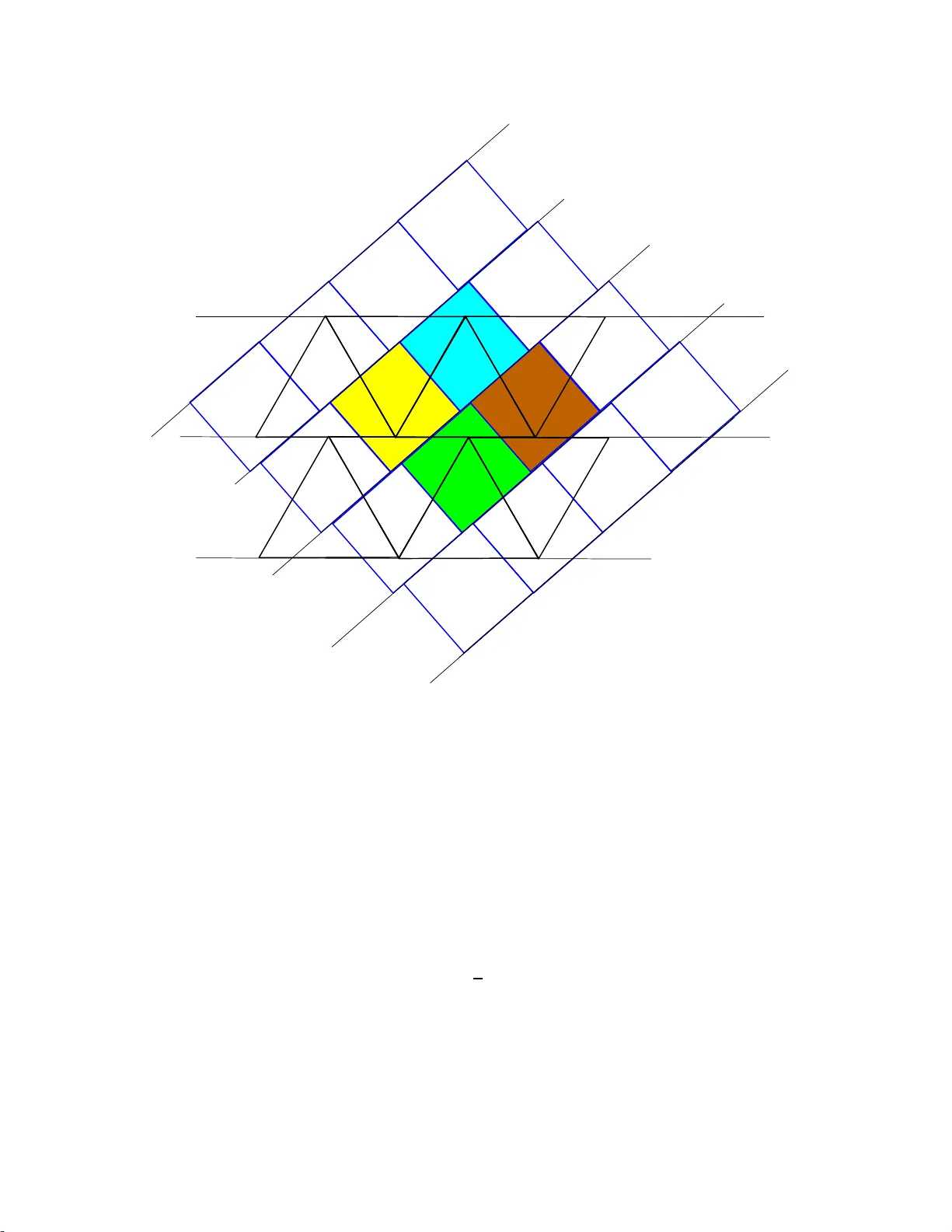
Generalizations of Sc h¨ obi’s T etrahedral Disse ction N. J. A. Sloane A T&T Shann on Labs 180 P ark Av e., Florham Park, NJ 0 7932-097 1 Vina y A. V aishampa ya n A T&T Shann on Labs 180 P ark Av e., Florham Park, NJ 0 7932-097 1 Email: njas@researc h.att.com, vin ay@researc h.att.c om Octob er 19, 2007; revised No v em b er 13, 2007 Abstract Let v 1 , . . . , v n b e unit v ectors in R n suc h that v i · v j = − w for i 6 = j where − 1 < w < 1 n − 1 . The p oints P n i =1 λ i v i (1 ≥ λ 1 ≥ · · · ≥ λ n ≥ 0) form a “Hill-simplex of the first t yp e”, denoted b y Q n ( w ). It was sh o wn b y Hadwiger in 1951 th at Q n ( w ) is equidissectable with a cub e. In 1985, Sc h¨ obi ga v e a three-piec e dissection o f Q 3 ( w ) into a triangular prism c Q 2 ( 1 2 ) × I , where I denotes an in terv a l and c = p 2( w + 1) / 3. Th e presen t pap er generalizes Sc h¨ obi’s diss ection to an n -piece d issection of Q n ( w ) int o a prism c Q n − 1 ( 1 n − 1 ) × I , where c = p ( n − 1)( w + 1) /n . Iterating this pro cess leads to a d issection of Q n ( w ) into an n -dimensional rect angular parallelepip ed (or “bric k”) u sing at most n ! pieces. The complexit y of computing the m ap from Q n ( w ) to th e brick is O ( n 2 ). A second generalization of S ch¨ obi’s dissection is g ive n whic h applies sp ecifically in R 4 . The results ha v e app lications to sour ce co d ing and to constant -wei ght bin ary co des. Keyw ords: d issections, Hill tetrahedra, Sc h¨ obi, p olytopes, V oronoi cell, s ou r ce codin g, constan t- w eigh t co d es 2000 Mathematics Sub ject C lassification: 52B4 5 (94A 29, 94 B60) 1. In tro duction W e d efine Q n ( w ) (where n ≥ 1 and − 1 < w < 1 n − 1 ) as in the Abstract, and let O n := Q n (0), P n := Q n ( 1 n ). Hadwiger [16] show ed in 1951 (see also Hertel [17]) that Q n ( w ) is equidissecta ble with a cu b e for all n . His pr o of is ind ir ect and n ot constructiv e. The simp lex O n is esp ecially in teresting: it has ve rtices 000 . . . 00 , 100 . . . 00 , 110 . . . 00 , 111 . . . 00 , . . . , 111 . . . 10 , 111 . . . 11 , (1) and is an orthoscheme in Co xeter’s term in ology [9]. Because of applications to enco ding and deco ding constan t-w eigh t co des [30], w e are intereste d in algorithms th at carry out the dissection of O n in an efficient manner. In fact our qu estion is slight ly easier than the classical p roblem, b ecause we only n eed to decomp ose O n in to pieces whic h can b e reassem bled to form a rectangular parallelepip ed (or n -dimensional “brick” ), n ot necessarily a cub e 1 . F or the case n = 3 , Hill [18] had already sho wn in 1895 that the tetrahedra Q 3 ( w ) are equidissectable w ith a cub e. It app ears that that the fi rst explicit d issection of O 3 in to a cub e w as giv en b y Sydler [29] in 1956 . Sydler sho ws that O 3 ma y b e cu t in to four p ieces wh ic h can b e reassem bled to form a pr ism with b ase an isoscele s right triangle. On e further cut then giv es a b ric k. Sydler’s d issection can b e seen in a num b er of references (Boltianskii [4, p. 99], Crom wel l [1 0 , p. 47 ], F rederic kson [13, Fig . 20.4] , Sydler [29], W ells [31, p . 2 51]) and we will not repro du ce it here. Some of these references incorrectly attribute Syd ler’s dissection to Hill. In our earlier pap er [30], we gav e a dissection of O n to a pr ism O n − 1 × I for all n that r equires ( n 2 − n + 2) / 2 pieces. In three dimensions this uses f ou r pieces, the same n umb er as Sydler’s, but is somewhat simpler th an Sydler’s in that all our cuts are made along p lanes perp endicular to co ord inate axes. By iterating this constru ction we ev en tually obtain a dissection of O n in to an n -dimensional bric k. The total num b er of pieces in the ov erall dissection is large (roughly ( n !) 2 / 2 n ), b ut the c omplexit y of compu ting the coordinates of a p oin t in the final bric k, given a initial p oint in O n , is on ly O ( n 2 ). In 1985, Sc h¨ obi [28] 2 ga v e a dissection of Q 3 ( w ) (where − 1 < w < 1 2 ) into a prism with base an equilateral triangle that u ses only three pieces (see Figs. 5 , 6 b elo w, also F rederic kson [13, Fig. 20.5]). Th ere is a w a y to cu t Q n ( w ) for an y n in to n pieces that is a n atural generalization of Sch¨ obi’s d issection, b ut for a lo ng time we w ere co nvinced that already for n = 4 these pieces could not b e reassembled to form a prism P × I for an y ( n − 1)-dimensional p olytop e P . In fact, w e we re wrong, and the main goal of this p ap er is to use the “Tw o Tile T h eorem” (Theorem 1) to 1 F or the problems of dissecting a rectangle into a square and a three-dimensional rectangular parallelepiped in to a cub e see Boltianskii [4, p. 52], Cohn [6], F rederickson [13, P age 236]. 2 According to F red erickson [13, Page 234], this construction was indep endently found by An ton Hanegraaf, unpublished. 2 generalize Sc h¨ ob i’s dissection to all d imensions. W e will sho w in Theorem 2 that Q n ( w ) can b e cut in to n p ieces th at can b e reassem bled to form a prism c P n − 1 × I ℓ , where c = p ( n − 1)( w + 1) /n and ℓ = p (1 − w ( n − 1)) /n . The cross-secti on is alw a ys pr op ortional to P n − 1 = Q n − 1 ( 1 n − 1 ), indep en d en tly of w . By iterating this dissection w e ev en tually decomp ose Q n ( w ) (and in particular O n ) in to a bric k. Th e total n umb er of pieces is at most n ! and the complexit y of co mpu ting the map from Q n ( w ) to the bric k is O ( n 2 ) (Theorem 3). Although this is the same order of complexit y as the algorithm giv en in our earlier pap er [30], the present algo rithm is simpler and the num b er of pieces is m uch smaller. The recreational literature on dissections consists mostly of ad ho c constructions, although there are a few general tec h niques, whic h can b e found in the b o oks of Lindgren [1 9] and F red- eric kson [13], [14]. Th e construction w e ha ve found the most useful is b ased on group th eory . W e call it the “Tw o Tile T h eorem”, and giv e our v ersion of it in Section 2 , together with sev eral examples. In Section 3 we state and pro ve the m ain th eorem, and then in Section 4 we stud y th e o v erall a lgorithm for dissecting O n in to a bric k. Before fi nding the general d issection ment ioned ab ov e, we found a different generaliza tion of Sc h¨ obi’s dissection wh ic h applies sp ecifically to the 4-dimensional case. This is d escrib ed in Section 5. It is of in terest b ecause it is partially (and in a lo ose sense) a “hinged” dissection (cf. F rederic kson [14]). After t wo cuts h a v e b een m ad e, th e first t wo motio ns eac h lea ve a t wo- dimensional face fi xed. W e then make a third cut, giving a total of six pieces wh ic h can r eassembled to give a prism c P 3 × I . This construction is also of interest b ecause it is symmetrical, and it is the only ad h o c dissection we kn o w of in four dimensions (the dissections found by Pa terson [26] are all b ased on a version of the Two Tile Theorem). A note ab out applications. If we h a v e a dissection of a p olytop e P in to a brick I ℓ 1 × I ℓ 2 ×· · · × I ℓ n , then we ha ve a n atural w a y to enco de the p oin ts of P in to n -tuples of real num b ers . This b ijection pro vides a useful parameterization of the p oin ts of P . It may b e used for source cod ing, if we ha v e a sour ce that p ro du ces p oin ts u n iformly distrib uted o v er P (for examp le, P might b e the V oronoi cell of a lattice). Conv ers ely , the bijecti on ma y b e u sed in sim ulation, when w e w ish to syn thesize a uniform distribu tion of p oints from P . F or the application to constant-w eight co des 3 w e refer the reader to [30]. Notation. A p olytop e in R n is a u nion of a finite num b er of finite n -dimensional simplices. It n eed b e neither con v ex nor connected. Let P , P 1 , . . . , P k b e p olytop es in R n . By P = P 1 + · · · + P k w e m ean that the interiors of P 1 , . . . , P k are pairwise disjoin t and P = P 1 ∪ . . . ∪ P k . Let Γ b e a group of isometries of R n . Two p olytop es P , Q in R n are said to b e Γ - e quidisse c table if there are p olytop es P 1 , . . . , P k , Q 1 , . . . , Q k for some in teger k ≥ 1 suc h that P = P 1 + . . . + P k , Q = Q 1 + . . . + Q k , and P g 1 1 = Q 1 , . . . , P g k k = Q k for appr opriate elemen ts g 1 , . . . , g k ∈ Γ. In case Γ is the fu ll isometry group of R n w e wr ite P ∼ Q and say that P and Q are e qu idisse ctable . Isometries ma y inv olv e reflections: we do not ins ist that the dissections ca n b e carried out u sing only transformations o f determinan t +1. I ℓ denotes an interv al of length ℓ , I is a finite in terv al of unsp ecified length, and I ∞ = R 1 . F or bac kground inf ormation ab out dissections and Hilb ert’s third problem, an d any undefined terms, w e refer the reader to the excellen t su rv eys by Boltianskii [4], Dup on t [11], F r ederic kson [13], [14], Lindgren [19], McMullen [23], McMullen and Schneider [24], Sah [27] and Y andell [32]. 2. The “Tw o Tile Theorem” Let A ⊂ R n b e a p olytop e, Γ a group of isometries of R n and Ω a subs et of R n . If the images of A u nder th e action of Γ ha ve disjoint inte riors, and Ω = ∪ g ∈ Γ A g , w e sa y that A is a Γ - tile for Ω. This implies that Γ is d iscon tin uous and fixed-p oin t-free. V ersions of the follo wing theorem—although n ot the exact v ersion that w e need—ha v e b een giv en by Aguil´ o, Fiol and Fiol [1, Lemma 2.2], M ¨ uller [25, Th eorem 3] and Paterson [26]. It is a more precise v ersion of the tec h n ique of “sup erp osing tesselations” used b y Macaula y [20], [21], Lindgren [19, Chap. 2] and F rederic kson [13, p. 29], [14, Chap. 3]. Theorem 1. If for some set Ω ⊂ R n and some gr oup Γ of isometries of R n , two n -dimensional p olytop e s A and B ar e b oth Γ -tiles for Ω , then A and B ar e Γ -e quidisse ctable. Pro of. W e hav e A = A ∩ Ω = A ∩ [ g ∈ Γ B g = [ g ∈ Γ A ∩ B g , 4 where on ly finitely m an y of the intersect ions A ∩ B g are n onempt y . The set of nonempty pieces { A ∩ B g | g ∈ Γ } therefore gives a dissectio n of A , and by s y m metry the set of nonemp t y p ieces { A g ∩ B | g ∈ Γ } give s a dissection of B . But ( A ∩ B g ) g − 1 = A g − 1 ∩ B , so the t w o sets of pieces are the same mo dulo isometries in Γ. W e giv e four examples; the main application will b e giv en in the next section. (0,0) (1,0) (1,1) (1/2,0) (1/2,1) (0,1) Figure 1 : Illustrating the Tw o T ile T heorem: A is the tria ngle (0 , 0) , (1 , 0) , (1 , 1), B (shaded) is the rectangle (0 , 0) , ( 1 2 , 0) , ( 1 2 , 1) , (0 , 1), Ω is the square (0 , 0) , (1 , 0) , (1 , 1) , (0 , 1) and Γ is generated b y φ : ( x, y ) 7→ (1 − x, 1 − y ). Example 1. Let A = O 2 , th e righ t triangle w ith v ertices (0 , 0) , (1 , 0) , (1 , 1), let B b e the rectangle with v ertices (0 , 0) , ( 1 2 , 0) , ( 1 2 , 1) , (0 , 1) and let φ b e the map ( x, y ) 7→ (1 − x, 1 − y ). Let Γ b e the group of order 2 generated by φ and let Ω b e the squ are (0 , 0) , (1 , 0) , (1 , 1 ) , (0 , 1). Th en A an d B are b oth Γ-tiles for Ω . It follo ws from Theorem 1 th at A and B are equidissectable (see Fi g. 1). Alternativ ely , we co uld tak e the origin to b e at the cen ter of the squ are, and then the theorem applies with φ := ( x, y ) 7→ ( − x, − y ). Example 2. Again w e tak e A = O 2 to b e the r igh t triangle with v ertices (0 , 0) , (1 , 0) , (1 , 1 ), but no w we tak e φ to b e the map ( x, y ) 7→ ( y + 1 , x ). Note that φ inv olve s a reflection. As menti oned in § 1, th is is p erm itted by our dissection rules. Let Γ b e the in finite cyclic group generated b y φ , and let Ω b e the infinite strip defined b y x ≥ y ≥ x − 1. Th en A is a Γ-tile for Ω (see Fig. 2). F or B , the seco nd tile, we tak e the square with vertices (0 , 0) , ( 1 2 , − 1 2 ) , (1 , 0) , ( 1 2 , 1 2 ). This is also a Γ-tile for Ω, and so A and B are equidissectable. The t wo nonemp t y pieces are the triangles A ∩ B and A ∩ B φ . Th e latter is mapp ed by φ − 1 to the triangle with ve rtices (0 , 0) , ( 1 2 , − 1 2 ) , (1 , 0). This is a sp ecial case of the dissectio n giv en in Theorem 2. O f cours e in this case the dissection could also ha ve b een accomplished w ithout u sing reflections. 5 (0,0) (1,0) (1,1) (2,1) (1/2,1/2) (1/2,-1/2) Figure 2: Another illustration of the Two Tile Theorem: A is the triangle (0 , 0) , (1 , 0) , (1 , 1), B (shaded) is the s q u are (0 , 0) , ( 1 2 , − 1 2 ) , (1 , 0) , ( 1 2 , 1 2 ) and Ω is the strip x ≥ y ≥ x − 1. Example 3. One of the most elegan t of all d iss ections is the w ell-kno wn four -piece d iss ection of an equilat eral triangle to a squ are, sho wn in Fig. 3. This w as pub lished in 190 2 b y Dudeney , although F red eric kson [13, P age 136] su ggests that he m a y n ot hav e b een the original d iscov erer. This dissection can b e f ound in many referen ces (for example, C offin [5, Ch ap. 1], Eve s [12, § 5.5.1 ], W ells [31, p. 61]) . Gardn er [15, Ch ap. 3] giv es a pro of by elemen tary geometry . The usual construction of this d issection, h o w ev er, is b y sup erimp osing t wo strips, a tec hnique that Lindgren calls a T T -dissection (Akiy ama and Nak amura [2], F rederic kson [13, Chaps. 11, 12], Figure 3: F our-piece dissection of an equilateral triangle to a square, u sually attribu ted to Dudeney (1902 ) 6 [14, Chap. 3], Lindgren [19 , Fig. 5.2] ). Th e lit erature on dissections do es not app ear to co ntai n a precise statemen t of conditions whic h guaran tee that this construction pr o duces a dissection. Suc h a th eorem can be obtained a s a coroll ary of the Tw o Tile Th eorem, and will b e published elsewhere, tog ether with rigorous v ersions of other strip dissections. Both Gardn er and E ves men tion that L. V. Ly ons extended Dudeney’s dissection to cut the w hole plane into a “mosaic of in terlo cking squares and equilateral triangles,” and Ev es sho ws this “mosaic” in his Fig. 5.5 b (Fig. 4 b elo w sh o ws essenti ally the same figure, w ith the addition of lab els for certain p oin ts). W e will u se this “mosaic,” which is really a double tiling of the plane, to giv e an alternativ e pro of that the dissection is correct f r om the Two Tile T h eorem. F ollo wing Lyons, w e first u s e th e dissection to construct the double tiling. W e then ignore h o w the double tiling wa s obtained, and apply the Tw o T ile Th eorem to giv e an im m ediate certificate of pro of for Dudeney’s dissection. The double tiling also has some in teresting prop erties that are not apparen t from Ev es’s figure, and do not seem to ha v e b een mentio ned before in the literature. Let Ω = R 2 , and tak e the first tile to b e an equ ilateral triangle w ith edge length 1, area c 1 := √ 3 4 and vertices A := ( − 1 / 4 , − c 1 ), B := − A a nd C := (3 / 4 , − c 1 ) ( see Fig. 4), with th e o rigin O at the midp oint of AB . The second tile is a square with ed ge length c 2 := √ c 1 . The existence of th e dissection imp oses man y constraints, suc h as | J B | = | J C | = | H I | = 1 / 2, | O D | = | O G | = c 2 / 2, 2 | LG | + | GK | = 2 | J K | + | GK | = c 2 , etc., and after some calculation w e find that the square should h a v e ve rtices D := ( − c 1 / 2 , c 3 / 2), E := ( c 3 − c 1 / 2 , c 3 / 2 + c 1 ), F := ( c 3 + c 1 / 2 , − c 3 / 2 + c 1 ) and G := − D , where c 3 = c 2 √ 1 − c 1 . W e now construct a strip of squares that r ep licates the square D E F G in the s outh we st/northeast direction, and a strip of triangles r eplicating AB C (with alternate triangles inv erted) in the horizon tal direction. In order to fill the p lane with copies of these str ips, w e m ust deter- mine the offset of one s tr ip of squares with r esp ect to the next strip of squares, and of one strip of triangles with resp ect to the next strip of triangles. This implies th e fur ther con- strain ts that P − O = L − H = K − E , etc., and in particular that P sh ou ld b e the p oin t (1 − 2 c 3 , − 2 c 1 ). Other significan t p oin ts are H := − L := ( c 3 − 1 / 2 , c 1 ), I := ( c 3 , c 1 ), J := (1 / 2 , 0), K := (1 − c 3 − c 1 / 2 , c 3 / 2 − c 1 ). The angle C L G is arctan( c 1 /c 3 ) = 41 . 15 . . . degrees. W e no w ha v e the desired double tiling of th e plane. Both the triangle AB C and the squ are D E F G are Γ-tiles for the whole p lane, where Γ is the group (of t yp e p 2 in the classical n otation, 7 A B C D E F G H I J K O P L Figure 4: Ly ons’s “mosaic,” a double tiling of the p lane b y triangles and squares. or t yp e 2222 in the orbifold notation) generated by translation by (1 , 0), translation by O P = (1 − 2 c 3 , − 2 c 1 ) = (0 . 009 015 . . . , − 0 . 8660 . . . ), and m ultiplication b y − 1. W e no w ignore ho w this tiling w as found, and deduce from Th eorem 1 that Dudeney’s d issection exists. Th e four pieces are O B J G , O D H B , H E I and B I F J . It is in teresting that the horizon tal strips of triangles do not line up exactly: eac h strip is shifted to the left of the one b elo w it by 1 − 2 c 3 = 0 . 009 015 . . . . The group is corresp ond ingly more complicated than one migh t hav e exp ected from lo oking at Fig. 4, since the second generator for the group is not quite translation b y (0 , − √ 3 / 2)! There is an asso ciated lattice, generated b y the v ectors O H and O J , and con taining the p oin ts I and L , whic h is ne arly recta ngular, the angle b et we en the generators b eing 89 . 04 . . . degrees. 8 Inciden tally , although Lindgren [19, p. 25] refers to this dissection as “minimal”, w e ha ve nev er seen a pro of th at a three-piece d issection of an equilateral triangle to a square is imp ossible. This app ears to b e an op en q u estion. Example 4. It is ea sy to sho w b y induction that any lattice Λ in R n has a b r ic k-shap ed fun da- men tal region. The theorem then p ro vides a dissection of the V oronoi cell of Λ into a bric k. F or example, th e V oronoi cell of the ro ot lattice D n is describ ed in [7, Chap. 21]. By applying th e theorem, w e obtain a d iss ection of the V oronoi cell in to a br ic k that us es 2 n pieces. F or n = 3 this giv es th e we ll-kno wn six-piece dissection of a rh ombic do decahedron in to a 2 × 1 × 1 bric k (cf. [13, pp. 18, 2 42]). 3. The main theorem W e b egin by c ho osing a particular realizati on of th e simplex Q n ( w ). Define the follo wing v ectors in R n : v 1 := ( a, b, b, . . . , b ) , v 2 := ( b, a, b, . . . , b ) , v 3 := ( b, b, a, . . . , b ) , . . . , v n := ( b, b, b, . . . , a ) , (2) where b := ( p 1 − w ( n − 1) − √ 1 + w ) /n , a := b + √ 1 + w . (3) Then v i · v i = 1, v i · v j = − w for i 6 = j , i, j = 1 , . . . , n . W e tak e the con v ex h ull of the vecto rs 0 , v 1 , v 1 + v 2 , . . . , v 1 + · · · + v n , that is, the zero vect or to gether with th e rows of a b b . . . b a + b a + b 2 b . . . 2 b a + 2 b a + 2 b a + 2 b . . . 3 b . . . . . . . . . . . . . . . a + ( n − 1) b a + ( n − 1) b a + ( n − 1) b . . . a + ( n − 1) b , (4) to b e our standard version of Q n ( w ). This simplex has v olume (1 + w ) ( n − 1) / 2 (1 − w ( n − 1)) 1 / 2 /n ! . (5) Setting w = 0 , a = 1 , b = 0 give s our standard version of O n , as in (1), and setting w = 1 /n, a = n − 3 / 2 (1 + ( n − 1) √ n + 1) , b = n − 3 / 2 (1 − √ n + 1) giv es our standard v ersion of P n . 9 Tw o other v ersions of P n will also app ear. Let p i := 1 / p i ( i + 1), and construct a n × n orthogonal matrix M n as follo ws. F or i = 1 , . . . , n − 1 the i th col um n of M n has en tries p i ( i times), − ip i (once) and 0 ( n − i − 1 times), and the entries in the last column are all 1 / √ n . (The last column is in th e (1 , 1 , . . . , 1) direction and the other column s are p erp end icular to it.) F or example, M 3 := 1 √ 2 1 √ 6 1 √ 3 − 1 √ 2 1 √ 6 1 √ 3 0 − 2 √ 6 1 √ 3 . The other tw o versions of P n are: the con v ex h ull of the zero v ector in R n together with the ro ws of r n + 1 n p 1 p 2 p 3 . . . p n 0 2 p 2 2 p 3 . . . 2 p n . . . . . . . . . . . . . . . 0 0 0 . . . dp n , (6) and the conv ex h ull of th e zero v ector in R n +1 together with the r o ws of r n + 1 n n n +1 − 1 n +1 − 1 n +1 . . . − 1 n +1 n − 1 n +1 n − 1 n +1 − 2 n +1 . . . − 2 n +1 . . . . . . . . . . . . . . . 1 n +1 1 n +1 1 n +1 . . . − n n +1 . (7) T o see that b oth of these simplices are congruent to th e standard v ersion of P n , note th at m ultiplying (7) on the right b y M n +1 pro du ces (6) supplemented by a column of zeros, and then m ultiplying (6) on the righ t by M tr n (where tr denotes tr an s p ose) pro du ces the standard v ersion. Remark. If w e ignore for the moment the scale factor in front of (7), w e see that its rows are the coset represen tativ es for the root lattice A n in its d ual A ∗ n [7, p. 10 9]. In other w ord s, the ro w s of (7) con tain one representati ve of eac h of the classes of v ertices of the V oronoi cell for A n . P 2 is an equilateral triangle and P 3 is a “Scottish tetrahedron” in the terminology of Con wa y and T orquato [8]. W e can no w state our main theorem. Theorem 2. The simplex Q n ( w ) is e quidisse ctable with the p rism c P n − 1 × I ℓ , wher e c := p ( n − 1)( w + 1) /n and ℓ := p (1 − w ( n − 1)) /n . Pro of. Let Ω b e the conv ex h ull of the p oin ts { u i ∈ R n | i ∈ Z } , w here u 0 := (0 , 0 , . . . , 0), 10 u i := u φ i 0 , φ is the map φ : ( x 1 , . . . , x n ) 7→ ( x n + a, x 1 + b, x 2 + b, . . . , x n − 1 + b ) and a, b are as in (3) (see T able 1). T able 1: P oin ts definin g the infi nite prism Ω. The con v ex h ull of a ny n + 1 successiv e ro ws is a cop y of Q n ( w ). . . . . . . . . . . . . . . . . . . . . . u − 1 = − b − b − b . . . − a u 0 = 0 0 0 . . . 0 u 1 = a b b . . . b u 2 = a + b a + b 2 b . . . 2 b . . . . . . . . . . . . . . . . . . . . . u n = a + ( n − 1) b a + ( n − 1) b a + ( n − 1) b . . . a + ( n − 1) b u n +1 = 2 a + ( n − 1) b a + nb a + nb . . . a + nb . . . . . . . . . . . . . . . . . . . . . W e no w argue in sev eral easily verifiable steps. (i) F or an y i ∈ Z , the conv ex h ull of u i , u i +1 , . . . , u i + n is a copy of Q n ( w ), Q ( i ) (sa y), with Q ( i ) ⊂ Ω and ( Q ( i ) ) φ = Q ( i +1) . (ii) The simplices Q ( i ) and Q ( i +1) share a common face, the con v ex hull of u i +1 , . . . , u i + n , but ha v e d isjoin t in teriors. More generally , for all i 6 = j , Q ( i ) and Q ( j ) ha v e disjoint interio rs. (iii) The p oints of Ω satisfy x 1 ≥ x 2 ≥ · · · ≥ x n ≥ x 1 − ( a − b ) . (8) (This is true for Q (0) and the prop erty is pr eserved by the action of φ .) The in equalities (8) define an infin ite prism with axis in the (1 , 1 , . . . , 1) direction. W e will sho w that ev ery p oin t in the prism b elongs to Ω, so Ω is in fact equal to this prism. (iv) T he pro jection of Q (0) on to the hyperp lane p erp endicular to the (1 , 1 , . . . , 1) direction is congruen t to c P n − 1 , where c := p ( n − 1)( w + 1) /n . (F or m ultiplying (4) on the r igh t by M n giv es a scale d cop y of (6).) O n the other hand, the inte rsection of the pr ism defined by (8) with the hyperp lane P n i =1 x i = 0 consists of the p oints (0 , 0 , . . . , 0), √ w + 1 (( n − 1) /n, − 1 /n, . . . , − 1 /n ), √ w + 1 (( n − 2) /n, ( n − 2) /n, − 2 /n, . . . , − 2 /n ), . . . , and—compare (7)—is also congruen t to c P n − 1 . Since the pro jection and the inte rsection ha v e the same volume, it follo w s that ev ery p oin t in the 11 prism is also in Ω. (F or consider a long bu t fi nite segment of the p rism. The total v olume of the copies of Q n ( w ) is determined b y the pro j ection, and the v olume of the prism is determined b y the cross-section, and these coincide.) W e hav e t herefore established that Ω is the infin ite prism c P n − 1 × I ∞ with w alls giv en by (8). F urthermore, Q n ( w ) is a Γ-tile for Ω, w here Γ is the infin ite cyclic group generated b y φ . (v) F or a second tile, w e take the p rism B := c P n − 1 × I ℓ , where ℓ := p (1 − w ( n − 1)) /n . The length ℓ is c hosen so that B has the same vo lume as Q n ( w ) (see (5)). W e ta ke the base of B to b e the particular copy of c P n − 1 giv en b y th e intersectio n of Ω with the h yp erplane P n i =1 x i = 0, as in (iv). Th e to p of B is found b y adding ℓ/ √ n to ev ery comp onent of the base v ectors. T o sho w that B is also a Γ-tile for Ω, we chec k that the image of the base of B u nder φ coincides with th e top of B . This is an easy v erification. Since Q n ( w ) and B are b oth Γ-tiles for Ω, the desired result follo ws from Theorem 1. Remarks. (i) T h e prism B consists of the p ortion of the infinite prism Ω b oun ded by the h yp erplanes P x i = 0 and P x i = p 1 − w ( n − 1). The “ap ex” of Q w ( n ) is the p oin t ( a + ( n − 1) b, a + ( n − 1) b, . . . , a + ( n − 1) b ), whic h—since a + ( n − 1) b = p 1 − w ( n − 1)—lies on the h yp erplane P x i = n p 1 − w ( n − 1). Th er e are therefore n pieces Q n ( w ) ∩ B φ k ( k = 0 , 1 , . . . , n − 1) in the dissection, obtained b y cutting Q w ( n ) a long the h yp erplanes P x i = k p 1 − w ( n − 1) for k = 1 , . . . , n − 1. T o r eassem ble them to f orm B , we app ly φ − k to the k th piece. (ii) The case n = 2, w = 0 of the th eorem was illustrated in Fig. 2. I n the case n = 3, − 1 < w < 1 2 , th e th ree pieces are exactly the same as th ose in Sch¨ obi’s dissection [28]. Ho we ve r, it is interesting that we reassem ble them in a different w a y to f orm the same prism c P 2 × I ℓ , w ith c := p 2( w + 1) / 3, ℓ := p (1 − 2 w ) / 3 . Firs t w e describ e our d issection, whic h is illustrated in Fig. 5. Th e figure sho ws an explo ded view of three adjacen t copies of Q 3 ( w ), n amely Q 3 ( w ) φ − 1 (the lo w er left tetrahedron), Q 3 ( w ) (the upp er left tetrahedron) and Q 3 ( w ) φ (the tetrahedron on the righ t), and their intersectio ns with th e t w o cutting planes. The three p ieces in the dissection can b e seen in the u pp er left tetrahedron Q 3 ( w ). T hey are τ − 1 = Q 3 ( w ) ∩ B φ − 1 (the piece AB C G on the left of this tetrahedron), τ 0 = Q 3 ( w ) ∩ B (the cen tral piece AB C D E F ) and τ 1 = Q 3 ( w ) ∩ B φ 12 τ −1 τ 1 τ 1 φ −1 τ −1 φ A C B D E F G H B C F E D’ A’ E C τ 0 Figure 5: Explo ded view sh o wing thr ee adjacen t copies of Q 3 ( w ) and their in tersections with the t w o cutting p lanes. (the piece D E F H on the righ t). In Fig. 5 we can also see an explo ded view of th ese three pieces reassem bled to form th e triangular prism: τ φ − 1 1 is the righ t-hand piece A ′ B C E of the lo w er fi gure and τ φ − 1 is the left-hand p iece C D ′ E F of the figure on the r igh t. The fully assem bled prism is sho wn in Fig. 6: the tetrahedron A ′ B C E is τ φ − 1 1 and the tetrahedron C D ′ E F is τ φ − 1 . On the other hand , S c h¨ obi reassem bles th e same pieces b y rotating τ 1 ab out the edge E F (whic h acts as a hinge), sending D to D ′ and giving the te trahedron C D ′ E F , and rotating τ − 1 ab out th e hinge B C , send ing A to A ′ and giving the tetrahedron A ′ B C E . Th is is strictly different from our construction, since φ has no fi xed p oin ts. The pieces are the same and the end result is the same, but the tw o outer pieces τ 1 and τ − 1 ha v e b een interc han ged! (iii) By rep eated app lication of Theorem 2 we can d iss ect Q n ( w ) in to an n -d imensional brick. Eac h of the n pieces from the first stage is cu t into at most n − 1 pieces at the second stage, and so on, so the total num b er of pieces in th e fin al dissection is at most n !. (It could b e less, if a piece fr om one stage is not inte rsected by all of the cutting p lanes at the n ext stage. It seems difficult to d etermine the exact num b er of pieces.) 13 A D B E D’ F A’ C Figure 6: Three-piece dissection o f the triangular p rism. Our construction and S c h¨ obi’s u s e the same three pieces but assemble them in a d ifferen t wa y . In this view th e p oin ts A ′ and B are at the bac k of the figure. 4. Dissecting O n in to a bric k In this section we discuss in more detail the recursive dissection of Q n ( w ) into a rectangular parallelepip ed or “bric k” in the case of greatest in terest to us , wh en w e start with O n = Q n (0). F rom Theorem 2 w e hav e O n ∼ r n − 1 n P n − 1 × I 1 √ n , P n ∼ √ n 2 − 1 n P n − 1 × I 1 n , (9) and so (since P 1 = I 1 ) O n ∼ 1 2 I 1 × I p 2 × I p 3 × · · · × I p n − 1 × I 1 √ n . (10) The righ t-hand side of (10) is our final bric k; w e will denote it by Π. Note that vol( O n ) = v ol(Π) = 1 /n !. Let Θ denote the map from O n to Π asso ciated with the dissection (10). W e will show that giv en x := ( x 1 , . . . , x n ) ∈ O n , ( y 1 , . . . , y n ) := Θ( x ) ∈ Π can b e computed in O ( n 2 ) steps. The algorithm for computing Θ breaks u p natur ally into t wo parts. Th e fir st step inv olv es dissecting O n in to n pieces and reassem bling them to form the prism B := r n − 1 n P n − 1 × I 1 √ n . 14 All later steps start with a p oin t in λ k P k for k = n − 1 , n − 2 , . . . , 2 and certain constant s λ k , and pro du ce a p oint in λ k − 1 P k − 1 × I . F or the fir st step w e m ust d etermine whic h of the p ieces O n ∩ B φ r 1 ( r = 0 , 1 , . . . , n − 1) x b elongs to, wh ere φ 1 is the map ( x 1 , . . . , x n ) 7→ ( x n + 1 , x 1 , x 2 , . . . , x n − 1 ). This is giv en b y r := ⌊ P n i =1 x i ⌋ , and then mapping x to x ′ := x φ − r 1 corresp onds to reassem bling the pieces to form B . Ho wev er, x ′ is exp r essed in terms of the original co ordin ates for O n and we m ust m ultiply it b y M n to get co ordinates p erp endicular to the (1 , 1 , . . . , 1) direction, getting x ′′ := ( x ′′ 1 , . . . , x ′′ n − 1 , y n ) = x ′ M n . The final comp onent of x ′′ is the pro jection o f x ′ in the (1 , 1 , . . . , 1) direction. T he other comp onent s of x ′′ , ( x ′′ 1 , . . . , x ′′ n − 1 ) define a p oin t in q n − 1 n P n − 1 , but expressed in coord inates of the form shown in (6), and b efore we pr o ceed to the next stage, w e m ust reexpress th is in the standard co ord inates for q n − 1 n P n − 1 , wh ic h w e do by multiplying it by M tr n − 1 (see th e b eginning of § 3), getting x ′′′ . The follo wing pair of observ ations shorten these calcula tions. First, y n can b e computed directly once we know r , sin ce eac h application of φ − 1 1 subtracts 1 fr om the sum of the co ordin ates. If s := P n i =1 x i , then r := ⌊ s ⌋ and y n = ( s − r ) / √ n . Second, the pro du ct of M n -with-its-last- column-deleted and M tr n − 1 is th e n × ( n − 1) m atrix N n := 1 − p n − p n . . . − p n − p n 1 − p n . . . − p n . . . . . . . . . . . . − p n − p n . . . 1 − p n − 1 √ n − 1 √ n . . . − 1 √ n . Multiplication by N n requires only O ( n ) steps. The first stage in the computation of Θ can therefore b e summarized as follo ws: Step A. Giv en x := ( x 1 , . . . , x n ) ∈ O n . Let s := P n i =1 x i , r := ⌊ s ⌋ . Compute x ′ := x φ − r 1 . P ass x ′′′ := x ′ N n to the next stage, and outpu t y n := (fractional part of s ) / √ n . In all the remaining steps we start with a p oint x in λ k P k for s ome constan t λ k , where k = n − 1, n − 2 , . . . , 2. Instead of φ 1 w e use the m ap φ 2 : ( x 1 , . . . , x k ) 7→ ( x k + a, x 1 + b, x 2 + b, . . . , x k − 1 + b ), where a = k − 3 / 2 (1 + ( k − 1) √ k + 1) , b = k − 3 / 2 (1 − √ k + 1). Eac h app lication of φ − 1 2 subtracts 15 1 / √ k fr om the sum of the coord inates. W e omit the remaining details and just giv e the su mmary of this step (for simplicit y we ignore the constant λ k ): Step B k . Giv en x := ( x 1 , . . . , x k ) ∈ P k . Let s := P k i =1 x i , r := ⌊ √ k s ⌋ . Compute x ′ := x φ − r 2 . P ass x ′′′ := x ′ N k to the next stage, and outpu t y k := (fractional p art of √ k s ) /k . Since the n umb er of computations needed at eac h step is linear, w e conclude that: Theorem 3. Given x ∈ O n , Θ( x ) ∈ Π c an b e c ompute d in O ( n 2 ) st eps. Remarks. The inv er s e map Θ − 1 is j u st as easy to compute, since eac h o f the individual s teps is easily reve rsed. Two details are w orth mentioning. When in ve rting step B k , giv en x ′′′ and y k , we obtain x ′ b y m ultiplying x ′′′ b y N tr k and adding y k / √ k t o eac h comp onen t. F or the computation of r , it can b e sho wn (w e omit the pro of ) that for inv erting step A, to go fr om x ′ to x , r sh ou ld b e take n to b e the n umb er of strictly negativ e comp onents in x ′ . F or step B k , r is the num b er of indices i suc h that x ′ i < b √ k k X j =1 x ′ j . 5. An alternativ e dissection of O 4 In this section w e giv e a six-piece d issection of τ := O 4 in to a p rism q 3 4 P 3 × I 1 2 . Although it requires tw o more pieces than th e dissection of Theorem 2, it still only uses three cuts. I t also has an app ealing symmetry . W e start b y subtracting 1 2 from the co ord inates in (1), in order to m o v e the origin to the cen ter of τ . That is, we tak e τ to b e th e conv ex h ull of th e p oints A := ( − 1 2 , − 1 2 , − 1 2 , − 1 2 ), B := ( 1 2 , − 1 2 , − 1 2 , − 1 2 ), C := ( 1 2 , 1 2 , − 1 2 , − 1 2 ), D := ( 1 2 , 1 2 , 1 2 , − 1 2 ), E := ( 1 2 , 1 2 , 1 2 , 1 2 ) (see Fig. 7). W e use ( w, x, y , z ) for coordin ates in R 4 . Note th at τ is fixed by the sym metry ( w, x, y , z ) 7→ ( − z , − y , − x, − w ). W e mak e t w o initial cuts, along the h yp erplanes w + y + z = − 1 2 and w + x + z = 1 2 . The first cut in tersects the edges of τ at the p oints B , C , F := (0 , 0 , 0 , − 1 2 ) and G := ( − 1 6 , − 1 6 , − 1 6 , − 1 6 ); the second at the p oint s C , D , H := ( 1 2 , 0 , 0 , 0) and I := ( 1 6 , 1 6 , 1 6 , 1 6 ). The three p ieces resulting 16 F G H I A B C D E Figure 7: τ := O 4 is the conv ex hull of A, B , C, D , E ; the first t w o cuts are made along the h yp erplanes cont aining B , C , F , G and C , D , H , I , resp ectiv ely . from these cuts will b e denoted b y τ 1 (con taining A ), τ 2 (the cen tral piece), and τ 3 (con taining E ). W e apply the transformation α := ( w , x, y , z ) 7→ ( − y , − x, − w , − 1 − z ) to τ 1 and β := ( w, x, y , z ) 7→ (1 − w , − z , − y , − x ) to τ 3 . α fixes the triangle B C F , although not p oin t wise, and similarly β fix es the triangle C D H , and so these transformations m a y b e regarded as hin ged, in a loose sense of that w ord 3 . This is what led us to this dissection—w e w ere atte mp tin g to generalize Sc h¨ obi’s hin ged thr ee-dimensional dissection. After applying α and β , the resulting p olytop e τ 4 := τ α 1 + τ 2 + τ β 3 is a con v ex b o dy w ith seven v ertices and six faces. (This and other assertions in this section w ere v erified with th e h elp of th e programs Qh ull [3] and MA TLAB [22].) The sev en ve rtices are B , C , D , G, I , J := ( 1 6 , 1 6 , 1 6 , − 5 6 ) and K := ( 5 6 , − 1 6 , − 1 6 , − 1 6 ), which are sh o wn sc hematically in Fig. 8. This figur e is r ealistic in so far as it suggests that the edges B K , GI and J D are equal and parallel (in fact, K − B = I − G = D − J = ( 1 3 , 1 3 , 1 3 , 1 3 )). W e now mak e one further cut, along the hyperp lane w + x + y + z = 0, whic h separates 3 Since a hinged ro d in the plane has a fix ed point, and a hinged door in three dimensions has a fixed one- dimensional su bspace, a hinged transformation in four dimensions should, strictly sp eaking, have a tw o-d imensional region that is p ointwise fixed. 17 C B L K I D N J G M Figure 8: After the first t wo motions, w e hav e a p olytop e τ 4 with sev en v ertices B , G, J, C , K, I , D . The third cut is along the h yp erplane conta ining C, L, M , N . τ 4 in to t wo pieces τ 5 (con taining B ) and τ 6 (con taining K ). T his h yp erplane meets the edge B K at the p oin t L := ( 3 4 , − 1 4 , − 1 4 , − 1 4 ), GI at the p oint M := (0 , 0 , 0 , 0), and J D at the p oin t N := ( 1 4 , 1 4 , 1 4 , − 3 4 ). The p oin t L is three-quarters of the wa y along B K , M b isects GI , and N is one-quarter of th e w a y along J D , The final motion is to apply γ := ( w , x , y , z ) 7→ ( x, y , z , w − 1) to τ 6 , and to form τ 7 := τ 5 + τ γ 6 . The conv ex hull of τ 7 in v olv es thr ee new p oints, the images of L , M and N under γ , namely P := ( − 1 4 , − 1 4 , − 1 4 , − 1 4 ), Q := (0 , 0 , 0 , − 1) and R := ( 1 4 , 1 4 , − 3 4 , − 3 4 ), resp ectiv ely . Then τ 7 is the con v ex hull of the eigh t p oints C , L, M , N and R, B , P , Q , and it may b e ve rified that the first four a nd the last four of these points defin e copies of q 3 4 P 3 , a nd that τ 7 is indeed congruent to q 3 4 P 3 × I 1 2 , as claimed. W e end with a question: can this construction b e generalized to higher dimensions? Ac kno wledgmen ts. W e thank G. N. F r ederic kson f or commen ts on the man uscrip t and for dra wing our atten tion to r eference [12 ]. 18 References [1] F. Ag uil´ o, M. A. Fiol and M. L. Fiol, P erio dic tilings as a dissection metho d, A mer. Math. Monthly , 107 (2000 ), 341 –352. [2] J. Akiy ama and G. Nak am ura, Dudeney dissection of p olygons, in J. Akiy ama, M. K ano and M. Urab e, eds., Discr ete and Comp utational Ge ometry (T okyo, 1998) , L e ctur e Notes i n Comput. Sci. , 1763 (2000 ), 14– 29. [3] C. B. Barb er, D. P . Dobkin and H. T. Huhdanp aa, The Quickh u ll algorithm for con- v ex h ulls, ACM T r ans. Mathematic al Softwar e , 22 (1996), 469–48 3. Av ailable f rom h ttp://www.qhull.org. [4] V. G. Boltianskii, Hilb ert’s Thir d Pr oblem , T ranslated from the Russian b y R. A. Silverman, Wiley , NY, 1978. [5] S. T. Coffin, The P u zzling World of P olyhe dr al Disse ctions , Oxford Univ. Press, 1961. [6] M. J . Cohn, Economical triangle- square dissection, Ge ometriae D e dic ata , 3 (197 4–1975), 447–4 67. [7] J. H. Con w a y and N. J. A. Sloane, Spher e Packings, L attic es and Gr oups , Springer, NY, 1988; 3rd . ed., 1998. [8] J. H. C on wa y and S. T orqu ato, P ac king, tiling, and cov ering with tetrahedra, Pr o c. Natl. A c ad. Sci. USA , 103 (2006), 10 612–1061 7. [9] H. S. M. Co xeter, R e gular Polyto p es , 3rd. ed., Do ver, NY, 1973. [10] P . R. Crom we ll, Poly he dr a , Cambridge Univ. Pr ess, 1997. [11] J. L. Dup ont, Scissors Congruenc es, Gr oup Homolo gy and Char acteristic Classes , W orld Scien tific, Singap ore, 2001. [12] H. Ev es, A Survey of Ge ometry , Allyn and Bacon, Boston, MA, V ol. 1, 1966. [13] G. N. F rederic kson, Disse ctions: Plane and F ancy , Cam brid ge Univ. Pr ess, 1997. 19 [14] G. N. F red er ickson, H inge d Disse ctions: Swinging & Twisting , Cambridge Univ. Pr ess, 2002. [15] M. Gardner, The Se c ond S cientific American Bo ok of Math ematic al P uzzles and Diversions , Simon and S ch uster, NY, 1961. [16] H. Hadw iger, Hillsc he Hyp ertetraeder, Gazeta Matem´ atic a (Lisb o a) , 12 (N o. 50, 1951), 47– 48. [Not for publication: a scanned cop y of this article h as b een placed on NJAS’s home page - see ww w .researc h.att.com/ ∼ njas/doc/HAD WIGER/hadwiger.h tml] [17] E. Hertel, V er al lgemeinerte Hadwiger-Hil l Simplexe , Rep orts on Algebra and Geometry , Mathematisc hes Ins titut, F riedric h-Sc hiller-Univ ersit¨ at Jena, Jena, German y , 2003 . [Not for publication: a v ailable from www .minet.uni-jena.de/ivs/jenaer sc hriften.htm] [18] M. J. M. Hill, Determination of the vol umes of certain sp ecies of tetrahedra without emplo y- men t of the metho d of limits, Pr o c. L ondon M ath. So c . , 27 (1895– 1896), 39–53. [19] H. Lindgren , Ge ometric Disse ctions , V an Nostrand, Princeton, NJ , 1964; revised edition with an app endix b y G. N. F rederic kson, Do v er, NY, 1972. [20] W. H. Macaula y , T h e dissection of rectilinear figures, Math. Gazette , 7 (1914), 381–3 88; 8 (1915 ), 72–7 6 and 109–11 5. [21] W. H. Macaula y , The dissection of rectilinear fi gures, Me ssenger Math. , 48 (1919), 159–165 ; 49 (1919 ), 111 –121; 52 (1922 ), 53– 56. [22] MA TLAB User’s Guide , MathW orks, Inc., Natic k, MA, 2007. [23] P . McMullen, V aluatio ns and dissections, in P . M. Gr ub er and J. M. Wills, eds., Handb o ok of Co nvex Ge ometry , North-Holland, Amsterd am, V ol. B, 1993, pp. 933–988 . [24] P . McMullen and R. Schneider, V aluations on con v ex b o dies, in P . M. Grub er and J. M. Wills, eds., Convexity and its Applic ations , Birkh¨ auser, Basel, 1983, pp . 170–247. [25] C. M ¨ uller, Equid ecomp osabilit y of p olyhedra with reference to crystallographic groups, Dis- cr ete Comput. Ge om. , 3 (1988), 383–389. [26] D. A. Pa terson, Geometric dissections in 4-D, J. R e cr e ational Math. , 28 (1996–1997 ), 22– 37. 20 [27] C.-H. Sah, Hilb ert’s Thir d Pr oblem: Scissors Congruenc e , Pitman, Lon d on, 1979 . [28] P . Sc h¨ obi, Ein elemen tarer und k onstruktiv er Bew eis f ¨ ur die Zerlegungsgleic hheit d er Hill’sc h en T etraeder mit einer Quader, Elem. Math. , 40 (1985), 85–97. [29] J.-P . Sydler, Sur les t ´ etra ` edres ´ equiv alents ` a un cub e, Elem. Math . , 11 (1956), 78–81. [30] C. Tian, V. A. V aishampay an and N. J. A. Sloane, Constant w eigh t co d es: a geomet- ric approac h based on dissections, Preprint, 2007 [Not for pu blication: a v ailable from arXiv:0706 .1217 ]. [31] D. W ells, The Penguin Dictionary of Cu rious and Inter esting Ge ometry , P enguin Bo oks, London, 1991. [32] B. H. Y and ell, The Honors Class: Hilb e rt’s Pr oblems and Their Solvers , A. K . Pe ters, Natic k, MA, 2002 . 21
Original Paper
Loading high-quality paper...
Comments & Academic Discussion
Loading comments...
Leave a Comment