Enforcing Label and Intensity Consistency for IR Target Detection
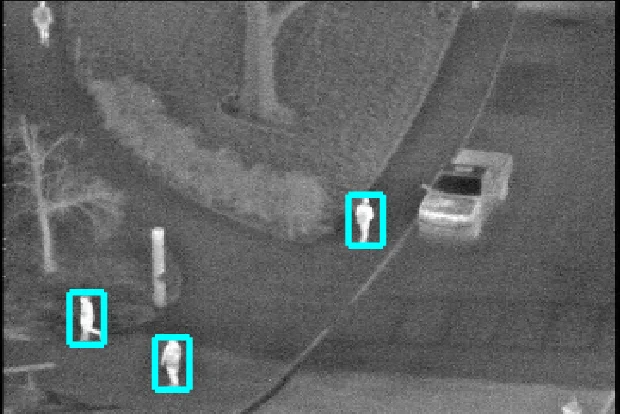
This study formulates the IR target detection as a binary classification problem of each pixel. Each pixel is associated with a label which indicates whether it is a target or background pixel. The optimal label set for all the pixels of an image maximizes aposteriori distribution of label configuration given the pixel intensities. The posterior probability is factored into (or proportional to) a conditional likelihood of the intensity values and a prior probability of label configuration. Each of these two probabilities are computed assuming a Markov Random Field (MRF) on both pixel intensities and their labels. In particular, this study enforces neighborhood dependency on both intensity values, by a Simultaneous Auto Regressive (SAR) model, and on labels, by an Auto-Logistic model. The parameters of these MRF models are learned from labeled examples. During testing, an MRF inference technique, namely Iterated Conditional Mode (ICM), produces the optimal label for each pixel. The detection performance is further improved by incorporating temporal information through background subtraction. High performances on benchmark datasets demonstrate effectiveness of this method for IR target detection.
💡 Research Summary
This paper tackles the problem of detecting targets in infrared (IR) imagery by formulating it as a pixel‑wise binary classification task. Rather than relying on handcrafted features such as HOG, SURF, or composite descriptors, the authors propose a probabilistic framework that explicitly models spatial dependencies both in the observed intensities and in the hidden class labels. The core of the method consists of two coupled Markov Random Fields (MRFs).
- Intensity Model (Conditional Likelihood) – The intensity field y is modeled with a Simultaneous Auto‑Regressive (SAR) MRF. For each class (target or background) a separate SAR model is defined:
\
Comments & Academic Discussion
Loading comments...
Leave a Comment