Fragmentation transition in a coevolving network with link-state dynamics
We study a network model that couples the dynamics of link states with the evolution of the network topology. The state of each link, either A or B, is updated according to the majority rule or zero-temperature Glauber dynamics, in which links adopt the state of the majority of their neighboring links in the network. Additionally, a link that is in a local minority is rewired to a randomly chosen node. While large systems evolving under the majority rule alone always fall into disordered topological traps composed by frustrated links, any amount of rewiring is able to drive the network to complete order, by relinking frustrated links and so releasing the system from traps. However, depending on the relative rate of the majority rule and the rewiring processes, the system evolves towards different ordered absorbing configurations: either a one-component network with all links in the same state or a network fragmented in two components with opposite states. For low rewiring rates and finite size networks there is a domain of bistability between fragmented and non-fragmented final states. Finite size scaling indicates that fragmentation is the only possible scenario for large systems and any nonzero rate of rewiring.
💡 Research Summary
The paper introduces a coevolving network model in which each edge carries a binary state (A or B). Edge states evolve according to a zero‑temperature Glauber (majority‑rule) dynamics: at each step a randomly chosen edge adopts the state that is in the majority among its neighboring edges (those sharing an endpoint). With probability p the model instead attempts a rewiring move: one endpoint of the selected edge is kept fixed, and if the edge’s state disagrees with the local majority at that endpoint, the edge is detached from its opposite endpoint and re‑attached to a randomly chosen node; simultaneously its state is switched to match the local majority. With probability 1‑p the majority‑rule update is performed. Time is measured in units of 1/N so that each node experiences, on average, one edge update per unit time.
When p = 0 the network is static and the dynamics reduces to the link‑state majority rule studied previously. In that case most realizations fall into disordered absorbing configurations (ρ > 0), either frozen links that are locally in the majority or “blinker” links that keep flipping because they have equal numbers of A‑ and B‑neighbors. Here ρ is the density of nodal interfaces, i.e., the fraction of pairs of incident edges that are in opposite states; ρ = 0 signals complete order.
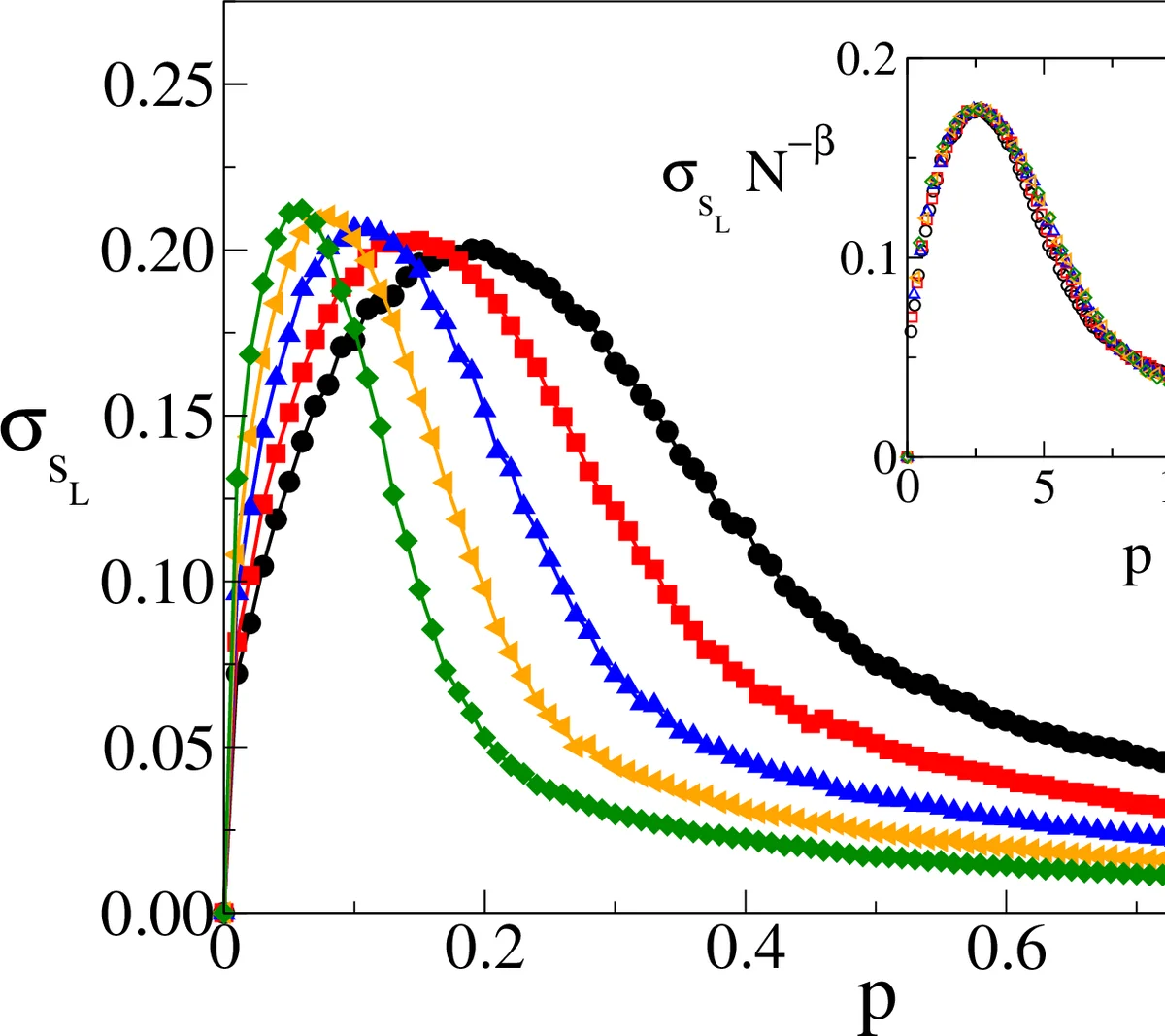
The key finding is that any non‑zero rewiring probability p eliminates the topological traps and drives the system to a fully ordered absorbing state (ρ = 0). However, the nature of the ordered state depends on p. For small p the system can end up either (i) in a single connected component where all edges share the same state, or (ii) in a fragmented network composed of two large disconnected components of roughly equal size, one component containing only A‑edges and the other only B‑edges. The authors quantify this by measuring (a) the probability P₁(p) that the final network is not fragmented, (b) the relative size s_L of the largest component, and (c) the fluctuations σ_{s_L}. As p increases, P₁ drops continuously from 1 (at p = 0) to values below 1/N beyond a critical rewiring rate p*; simultaneously s_L approaches 0.5, indicating symmetric fragmentation. For finite systems a bistable region 0 < p < p* exists where both outcomes are possible, but finite‑size scaling shows that the bistable window shrinks with system size and disappears in the thermodynamic limit. Consequently, for any p > 0 and sufficiently large N the only possible absorbing configuration is the fragmented one.
The authors also develop a mean‑field description of the order parameter ρ(t). In the regime of large p the mean‑field equations predict an exponential decay of ρ with a characteristic time that grows logarithmically with N, in agreement with simulations. For small p two distinct time scales are observed: a fast relaxation toward a partially ordered state, followed by a much slower coarsening driven by rare rewiring events that eventually either complete the ordering within a single component or cause the network to split.
Overall, the study demonstrates that coupling link‑state dynamics with adaptive topology generates a novel fragmentation transition absent in node‑centric models. Even a minimal amount of rewiring suffices to escape frozen or dynamically trapped configurations, but the competition between the speed of state propagation (1‑p) and the speed of topological adaptation (p) determines whether the system reaches global consensus or self‑organizes into two homogeneous communities. The results have direct relevance for social systems where the nature of an interaction (trust, friendship, language use) is the primary variable, suggesting that modest changes in the pattern of contacts can dramatically reshape the macroscopic structure of the network.
Comments & Academic Discussion
Loading comments...
Leave a Comment