The three-colour model with domain wall boundary conditions
We study the partition function for the three-colour model with domain wall boundary conditions. We express it in terms of certain special polynomials, which can be constructed recursively. Our method generalizes Kuperberg's proof of the alternating …
Authors: Hjalmar Rosengren
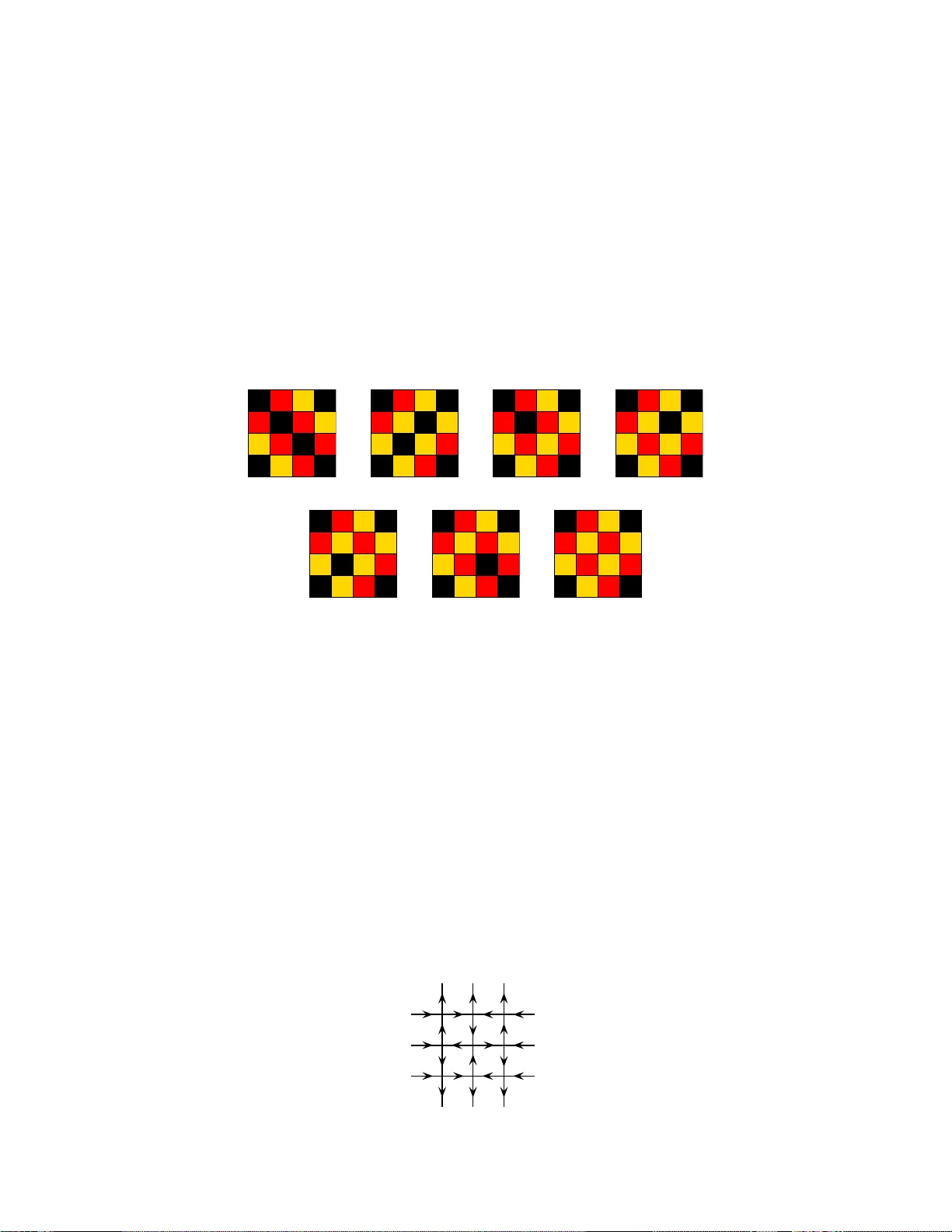
THE THREE-COLOUR MODEL WITH DOMAIN W ALL BOUND AR Y CONDITIONS HJALMAR ROSENGREN De dic ate d to De n nis Stanton on h is 60th birthday Abstract. W e study the partition function for the three-colour mo del with domain wall boundary conditions. W e exp ress it in terms of certain special p olynomials, whi ch can b e constructed recursive ly . Our method generalizes Kup erb erg’s proof of the alternating sign matrix theorem, replacing the six-ve rtex model used by Kuperb erg with the e ight - ve r tex-solid- on-solid mo del. As applications, we obtain some com bi natorial results on three-colourings. W e al s o conjec ture an explicit formula for the free energy of the mo del. 1. I ntro duction An alternating sign matrix is a square matrix with en tries 1, − 1 and 0, s uch that the non-zero en t r ies in eac h row and column alternate in sign and add up to 1. Mills, Robbins and Rumsey [MRR] conjectured that the n um b er of n × n alternating sign mat r ices is A n = 1!4!7! · · · (3 n − 2)! n !( n + 1) ! · · · (2 n − 1)! . (1.1) This conjecture w as prov ed b y Zeilb erger [Z1]. So on afterw ards, a m uc h sim- pler proof w as found by Kup erb erg [K], using the six - v ertex mo del o f statistical mec hanics. The six-v ertex mo del is an example of an i c e mo del , whose states can b e iden- tified with what we call ice graphs; see (2.2) b elo w. Alternating sign mat rices can b e identified with ice graphs satisfying domain wal l b oundary c onditions . F or the six-v ertex mo del, there is a closed form ula for the corr esp o nding partition function, the Izer gin–Kor epin determinant [I, ICK ]. Kup erb erg observ ed that in a sp ecial case, when all parameters of the mo del are cubic ro ots of unit y , the par- tition function simply coun ts t he n um b er of states. He could then prov e (1.1) by computing the cor r esp o nding limit of the determinan t. There is a nat ur a l tw o-parameter extension of the six-v ertex mo del kno wn as the eigh t- v ertex-solid-on-solid (8VSOS) mo del. This mo del was intro duced b y Baxter [B2] as a to ol for solving the eigh t-v ertex mo del. It is elliptic, that is, 2000 M athematics Subject Classific ation. 05A15, 33E05, 82B23. Key wor ds and phr ases. Three-colour mo del, eight-v ertex-solid-on-soli d mo del, domain wa ll b oundary condi- tions, partition f unction, alternating si gn matrix. Researc h supp orted by the Swedish Science Research Council (V ete nsk apsr ˚ adet). 1 2 HJALMAR ROSENGREN the Boltzmann weigh ts are elliptic functions of the parameters. W e stress that, in con tra st to the eigh t-v ertex mo del, the 8VSOS mo del is an ice mo del. In particular, for domain w all b oundary conditions, its states can b e iden tified with alternating sign mat r ices. It is na tural to ask what ha pp ens to the 8VSOS mo del under Kup erb erg’s sp ecialization of the par ameters. The a nswe r turns out to b e ve r y satisfactory: it degenerates to the thr e e-c olour mo del . It is an observ ation of Lenard that ice graphs are in bijection with three-colourings of a square lat t ice, such that adjacen t squares ha v e distinct colour [L]. The thr ee-colour mo del is defined b y assigning indep endent w eights to the t hr ee c olours; the partition function is simply the corresp onding generating function [B1 ]. Th us, one ma y hop e that extending Kup erb erg’s w ork to the 8VSOS mo del would lead to new applications of statistical mec hanics to combinatorics. That is precisely the ob ject of the presen t study . Apparen tly , the first step in t his program is to generalize the Izergin–Korepin form ula to the 8VSOS mo del. In a recen t paper [R] w e found suc h a generalizatio n. In the trigonometric limit (whic h is in termediate b et wee n the six-v ertex mo del and the general elliptic 8VSOS mo del), we used it to obta in a closed formula for a sp ecial case of the three-colour partition function, see (2.5). In the presen t pap er, w e consider the general case. Although there seems to b e no very simple form ula for the gene ral three-colour partition function, w e can express it in terms of certain sp ecial p olynomials, whic h ha ve remark able prop erties and deserv e further study . T o obtain these results ha s not b een straigh t-fo rw ard; in particular, w e hav e not b een a ble to w ork directly with the explicit form ulas fr om [R]. Rather, w e com bine a simple consequence of t hose form ulas with sev eral further ideas. The plan of the pap er is as follo ws. In § 2, we describ e the three-colour mo del with domain w all b oundary conditions, and its relation to ice g r a phs and alternat- ing sign ma t r ices. W e refer to t he states of the mo del as thr e e-c olour e d chessb o ar ds . In § 3, w e state our main results in elemen ta ry form. § 4 contains preliminaries o n theta functions a nd the 8 VSOS mo del. In § 5, we prov e our first main result, Theorem 3 .1 , which expresses the three-colour partition function Z 3 C n in terms of sp ecial p olynomials q n and r n . This is a rat her easy conseque nce o f r esults in [R]. W e t hen turn tow ards an alternativ e w ay of expressing Z 3 C n . In § 6, w e intro- duce a function Φ n , whic h pro vides a o ne-parameter extension of Z 3 C n . F or t he six-v ertex mo del, a similar f unction app ears in Zeilb erger’s pro of of the r efine d alternating sign matrix conjecture [Z 2]. In § 7, Φ n is generalized to a multiv ariable theta function Ψ n . T hese functions pla y a similar role as Sch ur p olynomials do in Stroganov’s pro of of the alternating sign matrix theorem [St] (see also [O]). Ho we v er, while t he Sc hur p olynomials are instances of the six-ve rtex partit ion function (with the crossing par a meter a cubic ro ot of unit y), the function Ψ n is not directly related to t he 8VSOS partition function. Th e function Ψ n has t wo imp ortant prop erties, the first b eing a determinan t formula reminiscen t of the Izergin–Korepin determinan t. The second prop ert y is a symmetry with respect to in v ersion of each v ariable, meaning that it naturally liv es on the Riemann sphere THREE-COLOUR MODEL WITH DOMAIN W ALL BOUND AR Y CONDITIONS 3 rather than t he tor us. As a consequence, Ψ n can b e iden tified with a symmetric p olynomial S n . In § 8, we sp ecialize the v ariables in S n , obtaining certain tw o- v ariable p olynomials P n and one-v ariable p olynomials p n . Using minor relat io ns for the determinan t defining Ψ n , w e obtain recursions fo r these p olynomials, whic h can b e used t o deriv e man y further prop erties. In § 9, we return to the three-colour mo del, expressing Z 3 C n in terms of the p olynomials p n . This result has com bina- torial consequences . F or instance, for three-coloured ch essboa rds of fixed size, we can compute the maximal and minimal p ossible num b er of squares of eac h colour, see Corolla ry 3.3 . Finally , in § 1 0 we study the thermo dynamic limit n → ∞ . Using non- rigorous argumen ts, w e are led to a n explicit formula for the free energy of the three- colour mo del with domain w all b o undary conditions ( Conjecture 3.14). F rom the viewpoint of ph ysics, this is t he main result of the pap er. T o prov e Conjecture 3 .14 rigorously is an in teresting problem, whic h we exp ect to b e rather difficult. F or the six-v ertex mo del with domain wall b oundary conditions, a rigorous analysis has b een done only recen tly [BF, BL1, BL2, BL3]. Note added in pro of: Immediately a f ter seeing an earlier v ersion of the presen t pap er, Vladimir Ba zhanov a nd Vladimir Mangazeev sen t me an intere sting conjectured recursion for the p olynomials p n . They hav e also o bta ined a similar conjecture for P n . These recursions give a m uch faster w ay of computing the three-colour par t ition function than those obtained in t he presen t pap er. Both conjectures can b e found in [BM4], where the authors stress the resem blance to p olynomials o ccurring in their analysis of the eigh t-v ertex mo del [BM1 , BM2, BM3]. It w o uld b e inte resting to in ves t ig ate if that relation can b e made precise; for instance, that ma y giv e a link b etw een the presen t w ork and the P a inlev´ e VI equation. Ac knowledgem en ts: This w ork w as partly carried out while participating in the programme Discrete In tegr a ble Systems at the Isaac Newton Institute for Mathematical Sciences , and I thank the institute and the prog r amme organizers for their supp ort. I would a lso lik e to thank Vladimir Bazhano v, Vladimir Mangazeev, Jacques P erk and, in particular, Don Zagier for their in terest and for v aluable commen ts and suggestions. Finally , I t ha nk the a non ymous r eferees for useful commen ts. 2. Three-coloured chessb o ards W e will refer to a state of the three-colo ur mo del with domain w all b oundary conditions as a thr e e-c olour e d chessb o ar d . Fixing n , consider a c hessb oard of size ( n + 1) × ( n + 1). The squares will b e lab elled with three colours, whic h w e iden tify with the three residue classes 0 , 1 , 2 mo d 3 . W e imp ose the following tw o rules. First, ve rtically or horizon tally adjacen t squares ha ve distinct colours. Second, the north- w est and south- east squares are lab elled 0 a nd, as one pro ceeds aw a y from these squares along the b oundary , the colo urs increase with resp ect to the 4 HJALMAR ROSENGREN cyclic order 0 < 1 < 2 < 0 . (2.1) In particular, the north- east a nd south-w est square are la b elled n mo d 3. As an example, when n = 3 there are sev en three-coloured c hessboa rds; these are displa y ed in F igure 1. Figure 1. T he sev en three-coloured c hess bo ards of size n = 3, wher e 0 is pictured as bla ck, 1 as red a nd 2 as yello w. W e will briefly explain the bijections to a lt ernat ing sign matrices and ice graphs men tioned in the in t ro duction. Let ( a b c d ) b e a 2 × 2-blo ck of adja cen t squares from a three-coloured c hessb oard, and c ho ose represen ta tiv es of the residue classes so that adjacen t lab els differ by exactly 1. F or instance, if the original blo c k is ( 0 2 2 1 ), w e may choose t he represen tatives ( 3 2 2 1 ). Ha ving made suc h a c hoice, w e contract eac h blo c k to the n um b er ( b + c − a − d ) / 2, obtaining an n × n -matrix with entries − 1 , 0 , 1. F or instance, fro m the la st che ssbo ard in ( ?? ) we obtain 0 1 0 1 − 1 1 0 1 0 . This giv es a bij ection from three-coloured c hessboa r ds to a lt ernating sign matrices. T o obtain the bijection to ice g raphs, w e draw an arrow b et w een an y tw o a dja- cen t squares in suc h a w ay that the larger lab el, with resp ect to the order (2.1 ) , is to the right. F or instance, the last che ssb o a rd in ( ?? ) corresp o nds to the arrow configuration . (2.2) THREE-COLOUR MODEL WITH DOMAIN W ALL BOUND AR Y CONDITIONS 5 The result is a directed graph, where eac h internal v ertex has t wo incoming a nd t wo outgoing edges. Considering v ertices as o xygen ato ms and incoming edges as h ydrogen b onds, this can b e view ed as a mo del for a t wo-dimens ional sheet of ice. W e are in t erested in the generating function Z 3C n ( t 0 , t 1 , t 2 ) = X c hessb oards Y squares t colour = X k 0 + k 1 + k 2 =( n +1) 2 N ( k 0 , k 1 , k 2 ) t k 0 0 t k 1 1 t k 2 2 , (2.3) where N ( k 0 , k 1 , k 2 ) denotes the num b er of three-coloured c hessb oards with exactly k i squares of colour i . In ph ysics terminology , Z 3C n is the p artition function of the three-colour mo del with domain w all b oundar y conditions. It is difficult to study Z 3C n b y direct metho ds. Indeed, to compute Z 3C n (1 , 1 , 1) = A n w as an unsolv ed problem for more than a decade. In [R], we generalized that en umeration using the trigo no metric 8VSOS mo del. Namely , we found a closed expression f or Z 3C n ( t 0 , t 1 , t 2 ) when ( t 0 t 1 + t 0 t 2 + t 1 t 2 ) 3 ( t 0 t 1 t 2 ) 2 = 27 . (2.4) This surface can b e parametrized b y t i ( λ, µ ) = µ/ (1 − λω i ) 3 , where, as througho ut the pap er, ω = e 2 π i/ 3 . By homogeneity , w e ma y tak e µ = 1. Then [R, Cor. 8.4], Z 3C n 1 (1 − λ ) 3 , 1 (1 − λω ) 3 , 1 (1 − λω 2 ) 3 = (1 − λω 2 ) 2 (1 − λω n +1 ) 2 (1 − λ 3 ) n 2 +2 n +3 A n (1 + ω n λ 2 ) + ( − 1) n C n ω 2 n λ , (2.5) where A n is as in (1.1 ) a nd C n = 2 · 5 · · · (3 n − 1) 1 · 4 · · · (3 n − 2) A n (2.6) is the nu m b er of cyclically symmetric plane par titions in a cub e of size n [A]. Although (2.4) is a strong restriction, it is sufficien t for computing the momen ts X k 0 + k 1 + k 2 =( n +1) 2 N ( k 0 , k 1 , k 2 ) k i , i = 0 , 1 , 2 , see [R, Cor. 8.5]. 6 HJALMAR ROSENGREN 3. St a tement of resul ts 3.1. Polynom ials q n and r n . In this Section, w e state our main r esults. W e b egin with the fo llo wing fact. As w e will see in § 5, it is a rat her straigh t-f o rw ard consequenc e of results in [R]. Theorem 3.1. L et T = T ( t 0 , t 1 , t 2 ) = ( t 0 t 1 + t 0 t 2 + t 1 t 2 ) 3 ( t 0 t 1 t 2 ) 2 . (3.1) Then, ther e exist p olynomials q n and r n such that, for n ≡ 0 mo d 3 , Z 3 C n ( t 0 , t 1 , t 2 ) e quals ( − 1) n +1 ( t 0 t 1 t 2 ) n ( n +2) 3 ( t 0 t 1 + t 0 t 2 + t 1 t 2 ) 2 t 0 t 1 t 2 q n ( T ) − 2 χ ( n odd) t 0 r n ( T ) , while for n ≡ 1 mo d 3 it e quals ( − 1) n +1 ( t 0 t 1 t 2 ) n ( n +2) 3 t 0 t 1 t 2 q n ( T ) − 2 χ ( n o dd) t 0 t 1 + t 0 t 2 + t 1 t 2 t 2 r n ( T ) and for n ≡ 2 mo d 3 it e quals ( − 1) n +1 ( t 0 t 1 t 2 ) ( n +1) 2 3 q n ( T ) − 2 χ ( n odd) t 0 t 1 + t 0 t 2 + t 1 t 2 t 0 t 2 r n ( T ) . Her e, χ (true) = 1 , χ ( f alse) = 0 . The first few instances o f the p olynomials q n and r n are giv en in T able 1. Note tha t , in eac h case, Z 3 C n is symme tric in the tw o v ariables t − n ± 1 mo d 3 . This is explained by the fact t ha t reflection in the v ertical (say) axis, follo w ed b y in- terc hanging the colours − n ± 1 mo d 3 , defines an in volution on three-coloured c hessb oards. Theorem 3.1 sho ws that Z 3 C n is v ery nearly symmetric in all three v ariables, b eing a linear comb ination of tw o symmetric p olynomials, where the co efficien ts a r e p olynomials in t − n mo d 3 of low order. Moreov er, the symmetric p olynomials dep end only on the second and third elemen tary symmetric p o ly- nomial, b eing indep enden t o f t 0 + t 1 + t 2 . T able 1. The p olynomials q n and r n . n q n ( x ) r n ( x ) 0 0 1 1 1 0 2 1 1 3 1 1 4 x + 3 x − 3 5 x 2 − 4 x + 6 x + 6 6 x 2 − 2 x + 40 x 3 − 8 x 2 + 20 7 x 4 − 10 x 3 + 15 x 2 + 100 x + 5 0 x 3 + 75 x − 5 0 THREE-COLOUR MODEL WITH DOMAIN W ALL BOUND AR Y CONDITIONS 7 The following result seems m uch deep er tha n Theorem 3.1. W e need consider- able preparat io n fo r its pro of, whic h is giv en in § 9.2 . Theorem 3.2. The p olynomials q n and r n ar e mon ic. Mor e over, their de gr e e s ar e given by deg( q n ) + 1 = deg( r n ) = n 2 12 , n ≡ 0 mo d 6 , deg( q n ) = deg ( r n ) + 1 = n 2 − 1 12 , n ≡ ± 1 mo d 6 , deg( q n ) = deg ( r n ) = n 2 − 4 12 , n ≡ ± 2 mo d 6 , deg( q n ) = deg ( r n ) = n 2 − 9 12 , n ≡ 3 mo d 6 . As a n application, we can determine the maximal and minimal n umber o f squares of eac h colour. These b o unds restrict the coun ting function N introduced in (2.3) to a n equilateral triang le. W e can also explicitly ev aluate the restriction of N to the b oundary . T o formulate the result, we introduce some nota tion. Fixing n , let ¯ N ( x, y , z ) = N ( x, y , z ) , n ≡ 0 mo d 3 , N ( y , z , x ) , n ≡ 1 mo d 3 , N ( z , x, y ) , n ≡ 2 mo d 3 , so that ¯ N ( x, y , z ) = ¯ N ( x, z , y ). Moreov er, let M = 5 n 2 + 8 n + 11 12 = (5 n 2 + 8 n ) / 12 , n ≡ 0 , 2 mo d 6 , (5 n 2 + 8 n + 11 ) / 12 , n ≡ 1 mo d 6 , (5 n 2 + 8 n + 3) / 12 , n ≡ 3 , 5 mo d 6 , (5 n 2 + 8 n + 8) / 12 , n ≡ 4 mo d 6 , m = ( n 2 + 4 n ) / 6 , n ≡ 0 , 2 mo d 6 , ( n 2 + 4 n + 7) / 6 , n ≡ 1 mo d 6 , ( n 2 + 4 n + 3) / 6 , n ≡ 3 , 5 mo d 6 , ( n 2 + 4 n + 4) / 6 , n ≡ 4 mo d 6 , ε = 1 , n ≡ 0 , 2 mo d 6 , − 2 , n ≡ 1 mo d 6 , 0 , n ≡ 3 , 5 mo d 6 , − 1 , n ≡ 4 mo d 6 , δ = n 2 4 = ( ( n 2 − 1) / 4 , n o dd , n 2 / 4 , n ev en . (3.2) 8 HJALMAR ROSENGREN Note tha t 2 M + m + ε = ( n + 1) 2 . Let ∆ = { ( x, y , z ) ∈ Z 3 ; x + y + z = ( n + 1) 2 , x ≤ M + ε, y , z ≤ M } . Then, ∆ is an equilateral triangle, with δ lat t ice p o in ts on each side. W e denote its corners by P = ( m + ε, M , M ) , Q = ( M + ε, m, M ) , R = ( M + ε, M , m ) . Corollary 3.3. The c onvex hul l of the supp ort of ¯ N is e qual to ∆ when n is o dd and ∆ \ { P } when n is even. In p a rticular, the maximal numb er of squar es of e ach of the c olours − n ± 1 mo d 3 is e qual to M , and the minimal numb er of such squar es is m . T h e maximal numb er of sq uar es of c olour − n mo d 3 is M + ε , and the minimal n umb er is m + ε if n is o dd and m + ε + 1 if n is even. Mor e over, the r estriction of ¯ N to ∂ ∆ is give n by ¯ N k P + ( δ − k ) Q δ = ¯ N k P + ( δ − k ) R δ = δ − 1 k , n ev en , δ k , n o dd , ¯ N k Q + ( δ − k ) R δ = δ k , n ev en , δ − 2 k + δ − 2 k − 2 , n o dd , wher e 0 ≤ k ≤ δ . It is straight-forw ard to deriv e Corollary 3.3 from Theorem 3.2; some details are giv en in § 9.2. As w e explain at the end of § 5, it follow s easily from Theorem 3.1 that the p olynomials q n , r 2 n and 2 r 2 n +1 ha ve integer co efficien ts. Ho w ev er, the follow ing fact is not ob vious, see § 9.3. Prop osition 3.4. The p olynomial r 2 n +1 has inte ger c o efficients. This result ha s a simple combinatorial meaning. If n ≡ 3 or 5 mo d 6, Theo- rem 3.1 expresses Z 3 C n as a sum of a symme t r ic p olynomial and a p olynomial with ev en co efficien ts. Th us, the function ( k 0 , k 1 , k 2 ) 7→ N ( k 0 , k 1 , k 2 ) mo d 2 is symmetric. Similarly , when n ≡ 1 mo d 6, ( k 0 , k 1 , k 2 ) 7→ N ( k 0 , k 1 , k 2 − 2) mo d 2 is symmetric. In the nota t io n o f Corollary 3.3, these facts can b e stated as fo llows. Corollary 3.5. When n is o dd, ¯ N mod 2 is invariant under the action of S 3 as the symme try gr oup of ∆ . THREE-COLOUR MODEL WITH DOMAIN W ALL BOUND AR Y CONDITIONS 9 T o illustrate Corollaries 3.3 and 3 .5, w e giv e tw o examples. When n = 4, the non-zero v alues of N are N (6 + i, 6 + j, 13 − i − j ) 4 i,j =0 = 1 4 3 6 6 3 4 6 1 1 3 3 1 . Since n is ev en, the lo w er right corner is missing fr o m the supp ort of N , and all b oundary en tries are binomial co efficien ts. When n = 5, the no n- zero v alues a re N (8 + i, 20 − i − j, 8 + j ) 6 i,j =0 = 1 4 6 7 18 15 8 12 36 2 0 7 12 36 40 1 5 4 18 36 40 24 6 1 6 15 20 15 6 1 . In this case, the diagonal en t ries are n umbers o f the fo rm 4 k + 4 k − 2 . Note the symmetric distribution of the o dd en tries, whic h is p eculiar to the case of o dd n . 3.2. Polynom ials p n and P n . The p olynomials q n and r n are closely related to a third class of p olynomials, whic h w e denote p n . In t he following result, whic h is pro ved in § 9.2, w e use the nota tion ˜ p ( x ) = x deg p p (1 /x ); (3.3) that is, ˜ p denotes the p olynomial obtained from p by rev ersing the co efficien ts. Theorem 3.6. Ther e exist p olynomials p n of de gr e e n ( n + 1 ) / 2 such that, for n o dd, p n − 1 ( ζ ) − ζ n +1 2 ˜ p n − 1 ( ζ ) = (1 − ζ )( ζ 2 + 4 ζ + 1) n 2 − 1 4 ˜ q n ζ ( ζ + 1) 4 2( ζ 2 + 4 ζ + 1) 3 , p n − 1 ( ζ ) − ζ n − 1 2 ˜ p n − 1 ( ζ ) = (1 − ζ )(1 + ζ ) 3 ( ζ 2 + 4 ζ + 1) n 2 − 9 4 ˜ r n ζ ( ζ + 1) 4 2( ζ 2 + 4 ζ + 1) 3 , wher e as for n even, p n − 1 ( ζ ) − ζ n +2 2 ˜ p n − 1 ( ζ ) = (1 − ζ )( ζ 2 + 4 ζ + 1) n 2 4 ˜ r n ζ ( ζ + 1) 4 2( ζ 2 + 4 ζ + 1) 3 , p n − 1 ( ζ ) − ζ n 2 ˜ p n − 1 ( ζ ) = (1 − ζ 2 )( ζ 2 + 4 ζ + 1) n 2 − 4 4 ˜ q n ζ ( ζ + 1) 4 2( ζ 2 + 4 ζ + 1) 3 . 10 HJALMAR ROSENGREN T able 2. The p olynomials p n . n p n ( ζ ) − 1 1 0 1 1 3 ζ + 1 2 5 ζ 3 + 15 ζ 2 + 7 ζ + 1 3 1 2 (35 ζ 6 + 231 ζ 5 + 504 ζ 4 + 398 ζ 3 + 147 ζ 2 + 27 ζ + 2 ) 4 1 2 (63 ζ 10 + 798 ζ 9 + 4122 ζ 8 + 11052 ζ 7 + 16310 ζ 6 + 13464 ζ 5 + 6636 ζ 4 +2036 ζ 3 + 387 ζ 2 + 42 ζ + 2) 5 1 2 (231 ζ 15 + 4554 ζ 14 + 39468 ζ 13 + 196922 ζ 12 + 622677 ζ 11 + 129844 6 ζ 10 +1816006 ζ 9 + 172630 2 ζ 8 + 114059 3 ζ 7 + 535478 ζ 6 + 181104 ζ 5 +44134 ζ 4 + 7603 ζ 3 + 882 ζ 2 + 62 ζ + 2) 6 1 8 (1716 ζ 21 + 50193 ζ 20 + 673530 ζ 19 + 548405 0 ζ 18 + 301992 60 ζ 17 +1187032 0 8 ζ 16 + 342834 244 ζ 15 + 738954 900 ζ 14 + 119855 6100 ζ 13 +1470762 9 70 ζ 12 + 137362 3128 ζ 11 + 984509 064 ζ 10 + 546520 100 ζ 9 +2368374 0 0 ζ 8 + 804763 80 ζ 7 + 214221 88 ζ 6 + 443090 4 ζ 5 + 699405 ζ 4 +81550 ζ 3 + 6630 ζ 2 + 336 ζ + 8) The shift in n is in tro duced for conv enience. See T a ble 2 for the first few instances of the p olynomials p n . T o indicate the meaning of Theorem 3.6, w e solv e f o r p n , obt a ining for n eve n p n ( ζ ) = ( ζ 2 + 4 ζ + 1) n ( n +2) 4 ˜ q n +1 ζ ( ζ + 1) 4 2( ζ 2 + 4 ζ + 1) 3 − ζ (1 + ζ ) 3 ( ζ 2 + 4 ζ + 1) ( n − 2)( n +4) 4 ˜ r n +1 ζ ( ζ + 1) 4 2( ζ 2 + 4 ζ + 1) 3 ! (3.4) and f o r n o dd p n ( ζ ) = ( ζ 2 + 4 ζ + 1) ( n +1) 2 4 ˜ r n +1 ζ ( ζ + 1) 4 2( ζ 2 + 4 ζ + 1) 3 − ζ (1 + ζ )( ζ 2 + 4 ζ + 1) ( n − 1)( n +3) 4 ˜ q n +1 ζ ( ζ + 1) 4 2( ζ 2 + 4 ζ + 1) 3 ! . A priori, the righ t- hand sides are p olynomials o f degree n ( n + 2) / 2, ( n + 1) 2 / 2, resp ectiv ely . The degree b ound n ( n + 1) / 2 imp oses relations b et we en high co effi- cien ts of the p olynomials q n and r n . In the notation o f Corollary 3.3, this implies relations b etw een v alues of ¯ N close to the b oundary ∂ ∆; the details will no t b e w orke d out here. An imp ortant prop ert y o f the p olynomials p n is that they a pp ear as solutions to certain linear equations. THREE-COLOUR MODEL WITH DOMAIN W ALL BOUND AR Y CONDITIONS 11 Theorem 3.7. Consider the p olynomial e quation AX − B Y = C , (3.5) wher e A = ( ζ + 1) 2 p n − 1 ( ζ ) , B = ζ n +1 ˜ p n ( ζ ) , C = (1 + 2 ζ ) 1+ χ ( n ev en ) 1 + ζ 2 1+ χ ( n odd ) p n ( ζ ) 2 . Then, this e quation has a solution ( X , Y ) such that X = p n +1 and deg Y = deg A . Theorem 3.7 f o llo ws from Prop osition 8.3 and Corollary 8.10. Although we ha ve not b een able to pr ov e it, w e b eliev e that the p olynomials A and B are alw ays relativ ely prime. In fact, w e b eliev e that p n is irreducible ov er Q for n ≥ 2. Assuming that this is the case, (3.5) has a unique solution ( X 0 , Y 0 ) with deg Y 0 < deg A . The solutions with deg Y ≤ deg A then ha ve the form ( X , Y ) = ( X 0 + λB , Y 0 + λA ), λ ∈ C . W e can sp ecify the solution X = p n +1 in this space b y declaring that the leading term is 2 − [ n +2 2 ] 2 n + 2 n + 1 ζ n ( n +1) / 2 , see Prop osition 8.9. Then, Theorem 3.7 giv es a recursiv e pro cedure for construct- ing the p olynomials p n . This giv es a comparative ly fast metho d for computing the partitio n function Z 3 C n . (As was men tioned at the end of the Intro duction, a m uc h faster metho d has b een suggested by Bazhano v and Mangazeev [BM4 ].) The p olynomials p n ha ve co efficien ts in Z / 2 Z ; see Corollary 9.8 for a more precise statemen t. Mor eov er, the following f acts seem to b e t rue. Conjecture 3.8. The p olynomial s p n have p ositive c o efficients. Conjecture 3.9. The p olynomial s p n ar e unimo dal in the sense that, if p n ( ζ ) = n ( n +1) / 2 X k =0 a k ζ k , then, fo r som e N , a 0 < a 1 < · · · < a N − 1 < a N > a N +1 > · · · > a n ( n +1) / 2 . Using Theorem 3.7, w e hav e v erified Conjectures 3 .8 and 3.9 up to n = 1 6 . F or these v alues, the maximal co efficien t a N o ccurs at N = n ( n + 2) / 4 , n eve n , n ≤ 16 ( n + 1) 2 / 4 , n o dd , n ≤ 7 ( n − 1)( n + 3) / 4 , n o dd , 9 ≤ n ≤ 15 . Numerical experiments suggest that the zero es o f p n form quite remark able patterns, see F igure 2. W e hav e some partial results on the real zero es, see § 8.4 fo r pro o fs. 12 HJALMAR ROSENGREN Figure 2. The 105 co mplex zer o es of p 14 . Conjecture 3.10. The p olynomial p n has exactly [( n + 1) / 2] r e a l zer o es. Conjecture 3.11. T h e p olynomial p n do es n o t vani s h in the interval − 2 < ζ < − 1 / 2 . Prop osition 3.12. Assume Conjecture 3.10 . Then, al l r e al zer o es of p n ( ζ ) ar e simple, a n d c ontaine d in the interval − 1 / 2 < ζ < 0 if n is o dd and in ζ < − 2 if n is even. Mor e over, the r e al zer o es of p 2 n interlac e the r e al zer o es o f ˜ p 2 n +1 , which in turn alterna te left of the r e al zer o es of p 2 n +2 . I n p articular, Conjecture 3.10 implies Conjecture 3.11 . The p olynomials p n can b e em b edded in a more general family of p olynomials P n ( x, ζ ), whic h are of degree n in x a nd degree [ n ( n + 2) / 2] in ζ . T o b e precise, P n (1 + 2 ζ , ζ ) = (1 + 2 ζ ) [ n 2 ] p n ( ζ ) . W e giv e the first few instances of P n in T able 3. The p olynomials P n satisfy a three-term recursion of the f orm A n P n +1 = B n P n + C n P n − 1 , where A n = A n ( x, ζ ) and C n = C n ( x, ζ ) are quadratic p olynomials in x , while B n = B n ( x, ζ ) is cubic in x , see Prop osition 8.6. This is reminiscen t of the recursion satisfied b y o rthogonal p olynomials (where A n and C n are constants and B n is linear). It also seems that P n resem ble orthogonal p o lynomials with resp ect to their zero es. Indeed, the following fact is pro v ed in § 8.4. Prop osition 3.13. Assume Conjecture 3.11 (or, in view of Prop osition 3 .1 2 , Conjecture 3 .10 ). Then, if − 2 < ζ < − 1 / 2 and ζ 6 = − 1 , al l ze r o es of P n ( x, ζ ) ar e simple and p ositive. Mor e over, the zer o es of P n +1 interlac e those of P n . THREE-COLOUR MODEL WITH DOMAIN W ALL BOUND AR Y CONDITIONS 13 T able 3. The p olynomials P n . n P n ( x, ζ ) 0 1 1 x + ζ 2 1 2 ( ζ + 2)(3 ζ + 1) x 2 + ζ ( ζ + 3)(3 ζ + 1) x + ζ 2 ( ζ + 3 )(2 ζ + 1) 3 1 2 ( ζ + 2)(5 ζ 3 + 15 ζ 2 + 7 ζ + 1) x 3 + ζ ( ζ + 4)(5 ζ 3 + 15 ζ 2 + 7 ζ + 1) x 2 + ζ 2 (4 ζ + 1)( ζ 3 + 7 ζ 2 + 15 ζ + 5 ) x + ζ 3 (2 ζ + 1)( ζ 3 + 7 ζ 2 + 15 ζ + 5) 4 1 8 ( ζ + 2) 2 (35 ζ 6 + 231 ζ 5 + 504 ζ 4 + 398 ζ 3 + 147 ζ 2 + 27 ζ + 2) x 4 + ζ ( ζ + 5)( ζ + 2)(35 ζ 6 + 231 ζ 5 + 504 ζ 4 + 398 ζ 3 + 147 ζ 2 + 27 ζ + 2 ) x 3 +3 ζ 2 (10 ζ 8 + 139 ζ 7 + 790 ζ 6 + 2245 ζ 5 +3232 ζ 4 + 2245 ζ 3 + 790 ζ 2 + 139 ζ + 10) x 2 + ζ 3 (2 ζ + 1)(5 ζ + 1)( 2 ζ 6 + 27 ζ 5 + 147 ζ 4 + 398 ζ 3 + 504 ζ 2 + 231 ζ + 35) x + ζ 4 (2 ζ + 1) 2 (2 ζ 6 + 27 ζ 5 + 147 ζ 4 + 398 ζ 3 + 504 ζ 2 + 231 ζ + 35) Computer calculations suggest that, if − 2 < ζ < − 1, the zero es are in fact con tained in the interv al x > 1, while if − 1 < ζ < − 1 / 2, they are containe d in 0 < x < 1. 3.3. Symmetric p olynomials S n . The k ey to the pro of of most our results is that the p olynomials P n and p n can b e obtained as sp ecializations of certain symmetric p olynomials S n of 2 n + 1 v ariables. T o define them, w e in tro duce t he elemen tary p olynomials f ( x ) = ( ζ + 2) x − ζ , g ( x ) = ( x − 1)( x − ζ ) , h ( x ) = x 2 ( x − (2 ζ + 1)) , (3.6) and then let F ( x, y , z ) = 1 ( y − x )( z − x )( z − y ) det f ( x ) f ( y ) f ( z ) g ( x ) g ( y ) g ( z ) h ( x ) h ( y ) h ( z ) = ( ζ + 2 ) xy z − ζ ( xy + y z + xz + x + y + z ) + ζ (2 ζ + 1) , (3.7) G ( x, y ) = 1 y − x det f ( x ) f ( y ) h ( x ) h ( y ) = ( ζ + 2) xy ( x + y ) − ζ ( x 2 + y 2 ) − 2( ζ 2 + 3 ζ + 1) xy + ζ (2 ζ + 1)( x + y ) . (3.8) In this not a tion, S n ( x 1 , . . . , x n , y 1 , . . . , y n , z ) = Q n i,j =1 G ( x i , y j ) Q 1 ≤ i [( n + 1) / 2] , f n k ( ζ ) is divisible by ( ζ + 2) k − [ n +1 2 ] . Mor e over, f n n ( ζ ) = 1 + ζ 2 [ n 2 ] p n − 1 ( ζ ) , (8.15 a) f n n − 1 ( ζ ) = 1 2 1 + ζ 2 [ n 2 ] − 1 ( ζ + n + 1) p n − 1 ( ζ ) . (8.15b) F urther results follow by applying (8.14) to t he other statemen ts. In particular, from (8.15a) w e obtain P n (0 , ζ ) = ζ n 2 ζ + 1 2 [ n 2 ] ˜ p n − 1 ( ζ ) . (8.16) Pr o of. F rom the pro of o f Prop o sition 8.1, and a lso fr o m Prop osition 8.6, it is clear that P n ( x, ζ ) is of degree at most n in x , so w e can write it as in (8.12), where a priori f n k ( ζ ) ζ n − k is a p olynomial. T o show that f n k is a p olynomial, w e consider the function F n ( x ) = lim ζ → 0 P n ( ζ x, ζ ) ζ n = n X k =0 lim ζ → 0 f n k ( ζ ) x k . W e will prov e b y induction tha t the limit exists a nd equals F n ( x ) = n X k =0 n + k k x n − k 2 k = x n 2 F 1 − n, n + 1 − n ; 1 2 x , (8.17) in standard h yp ergeometric notation. T o this end, w e divide ( 8 .11) b y ζ 2 n and then let ζ → 0. W e need t ha t, by (8.5a) a nd Corollary 8.4, P n (1 , 0) = p n (0) = 1 , and we also write lim ζ → 0 P n ( ζ / ( ζ + 2) , ζ ) ζ n = F n (1 / 2) . Then, the resulting iden tit y simplifies t o x − 1 2 F n − 1 (1 / 2) F n +1 ( x ) = x 2 F n − 1 (1 / 2) + x − 1 2 F n (1 / 2) F n ( x ) − x 2 F n (1 / 2) F n − 1 ( x ) . W e m ust sho w that this r ecursion is solv ed by (8.17). Equiv alen tly , since F n (1 / 2) = 1 2 n 2 F 1 − n, n + 1 − n ; 1 = 1 2 n +1 2 n + 2 n + 1 , THREE-COLOUR MODEL WITH DOMAIN W ALL BOUND AR Y CONDITIONS 45 w e need to c hec k that x − 1 2 F n +1 ( x ) = x 2 + 2 n + 1 n + 1 x − 1 2 F n ( x ) − 2 n + 1 n + 1 x 2 F n − 1 ( x ) , whic h can b e done b y a straigh t -forw a rd computat io n. The equation (8.17) sho ws t ha t f n k is a p o lynomial, with f n n − k (0) = 1 2 k n + k n . (8.18) It fo llo ws from (8.4), using also (8.2), that f n k ( ζ ) = ζ 2 δ n f n n − k (1 /ζ ) . T ogether with ( 8 .18), this prov es that f n k has degree 2 δ n , as w ell as (8.13) and (8.14). The statement on divisibility by p ow ers of ζ + 2 is equiv alent to say ing that lim ζ →− 2 ( ζ + 2 ) [ n +1 2 ] P n ζ x ζ + 2 , ζ exists finitely . This is a consequence of (8.3a ) and Theorem 7.17. T o prov e (8 .15), we pic k out the co efficien t s of x n +3 and x n +2 on b oth sides o f (8.11). On the right, neither C n nor the second of the t w o terms in B n con tribute. Using (8.5) and simplifying, w e find that p n − 1 ( ζ ) x 2 − ζ ζ + 2 + 2 ζ + 1 x f n +1 n +1 ( ζ ) x n +1 + ζ f n +1 n ( ζ ) x n = 1 + ζ 2 χ ( n odd) p n ( ζ ) x 2 ( x − 2 ζ − 1) f n n ( ζ ) x n + ζ f n n − 1 ( ζ ) x n − 1 + · · · , where the ellipsis denotes terms of o r der at most n + 1 in x . Pick ing out t he top co efficien t giv es the recursion p n − 1 ( ζ ) f n +1 n +1 ( ζ ) = 1 + ζ 2 χ ( n odd ) p n ( ζ ) f n n ( ζ ) , whic h is solv ed b y ( 8 .15a). Pic king out the next co efficien t then yields p n − 1 ( ζ ) f n +1 n ( ζ ) = 1 + ζ 2 χ ( n o dd) p n ( ζ ) f n n − 1 ( ζ ) + 1 2 1 + ζ 2 n − 1 2 p n − 1 ( ζ ) p n ( ζ ) , whic h is solv ed b y ( 8 .15b). F or the formu lation of the next r esult, it is conv enien t to intro duce the p oly- nomials φ n ( x ) = 2 F 1 − n/ 2 , − ( n − 1) / 2 n + 3 / 2 ; x , ψ n ( x ) = 3 F 2 − n/ 2 , − ( n + 1) / 2 , ( n + 5) / 4 n + 3 / 2 , ( n + 1) / 4 ; x 46 HJALMAR ROSENGREN of degree [ n/ 2], [( n + 1) / 2], resp ectiv ely . W e will need the identitie s (3 x + 1) ψ n ( x ) = 3(3 n + 1)(3 n + 4) (2 n + 1)(2 n + 3) xφ n +1 ( x ) + ( x − 1) 2 φ n − 1 ( x ) , (8.19) (3 x + 1 ) 2 φ n ( x ) = 3(3 n + 2)(3 n + 5) (2 n + 1)(2 n + 3) xψ n +1 ( x ) + ( x − 1 ) 2 ψ n − 1 ( x ) , (8.20) 3(3 n + 2)(3 n + 4) (2 n + 1)(2 n + 3) xφ n +1 ( x ) = (9 x − 1) φ n ( x ) + ( x − 1 ) 2 φ n − 1 ( x ) , (8.21) whic h are straight-forw ard to ve rify . Prop osition 8.8. F or sp e cial values of ζ , P n ( x, ζ ) may b e expr esse d as P n ( x, 0) = x n , (8.22) P n ( x, − 1) = ( − 1) χ ( n ≡ 2 mod 4) 2 δ n − 1 ( x − 1) n , (8.23) P n ( x, 1) = 2 δ n − 1 − n 3 [ n 2 ] A n +1 (1 + x ) n φ n (3 x − 1)( x − 3) 3(1 + x ) 2 , (8.24) P n ( x, − 2) = ( − 3 / 4) n 2 A n +1 (1 − x ) n 2 φ n x + 3 3(1 − x ) , n even , − 2 − n − 1 3 n − 1 2 C n +1 (1 − x ) n +1 2 ψ n x + 3 3(1 − x ) , n o dd . (8.25) Applying (8.4) to (8 .25) one may also ev aluate P n ( x, − 1 / 2 ). Pr o of. The identit y ( 8 .22) fo llows from (8.1 2 ) and (8.18). If we let ζ = − 1 in (8.11), w e o btain after simplification ( − 1) χ ( n even) 2 χ ( n odd) P n − 1 ( − 1 , − 1) P n +1 ( x, − 1) = ( x − 1) P n ( − 1 , − 1) P n ( x, − 1) . It is easy to c heck tha t this is solv ed by (8 .23), using (8.1) t o simplify the exp onen t of 2. Similarly , if w e let ζ = − 1 in (8 .11) and substitute (8.24), w e are reduced to the recursion (8.2 1 ). F or this computation, it is useful to note that A n A n +2 A 2 n +1 = 3(3 n + 2)(3 n + 4 ) 4(2 n + 1)(2 n + 3 ) and tha t y = (3 x − 1)( x − 3) 3(1 + x ) 2 = ⇒ y − 1 = − 16 x 3( x + 1 ) 2 , 9 y − 1 = 8( x 2 − 4 x + 1) ( x + 1) 2 . T o pro ve (8.25), w e multiply (8 .1 1) by (1 + ζ / 2) [ n +1 2 ] and then let ζ → − 2. This giv es ( − 3) χ ( n ev en ) ( x + 3) X n − 1 P n − 1 ( − 3 , − 2) P n +1 ( x, − 2) = X n − 9 P n − 1 ( − 3 , − 2) P n ( x, − 2) + x 2 P n ( − 3 , − 2) P n − 1 ( x, − 2) , (8.26) THREE-COLOUR MODEL WITH DOMAIN W ALL BOUND AR Y CONDITIONS 47 where X n = lim ζ →− 2 1 + ζ 2 [ n +1 2 ] P n ζ ζ + 2 , ζ . It fo llo ws from (8.3a) and Corollary 7.20 that X n = ( ( − 1) n 2 2 − 1 C n +1 , n ev en , − 2 − 1 A n +1 , n o dd . (8.27) It is now straigh t-fo rw ard to che ck that substituting (8.25) in ( 8.26) yields (8.19) when n is o dd a nd (8.2 0) when n is ev en. F or this computation, one needs the iden tities A n +2 C n A n +1 C n +1 = 3(3 n + 1)(3 n + 4) 4(2 n + 1)(2 n + 3) , A n C n +2 A n +1 C n +1 = 3(3 n + 2)(3 n + 5) 4(2 n + 1)(2 n + 3) , and a lso that, z = x + 3 3(1 − x ) = ⇒ z − 1 = 4 x 3(1 − x ) , 3 z + 1 = 4 1 − x . Prop osition 8.9. Th e p olynomial p n has de gr e e n ( n + 1) / 2 a n d le ading c o efficient 2 − [ n +2 2 ] 2 n +2 n +1 . Mor e over, p n assumes the sp e ci a l values p n ( − 1) = ( − 1) χ ( n ≡ 1 mod 4) 2 δ n +1 (8.28) p n (1) = 2 δ n +1 A n +1 (8.29) p n ( − 2) = ( A n +1 , n ev en , ( − 1) n +1 2 C n +1 , n o dd , (8.30) p n ( − 1 / 2) = ( 2 − 1 2 ( n 2 +2 n +2) C n +1 , n ev en , ( − 1) n +1 2 2 − 1 2 ( n +1) 2 A n +1 , n o dd . (8.31) Pr o of. The first statemen t follo ws (8.13) and (8.15 a ). The ev aluations (8.28), (8.29) and (8.30) follo w from Prop osition 8.8, using (8.5a). F inally , by (8.5b), (8.31) is equiv alen t to (8.27). W riting p n ( ζ ) = P n ( n +1) / 2 k =0 a k ζ k , w e hav e simple f orm ulas f or a 0 (Corollary 8.4) and a n ( n +1) / 2 . It is easy to deduce from Prop osition 8.3 that a 1 = 7 n ( n + 2) 8 , n ev en , 7( n 2 + 2 n + 3) 8 , n o dd . 48 HJALMAR ROSENGREN It also seems that a n ( n +1) 2 − 1 = n 2 (7 n + 10) 2 ( n +8) / 2 ( n + 2) 2 n + 2 n + 1 , n ev en , ( n + 1)(7 n 2 + 3 n − 6 ) 2 ( n +7) / 2 ( n + 2 ) 2 n + 2 n + 1 , n o dd . One can pro bably pro v e this using Prop osition 8.6, though w e ha ve not w orked out the details. It do es not seem that the o ther co efficien ts admit suc h simple expressions . Finally , w e use the first part of Prop o sition 8.9 to pic k out the leading term on b oth sides of (8.10). This allows us to compute the leading term in the p olynomials y n . In particular, w e ma y conclude t ha t deg Y = deg A in (3 .5 ). Corollary 8.10. The p olynomial y n has de gr e e n ( n − 1) 2 + 2 and le ading c o efficient (2 n + 2)!(2 n )! 2 n + χ ( n o dd) ( n + 2)!( n + 1)! 2 n ! . 8.4. Zero es. In this Section w e prov e Prop ositions 3.12 and 3.13. Pr o of of Prop osition 3.1 2 . W e pro ceed by induction on n , treating the cases of o dd and ev en n separately . Assume that the statement ho lds for the zeroes of p 2 n and p 2 n +1 . Let a 1 , . . . , a n denote the real zero es of p 2 n , b 1 , . . . , b n +1 the real zero es of ˜ p 2 n +1 , and c 1 , . . . , c n +1 the real zero es of p 2 n +2 . W e assume that b 1 < a 1 < b 2 < a 2 < · · · < a n < b n +1 < − 2 , (8.32) and need to prov e b 1 < c 1 < b 2 < c 2 < · · · < b n +1 < c n +1 < − 2 . Since, by Prop osition 8.9, p 2 n has p ositiv e leading co efficien t, it follows from (8.3 2 ) that ( − 1) n + i +1 p 2 n ( b i ) > 0 . Moreo ve r , b y Prop osition 8.3, if ˜ p 2 n +1 ( ζ ) = 0 , then ( ζ + 1 ) 2 p 2 n ( ζ ) p 2 n +2 ( ζ ) = (1 + 2 ζ ) 1 + ζ 2 2 p 2 n +1 ( ζ ) 2 . W e conclude that ( − 1) n + i p 2 n +2 ( b i ) > 0 . Thu s, p 2 n +2 has one zero b et wee n each consecutiv e pa ir of p oints b i , b i +1 . Since, by (8.3 0), p 2 n +2 ( − 2) > 0, the remaining zero lies b etw een b n +1 and − 2. The induction step for o dd n is similar, and w e do not giv e the details. Lemma 8.11. Fix ζ in the interval − 2 < ζ < − 1 / 2 a n d assume Conjecture 3.11 . Then, p n ( ζ ) is ne gative if n ≡ 1 mo d 4 and p ositive else. F urther, ˜ p n ( ζ ) is ne gative i f n ≡ 2 mo d 4 and p ositive els e . Mor e over, P n (0 , ζ ) is p ositive if n ≡ 0 mo d 4 and n e gative else . Final ly, the le ading c o efficient of P n ( x, ζ ) is n e gative if n ≡ 2 mo d 4 and p ositive else. THREE-COLOUR MODEL WITH DOMAIN W ALL BOUND AR Y CONDITIONS 49 Pr o of. Since w e assume that p n do es not v anish in the interv al − 2 < ζ < − 1 / 2, p n ( ζ ) has the same sign as p n ( − 1), so the first statemen t is obtained fro m (8.28). The sign of ˜ p n ( ζ ) is determined as a consequence. The remaining statements follow using (8.15 a) and (8.16). Pr o of of Prop osition 3.1 3 . F or fixed ζ , with − 2 < ζ < − 1 / 2 and ζ 6 = − 1, let a 1 , . . . , a n − 1 denote the zero es of P n − 1 , b 1 , . . . , b n the zero es of P n , and c 1 , . . . , c n +1 the zero es o f P n +1 . By induction, w e assume 0 < b 1 < a 1 < b 2 < a 2 < · · · < a n − 1 < b n , (8.33) and prov e 0 < c 1 < b 1 < c 2 < · · · < b n < c n +1 . Using Lemma 8.11, w e deduce from (8.33) tha t ( − 1) i + χ ( n ≡ 1 mo d 4) P n − 1 ( b i , ζ ) > 0 . It fo llo ws from (8.11) that, if P n ( x, ζ ) = 0, then P n +1 ( x, ζ ) = 2 χ ( n even) ζ ( ζ + 1) 2 x 2 ˜ p n ( ζ ) p n ( ζ ) ( x − 2 ζ − 1)(( ζ + 2) x − ζ ) ˜ p n − 1 ( ζ ) p n − 1 ( ζ ) P n − 1 ( x, ζ ) . Again using Lemma 8.11, ( − 1) n ˜ p n ( ζ ) p n ( ζ ) ˜ p n − 1 ( ζ ) p n − 1 ( ζ ) > 0 . Com bining these facts w e find that ( − 1) χ ( n 6≡ 3 mo d 4)+ i P n +1 ( b i , ζ ) > 0 . Th us, P n +1 has a zero b et wee n an y tw o consecutiv e b i . Moreo v er, y et again using Lemma 8.11, P n +1 (0 , ζ ) P n +1 ( b 1 , ζ ) < 0, so there is an additional zero b etw een 0 and b 1 . Finally , P n +1 ( b n , ζ ) and the leading co efficien t of P n +1 ( x, ζ ) ha v e opp osite signs, so the final zero is to the r ig h t of b n . 9. Return to three-colour model 9.1. Uniformization of Φ n . After the long detour in § 7 and § 8, w e are now ready to apply our results to the three-colour mo del. First, we express the function Φ n , in tro duced in § 6, in terms of the p olynomials P n − 1 . The following iden tit ies will b e useful. 50 HJALMAR ROSENGREN Lemma 9.1. With ζ as in (7 .5) , 2 ζ + 1 = θ ( − pω , ω ; p 2 ) 2 θ ( − ω , pω ; p 2 ) 2 , ζ + 2 = p θ ( − 1 , − ω ; p 2 ) θ ( ω ; p 2 ) 2 θ ( − p, − pω ; p 2 ) θ ( pω ; p 2 ) 2 , ζ + 1 = − θ ( p, − pω ; p 2 ) θ ( − p, pω ; p 2 ) , (9.1) ζ − 1 = θ ( p, pω ; p 2 ) θ ( ω ; p 2 ) 2 θ ( − p, − pω ; p 2 ) θ ( − ω ; p 2 ) 2 . ( 9.2) Pr o of. All four identities follow from Lemma 7.7, in t he last tw o cases b y writing ζ + 1 = ξ (1 ) − ξ ( − ω ) , ζ − 1 = ξ ( − ω ) − ξ ( − 1) and using (7.6 ). W e note in passing that Lemma 9.1 can b e used to prov e (5.5). It is enough to c hec k that, after elemen tary simplification, (2 ζ + 1)( ζ + 2)( ζ − 1) 4 ζ ( ζ + 1) 4 = pω θ ( ω ; p 2 ) 12 θ ( pω ; p 2 ) 4 θ ( − ω , − pω ; p 2 ) 8 = 3 6 p ( p 3 ; p 3 ) 12 ∞ ( p ; p ) 12 ∞ ; this implies ( 5 .5) in view of (3.1 3). Lemma 9.2. One has ζ ( ζ + 1) 4 = 2 η 3 , wher e η = − θ ( p ; p 2 ) θ ( − pω ; p 2 ) 2 θ ( pω ; p 2 ) θ ( − p ; p 2 ) 2 . Pr o of. This follows easily from (9.1), using ( 4 .2). Prop osition 9.3. In the notation ab ove, Φ n ( t ) = B n θ ( t, ± pt ; p 2 ) θ ( t ± , p t ± , p ω t ± ; p 2 ) n − 1 P n − 1 ( ξ ( t ) , ζ ) , (9.3 ) wher e B n = − pω 1 − n 2 − n θ ( − ω ; p 2 ) θ ( p, − p ; p 2 ) θ ( pω ; p 2 ) 2 n − 2 η n 2 4 (2 ζ + 1) n − 2 2 , n ev en , ω − n 2 − n θ ( p ; p 2 ) θ ( pω ; p 2 ) 2 n − 2 η n 2 − 1 4 (2 ζ + 1) n − 1 2 , n o dd . Pr o of. Both sides of (9.3) b elong t o the space V n − 1 (1 , . . . , 1 | {z } n − 1 , p , . . . , p | {z } n − 1 ) , whic h is one-dimensional b y Corollary 8.5. Th us, (9.3) holds for some constan t B n , which w e compute using part (iv) o f Prop o sition 6.2 . W e ha ve Φ n ( ω ) = ( − 1) n +1 B n ω 1 − n θ ( − pω ; p 2 ) θ ( p ; p 2 ) n − 1 θ ( ω ; p 2 ) 2 n − 1 θ ( pω ; p 2 ) 3 n − 2 P n − 1 (0 , ζ ) , THREE-COLOUR MODEL WITH DOMAIN W ALL BOUND AR Y CONDITIONS 51 Φ n − 1 ( t ) θ ( t ; p ) 2 n − 3 t = p = B n − 1 p 2 − n ω − n − 1 θ ( − 1; p 2 ) θ ( ω ; p 2 ) 2 n − 4 P n − 2 ζ ζ + 2 , ζ . By (8.5b) and (8.16), P n − 1 (0 , ζ ) P n − 2 ( ζ / ( ζ + 2) , ζ ) = ζ ( ζ + 2 )(2 ζ + 1) 2 [ n − 1 2 ] . W e conclude that B n B n − 1 = ( − 1) n p 3 [ n − 2 2 ] +3 − n ω 2 θ ( − 1; p 2 ) θ ( ω ; p 2 ) 2 n − 4 θ ( − pω ; p 2 ) θ ( p, pω ; p 2 ) n − 1 1 ζ 2 ( ζ + 2 )(2 ζ + 1) [ n − 1 2 ] = − pω n +1 θ ( − ω ; p 2 ) θ ( − p ; p 2 ) θ ( pω ; p 2 ) 2 η n 2 , n ev en , − p − 1 ω n − 1 θ ( − p ; p 2 ) θ ( − ω ; p 2 ) θ ( pω ; p 2 ) 2 η n − 1 2 (2 ζ + 1) , n o dd , where w e used Lemma 9.1 to simplify the expression. It is clear that this recursion can b e solv ed as indicated; the starting v alue B 1 = ω /θ ( p ; p 2 ) f ollo ws from part (v) of Prop osition 6.2. Corollary 9.4. When t i ar e as in (4.7) , Z 3 C n ( t 0 , t 1 , t 2 ) = θ ( λω 2 , λ ω n +1 ; p ) 2 θ ( p ; p 2 ) η n 2 4 θ ( λ 3 ; p 3 ) n 2 +2 n +3 × ζ n 2 ˜ p n − 1 ( ζ ) θ ( − pω , − ω n λ 2 ; p 2 ) − ω 1 − n λp n − 1 ( ζ ) θ ( − ω , − pω n λ 2 ; p 2 ) for n even, while for o dd n Z 3 C n ( t 0 , t 1 , t 2 ) = θ ( λω 2 , λ ω n +1 ; p ) 2 θ ( p ; p 2 ) η n 2 − 1 4 θ ( λ 3 ; p 3 ) n 2 +2 n +3 × p n − 1 ( ζ ) θ ( − p, − ω n λ 2 ; p 2 ) − ω − n λζ n − 1 2 ˜ p n − 1 ( ζ ) θ ( − 1 , − pω n λ 2 ; p 2 ) . Pr o of. In Corollary 6.3, express Φ n as in Theorem 9.3. Using (8.5), we see that lim t → 1 Φ n ( t ) θ ( t ; p ) 2 n − 1 = D n p n − 1 ( ζ ) , lim t → p Φ n ( t ) θ ( t ; p ) 2 n − 1 = E n ˜ p n − 1 ( ζ ) , where D n = ( − 1) n +1 θ ( − p ; p 2 ) θ ( pω ; p 2 ) 2 n − 2 (2 ζ + 1) [ n − 1 2 ] B n , E n = p 1 − n ω 1 − n θ ( − 1; p 2 ) θ ( ω ; p 2 ) 2 n − 2 ζ n − 1 ( ζ + 2 ) − [ n 2 ] B n . 52 HJALMAR ROSENGREN T o complete the pro of , w e use Lemma 9.1 to write these expressions as D n = pω 1 − n − n 2 θ ( − ω ; p 2 ) θ ( p ; p 2 ) η n 2 4 , n ev en ω − n − n 2 θ ( − p ; p 2 ) θ ( p ; p 2 ) η n 2 − 1 4 , n o dd , E n = − p 2 − 3 n 2 ω − n ( n +1) θ ( − pω ; p 2 ) ζ n 2 θ ( p ; p 2 ) η n 2 4 , n even p 3 2 (1 − n ) ω − n ( n +1) θ ( − 1; p 2 ) ζ n − 1 2 θ ( p ; p 2 ) η n 2 − 1 4 , n o dd . Using (8.30) and (8.31), one may c heck that in the trigonometric case p = 0 (whic h implies η = − 1 and ζ = − 2), Coro llary 9 .4 reduces to (2.5). When n = 2, we obtain the following imp orta nt consequence. Corollary 9.5. In the notation of Lemma 5.1 , τ ( p ) = ζ 2 + 4 ζ + 1 η . By Lemma 9.2, it fo llo ws that, when t i are g iven by (4.7), T ( t 0 , t 1 , t 2 ) = 2( ζ 2 + 4 ζ + 1) 3 ζ ( ζ + 1) 4 . (9.4) Pr o of. Noting t ha t Z 3 C 2 ( t 0 , t 1 , t 2 ) = θ ( λ ; p ) 3 + θ ( λω 2 ; p ) 3 θ ( λ ; p ) 9 θ ( λω ; p ) 12 θ ( λω 2 ; p ) 9 and tha t τ ( p ) = θ ( λ ; p ) 3 + θ ( λ ω ; p ) 3 + θ ( λω 2 ; p ) 3 θ ( λ 3 ; p 3 ) = lim λ → ω 2 θ ( λ ; p ) 3 + θ ( λω 2 ; p ) 3 θ ( λ 3 ; p 3 ) , w e expres s τ ( p ) using the case n = 2 of Corollary 9.4. After simplification, w e obtain τ ( p ) = − ω 2 θ ( − p, − ω ; p 2 ) θ ( ω ; p ) 2 θ ( p ; p 2 ) η ζ 2 ( ζ + 3 ) − (3 ζ + 1) . F actoring ζ 2 ( ζ + 3) − (3 ζ + 1) = ( ζ − 1)( ζ 2 + 4 ζ + 1) , applying (9.2 ) and using (4.2b), we arriv e at the stated result. THREE-COLOUR MODEL WITH DOMAIN W ALL BOUND AR Y CONDITIONS 53 9.2. Return to the p olynomials q n and r n . Com bining Theorem 3 .1 and Corol- lary 9.4, one easily reco vers tw o o f our main results: Theorem 3.2 and Theorem 3.6. As a starting p oint, w e note the theta function iden tities θ ( − ω n λ 2 ; p 2 ) = ω 2 θ ( − ω ; p 2 ) 2 θ ( λω 2 n ; p ) 2 − ω θ ( − 1; p 2 ) θ ( λω 2 n +1 , λ ω 2 n +2 ; p ) θ ( ω ; p ) 2 , (9.5a) λθ ( − pω n λ 2 ; p 2 ) = ω n +1 θ ( − pω ; p 2 ) 2 θ ( λω 2 n ; p ) 2 − θ ( − p ; p 2 ) θ ( λω 2 n +1 , λ ω 2 n +2 ; p ) θ ( ω ; p ) 2 . (9.5b) These can b e o btained as sp ecial cases of (4.1), or simply by noting that since they relate thr ee functions in a tw o-dimensional space, it is enough to v erify them at the p oin ts λ = ω n and λ = ω n +2 . Using (9.5 ) in Corollary 9 .4, w e obtain a n expression of the fo r m (5.1), where for n ev en, X n ( p ) = − ω 2 θ ( − ω ; p ) θ ( p ; p 2 ) θ ( ω ; p ) 2 η n 2 4 p n − 1 ( ζ ) − ζ n 2 ˜ p n − 1 ( ζ ) = − p n − 1 ( ζ ) − ζ n 2 ˜ p n − 1 ( ζ ) η n 2 − 4 4 (1 − ζ 2 ) , Y n ( p ) = ω 2 θ ( − ω , − p ; p 2 ) θ ( p ; p 2 ) θ ( ω ; p ) 2 η n 2 4 p n − 1 ( ζ ) − ζ n +2 2 ˜ p n − 1 ( ζ ) = p n − 1 ( ζ ) − ζ n +2 2 ˜ p n − 1 ( ζ ) η n 2 4 (1 − ζ ) , where we used Lemma 9 .1 and (4.2). Similarly , when n is o dd, X n ( p ) = p n − 1 ( ζ ) − ζ n +1 2 ˜ p n − 1 ( ζ ) η n 2 − 1 4 (1 − ζ ) , Y n ( p ) = − 2 p n − 1 ( ζ ) − ζ n − 1 2 ˜ p n − 1 ( ζ ) η n 2 − 9 4 (1 − ζ )(1 + ζ ) 3 . W e no w compare t hese express ions with (5.7). F or instance, when n ≡ 0 mo d 6, − X n = p n − 1 ( ζ ) − ζ n 2 ˜ p n − 1 ( ζ ) η n 2 − 4 4 (1 − ζ 2 ) = T q n ( T ) τ ( p ) . 54 HJALMAR ROSENGREN By Corollary 9.5 and (9.4), this can b e written as p n − 1 ( ζ ) − ζ n 2 ˜ p n − 1 ( ζ ) = (1 − ζ ) 2 ( ζ 2 + 4 ζ + 1) n 2 − 4 4 × ζ ( ζ + 1) 4 2( ζ 2 + 4 ζ + 1) 3 ) n 2 12 − 1 q n 2( ζ 2 + 4 ζ + 1) 3 ) ζ ( ζ + 1) 4 . Since, by Corollary 8.4, p n − 1 (0) = 1, it fo llo ws that q n is monic of degree n 2 / 12 − 1, and that the final equation of Theorem 3.6 holds. Rep eating the same argumen t for all cases, one obtains Theorem 3.2 and Theorem 3.6 . Finally , w e comment on the deduction of Corollary 3.3 from Theorem 3.2. This is a tedious exercise, and w e will only explain the case when n ≡ 1 mo d 6 and we consider squares of colour 2 . In this case, Z 3 C n ( t 0 , t 1 , t 2 ) = ( t 0 t 1 t 2 ) n ( n +2) 3 t 0 t 1 t 2 q n ( T ) − 2 t 0 t 1 + t 0 t 2 + t 1 t 2 t 2 r n ( T ) = ( t 0 t 1 t 2 ) n ( n +2) 3 t 0 t 1 t 2 T n 2 − 1 12 − 2 t 0 t 1 + t 0 t 2 + t 1 t 2 t 2 T n 2 − 13 12 + · · · , the ellipsis denoting low er terms in T , hence also in t 2 , W riting T = t 2 ( t 0 + t 1 ) 3 ( t 0 t 1 ) 2 + · · · , this can b e simplified to ( t 0 t 1 ) n 2 +4 n +7 6 t 5 n 2 +8 n − 13 12 2 ( t 0 + t 1 ) n 2 − 9 4 ( t 2 0 + t 2 1 ) + · · · . Th us, the leading p ow er of t 2 is (5 n 2 + 8 n − 1 3) / 12, and the co efficien t of t n 2 +4 n +7 6 + k 0 t 5 n 2 +8 n +11 12 − k 1 t 5 n 2 +8 n − 13 12 2 is ( n 2 − 9) / 4 k + ( n 2 − 9) / 4 k − 2 . Rep eating the same argument for eac h colour and eac h residue class of n mo d 6 , one obta ins Corollary 3.3. 9.3. Pro of of Pr op osition 3.4. In this Section, we pro v e that r 2 n +1 has in teger co efficien ts. W e need the follow ing fact, whic h is generalized in Corollary 9.8. Lemma 9.6. The p olynomial 2 n ( n +2) 2 p n ( ζ / 2 ) h as i n te ger c o efficients. F or the pro of , w e will use a determinan t form ula for p n . THREE-COLOUR MODEL WITH DOMAIN W ALL BOUND AR Y CONDITIONS 55 Lemma 9.7. The p olynomials p n ar e given by p n ( ζ ) = ( − 1) ( n +1 2 ) ζ n 2 ( ζ + 1 ) n 2 2 n 2 Q n j =1 ( j − 1)! 2 (1 + 2 ζ ) h n 2 4 i 1 + ζ 2 n 2 + h ( n − 1) 2 4 i × det 1 ≤ i,j ≤ n ∂ i + j − 2 ∂ x i − 1 ∂ y j − 1 x =2 ζ +1 , y = ζ ζ +2 F ( x, y , 2 ζ + 1) G ( x, y ) . Pr o of. Let x i → 2 ζ + 1, y i → ζ / ( ζ + 2) and z = 2 ζ + 1 in (3.9). The left-hand side can b e express ed in terms of the p olynomials p n using (8.3b). W e now apply t he w ell-kno wn iden t ity lim x 1 ,...,x n → a, y 1 ,...,y n → b det 1 ≤ i,j ≤ n ( f ( x i , y j )) Q 1 ≤ i
Original Paper
Loading high-quality paper...
Comments & Academic Discussion
Loading comments...
Leave a Comment