Opportunities in a Federated Cloud Marketplace
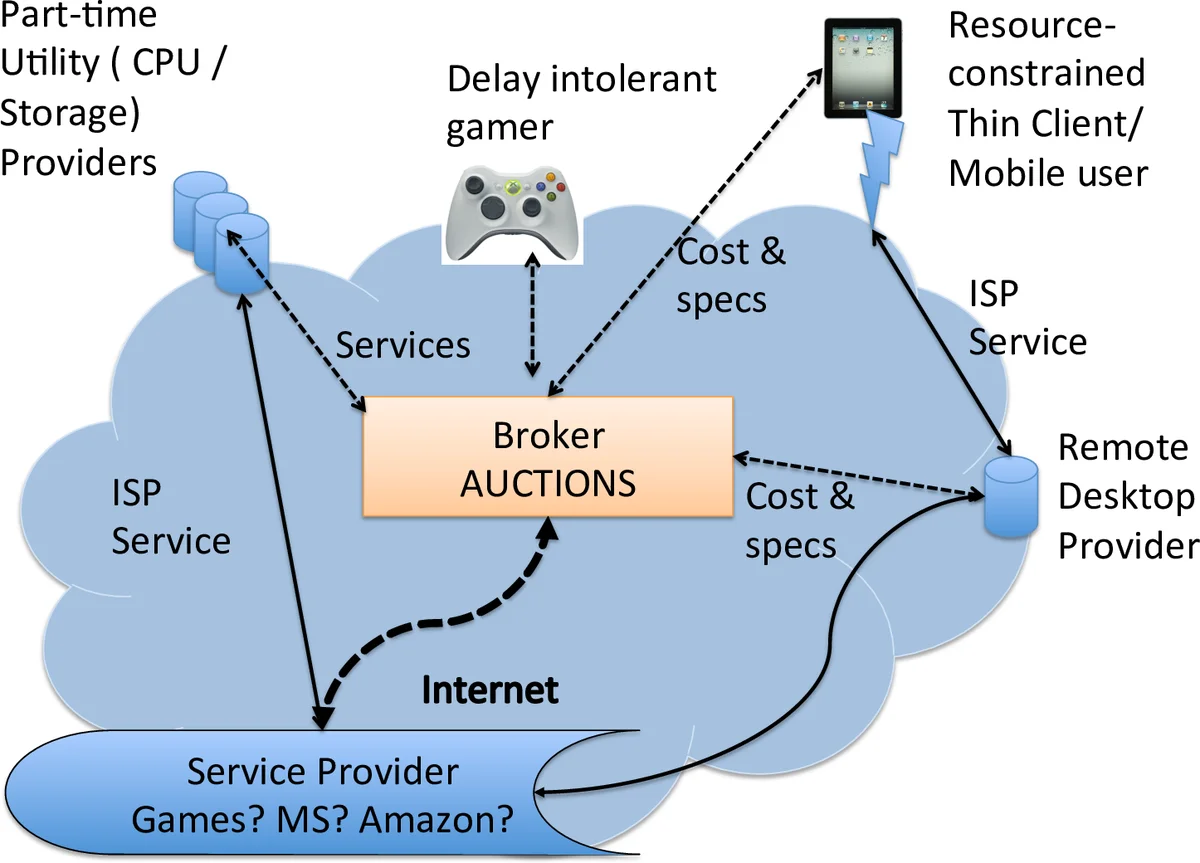
Recent measurement studies show that there are massively distributed hosting and computing infrastructures deployed in the Internet. Such infrastructures include large data centers and organizations’ computing clusters. When idle, these resources can readily serve local users. Such users can be smartphone or tablet users wishing to access services such as remote desktop or CPU/bandwidth intensive activities. Particularly, when they are likely to have high latency to access, or may have no access at all to, centralized cloud providers. Today, however, there is no global marketplace where sellers and buyers of available resources can trade. The recently introduced marketplaces of Amazon and other cloud infrastructures are limited by the network footprint of their own infrastructures and availability of such services in the target country and region. In this article we discuss the potentials for a federated cloud marketplace where sellers and buyers of a number of resources, including storage, computing, and network bandwidth, can freely trade. This ecosystem can be regulated through brokers who act as service level monitors and auctioneers. We conclude by discussing the challenges and opportunities in this space.
💡 Research Summary
The paper “Opportunities in a Federated Cloud Marketplace” argues that today’s cloud services are confined to the physical footprints of a few large providers such as Amazon, Rackspace, and Microsoft, leaving many geographically dispersed data centers, university clusters, and corporate compute farms under‑utilized. When these resources sit idle, they could serve local users—especially mobile and tablet users who suffer from high latency or limited bandwidth to the major clouds. The authors propose a global, federated cloud marketplace where sellers (resource providers) and buyers (application owners or end‑users) can trade compute, storage, and network bandwidth through a broker‑mediated system.
Key contributions include: (1) a clear articulation of the incentives for both sides—providers can monetize idle capacity and buyers can obtain low‑latency, cost‑effective resources close to their users; (2) a set of core requirements for the marketplace: truthfulness of sellers and buyers, robust billing and allocation that maximizes revenue while preserving future capacity, and privacy‑preserving virtualization; (3) a broker role that functions as an auctioneer, QoE monitor, reputation manager, and conflict resolver, without a single point of control; and (4) illustrative case studies (cloud‑assisted smartphones, online gaming, large‑scale events such as the Olympics, and nighttime stock‑market analytics) that demonstrate how the marketplace can improve performance and reduce costs in latency‑sensitive or bursty workloads.
The analysis highlights that most data centers experience diurnal load patterns; by exposing off‑peak capacity through dynamic pricing, providers can generate additional revenue streams while buyers benefit from lower prices. The paper also discusses the technical challenges of building a common API across heterogeneous clouds, ensuring accurate measurement of resource utilization, and handling privacy concerns when multiple tenants share virtualized hardware. While the authors acknowledge that privacy solutions are beyond the scope of this work, they point to virtualization isolation and future research on secure multi‑tenant environments.
In the discussion, the authors acknowledge that their proposal is an early feasibility study. They outline future work such as collecting real‑world usage traces to refine time‑of‑day pricing models, developing resource‑specific auction strategies (e.g., different mechanisms for CPU vs. storage), and exploring decentralized broker implementations possibly based on blockchain smart contracts. Overall, the paper makes a compelling case that a federated cloud marketplace could unlock significant economic value, improve service quality for latency‑sensitive applications, and foster a more competitive and innovative cloud ecosystem.
Comments & Academic Discussion
Loading comments...
Leave a Comment