Broders Chain Is Not Rapidly Mixing
We prove that Broder’s Markov chain for approximate sampling near-perfect and perfect matchings is not rapidly mixing for Hamiltonian, regular, threshold and planar bipartite graphs, filling a gap in the literature. In the second part we experimentally compare Broder’s chain with the Markov chain by Jerrum, Sinclair and Vigoda from 2004. For the first time, we provide a systematic experimental investigation of mixing time bounds for these Markov chains. We observe that the exact total mixing time is in many cases significantly lower than known upper bounds using canonical path or multicommodity flow methods, even if the structure of an underlying state graph is known. In contrast we observe comparatively tighter upper bounds using spectral gaps.
💡 Research Summary
This paper investigates the mixing properties of Broder’s Markov chain, a Metropolis–Hastings algorithm originally designed to sample uniformly from the union of near‑perfect and perfect matchings in bipartite graphs. The authors first establish that Broder’s chain is not rapidly mixing for several natural families of graphs—regular, planar, threshold, and Hamiltonian bipartite graphs. The key obstacle is the ratio between the number of near‑perfect matchings |N(G)| and the number of perfect matchings |M(G)|. When this ratio grows faster than any polynomial in the size of the graph, the expected number of trials needed to encounter a perfect matching becomes exponential, regardless of the chain’s convergence speed.
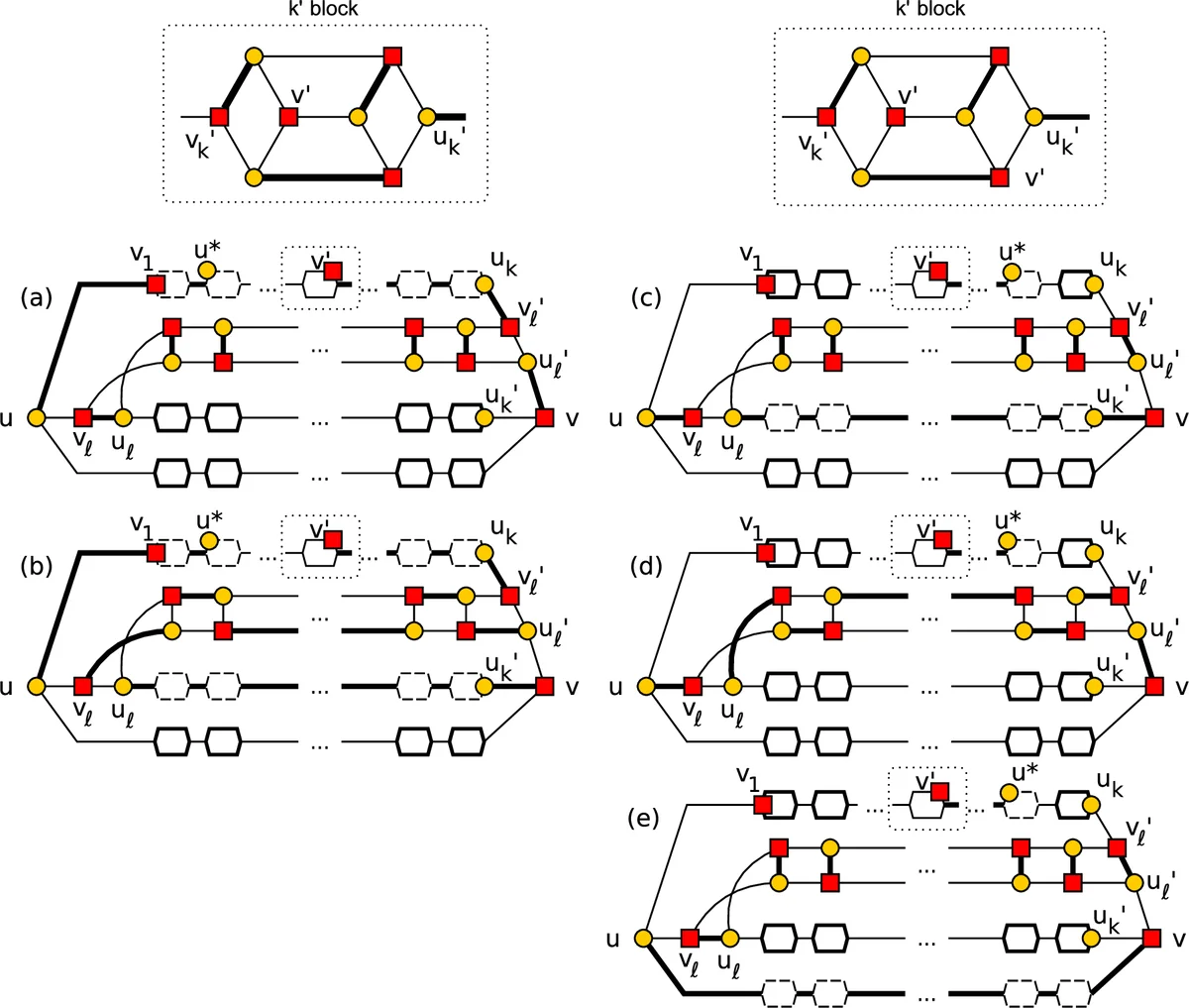
Using Sinclair’s multicommodity flow framework, the authors derive lower bounds on the mixing time τ(ε) that depend on the maximum load ρ₁ of any edge in a chosen set of canonical paths. For the planar “hexagon chain” graphs (k hexagons linked in a line, with two extra vertices u and v at the ends), they show that |M(G)| = 1 while |N(G)| = 2^k. By partitioning the near‑perfect matchings into two equally sized subsets N₁ and N₂ that differ on a central hexagon, any path connecting a state in N₁ to a state in N₂ must cross an edge whose load is Ω(2^k). Consequently ρ₁ is exponential, yielding an exponential lower bound on τ(ε). The same construction technique is adapted to regular, threshold, and Hamiltonian graphs, proving that Broder’s chain cannot be rapidly mixing on any of these classes.
The paper also proves that computing the ratio |N(G)|/|M(G)| itself is #P‑complete, eliminating the possibility of a polynomial‑time preprocessing step that could certify rapid mixing for a given instance.
In the second part, the authors conduct an extensive experimental study comparing Broder’s chain with the Jerrum‑Sinclair‑Vigoda (JSV) chain, which samples perfect matchings using a carefully chosen weight function w. For all bipartite graphs up to 12 vertices, they explicitly construct the state graph, compute the exact total variation mixing time, and evaluate three theoretical upper bounds: (i) the multicommodity flow bound based on ρ₂, (ii) the spectral gap bound 1/(1–λ_max), and (iii) the classic polynomial bound from the literature. The results reveal a striking gap: the multicommodity flow bound is often several orders of magnitude larger than the true mixing time, whereas the spectral gap bound is consistently tight, differing by at most a constant factor. Moreover, for graphs where |N(G)|/|M(G)| is large, Broder’s chain exhibits prohibitively long mixing times, confirming the theoretical lower bounds.
The JSV chain, while provably rapidly mixing, suffers from the #P‑completeness of computing the exact weights w, which dominates its practical runtime. The authors suggest that for special graph families (e.g., planar or threshold graphs) alternative weight‑estimation techniques might make the JSV approach viable.
Overall, the paper closes a long‑standing open question by proving that Broder’s chain is not rapidly mixing in general, highlights the limitations of multicommodity flow based mixing‑time analyses, and demonstrates the practical advantage of spectral methods for bounding convergence. It calls for future work on (a) efficient approximation of the JSV weight function for restricted graph classes, (b) development of new Markov chains that combine the simplicity of Broder’s transition rules with provably polynomial mixing times, and (c) deeper exploitation of state‑graph structure in spectral analyses to obtain tighter, instance‑specific mixing‑time guarantees.
Comments & Academic Discussion
Loading comments...
Leave a Comment