A Linear Iterative Unfolding Method
A frequently faced task in experimental physics is to measure the probability distribution of some quantity. Often this quantity to be measured is smeared by a non-ideal detector response or by some physical process. The procedure of removing this sm…
Authors: Andras Laszlo
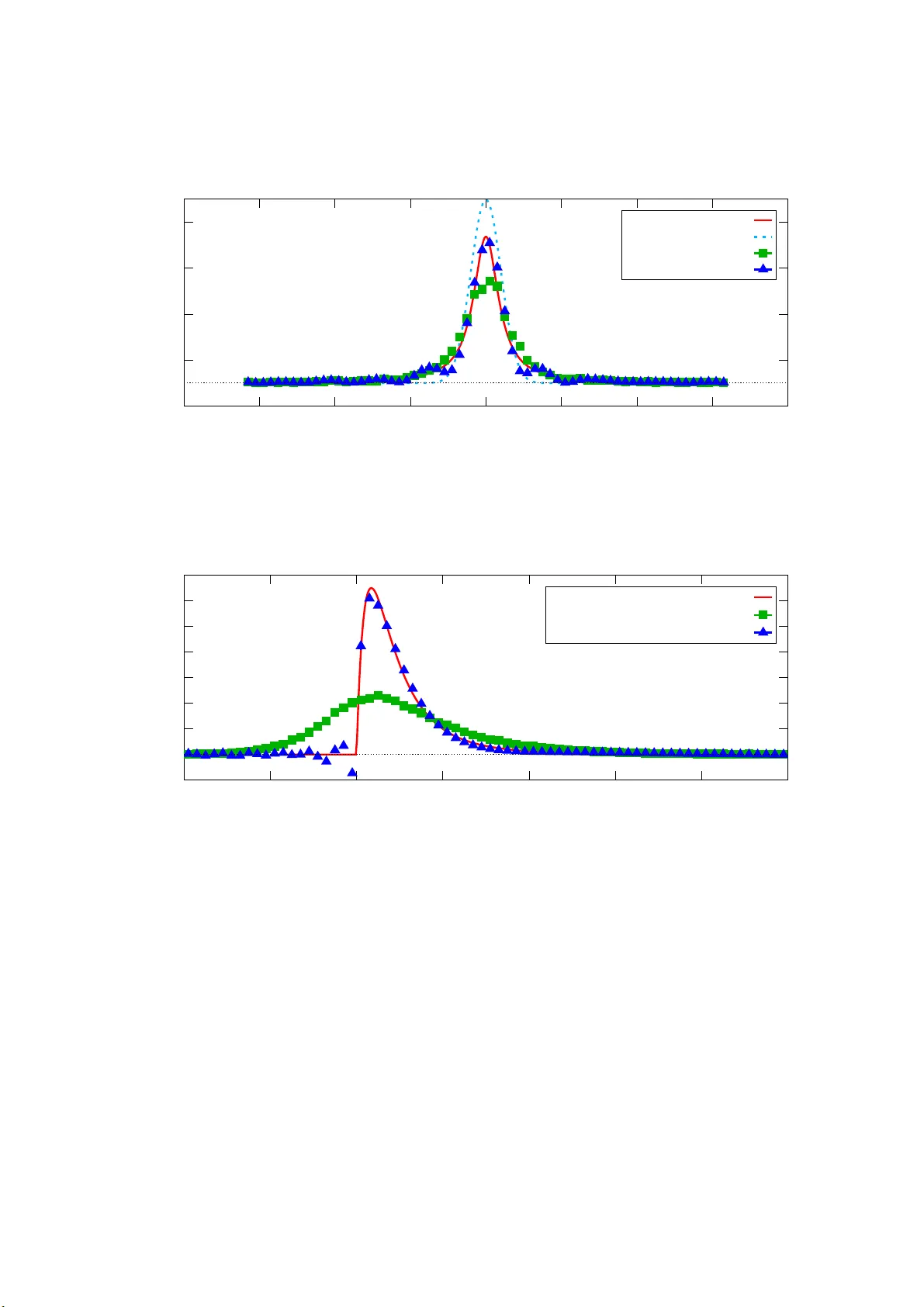
A linear iterati v e unfoldin g metho d Andr´ as L´ aszl´ o Wigner RCP , P .O.Box 49, H-1525 Budap est, Hungary CERN, CH-1211 Geneve 23 , Switzerland E-mail: laszl o.andras@wigner.mt a.hu Abstract. A frequently faced task in exp erimental ph ysics is to measure the probability distribution of some q uantit y . Often this q uantit y t o b e measured is smeared by a non- ideal det ector resp on se or b y some physical pro cess. The pro cedure of removing this smearing effect from the meas u red distribution is called unfolding, and is a delic ate problem in sig n al processing, due to the well-kno wn numerical ill b ehavior of this task. V arious methods were inv ented whic h, giv en some assumptions on the initial p robabilit y distribution, try to regularize the unfolding problem. Most of these methods definitely introduce bias in to the estimate of the initial probability distribution. W e propose a linear iterative method (motiv ated by the Neumann series / Landweber iteration known in functional analysis), whic h h as th e adv antag e that no ass u mptions on the initial probabilit y distribution is needed, and the only regularization parameter is the stopping order of the iteration, which can be used to choose the b est compromise b etw een the i ntro d uced bias and the propagated statistical an d systematic errors. The metho d is consistent: “bin wise” con vergence to the initial probab ility distribution is prov ed in absence of measurement errors under a quite general cond ition on the resp onse fun ction. This condition holds for practical app lications such as conv olutions, calorimeter resp onse functions, momentum reconstruction response fun ctions based on tracking in magnetic field etc. In p resence of measuremen t errors, explicit form ulae for the propagation of the three imp ortant error t erms is p ro v ided: bias error (distance from the u nknown to-b e-reconstructed initial distribution at a finite iteration order), statistical error, and systematic error. A trade-off b etw een these three error terms can b e used to defin e an optimal iteration stopping criterion, and t he errors can b e estimated th ere. W e p ro v ide a numerical C library for the implementation of the metho d, whic h incorp orates automatic statistical error propagation as wel l. The prop osed metho d is also discussed in the context of other kn ow n approaches. 1. In tro duction In data analysis one commonly faces th e p roblem that the probabilit y d ensit y function (p d f ) of a giv en p hysic al quantit y of interest is to b e measured, but some random p h ys ical p ro cess, suc h as the in trinsic b eha vior of th e measuremen t app aratus, smears it. The reconstruction of the p ertinent p df based on the measured smeared p df and on the resp onse fu nction of the measuremen t pro cedur e is calle d u nfolding. T o b e sp ecific, let us h a ve the original un kno wn p df x 7→ f ( x ) of the undistorted physica l qu an tit y w h ic h w e n eed to reconstruct, and assume that the actual measured p df can b e expressed of the f orm y 7→ g ( y ) = R ρ ( y | x ) f ( x ) d x , wh er e ( y , x ) 7→ ρ ( y | x ) describ es the smearing effect in a probabilistic manner. 1 Then, it is said that 1 All p dfs are understoo d to b e real v alued n on-negative Lebesgue integ rable functions ov er some finite dimensional real ve ct or space X . the p df g is the p df f folded with the resp onse function ρ . 2 Our mathematical task is to solv e the ab o ve linear inte gral equation in ord er to obtain f , given g and ρ . Th is pr oblem is kn o wn not to b e a simple n umerical task (ill-p osed p roblem), and sev eral metho ds are u sed by the data analysis comm un ities in order to regularize the problem (for an o verview on th e most p opular approac hes, we refer to [1, 2]). Let us denote b y A ρ the p ertinent folding op erator, whic h acts like ( A ρ f ) ( y ) = R ρ ( y | x ) f ( x ) d x on a f u nction f at a p oin t y . 3 Giv en the measur ed p df g = A ρ f , the pr oblem of un folding can then b e f ormalized as foll ows: t h e p df f = A − 1 ρ ( g ) is to b e determined or appro ximated. Th e mathematical cause of the numerical ill-p osedness of this unf olding problem can then b e pu t forwa r d as: the inv erse A − 1 ρ of a generic f olding op erator can b e shown n ot to b e con tin u ous despite the forwa rd folding op erator A ρ alw a ys b eing con tinuous 4 (this phenomenon is d iscussed in detail e.g. in [9]). The non-cont inuit y of the in verse foldin g op erator A − 1 ρ ma y b e also reformula ted in a less abs tract manner: initially distan t functions can b e mapp ed close b y the folding op erator A ρ , as illustrated in Figure 1. I.e. one can lose d iscr im in ating p o wer b et ween p dfs up on a folding. f 1 f 2 f 1 f 2 A ρ A ρ A ρ A ρ ( ) ) ( far close Figure 1. Illustration of the non-conti nuit y of the inv erse of a folding op erator A ρ : t wo distan t functions f 1 and f 2 ma y b e mapp ed close b y the folding – d istance of functions are here u ndersto o d as probabilistic distance, i.e. in the L 1 ( X ) fu nction n orm. A furth er asp ect of th e numerical ill-p osedness of the un folding problem is th at in practice the folded p df g is often obtained via statistical measurements (e.g. histograming), and therefore is con taminated b y statistica l errors. I.e. in realit y g = A ρ f + e holds instead of the idealized equation g = A ρ f , w here e ( x ) is a r an d om v ariable for eac h p oin t x (or for eac h histogram bin – in th e language of h istograms). Th u s , when estimating the unfolded p d f as A − 1 ρ ( g ) = f + A − 1 ρ ( e ), the cont r ibution of the second term is n ot guarant eed to remain small due to the non-con tinuit y of the inv erse folding op erator A − 1 ρ ev en wh en e is initially known to b e small. On top of this, the statistica l err or term e ma y conta in mo d es n ot w ithin the image of the folding op erator A ρ , on whic h the ev aluat ion of the inv erse op erator A − 1 ρ is not meaningfu l if th e problem is not initially discrete. These effects are demonstrated in Figure 2, wh ic h sho ws that simple inv ersion of the discretized folding op erator on the measured p df giv es u nphysical numerical result: a result very differen t from the initial p df, ha ving large negativ e and p ositiv e alternating amplitudes. In order to regularize the n um er ical ill-p osedness of the u n folding p roblem, v arious metho ds are used . These metho ds can b e divided in to th ree large classes. 2 Whenever the resp onse function ρ is translation inv arian t in the sense that for all x, y , z ∈ X one has ρ ( y + z | x ) = ρ ( y | x − z ), the folding is sp ecially called con volution, and in that case ρ ma y b e expressed by a single p d f: ρ ( y | x ) = ρ ( y − x | 0). 3 T o b e precise, A ρ is a L 1 ( X ) → L 1 ( X ) contin uous linear op erator, where L 1 ( X ) denotes the normed space of complex v alued in tegrable fun ctions ov er th e vector space X . The resp onse function ρ is assumed to b e ρ ( ·| x ) ∈ L 1 ( X ) for all x ∈ X . 4 Con tinuous in the L 1 ( X ) → L 1 ( X ) sense. Probability v ariable -20 -15 -10 -5 0 5 10 15 20 Probability density -200000 -150000 -100000 -50000 0 50000 100000 150000 200000 Unfolding by matrix inv ersion demo Input Cauc hy p df Con volv er Gauss pdf Measured p df Unfolded p df Figure 2. (Color online) Demonstration of the numerical ill-p osedness of the un folding problem: a Cau ch y distrib ution is conv olv ed with a Gauss distribution with Monte Carlo metho d to generate th e measured distribution conta min ated with statistical errors. Clearly , the unfolded p d f, obtained by simple n u merical inv ersion of the discretized folding op erator on the m easured p df giv es physically un reasonable numerical result: large alte r n ating p ositiv e / negativ e amplitude p d f v alues. (i) Usin g a p arametric Ansatz for f , and fit parameters, so that A ρ f gets close to g . This metho d can b e slightly insens itive to the details of the true f (as illustrated in Figure 1), and of course can introd uce strong systematic b ias on th e result if th e p arametric Ansatz do es not hold in an exact mann er of the form that was assumed. Su c h metho ds are used in general for inclusiv e particle identificat ion by sp ecific ionization (see e.g. [10]). (ii) Bin-by-bin fitting of the bin v alues of the histogramed f , so that A ρ f gets close to g . This is basically equiv alen t to the naive inv ersion of the discretized folding op erator, and therefore pro du ces similar oscillatory r esults, except when an artificial p enalt y fun ction is added to the χ 2 in order to suppr ess large lo cal gradient s. In that case, the method can pr o vide meaningful ans wers, b ut the in tro duced systematic bias is diffi cu lt to quan tify . Similarly to the parametric An s atz metho d , the fit can b e slight ly in sensitiv e to the details of the true f . Most p opular metho ds, s uc h as SVD metho d [3], are based on this idea. (iii) Th e iterativ e metho d of con verge nt w eigh ts (also kn o wn as iterativ e Ba y esian u nfolding) of Kondor-M ¨ ulthei-Sc horr-d ’Agostini [4, 5, 6, 7, 8]. This m etho d is, as opp osed to the previously men tioned metho ds, is n on -linear. On the other hand, by co n struction it preserve s p ositivit y and in tegral of the in itial p df, and therefore maps a p df exactly into a p df, whic h do es not h old for linear metho ds, th u s, this app roac h is quite fav orable for statistica l applicatio n s. Regularization is ac hiev ed solely by stoppin g the iteration at a fi nite order. How ev er, th ere is no kno w n pro of y et if the iterated p dfs co nv erge 5 to the initial to-b e-reconstructed p df in a non-discrete scenario, ev en in the absence of m easur emen t errors [6]. Also propagation of statistical and systematic errors of the measured p df to the unfolded p d f has not b een inv estiga ted, and consequently n o generally app licable iteration stopping condition is k n o wn. In a p revious p ap er [9] w e prop osed a linear iterativ e unfolding metho d , for whic h und er certain conditions con v ergence to the initial p df was pr o ve d analytic ally for some un folding problems 5 In case of an iterativ e unfolding metho d it is an absolute must to show that the sequence of iterated unfolded p dfs conve rge to th e initial one, in the absence of measuremen t errors (consistency of the meth o d) . in probabilit y theory (suc h as con v olutions), and due to the linearit y of the metho d, exact propagation of statistical errors of th e measured (folded) p d f to the un folded p df was p ossible. In this pap er we pr op ose an imp ro ved v ersion of that algorithm, whic h could b e pro v ed to b e con verge nt in quite general cases for unfolding problems in a probabilit y th eory setting. 6 The k ey equalit y of the con ve r gence pro of leads to explicit error p ropagation formulae for the three imp ortan t err or term s : for the bias error (distance from the tru e u nfolded p df ), for the propagated statistical error, and most notably for the p ropagated systematic error, wh ic h is of great imp ortance in rep orting exp erimen tal results. An implemen tation of the algorithm is written as C lib rary , along with app lication examples [13]. The imp lemen tation also incorp orates automatic s tatistical err or p ropagation. The pap er is organized as follo ws: in Section 2 the algorithm and its con v ergence theorem shall b e formulated, Section 3 is devot ed to the corresp onding err or propagation form u lae which help to formulate an optimal stoppin g criterion and err or estimates therein, while in S ection 4 w e demonstrate our metho d on examples. 2. A linear iterativ e unfolding algorithm W e pro vide no w a linear iterativ e s olution for a prob ab ility theory u nfolding problem of the form g = A ρ f , where f is the in itial (unknown) p df, g is the folded (measur ed) p d f, and ρ is the r esp onse fun ction. Giv en the resp on s e function ρ , one ca n also define along with the folding op erator A ρ the transp ose folding op er ator A T ρ b y s w app in g the v ariables of the resp onse function. 7 Then, one can attempt to app ro ximate th e true unfolded p df f in the follo win g wa y: define the fu nction sequen ce by setting the normalization factor K ρ = m ax x Z Z ρ ( y | z ) ρ ( y | x ) d y d z (1) and then taking the f 0 = K − 1 ρ A T ρ g , f N +1 = f N + f 0 − K − 1 ρ A T ρ A ρ f N (2) iteration form u la. W e p ro vide a con vergence result on this iterativ e appro ximation b elo w in absence of measurement errors on g (which is necessary for the consistency of the metho d). Theorem 1. (Conver genc e) The function se quenc e N 7→ f N r esulting fr om the ab ove iter ation scheme c onver ges to the c losest p ossible function to the true unfolde d p d f f in the aver age over any c o mp act r e gion, whenever the normalization factor K ρ is finite. I.e. for al l c omp act sets S ⊂ X one has lim N →∞ 1 V olume( S ) Z S f − P Ker( A ρ ) f − f N ( x ) d x = 0 . (3) Her e, P Ker( A ρ ) denotes the ortho gona l pr o j e ction op er ato r to the kernel set o f A ρ , and thus P Ker( A ρ ) = 0 holds autom atic al ly whenever A ρ is invertible. In addition, the c o nver genc e shal l also hold in the sp ac e of squar e-inte gr able functions, i. e . one has also lim N →∞ Z f − P Ker( A ρ ) f − f N 2 ( x ) d x = 0 . (4) 6 The d etailed mathematical p ro of of converg en ce shall b e published elsewhere: [11]. The p rop osed iteration sc h eme was motiv ated by the so called Neumann series and Land w eb er iteration [12] k now n in functional analysis, but t h e convergence of neither iterations hold, unfortunately , in a probability theory setting in th eir original form, as one can p ro ve. Our improv ed iterative algorithm, how ever, is sp ecially d evelo p ed to b e conve rgent for u nfolding problems in p robab ilit y theory . 7 The transp ose folding op erator is defin ed by ( A T ρ f )( y ) = R ρ ( x | y ) f ( x ) d x for all functions f and p oints y . N ote, that t h is simply translates t o matrix transp osition whenever the folding is d iscretized. Pro of The pro of is based on Riesz-Thorin theorem and on the sp ectral represen tation of p ositiv e op erators in the space of complex square-integ rab le fu nctions o ve r X (to b e p ublished in a more mathematically sp ecializ ed journal: [1 1 ]). The follo wing observ ations help to shed some further ligh t on prop erties of the prop osed unfolding algorithm. (i) I n case the p dfs are mo deled with histograming, the s et wise con v ergence of p d fs means bin w ise con v ergence of histograms, i.e. the probabilit y of eac h histogram bin is restored in the limit of in finite iterations. (ii) When the inv erse of A ρ exists, th e original p df f is completely restored. Whenev er the p ertinent inv erse d o es not exist, s till the maximum p ossible information ab out f is restored, namely the function f − P Ker( A ρ ) f . (iii) Whenever A ρ is a conv olution, then K ρ = 1 holds automaticall y , i.e. K ρ < ∞ is satisfied. (iv) The con vergence cond ition K ρ < ∞ holds p ro v ably for a wide class of practically relev an t resp onse functions, s uc h as energy resp onse fu nction of calorimeters, momen tu m resp ons e function of trac k reconstru ction in magnetic field etc. (v) The iteration scheme of the theorem is motiv ate d by the Neum ann series kno wn in fu nctional analysis. A similar iterativ e s olution, also referred to as Landw eb er iteration [12], is kno wn in the theory of F redholm op erators. In pr obabilit y th eory unfolding problems, how ev er, the n ecessary conv ergence criteria for Neumann series or for Landweber iteration do not hold in their original form. (vi) The pr op osed iterat ive unfolding algo rith m d o es not necessarily n eed an initial binnin g of p dfs. It ma y b e implemen ted as well b y differen t densit y estimators than histograms. Ho w ever, w hen the p dfs are mo deled by histograms, one ma y r ecognize that the binn ing and truncation of h istograming domain can also b e considered as foldin g op erator. Therefore, the histogram binning and trun cation effect ma y b e includ ed in th e resp onse function ρ , and then the effect of histograming can b e unfolded (to the maximum p ossible extent ) as w ell. I f one w an ts to n u merically implemen t this, the initial p df f must b e assumed to b etter approac h the con tinuum p df, i.e. m u st b e assumed to b e an un kno wn histogram o v er a larger domain with fin er granulatio n than the folded one. The schemat ic of suc h p ossible rebinnin g tric k is illustrated in Figure 3. A ρ Figure 3. (Color online) Illustration the rebinnin g tric k for un folding the h istogram binning and domain truncation as w ell (to the maximum p ossible exten t) along with the smearing effect of th e r esp onse fun ction ρ . F or this, the imp lemen tation of the folding op erator A ρ m ust map histograms o ve r a larger domain and with fin er graining to histograms with the binning sc heme of the measured (folded) p d f. 3. Bias, statist ical and systemat ic errors of the unfolded distribution In real measuremen ts, the folded p df g also admits statist ical and s y s tematic errors , and the propagation of these terms in to the unf olded p d f is necessary to qu antify at eac h finite iteration step. The key equalit y of the pro of of Th eorem 1 leads to explicit er r or propagation formulae for b ias error (d istance fr om the tru e unfolded p df ), statistical err or, and systematic error. First w e present our result ab out b ias error. Theorem 2. (Bias err or) T ake the iter ative solution for the unfolding pr oblem as in Se ction 2. Then, if the normalization factor K ρ is finite, the distanc e of an N -th iter ate f N fr om the closest p ossible fu nction to the true unfolde d p df f in the aver age over a c omp act r e gion has the fol lowing upp er b ound: for any c omp act set S ⊂ X one has 1 V olume( S ) Z S f − P Ker( A ρ ) f − f N ( x ) d x ≤ 1 p V olume( S ) (1 + ε ) s Z | f M − f N | 2 ( x ) d x (5) for any ε > 0 and lar ge enough iter ation or der M > N . The ab ov e r esult, translated to th e language of h istograms means that the bin -b y-bin a ve r age deviation f rom the true unfolded p df is b oun d by the righ t hand side of the inequalit y in Theorem 2., where V ol u me( S ) is the histogram bin v olume, N is the iteration order, and (1 + ε ) q R | f M − f N | 2 ( x ) d x is a calculable co efficien t. In this expression ε > 0 is arb itrary , while the iteration order M > N needs to b e large enough for giv en ε . It is seen that the b ias error tends to zero with in cr easing iteration order N and dep ends on th e histogram bin size as 1 √ V olume( S ) . In pr actical applications, the p dfs are often measured b y s tatistical metho ds (e.g. histograming). In that case, the v alue of the folded p df g in eac h h istogram bin admits a statistica l error. Th e b elo w theorem s tates an exact formula for the prop agation of this error in to the unfolded p d f. Theorem 3. (Statistic a l err or) T ake the iter ative solution for the unfolding pr o b lem as in Se ction 2. L et C b e the c ovarianc e matrix of the me asur e d p df g , wh er e g is assume d to b e of the form of a histo gr am. Sinc e a c ovarianc e matrix C is p os i tiv e definite, it is always p ossible to de c omp ose it – not uniquely – in the form C = E E T for some ma trix E , ( · ) T b eing th e matrix tr ansp ose. (Whenever C is diagonal, c onstruction of such an E is just trivial.) Then, the fol lowing iter ation c alculates the statistic al err or pr op a gation: E 0 = K − 1 ρ A T ρ E , E N +1 = E N + E 0 − K − 1 ρ A T ρ A ρ E N , (6) wher e in e ach step the c ovarian c e matrix of f N shal l b e C N = E N E T N . Due to the linearit y of th e metho d, the con tribution of th e pr opagated statistical error term is exactly calculable by means of the ab o ve formulae, if it is kno wn for the measured p df g . This error term increases with increasing iteration ord er N . The statistical error of a giv en h istogram bin of the N - th iterate f N is nothing but the square-ro ot of the corresp onding d iagonal elemen t of C N . Whenev er the folded p df g is a result of an exp erimen t, it may admit a systematic err or δ g . Also the systematic error δ ρ of the resp onse function ρ ma y giv e a non-zero contribution to it: A δρ f . The effect of this initial systematic error on the unf olded p df is qu antified by the follo wing theorem. Theorem 4. (Systematic err or) T ake the iter ative sol u tion for the unfolding pr oblem as in Se ction 2. Assume tha t δ g is the syst e matic err or of g (p o ssibly including c ontribution fr om systematic err or of the r esp onse function). Then the systematic err or for the N -the iter ate f N aver age d over a c omp act r e gion has the f ol lowing upp er b ound: for any c omp act set S ⊂ X 1 V olume( S ) Z S δ f N ( x ) d x ≤ s Z Ξ S,N 2 ( x ) d x s Z K − 1 ρ A T ρ δ g 2 ( x ) d x (7) wher e Ξ S,N is define d by the iter ation Ξ S, 0 := 1 V olume( S ) χ S , Ξ S,N +1 := Ξ S,N + Ξ S, 0 − K − 1 ρ A T ρ A ρ Ξ S,N χ S b eing the char acter i stic function of the set S . The ab ov e r esult, translated to th e language of h istograms means that the bin -b y-bin a ve r age systematic err or of the N -th iterate f N is b ound by the form ula in the righ t han d side of the inequalit y in Theorem 4., w h ere V olume ( S ) is the histogram bin volume, N is the iteration order , and the co efficien t r R K − 1 ρ A T ρ δ g 2 ( x ) d x is calculable kn o wing the b in-b y-b in s y s tematic errors δ g of the measured p df g . As the bias error decreases, while th e statistical and systematic error of the N - th iterate f N increases with the iteration order N , a tr ade-off b et ween these error terms pro vides an optimal cutoff criterion 8 in the iteration order N , and error estimates therein. Consequentl y th e true unfolded p d f f can b e app ro ximated optimally and th e error of this approxima tion can b e pu t under fu ll con trol. Thus, the regularization of the n um erically ill-p osed u nfolding p roblem is ac hiev ed, in case of th e prop osed approac h, solely b y usin g an iterativ e approximat ion and c ho osing an optimal iteration stop order taking in to account the con verge nt terms (bias error) and the divergen t terms (statistica l and systematic errors). 4. Examples In this section we giv e tw o examples to demonstrate our m etho d. In the first example, w e tak e a Cauch y distr ibution, and con v olve it with a Gaussian distribution w ith Mon te Carlo m etho d. The folded p df is determined by histograming the sum of th e Cauch y and Gaussian distribution random num b ers, i.e. the measured p df sh all admit P oissonian s tatistica l err ors. In this example, a relativ ely mod est statistics of 5000 entrie s w as take n to b e able to judge the metho d in the lo w statistics limit. The results is shown in Figure 4. It is seen that the original Cauc hy p df is restored, mo du lo the fluctuations arising from the propagated statistical errors – these are seen as “shoulders” of th e unfolded p d f , the amplitude of whic h decrease with in creased statistics. The iteration was stopp ed when th e integ r al of the statistical error term reac hed ab out 5% lev el. In the second Monte Carlo example, w e generate the energy distribu tion of transv ers ely emitted hadrons in 7 GeV p+p collisions [14], and w e assum e that this particle sp ectrum w as measured by the CMS-HCAL calorimete r [15]. The unfolded sp ectrum, along with the true and measured distr ib ution is shown in Figure 5. 8 E.g. one can take the sum of the three error terms, and stop the iteration when it reaches a minim u m. Probability v ariable -20 -15 -10 -5 0 5 10 15 20 Probability density -0.05 0.05 0.15 0.25 0.35 Iterativ e unfolding demo (40 iterations, error con tent=4.7218 7%) Statistics = 5000 ent r ies Input Cauc hy p df Con volv er Gauss pdf Measured p df Unfolded p df Figure 4. (Color online) T est example with un f olding a Cauc h y distribution con vol ved with a Gaussian d istr ibution. Iteration w as stopp ed w hen th e in tegral of the statistical error term reac hed ab out 5%. E T [GeV] -2 -1 0 1 2 3 4 5 Probability density -0.25 0 0.25 0.5 0.75 1 1.25 1.5 1.75 Iterativ e unfolding demo (1600 iterations, err or con tent = 2.30331%) Statistics = 100000 entries Input pdf (MC truth) Measured p df (with CM S-HCAL) Unfolded p df (iterative unfolding) Figure 5. (Color online) A ph ysical example with u nfolding energy distribu tion of c harged hadrons measured with hadronic calorimeter. Iteration w as stopp ed when th e int egral of the statistica l err or term reac hed ab out 2 . 3%. 5. Concluding remarks W e prop osed a linear iterativ e sp ectrum unfolding metho d for a p plication in data analysis. Con verge n ce to the true unfolded p df is pro ved under a qu ite general condition [11] in absence of measurement errors, and err or propagation form ulae are deriv ed for bias error, statistical error, and systematic error in the p resence of measur ement errors. The metho d is demonstrated on physical examples. A numerical library in C is pro vided with the implemen tation of the metho d [13 ]. The algorithm could b e included in the ROOUnfold pack age [16] in the futur e. Ac kno wledgments I would lik e to thank p rof. G ¨ unter Zec h for v aluable discussions. References [1] Co w an G 2002 Pr o c e e dings of Confer enc e on A dvanc e d Statistic al T e chniques in Particle Physics (18-22 Mar ch 2002, Durham, Unite d K ingdom) (IPPP/02/39, Durh am) p 248 [2] Blo b el V 2008 Unfolding for H EP Exp eriments ( T alk at DESY Computing Seminar ) http://www .desy.de/~blobel/D ESYcomp sem08.pdf [3] Hoeck er A and Kartveli shvili V 1996 Nucl. Instr. Meth. A 372 469 [4] Shepp L A and V ardi Y 1982 IEEE T r ans . M e d. Im ag. 1 113 [5] Kondor A 1983 Nucl. Instr. M eth. 216 177 [6] M¨ ulthei H N and Schorr B 1987 Mat. Meth. Appl. Sci. 9 137 [7] M¨ ulthei H N and Schorr B 1987 Nucl. Instr. Meth. A 257 371 [8] D’Agostini G 1995 Nucl. Instr. Meth. A 362 487 [9] L´ aszl´ o A 2006 J. Phys. A 39 13621 [10] L´ aszl´ o A 2008 Phys. R ev. C 77 034906 [11] L´ aszl´ o A Conv ergence results on a linear iterative sp ectrum unfolding metho d ( in pr ep ar ation ) [12] Landw eb er L 1951 Am. J. Math. 73 615 [13] L´ aszl´ o A 2011 The libunfold pack age ( Sour c e c o de ) http://www .rmki.kfki.hu/~las zloa/do wnloads/libunfold.tar.gz [14] Khac hatryan V et al 2010 Phys. R ev. L ett. 105 022002 [15] Y azgan E et al 2009 J. Phys. Conf. Ser. 160 012056 [16] Ady e T et al The ROOUnfold pack age http://hep unx.rl.ac.uk/~adye /softwa re/unfold/RooUnfold.html
Original Paper
Loading high-quality paper...
Comments & Academic Discussion
Loading comments...
Leave a Comment