Correlation Filters with Limited Boundaries
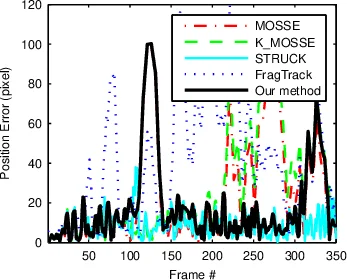
Correlation filters take advantage of specific properties in the Fourier domain allowing them to be estimated efficiently: O(NDlogD) in the frequency domain, versus O(D^3 + ND^2) spatially where D is signal length, and N is the number of signals. Recent extensions to correlation filters, such as MOSSE, have reignited interest of their use in the vision community due to their robustness and attractive computational properties. In this paper we demonstrate, however, that this computational efficiency comes at a cost. Specifically, we demonstrate that only 1/D proportion of shifted examples are unaffected by boundary effects which has a dramatic effect on detection/tracking performance. In this paper, we propose a novel approach to correlation filter estimation that: (i) takes advantage of inherent computational redundancies in the frequency domain, and (ii) dramatically reduces boundary effects. Impressive object tracking and detection results are presented in terms of both accuracy and computational efficiency.
💡 Research Summary
Correlation filters are prized for their ability to perform template matching efficiently in the Fourier domain, achieving a computational complexity of O(N D log D) where D is the length of the template and N the number of training examples. However, the classic formulation relies on circular shifts of a single training patch to generate D synthetic examples. Except for the zero‑shift case, all D‑1 shifted patches suffer from boundary effects because the circular shift wraps image content around the edges, producing samples that do not correspond to any real image patch. The authors point out that only 1/D of the training data is truly representative, and this imbalance dramatically degrades detection and tracking performance.
To address this, the paper introduces two key ideas. First, they enlarge the training image size (T > D) and apply a binary masking matrix P that selects only the central D‑pixel region of each shifted patch. By doing so, the proportion of unaffected samples becomes (T‑D+1)/T, which approaches 1 when T≫D, effectively eliminating the boundary problem. The new objective is
E(h) = ½ ∑ₙ‖yₙ − hᵀ P xₙ
Comments & Academic Discussion
Loading comments...
Leave a Comment