The Group Structure of Pivot and Loop Complementation on Graphs and Set Systems
We study the interplay between principal pivot transform (pivot) and loop complementation for graphs. This is done by generalizing loop complementation (in addition to pivot) to set systems. We show that the operations together, when restricted to si…
Authors: Robert Brijder, Hendrik Jan Hoogeboom
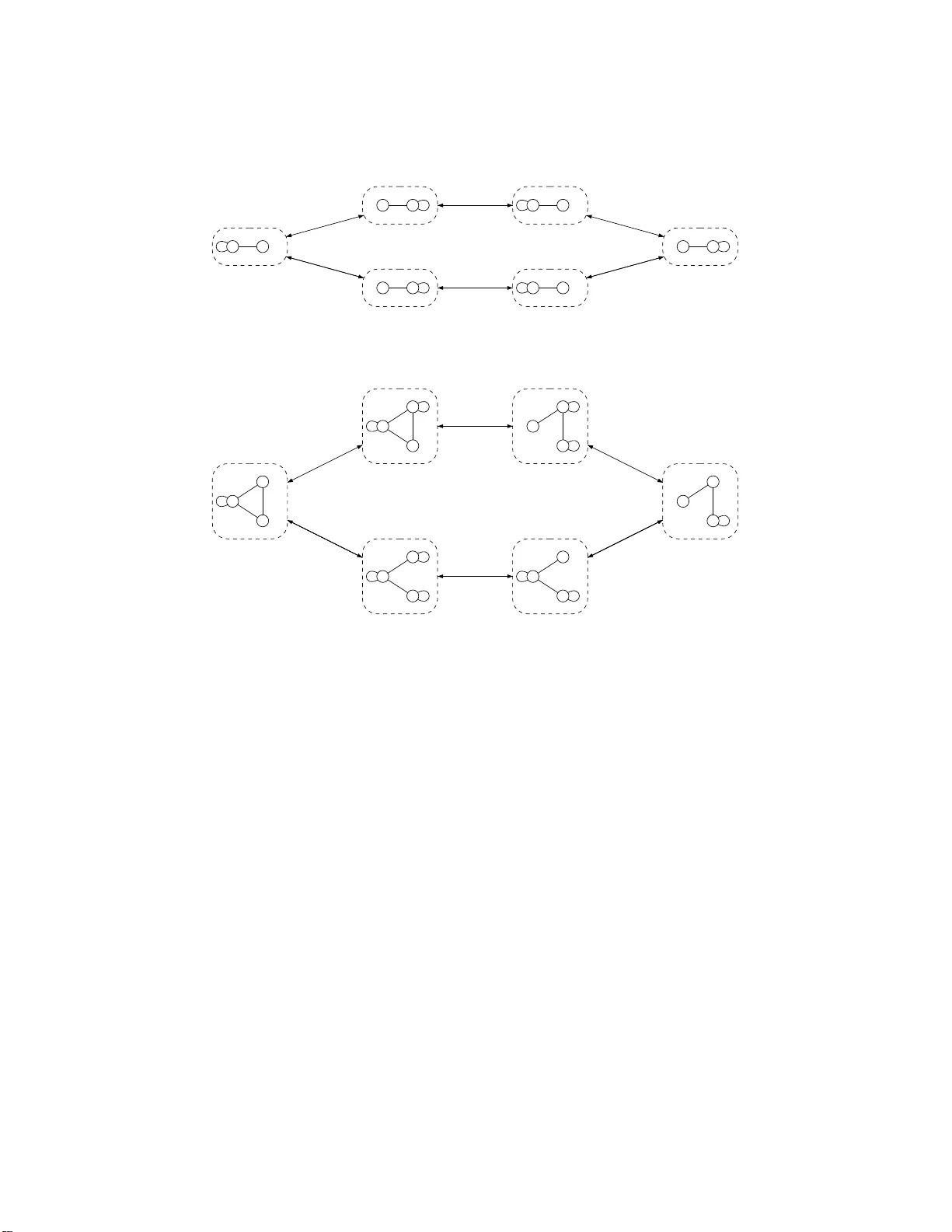
The Group Structur e of Pivot and Lo op Compl emen tati on on Graphs and Set Syst ems Rob ert Brijder a, ∗ , Hendrik Jan Ho oge bo o m b a Hasselt University and T r a nsnational Uni versity of Limbur g, Belgium b L eiden Institute of A dvanc e d Computer Scienc e, L eiden University, The Netherlands Abstract W e study the interpla y betw een principa l pivot transform (piv ot) and lo op co m- plement ation for g raphs. This is done by gener alizing lo op complementation (in addition to pivot) to set s y stems. W e show that the op erations toge ther, when restricted to single vertices, for m the p e rmut ation g roup S 3 . This leads, e.g., to a normal form for sequences of pivots and lo op complementation on graphs. The results hav e consequences for the o per ations of lo ca l complementation and edge complementation on simple graphs : an a lternative pro of of a cla ssic r esult in- volving lo cal and edge c o mplemen tation is obtained, and the effect of se quences of lo cal complementations on simple graphs is characterized. Keywor ds: lo cal complementation, principal piv ot trans fo rm, c ircle graph, int erlace p olynomial, delta-matr oid, algebraic gra ph theor y 1. In tro duction Principal pivot tr a nsform (PP T , or simply pivot), due to T uck er [21], par- tially inv erts a given ma trix. Its definition is originally motiv ated by the exten- sively studied linear complementarity problem [11]. How e ver, there are many other application ar eas for PPT, see [20] for an ov erview. W e consider pivots on graphs where lo ops a r e a llow ed (i.e., symmetric matrices ov er F 2 ). It is shown by Bo uc het [4] that, in this case, the pivot o per ation satisfies an equiv a lent def- inition in terms of set systems (more sp ecifica lly , in terms of delta-ma troids due to a sp ecific exchange axiom that they fulfill). Pivot op era tions on gra phs (where lo ops ar e allow ed) can b e decomp osed int o t wo types of elementary pivots: lo cal complementation a nd edge comple- men tation. The names “ lo c al complementation” and “edge co mplemen tation” are due to similar o per ations on simple graphs. Lo cal complement ation on sim- ple gra phs has origina lly be e n considere d in [16] and edge complementation ha s ∗ Corresp onding author Email addr ess: robert.br ijder@uha sselt.be (Rob ert Bri jder) Pr eprint submitte d to Elsevie r Novemb e r 9, 201 8 subsequently b een defined in terms o f lo cal c o mplement ation in [5]. T he r e these op erations were motiv a ted b y circle graphs (or ov erlap gra phs), where lo cal and edge complementation mo del natural transforma tions o n the underly ing inter- v al segments (or , equiv a lent ly , on Euler tours within a 4-reg ular graph). Ma n y other applica tion ar eas have since b een identified. F or example, lo cal comple- men tation on simple graphs reta ins the entanglemen t of the corr esp onding graph states in q ua nt um computing [22], and this op era tion is of main interest in rela - tion to rank-width in the vertex-minor pro ject initia ted in [17]. Mor eov er, edge complementation is fundamentally related to the interlace po lynomial [2, 3, 1], the definition o f which is motiv ated by the computation of the num b er of k - comp onent circuit partitions in a graph. E lementary piv ots on graphs naturally app ear in the formal study of gene assembly in ciliates [12, 8] (a res earch area of computational biolog y ). Surprisingly , the similarity b etw e e n lo cal and edg e c o mplement ation for sim- ple g raphs on the one hand and pivots o n matrices (or graphs) on the o ther hand has b een la r gely unnoticed (although it is o bserved in [13]), and as a result they hav e b een studied almost indep endent ly . In this pap er we consider the interplay betw een pivots and lo op complemen- tation (flipping the existence of lo ops for a given set of vertices) o n graphs. By generalizing lo op complementation to set systems, we o btain a common view- po in t for the t w o op erations: pivots and lo op co mplemen tations are elements of order 2 (i.e., inv olutions) in the p ermutation gr oup S 3 (b y restricting to s ing le vertices). W e find that the dual piv ot from [9] corre spo nds to the third element of order 2 in S 3 . W e o btain a nor mal form for sequences of piv ots and lo op complementations on graphs. As a cons e quence a num ber of results for lo cal and edg e complementations on simple gra phs are obtained including an a lter- native pro of of a classic result [5] rela ting lo c al and edge complementation (see Prop ositio n 23). Finally we characterize the effect of seque nc e s of lo cal com- plement ations on simple graphs. In this w ay we find that, surprisingly , lo ops are the key to fully understand loca l and edge complementation on simple (i.e., lo opless) gra phs, as they bridg e the g ap in the definitions of lo c al and edg e complementation for graphs on the one ha nd and simple graphs on the other. An extended abstr act of this pap er containing selected results without pro ofs was presented at T AMC 2010 [10]. 2. Notation and T erminology In this pap er matrix computations (except for the firs t pa rt of Section 3 ) will b e over F 2 , the field consisting of tw o elements. W e will o ften consider this field as the Bo olea ns, a nd its op e r ations addition and multiplication ar e as s uc h equal to the logical exclusive-or and logical conjunction, which are deno ted by ⊕ and ∧ res pec tively . These op era tions carry ov er to sets, e.g ., for se ts A, B ⊆ V and x ∈ V , x ∈ A ⊕ B iff ( x ∈ A ) ⊕ ( x ∈ B ). A set system (ov er V ) is a n order e d pair M = ( V , D ) with V a finite se t a nd D a family of subsets of V . W e write simply Y ∈ M to denote Y ∈ D . F or X ⊆ V , X is minimal ( maximal , res p.) in D w .r .t. inclusion iff b oth X ∈ D 2 and Y 6∈ D for every Y ⊂ X ( Y ⊃ X , resp.). The set of minimal (maximal, resp.) elements of D (w.r.t. inclusion) is denoted by min( D ) (max( D ), r e s p.). Moreov er, we write min( M ) = min( D ) a nd max( M ) = max( D ). F or a V × V -matrix A (the columns and rows of A are indexed b y finite s et V ) a nd X ⊆ V , A [ X ] denotes the principal submatrix of A w.r .t. X , i.e., the X × X -matrix obtained from A by res tricting to rows and columns in X . W e consider undirected gr aphs without para llel e dg es, how ever we do allow lo ops. F or graph G = ( V , E ) we use V ( G ) and E ( G ) to denote its set of vertices V and set of edges E , resp ectively , where for x ∈ V , { x } ∈ E iff x has a lo op. F or X ⊆ V , w e denote the subg raph of G induced by X a s G [ X ]. With a gr aph G one a sso ciates its a djacency matrix A ( G ), which is a V × V - matrix ( a u,v ) ov er F 2 with a u,v = 1 iff { u, v } ∈ E (w e hav e a u,u = 1 iff { u } ∈ E ). In this wa y , the family of gra phs with vertex set V corr esp onds precisely to the family of symmetric V × V -matrice s ov er F 2 . Therefore we o ften make no distinctio n b etw een a gra ph and its matrix , so, e.g., by the deter minant of graph G , denoted det G , we will mean the determinant det A ( G ) of its adjacency matrix (computed ov er F 2 ). By conv en tion, det ( G [ ∅ ]) = 1. F or gra ph G , the lo op c omplementation op eration on a set of vertices X ⊆ V , denoted by G + X , r emov es lo ops from the v ertices of X when present in G and adds lo ops to vertices of X when not pres en t in G . Hence the adjacency matrix of G + X is obtained from A ( G ) b y a dding 1 to ea ch diagonal element a xx , x ∈ X , of A ( G ). Clea rly , ( G + X ) + Y = G + ( X ⊕ Y ) for X , Y ⊆ V . 3. Piv ots In gener al the pivot op era tion is defined for matrices over a rbitrary fields, e.g., as done in [2 0]. In this pap er we r e strict to symmetric matr ices over F 2 , which leads to a n um be r of additional viewp oints to the same oper ation, and for each o f them an equiv a lent definition of the pivot o per ation. Matric es. Let A b e a V × V -matr ix (over an arbitr ary field), and let X ⊆ V be such that the co r resp onding pr incipa l submatrix A [ X ] is no nsingular, i.e ., det A [ X ] 6 = 0. The pivot o f A on X , denoted by A ∗ X , is defined as follows. If P = A [ X ] and A = P Q R S , then A ∗ X = P − 1 − P − 1 Q RP − 1 S − RP − 1 Q . The pivot can b e considered a partial inv erse, as A a nd A ∗ X satisfy the following characteristic relation, where the vectors x 1 and y 1 corres p ond to the e le men ts of X . A x 1 x 2 = y 1 y 2 iff A ∗ X y 1 x 2 = x 1 y 2 (1) Equality (1) can b e used to define A ∗ X given A a nd X : an y matrix B satisfying this equality is of the form B = A ∗ X , see [2 0, Theo rem 3.1], and therefor e such a 3 B ex ists precisely when det A [ X ] 6 = 0. Note that if det A 6 = 0, then A ∗ V = A − 1 . Also note that b y Equation (1) a piv ot op e ration is an in volution (op eration of order 2), and more generally , if ( A ∗ X ) ∗ Y is defined, then A ∗ ( X ⊕ Y ) is defined and they are equa l. It is eas y to verify that A ∗ X is skew-symmetric whenever A is. In particular, computed over F 2 , if A is a gra ph (i.e., a symmetric matrix ov er F 2 ), then A ∗ X is also a gra ph. The following fundamental r e s ult on pivots is due to T uc k er [21] (see also [18] or [11, Theor e m 4.1 .1] for an elegant pro o f using Equality (1)). Prop ositio n 1 ([ 21]). L et A b e a V × V -matrix, and let X ⊆ V b e such t hat det A [ X ] 6 = 0 . Then, for Y ⊆ V , det( A ∗ X )[ Y ] = det A [ X ⊕ Y ] / det A [ X ] . In particular , as suming tha t A ∗ X is defined, ( A ∗ X )[ Y ] is no nsingular iff A [ X ⊕ Y ] is nonsing ular. Set S ystems. Let M b e a se t system ov er V . W e define, for X ⊆ V , the pivot (often called twist in the literature, see, e .g ., [13]) M ∗ X = ( V , D ∗ X ), where D ∗ X = { Y ⊕ X | Y ∈ D } . F or V × V -matr ix A , let M A = ( V , D A ) b e the set sy stem with D A = { X ⊆ V | det A [ X ] 6 = 0 } . As o bs erved in [4] we hav e, by Prop os ition 1, Z ∈ M A ∗ X iff det(( A ∗ X )[ Z ]) 6 = 0 iff det( A [ X ⊕ Z ]) 6 = 0 iff X ⊕ Z ∈ M A iff Z ∈ M A ∗ X . Hence M A ∗ X = M A ∗ X . F rom now on we restrict to gra phs G and w e work ov er F 2 . Given set system M G = ( V ( G ) , D G ), one can (r e )construct the graph G : { u } is a lo op in G iff { u } ∈ D G , and { u, v } is a n edge in G iff ( { u, v } ∈ D G ) ⊕ (( { u } ∈ D G ) ∧ ( { v } ∈ D G )), see [7, Pr op erty 3.1]. Hence the function M ( · ) which as signs to each graph G its set system M G is injectiv e. In this wa y , the fa mily o f gr aphs (with set V of vertices) can b e co nsidered as a subset of the family of set s y stems (ov er set V ). Remark 2. Note that M ( · ) is not injective fo r binary matrice s (i.e., ma trices ov er F 2 ) in gener al: e.g., for fixed V with | V | = 2, the 2 × 2 zero matrix and the matrix 0 1 0 0 corres p ond to the same set system. Also , M ( · ) is not sur jective: we hav e, e.g., ∅ ∈ M A for every matrix A . Conse q uen tly , the notions of binary matrix and set sys tem are incomparable (i.e., one is not mo re general than the other) w.r.t. M ( · ) . As M G ∗ X = M G ∗ X , the pivot op era tion for gr a phs coincides with the pivot op eration for set systems . Therefor e, piv ot on set systems forms an a lter native definition of pivot on graphs . No te that while fo r a set s ystem M ov er V , M ∗ X is defined for all X ⊆ V , for a gra ph G , G ∗ X is defined precise ly when det G [ X ] = 1, or equiv alen tly , when X ∈ D G , which in turn is equiv a lent to ∅ ∈ D G ∗ X . It turns o ut that M G has a sp ecial structure, that of a delta-matr oid [4]. A delta-matroid is a set system M that satisfies the symmetric ex ch ange a xiom: 4 V 1 V 2 V 3 u v V 1 V 2 V 3 u v Figure 1: Pivot on an edge { u, v } i n a graph. Adjacency b et we en vertices x and y is toggled iff x ∈ V i and y ∈ V j with i 6 = j . Note that u and v are adjacent to all vertices in V 3 — these edges are omitted in the diagram. The operation does not affect edges adjacent to v ertices outside the sets V 1 , V 2 , V 3 , nor do es i t change any of the lo ops. F or all X, Y ∈ M and all x ∈ X ⊕ Y , we have X ⊕ { x } ∈ M or ther e is a y ∈ X ⊕ Y with y 6 = x such that X ⊕ { x, y } ∈ M 1 . In this pap er we will no t use this prop erty . In fact, we will consider an o per ation on se t systems that do es not retain this prop er t y of delta-matroids, cf. Ex a mple 10. Gr aphs. The pivots G ∗ X where X ∈ min( D G \ { ∅ } ) are called elementary . It is noted b y Geelen [13] that an elementary pivot X co rresp onds to either a lo o p, X = { u } ∈ E ( G ), or to an edg e, X = { u , v } ∈ E ( G ), wher e (distinct) v ertices u and v are both non-lo ops. Thus for Y ∈ M G , if G [ Y ] has elementary pivot X 1 , then Y \ X 1 = Y ⊕ X 1 ∈ M G ∗ X 1 . By iterating this ar gument, each Y ∈ M G can be partitioned Y = X 1 ∪ · · · ∪ X n such that G ∗ Y = G ∗ ( X 1 ⊕ · · · ⊕ X n ) = ( · · · ( G ∗ X 1 ) · · · ∗ X n ) is a comp os itio n of elementary pivots. Consequently , a direct definition of the elementary pivots on graphs G is sufficient to define the (general) pivot oper a tion on graphs. The e le mentary pivot G ∗ { u } on a lo o p { u } is called lo c al c omplementation . It is the gr aph obtained from G by “toggling ” the edges in the neighbo urho o d N G ( u ) = { v ∈ V | { u, v } ∈ E ( G ) , u 6 = v } of u in G : for each v , w ∈ N G ( u ), { v , w } ∈ E ( G ) iff { v , w } 6∈ E ( G ∗ { u } ), and { v } ∈ E ( G ) iff { v } 6∈ E ( G ∗ { u } ) (the case v = w ). The other edg es are left unchanged. W e now r e call e dge c ompleme ntation G ∗ { u, v } on an edge { u, v } b etw ee n non-lo op vertices. F or a vertex x consider its clos ed neighbourho o d N ′ G ( x ) = N G ( x ) ∪ { x } . The edge { u, v } par titions the vertices of G adjacent to u or v int o three sets V 1 = N ′ G ( u ) \ N ′ G ( v ), V 2 = N ′ G ( v ) \ N ′ G ( u ), V 3 = N ′ G ( u ) ∩ N ′ G ( v ). Note that u, v ∈ V 3 . The graph G ∗ { u, v } is c o nstructed by “to ggling” a ll edge s b etw een differ e n t V i and V j : for { x, y } with x ∈ V i and y ∈ V j ( i 6 = j ): { x, y } ∈ E ( G ) iff 1 The explicit for mu lation of the case X ⊕ { x } ∈ M i s often omitted in the definition of delta-matroids. It is then understoo d that y ma y b e equal to x and { x, x } = { x } . T o av oid confusion we w i ll not use this conv en tion here. 5 r p q s r p q s r p q s r p q s r p q s ∗{ q } ∗{ r, s } ∗{ r, s } ∗{ p, r } ∗{ p, s } ∗{ r, s } ∗{ q } ∗{ r } ∗{ s } ∗{ p } Figure 2: The orbit of G of Example 3 under pivot. Onl y the element ary pivots are shown. { x, y } / ∈ E ( G ∗ { u, v } ), see Figure 1. The other edges remain unchanged. Note that, as a res ult of this op eration, the neighbour s of u and v are in terchanged. Example 3. Let G b e the gr aph depicted in the upp er-left co rner of Fig- ure 2. W e hav e A ( G ) = p q r s p 1 1 1 1 q 1 1 0 0 r 1 0 0 1 s 1 0 1 0 . Graph G co rresp onds to M G = ( { p, q , r , s } , D G ), where D G = { ∅ , { p } , { q } , { p, r } , { p, s } , { r , s } , { p, q , r } , { p, q , s } , { p, r, s } , { q , r, s }} . F or ex ample, { p, r } ∈ D G since det( G [ { p, r } ]) = det 1 1 1 0 = 1. The orbit of G under pivot as well as the applicable elementary pivots (i.e., lo cal and edge complementation) ar e s hown in Figure 2. F or exa mple, G ∗ { p, q , r } is sho wn on the low er-right in the same figure. Note that D G ∗ { p, q , r } = { ∅ , { q } , { p , r } , { p, s } , { q , r } , { q , s } , { r , s } , { p, q , r } , { p, q , s } , { q, r , s }} indeed corr esp onds to G ∗ { p, q , r } . 4. Unifying Pi v ot and Lo op Complem en tation W e now introduce a class o f op erations on set systems. As we will show, it turns out tha t this class co n tains b oth the pivot and (a gener alization of ) lo o p complementation. Each op eratio n is a linear tr ansformation, where the input and o utput vectors indicate the presence (or abs ence) of sets Z and Z \ { j } in the origina l a nd resulting set systems. 6 Definition 4. Le t M = ( V , D ) b e a set s y stem, and le t α b e a 2 × 2-matrix over F 2 . W e define, for j ∈ V , the vertex flip α of M on j , denoted by M α j = ( V , D ′ ), where, for all Z ⊆ V with j ∈ Z , the member s hip of Z and Z \ { j } in D ′ is determined as follows: α ( Z ∈ D , Z \ { j } ∈ D ) T = ( Z ∈ D ′ , Z \ { j } ∈ D ′ ) T . In the a bove definition, we r e g ard the elements of the vectors as Bo ole an v alues, e.g., the expressio n Z ∈ D obtains either true (1) or false (0). T o b e more explicit, let α = a 11 a 12 a 21 a 22 . Then we have for a ll Z ⊆ V , Z ∈ D ′ iff ( ( a 11 ∧ Z ∈ D ) ⊕ ( a 12 ∧ Z \ { j } ∈ D ) if j ∈ Z ( a 21 ∧ Z ∪ { j } ∈ D ) ⊕ ( a 22 ∧ Z ∈ D ) if j 6∈ Z . Note that in the ab ov e s tatement w e may replac e b oth Z ∪ { j } ∈ D a nd Z \ { j } ∈ D b y Z ⊕ { j } ∈ D as in the former we have j 6∈ Z a nd in the latter we hav e j ∈ Z . Thus, the o per ation α j decides whether o r not set Z is in the new set system, based on the fact whe ther or not Z a nd Z ⊕ { j } belong to the or ig inal system. Note that if α is the identit y matr ix, then α j is simply the ident ity op eration. Moreov er, with α ∗ = 0 1 1 0 we have M α j ∗ = M ∗ { j } , the pivot op eration on a single element j . By definition, a co mpos ition of vertex flips o n the s ame element corr e spo nds to matr ix multiplication. Moreover, the following lemma shows that vertex flips on different e le ments commut e. Lemma 5. L et M b e a set system over V , and let j, k ∈ V . We have that ( M α j ) β j = M ( β α ) j , wher e β α denotes matrix multiplic ation of β and α . Mor e- over ( M α j ) β k = ( M β k ) α j if j 6 = k . Proof. The fact that ( M α j ) β j = M ( β α ) j follows dir ectly from Definition 4. Let M = ( V , D ), and assume that j 6 = k . Let M α j = ( V , D ′ ), and let M β k = ( V , D ′′ ). F or any set Z ⊆ V with j, k ∈ Z , we consider the sets Z , Z \ { j } , Z \ { k } , and Z \ { j, k } . Now, for any family Q o f subsets of V , let v Q = ( Z ∈ Q, Z \ { j } ∈ Q, Z \ { k } ∈ Q, Z \ { j, k } ∈ Q ) T . The 4 × 4-matrice s α ′ and β ′ such that α ′ v D = v D ′ and β ′ v D = v D ′ , are α ′ = a 11 a 12 0 0 a 21 a 22 0 0 0 0 a 11 a 12 0 0 a 21 a 22 and β ′ = b 11 0 b 12 0 0 b 11 0 b 12 b 21 0 b 22 0 0 b 21 0 b 22 , where α = a 11 a 12 a 21 a 22 and β = b 11 b 12 b 21 b 22 . Equiv a len tly , fo cussing o n the 2 × 2 blo cks, w e have α ′ = α 0 0 α and β ′ = b 11 I b 12 I b 21 I b 22 I . It is ea sy to see these matrices comm ute. Multiplication 7 (in either order ) yields the 4 × 4-matr ix α ′ β ′ = β ′ α ′ = ( b 11 I ) α ( b 12 I ) α ( b 21 I ) α ( b 22 I ) α . T o simplify notation, we a ssume left asso cia tivit y of the vertex flip, and wr ite M ϕ 1 ϕ 2 · · · ϕ n to denote ( · · · (( M ϕ 1 ) ϕ 2 ) · · · ) ϕ n , where ϕ 1 ϕ 2 · · · ϕ n is a seq ue nc e of vertex flip op era tions applied to s e t s ystem M . Hence, as a sp ecial case o f the vertex flip, the pivot op era tion is als o written in the simplified no tation. W e carry this simplified no tation ov er to g raphs G . Due to the commutativ e pro per t y shown in Lemma 5 we (may) define, for a s et X = { x 1 , . . . , x n } ⊆ V , M α X = M α x 1 α x 2 · · · α x n , where the result is independent of the order in which the op era tio ns a re applied. Moreov er, if α is of order 2 (i.e., αα is the identit y matrix), then ( M α X ) α Y = M α X ⊕ Y . Now co nsider α + = 1 1 0 1 . The matric e s α + and α ∗ given ab ove gen- erate the g roup GL 2 ( F 2 ) of 2 × 2 ma trices with non-z e ro determinant. In fact GL 2 ( F 2 ) is iso morphic to the gro up S 3 = { 1 , a, b, c, f , g } o f p ermutations of three element s, where 1 is the identit y , a , b , and c are the elements of o rder 2, and f and g ar e the element s of o rder 3. The matr ices α + and α ∗ are b oth of o rder 2 and we ma y identify them with any tw o (distinct) elements of S 3 of order 2 . T he gener ators α + and α ∗ satisfy the rela tions α 2 + = 1, α 2 ∗ = 1, a nd ( α ∗ α + ) 3 = 1 . As, by Lemma 5, vertex flips on j and k with j 6 = k c omm ute, w e have that the v ertex flips form the gro up ( S 3 ) V of functions f : V → S 3 where comp osition/multiplication is p oint wis e: ( f g )( j ) = f ( j ) g ( j ) for all j ∈ V . Note that by fixing a linear order of V , ( S 3 ) V is isomor phic to ( S 3 ) n with n = | V | , the direct pro duct of n times g roup S 3 . The vertex flips form an action of ( S 3 ) V on the family of set systems ov er V . 5. Lo op Complem e n tation and Set Systems In this sec tion w e fo cus on vertex flips of matr ix α + (defined in the pr evious section). W e will show that this o pe ration is a ge ne r alization to s et sys tems of lo op complementation for graphs (cf. Theo r em 8). Consequently , we will call it lo op c omplementation as well. Let M = ( V , D ) be a set system and j ∈ V . W e denote M α j + by M + { j } . Hence, we have M + { j } = ( V , D ′ ) where, for all Z ⊆ V , Z ∈ D ′ iff ( ( Z ∈ D ) ⊕ ( Z \ { j } ∈ D ) if j ∈ Z Z ∈ D if j 6∈ Z . The de finitio n o f lo op co mplementation can b e re formulated as follows: D ′ = D ⊕ { X ∪ { j } | X ∈ D , j 6∈ X } . Example 6. Let V = { 1 , 2 , 3 } and M = ( V , { ∅ , { 1 } , { 1 , 2 } , { 3 } , { 1 , 2 , 3 }} ) b e a set system. W e have M + { 3 } = ( V , { ∅ , { 1 } , { 1 , 2 } , { 3 } , { 1 , 2 , 3 }} ⊕ {{ 3 } , { 1 , 3 } , { 1 , 2 , 3 }} ) = ( V , { ∅ , { 1 } , { 1 , 2 } , { 1 , 3 }} ). 8 W e denote, for X ⊆ V , M α X + by M + X . Moreov er, as α + is of or der 2 , we hav e, similar to the pivot o pe ration, ( M + X ) + Y = M + ( X ⊕ Y ). Also, by the co mmutative pr op erty of vertex flip in Lemma 5, we ha ve for X , Y ⊆ V with X ∩ Y = ∅ , M ∗ X + Y = M + Y ∗ X . W e now provide a characterizatio n o f lo op complementation which describ es how succes sive applications of lo op complementation in set sys tems in teract. Theorem 7 . L et M b e a set system and X , Y ⊆ V . We have Y ∈ M + X iff |{ Z ∈ M | Y \ X ⊆ Z ⊆ Y }| is o dd. Proof. The pro of is by induction on | X | . First co nsider the ca se X = ∅ . Y ∈ M + ∅ iff Y ∈ M iff |{ Z ∈ M | Z = Y }| is o dd. Now consider X ∪ { y } with y / ∈ X in the induction step. If y / ∈ Y , then Y ∈ M + X + { y } iff Y ∈ M + X iff |{ Z ∈ M | Y \ X ⊆ Z ⊆ Y } | is o dd iff |{ Z ∈ M | ( Y \ X ) \ { y } ⊆ Z ⊆ Y }| is o dd, as Y \ X = ( Y \ X ) \ { y } . Now assume that y ∈ Y . Let C 1 = { Z ∈ M | ( Y \ { y } ) \ X ⊆ Z ⊆ Y \ { y } } and let C 2 = { Z ∈ M | Y \ X ⊆ Z ⊆ Y } . Elements in C 1 do no t contain y whereas those in C 2 do. Thus C 1 and C 2 are disjoint , and C 1 ∪ C 2 = { Z ∈ M | Y \ ( X ∪ { y } ) ⊆ Z ⊆ Y } . Moreover | C 1 ∪ C 2 | is o dd iff exa ctly one of | C 1 | and | C 2 | is o dd. By definition of lo op co mplemen tation Y ∈ ( M + X ) + y iff ( Y \ { y } ∈ M + X ) ⊕ ( Y ∈ M + X ). According to the induction hypothesis this means that exactly one o f | C 1 | a nd | C 2 | is o dd, i.e., |{ Z ∈ M | Y \ ( X ∪ { y } ) ⊆ Z ⊆ Y }| is o dd, as required. The next re sult implies that indeed the notion of lo op complementation for set systems is a gener alization of the notio n o f lo op complementation for gr aphs. Theorem 8 . L et A b e a V × V -matrix over F 2 and X ⊆ V . Then M A + X = M A + X . Proof. It s uffices to show the result for X = { j } with j ∈ V , a s the genera l case follows by the commutativ e prop er t y o f vertex flip (Lemma 5 ). Let Z ⊆ V . W e compar e det A [ Z ] with det( A + { j } )[ Z ]. Fir st assume that j / ∈ Z . Then A [ Z ] = ( A + { j } )[ Z ], th us det A [ Z ] = de t ( A + { j } )[ Z ]. Now assume that j ∈ Z , which implies that A [ Z ] and ( A + { j } )[ Z ] differ in exactly o ne p ositio n: ( j, j ). W e may compute determinants by Laplace expansion ov er the j - th c o lumn, and summing minor s. As A [ Z ] and ( A + { j } )[ Z ] differ at only the matrix -element ( j, j ), these expans ions differ o nly in the inclusion of minor det A [ Z \ { j } ]. Thus det( A + { j } )[ Z ] equals det A [ Z ] ⊕ det A [ Z \ { j } ], fro m whic h the s tatement follows. Surprisingly , this natura l definition o f lo op complementation on set s y stems is not found in the litera ture. Example 9. The se t system M = ( { 1 , 2 , 3 } , { ∅ , { 1 } , { 1 , 2 } , { 3 } , { 1 , 2 , 3 }} ) of Example 6 has a graph representation G : M = M G and G a re given on the 9 1 2 3 2 ∅ 23 3 12 1 123 13 1 2 3 2 ∅ 23 3 12 1 123 13 1 2 3 2 ∅ 23 3 12 1 123 13 1 2 3 2 ∅ 23 3 12 1 123 13 + 3 + 1 + 2 Figure 3: T oggling one-by-one lo ops on the ve rtices of a graph, and the corr esponding set systems. left-hand side in Figure 3. The figur e also contains some other s e t sy s tems obtainable from M through lo o p complementation. Notice that M + { 3 } = ( { 1 , 2 , 3 } , { ∅ , { 1 } , { 1 , 2 } , { 1 , 3 }} ) o f Example 6 corre s po nds to graph G + { 3 } . While for a set system the pro per t y of b eing a delta- ma troid is clo sed under pivot, the next e xample shows that it is n ot closed under lo op complementation. Example 10. Let V = { 1 , 2 , 3 } a nd M = ( V , D ) with D = { ∅ , { 1 } , { 2 } , { 3 } , { 1 , 2 } , { 2 , 3 } , { 3 , 1 }} b e a set system. It is shown in [7 , Sec tion 3] tha t M is a delta-matr oid without gra ph representation. Consider { 1 } ⊆ V . Then M + { 1 } = ( V , D ′ ) with D ′ = { ∅ , { 2 } , { 3 } , { 2 , 3 } , { 1 , 2 , 3 }} is not a delta-matroid: for X = ∅ , Y = { 1 , 2 , 3 } ∈ D ′ , and x = 1 ∈ X ⊕ Y , we hav e X ⊕ { x } = { 1 } 6∈ D ′ and there is no y ∈ X ⊕ Y such that X ⊕ { x, y } ∈ D ′ . 6. Comp osi tions of Lo op Compl ement ation and Pivot In this section we study sequences of lo op complementation and pivot op- erations. As we may consider b oth op eratio ns as vertex flips, we o btain in a s traightforw ard w ay general eq ua lities involving lo o p complementation and pivot. Theorem 1 1. Le t M b e a set system over V and X ⊆ V . Then M + X ∗ X + X = M ∗ X + X ∗ X . Proof. In group S 3 we hav e aba = bab = c . Hence α + α ∗ α + = α ∗ α + α ∗ . No w by Lemma 5, w e have M + { j } ∗ { j } + { j } = M ∗ { j } + { j } ∗ { j } for an y j ∈ V . By the comm utative prop erty o f v ertex flip in Lemma 5, this can b e generalized to sets X ⊆ V , a nd hence we obta in the desired r e s ult. 10 Let us denote α ¯ ∗ = α + α ∗ α + and denote, for X ⊆ V , M α X ¯ ∗ by M ¯ ∗ X . W e will ca ll the ¯ ∗ op eration the dual pivot . As α + is of o rder 2 , w e ha ve, simila r to the pivot o per ation and loo p complementation, ( M ¯ ∗ X ) ¯ ∗ Y = M ¯ ∗ ( X ⊕ Y ). The dual pivot together with pivot and lo op complementation cor resp ond precisely to the elements of order 2 in S 3 . W e now obtain a nor mal form for sequences of pivots a nd loo p complemen- tations. Theorem 1 2. Le t M b e a set system over V , and let ϕ b e any se quenc e of pivot and lo op c omplementation op er ations on elements in V . We have that M ϕ = M + X ∗ Y + Z for some X , Y , Z ⊆ V with X ⊆ Y . Proof. Again we can consider the op eratio ns with resp ect to a single element j , as the gener alization to sets follows b y the co mm utative prop erty of Lemma 5. The 6 elements of GL 2 ( F 2 ) are 1, α + , α ∗ , α + α ∗ , α ∗ α + , and α + α ∗ α + . Hence any sequence of pivot and lo op complementation ov er j r educes to one o f these six elements, ea ch of which ca n b e written in the form of the s tatemen t (with X , Y , Z either equal to { j } o r to the empty set). Because lo cal and edg e complementation op eratio ns are sp ecial cases of pivot the normal form of Theorem 12 is equally v alid for any se q uence ϕ of lo ca l, edge, and lo op complementation o per ations. The c e ntral interest of this pap er is to study comp ositio ns o f pivot and loop complementation on gr aphs. As explained in Section 3, the pivot op er a tions for set sy s tems and gra phs coincide, i.e., M G ∗ X = M G ∗ X , and w e hav e taken c a re that the same holds for lo op co mplementation, cf. Theor em 8. Hence results that hold for set systems in general, lik e Theorem 11, subsume the sp e c ial case where the s et sy stem M repres e n ts a gr a ph (i.e., M = M G for so me g raph G ) — recall that the injectivity of M ( · ) allows one to view the family G of graphs (ov er V ) a s a subset of the family of set sys tems (o ver V ). W e only need to make sure that we “stay” in G , i.e., by applying a pivot o r lo o p complementation op eration to M G we obtain a set system M such that M = M G ′ for some graph G ′ . F or lo op co mplemen tation this will alwa ys hold, how ever care must be taken for pivot as M G ∗ X , which is defined fo r all X ⊆ V , only repr esents a gr aph if det G [ X ] = 1. Hence when restricting a genera l result (on pivot or lo cal complementation for set sys tems) to graphs, we add the conditio n of applicability o f the ope rations. It is useful to ex plicitly state Theorem 11 restricted to gr aphs. This is a fundamen tal r esult for pivots o n gra phs (or, equiv alen tly , symmetric ma tr ices ov er F 2 ) not found in the literature. W e will study some of its consequence s in the remainder of this pap er. Corollary 13 . L et G b e a gr aph and X ⊆ V . Then G + X ∗ X + X = G ∗ X + X ∗ X when b oth sides ar e defin e d. In the particula r case o f Corollary 13 it is not necessa ry to v erify the appli- cability of b oth sides: it turns out that the a pplicability of the right-hand side implies the applica bilit y of the left-hand side of the equality . 11 Lemma 14 . L et G b e a gr aph and X ⊆ V . If G ∗ X + X ∗ X is define d, then G + X ∗ X + X is define d. Proof. Assume that G ∗ X + X ∗ X is defined. Thus, G 2 = G 1 + X ∗ X + X ∗ X + X is defined for G 1 = G + X . Now consider M G 2 . W e hav e that M G 2 ∗ X = M G 1 by Theorem 11. Since the pivot op eration is of or der 2, M G 1 ∗ X = M G 2 . Hence, M G 1 ∗ X has a gra ph representation (graph G 2 ), and thus ∅ is in set system M G 1 ∗ X . Cons e quent ly , X is in s et sys tem M G 1 , thus det G 1 [ X ] = 1 , and so G 1 ∗ X = ( G + X ) ∗ X is defined. The reverse implication of Lemma 1 4 do es not hold: take, e.g., G to b e the connected graph of tw o v ertices with ea ch vertex having a lo o p. W e now state Theorem 12 restricted to gr aphs. Corollary 15 . L et G b e a gr aph, and let ϕ b e a se quenc e of lo c al, e dge, and lo op c omplementation op er ations app lic able t o G . We have t hat Gϕ = G + X ∗ Y + Z for some X , Y , Z ⊆ V with X ⊆ Y . Proof. By Theo rem 12, M G ϕ = M G + X ∗ Y + Z for some X , Y , Z ⊆ V with X ⊆ Y . It suffices to show now that G + X ∗ Y + Z is defined, i.e., show that ∗ Y is applicable to G + X . As M G + X ∗ Y + Z repres en ts a graph (the graph Gϕ ), M G + X ∗ Y a lso repre sents a gra ph (the graph Gϕ + Z ). Therefore, ∅ is in M G + X ∗ Y and thus Y is in M G + X . Consequently , ∗ Y is indeed applicable to G + X . Corollar y 13 can also b e proven directly using Eq uality (1), i.e., the partial inv er se prop erty of pivots. This is s hown in the next theorem which a lso provides a direct definition of the dual pivot for matrices. Let A b e a V × V -matrix and let X ⊆ V . W e write A ( x, y ) T to denote the application of A to the vector x y , where it is understo o d that x co rresp onds to the X -co or dinates, and y to the remaining co ordinates . W e ma ke now an exception and consider ar bitrary matrices , instead o f symmetric matr ices, ov er F 2 . In this wa y the next result provides another g eneralization (in addition to the generaliza tion to set sy stems of Theore m 11) of the concept of dual pivot on graphs. Theorem 1 6. Le t A b e a V × V -matrix over F 2 and let X ⊆ V . Then A + X ∗ X + X = A ∗ X + X ∗ X (if b oth sides ar e define d), and mor e over A ( x 1 , y 1 ) T = ( x 2 , y 2 ) T iff ( A + X ∗ X + X )( x 1 + x 2 , y 1 ) T = ( x 2 , y 2 ) T (if A + X ∗ X is define d). In add ition, any matrix B with this pr op erty is of the form B = A + X ∗ X + X . Proof. The piv ot o per ation acts as a partial inv erse, cf. (1). Hence A ( x 1 , y 1 ) T = ( x 2 , y 2 ) T iff ( A ∗ X )( x 2 , y 1 ) T = ( x 1 , y 2 ) T . The lo op complemen tation adds 1 to the diago nal elements co rresp onding to X , thus A ( x 1 , y 1 ) T = ( x 2 , y 2 ) T iff ( A + X )( x 1 , y 1 ) T = ( x 1 + x 2 , y 2 ) T . W e simply chain these equalities: A ( x 1 , y 1 ) T = ( x 2 , y 2 ) T iff ( A + X )( x 1 , y 1 ) T = ( x 1 + x 2 , y 2 ) T iff ( A + X ∗ X )( x 1 + x 2 , y 1 ) T = ( x 1 , y 2 ) T iff ( A + X ∗ X + 12 X )( x 1 + x 2 , y 1 ) T = ( x 2 , y 2 ) T . W e get a simila r result by chaining the eq ua lities for A ∗ X + X ∗ X instead of A + X ∗ X + X . Finally , if a matrix B exists with B ( x 1 + x 2 , y 1 ) T = ( x 2 , y 2 ) T given the matrix A with A ( x 1 , y 1 ) T = ( x 2 , y 2 ) T , then ( B + X )( x 1 + x 2 , y 1 ) T = ( x 1 , y 2 ) T and ( A + X )( x 1 , y 1 ) T = ( x 1 + x 2 , y 2 ) T . Thus, b y the definition of pivot given by Equality (1 ) in Section 3, we hav e A + X ∗ X = B + X , and so B = A + X ∗ X + X . It is interesting to consider Theorem 16 for the case X = V . Rec a ll tha t for matrix A , A ∗ V is the inverse A − 1 of A . Also , A + V simply means adding the ident ity ma trix (o ften denoted by I ) to A . Therefore, by Theor em 16, we see that ov er F 2 addition of I a nd matrix in v ersion together form the g roup S 3 . In particular, (( A − 1 + I ) − 1 + I ) − 1 + I = A (assuming that the left-hand s ide is defined). 7. Maximal Piv ots In this section we show that the dual pivot re tains the ma ximal element s max( M ) (w.r .t. inclusion) fo r any set system M , i.e., max( M ) = max( M ¯ ∗ X ) for any X ⊆ V . In this way we ge ner alize and provide a n alterna tiv e pro o f for the main result of [9] where this result is shown for gra phs (i.e., the case M = M G ): max( M G ) = max( M G ¯ ∗ X ) for gr aph G a nd X ⊆ V ( G ) such that G ¯ ∗ X is defined. Remark 17. Mo re precisely , in [9] the op eration G + V ∗ X + V is co nsidered instead of G ¯ ∗ X = G + X ∗ X + X . Now a s pivot a nd lo op co mplemen tation on disjoint s e ts co mmute (see just b elow Exa mple 6), G + V ∗ X + V = G + X ∗ X + X (as V \ X and X are disjoint, and the left-hand s ide is defined iff the right-hand side is defined). Hence, this op eration is precisely the dual pivot G ¯ ∗ X restricted to graphs G . In fac t, M ¯ ∗ X defined in this pap er is named dual pivot a s the corres p onding gr a ph op eration G + V ∗ X + V in [9] is ca lled dual pivot as well. First we define the dual pivot ex plicitly for set systems . W e hav e α ¯ ∗ = 1 0 1 1 . Hence, for j ∈ V , M ¯ ∗{ j } = ( V , D ′ ) where, for all Z ⊆ V , Z ∈ D ′ iff ( Z ∈ D if j ∈ Z ( Z ∪ { j } ∈ D ) ⊕ ( Z ∈ D ) if j 6∈ Z . (2) Similarly a s for lo o p complementation, we can re formulate the definition of the dual pivot. If we let M = ( V , D ), then M ¯ ∗{ j } = ( V , D ′ ) with D ′ = D ⊕ { Z \ { j } | j ∈ Z ∈ D } . Mor eov er, we may pr ovide a characteriz ation of dual pivot similar to the characteriza tion of lo op complementation in Theo rem 7. Theorem 1 8. Le t M b e a set system and X , Y ⊆ V . We have Y ∈ M ¯ ∗ X iff |{ Z ∈ M | Y ⊆ Z ⊆ Y ∪ X }| is o dd. 13 Proof. W e apply Theor em 7 to M ¯ ∗ X = M ∗ V + X ∗ V and use the fact that the op eration ∗ V complements the sets o f a set sy stem. W e have Y ∈ M ¯ ∗ X iff V \ Y ∈ M ∗ V + X iff the set { Z ∈ M ∗ V | ( V \ Y ) \ X ⊆ Z ⊆ V \ Y } = { Z ∈ M | ( V \ Y ) \ X ⊆ V \ Z ⊆ V \ Y } = { Z ∈ M | Y ⊆ Z ⊆ X ∪ Y } is of o dd cardinality (where in the first eq uality we hav e changed the v ariable Z := Z ⊕ V , and in the seco nd equa lit y we applied ⊕ V to inv ert bo th inclusions). The following r esult is almost a direct consequence of Theor ems 7 and 18. Theorem 1 9. Le t M b e a set system over V and X ⊆ V . Then max( M ) = max( M ¯ ∗ X ) and min( M ) = min( M + X ) . Proof. If Y ∈ max( M ), then Y ∈ M ¯ ∗ X by Theorem 18 (as { Z ∈ M | Y ⊆ Z ⊆ Y ∪ X } = { Y } ). Let M ′ = M ¯ ∗ X . By ex actly the same rea soning as befo re, we find that Y ∈ max( M ′ ) implies that Y ∈ M ′ ¯ ∗ X = M . Hence max( M ) = max( M ¯ ∗ X ). Similarly , the equality min ( M ) = min( M + X ) follows from Theor e m 7. Example 20. Let V = { p, q , r , s } and M = ( V , D ) with D = { ∅ , { p } , { q } , { p, r } , { p, s } , { r , s } , { p, q , r } , { p, q , s } , { p, r, s } , { q , r, s }} . Then M ¯ ∗{ r } = ( V , D ′ ) with D ′ = { ∅ , { q } , { s } , { p, q } , { p, r } , { q , s } , { r, s } , { p, q , r } , { p, q , s } , { p, r , s } , { q , r , s }} . Thu s indeed max( M ) = {{ p, q , r } , { p, q , s } , { p, r, s } , { q , r, s }} = max ( M ¯ ∗{ r } ). Note that the maximal elements may differ dra ma tically when p erfor ming (reg- ular) pivot o r lo op complementation: e.g., ma x( M ∗ { q } ) = { { p, q , r , s }} . The cor resp onding result re stricted to graphs is g iven b elow for complete- ness. The result is s hown in [9] using line a r a lgebra techniques, while in this pap er it is almost a direct consequence of the definition of dua l pivot on set systems. Note that for gra ph G and X ⊆ V ( G ), X ∈ max( M G ) iff bo th det G [ X ] = 1 a nd det G [ Y ] = 0 for every Y ⊃ X . Corollary 21 ([9]). L et G b e a gr aph , and let X ⊆ V ( G ) . Then max( M G ) = max( M G ¯ ∗ X ) if t he right-hand side is define d (i.e., det( G + X )[ X ] = 1 ). While the r esult min ( M ) = min( M + X ) (in Theorem 1 9) may b e relev ant for arbitra ry set systems, the result is trivial when r estricted to gra phs . Indeed, for a graph G we hav e min( M G ) = { ∅ } and since M G + X represents a gra ph (it is the g raph G + X ) w e hav e min( M G + X ) = { ∅ } . Example 22. Set system M o f Example 20 corresp onds to graph G on the upper -left corner o f Figure 2. F or X = { r } , de t ( G + X )[ X ] = 1 holds as { r } is a lo op in G + { r } . Gr a phs G and G ¯ ∗{ r } are given in Figure 4. 14 r p q s r p q s ¯ ∗{ r } Figure 4: Dual pivot ¯ ∗{ r } on graph G fr om the upp er-left corner of Figure 2. The pro o f o f Corollar y 21 in [9] relies heavily on the fa ct that the elements of max( M G ) a re all o f ca rdinality equa l to the rank of (the adjacency ma trix of ) G , a co nsequence of the Strong Pr incipal Mino r Theorem, see [15 , Theor em 2.9 ]. This prop erty of ma x( M G ) turns out to b e irrelev ant for Corolla ry 2 1 as its generaliza tion, T he o rem 19, holds for set s ystems in g eneral where this prop erty of max( M G ) of course do es not hold. In [9] it was also no ted that the kernel (null space) of a graph is inv ariant under dual pivot. It is straightforw ard to verify now using Theore m 16 that this holds for arbitra r y matrices over F 2 : if A ( x 1 , y 1 ) T = (0 , 0), then A ¯ ∗ X ( x 1 + 0 , y 1 ) T = (0 , 0). Therefor e, A ¯ ∗ X ( x 1 , y 1 ) T = (0 , 0). The co nv e r se holds as dua l pivot is an involution (op eratio n of order 2). In par ticular, the ra nk of A is inv a riant w.r.t. the dua l piv ot. As observed in [9], as a g r aph tr a nsformation o per ation, the dual piv ot is similar to the (re g ular) pivot. More pre cisely , the elemen tary dual piv ots G ¯ ∗ X are either of the form (1) X = { u } wher e u do es not hav e a lo o p in G or of the form (2) X = { u, v } where { u, v } is an edge of G wher e b oth u a nd v hav e lo o ps. The effect of elementary pivot ¯ ∗{ u } is the sa me as that of ∗{ u } , complementing its neighbourho o d. Similar ly for elemen tary pivot ¯ ∗{ u, v } . Only the conditions for a pply ing of ele mentary dual piv ots are differen t compared to those for (regular ) elementary pivots: the effect o f the op eratio n is the same. 8. Consequences for Simpl e Graphs In this section we consider simple g r aphs, i.e., undirected g raphs without lo ops or parallel edges. Lo cal co mplemen tation was first studied on simple graphs [16]: lo c al complementation on a vertex u , by abuse of notation denoted by ∗{ u } , complements the edge s in the neighbourho o d of u , th us it is the same op eration a s for g raphs (lo ops allow ed) except that a pplicability is not dependent on the presence o f a lo op on u , a nd neither ar e lo o ps a dded or removed in the neighbourho o d. Also edge complementation ∗{ u, v } on edge { u, v } for simple graphs is defined as for graphs, in verting cer ta in sets of edg es, cf. Figure 1, but again the absence of lo ops is not an (explicit) re q uirement for applica bilit y . The “ curious” iden tit y ∗ { u, v } = ∗ { u } ∗ { v } ∗ { u } for simple g raphs sho wn by Bo uc het [5, Corolla r y 8.2] and found in standar d textb o oks, see , e.g., [14, Theorem 8 .10.2], can b e pr ov en by a straightforward (but slight ly tedious) case analysis inv olving u , v a nd all p ossible combinations of their neig h b ours. Here it is obtained, cf. P r op osition 23, as a conseq uence o f Theorem 11. 15 u v u v u v u v u v u v + { u } ∗{ u, v } ∗{ u } + { u } + { u } ∗{ u } ∗{ v } Figure 5: V erification of applicabilit y of ∗{ u, v } + { u } ∗ { u } ∗ { v } + { u } ∗ { u } + { u } to an y graph F having an edge { u, v } with b oth u and v non-loop vertices. Prop ositio n 23. L et H b e a s imple gr aph having an e dge { u, v } . We have H ∗ { u, v } = H ∗ { u } ∗ { v } ∗ { u } = H ∗ { v } ∗ { u } ∗ { v } . Proof. Let M b e a set system, a nd u and v tw o distinct elements from its domain. Define ϕ = ∗ { u, v } + { u } ∗ { u } ∗ { v } + { u } ∗ { u } + { u } . Recall that for set systems we hav e ∗{ u, v } = ∗ { u } ∗ { v } and tha t the op erations on differ e n t elements commute, e .g . ∗{ v } + { u } = + { u } ∗ { v } . W e hav e therefor e ϕ = ∗{ u } ∗{ v } + { u }∗{ u }∗{ v } + { u }∗{ u } + { u } = ∗{ u } + { u } ∗ { u } + { u }∗{ u } + { u } = id, where in the las t equality we used Theore m 11. Therefore, M ϕ = M for any set system M having u and v in its domain. Hence, any gra ph G for which ϕ is applicable to G , w e hav e Gϕ = G . Ass ume now that G is a gr aph (allowing lo ops) having the edg e { u , v } wher e bo th u and v do not hav e a loo p. By Figure 5 we se e that ϕ is applicable to G , and therefore Gϕ = G . Now, mo dulo loo ps, i.e., considering simple gra phs H , we no lo ng er worry ab out the presence of lo ops, and we ma y omit the lo op complementation op e r - ations from ϕ . Hence ∗ { u, v } ∗ { u } ∗ { v } ∗ { u } is the iden tit y on simple graphs, and therefor e ∗{ u, v } = ∗{ u } ∗ { v } ∗ { u } . By symmetry of the ∗{ u , v } o pe r ation we also hav e that ∗{ u , v } = ∗ { v } ∗ { u } ∗ { v } . Thu s, for s e t systems we hav e the decomp osition ∗{ u, v } = ∗ { u } ∗ { v } , whereas for simple graphs the decomp osition of edge complementation into lo cal complementation takes the form ∗{ u , v } = ∗{ u } ∗ { v } ∗ { u } . The ra tio nale behind this la st equa lit y is hidden, as in fact the equality ∗{ u, v } = + { u } ∗ { u } + { u } ∗ { v } ∗ { u } + { u } is demo nstrated for gra phs (lo ops allow ed) (see the pro of of Prop ositio n 2 3). The fact that the equality of Prop ositio n 23 do es not hold for gr aphs (with lo ops allow e d) is a co nsequence of the added r equirement of applicability o f the ope r ations. Applicability dep ends on the presence or absence o f lo ops, and it is curious that lo ops a re necess ary to fully understand these op erations for simple gr aphs (which are lo o pless by definition)! A seco nd remark c o ncerns Figure 5 and its r ole in the pro of. F ollowing the op erations ar ound the lo op in the diagra m, s ta rting and ending at the sa me po in t, we obtain the identit y op eration (on s et systems). The diag ram in the figure do es not show that the identit y holds, it mer ely concerns applic ability of the op erations (in gra phs). It is po s sible to graphica lly verify that comp osing the 16 u v u v u v u v u v u v + { u, v } ∗{ u } ∗{ v } ∗{ v } ∗ { u } + { u, v } + { u, v } ∗{ u } ∗{ v } Figure 6: V eri fication of applicability of ( ∗{ u } ∗ { v } + { u, v } ) 3 to a graph G having an edge { u, v } with a lo op on vertex u . u v w u v w u v w u v w u v w u v w + { v } ∗{ u } ∗{ v } ∗{ w } ∗{ v } + { v } + { v } ∗{ u } ∗{ v } ∗{ w } Figure 7: V eri fication of applicability of a sequence of lo cal and lo op complemen tations from Corollary 24 to a graph G where G [ { u, v , w } ] is the left-most graph i n the figure. op erations around the lo op forms the iden tit y: one has to add s everal “gener ic” vertices q each represe nting a sp ecific case o f whether o r no t u a nd whether or not v is in the neighbour ho o d of q . Howev er, the num ber of vertices q grows exp onentially in the num ber of vertices of the s ubgraph (in this case an edge consis ting of vertices u and v ) under consider a tion. Here, verifying the applicability o f ϕ on the subgr aph induced by u and v suffices . Incident ally , the equality ∗{ u } ∗ { v } ∗ { u } = ∗ { v } ∗ { u } ∗ { v } ca n also be verified directly by using Figure 6 ins tea d of Figure 5 in the pro of o f Pro po sition 23, and o bserving that that ( ∗{ u } ∗ { v } + { u, v } ) 3 is the identit y (in s et sys tems). This do es not show the equality to ∗{ u, v } in simple graphs. In addition to providing a new pro of for Pr o po sition 23, the presented metho d allows o ne to o btain ma n y more c urious eq ua lities in volving lo cal com- plement ation a nd/or edge co mplementation. The steps are as follows. One starts with a n identit y for set systems, inv olving pivot and lo op co mplemen- tation. Then one shows applicability for (general) graphs for the sequence of op erations. Fina lly one drops the lo o p complementation op er ations to o bta in an ident ity for simple graphs. W e illustrate this by stating one such equa lit y . Prop ositio n 2 3 cons iders the case where u , v ∈ V ( H ) is such that the subg raph of H induced by { u, v } is a 17 complete graph (i.e., { u, v } is an edge in H ). W e now deduce an equality wher e three vertices induce a complete graph. Corollary 24 . L et H b e a s imple gr aph, and let u, v, w ∈ V ( H ) b e such that the sub gr aph of H induc e d by { u , v , w } is a c omplete gr aph . Then H ( ∗{ u } ∗ { v } ∗ { w } ) 2 = H ∗ { v } . Proof. The pro of o f this lemma is very similar to the pro of of Prop osition 2 3. W e have ∗{ u } ∗ { v } ∗ { w } + { v } ∗ { u } ∗ { v } ∗ { w } = ∗{ v } + { v } ∗ { v } as piv ot and lo op complementation on disjoint sets commut e. Mo reov er, ∗{ v } + { v } ∗ { v } = + { v } ∗ { v } + { v } by Theor em 11. By Figure 7 we see that b oth ∗{ u } ∗ { v } ∗ { w } + { v } ∗ { u } ∗ { v } ∗ { w } and + { v } ∗ { v } + { v } are applicable to any gra ph G wher e G [ { u , v , w } ] (the left- most gra ph in the figure) ha s loo p { u } and edge s { u, v } , { u, w } , and { v , w } . The result follows by co nsidering the equa lit y mo dulo loo ps, i.e., “for getting” ab out lo ops. Remark 25. Sa bidussi [19] studies lo ca l complementation on simple graphs with bicolo ured vertices. Loc al complementation on a vertex u then also tog gles the colours of the vertices adjacent to u . By mo delling the tw o co lours by the existence or nonexistence of lo ops, w e find that this oper ation is exactly lo cal complementation in gra phs, where we additiona lly allow lo cal co mplement ation to b e applied o n non- lo op ed vertices. Le t us denote this op eration on a vertex u by ˜ ∗{ u } . Hence, ˜ ∗{ u } is equa l to ∗{ u } if u has a lo op and equa l to ¯ ∗{ u } if u has a no lo op. In this context, we may r econsider the equality G ( ∗{ u } ∗ { v } + { u, v } ) 3 = G from Figure 6 where G ha s an edge { u , v } with u and v non-lo op ed v ertices. W e hav e that ˜ ∗{ u } and + { u } comm ute as a loop is of no consequence for applicability of ˜ ∗ (o r mo re fo rmally , as ∗{ u } + { u } = + { u } ¯ ∗ { u } ). W e infer that G ( ˜ ∗{ u } ˜ ∗{ v } ) 3 = G + { u, v } , a nd obtain in this w ay [19, Lemma 1 ]. Similarly the equality G ∗ { u } ∗ { v } ∗ { w } + { v } ∗ { u } ∗ { v } ∗ { w } = G + { v } ∗ { v } + { v } where G has a triangle, as proved in Coro lla ry 24, see Fig ure 7, reduces to G ˜ ∗{ v } ( ˜ ∗{ w } ˜ ∗{ v } ˜ ∗{ u } ) 2 = G + { v } . T hus we als o have obtaine d in this wa y [1 9, Lemma 2]. T o g ether these tw o results form the cor e of the central res ult in [19] that any bicolour ed simple gra ph may b e colo ur reversed by a linear num ber of lo cal complementation op er ations. E quiv alently , G + V can b e obtained from G by a sequence of ˜ ∗ op erations (of length linea r in | V | ). In the next result, Theo rem 2 7, we go back-and-forth b etw een the no tions of simple graph and graph. T o av oid confusio n, we explic itly formalize these transitions. F o r a simple graph H , we define i ( H ) to be H regar de d as a gr aph (i.e., symmetric matrix ov er F 2 ) having no lo ops. Similarly , for gr aph G , we define π ( G ) to b e the simple gr aph obtained fro m G by r emoving the lo ops. Thu s, i ( H ) is the obvious injection fro m the set of simple graphs to the set of graphs, w hile π ( G ) is the obvious pro jection fro m the set o f gr a phs to the set of simple gra phs. W e will use the fo llowing iden tities. 18 Lemma 26 . F or simple gr aph H , π ( i ( H )) = H . F or gr aph G and elementary pivot G ∗ X (henc e ∗ X is either lo c al or e dge c omplementation), π ( G ∗ X ) = π ( G ) ∗ X . Mor e over, for Y ⊆ V ( G ) , π ( G + Y ) = π ( G ) . If ϕ is a sequence of e dge complement ation op erations applicable to graph G , then ϕ ( G ) = G ∗ Y fo r so me Y ⊆ V ( G ), see [8] (or alterna tively , it may deduced from [6, Sectio n 2], [4], a nd observing that the matrix op eration c onsidered in these pa p er s is, mo dulo F 2 , equal to principal pivot transform). The converse also ho lds : if gr a ph G do es not hav e lo ops, then G ∗ Y is applica ble iff Y can be decomp osed into a s equence of applicable edge co mplemen tation op erations (i.e., all elementary piv ot op era tions are edge complementations). Simila r ly , as a c o nsequence of Theo rem 1 2, the following r esult characterize s the e ffect o f sequences of lo cal complementations on simple gra phs. Theorem 2 7. Le t H b e a simple gr aph , and let ϕ b e a se quenc e of lo c al c om- plementation op er ations applic able to H . Then H ϕ = π ( i ( H ) + X ∗ Y ) for some X , Y ⊆ V with X ⊆ Y . Conversely, for gr aph G , if G + X ∗ Y is define d for some X , Y ⊆ V , then ther e is a se quenc e ϕ of lo c al c ompleme ntation op er ations applic able to π ( G ) such that π ( G ) ϕ = π ( G + X ∗ Y ) . Proof. W e firs t prov e the first statement of the theorem. Let ϕ = ∗{ v 1 } · · · ∗ { v n } . W e hav e, for any gr aph G and u ∈ V ( G ), either G ∗ { u } is defined or G + { u } ∗{ u } is defined (but not bo th). Thus there is a (unique) ϕ ′ = ϕ ′ 1 ϕ ′ 2 · · · ϕ ′ n , where ϕ ′ i is either ∗{ v i } or + { v i } ∗ { v i } for a ll i ∈ { 1 , . . . , n } , such that ϕ ′ is defined on (applicable to) i ( H ). B y Co rollary 1 5, i ( H ) ϕ ′ = i ( H ) + X ∗ Y + Z for some X , Y , Z ⊆ V with X ⊆ Y . By Lemma 2 6, π ( i ( H ) + X ∗ Y ) = π ( i ( H ) + X ∗ Y + Z ) = π ( i ( H ) ϕ ′ ) = H ϕ and w e ha ve the first statement of the theo rem. Now assume G + X ∗ Y is defined for s ome X, Y ⊆ V . Partition Y = Y 1 ∪ · · · ∪ Y n such that G + X ∗ Y = G + X ∗ Y 1 · · · ∗ Y n is a sequence of ele men tary pivots on G + X . By Lemma 26, π ( G + X ∗ Y ) = π ( G + X ∗ Y 1 · · · ∗ Y n ) = π ( G ) ∗ Y 1 · · · ∗ Y n . By replacing each edge complementation ∗ Y i with Y i = { u i , v i } by either sequence ∗{ u i } ∗ { v i } ∗ { u i } or sequence ∗ { v i } ∗ { u i } ∗ { v i } , see Prop osition 23, we have a desired sequence ϕ of lo cal co mplementations applicable to π ( G ) with π ( G ) ϕ = π ( G + X ∗ Y ). 9. Discussion W e hav e consider ed lo o p complement ation + X , pivot ∗ X , and dual pivot ¯ ∗ X on b oth set systems and g raphs, and have shown that they can b e seen as elements of order 2 in the p ermutation group S 3 . This g roup structure, in a ddition to the co mm utation pro per t y in Lemma 5, lea ds to the identit y ( + X ∗ X ) 3 = id, cf. Theorem 11, and to a normal form w.r .t. sequences o f pivots and lo o p co mplemen tation, cf. Theor em 1 2. Although the three o p er ations are equiv alent as elements of S 3 , they are quite different for set systems a nd gra phs. Indeed, for set systems, the defini- tion of pivot is muc h less inv olv ed than the (symmetr ic a l) definitions of lo op 19 complementation a nd dual piv ot. In contrast, for gr aphs, the definition of lo op complementation is muc h less involv ed than the (symmetrica l) definitions of pivot and dua l pivot. As a dir ect conseque nc e o f the definitions of lo op comple- men tation and dual pivot on set systems we notice that these o p er ations r e tain the minimal and maxima l elemen ts, resp ectively , of the set system. Moreov er, we obtain as a sp ecial case “mo dulo lo o ps” a classic relation in- volving lo cal and edg e complementation on simple g raphs, cf. P rop osition 23. Other relations may be ea sily deduced, cf. Coro llary 2 4. Since the notions o f binary matr ix and set s ystem are incompar a ble w.r .t. M ( · ) , the op era tions o f pivot and lo op co mplemen tation for binary matric es and se t systems a re also incomparable. It remains o pen whether or not one may combine a nd gener alize the t wo notions and its o per ations of pivot and lo op complementation in a natural wa y . A cknow le dgements W e thank the r e ferees for their v aluable comments on the pap er, and in particular for bringing [19] to our attention. R.B. is supp orted by the Nether- lands O rganizatio n for Scientific Resear ch (NW O), pro ject “Annotated gr aph mining”. References [1] M. Aigner and H. v a n der Hols t. Interlace p olynomials . Line ar Algeb r a and its Applic ations , 377 :11–30 , 20 04. [2] R. Arratia, B. Bollo b´ as, and G.B. So rkin. The interlace po lynomial: a new graph p olynomia l. In SODA ’00: Pr o c e e dings of t he Eleventh Annual ACM- SIAM Symp osium On Discr ete Algorithms , pag es 237–2 45, Phila delphia, P A, USA, 2000. So ciety for Industr ial and Applied Mathematics . [3] R. Arr atia, B. Bollob´ a s, a nd G.B. So rkin. The interlace p olynomial of a graph. Journal of Combinatorial The ory, S eries B , 92(2 ):199–23 3, 2 004. [4] A. Bouchet. Representabilit y of ∆-matro ids. In Pr o c. 6th Hungarian Col- lo quium of Combinatorics, Col lo quia Mathematic a S o cietatis J´ anos Bolya i , volume 52 , pages 167 – 182. Nor th-Holland, 1987. [5] A. B ouchet. Graphic presentations of is otropic s y stems. Journal of Com- binatorial The ory, Series B , 45 (1):58–76 , 1988. [6] A. Bouchet. Multimatro ids I I I. Tig h tness and fundament al gr aphs. Euro - p e an Journal of Combinatorics , 22 (5):657–6 77, 200 1 . [7] A. Bouchet and A. Duc hamp. Repr esentabilit y of ∆-matro ids over GF (2). Line ar Algebr a and its Applic ations , 1 46:67– 78, 199 1. [8] R. Brijder, T. Har ju, a nd H.J. Ho og e b o o m. P ivots, determinants, and per fect matchings of graphs. Submitted, [arXiv:08 11.350 0], 2 008. 20 [9] R. Br ijder and H.J. Hoo geb o om. Ma ximal piv ots on graphs with an appli- cation to gene assembly . Discr ete A pplie d Mathematics , 15 8(18):19 7 7–198 5, 2010. [10] R. Brijder and H.J. Ho og ebo o m. Pivot and lo op complementation on graphs a nd s e t sy stems. In J. K rato ch vil and A. L i, editor s, T AMC 2010 , volume 610 8 of L e ctur e Notes in Computer Scienc e , pages 15 1–162 . Springer, 20 1 0. [11] R.W. Cottle, J.-S. Pang, and R.E . Stone. The Line ar Complementarity Pr oblem . Acade mic Press , San Diego , 1992. [12] A. Ehrenfeuch t, T. Harju, I. Petre, D.M. Prescott, and G. Rozenberg . Com- putation in Living Cel ls – Gene Assembly in Cili ates . Springer V erlag, 2004. [13] J.F. Geelen. A generaliz ation of Tutte’s characterizatio n of totally uni- mo dular matrices. Journal of Combinatorial The ory, Series B , 70:101 –117, 1997. [14] C. Go dsil and G. Royle. Algebr aic Gr aph The ory . Springer , 2001. [15] V. Ko diyalam, T. Y. Lam, and R. G. Sw an. Determina n tal ideals , Pfaffian ideals, a nd the principal minor theorem. In Nonc ommutative R ings, Gr oup Rings, Diagr am Algebr as and Their Applic ations , pages 3 5–60. American Mathematical So ciety , 20 08. [16] A. K otzig. E ule r ian lines in finite 4-v alen t graphs and their transfor ma- tions. In The ory of gr aphs, Pr o c e e dings of the Col lo quium, Tihany, Hu n- gary, 1966 , page s 2 19–23 0. Academic Pr ess, New Y or k, 1968. [17] S. Oum. Rank-width and vertex-minors. Journal of Combinatorial The ory, Series B , 95 (1):79–10 0, 2005 . [18] T.D. Parsons. Applications of principal pivoting. In H.W. Kuhn, editor , Pr o c e e dings of the Princ eton Symp osium on Mathematic al Pr o gr amming , pages 567 –581. P rinceton Universit y P ress, 197 0. [19] G. Sa bidussi. Color-r eversal by lo ca l complemen tation. Discr ete Mathe- matics , 64 (1):81–86 , 1987. [20] M.J. Tsatsomer os. Principal pivot tr ansforms: prop erties and applications. Line ar Algebr a and its Applic ations , 3 07(1-3 ):151–16 5, 2 000. [21] A.W. T uck er. A combinatorial equiv alence of matrices. In Combinato- rial Analysis, Pr o c e e dings of Symp osia in Applie d Mathematics , volume X, pages 129 –140. Americ an Mathematical So ciety , 196 0. [22] M. V a n den Nest, J. Dehaene, and B. De Mo o r . Gra phical description of the action of lo cal clifford transfo rmations on g raph states. Physic al R eview A , 69(2 ):022316 , 2004. 21
Original Paper
Loading high-quality paper...
Comments & Academic Discussion
Loading comments...
Leave a Comment