Disjoint compatibility graph of non-crossing matchings of points in convex position
Let $X_{2k}$ be a set of $2k$ labeled points in convex position in the plane. We consider geometric non-intersecting straight-line perfect matchings of $X_{2k}$. Two such matchings, $M$ and $M’$, are disjoint compatible if they do not have common edges, and no edge of $M$ crosses an edge of $M’$. Denote by $\mathrm{DCM}_k$ the graph whose vertices correspond to such matchings, and two vertices are adjacent if and only if the corresponding matchings are disjoint compatible. We show that for each $k \geq 9$, the connected components of $\mathrm{DCM}_k$ form exactly three isomorphism classes – namely, there is a certain number of isomorphic small components, a certain number of isomorphic medium components, and one big component. The number and the structure of small and medium components is determined precisely.
💡 Research Summary
The paper investigates the disjoint compatibility graph DCMₖ of non‑crossing perfect matchings on a set X₂ₖ of 2k labeled points placed in convex position. A perfect matching consists of k straight‑line segments that do not intersect; two matchings M and M′ are called disjoint compatible if they share no edge and no edge of M crosses an edge of M′. The vertices of DCMₖ are all such matchings, and edges join pairs that are disjoint compatible.
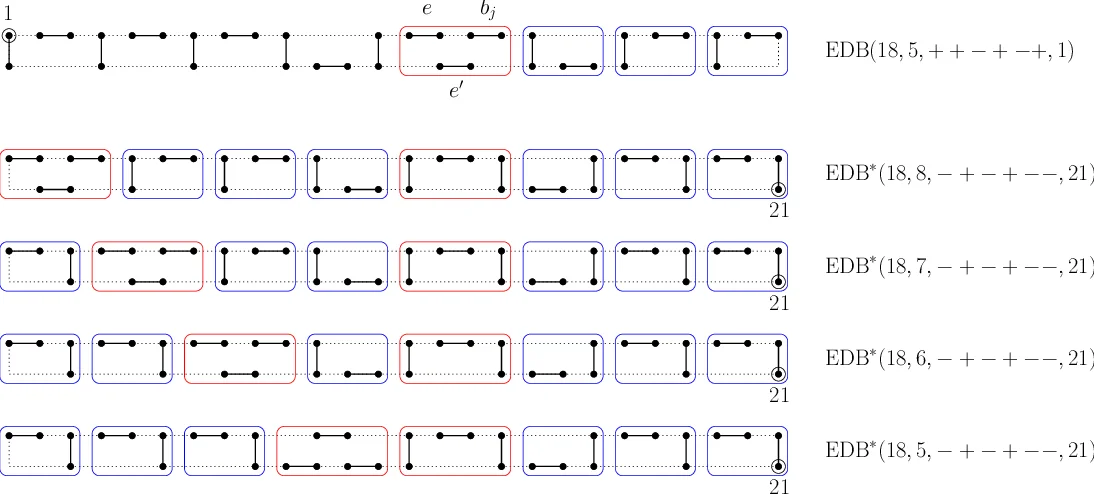
The authors first introduce several combinatorial tools. A block is a pair of edges that together connect four consecutive points (i,i+1,i+2,i+3) as (i,i+3) and (i+1,i+2). If a matching contains a block, the four points can be re‑connected in exactly one way in any matching that is disjoint compatible with it, which imposes strong local restrictions. They also define a flippable set: a collection of alternating edges of a matching that form a convex polygon whose interior is free of other edges. Replacing this alternating set by the complementary alternating set (a flip) yields another matching, and the two are disjoint compatible. Crucially, any pair of disjoint compatible matchings can be described uniquely by a flippable partition of one of them, i.e., a decomposition into pairwise disjoint flippable sets whose flips produce the other matching.
With these notions, the paper proves three main theorems.
Theorem 1 (global structure). For every k ≥ 9 the graph DCMₖ has exactly three isomorphism classes of connected components:
- Small components – the smallest possible order (1 for odd k, 2 for even k);
- Medium components – a middle size depending on k;
- One big component containing all remaining matchings.
Thus DCMₖ is never connected for k ≥ 3; only k = 1,2 give a connected graph.
Theorem 2 (odd k). Let ℓ = ⌈k/2⌉.
- Small components are isolated vertices; their number is
(1·ℓ^{4} - 2ℓ^{3} - ℓ^{2} + 4ℓ - 1). - For k ≥ 3, medium components are stars K₁,ℓ−1 (order ℓ). For k ≥ 5 the number of such stars is ((2ℓ-1)·2^{ℓ-3}).
Theorem 3 (even k). Again ℓ = ⌈k/2⌉.
- Small components are pairs (order 2); their number is ℓ·2^{ℓ-1}.
- For k ≥ 4, medium components have order 6ℓ−6 (a specific regular structure described in the paper). For k ≥ 6 the number of these components is ℓ·2^{ℓ-2}.
The enumerative formulas are derived by a careful analysis of matchings that consist solely of boundary edges (the so‑called rings) and by counting how blocks can be inserted or removed while preserving disjoint compatibility. Rings come in exactly two matchings; they are always disjoint compatible with each other and serve as a “bridge” that connects all non‑small, non‑medium matchings into the unique big component. The authors show that any matching not belonging to a small or medium component can be transformed, via a sequence of flips and block‑replacements, into one of the two rings. Consequently, all such matchings lie in the same connected component.
The proof strategy proceeds in four stages:
- Local restrictions – using blocks and flips to limit possible neighbours of a given matching.
- Classification of extremal matchings – identifying matchings that yield isolated vertices (odd k) or isolated edges (even k).
- Construction of medium components – building families of matchings that share a common “core” and differ only by the placement of a single block, leading to stars for odd k and a more intricate regular graph for even k. The authors prove that any two matchings within the same family are connected, and that different families are not connected to each other.
- Unification into the big component – demonstrating that any remaining matching can be linked to a ring, and that the two rings are adjacent, establishing the existence of a single large component.
Beyond the combinatorial classification, the paper situates its results within broader contexts. Non‑crossing matchings on convex points correspond to pattern links, which form a basis of the Temperley‑Lieb algebra TLₖ(δ) and are linked to alternating sign matrices, fully packed loops, and statistical‑mechanics models. The disjoint compatibility graph can be viewed as a reconfiguration graph, analogous to flip graphs of triangulations or spanning trees. The authors’ findings answer a previously open question (posed by Ishaque et al.) about the connectivity of DCMₖ for even k, showing that even in the convex setting the graph is always disconnected for k ≥ 3.
The paper concludes with additional enumerative data, a brief discussion of “almost perfect” matchings (when the point set has an odd number of points), and several open problems, such as determining the diameter of the big component, extending the analysis to non‑convex point sets, and exploring the interplay with other geometric reconfiguration graphs.
In summary, the work provides a complete structural description of the disjoint compatibility graph of non‑crossing perfect matchings on convex point sets, delivering exact counts of all component types, explicit constructions of each component, and a clear connection to well‑studied algebraic and combinatorial objects.
Comments & Academic Discussion
Loading comments...
Leave a Comment