Almost optimal sparsification of random geometric graphs
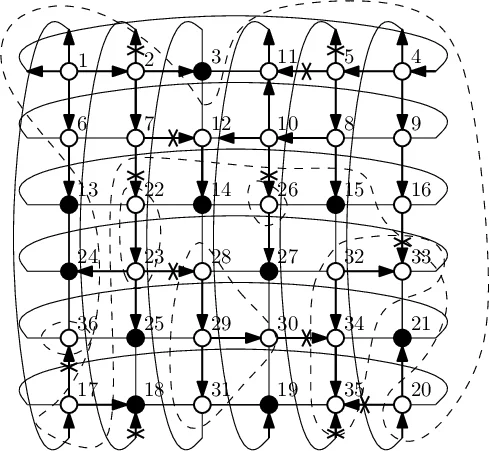
A random geometric irrigation graph $\Gamma_n(r_n,\xi)$ has $n$ vertices identified by $n$ independent uniformly distributed points $X_1,\ldots,X_n$ in the unit square $[0,1]^2$. Each point $X_i$ selects $\xi_i$ neighbors at random, without replacement, among those points $X_j$ ($j\neq i$) for which $|X_i-X_j| < r_n$, and the selected vertices are connected to $X_i$ by an edge. The number $\xi_i$ of the neighbors is an integer-valued random variable, chosen independently with identical distribution for each $X_i$ such that $\xi_i$ satisfies $1\le \xi_i \le \kappa$ for a constant $\kappa>1$. We prove that when $r_n = \gamma_n \sqrt{\log n/n}$ for $\gamma_n \to \infty$ with $\gamma_n =o(n^{1/6}/\log^{5/6}n)$, then the random geometric irrigation graph experiences explosive percolation in the sense that when $\mathbf E \xi_i=1$, then the largest connected component has size $o(n)$ but if $\mathbf E \xi_i >1$, then the size of the largest connected component is with high probability $n-o(n)$. This offers a natural non-centralized sparsification of a random geometric graph that is mostly connected.
💡 Research Summary
The paper studies a sparsification scheme for random geometric graphs (RGGs) based on the so‑called irrigation (or Bluetooth) model. Let X₁,…,Xₙ be i.i.d. uniform points in the unit square (treated as a torus). For a given radius rₙ, the underlying RGG Gₙ(rₙ) connects any two points whose toroidal distance is at most rₙ. The authors consider a subgraph Γₙ(rₙ,ξ) obtained by letting each vertex independently choose a random number ξᵢ of neighbours among those lying within distance rₙ, without replacement. The integer‑valued ξᵢ satisfies 1 ≤ ξᵢ ≤ κ for a fixed κ>1, and the ξᵢ’s are i.i.d. with mean μ=E
Comments & Academic Discussion
Loading comments...
Leave a Comment