Compressive Hyperspectral Imaging Using Progressive Total Variation
Compressed Sensing (CS) is suitable for remote acquisition of hyperspectral images for earth observation, since it could exploit the strong spatial and spectral correlations, llowing to simplify the architecture of the onboard sensors. Solutions proposed so far tend to decouple spatial and spectral dimensions to reduce the complexity of the reconstruction, not taking into account that onboard sensors progressively acquire spectral rows rather than acquiring spectral channels. For this reason, we propose a novel progressive CS architecture based on separate sensing of spectral rows and joint reconstruction employing Total Variation. Experimental results run on raw AVIRIS and AIRS images confirm the validity of the proposed system.
💡 Research Summary
The paper addresses the challenge of applying compressed sensing (CS) to hyperspectral imaging in the context of satellite push‑broom sensors, which acquire data one spectral row (x‑λ plane) at a time while the along‑track dimension (y) is built up sequentially. Existing CS approaches typically treat the spatial dimensions (x‑y) jointly and then refine the reconstruction using the spectral dimension (λ), or they decouple spatial and spectral processing. Such strategies ignore the actual acquisition order of push‑broom instruments, leading to inefficient use of correlations and prohibitive computational costs when reconstructing large 3‑D data cubes.
The authors propose a novel “x‑λ + y” architecture. Each spectral row (F_i) (size (N_C \times N_B)) is measured independently using a random Gaussian sensing matrix (\Phi_i) that produces (M < N_CN_B) compressed measurements (y_i = \Phi_i \operatorname{vec}(F_i)). This matches the push‑broom acquisition flow, allowing on‑board compression without storing the full cube.
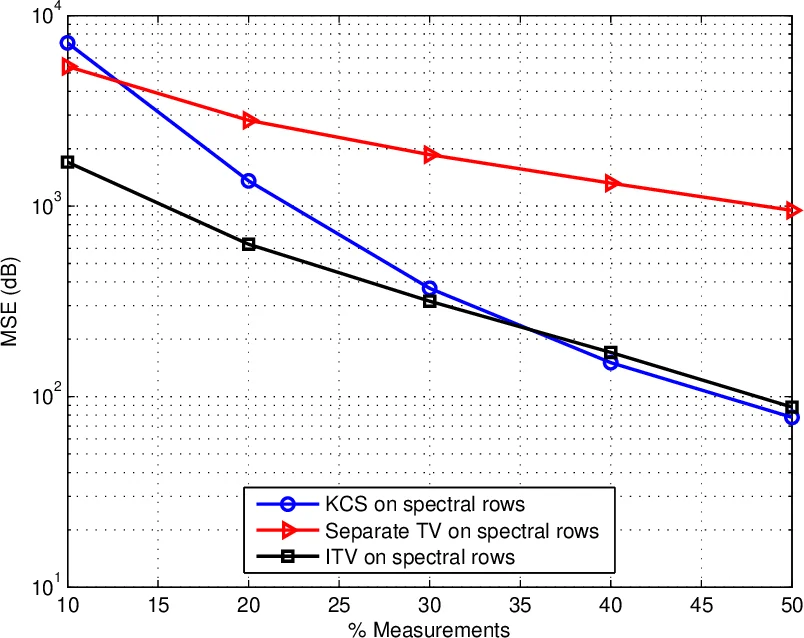
Reconstruction proceeds in two stages. First, each row is reconstructed separately by solving a total variation (TV) minimization problem: (\min_X TV(X)) subject to (\Phi_i \operatorname{vec}(X)=y_i). TV promotes sparsity of the gradient, which is appropriate for the piecewise‑smooth nature of spectral rows. However, this initial estimate ignores vertical (y) correlation.
To incorporate the y‑direction information, the authors introduce an Iterative Total Variation (ITV) algorithm. At iteration (n), a prediction (F_P) for row (i) is generated from the latest estimates of its neighboring rows (F_{i-1}^{(n-1)}) and (F_{i+1}^{(n-1)}) using a predictor similar to that in prior work
Comments & Academic Discussion
Loading comments...
Leave a Comment