Equivariant absolute extensor property on hyperspaces of convex sets
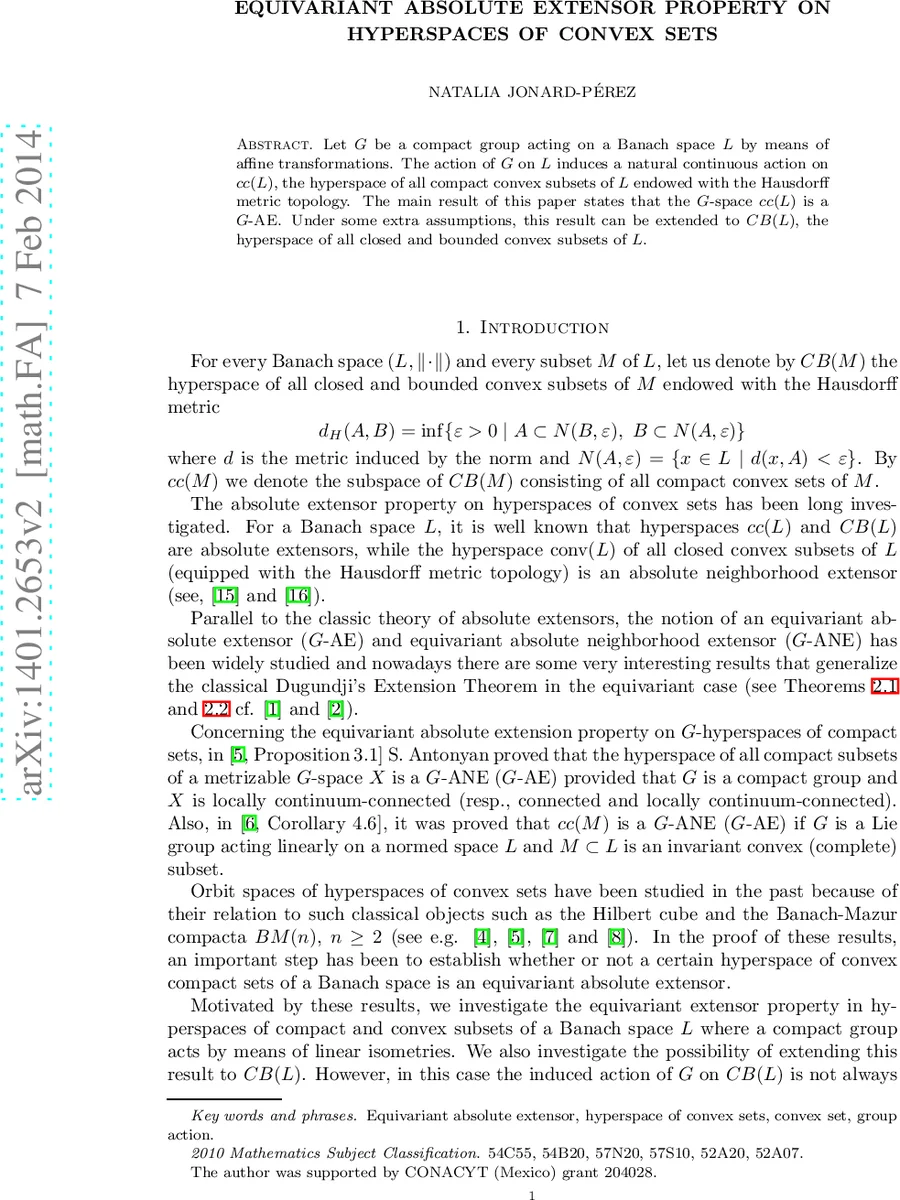
Let G be a compact group acting on a Banach space L by means of linear isometries. The action of G on L induces a natural continuous action on cc(L), the hyperspace of all compact convex subsets of L endowed with the Hausdorff metric topology. The main result of this paper states that the G-space cc(L) is a G-AE. Under some extra assumptions, this result can be extended to CB(L), the hyperspace of all closed and bounded convex subsets of L.
💡 Research Summary
The paper investigates the equivariant absolute extension property of hyperspaces of convex subsets in a Banach space when a compact group acts on the space. Let G be a compact group and L a Banach space equipped with a continuous linear isometric (or more generally affine) action of G. The action on L induces a natural action on the hyperspace cc(L) of all non‑empty compact convex subsets of L, as well as on CB(L) (the family of all closed bounded convex subsets) via g·A = {g a | a ∈ A}. The induced action is always continuous on cc(L); however, it may fail to be continuous on CB(L) unless additional hypotheses on the topology of G are imposed (e.g., G finite or equipped with the operator‑norm topology). An explicit counter‑example using the Cantor group and L = C(G,ℝ) shows the discontinuity.
The central technical tool is the Radström‑Schmidt (or Radström) embedding. For a hyperspace K (= cc(L) or CB(L)) one defines an equivalence relation on K × K by (A,B) ∼ (C,D) ⇔ A + D = B + C. The quotient H(K) becomes a real vector space with addition and scalar multiplication induced from Minkowski sum and scaling. The norm on H(K) is defined by ‖h_{A,B}‖ = d_H(A,B), where d_H is the Hausdorff distance inherited from L. The map j: K → H(K), j(A) = h_{A,{0}}, is an isometric embedding.
If G acts linearly and isometrically on L, the rule g·h_{A,B} = h_{gA,gB} gives a well‑defined, continuous, isometric action of G on H(K). Consequently, H(K) is a Banach G‑space and j(K) is a closed, convex, G‑invariant subset of it. Classical results (Theorem 2.1) state that any closed convex G‑invariant subset of a Banach G‑space is a G‑absolute extensor (G‑AE). Hence j(K) and therefore K itself inherit the G‑AE property.
The main theorem (Theorem 5.1) asserts that for any compact group G and Banach G‑space L, the hyperspace cc(L) is always a G‑AE. Moreover, if the induced action on CB(L) is continuous (which holds, for instance, when G is finite or when the topology on G is the operator‑norm topology), then CB(L) is also a G‑AE.
Further corollaries (Theorem 5.2) extend the result to any G‑invariant convex family C ⊂ K. If C is closed in K, then C is a G‑AE; if G is a Lie group, C is a G‑ANE, and the presence of a G‑fixed point upgrades it to a G‑AE. Concrete examples include:
- The hyperspace of all convex bodies in ℝⁿ (or the unit ball Bⁿ) under the orthogonal group O(n);
- The family of all finite‑dimensional convex compacta;
- The family of all infinite‑dimensional convex compacta;
- The family of all closed bounded convex subsets with non‑empty interior.
These examples recover known results (e.g., Antonyan’s and Chigogidze’s work) and demonstrate that the equivariant absolute extension property holds under very natural symmetry assumptions.
The paper also discusses the necessity of continuity of the induced action on CB(L). Example 3.1 shows that without suitable topological control on G, the action can be discontinuous, preventing CB(L) from being a G‑AE. Conversely, Example 3.3 shows that when G is equipped with the uniform convergence topology (or is finite), the action becomes continuous.
In summary, the work provides a clean and general proof that hyperspaces of compact convex sets in a Banach space are equivariant absolute extensors for any compact group acting linearly and isometrically. By embedding these hyperspaces into a Banach G‑space via the Radström construction and invoking classical equivariant extension theorems, the authors extend the classical Dugundji extension theory to the equivariant setting, covering a wide range of natural examples and clarifying the role of continuity in the induced action on CB(L).
Comments & Academic Discussion
Loading comments...
Leave a Comment