Searching for integrable Hamiltonian systems with Platonic symmetries
In this paper we try to find examples of integrable natural Hamiltonian systems on the sphere $S^2$ with the symmetries of each Platonic polyhedra. Although some of these systems are known, their expression is extremely complicated; we try here to fi…
Authors: Giovanni Rastelli
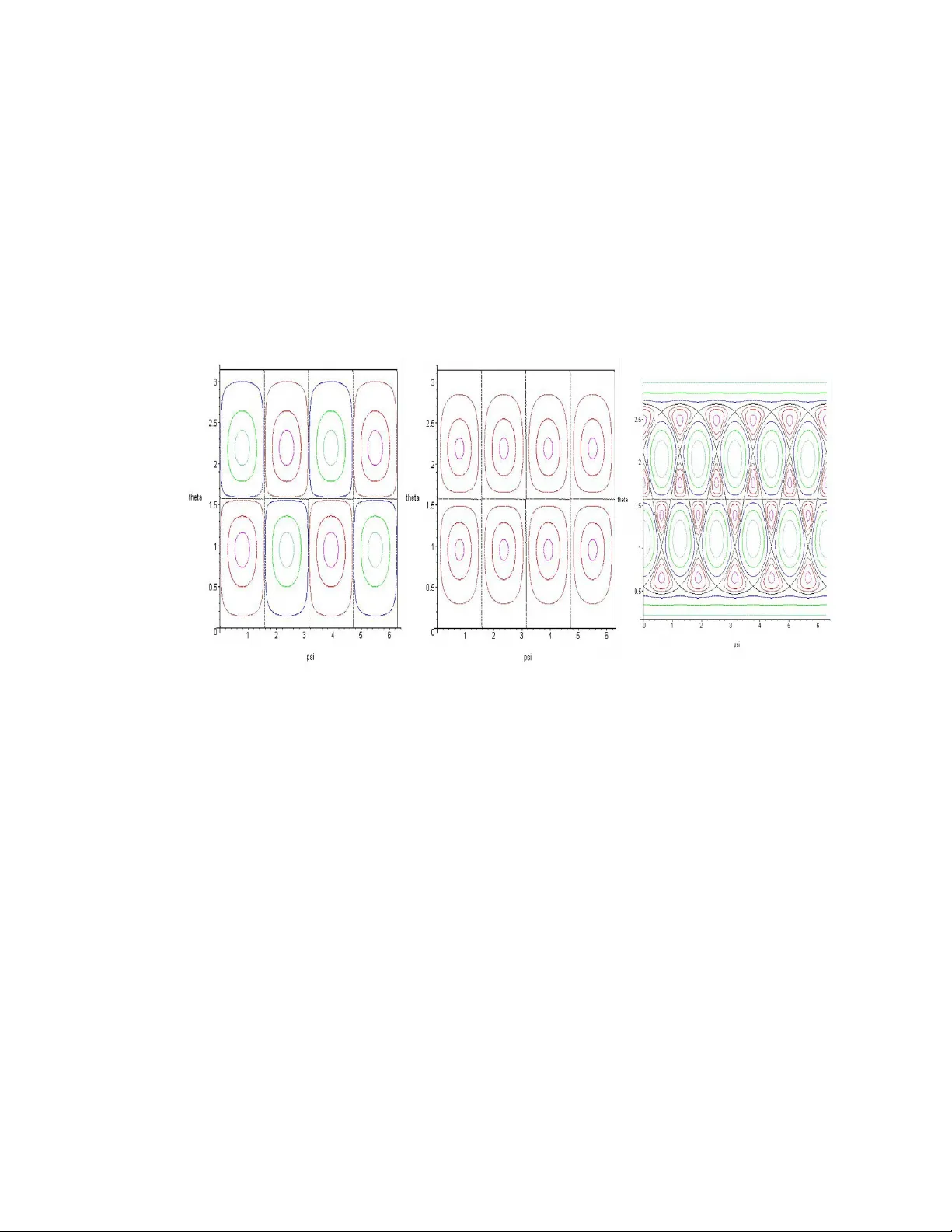
Searc hing for in tegrable Hamiltonian systems with Platonic symmetries Gio v anni Rastelli L ast affiliation : Dipartimen to di Matematica, Univ ersit` a di T orino. T orino, via Carlo Alb erto 10, Italia. e-mail: giorast.giorast@alice.it No vem b er 25, 2021 Abstract In this pap er w e try to find examples of in tegrable natural Hamil- tonian systems on the sphere S 2 with the symmetries of eac h Platonic p olyhedra. Although some of these systems are kno wn, their expres- sion is extremely complicated; w e try here to find the simplest possible expressions for this kind of dynamical systems. Ev en in the simplest cases it is not easy to prov e their integrabilit y b y direct computation of the first in tegrals, therefore, we make use of numerical metho ds to pro vide evidences of in tegrability; namely , by analyzing their Poincar ´ e sections (surface sections). In this wa y w e find three systems with pla- tonic symmetries, one for each class of equiv alen t Platonic polyhedra: tetrahedral, exahedral-o ctahedral, do decahedral-icosahedral, sho wing evidences of integrabilit y . The pro of of integrabilit y and the construc- tion of the first integrals are left for further works. As an outline of the p ossible developmen ts if the in tegrability of these systems will b e pro ved, w e show how to build from them new in tegrable systems in di- mension three and, from these, sup erin tegrable systems in dimension four corresponding to sup erin tegrable in teractions among four points on a line, in analogy with the systems with dihedral symmetry treated 1 in a previous article. A common feature of these p ossibly integrable systems is, besides to the ric h symmetry group on the configuration manifold, the partition of the latter in to dynamically separated regions sho wing a simple structure of the p oten tial in their interior. This ob- serv ation allows to conjecture integrabilit y for a class of Hamiltonian systems in the Euclidean spaces. 1 In tegrable and sup erin tegrable systems It is not easy to include all known completely in tegrable systems within a con- cise definition or ev en a list; they appear in almost ev ery field of mathematics and mathematical ph ysics, from algebraic geometry to sup ersymmetry theory touc hing classical and quan tum mechanics, elliptic curves, minimal sufaces, n umber theory , Riemann surfaces etc [13], [3], [14], [23] [22]. In few w ords, by quoting F.Helein [13]: ”...w orking on completely in tegrable systems is based on a con templation of some very exceptional equations whic h hide a Platonic structure: although these equations do not look trivial a priori, w e shall dis- co ver that they are elementary , once we understand ho w they are enco ded in the language of symplectic geometry , Lie groups and algebraic geometry . It will turn out that this con templation is fruitful and lead to man y re- sults”; the word ”Platonic” m ust b e intended here in its purely philosophical meaning. In the following w e consider classical time-indep enden t completely in tegrable Hamiltonian systems. In this con text, complete in tegrabilit y co- incides with Liouville integrabilit y: a Hamiltonian system with n degrees of freedom is Liouville in tegrable if it admits n functionally indep enden t and P oisson-commuting first integrals (i.e. constan ts of the motion), including the Hamiltonian function itself; the integral curves of the system are then determined by quadratures [1]. Finite dimensional Hamiltonian systems can admit up to 2 n − 1 functionally independent first in tegrals. Liouville in te- grable Hamiltonian systems with extra indep enden t constan ts of the motion are said to b e sup erin tegrable [27]. A w ell kno wn example of completely in- tegrable and sup erin tegrable system is the Kepler system in the plane, whose Hamiltonian in p olar co ordinates ( r , ψ ) is H = 1 2 ( p 2 r + 1 r 2 p 2 ψ ) + k r where k is a real constan t, its functionally indep enden t first integrals are the Hamil- tonian, the angular momentum and one of the comp onen ts of the Laplace v ector (the other dep ends functionally on these three) [17]. The in tegral curv es of (time indep enden t) Hamiltonian systems b elong to the phase-space 2 (cotangen t bundle, in the language of symplectic geometry), whose dimen- sion is twice the degrees of freedom of the Hamiltonian; the existence of 2 n − 1 first integrals implies that eac h in tegral curve is geometrically de- termined b y the one-dimensional in tersection of all the 2 n − 1 dimensional h yp ersurfaces corresp onding to the constants of the motions determined by the initial conditions, then, without need of integrating the Hamilton differ- en tial equations, even if it can b e practically imp ossible its explicitation in that w ay due to the mathematical complexity of the functions in volv ed. If the indep enden t constants of the motion are 2 n − 2, then each in tegral curv e will sta y in their tw o-dimensional in tersection and so on. The n Poisson- comm uting indep endent first in tegrals K i of a Liouville in tegrable Hamilto- nian, under the assumption of completeness and excluding even tual critical p oin ts of the Hamiltonian fields, generate the foliation of the phase space in to the n-dimensional submanifolds determined b y the intersection of the manifolds K i = const. , which are diffeomorphic to R k × T n − k , for 0 ≤ k ≤ n , where T n − k is the n − k dimensional torus (known as Liouville torus). If the Hamiltonian has t wo degrees of freedom, one first integral other than H as- sures the Liouville in tegrabilit y of H and if the submanifolds of the foliation are compact, then they are diffeomorphic to tori [1]. 2 P oincar ´ e sections F or t wo-dimensional completely integrable Hamiltonian systems the phase space is foliated in to tw o-dimensional manifolds and eac h in tegral curve of the system b elongs to one and one only of the leav es of the foliation. In this case, the intersections of an y in tegral curv e with a given plane of the phase space (”Poincar ´ e sections” or ”phase sections”) consist of p oin ts arranged in to curves, determined by the intersection of the tw o-dimensional Liouville torus with the section plane. Naturally , the Liouville tori are only diffeo- morphic to the standard torus, then they app ear twisted and folded in to the phase space so that their in tersections with a section plane can pro duce sev- eral disconnetted closed curves. This b eha viour is a c haracteristic feature of t wo-dimensional in tegrable systems. P oincar´ e sections of non-in tegrable sys- tems, instead, can sho w both p oin ts arranged in curves or points shattered in to the section plane, dep ending on their different initial data (Figure 1), [18]. If one w ant to show the integrabilit y of a system b y means of P oincar´ e sections only , it would b e necessary to pro duce sections for all possible sets 3 of initial conditions all showing p oin ts forming curves; how ev er, this is clarly imp ossible in practice. The only proof of the existence of first in tegrals, and complete in tegrability , is the knowledge of their mathematical expression it- self and the v alidity of P oisson equations. Such a kno wledge can be extremely hard to obtain for Hamiltonian with not simple p oten tials. An experimental approac h is ho wev er possible: numerical integration of the integral curves of the system can b e performed for generic initial data and P oincar´ e sections can b e obtained. Several computer algebra systems can do the task and w e used the ”p oincare” pro cedure implemented in Maple 9.5. By analyzing the P oincar ´ e sections so obtained we can ha ve an exp erimen tal evidence of in tegrability , in the case all sections we obtain for generic initial data show the features exp ected in case of in tegrable systems, and therefore fo calize the efforts in search of a rigorous pro of. W e pro duce b elo w some of these exp er- imen tal evidences for three p oten tials with the symmetries of the Platonic p olyhedra. 3 The Calogero system and dihedral symme- try An in tegrable system of great imp ortance in mathematical physics is the Calogero-Sutherland-Moser system [3], which is studied b oth in its classical and quantum form. This system, in its simplest form, describes the recipro cal in teractions of three p oin ts on a line, denoted b y their p ositions x i with resp ect to some origin, with p oten tial (1) V = 1 ( x 1 − x 2 ) 2 + 1 ( x 2 − x 3 ) 2 + 1 ( x 3 − x 1 ) 2 . It is p ossible to write the Calogero system as a one-p oin t system in R 3 with cylindrical co ordinates ( r, ψ , z ) (see Section 8 and [5]) whic h, b ecause of the conserv ation of the momentum, reduces to a t wo-dimensional system in the plane ( r , ψ ) with p oten tial (2) V = 1 r 2 sin 2 3 ψ . It is now eviden t the dihedral symmetry of the system: the plane is divided in to six iden tical sectors where the dynamics is the same, and the symmetries 4 of the potential are those of the hexagon (the discrete rotational symmetries of the regular p olygons and their reflectional symmetries are called dihe- dral symmetries). P articles mo ving on the plane under the potential V are trapp ed into eac h sector b y the infinite v alue of the p oten tial attained on the b oundaries of the sector. In [5] is conjectured the sup er-in tegrabilit y of systems in the plane with p oten tial V = 1 r 2 sin 2 k ψ with k integer and, for o dd k, the expression of the corresp onding constant of the motion is given (the pro of will b e published so on), moreo ver, these systems are sho wn to corresp ond to three-b ody in teractions among three p oin ts on a line in the same wa y of the Calogero system. F or these systems the dihedral symmetry corresp onds to the symmetry of the regular p olygon with 2 k sides. Other studies ab out systems with dihedral symmetry recently app eared are [24], [25], [16]. The hexagonal symmetry of the p oten tial (2) is directly related to a cubic in the momen ta first integral of the system and the same holds for more general p oten tials [5]. It must b e remarked that the hexagonal symmetry is completely hidden if the p oten tial is represen ted as (1). The main idea of the present inv estigation is (try) to show that, in analogy with the Calogero system, finite symmetries of the p oten tial, maybe together with some other ingredien t, lead to first integrals. 4 Systems with Platonic symmetries It is natural try to generalize the previous results to the three dimensional space, then, to search for integrable Hamiltonian systems with p oten tials of the form (3) V = 1 ρ 2 f ( θ , ψ ) in spherical co ordinates ( ρ, θ, ψ ) where f is a function on the sphere S 2 , with p olyhedral symmetry . Integrable systems of this kind will b e sup er- in tegrable if em b edded in R 4 (with 5 independent constan ts of the motion) and equiv alent to sup erin tegrable in teractions among four points on a line, as w e show in Section 9. The resulting natural Hamiltonian system in the three-dimensional Euclidean space is sometimes referred to as ”conformal 5 mec hanics” and its construction is generalizable to the building of integrable and superintegrable systems from spheres S n − 1 to n -dimensional Euclidean spaces [5], [6], [10] (where connections are made with Calogero system, Higgs oscillators and sup ersymmetric mec hanics). W e limit our inv estigation to p oten tials with the same symmetries of the fiv e Platonic p olyhedra as the simplest three-dimensional generalization of the dihedral symmetry manifested by the Calogero and the other systems seen ab o ve. There is no need to remark the relev ance of Platonic p olyhedra in philosoph y , arts and science, more can b e found for example in [7]. The Platonic polyhedra are those p olyhedra whose faces are all made b y the same regular p olygons and whose v ertices b elong to a sphere. Their symmetries are the rotations and reflections lea ving fixed the cen ter of the p olyhedron and making the faces to corresp ond, lea ving in this w ay unaltered the ap- p earence of the solid: the p olyhedral symmetries are those rotations and reflections which lea ve in v ariant the p olyhedron. Since Euclid’s times it is kno wn that there are only fiv e possible Platonic p olyhedra: tetrahedron, ex- ahedron (or cub e), o ctahedron, do decahedron and icosahedron. Actually , esahedron-o ctahedron and do decahedron-icosahedron form so called dual (or recipro cal) couples (the centers of the faces of one correspond to the v ertices of the other) and each couple share the same symmetries while the tetra- hedron is self-dual. The same symmetries are shared by the Archimedean p olyhedra obtained from the Platonic ones, and b y their duals the Catalan solids [7], [4], [23]. Namely , the symmetries we are considering are the p oly- hedral groups denoted b y T 12 , O 24 and I 60 (isomorphic to A (4), S (4), A (5) resp ectiv ely , A ( n ) and S ( n ) denoting the alternate and symmetric grups of degree n resp ectiv ely), where the low er n um b er is the order of the group. An example of sup erin tegrable system with platonic symmetry whose first in tegrals can b e explicited is giv en in [11]. It is obtained from the three particle Calogero system D 3 [20] and interpreted as p oten tial generated b y six cen ters of force on the sphere, eac h one on the v ertices of a cub octahedron (one of the Archimedean p olyhedra). It is a superintegrable system with the symmetries of the exahedron-o ctahedron, and its p oten tial on the sphere is V C O = 9(8 − tan 2 θ ) 2 2(3 tan 2 θ − 8 + tan 3 θ cos 3 ψ ) 2 + 12 3 tan 2 θ − 8 + tan 3 θ cos 3 ψ + + 9 4 sin 2 θ (1 + cos 6 ψ ) , its first integrals can be obtained by follo wing [11]. Here, the integrabilit y 6 of the system is deriv ed from that of the original Calogero system D 3 , the complexit y of the p oten tial mak e almost imp ossible an y direct inquiry in that direction. W e try here to build simpler inte grable systems with platonic symmetries in order to pro vide more suitable matter for further analysis. Symmetry groups for Platonic polyhedra and their p olynomial in v arian ts, i.e. p olynomials in CArtesian co ordinates ( x, y , z ) left in v arian t by the sym- metry groups of the corresp onding p olyhedra, are w ell known. Examples of applications of platonic symmetries in ph ysics and mathematics are [2] or [23], generalizations are curren tly ob ject of in v estigation relatively to more general symmetry groups [12]. It can b e sho wn that all in v ariant polynomials ov er the reals R (or the complex C ) for eac h one of the symmetry group of the Platonic p olyhe- dra can be written as polynomials, o ver the field R (or C ), in the v ariables [ U 1 , U 2 , U 3 ], where the U i are suitable homogeneous poynomials in Cartesian co ordinates ( x, y , z ) (an instance of the celebrated Hilb ert finite base theo- rem) [9], [21]. Because of their homogeneit y , these p olynomials, written in spherical coordinates, can alw ays b e factorized into the form U i = ρ k f i ( θ , ψ ) for some p ositiv e integer k , this corresp ond to some ”conformal inv ariance” of the system [10]. Therefore, the functions f i on S 2 so determined carry all the p olyhedral symmetries of the original p olynomial, the same do f − 1 i and an y function of the form g ( ρ ) f − 1 i for arbitrary functions g ( ρ ). In analogy with the tw o-dimensional dihedral case, we will consider p oten tial functions on S 2 of the form V = f − 1 and in R 3 of the form W = ρ − 2 f − 1 . T o pro- duce our examples we consider some of the p olynomials of the bases ( U i ) as giv en in [9], due to the fact that they ha v e p ossibly the simplest algebraic expression for functions with the desired symmetries. In these bases, the low est-order p olynomial is alw ays x 2 + y 2 + z 2 whic h ob viously is inv ariant under all rotations and reflections lea ving fixed the origin, while, T = xy z for the tetrahedron, O = x 2 y 2 z 2 for the exahedron-o ctahedron and I = − z (2 x + z )( x 4 − x 2 z 2 + z 4 + 2( x 3 z − xz 3 ) + 5( y 4 − y 2 z 2 ) + 10( xy 2 z − x 2 y 2 )) for the do decahedron-icosahedron, are characteristic of each of them. The p olynomial T O = x 2 y 2 + x 2 z 2 + y 2 z 2 is common to the bases of tetrahedral and 7 o ctahedral in v arian t p olynomials. By writing these p olynomials in spherical co ordinates and b y factorizing out the radial terms, we obtain, as describ ed ab o v e, the functions f i for the p olynomials T , O and I and from f − 1 i the follo wing ”platonic” p otentials on the sphere: V T = (sin 2 θ cos θ cos ψ sin ψ ) − 1 with tetrahedral symmetry , V O = V 2 T with cubic-o ctahedral symmetry , and V I = − cos − 1 θ [cos 5 θ − 5 sin 2 θ cos 3 θ + 5 sin 4 θ cos θ + sin 5 θ (32 cos ψ sin 4 ψ − 24 cos ψ sin 2 ψ + 2 cos ψ )] − 1 , with do decahedral-icosahedral symmetry . Still, it is not easy to find directly the expressions of first in tegrals of these systems, ev en b y using computer algebra metho ds as we did in the lo wer-dimensional case [5]. Therefore, w e in tegrate n umerically the natural Hamiltonian systems with the three p oten tials of ab o ve on the sphere and analyze their P oincar´ e sections. P oincar´ e sections are meaningful only if orbits b elong to a compact sub- manifold of the phase space, in this case each orbit, numerically computed, winds itself in general several times around the Liouville torus and can pro- duce several points on a suitably chosen section plane. This happ ens in our case in the regions of S 2 where the p oten tial is p ositiv e. In the remaining regions the p oten tial generates a force pulling the particle to w ards the b or- ders of the region and the orbit crosses the section planes only few times. The structure of the Hamiltonian in the negative-potential regions could b e studied by considering − V instead of V , whic h of course are differen t systems. It is remark able that in all these examples the sphere is partitioned b y the lines of the zero es of the f i in to separated regions. Because on these lines the v alue of V go es to infinity , particles moving under the p oten tial V cannot cross the b orders of these regions. In these regions, the p oten tial admits just one critical p oin t which is either a maxim um or a minim um (Figure 2), therefore, the structure of the dynamics is essentially simple: there are on the sphere dynamically separated regions each one with some simple dynamical structure. The same happens for the Calogero system considered ab o v e: the 8 sphere S 1 is partitioned into six regions b y the infinities of the p oten tial, regions equiv alen t under the symmetries of the hexagon. P ossibly as a consequence of that additional structure, the corresp onding Hamiltonian systems app ear to b e Liouville integrable: the computation of Poincar ´ e sections for sev eral randomly chosen initial conditions in the regions where the p oten tial is p ositiv e shows in fact alw ays the curvilinear features of the intersections of the integral curv es with the section planes, giving evidence of an indep enden t first integral K ( p θ , p ψ , θ , ψ ) at least for eac h system (Figure 3). This happ ens also for the systems with p oten tial − V in the regions where V is negative. The simple p oten tial in each region can allow the existence of a lo cal first in tegral which is extended on the other regions corresp onding under the platonic symmetry group. The same approac h with p oten tials on the sphere obtained from the f i instead of the f − 1 i of abov e do not sho w y et signs of in tegrabilit y . Some computations made with the p oten tial obtained in a similar w ay from the third p olynomial of the icosahedral base ( U i ) giv en in [9] indicate its in tegrability , ho wev er, muc h less sections ha ve b een considered in this case. Not all the p oten tials with platonic symmetry obtained from the p olyno- mials U i seem to b e in tegrable; as an example consider V T O = sin − 2 θ [cos 2 ψ − cos 4 ψ − cos 2 ψ cos 2 θ + cos 4 ψ cos 2 θ + cos 2 θ )] − 1 , obtained from the polynomial T O of ab ov e, whic h sho ws six isolated poin ts of maxim um with infinite v alue there. In this case the sphere is not partitioned in to regions with a simple b eha viourhed p oten tial. Neither all integrable p oten tials with platonic symmetries partition the sphere into dynamically separated regions with a simple p oten tial within, for example, V C O . The integrable dynamics just analyzed on the sphere can b e extended to the three-dimensional space with the p oten tials W = ρ − 2 V . The new natural Hamiltonian systems are integrable in R 3 if the original ones on the sphere are, and their em b edding in dimension 4 is sup erin tegrable as w e pro ve in Sections 7 and 8. An harmonic term prop ortional to ρ 2 can b e added to each one of the previous p oten tials in R 3 k eeping the integrabilit y and allo wing for finite tra jectories of the systems. Then, integrabilit y can b e studied by analyzing the orbit structure of the system b y following the approac h dev elop ed in dimension 2 b y [24]. Even if w e do not know y et the expression of the p ossible first integrals, lik ely they are p olynomial in the momen ta. 9 In Sections 8 and 9 we see as In tegrable systems on S 2 lead to sup er- in tegrable 4-p oints systems on a line, in the same wa y in tegrable systems on S n − 2 can b e interpreted as superintegrable n -b o dy systems on a line [5]. In this p erspective could b e interesting to analyze higher dimensional p oly- top es (by using a Co xeter’s expression, a p olytope is the general term of the sequence: p oint, segment, p olygon, p olyhedron,...), in Euclidean or non Euclidean spaces [4]. 5 Remarks The partition of the configuration manifold into ”simple” dynamically sep- arated regions united to some suitably ric h symmetry group on the same manifold seems a go o d indicator of integrable p oten tials. F or example, on the Euclidean plane p oten tials of the form V 1 = (sin a hx cos b k y ) − 1 , with a, b, h, k positive in tegers and ( x, y ) cartesian co ordinates, partition by their lines of infinities the plane into rectangular regions where the p oten tial has only one point of maxim um or minim um and a simple behaviour. In eac h region of the partition the P oincar´ e sections sho w a dynamics compatible with in tegrability . On the plane, these systems admit translational symmetries along axes x and y of magnitude s x h π (resp s y k π ), where s x ( s y ) are ev en in tegers for a (resp. b ) o dd and any in teger otherwise, all generated by a π h ( 2 π h for o dd a ) translation in the x direction and by a π k ( 2 π k for o dd b ) translation in the y direction. The lines of reflectional symmetry hav e equations x = s x 2 h π and y = s y +1 2 k π . It seems likely that integrabilit y holds also for the three-dimensional natural Hamiltonian systems in the Euclidean space with p oten tial of type W 1 = (sin a hx sin b k y sin c l z ) − 1 with c and l positive in tegers, as well as for the generalization of these systems to higher dimensions, where again the space is honeycombed in to dynamically separated cells with simple p oten tials in eac h of them and the symmetry group is generated b y the elemen tary translations of magnitude π h , π k , π l (t wice in the cases of o dd a , b , c resp ectiv ely) in the three co ordinate directions, plus the ob vious reflectional symmetries. In all these cases, assuming they 10 are integrable, the in tegrabilit y in each cell, which is due to some lo cal first in tegral, is extended to the whole configuration manifold b y the symmetry group on it and the lo cal first in tegrals b ecome a global one. P otentials of the form V 2 = (sin a hθ sin b k ψ ) − 1 instead, hav e p olyhedral but not platonic symmetry and partition the sphere in to a meridian-parallel web of ”simple” dynamically separated regions b y their lines of infinite v alue. In this case, the rotations of the dihedral symme- try group on the configuration manifold are generated b y the rotation around the p oles of amplitude π k for b ev en and π k for o dd b , a dihedral group. The planes of reflectional symmetry are defined by the integer m ultiples of ψ = π k for b ev en and ψ = 2 π k for o dd b . There is the additional reflectional symme- try with resp ect to the equatorial plane when a is even or h is o dd. While app earing in general in tegrable, in some cases their Poincar ´ e sections seem to show integrable b eha viour only in the regions which are not neigh b ouring to the p oles, for example for a = 4, h = 2, b = 1, k = 3. A b eha viour analogous to the systems with p oten tials of type V 2 is sho wn in the Euclidean plane b y the p oten tials of type V 3 = (sin a hr cos b k ψ ) − 1 with, m utatis mutandis, all p ossible permutations of sin and cos functions, where ( r, θ ) are p olar co ordinates. In the regions neighbouring to the origin they seem do not to b e alw ays in tegrable, differently from the others regions, for example when a = b = 2, h = k = 1. Here, an eviden t dihedral symmetry group exists. In all these cases, some kind of local first in tegral could exist on the quadrangular regions only , but not on the triangular ones neighbouring to the origin. A lo cal in tegral is extended by the symmetries of the config- uration manifold to a semiglobal first in tegral on the whole manifold min us the regions surrounding the p oles of the coordinates: the whole plane min us a disc cen tered on the origin of the co ordinates. Due to the dynamical sep- aration of eac h region, systems of this kind could be considered completely in tegrable as far as initial conditions are not c hosen to b e in to the ”bad” regions around the p oles. Differen tly from these last examples, the Calogero system considered ab o v e, the systems in [5] with dihedral symmetry and the particular case 11 of V 2 with a = 2, h = 1 on the sphere, admit the additional symmetry of sep- arabilit y . Indeed, in all these cases the differential equations of the dynamics are separated for the tw o co ordinates thanks to a quadratic first integral (see [5] for the first tw o cases). On the sphere, the natural Hamiltonian with p oten tial V 4 = F ( ψ ) sin 2 θ , for any function F ( ψ ), admits the quadratic first integral p 2 ψ + 2 F ( ψ ) and is therefore completely integrable and separable as in the previous cases. Symmetries like the latter are sometimes called ”hidden”, b ecause not im- mediately recognizable from the expression of the p otential, as instead is for example the cen tral symmetry for the Kepler system whic h is associated with the conserv ation of the angular momentum. In some cases, hidden symme- tries can b e un veiled b y muc h more eviden t ones. It is the case of the three b ody Calogero system sho wn abov e where the hidden symmetry is a third- order p olynomial in the momenta, unv eiled by the hexagonal symmetry of the p oten tial written in the cen ter of mass frame. Remark ably , in [15] the three-dimensional system with Hamiltonian H = p 2 ρ + p 2 θ ρ 2 + p 2 ψ ρ 2 sin 2 hθ + α ρ + 1 ρ 2 β 1 cos 2 hθ + β 2 sin 2 hθ cos 2 k ψ + β 3 sin 2 hθ sin 2 k ψ where α , β i are real parameters, is sho wn to be maximally sup erin tegrable for all h, k rationals. If reduced to the submanifolds ρ = const. , for α = β 1 = 0 and h = 1 the system b ecomes an instance of the natural Hamiltonian on the sphere with p oten tial V 4 and dihedral symmetry . W e think to ha v e provided here several evidences for the presence of hidden symmetries connected b oth with platonic symmetries of the potential and with the partition of the configuration manifold into simple dynamically separated regions. An ywa y , all the examples of abov e are just hin ts to further inquiries and w e do not pretend to giv e here a detailed description of their b eha viour. 6 Quan tization The classical systems here considered can b e transformed in to quantum me- c hanical ones b y standard quan tization tec hniques. Indeed, the Calogero system is in origin quan tistic. Instead of Hamiltonians we hav e in this case 12 Sc hr¨ odinger op erators on the sphere or on the Euclidean three-dimensional space, instead of Poisson commuting quadratic in the momenta first in te- grals, comm uting second order differen tial op erators. More subtle is the quan tization of higher-order first in tegrals [8] or the definition of quan tum sup erin tegrabilit y [26]. W e do not consider further here the quantum v ersion of our systems. 7 First in tegrals in R 3 The pro cedure described b elow applies to every Hamiltonian in tegrable sys- tem on the sphere with p oten tial of the form (3), in particular to the systems describ ed in Section 4, provided they admit a first in tegral and are, conse- quen tly , completely in tegrable. The natural Hamiltonian on S 2 is H 1 = 1 2 ( p 2 θ + 1 sin 2 θ p 2 ψ ) + V ( θ , ψ ) and our platonic systems correspond to the case when V is either V T , V O or V I . Let us call H 2 ( θ , ψ , p θ , p ψ ) an indep enden t first integral of H 1 , (the unknown first in tegral inferred from the structure of the P oincar ´ e sections in our case). The system is then Liouville in tegrable. Let, in spherical coordinates ( ρ, θ , ψ ) of R 3 , H 3 = 1 2 ( p 2 ρ + 2 ρ 2 H 1 ) + k 2 ρ 2 , the natural Hamiltonian with potential W = 1 ρ 2 V + k 2 ρ 2 where the original p oten tials on the sphere are mo dified by a harmonic term with parameter k ∈ R + . The system determined b y H 3 is completely integrable if H 1 is. Indeed, the three functions H 3 , H 1 and H 2 are functionally indep enden t and all in in volution if H 1 and H 2 are. The equations of the motion are partially separated in to equations in θ , ψ , for the dynamics pro jected on to the sphere of fixed radius ρ 0 (the dynamics of H 1 ), and p 2 ρ = 2 h 3 − k ρ 2 − 2 ρ 2 h 2 where h i are the v alues tak en by H i in the giv en initial conditions. 13 8 First in tegrals in R 4 . The Hamiltonian H 3 of ab o v e can b e extended to R 4 [5], [10] b y introducing cylindrical co ordinates ( u, ρ, θ , ψ ) and obtaining the natural Hamiltonian H 4 = 1 2 ( p 2 u + 2 H 3 ) whic h admits the trivial first in tegral H 5 = p 2 u and, if k = 0, the less trivial H 6 = 1 2 ( up ρ − ρp u ) 2 + u 2 ρ 2 H 1 , in these co ordinates, ρ is the distance from the axis of the three-dimensional cylindrical h yp ersurfaces. The functions H 1 , H 2 , H 4 and H 5 are still inde- p enden t and in in volution with eac h-other, while H 6 , if k = 0, is in in volution with H 1 , H 2 , H 4 and indep enden t from H 1 , H 2 , H 4 and H 5 . Therefore, the system of Hamiltonian H 4 is (minimally) sup erin tegrable in R 4 . Other ex- amples of this kind of extension, applied to sup erin tegrable Ev ans systems, are giv en in [6]. 9 F our p oin ts on a line The system of ab o v e can b e in terpreted as a natural Hamiltonian system describing recipro cal four-b o dy interactions among four p oin ts on a line b y the c hange of v ariables u j = 1 p j ( j + 1) ( x 1 + . . . + x j − j x j +1 ) j = 1 . . . 3 u 4 = 1 √ 4 ( x 1 + . . . + x 4 ) , where u 1 = x , u 2 = y , u 3 = z , u 4 = u and x i denote the p ositions of four p oin ts on a line whose dynamics is still describ ed by the Hamiltonian H 4 and k eep the same integrals of the motion. The integral H 5 corresp ond to 14 the conserv ation of the momen tum of the system of four b o dies. Evidently , the previous iden tification b et w een one-p oin t systems in R 4 and four b ody systems on R is essen tially unaffected b y phase shifts in θ and ψ , namely transformations θ → θ + θ 0 and ψ → ψ + ψ 0 , because suc h phase shifts do not mo dify the dynamics of the four p oin ts but only their recipro cal p osition on the line. An example of the equiv alence just remark ed is given in [5] b et w een the Calogero and W olfes p oten tials. The pro cedure can be extended to n p oin ts on a line [6]. 10 Numerical pro cedures The P oincar´ e sections of this paper hav e b een obtained b y using the ”p oincare” pro cedure implemented in Maple 9.5, which is a fourth-order Runge-Kutta algorithm. F or eac h section the integral curv es ha ve b een n umerically in te- grated for a Hamiltonian parameter t ranging t ypically b et w een ± 100 or ± 50 and sev eral h undreds of crossing points are obtained. The section planes par- allel to ( q 1 , p 1 ) or ( p 1 , p 2 ) ha ve b een selected in order to sho w intersections for all the four sets of initial conditions and the c hoice is not particularly relev an t regarding the shap e of the sections. The pro cedure ”p oincare” au- tomatically chec k the maximal p ercen tage deviation from the initial v alue of the Hamiltonian along the computed in tegral curv e, giving in this w a y some measure of the confidence of the integration. If the p ercen tage devi- ation exceed some given maxim um, the accuracy of the in tegration can b e increased, for example, b y refining the discretization of the t in terv al. In our computations we allow ed deviations up to 1 × 10 − 3 % of H , even if in most of the graphics the deviation is typically 1000 times smaller. P oint crossing the section plane are assumed do not describ e curv es if, after further refinements of the t discretization, they k eep that b eha viour. Obviously , the curv es in the section planes are obtained after some minimal discretization and are stable for finer discretizations. The practical minimum of the discretization step on our computer for t in the interv als of ab o ve is around 0 . 002. 11 Conclusions. In this pap er we produce evidences of complete in tegrabilit y for tw o dimen- sional Hamiltonian systems on the sphere with the symmetries of the pla- 15 tonic p olyhedra. By assuming the effective existence of a first in tegral, w e sho w ho w to extend the systems from the sphere to an integrable system in the three-dimensional space and ho w to build sup erin tegrable systems in dimension four corresp onding to four-b o dy interactions on a line. Ev en if no explicit first in tegral of the platonic systems on the sphere is obtained, its existence seems more than probable. The in tegrabilit y of these systems seems ascribable to the presence of a partition of the configuration manifold in to dynamically separated regions, each one with a simple structure of the p oten tial allo wing a lo cal first integral, and of a symmetry group allowing the extension of the lo cal first in tegrals in to a global one on the whole con- figuration manifold. The conjecture is extended to a class of similar natural Hamiltonians in Euclidean spaces. If the extension fails in some of the re- gions, the system can b e considered in tegrable in a semiglobal sense. The approac h seems fertile for further inquiries: first, to w ards a determination of the first intergrals, second, tow ards the extension of the approac h to higher dimensional p olytopes and to non-euclidean spaces. 12 Ac kno wledgemen ts I am grateful to Claudia Chan u and Luca Degiov anni for sev eral fruitful discussions ab out the sub ject of this article. References [1] V.I. Arnold Mathematic al metho ds of classic al me chanics , Springer, New Y ork (1989) [2] H. A. Bethe Splitting of terms in crystals , Selected w orks of H. A. Bethe, W orld Sci. pub., Singapore (1997) (translation from Ann. Ph ysik 3 , 133- 206 (1929)) [3] F. Calogero, J. Math.Ph ys. 10 2191 (1969); C. Marc hioro, J. Math.Phys. 11 2193 (1970); J. Moser, Adv. Math. 16 197 (1975) [4] H. S. M. Coxeter R e gular p olytop es , Do v er, Mineola (1973) [5] C. Chanu, L. Degio v anni and G. Rastelli Sup erinte gr able thr e e-b o dy sys- tems on the line , J. Math. Phys. 49 , 112901 (2008) 16 [6] C. Chanu, L. Degio v anni and G. Rastelli Sup erinte gr able thr e e-b o dy sys- tems in one dimension and gener alizations , [7] P . Cromw ell Polyhe dr a , Cam bridge Universit y press (1999) [8] C. Duv al and G. V alen t, J. Math.Ph ys. 46 , 053516 (2005) [9] A. F ritz and H. Hauser Platonic Stars , Math. Intelligencer, Springer (to app ear); preprint a v ailable at h ttp: //homepage.univie.ac.at/ her- wig.hauser/ [10] T. Hakob yan, S. Kriv onos, O. Lech tenfeld and A. Nersessian Hidden symmetries of inte gr able c onformal me chanic al systems , arXiv:0908.3290v1 (2009) [11] T. Hak oby an, A. Nersessian and V. Y eghikian The cub o ctahe dric Higgs oscil lator fr om the r ational Calo ger o mo del , J. Ph ys. A 42 205206 (2009) [12] K. Iw asaki R e c ent pr o gr ess in p olyhe dr al harmonics , Acta Applicandae Math. 60, 179197 (2000); K. Iwasaki, A. Kenma and K. Matsumoto Polynomial invariants and harmonic functions r elate d to exc eptional r e g- ular p olytop es , Kyush u Univ. Preprin t Series in Math. 2000-11, Kyush u Univ., F ukuok a , 15 pages (2000). [13] F. Helein Constant me an curvatur e surfac es, harmonic maps and inte- gr able systems , Lectures in Mathematics, ETH Z ¨ uric h, Birkh¨ auser Basel (2001) [14] N.J.Hitchin, G.B.Segal and R.S.W ard Inte gr able systems , Oxford grad- uate text in mathematics, Oxford (1999) [15] E. G. Kalnins, J. M. Kress and W. Miller Jr. F amilies of classic al sub- gr oup sep ar able sup erinte gr able systems , [16] E. G. Kalnins, W. Miller Jr. and G. S. P ogosyan Sup erinte gr abil- ity and higher or der c onstants for classic al and quantum systems , [17] L.D. Landau, E.M. Lifschitz Me chanics , Butterworth-Heinemann, Ox- ford (1993). 17 [18] A. J. Lich ten b erg and M. A. Lieb erman R e gular and chaotic dynamics , Springer, New Y ork (1992) [19] N. Nekraso v and S. L. Shatash vili Sup ersymmetric vacua and quantum inte gr ability , Lecture giv en at the XVI ICMP in Prague (2009) (to ap- p ear on the proceedings ?); see also [20] M. A. Olshanetsky and A. M. Perelomo v, Physics Rep orts (Review Sec- tion of Physics Letters) 71 No. 5 313 (1981); M. A. Olshanetsky and A. M. Perelomo v, Physics Reports (Review Section of Physics Letters) 94 No. 6 313 (1983) [21] B. Sturmfels A lgorithms in invariant the ory , T exts & monographs in sym b olic computation, Springer-V erlag/Wien (2008) [22] P .T emp esta F r om symmetries to numb er the ory , Ph ysics of Atomic Nu- clei, V ol. 72, No. 5, pp. 866874 (2009). [23] S. T orquato and Y. Jiao Dense p ackings of the platonic and ar chime de an solids , Nature 460 n.7257, August 2009 [24] F. T rem blay , A. V. T urbiner and P . Win ternitz A n infinite family of solv- able and inte gr able quantum systems on a plane , J. Ph ys. A 42 (2009), no. 24, 242001, 10 pp.; F. T rembla y , A. V. T urbiner and P . Winternitz Perio dic orbits for an infinite family of classic al sup erinte gr able systems , arXiv:0910.0299v1 (2009) [25] C. Quesne Infinite family of sup erinte gr able quantum Hamiltoni- ans on a plane gener alizing the Calo ger o-Mar chior o-Wolfes mo del , arXiv:0911.4404v1 (2009) [26] S. Grav el and P . Win ternitz, J. Math. Ph ys. 43 (12) 5902 (2002) [27] S. W oijecho wski, Ph ys. Lett. A 95 279 (1983) 18 Figure 1: A cr oss se ction showing interse ctions of two distinct tr aje ctories for V T O . Black squar es c orr esp ond to an orbit lying on some 2-dimensional submanifold of the phase sp ac e while the magenta ones c orr esp ond to an orbit not lying on a surfac e. Ther efor e, the system do not show b ehaviour of c omplete inte gr ability. 19 Figure 2: F or the p otentials V T , V O and V I with tetr ahe dr al, cubic-o ctahe dr al and do de c ahe dr al-ic osahe dr al symmetry r esp e ctively, some isop otential lines ar e dr awn on the spher e S 2 . A quamarine-gr e en-blue denote de cr e asing ne gative and magenta-or ange- r e d incr e asing p ositive values of the p otential. Black lines denote infinite values of the p otential, ther efor e, they determine r e gions of the spher e wher e the motion is c onfine d. R e gions with identic al b ehaviour of the p otential c orr esp ond under the symmetry gr oup of the asso ciate d p olyhe dr on. The isop otential lines show the simple structur e of the p otential in e ach r e gion of the spher e b ounde d by the black lines. 20 Figure 3: Ar e shown her e examples of Poinc ar ´ e se ctions, with q 1 = θ , p 1 = p θ the momentum c onjugate to θ , of inte gr al curves of natur al systems on the spher e with p otential, fr om left to right, V T , V O and V I with four distinct initial c ondition sets, dis- tinct by their c olors. After some minimal level of ac cur acy in the numeric al inte gr ation of the inte gr al curves, their interse ction p oints with a plane ( p 1 , q 1 ) in the phase sp ac e describ e close d curves, a b ehaviour c omp atible with c omplete inte gr ability. 21 Figure 4: Poinc ar´ e se ctions in planes p ar al lel to ( p 1 = p θ , p 2 = p ψ ) for V T , V O , V I r esp e ctively, with the same initial c onditions of Figur e 3. 22
Original Paper
Loading high-quality paper...
Comments & Academic Discussion
Loading comments...
Leave a Comment