Urban Mobility Scaling: Lessons from `Little Data
Recent mobility scaling research, using new data sources, often relies on aggregated data alone. Hence, these studies face difficulties characterizing the influence of factors such as transportation mode on mobility patterns. This paper attempts to c…
Authors: Galen Wilkerson, Ramin Khalili, Stefan Schmid
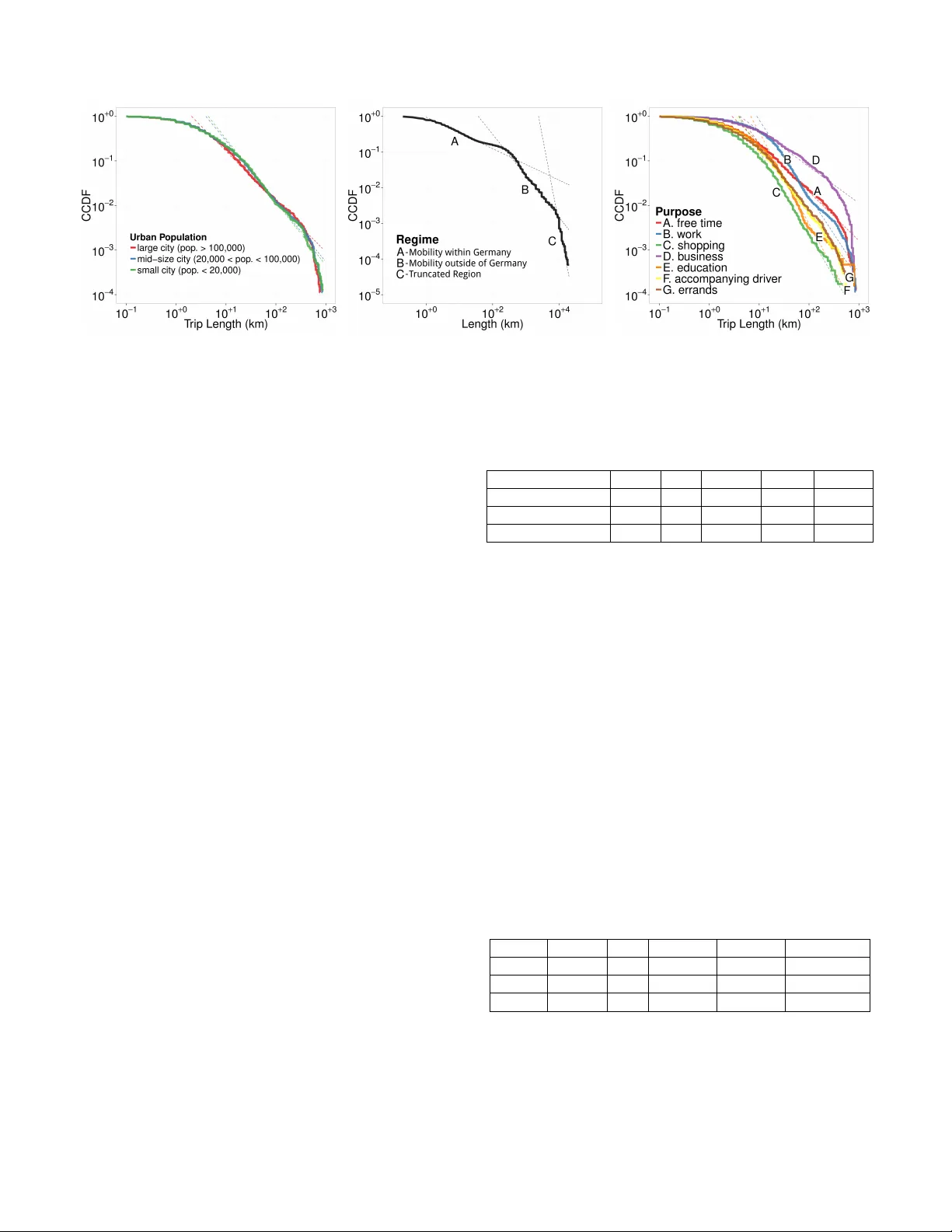
Urban Mobility Scaling: Lessons from ‘Little Data’ Galen W ilkerson 1 , Ramin Khalili 2 , Stefan Schmid 2 1 T echnical University Berlin, Berlin, Germany galen.wilkerson@inet.tu-berlin.de 2 T echnical University Berlin & T -Labs, Berlin, Germany { ramin,stefan } @net.t-labs.tu-berlin.de Abstract —Recent mobility scaling resear ch, using new data sources, often relies on aggregated data alone. Hence, these studies face difficulties characterizing the influence of factors such as transportation mode on mobility patterns. This paper attempts to complement this r esearch by looking at a category-rich mobility data set. In order to shed light on the impact of categories, as a case study , we use con ventionally collected German mobility data. In contrast to ‘check-in’-based data, our results are not biased by Euclidean distance approxi- mations. In our analysis, we show that aggregation can hide crucial differences between trip length distributions, when subdivided by categories. For example, we see that on an urban scale (0 to ∼ 15 km), walking, versus driving, exhibits a highly different scaling exponent, thus uni versality class. Moreov er , mode shar e and trip length are responsive to day-of-week and time-of-day . For example, in Germany , although driving is relativ ely less frequent on Sundays than on W ednesdays, trips seem to be longer . In addition, our work may shed new light on the debate between distance-based and intervening-opportunity mechanisms affecting mobility patterns, since mode may be chosen both according to trip length and urban form. I . I N T R O D U C TI O N It is important to understand mobility for a v ariety of reasons, including uncertainty reduction for allocation of re- sources such as communications and computing [1] infras- tructure usage, robustness and interdependence [2], wireless networking applications [3], social network analysis [4], in- telligent transportation [5], economic development [6], crisis response [7], [8], and lar ge-scale energy consumption and CO 2 emissions [9]–[11], to name a few . The data sources in recent papers in the ‘big’ mobility- scaling literature ha ve been dollar bill mo vements, mobile call- data records (CDRs), and geo-tagged social media such as Foursquare, T witter , Go walla, Facebook, and others [4], [12]– [14]. The defining characteristic of this big mobility data is not only its size, which can be smaller than some conv entional sources – the number of trips or movements in these ‘big’ sources can range from 10 5 to 10 9 or broader – but most often they are characterized by ne w forms of lar ge-scale automatic data collection using ‘check-ins’ (phone calls, tweets, etc.), for some purpose other than their ev entual research use, at relativ ely low cost. The Where’ s Geor ge, CDRs, and social media contain either little or no categorical data about the trip or individual, or are limited due to priv acy concerns. Spatial resolution can vary from cell-tower radius ( ∼ 3 km) to less than a fe w meters in the case of GPS-based social media [4], [12]–[14]. There are sev eral challenges posed by these data sources, stemming from the large geographic- and time-scales, as well as the incidental sampling method, to be discussed below . A. Our Contrib utions Here, we are interested in the ability of conv entionally- collected (‘little’) mobility data to contribute to scientific research on mobility patterns. The availability of categorical information allows us to ask and address questions that are challenging using exclusi vely check-in mobility data. T rans- portation mode, city size, and trip purpose are particularly helpful to shed light on mobility patterns at an urban scale. W e say this data is conv entional because it was collected as a lar ge ef fort including survey design by e xperts as part of a series running over man y years, with an intentional focus on understanding of mobility patterns. Based on this we ask – how can mode, trip purpose, and other cate gories further our understanding of mobility generally , and especially of urban mobility? Also, how can we begin to address the challenges faced by big mobility research above? For e xample, in contrast to most check- in displacements, which are inherently based on misleading Euclidean distances and may not correspond to actual trip start and end, we hav e reported lengths of the trips themselves. Our main findings are: • W e argue that assuming that trips are i.i.d. is imprudent, and that categories matter in refining our understanding of mobility patterns. Mode matters, helping to character- ize mobility univ ersality classes, both at the urban and inter-urban scales. E.g. there are significant dif ferences between walking, bicycling, and automobile driving trip length distributions. In addition, looking at trip lengths rescaled by maximum length for each mode, there are significant distinguishable uni versal properties. • Even for trip lengths at and below the urban scale ( ∼ 10 km), mode dif ferences are evident, a fact that is at odds with pre vious claims [14]. On a related note, it seems that city population is not a strong determinant of mean trip length, with only a slight dif ference found in large vs. small cities. • Scaling of mobility confirms previous findings, when histograms of daily trips and overnight travel are taken together , yielding a scaling exponent of 1 . 44 for trip lengths within German y . • W e show that other categories and dependencies are also important. T rip lengths respond differently to different purposes, shopping and business, for example. It is also evident that mobility is time-dependent. E.g. trip lengths on Sunday v ary from those on W ednesday . More broadly , we see that: Scaling in response to categories hints at the existence of different uni versality classes in mo- bility patterns; purpose, along with mode, may giv e us insight into how to form a bridge between distance and intervening opportunity arguments for trip length form in cities; since this dataset is less prone to sampling error, we believ e it can also offer the ability to understand trip length changes in time, and helps elucidate some of the factors that are av eraged together when using lar ge-scale check-in data. I I . R E L A T E D W O R K A N D C H A L L E N G E S There has recently been progress characterizing scaling of long-distance trips ( ∼ 10 2 to ∼ 10 4 km), fitting them with power la w having scaling exponent ranging between 1 . 50 and 1 . 75 [12]–[14]. Since at the longer scale fe wer (motorized) modes dominate mobility , and they are somewhat clustered compared to non-motorized modes (See Fig. 1a and T able. I), it is not surprising that these trips are easier to characterize. There has been some success modelling these long trips and attempting to determine major mechanisms driving them. These mechanisms – some also found in past research using con ventional data – are based on distance (Random W alks and Levy Flights) [12], [13], ‘intervening opportunity’ (place density) [15], [16], along with social networks [4], and others [17]. Longer trips are very dif ferent from spontaneous, inexpen- siv e, dense infrastructure, dense location, urban-scale mobility , occurring at distances less than or close to 10 1 km [14], [18]. Mobility research has been facing an ‘urban challenge’, due to: A. Dif ficulties fitting shorter distance trips, or the necessity of using distance transformations [13], [14], B. the limits of spatial resolution (e.g. in CDRs) [13], and C. because hea vy- tail research is focused exactly on the tail of distributions, due to the systemic and mathematical property of power law scaling – to break down at small data v alues [19]. Recently , this work has attempted to address the apparent debate between two schools of thought about mechanisms influencing mobility patterns on the urban scale: A. distance- based mechanisms [13], [20], v ersus B. interv ening oppor - tunity [14], [16]. Basically , their question is: Is there some inherent property of human behavior – purely related to distance – that leads to heavy-tailed trip-length distributions, or are these trip length patterns dri ven more by urban form, as seen in the density of ‘places’? This mobility research faces some significant challenges: First, these check-in sources do not usually contain very much ancillary categorical information about a trip such as mode, weather , purpose, number of passengers, etc. Thus, if one wants to kno w the ef fect of external factors, one may be limited by resources to determine all of them accurately [21]. Second is sampling bias. Between check-ins, it may be impossible to kno w actual travel patterns, and check-in rates may not be independent of factors (such as mode) that affect these patterns. T rips may not begin and end at check-ins, and very rarely follow a linear path – the terms ‘travel’ and ‘displacement’ are intermingled [12]–[14], which may be appropriate at distances mostly trav ersed by air , b ut certainly can be misleading at urban scales. Shorter trips length mea- surements may be more sensitiv e to these inaccuracies. W ith one or two significant exceptions, existing mobility scaling research seems to implicitly assume that ‘mean field’, random, independent characteristics apply – due to the large data size – and that these approximations are sufficient to account for sampling bias [12]–[14], so that check-in dis- placements are assumed to reflect actual displacements or trip lengths. Finally , related to sampling bias is stability of mobility patterns over time. There is no question that mode share and trip length change, and that this needs to be considered. I I I . D A T A A N D M E T H O D O L O G Y This work is based on the Mobility in Germany 2008 (MID 2008) surve y data set, which was collected and is maintained by the Infas Institute for Applied Social Science Research and the German Aerospace Center (DLR), with the main survey between the dates of February 2008 and March 2009. The final surv ey inv olved 25,922 Households, 60,713 Indi viduals, 193,290 T rips and 36,182 Tra vel events. ‘Trips’ describe daily journeys, where a return journey w as counted as a separate trip, while ‘trav el’ data describe mobility that included an ov ernight stay [22]. MID 2008 was designed carefully , as a continuation of the W est German Konti v surveys in 1976, 1982 and 1989, and MID 2002. It included a pre-surve y , pretest, and used a mixed methodology combination of computer-aided telephone interview (CA TI), online, and mail surveys in order to a void bias and maintain continuity with past surveys. Querying a large number of households from different federal states, it was the largest household survey apart from the official German microscensus. The trip lengths ( ` ) in our data correspond to the actual trav eled distances, reported by subjects. Hence, in contrast to check-in data, we do not have to approximate trip lengths by Euclidean displacements (∆ r ) [12]–[14], which may introduce a bias to the scaling exponent, especially for short trips. This is particularly interesting, since our data features a high resolution, recorded do wn to the 100m scale. If not otherwise stated, lengths shown are for trips only , not travel, and trips are counted over the entire measurement period. Categorical information describe trip origination and mode describes the main transportation mode for a trip. W e 2 define urban trips as those starting in a city (pop. > 100 , 000 ), and other categorical information is stated explicitly . ‘ All modes’ is composed of a weighted av erage of walking, bi- cycling, automobile driv ers, automobile passengers and public transportation trips. W e have remov ed the automobile passen- ger mode from figures for ease of visibility , but note that its scaling and statistical characteristics are similar to those of public transportation (T able I). (a) (b) Fig. 1: (1a) Trip length distrib utions (CCDF) of all trips starting in German cities with population > 100 , 000 by major transportation mode. (1b) CCDF of trip lengths rescaled by maximum trip length ( `/` max ) for each respecti ve mode. W e simply use best-fit power law scaling exponents ( α ) to giv e a sense of relative scaling in what are visibly truncated heavy-tailed distributions, not as claim to fit. Power laws are of the form p ( ` ) = C ` − α , for normalization constant C , trip length ` , scaling exponent α , and ` > ` 0 , the minimum fit trip length. Here we have shown trip lengths as log-log CCDFs, p ( L > ` ) , as is common in scaling literature [19]. Statistical fitting was carried out by a method that uses max- imum likelihood estimators and K olmogorov-Smirnov statis- tics to fit data with a po wer law . (See [19].) I V . T H E I M P O RT A N C E O F C A T E G O R I E S A. Mode Matter s for Mobility Scaling Mode Count α ` 0 (km) ¯ ` (km) σ 2 I. All Modes 52973 2.13 29.40 9.99 1313.79 A. W alk 14303 3.99 6.37 1.37 3.77 B. Bicycle 5581 2.72 6.37 3.47 30.06 C. Auto. Driv er 18484 2.29 39.90 13.06 1331.84 D. Public T rans. 6944 1.97 27.98 16.34 2875.92 Auto. Passenger 7658 2.00 24.32 17.69 2949.11 T ABLE I: Sample size, best-fit scaling exponent α , beginning of fit ` 0 , and moments – mean trip length ¯ ` and v ariance σ 2 for the major modes. Check-in-based mobility data research must av erage to- gether displacements of substantially different modes. W ith our con ventional categorical data we can distinguish between modes, seeing a visible discrepancy in scaling between walk- ing, bicycling, automobile dri vers, and those using public transport (Fig. 1a). F or comparison of the scaling, best-fit power laws are drawn, with corresponding exponents shown in T able I. W ith α > 3 for walking (A), the first two moments – mean and variance – are defined. F or bicycling and driving (B, C), with 2 < α < 3 , the mean is defined but variance div erges. For public transport (D), with 1 < α < 2 , neither the mean nor v ariance is defined [23]. Scaling exponent ( α ) and mean trip length ( ¯ ` ) for walk- ing and bicycling (T able I: A,B), both non-motorized, dif fer greatly from that of motorized modes- automobile dri ving and public transportation usage (C, D), as one might e xpect. W e also note that walking and bicycling have exponents dif fering by more than one, and that the exponent for w alking, nearly 4, implies that it behaves quite differently than other modes. Note that trip lengths, representing daily trips originating within German y , are truncated at approximately the diameter of Germany 1 (674 km ≈ 10 2 . 83 km, see Fig. 1a). This is confirmed by intuition, since it is perhaps less likely that trips beginning in Germany , not including an overnight stay , will end in another country . Rescaling trip lengths by the maximum trip length for each respecti ve mode, we also observ e that certain modes hav e some what similar heavy tails (Fig. 1b), again suggesting distinct univ ersality classes, and thus some mechanism at work causing these differences. Between ∼ 10 − 3 and ∼ 10 − 1 of maximum trip length, trips seem clustered into two groups by scaling, non-motorized – walking and bicycling, and motorized – auto. driving and public transport. From 10 − 1 to 10 0 of max. trip length, scaling for the various modes seems to div erge. Generally , correlation of mode with trip length scaling has considerable implications for human systems such as cities. A small change in a mode’ s scaling exponent can imply a large dif ference in total trips of a certain length, and therefore total energy . Mode share also implies a significantly dif ferent energy consumption budget. (E.g. walking vs. automobile modes.) Since these statistics describe system characteristics of large-scale random processes – sometimes called ‘urban metabolism’ [10], [11], [24], [25] – and therefore substantial amounts of energy and C O 2 emissions, the y are very impor- tant to understand. B. Urban Mobility P atterns Length Mode % walking bicycling auto. public auto. driving trans. passenger intra-urban 28.30 11.91 38.06 6.99 14.73 inter-urban 0.31 1.83 58.60 14.57 24.68 T ABLE II: Mode share (%) for intra-urban ( < 10 1 . 17 km) and inter-urban trips ( ≥ 10 1 . 17 km) for lar ge cities (pop. > 100 , 000 ) in German y . For Germany’ s 76 cities with ov er 100,000 population, the av erage area is 174.02 km 2 [26]. Using a similar approxima- tion as for German y 1 , this yields an urban diameter of 14.89 km ( ≈ 10 1 . 17 km). 1 Using a simplifying approximation of a disc, we calculate log 10 (diameter) = log 10 (2 q A π ) ≈ 2 . 83 , where A = 357 , 021 km 2 , Germany’ s square area. 3 (a) (b) (c) Fig. 2: CCDFs of (2a) trip length according to urban population, (2b) daily trip and overnight travel lengths originating in Germany , tak en together , (2c) trip length according to purpose. Mode is therefore also re vealing about urban scale mobility , since we can now use trip length statistics separated by mode to distinguish between patterns near and belo w this scale (Fig. 1a). For intra-urban trip lengths belo w the urban diameter , non-motorized modes contrib ute significantly to trip statistics (T able II) At the inter-urban scale, trip statistics are mostly the result of motorized modes, as expected. It is important to note these scaling dif ferences, especially in intra-urban region. Here, averaging together all of these modes (‘all modes’) is essentially a veraging the heads of some trip length distrib utions together with the tails of others (See ` 0 and ¯ ` , T able I and Fig. 1a), and thereby aggregating the results of processes belonging to significantly distinct univ ersality classes. It is therefore not surprising that urban scale mobility patterns hav e posed a challenge to those using aggregated check-in data. As noted abov e, the non-motorized versus motorized modes each seem to be the product of some unique mobility process at the urban scale – since both their absolute and rescaled trip length distributions stand apart (Figs. 1a and 1b). These largely dif ferent exponents imply that trips by certain modes are caused by different processes and system characteristics, belonging to distinct universality classes – plausible when comparing these groups of modes. This also suggests that we may be able to consider modes as making up separate phases of the underlying process of mobility [23], [27], [28]. Also, due to the different form of rescaled trip lengths for non- motorized modes – perhaps e xponential – this is interesting to consider in the conte xt of mobility behavior of other or ganisms [29]. Thus with this information, we can begin to in vestigate causal mechanisms more carefully . It seems that mode allows us to describe trip lengths primarily by their scaling exponent within the intra-urban region, perhaps down as far as ` 0 = 6.37 km ( 10 . 8 km) (T able I). Ho we ver , belo w that distance other factors may be at work, and the behavior may be better described primarily by something other than scaling with respect to the mode category . Urban Population Count α ` 0 (km) ¯ ` (km) σ 2 small ( < 20 k ) 23433 2.41 43.32 10.52 1202.28 medium ( 20 k - 100 k ) 53038 2.35 30.38 10.62 1329.72 large ( > 100 k ) 53011 2.13 29.40 9.99 1312.92 T ABLE III: Sample size (Count), best-fit scaling exponent ( α ), beginning of fit ( ` 0 ), mean trip length ( ¯ ` ) and variance ( σ 2 ) according to city population. On a related note, trip lengths seem related to urban popula- tion, but not strongly (Fig. 2a and T able III), confirming other results [18]. For example, there is a small dif ference between mean trip lengths ( ¯ ` ) in low-population rural municipalities versus larger urban populations. It therefore seems further in vestigation is needed to determine whether mean trip length scales allometrically with city population alone, as has been found for other urban parameters [30]. Also, this indeterminate response by trip length to city population may support previous results about the indepen- dence of trip length and city ar ea [14], but since the Pearson correlation of urban population and area in Germany is not high ( r = 0 . 51) [26], this cannot yet be confirmed. C. T rips taken tog ether with overnight travel confirm pre vious findings Regime Count α ` 0 (km) ¯ ` (km) σ 2 A 209,045 1.44 1.81 48.97 14,727.00 B 8,055 2.17 816.00 1,670.36 2,172,741.49 C 380 5.91 11,000.00 11,312.92 7,047,781.70 T ABLE IV: Count, α , ` 0 , ¯ ` and σ 2 for the three distance regimes of trips and trav el taken together . Furthermore, if we take daily trips and overnight travel together (Fig. 2b), there seem to be three regimes: (A) Within Germany , (B) outside of Germany , and (C) near the maximum 4 distance that can be trav eled from Germany to the other side of the w orld. For trips within Germany (Regime A), our best-fit giv es us a scaling exponent of α = 1 . 44 , which is proximate to that found for Foursquare data ( α = 1 . 50 ) [14], and for the Where’ s Geor ge data ( α = 1 . 59 ) [12], though not as near to that found using call data records ( α = 1 . 75 ) [13]. Similar to trips without overnight trav el (Fig. 1a), this is truncated by the diameter of German y ( ∼ 10 2 . 83 km). For longer trips outside of Germany (Regime B), our best- fit result is quite dif ferent from others ( α = 2 . 24 ). Howe ver , big mobility data sources can include trips from all possible origins. Since our data was collected differently and only includes journe ys originating within German y , is not surprising that we see a marked decrease in the number of trips of this length. This second regime is truncated at roughly the distance of the furthest significant tra vel destination, Southeast Asia. (E.g. The flying distance from German y to Thailand is approximately 8667 km ≈ 10 3 . 94 km.) This truncation seems to agree with 2008 trav el planning statistics, which show that few journeys ( < 1% ) were planned farther than Asia [31]. D. Distance-based and intervening opportunity arguments Purpose Count α ` 0 (km) ¯ ` (km) σ 2 education 12704 3.06 31.07 8.15 574.29 shopping 40322 2.88 35.15 5.19 196.73 work 25808 2.71 38.95 17.40 1654.51 errands 23716 2.51 45.13 8.06 593.81 accompanying driver 16447 2.50 32.30 7.74 476.70 free time 61152 2.10 30.38 13.55 2209.65 business 2706 1.82 12.35 36.58 8011.00 T ABLE V: Count, α , ` 0 , ¯ ` and σ 2 for trips by purpose. This mode information lets us address the central premise of a previous work, which suggested that trip length patterns cannot be distinguished at an urban scale [14]. These authors then went on to gi ve con vincing arguments that ‘intervening opportunity’ – using rank-distance of place – can largely explain urban trip length patterns, rather than purely distance- based mechanisms. Here, howe ver , we have seen that trip lengths according to mode are distinguishable at this scale, lending credence to distance-based mechanisms. Our e vidence does not necessarily contradict their conclusions, but rather allo ws us to hypothe- size that mode, together with trip purpose – both obviously strongly correlated with trip length (Figs. 1 and 2c) – can help elucidate the debate between these apparently disparate schools of thought. The distinct response of trip length to purpose (Fig. 2c) seems to support this line of thinking, since by necessity trip length according to purpose must respond to urban form (density and location of schools or grocery stores, for example). Another work analyzing earlier v ersions of our data set has also suggested that trip distance is a function of facility location (urban form), which then determines mode [18]. Certainly , further work is needed, such as multi variate analysis and clustering. V . T H E I N FL U E N C E O F T I M E (a) (b) (c) (d) Fig. 3: (3a) W eekday hourly trip frequency according to mode. (3b) CCDF of weekday hourly trip lengths. (3c) Day-of-week trip frequenc y according to mode. (3d) CCDF of trip lengths by day-of-week. T ime of Day Count α ` 0 (km) ¯ ` (km) σ 2 before 5 AM 1670 2.01 25.27 32.92 10,123.99 5 to 7 AM 7026 2.41 20.58 23.71 3,268.39 7 to 9 AM 21991 2.33 16.15 11.29 1,717.64 9 to 11 AM 24511 2.03 10.45 11.31 2,159.07 11 to 2 PM 37693 2.32 31.36 9.49 1,046.26 2 to 5 PM 43375 2.43 51.30 10.34 868.00 5 to 8 PM 34742 2.55 31.36 9.68 705.90 8 to 10 PM 7819 2.39 34.30 9.58 684.20 after 10 PM 4060 2.89 30.40 10.94 550.62 T ABLE VI: Count, α , ` 0 , ¯ ` and σ 2 for trips by time of day . Day of W eek Count α ` 0 (km) ¯ ` (km) σ 2 Sunday 17768 2.11 32.34 15.84 2,652.07 Monday 28476 2.42 34.20 9.66 1,026.79 T uesday 28449 2.42 38.81 9.47 919.62 W ednesday 28649 2.46 48.45 9.86 966.94 Thursday 27787 2.38 38.95 10.07 943.46 Friday 27878 2.22 43.23 11.46 1,507.96 Saturday 23880 2.23 32.30 12.60 1,789.28 T ABLE VII: Count, α , ` 0 , ¯ ` and σ 2 for trips by day of week. 5 Finally , we see that trip frequency , mode share, and trip lengths are clearly dependent on time. On weekdays, according to time-of-day , we see an e xpected daily pattern of increased trips in morning ( ∼ 7 AM) and e vening ( ∼ 5 PM) (Fig. 3a). W e also note a change in the relative mode share at dif ferent times of day . Dri ving, for example, mak es up a much higher proportion of trips during the day , lower in e vening hours. Trip lengths are also notably responsiv e to time-of-day , e.g. from 5 to 7AM, trips tend to be longer (Fig. 3b). Similar observ ations can be made about day-of-week pat- terns. For example, on Sundays we see a change in trip frequency and mode share from weekday le vels, with fewer ov erall trips and less driving relative to other modes. (Fig. 3c). T rip lengths are also clearly responsi ve to day-of-week, with a higher proportion of long trips also on Sunday (Fig. 3d). Aggregation o ver all time periods can therefore also obscure time-dependency and potentially bias results. W e must con- clude that sampling time needs thorough in v estigation when making statements characterizing av erage mobility patterns. V I . C O N C L U S I O N S A N D F U RT H E R W O R K W e ha ve ar gued that aggre gate data misses important aspects of mobility patterns. As a case study , we have analyzed a category-rich set of German mobility data and found that mode, city size, population, purpose, and temporal aspects of trips can be illustrati ve. This con v entional data can e xpose both inter- and intra- urban-scale mobility , and possibly address related issues such as urban metabolism, allometric scaling, and the debate between distance- and intervening-opportunity- based mechanisms for mobility patterns. W e understand our work as a first step toward a more refined understanding. In particular , we hav e only focused on Germany and will be interested whether other countries hav e similar characteristics. Our data may still have some bias and errors, and we w ould lik e to address those. Moreo ver , so far we have focused on data analysis only . In future work, it would be interesting to come up with models explaining the observed statistics. Based on our work, mode, purpose, urban population, and time look like useful categories to in vestigate. From other research, density , mode av ailability , and other urban parameters also seem relev ant [14], [18], [32]. Further work fitting trip length along with duration, analyzing mean squared distance, and using clustering and dimensionality reduction to understand the main categories and dependencies making up the space of mobility universality classes all seem promising. R E F E R E N C E S [1] J. Sousa and D. Garlan, “ Aura: An architectural framework for user mo- bility in ubiquitous computing en vironments, ” in Software Ar chitectur e: System Design, Development, and Maintenance (Pr oceedings of the 3rd W orking IEEE/IFIP Conference on Softwar e Ar chitectur e) , 2002. [2] A. V espignani, “Complex networks: The fragility of interdependency, ” Natur e , vol. 464, 2010. [3] T . Camp, J. Boleng, and V . Davies, “ A survey of mobility models for ad hoc network research, ” Wir eless communications and mobile computing , vol. 2, no. 5, 2002. [4] E. Cho, S. A. Myers, and J. Leskov ec, “Friendship and mobility: user movement in location-based social networks, ” in Proceedings of the 17th ACM SIGKDD international confer ence on Knowledge disco very and data mining (KDD) , 2011. [5] B. C. da Silva, A. L. Bazzan, G. K. Andriotti, F . Lopes, and D. de Oli veira, “Itsumo: an intelligent transportation system for urban mobility , ” in Innovative Internet Community Systems . Springer , 2006. [6] D. Helbing and K. Nagel, “The physics of traf fic and regional develop- ment, ” Contemporary Physics , vol. 45, no. 5, 2004. [7] X. Chen and F . B. Zhan, “ Agent-based modelling and simulation of urban ev acuation: relativ e effecti veness of simultaneous and staged ev acuation strategies, ” J ournal of the Operational Researc h Society , vol. 59, no. 1, 2006. [8] D. Helbing, I. Farkas, and T . V icsek, “Simulating dynamical features of escape panic, ” Natur e , vol. 407, no. 6803, 2000. [9] J. A. Momoh, “Smart grid design for efficient and flexible power net- works operation and control, ” in IEEE/PES P ower Systems Confer ence and Exposition (PSCE), 2009. [10] A. T o wnsend, “Life in the real-time city: Mobile telephones and urban metabolism, ” Journal of urban technology , vol. 7, no. 212, 2000. [11] D. Banister, “Cities, mobility and climate change, ” Journal of T ransport Geography , vol. 19, no. 6, pp. 1538–1546, 2011. [12] D. Brockmann, L. Hufnagel, and T . Geisel, “The scaling laws of human trav el, ” Nature , vol. 439, no. 7075, 2006. [13] M. C. Gonzalez, C. A. Hidalgo, and A.-L. Barabasi, “Understanding individual human mobility patterns, ” Nature , vol. 453, no. 7196, 2008. [14] A. Noulas, S. Scellato, R. Lambiotte, M. Pontil, and C. Mascolo, “A tale of many cities: uni versal patterns in human urban mobility, ” PloS one , vol. 7, no. 5, 2012. [15] F . Simini, M. Gonz ´ alez, A. Maritan, and A. Barab ´ asi, “A universal model for mobility and migration patterns, ” Nature , vol. 484, no. 96, 2012. [16] S. Stouffer , “Interv ening opportunities: a theory relating mobility and distance, ” American sociological r eview , 1940. [17] C. Song, T . Koren, P . W ang, and A.-L. Barab ´ asi, “Modelling the scaling properties of human mobility , ” Nature Physics , vol. 6, no. 10, 2010. [18] J. Scheiner, “Interrelations between tra vel mode choice and trip dis- tance: trends in Germany 1976-2002, ” Journal of T ransport Geography , vol. 18, no. 1, 2010. [19] A. Clauset, C. Shalizi, and M. Newman, “Po wer-law distributions in empirical data, ” SIAM re view , 2009. [20] C. Song, Z. Qu, N. Blumm, and A.-L. Barab ´ asi, “Limits of predictability in human mobility .” Science (New Y ork, N.Y .) , vol. 327, no. 5968, 2010. [21] S. Reddy , M. Mun, J. Burke, D. Estrin, M. Hansen, and M. Sri vas- tav a, “Using mobile phones to determine transportation modes, ” ACM T ransactions on Sensor Networks (TOSN) , vol. 6, no. 2, 2010. [22] R. F ollmer, D. Gruschwitz, B. Jesske, and S. Quandt, “Mobilit ¨ at in Deutschland 2008, ” Bundesministerium fuer V erkehr, Bau, und Stadten- twicklung, Bonn, T ech. Rep., 2008. [23] M. E. Newman, “Power laws, pareto distributions and zipf ’ s law , ” Contemporary physics , v ol. 46, no. 5, 2005. [24] A. W olman, “The metabolism of cities, ” Scientific American , vol. 213, 1965. [25] G. B. W est and J. H. Brown, “Life’ s universal scaling laws, ” Physics today , vol. 57, no. 9, 2004. [26] “St ¨ adte (Alle Gemeinden mit Stadtrecht) nach Fl ¨ ache, Bev ¨ olkerung und Be v ¨ olkerungsdichte, ” German Fed- eral Statistical Office, T ech. Rep., 2012. [Online]. A v ailable: https://www .destatis.de/DE/ZahlenFakten/LaenderRegionen/ Regionales/Gemeinde verzeichnis/Administrativ/Aktuell/05Staedte.html [27] M. Mitzenmacher , “A Brief History of Generati ve Models for Power Law and Lognormal Distributions, ” Internet Mathematics , vol. 1, no. 2, 2004. [28] H. Stanley , “Scaling, universality , and renormalization: Three pillars of modern critical phenomena, ” Revie ws of modern physics , vol. 71, no. 2, 1999. [29] G. Ramos-Fernandez, J. L. Mateos, O. Miramontes, G. Cocho, H. Lar - ralde, and B. A yala-Orozco, “L ´ evy walk patterns in the foraging move- ments of spider monkeys (ateles geoffroyi), ” Behavior al Ecolo gy and Sociobiology , vol. 55, no. 3, 2004. [30] L. M. Bettencourt, J. Lobo, D. Helbing, C. K ¨ uhnert, and G. B. W est, “Growth, innov ation, scaling, and the pace of life in cities, ” Proceedings of the National Academy of Sciences , vol. 104, no. 17, 2007. [31] “Reisemonitor 2008, ” AD AC V erlag, T ech. Rep., 2008. [32] M. Batty , “Spatial Entropy, ” Geographical Analysis , vol. 6, no. 1, 2010. 6
Original Paper
Loading high-quality paper...
Comments & Academic Discussion
Loading comments...
Leave a Comment