Breaking the n^(log n) Barrier for Solvable-Group Isomorphism
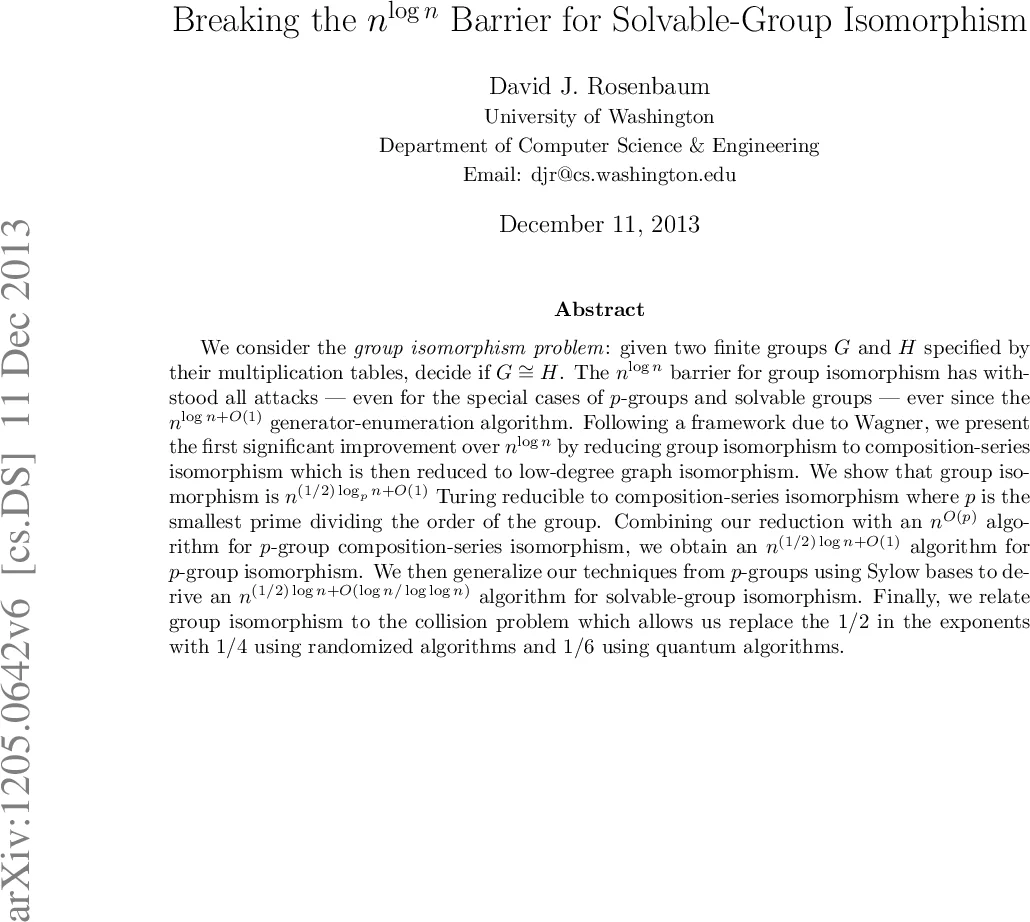
We consider the group isomorphism problem: given two finite groups G and H specified by their multiplication tables, decide if G and H are isomorphic. The n^(log n) barrier for group isomorphism has withstood all attacks — even for the special cases of p-groups and solvable groups — ever since the n^(log n + O(1)) generator-enumeration algorithm. In this work, we present the first significant improvement over n^(log n) by showing that group isomorphism is n^((1 / 2) log_p n + O(1)) Turing reducible to composition-series isomorphism where p is the smallest prime dividing the order of the group. Combining our reduction with an n^(O(p / log p)) algorithm for p-group composition-series isomorphism, we obtain an n^((1 / 2) log n + O(1)) algorithm for p-group isomorphism. We then generalize our techniques from p-groups using Sylow bases to derive an n^((1 / 2) log n + O(log n / log log n)) algorithm for solvable-group isomorphism. Finally, we relate group isomorphism to the collision problem which allows us replace the 1 / 2 in the exponents with 1 / 4 using randomized algorithms and 1 / 6 using quantum algorithms.
💡 Research Summary
The paper tackles the long‑standing “n^{log n} barrier” for the finite‑group isomorphism problem, which asks whether two groups given by multiplication tables are isomorphic. The classic generator‑enumeration algorithm runs in time n^{log p n+O(1)} where p is the smallest prime divisor of the group order, and no substantially faster algorithm has been known even for the important subclasses of p‑groups and solvable groups.
The authors achieve the first super‑polynomial improvement by introducing two key ideas. First, they replace the traditional approach of guessing generators for each level of a composition series with a direct enumeration of the intermediate subgroups themselves. A composition series is a maximal normal series 1 = G₀ ⊲ G₁ ⊲ … ⊲ G_m = G whose factors are simple. By constructing the socle (the direct product of all minimal normal subgroups) and then recursively building the series, the number of possibilities for the first subgroup is at most |G|, and for each subsequent subgroup the number of choices shrinks by at least a factor of p, the smallest prime dividing |G|. This yields a total of ∏_{i=1}^{log_p n} p^{i} = n^{(1/2)·log p n} possibilities, giving a deterministic Turing reduction from group isomorphism to composition‑series isomorphism in time n^{(1/2)·log p n+O(1)}.
Second, they adapt Wagner’s Karp reduction from composition‑series isomorphism to low‑degree graph isomorphism, fixing several gaps in Wagner’s original proof. Each composition series is encoded as a graph whose maximum degree is bounded by p (or p/ log p). Using the best known algorithms for bounded‑degree graph isomorphism (running in n^{O(d/ log d)} time), they obtain a deterministic algorithm for p‑group isomorphism running in n^{(1/2)·log n+O(1)} time.
To handle general solvable groups, the authors employ Sylow theory and the notion of a Hall composition series. By decomposing a solvable group into its Sylow p‑subgroups (a Sylow basis) and applying the previous technique to each component, they achieve a deterministic algorithm with running time n^{(1/2)·log n+O(log n/ log log n)}.
The paper further shows that the same structural reduction can be viewed as a collision problem. By randomly sampling O(n^{(1/4)·log p n}) composition series from each group and detecting a collision, a Monte‑Carlo algorithm runs in n^{(1/4)·log n+O(1)} time. Using quantum collision detection reduces the exponent further to n^{(1/6)·log n+O(1)}. These speed‑ups rely on using an n^{O(d)} canonical‑form algorithm for bounded‑degree graphs rather than the n^{O(d/ log d)} isomorphism tester.
In addition to the algorithmic contributions, the authors correct a serious flaw in Wagner’s earlier work concerning the dependence of the constructed graphs on arbitrary coset representatives. They salvage Wagner’s “generator‑fixing” trick in a restricted setting and integrate it into their own framework, thereby providing a sound and complete reduction pipeline.
Finally, the techniques extend to group canonization: by computing canonical forms of the graphs associated with each composition series and selecting the lexicographically smallest one, the authors obtain a polynomial‑time algorithm that produces a unique multiplication table for the isomorphism class of any input group.
Overall, the paper delivers (1) a novel reduction from group isomorphism to composition‑series isomorphism with a ½‑exponent improvement, (2) a rigorous reduction from composition‑series isomorphism to bounded‑degree graph isomorphism, (3) deterministic, randomized, and quantum algorithms for p‑groups and solvable groups with exponents ½, ¼, and ⅙ respectively, (4) a correction of prior literature, and (5) an application to group canonization. These results constitute a substantial breakthrough in the algorithmic theory of finite groups.
Comments & Academic Discussion
Loading comments...
Leave a Comment