Should the democrats move to the left on economic policy?
Could John Kerry have gained votes in the 2004 Presidential election by more clearly distinguishing himself from George Bush on economic policy? At first thought, the logic of political preferences would suggest not: the Republicans are to the right …
Authors: ** Andrew Gelman (Columbia University) Cexun Jeffrey Cai (Columbia University) **
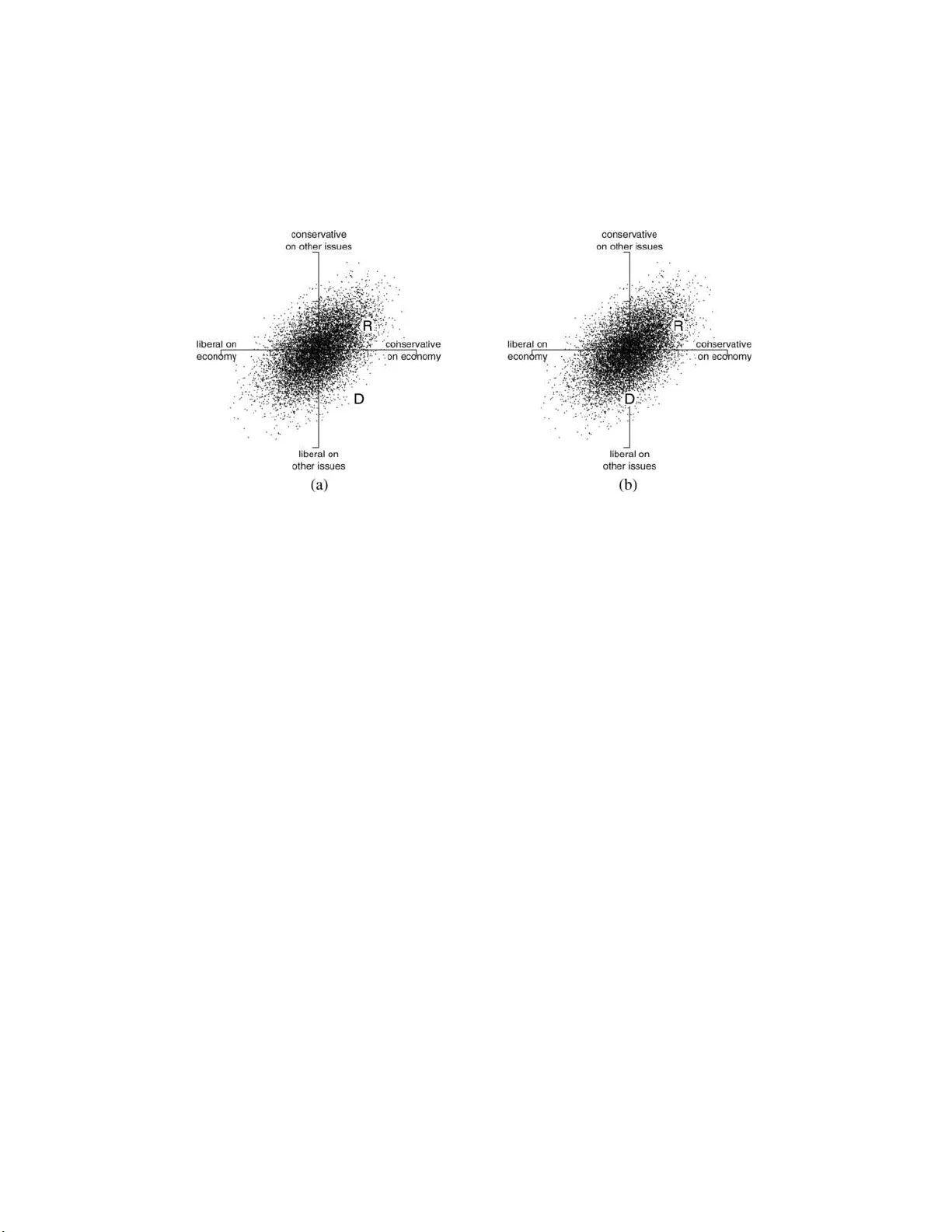
The Annals of Applie d Statistics 2008, V ol. 2, No. 2, 536–549 DOI: 10.1214 /07-A OAS150 c Institute of Mathematical Statistics , 2 008 SHOULD THE DEMOCRA TS MO VE TO THE LEFT ON ECONOMIC POLICY? 1 By Andrew Gelman and Cexun Jef frey Cai Columbia University Could John Kerry ha ve gained v otes in the 2004 Presidentia l elec- tion by more clearly distinguishing himself from George Bush on eco- nomic p olicy? A t first thought, the logic of p olitical preferences would suggest not: the Republicans are to the rig ht o f most Americans on economic policy , and so in a one-dimensional sp ace with part y p osi- tions measured with no error, the op t imal strategy for the D emocrats w ou ld b e to stand in fi nitesimally to the left of the Republicans. The median voter t heorem suggests that each party should ke ep its p olicy p ositions just barely distinguishable from the opposition. In a multidimensional setting, how ever, or when voters v ary in their p ercep t ions of the parties’ p ositions, a party can b en efit from putting some dayligh t betw een itself and t h e oth er part y on an issue where it has a public-opinion adv antage (such as economic policy for the D emocrats). W e set u p a plausible t heoretical model in which the Democrats could achiev e a n et gain in votes by moving to the left on economic policy , given the parties’ p ositions on a range of issue dimensions. W e th en ev aluate this mo del based on survey data on voters ’ percept ions of their o wn p ositions and those of the candidates in 2004. Under our mod el, it turn s out to b e optimal for the Democrats to mo ve sligh tly to the right but sta y ing clearly to t he left of the Republicans’ current position on economic issues. 1. In tro d uction. In the 2004 presid en tial election campaign, it has b een suggested that vote r s sa w little d ifferen ce b et we en the parties on economics but large d ifferences on other issues. The Demo crats are traditionally closer than the R ep ublicans to the av erage v oter’s view on the economy . Should the Demo cr ats h a ve mo v ed to the left on economic issues? C ould suc h a strategy win them vo tes? W e stu d y this using a theoretical mo d el and survey data. Received Novem b er 2007; revised Nov ember 2007. 1 Supp orted by U.S . National Science F oundation an d the Columbia Universit y Applied Statistics Center. Key wor ds and phr ases. Median voter, Presidentia l election, public opinion, spatial mod el of voting. This is a n electr o nic r eprint of the or ig inal ar ticle published by the Institute of Ma thematical Statistics in The Annals of Applie d Statistics , 2008, V ol. 2, No. 2, 536–54 9 . This repr int differs from the original in pagination and typo graphic deta il. 1 2 A. GELMAN AND C. J. CAI Fig. 1. Some p ossibil ities in a one-dimensional sp atial mo del: the curve indic ates the opinions of voters on e c onomi c issues, and D and R show the p ositions of the Demo cr atic and R epublic an p arties, r esp e ctively. I n al l thr e e pictur es the R epublic ans ar e right of c en- ter. In (b) , the Demo cr ats ar e at the me dian voter; in (c) , the Demo cr ats ar e just b ar el y to the left of the R epubli c ans, thus optimizing their vote shar e if the R epublic ans ar e not fr e e to move. (We ar e assuming her e that the R epublic an p osition is fixe d, p erhaps b e c ause they ar e the incumb ent p arty or p erhaps b e c ause of str ong p olicy pr ef er enc es.) 1.1. Candidate p ositions and the me dian voter the or em. I n a t wo-part y system th e median vo ter theorem states that it is in eac h part y ’s b est in- terest to mo ve to ward the cen ter (the median) of the distribution of vo ters [Hotelling ( 1929 ) and Do wn s ( 1957 )]. If either part y is not at the med ian, the other p art y h as a winn ing strategy . F or example, in Figure 1 (a) the Rep ub- licans ha ve a p osition to the right of the a v erage v oter. If the Demo crats sit at the med ian [see Figure 1 (b)], they will attract more than half the vot ers. But the Demo crats will do ev en b ett er by moving ju st in fi nitesimally to the left of the Repu blicans [see Figure 1 (c)] and getting the votes of every one to the left. This analysis ignores the p ossibilit y that th e Repub licans can also mo ve (an issue to which we return in Section 4 ). If b oth parties are free to mo v e to optimize their vote s, they will conv erge to an equilibrium wh ere they are b oth at the median. The median v oter theorem is regularly falsified b y actual data. P oliti- cians regularly depart from the median [Poole and R osenthal ( 1997 )] de- spite there b eing clear evidence of an electoral b enefit for ha vin g mo d erate p ositions [Gelman and Katz ( 2005 )]. Legislators’ distances from the median ha ve b een found to b e correlated with d istr ict characte ristics [Gerb er and Lewis ( 2004 )]. There are man y p ractical reasons for p olit icians to mo ve a wa y from the cen ter. Ideological p ositioning is only one of the factors influencing electio n outcomes, and a candidate might well, f or example, sacrifice an esti- mated 2% of the v ote in ord er to b e b ette r p ositio n ed to implement desired p olicies in the even t of an election victory . T here are also other constituen- cies to satisfy (including ca mpaign con trib utors, party activists and primary electio n vo ters). W e are assuming that id eologic al stances r eflect real p ol- icy iss ues—or, to p ut it another w ay , we are assum ing that the candidates ha ve already p erformed whatev er ideological p osturing they can, and that SHOULD THE DEMOCRA TS MOVE TO THE LEFT ON ECONOMIC POLICY? 3 c hanges in their spatial “lo cations” can b e effected only b y c hanges in p olicy p ositions. The median vo ter theorem also b ecomes more complicat ed with con- strain ts on candidate p ositions, m u ltiple issue dimensions, and v ariation among vo ters in p erceptions of candidates. These are the directions we ex- plore in this pap er, to see whether the Demo crats migh t gain from mo ving to the left on economic issues, app aren tly contradicti ng the one-dimensional picture in Figure 1 . 2. Simple theoretical mo dels. W e shall illustrate the p oten tial b en efi ts for the Demo crats to mo ve using a s imple spatial v oting mo del with error [follo wing Erikson and Romero ( 1990 )] in one, t wo and three dimensions. In eac h mo del we set up a simple unimo d al distribution for v oter preferences, place th e tw o parties in this d istribution, and then consider what happ ens to the Democrats’ share of the v ote if w e c h ange their p osition on the economic dimension. 2.1. Sp atial voting mo dels in 1, 2 and 3 dimensions. One-dimensional mo del. W e stipulate that v oters’ individu al p ositio ns on th e econom y follo w a unit normal d istr ibution, with negativ e and p ositiv e v alues b eing lib eral and conserv ativ e. W e f urther assume that the Repu b- licans’ p osition is + 2 (ve ry conserv ativ e) and that the Demo crats start at +1 (somewhat conserv ativ e). If we no w let the Democrats mov e freely , it is clear that their optimal p ositi on is around + 1.9999, so that they will get all the vo tes of the p eople to their left. [See Figure 1 (c).] This is th e sort of reasoning th at leads the Demo crats to mo ve as close as p ossible to the Republicans while sta ying just s ligh tly to w ard the cent er. This mo d el also predicts that the Demo crats will get o ver 90% of the v ote! In actual elections, though, the Republicans actually do pretty wel l, but ma yb e not sp ecifically b eca use of their conserv ativ e economic p olicies on issues su c h as tax rates, trade, the min im u m w age, and so forth. Two-dimensional mo del. W e now mov e to a t wo-dimensional mo d el, whose dimensions we lab el as “economic issu es” and “all other issu es.” Figure 2 (a) sho w s our assump tions: the v oters h a ve a biv ariate normal distrib ution with correlation 0.5 (fiscal conserv ativ es are commonly , but not alw a ys, social conserv ativ es), the Repu blicans are at (+2 , +1)—v ery conserv ativ e in eco- nomic p olicy , somewhat conserv ativ e otherwise—and the Demo crats are at (+1 , − 2)—mo derately conserv ativ e economica lly , ve r y lib eral otherwise. Fi- nally , we assume the t wo d im en sions are equ ally imp ortan t and that a v oter will prefer th e candid ate who is close r (in Eu clidean distance). 4 A. GELMAN AND C. J. CAI Fig. 2. Some p ossibilities i n a two-dimensional sp atial mo del: the p oints in the sc atter- plot indic ate the opinions of voters on e c onomi c and other i ssues, and D and R show the p ositions of the Demo cr atic and R epublic an p arties, r esp e ctively. In b oth pictur es the R epublic ans ar e right of c enter on e c onomi cs and on other issues, and the Demo cr ats ar e left of c enter on other issues. In (a) , the Demo cr ats ar e at just b ar el y to the left of the R epublic ans on e c onomics; in (b ) , the Demo cr ats ar e at the me dian. Unlike in the one-di- mensional sc enario (se e Figur e 1 ), the Demo cr ats ar e b etter off sep ar ating themselve s f r om the R epublic ans on e c onomi c issues. In Figure 2 (a) more vote rs are closer to the Repu blicans’ p osition than to the Democrats’. Although the Demo cr ats are slight ly more mo derate on economic issues, they are further from the ma jorit y of the vote rs. No w supp ose the Democrats ha v e the freedom to alter their p osition—but only on the economic dimension (see Section 4 for discussion of this p oin t). Should they mo v e left wa r d (to ward the median v oter) or right ward (to w ard the Republicans, in the w a y that w ould b e recommended from the one- dimensional mo del)? The answ er is: unlik e in one d imension, the Demo crats should mo v e to the left! Figure 2 (b) sho w s that if the Demo crats mo ve to (0 , − 2), they pick up v otes from the Republicans. More generally , Figure 3 (a) (computed b y simulation using 10,000 voters randomly-sampled from th e biv ariate normal distribution) sho ws the prop or- tion of v oters who w ould pr efer the Repu blicans, under the sp atial mo d el, as a fun ction of the Demo crats’ p osition. In this configuration the Demo crats b enefit by b eing sligh tly more conserv ativ e than the a verage vo ter bu t still clearly separated f rom the Repu blicans on the economic dimension, so as to b e closer to the mass of vo ters in the t wo-dimensional space. This mo d el seems unr ealistic, as it predicts that the R ep ublicans s upp ort could v ary f rom the range of 45% to 65%. W e shall d iscuss more r ealistic mo dels b elo w. The p oint here is that ev en the simple spatial mo del has in teresting implications wh en mo ving b ey ond one d imension, leading to a SHOULD THE DEMOCRA TS MOVE TO THE LEFT ON ECONOMIC POLICY? 5 violatio n of the often-assumed ru le that th e Demo crats w ould gain by b eing as conserv ativ e as p ossible (and , con ve rsely , that th e Republicans sh ould b e as lib eral as p ossib le). Thr e e-dimensional mo del. Figure 3 (b) sho ws that a s imilar p attern holds for the three-dimensional mo del. Here the dimensions are economic, for- eign, and so cial p olicy . W e assume the v oters follo w a normal d istribution with correlation 0.5 among eac h pair of d imensions, w ith Repu blicans at (+2 , +1 , +1) and Demo crats at ( x, − 1 , − 2), where we consider v alues of x ranging from − 2 to +2. If w e consider x = +1 to b e the status quo, we see that, as in tw o dimens ions, the Demo crats w ould do b etter to mov e to th e left, to w ard the mass of the v oters. 2.2. V arying the mo del sp e cific ation. Ou r spatial mo del can b e general- ized in many w a ys, t wo of which w e consider h ere. First, we supp ose that differen t vo ters ha ve different p erceptions ab out where cand id ates stand on the issu es. Second, we sup p ose that preferences dep en d on factors other th an ideology . Differing p er c eptions of c andidate issue stanc es. Differen t v oters ha ve differen t views ab out where the candidates stand on the issu es. This v aria- tion can b e expressed as an error term in our mo d el of candidate p ositions, and the distribution of these p erceptio ns can b e estimated usin g sur v ey data. Fig. 3. (a) Pr op ortion of voters who would pr efer the Demo cr ats, as a function of the p arty ’ s p osition on the e c onomy, assuming that the Demo cr ats ’ p ositions on other issues is fixe d at − 2 and that the R epublic ans ’ p ositions ar e fixe d at + 2 on the e c onomy and + 1 on other issues; se e Fi gur e 2 . Under these c onditions, the Demo cr ats ar e b est off b ei ng very slightly to the ri ght of c enter. They should not b e at + 1.999 as would b e implie d by the sim ple one-dimensional sp atial the ory. (b) Pr op ortion of voters who woul d pr efer the Demo cr ats, as a function of the p arty ’ s p osition on the e c onomy, in a similar thr e e-dimen- sional sp atial mo del. As in two dimensions, it b enefits the D em o cr ats to cle arly distinguish themselves fr om the R epublic ans on the e c onomy. 6 A. GELMAN AND C. J. CAI What will b e the effect of adding uncertaint y ab out party p ositions? In the one-dimensional mo del, it can make a big difference. On ce w e add un- certain t y , it is n o longer optimal for the Democrats to b e infin itesimally to th e left of the Republicans. Ev en in one dimen s ion, it make s sense for the Demo crats to mo ve to the left—that is, to ward the center—to establish a clear difference for the vo ters [Er iks on and Romero ( 1990 )]. In add ition, as discussed by Chapp ell and Keec h ( 1986 ), in the presence of un certain t y ab out part y p ositions, it mak es sense f or parties to m o ve to w ard their p olicy preferences. Ev en in the absence of motiv ation or tur nout effects, once there is un cer- tain t y or v ariation in p erceptions of candid ates, a part y can gain by clearly delineating itself on issues for wh ic h it h as p opular supp ort (such as the econom y for Demo crats). Separation is b eneficial in itself if it con veys the relativ e p ositions of the p arties to more of th e vot ers. W e shall explore this further in our empirical analysis in the next section. In t wo or more dimensions, adding uncertaint y d o esn’t change the fun - damen tals of the mo del: dep en d ing on the p ositio ns of the parties and the distribution of the vot ers, it can still mak es sense for the Demo crats to mo ve to ward the center, or to distance themselv es fr om the Repub licans on economic issues. Al lowing pr efer enc es to dep end on factors other than ide olo gy. There are also the “v alence issues.” Supp ose all the v oters’ p ositio ns on issues are fixed, and the cand id ate p ositions are fixed. Th en the econom y b o oms. This will b enefi t the part y in p o w er, even if basic views on economy are not c h anged. A c h ange in the econom y migh t also change v oters’ views ab out economic issues, bu t the “v alence” idea is that, in addition to any suc h fu ndamenta l c hange, there will b e a shift in preferences. This w ould b e expressed as an additive term in the utilit y mo del. T h us, the relativ e utilit y of the Demo crats, compared to th e Repu blicans, for v oter i , wo uld b e k x i − R k 2 − k x i − D k 2 + shift, where x i is the (m ultidimensional) ide- ologic al p ositi on of voter i , R and D are the p ositions of the tw o parties, and the shift represents v alence issues. “V alence issues” in this definition also include incumb ency ad v antag e, unequ al sp ending, and any other ad- v antag es for one party or another, b eyo n d issue p ositions. This framew ork is consistent with the findings of Rosenstone ( 1984 ) and others that electi on outcomes are predictable giv en measures of ideologic al difference and r ecent economic conditions. As Groseclose ( 2001 ) p oin ts out, a cand idate who is w eake r on v alence issues can b e motiv ated to mo ve a w a y from the cen ter on issues. One can also alte r the mo d el in other wa ys. F or example, so far w e hav e assumed a quadratic utilit y function—that is, based on squared Euclidean distance b et w een candidates and vo ters. In stead we can define utilit y based SHOULD THE DEMOCRA TS MOVE TO THE LEFT ON ECONOMIC POLICY? 7 Fig. 4. R esp ondents ’ views of Bush, Kerry, and themselves on a sc ale of − 9 (extr emely lib er al) to + 9 (extr emely c onservative) for e c onomic p ol icies and − 8 (extr emel y li b er al) to + 8 (extr emely c onservative) for so cial p olicies. Points have b e en j itter e d to avoid over- plotting. The symb ols in the thir d gr aph show the aver age p er c eive d p ositions of Bush and Kerry. on absolute-v alue d istance [i.e., c hanging from d ( x, y ) = P j ( x j − y j ) 2 to d ( x, y ) = P j | x j − y j | , in b oth cases su mming ov er dimen s ions j ]. Changing this distance f unction has little effect on the basic patterns w e hav e foun d. The utilit y fu n ction can also b e generalized so that some issues are more imp ortant than others—that is, a w eigh ted sum o v er dim en sions in stead of a simple sum. 3. Empirical d ata on v oter and candid ate p ositio ns on issues. The anal- ysis presented in the preceding section is interesting, coun terintuitiv e, and p oten tially app ealing if y ou think it would b e d esirable for the t wo parties to b e further apart, to present a clearer c hoice to vote rs. W e test it us in g v oters’ p lacemen ts of themselv es and the candid ates on economic and so cial issues in the 2004 Natio nal Election Study . W e tak e three questions for eac h set of issues, 2 using all the relev an t questions from the National Election Study in whic h resp ond en ts were ask ed to judge the p ositions of Bush, Kerry , and themselve s. W e th en summed the resp onses in eac h d imension, yielding a − 9 to 9 scale on economic issues and a − 8 to 8 scale on so cia l issues. W e then ha ve six data p oin ts for eac h resp ond en t, representing economic and so cia l p ositions as judged for Bush, Kerry , and self. Figure 4 d ispla ys the data: there is correlation across iss u e 2 The so cial issues wer e opinions ab out the role of w omen, gu n -control p oli cy , and go vernment aid to African A m ericans. The economic issues were opinions ab out the level of sp en ding that the go vernment should undertake in the economy , the role of the go vernmen t in providing an economic environmen t where there is job security , and the level at whic h the gov ernment should sp end on d efense. W e replicated our analysis removing th e defense sp en ding q uestion (whic h is arguably on a different dimension th an economics) and got similar results [Cai ( 2006 )]. 8 A. GELMAN AND C. J. CAI dimensions and also a lot of v ariation. It is p erhaps surprising that vot ers differed s o muc h in their assessments of where Bush and Ker r y stand on the issues. T o estimate the effect of a c hange in p art y p ositio ns, w e mo d el in three steps the data on issue attitudes and v ote preference. First, we fit linear regressions to predict views of Bush ’s and Kerry’s p olicy p ositions, giv en re- sp ond en t’s part y iden tification and self-placemen ts on the issues. Second, w e fit logistic regressions to the pr ob ab ility of su pp ortin g Bush (among those re- sp ond en ts who express a preferen ce), giv en r esp ondent’s p art y identi fication and his or her relativ e d istance from eac h candidate on the iss ues. Third , w e consider counte rfactuals in wh ic h the cand idates’ p erceiv ed issue p ositi ons c hange (by altering the inte rcepts in the regression in the first stage of th e mo del), and then seeing the effect in aggrega te vote preferences as predicted b y the logistic regressions. Mo del of p e r c eive d c andidate issue p ositions given self-plac ements. W e fit separate regressions on four different outcomes—views of Bu sh’s and Kerry ’s p osition on economic and so cial issues—and the displa y in Figure 5 s ho ws the estimated co efficien ts f or the constant term and for self-p erceptions on economic and social issues. Within eac h of the t welv e plots are the estimate s for th e mod els fi t separately to Demo crats, indep end en ts and Rep u blicans. In considering Figure 5 , we firs t discuss the tw o columns on the left, whic h r elate to views of the candid ates’ economic p ositions. T h e constant terms sh o w, u nsur p risingly , th at Bush is v iewed as more conserv ativ e than Kerry , with Demo crats p erceivi ng Bush as more conserv ativ e and Repub - licans p erceiving Kerry as more lib eral. The co efficien ts for self-p erceptio n on economic issues sho w a striking pattern: the more lib eral a Demo crat is on economic issu es, the m ore he or she views Bush as conserv ative and Kerry as lib eral, with the reve r se h app ening for Repub licans. Apparentl y , there is a strong motiv ation to b elie v e that y our party’s candidate is sim- ilar to you in his p olitic al views. W eak er patterns app ear in the firs t t w o plots in the lo west ro w of Figure 5 with self-p erceptions on so cial issues b e- ing sligh tly negativ ely p redictiv e of views of Bush’s economic p ositi on and sligh tly p ositiv ely predictiv e of views on Kerry . W e now consider the t wo columns on th e right of Figure 5 . Again, the in tercepts are higher for Bush than for Kerry , b ut to a m uc h w eak er exten t than for the economic p osition, indicating that more of the v ariation in views of the candid ates’ p ositions on so cia l iss u es is explained b y r esp onden ts’ self-p erceptions. Here the p atterns are m ore complex. Demo crats’ views of Bush’s p osition on so cial issues is n egativ ely p redicted by self-p erceptio ns on e c onomic issues, with self-p erception on so cial issues not coming into the equation at all. In con trast, Democrats’ views of Kerry’s p ositions on so cial issues are entirely pred icted b y self-p erceptions on so cial issues. No w w e SHOULD THE DEMOCRA TS MOVE TO THE LEFT ON ECONOMIC POLICY? 9 Fig. 5. Estimate d c o effi ci ents for the r e gr essions of p er c eptions of Bush and Kerry on e c onomic and so cial i ssues. The f our c olumns of the display r epr esent these f our outc omes. F or e ach, the top, midd le and b ottom r ows show estimates ( ± 1 standar d err or) of the c onstant term and the c o efficients for self-p er c eption on e c onomic and so cial issues. The mo del was fit sep ar ately to Demo cr ats, indep endents and R epubli c ans, as indic ate d by the thr e e p oints within e ach gr aph. Gener al ly, Demo cr ats with mor e lib er al p ositions viewe d Kerry as mor e lib er al and Bush as mor e c onservative on the issues, and R epublic ans show the opp osi te p attern. lo ok at the co efficien ts for Repub lican resp onden ts: to p redict their views of Bush’s p osition on so cial issu es, only th eir self-p erception on so cial issues is relev ant, bu t when predicting Kerr y’s p osition on social issues, only their self-p erception on economics is relev ant. T o summarize, vo ters app ear to c haracterize their o wn party’ s n ominee’s p ositions in a w a y consisten t with their self-p erception on eac h issue di- mension. But their views of the other part y’s nominee, in b oth d im en sions, is predicted (with a negativ e co efficien t) solely based on self-p erception on economics. 10 A. GELMAN AND C. J. CAI Mo del of vote choic e given distanc es fr om c andidates. O ur next step is a logistic regression mo del predicting vote preference giv en ideological distance from candidates. W e define, for eac h sur v ey resp onden t i , the distance f rom Bush min u s the distance fr om Kerr y: (dist . E) i = (econ Bush i − econ self i ) 2 − (econ Kerry i − econ self i ) 2 , (dist . S) i = (so c Bush i − so c self i ) 2 − (so c Kerry i − so c self i ) 2 , and then w e fit a logistic regression of v ote in ten tion ( y i = 1 if resp ondent i supp orts Bush f or Pr esiden t, 0 for Kerry , excludin g un decideds and others from the analysis) on dist . E and dist . S. W e fit separate mo dels f or eac h part y identificat ion, yielding Pr( y i = 1) = logit − 1 ( − 1 . 32 − 0 . 05 · (dist . E) i − 0 . 04 · (dist . S ) i ) for Democrats , Pr( y i = 1) = logit − 1 (0 . 38 − 0 . 05 · (dist . E) i + 0 . 02 · (dist . S) i ) (3.1) for in dep end en ts , Pr( y i = 1) = logit − 1 (2 . 30 − 0 . 03 · (dist . E) i − 0 . 02 · (dist . S) i ) for R ep ublicans. As exp ecte d, dist . E (economics) is more imp ortan t th an dist . S (social is- sues), and the co efficients themselv es are negativ e: if you are further from Bush than from K erry , y ou are less likel y to sup p ort Bush. The only ex- ception is the p ositiv e co efficien t for d ist . S among ind ep endents, but this is not statistically s ignifican t (the estimate is 0.02 with a standard error of 0.02) so we take it to just represent samp lin g error. W e also s ee that the co efficien ts for ideologica l distance are greater for Demo crats than for Re- publicans, w hic h is consistent with the idea that Democrats are more div erse in their p olitica l preferen ces (so that conserv ative Democrats are more lik ely to vote for Bush than lib eral Rep u blicans w ere to vote f or Kerry). Mo del of aggr e gate vote given shifts in c andidates ’ p ositions. Ou r next step is to consider hypothetical changes in the candidates’ p ositions on eco- nomic and social issues, and see h o w these w ould translate in to vo te changes. F or eac h c hange, we simply alter the constan t term in the appr opriate regres- sions sho wn in Figure 5 —for example, if w e wa nt to sh ift Kerry b y one p oint to the righ t on the − 9 to 9 economic scale, w e add 1 to the intercepts of the “Kerry econ” regressions for eac h of the thr ee party identificat ion groups. W e then run the m o dels of the p r evious sections forward, first sim ulating random p ositions from th e linear mo dels f r om Figure 5 (with intercepts al- tered appropriately), then computing estimated ideolog ical distances and SHOULD THE DEMOCRA TS MOVE TO THE LEFT ON ECONOMIC POLICY? 1 1 Fig. 6. Pr e dicte d change in Bush ’ s shar e of the vote, if Kerry ’ s or Bush ’ s p osition on e c onomic or so cial issues wer e to shift by a sp e cifie d amount. The pr e dictions ar e c alculate d b ase d on the fitte d lo gi stic mo del of vote choic e given voters ’ i de olo gic al distanc es f r om c andidates. Positions on the e c onomy and on so cial issues ar e me asur e d on a − 9 to 9 sc ale, and a − 8 to 8 sc ale, r esp e ctively; se e Figur e 4 . Base d on this mo del, it would b e b eneficial for Kerry to shift slightly to the ri ght in b oth dimensions, for Bush to shift slightly to the left on so cial issues, and f or Bush to shift a gr e at de al to the left on e c onomic issues. The curves ar e slightly j ittery b e c ause of si m ulation variabili ty. sim u lating vote pr eferences from the logistic regressions ( 3.1 ). This rep r e- sen ts a r eplicated election outcome under the h yp othetical p osition shift. F or eac h hyp othesized shift, we tak e the a ve rage of 100 simulatio ns to get the predicted election outcome. Figure 6 shows the effect, un der this mo del, of shifting the p ositio ns of either Kerry or Bush on economic or so cial issues, by as muc h as 3 p oin ts in either direction. The answ er to the question p osed by the title of the pap er app ears to b e No, Kerr y should not ha v e mo ved to the left on economic p olicy . Conv entional wisdom app ears to b e correct: Kerry wo uld hav e b en- efited by moving to the righ t, and Bush b y mo ving to the left. The op timal shifts for Bush are greater than those for Kerr y , w h ic h is consisten t with the 12 A. GELMAN AND C. J. CAI Fig. 7. Pr e dicte d change in Bush ’ s shar e of the vote, if Kerry ’ s or Bush ’ s p osition wer e to shift on b oth e c onomi c and so ci al issues. A c c or ding to this mo del, the optimal str ate gy for Kerry is to move 1 p oint to the right in b oth dimensions; in c ontr ast, Bush would b enefit by moving ab out 2 p oints to the left on so cial issues and ne arly 3 p oints to the left on the e c onomy. observ ation that v oters are, on a v erage, closer to the Demo crats on issue attitudes. Figure 7 sh o ws similar calculations, allo w ing eac h candidate to mo ve in b oth issue d im en sions. Again, this mo del fin ds Kerry b enefiting by movi ng a bit to the right, and Bush b enefiting b y mo ving a lot to the left, esp ecially in the economic dimension. One could con tinue alo ng these lines by allo win g the tw o candidates to mo v e simultaneously , but th is is not our goal here. W e do n ot consider our calculat ions to repr esent a realistic causal m o del of what would happ en if candidates were to mo ve ; rather, it is a w ay of exploring the m ultidimen s ional space of v oters’ p erceptions of themselv es and the candidates, and ev aluating in a fairly direct w a y the hyp otheses of Section 2 . Comparing these shifts to the candid ates’ av erage p erceiv ed p ositions (see the righ tmost plot in Figure 4 ), the optimal p osition for Kerr y is to the righ t of his p osition at the time, b ut s till far to the left of the p ercei v ed p ositio n of Bush . Give n that the Republicans are far to the right of the median vot er on economic issues—and give n the large v ariation in v oters’ p erceptions of the candidates’ p ositions—it app ears to b e b est for the Demo crats to stay in the cen ter, quite a bit left of the Republicans, in order to mak e their relativ e lo cation clear to the v oters. Comp arison to the the or etic al mo del. The empirical mo del we ha ve u sed is a generalization of the formal mo del of Section 2 , in four wa ys: (a) vot- ers are allo wed to v ary in their p erceiv ed p ositions of the candidates, (b) candidates can differ in their v alences, (c) the t w o issue dim en sions need SHOULD THE DEMOCRA TS MOVE TO THE LEFT ON ECONOMIC POLICY? 1 3 not b e equal in imp ortance, and (d) d ifferent mo dels apply to Demo crats, Republicans and ind ep endents. Th e mo del ( 3.1 ) is equiv alen t to a sp atial v oting mo del with w eigh ted squ ared Eu clidean distance and logisti c errors (the discrete resp onses ha ve enough differen t cat egories that the con tinuous appro ximation seems reasonable enough). The empirical conclusions are similar but not id entical to the r esults of Section 2 , with the ke y difference b eing th at the v oters on a v erage p erceiv ed Kerry as sligh tly left of cen ter on economic issues [see Figure 4 (c)], as com- pared to the theoretical mo d el of Figure 2 (a), w hic h hyp othesized that v oters sa w little difference b et we en the candidates on this dimens ion. In b oth the theoretical and emp irical mo d els, the Demo crats wo uld b enefit b y placing or maintaining some d istance b etw een thems elves and the Repub licans on economic issues. 4. Practical concerns. 4.1. Using survey r esp onses to me asur e p er c eive d ide olo gic al p ositions. A key issue regarding with the empirical part of this study is the reliabilit y and v alidit y of the su rv ey questions ab out candid ate- an d self-placeme n t. It has long b een known that resp onses to individual issu e p ositions are u nsta- ble ov er time and are not meaningful for man y vot ers [Erikson and T edin ( 2004 )]. In our d ata this can b e seen in the w ide v ariation in p erceptions of Bush and K erry on th e issues (see th e left t wo plots in Figure 4 ). An- solab ehere, Ro dden and Snyder ( 2006 ) ha ve sho wn that more can b e learned b y av eraging the resp on s es to sev eral r elated qu estions. O ur economic and so cial attitude scales are based on only three questions eac h (in the National Election Study , all we could find that asked ab out the candidates and the resp ond en t), and w e would b e interested in r esults from a more d etailed surve y . On the other hand, if the goal is to mod el wh at would happ en if candidate p ositions c h ange, th is needs to b e filtered through the imp erfect p erceptions of vot ers, so it is not a f atal fla w that resp ond en ts are not com- pletely consisten t with themselv es and eac h other. Another concern is the complicated n onsequen tial relationship b et we en part y iden tification, issue attitudes, p erceptions of candid ates, and v ote preference [P age and Jones ( 1979 )]. P arty identificati on is a stable indi- vidual m easur e [Miller and Shanks ( 1996 )], s o w e do not mind sub dividing our analysis in to Demo crats, indep enden ts and Repub licans. Bey ond this, w e recognize that it is an approximati on to mo d el v ote preference as a function of candidate p erceptio ns rather than the r ev erse. Our regressions are b ased on the obs erv ed correlations b et w een the issue-resp onse and vot e- c hoice questions, and w e are implicitly making additional causal assumptions in usin g the m o del to sp eculate on what w ould happ en if the cand id ate p o- sitions c hanged. W e think our approac h is a useful starting p oin t, ho wev er, 14 A. GELMAN AND C. J. CAI and eve n this imp erfect empirical analysis giv es insigh t into m o dels su c h as the median v oter theorem that are commonly applied automat ically without an y connection to data. 4.2. Constr aints and flexibility in p arty p ositions. Our analysis treats the t wo parties asymm etrically and treats the issu e d im en sions differently as well. Is it reasonable to s upp ose that the Republicans cannot mo ve ideo- logica lly but the Demo crats can? And is it p laus ib le that the Demo crats are free to mo ve to the left on economic p olic y but cann ot m o ve to the cen ter on foreign p olicy and so cial iss ues? W e w ould answ er Y es to b oth these questions. I t is reasonable to s u p- p ose that, as the part y in p o w er, the Repu blicans are less inclined to make an ideological mo ve that w ou ld con vince the vo ters. In addition, their con- serv ative p ositio n on economic issues is imp ortant to a key segmen t of the Republicans’ electoral, financial, and in tellectual base. It mak es sense that the Repu blicans will remain to the r igh t of the ma jorit y of vo ters on eco- nomic issues, eve n if this costs them some vot es. As for the Demo crats, we would exp ect that m ost of their stak eholders w ould prefer a mov e to the left on economic issu es—if an ything, it might b e that their mo derately conserv ativ e p ositio n w as c hosen partly from a median-v oter thinking as exemplified by Figure 1 . 3 In con tr ast, internal part y p ressures could mak e it more difficult for the Demo crats to mo ve to wa rd the cen ter in other d imensions. A related qu estion is how th e parties can signal their p osition changes to the v oters. Our mo dels simply assume the abilit y to do so, but p resumably the v oters would need some convincing th at a mov e to the cen ter is n ot j u st a pre-elect ion plo y . Finally , a common counte r-argumen t to spatial v oting mo dels is that mo v- ing to the median migh t gain vo tes at the midd le at th e exp ense of the other part y , but at the cost of d iminishing tur nout among one’s core sup p orters. There is no p articular evidence that th is happ ened in 2004. The innov a- tion of the theoretic al mo del of this pap er is to p osit a counterin tuitiv e motiv ation for a p art y (in this case, th e Demo crats) to distinguish itself in p olicy from the other part, purely from spatial v oting concerns arising from m u ltidimensionalit y and v ariation in v oters’ p erceptions of the candidates, without br inging in turnout. Ac kn o wledgment s. W e thank Jasjeet Sekhon, Sh igeo Hirano, Rob ert Er ik- son, Jeff Lax, Joseph Bafumi and Da vid Park for helpful con ve rsations. 3 Mo v ing to the left would not b e costless for the Demo crats, how ever. In particular, one w ou ld exp ect them to lose some contributions from bu sinesses and affluent individ u als, and supp ort of p olicies such as tariff barriers could b e un p opular among elite opinion-makers such as those who determine newspaper endorsemen ts. SHOULD THE DEMOCRA TS MOVE TO THE LEFT ON ECONOMIC POLICY? 1 5 REFERENCES Ansolabehere, S. , Ro dden, J. and Snyd er, J. M. (2006). I ssue preferences and m ea- surement error. T echnical rep ort, Dept. Poli tical Science, MIT. Cai, C. J. (200 6). Wh y shift p olicy? M.A. thesis, Q uantitativ e Metho ds in So cial Science Program, Columbia U niv. Chappell, H. W . and Keech, W. R. (1986). Poli cy motiv ation and part y differences in a dy namic spatial mod el of party competition. Americ an Politic al Scienc e R eview 80 881–899 . Do wns, A. ( 1957). A n Ec onomic The ory of D em o cr acy . Harp er and Brothers, New Y ork. Erikson, R. S. and R omero , D. W. (1990). Candidate equ ilibrium and the b ehavioral mod el of the vote. Americ an Politic al Scienc e R eview 84 1103–11 26. Erikson, R. S. and Tedi n, K. L. (2004). Americ an Public Opinion : Its Origi n , Content s , and I mp act , 7th ed. Longman, New Y ork. Gelman, A . and Ka tz, J. N. (2005). The mo derate b enefits of mo deration in Congres- sional elections. T echnical report, D ept. Statistics, Colum bia Univ. Gerber, E. R. and Lewis, J. B. (2004). Beyond the median: V oter preferences, d istrict heterogeneit y , and p olitical rep resen tation. J. Politic al Ec onomy 6 1364–1383. Gros eclose, T. (2001). A mo del of cand idate lo cation when one candidate has a v alence adv antage. A meric an J. Politi c al Scienc e 45 862–886. Hotelling, H. (1929). Stability in competition. Ec onomi c J. 39 41–57. Miller, W. E. and Shanks, J. M. (1996). The New Americ an V oter . H arv ard Univ. Press. P a ge , B. I. and Jones, C. C. (1979). Recipro cal effects of p olicy preferences, party lo yalties and th e vote. A meric an Politic al Scienc e R eview 73 1071–1089. Poole, K. T. and R osenthal, H. (1997). Congr ess : A Pol itic al–Ec onomic History of R ol l Cal l V oting . Oxford Univ. Press. Ro senstone, S. J. (1984). F or e c asting Pr esidential Ele ctions . Y ale Univ. Press. Dep ar tment of St a tistics and Dep ar tment of Political Science Columbia University New York USA E-mail: gelman@stat.colum bia.edu jeffccx@gmail.com The Annals of Applie d Statistics 2013, V ol. 7, No. 2, 1248 DOI: 10.1214 /13-A OAS641 Main articl e DO I: 10.1214 /07-A OAS150 c Institute of Mathematical Statistics , 2 013 CORRECTION: SHOULD THE DEMOCRA TS MO V E TO THE LEFT ON ECONOMIC POLICY? By Andrew Gelman Columbia U niversity In the p ap er “Sh ould the Democrats mo v e to the left on economic p olicy?” [ Ann. Appl. Stat. 2 ( 2008 ) 536–54 9] b y And rew Gelman and Cexun Jeffrey Cai, b ecause of a d ata co d ing error on one of the v ariables, all our analysis of so cia l issues is incorrect. Th us, arguably , all of Section 3 is w rong until pro ven otherw ise. W e th an k Y ang Y ang Hu for disco vering this error and demonstrating its imp ortance. REFERENCES Gelman, A. and Cai, C. J. (2008). Should the Demo crats mov e to the left on economic p olicy? Ann. Appl. Stat. 2 536–549 . MR2524345 Dep ar tment of St a tistics Columbia University 1255 Amsterdam A ve New York, New York 10027 USA E-mail: gelman@stat.colum bia.edu Received F eb ruary 2013; revised F ebruary 2013. This is a n electr o nic r eprint of the or ig inal ar ticle published by the Institute of Ma thematical Statistics in The Annals of Applie d Statistics , 2013, V ol. 7, No. 2, 1248 . This reprint differs from the origina l in pagination and t ypo graphic detail. 1
Original Paper
Loading high-quality paper...
Comments & Academic Discussion
Loading comments...
Leave a Comment