Object-oriented Bayesian networks for a decision support system for antitrust enforcement
We study an economic decision problem where the actors are two firms and the Antitrust Authority whose main task is to monitor and prevent firms' potential anti-competitive behaviour and its effect on the market. The Antitrust Authority's decision pr…
Authors: Julia Mortera, Paola Vicard, Cecilia Vergari
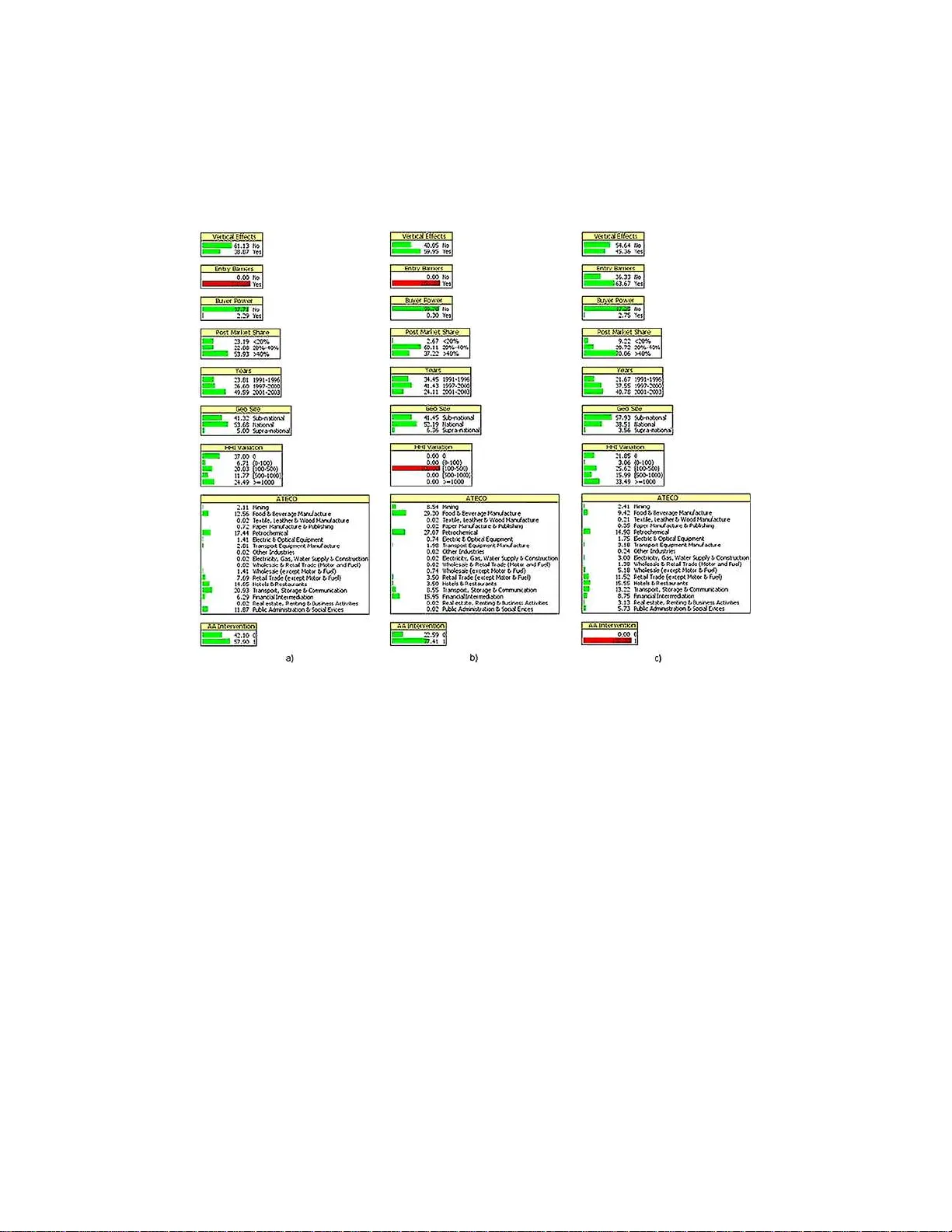
The Annals of Applie d Statistics 2013, V ol. 7, No. 2, 714–738 DOI: 10.1214 /12-A OAS625 c Institute of Mathematical Statistics , 2 013 OBJECT-ORIENTED BA YESIAN NETW ORKS F OR A DECISION SUPPOR T SYSTE M F OR ANTITRUST ENF OR C EMENT 1 By Julia Mor tera, P a ola Vicard a nd Cecilia Vergari Universit` a R oma T r e, Universit` a R oma T r e and Universit` a di Bolo gna W e study an economic decision problem where the actors are tw o firms and t he A ntitrust Authority whose m ain task is to monitor and preven t firms’ potential an ti-comp etitive behaviour and its effect on the mark et. The A ntitrust Authority’s decision pro cess is mo delled using a Ba yesian netw ork where b oth the relational structure and the parameters of the model are estimated from a data set provided by the A uthority itself. A num b er of economic v ariables that influence this d ecision pro cess are also included in the model. W e analyse how monitoring by the Antitrust Authority affects firms’ strategies ab out coop eration. Firms’ strategies are mo delled as a rep eated prisoner’s dilemma using ob ject-orien t ed Bay esian net w ork s. W e show h ow the integ ration of firms’ decis ion pro cess and external market information can b e m o delled in th is wa y . V arious decision scenarios and strategies are illustrated. 1. In tro d uction. Firms in man y cases ha ve incen tiv es to coop erate (col- lude) to increase their profits. The p ossib ilit y for firms to collude do es not dep end solely on their decision b ut also on external circumstances. First of all, firms need to comply with antit rust la ws. If the Antit rust Au thorit y (AA) finds negativ e an ti-competitiv e effects, resulting from firms’ co op era- tiv e b eha viour , it m ay interv ene to pr even t the firms from m erging. The AAs decision pro cess is mo delled here b y u sing a Ba yesia n netw ork (BN) or Probabilistic Exp ert S y s tem (PES) [Co we ll et al. ( 1999 )] estimated from real d ata. A BN is a graphical mo del that enco des the p robabilistic relationships among the v ariables of interest allo wing f or the application of fast general-purp ose algorithms to compute inferences. Often go v ernm en ts may find negativ e anti-c omp etitiv e effects resulting from a merger. As a consequ ence, the decisio n by fi rms to coop erate is Received Novem b er 2011; revised September 2012. 1 Supp orted by a PRIN07 Italian Researc h Grant. Sections 3.1 , 4.1 and 4.3 are due to C. V ergari, the remaining sections are d u e to J. Mortera and P . Vicard. Key wor ds and phr ases. Antitrust A uthority , Ba yesi an netw orks, mergers, mo del inte- gration, prisoner’s dilemma, rep eated games. This is an electronic reprint o f the o riginal article published by the Institute of Mathematical Statistics in The Annals of Applie d St atistics , 2013, V ol. 7, No. 2, 714 –738 . This r eprint differs from the orig ina l in pag ination and t y po graphic detail. 1 2 J. MOR TERA, P . V ICARD AND C. VERGARI actually affected b y the decision p ro cess of the AA. The AA may start an in vesti gation either b ecause t wo fi rms mak e a formal request to merge (explicit collusion) or b ecause th e authorit y susp ects that t wo fir ms are implicitly coll uding. In wh at follo ws the term merger will b e used for b oth explicit and implicit collusion. W e also study ho w the AAs monitoring affects firms’ strategies ab out co- op eration. F or this pur p ose, the firms’ set of p oten tial strategies are mo d elled in turn as a rep eated prisoner’s dilemma u sing ob ject-orien ted Ba y esian net- w orks (OOBNs) [Koller and Pfeffer ( 1997 ), Bangsø and W uillemin ( 20 00 )]. OOBNs are a recen t extension of BNs whic h allo w for a hierarc hical d efini- tion and construction of a BN. T hey pro vid e a compact and intuitiv e repr e- sen tation of th e rep eated prison er ’s dilemma (PD). F urthermore, thanks to the mo dularit y and flexibilit y of this approac h, v arious sou r ces of uncertaint y within the game and generalizat ions of th e rep eated prisoner’s dilemma can b e analysed. W e us e th e PD as a naiv e representati on of firms’ economic in teraction, the f o cus of this p ap er b eing that of analysing the ev olution of firms’ b ehaviour according to v arious external scenarios. F or th eoretical asp ects on su b optimal s trategies in Ba yesian games see, for example, Y oung and Smith ( 1992 ). W e presen t t w o differen t net works: the fi rst mo dels the AAs decision pro- cess, and the s econd represents the b eha viour of the t wo fi rms in a du op oly . OOBNs giv e the graphical framew ork to int egrate these t wo net works and to represen t their time evo lution. Both the graph ical s tructure and the as- so ciated probability tables of AAs decision pro cess n et wo rk are estimated from a r eal data set. As a r esult, w e obtain the estimat ed probability that AA in tervenes to preven t antico mp etitiv e b eh aviour of a merger. F or v arious economic sectors (mark ets of inte r est) we stud y the s en sitivit y of co op era- tiv e outcomes with r esp ect to f actors s uc h as geographical size, marke t share, Herfindahl–Hirsc hman Index (HHI) v ariation, v er tical effec ts, the presence of entry barr iers and buyer p o wer. Th e global OOBN mo del w h ic h inte- grates the AAs decision pro cess with a duop oly mo del is u sed to obtain the optimal d ecision in ligh t of a s er ies of inte resting s cenarios that could o ccur in practice. The outline of th e pap er is as f ollo ws. In Section 2 w e b riefly d escrib e the merger con trol p roblem. W e illustrate the BN for the AAs decision pr o cess estimated from th e data and show its use in v arious scenarios in S ection 3 . A brief introdu ction to the prisoner’s dilemma is illustr ated in Section 4.1 follo w ed b y the Bay esian net w ork represen tation of the PD in Section 4.2 . After in tro ducing the rep eated prisoner’s dilemma in Section 4.3 , in Section 4.4 w e s h o w how this can b e repr esen ted as an OOBN. In S ection 5 we show ho w w e in tegrate the PD net wo r k with the AA net wo r k obtaining a general purp ose global represen tation of the problem, and in Section 5.1 w e app ly this to sev eral decision scenarios. Finally , in Section 6 w e d ra w conclusions and discuss further dev elopments. DECISION SUPPOR T SYSTEM 3 Fig. 1. (a) Pictorial r epr esentat ion of the AA de ci si on pr o c ess and Fi rms’ b ehavior in a Duop oly. (b) Corr esp onding r epr esentat i on for a r ep e ate d sc enario. 2. The merger con trol problem. The AA studies the impact of a merger on the mark et an d its consequences on so cial welfare. Hence, the AAs de- cision affec ts the d ynamics in firms’ eco nomic in teraction as w ell as the corresp ondin g equilibrium outcome. When c ho osing b et w een co op erating or defecting, firms tak e the AAs decision pro cess int o accoun t, b oth when they formally request to merge and in the case of implicit collusion. In our setup, th e actors are as follo ws: the Ant itrust Authority and the t wo merging firms, termed Firm 1 and Firm2 (the duop olists). Figure 1 (a) sho w s a pictorial repr esen tation of th e effects of AAs con trol activit y on Firms’ b ehavio ur. The t wo rounded recta ngles, AA and Duop oly , represent the AAs decision pro cess and the Firms’ merging strategy , r esp ectiv ely . The AAs decision pro cess is mo delled b y a Ba yesia n n et work learned from r eal data (see Sections 3.2 and 3.3 ). The du op oly is mo delled as a P D usin g a Ba y esian net w ork for decision making (see Section 4 ). The tw o net works are then int egrated giving rise to a global mo del, w here b oth the AAs d ecision pro cess and the du op oly are represen ted b y OOBNs. Figure 1 (a) represent s a single stage (v ertical slice) of the ov erall mo d el. Th e merger p roblem, as well as AAs activit y , ev olve in time. Figure 1 (b) giv es a graphical representa tion of th e decision pro cess dyn amics. Details on these net works are give n in Sections 4 and 5 . 3. An titrust Authorit y’s decision pro cess. 3.1. Curr ent pr actic e. The p rimary task of the AA is to enforce the an- titrust la w whic h prohibits an ticomp etitiv e b eha viour , so as to p r ev ent a reduction in so cial w elfare. 2 In p articular, the AA is resp ons ib le for de- tecting the follo w ing: (a) agreeme n ts restricting comp etition; (b ) abu ses of dominan t p ositions; (c) merger op erations in volving the creation or strength- ening of dominan t p ositions in w ays that eliminate or substanti ally reduce comp etition. 2 F or details on the Italian antitrust la w and AA s tasks see: http://www .agcm.it/ en . 4 J. MOR TERA, P . V ICARD AND C. VERGARI T able 1 Description of the variables in the AA network V ariable States Description Y ears { 1991–1 996, 1997–2000 , Reference p erio ds 2001–20 03 } A TEC O Mining, fo o d & beverage Relev ant m arket Man ufacture, etc. (see Figure 3 ) Geo size { Sub-national, n ational, Size of the relev ant market supra-national } Buyer p ow er { Y es, No } Presence (Y es) of comp etitive pressure on the merging p arties Entry b arriers { Y es, No } Presence (Y es) of entry barriers HHI va riations { 0, (0 , 100), [100, 500), V ariati on in mark et [500, 1000), ≥ 1000 } concentrati on index P ost market share { < 20%, [20%–40%], > 40% } P ost-merger market share V ertical effects { Y es, No } Presence (Y es) of vertical effects AA interv entio n { 0, 1 } No (0)/Y es (1) Once the Authorit y has receiv ed a complain t or h as collected informa- tion on p ossible inte r ference with comp etition, a p reliminary examination is carried out and if there are alleged violations of the Antitrust la w, the AA carries out a full in vestig ation. T he la w requires th at wh enev er the p o- ten tially merging firm s exhibit sale reve n u es in excess of certain predefined thresholds, the merger op eration must b e notified to the authorit y in ad- v ance. The thresholds are up dated annually acco rding to the deflator index for gross domestic pro duct. Decisions on a merger are based on a case by case examination and, to our kn o wledge, currently , no sp ecific mo d els are u sed. Th e la w also do es not giv e an y sp ecific thresholds for relev ant v ariables, suc h as mark et share or a mark et concen tration index. 3.1.1. The data. The data we use were collect ed b y the Italian Anti trust Authorit y and concern all the cases examined from 1991 to 2003. T his data set consists of 6920 observ ations. Based on this data set, La No ce et al. ( 2006 ) dev elop ed a logit mo del to analyse the impact of differen t factors on the Authorit y decision. F ollo wing La No ce et al. ( 2006 ), w e consider rele- v an t m ark ets affected by the merger as elemen tary units of analysis. These mark ets are denoted by the IST A T (Italian National In s titute of Statistics) economic activit y co d e A TECO. T able 1 describ es the v ariables in the data set that were used to estimate the AA net w ork. The Herfin dahl–Hirsc hm an Index, HHI, is defi ned as the sum of the squares of n firms’ mark et share, P n i α i 2 , where α i denotes DECISION SUPPOR T SYSTEM 5 Fig. 2. L o gic al c onstr aints f or AA network estimation. firm i ’s mark et share and P n i α i = 100. Increase in the HHI indicate s a decrease in comp etition and an increase in marke t p o we r. V ertical effects refer to the anti comp etitiv e effects that a vertica l merger could imply , that is, the p ossibility to raise entry barriers b y inp ut foreclosure or b y customer foreclosure. The estimatio n (learning) pro cess of a Ba ye sian net wo r k consists of t wo phases: the graphical stru cture estimatio n and the conditional probabilit y table estimation. These will b e illus tr ated in turn. 3.2. Estimation of the network’s gr aph i c al structur e. The graphical s truc- ture of the AA net work represen ting th e AA decision pr o cess is obtained by a com bin ation of sub ject-matter kno wledge, pro vided by a domain exp ert, and the information in th e d ata. The Ne c essary Path Condition (NPC) algorithm [Stec k ( 200 1 )] imple- men ted in Hu gin is used to estimate the graph ical stru ctur e of the net wo r k. The NPC is a constraint- based algorithm recursiv ely testing marginal and conditional asso ciation b et wee n categorica l v ariables. The NPC algorithm allo ws the user to choose the m ost suitable among indep endence equiv alen t mo dels. The NPC algorithm tak es in to accoun t logical constr aints, su c h as presence/absence of a link or assignment/ban of a sp ecific dir ection b et w een v ariables. The logica l constrain ts we implemen ted h ere are sh o wn in Figure 2 . These imply that if there is a relation b et w een tw o v ariables in differen t b o xes, it must h a ve the same direction as that in Figure 2 . F ur thermore, if t wo v ariables b elong to the same b ox, their asso ciation (if it exists) can b e in any one of the t wo p ossible directions. F or example, if no de AA Interven tion 3 is connected with an y of the other v ariables, th e direction has to b e from these in to AA Interven tion no de (AA decision logically d ep ends on the v alues of the other v ariables). Th is means that arrows from AA Interven tion to any other v ariable are logically prohib ited. The reference p erio d (no de Years ) is not influenced b y any of the other v ariables in the mo del. The dep enden ce stru cture—based on the logical constraints giv en in Fig- ure 2 —learn t from the data is shown in Figure 3 . The main d ep endence relationships estimated from the data are as follo ws: 3 Here w e indicate nodes in teletype . 6 J. MOR TERA, P . V ICARD AND C. VERGARI Fig. 3. AA network showing the dep endencies of AA Intervent ion on the r elevant vari- ables describing the market and the mar ginal pr ob abilities of the variables. (i) The market of in terest ( ATEC O ) can dep end on Year : an economic sector could b e more r elev ant and w orth in vesti gating du ring one of the three reference p erio ds (note that the president of the AA change d in 1997 and from 2001 I talian currency Lira w as replaced b y the Euro). (ii) AA Interven tion dep ends directly on HHI Variation , Vertical Effects , P ost M arket Sh are , Geo Size and Entr y Barrie rs . F urthermore, the relev an t market ( ATEC O ) do es not affect AAs decision ( AA Interventi on ) directly but only thr ough the relev ant features of the m arket and of the merg- ing firms ( HHI Variat ion , Vert ical Effect s , Pos t M arket Sh are , Geo S ize and Entry Barriers ). These r esu lts are consisten t with those in Bergman, Jak obsson and Razo ( 2005 ) and La No ce et al. ( 2006 ). (iii) The Herfindahl–Hirsc hman concen tration index v ariation ( HHI Variatio n ) d ep ends on all the v ariables that logically precede it or are on an equal fo oting (as shown in Figure 2 ), wh ereas Post Mark et Share dep end s only on Entry Barriers , Geo Size and A TECO . An explanation of this could b e that when a mark et sector is c haracterised b y ent ry barriers (b ecause of p aten ts or incr easing returns to scale) w e exp ect that this m ark et DECISION SUPPOR T SYSTEM 7 ma y b e comp osed of a f ew firms with high mark et shares, th us influ encing Post Market Share and a relev an t H HI Variation . Man y other conditional indep endencies can b e read off the AA net wo rk in Figure 3 , but for brevit y they will not b e presen ted h ere. 3.3. Estimation of the pr ob ability tables. T o complete the construction of our mo d el, w e estimate the conditional probabilit y distributions of the v ariables from the data. Th e EM-algorithm [Dempster, Laird and Ru bin ( 1977 )] is used for learning the p robabilities. The net work in Figure 3 exhibits a complex asso ciation str u cture among the v ariables. F or example, no d e HHI vari ation has sev en paren ts. Its con- ditional p r obabilit y table h as 17 × 3 3 × 2 3 × 5 = 18, 360 entries corresp onding to the state sp ace of its parent v ariables: ATECO , Post Ma rket Share , Ye ars , Geo Size , Entry Barrie rs , Buye r P ower , Vert ical E ffects , as well as HHI Variatio n ’s s tate sp ace. Many of these com bin ations are not represen ted in the data set, although they cannot b e considered imp ossible ex ante . In fact, according to Bergman, Jak obss on and Razo ( 2005 ), if a threshold for relev an t v ariables—lik e p ost mark et sh are—can b e detected in AAs legal practice, this thresh old may v ary according to other v ariables, s u c h as buy er p o wer and entry barriers. Therefore, no v ariable lev el com bin ations can in principle b e ru led out. So, in ord er to av oid that certain p ossible configurations in the conditional probability tables ha v e zero pr obabilit y , w e set noninformative nonzero prior probabilities. Figure 3 displays the marginal probab ilities 4 estimated from our data. Note, for example, that the probability of an AA inte rv ention is only 0 . 018 9 , whic h could b e d ue to the fact th at in most case s, 74 . 38%, the p ost market share is less than 20% and ent ry barr iers and vertic al effects are absent (with probabilit y 0 . 979 3 and 0 . 926 8, resp.), HHI ind ex is less than 100 in 87 . 85% of the cases and only in 15 . 38% the geographical size is sup ra-national. 3.4. Using the network. Once the mo del has b een estimated, w e can ad- dress a n um b er of qu estions ab out the AAs d ecision pr o cess. V arious p ossible scenarios can b e examined by inserting and propagating the appropr iate ev- idence throughout the net work. W e illustrate three hyp othetical scenarios. Sc enario A. What is the probability of an AA interv en tion in a merger request w hen there are en try barriers in the mark et? This scenario is rep- resen ted in Figure 4 (a ). The p osterior pr ob ab ility of an A A Inte rvention increases from 0 . 018 9 to 0 . 5790 when the evidence Entry Barr iers = Y es is inserted and propagated throughout the net wo r k. Sc enario B. How would the probabilit y ob tained in S cenario A change if the Herfin dahl–Hirsc hm an concen tration index v ariation ( HHI variat ion ) 4 In all figures probabilities are exp ressed as p ercentages. 8 J. MOR TERA, P . V ICARD AND C. VERGARI Fig. 4. Sc enarios (a) , (b) and (c) giving mar ginal p osterior pr ob abilities for the AA network. is in the class [10 0 , 500)? Note in Figure 4 (b) that the p robabilit y of AA Interven tion no w increases to 0 . 7 741. The n et wo rk can b e used not only f or direct r easoning ab out the p roba- bilit y of AA Interventio n , bu t also for reasoning ab out p ossible “causes” of a giv en AA decision. Sc enario C. A question ab out comp etition auth orities’ b ehavio ur that has b een rarely addressed in the literature is ab out the t yp e of mergers that are t ypically p r ohibited [Bergman, Jakobsson and Razo ( 2005 )]. O ur net work can b e used for this pur p ose. Su pp ose that the AA decides to interv ene in a fi rm’s merger r equest. What are the most plausible reasons of this decision? Figure 4 (c) giv es the p osterior pr obabilities giv en the evidence that AA Inter vention is equal to one. On comparing Figures 3 and 4 (c) we see that: • The probabilit y of entry barr iers increases from 0.0207 to 0.6367; • The probabilit y of ve rtical effects increases from 0.0732 to 0.4536 . T his is an in teresting result, since, although there is common agreemen t ab out the relev ance of v ertical effects f or AAs decision on a mer ger request, it is DECISION SUPPOR T SYSTEM 9 T able 2 Payoff matrix for the prisoner’s dilemma Firm2 C D Firm1 C a, a c, d D d, c b, b con trov ersial whether v ertical effects influence th e market negativ ely b y foreclosing comp etitors or p ositiv ely b y reducing transaction costs. Here w e find that the pr esence of vertic al effects is m u c h more probable for those fir ms where AA decides to in terv ene. La No ce et al. ( 2006 ) foun d similar results. • The pr obabilit y of p ost marke t s h are less than 20% decreases fr om 0.7438 to 0.0922, wh ereas the probabilit y of p ost market share greater than 40% increases from 0.077 7 to 0.700 6. • The HHI ind ex decreases in the fir st tw o classes and increases in the last three classes. Note that when evidence is propagated in the netw ork, all marginal proba- bilit y tables are u p dated acc ordingly . 4. Duop oly represen tation. 4.1. The prisoner’s dilemma. The prisoner’s dilemma [Flo o d ( 1958 )] de- scrib es co op eration b y rational agen ts. The PD is a 2-pla ye r s ymmetric game where the t wo pla y ers ha ve th e same rˆ ole and ha v e th e same set of p oten- tial strategies termed c o op er ate C and defe ct D . The PD is a s imultaneous game where the pla yers choose just once and sim ultaneously and the unique equilibrium 5 is the pair of strategie s ( D , D ). Pla y ers ’ pa y offs are suc h that defect is a dominan t strategy , that is, a strateg y that is preferred by eac h pla yer indep end en tly of his/her riv al. The problem is that th is strategy is in- efficien t since b oth pla yers wo u ld gain more if they co op erated and adopted the ( C , C ) strategy . Th e source of the dilemma lies in the fact th at eac h pla yer has an incen tiv e to d efect if the riv al play er coop erates, so that an agreemen t to co op erate w ould not b e credible. Sim ultaneous games, su ch as the PD, are commonly r ep resen ted in either the n ormal or the extensiv e f orm. I n the normal f orm repr esen tation, the PD can b e describ ed by the pa yo ff matrix in T able 2 . The t wo firms, Firm1 and Firm2, h a ve t wo a v ailable strategie s : co op erate C or d efect D . The pa yoffs 5 An equilibrium is a strategy pair such that no play er can improv e his p osition by unilaterally c han ging his decision. I n other wo rds, it is a situation in whic h all pla yers choose mutual b est resp onses. 10 J. MOR TERA, P . V ICARD AND C. VERGARI Fig. 5. (a) T r e e r epr esentation of the simultane ous duop oly game. (b) Corr esp onding Bayesian network r epr esentation. need to b e such that d > a > b ≥ c and 2 a > ( c + d ) > 2 b , so th at ( C, C ) maximises pla yers’ join t p a yo ff. Give n that b < a , the strategy pair ( D , D ) is strictly w orse than ( C, C ). In the extensiv e form the game is repr esen ted by a tree. Figure 5 (a) sho ws the tree r epresen tation (equiv alent to T able 2 ) of the simulta n eous duop oly game. Firm1 mo v es firs t and chooses either C or D , Firm2 mo v es second but without kno wing wh at Firm1 d id. A symmetric duop oly , s u c h as a mark et with tw o symmetric p rofit-maxi- mising firms in mutual comp etition, can b e mo d elled as a PD. The d uop oly profit is the gain of eac h of the sellers in this market. Supp ose the tw o firms pro duce iden tical go o ds, incurring constant margi- nal costs, and th ey comp ete setting their prices. Since consu mers will buy from the fir m charging the lo we st price, fi rms ha v e an incen tiv e to u n dercut their price to conquer the mark et (nonco op erativ e or defect strategy). At equilibrium firms w ill set th e competitiv e p rice (the market p rice under DECISION SUPPOR T SYSTEM 11 p erfect comp etition whic h is equal to fi rm’s marginal cost of pro d u ction), gaining duop oly profit b = 0. T his result is often called a paradox, since there are just t wo fir ms in the market and still the p er f ectly comp etitiv e strategy yields zero profit. Ho wev er, if fir ms d ecide to co op erate and set the monop oly p rice, they can share p ositiv e monop oly profits. The monop oly profit is alw a ys greate r than t wice the duop oly profit, 2 a > 2 b . In most mark ets, from a consum er ’s p oin t of view, goo ds are not id en tical. This giv es fir ms the abilit y to raise the p rice ab o v e the m arginal cost of pro du ction without losing their customers to comp etitors. In a symmetric duop oly with pro du ct d ifferen tiation fir ms pro duce and sell different iated go o ds (imp erfect su bstitutes). As long as pro duct different iation is not to o large, firms face a P D: if they coop er ate, they could share monop oly profit, but they ha ve incen tiv e to defect if the riv al co op erates. Ho wev er, when go o ds are imp erfect substitutes, fi rms mak e p ositiv e duop oly profit, b > 0, under the nonco op erativ e s tr ategy p air ( D , D ). This du op oly profi t is smaller than half the monop oly profit, b < a , so that the co op erative strategy C is sup er ior for eac h fir m sin gly . 4.2. The prisoner’s dilemma network. Ba ye sian n et works for d ecision supp ort sys tems can incorp orate b oth decision no des and u tilit y no des [Jensen ( 2001 )], giving r ise to an influ ence diagram (ID) representa tion. IDs w ere extended b y Lauritzen and Nilsson ( 2001 ) to allo w for limited in formation decision p roblems (LIMIDs). A different approac h to r ep resen t and solv e games u sing grap h ical m o dels wa s initially prop osed b y Smith ( 1996 ) and later by La Mura ( 2000 ), Kearns, Littman and S ingh ( 2001 ) and K oller and Milc h ( 2003 ). The one stage PD b eing a symmetric game can b e represent ed b y the ID netw ork in Figure 5 (b). The simulta neit y of the game is implemen ted b y represen tin g Firm1 as a random v ariable (o v al no de) and Firm2 as the decision mak er (rectangular n o de) ha ving tw o p ossible actions: defect D and co op erate C . Firm2’s decision is in fluenced by Firm1. Firm1’s asso ciated prior probabilit y d istribution represen ts Firm2’s s ub jectiv e opinion ab out Firm1’s b ehavio ur. Random v ariable Firm1 has t wo states, defect (coded as 0) an d co op erate (cod ed as 1), w ith u niform p rior pr ob ab ilities indicating Firm2’s ignorance ab out Firm1’s c h oice. Firm2 could assign differen t pr ior probabilities b ased on h is/her prior kn o wledge ab out Firm1’s b eha viour . T able 3 sho ws Firms2’s u tilit y [no d e Firm2’s ut ility U2 in Figure 5 (b)] based on Firm1 and Firm 2’s actions. Thanks to game symmetry , T able 3 is equiv alen t to the normal form pa yoff matrix give n in T able 2 . Once th e n etw ork is compiled, the optimal decision for Firm2 is automati- cally computed b y maximising exp ected utilit y . Since the game is symmetric, Firm2’s optimal strategy coi ncides with Firm1’s optimal strategy and this pair of strategies constitutes a Nash equilibrium. Thus, in the ID represen- tation the c hoice of Firm2 as decision mak er is without loss of generalit y . 12 J. MOR TERA, P . V ICARD AND C. VERGARI T able 3 Firm2’s utility U2 c onditional on Firm1 and Firm2 ’s actions Firm1 Defect (0) Coop erate (1) Firm2 Defect (0) Coop erate (1) Defect (0) Co op erate (1) U2 b c d a In what follo ws w e alw a ys consider Firm2 as the decision maker. The prior p robabilit y distrib u tion on the r andom v ariable Firm1 r eflects Firm2’s sub jectiv e opinion on the type of riv al pla yer h e/she is pla ying against. 4.3. R ep e ate d prisoner ’s dilemma. Since firms interact more th an once, w e need to consider the rep eated ve rsion of the PD. In rep eated games, pla yers’ actions are observ ed at th e end of eac h p erio d and their o verall pay off is the sum of the pa y offs in eac h stage d iscoun ted by a factor δ ∈ [0 , 1]. Th u s, pla yers ma y condition th eir pla y on the opp onen ts past pla y . Here we assume that firms nev er forget previous mo ves and other information acquired, in other w ord s, w e assume that firms ha ve p erfect recall. The rep eated P D analyzes how threats and pr omises ab out fu ture b e- ha viour can affect and impro ve current b eha viour. When the time h orizon is in definite fir ms may decide to adopt a co op erativ e strategy wh ere the discoun t facto r δ represents uncertain ty ab out the n u mb er of s tages faced b y firms. This uncertain t y is usually not mo delled within the game itself. In S ection 5 we illustrate ho w to incorp orate this un certain t y in the m erger con trol p roblem. 4.4. OOBN for r ep e ate d priso ner’s dilemma. Generalising the tree rep- resen tation in Figure 5 (a) to rep eated ga mes is b oth compu tationally and graphically demand ing. The game tree grows exp onentia lly with the n u m- b er of stages. F or example, Figure 6 (a) sho ws th e tree representa tion of a t wo- stage PD. OOBNs are particularly w ell su ited for an app licatio n area su ch as th e present b ecause the similarit y b et ween net work elemen ts (the stage s of th e game) can b e exploited in a mo dular and flexible constru ction. Ob ject- orien ted Ba y esian net wo rks ha ve a hierarc h ical structure where a no de itself can represent a (ob ject-orien ted) net wo rk cont aining sev eral instanc es of other generic classes of n et works. Instances ha ve interface input and output no des as well as ordinary no des. In stances of a particular class h a ve ident ical conditional p robabilit y tables for n oninput no des. I nstances are conn ected b y arr o ws fr om output no d es into inpu t no des. These arro ws, as well as those from ord inary no des to inp ut n o des, r epresen t iden tity links, whereas arro ws b et we en t w o ordinary nod es or an output no de and an ordinary no de repr esen t p robabilistic dep enden ce. Th e grap h ical simplicit y automat- DECISION SUPPOR T SYSTEM 13 Fig. 6. (a) T r e e r epr esentation of the two-stage duop oly game. (b) Corr esp onding OOBN r epr esentat ion. ically pro duces computational efficiency . As a r esult, incr easingly complex net works can b e constructed by simp ly adding new ob jects whic h p erform differen t tasks. Since w e assum e p erfect r ecall, Hu gin 6 v ersion 6.9 soft w are, whic h au- tomatica lly implements th e fact that at ev ery stage the decision m ak er re- calls all previous decisions, is used to build the net works. This implies that eac h d ecision dep ends on the decisions tak en in all previous stages, so ev en though the graphical representat ion do es not implicitly repr esen t this, in the jun ction tree construction [Co w ell et al. ( 1999 )] these d ep endencies are explicitly considered. In wh at follo ws w e ind icate an instance in b old . Fig- ure 6 (b) sh ows the O OBN t wo-sta ge r ep eated game that co rresp ond s to the tree representat ion in Figure 6 (a). Each roun d ed rectangle r epresen ts an in stance termed Duop oly and mo dels a stage of the rep eated game . In order to sp ecify the links b et ween successiv e stages (instances), Figure 5 (b) 6 www.h ugin.com . 14 J. MOR TERA, P . V ICARD AND C. VERGARI Fig. 7. C l ass network for r ep e ate d PD with asso ciate d mar ginal prior pr ob ability tables. (whic h repr esen ts eac h Duop oly instance) needs to b e generalised as sho wn in Figure 7 . The no d e Firm 1 ∗ mo dels the b eha viour of Firm1 in th e next stage. In eac h stage the game can either con tinue or terminate. F irm1 and Firm1 ∗ no w need to b e giv en thr ee states: defect (0), coop erate (1) and stop (2). Since in a rep eated game every stage dep en ds on the actions tak en in the pre- vious stages, Firm1 ∗ is logically dep end en t on Firm2 . Uncertain ty ab out the existence of further stages is mo delled b y addin g a new rand om n o de stop? . No de st op? has tw o states, { 0 , 1 } according to wh ether the game con tinues or stops and has a Bernoulli distribution Bin(1 , 1 − delta ). The parameter no de delta is th e p robabilit y th at the game con tinues P ( stop? = 0). No de delta has a u niform prior distribution o v er a plausible set of v alues. In the firs t s tage, to ensure that the game starts, Firm1 can only c h o ose b et w een defect and co op erate. T able 4 giv es the conditional probabilit y dis- tribution of Fi rm1 ∗ giv en stop? and Firm2 . It shows that if the game stops ( stop? = 1), Fi rm1 ∗ stops with certain t y , else Fi rm1 ∗ co op erates or defects according to Firm2 ’s decision. This implemen ts the tit for tat (T FT ) s tr at- T able 4 Conditional pr ob ability table for Firm1 ∗ given stop? and Firm2 Stop? No (0) Y es (1) Firm2 Defect (0) Coop erate (1) Defect (0) Coop erate (1) Defect (0) 1 0 0 0 Coop erate (1) 0 1 0 0 Stop (2) 0 0 1 1 DECISION SUPPOR T SYSTEM 15 Fig. 8. Gener alise d r ep e ate d PD network r epr esenting various str ate gies and i nc omplete information. egy in whic h Firm1 b egins by co op erating and coop erates as long as Firm2 co op erates, and defects otherw ise. V ariatio ns on this strategy will b e sh o wn in Section 4.4.1 . 4.4.1. Other str ate gies. Exp erimen tal results sho w that p eople, contrary to stand ard p rescriptions of game theory , may co op erate more f requen tly than exp ected [And reoni and Miller ( 1993 )]. An explanation b ehind this empirical evidence is pro vid ed b y the theoretical mo dels of Kreps and Wilson ( 1982 ) and Kr eps et al. ( 1982 ). Figure 7 can b e mo dified to provide a general class netw ork that explicitly incorp orates a set of p otenti al strategies for Firm1 other than TFT. This net work is displa yed in Figure 8 . T he net work can, for example, mo del a rep eated PD with in complete information, that is, where there is u ncertain ty ab out the t yp e of riv al that a firm is going to face. The conditional probabilit y distribution of Firm1 ∗ reflects Firm2’s uncertain ty ab out its opp onent. If Firm 2 b eliev es Firm1 to b e “altruistic”, it can exp ect Firm1 to co op erate, with probabilit y α D > 0, even if it defected in the pr evious stage. On th e other hand, if Firm2 b eliev es Firm1 to b e “egoisti c”, then it exp ects Firm1 to co op erate, with probabilit y α C < 1 , ev en if it co op erated in th e p revious stage. Additional n o des, F irm1 ∗ |D and Fi rm1 ∗ |C , h aving Bernoulli distribu - tions with parameter n o des alpha D and al pha C are added to the net w ork of Figure 7 . No de Fi rm1 ∗ tak es v alue 2 if the game stops in the curr ent stage, wh er eas if the game con tin ues ( stop? = 0), the v alue of Firm 1 ∗ de- p ends on that of Firm2 . If Firm2 defects (co op erates), Firm1 ∗ is Firm1 ∗ |D ( Firm1 ∗ |C ), with alpha D ( alpha C ) b eing the probabilit y that Firm1 will co op erate in the next s tage giv en that Firm2 defected (co op erated) in the previous stage. T he conditional pr ob ab ility distribution of Firm1 ∗ is th us 16 J. MOR TERA, P . V ICARD AND C. VERGARI Fig. 9. Inte gr ate d AA-duop oly mer ger stage game. defined by the logical expression if ( sto p == 1 , 2 , i f ( Firm2 == 0 , Firm 1 ∗ |D , Firm1 ∗ |C )). 7 Firm1 ∗ represent s Firm2’s sub jectiv e opinions ab out Firm1’s b ehavi our in eac h single stage of the rep eated game. This mod el can also incorp orate a large set of strategies, including T FT , and it can mo del s cenarios where the probabilit y that the game con tinues dep end s on external factors. An illustrativ e example is given in Section 5 . 5. Global net wo r k. Th an k s to th e m o dularit y and flexibility of OOBNs, it is p ossible to integrate the AA an d the Duop oly net works, giving rise to a u nique ov erall OOBN represen tation of the p r oblem [Figure 1 (a)]. An expanded representa tion of this mod el is s h o wn in Figure 9 . 7 The function if ( A, x, y ) takes v alue x if condition A is satisfied, otherwise y . DECISION SUPPOR T SYSTEM 17 Fig. 10. OOBN r epr esenting a thr e e-stage r ep e ate d mer ger game with unc ertainty ab out the numb er of stages. The Duop oly net work (the b ottom n et wo rk) in Figure 9 is s imilar to the net work in Figure 8 except that the u n certain t y ab out the next stage stop? is no w identified w ith AA I nterventi on in the A A net wo rk (the top net work in Figure 9 ) r epresen ting AAs decision p ro cess. The AA d ecision pro cess is usually d ynamic; it can c hange o v er time due to c hanges in the antit rust la w as w ell as c hanges in mark et conditions. W e are th u s intereste d in the rep eated v ersion of the mo d el in Figure 9 . Figure 10 represents the global mo del (Figure 9 ) rep eated four times for a thr ee-stage merger game with u ncertain ty on the num b er of stages. In general, an O OBN with n + 1 instances mo d els a game rep eated n times with uncertaint y ab out the successiv e stage. In th is mo del, the AAs d ecision pro cess is represen ted by th e same instance in eac h p eriod . Th is is ju stified b y assumin g that, ev en if the AA decides not to in tervene, it con tinues monitoring firms’ b ehavio ur in successiv e stages. 5.1. Firms’ str ate gy. W e n o w stud y the sens itivit y of co op erativ e b e- ha viour with resp ect to t w o sets of utilities and all the f actors that might directly or ind irectly influence the AAs d ecision. W e consider b oth the TFT strategy and a more general s tr ategy . The TFT strategy can b e implemen ted using the glo bal net work b y setting Firm1 ∗ = 1 in stage Duop oly 1 and Firm1 ∗ |C = 1, Firm1 ∗ |D = 0 in all other stages. 18 J. MOR TERA, P . V ICARD AND C. VERGARI T able 5 Firm2’s utility U2 for a market with p erfe ct substitutability Firm1 Defect (0 ) Coop erate (1) Firm2 Defect (0) Co op erate (1) Defect (0) Coop erate (1) U2 0 − 10 150 100 5.1.1. TFT str ate gy: Perfe ct substitutability. T able 5 sho ws an example of Firm2’s utilit y for a mark et with p erfect s ubstitutable go o ds. Figures 11 , 12 and 13 sh o w the marginal pr obabilities f or a selectio n of random v ariables and the exp ected utilities f or the d ecision no des in the first stage AA 1 and Duop oly 1 . Fig. 11. Mar ginal pr ob abil ities and optimal de cision in the first stage AA 1 and Duop oly 1 , under p erfe ct substitutability, when Fi rm1 pl ays TFT. DECISION SUPPOR T SYSTEM 19 Fig. 12. Mar ginal pr ob abil ities and optimal de cision in the first stage AA 1 and Duop oly 1 , under p erfe ct substitutability, when Firm1 plays TFT, Entry Barrier s = Y es and HHI Variatio n > = 1000. When no evidence ab out the v ariables in the market is inserted in the net work (Figure 11 ) Firm2’s optimal decision is to co op erate (1), ha ving exp ected utilit y equal to 443 .40 (while defect has exp ected utilit y equal to 385.47). This could b e in part du e to the small pr obabilit y of an AA in terven tion, 0.0189. Figure 12 sho w s the case where there are entry barriers in the mark et of in terest ( Entry Barriers = Y es) and the merger causes the HHI v ariation to b e in the last class ( HH I Variat ion > = 1000). The resulting p robabilit y of AA in terven tion sho ots up to 0.94 35 and Firm 2’s optimal decision is to defect with exp ected utilit y of 394.72, against 350.93 for co op erating. This strategy still remains optimal (although with a smaller gap b et wee n the exp ected utilities) when based only on the p resence of en try barriers . 20 J. MOR TERA, P . V ICARD AND C. VERGARI Fig. 13. Mar ginal pr ob abil ities and optimal de cision in the first stage AA 1 and Duop oly 1 , under p erfe ct substitutability, when Firm1 plays TFT, Entry Barriers = Y es, HHI Variatio n > = 1000 and Buyer Power = Y es. Figure 13 sh o ws the case where, as b efore, there are entry barriers, the HHI v ariation is ≥ 1000, and customers exert comp etitiv e p ressure on the merging parties ( Buyer Power = Y es). The probabilit y of AA in terv en tion decreases from 0.943 5 to 0.2915 and Firm 2’s optimal decision is to co op erate, ha ving exp ected utilit y of 416.1 4. It is in teresting to n ote that bu y er p o we r is able to counterbalance th e effect of b oth en try barriers an d a large HHI v ariation. 5.1.2. TFT str ate gy: Imp erfe ct substitutability. W e n o w use Firm2’s util- it y for a market with imp erfect sub stitutable goo ds giv en in T able 6 . Figure 14 sho ws r esu lts when evidence ab out the market is n ot a v ailable. Firm2 ’s optimal decision is to co op er ate (1), having exp ected utilit y equal DECISION SUPPOR T SYSTEM 21 T able 6 Firm2’s utility U2 for a market with imp erfe ct substitutability Firm1 Defect Co op erate Firm2 Defect Coop erate Defect Coop e rate U2 100 5 0 160 150 to 601.33 (while defect has exp ected u tilit y equal to 513 .21). Aga in, this is most plausibly due to the small pr obabilit y of an AA in terven tion. When Entr y Barriers = Y es and HHI Varia tion > = 1000 , Firm2’s ex- p ected u tility to co op erate or to defect is almost equal, although th e prob- abilit y of AA int erv entio n is close to 1 (Figure 15 ). Fig. 14. Mar ginal pr ob abil ities and optimal de cision in the first stage AA 1 and Duop oly 1 , under i mp erfe ct substitutability, when Fi rm1 pl ays TFT. 22 J. MOR TERA, P . V ICARD AND C. VERGARI Fig. 15. Mar ginal pr ob abilities and optimal de cision in the first stage AA 1 and Du op oly 1 , under imp erfe ct substitutability, when Firm1 plays TFT, Entry Barriers = Y es and HHI Variation > = 1000. F urthermore, in con tr ast to p erfect su bstitutabilit y , account ing for the presence of en try barriers alo ne is not su fficien t to mo d ify the optimal deci- sion from co op erate to d efect. The main r eason b eing that when the firms’ pro du cts are imp erfect s ubstitutes, the set of utilities reflects the f act that the defect strategy do es not corresp ond to such a strong pu nishment, so that a firm can contin ue to co op er ate even if ther e is high r isk that the game migh t stop. 5.1.3. Inc omplete information. Assu me that Firm2 has incomplete in- formation ab out the t yp e of riv al it is going to f ace. This is a reasonable scenario, as firms are likel y to b e uncertain ab out their r iv als’ costs and b enefits from co op eration. T able 7 shows Firm2’s exp ected u tilit y in case of p erf ect substitutabil- it y (based on Firm2’s utilit y given in T able 5 ) for different probability DECISION SUPPOR T SYSTEM 23 T able 7 Firm2’s exp e cte d utili ty for differ ent values of α C and α D , without evidenc e, with evidenc e E 1 and E 2 , for likeliho o d evidenc e and for the TFT str ate gy Without evidence With evidence E 1 With evidence E 2 α C α D E [ u ( D )] E [ u ( C )] E [ u ( D ) | E 1 ] E [ u ( C ) | E 1 ] E [ u ( D ) | E 2 ] E [ u ( C ) | E 2 ] 1 0 . 25 337 388 329 339 322 298 0.8 0 . 25 286 316 278 277 271 24 5 0.6 0 . 25 238 250 228 219 220 19 3 0.4 0 . 25 203 193 190 170 180 152 1 0 . 2 332 388 326 339 321 298 0.8 0 . 2 281 316 275 277 270 245 0.6 0 . 2 231 247 225 217 219 19 3 0.4 0 . 2 192 188 183 167 177 149 1 0 . 1 321 388 321 339 320 298 0.8 0 . 1 270 316 270 277 269 245 0.6 0 . 1 219 243 219 215 218 19 3 0.4 0 . 1 172 179 171 159 170 14 3 Likel ihoo d 280 313 273 275 268 243 TFT 385 443 390 394 395 353 v alues of α C and α D (no des alpha C and alp ha D in Figure 9 ). Th ree t yp es of information ab out the r elev an t market are considered : n o evi- dence, eviden ce E 1 = { Post Market Share ≥ 40%, Entry Barriers = Y es and Bu yer Power = Y es } and evidence E 2 = { Entry Ba rriers = Y es and HHI Variatio n ∈ [500–1000] } . The optimal decision yielding the highest ex- p ected utilit y for eac h scenario is italic ised. The second last row of T able 7 give s the resu lts w hen inserting a uniform lik eliho o d function for α C > 0 . 5 and α D < 0 . 5. I n th is case, Firm2’s optimal decision is to coop erate under no evidence and E 1 . Wh er eas, for E 2 , w hen the probabilit y of AA int erv entio n is close to one, E [ u ( D ) | E 2 ] > E [ u ( C ) | E 2 ], so Firm2’s optimal d ecision is to defect. These results coi ncide with those obtained u sing the TFT strategy shown in the last ro w of T able 7 . Reca ll that the TFT s tr ategy corresp ond s to sett ing α C = 1 and α D = 0 in all Duop oly instances. No w, supp ose Firm2 b eliev es that its riv al co op erates—with probabil- it y α C = 0 . 8—if Firm2 co op erates; and co op erates—with probabilit y α D = 0 . 25—ev en if Firm2 defects. This is imp lemen ted in the net work insert- ing and propagating evidence alpha C = 0.8 and a lpha D = 0.25 in eac h Duop oly instance. As w e can see in T able 7 , Firm 2’s exp ected utilit y to co op erate, E [ u ( C )] = 316, is greater than to defect, E [ u ( D )] = 286. Int ro- ducing evidence E 1 in AA 1 , the tw o decisions b ecome almost utilit y equiv- 24 J. MOR TERA, P . V ICARD AND C. VERGARI alen t. Whereas, under the T FT strategy , E 1 yields an optimal decision to co op erate E [ u ( C ) | E 1 ] = 394, whereas E [ u ( D ) | E 1 ] = 390. Recall that when information ab out the relev an t mark et is not tak en into accoun t, the p robabilit y of AA in terven tion is 0.0189. If th e probability that Firm1 coop erates wh en Firm2 defects is very small ( α D = 0 . 1), then its op- timal decision is to co op erate, ev en for sm all v alues of α C . On the other hand, w h en α D ≥ 0 . 2, defecting is Firm2’s b est c h oice for α C = 0 . 4, yield- ing a differen t b eha viour from that obtained us ing the TFT str ategy . Ho w- ev er, using evidence E 1 , when the prob ab ility of AA in terven tion is 0.51 4, E [ u ( D ) | E 1 ] > E [ u ( C ) | E 1 ] ev en when Firm1 is sligh tly altruistic, α D ≤ 0 . 2 and α C ≤ 0 . 6. F urthermore, if α D = 0 . 25, then E [ u ( D ) | E 1 ] > E [ u ( C ) | E 1 ] also for α C ≤ 0 . 8. I f the TFT strateg y is adop ted, Firm2 optimally coop erates b oth under no evidence and E 1 , whereas for E 2 the asso ciated probabilit y of AA interv en tion is v ery large, so that Firm 2’s optimal decisio n is to d efect for all v alues of α C and α D considered here. While the examples sh o wn here are merely illustrativ e, the n u m b er of questions and different strategies that can b e analysed is clearly huge and increases with the n umb er of s tages consid ered. 6. Conclusion. When the an titrust authorit y starts an inv estigation, the t wo p oten tially merging fir ms are likely to r epresen t a relev an t share of the mark et, hence, they migh t affect the price of the go o d s traded. In con trast, the d ecisions of other firms inside the mark et, but outside the merged en- tit y , can b e assumed to b e irrelev ant. In circum s tances suc h as these, a P D duop oly mo del is a reasonable r epresen tation. F rom an economic p ersp ectiv e, the metho d ology w e present can b e seen as a u seful decision supp ort system. It mo d els and inte grates the different uncertain ty sources deriving from a riv al comp etitor and from the economic en viron m en t. F urthermore, the mod el can b e up dated as w e consider new cases, changes in market conditions or new ant itrust r egulations. Th e em- phasis in this pap er is to sho w the p oten tialit y of OOBNs in the analysis of duop oly mark ets with external un certain t y . F or the sak e of simplicit y , the duop oly is represented b y a rather naiv e game theoretic mo d el; in future studies we wish to implemen t a more complex in teraction mo del b et we en firms. As is standard in ind ustrial organization, the fir m is seen as a s ingle de- cision making un it; generalisatio n s of our OOBN to mo del firms’ in ternal organizatio n could also b e considered. Indeed, a fi r m’s top and middle man - agemen t ma y hav e differen t ob jectiv es fr om its o wner. An appropr iate BN could b e built to mo del these int errelationships and incorp orate them in to a more general OOBN mo d el. This would yield a more complete and realistic picture of firms’ coop erativ e b ehavio u r. W e h op e to dev elop this and other asp ects in the future. DECISION SUPPOR T SYSTEM 25 Ac kn o wledgemen ts. W e are indebted to Carlo Cazzola , Mauro La No ce and V alerio Ruo cco of the Italian An titrus t Authorit y for pro vid ing the data. W e th an k the referee and Asso ciate Ed itor for their insightful commen ts. W e also thank Mario Tirelli and Filipp o C alciano for suggestions on a p revious v ersion. REFERENCES Andreoni, J. an d Miller, J. (1993). Rational coop eration in the fi nitely rep eated p ris- oner’s dilemma: Exp erimental evid ence. Ec onomic Journal 103 570–5 85. Bangsø, O. and Wui llemi n, P. (2000). Ob ject oriented Ba yesian netw orks: A framework for top dow n sp ecification of large Ba yesi an n etw orks and rep etitive stru ct ures. T ec hnical rep ort, Dept. Computer Science, A alborg Univ. Bergman, M. A. , Jak obsson, M. and Razo, C. (2005). An econometric analysis of the Europ ean Commissions merger decisions. International Journal of I ndustrial Or ganiza- tion 23 717–737. Co well, R. G. , Da wid, A. P. , Lauritzen, S. L. and Sp iegelhal ter, D. J. (1999). Pr ob abilistic Networks and Exp ert Systems . Springer, N ew Y ork . MR1697175 Dempster, A. P. , Laird , N. M. and Rubin, D. B. (1977). Maxim um likelihoo d from incomplete data via the EM algorithm. J. R. Stat. So c. Ser. B Stat. Metho dol. 39 1–38. MR0501537 Flood, M. M. (1958). Some exp erimen tal games. Management Sci. 5 5–26. MR0097986 Jensen, F. V. (2001). Bayesian Networks and De cision Gr aphs . Springer, New Y ork. MR1876880 Kearns, M. , Littman, M. and Singh, S. (2001). Graphical models for game t heory. In Pr o c e e dings of the 17th Conf er enc e in Unc ertainty in Artificial Intel li genc e 253– 260. Morgan Kaufmann, San F rancisco , CA. Ko ller, D. and Milch, B. (2003). Multi-agen t influ ence diagrams for rep resen ting and solving games. Games Ec onom. Behav. 45 181–221. MR2022867 Ko ller, D. and Pfeffer, A. (1997). Ob ject-oriented Ba yesi an netw orks. I n Pr o c e e dings of the 13th Annual Confer enc e on Unc ertainty i n AI (UAI) 302 –313. Morgan Kauf- mann, San F rancisco, CA. Kreps, D. M. and Wilson, R. ( 1982). Reputation and imp erfect information. J. Ec onom. The ory 27 253–2 79. MR0671658 Kreps, D. M. , Milgrom, P. , Rober ts, J. and W ilson, R. (1982). Rational co op eration in th e finitely rep eated prisoners’ dilemma. J. Ec onom. The ory 27 245–252. MR0671657 La Mura, P. (2000). Game n etw orks. In In Pr o c e e dings of the 16th Confer enc e on Un- c ertainty i n Art i ficial Intel ligenc e (UAI) 335–342. Morgan Kaufmann, S an F rancisco, CA. La Noce, M. , Bolasco, S. , Allegra, E. , R uocco, V. and C apo, F. M. (2006). Merger contro l in Italy 1995–2003 : A statistical study of the enforcement practice by mining the text of Au thority resolutions. International Journal of the Ec onomics of Business 13 307–334. Lauritzen, S. L. and N i lsson, D. (2001). Represen t ing and solving decision problems with limited information. Management Sci. 47 1238– 1251. Smith, J. Q. (1996). Plausible Bay esian games. In Bayesian Statistics, 5 (Alic ante, 1994) ( J. M. Bernardo , J. O. Berger , A. P. Da wid an d A. F. M. Smi th , ed s.) 387–405. Oxford Un iv. Press, New Y ork. MR1425416 Steck, H. (2001). Constraint-based stru ctural learning in Bay esian netw orks using fin ite data sets. Ph.D. thesis, Dept . Computer Science, Univ. Munich. 26 J. MOR TERA, P . V ICARD AND C. VERGARI Young, S. C. and Smi th, J. Q. (1992). Sub optimalit y of m -step back strategies in Ba yesian games. Internat. J. Game The ory 21 57–74 . MR1178813 J. Mor tera P. Vicard Dip ar timento di Economia Universit ` a Roma Tre Via S. D’Amico 7 7 00145 Roma It al y E-mail: mortera@uniroma3.it vicard@uniroma3.it C. Vergari Dip ar timento di Scienze Economiche Universit ` a di Bologna Strada Maggiore 45 40125 Bologna It al y E-mail: cecilia.ve rgari@unib o.it
Original Paper
Loading high-quality paper...
Comments & Academic Discussion
Loading comments...
Leave a Comment