Compressive Sampling with Known Spectral Energy Density
A method to improve l1 performance of the CS (Compressive Sampling) for A-scan SFCW-GPR (Stepped Frequency Continuous Wave-Ground Penetrating Radar) signals with known spectral energy density is proposed. Instead of random sampling, the proposed meth…
Authors: Andriyan Bayu Suksmono
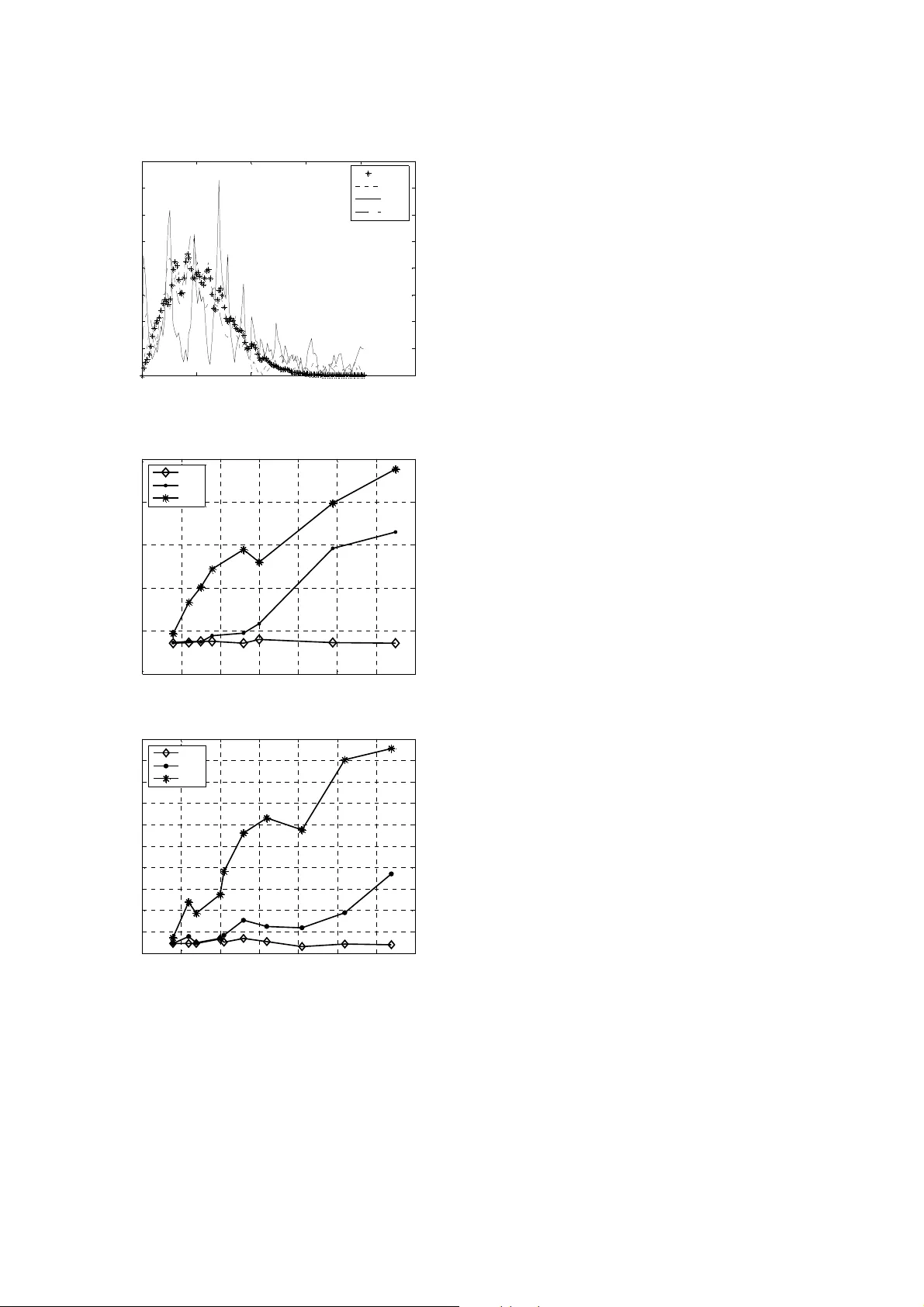
Submitted to rICT 2009 Compressive Sampling wit h Known Spectr al Energy Density for SFCW-GPR App lications Andriyan Bayu Suk smono Schoo l of Electrical Eng ineering and Info rmatics, Institut Tek nologi Bandung Jl. Ganesh a No.10, B andung, Indon esia suksmono@y ahoo.com, suksmono@ radar.ee. itb.ac.id Abstract — A m ethod to i mprove l 1 performance of the CS (Compressive S ampling) for A-scan S FCW-GPR (Stepped Frequency Continuous Wave-Ground Penetrating Radar) signals wit h known spectral energy density is proposed. Instead of random sa mpling, the proposed method selects the location of samples to follow the distribution of the spectral energy. Samples collected fro m three different measurement methods; t he unifor m sa mpling, random s ampling, a nd energy equipartition sa mpling, are used to rec onstruct a given monocycle signal w hose spectral e nergy density is known. Objective performance evaluation in ter m of PS NR (Peak S ignal to Noise R atio) i ndicates e mpirically that the CS reconstruction of random sa mpling outperform the unifor m sampling, while the energy equipartition sampling outperforms both of t hem. These results suggest that similar performance improvement can be achieved f or the compressive S FCW (Steppe d Frequency Continuous Wave) radar, allowing even higher acquisition speed. Keywords —Compressive Sensing, Compressive Sampling, Equipartition of Energy, Non Uniform Sampling, SFCW, UWB I. I NTRODUCTI ON Compressive sampling (CS) is an em ergi ng method with various practical applications [1], [2]. In c ontrast to the Sha nnon sampling t heorem that put a minimu m limit a t 2 ∆ ω sampling rate for a ∆ω bandlimited signal, the CS capable to reconstruct the signal exacly based on much lower rate or fewer number o f samples. Currently, there ha ve been efforts to impr ove the performance of CS b y inco rporating prior kno wledge. Paper [3] pro poses a method fo r sp arse signal r ecovery that outperfor ms s tandard l 1 in term of fewer number of required samples. The algorithm solve s a seque nce of l 1 minimization pr oble m where the weights used for the next iteration are computed fro m the value of t he current solution. Related to this method , the auth ors o f paper [4 ] propose an algor ithm to reco ver sparse sig nal from syste m of un derdeter mined linear equation s when there is prior information about t he prob ability of eac h entry of the unknown sig nal being no nzero. While in [5] , a method o f modifying CS for p roblem with par tially kno wn suppor t is presented. This method is closely related to CS with partially known suppo rt descr ibed in [5 ]. In parc tice the user i s more interrested to kno w how the modification of his/ her measurement pro tocol improves the perfor mance. This paper shows that a simple method to select the locatio n of the samples in the proj ection domain si gnificantl y i mprove the objec tive performance for a given sample n umber. The problem ca n b e for mulated as follows: give n the spectral energy distrib ution of an A-scan G PR signal and a restricted b udget o n the n umber of measurements, ho w to select a set o f samples that best r epresents t he signal i n the sense o f CS? T his p roblem occurs especiall y in the compressive SFCW (Stepped -Frequency Continuo us Wave) r adar [ 6]. It should b e noted that the knowledge on absolute val ues o f the si gnal’s Fourier coefficients defining the spectral energy density cannot be used directly to recover the signal without a ny knowledge on their p hase values. In an SFCW rad ar, an impulse is not-dire ctly transmitted i n ti me-do main. Instead , the Fourier coefficients representin g the signal is collected by measuring the respond s of the ob served obj ects on a range of f reque ncy. The A-scan, w hich is reflections of t he attenuated and shifted i mpulses, us ually can be repr esented as derivati ve of G aussia n func tion. Since shifting in time domain is equivalent to shifting the phase of the Fourier coefficients i n freq uency d omain, t he magnitud e o f the signal spectrum will almost remain the same. Therefore, the i nformation of t he signal’s spectral energy density can be used as a prior knowledge in the reconstructio n. If t he number o f req uired sa mples can be reduced by t he proposed method, the acq uisition spee d of t he compressi ve SFCW radar can be increased significantly. In t his paper , o ne di mensional UWB (U ltra W ide Band) signal consisting of shifted and attenuated monocycles a s a case, which c an be generalized i nto higher dimensions is used. T he o bjective per formance o f l 1 reconstruction for three d ifferent sampling sche mes, namely, the r andom sampling, the frequency e quipartio n sampling (FES), and the energ y equipartition sampli ng (EES) ar e compared . It has b een shown i n [ 7] that the EES performs better for d irect FFT inversion repr esenting the l 2 reconstruction, co mpared to the u niform sampling sche me. The p roposed m ethod is actually t he l 1 exten sion o f this scheme. The rest o f the pa pers is organized as follo ws. Section II explains brief ly the principl e of the sta ndard CS and t he modified CS when prior is k nown. I n Sect ion II I, an algorithm to select a set of best samples in frequency domain for a given spectral energy de nsity is derived. Experiments and a nalysis is give n in Section I V a nd Section V concl udes the pap er. II. T HEORY OF CS AND M ODIFIED -CS WITH P RIOR In the CS, reconstr uction of a signal s r that is spar se i n a ba ses system Ψ r equires just a s mall nu mber o f meas ured samples S r . This subsa mpling process can be rep resented as a pr ojection b y an M × N me asurement matri x Φ Φ Φ Φ , wh ere Submitted to rICT 2009 M<
Original Paper
Loading high-quality paper...
Comments & Academic Discussion
Loading comments...
Leave a Comment