Asymptotics of generalized Hadwiger numbers
We give asymptotic estimates for the number of non-overlapping homothetic copies of some centrally symmetric oval $B$ which have a common point with a 2-dimensional domain $F$ having rectifiable boundary, extending previous work of the L.Fejes-Toth, …
Authors: Valentin Boju, Louis Funar
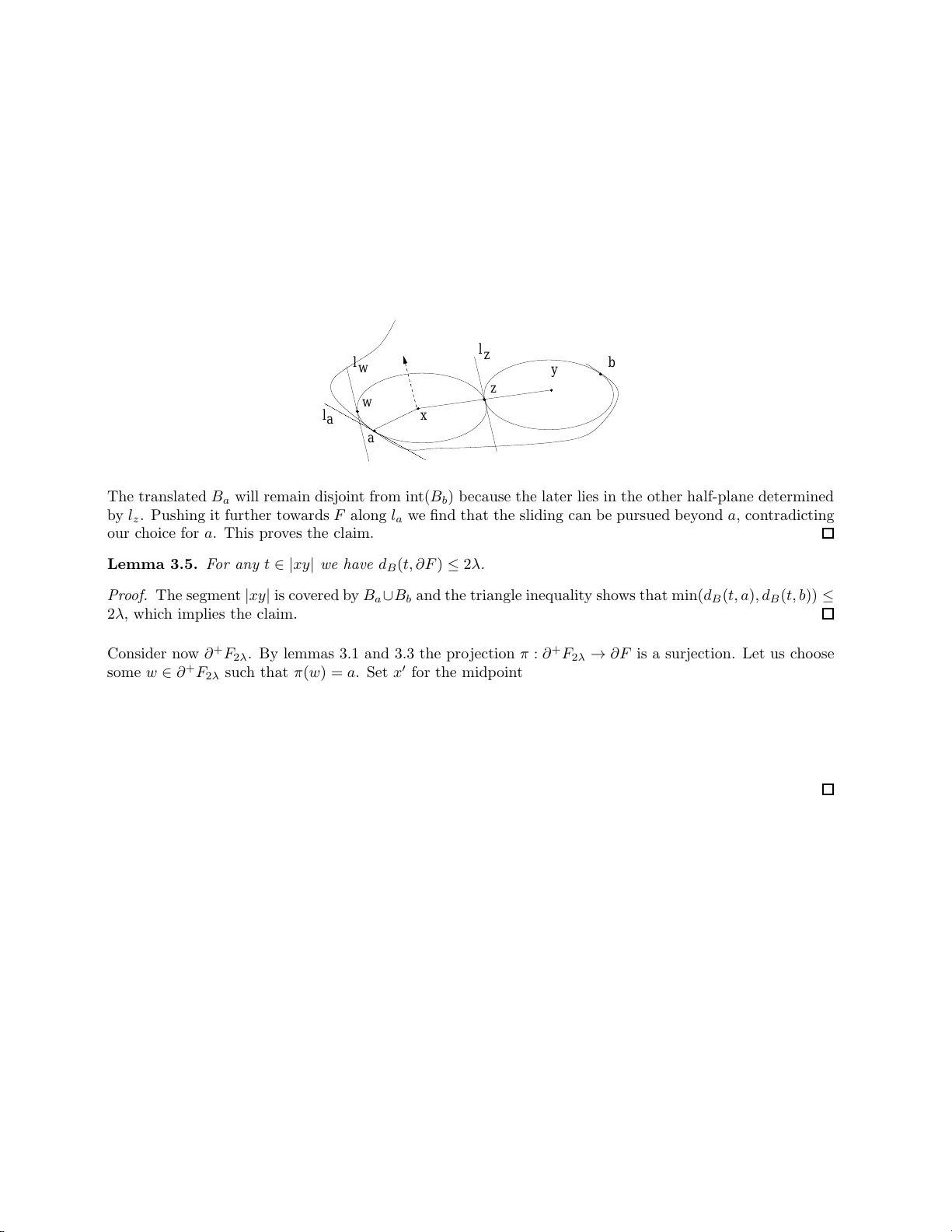
Asymptotics of generalized Hadwiger n um b ers V alen tin Bo ju Louis F unar Montr e al T e ch, Institut de T e chnolo gie de Montr e al Institut F ourier BP 74, UMR 5582 POBox 78574, Station Wilderton University of Gr enoble I Montr e al, Queb e c H3S 2W9, Canada 38402 Saint-Martin-d’H ` er es c e dex, F r anc e e-mail: valenti nboju@mont realtech. org e-mail: funar@fourie r.ujf-gre noble.fr No vem b er 2 0, 2018 Abstract W e giv e a symptotic estimates for the n u m b er of n on-ov erlapping homothetic copies o f some cen t rally symmetric o v al B whic h have a common point with a 2-d imen sional domain F having rectifiable b ound ary , extending previous w ork of the L.F ejes-T oth, K .Boro ckzy J r., D.G.Larman, S.Sezgin, C.Zong and the authors. The asymp totics compute the length of the boundary ∂ F in the Mi nko wski metric determined by B . The c ore of the proof consi sts of a method for sliding con vex b eads along curves with p ositive reac h in the Mink owski plane. W e al so prov e that level s ets are rectifiable subsets, extending a theorem of Erd¨ os, Oleksiv and P esin for th e Euclidean space to the Mink owski space. MSC (AMS) Sub ject Classificatio n: 52 C 15, 52 A 38, 28 A 75. 1 In tro duction F or closed to p olo gical disks F , B ⊆ R d , w e denote by N λ ( F, B ) ∈ Z + the following generaliz e d Hadwiger nu m be r . Let A F, B ,λ denote the family of all sets, homothetic to B in the ratio λ , which ha ve only b ounda ry po int s in co mmon with F . Then N λ ( F, B ) is the grea test integer k such that A F, B ,λ contains k sets with pairwise disjoin t interiors. In particular, N 1 ( F, F ) is the Ha dwiger num ber o f F and N λ ( F, F ) the generalized Hadwiger num b er considered first by F ejes T oth fo r p olytop es in ([8, 9]) a nd further in [2]. Extensive bibliography and results conce r ning this topic can be found in [3]. The main conce r n of this note is to find asymptotic estimates for N λ ( F, B ) as λ a pproaches 0, in ter ms of geometric inv ar iants of F and B , as it was done for F = B in [2 ], and to seek for the higher order terms. Roughly s pea king, coun ting the n umber of ho mothetic copies of B pack ed along the surface o f a d -dimensional bo dy F amounts to compute the ( d − 1 )-area of its bo undary , up to a certa in density factor dep ending o nly on B . The density factor is e s pec ia lly simple when dimension d = 2. A b ounded convex centrally symmetric domain B deter mines a Bana ch structur e on R n and thus a metric, usually called the Minko wski metric asso ciated to B (see [17, 21]). In particula r it ma kes sense to consider the le ng th of curves w ith res pect to the Minkowski metric. The main result of this pap er states the conv ergence of the num ber o f homothetic copies times the homothety factor to half of the Minkowski length o f ∂ F , in the ca s e of planar do mains F having rectifiable b ounda ry . In or der to achiev e this we need fir st a reg ularity result conc e r ning level s ets that we ar e able to pr ov e in full g enerality in the first section. This is a gener alization of a theorem due to Erd¨ os, Oleksiv and Pesin for the Euclidea n space to the Minkowski space . The core of the pap er is the s econd section which is devoted to the pro of o f the ma in result s ta ted a bove. W e first prove it fo r cur ves o f p ositive r each (following F ederer [7]) a nd then deduce the gener al case from this. The rema ining sections contain partial results conc e rning the higher o rder terms for sp ecia l cases (conv ex and p ositive reach do mains) a nd an extensio n of the main result in higher dimensions for do mains with conv ex and smo oth b oundar y . 1 2 Lev el sets Through out this s e ction B will deno te a centrally symmetric compac t conv ex domain in R n . An y such B determines a no rm k k B by k x − y k B = k x − y k / k o − z k , where kk is the Euclidea n norm, o is the center o f B and z is a p oint on the bo undary ∂ B of B such tha t the half-lines | oz and | xy are par allel. When equipp ed with this nor m, R n bec omes a B a nach spa ce whose unit disk is isometric to B . W e also denote by d B the distance in the k k B norm, called also the Minkowski metric structure on R n asso ciated to B . W e s et xy , resp ectively | xy , | xy | for the line, r esp ectively half-line and seg ment determined by the p oints x and y . As it is well-known in Minko wski geometr y segments are g eo desics but when B is not str ic tly conv ex one might hav e als o other geo desic segments than the usual segments. The goal of this section is to generaliz e the Er d¨ os theore m ab out the Lipschitz regular it y of level sets from the E uclidean spa ce to an arbitr ary Minko wski space (see [6]). W e will make use of it o nly for n = 2 in the next section but we think that the general r esult is also of independent in terest (see also [11, 12]). The theor em for the Euclidean space was stated and the b eautiful ideas of the pro of were sketc hed by E rd¨ os in [6]; forty years later the full details were work ed o ut by Olek s iv and Pesin in [18]. Theorem 1. If the set M is b ounde d and r is lar ge enough t hen the level set M r = { x ∈ R n ; d B ( x, M ) = r } is a Lipschitz hyp ersurfac e in the Minkowski sp ac e. F urthermor e, for arbitr ary r > 0 t he level set M r is the union of finitely m any Lipschitz hyp ersurfac es and in p articular it is a ( n − 1 ) - r e ctifiable su bset of R n . Pr o of. Our pro of ex tends the one g iven b y Er d¨ os [6] and Oleksiv a nd Pesin in [18]. Let r 0 such that M ⊂ B ( c, r 0 ), where B ( c, r 0 ) denotes the metric ball of ra dius r 0 centered at c . Consider first r lar ge enough in ter ms of r 0 . Lemma 2.1. L et B ( x, r ) b e su ch that B ( x, r ) ∩ B ( c, r 0 ) 6 = ∅ and B ( x, r ) \ B ( c, r 0 ) 6 = ∅ . Set γ for the angle under which we c an se e B ( c, r 0 ) fr om x . Then, for any ε > 0 t her e exists some r 1 ( ε, r 0 ) which dep ends only B , r 0 and ε such that, for any r ≥ r 1 ( ε, r 0 ) we have γ < ε . Pr o of. If r max (resp ectively r min ) denotes the maximum (resp ectively minim um) Euclidea n radius o f B , then sin γ 2 ≤ r 0 r max r 1 r min (1) Lemma 2.2. Ther e exists some α ( B ) < π such t hat d y xz ≤ α , for any z ∈ B ( y , r ) \ in t B ( x, r ) . Pr o of. The problem is ess e n tially tw o- dimens ional as we can cut the t wo metric balls by a 2-pla ne cont aining the line xy a nd the p oint z . Supp ose henceforth B is plana r and consider supp ort lines l + and l − parallel to xy . Since l + ∩ ∂ B ( x, r ) is conv ex it is a segment | v + 1 v + 2 | , p ossibly degenerate to one po int. W e choose v + 1 to be the farthest from l + ∩ B ( y , r ) among v + 1 and v + 2 . By symmetry l − ∩ ∂ B ( x, r ) is a parallel seg men t | v − 1 v − 2 | , with v + 1 v − 1 parallel to v + 2 v − 2 . Let v + (and v − ) b e the midpo int of | v + 1 v + 2 | (resp ectively of | v − 1 v − 2 | ). Obser ve that x ∈ | v + v − | . W e ass ume that v + 2 and v − 2 lie in the half-plane determined by v + v − and containing y . W e claim then that d y xz ≤ max( [ y xv + 1 , [ y xv − 1 ). This amounts to pr ov e that any z ∈ B ( y , r ) \ B ( x, r ) should lie in the half-plane deter mined by the line v + 1 v − 1 and containing y , as in the picture b elow. 0 0 1 1 0 1 0 0 1 1 0 1 00 11 0 0 1 1 0 0 1 1 0 1 0 1 0 1 z l l + − B(x,r) x B(c,r ) 0 c v v v + + v − 1 1 2 + 2 v − − v y B(y,r) 2 Suppo se the co n trary , namely that there exists z ∈ B ( y , r ) \ B ( x, r ) in the opp osite half-plane. Let T b e the transla tion in the direction | y x of length | y x | . W e ha ve T ( B ( y , r )) = B ( x, r ) a nd z ∈ B ( y , r ), hence T ( z ) ∈ B ( x, r ). The half-line | T ( z ) z intersects the segment | v + v − | in a p oint w ∈ B ( x, r ). Suppo se first that B is s trictly conv ex . Then b oth w and T ( z ) b elong to B ( x, r ) while the p oint z 6∈ int B ( x, r ). This contradicts the strict conv ex ity of B ( x, r ), since T ( z ) 6 = w . The direction v + v − is called the dual d ∗ of d = xy with res p ect to B (also ca lled the B - orthogona l, as int ro duced by Birkho ff ). It suffices now to remar k that for given B the quantit y s up π sup d max( ∠ ( d, d ∗ ) , ∠ ( d, − d ∗ )), the supremum being ta ken ov er all planes π and all directions d , is b ounded from ab ov e by so me α < π . In fact the space of par ameters is a compact (a Gra s smannian pro duct the spher e) and that this angle canno t b e π unless the planar slice dege nerates. Let us ass ume now that B is no t strictly convex. Then the arg ument ab ov e shows that w , T ( z ) be lo ng to B ( x, r ) while the p oint z 6∈ int B ( x, r ). Therefore z ∈ ∂ B ( x, r ) and hence w , z , T ( z ) ∈ ∂ B ( x, r ). Thus w belo ngs to one of the tw o supp ort lines l + or l − . By symmetry it suffices to consider the ca se when w = v + . Since T ( ∂ B ( y , r ) ∩ l + ) ⊂ ∂ B ( x, r ) ∩ l + it follows that ∂ B ( y , r ) ∩ l + is the segment | T − 1 ( v + 1 ) T − 1 ( v + 2 ) | . Thus z belo ngs to the half-plane deter mined by T − 1 ( v + 1 ) and T − 1 ( v − 1 ), which is contained into the one determined by v + 1 v − 1 and containing y . The compa c tnes s ar gument ab ove extends to the non strict conv ex B . R emark 1 . W e hav e d y xz ≤ max( [ y xv + , [ y xv − ) if z ∈ B ( y , r ) \ B ( x, r ). The pro o f is similar. The upp er b ound is v alid for the clos ure of B ( y , r ) \ B ( x, r ) as w ell. Ther efore it ho lds also for B ( y , r ) \ int( B ( x, r )) provided that B is str ictly convex, but not in g eneral, see for instance the ca se when B is a rectangle and xy is par allel to one side. If β is an ang le smaller than π 2 we set K ( x, β , | c x ) for the cone with vertex x of total ang le 2 β , of axis | c x and go ing outw ard c . Lemma 2.3. L et us cho ose ε such that α ( B ) + ε < π . Then for any p oint x ∈ M r , with r ≥ r 1 ( ε, r 0 ) we have K ( x, π − α ( B ) − ε, | cx ) ∩ M r = { x } . Pr o of. If x ∈ M r then int( B ( x, r )) ∩ M = ∅ . Mor e ov er, M ⊂ B ( c, r 0 ) and s o M ⊂ B ( c, r 0 ) \ in t( B ( x, r )). Let now y ∈ M r , y 6 = x . Thus B ( y , r ) ∩ ( B ( c, r 0 ) \ int( B ( x, r )) 6 = ∅ . L e t then z b e a point from this set. Then z ∈ B ( y , r ) \ int B ( x, r ) so that by lemma 2.2 ∠ ( y xz ) ≤ α ( B ). F urther lemma 2.1 shows that | ∠ ( cz x ) | ≤ ε , provided that r ≥ r 1 ( ε, r 0 ). Thus the angle made betw een the half-lines | cx a nd | xy is at leas t π − α − ε , as ca n b e seen in the figure. 0 0 1 1 0 0 1 1 0 0 1 1 00 11 0000000000000000000000 0000000000000000000000 0000000000000000000000 0000000000000000000000 0000000000000000000000 0000000000000000000000 0000000000000000000000 0000000000000000000000 0000000000000000000000 0000000000000000000000 0000000000000000000000 0000000000000000000000 0000000000000000000000 0000000000000000000000 0000000000000000000000 0000000000000000000000 0000000000000000000000 0000000000000000000000 0000000000000000000000 0000000000000000000000 0000000000000000000000 0000000000000000000000 0000000000000000000000 0000000000000000000000 1111111111111111111111 1111111111111111111111 1111111111111111111111 1111111111111111111111 1111111111111111111111 1111111111111111111111 1111111111111111111111 1111111111111111111111 1111111111111111111111 1111111111111111111111 1111111111111111111111 1111111111111111111111 1111111111111111111111 1111111111111111111111 1111111111111111111111 1111111111111111111111 1111111111111111111111 1111111111111111111111 1111111111111111111111 1111111111111111111111 1111111111111111111111 1111111111111111111111 1111111111111111111111 1111111111111111111111 000000000000 000000000000 000000000000 000000000000 000000000000 000000000000 000000000000 000000000000 000000000000 000000000000 000000000000 000000000000 000000000000 000000000000 000000000000 111111111111 111111111111 111111111111 111111111111 111111111111 111111111111 111111111111 111111111111 111111111111 111111111111 111111111111 111111111111 111111111111 111111111111 111111111111 0 x y c z B(c ,r ) B(x,r) B(y,r) In pa rticular y canno t b elong to the co ne K ( x, π − α ( B ) − ε, | cx ). This proves the lemma. Pr o of of the the or em . Set β = π − α ( B ) − ε and let r ≥ r 1 ( ε, r 0 ). First ta ke a n y x ∈ M r and let U = M r ∩ K ( c, β / 2 , | cx ). If u ∈ U then K ( u, β / 2 , | cx ) ⊂ K ( u, β , | cu ) and hence K ( u , β / 2 , | cx ) ∩ M r ⊂ K ( u, β , | cu ) ∩ M r = ∅ (2) 3 This means that fo r ea ch u ∈ U the co ne with angle β a nd axis par a llel to the fixed half-line | cx co n tains no other p oints of U . Therefore U is the gra ph of a function of n − 1 v ariables satisfying a Lipschitz condition with co nstant equa l to 1 tan β . Let consider now the cas e when r is a rbitrary po sitive. Cho ose then s s uch that r 1 ( ε, s ) < r . Split M into a finite nu mber of sets M j such that each M j has diameter at most s . It fo llows that M r ⊂ ∪ j M j r . Since each M j r is lo ca lly Lipschitz it follows that M is lo ca lly the union of finitely many Lipschitz hyper surfaces. Corollary 1 . If M ⊂ R 2 then for almost al l r the level set M r is a 1-dimensional Lipschitz m anifold i.e. the un ion of disjoint simple close d Lipschitz curves. Pr o of. In fact F erry pr ov ed (see [10]) that for a lmost all r the level set M r is a 1- manifold. R emark 2 . Lipschitz curves are precise ly those cur ves whic h are rectifiable. Notice also that the rectifiability do es not dep end on the particula r Minko ws ki metric, as a lready obs erved by G´ olab ([13, 1 4]). R emark 3 . Stac h´ o ([19]) prov ed that level s ets M r in the Minko wsk i space are rectifiable in the sens e of Minko wski fo r all but countably many r gener a lizing earlier results of Sz¨ okefalvi-Nagy for planar sets. 3 Planar domains: approac hing the p erimeter Unless explicitly stated o therwise, throughout this sectio n, B will denote a ce ntrally symmetric plane ov al, where by ov al we mean a co mpact convex domain with no n-empt y interior. W e assume henceforth that ∂ F is a rec tifia ble curve, namely it is the image of a Lipschitz map from a bo unded interv al into the plane. Set p B ( ∂ F ) for the length of ∂ F in the nor m k k B . Our main r esult generalizes theo rem 1 fro m ([2]), where we consider ed the case F = B and th us F w a s conv ex. Theorem 2. F or any symm et ric oval B and t op olo gic al disk F with r e ctifiable b oundary in the plane, we have p B ( ∂ F ) = 2 lim λ → 0 λN λ ( F, B ) (3) R emark 4 . The guiding principle of this pap er is that we can co nstruct some outer packing measure for sets in the Minkowski space which is simila r to the packing measur e defined by T ric ot (see [22]) but uses o nly e qual homo thetic c opies of B which ar e pack ed outside a nd hang on the r esp ective set. These constraints make it muc h more rig id than the measures co nstructed by means of the Ca ratheo dory metho d (see [7]). O n the o ther hand it is r elated to the Mink owski conten t a nd the asso ciated cur v ature mea sures. F or a fractal set F consider thos e s for which lim λ → 0 (2 λ ) s N λ ( F, B ) is finite no n-zero. If this set consists in a s ingleton, then call it the Hadwiger dimension of F and the above limit the Hadwiger s -measure of F . This measure is a ctually supp orted o n the “frontier” ∂ F of F . Although it is not, in g eneral, a b ona-fide measure but only a pre - measure, there is a standard pro cedure for conv er ting it into a measure. Explic it computations for De Rha m curves show that these make se nse for a larg e num b er o f fractal curves. One might exp ect such mea sures b e Lipschitz functions on the spa c e o f measurable curves endowed with the Hausdorff metric. 3.1 Curv es of p ositiv e reach F ederer intro duced in [7] subse ts of p ositive r each in Riemannian ma nifolds. His definition extends immedi- ately to Finsler manifolds and in particular to Mink owski spa c es, as follows: Definition 1. The close d subset A ⊂ R n has p ositive r e ach if it admits a n eighb orho o d U such that for al l p ∈ U ther e ex ist s a un ique p oint π ( p ) ∈ A which is the closest p oint of A t o p i.e. s u ch t hat d B ( p, π ( p )) = d B ( p, A ) . It is clear that co nv ex s e ts and sets with b ounda ry of class C 2 hav e p os itiv e reach in the E uclidean s pace. A class ical theo rem o f Motzkin character ized convex sets as those sets o f p os itive reach in any Minkowski space whose unit disk B is strictly conv ex and smo oth (see [23], Theorem 7 .8, p.94). Moreov er, Banger t characterized completely in [1] the sets o f p os itiv e reach in Riemannian manifolds, as the sub-level se ts of 4 functions f , admitting lo cal charts ( U, ϕ U : U → R n ) and C ∞ functions h U such that ( f + h U ) ◦ ϕ − 1 U are conv ex functions. Another characterization was r ecently obta ine d by Lytchak ([1 6]), a s follows. Subsets A of p ositive rea ch in Riema nn manifolds a re those which are lo cally co nv ex with r esp e c t to some Lipschitz contin uous Riemann metric on the manifo ld, and equiv alently those for which the inner metric d A induced on A by the Riema nn dista nce verifies the inequality d A ( x, y ) ≤ d ( x, y )(1 + C d ( x, y ) 2 ) (4) for any x, y ∈ A with d ( x, y ) ≤ ρ , for so me co ns tant s C , ρ > 0. F ederer proved in [7] that Lips ch itz manifolds of p ositive rea ch ar e C 1 , 1 manifolds. This was further show e d to hold tr ue more gener ally for top olog ic a l manifolds o f p ositive rea ch (see [16]). On the other hand the sets of p ositive rea ch might dep end o n the sp ecific Mink owski metric o n R n . F or instance if B is a s quare in R 2 then any other rec tangle F having an edge parallel to one of B has not po sitive r each. In fact a p oint in a neighborho o d of that edge ha s infinitely many closest po int s. R emark 5 . It seems that sets of p ositive reach are the same for a Riemannian metric on R n and the Mink owski metric d B asso ciated to a strictly conv ex smo oth B (see also [23] for the extension of the Motzkin theorem to Minkowski spaces ). W e will prov e now the main theorem for sets of pos itiv e rea ch: Prop ositio n 1. If ∂ F is a Lipschitz curve of p ositive r e ach with r esp e ct t o the Minkowski metric d B then lim λ → 0 2 λN λ ( F, B ) = p B ( ∂ F ) . Pr o of. W e star t by revie w ing a num b er of notations a nd concepts. Let A <ε (resp ectively A ≤ ε and A ε ) denote the set of p oints a t distance less than (resp ectively less or eq ual than, or equal to) ε fro m A , in the metric d B . Recall fro m [7] the following definition: Definition 2. The r e ach r ( A ) of the set A is define d t o b e t he lar ger ε (p ossibly ∞ ) su ch that e ach p oint x of the op en neighb orho o d A <ε has a unique π ( x ) ∈ A r e alizing the distanc e fr om x t o A . Assume fro m now that F is a planar do main such that ∂ F is a Lips c hitz curve which has p os itiv e reach. W e will consider henceforth only those v alues of λ > 0 for which 2 λ < r ( ∂ F ). Definition 3. Elements of A F, B ,λ ar e c al le d b eads (or λ -b e ads if one wants to sp e cify t he value of λ ) and a c onfigura tion of λ -b e ads with disjoint interiors is c al le d a λ - necklace . The ne cklac e is said to b e co mplete (r esp e ctively a lmost complete ) if al l ( r esp e ctively al l but one) p airs of c onse cut ive b e ads have a c ommon p oint. A ne cklac e is maximal if it c ontains N λ ( F, B ) b e ads. The main step in proving the pro p os ition is to esta blis h first: Prop ositio n 2. If ∂ F is Lipschitz and has p ositive r e ach then t her e exist maximal almost c omplete λ - ne cklac es for any λ < 1 2 r ( ∂ F ) . Consider now a maximal a lmost complete necklace and P ( λ ) b e the a sso ciated p olygon whose vertices a re the centers of the b eads. Le t a and c denote the pair of cons e cutiv e vertices of P ( λ ) realizing the maximal distance among co nsecutive vertices. These a re the centers of tho se b eads A and C of the necklace which might not touch each other. The distance betw een the bea ds A and C is called the gap of the almo st complete necklace. Prop ositio n 3. A max imal almost c omplete λ -n e cklac e of the simple close d curve ∂ F whose re ach is gr e ater than 2 λ has gap smal ler than 3 λ . Conse quently the p erimeter p B ( P ( λ )) of P ( λ ) satisfies the fol lowing ine qualities: 0 ≤ p B ( P ( λ )) − 2 λN λ ( F, B ) < 3 λ (5) Observe that the set ( ∂ F ) λ has two co mpo nent s, namely the o ne contained in the interior of F and that exterior to F . W e set ∂ + F λ = ( ∂ F ) λ ∩ ( R 2 \ F ). Moreov er , it is easy to see that ∂ + F λ = ∂ ( F ≤ λ ). 5 Prop ositio n 4. Supp ose that F is a planar domain whose b oundary ∂ F is r e ctifiable (without assuming that the r e ach is p ositive). Then for any λ > 0 we have: p B ( ∂ + F λ ) ≤ p B ( ∂ F ) + λp B ( ∂ B ) (6 ) Pr o of of Pr op osition 1 assuming Pr op ositions 2, 3 and 4 . Recall now that P ( λ ) is a p olygo n with N λ vertices inscrib ed in ∂ + F λ . Each pair of consec utive vertices of the p oly gon determines an or ie nted ar c of ∂ + F λ . F urther more, each edge corr esp o nds to a pair of co nsecutive b e ads and thus the arc s a sso ciated to different edges o f P ( λ ) do no t ov erlap. W e will s how later a lso that ∂ + F λ is co nnected. These imply that the p er imeter of P ( λ ) is bounded from ab ov e by the length of ∂ + F λ . Ther e fore we hav e the ine q ualities: p B ( P ( λ )) ≤ p B ( ∂ + F λ ) ≤ p B ( ∂ F ) + λp B ( ∂ B ) (7) Let λ go es to 0 . W e derive that: lim λ → 0 p B ( P ( λ )) ≤ p B ( ∂ F ) (8) On the other hand recall that P ( λ ) conv er ges to ∂ F since the distance b etw een co nsecutive vertices is bo unded b y 2 λ . Using the fact that the Leb esgue-Minko wski length is low e r se mi- contin uous (see [5]) we find that: lim λ → 0 inf p B ( P ( λ )) ≥ p B ( ∂ F ) (9) The tw o inequalities ab ov e imply that lim λ → 0 p B ( P ( λ )) exists and is equal to p B ( ∂ F ). In par ticular lim λ → 0 2 λN λ ( F, B ) = lim λ → 0 p B ( P ( λ )) = p B ( ∂ F ) (10) and Pr op osition 1 is prov ed. R emark 6 . O ne can als o consider packings with disjoint homothetic copies of B lying in F and having a common p oint with the complement R 2 − int( F ). Then a similar asymptotic r esult ho lds true. 3.2 Pro of of P rop osition 2 Consider a ma x imal necklace and join consecutive centers of b eads by segments to obtain a p olyg on P ( λ ). W e w a nt to slide the bea ds along ∂ F s o that all but at one pa irs of consecutive b eads hav e a common bo undary point. Obser ve that P ( λ ) is a p olygon with N λ = N λ ( F, B ) vertices inscrib ed in ∂ + F λ . Let π : ∂ + F λ → ∂ F b e the map tha t a sso ciates to the po int x the closes t p oint π ( x ) ∈ ∂ F . Since λ < r ( ∂ F ) the ma p π is well-defined and co nt in uous. Lemma 3.1. The pr oje ction map π : ∂ + F λ → ∂ F is surje ctive. Pr o of. Assume the co nt rary , namely that π would not b e surjective. Contin uous maps betw een compac t Hausdorff spa c es are clos ed so that π is closed. Moreover each connected c ompo nent o f ∂ + F λ is se n t by π int o a closed connected subset of ∂ F . If some imag e comp onent consists of one p oint then ∂ + F λ is a metr ic circle centered at that po in t and thus ∂ F has a p oint comp onent, which is a co nt radiction. Give these b oundar y curves the clo ckwise orientation. The orientation induces a cyc lic o rdering o n each comp onent. Moreov er, this cyclic order restricts to a linear order on a ny pro per subset, in particular on small neighbor ho o ds of a p oint. When talking ab out left (or right) po sition with resp ect to s ome po int we actually co nsider p oints which are sma ller (or greater ) than the r e spe c tiv e p oint with resp ect to the linea r order defined in a neighborho o d of that p o int . Let assume tha t some image co mpo nen t is a pr op er ar c within ∂ F . This a rc has the rig ht b oundary p oint π ( s ) and there is no other p oint in the image s itting to the rig h t of π ( s ), in a small neighbo rho o d of π ( s ). Lt s ′ be maxima l such that π ( t ) = π ( s ) for all t in the rig h t of s in the interv al from s to s ′ . As we saw ab ov e this is a prop er subset of ∂ + F λ . Cho ose then so me t ∈ ∂ + F λ which is nearby s ′ and slightly to the r ight of s ′ . Therefore, we hav e π ( s ) 6 = π ( t ). By hypothesis π ( t ) ∈ ∂ F should s it slightly to the left and closed-by to π ( s ), by the contin uit y o f the map π . There a re several p ossibilities: 6 1. the segments | sπ ( s ) | and | tπ ( t ) | intersect in a p oint u (see case 1. in the figure b elow). If d B ( s, u ) < d B ( t, u ) then d B ( s, π ( t )) ≤ d B ( s, u ) + d B ( u, π ( t )) < d B ( t, u ) + d B ( u, π ( t )) = λ and thus d B ( s, ∂ F ) < λ contradicting the fact that s ∈ ∂ + F λ . If d B ( s, u ) > d B ( t, u ) then d B ( u, π ( s )) < d B ( u, π ( t ) and hence d B ( t, π ( s )) ≤ d B ( t, u ) + d B ( u, π ( s )) < d B ( t, u ) + d B ( u, π ( t ) = λ , le ading to a contradiction again. Suppo se now that d B ( s, u ) = d B ( t, u ). The previous arg ument shows that d B ( s, π ( t )) ≤ λ . In or der to av oid the co ntradiction above the inequality cannot b e stric t, so that d B ( s, π ( t )) = λ = d B ( s, ∂ F ). This means that there are tw o p oints o n ∂ F realizing the distance to s . This co n tradicts the fact that the r each o f ∂ F was supp osed to be lar ger than λ . 2. The segments | s π ( s ) | a nd | tπ ( t ) | have empty intersection. (a) Moreover, the segments | s ′ π ( s ) | and | tπ ( t ) | a re disjoint (see the case 2.a. on the fig ure b elow). 0 1 00 00 11 11 0 0 1 1 0 1 t s u 00 00 11 11 π( ) π( ) s t 0 1 0 0 1 1 00 11 0 1 0 1 0 1 0 1 00 00 11 11 00 11 00 11 π( ) t π( ) π( ) s t s s s’ s’ t (1.) (2.b.) (2.a.) t π( ) s ∆ In this situation we observe that the arc of metric circ le ss ′ , the ar c of ∂ F going clo ck-wisely from π ( t ) to π ( s ) and the segments | sπ ( s ) | and | tπ ( t ) | b ound a doma in ∆ in the plane. The arc o f ∂ F which is co mplement ary to the clo ckwise arc π ( t ) π ( s ) joins π ( s ) and π ( t ) and thus it has to cut at leas t o nce more the b oundar y of the domain ∆. How ever this curve ca nnot intersect: i. neither the a r c π ( t ) π ( s ), sinc e ∂ F is a simple curve; ii. nor the segments | sπ ( s ) | and | tπ ( t ) | , since it would imply that there ex ist po int s in ∂ F at distance smaller than λ on ∂ + F λ . iii. nor the arc o f metric circle ss ′ ⊂ ∂ + F λ , since the distance b etw een ∂ + F λ and ∂ F is λ > 0. Thu s ea ch alter na tive ab ov e leads to a contradiction. (b) The segments | s ′ π ( s ) | and | tπ ( t ) | a re disjoint (case 2.b. in the figure ab ov e). Here we conclude as in the fir st case by us ing s ′ in the place of s and get a co n tradiction ag ain. Therefore our assumption was false so tha t the imag e comp onent is all o f ∂ F . Notice that we actually prov e d that π is op en. Lemma 3.2. The fi b ers of t he pr oje ction map π : ∂ + F λ → ∂ F ar e either p oints or c onne cte d ar cs. In p articular ∂ + F λ is c onne cte d. Pr o of. Let π ( s 1 ) = π ( s 2 ) for tw o distinct p oints s 1 and s 2 and assume that π is no t constant on the clo ckwise arc s 1 s 2 . Pick up s ome v in the ar c s 1 s 2 . According to the pro of o f the previo us lemma we cannot have π ( v ) sitting to the left of π ( s 1 ), for v near s 1 . Thus π ( v ) sits in the rig ht o f π ( s 1 ). Mo reov er , if w lies b et ween v and s 2 the s ame argument shows that π ( w ) sits in the right of π ( v ). Co nsequently the image b y π of the arc s 1 s 2 cov er s completely ∂ F and the s ituation is that from the figur e b elow. 7 00 00 11 11 0 0 1 1 0 0 1 1 00 11 00 00 11 11 s s t 1 s 2 1 π( ) T ake now any t in the complementary arc s 2 s 1 . If π ( t ) 6 = π ( s 1 ) then | tπ ( t ) | intersects either | s 1 π ( s 1 ) | o r e ls e | s 2 π ( s 2 ) | , lea ding to a co nt radiction as in the pr o of of the previous le mma. The lemma follows. W e will need to hav e informations ab out the rectifiability of the set ∂ + F λ , as follows: Lemma 3.3. If 0 < λ < r ( ∂ F ) then ∂ + F λ is a Lipschitz curve and in p articular a C 1 , 1 simple close d cu rve. Pr o of. Since λ is smaller than the r each r ( ∂ F ) it follows that ∂ + F λ has also p ositive r each. The pro of from [10] s hows tha t ∂ + F λ is a 1-manifold. Thus, by Theo rem 1 the set ∂ + F λ is a Lipschitz 1 -manifold. L e mma 3.2 shows that ∂ + F λ is connected and thus it is a simple closed curve. Therefore the curve ∂ + F λ is rectifiable. Recall that ∂ + F λ has an orient ation, say the clockwise one. Consider a maximal λ -necklace B and supp ose that there exists a pair of consecutive b eads which do not touch each other. The r e is induced a cyclic or der on the b eads o f any λ -necklace: the b eads B 1 , B 2 and B 3 are cyclically ordered if the three cor resp onding p oints on which the B i touch ∂ F ar e cy clically ordered. As λ < r ( ∂ F ) each λ -b ead intersects ∂ F in a unique p oint and thu s the definition makes sens e . Consider tw o consec utiv e b eads which do not touch ea c h other. If x ∈ ∂ F let l x be some supp ort line for ∂ F at x and B x (depending also on l x ) the translate of λB which a dmits l x as supp ort line at x . W e assume that going from x to the center of B x we go lo cally outw ard F . W e call B x the vir tua l λ -b ead attached at x . Actually the virtual bea d mig ht intersect ∂ F and thus b e not a b ead. The consecutive b eads are B p and B q for p, q ∈ ∂ F . W e wan t to slide B q in counterclockwise direction among the vir tual b eads B x , where x is going from q to p along ∂ F until B x touches B p . Let B x be the virtual nec klace obtained from the ne cklace B by replacing the bea d B q by the virtual b ead B x . If all virtual necklaces B x are genuine nec kla c e s then w e o btained another maximal necklace in which the pair of consecutive be ads are now touching each other . W e contin ue this pro cedur e while p ossible. Ev en tually we stop either when the necklace was transformed into an almos t complete one, or else the sliding pro cedur e cannot b e p erformed anymore. Let then as sume we have t wo c o nsecutive b eads which c a nnot g et clos e r by sliding. Let then a be the first p oint on the curve seg men t from q to p (running counter-clo ckwisely) where the sliding pro cedure g ets stalked. W e have then t wo p oss ibilities: 1. B a touches ∂ F in one more p oint. 2. B a touches a nother b ea d B b from the necklace B . In the first situation the center of B a is at distance λ fr om ∂ F and the distance is realized twice. Thus r ( ∂ F ) ≤ λ , contradicting our c hoice of λ . The a na lysis of the second alter native is slig htly mor e delicate. Let z be the midp oint of the s egment | xy | joining the centers of the tw o b eads B a and B b resp ectively . 00 00 11 11 00 00 11 11 00 11 0 0 1 1 00 00 11 11 000000000000000 000000000000000 000000000000000 000000000000000 000000000000000 000000000000000 000000000000000 000000000000000 000000000000000 000000000000000 000000000000000 000000000000000 000000000000000 000000000000000 000000000000000 000000000000000 000000000000000 111111111111111 111111111111111 111111111111111 111111111111111 111111111111111 111111111111111 111111111111111 111111111111111 111111111111111 111111111111111 111111111111111 111111111111111 111111111111111 111111111111111 111111111111111 111111111111111 111111111111111 b l a a x z y 8 Let l z be a supp ort line at z , common to b oth B a and B b . Lemma 3.4. Either l a and l z ar e p ar al lel or else t hey interse ct in the half-pla ne determine d by xy and c ontaining the germ of the ar c of ∂ F issue d fr om a which go es towar d p . Pr o of. Assume the contrary and let then l w be a suppor t line to B a which is pa r allel to l z and touches ∂ B a int o the p oint w ∈ ∂ B a . The cyclic or der on ∂ B a is then z , a and w . Consider the arc of ∂ F issue d fro m a . Since the reach of ∂ F is larg er than λ we hav e w and all p oints of B a \ { a } are contained in R 2 − F . Thus there is some ε -neighborho o d o f w which is still contained in the ope n s et R 2 − F . This implies that we can translate s lig ht ly B a along l z within the strip determined by l z and l w such that it do e s not intersect ∂ F anymore. 0 0 1 1 00 11 0 1 00 11 0 0 1 1 00 00 11 11 000000000000000 000000000000000 000000000000000 000000000000000 000000000000000 000000000000000 000000000000000 000000000000000 000000000000000 000000000000000 000000000000000 000000000000000 000000000000000 000000000000000 000000000000000 000000000000000 111111111111111 111111111111111 111111111111111 111111111111111 111111111111111 111111111111111 111111111111111 111111111111111 111111111111111 111111111111111 111111111111111 111111111111111 111111111111111 111111111111111 111111111111111 111111111111111 l a a x y z l z b w w l The tra nslated B a will rema in disjoint fro m int( B b ) b eca use the la ter lies in the other half-pla ne determined by l z . Pushing it further tow ar ds F a lo ng l a we find that the s liding can be pursued beyond a , contradicting our choice for a . This proves the claim. Lemma 3.5. F or any t ∈ | xy | we have d B ( t, ∂ F ) ≤ 2 λ . Pr o of. The segment | xy | is cov er e d by B a ∪ B b and the tria ngle inequalit y s hows that min( d B ( t, a ) , d B ( t, b )) ≤ 2 λ , which implies the claim. Consider now ∂ + F 2 λ . By lemmas 3.1 and 3.3 the pro jection π : ∂ + F 2 λ → ∂ F is a sur jection. Let us choose some w ∈ ∂ + F 2 λ such that π ( w ) = a . Set x ′ for the midp oint of the segment | aw | . Lemma 3.6. The metric b al l B ( x ′ , λ ) is a λ -b e ad. Pr o of. As a ∈ B ( x ′ , λ ) ∩ ∂ F it suffices to s how that B ( x ′ , λ ) ⊂ R 2 \ in t ( F ). Suppose the contrary and let p ∈ int( B ( x ′ , λ )) ∩ in t( F ). Ther e e x ists then some p ′ ∈ | px | \ { p } with p ′ ∈ B ( x ′ , λ ) ∩ ∂ F . The diameter o f B ( x ′ , λ ) is 2 λ and so d B ( w, p ) ≤ 2 λ , but p ′ lies on the segment | pw | so that d B ( p ′ , w ) < 2 λ . This implies that d B ( w, ∂ F ) < 2 λ which is a contradiction. This establishes the lemma. The diameter of a λ -be ad is obviously 2 λ . W e say that p oints u and v a re opp osite p oints in the b ead if they realize the dia meter of the b ead. If B is strictly co nv ex the ea c h b oundar y p oint has a unique opp osite po int . This is not anymore true in gene r al. Giv en a p o int on the bo undary of a rectangle any p o int on the opp osite side is an o ppo site of the former one. Lemma 3.7. Ther e exists some p oint w which is opp osite to a in B a such that w ∈ ∂ + F 2 λ . Pr o of. Let us as s ume fir st that ∂ F is smo oth at a , or equiv alently that it has unique supp ort line a t a . As bo th B ( x ′ , λ ) a nd B a are λ -b eads which hav e the s ame supp ort line l a (since it is unique) it follows tha t they coincide. In other terms w is one o f the p oints opp osite to a in B a . Consider now the gener al case when ∂ F is not ne c e ssarily smo oth a t a . Let l + a and l − a denote the extreme po sitions o f the s uppo rt lines to ∂ F at a . Thus l a belo ngs to the cone determined by l + a and l − a . Reca ll that ∂ F was s uppo sed to b e Lipschitz and thus b y the Rademacher theo rem it is a lmost everywhere differen tiable. There exists then a sequence of p oints p ± j ∈ ∂ F conv erg ing to a such that ∂ F is smo oth at p + j and p − j and the ta ngent lines at p + j (resp ectively p − j ) co nv erg e to l + a (resp ectively to l − a ). Let w ± j be points on ∂ + F 2 λ such that π ( w ± j ) = p ± j . It follows that w + j (resp ectively w − j ) conv erge tow a r ds a po int w + (resp ectively w − ) which lies on the b oundar y of a λ -b ead B ( x + , λ ) (res pec tively B ( x − , λ ) having the supp ort line l + a (resp ectively l − a ). F urther π ( w + ) = π ( w − ) = a . The pro of of Lemma 3 .2 shows that the 9 arc of the metric cir cle centered at a and o f ra dius 2 λ which jo ins w + to w − is als o co nt ained in ∂ + F 2 λ . The po int w which is opp osite to a in the λ -b ead B a is contained in this arc and thus it belo ng s to ∂ + F 2 λ . End of the pr o of of Pr op osition 2 . The clo ckwise arc ab of ∂ F a nd the union of se gments | ax | ∪ | xy | ∪ | y b | which is disjoint from ∂ F bo und together a simply co nnected domain Ω 0 in the plane. Then Ω = Ω 0 \ int ( B a ) ∪ int( B b ) is also a top ological disk, p os sibly with a n ar c attached to it (if B a ∩ B b is a n ar c ) since it is obtained fr om Ω 0 by deleting out tw o small disks touching the b oundary and having connected intersection. 0 1 0 1 0 0 1 1 00 11 0 1 0 1 0 0 1 1 0 0 1 1 0 1 0 0 1 1 b l a x z y w Ω F q u r According to lemma 3.4 w b elongs either to Ω (for insta nce when B is strictly conv ex) o r else to B a ∩ B b (when the supp ort line l a meets B a along a seg men t). On the other hand the curve ∂ + F 2 λ contains b oth the p oint w ∈ Ω and p oints outside Ω. In fact the arc ab is co n tained in ∂ F which b ounds the domain F . Pick up a p oint q of Ω and r in the arc ab such that the half-line | v r do es no t meet | ax | ∪ | xy | ∪ | yb | . Then | v r intersects the do main F and th us at leas t once the clo ckwise arc ba . Let r b e s uch a p oint. Then there exis ts u ∈ ∂ + F 2 λ for which π ( u ) = r . It is clear that u 6∈ Ω. Otherwise , by Jordan curve theorem the segment | r u | should intersect once more the c lo ckwise arc ab a nd this w ould co ntradict the fact that d B ( u, r ) = d B ( u, ∂ F ). Therefore the curve ∂ + F 2 λ has to exit the domain Ω and there are tw o p oss ibilities : 1. either ∂ + F 2 λ meets int( B a ) ∪ in t( B b ). This will furnish po in ts of ∂ + F 2 λ at distance less than 2 λ from either a or b and thus from ∂ F and hence it le a ds to a contradiction. 2. or else ∂ + F 2 λ meets ∂ B a ∪ ∂ B b . In this ca s e any p oint fr o m ( ∂ B a ∪ ∂ B b ) ∩ ∂ + F 2 λ is at distance 2 λ bo th fr om a a nd from b . In par ticular the distance 2 λ is not uniquely realized and this contradicts the choice of 2 λ < r ( ∂ F ). 3.3 Pro of of P rop osition 3 Assume that d B ( a, c ) ≥ 5 λ . Let d ∈ | ac | b e the midp oint of | ac | a nd D denote the tra nslate of A centered at d . The triangle inequality shows that A ∩ D = C ∩ D = ∅ . The segment | ac | intersects once each one o f A and C . Co nsider the supp or t lines l A and l C at these p oints. Since A and C ar e obtained b y a tra nslation one from the o ther, we can choos e the supp or t lines to be para llel. The convexit y of D implies that D is contained in the strip S deter mined by the parallel lines l A and l C . 00 11 00 00 11 11 C l A l A D E C c a 10 If D ∩ ∂ F is e mpt y , then w e tr anslate it within S until it touches fir st ∂ F . If D intersects no n- trivially the int erior of F o n one side of the segment | a c | , then we trans la te it in the opp osite direction until the contact betw een D and F is alo ng b oundary p oints. W e keep the no tation D for the transla ted ov al. How ever, by the maximality of our a lmo st complete λ -necklace, we cannot add D to our b eads to make a necklace. Th us D has to in tersect either o nce more ∂ F , or else another bea d E fr o m the necklace. Let consider the first situation. W e deflate gradually the b ead D by a homothety of r atio going from 1 to 0 by keeping its bo undary contact with ∂ F until we r each a po sition wher e all contact p oints b etw een D and F are b o undary p oints in ∂ F . This implies that the reach of ∂ F is less than λ which contradicts our choice of λ . When the seco nd alterna tive holds tr ue w e make use of the following: Lemma 3.8. If two λ -b e ads interse ct e ach other and t her e exist λ -b e ads b etwe en them (b oth in the clo ckwise and the c ounter clo ckwise dir e ctions) then the r e ach of ∂ F is at most 2 λ . Pr o of. If D and E are the tw o bea ds which intersect non-tr ivially at z let d and e b e the p oints where they touch ∂ F . O ne can cho ose one o f the arcs de or e d o f ∂ F suc h tha t to g ether with | dz | ∪ | z e | b ound a simply connected b ounded do main Ω 0 which is disjo in t from F . Ther e exists at least one other λ -bea d say G ⊂ Ω 0 . Then w e c a n find as ab ov e a p oint w ∈ ∂ G which lies in ∂ + F 2 λ . Therefore ∂ + F 2 λ contains po int s from Ω 0 . It is not hard to see that the ar gument given a t the end of the pr o of of Pro po sition 2 shows that ∂ + F 2 λ has a lso p oints from o utside Ω 0 . Ho w ever ∂ + F 2 λ is connected and disjoint fro m ∂ F and hence it has to cross D ∪ E . But then we will find that either there ar e p oints on ∂ + F 2 λ of distance 2 λ fr om both d and e (contradicting the fact that the reach was larger than 2 λ ) or else we find point a t distance str ictly less than 2 λ from either d or e , which contradicts the definition o f ∂ + F 2 λ . In our cas e both A and C are λ -b ead disjoint fr om D b oth in clo ckwise and count erclo ckwise directions. Thu s if D intersects another b e ad E , different from A and C , of the necklace then the reach of ∂ F will be smalle r than 2 λ . This contradiction shows that we can a dd D to our necklace and the Pr op osition 3 is prov ed. 3.4 Pro of of P rop osition 4 W e will pr ov e first the Prop ositio n 4 in the case when ∂ F is a p olygo n Q . Denote by Q λ the set of p oints lying outside Q and having dis tance λ to Q (o r, this is the same, to ∂ Q ). Let us define a (no t necessarily simple) curve W λ as fo llows. T o each edge e o f Q there is asso ciated a parallel s e gment e λ which is the translation o f e in outw ard (with resp ect to Q ) dir ection dual to e . Recall the definition of the dua l to a given dire c tion. Assume fo r the moment that ∂ B is strictly conv e x. If d is a line then let d + and d − be supp or t lines to ∂ B which ar e par a llel to d ; by the strict conv exity assumption each lines d + , d − int ersects ∂ B into one point p + , p − resp ectively . Then the dual of d is the line p + p − (whic h pass e s through the origin). If ∂ B is not strict conv ex then it migh t still happ en that each suppo rt line para llel to d has one intersection p oint with ∂ B , in which ca se the definition of the dual is the same as ab ove. Otherwise d + ∩ ∂ B has at least tw o p oints and thus, by convexit y , it sho uld b e a segment z + t + . In a simila r wa y d − ∩ ∂ B is the a segment z − t − which is the symmetric of z + t + with resp ect to the center of B . Th us z + z − t − t + is a parallelo gram having tw o sides par allel to d . The direction of the o ther t wo side s is the dual of d . It is immediate then that d B ( e, e λ ) = λ . F or each vertex v o f Q where the edges e a nd f meet tog ether we will asso cia te an arc v λ of the circle λ∂ B of ra dius λ . Let n e and n f be the leng th λ vectors whose directions are dual to e and f resp ectively and a re po int ing outw ard Q . Let v λ be the arc of λB corr esp onding to the tra jectory drawn by n e when rotated to arrive in p osition n f while pointing outw ard o f Q . Let us or der cyclically the edges e 1 , e 2 , . . . , e n of Q clo ckwisely a nd the vertices v j (whic h is common to e j and e j +1 ). Let also A j (resp ectively B j ) deno te the left (res pectively r ig ht ) endp oint o f e j λ . Set α j for the interior a ngle (with r esp ect to Q ) b etw een e j and e j +1 . Obser ve that the configuratio n a round tw o consecutive edge s is one of the following type: 1. if α j ≤ π then e j λ and e j +1 λ are disjoint a nd joined by the a rc v j λ is whic h is lo cally outside Q ; 11 2. if π < α j < 2 π then e j λ and e j +1 λ int ersect a t s ome p oint C j . Let us define e j ∗ λ to b e the segment whose left endp oint is C j − 1 , if α j − 1 > π and A j elsewhere while the right endp oint is C j , if α j > π , and B j otherwise. Let also v ∗ j λ be empty when α j > π a nd the arc v j λ otherwise. Set W λ for the union of edges e ∗ j λ and of ar c s v ∗ j λ . Notice that W λ might have (glo bal) self-intersections. Observe tha t Q λ ⊂ W λ . Notice that the inclusion mig ht b e prop er . W e claim now that: Lemma 3.9. The length of W λ verifies p B ( W λ ) ≤ p B ( Q ) + λp B ( ∂ B ) (11) Pr o of. The arcs v j λ are natur a lly oriented, using the orientation of ∂ Q . More over, its orie n tation is po sitive if α j ≤ π and nega tive otherwise. Since P n j =1 α j = ( n − 2) π we hav e P n j =1 ( π − α j ) = 2 π , which means that the a lgebraic sum of the a rcs v j λ is once the circumference of λ∂ B . Th us n X j =1 σ ( v j ) p B ( v j λ ) = λp B ( ∂ B ) ( 12) where σ j ∈ {− 1 , 1 } is the sign giv ing the orientation of v j λ . It follows tha t λp B ( ∂ B ) + p B ( Q ) = n X j =1 σ ( v j ) p B ( v j λ ) + n X j =1 p B ( e j ) (13) Now, σ ( j ) = − 1 if and o nly if C j is defined (i.e. the a ngle α j > π ). Thus n X j =1 σ ( v j ) p B ( v j λ ) + n X j =1 p B ( e j ) = n X j =1; α j ≤ π ( p B ( v j λ ) + p B ( e j )) + + n X j =1; α j >π ( | A j +1 C j | B + | C j B j | B − p B ( v j λ ) + p B ( e ∗ j λ )) = = p B ( W λ ) + n X j =1; α j >π ( | A j +1 C j | B + | C j B j | B − p B ( v j λ ) ≥ ≥ p B ( W λ ) (14) The last inequality follows from | A j +1 C j | B + | C j B j | B ≥ p B ( v j λ ) (15) In fact, it is proved in ([2 1], p.1 21), s ee also o r the elemen tar y pro of from ([17], 3 .4., p.1 11-11 3), that a conv ex curve is shor ter than any other cur ve sur rounding it. Moreov er the directio n B j C j is dual to e j and thus it is ta ngent to a copy of λB tr anslated at v j ; in a similar way A j +1 C j is dual to e j +1 and thus tangent to the sa me copy of λB . In other words the arc v j λ determined by A j +1 and B j is surro unded by the union | A j +1 C j | ∪ | C j B j | of tw o supp ort segments. The co nv exity of ∂ B implies the inequality ab ov e , and in particula r our claim. R emark 7 . One can use the sig ned measures defined by Stach´ o in [20] for co mputing the length of ∂ + F λ and to o btain, as a coro lla ry , the result of Pro po sition 4. Our pro of for planar rec tifiable curves has the adv antage to b e completely elementary . End of the pr o of of pr op osition 4 . Let now ∂ F be an a rbitrary rectifiable simple cur ve. It is known that there exists a s e quence of p oly gons Q n inscrib ed in ∂ F such that lim n p B ( Q n ) = p B ( ∂ F ). Here p B denotes the J ordan (equiv alently Leb esgue) length of the re s pec tive curve, in the Minkowski metric. 12 Therefore Q n λ is a sequence of rectifiable curves which conv er ge to ∂ + F λ . By theorem 1 ∂ + F λ is the union of finitely many Lipschitz 1-ma nifolds and thus the Leb esgue length of ∂ + F λ makes sense . By the lower semi-contin uity o f the Leb esgue length (see e.g. [5]) it follows that lim n inf p B ( Q n λ ) ≥ p B ( ∂ + F λ ) (16) How ever we proved ab ov e that for simple p olygo nal lines Q n we have: p B ( Q n λ ) ≤ p B ( Q n ) + λp B ( ∂ B ) (17) Passing to the limit n → ∞ w e obtain p B ( ∂ + F λ ) ≤ lim n inf p B ( Q n ) + λp B ( ∂ B ) = p B ( ∂ F ) + λp B ( ∂ B ) (18) Therefore P rop osition 4 follows. 3.5 Curv es of z ero reac h Consider now an arbitrary simple closed Lipschitz curv e ∂ F in the plane. When sliding λ -b eads fo r achieving almost completeness o f necklaces we might get stalked b ecause we encounter p oints of ∂ F with r each smaller than λ . Let us introduce the following de finitio ns . Definition 4. The clo ckwise ar c ab of ∂ F is a λ -c orner if ther e exists a λ -b e ad B a which t ouches ∂ F at a and b and su ch that ther e is no λ -b e ad B x for x in t he interior of the ar c ab (exc ept p ossibly for B a ). Definition 5. The clo ckwise ar cs aa ′ and b ′ b of ∂ F form a long λ -gal lery if ther e exist two dis jo in t λ -b e ads B a and B a ′ with { a, b } ⊂ B a ∩ ∂ F and { a ′ , b ′ } ⊂ B a ′ ∩ ∂ F such that: 1. ther e is no λ -b e ad touching t he ar cs aa ′ or bb ′ ; 2. at le ast one c omplementary ar c among a ′ b ′ and ba admits a λ -b e ad which is disjoint fr om B a and B a ′ . Definition 6. The clo ckwise ar cs aa ′ and b ′ b of ∂ F form a short λ -gal lery if t her e exist two λ -b e ads B a and B a ′ with non-empty interse ction, { a, b } ⊂ B a ∩ ∂ F and { a ′ , b ′ } ⊂ B a ′ ∩ ∂ F such that: 1. any λ -b e ad touching aa ′ ∪ b ′ b should interse ct the b oundary b e ads B a ∪ B a ′ ; 2. ther e is no 2 λ -b e ad touching the ar cs a a ′ ∪ b ′ b ; Observe that λ -corner s do not really make pro blems in sliding λ -b eads, b ecause we can jump from a to b keeping the s ame b ead and w e can contin ue the sliding from there on. Set Z λ for the set of points that b elong to s o me λ -ga llery (long or short). Lemma 3.10. F or e ach λ > 0 the nu mb er of maximal λ -gal leries is fi nite. Pr o of. Assume that we hav e infinitely many λ -g alleries. They hav e to b e disjoint, exc e pt p oss ibly fo r their bo undary p oints. Thus the leng th of their a rcs conv erges to zero. Moreov er , the asso ciated pair s of arcs of ∂ F converge tow ards a pair o f tw o p oints at distance 2 λ . Th us all but finitely many galler ie s are shor t galleries. The le ng ths of intermediary a r cs (those joining conse c utiv e ga llery ar cs in the s equence) should hav e their length going to zer o since their total leng th is finite. Consider now the union of tw o co ns ecutive g a lleries in the sequence together with the intermediary arcs betw een them. W e c la im that if we are deep enough in the se q uence then this union will als o b e a galler y , th us contradicting the maxima lity . Assume the contrary , namely that the union is not a shor t galle ry . Then one should find either a λ -b ead to uchin g one intermediary ar c which is disjoint from the b oundar y b eads, o r else a 2 λ -b ead. In the first case the intermediary arc joins tw o p oints x, y of intersecting λ -b eads and surr ounds a disjo in t λ -bea d. Let z b e a c o mmon p oint for the t wo b oundary b eads. Then the unio n of | xz | ∪ | z y | with the int ermediary arc forms a closed curve surro unding the b oundar y of a λ -b ea d. In particular its length is larger than or equal to λp B ( ∂ B ). Since d B ( x, z ) , d B ( z , y ) ≤ 2 λ it follows that the length of the intermediary 13 arc is at least λ ( p B ( ∂ B ) − 4) ≥ 2 λ . How ever intermediary a rcs should hav e length go ing to z ero, so this is a contradiction. The second alterna tive tells us that there exists a 2 λ -bea d touching the intermediary a rc. Let the arcs b e xy and x ′ y ′ . Then we claim that the union of the ar cs xx ′ (in the b oundar y of the b ead), x ′ y ′ , y ′ y (in the bo undary of the b ead) and y x is a close d curve surro unding the co nv ex 2 λ -b ea d. Ther e fore their total leng th is at least 2 λp B ( ∂ B ). In fa ct s upp os e tha t the 2 λ -be a d of center w intersects the a rc xx ′ . Observe that w is not contained in the int erior of the λ -b e ad b ecause other wise the 2 λ -b ead would contain it and thus there will b e no pla ce for the arc o f ∂ F . F urther we find that the distance function d B ( z , w ) for z in the arc xx ′ will hav e p oints where it takes v alues s maller than 2 λ . As d B ( x, w ) , d B ( x ′ , w ) ≥ 2 λ it follows that the distance function will hav e at least tw o lo ca l maxima . How ever since B is conv ex the distance function to a p o int cannot hav e several lo cal maxima unless when B is not strictly co nvex and there is a segment of ma xima. This proves the cla im. 00 11 0 0 1 1 0 1 0 0 1 1 0 1 0 0 1 1 0 0 1 1 1. 2. y y’ x x’ x y z How ever the sum o f the leng ths of the a rcs xx ′ and y ′ y is smalle r than 4 λ 3 p B ( ∂ B ) if we ar e far enough in the sequence. Indeed the tw o b oundar y λ -b e ads intersect each other and their centers bec o me closer and closer as we appro ach the limit b ead. Then the p erimeter of the union of the tw o convex λ -b eads conv e r ge to the per imeter o f o ne b ead. I n par ticular, at some p oint it b ecomes smaller than 4 λ 3 p B ( ∂ B ). This implies tha t the le ngth of the ar cs xy and x ′ y ′ is at least 2 λ 3 p B ( ∂ B ) ≥ 4 λ . This is in contradiction with the fa c t that int ermediary arcs s hould converge to p oints. Lemma 3.11. F or any λ > 0 we have p B ( ∂ F \ Z 2 λ ∪ Z λ ) ≤ lim δ → 0 2 δ N δ ( ∂ F ) (19) Pr o of. Since there are finitely ma ny maximal 2 λ -g alleries consider δ b e small enough such that t wo δ -b eads which touch a maximal 2 λ -galler y at each end p oint sho uld b e disjoint. Let then cho ose a δ -necklace N j for ea ch connected c ompo nent A j of ∂ F \ Z 2 λ . W e claim that the unio n of necklaces ∪ j N is a necklace on ∂ F . No b ead exterio r to a 2 λ -galler y can intersect the arcs of that gallery . Extreme po sitions o f δ -b eads are contained in b ounda ry b eads and thus o nly b oundar y p oints o f the ga llery can be touched by the necklace. Two comp onent necklaces a r e separated by a ga llery . W e chose δ such that the last δ -b ead o f one necklace is disjoint fro m the first δ -b ead of the next comp onent. Remark now that δ -necklaces with δ < λ ar e otherwise disjoin t. In fact supp ose that t wo bea ds from differen t necklaces (or one be a d from a necklace and an ar c A j ) int ersect each other. Going far enough to one side of the a rcs we s ho uld find lar ge enough b eads and hence 2 λ -b eads, since b ea ds lie in R 2 \ F . Going to the other s ide, if we can find a 2 λ -bea ds then the tw o ar cs co n tain a 2 λ -g a llery , contradicting o ur as s umptions. Otherwise the remaining pa rt forms a 2 λ -cor ner and in particular the arcs b elong to the sa me comp onent. Then the be a ds should be disjoint , since they are b eads of the sa me necklace. The same pro of works for the bea d intersecting an arc. Let then N δ ( A j ) b e the maximal cardina l of a δ -necklace in R 2 − F s uch that all b eads touch the arc A j . W e set (by a buse of notation) N δ ( ∂ F \ Z 2 λ ∪ Z λ ) = P j N δ ( A j ). Summing up we prov ed ab ov e that N δ ( ∂ F \ Z 2 λ ∪ Z λ ) ≤ N δ ( ∂ F ) (20) 14 Recall now that e a ch arc A j is a Lipschitz curve of re a ch at least 2 λ . The pro of of Prop os ition 1 can b e carried ov er not only fo r simple closed curves but also for simple Lipschitz a rcs of p ositive rea ch without essential mo difications , with a slightly different upper b ound in Prop osition 4 . Thu s the result holds true for each one of the ar cs A j . As we hav e finitely many such arcs A j we obta in lim δ → 0 2 δ N δ ( ∂ F \ Z 2 λ ∪ Z λ ) = X j p B ( A j ) = p B ( ∂ F \ Z λ ) (21) The inequality a b ove implies the one fro m the statement. Lemma 3.12. We have lim λ → 0 p B ( Z λ ) = 0 . Pr o of. F or each λ -gallery there is some µ ( λ ) such that its p oints a re not contained in any µ -galler y . Assume the contrary . Then ther e exists a sequence o f λ j → 0 of nested λ j -gallerie s . Their int ersection p oint is an int erior po int of these ar cs and th us it yields a p oint where the curve ∂ F has a self-intersection, which is a contradiction. Thus the claim follows. Since the num ber of λ -galle ries is finite ther e is a sequence λ j → 0 such that λ j -gallerie s are pair wise disjoint . Thu s X j p B ( Z λ j ) ≤ p B ( ∂ F ) (22) and hence lim j p B ( Z λ j ) = 0. F urther any Z λ is contained into so me the union o f Z λ j for s o me j > j ( λ ). The result follows. Lemma 3.13. We have lim λ → 0 2 λN λ ( F, B ) ≤ p B ( ∂ F ) . Pr o of. Let P ( λ ) be the p olygon asso ciated to a maximal λ -necklace on ∂ F . Then 2 λN λ ( F, B ) ≤ p B ( P ( λ )) (23) F or all λ the set ∂ + F λ is the union of finitely many Lipschitz cur ves and P ( λ ) is a po lygon inscr ibed in ∂ + F λ . How ever, it might happ en that ∂ + F λ has s e veral co mpone nts, p ossibly infinitely many . Recall tha t we defined in the pro of of Pro p os ition 4 the intermediary curve W λ = W λ ( Q ) which is asso ciated to a p olyg on Q . W e can define W λ ( F ) as the Hausdo rff limit of W λ ( Q n ) where Q n is approximating ∂ F . Or else we ca n choo s e Q which appr oximates clo sed eno ug h to ∂ F s o that the vertices of P ( λ ) b elong to W λ ( Q ). Moreov er, W λ ( Q ) is now a closed cur ve, which mig h t hav e self-int ersections. The p olygon P ( λ ) is inscrib ed in W λ ( Q ) and we ca n asso ciate disjoin t a rcs to differ e nt edg es, s ince edges a r e as so ciated to co nsecutive bea ds. Therefor e we hav e: p B ( P ( λ )) ≤ p B ( W λ ( Q )) (24) Then the pro o f of Prop osition 4 actually shows that p B ( W λ ( Q )) ≤ p B ( Q ) + λp B ( ∂ B ) ≤ p B ( ∂ F ) + λp B ( ∂ B ) (25) The inequalities a b ove imply that 2 λN λ ( ∂ F ) ≤ p B ( ∂ F ) + λp B ( ∂ B ) (26) and taking the limit when λ go es to zer o yields the claim. End of the pr o of of The or em 1 . By Lemma 3 .11 the limit is at least p B ( ∂ F \ Z λ ), for a ny λ . Using Lemma 3.12 this low er b ounds conv er ges to p B ( ∂ F ) when λ go es to ze ro. Then Lemma 3.13 concludes the pro of. 15 4 Second order estimat es The aim of this sec tion is to understand b etter the rate o f conv ergence in Theorem 2. F irst, we hav e the very ge ner al upp er b ound below: Prop ositio n 5. F or any planar simply c onne cte d domain F with Lipschitz b oundary we have 2 λN λ ( F, B ) ≤ p B ( ∂ F ) + λp B ( ∂ B ) (27) Pr o of. This is an immediate conseque nc e of the pro o f of Lemma 3 .13. When F is co nvex, we can obtain mo re effective estimates of the r ate of conv er gence for the lower b ound: Prop ositio n 6. F or any symmetric oval B and c onvex disk F in t he plane, the fol lowing ine qualities hold true: p B ( F ) − 2 λ ≤ 2 λN λ ( F, B ) ≤ p B ( F ) + λp B ( ∂ B ) (28) Pr o of. By approximating the convex cur ve ∂ F by co n vex p olygo ns we deduce the following extensio n of the classical tub e formula to Mink owski spaces: p B ( ∂ + F λ ) = p B ( F ) + λp B ( ∂ B ) (29) Notice that for non-conv ex F we hav e o nly an inequality ab ov e. Let B 1 , . . . , B N be a maximal necklace with b eads which are tra nslates of λB and o 1 , o 2 , . . . , o N be their resp ective centers, co nsidered in a cyclic order around F . Since B i ∩ F co nt ains at least one b ounda ry p oint it follows that o i ∈ F λ and B i ⊂ F 2 λ . Since B and F are conv ex it follows that F λ is conv ex . Therefore the p oly gon P = o 1 o 2 · · · o N is conv ex since its vertices b elong to ∂ + F λ and, moreov er, P ⊂ F λ . It is not true in gener al that P contains F , and we have to mo dify P . If the necklace is incomplete, we can fill in the space left by adjoining an additional translate B ∗ N +1 homothetic to B in the r atio λµ , w ith µ < 1, which has a commo n p oint with ea ch one of F, B 1 and B N . Set o N +1 for its cen ter. Now, we claim tha t the polyg on P ∗ = o 1 o 2 · · · o N +1 contains F . In fact, d B ( o i , o i +1 ) ≤ 2 s ince B i and B i +1 hav e a common p oint, which is at unit distance from the c en ters. But their interiors hav e empt y int ersection th us d B ( o i , o i +1 ) = 2 λ and the segmen t | o i o i +1 | c ontains one in tersection p oint from ∂ B i ∩ ∂ B i +1 . F urthermo re, the sa me argument shows that d B ( o N , o N +1 ) = d B ( o 1 , o N +1 ) = (1 + µ ) λ a nd each s egment | o N o N +1 | and | o N +1 o 1 | contains one b oundary p oint from the cor r esp onding b o undaries intersections. Thus the b oundary of P ∗ is contained in ∪ N +1 i =1 B i ∪ B ∗ N +1 , the later b eing disjoint from the interior of F . This prov es our claim. Remark that P ∗ is not necessa rily conv ex. W e know that P ⊂ F λ and d B ( o i , o i +1 ) ≥ 2 (for i = 1 , 2 , . . . , N ) b ecause B i and B i +1 hav e no common int erior p oints. Since a co nv ex curve sur rounded by another cur ve is shor ter than the containing o ne we obtain: 2 λN ≤ p B ( P ) ≤ p B ( ∂ + F λ ) = p B ( ∂ F ) + λp B ( ∂ B ) (30) Next, rec a ll that F ⊂ P ∗ and d B ( o i , o i +1 ) ≤ 2, where i = 1 , 2 , . . . , N + 1, since consecutive b eads hav e at least o ne common p oint. This implies that: p B ( ∂ F ) ≤ p B ( P ∗ ) < 2 λ ( N + 1) (31) The tw o inequalities ab ov e prov e the Pr op osition 6. Consider a mor e genera l cas e when F is not ne c essary conv ex. W e assume that F is r e gu lar , namely that its bounda ry is the unio n of finitely many ar cs with the prop erty that each arc is either conv ex o r co ncav e. The endpoints of these maximal arcs are called vertices of ∂ F . This is the c ase, for instance, when ∂ F is a piecewise analytic curve. Moreov er w e will s upp os e that F ha s po sitive reach. T his is the ca se for instance when F admits a s upp or t line thro ugh ea ch vertex o f ∂ F , which leav es a neig h bo rho o d of the vertex in F on one side of the half-plane. 16 The estimates for the ra te of conv ergence will not b e anymore shar p. By hypothesis, ∂ F can b e dec o mpo sed int o finitely many arcs A i , i = 1 , m , which we call pieces, so that ea ch piece is either co n vex or concav e. Prop ositio n 7. Consider a symmetric oval B and a r e gu lar t op olo gic al disk F of p ositive r e ach having c ( F ) c onvex pie c es and d ( F ) c onc ave pie c es. Then the fol lowing ine qualities hold: p B ( F ) − 2 λ (2 c ( F ) + p B ( ∂ B ) d ( F ) + 3 d ( F )) ≤ 2 λN λ ( F, B ) ≤ p B ( F ) + 2 λp B ( ∂ B ) (32) for 2 λ < r ( ∂ F ) . Pr o of. If N is a ma ximal necklace on F de no te by N | A j its trace o n the arc A j , i.e. o ne cons iders only those bea ds that touch A j . Conside r a lso ma ximal necklaces M A j on each a rc A j , co ns isting of o nly those b eads sitting outside F whic h have c o mmon p oints to A j . Consider now the union o f the ma ximal necklaces M A j . Beads of M A j cannot intersect ∂ F since the reach is la rger than λ . Mor eov er b eads fr om different necklaces cannot intersect (according to Lemma 3.8) unless the b eads are conse c utiv e b eads i.e. one is the las t b e ad on A j and the other is the fir st b ead on the next (in clo ckwise direction) arc A j +1 . Therefore if we drop the las t b ead from each M A j and ta ke their union we obtain a necklace on ∂ F . This implies that: m X i =1 N λ ( A i , B ) − N λ ( F, B ) ≤ c ( F ) + d ( F ) (33) W e analyze conv ex ar cs in the sa me manner as we did for ov als in the previous Prop ositio n. Since the ar c A j has p ositive r each we c a n slide all b ea ds to the left s ide. Add one more smaller be a d in the right s ide which touches the ar c at its endpoint, if p oss ible. The ce nters o f the b eads form a p oly g onal line P ∗ with a t most N λ ( A j , B ) + 1 b eads. Join its endpoints to the endp oints of the ar c A j by tw o segments o f leng th no larger than λ . This p olygo nal line s ur rounds the co n vex a rc A j and thus its length is grea ter than p B ( A j ). Therefore, for each conv ex arc A j we have: 2 λ ( N λ ( A j , B ) + 1) ≥ p B ( A j ) (34) The next s tep is to derive simila r es tima tes fro m b elow for a concave arc A s . Since the arc has p ositive reach we can slide all b eads to its left side. If there is more space left to the right let us contin ue the a rc A s by adding a short arc on its right side alo ng a limit supp ort line at the rig ht endp oint so tha t we can add one more b ead to our necklace which touches the completed a rc A ∗ s at its endp oint. W e ca n choose this line so that the re a ch of A ∗ s is the same as that of A s . Let the b eads have centers o i , i = 1 , N + 1 , where N = N λ ( A s , B ), the last one b eing the cen ter of the additional b ead. Then d B ( o i , o i +1 ) = 2 λ and d B ( o i , A ) = λ , as in the conv ex ca s e. The p oint is that the function d B ( x, A ) is not a nymore conv ex , as it was for conv e x arcs . How e ver, fo r any p oint x ∈ | o i o i +1 | we hav e d B ( x, A ) ≤ min( d B ( x, o i ) + d B ( o i , A ) , d B ( x, o i +1 ) + d ( o i +1 , A )) ≤ 2 λ . If P ∗ denotes the p olyg onal line o 1 o 2 · · · o N +1 then P ∗ ⊂ A ∗ s 2 λ . Moreover the p oints which are opp osite to the contacts b etw een the b eads and A ∗ s belo ng to A ∗ s 2 λ . Join in pairs the endp oints of P ∗ and those of A ∗ s 2 λ by tw o seg ment s of leng th λ and denote their union with P ∗ by P ∗ . The a r c A s was cons ide r ed co ncav e of p ositive reach and this means that for small enough λ < r ( ∂ F ) / 2 the b oundar y ∂ A ∗ s 2 λ is still concave of p ositive reach. Looking from the oppo site side A ∗ s 2 λ is a c onv ex a r c. Moreov e r P ∗ encloses (from the opp osite side ) this conv ex arc and thus p B ( P ∗ ) ≥ p B ( A ∗ s 2 λ ) ≥ p B ( A s 2 λ ). The for m ula g iving the per imeter for the par allel has a version for the inw ard deformation of conv ex ar cs, or equiv alently , for out ward defor ma tions of concav e arcs, which r eads as follows: p B ( A s 2 λ ) = p B ( A s ) − 2 λp B ( X A s ) (35) where X A s ⊂ ∂ B is the imag e of A s by the Gauss map asso ciated to B . As X A s ⊂ ∂ B we obtain p B ( A s ) − 2 λp B ( ∂ B ) ≤ p B ( P ∗ ) + 2 λ ≤ 2 λN λ ( A s , B ) + 4 λ (36) Summing up these inequalities we der ive the inequality from the s tatement . 17 R emark 8 . The pro o fs ab ov e work for arbitrar y co nvex B , not ne c essarily c en trally symmetric . In this ca se, we co uld obtain: p B ( F ) = 2 lim λ → 0 λN λ ( F, B ) (37 ) where B = 1 2 ( B − B ) = { z ∈ R 2 ; there exist x, y ∈ B , such that 2 z = x − y } . Consider the set N ( F , B ) o f all p ositive integers that app ear as N λ ( F, B ) for some λ ∈ (0 , 1]. Corollary 2. If F is r e gular and its b oundary has p ositive r e ach t hen lar ge enough c onse cutive terms in N ( F, B ) ar e at most distanc e 11 d ( F ) + 2 c ( F ) + 4 ap art. When F is c onvex c onse cutive terms in N ( F , B ) ar e at most distanc e 4 ap art, if B is not a p ar al lelo gr am and 5 otherwise. Pr o of. Let us c o nsider F c o nv ex. Theo rem 2 shows tha t p B ( F ) 2 λ − 1 < N λ ( F, B ) ≤ p B ( F ) 2 λ + p B ( ∂ B ) 2 (38) Moreov er one knows that p B ( ∂ B ) ≤ 8 (see [2 ] and references there) with equality only when B is a parallel- ogram. In particular a ny interv al ( α, α + p B ( ∂ B ) 2 ] contains at lea st one element of N ( F, B ). If c < d ar e t wo consecutive elements o f N ( F , B ) this implies that c ∈ ( d − p B ( ∂ B ) 2 − 1 , d ), a nd thus d − c < p B ( ∂ B ) 2 + 1 ≤ 5 (39) Since c, d are integers it follows that d − c ≤ 4, if B is not a parallelo gram. When F is arbitra ry the ine q uality in theorem 3 shows that an y interv al of length 11 d ( F ) + 2 c ( F ) + 4 contains some N λ ( F, B ). W e conclude as a b ove. Corollary 3. Conse cutive terms in N ( B , B ) ⊂ Z + ar e at most distanc e 4 ap art. Pr o of. If F = B is a paralle lo gram then N λ ( F, B ) = 4 1 λ + 4 and thus N ( F, B ) = 4 ( Z + − { 0 , 1 } ). R emark 9 . If F is not convex then we ca n have gaps of larger size in N ( F, B ). T ake for insta nce F having the sha pe of a staircase with k stairs and B a squar e. As in the remark ab ov e we c a n compute N λ ( F, B ) = 4 k 1 λ + 4 and thus there are gaps o f siz e 4 k . 5 Higher dimensions The previous results have generaliz ations to higher dimensions in terms of some Busemann-type areas defined by B . Theo rem 2, when F = B , was e xtended in [4] a nd ([3], 9.1 0). The res ult inv olves the pre s ence of an additional densit y factor which seems more complica ted for d > 2 . F or a conv ex b o dy K in R d one defines the tra nslative packing density δ ( K ) to b e the supremum o f the densities of p erio dic packings b y translates of K and set ∆( K ) = 1 δ ( K ) vol ( K ). Alternatively , ∆( K ) = inf T ,n vol ( T ) /n ov er all tori T and integers n such that ther e exists a packing w ith n tr a nslates of K in T , where T is identified with a quotient of R d by a lattice. W e consider fr om now on that B and F are conv ex and smo oth. Prop ositio n 8. We have for a c onvex smo oth F ⊂ R d and a c entr al ly symmetric s mo oth domain B ⊂ R d that lim λ →∞ λ d − 1 N λ ( F, B ) = Z ∂ F 1 ∆( B ∩ T x ) dx (40) wher e x ∈ ∂ F and T x is a hyp erplane thr ough the c enter of B which is p ar al lel to the tangent sp ac e at ∂ F in x . Her e B ∩ T x ⊂ T x is identifie d to a ( d − 1 ) -dimensional domain in R d − 1 . Pr o of. The pro of from ([3] 9.10) can b e adapted to w ork in this more general situatio n as well. Although the pres en t metho ds do no t ex tend to gener al a rbitrary domains with rectifia ble b oundary the previous pr o po sition se e m to genera lize at lea st when the bo undary ha s p ositive rea ch. 18 R emark 10 . W e hav e an ob vious upp er b ound N λ ( F, B ) ≤ λ − d vol ( F 2 λ ) − vol( F ) vol ( B ) = λ 1 − d area B ( ∂ F ) + o ( λ 1 − d ) (41) which follows from the inclusion ∪ N i =1 B i ⊂ F 2 λ with B i having disjoint interiors and the Steiner formula (see [15]). 6 Remarks and conjectures The str uc tur e of the s ets N ( F , B ) is lar gely unknown. One c a n prove that when F is co n vex and b oth F and B are smo oth then N ( F, B ) contains all integers fro m N 1 ( F, B ) on, at lea st in dimension 2 . F or genera l F we saw that we c o uld ha ve gaps. It would b e interesting to know whether N ( B , B ) contains all sufficien tly large integers when F = B is a conv ex domain a nd no t a para llelohedron. It seems tha t Co rollary 3 can b e generalized to higher dimensions as follows: Conjecture 1. The lar gest distanc e b etwe en c onse cutive elements of N ( F, B ) , wher e F is c onvex is at most 2 d with e quality when F = B is a p ar al lelohe dr on. Another natura l pro blem is to under s tand the hig her o rder terms in the asy mpto tic estimates. Or, it app ears that second or de r ter ms from sectio n 4 are actually os cillating accor ding to the inequa lities in pro po sition 6 as b elow: Corollary 4. F or c onvex F we have − 2 ≤ l − ( F, B ) = lim inf λ → 0 2 λN λ ( F, B ) − p B ( F ) λ ≤ lim sup λ → 0 2 λN λ ( F, B ) − p B ( F ) λ = l + ( F, B ) ≤ p B ( ∂ B ) 2 (42) The exa c t meaning of l − ( F, B ) and l + ( F, B ) is not clear. Assume that F = B . W e computed: 1. If B is a disk then l − ( F, B ) = − 2 and l + ( F, B ) = 0; 2. If B is a square then l − ( F, B ) = 0 and l + ( F, B ) = 4; 3. If B is a regular hex agon then l − ( F, B ) = 0 and l + ( F, B ) = 3; 4. If B is a triangle then l − ( F, B ) = 0 and l + ( F, B ) = 3. There a re v ario us other inv a riants rela ted to the sec o nd or der terms. Set J k = { λ ∈ (0 , 1]; there exists a complete λ − necklace B 1 , . . . , B k } , I k = { λ ∈ (0 , 1]; N Λ ( F, B ) = k } (43) so tha t J k ⊂ I k . Then I k are disjoint connected interv als but w e don’t know whether this is equally true for J k . It seems that J k are singletons when B is a round disk. Let { r } = r − [ r ] deno te the fractionar y part of r . Conjecture 2. Ther e exists some c onstant c = c ( B ) such that the fol lowing limit exists lim r →∞ , { r } = α 2 N c ( B ) /r ( F, B ) − r = ϕ ( α ) (44) wher e ϕ : [0 , 1 ) → [ − 2 , p B ( ∂ B )] is a right c ont inuous fu n ction with fi nitely many singularities. If F and B ar e p olygons then ϕ is line ar on e ach one of its intervals of c ontinu ity. Ac knowledgmen ts. The authors are indebted to the r eferee for sugge s ting gr eater gener ality for the ma in result a nd to Her v´ e Pa jot for several discus sions concer ning the r esults o f this pa pe r . The s econd a uthor ackno wle dg es supp or t from the grant ANR Repsurf: ANR-06-BLAN-0311 . 19 References [1] V.Bangert, Sets with p ositive r e ach , Arc hiv Math. 38(1982), 54-57. [2] V.Bo ju and L.F unar, Gener alize d Hadwiger numb ers for symmetric ovals , Pro c. Amer. Math. So c. 119(1993), 931–934 . [3] K.B¨ or¨ oczky Jr, Finite pac king and co vering, Cambridge T racts in Mathematics, 154, Cambridge Univ ersit y Pres s, Cam b ridge, 2004. [4] K.B¨ or¨ oczky Jr., D .G.Larman, S.Sezgin and C.Zong, On gener ali ze d kissing numb ers and blo cking num b ers , I I I International Conference in ”Sto c hastic Geometry , Conv ex Bo dies and Empirical Measures”, Part I I (Mazara del V allo , 1999). Rend. Circ. Mat. Pale rmo (2) S uppl. N o. 65, p art I I (2000), 39–57. [5] L.Cesari, S urface area, A n n. Math. Stu dies 35, Princeton Univ. Press, Princeton, 1956. [6] P .Erd¨ os, Some r emarks on the me asur abili ty of c ertain sets , Bull. Amer. Math.Soc. 51(1945), 728-731. [7] H.F ederer, Curvatur e mesaur es , T rans.Amer. Math. S o c. 93(1959), 418-491. [8] L. F ejes T oth, ¨ Ub er ei ne affini nvariante Masszahl b ei Eip olye dern , Stud ia Sci. Math. Hu ngar. 5(1970), 173–180. [9] L. F ejes T oth, On Hadwiger numb ers and Newton numb ers of a c onvex b o dy , Stud ia Sci. Math. Hun gar. 10(1975), 111–115 . [10] S.F erry , When ε -b oundaries ar e manifolds , F undamenta. Math. 90(1976), 199-210. [11] J.H.G.F u, T ubular neighb orho o ds i n Euclide an sp ac es , Duke Math. J. 52(1985), 1025-1046. [12] R.Gariepy and W.D .Pepe, On the level sets of a di stanc e function in a M inkowski sp ac e , Pro c. A mer. Math. Soc. 31(1972), 255-259. [13] S.G` olab, Sur la longueur de l’indi c atric e dans la g´ eom ´ etrie plane de Mi nkowski , Colloq . Math. 15(195 6), 141-144. [14] S.G` olab, Some metric pr oblems i n the ge ometry of Minkowski , (Poli sh, F ren c h summary), Prace Ak ad. G´ orniczej w K rako wie 6(1932), 1-79. [15] A.Gray , T ub es, Progress in Mathematics, 221, Birkh ¨ auser V erlag, Basel, 2004. [16] A.Lytchak, Almost c onvex curves , Geom.Dedicata 115(2005), 201-218. [17] H.Martini, K.J.Swa nep oel and G. W eiss, The ge ometry of Mi nkowski sp ac es—a survey I, Exp ositiones Math. 19(2001), 97–142. [18] I.Y a.Oleksiv and N.I.Pes in, Finiteness of Hausdorff me asur e of level sets of b ounde d subsets of Eucli de an sp ac e , Mat.Zametki 37(1985), no. 3, 422-431. [19] L.L.Stach´ o, On the volume function of p ar al lel sets , Acta. Sci. Math. 38(1976), 365-374. [20] L.L.Stach´ o, On curvatur e me asur es , A cta. Sci. Math. 41(1979), 191-207. [21] A.C.Thompson, Minko wski Geometry , Ency clopedia of Mathematics and its Applications, 63, Cam bridge U ni- versi ty Press, Cambridge, 1996. [22] C.T ricot Jr., T wo definitions of fr actional dimensions , Math.Pro c.Cam b rid ge Ph ilos.Soc. 91(1982 ), 57-74. [23] F.A. V alen tin e, Conv ex sets, McGraw -Hill Series in Higher Math., 1964. 20
Original Paper
Loading high-quality paper...
Comments & Academic Discussion
Loading comments...
Leave a Comment