Avoiding 2-binomial squares and cubes
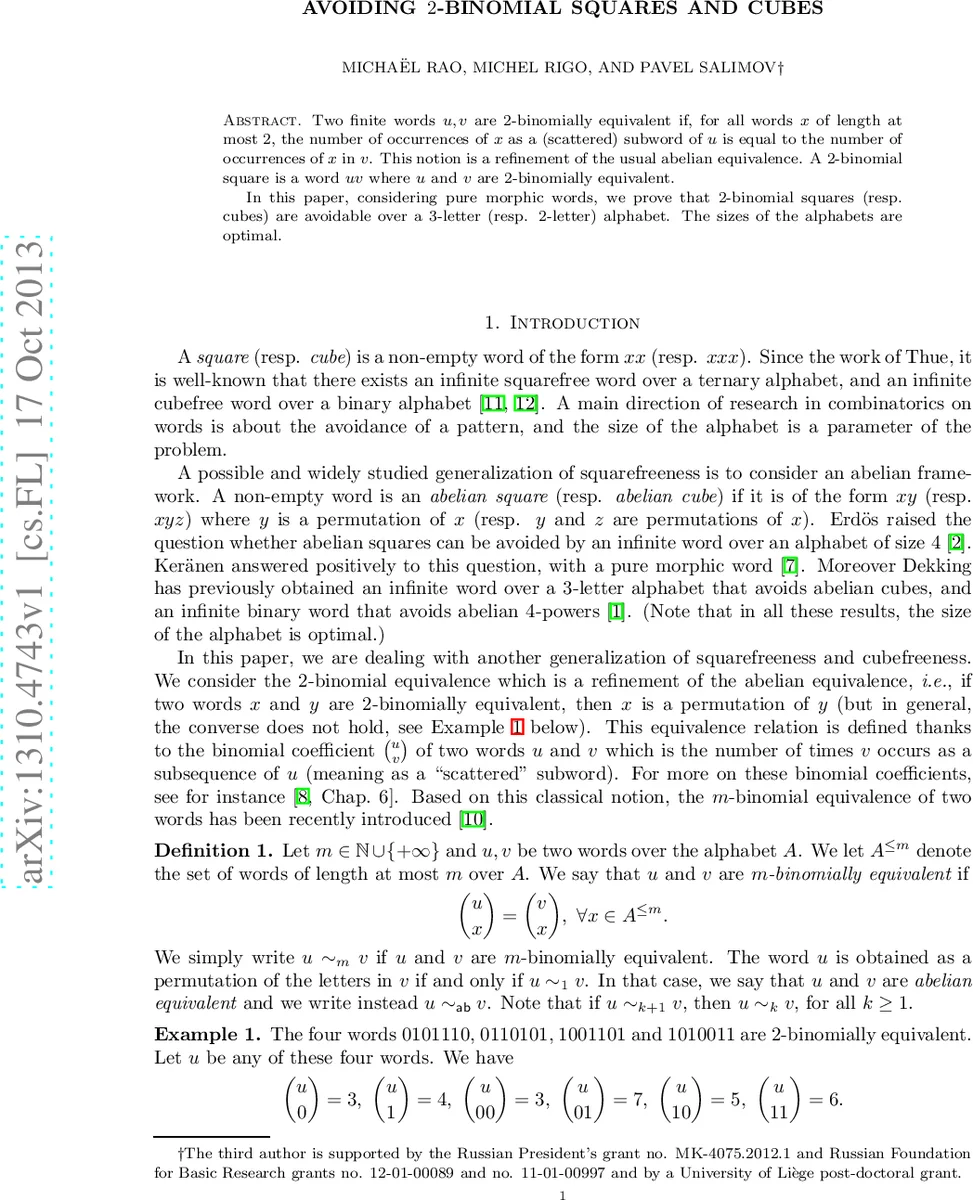
Two finite words $u,v$ are 2-binomially equivalent if, for all words $x$ of length at most 2, the number of occurrences of $x$ as a (scattered) subword of $u$ is equal to the number of occurrences of $x$ in $v$. This notion is a refinement of the usual abelian equivalence. A 2-binomial square is a word $uv$ where $u$ and $v$ are 2-binomially equivalent. In this paper, considering pure morphic words, we prove that 2-binomial squares (resp. cubes) are avoidable over a 3-letter (resp. 2-letter) alphabet. The sizes of the alphabets are optimal.
💡 Research Summary
The paper investigates the avoidance of a refined combinatorial pattern called a “2‑binomial square” and its cubic analogue, a “2‑binomial cube”. Two finite words u and v are said to be 2‑binomially equivalent (denoted u ∼₂ v) if, for every word x of length at most two, the number of scattered (subsequence) occurrences of x in u equals that in v. This relation is strictly stronger than ordinary abelian equivalence (which only requires equality of letter counts) but weaker than full equality; for instance, the four binary words listed in Example 1 are all 2‑binomially equivalent while not being permutations of each other.
A 2‑binomial square is a non‑empty word uv where u ∼₂ v; a 2‑binomial cube is a word xyz with x ∼₂ y ∼₂ z. The central question is whether infinite words avoiding these patterns exist, and if so, what is the smallest alphabet size required.
Avoiding 2‑binomial squares (ternary alphabet).
The authors define a pure morphism g on the alphabet A={0,1,2} by
g(0)=012, g(1)=02, g(2)=1.
The fixed point x=g^ω(0) = 0120210121… is the classic ternary Thue–Morse word, known to avoid ordinary squares. The set X={012, 02, 1} forms a prefix code, so any factor of x can be uniquely factorised over X. By erasing all occurrences of the letter 1 (via a morphism e), the authors obtain e(x) = (02)^ω, which is a pure binary periodic word. Lemma 1 shows that a word u occurs in x iff e(u) occurs in x, establishing a tight link between factors of x and their “1‑erased” counterparts.
Lemma 2 (desubstitution) proves that if u and v are abelian‑equivalent non‑empty factors of x with uv a factor of x, then either u and v are direct images under g of shorter factors u′, v′, or they appear swapped after applying e. This enables an inductive reduction of any potential 2‑binomial square to a shorter one.
A crucial auxiliary quantity λ(u)=#{01}(u)−#{12}(u) is introduced. Lemma 3 shows that if u∼₂v and λ(u)=λ(v), then the desubstituted words u′, v′ are also abelian‑equivalent and satisfy λ(u′)=λ(v′). The proof relies on explicit counting formulas for binomial coefficients of length‑2 subwords under g, together with the observation that in any factor of x the numbers of 0’s and 2’s differ by at most one.
Theorem 1 proceeds by contradiction: assuming x contains a 2‑binomial square uv, one repeatedly applies Lemma 2 and Lemma 3, obtaining an infinite descending chain of shorter and shorter factors that must eventually collapse to a trivial square aa (a single letter repeated). However, the ternary Thue–Morse word is known to be square‑free, so such a factor cannot exist. Hence x avoids all 2‑binomial squares. Remark 2 notes that the morphism g itself is not 2‑binomial‑square‑free (e.g., g(010)=01202012 contains a 2‑binomial square), but its fixed point is.
Avoiding 2‑binomial cubes (binary alphabet).
For the binary case the morphism h is defined by
h(0)=001, h(1)=011.
The fixed point z=h^ω(0) = 001001011001… is the object of study. To capture 2‑binomial equivalence on binary words, the authors use the extended Parikh vector
Ψ₂(u) = (|u|₀, |u|₁, #{00}(u), #{01}(u), #{10}(u), #{11}(u)).
Two words are 2‑binomially equivalent iff their Ψ₂ vectors coincide.
A 6×6 integer matrix M_h is computed such that Ψ₂(h(u)) = M_h·Ψ₂(u) for every binary word u; M_h is invertible, guaranteeing that 2‑binomial equivalence is preserved under h. Proposition 2 and Proposition 3 give simple transformation rules for Ψ₂ when a word is prefixed or suffixed by a single letter, which are essential for the subsequent combinatorial analysis.
Lemma 4 (and its symmetric Lemma 5) consider three words p, q, r built from images under h together with extra leading or trailing letters. Assuming p∼₂q∼₂r, the authors derive explicit expressions for the differences #{01}−#{10} of each word in terms of the Parikh components of the underlying pre‑images p′, q′, r′ and the indicator variables δ_{a,0}, δ_{b,1} (which record whether the added letters equal 0 or 1). By reducing these equalities modulo 2 and modulo 3, they obtain contradictory congruences, showing that the three words cannot all be pairwise 2‑binomially equivalent. Consequently, any factor of the form p q r that would constitute a 2‑binomial cube cannot appear in z.
Since any occurrence of a 2‑binomial cube in z would give rise to such a triple, the absence of the triple implies that z is 2‑binomial‑cube‑free. Therefore, an infinite binary word avoiding 2‑binomial cubes exists, and the binary alphabet is optimal (a unary alphabet cannot avoid cubes at all).
Optimality and broader context.
The results improve upon earlier work on abelian pattern avoidance: abelian squares require a 4‑letter alphabet, while abelian cubes can be avoided over 3 letters. Here the stricter 2‑binomial condition reduces the required alphabet size to 3 for squares and to 2 for cubes, matching the known lower bounds for ordinary squares and cubes. The paper also discusses alternative refinements of abelian equivalence (the so‑called m‑abelian equivalence) and notes that the avoidance behavior differs markedly under those definitions.
In summary, the authors introduce a natural refinement of abelian equivalence, construct explicit pure morphic fixed points that avoid the corresponding square and cube patterns, and prove that the alphabet sizes (3 for squares, 2 for cubes) are optimal. The methodology blends combinatorial factorisation, careful counting of scattered subwords, auxiliary invariants (λ), and linear algebraic tools (invertible matrices) to achieve the results. This work opens the door to further investigations of pattern avoidance under increasingly fine equivalence relations.
Comments & Academic Discussion
Loading comments...
Leave a Comment