Kramers law: Validity, derivations and generalisations
Kramers' law describes the mean transition time of an overdamped Brownian particle between local minima in a potential landscape. We review different approaches that have been followed to obtain a mathematically rigorous proof of this formula. We als…
Authors: Nils Berglund
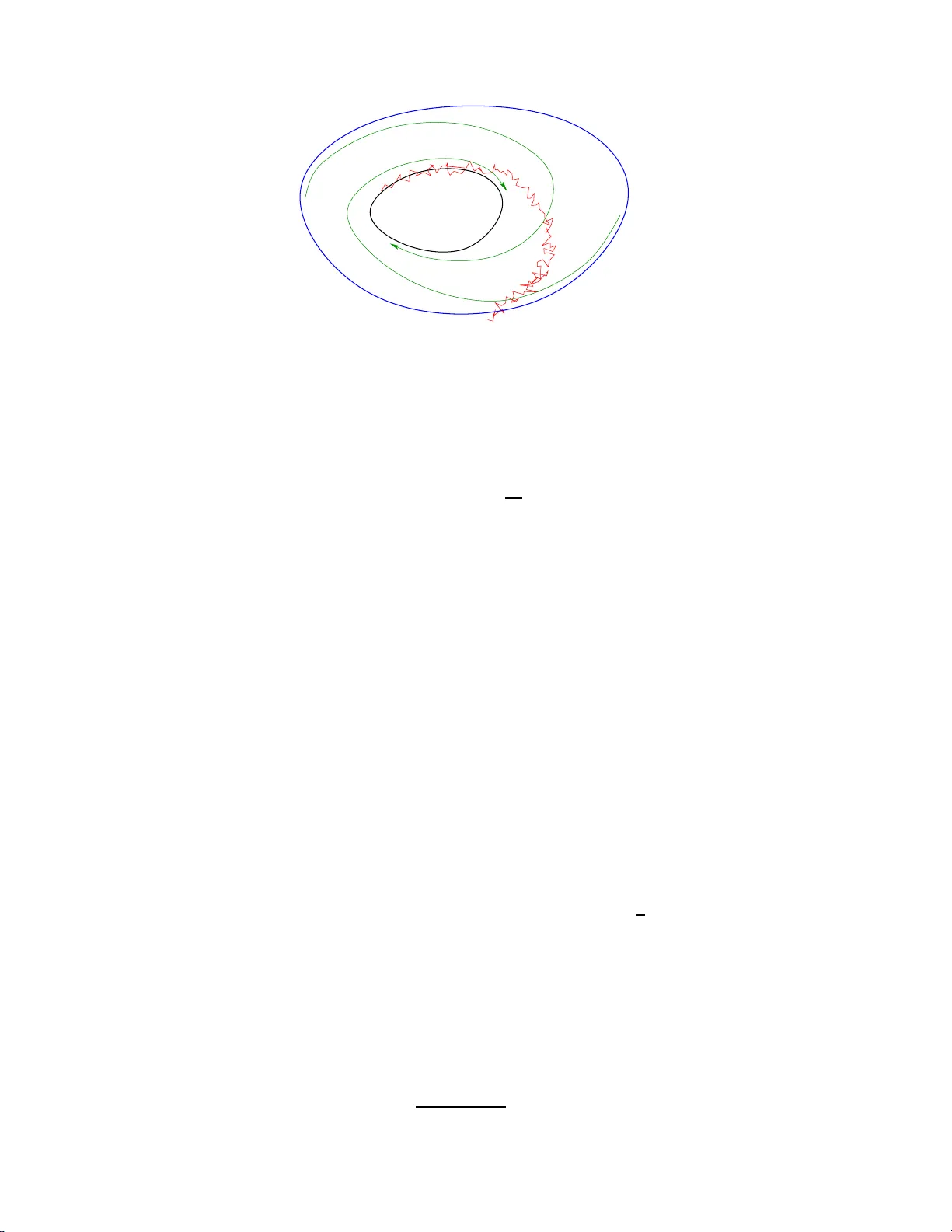
Kramers’ la w: V alidit y , deriv ations and generalisations Nils Berglund June 28, 2011. Updated, Jan uary 22, 2013 Abstract Kramers ’ law describ es the mean transition time of a n ov erdamp ed Brownian par- ticle betw een lo cal minima in a p otential landscape. W e review different appro a ches that hav e been followed to obtain a mathematically rigor ous pr o of of this formula. W e also discuss some generalisatio ns, and a case in whic h Kramers’ la w is not v alid. This review is written fo r b oth mathematicians a nd theor etical ph ysicis ts, and endeavours to link conce pts and terminolo gy from b o th fields. 2000 Mathematic al Subje ct Classific ation. 58J65 , 6 0F10, (primar y), 60J4 5, 34E20 (seconda ry) Keywor ds and phr ases. Arrhenius’ law, K ramers’ law, metastability , larg e deviations, W entzell- F reidlin theory , WKB theory , p otential theory , capacity , Witten La placian, cycling. 1 In tro duction The o verdamp ed motion of a Bro wnian particle in a p oten tial V is go verned b y a first-order Langevin (or S moluc ho wski) equation, usually w ritten in the physics literature as ˙ x = −∇ V ( x ) + √ 2 ε ξ t , (1.1) where ξ t denotes zero-mean, delta-correlated Gaussian white noise. W e will rather adopt the mathematician’s n otatio n, and write (1.1) as the Itˆ o sto chastic differential equation d x t = −∇ V ( x t ) d t + √ 2 ε d W t , (1.2) where W t denotes d -dimensional Bro wnian motion. T he p oten tial is a fun ction V : R d → R , wh ic h w e w ill alwa ys assu me to b e smo oth and growing sufficiently fast at infi nit y . The fact that the drift term in (1.2) has gradien t form en tails t wo imp ortant p rop erties, whic h greatly simplify the analysis: 1. T h ere is an inv arian t probability measure, with the explicit expression µ (d x ) = 1 Z e − V ( x ) /ε d x , (1.3) where Z is the normalisation constan t. 2. T h e system is r eversible with r esp ect to the in v ariant measure µ , that is, the tr ansition probabilit y density s atisfies the detaile d b alanc e c ondition p ( y , t | x, 0) e − V ( x ) /ε = p ( x, t | y , 0) e − V ( y ) /ε . (1.4) 1 x ⋆ z ⋆ y ⋆ Figure 1. Graph of a po ten tial V in dimension d = 2, with t wo lo ca l minima x ⋆ and y ⋆ and saddle z ⋆ . The m ain qu estion we are in terested in is the follo w ing. Assume that the p oten tial V has several (meaning at least t wo) lo cal minima. Ho w long do es the Bro wn ian particle tak e to go from one lo cal minim um to another one? T o b e more p r ecise, let x ⋆ and y ⋆ b e tw o lo cal minima of V , and let B δ ( y ⋆ ) b e the ball of radius δ centred in y ⋆ , wh ere δ is a small p ositiv e constant (whic h m ay p ossibly dep end on ε ). W e are in terested in c haracterising the fi rst-hitting time of this ball, defin ed as th e random v ariable τ x ⋆ y ⋆ = inf { t > 0 : x t ∈ B δ ( y ⋆ ) } where x 0 = x ⋆ . (1.5) The t wo p oints x ⋆ and y ⋆ b eing lo cal minima, the p otenti al along an y con tin uous path γ from x ⋆ to y ⋆ m ust increase and decrease again, at least once but p ossibly sev eral times. W e can determine the maximal v alue of V along s uc h a path, and then min imise this v alue o v er all con tin uous p aths fr om x ⋆ to y ⋆ . T h is defines a c ommunic ation height H ( x ⋆ , y ⋆ ) = inf γ : x ⋆ → y ⋆ sup z ∈ γ V ( z ) . (1.6) Although there are m any paths r ealising the infimum in (1.6 ), th e communicatio n heigh t is generically reac hed at a uniqu e p oin t z ⋆ , which we will call the r elevant sadd le b et ween x ⋆ and y ⋆ . In th at case, H ( x ⋆ , y ⋆ ) = V ( z ⋆ ) (see Figure 1). O ne can sh o w th at generically , z ⋆ is a critical p oin t of index 1 of the p oten tial, that is, wh en seen from z ⋆ the p oten tial decreases in one direction and increases in the other d − 1 directions. This tran s lates mathematicall y in to ∇ V ( z ⋆ ) = 0 and the Hessian ∇ 2 V ( z ⋆ ) ha ving exactly one strictly negativ e and d − 1 strictly p ositiv e eigen v alues. In order to simplify the pr esen tation, w e will state the m ain results in the case of a double-w ell p oten tial, meaning that V has exactly t wo lo cal minima x ⋆ and y ⋆ , separated b y a unique sadd le z ⋆ (Figure 1), henceforth referred to as “the double-w ell situ ation”. The K ramers la w has b een extended to p oten tials with more than t w o lo cal minima, and w e will commen t on its form in these cases in Section 3.3 b elo w. In the con text of c hemical reaction rates, a relation for the m ean transition time τ x ⋆ y ⋆ w as fi rst prop osed by v an t’Ho ff, and later physica lly justified by Arrhen iu s [Arr 89]. It reads E { τ x ⋆ y ⋆ } ≃ C e [ V ( z ⋆ ) − V ( x ⋆ )] /ε . (1.7) 2 The Eyring–Kramers la w [Eyr35, Kr a40] is a r efinemen t of Arr henius’ la w, as it giv es an appro ximate v alue of the prefactor C in (1.7 ). Namely , in th e one-dimensional case d = 1, it r eads E { τ x ⋆ y ⋆ } ≃ 2 π p V ′′ ( x ⋆ ) | V ′′ ( z ⋆ ) | e [ V ( z ⋆ ) − V ( x ⋆ )] /ε , (1.8) that is, the prefactor dep ends on the cu rv atures of the p oten tial at the starting minim um x ⋆ and at the saddle z ⋆ . S maller curv atures lead to longer tran s ition times. In th e multidimensional case d > 2, the Eyr ing–Kramers law reads E { τ x ⋆ y ⋆ } ≃ 2 π | λ 1 ( z ⋆ ) | s | det( ∇ 2 V ( z ⋆ )) | det( ∇ 2 V ( x ⋆ )) e [ V ( z ⋆ ) − V ( x ⋆ )] /ε , (1.9) where λ 1 ( z ⋆ ) is th e single negativ e eigenv alue of the Hessian ∇ 2 V ( z ⋆ ). If we denote the eigen v alues of ∇ 2 V ( z ⋆ ) by λ 1 ( z ⋆ ) < 0 < λ 2 ( z ⋆ ) 6 · · · 6 λ d ( z ⋆ ), and th ose of ∇ 2 V ( x ⋆ ) by 0 < λ 1 ( x ⋆ ) 6 · · · 6 λ d ( x ⋆ ), th e relation (1.10) can b e rewritten as E { τ x ⋆ y ⋆ } ≃ 2 π s λ 2 ( z ⋆ ) . . . λ d ( z ⋆ ) | λ 1 ( z ⋆ ) | λ 1 ( x ⋆ ) . . . λ d ( x ⋆ ) e [ V ( z ⋆ ) − V ( x ⋆ )] /ε , (1.10) whic h indeed redu ces to (1.8) in the case d = 1. Notice th at for d > 2, smaller cur v atures at the sad d le in the stable d ir ections (a “br oader mountai n pass”) d ecrease the mean transition time, wh ile a smaller cu rv ature in the u n stable direction increases it. The question we will add ress is whether, und er which assu mptions and for which meaning of the symb ol ≃ the E y r ing–Kramers la w (1.9) is tru e. Answering this qu estion has tak en a sur prisingly long time, a f ull pro of of (1.9 ) ha ving b een obtained only in 2004 [BEGK04 ]. In the sequel, w e will presen t s everal appr oac h es to w ards a rigorous pr o of of the Arrhe- nius and Eyrin g–Kramers laws. In Section 2, we pr esen t the app roac h based on the theory of large deviations, w hic h allo w s to prov e Arrh enius’ law for more general than gradien t systems, b ut fails to con tr ol the pr efactor. In Section 3, we review differen t analytical approac hes, tw o of wh ic h y ield a f ull p r o of of (1.9). Finally , in Section 4, we discuss some situations in whic h the classical Eyrin g–Kramers la w do es not apply , bu t either ad m its a generalisatio n, or has to b e replaced b y a d ifferen t expression. Ac kno wledgemen ts: This review is based on a talk giv en at the m eeting “Inhomogeneous Random Systems”at Institut Henr i Poinca r´ e, P aris, on Jan ur a y 26, 2011. It is a p leasure to thank Ch ristian Maes for in viting me, and F ran¸ cois Dunlop, Th ierry Go br on and Ellen Saada for organising the meeting. I’m also grateful to Barbara Gen tz for numerous discussions and us eful commen ts on the manuscript, and to Aur´ elien Alv arez for sharing his knowledge of Ho dge theory . 3 2 Large deviations and Arrhenius’ la w The theory of large deviatio ns has applications in many fields of p robabilit y [DZ98, DS 89 ]. It allo ws in particular to give a mathematically rigorous framework to what is kno wn in physic s as the path-in tegral approac h, for a general class of stochasti c d ifferen tial equations of the form d x t = f ( x t ) d t + √ 2 ε d W t , (2.1) where f need not b e equal to the gradient of a p oten tial V (it is ev en p ossible to consider an x -dep en d en t diffusion co efficien t √ 2 ε g ( x t ) d W t ). In this con text, a lar ge-deviation principle is a relation stating that for small ε , the p robabilit y of sample paths b eing close to a fun ction ϕ ( t ) b eha ve s like P x t ≃ ϕ ( t ) , 0 6 t 6 T ≃ e − I ( ϕ ) / 2 ε (2.2) (see (2.4) b elo w for a m athematical ly precise formulation). The quan tit y I ( ϕ ) = I [0 ,T ] ( ϕ ) is called r ate function or action functional . Its expression w as determined by Sc h ild er [Sc h 66] in the case f = 0 of Bro wnian motion, usin g the Cameron–Martin–Girsano v formula. Sc hilder’s r esult has b een extended to general equations of the form (2.1) by W en tzell and F reidlin [VF70], who sho w ed that I ( ϕ ) = 1 2 Z T 0 k ˙ ϕ ( t ) − f ( ϕ ( t )) k 2 d t . (2.3) Observe that I ( ϕ ) is nonn egativ e, and v anish es if and only if ϕ ( t ) is a solution of the deterministic equation ˙ ϕ = f ( ϕ ). On e ma y think of the rate function as representing the cost of trac king th e function ϕ r ather than follo wing the deterministic dynamics. A precise formulatio n of (2.2) is that for any set Γ of paths ϕ : [0 , T ] → R d , one has − inf Γ ◦ I 6 lim in f ε → 0 2 ε log P ( x t ) ∈ Γ 6 lim sup ε → 0 2 ε log P ( x t ) ∈ Γ 6 − inf Γ I . (2.4) F or sufficiently well- b eha v ed sets of paths Γ, the infim um of the rate function o ver the in terior Γ ◦ and th e closure Γ coincide, and thus lim ε → 0 2 ε log P ( x t ) ∈ Γ = − inf Γ I . (2.5) Th us roughly sp eaking, we can write P { ( x t ) ∈ Γ } ≃ e − inf Γ I / 2 ε , b ut we should k eep in mind that this is only true in the sense of logarithmic equiv alence (2.5 ). Remark 2.1. The large-deviation principle (2.4 ) can b e consid er ed as an infinite-dimen- sional v ersion of Laplace’s method. In th e fin ite-dimensional ca se of functions w : R d → R , Laplace’s metho d y ields lim ε → 0 2 ε log Z Γ e − w ( x ) / 2 ε d x = − inf Γ w , (2.6) and also provides an asymptotic expansion f or the prefactor C ( ε ) s u c h that Z Γ e − w ( x ) / 2 ε d x = C ( ε ) e − inf Γ w / 2 ε . (2.7) This approac h can b e extended formally to the infin ite-dimensional case, where it yields to a Hamilton–Jaco bi equ ation, whic h is often used to d eriv e sub exp onenti al corrections to large-deviation results via a (see e.g. [MS93]). W e are not a wa re, ho w ev er, of this pro cedure h a ving b een justified mathematically . 4 D x ⋆ x τ Figure 2. The setting of Theorems 2 .2 and 2.3. The domain D c o nt ains a unique stable equilibrium p oint x ⋆ , and all orbits of the deterministic system ˙ x = f ( x ) starting in D conv erge to x ⋆ . Let us no w explain h o w the large-deviatio n prin ciple (2.4) can b e u sed to p ro v e Ar- rhenius’ la w. Let x ⋆ b e a s table equ ilibr ium p oin t of the deterministic system ˙ x = f ( x ). In the gradien t case f = −∇ V , this means that x ⋆ is a lo cal m inim um of V . Cons id er a domain D ⊂ R d whose closure is included in the d omain of attraction of x ⋆ (all orbits of ˙ x = f ( x ) starting in D con v erge to x ⋆ , see Figure 2). The quasip otential is th e function defined for z ∈ D by V ( z ) = inf T > 0 inf ϕ : ϕ (0)= x ⋆ ,ϕ ( T )= z I ( ϕ ) . (2.8) It measures the cost of reac hin g z in arbitrary time. Theorem 2.2 ([VF69, VF70]) . L et τ = inf { t > 0 : x t 6∈ D } denote the first-exit time of x t fr om D . Then for any initial c ondition x 0 ∈ D , we have lim ε → 0 2 ε log E x 0 { τ } = inf z ∈ ∂ D V ( z ) = : V . (2.9) Sketch of proof . First one shows that for any x 0 ∈ D , it is lik ely to hit a small neigh- b ourh o o d of x ⋆ in finite time. The large-deviation principle sho ws the existence of a time T > 0, in dep end ent of ε , s uc h that the pr ob ab ility of leaving D in time T is close to p = e − V / 2 ε . Using the Mark o v prop erty to restart the pr o cess at multiples of T , one sho ws that the num b er of time int erv als of length T n eeded to leav e D follo ws an app ro x- imately geometric distribution, w ith exp ectation 1 /p = e V / 2 ε (these time interv als can b e view ed as r ep eated “attempts” of the pr o cess to lea ve D ). The errors made in the d ifferen t appro ximations v anish when taking the limit (2.9). W en tzell and F reidlin also sho w that if the q u asip oten tial reac hes its minimum on ∂ D at a unique, isolated p oint, then the fi r st-exit lo cation x τ concen trates in that p oin t as ε → 0. As for th e distribu tion of τ , Da y h as shown th at it is asymptotically exp onentia l: Theorem 2.3 ([Da y83]) . In the situation describ e d ab ove, lim ε → 0 P τ > s E { τ } = e − s (2.10) for al l s > 0 . 5 In ge neral, the quasip oten tial V has to b e determined by minimisin g the rate fu nc- tion (2.3 ), u s ing either the Euler–Lagrange equati ons or the associated Hamilton equations. In the gradien t case f = −∇ V , how ever, a remark able simplification o ccurs. Indeed, we can w rite I ( ϕ ) = 1 2 Z T 0 k ˙ ϕ ( t ) + ∇ V ( ϕ ( t )) k 2 d t = 1 2 Z T 0 k ˙ ϕ ( t ) − ∇ V ( ϕ ( t )) k 2 d t + 2 Z T 0 h ˙ ϕ ( t ) , ∇ V ( ϕ ( t )) i d t = 1 2 Z T 0 k ˙ ϕ ( t ) − ∇ V ( ϕ ( t )) k 2 d t + 2 V ( ϕ ( T )) − V ( ϕ (0)) . (2.11) The first term on the r igh t-hand v anishes if ϕ ( t ) is a s olution of the time-rev ersed deter- ministic system ˙ ϕ = + ∇ V ( ϕ ). Connecting a lo cal m inim um x ⋆ to a p oin t in the basin of attractio n of x ⋆ b y su c h a solution is p ossible, if one allo ws for arbitrarily long time. T hus it f ollo ws that the quasip oten tial is giv en by V = 2 h inf ∂ D V − V ( x ⋆ ) i . (2.12) Corollary 2.4. In the double-wel l situation, lim ε → 0 ε log E τ B δ ( y ⋆ ) = V ( z ⋆ ) − V ( x ⋆ ) . (2.13) Sketch of proof . Let D b e a set cont aining x ⋆ , and con tained in the basin of att raction of x ⋆ . One can choose D in suc h a w a y that its b ound ary is close to z ⋆ , and that the minim um of V on ∂ D is attained close to z ⋆ . Theorem 2.2 and (2.12) show that a relation similar to (2.13) holds for the fir st-exit time fr om D . Then one shows that once x t has left D , the a v erage time needed to hit a small neighbour ho o d of y ⋆ is negligible compared to the exp ected fir st-exit time from D . Remark 2.5. 1. T h e case of more than t wo stable equ ilibr ium p oin ts (or more general attractors) can b e treated by organising th ese p oin ts in a hierarc hy of “cycles”, wh ic h determines the exp onent in Arrhen ius’ la w and other quan tities of in terest. See [FW98, F re00]. 2. As we ha ve seen, the large-deviations approac h is n ot limited to th e gradien t case, bu t also allo ws to compute the exp onen t for irreve rsib le systems, b y solving a v ariational problem. Ho wev er, to our knowle dge a rigorous computation of the p refactor b y this approac h h as not b een ac hiev ed, as it w ould require proving that the large-deviatio n functional I also yields the correct su b exp onen tial asymptotics. 3. S ugiura [Sug95, Sug96, Su g01] has built on these large-deviation resu lts to deriv e appro ximations f or the sm all eigen v alues of the diffusion’s generator (defined in the next section). 6 A x 1/2 1/2 B Figure 3. Symmetric random w alk o n Z with tw o absor bing sets A , B . 3 Analytic approac hes and Kramers’ la w The different analytic appr oac h es to a pro of of Kramers’ la w are based on the fact that exp ected first-hitting times, when considered as a fun ction of the starting p oin t, satisfy certain p artial d ifferen tial equ ations related to F eyn m an–Kac form ulas. T o illustrate this fact, we consider the case of the symmetric simp le ran d om wa lk on Z . Fix tw o disjoint sets A, B ⊂ Z , f or in stance of the form A = ( −∞ , a ] and B = [ b, ∞ ) with a < b (Figure 3). A firs t quan tit y of interest is the pr obabilit y of h itting A b efore B , when starting in a p oin t x b et w een A and B : h A,B ( x ) = P x { τ A < τ B } . (3.1) F or reasons that w ill b ecome clear in Section 3.3, h A,B is called th e e quilib riu m p otential b et wee n A and B (some authors call h A,B the c ommittor function ). Using the Marko v prop erty to restart the pro cess after the fi r st step, w e can write h A,B ( x ) = P x { τ A < τ B , X 1 = x + 1 } + P x { τ A < τ B , X 1 = x − 1 } = P x { τ A < τ B | X 1 = x + 1 } P x { X 1 = x + 1 } + P x { τ A < τ B | X 1 = x − 1 } P x { X 1 = x − 1 } = h A,B ( x + 1) · 1 2 + h A,B ( x − 1) · 1 2 . (3.2) T aking in to accoun t the b oun dary conditions, we see th at h A,B ( x ) satisfies the linear Diric hlet b oun dary v alue pr oblem ∆ h A,B ( x ) = 0 , x ∈ ( A ∪ B ) c , h A,B ( x ) = 1 , x ∈ A , h A,B ( x ) = 0 , x ∈ B , (3.3) where ∆ denotes the d iscrete Laplacian (∆ h )( x ) = h ( x − 1) − 2 h ( x ) + h ( x + 1) . (3.4) A fu nction h satisfying ∆ h = 0 is called a (discrete) harmonic function. In this one- dimensional s itu ation, it is easy to solv e (3.3): h A,B is simply a linear function of x b et wee n A and B . A similar b ound ary v alue problem is satisfied by the mean fi r st-hitting time of A , w A ( x ) = E x { τ A } , assuming that A is suc h that th e exp ectation exist (that is, the rand om w alk on A c m ust b e p ositiv e r ecurren t). Here is an elemen tary computation (a shorter 7 deriv ation can b e giv en using cond itional exp ectations): w A ( x ) = X k k P x { τ A = k } = X k k h 1 2 P x − 1 { τ A = k − 1 } + 1 2 P x +1 { τ A = k − 1 } i = X ℓ ( ℓ + 1) h 1 2 P x − 1 { τ A = ℓ } + 1 2 P x +1 { τ A = ℓ } i = 1 2 w A ( x − 1) + 1 2 w A ( x + 1) + 1 . (3.5) In the last line we h a v e used th e fact that τ A is almost surely finite, as a consequen ce of p ositiv e recurrence. It f ollo ws that w A ( x ) satisfies the P oisson problem 1 2 ∆ w A ( x ) = − 1 , x ∈ A c , w A ( x ) = 0 , x ∈ A . (3.6) Similar relatio ns can b e written for more general quan tities of th e form E x e λτ A 1 { τ A <τ B } . In the case of Bro wnian motion on R d , th e probabilit y h A,B ( x ) of hitting a set A b efore another set B satisfies the Diric hlet problem 1 2 ∆ h A,B ( x ) = 0 , x ∈ ( A ∪ B ) c , h A,B ( x ) = 1 , x ∈ A , h A,B ( x ) = 0 , x ∈ B , (3.7) where ∆ now denotes the us ual Laplacian in R d , and th e exp ected first-hitting time of A satisfies the Poisson pr oblem 1 2 ∆ w A ( x ) = − 1 , x ∈ A c , w A ( x ) = 0 , x ∈ A . (3.8) F or more general d iffusions of the form d x t = −∇ V ( x t ) d t + √ 2 ε d W t , (3.9) Dynkin’s form ula [Dyn65, Øks85] shows that similar relations as (3.7), (3.8) hold, with 1 2 ∆ rep laced by the infinitesimal generator of the diffusion, L = ε ∆ − ∇ V ( x ) · ∇ . (3.10) Note that L is the adj oin t of th e op erator app earing in th e F okker–Pla nck equation, whic h is more familiar to physicists. Th us by solving a b oundary v alue p roblem inv olving a second-order differen tial op erator, one can in principle compu te the exp ected first-hitting time, and th us v alidate K ramers’ la w. This turns out to b e p ossible in th e one-dimensional case, bu t n o general solution exists in higher dimen sion, where one has to resort to p er- turbativ e tec hniques instead. Remark 3.1. Dep ending on the set A , Sys tems (3.6) and (3.7) need not admit a b ounded solution, o wing to the fact that th e symmetric random w alk and Bro w n ian motion are n ull recurrent in d imensions d = 1 , 2 and transient in dimensions d > 3. A solution exists, h o w ev er, for sets A with b ound ed complement. Th e situation is less restrictiv e for diffusions in a confining p oten tial V , wh ic h are us u ally p ositive recurrent. 8 A a z ⋆ y ⋆ x Figure 4. Example of a one-dimensiona l po tential for which Kramers’ law (3.15) holds. 3.1 The one-d imensional case In th e case d = 1, the generator of the diffusion has th e f orm ( Lu )( x ) = εu ′′ ( x ) − V ′ ( x ) u ′ ( x ) , (3.11) and the equations f or h A,B ( x ) = P x { τ A < τ B } and w A ( x ) = E x { τ A } can b e solv ed explicitly . Consider the case where A = ( −∞ , a ) and B = ( b, ∞ ) for some a < b , and x ∈ ( a, b ). Then it is easy to see that the equilibr ium p oten tial is given by h A,B ( x ) = Z b x e V ( y ) /ε d y Z b a e V ( y ) /ε d y . (3.12) Laplace’s metho d to lo west order shows that for small ε , h A,B ( x ) ≃ exp − 1 ε sup [ a,b ] V − sup [ x,b ] V . (3.13) As one exp ects, the probabilit y of hitting A b efore B is close to 1 wh en the starting p oin t x lies in the basin of attraction of a , and exp onen tially small otherwise. The exp ected fi rst-hitting time of A is giv en by the double integral w A ( x ) = 1 ε Z x a Z ∞ z e [ V ( z ) − V ( y )] /ε d y d z . (3. 14) If w e assume that x > y ⋆ > z ⋆ > a , where V h as a local maximum in z ⋆ and a local minim um in y ⋆ (Figure 4), then the in tegrand is maximal for ( y , z ) = ( y ⋆ , z ⋆ ) and Laplace’s metho d yields exactly K r amers’ la w in the f orm E x { τ A } = w A ( x ) = 2 π p | V ′′ ( z ⋆ ) | V ′′ ( y ⋆ ) e [ V ( z ⋆ ) − V ( y ⋆ )] /ε 1 + O ( √ ε ) . (3.15) 9 3.2 WKB theory The p erturb ativ e analysis of the infi nitesimal generator (3.10) of the diffusion in th e limit ε → 0 is strongly conn ected to semiclassical analysis. Note that L is not self-adjoin t for the canonical scalar p ro duct, but as a consequence of reversibilit y , it is in fact self-adjoin t in L 2 ( R d , e − V /ε d x ). This b ecomes immediately apparent when writing L in th e equiv alen t form L = ε e V /ε ∇ · e − V /ε ∇ (3.16) (just w r ite out the w eigh ted scalar pro duct). It follo ws that the conju gated op erator e L = e − V / 2 ε L e V / 2 ε (3.17) is self-adjoin t in L 2 ( R d , d x ). In fact, a simple computation sho ws that e L is a S chr¨ odinger op erator of the form e L = ε ∆ + 1 ε U ( x ) , (3.18) where th e p oten tial U is giv en b y U ( x ) = 1 2 ε ∆ V ( x ) − 1 4 k∇ V ( x ) k 2 . (3.19) Example 3.2. F or a double-wel l p oten tial of the form V ( x ) = 1 4 x 4 − 1 2 x 2 , (3.20) the p oten tial U in the Sc hr¨ odin ger op erator tak es the form U ( x ) = − 1 4 x 2 ( x 2 − 1) 2 + 1 2 ε ( x 2 − 1) 2 . (3.21 ) Note that this p oten tial has 3 lo cal minima at almost the same heigh t, namely t w o of them at ± 1 where U ( ± 1) = 0 and one at 0 where U (0) = ε/ 2. One ma y try to solv e the Poisson problem Lw A = − 1 by WKB-tec hniques in order to v alidate Kramers’ formula. A closely related pr oblem is to determine the sp ectrum of L . Ind eed, it is kno wn that if the p oten tial V has n lo cal m inima, then L admits n exp onenti ally small eigenv alues, whic h are related to the inv erse of exp ected transition times b et w een certain p oten tial minima. The asso ciated eigenfunctions are concent rated in p oten tial w ells and represen t metastable states. The WKB-approac h has b een in ve stigated, e.g., in [SM79, BM88, KM96, MS 97]. See [Kol00] for a recen t review. A mathematical justification of this formal pro cedure is often p ossible, usin g hard analytical metho ds suc h as microlocal analysis [HS 84, HS85b, HS85a, HS85c], which hav e b een dev elop ed for quantum tun nelling problems. The d iffi- cult y in the case of Kramers’ la w is that due to the form (3.19) of the Sc hr¨ odinger p oten tial U , a phenomenon called “tunnelling through nonresonant w ells” preve nts the existence of a single WKB ansatz, v alid in all R d . One thus h as to use different ansatzes in differen t regions of space, whose asymptotic exp an s ions ha ve to b e matc hed at the b oundaries, a pro cedure th at is difficu lt to justify mathematical ly . Rigorous results on the eigen v alues of L h a v e neve rtheless b een obtained w ith differen t metho ds in [HKS89, Mic95, Mat95], bu t without a sufficiently p recise cont rol of their sub exp onen tial b eha viour as w ould b e required to r igorously p ro v e Kramers’ la w. 10 y A Figure 5 . Green’s function G A c ( x, y ) for Br ownian motion is eq ua l to the electros tatic po tent ial in x created by a unit charge in y a nd a gr ounded conductor in A . 3.3 P otential theory T ec hn iques from p oten tial th eory h av e b een widely used in p r obabilit y th eory [Kak45, Do o84, DS84 , Szn98]. Although W entzel l may ha v e had in mind its application to Kramers’ la w [V en73], this program has b een systematically ca rr ied out only quite recen tly b y Bo vier, Ec khoff, Ga yrard and Klein [BEGK04 , BGK05 ]. W e will explain the b asic idea of this approac h in th e simp le setting of Bro w nian motion in R d , which is equiv alent to an electrostati cs problem. Recall that the fi r st-hitting time τ A of a set A ⊂ R d satisfies the Poisson pr oblem (3.6). It can thus b e expressed as w A ( x ) = − Z A c G A c ( x, y ) d y , (3.22) where G A c ( x, y ) denotes Gr een’s f unction, wh ic h is the formal solution of 1 2 ∆ u ( x ) = δ ( x − y ) , x ∈ A c , u ( x ) = 0 , x ∈ A . (3.23) Note that in electrostatics, G A c ( x, y ) represent s the v alue at x of the electric p oten tial created by a unit p oin t charge at y , wh en the set A is o ccupied by a groun ded conductor (Figure 5 ). Similarly , th e solutio n h A,B ( x ) = P x { τ A < τ B } of the Dirichlet p roblem (3.7) represen ts the electric p oten tial at x , created by a capacitor formed by tw o conductors at A and B , at resp ectiv e electric p oten tial 1 and 0 (Figure 6). Hence the n ame e quilibrium p otential . If ρ A,B denotes the sur face c harge den sit y on the tw o condu ctors, the p otent ial can thus b e expressed in the form h A,B ( x ) = Z ∂ A G B c ( x, y ) ρ A,B (d y ) . (3.24) Note fi nally that the capacitor’s capacit y is simply equal to the total c harge on either of the t w o conductors, giv en by cap A ( B ) = Z ∂ A ρ A,B (d y ) . (3.25) 11 A B V 1 + + + + + + + + + + − − − − − − − − − − − − − − − − − − + + + − Figure 6. The function h A,B ( x ) = P x { τ A < τ B } is eq ual to the electric p otential in x o f a capa c ito r with conducto rs in A and B , at r esp ective potential 1 and 0. The key observ ation is that ev en though we know neither Green’s fun ction, nor the surface c harge density , th e expressions (3.22), (3.24) an d (3.25) can b e combined to yield a useful relation b et wee n exp ected fir st-hitting time and capacit y . Indeed, let C b e a small ball centred in x . Then we hav e Z A c h C,A ( y ) d y = Z A c Z ∂ C G A c ( y , z ) ρ C,A (d z ) d y = − Z ∂ C w A ( z ) ρ C,A (d z ) . (3.26) W e hav e used the symmetry G A c ( y , z ) = G A c ( z , y ), which is a consequence of rev ersibilit y . No w sin ce C is a small ball, if w A do es not v ary to o muc h in C , the last term in (3.26) will b e close to w A ( x ) cap C ( A ). This can b e justified b y using a Harnac k inequalit y , w h ic h pro vides b ound s on the oscillato ry part of h armonic functions. As a result, w e obtain the estimate E x τ A = w A ( x ) ≃ Z A c h C,A ( y ) d y cap C ( A ) . (3.27) This relation is u seful b ecause capacities can b e estimated by a v ariational pr in ciple. Indeed, us in g again the electrostatics analogy , for un it p oten tial difference, the capacit y is equal to the capacitor’s electrostatic energy , whic h is equal to the total energy of the electric fi eld ∇ h : cap A ( B ) = Z ( A ∪ B ) c k∇ h A,B ( x ) k 2 d x . (3.28) In p oten tial theory , this in tegral is kn own as a Dirichlet form . A remark able fact is that the capacito r at equ ilibr ium minimises the electrostati c energy , namely , cap A ( B ) = inf h ∈H A,B Z ( A ∪ B ) c k∇ h ( x ) k 2 d x , (3.29) where H A,B denotes the s et of all suffi cien tly r egular f u nctions h satisfying the b oun dary conditions in (3.7). Similar considerations can b e m ade in the case of general rev ersible diffusions of the form d x t = −∇ V ( x t ) d t + √ 2 ε d W t , (3.30) 12 a cru cial p oin t b eing that rev ersibilit y implies the symmetry e − V ( x ) /ε G A c ( x, y ) = e − V ( y ) /ε G A c ( y , x ) . (3.31) This allo ws to obtain the estimate E x τ A = w A ( x ) ≃ Z A c h C,A ( y ) e − V ( y ) /ε d y cap C ( A ) , (3.32) where th e capacit y is n o w defi ned as cap A ( B ) = inf h ∈H A,B Z ( A ∪ B ) c k∇ h ( x ) k 2 e − V ( x ) /ε d x . (3.33) The numerato r in (3.32) can b e controlle d quite easily . In f act, rather rough a priori b ound s suffice to show that if x ⋆ is a p oten tial minim um, then h C,A is exp onentia lly close to 1 in the basin of attraction of x ⋆ . Thus by straigh tforward Laplace asymp totics, w e obtain Z A c h C,A ( y ) e − V ( y ) /ε d y = (2 π ε ) d/ 2 e − V ( x ⋆ ) /ε p det( ∇ 2 V ( x ⋆ )) 1 + O ( √ ε | log ε | ) . (3.34) Note that this already pro vides one “half ” of Kramers’ la w (1.9) . The other half thus has to come from the capacit y cap C ( A ), which can b e estimated w ith th e h elp of the v ariational principle (3.33). Theorem 3.3 ([BEGK04]) . In the double-wel l situation, Kr amers’ law holds in the sense that E x τ B ε ( y ⋆ ) = 2 π | λ 1 ( z ⋆ ) | s | det( ∇ 2 V ( z ⋆ )) | det( ∇ 2 V ( x ⋆ )) e [ V ( z ⋆ ) − V ( x ⋆ )] /ε 1 + O ( ε 1 / 2 | log ε | 3 / 2 ) , (3.35) wher e B ε ( y ⋆ ) is the b al l of r adius ε (the same ε as in the diffu sion c o effici e nt) c entr e d in y ⋆ . Sketch of proof . In view of (3.32 ) and (3.34), it is su ffi cien t to obtain sharp upp er and low er b ound s on the capacit y , of the form cap C ( A ) = 1 2 π s (2 π ε ) d | λ 1 ( z ) | λ 2 ( z ) . . . λ d ( z ) e − V ( z ) /ε 1 + O ( ε 1 / 2 | log ε | 3 / 2 ) . (3.36) The v ariational prin ciple (3.33) sho ws that the Dirichlet form of any fun ction h ∈ H A,B pro vides an u pp er b ound on the capacit y . It is th us sufficien t to construct an appr opriate h . It turns out that taking h ( x ) = h 1 ( x 1 ), dep end ing only on the pro jection x 1 of x on the unstable manifold of the sadd le, with h 1 giv en b y the solution (3.12) of the one-dimensional case, do es the job. The lo w er b oun d is a bit m ore tricky to obtain. Observe first that restricting th e domain of inte gration in the Diric hlet form (3.33) to a small rectangular b o x centred in the saddle d ecreases the v alue of the in tegral. F u rthermore, the in tegrand k∇ h ( x ) k 2 is b ound ed b elow by the der iv ativ e in the unstable direction squared. F or giv en v alues of the equilibrium p oten tial h A,B on the sides of th e b ox int ersecting the unstable manifold of the sadd le, the Diric hlet f orm can th us b e b ound ed b elo w b y solving a one-dimensional v ariational problem. T hen rough a p riori b oun ds on the b oundary v alues of h A,B yield the result. 13 x ⋆ 1 x ⋆ 2 x ⋆ 3 h 1 h 2 H Figure 7. E x ample o f a three-well p otential, with asso ciated metastable hiera rch y . The relev a nt communication heights are given by H ( x ⋆ 2 , { x ⋆ 1 , x ⋆ 3 } ) = h 2 and H ( x ⋆ 1 , x ⋆ 3 ) = h 1 . Remark 3.4. F or simplicit y , we hav e only presented the result on the exp ected transition time for the double-w ell situation. Results in [BEGK04, BGK05] also includ e the follo wing p oint s: 1. T h e distrib ution of τ B ε ( y ) is asymptotically exp onen tial, in th e sense of (2. 10 ). 2. In the case of more than 2 lo cal min ima, Kr amers’ la w h olds for tran s itions b et w een lo cal minima pr o vided they are appropr iately ordered. See Example 3.5 b elo w . 3. T h e small eigen v alues of the generator L can b e sh arply estimated, th e leading terms b eing equ al to inv erses of mean transition times. 4. T h e asso ciated eigenfunctions of L are w ell-appro ximated by equ ilibrium p oten tials h A,B for certain sets A, B . If the p oten tial V h as n lo cal minima, there exists an ordering x ⋆ 1 ≺ x ⋆ 2 ≺ · · · ≺ x ⋆ n (3.37) suc h that Kramers’ la w holds for the transition time from eac h x ⋆ k +1 to the set M k = { x ⋆ 1 , . . . , x ⋆ k } . The orderin g is defin ed in terms of communicati on heights by th e condition H ( x ⋆ k , M k − 1 ) 6 min i 0. This means that the minima are ord ered fr om deep est to s hallo west. Example 3.5. Consider the three-w ell p oten tial sh o wn in Figure 7. Th e metastable ordering is give n by x ⋆ 3 ≺ x ⋆ 1 ≺ x ⋆ 2 , (3.39) and K ramers’ law holds in th e form E x ⋆ 1 τ 3 ≃ C 1 e h 1 /ε , E x ⋆ 2 τ { 1 , 3 } ≃ C 2 e h 2 /ε , (3.40) where the constan ts C 1 , C 2 dep end on second deriv ativ es of V . Ho w ev er, it is not true that E x ⋆ 2 { τ 3 } ≃ C 2 e h 2 /ε . In fact, E x ⋆ 2 { τ 3 } is rather of the ord er e H/ε . Th is is due to the fact that eve n though when starting in x ⋆ 2 , the pr o cess is v ery un lik ely to h it x ⋆ 1 b efore x ⋆ 3 (this happ ens with a probabilit y of order e − ( h 1 − H ) /ε ), this is ov ercomp ens ated by the very long waiting time in the well x ⋆ 1 (of order e h 1 /ε ) in case this h app ens. 14 3.4 Witten Lap lacian In this sectio n, we giv e a brief acco unt of another su ccessful approac h to pro ving Kramers’ la w, based on WKB theory for th e Witten Laplacian. It pr o vides a go o d example of the fact that problems ma y b e made m ore accessible to analysis b y generalising them. Giv en a compact, d -dimensional, orien table manifold M , equ ip p ed with a smo oth metric g , let Ω p ( M ) b e the set of differen tial forms of order p on M . The e xterior d eriv ativ e d maps a p -form to a ( p + 1)-form. W e write d ( p ) for the r estriction of d to Ω p ( M ). The sequence 0 → Ω 0 ( M ) d (0) − − → Ω 1 ( M ) d (1) − − → . . . d ( d − 1) − − − − → Ω d ( M ) d ( d ) − − → 0 (3.41) is called the de Rham c omplex asso ciated with M . Differen tial forms in the imag e im d ( p − 1) are called exact , while differential f orms in the k ernel ker d ( p ) are called close d . Exact forms are closed, that is, d ( p ) ◦ d ( p − 1) = 0 or in short d 2 = 0. Ho wev er, closed forms are not necessarily exact. Hence the idea of considering equiv alence classes of d ifferen tial forms d ifferin g by an exact form . The v ector spaces H p ( M ) = k er d ( p ) im d ( p − 1) (3.42) are thus n ot necessarily trivial, and conta in information on th e global top ology of M . They f orm the so-called de Rham c ohomolo gy . The metric g ind uces a natural scalar pro du ct h· , ·i p on Ω p ( M ) (based on the Ho dge isomorphism ∗ ). The c o differ ential on M is the formal adj oin t d ∗ of d , whic h maps ( p + 1)- forms to p -forms and satisfies h d ω , η i p +1 = h ω , d ∗ η i p (3.43) for all ω ∈ Ω p ( M ) and η ∈ Ω p +1 ( M ). The Ho dge L aplacian is defined as th e symmetric non-negativ e op erator ∆ H = d d ∗ + d ∗ d = (d + d ∗ ) 2 , (3.44) and we wr ite ∆ ( p ) H for it s restriction to Ω p . In the Euclidean case M = R d , using integ ration b y parts in (3.43) shows that ∆ (0) H = − ∆ , (3.45) where ∆ is the u s ual Laplacian. D ifferenti al forms γ in the kernel H p ∆ ( M ) = ke r ∆ ( p ) H are called p -harmon ic forms . Th ey are b oth closed (d γ = 0) and co-closed (d ∗ γ = 0). Ho dge has sho wn (see, e.g. [GH94]) that an y differentia l form ω ∈ Ω p ( M ) admits a un ique decomp osition ω = d α + d ∗ β + γ , (3.46) where γ is p -h armonic. As a consequence, H p ∆ ( M ) is isomorphic to th e p th de Rham cohomology group H p ( M ). Giv en a p oten tial V : M → R , th e Witten L aplacian is defined in a similar wa y as the Ho dge L aplacian by ∆ V ,ε = d V ,ε d ∗ V ,ε + d ∗ V ,ε d V ,ε , (3.47) where d V ,ε denotes the d eformed exterior deriv ativ e d V ,ε = ε e − V / 2 ε d e V / 2 ε . (3.48) 15 As b efore, w e write ∆ ( p ) V ,ε for the restriction of ∆ V ,ε to Ω p ( M ). A direct computation sh o ws that in the Euclidean case M = R d , ∆ (0) V ,ε = − ε 2 ∆ + 1 4 k∇ V k 2 − 1 2 ε ∆ V , (3.49) whic h is equiv alen t, u p to a scaling, to the S c hr¨ odinger op erator (3.18). The in terest of this approac h lies in th e fact that while eigenfunctions of ∆ (0) V ,ε are concen trated n ear lo cal min ima of the p oten tial V , those of ∆ ( p ) V ,ε for p > 1 are concent rated near saddles of index p of V . This mak es th em easier to app ro ximate b y WKB theory . The intert win ing relations ∆ ( p +1) V ,ε d ( p ) V ,ε = d ( p ) V ,ε ∆ ( p ) V ,ε , (3.5 0) whic h f ollo w from d 2 = 0, then allo w to infer more precise information on the sp ectrum of ∆ (0) V ,ε , and hence of the generator L of the d iffusion [HN05]. This app r oac h h as b een u sed by Helffer, Klein and Nier [HKN04] to pro ve Kramers’ la w (1. 9 ) with a full asymp totic expansion of the p r efactor C = C ( ε ), in [HN06] to describ e the case of general manifolds with b oundary , and by Le Peutrec [LP10] for th e case with Neumann b oundary conditions. General expressions for the small eigen v alues of all p - Laplacians h a v e b een recen tly derive d in [LP11, LPNV12]. 4 Generalisations and limits In this s ection, w e d iscuss tw o ge neralisations of K ramers’ f orm ula, and one irrev ers ible case, w here Arrhenius’ la w still holds true, but the prefactor is no longer giv en b y Kramers’ la w. 4.1 Non-quadratic saddles Up to now, we hav e assumed that all critical p oints are quadr atic saddles, that is, with a nonsingular Hessian. Although this is tru e generically , as so on as one considers p oten tials dep end in g on one or sev eral parameters, d egenerate saddles are b oun d to o ccur. See for instance [BF G07a , BFG0 7b ] for a natural sys tem disp la ying many bifurcations in vo lving nonquadratic saddles. Obvio usly , Kramers’ la w (1.9) cannot b e tru e in the p resence of singular Hessians, sin ce it w ould predict either a v anishing or an infinite pr efactor. I n fact, in suc h cases th e pr efactor w ill dep end on higher-order terms of the T a ylor expans ion of the p oten tial at the relev an t critical p oints [Ste05]. The main p roblem is th us to d etermine the prefactor’s leading term. There are t wo (non-exclusiv e) cases to b e considered: the starting p oten tial minimum x ⋆ or the relev ant sadd le z ⋆ is non-quadratic. The p oten tial-theoretic approac h pr esen ted in S ection 3.3 provides a s imple w a y to d eal with b oth cases. In the first case, it is in fact sufficien t to carry o ut Laplace’s metho d for (3 .34 ) when the p oten tial V h as a nonqu adratic minim um in x ⋆ , whic h is straight forward. W e discuss the more interesting case of the sadd le z ⋆ b eing non-quadr atic. A general classification of n on -qu adratic sadd les, based on n ormal-form theory , is give n in [BG10]. Consider the case w h ere in app ropriate co ordinates, the p oten tial near the saddle admits an expansion of the form V ( y ) = − u 1 ( y 1 ) + u 2 ( y 2 , . . . , y k ) + 1 2 d X j = k + 1 λ j y 2 j + O ( k y k r +1 ) , (4.1) 16 for some r > 2 and 2 6 k 6 d . The functions u 1 and u 2 ma y tak e negativ e v alues in a small neigh b our ho o d of the origin, of the order of some p ow er of ε , but should b ecome p ositiv e and gro w outside this n eigh b ourh o o d. In that case, we h a v e the follo wing estimate of the capacit y: Theorem 4.1 ([BG10 ]) . Ther e e xists an explicit β > 0 , dep ending on the gr owth of u 1 and u 2 , such that in the double-wel l situation the c ap acity is giv e n by ε Z R k − 1 e − u 2 ( y 2 ,...,y k ) /ε d y 2 . . . d y k Z ∞ −∞ e − u 1 ( y 1 ) /ε d y 1 d Y j = k + 1 s 2 π ε λ j h 1 + O ( ε β | log ε | 1+ β ) i . (4.2) W e d iscuss one p articular example, inv olving a pitchfork b ifurcation. See [BG10] for more examples. Example 4.2. Consider the case k = 2 with u 1 ( y 1 ) = − 1 2 | λ 1 | y 2 1 , u 2 ( y 2 ) = 1 2 λ 2 y 2 2 + C 4 y 4 2 , (4.3) where λ 1 < 0 and C 4 > 0 are b oun ded aw ay from 0. W e assume that the p oten tial is ev en in y 2 . F or λ 2 > 0, the origin is an isolated quadratic saddle. A t λ 2 = 0, the origin un dergo es a p itc h fork b ifurcation, and f or λ 2 < 0, there are t w o saddles at y 2 = ± p | λ 2 | / 4 C 4 + O ( λ 2 ). Let µ 1 , . . . , µ d denote the eigen v alues of the Hessian of V at these saddles. The in tegrals in (4.2) can b e compu ted explicitly , and yield the follo wing prefactors in Kramers’ law: • F or λ 2 > 0, the p refactor is give n by C ( ε ) = 2 π s ( λ 2 + √ 2 εC 4 ) λ 3 . . . λ d | λ 1 | d et( ∇ 2 V ( x ⋆ )) 1 Ψ + ( λ 2 / √ 2 εC 4 ) , (4.4) where the fun ction Ψ + is b ounded ab o v e and b elo w by p ositiv e constan ts, and is giv en in terms of the mo dified Bessel fun ction of the second kin d K 1 / 4 b y Ψ + ( α ) = r α (1 + α ) 8 π e α 2 / 16 K 1 / 4 α 2 16 . (4.5) • F or λ 2 < 0, the p refactor is give n by C ( ε ) = 2 π s ( µ 2 + √ 2 εC 4 ) µ 3 . . . µ d | µ 1 | d et( ∇ 2 V ( x ⋆ )) 1 Ψ − ( µ 2 / √ 2 εC 4 ) , (4.6) where the fu nction Ψ − is again b ounded ab o v e and b elo w b y p ositiv e constant s, and giv en in terms of the mo dified Bessel fu n ctions of the fi rst kin d I ± 1 / 4 b y Ψ − ( α ) = r π α (1 + α ) 32 e − α 2 / 64 I − 1 / 4 α 2 64 + I 1 / 4 α 2 64 . (4.7) 17 -5 -4 -3 -2 -1 0 1 2 3 4 5 0 1 2 -5 -4 -3 -2 -1 0 1 2 3 4 5 0 1 2 -5 -4 -3 -2 -1 0 1 2 3 4 5 0 1 2 C ( ε ) ε = 0 . 5 ε = 0 . 1 ε = 0 . 01 λ 2 Figure 8. The prefactor C ( ε ) in Kr a mers’ law when the p otential under go es a pitchfork bifurcation as the pa rameter λ 2 changes sign. The minimal v alue o f C ( ε ) has order ε 1 / 4 . As long as λ 2 is b ounded a wa y from 0, we reco ver the usu al Kramers p refactor. When | λ 2 | is smaller than √ ε , ho wev er, the term √ 2 εC 4 dominates, and yields a prefactor of order ε 1 / 4 (see Figure 8). The expon ent 1 / 4 is c haracteristic of this particular t yp e of bifurcation. The f u nctions Ψ ± determine a multiplica tiv e constan t, whic h is close to 1 wh en λ 2 ≫ √ ε , to 2 when λ 2 ≪ − √ ε , and to Γ(1 / 4) / (2 5 / 4 √ π ) for | λ 2 | ≪ √ ε . The f actor 2 for large negativ e λ 2 is due to the presence of tw o sadd les. 4.2 SPDEs Metastabilit y can also b e display ed by parab olic sto c hastic partial differential equations of the form ∂ t u ( t, x ) = ∂ xx u ( t, x ) + f ( u ( t, x )) + √ 2 ε ¨ W tx , (4.8) where ¨ W tx denotes space-time white noise (see, e.g. [W al86 ]). W e consider here the simp lest case where u ( t, x ) tak es v alues in R , and x b elongs to an in terv al [0 , L ], w ith either p erio dic or Neumann b ound ary conditions (b.c.). E q u ation (4.8) can b e considered as an infinite- dimensional gradien t system, with p oten tial V [ u ] = Z L 0 1 2 u ′ ( x ) 2 + U ( u ( x )) d x , (4.9) where U ′ ( x ) = − f ( x ). In deed, using in tegratio n by parts one obtains that the F r´ ec het deriv ativ e of V in the direction v is giv en by d d η V [ u + ηv ] η =0 = − Z L 0 u ′′ ( x ) + f ( u ( x )) v ( x ) d x , (4.10) whic h v anishes on stationary s olutions of the deterministic system ∂ t u = ∂ xx u + f ( u ). In the case of the double-wel l p oten tial U ( u ) = 1 4 u 4 − 1 2 u 2 , the equiv alen t of Arrheniu s’ la w h as b een pro v ed by F aris and Jona-Lasinio [FJL82], based on a large-deviation princi- ple. F or b oth p erio d ic and Neumann b.c., V admits t w o global minima u ± ( x ) ≡ ± 1. The relev an t saddle b et w een these solutions d ep ends on the v alue of L . F or Neumann b.c., it is giv en b y u 0 ( x ) = 0 if L 6 π , ± q 2 m m +1 sn x √ m +1 + K( m ) , m if L > π , (4.11) 18 where 2 √ m + 1 K( m ) = L , K denotes the elliptic integral of the first kind , and sn denotes Jacobi’s el liptic sine. Ther e is a p itc hfork bifurcation at L = π . The exp onent in Arr henius’ la w is giv en by the d ifference V [ u 0 ] − V [ u − ], whic h can b e computed explicitly in terms of elliptic integrals. The pr efactor in Kr amers ’ law has b een computed by Maier and Stein, for v arious b.c., and L b oun ded a w a y from the bifurcation v alue ( L = π for Neumann and Diric hlet b.c., L = 2 π for p erio d ic b.c.) [MS01, MS03, Ste04]. The basic observ ation is that the second-order F r ´ ec het deriv ativ e of V at a stationary solution u is the quadratic f orm ( v 1 , v 2 ) 7→ h v 1 , Q [ u ] v 2 i , (4 .12) where Q [ u ] v ( x ) = − v ′′ ( x ) − f ′ ( u ( x )) v ( x ) . (4 .13) Th us the rˆ ole of the eigen v alues of the Hessian is play ed b y the eigenv alues of the second- order differen tial operator Q [ u ], compatible with th e giv en b.c. F or instance, for Neumann b.c. and L < π , the eigen v alues at the sadd le u 0 are of the f orm − 1 + ( π k /L ) 2 , k = 0 , 1 , 2 , . . . , while the eigen v alues at the lo cal minimum u − are giv en by 2 + ( π k /L ) 2 , k = 0 , 1 , 2 , . . . . Thus formally , the p refactor in Kramers’ la w is giv en b y the r atio of infinite p ro ducts C = 2 π s Q ∞ k =0 |− 1 + ( π k /L ) 2 | Q ∞ k =0 [2 + ( πk /L ) 2 ] = 2 π v u u t 1 2 ∞ Y k =1 1 − ( L/πk ) 2 1 + 2( L/π k ) 2 = 2 3 / 4 π s sin L sinh( √ 2 L ) . (4.14) The determination of C for L > π requires the computation of r atios of sp ectral de- terminan ts, whic h can b e done using path-in tegral techniques (Gelfand’s metho d , see also [F or87, MT95, CdV99] f or different appr oac hes to the computation of sp ectral deter- minan ts). T he case of p erio dic b.c. and L > 2 π is ev en more d ifficult, b ecause there is a con tin uous set of relev ant saddles owing to tr anslation inv ariance, b u t can b e treated as w ell [Ste04]. The formal computations of the pr efactor hav e b een extended to the case of bifurcations L ∼ π , resp ectiv ely L ∼ 2 π for p erio d ic b.c. in [BG09]. F or instance, for Neumann b.c. and L 6 π , th e expression (4.14) of the pr efactor has to b e replaced by C = 2 3 / 4 π Ψ + ( λ 1 / p 3 ε/ 4 L ) s λ 1 + p 3 ε/ 4 L λ 1 s sin L sinh( √ 2 L ) , (4.15) where λ 1 = − 1 + ( π /L ) 2 . Unlik e (4.14), whic h v anishes in L = π , the ab o ve expression con v erges to a finite v alue of order ε 1 / 4 as L → π − . These r esu lts hav e recen tly b een p ro v ed rigorously , by considering sequen ces of fi nite- dimensional systems con v erging to the SPDE as dimension go es to infin it y , and con trolling the dimension-dep endence of th e er r or terms. T he fi rst step in this d irection was made in [BBM10] for the c hain of int eracting particles introdu ced in [BF G07a], wh er e a Kramers la w with uniform err or b ounds was obtained for particular initial distributions. F ull pr o ofs of the Kramers la w for classes of parab olic SPDEs ha ve then b een obtained in [BG12b], using sp ectral Galerkin app ro ximations for th e con ve rging s equ ence, and in [Bar12] us in g finite-difference appro ximations. 19 D Figure 9. Two-dimensional vector field with an unstable p erio dic o rbit. The lo ca tio n of the fir st e xit fr o m the domain D delimited by the unstable or bit dis plays the phenomeno n of cycling. 4.3 The irrev ersible case Do es K ramers’ law remain v alid for general diffusions of the form d x t = f ( x t ) d t + √ 2 ε d W t , (4.16) in wh ic h f is not equal to the gradien t of a p oten tial V ? In general, the answ er is negativ e. As we remarked b efore, large-deviat ion r esults imp ly that Arrhenius’ la w still holds for suc h systems. The pr efactor, ho wev er, can b eha ve ve ry different ly th an in Kr amers ’ law. It need not ev en con v erge to a limiting v alue as ε → 0. W e d iscuss here a particular example of s u c h a n on -K r amers b eha viour, called cycling . Consider a tw o-dimensional v ector field admitting an unstable p erio dic orbit, and let D b e the int erior of the u nstable orb it (Figure 9 ). Since paths trac king the p erio d ic orbit d o not con tribute to the rate function, the quasip otent ial is constan t on ∂ D , meaning th at on the leve l of large deviations, all p oints on the p erio d ic orb it are equally likely to o ccur as fi rst-exit p oin ts. Da y has disco v ered th e remark able fact that the distribution of first-exit lo cations rotates around ∂ D , by an angle pr op ortional to log ε [Da y90, Day9 4 , Da y96 ]. Hence this distribution do es n ot con ve rge to any limit as ε → 0. Maier an d Stein p ro vided an intuitiv e explanation f or this phenomenon in terms of most probable exit paths and WKB-approxima tions [MS96]. Even though the quasip otenti al is constant on ∂ D , there exists a w ell-defined path min imising the r ate function (except in case of symm etry-r elated d egeneracies). This path spirals to w ards ∂ D , th e d istance to the b oundary decreasing geometrically at eac h rev olution. One exp ects that exit b ecomes lik ely as s o on as the m in imising path reac hes a distance of ord er √ ε fr om the b ound ary , whic h happ ens after a num b er of rev olutions of order log ε . It turns out that the distribution of fi rst-exit lo cations itself has universal c haracteris- tics: Theorem 4.3 ([B G04, BG12a]) . Ther e exi sts an explicit p ar ametrisation of ∂ D by an angle θ (taking into ac c ount the numb er of r evolutions), such that the distribution of first- exit lo c ations has a density close to p ( θ ) = f transien t ( θ ) e − ( θ − θ 0 ) /λT K λT K P λT ( θ − log ( ε − 1 )) , ( 4.17) 20 wher e • f transien t ( θ ) is a tr ansient term, exp onential ly close to 1 as so on as θ ≫ | log ε | ; • T is the p erio d of the u nstable orbit, and λ is its Lyapunov exp onent; • T K = C ε − 1 / 2 e V /ε plays the rˆ ole of Kr amers’ time; • the universal p erio dic fu nction P λT ( θ ) is a sum of shifte d Gumb e l distributions, given by P λT ( θ ) = X k ∈ Z A ( θ − k λT ) , A ( x ) = 1 2 e − 2 x − 1 2 e − 2 x . (4.18) Although this resu lt concerns the first-exit lo cation, th e fir s t-exit time is str on gly correlated with the first-exit lo cation, and sh ould thus disp la y a similar b ehaviour. Another inte resting consequence of this result is that it allo ws to d etermine the r esi- dence-time d istribution of a particle in the we lls of a p erio dically p erturb ed double-well p oten tial, and therefore giv es a wa y to qu an tify the p henomenon of sto c hastic r eso- nance [BG05]. 4.4 Some recen t dev elopmen ts Since the fi rst v ersion of th is review app eared as a prepr in t, there ha v e b een quite a n u m b er of new resu lts related to the Kr amers formula, w hic h sh o ws that this fi eld of researc h is still very activ e. Here is a n on-exhaustiv e list. A num b er of new app roac h es analyse the generator of the diffu sion using v ariational metho ds from the theory of PDEs. In [MS12], Menz and Schlic hting pro ve Kramers ’ la w for the first nonzero eigen v alue of the generator usin g P oincar ´ e and logarithmic Sob olev inequalities. In [PSV12], Pe letier, Sav ar ´ e and V eneroni use Γ-conv ergence to obtain a Kramers law from a more realistic Kramers–Smoluc ho wski equation, in whic h particles are describ ed by their p osition and their c hemical state. See also [AMP + 12] for an approac h based on the W asserstein distance, and [HN11, HNV12] f or related wo rk. A situation where saddles are ev en more degenerate than in the cases considered in Section 4.1, due to the existence of a fi rst in tegral, h as b een considered b y Bouchet and T ouchett e in [BT12]. In [CGLM12], C´ erou, Guyader, Leli ` evr e and Malrieu show that the Gumb el d istribu- tion, whic h we hav e seen go v erns the fi rst-exit distribution through an un stable p erio dic orbit, also describ es the length of the reactiv e p ath, th at is, the first successful excursion out of a p otent ial well. Concerning irrev ersible diffusions, semiclassica l analysis has b een extended to the Kra- mers–F okk er–Planc k equation, whic h describ es th e motion of a particle in a p oten tial when inertia is tak en int o account, that is, without the assumption that the motion is o v erdamp ed. S ee for instance [HHS08, HHS11]. One limitatio n of the results on SPDEs in Sectio n 4.2 is that the in terv al length L is fi xed. Th is implies that the tran s ition states are stationary solutions that change sign only once or twice p er p erio d (dep ending on the b.c.). S tationary solutions with more sign changes ha v e a higher energy , and do n ot con tribu te to the transition rate. This is no longer tru e if L = L ( ε ) gro ws su fficien tly fast as ε → 0. Recen t results by Otto, W eb er and W estdic ken b erg [OWW1 3 ], who stud y the Allen–Cahn equ ation in that regime, ma y help to pr o v e a Kramers formula in that case. In suc h systems, metastabilit y ma y b e due to the fact that long time spans are sp en t on the stable manif old of transition states, see also the discus s ion in [BW11]. 21 References [AMP + 12] Steffen Arnric h, Alexander Mielk e, Mark A. Peletier, Giuseppe Sav ar´ e, and Mar c o V en- eroni, Passing to the limit in a Wasserst ein gr adient flow: fr om diffusion to r e action , Calculus of V a r iations a nd Partial Differen tial Equatio ns 44 (2012 ), 419– 454. [Arr89] Sv ante Arrhenius, J. Phys. Chem. 4 (1889 ), 226. [Bar12 ] Florent Bar ret, Sharp asymptotics of met astable tr ansition times for one dimensional SPDEs , preprint arXiv :1201. 4440 , 201 2 . [BBM10] Florent Ba rret, Anton Bovier, a nd Sylvie M´ el´ eard, Uniform estimates for metastable tr ansition times in a c ouple d bistable system , Electron. J. Probab. 15 (2010), 323–34 5. MR 26 09590 (2011h:8 2066) [BEGK04 ] An ton Bovier, Michael Eckhoff, V´ ero nique Gayrard, a nd Mar kus Klein, Metastability in r eversible diffusion pr o c esses. I. Sharp asymptotics for c ap acities and exit times , J. Eur. Math. So c. (JE MS) 6 (2004), no. 4, 3 99–42 4. MR 209 4 397 (2006b:821 12) [BFG07a] Nils Berglund, B astien F ernandez, and Barbar a Gen tz, Metastability in inter acting nonline ar sto chastic differ ential e quations: I. Fr om we ak c oupling t o synchr onization , Nonlinearity 20 (2 007), no. 1 1 , 255 1–258 1. MR 2 36124 6 (2009a:60 116) [BFG07b] , Metastability in inter acting nonline ar sto chastic differ ential e quations II : Lar ge- N b ehaviour , Nonlinearity 20 (20 07), no . 11, 258 3–261 4. MR 23 6124 7 (2009a :60117 ) [BG04] Nils Berglund and Bar bara Gentz, O n the noise-induc e d p assage t hr ough an uns t able p erio dic orbit I: Two-level mo del , J. Statist. Phys. 1 14 (200 4), 1577– 1618. [BG05] , Universality of first-p assage and r esidenc e- t ime distributions in non-adiab atic sto chastic r esonanc e , Europhys. Letters 70 (2005 ), 1–7. [BG09] , Anomalo us b ehavior of the K r amers r ate at bifur c ations in classic al field the- ories , J. Phys. A: Math. The o r 42 (2009), 05 2 001. MR 2 5 2536 8 (20 1 0m:8205 3) [BG10] , The Eyring–Kr amers law for p otentials with n onquadr atic sadd les , Mar ko v Pro cess e s Relat. Fields 16 (201 0), 549–5 98. MR 275 9772 (2011i:60 139) [BG12a] , On t he n oise-induc e d p assage thr ough an u nstable p erio dic orbit II: Gener al c ase , submitted, arXiv /1208 .2557 , 2012. [BG12b] , Sharp est imates for m et astable lifetimes in p ar ab olic SPDEs: Kr amers’ law and b eyond , submitted, arXi v/1202 .0990 , 201 2. [BGK05] An ton Bovier, V´ ero nique Gayrard, and Ma rkus Klein, Metastabil ity in r eversible diffu- sion pr o c esses. II. Pr e cise asymptotics for smal l eigenvalues , J. Eur. Math. Soc. (JE MS) 7 (2005 ), no. 1, 69–9 9. MR 2120 991 (2006b:8 2113) [BM88] V. A. Buslov and K. A. Ma k ar ov, A time-sc ale hier ar chy with smal l diffusion , T eor e t. Mat. Fiz. 76 (198 8), no. 2 , 219– 230. [BT12] F r eddy Bouchet and Hugo T ouchette, Non-classic al lar ge deviations for a noisy system with non-isolate d attr actors , Journal o f Statis tica l Mec hanics: Theory and E xp eriment 2012 (2012 ), no. 05 , P050 28. [BW11] Margar et Bec k and C. E ugene W ayne, Using glob al invariant manifolds to understand metastability in the Bur gers e quation with smal l visc osity , SIAM Rev. 53 (2011), no. 1 , 129–1 53. MR 27858 82 [CdV99] Yves Colin de V e r di` ere, D´ eterminants et int´ egr ales de F r esnel , Ann. Inst. F ourier (Grenoble) 49 (1999), no. 3, 861–88 1, Symp osium ` a la M´ emoire de F ran¸ cois Jaege r (Grenoble, 19 98). MR 1 70342 8 (20 01k:58 065) 22 [CGLM12] F r ´ ed´ eric C´ erou, Arna ud Guy ader , T on y Leli` ev re, a nd Florent Malrieu, O n the length of one-dimensional r e active p aths , preprint, arXiv: 1206.0 949 , 2012. [Day83] Martin V. Day , On the exp onential exit law in the smal l p ar ameter exit pr oblem , Sto chastics 8 (1983), 29 7–323 . [Day90] , L ar ge deviations r esults for the exit pr oblem with char acteristic b oundary , J. Math. Anal. Appl. 147 (1990 ), no. 1, 134–1 53. [Day94] , Cycling and s kewing of exit me asur es for planar syst ems , Sto ch. Sto ch. Rep. 48 (199 4), 227–2 47. [Day96] , Exit cycling for the van der Pol oscil lator and qu asip otential c alculations , J. Dynam. Differential Equations 8 (19 9 6), no. 4 , 573 –601. [Do o 84] J. L. Doob, Classic al p otential t he ory and its pr ob abilistic c ounterp art , Grundlehren der Mathematischen Wisse nschaften [F undament al Pr inciples of Mathema tical Sciences], vol. 262, Springer- V erlag , New Y ork, 19 84. [DS84] Peter G. Doyle and J. Laurie Snell, R andom walks and ele ctric networks , Ca rus Mathe- matical Monogr aphs, vol. 22, Mathematical Asso ciatio n o f America, W ashington, DC, 1984. [DS89] Jean-Dominique Deuschel and Daniel W. Str o o ck, L ar ge deviations , Academic Press , Boston, 198 9, Reprinted b y the American Mathematical So cie ty , 20 01. [Dyn65] E. B. Dynkin, Markov pr o c esses. Vols. I, II , Academic Press Inc., Publis he r s, New Y o rk, 19 65. [DZ98] Amir Dembo and Ofer Zeitouni, L ar ge deviations te chniques and applic ations , second ed., Applicatio ns of Mathematics, vol. 38, Springe r -V erlag, New Y ork, 19 98. [Eyr35 ] H. Eyring, The activate d c omplex in chemic al r e actions , Journal o f Chemical Physics 3 (1935 ), 107–11 5. [FJL82] William G. F aris and Giov anni J ona-Lasinio , L ar ge fluctu ations for a nonline ar he at e quation with noise , J. P hys. A 15 (1982 ), no. 10, 3 0 25–3 0 55. MR 6845 78 (84j:81073 ) [F o r87] Robin F orman, F unctional determinants and ge ometry , Inv ent. Math. 88 (1987), no . 3, 447–4 93. MR 88479 7 (89b:58212 ) [F r e00] Ma rk I. F reidlin, Q uasi-deterministic appr oximation, metastability and sto chastic r es- onanc e , Physica D 137 (2000), 33 3 –352 . [FW98] M. I. F reidlin a nd A. D. W entzell, Ra ndom p erturb ations of dynamic al systems , second ed., Spring er-V erlag, New Y ork, 199 8. MR 16 52127 (99h:601 28) [GH94] Phillip Gr iffiths and Joseph Har ris, Principles of algebr aic ge ometry , Wiley Class ics Library , John Wiley & Sons Inc., New Y ork, 1 994, Reprint of the 1978 or ig inal. MR 12885 23 (95d:14001) [HHS08] F r´ ed´ er ic H´ er au, Michael Hitrik, and Jo hannes Sj¨ ostra nd, T unnel effe ct for Kr amers- Fokker-Planck typ e op er ators , Ann. Henri Poincar´ e 9 (200 8 ), no. 2 , 209–2 7 4. MR 23991 89 (2009k:352 1 4) [HHS11] , T unnel effe ct and symmetries for K ra mers-Fokker-Planck typ e op er ators , J. Inst. Math. Jussieu 10 (20 1 1), no. 3, 5 67–6 34. MR 280 6463 (2012h:35 2 49) [HKN04] Bernard Helffer , Markus Klein, and F r ancis Nier, Qu antitative analysis of metastabili ty in r eversible diffusion pr o c esses via a Witten c omplex appr o ach , Ma t. Con temp. 26 (2004), 41– 85. [HKS89] Richard A. Holley , Shigeo Kusuok a, and Daniel W. Stro o ck, Asymptotics of the sp e ctr al gap with applic ations to the t he ory of simulate d anne aling , J. F unct. Anal. 8 3 (1989 ), no. 2, 3 33–3 4 7. 23 [HN05] Bernard Helffer and F rancis Nier, H yp o el liptic estimates and sp e ctra l t he ory for Fokker- Planck op er ators and Witten Laplaci ans , Lecture Notes in Mathematics, vol. 1 862, Springer-V erlag, Berlin, 2 005. [HN06] , Quantitative analysis of metastability in r eversible di ffusion pr o c esses via a Witten c omplex appr o ach: the c ase with b oundary , M´ emoire 1 05, Soci´ et ´ e Math´ ematique de France, 2006. [HN11] Mic hael Herrmann and Bar ba ra Niethammer, Kr amers’ formula for chemic al r e actions in the c ontex t of Wasserstein gr adient flows , Commun. Math. Sci. 9 (20 11), no. 2, 623–6 35. MR 28156 89 (2012h:3534 3) [HNV12] Michael Herrmann, Ba r bara Niethammer, and J uan J.L. V el` azquez , R ate-indep endent dynamics and Kr amers-typ e ph ase tr ansitions in nonlo c al Fokker– Planck e quations with dynamic al c ontro l , preprint arXiv:1 212.3 128 , 2012. [HS84] B. Helffer and J. Sj¨ ostrand, Multiple wel ls in the semiclassic al limit. I , Co mm. Partial Different ial Equations 9 (1984 ), no. 4, 337– 408. [HS85a] , Multiple wel ls in the semiclassic al limit. III. Inter action thr ough n onr esonant wel ls , Math. Nachr. 124 (1985 ), 263–31 3. [HS85b] , Puits multiples en limite semi-classique. II. In ter action mol´ eculair e. Sym´ etries. Perturb ation , Ann. Ins t. H. Poincar´ e Ph ys. Th´ eor. 42 (1 9 85), no. 2, 12 7–212 . [HS85c] , Puits multiples en m´ ec anique semi-classique. IV. ´ Etude du c omplexe de Witten , Comm. Partial Differential Equations 10 (1985), no. 3, 2 45–34 0. [Kak45 ] Shizuo Kak utani, Markoff pr o c ess and the Dirich let pr oblem , Pro c. Ja pan Aca d. 21 (1945), 227 –233 (1949). [KM96] V assili N. Ko lokol ′ tsov and Ko nstantin A. Mak arov, Asymptotic sp e ctr al analysis of a smal l diffusion op er ator and t he life times of the c orr esp onding diffusion pr o c ess , Russian J. Math. P h ys. 4 (199 6), no. 3 , 341– 360. [Kol00] V assili N. Kolo koltso v, Semiclassic al analysis for diffusions and sto chastic pr o c esses , Lecture Notes in Mathema tics , vol. 1724, Spring e r-V erlag, Berlin, 200 0. [Kra40 ] H. A. K ramers, Br ownian motion in a field of for c e and the diffusion m o del of chemic al r e actions , Physica 7 (1940), 2 84–3 0 4. MR 000 2962 (2,140d) [LP10] Doria n Le Peutrec, Smal l eigenvalues of the Neumann r e alization of the semiclassic al Witten Laplacia n , Ann. F ac. Sci. T oulouse Math. (6) 19 (20 1 0), no. 3-4, 735–8 09. MR 27908 17 (2012c:5804 2) [LP11] , Smal l eigenvalues of the Witten Laplac ian acting on p -forms on a surfac e , Asymptot. Anal. 73 (2011), no. 4 , 187 – 201. MR 2 8 5912 4 (20 1 2i:580 2 5) [LPNV12] Dor ian Le P eutrec, F r ancis Nier, and Claude Viterbo, Pr e cise Arrhenius law for p- forms: The Witt en Laplacian and Morse–Bar annikov c omplex , Annales Henri Poincar´ e (2012), 1–4 4. [Mat95] Pierre Mathieu, Sp e ctr a, exit times and long t ime asymptotics in the zer o-white-noise limit , Sto chastics Sto chastics Rep. 55 (1995 ), no. 1-2 , 1–20. [Mic95] Laurent Miclo, Comp ortement de sp e ct r es d’op ´ er ateurs de Schr¨ odinger ` a b asse temp´ er atur e , Bull. Sci. Math. 119 (199 5), no. 6 , 529 –553. [MS93] Ro b er t S. Maier and Daniel L. Stein, Esc ap e pr oblem for irr eversible syst ems , P h ys. Rev. E 4 8 (19 93), no. 2, 93 1–938 . [MS96] , Oscil latory b ehavior of the r ate of esc ap e thr ough an unstable limit cycle , Ph ys. Rev. Lett. 77 (1 996), no. 2 4, 486 0–486 3. 24 [MS97] , Limiting exit lo c ation distributions in the s to chastic exit pr oblem , SIAM J. Appl. Math. 57 (19 97), 752– 790. [MS01] , Dr oplet nucle ation and domain wal l motion in a b ounde d int erval , Phys. Rev. Lett. 87 (2001), 27 0601– 1. [MS03] , The effe cts of we ak sp atiotemp or al noise on a bistable one-dimensional system , Noise in complex systems a nd sto chastic dynamics (L. Schimanski-Geier, D. Abb ott, A. Neimann, a nd C. V an den Bro eck, eds.), SPIE P ro ceedings Series, vol. 5114, 20 03, pp. 67 –78. [MS12] Geo rg Menz a nd Andr´ e Schlich ting, Poinc ar´ e and lo garithmic Sob olev ine qualities by de c omp osition of the ener gy landsc ap e , prepr int arXiv :1202 .1510 , 201 2. [MT95] A. J. McKane and M.B. T ar lie, R e gularization of functional determinants using b ound- ary c onditions , J. Phys. A 28 (1995), 693 1–69 4 2. MR 138 1151 (97i:5818 0) [Øks85] Bern t Økse ndal, Sto chastic differ ent ial e quations , Springer-V erlag, Berlin, 1 985. [OWW13] F elix Otto, Hendrik W eber, and Mar ia W es tdicken b er g, Invariant me asur e of the sto chastic Al len-Cahn e quation: the r e gime of smal l noise and lar ge system size , preprint arXiv:1 301.04 08 , 2013. [PSV12] Mark A. Peletier, Giuseppe Sa v a r´ e, and Marco V eneroni, Chemic al r e actions as Γ - limit of diffusion , SIAM Rev. 54 (2 012), no. 2, 32 7–35 2 . MR 2916 310 [Sch66] M. Schilder, Some asymptotic formulas for Wiener inte gr als , T rans. Amer. Math. So c. 125 (19 6 6), 63–85 . [SM79] Ze e v Sch us s and Ber nard J. Matkowsky , The exit pr oblem: a n ew appr o ach to diffusion acr oss p otential b arriers , SIAM J. Appl. Math. 36 (19 7 9), no. 3 , 604 – 623. [Ste04] Daniel L . Stein, Critic al b ehavior of the Kr amers esc ap e r ate in asymmetric classic al field the ories , J . Stat. P hys. 114 (2004 ), 1537–1 556. [Ste05] , L ar ge fl u ctuations, classic al activation, quantum tunn eling, and phase t ra nsi- tions , Br az. J. Phys. 35 (2 0 05), 24 2–25 2 . [Sug95] Makoto Sugiura, Metastable b ehavio rs of diffusion pr o c esses with smal l p ar ameter , J . Math. So c. Japan 4 7 (1995 ), no. 4, 755– 788. [Sug96] , Ex p onential asymptotics in the smal l p ar ameter ex it pr oblem , Na g oy a Math. J. 144 (1996), 13 7 –154 . [Sug01] , Asymptotic b ehaviors on the smal l p ar ameter exit pr oblems and t he singularly p ertu rb ation pr oblems , Ryukyu Math. J. 14 (200 1), 79–11 8. [Szn98] A lain- So l Sznitman, Br ownian motion, obstacles and r andom me dia , Springer Mono- graphs in Mathematics, Spr inger-V erlag, Berlin, 19 98. [V en7 3] A. D. V entcel ′ , F ormulas for eigenfunctions and eigenme asur es that ar e c onne cte d with a Markov pr o c ess , T eor. V ero jatnost. i Primenen. 1 8 (1973 ), 3–29 . [VF69] A. D. V entcel ′ and M. I. F re ˘ ıdlin, Smal l r andom p erturb ations of a dynamic al system with st able e quilibrium p osition , Dok l. Ak ad. Nauk SSSR 187 (1969), 506–50 9. MR 02497 95 (40 #3036) [VF70] , Smal l ra ndom p erturb ations of dynamic al syst ems , Usp ehi Ma t. Nauk 25 (1970), no. 1 (1 5 1), 3–55. [W a l86] John B. W alsh, An intr o duction to st o chastic p artial differ ent ial e qu ations , ´ Ecole d’ ´ et´ e de proba bilit ´ es de Sain t-Flour, XIV—1984, Le c ture Notes in Math., v ol. 1 1 80, Springer , Berlin, 19 86, pp. 2 65–43 9. 25 Con ten ts 1 In tro duction 1 2 Large deviations and Arrhenius’ la w 4 3 Analytic approac hes and Kramers’ law 7 3.1 The one-dimensio nal case . . . . . . . . . . . . . . . . . . . . . . . . . . . . . . . . 9 3.2 WKB theory . . . . . . . . . . . . . . . . . . . . . . . . . . . . . . . . . . . . . . . 10 3.3 Poten tial theory . . . . . . . . . . . . . . . . . . . . . . . . . . . . . . . . . . . . . 11 3.4 Witten Laplacia n . . . . . . . . . . . . . . . . . . . . . . . . . . . . . . . . . . . . . 15 4 Generalisatio ns and limits 16 4.1 Non-quadra tic sa ddles . . . . . . . . . . . . . . . . . . . . . . . . . . . . . . . . . . 16 4.2 SPDEs . . . . . . . . . . . . . . . . . . . . . . . . . . . . . . . . . . . . . . . . . . . 18 4.3 The irreversible case . . . . . . . . . . . . . . . . . . . . . . . . . . . . . . . . . . . 20 4.4 Some recent developmen ts . . . . . . . . . . . . . . . . . . . . . . . . . . . . . . . . 21 Nils Ber glund Univ ers it ´ e d’Or l´ eans, Lab ora toire Mapmo CNRS, UMR 7349 F ´ ed´ eration Denis Poisson, FR 29 64 Bˆ a timen t de Math´ ema tiques, B.P . 675 9 45067 Orl´ eans Cedex 2 , F rance E-mail addr ess: nils. bergl und@univ-orleans.fr 26
Original Paper
Loading high-quality paper...
Comments & Academic Discussion
Loading comments...
Leave a Comment