Matter rogue wave in Bose-Einstein condensates with attractive atomic interaction
We investigate the matter rogue wave in Bose-Einstein Condensates with attractive interatomic interaction analytically and numerically. Our results show that the formation of rogue wave is mainly due to the accumulation of energy and atoms toward to …
Authors: Lin Wen, Lu Li, Zai-Dong Li
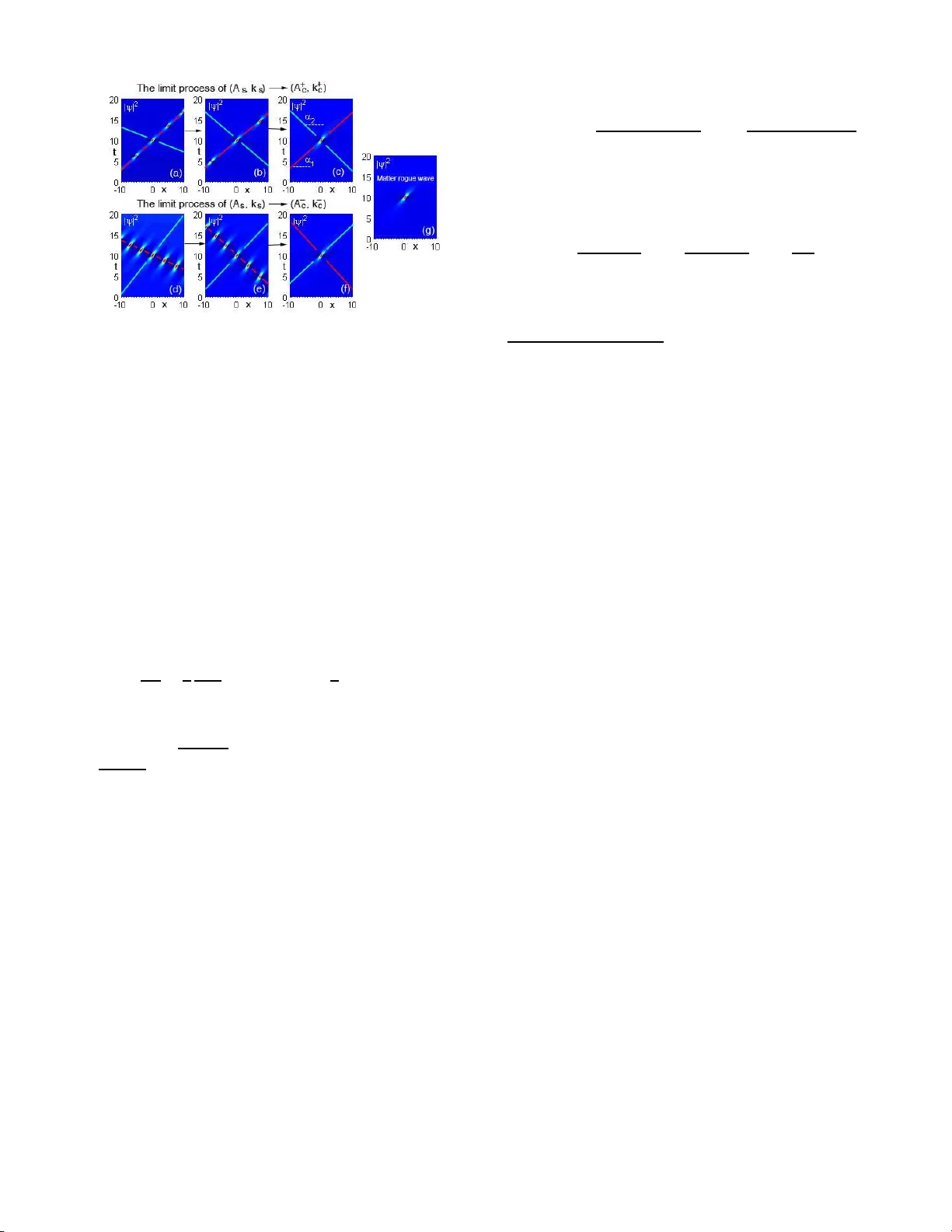
Matter rogue w a v e in Bose-Einstein cond ensates with attractiv e atomic in teraction Lin W en 1 , Lu Li 2 , Z ai-Dong Li 3 , Shu-W ei Song 1 , Xia o-F ei Zhang 1 , a nd W.M. Liu 1 1 Beijing National L ab or atory f or Condense d Matter Physics, Institute of Physics, Chinese A c ademy of Scienc es, Beij ing 100080, China. 2 Institute of The or etic al Physics, Shanxi Univer sity, T aiyuan, 030006, China and 3 Dep artment of Applie d Physics and Scho ol of Information En gine ering, Heb ei Uni versity of T e chnolo gy, Tianjin 300401, China W e inv estigate the matter rogue wa ve in Bose-Einstein Condensates with attractive in teratomic intera ction analytically and numerical ly . Our res ults show that the formation of rogue w ave i s mainly due to the accumulatio n of energy and atoms to wa rd to its cen tral part; Rogue wa ve is unstable and the deca y rate of the atomic number can b e effectively con trolled by mod ulating the trapping frequency of ex ternal p otential. The numerica l simulation demonstrate that even a small p erio dic p erturbation with s mall mo du lation frequency can in d uce the generation of a near-ideal matter rogue wa ve. W e also give an exp erimental proto col t o observe this ph enomenon in Bose-Einstein Condensates. P ACS n umbers: 03 .75.Kk, 03.75.Lm, 67.85.Hj I. INTRO D UCTION The dynamics o f Bose-Einstein condensates (BE Cs) at ultralo w temper ature ar e describ ed well b y Gros s- Pitaevskii (GP) equation [1], in which the nonlinear - it y is a rose from interatomic interactions character iz ed by the s-wa ve sc a ttering leng th. Recently exp eriments hav e demonstra ted that tuning of the effective sca ttering length, including a p o ssibility to change its sig n, can b e achiev ed by using the so-ca lled F eshbac h re s onance tech- nique [2]. In par ticular, the e x pe r imental rea lization of BECs in dilute qua nt um gases hav e op ened the flo o dgate in the field of a to m optics and co ndensed matter physics [3]. At the same time, the collective excita tion of matter wa ves in BECs has also drawn a great de a l o f interest to explore the dy namics of BECs deeply from b oth exp eri- men tal and theo retical p ersp ectives, such as ma tter wa ve solitons [4 – 9], p erio dic wa ves [10], sho ck w aves [1 1], vor- tex [12] and ne cklaces [13]. How ever, to our knowledge less attention hav e be en paid to the matter ro gue wa ve which is a fundamental a nd novel nonlinear excitatio n in BECs. Rogue wa ves from o cean a re that their heights, from crest to tr ough, ar e mor e than ab out t wice the s ig nifi- cant wa ve height [14]. T hey a ppea r without a ny warning and disapp ear without the slightest trace. Owing to se- vere environment a nd high risk in o cean, the systematic study of r ogue wa ves b ecome so difficult that the nec- essary conditions and physical mechanism of their g en- eration are no t sufficient ly well under s to o d. Recently , theoretical studies hav e shown that the r ogue wa ve phe- nomenon can b e explained well by nonlinea r theories [15, 1 6], and the v ario us p ossible formative mechanisms hav e b een discus sed, such a s the mo dulation instability in one dimension [17, 18], no nlinear sp e ctral instability [19] and in tw o-dimensional cros s ings [20]. F urthermore, the rog ue wa ves phenomeno n hav e be e n observed exp er- imen tally in v arie ty o f physical s ystems including o ptical fiber s [21, 22], arrays of o ptical wa veguide [23 ] a nd cap- illary wa ves [24]. As a nonlinear physical s ystem with s imila r nonlinea r characteristics, BECs can suppo rt the interesting ro gue wa ves and allow us to under stand deeply the nature and the dynamics o f rogue wa ves in labor atory conditions. The mana gement o f F eshbac h r esonance for nonlinea rity and a tunable atomic tra pping p otential a ls o provide us with a p ow er ful to ol for manipulating ro gue wa ve. This enable BECs to have more adv antages for inv estigating rogue wav e than other physical media. In this pap er, we mainly inv estigate the matter rog ue wa ve of Peregrine t ype with the emphasis on its formative mechanism in BECs. W e firstly o btain the exa ct r ogue wa ve solution of the GP e q uation with time-dependent attractive atomic int e raction in an expulsive par ab olic po tent ial. By an- alyzing the atomic n umber density distribution in the rogue wa ve aga inst the background, the formative mech- anism of matter rog ue wav e can b e clar ified that the ac- cum ulation of energy and a to ms toward to its cen tra l part. Rogue wa ve ca n not keeps dyna mic stability and the decay ra te o f the atomic num b er ca n be e ffectively controlled b y mo dulating the tr a pping fre quency o f ex- ternal p otential. Moreover, w e use the breather evolution in a regime appro a ching the excitation of ma tter rogue wa ve as approximation to simu late the creation of mat- ter rogue wa ve numerically , which indicates that a small per io dic p erturbation with small mo dulation frequency can excite a near-idea l matter rogue wa ve. Finally , we also give a practica l a nd effective exp erimental pro to col to obs erve this in teresting phenomenon in future BECs exp eriments. II. MA TTER RO GUE W A VE SOLUTION Under the mean-field level, the evolution of macr o- scopic wa ve function of B ECs o bey the 3 D GP e quation [3]. F or a ciga r-shap ed condensate at a relatively low den- sity , when the energy of tw o bo dy int eractions is muc h 2 FIG. 1. (Color online) The asymptotic pro cesses from Eq. (2) to Eq. (3 ) in the limitation of ( A s , k s ) → (2 A c , k c ). As t h e bright soliton amplitude A s and wa ve num b er k s approac hing (2 A c , k c ), the spatio-temp oral separation betw een adjacent p eaks gradually increases shown in Fig. 1(a-f ), where the parameters are (a) A s = 2 . 4 , k s = 1 . 2 . ( b) A s = 2 . 2 , k s = 1 . 2 . (c) A s = 2 . 01 , k s = 1 . 01 . (d) A s = 1 . 6 , k s = 0 . 8 . (e) A s = 1 . 8 , k s = 0 . 8 . ( f ) A s = 1 . 99 , k s = 0 . 99. Fig. 1(g) represents t h e exact matter rogue wa ve solution Eq. (3) with A s = 2 , k s = 1. Other parameters are λ = 0 . 01 , t 0 = 10 , k c = A c = 1 . The red and green lines represent the sloping lines V θ and V α , resp ectively . less than the kinetic ener gy in the trans verse direction, the sys tem can b eco me effectively q uasi-one-dimens io nal regime with time-dep e nden t attractive interaction in an expulsive p otential [25], i ∂ ψ ∂ t + 1 2 ∂ 2 ψ ∂ x 2 + a ( t ) | ψ | 2 ψ + 1 2 λ 2 x 2 ψ = 0 , (1) where the asp ect ratio reads λ = | ω 0 | /ω ⊥ ≪ 1, co ordi- nate x a nd time t ar e measured in units a ⊥ and 1 / ω ⊥ with a ⊥ = p ~ /mω ⊥ ( m is the a to mic mass) and a 0 = p ~ /mω 0 the linear oscillator lengths in the transverse and cig ar-axis directions, r esp ectively . ω ⊥ and ω 0 are cor - resp onding har mo nic oscillator fr equencies. The nonlin- ear co efficient a ( t ) is defined a s a ( t ) = | a s ( t ) | /a B , where a s ( t ) is so- c alled s - w av e scattering le ng th. Corresp o nd- ing to the real BEC s exp er iment [9 ], the brig ht s oliton can be created for 7 Li by tuning the scatter ing length contin- uously in an expulsive p otential with ω ⊥ = 2 π × 700 H z and ω 0 = 2 iπ × 7 H z . So we can choose the nonlinear co- efficient in the form o f a ( t ) = ex p[ λ ( t − t 0 )] manipulated by F e shbac h r e sonance technique [26], where t 0 repre- sents a n arbitr a ry real constant determining the initial scattering length | a s ( t = 0) | = a B e − λt 0 . T o o bta in the exact so lution of E q. (1), we intro duce the transforma tion ψ = q ( X , T ) exp[ λ ( t − t 0 ) / 2 − iλx 2 / 2] with the co ordinate transfor mations X = e λ ( t − t 0 ) x and T = [ e 2 λ ( t − t 0 ) − 1] / ( 2 λ ) . Then Eq. (1) can reduce to the standard nonlinear Schr¨ odinger equa tion, and the so- lution of Eq. (1) constructed on co nt in uous wa ve (cw) background ψ cw = A c e iϕ can be obtained as follows [27], ψ = A c + A s χ cosh θ + cos α cosh θ + χ cos α + iA s η sinh θ + δ sin α cosh θ + χ cos α (2) × exp( iϕ ) , with χ = − 2 A c A s A 2 s + M 2 R , η = − 2 A c M R A 2 s + M 2 R , δ = M I A s , where θ = M I X − [ A s M R + ( k c + k s ) M I ] T / 2, α = M R X − [( k c + k s ) M R − A s M I ] T / 2 , ϕ = ϕ c − λx 2 / 2 − iλ ( t − t 0 ) / 2 , ϕ c = k c X + ( A 2 c − k 2 c / 2) T and M R + iM I = p ( k c − k s − iA s ) 2 + 4 A 2 c . T he subscripts R and I de- note the rea l and imaginary part o f M , r esp ectively . In genera l, so me ex cited state so lutions, such a s cw wa ve a nd brigh t soliton on the background of ground state, can b e recovered successfully fro m Eq. (2). Firstly , when the cw background a mplitude v anis he s ( A c = 0), Eq. (2) r educes to the bright soliton solution ψ sol = A s e iϕ s sech θ s with v ary ing amplitude A s e λ ( t − t 0 ) and group volecit y v s = k s cosh[ λ ( t − t 0 )] [28], where θ s = A s ( X − k s T ) and ϕ s = k s X + ( A 2 s − k 2 s ) T / 2, and k s repre- sents the wav e num b er of bright solito n. Secondly , when the initial amplitude of bright soliton v anishes ( A s = 0), Eq. (2) reduces to cw background solution ψ cw = A c e iϕ with v ary ing group velocity v c = k c cosh[ λ ( t − t 0 )], where k c is the wav e num b er of cw background. So the exa c t solution E q. (2) r epresents a bright s o liton embedded in a c w background field. It should b e po inted that the parameters A c , A s , k c and k s are der ived from the math- ematical cons truction of E q . (2), the numerical v alues o f these para meters can b e chosen fre e ly , so we a ssume that these para meters a re real co nstants without loss o f gen- erality . F ur thermore, the dynamical evolution of solution Eq. (2) ar e shown in Fig. 1(a-f ). F rom Fig. 1 we obser ve that the solution in E q. (2 ) co mmonly exhibits a br e ather characteristic and a time p erio dic mo dulation of the soli- ton amplitude, which can be rega rded as the res ults of the interaction be t w een the loc alized pro c e ss of cw ba ck- ground along the slop e direction V α and the pe rio diza- tion pro ce s s of brig ht solito n along the slop e dir ection V θ , i.e., the bright so liton undergo p erio dic energ y and atoms exchange with cw ba ckground, where V θ and V α repre- sent the lines M I X − [ A s M R + ( k c + k s ) M I ] T / 2 = 0 and M R X − [( k c + k s ) M R − A s M I ] T / 2 = 0 on the space-time plane as shown in Fig. 1 , r esp ectively . Through a b ove a nalysis we can see that when k c = k s , the bright solito n must mov e with the same gro up ve- lo city as that of cw background which implies that the bright soliton and cw ba ckground are in “res onant s ta te” in space. The cr itical p oint A 2 s = 4 A 2 c forms the dividing line b etw een mo dulation instability pro c ess ( A 2 c > A 2 s / 4) and the p erio dization pro cess o f brigh t soliton ( A 2 c < A 2 s / 4) under the resonant co nditio n k c = k s [27], which means that the r elative initia l int ensity between the cw background a nd bright s oliton determine the different 3 FIG. 2. ( Color on line) The plots for the evolutions of α 1 and α 2 as the function of A s and k s during the limit pro cesses, where k c = 1 and A c = 1. The tw o angles α 1 and α 2 as the function of A s and k s are not contin uous at the limit p oint. ph ysical b ehaviors o f the solution E q. (2). Esp ecially , with the limit conditions of k c = k s and A 2 s = 4 A 2 c , we hav e ψ R = " 4 + i 8 A 2 c T 1 + 4 A 4 c T 2 + 4 A 2 c ( X − k c T ) 2 − 1 # A c e iϕ , (3) which repr e s ents a lo calized matter wa ve with the max- imal amplitude A P = 3 A c in BECs, a nd its dynamical evolution is s hown in Fig . 1 (g). In ter estingly , the exac t solution Eq. (3) displays the typical r o gue wav e charac- teristics of Peregr ine t y pe that a lo ca lized breather char- acteristic with only a single hump b oth in spa ce and time, which indica tes that the lo calized w av e is captured com- pletely at x = 0 and t = t 0 by the cw background [16]. So far, s uch so lution Eq. (3) has b een co njectured to b e a prototype o f o ce a nic rogue wav es. II I. DYNAMICS OF MA TTER R OGUE W A VE In o rder to b etter clarify the formative mechanism o f rogue wa ve solution in Eq. (3), we firstly inv estiga te the asymptotic pro c e sses o f Eq. (2) to Eq. (3) in the limit pro cesses ( A s , k s ) → (2 A c , k c ) by fixing the numerical v alues of cw background amplitude A c and wa ve num- ber k c . F ro m Fig. 1(a- f ), we c an o bserve clearly that the spatio-temp ora l separatio n b etw e e n adjacent p eaks grad- ually incre a ses as the br ight solito n a mplitude A s and wa ve num b er k s approaching (2 A c , k c ), which lea ds to a greater spatio-temp ora l lo ca lization in Eq. (2). F urther- more, the par ameters tan α 1 = 2 / ( k c + k s + A s M R / M I ) and ta n α 2 = 2 / ( k c + k s − A s M I / M R ) shown in Fig. 1(c) represent the slop e of the lines V θ and V α at x = 0 and t = t 0 , resp ectively . When the v alues of A s and k s ap- proaches to the cr itical p o int, V θ and V α gradually turn to a relative fixed direction asso ciated with the max i- mal spatio-temp ora l lo caliz a tion in Eq. (2). How ever, the tw o angles α 1 and α 2 as the function of A s and k s are not contin uous at the limit p oint shown in Fig. 2, i.e., α 1 and α 2 do not exist limitation, which play the impo rtant role to describ e that the solution Eq. (2) is lo calized a long V θ and V α at the limit p oint. E sp ecially , rogue wav e solution in Eq . (3) ca n b e considered a s a −5 0 5 0 2 4 6 8 0 10 20 30 40 0 5 10 15 ζ (t, λ =0.01) ζ (t, λ =0.2) S 1 S 3 S 2 ρ (x, t=t 0 ) (a) (b) x t FIG. 3. (Color online) (a) The atomic num b er density dis- tribution in matter rogue wa ve at fixed time p oint. (b) The atomic exchange b et w een matter rogue wa ve and backgro und. The parameters are A c = k c = 1 and t 0 = 10 . transition state betw een the mo dulation instability pro- cess ( A s → 2 A − c ) and the p erio diza tion pro c e s s of the bright solito n ( A s → 2 A + c ) under the reso nant co ndition k c = k s . As shown in the following, the formation of r ogue wa ve ca n b e cla rified by the atomic num b er density dis- tribution against the background defined a s ρ ( x, t ) = | ψ R ( x, t ) | 2 − | ψ R ( x = ±∞ , t ) | 2 . With Eq. (3), we hav e ρ ( x, t ) = 8 A 2 c + 32 A 6 c T 2 − 32 A 4 c ( X − k c T ) 2 [1 + 4 A 4 c T 2 + 4 A 2 c ( X − k c T ) 2 ] 2 e λ ( t − t 0 ) , (4) and the time-indep endent in tegr al R + ∞ −∞ ρ ( x, t ) dx = 0 . F rom the co nditio n ρ ( ± 1 / (2 A c ) , t 0 ) = 0 and ρ (0 , t 0 ) = 8 A 2 c , one ca n define the spa tial width of the h ump part in r ogue wav e as 1 / A c . A t the fixed time t = t 0 , we hav e in tegra l R 1 / (2 A c ) − 1 / (2 A c ) ρ ( x, t 0 ) dx = 4 A c and R − 1 / (2 A c ) −∞ ρ ( x, t 0 ) dx + R ∞ 1 / (2 A c ) ρ ( x, t 0 ) dx = − 4 A c . These results demonstrates cle a rly that for the attractive in- teratomic int eraction, the generatio n of ro gue w av e with stronger breather characteristic is ma inly due to the ac- cum ulation of energy and a to ms toward to its cen tra l part. The time-indep endent ar e a relation shown in Fig. 3(a), i.e., S 1 + S 2 = S 3 , mea ns that the loss of atoms in background co mpletely transfer to the hump pa rt o f rogue wa ve. The forthcoming fundamental problem is that how ro gue wa ve ga ther a toms and ener gy tow ar d to its central pa rt from the ba ckground. T o this pur po se, we inv estigate the exact num b e r of ato mic exchange b e - t ween rogue wa ve and background which has the for m ζ ( t ) = Z ∞ −∞ | ψ R ( x, t ) − ψ R ( ±∞ , t ) | 2 dx = 4 π A c p 1 + 4 A 4 c T 2 . (5) F rom the ab ov e expres sion, w e can see that ζ ( t ) is time- ap erio dic which is different fro m perio dic exchange o f atoms b etw een the bright soliton and the cw background in Eq. (2). As s hown in Fig. 3 (b), the atoms in back- ground is gathered to the central par t whe n t < t 0 , which leads to the gener a tion of a hum p with tw o fillisters on the background alo ng the space direction. The maxi- mal p eak o f the hump and the deep es t fillisters o ccur at t = t 0 . Ho wever, the a toms in the hump star t to sprea d 4 Rogue wave (a) (b) (c) (d) analytic Sim analytic Sim FIG. 4. (Color online) (a) Evolution of the exact rogue wa ve solution Eq . ( 3), where A c = 1 , k c = 0 , λ = 0 . 01 and t 0 = 10. (b) Evolution of the numerical solution of rogue wa ve with the initial condition Eq. (6), where A s = 1 . 92, λ = 0 . 01 , t 0 = 10 . (c) and (d ), The comparison of intensit y profile b etw een near- ideal rogue wa ve (in (c) with solid blue line) or sub-rogue wa ve pair (in (d) with solid blue line) and ideal rogue w a ve (circles). int o the fillisters when t > t 0 . The r efore, the hump grad- ually decay which verifies that the rogue wa ve is o nly o ne oscillation in time and displays a unstable dynamica l b e- havior. Considering the dynamics of r ogue wa ve in the ba ck- ground, on the one hand, a nec e ssary co ndition for real- izing r ogue wav e in exp er iment is that the scale of r o gue wa ve must b e very small compare d with the leng th of the background of BECs. In the r eal exp eriments [8], the length of the background of BECs is at least 3 7 0 µm . At the same time, in Fig . 3(a), the a ctual width of ro gue wa ve is ab out 1 0 a ⊥ = 14 µm ≪ 37 0 µm (a unity of co ordi- nate cor r esp onds to a ⊥ = p ~ /mω ⊥ = 1 . 4 µm ). Thus the rogue wav e is obser v able exp er iment ally . On the other hand, the decay rate of atoms in rog ue wav e ca n b e con- trolled effectively by mo dulating the trapping fre q uency of ex ternal p otential shown in Fig. 3(b). The decay time t d is abo ut 8 . 05 m s for λ = 0 . 01 ( ω ⊥ = 2 π × 700 H z and ω 0 = 2 iπ × 7 H z or iginate from the exp eriment [9]), while t d ≈ 2 . 30 ms for λ = 0 . 2 ( ω ⊥ = 2 π × 70 0 H z and ω 0 = 4 i π × 70 H z ), which demonstrate that a trap with small trapping frequency is co nducive to the obs e rv ation of matter r o gue w av e in BECs ex pe r iments. A ques tion ar is es ab out the p ossibility of the cr eation of such a matter rogue wa ve exp erimentally . Gener ally , the excitation of ro gue wav e ca n b e recov ered by means of the n umer ical simulation with some particula r initial conditions [2 9]. F rom the ex p er iment al p oints o f vie w, optimal initial conditio ns ar e not o nly c o nducive to the exp erimental prepara tion, but it is also useful for under - standing the nec essary co nditions and physical mecha- nism of the gener ation of rogue wa ve. In wha t follows, we will lo o k for the optimal initial conditions which can excite the resemble physical b ehavior of ro gue w av e. By compa ring the Fig. 1(c) and (f ) with Fig. 1(g), Eq. (2) with infinity oscillatio n p erio d is a very go o d approximation o f ro gue wa ve s olution E q. (3), this pa - rameter regime yields characteris tic rogue wa ve fea tures in the spatio-temp oral env elop e even though the idea l rogue wa ve s olution exists only asymptotica lly in the lim- itation of A c = 2 A s and k c = k s . Base d on mo dula tion instability mechanism in ultra cold ato m s y stem [3 0], we consider the case of A 2 c > A 2 s / 4 with k s = k c = 0 cor- resp onding to the mo dulation instability pro cess of cw background. In this case, we can take T ≈ − t 0 at t = 0 for a very s mall quantit y λ , and the suitable v alues of A s and A c can e ns ure θ ≈ t 0 A s M R / 2 to b e so lar ge that κ = e − θ is a small quantit y . B y linear izing the initial v alue with the sma ll quantit y κ in Eq. (2) we get ψ ( x, 0 ) = ( σ + γ κ cos α 0 ) e iϕ ( x, 0) , (6) where σ = (2 A 2 c − A 2 s − iA s M R ) / (2 A c ) , γ = A s M R ( M R − iA s ) / (2 A 2 c ) and α 0 = M R e − λt 0 x, ϕ c ≈ − A 2 c t 0 and the mo dulation frequency of initial co ndition Eq. (6) is Ω = M R e − λt 0 . The solution o f initia l v alue problem a sso ciated with E q. (1) with initial condition Eq. (6) ca n b e descr ib e d well by the exact so lution Eq. (2) [2 7]. F or the crea tion of rog ue wa ve, we r equire the v alue of A s / 2 to approa ch A c asso ciated with a very small mo dulation frequency in E q. (6). The numerical results are shown in Fig. 4(b), which demonstrates that a small per io dic p erturba tion with a very small mo dulatio n fre- quency can induce a near- ideal ro gue wav e lo c a lization, whose profile is ba sically consis ten t with the ideal the- oretical limit solution Eq. (3 ) as shown in Fig . 4(a) and (c). How ever, the o bvious difference is that owing to the actions o f mo dulation instability a nd insta bility of rogue wa ve, the initial near -ideal rogue wa ve can break up int o tw o low er amplitude but e qually stro ngly lo calize d sub-rogue wav e, a nd each sub-rog ue wav e itself exhibits ideal rogue wa ve characteristics a s shown in Fig. 4(d), which a grees well with the optica l ex p er iment al conclu- sions [2 1, 22]. As a result, a small initial p erio dic p ertur- bation with a sma ll mo dulation frequency ca n induce the generation of a near- ideal rogue wav e by the mo dulation instability mechanism in BECs. Inspired by the exp eriments [7 – 9], we can desig n the following exp erimental steps to obs e rve the in teresting rogue wav e phenomenon in BECs: (i) Crea ting a conden- sates of 7 Li with total num b er o f particles N ≈ × 1 0 3 and contin uous w ave phase distribution by us ing quan tum phase imprinting tech nique and amplitude e ng ineering; (ii) Lo a ding the condensates into a slightly ex puls ive har- monic p otential with the parameter s ω ⊥ = 2 π × 70 0 H z and ω 0 = 2 iπ × 7 H z , and ramping up the scattering length in the form of a s ( t ) = − 0 . 9 a B e λt ; (iii) Optimal initial s tate Eq. (6) can b e pr o duced by imprinting a per io dic p erturbation la ser with very small mo dula ting frequency o nt o condensates. The main effect of this ex- pulsive term is that the center o f the condensates a ccel- erates along the long itudinal dir ection. In addition, a crucial question is that since we req uir e the scattering 5 length to change ov e r time in ab ove ex p er iment al proto- col, we must e ns ure the v alidity of quas i- one-dimensional regime a nd avoid the collapse of co ndensates with at- tractive in tera ction. In o ther words, we m ust ens ur e that the energy of tw o b o dy in teractions is muc h le ss than the kinetic energy in the transverse dir ection, i.e., ε 2 ∼ N | a s | /a 0 ≪ 1. With initial scattering length a s ( t = 0 ) = − 0 . 9 a B , we can o bta in ε 2 ≈ 0 . 0 3 ≪ 1. Af- ter ab out 50 dimensionless units of time, the scattering length b e comes | a s ( t ) | = 1 . 4 a B corres p o nds to ε 2 ≈ 0 . 057 ≪ 1. So the v alidity of quasi-o ne-dimensional system can be maintained w ell. Finally , we emphasize that the int er- esting phenomenon of rogue wav e can be o bserved within current exp er imen tal capability . IV. CONCLUSIONS In conclusio n, w e hav e inv estig ated the formative mechanism of matter rogue wav e in BE Cs with time- depe ndent interaction in an expulsive parab olic p otential, analytically and numerically . The generatio n o f rogue wa ve with stronger brea thing characteristic is mainly due to the accumulation of energy and a toms toward to its central pa rt. Rog ue wa ve can not keeps dynamic sta- bilit y b ecause of the a p e rio dic exchange of ener gy a nd atoms with the background; The decay r ate o f the num- ber of a toms in rog ue wa ve can b e controlled effectively by mo dulating the trapping fr e quency of the external p o- ten tial. Our numerical results s how that a sma ll p erio dic per turbation with a sma ller mo dula ting frequency can in- duce the gener a tion o f the near-idea l rogue wa ve. Finally , we emphasize that the in ter esting phenomenon of rogue wa ve in BECs ca n b e obser ved exp er iment ally . O ur work may facilitate the deep er studies of hydro dy namic r ogue wa ve. The authors thank P rof. Z. Y. Y a n and B. Xiong for helpful dis cussions. This work was supp orted by the NSF C under g rants Nos. 108 7423 5 , 10934 010, 61 0 7807 9, 60978 019, 108 74038 and the NKBRSF C under gr ants Nos. 2009 CB9307 01, 20 10CB92 2904 and 2011 CB9215 02, NSF C- RG C under grants Nos1 386-N-HK U7 48/10 , and the Hundred Innov ation T alents Suppo rting P r o ject of Hebei Province of China under Gra nt No. CPRC014. [1] L. Pitaevskii and S. Stringari, Bose-Einstein Condensa- tion (Oxford Universit y Press, New Y ork, 2003). [2] J. L. Rob erts et al ., Phys. Rev. Lett. 81 , 5109 (1998); J. Stenger et al ., Ph ys. Rev . Lett. 82 , 2422 (1999). [3] F. Dalfo vo, S. Giorgini, L. P . Pitaevskii, and S. Strin gari, Rev. Mo d. Phys. 71 , 463 (1999). [4] A. D. Jac kson et al ., Phys. R ev . A 58 , 2417 (1998); A. E. Muryshev et al ., Phys. Rev. A 60 , R2665 ( 1999); P . O. F edichev et al ., Phys. R ev. A 60 , 3220 (1999); Th. Busch et al., Phys. Rev. Lett. 87 , 010401 (2001). [5] W. P . Zhang et al ., Phys. R ev. L ett . 72 , 60 (1994); R. Dum et al ., Phys. Rev . Lett . 80 , 2972 (1998); X. F. Zhang et al ., Phys. R ev. A 77 , 023613 (2008). [6] Z. X. Liang et al ., Phys. Rev. Lett. 94 , 050402 (2005); B. Li et al ., Phys. R ev. A 78 , 023608 (2008); H. Saito et al ., Phys. R ev. Lett. 90 , 040403 (2003). [7] S. Burger et al ., Phys. Rev. Lett. 83 , 5198 (1999); J. Denschlag et al ., Science 287 , 97 (2000). [8] K. E. Strecker, G. B. Partridge, A. G. T ruscott, and R . G. Hulet, N ature (Lond on ) 417 , 150 (2002). [9] L. K hayk ovic h , F. Schrec k, G. F errari, T. Bourdel, J. Cu- bizolles, L. D . Carr, Y. Castin, and C. Salomon, Science 296 , 1290 (2002). [10] F. Kh. Ab d ullaev et al ., Phys. Rev. Lett. 90 , 230402 (2003). [11] V . M. Pere z-Garcia, V. V . Konotop and V. A. Brazhnyi, Phys. Rev. Lett. 92 , 220403 (2004). [12] B. P . Anderson et al. , Phys. R ev. Lett. 86 , 2926 (2001). [13] G. Theo charis et al., Phys. R ev. L ett . 90 , 120403 (2003). [14] C. Kharif and E. P elinovsky , Eur. J. Mec h. B/Fluids 22 , 603 (2003); P . M ¨ uller, Ch. Garrett, and A . Osb orne, Oceanogr. 18 , 66 (2005). [15] A . R. Osborne, Mar. Struct . 14 , 275 (2001). [16] D . H. Peregrine, J. A ustral. Math. So c. 25 , 16 (1983). [17] K. L. Hend erson, K. L. Peregrine, J. W. D old, W av e Motion 29 , 341 (1999). [18] M. O norato, A . R. Osb orne, M. Serio, S. Bertone, Phys. Rev. Let t . 86 , 5831 (2001). [19] P . A. E. M. Janssen, J. Phys. Oceanogr. 33 , 863 (2003). [20] M. Onorato, A. R. Osb orne, M. Serio, Phys. Rev . Lett. 96 , 014503 (2006); P . K. S hukla, I. Kourakis, B. Eliasson, M. Marklund , L. Stenfl o, Phys. R ev . Lett. 97 , 094501 (2006). [21] D. R. Solli et al., Nature 450, 1054 (2007); D. -I. Y eom et al., N ature (London) 450 , 953 (2007). [22] B. Kibler et al. , Nature Phys. 6 , 790 (2010); K. Hammani et al. , Opt. Lett. 36, 112 (2011). [23] Y u. V. Bludov, V . V. Konotop, N. Ak hmediev, O pt. Lett. 34 , 3015 (2009). [24] M. Shatz, H. Punzmann, H. X ia, Phys. Rev. Lett. 104 , 104503 (2010). [25] G. Fibich et al ., Phys. Rev. Lett . 90 , 203902 (2003); P . G. Kevrekidis et al., Mo d. Phys. Lett. B 18 , 173 (2004). [26] P . G. K evrekidis et al ., Phys. Rev. Lett. 90 , 230401 (2003). [27] L. Li et al ., O pt. Commun. 234 , 169 (2004); Q. Y. Li et al ., Opt. Commun. 283 , 3361 (2010). [28] V. N . Serkin, A. Hasega wa, T. L. Belyaev a, Ph ys. Rev. Lett. 98, 074102 ( 2007). [29] N. A khmediev, J. M. S oto-Crespo, and A. Ank iewicz, Phys. R ev. A 80 , 043818 (2009). [30] L. D. Carr and J. Brand, Phys. Rev. Lett. 92 , 040401 (2004); L. Salasnic h, A. Parola, and L. R eatto, Phys. Rev. Let t . 91 , 080405 (2003).
Original Paper
Loading high-quality paper...
Comments & Academic Discussion
Loading comments...
Leave a Comment