SAR Image Despeckling Algorithms using Stochastic Distances and Nonlocal Means
This paper presents two approaches for filter design based on stochastic distances for intensity speckle reduction. A window is defined around each pixel, overlapping samples are compared and only those which pass a goodness-of-fit test are used to c…
Authors: Leonardo Torres, Alej, ro C. Frery
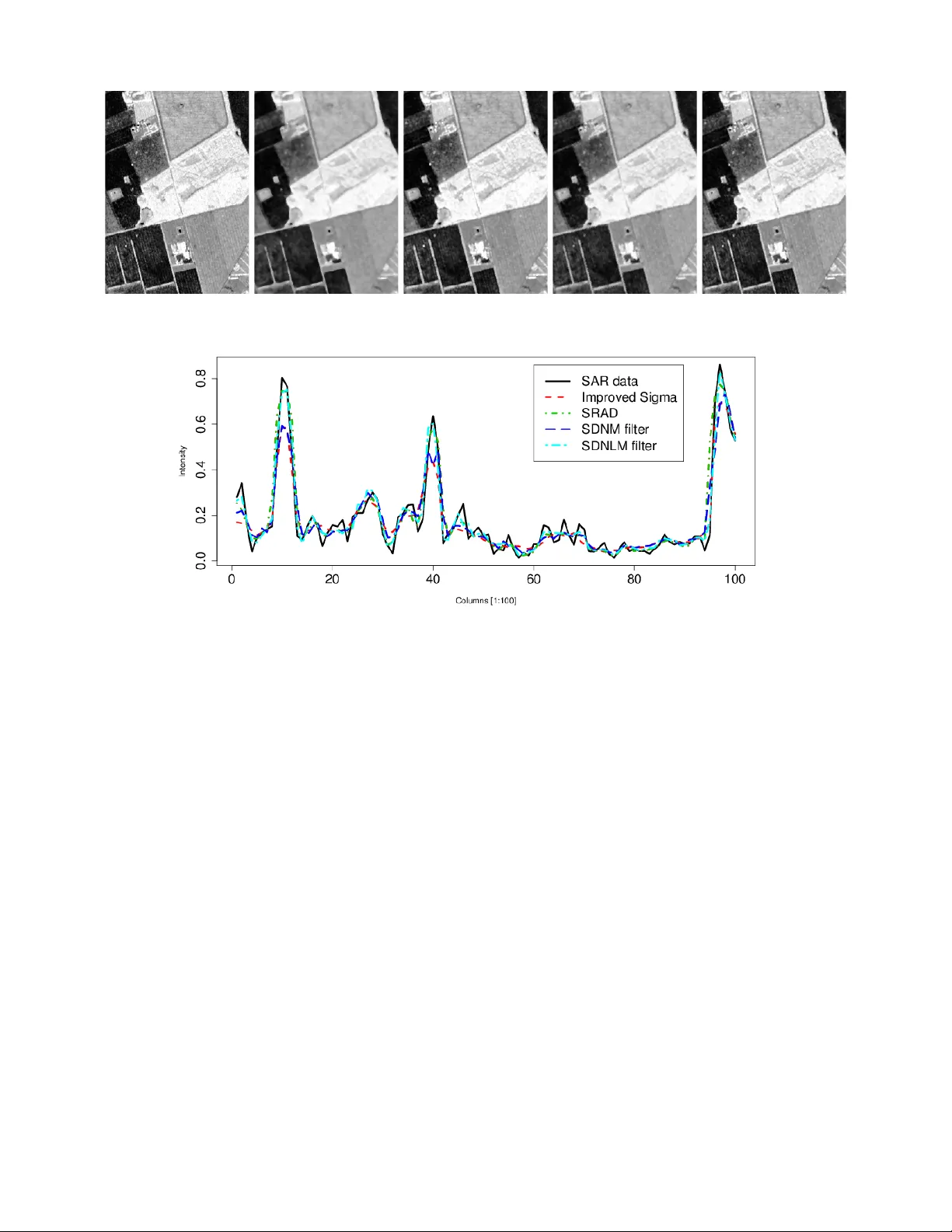
SAR Image Despeckling Algorithms using Stochastic Distances and Nonlocal Means Leonardo T orres and Alejandro C. Frery Laborat ´ orio de Computac ¸ ˜ ao Cient ´ ıfica e An ´ alise Num ´ erica – LaCCAN Univ ersidade Federal de Alagoas – UF AL 57072-970, Macei ´ o, AL – Brazil Email: { ljmtorres, acfrery } @gmail.com Abstract —This paper presents two approaches f or filter design based on stochastic distances for intensity speck le reduction. A window is defined around each pixel, o verlapping samples are compared and only those which pass a goodness-of-fit test are used to compute the filtered value. The tests stem from stochastic divergences within the Inf ormation Theory framework. The technique is applied to intensity Synthetic Aperture Radar (SAR) data with homogeneous regions using the Gamma model. The first approach uses a Nagao-Matsuyama-type procedure f or setting the overlapping samples, and the second uses the nonlocal method. The proposals are compared with the Improv ed Sigma filter and with anisotropic diffusion for speckled data (SRAD) using a protocol based on Monte Carlo simulation. Among the criteria used to quantify the quality of filters, we employ the equivalent number of looks, and line and edge pr eservation. Moreo ver , we also assessed the filters by the Universal Image Quality Index and by the Pearson correlation between edges. Applications to real images are also discussed. The proposed methods show good results. Index T erms —Despeckling; Information Theory; Nonlocal means; SAR data; Stochastic Distances. I . I N T RO D U C T I O N Synthetic Aperture Radar (SAR) data are generated by a system of coherent illumination and are affected by the interference coherent of the signal. It is known that these data incorporate a granular noise, known as speckle noise, that degrades its quality . This noise is also present in the laser, ultrasound-B, and sonar imagery [1]. The speckle phenomenon in SAR data hinders the interpre- tation of these data and reduces the accuracy of segmentation, classification and analysis of objects (targets) contained within the image. Therefore, reducing the noise effect is an important task, and multilook processing is often used for this purpose in single-channel data. Lee et al. [ 2 ], [ 3 ] proposed techniques for speckle reduction based on the multiplicativ e noise model using the minimum mean-square error (MMSE) criterion. Lee et al. [ 4 ] proposed a methodology for selecting neighboring pixels with similar scattering characteristics, known as Refined Lee filter . The Improv ed Sigma filter [ 5 ] is an improvement of the previous proposals, where an undesired blurring was solv ed by redefining the sigma range based on the speckle probability density functions. C ¸ etin and Karl [ 6 ] presented a technique for image filtering based on regularized image reconstruction. This approach employs a tomographic model which allows the incorpora- tion of prior information about, among other features, the sensor . The resulting images hav e many desirable properties, reduced speckled among them. Our approach deals with data already produced and, thus, does not require interfering in the processing protocol of the data. Osher et al. [ 7 ] presented a novel iterativ e regularization method for in verse problems based on the use of Bre gman distances using a total variation denoising technique tailored to additive noise. The authors also propose a generalization for multiplicativ e noise, but no results with this kind of contamination are sho wn. The main contributions were the rigorous con ver gence results and ef fectiv e stopping criteria for the general procedure, that provides information on how to obtain an approximation of the noise-free image intensity . More recent proposals are based on nonlocal (NL) means method originally proposed by Buades et al. [ 8 ] which is based on the redundancy of neighboring patches. The noise-free estimated value of a pixel is defined as a weighted mean of pixels in a certain region. Under the Additiv e White Gaussian Noise (A WGN) assumption, these weights are calculated using Euclidean distances to measure the similarity between a central region patch and neighboring patches in a search windo w . Howe v er , the speckle noise is not well described by a Gaussian distribution requiring, thus, changes in the model. Deledalle et al. [ 9 ] analyzed several similarity criteria for data which depart from the Gaussian assumption, viz., the Gamma and Poisson noises. In [ 10 ] the same authors extended the NL-means method to speckled imagery using statistical inference in an iterativ e procedure. The authors derived the weights using the likelihood function of Gaussian and square root of Gamma (termed “Nakagami-Rayleigh”) noises. In [ 11 ], the authors proposed the use of a nonlocal approach to estimate jointly reflectivity , phase difference and coherence from a pair of co-registered single-look complex SAR images. Coup ´ e et al. [ 12 ] also used a logarithmic transformation and assume zero-mean Gaussian noise to propose the Optimized Bayesian NL-means with block selection (OBNLM). The OBNLM filter is an optimized version of the filter proposed by Kervrann et al. [ 13 ] which employs a new distance for comparing patches and then selecting the most similar pixels. Parrilli et al. [ 14 ] presented a nonlocal technique based on Block-Matching 3D for SAR images (SAR-BM3D) inspired by the algorithm presented in [ 15 ] for A WGN denoising. The SAR-BM3D filter has two steps: first, the algorithm estimates the noise-free image, and the second step, the algorithm filters anew using the more reliable statistics computed on the basic estimate to improv e the filter performance. Statistical analysis is essential for dealing with speckled data. Different statistical distributions are proposed in the literature to describe speckle data. It provides comprehensiv e support for dev eloping procedures for interpreting the data efficiently , and to simulate plausible images. In this paper we use the Gamma distribution to describe the speckle noise, and a constant to characterize the ground truth [ ? ]. This paper presents two approaches for speckle noise filtering: the first, a local nonlinear procedure, and the second, an adapti ve nonlinear extension of the NL-means algorithm introduced by Buades et al. [ 8 ]. The first approach [ 16 ], [ 17 ], termed Stochastic Distances Nagao-Matsuyama (SDNM) filter , uses the neighborhoods defined by Nagao and Matsuyama [ 18 ] around each pixel; samples are compared and only those which pass a goodness-of-fit test based on stochastic distances between distributions. The test is based on a stochastic distance whose good statistical properties stem from the Information Theory framew ork. The improvement of previous works, the second approach, we called Stochastic Distance Nonlocal Means (SDNLM). An improvement of this latest proposal applied to PolSAR data is found in [19]. The paper is organized as follows: Section II presents the statistical modeling used to describe speckle data. In Section III samples are compared and only those which pass a goodness- of-fit test based on stochastic distances between distributions. Section IV presents the metrics for assessing the quality of the filtered images. Sections V and VI present the results and conclusions, respectiv ely . I I . T H E M U LT I P L I C A T I V E M O D E L According to [ 1 ], the multiplicati ve model can be used to describe SAR data. This model asserts that the intensity observed in each pixel is the outcome of the random variable Z which, in turn, is the product of two independent non- negati ve random variables: X , that characterizes the mean radar reflectivity or radar cross section; and Y , which models speckle noise. The law which describes the observed intensity Z = X Y is completely specified by the distributions proposed for X and Y . This paper assumes locally homogeneous intensity images, so the constant scale parameter X = λ > 0 defines the backscatter , and the unitary-mean Gamma distribution models the multilook speckle noise. Thus, it follows that Z ∼ Γ ( L, L/λ ) and its density is f Z ( z ; L, λ ) = L L λ L Γ( L ) z L − 1 exp n − Lz λ o , z > 0 , (1) where Γ stands for the Gamma function and L ≥ 1 is the equiv alent number of looks. W e describe different le vels of heterogeneity by allowing the number of looks L to v ary locally . In a similar way , Sølbo & Eltoft [ 20 ] assume a Gamma distribution in a w avelet-based speckle reduction procedure, and they locally estimate all the parameters without imposing a fixed number of looks (which they call “degree of heterogeneity”) for the whole image. These authors use a large 33 × 33 neighborhood to estimate this parameter, whereas we employ small windows. The likelihood of z = ( z 1 , z 2 , . . . , z n ) , a random sample of size n from the Gamma ( L, L/λ ) law , is giv en by L ( L, λ ; z ) = L L λ L Γ( L ) n n Y j =1 z L − 1 j exp n − Lz j λ o . (2) Thus, the maximum likelihood estimator for ( L, λ ) , namely ( b L, b λ ) , is giv en by b λ = n − 1 P n j =1 z j and by the solution of ln b L − ψ 0 ( b L ) − ln 1 n n X j =1 z j + 1 n n X j =1 ln z j = 0 , (3) where ψ 0 is the digamma function [17]. I I I . S T O C H A S T I C D I S TA N C E S F I LT E R A. Neighborhood of the first appr oach The first filter , initially proposed in [ 16 ], [ 17 ], is local and nonlinear . It is based on stochastic distances and tests between distributions [ 21 ], obtained from the class of ( h, φ )-div ergences. The proposal employs the neighborhoods defined by Nagao and Matsuyama [18]. Each filtered pixel has a 5 × 5 neighborhood, within which nine areas are defined and treated as different samples. Denote b θ 1 the estimated parameter in the central 3 × 3 neighborhood, and b θ 2 , . . . , b θ 9 the estimated parameters in the eight remaining areas. T o account for possible departures from the homogeneous model, we estimate b θ i = ( L i , λ i ) , i = { 1 , . . . , 9 } by maximum likelihood. The filtered value is the result of averaging the central patch with those that pass the goodness-of-fit test at a certain level of confidence stipulated by the user . B. Neighborhood of the second appr oach In this approach the neighborhoods of the central pixel and of its surrounding pixels are of the same size: 3 × 3 pixels. The central patch, with center pixel z 1 , is thus compared with 24 neighboring patches, whose center pixels are z i , i = 2 , . . . , 25 , as illustrated in Figure 1. The estimate of the noise- free observation at z 1 is a weighted sum of the observations at z 2 , . . . , z 25 , being each weight a function of the p -value ( p (1 , i ) ) observ ed in the statistical test of same distribution between two Gamma laws: w (1 , i ) = 1 if p (1 , i ) ≥ η , 2 η p (1 , i ) − 1 if η 2 < p (1 , i ) < η , 0 otherwise , (4) where η is the confidence of the test, chosen by the user . This function is illustrated in Figure 2. In this way we employ a soft threshold instead of an accept-reject decision. This allo ws the use of more evidence than with a binary decision. z 1 z 2 Fig. 1. Central pixel z 1 and its neighboring z i , i = { 2 , . . . , 25 } with 3 × 3 pixels patches. 0 1 w (1 , i ) η / 2 η 1 p (1 , i ) Fig. 2. W eight function for every pair of patches (1 , i ) , 2 ≤ i ≤ 25 . In this way , this proposal employs those pixels whose observations are not rejected by a test of strong isotropy with respect to the central value. C. Stochastic Distances Filter The proposals are based on the use of stochastic distances on small areas within the filtering window . Consider Z 1 and Z i random variables defined on the same probability space, characterized by the densities f Z 1 ( z 1 ; θ 1 ) and f Z i ( z i ; θ i ) , respectiv ely , where θ 1 and θ i are parameters. Assuming that both densities have the same support I ⊂ R , the ( h, φ )- div ergence between the distributions is given by D h φ ( Z 1 , Z i ) = h Z x ∈ I φ f Z 1 ( x ; θ 1 ) f Z i ( x ; θ i ) f Z i ( x ; θ i ) d x , (5) where h : (0 , ∞ ) → [0 , ∞ ) is a strictly increasing function with h (0) = 0 and h 0 ( x ) > 0 ; and φ : (0 , ∞ ) → [0 , ∞ ) is a con ve x function for all x ∈ R . Choices of the functions h and φ result in sev eral div ergences. Div ergences sometimes do not obey the requirements to be considered distances. A simple solution is to define a new measure, the distance d h φ , giv en by d h φ ( Z 1 , Z i ) = D h φ ( Z 1 , Z i ) + D h φ ( Z i , Z 1 ) 2 . (6) Distances, in turn, can be con veniently scaled in order to present good statistical properties that make them test statistics [21]: S h φ ( b θ 1 , b θ i ) = 2 mnk m + n d h φ ( b θ 1 , b θ i ) , (7) where b θ 1 e b θ i are maximum likelihood estimators based on samples size m and n , respectiv ely , and k = h 0 (0) φ 00 (1) − 1 . The null hypothesis θ 1 = θ i is rejected at a lev el η , if Pr( S h φ > s ) ≤ η ) , where s is the observed value. Under mild conditions S h φ is χ 2 M asymptotically distributed, being M the dimension of θ 1 , the test is well defined. Details can be seen in the work by Salicr ´ u et al. [ 22 ]. Sev eral statistical tests were derived (Hellinger , Bhattacharyya, T riangular , χ 2 , and R ´ enyi of order β ), and the one with the best computational performance was the one based on the Kullback-Leibler diver gence: S K L = mn b L 1 + b L i m + n b λ 2 1 + b λ 2 i 2 b λ 1 b λ i − 1 . (8) The filtering procedure consists in checking which regions can be considered as coming from the same distribution that produced the data which comprises the central block. The sets which are not rejected are used to compute a local mean. If all the sets are rejected, the filtered value is updated with the av erage on the 3 × 3 neighborhood around the filtered pixel. I V . I M A G E Q UA L I T Y A S S E S S M E N T Image quality assessment in general, and filter performance ev aluation in particular , are hard tasks [ 23 ]. Moschetti et al [ 24 ] discussed the need of making a Monte Carlo study when assessing the performance of image filters. They proposed a protocol which consists of using a phantom image (see Figure 3(a)) corrupted by speckle noise (see Figure 3(b)). The experiment consists of simulating corrupted images as matrices of independent samples of some distribution with different parameters. Every simulated image is subjected to filters, and the results are compared (see Figures 3(c) to 3(f)). Among the criteria used to quantify the quality of the filters, we employ [24]: • Equivalent Number of Looks : in intensity imagery and homogeneous areas, it can be estimated by ENL = ( ¯ z / b σ Z ) 2 , i.e., the square of the reciprocal of the coefficient of variation. In this case, the bigger the better . • Line Contrast : the preserv ation of a line of one pixel of width will be assessed by computing three means: in the coordinates of the original line ( x ` ) and in two lines around it ( x ` 1 and x ` 2 ). The contrast is then defined as 2 x ` − ( x ` 1 + x ` 2 ) , and compared with the contrast in the phantom. The best values are the smallest. • Edge Preserving : it is measured by means of the edge gradient (the absolute difference of the means of strip around edges) and variance (same as the former but using variances instead of means). The best values are the smallest. A “good” technique must combat speckle and, at the same time, preserve details as well as relev ant information. Furthermore, we also assessed the filters by the universal image quality index [ 23 ], the correlation measure β ρ and the BRISQUE model [ 25 ] on real images. The univ ersal image quality index is defined by Q = s xy s x s y 2 xy x 2 + y 2 2 s x s y s 2 x + s 2 y , (9) (a) Phantom (b) Corrupted, 3 -looks (c) Improved Sigma filter (d) SRAD filter (e) SDNM filter (f) SDNLM filter Fig. 3. Lee’ s Protocol phantom, speckled data and filtered images. where s 2 • and • denote the sample variance and mean, respecti vely . The range of Q is [ − 1 , 1] , being 1 the best value. The quantity β ρ = P n j =1 ( x j − ¯ x )( y j − ¯ y ) q P n j =1 ( x j − ¯ x ) 2 P n j =1 ( y j − ¯ y ) 2 , (10) is a correlation measure is between the Laplacians of images X and Y , where • j and • denote the gradient v alues of the j th pixel and mean of the images ∇ 2 X and ∇ 2 Y , respectively . The range of β ρ is [ − 1 , 1] , being 1 perfect correlation. The BRISQUE is a model that operates in the spatial domain and requires no-reference image. This image quality ev aluator does not compute specific distortions such as ringing, blurring, blocking, or aliasing, but quantifies possible losses of “naturalness” in the image. This approach is based on the principle that natural images possess certain regular statistical properties that are measurably modified by the presence of distortions. No transformation to another coordinate frame (DFT , DCT , wavelets, etc) is required, distinguishing it from previous blind/no-reference approaches. The BRISQUE is defined for scalar-valued images and it ranges in the [0 , 100] interval, and smaller values indicate better results. Figure 4 shows a block diagram of the assessment method for the first proposal. V . R E S U LT S A N D A N A L Y S I S The proposals were compared with the Improv ed Sigma filter [ 5 ] and the SRAD (Speckle Reduction Anisotropic Diffusion) filter proposed by Y u and Acton [ 26 ], specifically designed for combating speckle. The Improved Sigma filter was applied in windows of sides 5 . The SRAD filter used a windo w of side 5 , and diffusion threshold q 0 = 1 / 2 . The tests of the stochastic distances filters were performed at the 90% lev el of significance. T able I presents the three situations that were simulated. These parameters describe situations commonly found when analyzing SAR imagery in homogeneous regions. T ABLE I S I MU L A T E D S I TU A T I ON S W I T H T H E G A M MA ( L, L/λ ) D I S TR I B UT I O N . Situation ID L λ ` Background mean #1 1 200 20 #2 3 195 55 #3 4 150 30 The results obtained in one hundred independent replications are summarized in T able II: the mean and the standard deviation (in parenthesis) of each measure are shown in each situation. Only the results of applying the filter once are presented, for L = { 1 , 3 , 4 } looks following the T able I, and the best results are highlighted in bold. As expected, the Improv ed Sigma filter (denoted as Lee) is the one which provides the strongest speckle reduction as measured by the equiv alent number of looks ( ENL ). This filter was designed with that purpose in mind. When it comes to measures of detail preservation, our proposal is the winner . Not every aforementioned quality measure can be applied to real data, unless the ground truth is known. One of the quality measures that can be used in this case is the BRISQUE index [25]. Figure 5 presents the results of applying the filters to an image obtained by the Danish EMISAR L-band fully polarimetric sensor over agricultural fields in Foulum, Denmark. The original 250 × 350 pixels image of the HH intensity band is shown in Fig. 5(a), its filtered versions by the Improv ed Sigma, SRAD, SDNM and SDNLM filters are presented in Figs. 5(b), 5(c), 5(d) and 5(e), respectively . Figure 5(f) presents the values of row 300 . T able III presents the observed BRISQUE index and equiv alent number of looks on the real image. It is noticeable that the proposed technique produces better results than the Improv ed Sigma, SRAD and SDNM filters regarding the BRISQUE index by a significant margin. As expected, it provides a smaller increase in the equiv alent number of looks, especially in the second image, which exhibits more spatial variability and thus leads to a more conservati ve filter . T ABLE III I M AG E Q UA L IT Y IN D E X ES I N T H E R E AL S AR I MA GE . Filtered BRISQUE ENL V ersions Index Improved Sigma 49.239 4.581 SRAD 39.235 3.101 SDNM 39.164 4 . 661 SDNLM 37 . 384 4.539 V I . C O N C L U S I O N S This paper presented an assessment of the filter based on stochastic distances for speckle noise reduction. The proposal Phan tom Corrupted x x x x x x x x x Nagao-Matsuy ama neighborho od x b θ 1 x b θ i b L 1 , b λ 1 b L i , b λ i d h φ ( Z 1 , Z i ) S K L = mn ( b L 1 + b L i ) m + n b λ 2 1 + b λ 2 i 2 b λ 1 b λ i − 1 Kullbac k-Leibler test if Pr( S h φ > s ) ≤ η ) Select data x x x b x = b λ 1 b x = b λ j Filtered Image Qualit y Assessmen t Z ∼ ∼ ∼ Γ( L, L/λ ) Local Op erator Maximum Likelihood Statistical T est Y es Merge No T rue F eatures F eatures After R es toration Fig. 4. Block diagram for assessment of the first proposed technique. T ABLE II S T ATI S T I CS O F T H E M ET R I C S O F S I M UL ATE D IM AG E S : 100 R EP L I C A T IO N S W I T H 1 - IT E R A T I ON . Filtered SAR Measures Q Index β ρ Index V ersions ENL Line Cont. Edge Grad. Edge V ar . Improved Sigma #1 14 . 375 (2.034) 1.724 (0.032) 74.806 (10.065) 2 . 117 (1.426) 0.149 (0.002) 0.747 (0.005) SRAD #1 1.009 (0.144) 1.798 (0.027) 84.217 (8.066) 2.533 (1.108) 0.001 (0.000) 0.793 (0.007) SDNM #1 13.391 (1.333) 1.566 (0.035) 61 . 975 (6.900) 4.533 (1.234) 0.220 (0.002) 0.812 (0.009) SDNLM #1 12.054 (3.393) 1 . 522 (0.041) 64.531 (6.789) 5.020 (1.256) 0 . 226 (0.002) 0 . 822 (0.008) Improved Sigma #2 54 . 467 (7.226) 1.495 (0.029) 62.709 (5.038) 6.772 (1.492) 0.198 (0.002) 0.784 (0.006) SRAD #2 3.158 (0.421) 1.639 (0.042) 72.925 (5.583) 6.444 (1.250) 0.001 (0.000) 0.811 (0.011) SDNM #2 40.234 (3.978) 1.393 (0.041) 61 . 975 (6.900) 6.736 (1.321) 0.235 (0.002) 0.840 (0.010) SDNLM #2 43.495 (6.514) 1 . 361 (0.060) 64.531 (6.789) 5 . 899 (1.644) 0 . 243 (0.001) 0 . 845 (0.010) Improved Sigma #3 90 . 238 (10.939) 1.401 (0.024) 47.230 (6.051) 8.315 (1.728) 0.218 (0.001) 0.845 (0.002) SRAD #3 4.765 (0.850) 1.511 (0.046) 63.068 (8.751) 3 . 528 (0.875) 0.001 (0.000) 0.863 (0.005) SDNM #3 65.678 (7.451) 1.293 (0.037) 37 . 255 (4.928) 6.053 (1.619) 0.248 (0.001) 0.883 (0.003) SDNLM #3 66.485 (19.580) 1 . 207 (0.063) 47.866 (3.581) 4.765 (1.518) 0 . 262 (0.001) 0 . 899 (0.007) was compared with the Improved Sigma filter and other more sophisticated filters, using a protocol based on Monte Carlo experiences and real images. Moreover , the β ρ , Q index and BRISQUE model were used to assert the proposal. The proposed filter outperforms the Improved Sigma filter in fi ve out of six quality measures. Other significance lev els will be tested, along with different points of the parameter space of the simulation in order to have a more complete assessment of the proposal. R E F E R E N C E S [1] J. W . Goodman, “Some fundamental properties of speckle, ” Journal of the Optical Society of America , vol. 66, no. 11, pp. 1145–1150, 1976. [2] J.-S. Lee, M. R. Grunes, and G. de Grandi, “Polarimetric SAR speckle filtering and its implication for classification, ” IEEE T ransactions on Geoscience and Remote Sensing , vol. 37, no. 5, pp. 2363–2373, 1999. [3] J.-S. Lee, M. R. Grunes, and S. A. Mango, “Speckle reduction in multipolarization, multifrequency SAR imagery , ” IEEE T ransactions on Geoscience and Remote Sensing , vol. 29, no. 4, pp. 535–544, 1991. [4] J.-S. Lee, M. R. Grunes, D. L. Schuler, E. Pottier , and L. Ferro-Famil, “Scattering-model-based speckle filtering of Polarimetric SAR data, ” IEEE T ransactions on Geoscience and Remote Sensing , vol. 44, no. 1, pp. 176– 187, 2006. [5] J.-S. Lee, J.-H. W en, T . L. Ainsworth, K.-S. Chen, and A. J. Chen, “Improved sigma filter for speckle filtering of SAR Imagery, ” IEEE T ransactions on Geoscience and Remote Sensing , vol. 47, no. 1, pp. 202–213, 2009. [6] M. C ¸ etin and W . C. Karl, “Feature-enhanced synthetic aperture radar im- age formation based on nonquadratic regularization, ” IEEE T ransactions on Image Pr ocessing , vol. 10, no. 4, pp. 623–631, 2001. [7] S. Osher, M. Burger , D. Goldfarb, J. Xu, and W . Y in, “ An iterated regu- (a) SAR data (HH polariza- tion) (b) Improved Sigma filter (c) SRAD filter (d) SDNM filter (e) SDNLM filter (f) 1 -D analysis on row 300 Fig. 5. Real data, filtered versions and 1 -D analysis of row 300 . larization method for total variation-based image restoration, ” Multiscale Modeling & Simulation , vol. 4, no. 2, pp. 460–489, 2005. [8] A. Buades, B. Coll, and J. M. Morel, “A review of image denoising algorithms, with a new one, ” Multiscale Modeling & Simulation , vol. 4, no. 2, pp. 490–530, 2005. [9] C.-A. Deledalle, F . Tupin, and L. Denis, “Patch similarity under non gaussian noise, ” in IEEE International Conference on Image Pr ocessing (ICIP) , 2011, pp. 1845–1848. [10] C.-A. Deledalle, L. Denis, and F . T upin, “Iterative weighted maximum likelihood denoising with probabilistic patch-based weights, ” IEEE T ransactions on Image Processing , vol. 18, no. 2, pp. 2661–2672, 2009. [11] C.-A. Deledalle, F . Tupin, and L. Denis, “ A non-local approach for SAR and interferometric SAR denoising, ” in IEEE International Geoscience and Remote Sensing Symposium (IGARSS) , Honolulu, 2010, pp. 714–717. [12] P . Coup ´ e, P . Hellier, C. Kervrann, and C. Barillot, “Nonlocal means- based speckle filtering for ultrasound images, ” IEEE T ransactions Image Pr ocessing , vol. 18, no. 10, pp. 2221–2229, 2009. [13] C. Kervrann, J. Boulanger, and P . Coup ´ e, “Bayesian non-local means filter , image redundancy and adaptive dictionaries for noise removal, ” in Pr oc. Conf. Scale-Space and V ariational Meth , Ischia, 2007, pp. 520–532. [14] S. Parrilli, M. Poderico, C. V . Angelino, and L. V erdoliv a, “ A nonlocal SAR image denoising algorithm based on llmmse wavelet shrinkage, ” IEEE T ransactions on Geoscience and Remote Sensing , vol. 50, no. 2, pp. 606–616, 2012. [15] K. Dabo v , A. Foi, V . Katk ovnik, and K. Egiazarian, “Image denoising by sparse 3-d transform-domain collaborative filtering, ” IEEE Tr ansactions on Image Pr ocessing , vol. 18, no. 8, pp. 2080–2095, 2007. [16] L. T orres, T . Cav alcante, and A. C. Frery , “ A new algorithm of speckle filtering using stochastic distances, ” in IEEE International Geoscience and Remote Sensing Symposium (IGARSS) , Munich, 2012. [17] L. T orres, T . Cav alcante, and A. Frery , “Speckle reduction using stochastic distances, ” in P attern Recognition, Image Analysis, Computer V ision, and Applications , ser . Lecture Notes in Computer Science, L. Alvarez et al., Ed., vol. 7441. Buenos Aires: Springer, 2012, pp. 632–639. [18] M. Nagao and T . Matsuyama, “Edge preserving smoothing, ” Computer Graphics and Image Pr ocessing , vol. 9, no. 4, pp. 394–407, 1979. [19] L. T orres, S. J. S. Sant’Anna, C. C. Freitas, and A. C. Frery , “Speckle reduction in polarimetric SAR imagery with stochastic distances and nonlocal means, ” P attern Recognition , April 2013, in press. [20] S. Sølbo and T . Eltoft, “ Γ -WMAP: a statistical speckle filter operating in the wav elet domain, ” International Journal of Remote Sensing , vol. 25, no. 5, pp. 1019–1036, 2004. [21] A. D. C. Nascimento, R. J. Cintra, and A. C. Frery , “Hypothesis testing in speckled data with stochastic distances, ” IEEE T ransactions on Geoscience and Remote Sensing , vol. 48, no. 1, pp. 373–385, 2010. [22] M. Salicr ´ u, D. Morales, M. L. Men ´ endez, and L. Pardo, “On the applications of diver gence type measures in testing statistical hypotheses, ” Journal of Multivariate Analysis , vol. 21, no. 2, pp. 372–391, 1994. [23] Z. W ang and A. C. Bovik, “ A univ ersal image quality index, ” IEEE Signal Processing Letters , vol. 9, no. 3, pp. 81–84, 2002. [24] E. Moschetti, M. G. Palacio, M. Picco, O. H. Bustos, and A. C. Frery , “On the use of Lee’ s protocol for speckle-reducing techniques, ” Latin American Applied Research , vol. 36, no. 2, pp. 115–121, 2006. [25] A. Mittal, A. K. Moorthy , and A. C. Bovik, “No-reference image quality assessment in the spatial domain, ” IEEE Tr ansactions on Image Pr ocessing , vol. 21, no. 12, pp. 4695–4708, 2012. [26] Y . Y u and S. Acton, “Speckle reducing anisotropic diffusion, ” IEEE T ransactions on Image Pr ocessing , v ol. 11, no. 11, pp. 1260–1270, 2002.
Original Paper
Loading high-quality paper...
Comments & Academic Discussion
Loading comments...
Leave a Comment