On the Shiftability of Dual-Tree Complex Wavelet Transforms
The dual-tree complex wavelet transform (DT-CWT) is known to exhibit better shift-invariance than the conventional discrete wavelet transform. We propose an amplitude-phase representation of the DT-CWT which, among other things, offers a direct expla…
Authors: Kunal Narayan Chaudhury, Michael Unser
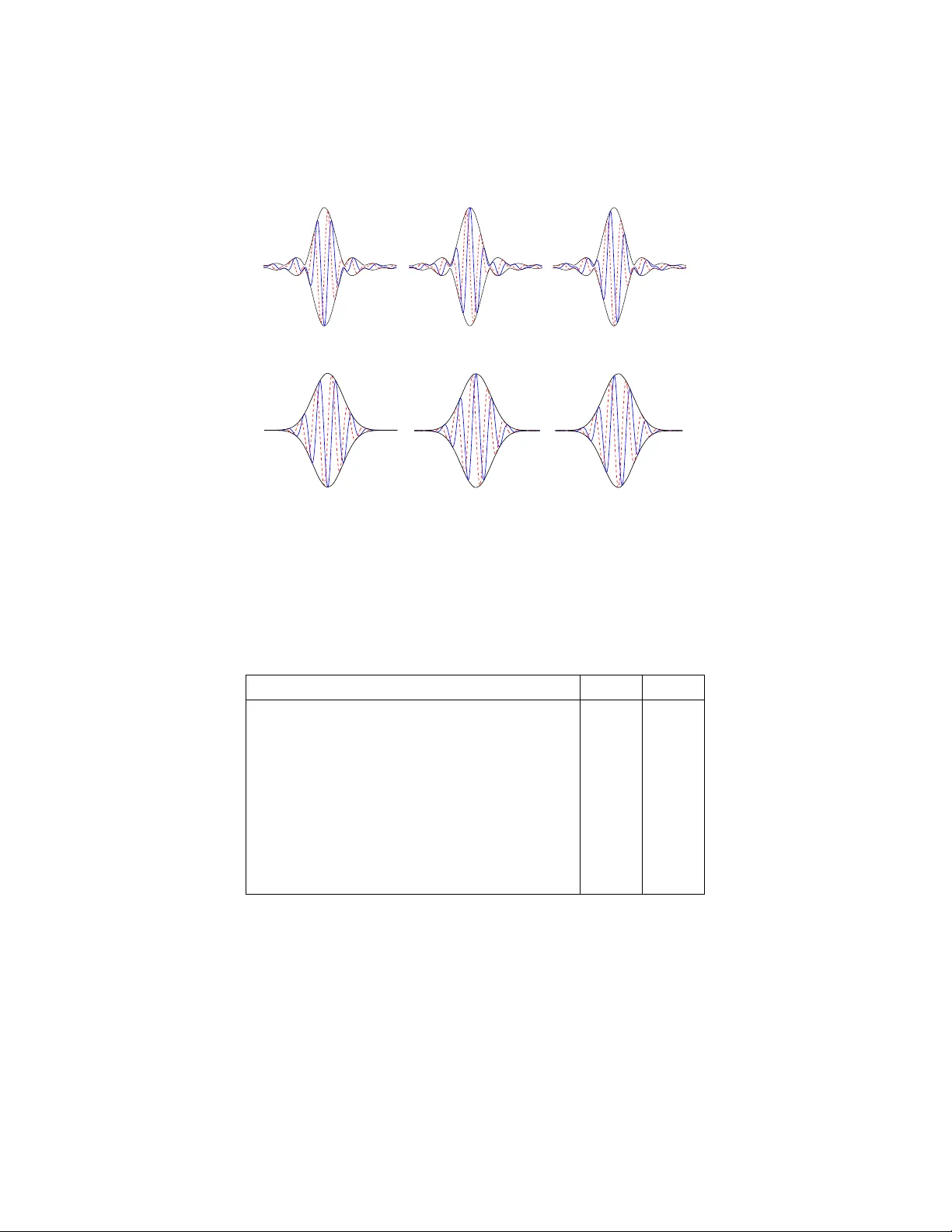
On the Shiftabilit y of Dual-T ree Complex W a v elet T ransforms Kunal Nara yan Chaudh ury and Mic hael Unser ∗ Abstract The dual-tree complex w av elet transform (DT- C WT) is known to ex- hibit better shift-inv ariance than the conv entional discrete wa velet trans- form. W e prop ose an amplitude-phase representation of the DT- C WT whic h, among other things, offers a direct explanation for the improv e- men t in the shift-inv ariance. The represen tation is based on the shifting action of the group of fractional Hilbert transform (fHT) operators, whic h extends the notion of arbitrary phase-shifts from sin usoids to finite-energy signals (wa velets in particular). In particular, we c haracterize the shifta- bility of the DT- C WT in terms of the shifting prop ert y of the fHTs. A t the heart of the representation are certain fundamental inv ariances of the fHT group, namely that of translation, dilation, and norm, whic h play a decisiv e role in establishing the key prop erties of the transform. It turns out that these fundamental in v ariances are exclusive to this group. Next, by in tro ducing a generalization of the Bedrosian theorem for the fHT op erator, we derive an explicitly understanding of the shifting action of the fHT for the particular family of w av elets obtained through the mod- ulation of lo wpass functions (e.g., the Shannon and Gab or w av elet). This, in effect, links the corresp onding dual-tree transform with the framework of window ed-F ourier analysis. Finally , we extend these ideas to the multi-dimensional setting by in- tro ducing a directional extension of the fHT, the fractional directional Hilb ert transform. In particular, we deriv e a signal represen tation in- v olving the sup erposition of direction-selective w av elets with appropri- ate phase-shifts, which helps explain the improv ed shift-inv ariance of the transform along certain preferential directions. 1 INTR ODUCTION The dual-tree complex w av elet transform (DT- C WT) is an enhancement of the conv entional discrete wa velet transform (DWT) that has gained increas- ∗ Corresponding Author: Kunal Naray an Chaudhury . The authors are with the Biomed- ical Imaging Group, ´ Ecole p olytec hnique f´ ed´ erale de Lausanne (EPFL), Station-17, CH- 1015 Lausanne VD, Switzerland. F ax: +41 21 693 37 01, e-mail: { kunal.chaudh ury , michael.unser } @epfl.c h. This work w as supported in part by the Swiss National Science F oundation under grant 200020-109415. 1 ing p opularit y as a signal pro cessing to ol. The transform, originally prop osed b y Kingsbury [12] to circumv ent the shift-v ariance problem of the decimated D WT, in volv es tw o parallel D WT c hannels with the corresp onding wa v elets forming approximate Hilb ert transform pairs [16]. W e refer the reader to the excellen t tutorial [16] on the design and application of the DT- C WT. In this con tribution, we characterize the dual-tree transform from a com- plemen tary p erspective by formally linking the multiresolution framework of w av elets with the amplitude-phase representation of F ourier analysis. The lat- ter provides an efficient wa y of enco ding the relativ e lo cation of information in signals through the phase function that has a straigh tforward interpretation. Sp ecifically , consider the F ourier expansion of a finite-energy signal f ( x ) on [0 , L ]: f ( x ) = a 0 + a 1 cos( ω 0 x ) + a 2 cos(2 ω 0 x ) + · · · + b 1 sin( ω 0 x ) + b 2 sin(2 ω 0 x ) + · · · . (1) Here ω 0 ( ω 0 L = 2 π ) denotes the fundamental frequency , and a 0 , a 1 , a 2 , . . . , and b 1 , b 2 , . . . are the (real) F ourier co efficien ts corresp onding to the ev en and o dd harmonicsresp ectiv ely . No w, by introducing the complex F ourier co efficien ts c n = a n − j b n and by expressing them in the p olar form c n = | c n | e j φ n , 0 6 φ n < 2 π , one can rewrite (1) as f ( x ) = ∞ X n =0 | c n | cos φ n cos( nω 0 x ) − sin φ n sin( nω 0 x ) = ∞ X n =0 | c n | ϕ n x + ´ τ n (2) with ´ τ n = φ n /nω 0 sp ecifying the displacemen t of the reference sin usoid ϕ n ( x ) = cos( nω 0 x ) relativ e to its fundamental perio d [0 , L/n ]. The ab o v e amplitude- phase representation highlights a fundamental attribute of the shift parameter ´ τ n : it corresp onds to the shift ´ τ that maximizes |h f ( · ) , ϕ n ( · + ´ τ ) i| , the correla- tion of the signal with the reference ϕ n ( x ). The corresp onding amplitude | c n | measures the strength of the correlation. As far as signals with isolated singularities (e.g. piecewise-smo oth signals) are concerned, the wa velet representation – employing the dilated-translated copies of a fast-decaying oscillating wa v eform – has prov en to b e more efficient. Moreo ver, the added asp ect of m ultiscale represen tation allows one to zo om onto signal features at different spatial resolutions. Complex wa velets, derived via the combination of non-redundant wa v elet bases, provide an attractive means of reco v ering the crucial phase information. In particular, the phase relation b et w een the comp onen ts (of the complex wa v elet) is used to enco de the relative signal displacement (besides offering robustness to interference). The DT- C WT is a particular instance where the comp onen ts are related via the Hilb ert trans- form [16, 15]. 2 1.1 Main Results Analogous to the fact that the complex F ourier co efficien ts in (2) are deriv ed from the (primitiv e) analytic signals e j nω 0 x = ϕ n ( x ) + j H ϕ n ( x ): c n = a n − j b n = h f ( x ) , e j nω 0 x i [0 ,L ] , the DT- C WT coefficients are obtained b y pro jection the signal on to the dilated- translated copies of the analytic wa v elet Ψ( x ) = ψ ( x ) + j H ψ ( x ). The cen- tral idea of this pap er is the identification of the wa velet counterparts of the phase-shifted sinusoids ϕ n ( x + τ n ) in (2). In particular, these so-called shifte d w av elets are derived by the action of the single-parameter family of fHT op er- ators { H τ } τ ∈ R (for definition and properties see § 2) on the reference w av elet ψ ( x ). The shift parameter τ controls the shifting action ψ ( x ) 7→ H τ ψ ( x ) of the fHT, and, in effect, resulting in the realization of a con tin uously-defined fam- ily of shifted w av elets. This action has an imp ortan t connotation in relation to pure sinusoids: H τ ϕ n ( x ) = cos( nω 0 x + π τ ). In fact, the amplitude-phase represen tation of the DT- C WT is deriv ed in § 3.1 by generalizing the following equiv alent expression of (2): f ( x ) = ∞ X n =0 | c n | H τ n ϕ n ( x ) ( τ n = φ n /π ) whic h, in turn, is based on the ab o ve-men tioned phase-shift action of the fHTs. The significance of either represen tation is that they allow us to provide a precise c haracterization of the shiftability of the asso ciated reference functions in terms of the shifting action of the fHT. Motiv ated by this connection, w e make a detailed study of the group of fHT op erators in § 2.1. In particular, w e highligh t their inv ariance to translations and dilations which allo ws us to seamlessly integrate them in to the multiresolution framew ork of w av elets. Moreo v er, the observ ation that the ab o ve-men tioned in v ariances are exclusively enjoy ed by the fHT group (cf. Theorem 3.1) mak es the shiftabilit y of the dual-tree transform unique. F or the particular family of dual-tree transforms inv olving HT pairs of mo dulated wa velets, w e deriv e an explicit characterization of the shifting action of the fHT in § 3.2. If the dual- tree wa v elet is not mo dulated, we can still characterize the action of the fHT by studying the family of fractionally-shifted wa v elets { H τ ψ } τ ∈ R , and w e do this explicitly for the particular case of spline wa v elets in § 5. Finally , we extend the prop osed representation to the multi-dimensional setting in § 4 by introducing certain directional extensions of the fHT. The ab o v e results hav e certain practical implications. In § 3.3, we prop ose certain measures for accessing the qualit y of the factors, namely the HT cor- resp ondence and mo dulation criterion, that are fundamental to the shiftabilit y prop ert y of the dual-tree wa v elets. These metrics could prov e useful in the design of dual-tree wa velets with a go od shift-inv ariance prop ert y . 3 2 THE FRACTIONAL HIBER T TRANSF ORM In what follows, the F ourier transform of a function f ( x ) defined ov er R d ( d > 1) is sp ecified by ˆ f ( ω ) = R R d f ( x ) exp ( − j ω T x ) d x , where ω T x denotes the usual inner-pro duct on R d . The other transform that plays a significant role is the Hilb ert transform (HT) [6, 18]; w e will denote it by H . In particular, we shall frequen tly inv oke the F ourier equiv alence H f ( x ) F ← → − j sign( ω ) ˆ f ( ω ) (3) c haracterizing the action of the HT on L 2 ( R ), the class of finite-energy signals 1 . Three fundamental properties of the HT that follo w from (3) are its inv ariance to translations and dilations, and its unitary (norm-preserving) nature. Moreov er, w e shall use I to denote the identit y op erator ( I f )( x ) = f ( x ). W e b egin with a detailed exposition of the relev an t c haracteristics of the fHT that forms the cornerstone of the subsequent discussion. There exit several def- initions of the fHT in the signal pro cessing and optics literature [23, 19, 13, 9]; ho wev er, for reasons that will b e ob vious in the sequel, we prop ose to formulate it as an interpolation of the “quadrature” identit y and HT operator using con- jugate trigonometric functions. In particular, we define the fHT op erator H τ , corresp onding to the real-v alued shift parameter τ , as H τ = cos( π τ ) I − sin( πτ ) H . (4) This definition is equiv alent to the form ulation introduced in [13, 9], but differs from the ones in [23, 19] up to a complex chirp. The imp ortan t asp ect of the ab o ve op erator-based formulation is that it directly relates the fHT and its prop erties to the more fundamen tal identit y and HT op erator, which are iden tified a p osteriori as sp ecial instances of the fHT: I = H 0 and H = H − 1 / 2 . In view of (4), w e would lik e to mak e note of fact that I and H hav e a non-linear corresp ondence: H 2 = − I , (5) and act in “quadrature” in the sense that h I f , H f i = 0 ( f ∈ L 2 ( R )) . (6) These come as a direct consequence of definition (3) and certain prop erties of the inner-product. As far as the domain of definition of (4) is concerned, note that b oth I and H act as b ounded op erators (with a b ounded inv erse) on L p ( R ) for 1 < p < ∞ [4], and so do es H τ . In particular, the fHT admits the follo wing equiv alen t sp ecification on L 2 ( R ): H τ f ( x ) F ← → exp j π τ sign( ω ) ˆ f ( ω ) (7) that comes as a consequence of equiv alence (3). W e shall henceforth inv oke (4) and (7) in terchangeably in the context of finite-energy signals. 1 The domain can also b e extended to include distributions such as the Dirac delta and the sinusoid [4, Chapter 2] 4 2.1 Characterization of the fHT As remarked earlier, most of the c haracteristic features of the constituent iden- tit y and HT op erators carry ov er to the family of fHT op erators { H τ } τ ∈ R . In particular, the follo wing prop erties of the fHT can b e readily derived: (P1) T ranslation-inv ariance: ( H τ f )( x − y ) = H τ { f ( · − y ) } ( x ) for all real y . (P2) Dilation-in v ariance: ( H τ f )( λx ) = H τ { f ( λ · ) } ( x ) for all p ositiv e λ . (P3) Unitary nature: h H τ f , H τ g i = h f , g i ; in particular, || H τ f || = || f || for all f , g in L 2 ( R ). (P4) Composition law: H τ 1 H τ 2 = H τ 1 + τ 2 . (P5) Phase-shift operator: H τ { cos( ω 0 x ) } = cos( ω 0 x + π τ ). Indeed, (P1) and (P2) are immediate consequences of the dilation- and translation-in v ariance of I and H ; (P3) follo ws from the unitary frequency resp onse (7) and P arsev al’s identit y; and (P4) follows from (5): H τ 1 H τ 2 = cos( π τ 1 ) I − sin( π τ 1 ) H cos( π τ 2 ) I − sin( π τ 2 ) H = cos π ( τ 1 + τ 2 ) I − sin π ( τ 1 + τ 2 ) H . Finally , it is the quadrature-shift action cos( ω 0 x ) 7→ sin( ω 0 x ) of H that results in (P5): H τ cos( ω 0 x ) = cos( π τ ) cos( ω 0 x ) − sin( π τ ) H { cos( ω 0 x ) } = cos( ω 0 x + π τ ); (8) this is also justified by the frequency resp onse of the fHT. As will b e discussed shortly , prop erties (P1), (P2) and (P3) play a crucial role in connection with w a velets. The composition la w (P4) tells us that the family of fHT op erators is closed with resp ect to comp osition. Moreo ver, as the iden tity H τ H − τ = H 0 = I suggests, the in v erse 2 fHT op erator is also a fHT op erator sp ecified by H − 1 τ = H − τ . These closure properties can b e summarized b y following geometric characterization: Prop osition 2.1 The family of fHT op er ators forms a c ommutative gr oup on L p ( R ) , 1 < p < ∞ . In this resp ect, note the marked resemblance b et ween the family of fHT opera- tors and the comm utative group of translation op erators that play a fundamen- tal role in F ourier analysis; the relev ance of the former group in connection with the DT- C WT will be demonstrated in the sequel. Moreo ver, the finite subgroup { I , H , − I , − H } of self-adjoint 3 op erators (see Fig. 1) is worth identifying. It is the smallest subgroup containing the in-phase/quadrature op erators that play a fundamen tal role in the dual-tree transform. 2 Note that, for a given τ , there exists infinitely many τ 0 such that identity H τ H τ 0 = I holds; this comes as a consequence of the perio dicity of the trigonometric functions inv olved in the definition. One can easily factor out the p eriodic structure by identifying τ 1 and τ 2 iff H τ 1 = H τ 2 ; in effect, this equiv alence relation results in the sp ecification of equiv alence classes of fHTs. How ev er, for the simplicity of notation, we shall henceforth use H τ to denote b oth the equiv alence class and its representativ es. 3 self-adjoint up to a sign: T ∗ = ± T for eac h T in the subgroup. 5 − H − I H I H τ θ = πτ 0 Figure 1: Geometrical interpretation of the con tinuous fHT group using the isomorphic unit-circle group S 1 (the multiplicativ e group of complex num b ers ha ving unit mo dulus); the corresp ondence is H τ ← → (cos( π τ ) , sin( πτ )). 2.2 The W a velet Con text Similar to the Hilb ert transform, the fHT p erfectly fits the wa velet framework. The implication of prop erties (P1) and (P2) is that the fHT of simultaneous dilates and translates of a wa velet is a w a velet, dilated and translated by the same amount. This has fundamen tal ramifications in connection with dyadic w av elet bases generated via the dilations and translations of a single mother- w av elet ψ ( x ). In particular, let ψ i,k ( x ) and Ξ i,k denote the dilated-translated w av elets Ξ i,k ψ ( x ) = 2 i/ 2 ψ (2 i x − k ) , ( i, k ) ∈ Z 2 and the corresp onding (normal- ized) dilation-translation operators, resp ectiv ely . Then the commutativit y H τ Ξ i,k = Ξ i,k H τ (9) holds for all real τ and integers i and k . The significance of (9) is that it allo ws us to conv eniently factor out the p erv asive dilation-translation structure while analyzing the action of fHTs on wa velet bases. On the other hand, a fundamental consequence of the isometry prop ert y (P3) is that H τ maps a Riesz basis onto a Riesz basis; in particular, if { ψ i,k } forms a w a velet basis of L 2 ( R ), then so do es { H τ ψ i,k } . In fact, H τ preserv es biorthogonalit y: if { ψ i,k } and { ˜ ψ i 0 ,k 0 } constitute a biorthogonal w av elet basis satisfying the duality criteria h ψ i,k , ˜ ψ i 0 ,k 0 i = δ [ i − i 0 ] δ [ k − k 0 ], then also w e ha ve that hH τ ψ i,k , H τ ˜ ψ i 0 ,k 0 i = h ψ i,k , ˜ ψ i 0 ,k 0 i = δ [ i − i 0 ] δ [ k − k 0 ] , signifying that {H τ ψ i,k } and {H τ ˜ ψ i 0 ,k 0 } form a biorthogonal basis as well. 6 3 SHIFT ABILITY OF THE DUAL-TREE TRANS- F ORM 3.1 Multiscale Amplitude-Phase Representation W e no w derive the amplitude-phase represen tation of the DT- C WT based on the shifting action of the fHT. As remark ed earlier, the parallel is grounded on the observ ation that instead of the quadrature sin usoids { cos( nω 0 x ) } and { sin( nω 0 x ) } , the DT- C WT employs tw o parallel wa velet bases, { ψ i,k } and { ψ 0 i,k } , deriv ed via the dilations-translations of the wa velets ψ ( x ) and ψ 0 ( x ) that form a HT pair: ψ 0 ( x ) = H ψ ( x ). A signal f ( x ) in L 2 ( R ) is then sim ultaneously analyzed in terms of these wa velet bases yielding the w av elet expansions f ( x ) = ( P ( i,k ) ∈ Z 2 a i [ k ] ψ i,k ( x ) . P ( i,k ) ∈ Z 2 b i [ k ] ψ 0 i,k ( x ) . (10) The analysis co efficien ts a i [ k ] and b i [ k ] are sp ecified by the pro jections onto the dual w av elet bases { ˜ ψ i,k } and { ˜ ψ 0 i,k } : a i [ k ] = h f , ˜ ψ i,k i , and b i [ k ] = h f , ˜ ψ 0 i,k i . The dual wa v elet bases are implicitly related to the corresp onding primal bases through the duality criteria h ˜ ψ i,k , ψ p,n i = δ [ i − p, k − n ] and h ˜ ψ 0 i,k , ψ 0 p,n i = δ [ i − p, k − n ]. A fundamen tal consequence of the unitary prop ert y of the HT is that these dual bases can b e generated through the dilations-translations of tw o dual w av elets, say ˜ ψ ( x ) and ˜ ψ 0 ( x ), that form a HT pair as well: ˜ ψ 0 ( x ) = H ˜ ψ ( x ) [7]. In particular, b y introducing the complex wa v elet ˜ Ψ( x ) = 1 2 ˜ ψ ( x ) + j ˜ ψ 0 ( x ) and its dilated-translated v ersions ˜ Ψ i,k ( x ) – the analytic counterpart of the complex sinusoids exp( j nω 0 x ) – the dual-tree analysis can simply b e view ed as the sequence of transformations f ( x ) 7→ c i [ k ] = h f , ˜ Ψ i,k i resulting in the complex analysis coefficients { c i [ k ] } ( i,k ) ∈ Z 2 . Our ob jectiv e is to derive a representation of f ( x ) in terms of the mo dulus- phase information c i [ k ] = | c i [ k ] | e j φ i [ k ] , and the reference w av elets ψ i,k ( x ). In particular, by com bining the expansions in (10) and by in voking (9), we arrive at the follo wing representation: f ( x ) = 1 2 X ( i,k ) ∈ Z 2 a i [ k ] ψ i,k ( x ) + b i [ k ] ψ 0 i,k ( x ) = X ( i,k ) ∈ Z 2 | c i [ k ] | H φ i [ k ] /π ψ i,k ( x ) = X ( i,k ) ∈ Z 2 | c i [ k ] | Ξ i,k ψ x ; τ i [ k ] , (11) 7 where the syn thesis w av elet ψ x ; τ i [ k ] = H τ i [ k ] ψ ( x ) is derived from the mother w av elet ψ ( x ) through the action of the fHT corresp onding to the shift τ i [ k ] = φ i [ k ] /π . The ab o v e m ultiresolution amplitude-phase representation provides t wo imp ortan t insights into the signal transformation f ( x ) 7→ n | c i [ k ] | , τ i [ k ] o ( i,k ) ∈ Z 2 . The first of these is derived from the observ ation that the fractionally-shifted w av elets ψ ( x ; τ i [ k ]) in (11) play a role analogous to the phase-shifted sinusoids ϕ n ( x + τ n ) in (2). In particular, (11) offers a rigorous in terpretation of the ampitude-phase factors: while | c i [ k ] | indicates the strength of wa velet correla- tion, the relative signal displacement gets enco ded in the shift τ i [ k ] corresp ond- ing to the most “appropriate” wa velet within the family { H τ ψ i,k } τ ∈ R . The “shiftable-wa velet representation” in (11) also offers an explanation for the improv ed shift-inv ariance of the dual-tree transform whic h is complementary to the frequency-domain argument given by Kingsbury in [12]. It is well-kno wn that the signal represen tation asso ciated with the (critically-sampled) discrete w av elet transform is not shift-inv ariant; in particular, the uniform sampling of the translation-parameter of the contin uous transform limits the degree of shift-in v ariance of the transform. The fact that the ov er-sampled dual-tree transform tends to exhibit b etter shift-inv ariance can then b e explained in terms of the asso ciated shiftability of the transform. Indeed, the fractional-shifts of the reference wa v elets around their discrete translates partially comp ensates for the limited freedom of translation. It is clear that the in v ariances of the fHT group w ere cen tral to the deriv ation of (11). The following result establishes the fHTs as the only complete family of operators that exhibits such characteristics: Theorem 3.1 (Uniqueness of the fHT) A unitary line ar op er ator T on L 2 ( R ) is invariant to tr anslations and dila- tions if and only if it c an b e r epr esente d as T = cos θ I − sin θ H (12) for some unique θ in ( − π , π ] . The ab o ve result (pro of provided in App endix 7.1) signifies that any family of unitary operators that sim ultaneously commutes with translations and dilations is isomorphic to the fHT group. This provides significant insight into the rep- resen tation in (11) since it is these fundamental in v ariances that facilitate the incorp oration of the fHT in to the wa v elet framework. As discussed next, it turns out that the shifted wa velets can b e very explicitly c haracterized for certain classes of wa v elets which pro vides a deep er insigh t into the abov e signal representation. 8 0 ω 0 ω 0 − Ω ω 0 + Ω ω π | ! ψ ( ω ) | Figure 2: Idealized sp ectrum of a mo dulated w av elet. The sp ectrum has pass- bands o ver ω 0 − Ω < | ω | < ω 0 + Ω with lo cal axes of symmetry at ω = ± ω 0 . 3.2 Mo dulated W a velets: Window ed-F ourier-like Repre- sen tation A w av elet is, by construction, a bandpass function. Sp ecifically , if the wa velet is a modulated function of the form ψ ( x ) = ϕ ( x ) cos ω 0 x + ξ 0 , (13) where ϕ ( x ) is bandlimited to [ − Ω , Ω] (for some arbitrary Ω), and ω 0 > Ω [cf. Fig. 2], we can make precise statemen ts on the represen tation (11) corresp ond- ing to the dual-tree transform in volving such a mo dulated wa velet and its HT pair. In order to do so, we pro vide a very generic result that allows us to extend the phase-action in (8) to mo dulated functions: Theorem 3.2 (Generalized Bedrosian Identit y) L et f ( x ) and g ( x ) b e two r e al-value d functions such that the supp ort of ˆ f ( ω ) is r estricte d to ( − Ω , Ω) , and that ˆ g ( ω ) vanishes for | ω | < Ω for some arbitr ary fr e quency Ω . Then the fHT of high-p ass function c ompletely determines the fHT of the pr o duct: H τ f ( x ) g ( x ) = f ( x ) H τ g ( x ) . (14) Informally , the ab ov e result (cf. App endix § 7.2 for a pro of ) asserts that the fHT of the pro duct of a lo wpass signal and a highpass signal (with non- o verlapping sp ectra) factors into the pro duct of the lowpass signal and the fHT of the highpass signal. Note that, as a particular instance of Theorem 3.2 corresp onding to τ = − 1 / 2, we recov er the result of Bedrosian [3] for the HT op erator. An imp ortan t consequence of Theorem (3.2) is that, for a wa v elet is the form ϕ ( x ) cos( ω 0 x ) with ϕ ( x ) is bandlimited to ( − ω 0 , ω 0 ), the fHT acts on the phase of the mo dulating sin usoid while preserving the lowpass env elope: H τ ϕ ( x ) cos( ω 0 x ) = ϕ ( x ) cos( ω 0 x + π τ ) . (15) 9 In particular, the ab o ve mo dulation action allows us to rewrite the signal rep- resen tation in (11) as X ( i,k ) ∈ Z 2 fixed window z }| { ϕ i,k ( x ) Ξ i,k n v ariable amp − phase oscillation z }| { c i [ k ] cos ω 0 x + ξ 0 + π τ i [ k ] o , (16) where ϕ i,k ( x ) = Ξ i,k ϕ ( x ) denotes the (fixed) window at scale i and translation k . This provides an explicit interpretation of the parameter τ i [ k ] as the phase- shift applied to the mo dulating sin usoid of the wa velet. In this regard, its role is therefore similar to that of the shift parameter ´ τ n in the F ourier representation (2). In effect, while the lo calization window ϕ i,k ( x ) is kept fixed, the oscillation is shifted to b est-fit the underlying signal singularities/transitions. In this light, one can interpret the asso ciated dual-tree analysis as a multiresolution form of the window ed-F ourier analysis, with the fundamental difference that, instead of analyzing the signal at different frequencies, it resolves the signal ov er differen t scales (or resolutions). Tw o concrete instances of such mo dulated wa velets are: • Shannon wa v elet: The Shannon w av elet is constructed from the Shan- non m ultiresolution [14]; it is sp ecified as ψ ( x ) = sinc x − 1 / 2 2 cos 3 π ( x − 1 / 2) 2 , and it dilates-translates constitute an orthonormal wa v elet basis of L 2 R . Man y w av elet families conv erge to the Shannon multiresolution as the order increases [1]; e.g., the orthonormal Battle-Lemari´ e wa v elets [2], and the in terp olating Dubuc-Deslauriers wa velets [10]. • Gab or w av elet: The sinc( x ) env elop e of the Shannon wa v elet results in an “ideal” frequency resolution but only at the exp ense of p o or spa- tial deca y . As against this, w av elets mo deled on the Gab or functions [11] (mo dulated Gaussians) exhibit b etter space-frequency localization. More- o ver, as in the case of the Shannon w av elet, they are quite generic in nature since several wa velet families closely resem ble the Gab or function. F or example, the B-splines w av elets (a semi-orthogonal family of spline w av elets) asymptotically con verge to the Gab or wa velet ψ ( x ) = g α ( x ) cos ω 0 x + ξ 0 , where g α ( x ) is a Gaussian window that is completely determined by the degree of the spline [20]. In fact, based on this observ ation, a m ultiresolu- tion Gabor-like transform was realized in [7] within the framework of the dual-tree transform. This Gab or-lik e transform inv olved the computation of the pro jections f ( x ) 7→ h f ( x ) , Ξ i,k Ψ( x ) i ( i, k ∈ Z ) (17) 10 on to the dilates-translates of the Gab or-lik e w av elet Ψ( x ) = ψ ( x ) + j H ψ ( x ), and w as realized using the usual dual-tree transform correspond- ing to the spline wa velets ψ ( x ) and H ψ ( x ). W e would, how ever, lik e to p oin t out that the representation in (16) corresp onds to a situation where the role of the analysis and syn thesis functions ha ve b een reversed, namely one in whic h the signal is analyzed using the dual complex wa velet ˜ Ψ( x ), and where the Gab or-lik e wa velet Ψ( x ) is used for reconstruction. Graphical Illustrations : Fig. 3 shows quadrature pairs H τ ψ ( x ) , H τ +1 / 2 ψ ( x ) of Shannon-like (resp. Gab or-lik e) wa v elets corresp onding to differen t τ . The fHT pair ( H τ , H τ +1 / 2 ) driv es the modulating oscillation to a relativ e quadra- ture that are lo calized within a common sinc-lik e (resp. Gaussian-like) window sp ecified by | H τ ψ ( x ) + j H τ +1 / 2 ψ ( x ) | . In figure 4, we demonstrate the shiftability of the dual-tree transform using a Gab or-lik e B-spline w av ele t ψ ( x ) of degree 3 as the reference. T o this end, w e consider the step input f ( x ) = sign( x − x 0 ) that has a discontin uity at x 0 . The M -level decomp osition of this signal (cf. [7] for implementation details) in terms of the conv entional DWT is given by f ( x ) = X ` p ` ϕ M ,` ( x ) + M X i =1 X k a i,k ψ i,k ( x ) , (18) with ϕ M ,` ( x ) denoting the translates of the coarse representation of the scaling function. As for the DT- C WT, w e hav e the represen tation f ( x ) = X ` p ` ϕ M ,` ( x ) + X n p 0 n ϕ 0 M ,n ( x ) + M X i =1 X k | c i [ k ] | ψ i,k x ; τ i [ k ] . (19) The idea here is to demonstrate that the shifted w av elets in (19) resp ond b etter to the signal transition than the wa v elets in (18); that is, the oscillations of the shifted wa velets hav e a b etter lo c k on the singularity at x 0 . Figure 4 sho ws the reference wa velet ψ i,k ( x ) and the shifted wa velet ψ i,k ( x ; τ i [ k ]) corresp onding to a specific resolution i = J and translation k = [ x 0 / 2 J ] (around the position of the singularity at the coarser resolution). Also shown in the figures are the step input and the fixed Gaussian-lik e lo calization windo w of the wa v elet. The oscillation of the shifted wa velet is clearly seen to hav e a b etter lock on the transition than the reference. The magnitude of the signal correlation in either case justifies this observ ation as well. 3.3 Qualit y Metrics for Dual-T ree W a velets The shiftability of the DT- C WT was established based on tw o fundamen tal prop erties of the w av elets, ψ 1 ( x ) and ψ 2 ( x ), of the tw o branches: (C1) HT correspondence: ψ 2 ( x ) = H ψ 1 ( x ), (C2) Their mo dulated forms: ψ 1 ( x ) = ϕ ( x ) cos( ω 0 x + ξ 0 ), and ψ 2 ( x ) = ϕ ( x ) sin( ω 0 x + ξ 0 ), with the supp ort of ˆ ϕ ( ω ) restricted to [ − ω 0 , ω 0 ]. 11 (1a) τ = − 1 (1b) τ =0 (1c) τ =1 / 2 (2a) τ = − 1 (2b) τ =0 (2c) τ =1 / 2 Figure 3: Quadrature pairs of orthonormal spline (resp. B-spline) w av elets re- sem bling the Shannon (resp. Gab or) wa v elet: Solid (blue) graph: H τ ψ 8 ( x ); Brok en (red) graph: H τ +1 / 2 ψ 8 ( x ); and Solid (black) graph: Common lo caliza- tion windo w given by | H τ ψ 8 ( x ) + j H τ +1 / 2 ψ 8 ( x ) | . T able 1: Qualit y metrics for different dual-tree wa velets T yp e of Dual-T ree W av elets % κ Shannon w av elets (ideal) 1 0 B-spline w av elets, degree=1 1 0 . 9245 B-spline w av elets, degree=3 1 0 . 0882 B-spline w av elets, degree=6 1 0 . 0373 Orthonormal spline w av elets, degree=1 1 0 . 9292 Orthonormal spline w av elets, degree=3 1 0 . 1570 Orthonormal spline w av elets, degree=6 1 0 . 0612 Kingsbury’s w av elets (q-shift Le Gall 5/3) [12] 0 . 9992 0 . 6586 The practical challenge is the construction of differen t flav ors of wa v elets that fulfill or, at least, provide close approximations of these criteria. Indeed, the first criteria has b een mark ed by an extensive researc h into the problem of designing both approximate and exact HT wa velet-pairs [16, 7]. W e prop ose new design metrics for assessing the qualit y of the approxima- 12 tion. A simple measure for criterion (C1) is the correlation % = max h ψ 2 , H ψ 1 i || ψ 1 || · || ψ 2 || , 0 . (20) The Cauch y-Sch w arz inequalit y asserts that 0 6 % 6 1, where % = 1 if and only if ψ 2 ( x ) = H ψ 1 ( x ). Th us, the higher the v alue of ρ , the b etter would b e the appro ximation. Next, note that criterion (C2) also has a simple F ourier domain c haracteri- zation: S ( ω ) = ˆ ψ 1 ( ω ) + j ˆ ψ 2 ( ω ) = ( g ( ω ) , 0 < ω < ∞ , 0 , −∞ < ω 6 0 . where g ( ω ) is complex-v alued in general, and has a lo cal axis of symmetry within its supp ort. In particular, if g ( ω ) is constrained to b e real-v alued (corresp ond- ing to a symmetric ϕ ( x )), then ψ 1 ( x ) + j ψ 2 ( x ) has a constan t instan taneous frequency (deriv ativ e of the phase) o v er its supp ort. A reasonable qualit y metric for (C2) would then b e the v ariation of the instantaneous frequency . Alterna- tiv ely , w e can also assess the degree of symmetry of S ( ω ). In particular, we prop ose the following measure: κ = R ∞ 0 | S ∗ ( ¯ ω + ω ) − S ( ¯ ω − ω ) | dω R ∞ −∞ | S ( ω ) | dω , (21) where ¯ ω , the centroid of | S ( ω ) | , is sp ecified as ¯ ω = R ∞ −∞ ω | S ( ω ) | dω R ∞ −∞ | S ( ω ) | dω . That is, κ , whic h lies b et w een 0 and 1, measures the disparit y betw een S ( ω ) and its reflection around the centroid. Indeed, κ equal zero if and only if S ( ω ) is symmetric (with ¯ ω as the centre of symmetry). Con versely , a high v alue of κ signifies greater lo cal asymmetry in S ( ω ), and hence a po orer approximation of the modulation criterion. W e computed the metrics % and κ for different dual-tree wa velets (cf. T able 1). The wa velets ψ 1 ( x ) and ψ 2 ( x ) w ere synthesized using the iterated filter- bank algorithm, and the integrals inv olv ed in (20) and (21) w ere realized using high-precision numerical integration. It can easily b e verified that % and κ are appropriately normalized in the sense that they are inv arian t to the scale and translation of the syn thesized w av elets. This is a necessary criteria since the w av elets are essentially synthesized b y the filterbank algorithm at some arbi- trary scale and translation. The spline w av elets are analytic b y construction [7], and hence % = 1 ir- resp ectiv e of their degree. This is a necessary criteria since the synthesised w av elets are essen tially at some arbitrary scale and translation. How ever, as their degree increases, the B-spline (resp. orthonormal) w a velets conv erge to the real and imaginary comp onen ts of the complex Gab or (resp. Shannon) 13 w av elet whic h exhibits a symmetric spectrum (see § 5 for details). The rapid decrease in the v alue of κ reflects this improv emen t in symmetry (and also the rate of con vergence). 4 MUL TI-DIMENSIONAL EXTENSION In this section, we extend the amplitude-phase representation derived in § 3.1 to the multi-dimensional setting. The key ideas carry ov er directly , and the final expressions (cf. (27) and (16)) are as simple as their 1D counterparts. The attractiv e feature of the multi-dimensional dual-tree wa v elets is that, b esides impro ving on the shift-inv ariance of the corresp onding transform, they exhibit b etter directional selectivity than the conv en tional tensor-pro duct (separable) w av elets [16]. F or the sake of simplicity , and without the loss of generality , we deriv e the amplitude-phase representation for the particular tw o-dimensional setting. Tw o-Dimensional Dual-T ree W av elets : T o set up the w av elet notations, w e briefly recall the construction framework prop osed in [7] in volving the tensor- pro ducts of one-dimensional analytic w av elets. Sp ecifically , let ϕ ( x ) and ϕ 0 ( x ) denote the scaling functions associated with the analytic wa velet ψ a ( x ) = ψ ( x )+ j ψ 0 ( x ), where ψ 0 ( x ) = H ψ ( x ). The dual-tree construction then hinges on the iden tification of four separable multiresolutions of L 2 ( R 2 ) that are naturally asso ciated with the tw o scaling functions: the approximation subspaces V ( ϕ ) ⊗ V ( ϕ ) , V ( ϕ ) ⊗ V ( ϕ 0 ) , V ( ϕ 0 ) ⊗ V ( ϕ ) and V ( ϕ 0 ) ⊗ V ( ϕ 0 ), and their multiscale coun terparts 4 . The corresp onding separable w av elets – the ‘low-high’, ‘high- lo w’ and ‘high-high’ wa v elets – are sp ecified by ¯ ψ 1 ( x ) = ϕ ( x ) ψ ( y ) , ¯ ψ 4 ( x ) = ϕ ( x ) ψ 0 ( y ) , ¯ ψ 2 ( x ) = ψ ( x ) ϕ ( y ) , ¯ ψ 5 ( x ) = ψ ( x ) ϕ 0 ( y ) , ¯ ψ 3 ( x ) = ψ ( x ) ψ ( y ) , ¯ ψ 6 ( x ) = ψ ( x ) ψ 0 ( y ) , ¯ ψ 7 ( x ) = ϕ 0 ( x ) ψ ( y ) , ¯ ψ 10 ( x ) = ϕ 0 ( x ) ψ 0 ( y ) , ¯ ψ 8 ( x ) = ψ 0 ( x ) ϕ ( y ) , ¯ ψ 11 ( x ) = ψ 0 ( x ) ϕ 0 ( y ) , ¯ ψ 9 ( x ) = ψ 0 ( x ) ψ ( y ) , ¯ ψ 12 ( x ) = ψ 0 ( x ) ψ 0 ( y ) , (22) whereas the dual wa velets ˜ ¯ ψ 1 , . . . , ˜ ¯ ψ 12 are sp ecified in terms of ˜ ψ ( x ) and ˜ ψ 0 ( x ) (here x = ( x, y ) denotes the planar coordinates). As far as the identification of the complex wa velets is concerned, the main issue is the p o or directional selec- tivit y of the ‘high-high’ wa velets along the diagonal directions. This problem can, ho wev er, b e mitigated by appropriately exploiting the one-sided sp ectrum of the analytic wa v elet ψ a ( x ), and, in effect, by appropriately combining the 4 The tensor-product V ( ϕ ) ⊗ V ( ϕ ) denotes the subspace spanned by the translated functions ϕ ( · − m ) ϕ ( · − n ) , ( m, n ) ∈ Z 2 . 14 w av elets in (22). In particular, the complex w av elets Ψ 1 ( x ) = ψ a ( x ) ϕ ( y ) = ¯ ψ 2 ( x ) + j ¯ ψ 8 ( x ) , Ψ 2 ( x ) = ψ a ( x ) ϕ 0 ( y ) = ¯ ψ 5 ( x ) + j ¯ ψ 11 ( x ) , Ψ 3 ( x ) = ϕ ( x ) ψ a ( y ) = ¯ ψ 1 ( x ) + j ¯ ψ 4 ( x ) , Ψ 4 ( x ) = ϕ 0 ( x ) ψ a ( y ) = ¯ ψ 7 ( x ) + j ¯ ψ 10 ( x ) , Ψ 5 ( x ) = 1 √ 2 ψ a ( x ) ψ a ( y ) = ¯ ψ 3 ( x ) − ¯ ψ 12 ( x ) √ 2 + j ¯ ψ 6 ( x ) + ¯ ψ 9 ( x ) √ 2 , Ψ 6 ( x ) = 1 √ 2 ψ ∗ a ( x ) ψ a ( y ) = ¯ ψ 3 ( x ) + ¯ ψ 12 ( x ) √ 2 + j ¯ ψ 6 ( x ) − ¯ ψ 9 ( x ) √ 2 (23) exhibit the desired directional selectivit y along the primal orientations θ 1 = θ 2 = 0, θ 3 = θ 4 = π / 2, θ 5 = π / 4, and θ 6 = 3 π / 4 resp ectiv ely [7]. The dual complex w av elets ˜ Ψ 1 , . . . , ˜ Ψ 6 , specified in an iden tical fashion using the dual w av elets ˜ ¯ ψ p ( x ), are also oriented along the same set of directions. Directional Hilbert T ransform (dHT): Ha ving recalled the complex wa velet definitions, w e next recall the “quadrature” correspondence betw een the comp o- nen ts of the complex wa v elets that provides further insight in to their directional selectivit y . Akin to the HT corresp ondence, the comp onen ts can b e related through the directional HT H θ , 0 6 θ < π : H θ f ( x ) F ← → − j sign( u T θ ω ) ˆ f ( ω ) where u θ = (cos θ , sin θ ) denotes the unit vector 5 along the direction θ . In particular, one has the corresp ondences Im (Ψ ` ) = H θ ` Re (Ψ ` ) ( ` = 1 , . . . , 6) , so that, b y denoting the real comp onen t of the complex wa v elet Ψ ` ( x ) b y ψ ` ( x ), w e hav e the follo wing conv enien t representations Ψ ` ( x ) = ψ ` ( x ) + j H θ ` ψ ` ( x ) ( ` = 1 , . . . , 6) (24) whic h are reminiscent of the 1D analytic represen tation. 4.1 Amplitude-Phase Representation Let us denote the dilated-translated copies of the each of the six analysis wa velets ˜ Ψ ` ( x ) b y ˜ Ψ `,i, k ( x ), so that ˜ Ψ `,i, k ( x ) = Ξ i, k ˜ Ψ ` ( x ) ( i ∈ Z , k ∈ Z 2 ) , 5 Note that the half-spaces { ω : u T θ ω > 0 } and { ω : u T θ ω < 0 } play a role, analogous to that play ed by the half-lines 0 6 w 6 ∞ and −∞ 6 w 6 0 in case of the HT, in sp ecifying the action of dHT. 15 ! f ( x ) , ψ i , k ( x ; τ i [ k ]) " = 29.3 ! f ( x ) , ψ i , k ( x ;0 ) " = 21.1 (a) (b) Figure 4: W a velets corresp onding to the step unit f ( x ): (a) reference w av elet ψ i,k ( x ) = ψ i,k ( x ; 0) corresponding to the con v entional D WT; (b) shifted wa velet dual-tree ψ i,k ( x ; τ i [ k ]). The magnitudes of the signal correlation in either case clearly sho ws that the shifted wa velet has a b etter lo c k on the singularity . 16 where Ξ i, k is sp ecified b y Ξ i, k f ( x ) = 2 i f (2 i x − k ). The corresponding dual-tree transform in volv es the analysis of a finite-energy signal f ( x ) in terms of the sequence of pro jections c ` i [ k ] = 1 4 f , ˜ Ψ `,i, k , (25) where the use of the normalization factor 1 / 4 will b e justified shortly . Before deriving the representation of f ( x ) in terms of the analysis co efficients c ` i [ k ], we in tro duce the following fractional extensions of the dHT: H θ,τ = cos( π τ ) I − sin( π τ ) H θ ( τ ∈ R ) (26) that formally allow us to capture the notion of direction-selectiv e phase-shifts. Certain k ey properties of the fHT carry ov er to the fdHT. In particular, the family of fdHT op erators { H θ,τ } τ ∈ R , 0 6 θ < π , exhibit the fundamen tal in- v ariances of • T ranslation: H θ,τ { f ( · − y ) } ( x ) = ( H θ,τ f )( x − y ); • Dilation: H θ,τ { f ( λ · ) } ( x ) = ( H θ,τ f )( λ x ); and • Norm: || H θ,τ f || = || f || , for all f ∈ L 2 ( R 2 ), whic h pla y ed a decisive role in establishing (11). Based on the ab o ve inv ariances, w e can derive the following representation f ( x ) = X ( `,i, k ) c ` i [ k ] Ξ i, k ψ ` x ; τ ` i [ k ] (27) in volving the sup erposition of direction-selectiv e synthesis wa v elets affected with appropriate phase-shifts (cf. App endix § 7.3 for deriv ation details). In partic- ular, the wa v elets ψ ` x ; τ ` i [ k ] are derived from the reference wa v elet ψ ` ( x ) through the action of fdHT, corresp onding to the direction θ ` and shift τ ` i [ k ] = arg( c ` i [ k ]) /π As in the 1D setting, further insight in to the ab o v e representation is obtained b y considering wa v elets resembling window ed plane w av es. 4.2 Directional Mo dulated W a velets A distinctive feature of the dHT is its phase-shift action in relation to plane- w av es: it transforms the directional cosine cos( u T θ x ) into the directional sine sin( u T θ x ). Moreov er, what turns out to b e even more relev ant in the current con text is that the ab o v e action is preserved for certain classes of window ed plane w av es; in particular, w e hav e H θ ϕ ( x ) cos(Ω u T θ x ) = ϕ ( x ) sin(Ω u T θ x ) pro vided that ϕ ( x ) bandlimited to the disk D Ω = { ω : || ω || < Ω } . The following result – a specific multi-dimensional extension of Theorem 3.2 – then follows naturally for the fractional extensions: 17 Prop osition 4.1 L et the window function ϕ ( x ) b e b and limite d to the disk D Ω . Then we have that H θ,τ ϕ ( x ) cos(Ω u T θ x ) = ϕ ( x ) sin(Ω u T θ x + π τ ) . (28) That is, the fdHT acts only on the phase of the oscillation w hile the window remains fixed. In particular, if the dual-tree wa velets are of the form ψ ` ( x ) = ϕ ` ( x ) cos Ω ` u T θ ` x , ` = 1 , . . . , 6 , (29) then the righ t-hand side of (27) assumes the form X ( `,i, k ) fixed window z }| { ϕ `,i, k ( x ) Ξ i, k n v ariable amp − phase directional w av e z }| { | c ` i [ k ] | cos Ω ` u T θ ` x + π τ ` i [ k ] o , where ϕ `,i, k ( x ) are the dilated-translated copies of the windo w ϕ ` ( x ). The ab o v e expression explicitly highligh ts the role of τ ` i [ k ] as a scale-dependent mea- sure of the lo cal signal displacemen ts along certain preferential directions. Indeed, this is the scenario for the spline-based transform prop osed in [7] where the dual-tree wa velets asymptotically con verge to the tw o-dimensional Gab or functions prop osed by Daugman [8]. Moreov er, these Gab or-lik e dual- tree wa v elets were constructed using the B-spline scaling function and the semi- orthogonal B-spline wa velet. Replacing these with the orthonormal B-spline and the orthonormal wa v elet, resp ectiv ely , would then result in Shannon-lik e dual-tree w av elets – sinc-windo wed directional plane wa ves – following the fact that the orthonormal spline multiresolution asymptotically conv erges to the Shannon multiresolution (cf. § 3.2). flip the roles of the analysis and syn the- sis wa velets: we analyze the signal using the dual complex wa velet ˜ Ψ( x ; α ) = ˜ ψ ( x ; α ) + j ˜ ψ 0 ( x ; α ), and the Gab or-lik e w av elet Ψ( x ; α ) is used for reconstruc- tion. 5 SHIFT ABLE SPLINE W A VELETS If the w av elet is not mo dulated, we can c haracterize the action of the fHT and the fdHT by studying the family of wa velets { ψ ( x ; τ ) } τ ∈ R and { ψ ` ( x ; τ ) } τ ∈ R , resp ectiv ely . The remark able fact is that it can b e done explicitly for all spline w av elets derived from the fractional B-splines [5], which are the fractional ex- tensions of the p olynomial B-splines. Spline Multiresolution : W e recall that the B-spline β α τ ( x ), of degree α ∈ R + 0 and shift τ ∈ R , is sp ecified via the F ourier transform β α τ ( x ) F ← → 1 − e − j ω j ω α +1 2 + τ 1 − e j ω − j ω α +1 2 − τ . (30) 18 The degree primarily con trols the width (and norm) of the function, whereas the shift influences the phase of the F ourier transform. As will b e seen shortly , the latter property plays a key role in conjunction with the fHT. Though these func- tions are not compactly supp orted in general, their O (1 / | x | α +2 ) decay ensures their inclusion in L 1 ( R ) ∩ L 2 ( R ). More crucially , they satisfy certain technical criteria [5, 22] needed to generate a v alid m ultiresolution of L 2 ( R ): (MRA1) Riesz-basis property: the subspace span ` 2 { β α τ ( · − k ) } k ∈ Z admits a stable Riesz basis. (MRA2) Two-scale relation; the refinement filter is specified by the transfer function H α τ (e j ω ) = 1 2 ( α +1) 1 + e − j ω α +1 2 + τ 1 + e j ω α +1 2 − τ . (MRA3) P artition-of-unity prop ert y . Spline W av elets : As far as the wa velet specification is concerned, the transfer function of the wa velet filter that generates the generic spline wa v elet ψ α τ ( x ), of degree α and shift τ , is given by G α τ (e j ω ) = e j ω Q α ( − e − j ω ) H α τ ( − e − j ω , (31) where the filter Q α (e j ω ) satisfies the lowpass constraint Q α (1) = 1, and is inde- p enden t of τ . The filter pla ys a crucial role in differen tiating betw een v arious or- thogonal (e.g., Battle-Lemari´ e wa velet) and biorthogonal (e.g., semi-orthogonal B-spline w av elet) flav ors of spline wa velets of the same order [20, 21]. The as- so ciated dual multiresolution is sp ecified by a dual spline function and a dual spline wa velet ˜ ψ α τ ( x ); the fundamental requiremen t for the dual system is that the dual w a velet – generated using a transfer function similar to that in (31) – satisfies the biorthogonality criterion h ψ α τ ( · − m ) , ˜ ψ α τ ( · − n ) i = δ [ m − n ]. W e shall henceforth use the notation ψ α τ ( x ) to denote a spline wa v elet of order α and shift τ , irresp ectiv e of its gen us (orthonormal, B-spline, dual spline, etc.). It turns out that the family of spline wa velets { ψ α τ } τ ∈ R (of a sp ecified genus and order) is closed with resp ect to the fHT op eration. Prop osition 5.1 The fHT of a spline wavelet is a spline wavelet of same genus and or der, but with a differ ent shift. In p articular, H ¯ τ ψ α τ ( x ) = ψ α τ − ¯ τ ( x ) . The ab o ve result (cf. part I of Appendix § 7.4) signifies that the fHT acts only on the shift parameter of the spline w av elet while preserving its genus and order. Th us, for the dual-tree transform inv olving the corresp onding wa v elet basis 19 { ψ α i,k ( x ) } ( i,k ) ∈ Z 2 and its HT pair, we hav e the following signal representation f ( x ) = X ( i,k ) | c i [ k ] | Ξ i,k H τ i [ k ] ψ α τ ( x ) = X ( i,k ) Ξ i,k | c i [ k ] | ψ α τ − τ i [ k ] ( x ) in volving the weigh ted sum of the appropriately “shifted” spline wa velets. Finally , we inv estigate the action of the fdHT on the 2D dual-tree wa velets ψ ` ( x ) constructed using a spline wa velet ψ α τ ( x ) of a sp ecific genus, and its HT pair ψ α τ +1 / 2 ( x ) [7]. It turns out that, as in the 1D case, the action is purely determined by the p erturbation of the shift parameter of the constituent spline functions. How ev er, the key difference is that the fdHT op erators act “differen tially” on the shifts of the spline functions along each dimension. Before stating the result we briefly digress to in tro duce a con venien t notation. Observ e that the six dual-tree wa velets are of the general form X ` g ` ( x ; α, τ x ) h ` ( y ; α, τ y ) where g ` ( x ; α, τ x ) and h ` ( y ; α, τ y ) are spline scaling functions/w a velets that ha v e a common degree α but whose shifts dep end on τ x and τ y resp ectiv ely . T o explicitly emphasize the dep endence on the parameters τ x and τ y , w e denote the dual-tree w av elets by ψ ` ( x ; α, τ ) with the shift-v ector τ = ( τ x , τ y ) sp ecifying the shift parameters of the spline functions inv olved along eac h dimension. F or instance, the w av elets ψ 1 ( x ; α, τ ) and ψ 5 ( x ; α, τ ) are sp ecified (see (23)) by ψ 1 ( x ; α, τ ) = ψ α τ x ( x ) β α τ y ( y ) , ψ 5 ( x ; α, τ ) = 1 √ 2 ψ α τ x ( x ) ψ α τ y ( y ) − ψ α τ x +1 / 2 ( x ) ψ α τ y +1 / 2 ( y ) , where τ = ( τ , τ ) by construction. In general, setting τ = ( τ , τ ) for all the six w av elets we deduce (see part I I of App endix § 7.4 for a pro of ) the following: Prop osition 5.2 The fdHT of a 2 D dual-tr e e spline wavelet is a dual-tr e e spline wavelet of the same or der and dir e ction, but with a differ ent shift: H θ ` , ¯ τ ψ ` ( x ; α, τ ) = ψ ` x ; α, τ − ¯ τ µ ` u θ ` wher e µ ` = 1 for ` = 1 , . . . , 4 , and e quals 1 / √ 2 for ` = 5 and 6 . The result is quite in tuitive. The horizon tal and v ertical w av elets can b e ‘shifted’ along the direction of the corresp onding fdHT by p erturbing the shift of the spline functions running along the same direction; the shift of the spline functions along the orthogonal direction remains unaffected. Ho wev er, the di- agonal w av elets can be ‘shifted’ only by simultaneously by p erturbing the shift of the splines along b oth dimensions. 20 Th us, as a direct consequence of (27) and prop osition 5.2, we hav e the follo wing signal representation: f ( x ) = X `,i, k Ξ i, k n c ` i [ k ] ψ ` x ; α, τ − µ k τ ` i [ k ] u θ ` o where the shift information τ ` i [ k ] = arg ( c ` i [ k ]), at different scales along each of the six directions, is directly enco ded into the shift-parameter of the spline w av elets. As discussed in § 4, for sufficiently large α , ψ ` ( x ; α, τ ) constructed us- ing the B-spline (orthonormal spline) w av elets resemble the Gab or (resp. Shan- non) w av elet where the shift τ ` i [ k ] gets directly incorp orated into the phase of the modulating plane wa ve. 6 CONCLUDING REMARKS W e derived an insigh t in to the improv ed shift-in v ariance of the dual-tree complex w av elet transform based on single fundamental attribute of the same: the HT corresp ondence b et ween the wa velet bases. Indeed, the identification of the fHT-transformed wa velets in volv ed in represen tation (16) follo wed as a direct consequence of this corresp ondence. The shiftabilit y of the transform w as then established based on tw o key results: • the intrinsic in v ariances of the fHT group with resp ect to translations, dilations and norm-ev aluations; and • theorem (3.2) describing the phase-shift action of the fHT on mo dulated w av elets. In particular, a m ultiscale amplitude-phase signal represen tation w as deriv ed for the class of the mo dulated wa v elets which highlighted the additional freedom of the wa v elets to lo c k on to singularities of the signal. W e also prop osed certain metrics for accessing the mo dulation c riteria and the qualit y of the HT corresp ondence b et w een the dual-tree w av elets. These could prov e useful in the design of new dual-tree wa velets with b etter shiftability . Before concluding, we would lik e to remark that the (direction-selectiv e) shiftabilit y of the dual-tree transform can also be extended to higher dimensions. In particular, the wa velet construction (23), the fHT corresp ondences (24), the mo dulation la w (28), and, crucially , the amplitude-phase represen tation (27) carry o ver directly to the multi-dimensional setting. 7 App endix 7.1 Pro of of Theorem 3.1 The sufficiency part of the theorem follo ws from the prop erties of the fHT op erator; we only need to prov e the conv erse. It is well-kno wn that a unitary 21 linear op erator T on L 2 ( R ) is translation inv ariant if and only if there exists a b ounded (complex-v alued) function m ( ω ) such that c T f ( ω ) = m ( ω ) ˆ f ( ω ) , for all f ∈ L 2 ( R ) [18, Chapter 1]. This F ourier domain characterization reduces the problem to one of sp ecifying a b ounded function m ( ω ) such that T has the desired in v ariances. It can b e readily demonstrated that the dilation-in v ariance criterion translates in to the constraint m ( aω ) = m ( ω ) , a > 0 . (32) Moreo ver, since the real and imaginary comp onen ts of m ( ω ) m ust indep enden tly satisfy (32), one ev en has m 1 ( aω ) = m 1 ( ω ) and m 2 ( aω ) = m 2 ( ω ), for all a > 0, where m 1 ( ω ) and m 2 ( ω ) are the real and imaginary comp onen ts of m ( ω ). Next, observ e that the Hermitian symmetry requiremen t m ∗ ( ω ) = m ( − ω ) (33) on the multiplier require m 1 ( ω ) and m 2 ( ω ) to be ev en and o dd symmetricre- sp ectiv ely; that is, m 1 ( − ω ) = m 1 ( ω ) and m 2 ( − ω ) = − m 2 ( ω ). These constitute the crucial relations, since one can easily verify that the only b ounded functions (up to a scalar multiple) that satisfy (32) and (33) simultaneously are the con- stan t function m 1 ( ω ) ≡ 1, and its “skew ed” counterpart m 2 ( ω ) = sign( ω ); that is, it is b oth necessary and sufficien t that m ( ω ) = γ 1 + j γ 2 sign( ω ) , for some real γ 1 and γ 2 . Finally , com bining the equiv alence || T f || 2 = 1 2 π Z | m ( ω ) | 2 | ˆ f ( ω ) | 2 d ω = ( γ 2 1 + γ 2 2 ) 2 || f || 2 obtained through Parsev al’s iden tity , with the norm inv ariance requirement we arriv e at the criterion γ 2 1 + γ 2 2 = 1. Therefore, it is b oth necessary and sufficient that m ( ω ) = cos θ + j sin θ sign( ω ) for some θ ∈ ( − π , π ], and this establishes the represen tation T = cos θ I − sin θ H . The uniqueness of θ ∈ ( − π , π ] necessarily follo ws from the quadrature corre- sp ondence in (6). 7.2 Pro of of Theorem 3.2 W e note that the F ourier transform of f ( x ) g ( x ) is given by the conv olution (2 π ) − 1 ( ˆ f ∗ ˆ g )( ω ). Thus, if we denote the F ourier transform of H τ f ( x ) g ( x ) b y F ( ω ), then follo wing definition (7), we hav e that F ( ω ) = e j πτ sign( ω ) d ( f g )( ω ) = e j πτ sign( ω ) 1 2 π Z R ˆ f ( ξ )ˆ g ( ω − ξ )d ξ . 22 In particular, this gives us the F ourier representation H τ f ( x ) g ( x ) = 1 2 π Z R F ( ω )e j ωx d ω = 1 2 π Z R e j ωx e j πτ sign( ω ) 1 2 π Z R ˆ f ( ξ )ˆ g ( ω − ξ )d ξ d ω . (34) No w, b y commuting the order of the in tegrals and by applying the frequency translation ζ = ω − ξ , we can rewrite (34) as the double integral 1 4 π 2 Z R 2 e j ωx ˆ f ( ξ )e j πτ sign( ω ) ˆ g ( ω − ξ )d ω d ξ = 1 4 π 2 Z Q e j ( ξ + ζ ) x ˆ f ( ξ ) e j πτ sign( ξ + ζ ) ˆ g ( ζ )d ζ d ξ . (35) The effectiv e domain of in tegration in (35) gets restricted to the region Q = { ( ζ , ξ ) : | ζ | > Ω , | ξ | < Ω } as a consequence of the assumptions on the supp orts of ˆ f ( ξ ) and ˆ g ( ζ ). In particular, it can easily b e verified that sign( ξ + ζ ) = sign( ζ ) on Q ; this allows us to factor (35) into tw o separate integrals giving the desired result: H τ f ( x ) g ( x ) = 1 4 π 2 Z Q e j ξx e j ζ x ˆ f ( ξ ) e j πτ sign( ζ ) ˆ g ( ζ )d ζ = 1 2 π Z | ξ | < Ω e j ξx ˆ f ( ξ )d ξ ! 1 2 π Z | ζ | > Ω e j ζ x \ ( H τ g )( ζ )d ζ ! = f ( x ) H τ g ( x ) . 7.3 Deriv ation of Equation (27) As a first step, we consider the equiv alent representations of f ( x ) in terms of the four distinct bases generated through the dilations-translations of the separable w av elets in (22): f ( x ) = X ( i, k ) a 1+ p,i [ k ] ¯ ψ 1+ p,i, k ( x ) + a 2+ p,i [ k ] ¯ ψ 2+ p,i, k ( x ) + a 3+ p,i [ k ] ¯ ψ 3+ p,i, k ( x ) (36) for p = 0 , 3 , 6 and 9, where the expansion co efficien ts are sp ecified by a q ,i [ k ] = h f , e ¯ ψ q ,i, k i ( q = 1 , . . . , 12) . (37) 23 Next, w e combine and regroup these expansions as follo ws f ( x ) = X ( i, k ) ( 1 4 a 2 ,i [ k ] ¯ ψ 2 ,i, k ( x ) + a 8 ,i [ k ] ¯ ψ 8 ,i, k ( x ) + 1 4 a 5 ,i [ k ] ¯ ψ 5 ,i, k ( x ) + a 11 ,i [ k ] ¯ ψ 11 ,i, k ( x ) + 1 4 a 1 ,i [ k ] ¯ ψ 1 ,i, [ k ] ( x ) + a 4 ,i [ k ] ¯ ψ 4 ,i, k ( x ) + 1 4 a 7 ,i [ k ] ¯ ψ 7 ,i, k ( x ) + a 10 ,i [ k ] ¯ ψ 10 ,i, k ( x ) + 1 4 √ 2 ( a 3 ,i [ k ] − a 12 ,i [ k ]) ¯ ψ 3 ,i, k ( x ) − ¯ ψ 12 ,i, k ( x ) √ 2 + 1 4 √ 2 ( a 6 ,i [ k ] + a 9 ,i [ k ]) ¯ ψ 6 ,i, k ( x ) + ¯ ψ 9 ,i, k ( x ) √ 2 + 1 4 √ 2 ( a 3 ,i [ k ] + a 12 ,i [ k ]) ¯ ψ 3 ,i, k ( x ) + ¯ ψ 12 ,i, k ( x ) √ 2 + 1 4 √ 2 ( a 6 ,i [ k ] − a 9 ,i [ k ]) ¯ ψ 6 ,i, k ( x ) − ¯ ψ 9 ,i, k ( x ) √ 2 ) . The terms on the right-hand side can now b e conv eniently expressed in terms of the coefficients c ` i [ k ] = c ` i [ k ] e j φ ` i [ k ] and the dual-tree wa v elets ψ `,i, k ( x ). F or instance, consider the terms in the third line. The wa velet pair ψ 5 ,i, k ( x ) and H θ 5 ψ 5 ,i, k ( x ) are readily identified; moreov er, the corresp ondences ( a 3 ,i [ k ] − a 12 ,i [ k ]) 4 √ 2 = 1 4 Re h f , e Ψ 5 ,i, k i = | c 5 i [ k ] | cos φ 5 i [ k ]; ( a 6 ,i [ k ] + a 9 ,i [ k ]) 4 √ 2 = 1 4 Im h f , e Ψ 5 ,i, k i = −| c 5 i [ k ] | sin φ 5 i [ k ] , that follo w from (25) and (37), allo w us to rewrite it as | c 5 i [ k ] | cos φ 5 i [ k ] ψ 5 ,i, k ( x ) − sin φ 5 i [ k ] H θ 5 ψ 5 ,i, k ( x ) = | c 5 i [ k ] | ψ 5 ,i, k ( x ; τ 5 i [ k ]) with the shift sp ecified by τ 5 i [ k ] = φ 5 i [ k ] /π . Sub jecting the rest of the terms to a similar treatmen t we arrive at the desired representation. 7.4 Pro of of Prop ositions 5.1 and 5.2 P art I : This result is easily established using an auxiliary op erator. Sp ecifically , w e consider the fractional finite-difference (FD) op erator ∆ τ f ( x ) F ← → D τ (e j ω ) ˆ f ( ω ) , (38) corresp onding to the frequency resp onse D α τ (e j ω ) = 1 − e − j ω τ 1 − e j ω − τ , whic h allo ws us to relate fractional B-splines (and the corresp onding filters) of the same order but with different shifts. In particular, it allows us to express the action of the fHT on a B-spline as a linear (digital) filtering: H ¯ τ β α τ ( x ) = ∆ ¯ τ β α τ − ¯ τ ( x ) = X k ∈ Z d τ [ k ] β α τ − ¯ τ ( x − k ) . (39) 24 Indeed, based on definitions (30) and (38), and the identit y 6 ( j ω ) − ¯ τ ( − j ω ) ¯ τ = exp − j π τ sign( ω ) , w e hav e the follo wing factorization ˆ β α τ ( ω ) = ( j ω ) − ¯ τ ( − j ω ) ¯ τ D ¯ τ (e j ω ) ˆ β α τ − ¯ τ ( ω ) = exp − j π ¯ τ sign( ω ) D ¯ τ (e j ω ) ˆ β α τ − ¯ τ ( ω ) whic h results in the equiv alence H ¯ τ β α τ ( x ) F ← → exp j π τ sign( ω ) ˆ β α τ ( ω ) = D ¯ τ (e j ω ) ˆ β α τ − ¯ τ ( ω ) F ← → ∆ ¯ τ β α τ − ¯ τ ( x ) . Next, we observe that the c onjugate-mirrr or e d v ersion of the FD filter can also be used to relate the spline refinemen t (scaling) filters of the same order but with different shifts: H α τ − ¯ τ (e j ω ) = D ¯ τ ( − e − j ω ) H α τ (e j ω ). In particular, we hav e the relation g α τ − ¯ τ [ k ] = (d ¯ τ ∗ g α τ )[ k ] b et ween the corresp onding wa velet filters: G α τ − ¯ τ (e j ω ) = e j ω Q α ( − e − j ω ) H α τ − ¯ τ ( − e − j ω ) = D ¯ τ (e j ω )e j ω Q α ( − e − j ω ) H α τ ( − e − j ω ) = D ¯ τ (e j ω ) G α τ − ¯ τ (e j ω ) . (40) As a result of (39) and (40), we hav e the desired equiv ale nce: H ¯ τ ψ α τ ( x/ 2) = X k ∈ Z g α τ [ k ] H ¯ τ β α τ ( x − k ) = X k ∈ Z g α τ [ k ] n X n ∈ Z d ¯ τ [ n ] β α τ − ¯ τ ( · − n ) o ( x − k ) = X m ∈ Z ( g α τ ∗ d ¯ τ )[ m ] β τ − ¯ τ ( x − m ) = ψ α τ − ¯ τ ( x/ 2) . P art I I : W e derive the relation for the spline wa velets ψ 1 ( x ; α, τ ) and ψ 5 ( x ; α, τ ) (the rest can b e deriv ed iden tically). Using prop osition 5.1, w e im- mediately arriv e at one of the results: H θ 1 , ¯ τ ψ 1 ( x ; α, τ ) = H 0 , ¯ τ { ψ α τ ( x ) } β α τ ( y ) = ψ α τ − ¯ τ ( x ) β α τ ( y ) = ψ 1 ( x ; α, τ − ¯ τ u θ 1 ). The second result relies on the factorization H π / 4 ,τ = H 0 ,τ / 2 H π / 2 ,τ / 2 that holds for functions whose frequency supp orts are restricted to the quadran ts { ( ω x , ω y ) : ω x > 0 , ω y > 0 } and { ( ω x , ω y ) : ω x < 0 , ω y < 0 } . In particular, the condition is satisfied b y ψ 5 ( ω ; α, τ ) so that, in conjunction with prop osition 5.1, 6 W e sp ecify the fractional p o wer of a complex num ber z by z γ = | z | γ e j γ arg( z ) correspond- ing to the principal argumen t | arg( z ) | < π . On this branch, the iden tity ( z 1 z 2 ) γ = z γ 1 z γ 2 holds only if arg( z 1 ) + arg( z 1 ) ∈ ( − π , π ) [17, Chapter 3]. 25 w e hav e H θ 5 , ¯ τ ψ 5 ( x ; α, τ ) = 1 √ 2 H 0 , ¯ τ 2 H π 2 , ¯ τ 2 ψ α τ ( x ) ψ α τ ( y ) − ψ α τ + 1 2 ( x ) ψ α τ + 1 2 ( y ) = 1 √ 2 ψ α τ − ¯ τ 2 ( x ) ψ α τ − ¯ τ 2 ( y ) − ψ α τ − ¯ τ 2 + 1 2 ( x ) ψ α τ − ¯ τ 2 + 1 2 ( y ) = ψ 5 x ; α, τ − ¯ τ 1 √ 2 u θ 5 . References [1] A. Aldroubi and M. Unser, F amilies of multir esolution and wavelet sp ac es with optimal pr op erties , Numerical Functional Analysis and Optimization 14 (1993), 417–446. [2] G. Battle, A b olck spin c onstruction of ondelettes. Part I: L emarie func- tions , Comm un. Math. Physics. 110 (1987), 601–615. [3] E. Bedrosian, A pr o duct the or em for Hilb ert tr ansforms , Pro c. IEEE 51 (1963), 868–869. [4] J. J. Benedetto, Harmonic Analysis and Applic ations , pp. 102–104, CR C Press, 1996. [5] T. Blu and M. Unser, A c omplete family of sc aling functions: The ( α, τ ) - fr actional splines , Pro c. IEEE International Conference on Acoustics, Sp eec h, and Signal Pro cessing (ICASSP’03) VI (2003), 421–424. [6] R. Bracewell, The Fourier Tr ansform and Its Applic ations , McGraw-Hill, 1986. [7] K. N. Chaudhury and M. Unser, Construction of Hilb ert tr ansform p airs of wavelet b ases and Gab or-like tr ansforms , IEEE T rans. on Signal Pro cessing (accepted). [8] J. G. Daugman, Complete discr ete 2-D Gab or tr ansforms by neur al net- works for image analysis and c ompr ession , IEEE T rans. Acoustics, Sp eec h, and Signal Processing 36 (1988), no. 7, 1169–1179. [9] J. A. Davis, D. E. McNamara, and D. M. Cottrell, Analysis of the fr actional Hilb ert tr ansform , Applied Optics 37 (1998), 6911–6913. [10] S. Dubuc, Symmetric iter ative interp olation pr o c esses , Construct. Approx. 5 (1989), 49–68. [11] D. Gab or, The ory of c ommunic ation , J. Inst. Elect. Eng. 93 (1946), 429– 457. 26 [12] N. G. Kingsbury , Complex wavelets for shift invariant analysis and filtering of signals , Journal of Applied and Computational Harmonic Analysis 10 (2001), no. 3, 234–253. [13] A. W. Lohmann, D. Mendlo vic, and Z. Zalevsky , F r actional Hilb ert tr ans- form , Optics Letters 21 (1996), 281–283. [14] S. Mallat, A Wavelet Tour of Signal Pr o c essing , San Diego, CA: Academic Press, 1998. [15] I. W. Selesnic k, Hilb ert tr ansform p airs of wavelet b ases , IEEE Signal Pro- cess. Lett. 8 (2001), no. 6, 170–173. [16] I. W. Selesnic k, R. G. Baraniuk, and N. C. Kingsbury , The dual-tr e e c om- plex wavelet tr ansform , IEEE Sig. Pro c. Magazine 22 (2005), no. 6, 123– 151. [17] E. M. Stein and R. Shak arc hi, Complex analysis , Princeton Universit y Press, 2003. [18] E. M. Stein and G. W eiss, Intr o duction to Fourier Analysis on Euclide an Sp ac es , Princeton Universit y Press, 1971. [19] R. T ao, X. M. Li, and Y. W ang, Gener alization of the fr actional Hilb ert tr ansform , IEEE Signal Pro cess. Lett. 15 (2008), 365–368. [20] M. Unser, A. Aldroubi, and M. Eden, On the asymptotic c onver genc e of B-spline wavelets to Gab or functions , IEEET rans. Inf. Theory 38 (1992), no. 2, 864–872. [21] M. Unser and T. Blu, Construction of fr actional spline wavelet b ases , Pro c. SPIE Conference on Mathematical Imaging: Wav elet Applications in Sig- nal and Image Pro cessing VI I 3813 (1999), 422–431. [22] M. Unser and T. Blu, F r actional splines and wavelets , SIAM Review 42 (2000), no. 1, 43–67. [23] A. I. Za yed, Hilb ert tr ansform asso ciate d with the fr actional Fourier tr ans- form , IEEE Signal Pro cess. Lett. 5 (1998), 206–208. 27
Original Paper
Loading high-quality paper...
Comments & Academic Discussion
Loading comments...
Leave a Comment